KTX – Gold Standard
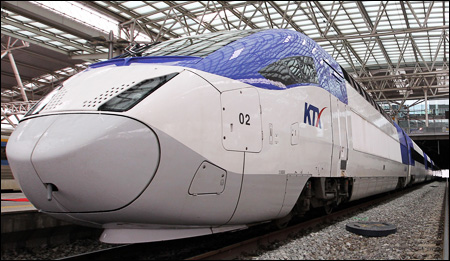
the impressive KTX, launched on April 1 2004 with speed of 186 mph (later increased to 190 mph)
KTX 1 launched April 1 2002 with top working speed of 300 kph (186 mph)
(This was later increased to 305 kph (190 mph))
KTX 2 (Sancheon) introduced March 2 2010 with top working speed of 350 kph (217 mph) It is named ‘Sancheon’ after the Cherry Salmon
KTX 3 with a top working speed now likely to be 370 kph (230 mph) is due to appear in 2015
HEMU 400X will take speeds to 400 kph (249 mph). Line test begin in 2012. This is the second of 2 experimental trains the other being the HSR-350x

Cherry Salmon
If I hadn’t been so tired after almost 32 hours of traveling, I’d have taken some photos. I am totally in love with the Korean KTX train service and traveling first class is well worth the extra money. Though the British 125, high-speed train towing 7-8 carriages at a maximum speed of 125 mile per hour, has been the backbone of British intercity travel for thirty years, it is far from the golden standard of travel even if you sit in first class. And it might not be upgraded within the next 10 years! The KTX service is certainly a limited service, operating to only a few destinations but despite being less than 10 years old, services are being extended and new engines and rolling stock introduced. Towing 18 carriages, at a top speed of just over 200 mph, the compartments are fairly quiet and you might be fooled into thinking the train isn’t traveling so fast. However, having kept an eye on the carriage plasma screens, where the speed is constantly visible, we traveled at about 290 kph for most of the journey (that’s c. 180 mph). The KTX, modeled on the French TGV system, is a technological masterpiece but it isn’t just technology and speed that make a service ‘gold standard.’
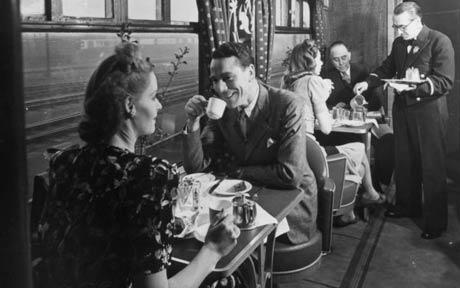
British first-class train travel when it was more than just ‘oik’ free
When trains stop at stations prior to departing for another destination, a small army of cleaners purge the train and ‘spruce it up.’ In the UK, a class divided society, first-class bestows kudos and is a great way to feel superior over fellow travelers by reminding them you have more money. Apart from the absence of ‘oiks,’ there is very little else to attract potential customers and first class on British trains can hardly be compared to business-class on airlines. KTX first-class however, is quite different and very comparable to airline business class standards. A carpet with at least a little pile cushions your feet and it’s clean, a fact you can tell because the light fawn colour highlights any dirt – which there isn’t. I don’t remember if British Rail has carpets on the first-class floor but if they do, they are certainly not a light colour but most definitely dark blue or brown or some other dirt-masking colour. The seats are broad and spacious and their backs can be adjusted with an electrically assisted motor, to provide ultimate comfort. A small buffet car provides refreshments and is the headquarters for the refreshment trolleys that service both first and second class. There are male and female toilets, baby changing and feeding stations, small recesses to power mobile devices and wi-fi internet access and sockets for powering computers are provide throughout the train. In all carriages plasma screens provide a range of information and are coordinated with the journey’s progress so that as a program ends the approaching station is announced and often there may then follow some useful information on that town or city. On first class, snacks such as peanuts or biscuits and bottled water are complimentary provisions.
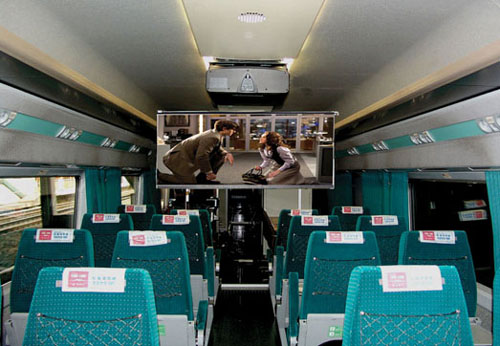
The KTX cinema carriage
Staff are highly visible on trains and their bearing and dress is impeccable and perhaps it is this more than anything else that puts the KTX service on a par with the business class of an airline. In addition, if you’re making a longer journey, the train’s cinema carriage provides a unique experience. The next wave of KTX rolling stock will have first class seats that can swivel 360 degrees and though I’m not sure how it will materialise, but several reports claim the new rolling stock will have basic cooking resources for passengers. I can’t imagine this meaning trains will have gas ranges and barbecue facilities so imagine it might mean publicly available microwaves.
THE KTX EXPRESS 2 (SANCHEON) WITH A SPEED OF 330KPH (205 MPH)
THE KTX IN SEOUL STATION
Meanwhile, back in ‘Broken Britain,’ from early 2011, London-Scotland routes will be terminating the refreshment trolley to second class carriages while first class provisions will be upgraded with passengers being served, at their seats, as many sandwiches and drinks as they can consume before reaching their destination. Management seem to think this will attract more customers but with British rail prices one of the most expensive in Europe, you have to be a retard to spend the equivalent of between the price of a two course all for the sake of some complimentary sandwiches. British rail sandwiches were never very palatable even when you paid inflated prices for them. I am reminded of the doomed Titanic and the manning of lifeboats in order of class.
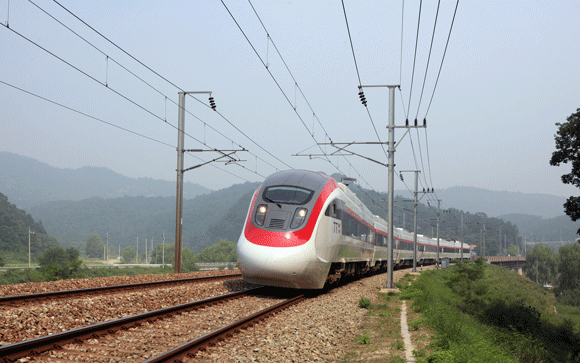
This model, currently being developed, is able to tilt
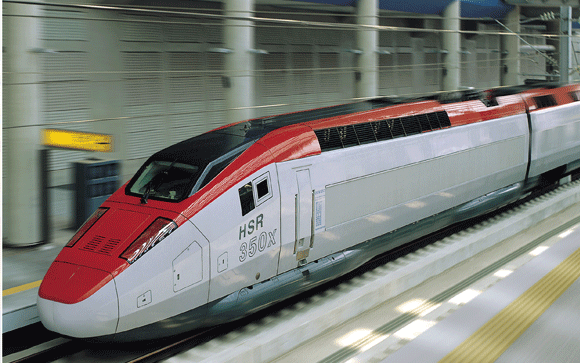
The experimental HSR 350X which reaches speeds of 350 kph (217 mph)
I am very tempted to make a first-class journey on one of East Coast’s trains simply to see how many sandwiches I could gorge myself on before the train reaches the first stop, where I would alight.
At this point I did a little research. A ticket from London King’s Cross, to Nottingham, on an East Coast train, which can be used at anytime of day making it comparable to the KTX ticket, on which there are no time restrictions, costs £64 second-class and £90 first class. That’s a difference of £26. At 2 hours 11 minutes, the traveling time is about 20 minutes longer than Seoul to Daegu. If I travel 2nd class the difference will easily buy a two course meal in a decent restaurant or, short of £9, book a room in Nottingham’s Days Hotel. If I go first-class I am sure I could eat at least ten sandwiches and a couple of cups of tea and with a sandwich or two in my pocket, I could certainly eat my way into a substantial part of the profit the company would otherwise take.
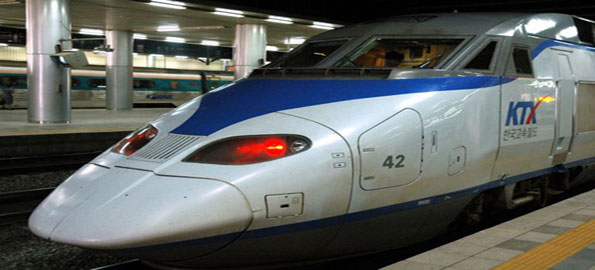
the sleek shark-like design was apparently deliberate

The blue shark. An urban myth, perhaps?
Out of interest, Seoul to Daegu cost approx £38 (first class) with the distance being 322 kilometers. King’s Cross to Nottingham is 174 kilometers. Based on departure and arrival times, I calculated the KTX travels at approx 175 kph or 108 mph while the Nottingham destined train, an intercity train, travels at 108 kph or 49 mph. Using my rather basic skills of arithmetic, this means the KTX costs 19 pence per mile (12 pence per kilometer) while the East Coast company train costs 83 pence per mile (51 pence per kilometer). Travel on a comparative service in terms of ticket usage and train service means the UK service is 4.37 times more expensive and yet 2.2o times slower than a journey on KTX. The London to Aberdeen journey is a long haul of 8 hours thirty minutes which means a second class passenger is going to be very thirsty and hungry at the end of their journey. However, simply pay the extra £50 and all the sandwiches and tea you want will be waiting for you.
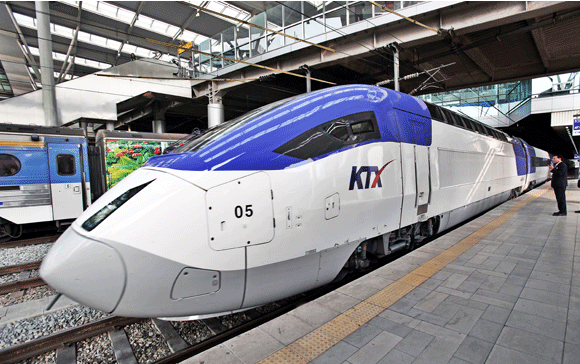
The KTX Sancheon began service on March 2 2010 and reaches 230 kph (205 mph) KTX 3, with a speed of 250 kph (217 mph) will be introduced in 2015
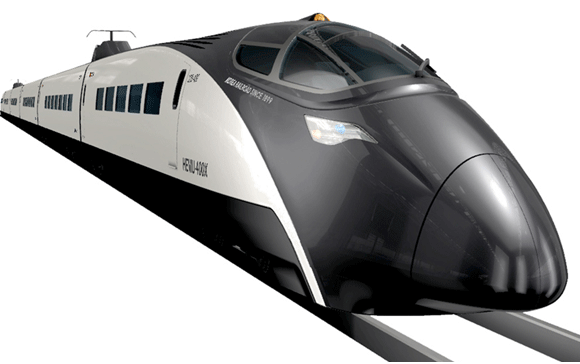
The shape of things to come. The next generation capable of speeds in excess of 400 kph (248 mph) are already being planned
Related Articles
(Several years ago Korail reduced the numbers of staff on the KTX and dismissed a large number of attendants. Many took the matter to court and even went on hunger strike. Link to Korea Times article.)
- Britain was built on its railways. Now we can’t even run them | Andrew Martin (guardian.co.uk)
- Sir Nicholas not Simply a First Class Twit (Guardian UK)
- Food trolleys to be scrapped on services (pressandjournal.co.uk)
- Koreabrand. Interesting info on KTX developments.

© 林東哲 2011 Creative Commons Licence.
Bathhouse 'Zen' (Part 2)
I’m working through some ideas here and not only have another part to follow this post, but will make amendments here. If you want to add your views, more educated and sociological ones welcomed, please do so however, I won’t bother publishing the usual offensive crap that this kind of post sometimes generates. (Hence the pumpkin logo) Part one can be accessed here: Bathhouse Zen (Part 1)

Once you have recognised your own cultural inhibitions and prejudices that prevent you entering bathhouse complexes or get in the way of your fully enjoying the experience, it is time to look at how bathhouse culture can be seen in a broader context.
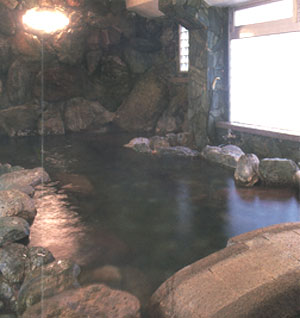
a cave pool
The bathhouse is an environment where social rank and hierarchy either cease operating or do so at a minimal level. In an environment divested of the clothes which we use to mask and manipulate our personalities, communication is both more direct and honest. Mutual nudity brings participants into a closer relationship where friendships and ties are strengthened. The Korean phenomena of ‘testicle friends’ (불알 친구) or ‘penis friends’ (고추 친구) clearly demonstrate that a relationship enters a deeper level through familiarity with the naked body. This is further consolidated through ‘skinship’ ‘rituals’ such as scrubbing each others backs or bodies. Skinship is an important bonding process in all human interaction though it needn’t be restricted exclusively to mother-child or sexual relationships. In the Korean context ‘skinship’ has an important function in wide range of platonic relationships and even serve to form a bridge between relationships that are normally unequal. Unlike western culture, in which physical contact might be substantially altered in a naked or semi-naked state, in the bathhouse ‘skinship’ practices do not alter.
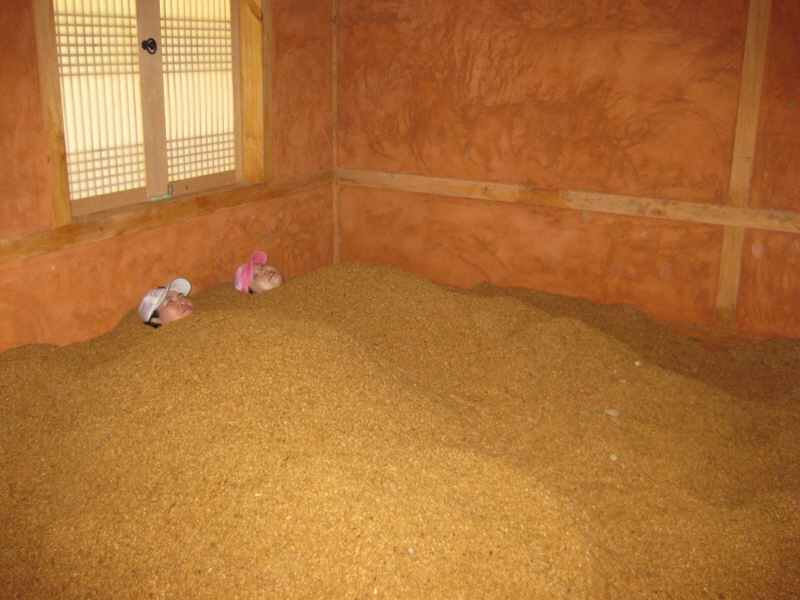
a cypress chipping bath
Additionally, bathhouse nudity also rekindles our relationship to nature and it is not unusual to see individuals sat in pools or quiet corners meditating or simply contemplating. Most bathhouses reinforce the connection with nature and rock, wood, salt, soil, sea water, wood chippings, charcoal, bamboo, herbs, jade etc, are all common features incorporated into bathhouse design. The artificial worlds we inhabit in our regular lives, often fast paced and technologically dependent, all evaporate in the presence of a bathhouse’s watery symphony of splashing, pulsing, lapping, dripping and hissings. Water as water, ice, spray or steam, incorporated with suitable lighting and other elements rich in association with nature combine to create and ambience that can lure us into psychological states conducive to meditation or reflection. A state of nudity fully exposes the body to various transitions in temperature, textures, aroma and humidity.
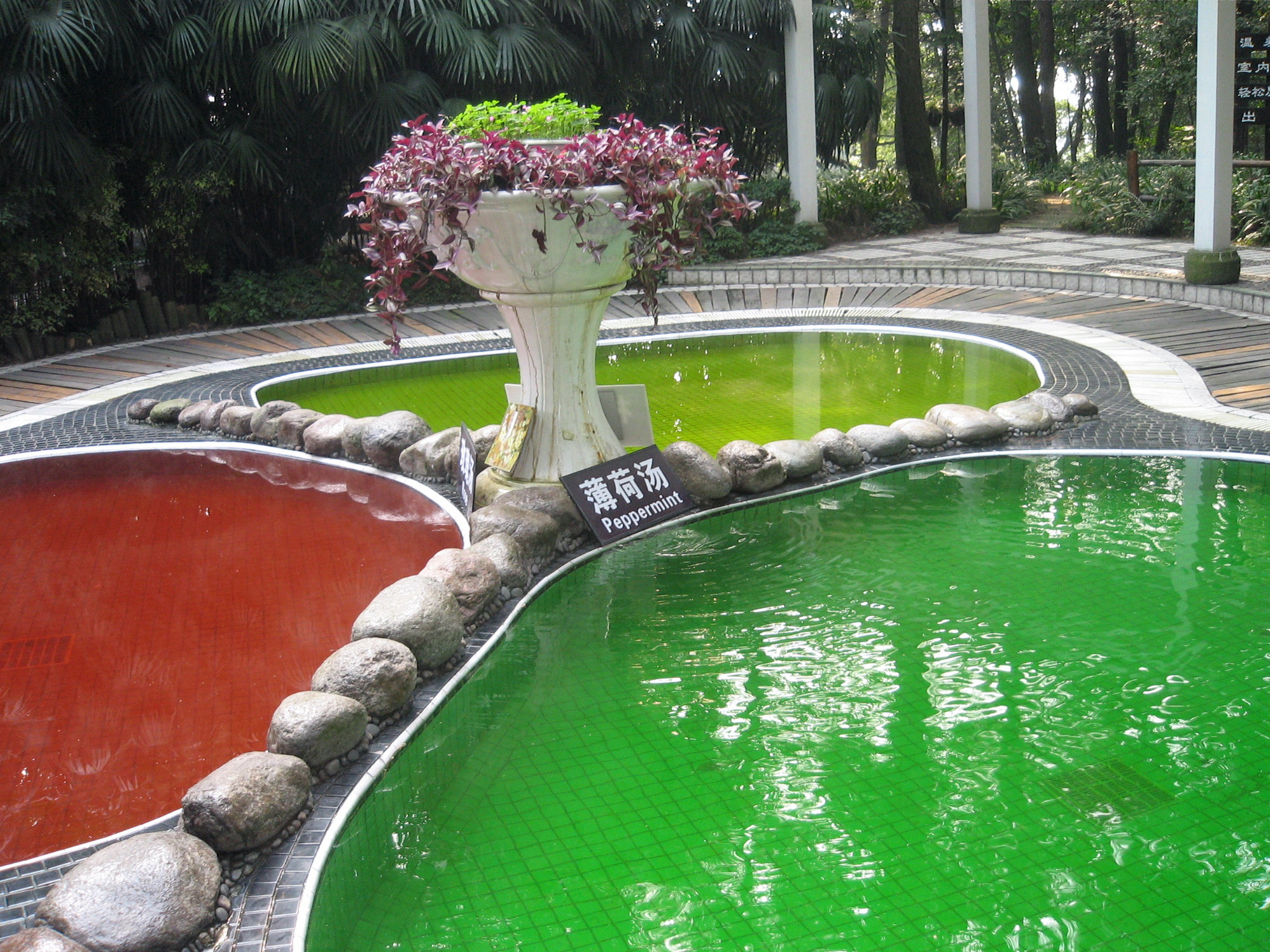
various aromatic baths
Most bathhouses have something unique to offer and an awareness of the ambience of bathhouses at differing times of the day or week mean that it is possible to bathe in a manner that suits not just differing emotions but physical states. Some establishments are better suited for taking a sleep, others for relaxing in various types of pool or experiencing various types of hydro-therapy and some more suited for those times of year when the weather is hot, humid or cold. And if one finishes a session properly they should leave the bathhouse feeling both mentally and physically revitalised.
© 林東哲 2010 Creative Commons Licence
Korea 'Made Simple'
(This post refers to Chris Backe’s blog and uses the term ”made simple’ which bears a similarity to the title of Chris’ recent book on learning Korean, Korean Made Easy). My references to ‘Korea made simple’ have nothing to do with his excellent book )

waygookin - foreigner
I had a drink this weekend in a bar around the corner from where I live. Everything was going well until the place was invaded by fifteen foreigners who were all drunk and noisy. As they entered, only one acknowledged the presence of either myself, or the two westerners I was with. When we decided to leave, just a few minutes later, the same woman that had said hello, apologised for not having been friendlier, meanwhile, the rest of the crowd she was with, continued to blank us.

Scene from a Typicaly British high street
It seems that expat-sub-culture slang, recently highlighted by Chris Backe (Chris in Korea), describes our experience as that of, ‘being waygooked.’ Chris lists a number Korean words adopted by westerners to use as slang and all comprise the first and only words many westerners learn during their short stay in Korea. I am pleased to report I wasn’t aware of any other meanings than those of the original Korean.
A sub-culture lingo lurks in any foreign place with a substantial numbers of foreigners but without doubt, the increased numbers of foreigners now living in Korea, coupled with the internet and the high number of ESL teachers help to consolidate and disseminate its lexicon. Whilst some of the examples Chris cites are harmless and amusing, a ‘chunner’ for a thousand Won, ‘manner’ for 10.000 Won, for example, others are not just unpleasant, but suggest many come to Korea with cultural attitudes cast in stone and from which they judge everything Korean – generally in a negative light.
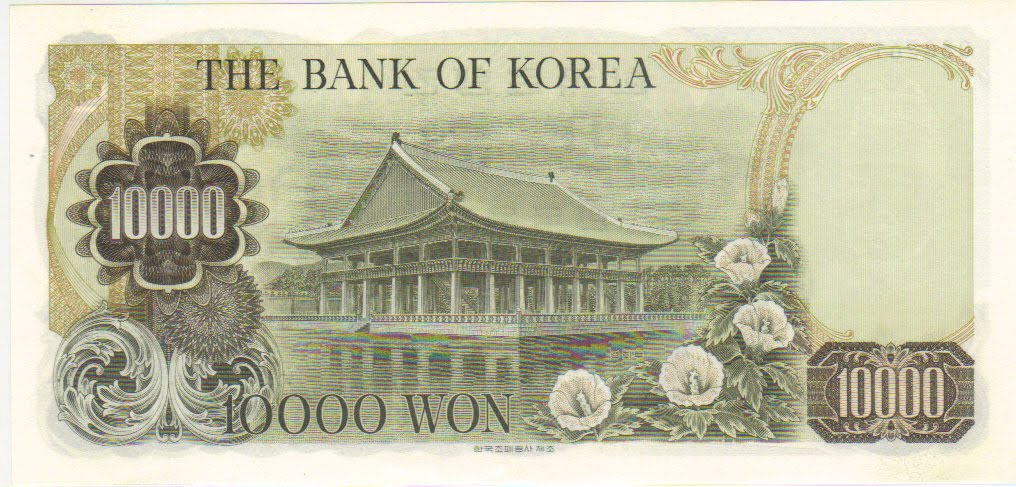
a 'manner' - 10000 Won
To use expat, sub-culture slang self reflectively, Korea has been well and truly ‘waygooked’ though it might be more appropriate to stick to English and simply use the word ‘invaded!’ As each one of us arrives on the peninsula the reception for subsequent ‘visitors’ is made less unique and more mundane. Anyone who was here just ten years ago, will testify how much Korea has changed. To allow westerners to interface with Korean culture, and in order to look progressive, Korea has been ‘made simple.’ Gone are the days when you were compelled to either try to learn Korean or enjoy taking a gamble as everything from menus to bus arrival and departure boards, are now bilingual. About the only item still to be ‘made simple’ is the train ticket. Western food is now available everywhere and it is now possible to eat in different restaurants everyday without being required to sit on the floor or use chopsticks. And a wealth of information relative to Korea grows at a rapid rate. Language packages, blogs, cultural information, official websites, cooking websites, all proliferate. The Daegu, Kyobo book store’s section on the Korea Language for foreigners now occupies ten times the space it did ten years ago and one of the most elusive aspects of Korean culture, notably hanja, now has a number of books designed specifically for English speakers. Learning about Korea has never been easier but in the process, acquiring that information has never been more boring and unchallenging. The diary I kept on a daily basis during my first visit to Korea, before the days of blogging, vlogging and podcasts was was written with a view to publication back in the UK and the audience were clearly western. Today, a high percentage of the audience who access this blog live on the peninsula and are themselves bloggers.
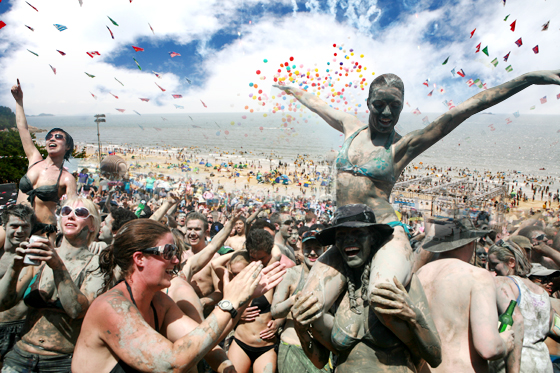
Boryeong, thogoughly 'waygooked'
Not too long ago, Korea needed to be discovered, it was elusive and mysterious and attracted a kind of foreigner with some spirit of adventure. I’m not saying that such individuals no longer come here, they do, but if you’re looking to ‘discover’ and ‘uncover’ things unique, as well as discover something about your own character, Korea is rapidly becoming a very safe option and ‘waygookinized’ almost, but not quite, to the same extent Thailand was ‘DeCaprionized.’ Soon the entire peninsula will posses as much potential to offer a unique experience as the Boring Boryeong Mud Festival. Not only can you research a wealth of information before you even buy passage, but you can communicate in various formats with those already here and discover just how safe it all is. And when you arrive you can pal-up, online and in reality, with a community predominantly doing the same thing you are – probably teaching. If I was setting out to Korea anew, it would be to somewhere like backwater Kangwondo or Ulundo and certainly not to any of the major cities which have now been saturated.
Yes, I am making a mountain out of a mole hill! I shouldn’t take it too seriously! But if anything is likely to make me leave Korea it is when it reaches a point where the experience of being here is not that different to being back-home. I came to Korea to experience its uniqueness and the more waygookins that come here, and I too am part of the problem, the more we connect and form a sub-culture, the more we adapt Korean to express our own predjudices (especially when so few of us can actually speak Korean), and assert a cultural superiority, the more unease I feel.
‘Ganging up’ with other foreigners to invade places, to ‘waygook’ them, is last thing I want to participant in and I certainly don’t want to be its victim. Many foreigners share such feelings and come to Korea to escape aspects of their own culture and to immerse themselves in a new one; ‘waygooking’ an environment is counterproductive to such objectives. And while I can chuckle at terms such as ‘chunner’ and ‘manner,’ and may well use them, other terms verge on either the culturally elite, or are racist. Korean ‘ajjumas’ can dress ‘loudly’ and those dollies that participate in high energy aerobic classes, decked out in glitzy leggings and multi-coloured, sequined apparel, are a constant source of interest rather than mockery. Back in the UK the dress code for a great number of younger women can be summarized as ‘vulgar and skimpy.’ For many Brits, fashion, which of course we think the ultimate, is on much the same level as that of some former soviet bloc nations. And yes, ‘ajjumas’ push and shove but this is a cultural difference and the way to diffuse your annoyance is to embrace it and simply shove back.
Yes, ajjumas can be somewhat exotic in the mish-mash of colours, but how much nicer and civilised that of a man-like female, covered in tattoos and with a mouth like a sewer. Where I live in the UK some of the females are very unpleasant. And Koreans can push and shove but I’ve never had one treat me with the anything like the level of aggression I would face on many a street in the UK. Meanwhile, here are some Korean words which can be adapted to describe some foreigners or indeed broader idiosyncrasies of western, or more specifically, British culture.
Sir-e-ki sa-ram – ‘dirty people’ who don’t wash properly especially as a report last year highlighted how as many as 40% of Brits don’t wash their hands after having a shit. ‘That businessman looks like a sir-e-ki saram‘ (he looks dirty or unclean).
Tre-shi ot – ‘trash clothes’ / ‘trash bag’ – the term used to describe the clothes worn by British people. ”The whole family wear tre-shi ot’ (the whole family dress like shit). This could aptly describe those teachers in Korea who go to work in cargo shorts and flip-flops.
Ch’ang n’yeo hak – ‘Prostitute girls’ – to describe the promiscuous manner in which many teenagers dress. (That crotchless thong makes your nine year old daughter look like a ch’ang n’yeo hak. (Basically, you little kid looks like a slapper!)

ch'ang n'yeo hak (prostitute student)
Bok pal-ip – ‘mouth explosion’ – to describe notoriously bad British teeth. ‘Look at the bok pal ip on him. (Look at his shit teeth)
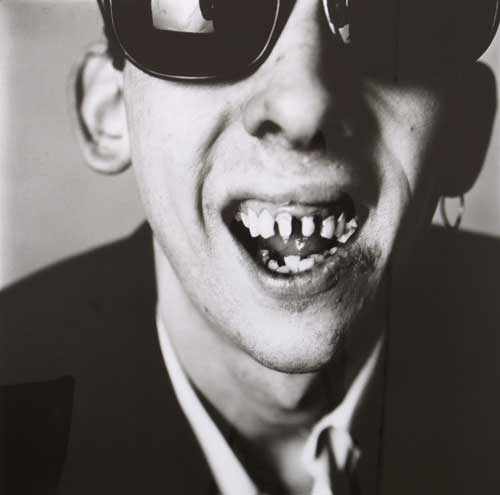
too gross to enlarge
Ddong mul pa-i-peu – ‘sewer pipe’ – a term used to describe both the physical and mental degeneracy of many British people – basically clean on the outside and filthy within. ‘Their kids are as wholesome as a ddong mul pa-i-peu.’ (The underwear might be clean but their contents house numerous infectious diseases).
ch’a-pi – chav – ‘most of the nation are ch’a-pi’ (most of the nation are chav).
di-pi-di – ‘dirty, violent , depressing” – DVD.
But I don’t mean to be offensive…
© 林東哲 2010 Creative Commons Licence.
Bathhouse ‘Zen’ (Part 1)
I’m working through some ideas here and not only have another three parts to follow this post, but will make amendments here. If you want to add your views, more educated and sociological ones welcomed, please do so however, I won’t bother publishing the usual offensive crap that this kind of post sometimes generates. (Hence the pumpkin logo)
Not suitable for pumpkin people
Not too long ago, I joined the social networking site, Skinbook, a site for nudists. I had never considered myself a nudist and of course, in Korea I’m not. But once you head back home on a vacation you realise that bathing, even in a same-sex environment, is a form of nudism. So,while in Korea I regard myself completely normal and healthy but once I step off the plane in the UK , or even talk to some westerners here in Korea, I have to re-configure one of my pleasures and label it ‘partial nudism’ and of course, this then includes the slurs and innuendos associated with any form of nudity. What is a completely normal pursuit in one country is almost perversified in another. It is ironic that my home country, like the USA, has not just one of the highest rates of teen pregnancy in the world, but one of the highest rates of sexually transmitted diseases. In addition, children as young as 12 and 13 engage in sex and if they go to the doctor are granted anonymity and, child abuse in one form or another, is clearly a national pastime. Being judged by my own culture, and those who bring its attitudes to Korea is rather like being judged by the town’s most prolific pox spreading, pimp.

the hanja character for ‘nothing,’ ‘not having,’ (없을-무)
For a waygukin to really enjoy Korean bathhouses one has to divest themselves of the cultural baggage that prohibits or hinders one from fully capitalizing on what the experience has to offer. Though our cultural baggage may be similar, as between that of a Canadian and Scotsman, there are naturally differences that shape and inform the reception we have to going-naked in a same-sex, public environment. Some cultures are more relaxed than others and within and across cultures there are differing attitudes towards nudity and proxemics; some may be constrained by religious views, some may have very strong associations between nudity and sex, some may be more liberated due to upbringing. So, the point at which we each stand in relation to nudity and the various forms it appears in, differ. Despite the reference to ‘zen,’ (선), there is nothing deep or mystical in the Korean practice of public bathing any more than there is swimming in a public bathhouse in the UK and my use of the term is based on the loosest meaning and simply suggests the ability to enjoy the experience without being hindered by cultural baggage.
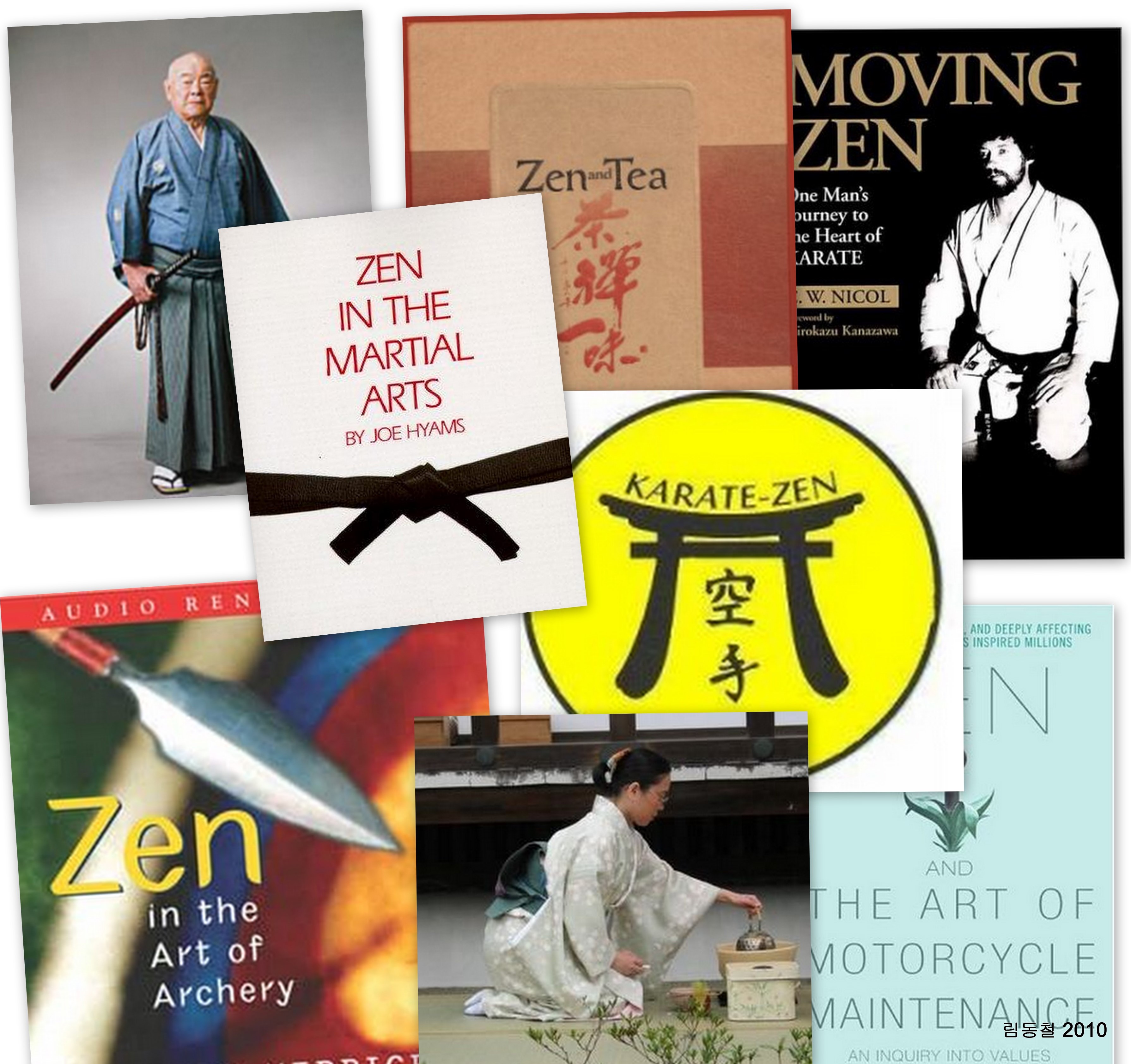
spheres of zen
For many, myself included, taking the first step into a bathhouse was a traumatic experience and certainly one I’ll never forget it! For others, nudity in the company of others is no different to being nude in isolation; many people are quite used to showering in a same-sex environment and if you play rugby in the UK, bathing in a large bathtub with your team, all naked, is a long-standing ritual. However, showering or bathing naked is quite different from other experiences a bathhouse will eventually confront you with, experiences which will test your levels of comfort and possibly expose the cultural baggage you still carry, but which you thought you’d ditched.
Let me give you a very recent example; I use bathhouses on a regular basis and my first introduction to them was almost ten years ago. However, while bathing less than three hours ago, I had two interesting reflections. I still do not feel comfortable with a close friend scrubbing my back and after a little analysis decided it was because in my culture such intimacy is more likely to occur as a prelude to sex and also because I am over weight and self-conscious. The second one occurred while we were in a sauna. The room is fairly large and is occupied by only my friend and I, yet when two new men enter the room, independent of each other, they sit on seats on either side of me. Meanwhile, my friend is laying on the floor, taking a nap. I am sat facing the television but they sit each looking directly at one side of my face, and to compound matters, their heads are less than three feet from mine and they sit with knees wide apart in a position that in western body language can convey a sexual meaning. Within the parameters of my culture, no only do their body positions establish a hostile or sexual tension between us, but a corresponding tension between themselves, as they are sat facing each other. And remember, they could have sat in any of three corners but instead chose to sit directly next to me. Even after years of bathing, little alarm bells jangled! Of course, neither are making aggressive or sexual suggestions and probably sat down without any conscious deliberation at all.
sk
While you might feel very ‘at-home’ naked in the bathhouse shower, or sat on your own in a corner of a pool, if you frequent bathhouses on a regular basis, the day will eventually arrive when:
♦You’re just steeping into a pool when you notice the person at the far end is a co-worker.
♦You drop the soap and need to bed over
♦You’re sitting on a bucket seat when a Korean friend begins a conversation, their dick dangling in your face
♦You end up talking to a friend who is sat on a bucket seat, while you are standing, your dick in their face
♦You’re asked to either scrub someone’s back or they offer to scrub yours
♦You enter a pool only to discover a couple of your students are staring at you
♦Your school or work decide to organise a trip to the bathhouse
♦You somehow end up having a full body scrub-down
If any of these scenarios are liable to make you feel uncomfortable, then you have not yet reached the state of ‘zen’ required to ensure your enjoyment is the ultimate possible and in which your reception of the experience is similar to that of a Korean. The cited examples, and there are others, highlight the point at which east and west differ and yet it is for this reason many people decide to live in Korea. (Surely it wasn’t just for the money!) The manner in which we approach this point of separation, or stay cocooned in our safety zone, is dependent the ability to suspend our own cultural mores and subsequently embrace those of Korean society. The fewer of these scenarios which trouble you, the closer you are in approximation to the manner in which a Korean perceives a bathhouse experience. If you can bend over in full view of bathers, poke your backside clean with soaped fingers, use the hair dryer on your pubic hair or do a series of exercises, naked and in front of an audience, you can award yourself a red-belt (the rank prior to a taekwon-do black belt) in bathhouse familiarity. And not only will you be better able to understand the Korean psyche, but you may also have a deeper understanding of the nature of your own society. Personally, I still have a long way to go but I’m getting there!
A Korean’s behaviour in a bathhouse has nothing to do with zen and with no barriers to overcome such a ‘state’ isn’t necessary. They simply behave in a manner which conforms to their social mores. Being outside this point of references, ‘zen’ is the mental ‘state’, or ‘attitude ‘we have to aspire to if we want to truly enjoy the experience and step closer to understanding the Korean psyche. In a ‘state ‘of ‘zen,’ a state of statelessness, you will have abandoned all cultural shackles and have no problem with your bum hole pontificating the heavens should you drop the soap. And when you can rationalize bathhouse culture without suggesting it is perverse, homo-erotic or ‘gay,’ as many westerners do, you will truly be in a state of enlightenment.
There are two parts involved in learning to enjoy the Korean bathhouse experience. The first involves ditching or suspending your own cultural baggage and all the assumptions it makes and judgments it levies. The second lies in embracing Korean attitudes towards same-sex nudity and bathing. Suspending the outrage of your own values is not always easy considering the British, for example, have a very long history of demonizing anything sexual. We have been imbued to perceive genitals as solely sexual and invested with the powers to pervert those who gaze upon them or even talk about them. Even the genitals of a baby are now perceived as sexual and that you cannot photograph or draw a naked baby, even your own, without the overwhelming realization that you are doing something terribly wrong, is alarming. And because nudity exposes what is deemed sexual, it has the potential to pervert and hence needs close control. As for ‘skinship,‘ a problematic enough concept for many westerners when clothed, when nude, it can only be rationalised as sexually motivated. Many young and liberal westerners like to think they are ‘progressive’ in their attitudes to sex and the body, but many, the moment confronted with the opportunity to be naked, it is revealed that they are not only terrified by it, but conflate it with sex. For many men, the idea of being naked with other men is repugnant. Ditching such silly attitudes, even if temporarily, is wonderfully liberating and frees you from centuries of oppression.
Disengaging your cultural shackles:
Over-coming the fear of your own body – in modern capitalism the body is a battle ground used to manipulate our dreams, aspirations, inadequacies and fears in the attempt, planned and unplanned, to spur us onto the treadmill that sees us seeking remedy in an array of consumer products. Products articulated around diet and exercise are lucrative and a nation riddled with guilt at being overweight or unhealthy, even if you’re not, is a nation ready to chuck money away in pursuing the latest fad. It’s a Machiavellian philosophy of ‘give ’em dreams and sell them shit.’ All too often, the first barrier to getting naked in public is the fear of being seen by others, of being exposed and then judged by the criteria of market forces. Obesity and being overweight are obvious but even our attitude to dick size is influenced by market forces; my spam box is constantly bombarded with adverts claiming to enhance the male appendage. When did you ever see an advert offering to reduce penile proportions? Porn actors are often rumoured to have dicks of Herculean proportions and any actor or celebrity who is discovered to have a little wiener, an average wiener, can expect ridicule. Societies have not all valued a big dick and at the height of Classical Athens, being well hung, and worse, well hung and circumcised, was considered very un-sexy. Among the classical statues and red pottery of the period – not a big cock among them unless it’s owned by a grotesque satyr. If you can find a penis poking from the loin of a Praxiteles, it probably fits the modern-day parameters of ‘average’ and this is often a euphemism for ‘small.’
I have frequently heard or read comments by westerner visitors to bathhouses, berating the bodies of everyone who is not minus 20, slim and sexy. Such people are ‘shocked’ or ‘appalled’ by the ugliness of others and see only attractiveness in the same way it is seen by Hollywood. Such attitudes are rooted in the assumption that if nudity is to be tolerated, it should at least be practiced by those who are sexually attractive because, as we all know, sex among fatties and oldies is a turn-off. It there’s one thing you learn in a bathhouse, it’s that we are more alike than unlike, regardless of age, size and condition. Overcoming a fear of exposing our bodies in a public forum is for many people a big step because of our own negative self images induced in us by our own culture. As a result, to overcome the fear is empowering.
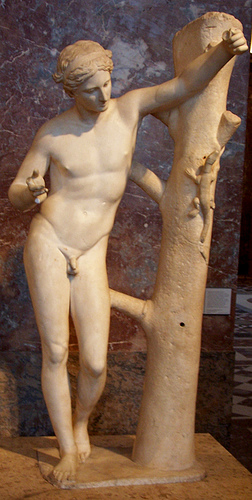
Apollo Saurodithonos (Lizard-killer). Possibly a Praxiteles original
Separating the conflation of sex and nudity – Western social mores conflate sex and nudity and this tradition, one with a long history, is always an obstacle faced by nudists in the west because public sentiment demonize or peversifies nudity on the grounds it is sexual. If you enjoy nudity it implies you do so for sexually motivated reasons and is likely to classify you with terms such as ‘kinky’ or ‘pervert.’ Male same-sex nudity bears the greatest brunt of this conflation especially when it suggests those involved are homosexual. And it is this conflation which informs the opinions of many a westerner opposed or fearful of bathhouse culture. If you start a conversation with many British men about Japanese bathhouses, which often do not segregate the sexes, the tone of the conversation becomes sexually orientated, many western men would love peep through a chink in a wall of a Japanese bathhouse and indeed, you can even download videos of such scenarios. It is therefore predictable that their assumptions about same-sex bathing is going to be articulated around sex and homosexuality. It is the intense conflation of sex and nudity in the western tradition that has given rise to the phenomena of gay bathhouses and in the minds of many people bathhouses are strongly associated with a homosexuality, hedonism and promiscuity. Unfortunately, in the west nudity is often invaded by those assuming it must be sexual and in pursuit of a quick thrill. My local hometown in the UK had to close male only, nude bathing sessions because the tone of the place slipped into seediness.
Overcoming the fear of nude children – On occasion when I have witnessed something interesting in a bathhouse involving non-adults and have dared to write about it, and especially if I have written about it without expressing anything but disgust and loathing, it has provided an opportunity for those with a pumpkin mentality to accuse me of perversion. Many people now recoil in horror at the thought of adults and non-adults sharing the same space especially when semi nudity or nudity is involved. In Britain, public changing rooms, those open planned types where everyone undressed in view of each other, have now disappeared. There are a number of individuals who will fear a bathhouse experience because Korean children use bathhouses and I have met and spoken with individuals who will not go to a bathhouse or jjimjilbang on trips organised by their schools. I once had to console a western teacher who cried uncontrollably because Korean Kindergarten teachers took kids to the toilet alone and without a second person in tow to ‘Big Brother’ the procedure. Once again, we are back to the conflation of sex and nudity and of the western obsession of seeking perversion wherever possible. Shouldn’t we be highly suspicious of societies that are obsessed with categorising non-adult nudity, solely by the label ’sexual’ and which cannot compel us only to do likewise.
I very often talk to Korean friends, male and female about cute kids I’ve seen in the bathhouse. Last week I was amused by a baby boy who could only just walk and who wore a pair of socks to prevent him slipping on the slippy floor. I can share this observation with Koreans without the need to add interjections to the effect I’m no pervert or that I’m not interested in baby boys. But to raise such issue to a western audience, especially as a man, and you invite the most vitriolic reprisals. I’m here reminded of the comments I saw posted on various sites in response to a Korean advert where baby boys appeared scrubbing each other’s backs in a bathhouse. Most did not see it as cute or amusing imagery but as sexual, perverse and exploitative. And neither were any genitals flashed for them to arrive at such twisted conclusions.
Redefining your proximity zone – Britain is often cited as one of the least tactile cultures. In Germany, for example, people shake hands on every meeting and not simply when meeting someone for the first time. The French of course, kiss each other on both cheeks. Many other cultures are much more tolerant in allowing males physical contact without the slur of them being ‘homosexual’ and in such societies body proxemics are much closer than they are in the UK or USA where between close friends, 1.5-4 feet define comfortable parameters. Intimate relationships operate between 0-15 inches. Many Koreans friends are quite comfortable operating at a distance of much closer than 15 inches and indeed of operating within a zone that many British people could only tolerate in a sexual relationship. In addition physical contact, ‘skinship,’ occurs not just more often, but for longer periods of time and much closer to the ‘parts’ we have been taught to avoid. It is not in the least unusual to see Korean friends lay down and put their head in their friends lap and I have even seen this in a bathhouse.
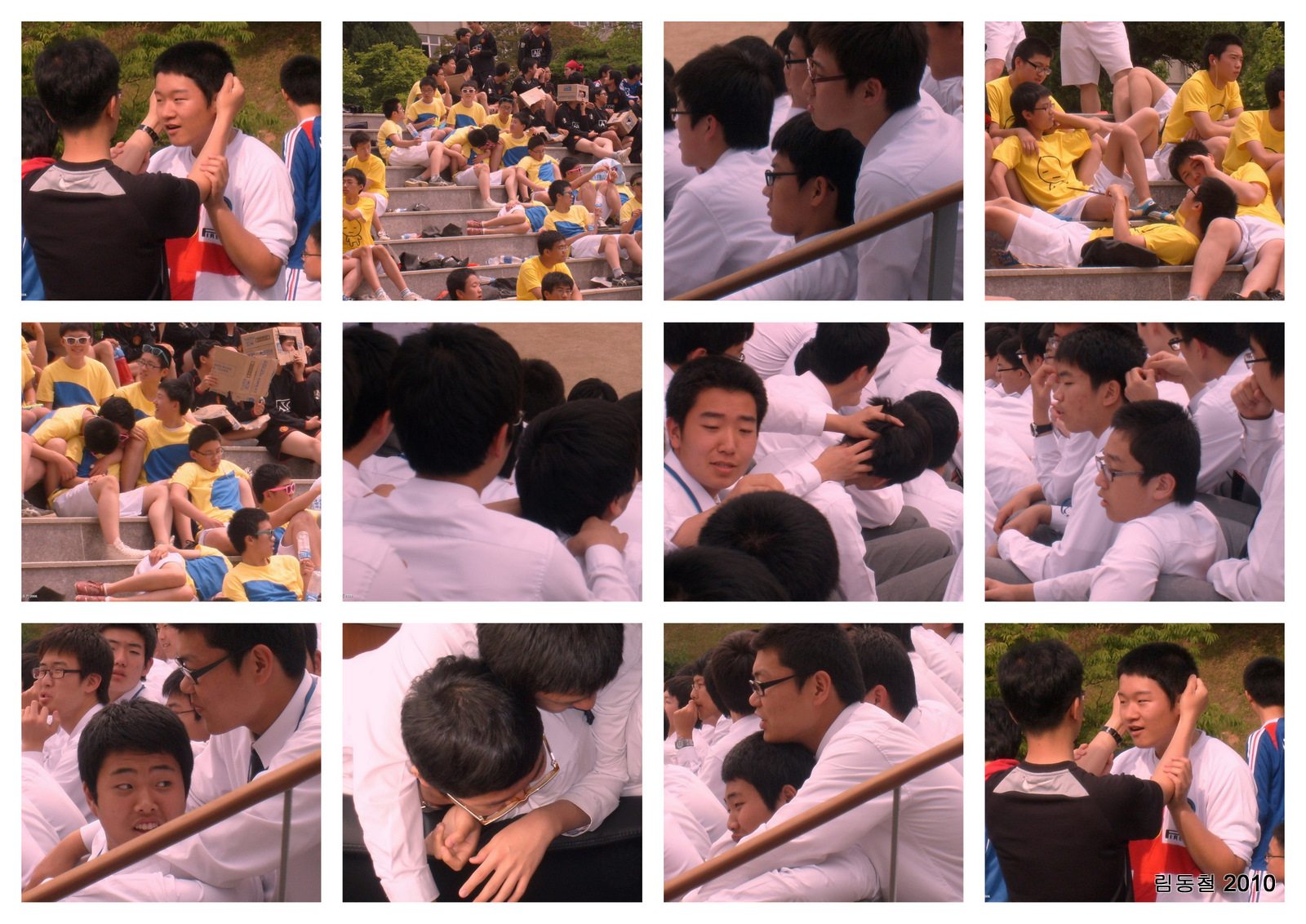
Korean ‘skinship’
Fully acknowledging nudity – many westerners are quite happy nude bathing because they manage to blank out the bits they find difficult to deal with or find offensive or repugnant. As long as it’s not in your face, or better still, as long as it’s in the zone of peripheral vision and can be ignored rather than acknowledged, many people can live with same-sex nudity. If you ask most men about the things they see in a changing room, even in locker room showers, and they will aggressively tell you they don’t look and I believe most of them don’t. And if they do the images are purged from their minds. As I have mentioned before, for a man to see a cock in the UK constitutes such a traumatic experience, unless of course you do happen to be gay, that it can potentially convince a man he is homosexual. It is only when a cock holds the same value as someone’s toes, or their nose, that you are free of this puerile conditioning. Learning to accept what nudism involves, the exposure of those parts you’d rather not acknowledge, is very much about confronting a deep-seated homophobia that assumes the penis is at all times a sexual object, which in western culture usually encompasses any penis whether it be flaccid, erect or even the redundant penis of a baby, and therefore, to consciously acknowledge the penis of another male is to engage in homosexual behaviour. I would further suggest, the fear of acknowledgment is both a means of consolidating a heterosexual identity or facade and avoiding either temptation or the revelation that one’s sexuality may not be what it seems.
When one is able to acknowledge those ‘offensive’ areas dispassionately, in a manner unfettered by emotions and obsessions and which no longer sees them as sexual but as parts with functions such as the nose or ears, and with corresponding qualities and attributes, interesting, quirky, large, etc, one has clearly transcended the myopic conditioning of culture. I would imagine experiencing nude bathing in a non segregated forum, as often practiced in Japan, and to do so with a similar ‘zen’ detachment would be highly enlightening. To achieve this does not mean that no one is appealing or beautiful or sexually attractive, but that this is no longer the primary manner in which you respond to the naked body. Learning to see nudity with ‘zen’ detachment, where the conflation between sex and nudity is separated, and the classification of others in terms of their sexual appeal, minimised, allows you not just to appreciate more fully other human beings, but to feel more human in the process.
© 林東哲 2010 Creative Commons Licence.
Learning to Love the ‘One Room’
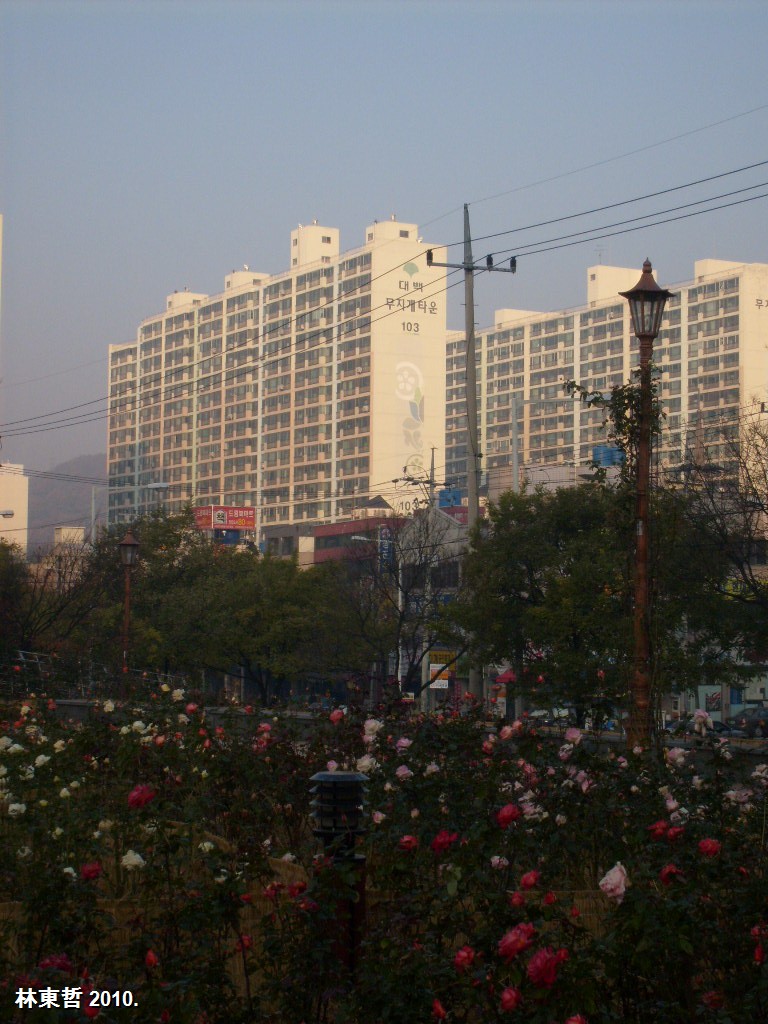
Song-so, Daegu
For a long time, I hated referring to my Korean accommodation as a ‘one-room’ and other terms I used to substitute it were either misunderstood or didn’t seem quite right. Koreans use the word ‘apartment’ in relation to the high-rise accommodation in which most live and it is rare to hear the word ‘house’ as so few of them exist. The houses you do find, often in the country or sandwiched between taller, city buildings are usually traditional or luxury versions. Apartments are associated with high-rises and though they can be pokey and small, especially in parts of Seoul where space is the most expensive, they are often extremely spacious. I clearly do not live in an ‘apartment.’ For awhile I used the term ‘studio-room’ or ‘studio-flat’ and though a few of my English-speaking Korean friends understood this, many others didn’t and personally, it didn’t seem appropriate. I have this notion that studio flats are grand, exclusive and the preferred accommodation of artists and opera singers.
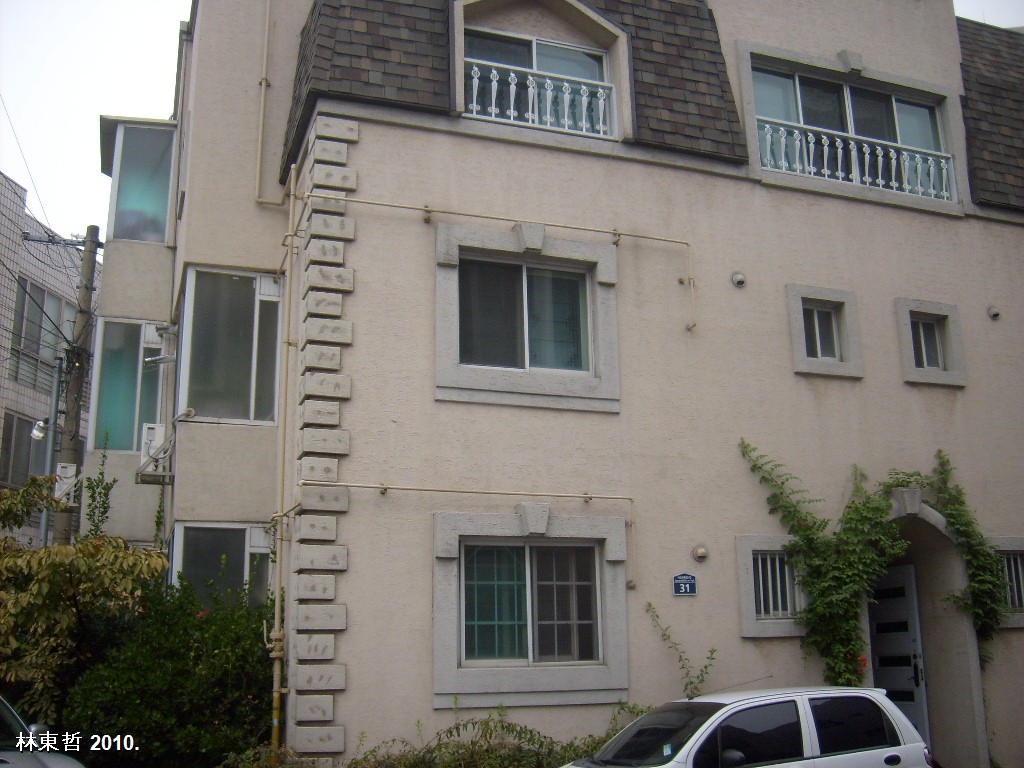
My barred one-room, Daegu 2003
Finding a suitable term to describe my accommodation, without using ‘one-room’, was difficult. ‘One-room’ seems such a pathetic term to use especially when you are anything over forty and invokes the same resonance in Korea as, ‘unmarried,’ ‘living-alone’ or being ‘childless,’ and in the UK, as the word bed sit. What a ghastly word! What shame it invokes! ‘Bedsits’ are the domains of the unemployed, of single people, those on low wages or youngsters just starting out in life. They are always gloomy, lit by yellowey lights and with stairs that creak, and then there’s the gas meter and dingy bedding of blankets, sheets, and quilt because the ‘bedsit’ is a relic term from the days before the popularity of continental quilts (duvets). But the ‘bedsit’ wasn’t just a manky dwelling; to many it represented a lifestyle as epitomised by Soft Cell’s, Bedsitter.
Sunday morning going slow
I’m talking to the radio
Clothes and records on the floor
The memories of the night before
Out in club land having fun
And now I’m hiding from the sun
Waiting for a visitor
Though no-one knows I’m here for sure
Dancing laughing
Drinking loving
And now I’m all alone
In bed sit land
My only home
The solution, is obvious! Don’t call your accommodation a ‘bedsit.’ Just because it’s small doesn’t mean it has to be grotty any more than it implies you have to lead a pointless hedonistic life.
‘One rooms’ come in all shapes and sizes and some are pretty shitty. Usually they are contained in buildings of two, three of four floors. I lived in a one room in Ch’eonan that was truly a one room. The toilet doesn’t seem to count and probably neither the kitchen but this example, clean and not altogether unpleasant, was simply one room. From the edge of my bed I could lean across to the sink and pull out a sliding table and from their I could prepare a meal, stand up and cook it without take more than half a pace, and then sit back down on the edge of my bed and eat it. Washing up simply involved standing up. My Ch’eonan ‘one-room’ was the ideal accommodation for an invalided person and if I so wished I could have pissed in the sink while stood in my bed. Indeed it was so small that if I’d piddled 360 degrees I could have hit ever wall. Prior to Ch’eonan I had a ‘one-room’ in Daegu and once again it was simply one room, bedroom and kitchen combined, with a separate toilet and shower. It lacked air-conditioning, something I now wouldn’t live without and though it wasn’t unpleasant, the fact I cooked a lot of mackerel at the time made it smell.
But there are perhaps worse types of accommodation. If you’re a waygukin a ‘two-room’ is perhaps worse as it involves sharing facilities with a co-worker. I spent a winter with a great chap from Ghana who happened to have the controls for the ondol heating in his room and he liked the temperature set at maximum. I slept on the floor at the time and the effectiveness of ondol heating is non the more obvious than when you can’t escape its intensity. Under a duvet, all heat is trapped and often there are no cool spots, such as you have with western style radiator heating, from which to escape the onslaught. I’d sneak the temperature down when he was out, he’d come home, put on two sets of thermal clothing, rack the temperature back up and climb under his duvet. He’d lived in Korea twelve years and like most Koreans, he hated the cold and anything under 25 degrees was classified an atomic winter.
How you might rate as ‘0.50 room,’ that is a one-room shared by two people, would depend on the extent you feel compensated by the luxury of regular sex and I’ve known couples share the tiniest of one-rooms. I like my space and space means a double bed. A shag is great but I’ve been too long as a sad-singly to want to sleep in the same bed as another human and besides, I snore!
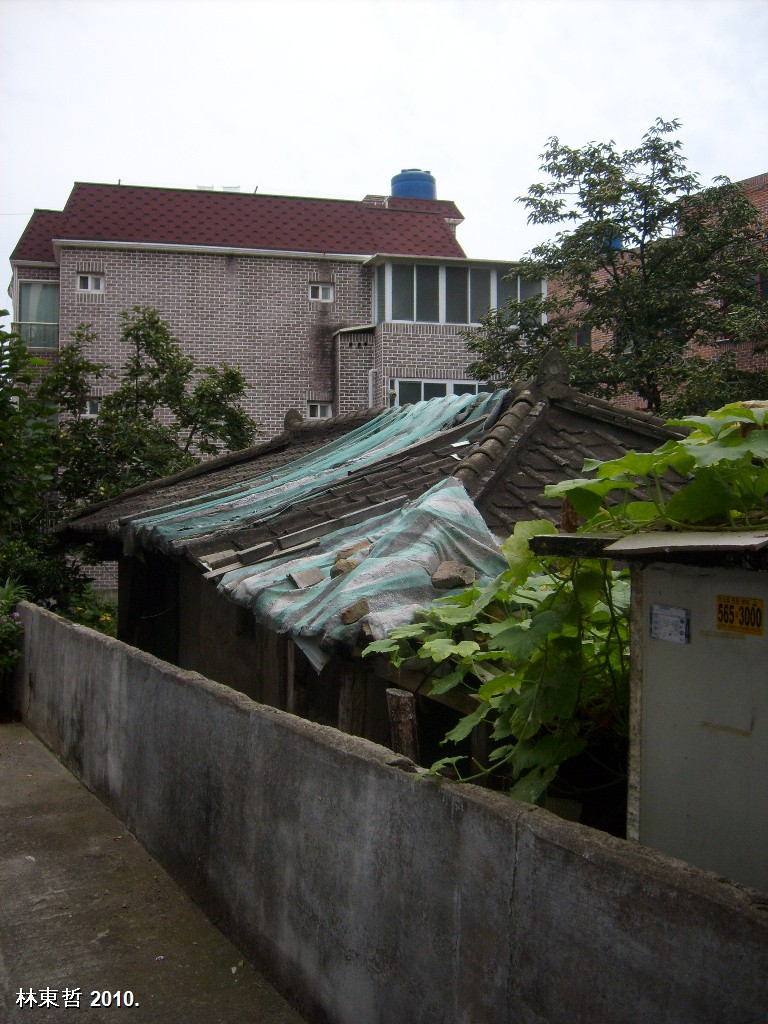
past and present
Eventually, you come to realise that Koreans don’t actually see anything significantly negative in a ‘one-room.’ As far as such rooms go I feel I am probably luckier than most. My present abode accounts for the combined area of 2.5 of my previous one-rooms and my kitchen is separate from my bedroom/study. It has also taught me the benefits of minimalism and heightened my awareness of the way we amass shit you don’t really need and of course, the more space you have the more you feel compelled to fill it. Back in the UK I have a house packed with junk and a substantial set of books shelves which host books and music I have had for years and never accessed. In Korea, a digital orientated life and two terabyte external hard drives have allowed me to acquire and store enough music and literature for the rest of my life and reduced the storage capacity a thousand fold. Yes, the future is getting smaller and upgrading to the latest formats is much more enjoyable especially when it involves denying greedy multi-billionaires even more money.
The worst thing about ‘one-rooms’ is they rarely have any view other than the concrete walls of the next building. If you’re on the ground floor the advantage you might have in being able to see the world beyond is ruined by the bars that turn such rooms into a prison cell. In ‘one-room’ land a computer is a necessity because your monitor can provide an appropriate background scene to offset the lack of any real view but one adapts very quickly and if you can imagine you’re in a spaceship or ship, claustrophobia can be minimized.
Links
Soft Cell: Bedsitter (link to youtube)
© 林東哲 2010 Creative Commons Licence.
Minimal Intervention – Toilet Technology
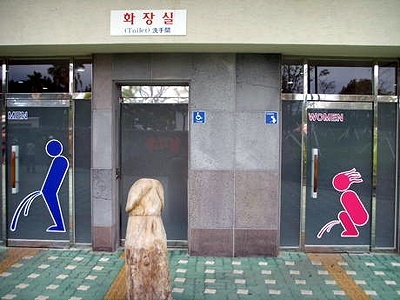
but what;s inside is a gamble
This month the Korean census is being compiled and on Sunday afternoon I was visited by a friendly woman who took my details. Handing me the census form to complete, I sat at my desk by the front-door while she knelt on her knees so her shod feet hung over the small entrance where you leave your shoes. From that position she could just manage to offer me assistance without taking her shoes off and entering my one-room proper. With her at my feet looking up, I felt a little like a Buddha.
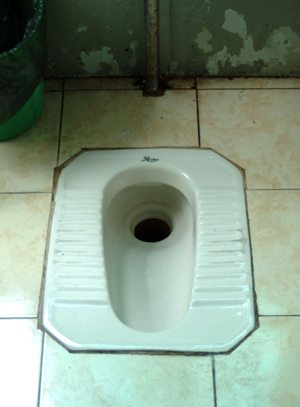
an unpleasant experience and even worse if there's no toilet paper
One of the questions on the census asked if my ‘one-room’ toilet is ‘sit-down’ or ‘squat’ and it would seem that the ‘sit-down’ toilet is more desirable or ‘classy’ than a ‘squat’ job and this might suggest that the proliferation of such toilets is part of the ‘westernization’ of Korea. Not only are Koreans being encouraged to eat western shit in the form of fast-food, but they are being encouraged to expel it whilst seated. I’ve had my fair share of squatting in countries like India and Morocco and having to do so in Korea always reminds me of unpleasant digital incursions necessitated by a lack of toilet paper. Of course, Korea has toilet paper, or at least it’s available but if you’re using a toilet away from home there is a probability that both the toilet you are forced to use and you yourself, are tissue-less and hence a digital dredging will be required. Last time I encountered such a situation I was fortunate that both a hose lay in the cubicle and a handkerchief in my pocket (Emergency Dump)
Personally, the idea of squat toilets are rich in unpleasant associations but they do offer some advantage on the seated toilet bowl. Firstly, they conform to the Korean ideal of ‘well-being’ in that they ideally align the body to provide the greatest expulsion of waste and in the process help reduce or retard the development of hemorrhoids. Secondly, much less ‘skinship’ is required squatting and most notable are the fact you don’t have to sit on what is a public seat and neither do you have to reach for the sheets from a communal toilet roll. Nothing is worse than having to sit on those stainless steel toilets in British public conveniences which look great if regularly cleaned, but when not are tarnished with stains of unspeakable origins.
I notice many K-bloggers don’t like squat toilets but for those who have traveled and have more than one frame of reference, even the worst Korean public toilets aren’t that bad; they actually have partitions and doors, are usually made of porcelain, have running water, and there’s never a sea of shit six feet from your backside. Regardless of where you are in the world, shitting anywhere but in your home is a gamble and the worst you can expect in Korea is a lack of toilet paper, some bad smells and the need to squat. And unlike some of the more ‘developed’ countries in which I’ve traveled, you’re unlikely to encounter anything ‘seedy.’ I once wet for a piss in a toilet in Denver and what I witnessed can be left to the imagination. Yes; Korean public toilets often lack toilet paper and they can be basic and require that you squat but in the scale of things this isn’t that bad. But Korea is full of surprises and it is just possible to discover that the emergency toilet is not only impeccably clean but creatively designed. Last winter, on my way to Seoul, the bus pulled-in at what in the UK would be ‘motorway services.’ The gents toilet was amazing with a large central, glass atrium which filled the toilet with natural light and under which a large garden flourished. There were even a number of showers. Many bloggers seem to think Koreans have a monopoly on dirty toilets and not only could I cite truly unpleasant toilet experiences, but also that you don’t necessarily need to travel beyond Britain or the USA to find them. I’ve taught in British schools where students would piss or shit on the floor because they thought it amusing and I have even seen examples where kids would jam a whole toilet roll in the ‘S’ bend and then cap it with a shit. Every country has unclean toilets and a lack of toilet paper does not make a toilet ‘dirty’ it just means you should have carried tissues with the same zeal in which you carry a bottled water in summer.
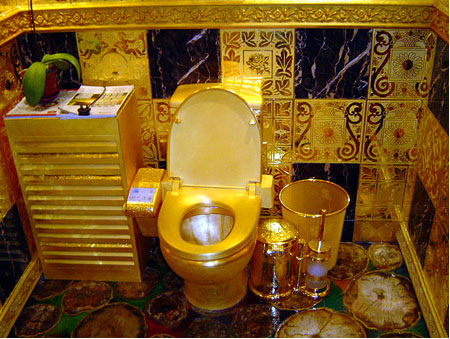
a luxury toilet
I am tempted to refer to the toilet on which you sit as ‘comfortable.’ Of course, this is a culturally orientated value judgment as Koreans do not find squatting, either on a toilet or waiting for a bus, uncomfortable. It isn’t that a Korean wouldn’t want to read a book or newspaper while squatting, but that to do so seated is preferable. The difference is much the same between that of a stool and an armchair; a stool is great for milking a cow or weeding the garden but if you want to watch TV or read a novel, an armchair is much nicer.
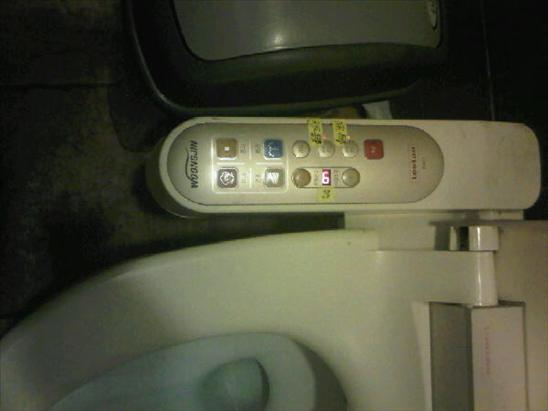
control console
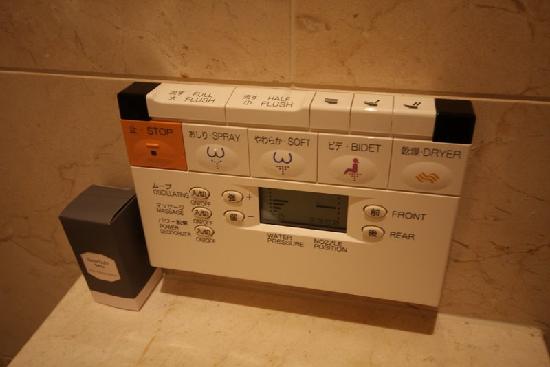
alternative control console
Basically, Korea has four classes of toilet which may be designated squat, seated, luxury-seated and deluxe-seated. The three classes can be further classified by four bands based on cleanliness: very bad, bad, okay, super nice. The UK, on the other hand, only has one class of toilet, ‘seated’ and though UK toilets can be ‘super nice’ in terms of cleanliness, I have yet to witness a ‘luxury’ or ‘deluxe’ toilet though it’s been rumoured for a long time that the Queen has one.
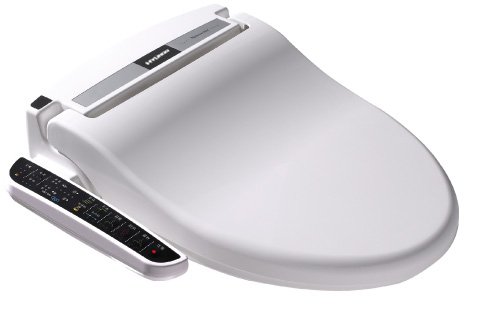
Hyundai's electronic bidet
Both Korea and Japan have taken the western style toilet and transformed it into a luxury item which has invested bathrooms and toilets with the same comfort one would expect in a bedroom or front room. If the ubiquitous British toilet is suitable for reading and relaxation, the Korean luxury toilet provides the comfort in which to enjoy the marathon epics of Tolstoy and Wagner. Many Koreans households now have toilets fitted with an additional tier which is plumbed and wired-in to create a crapper with the same sophistication as the Starship Enterprise. Among the state of the art additions are features such as a toilet lid which raises and closes at the touch of a button or even automatically as you enter or leave the toilet. Koreans love heat under them and so a heated toilet seat is ideal. Cleaning you arse properly never really caught on in the UK and only on the rarest occasions have I ever seen a bidet in a British home. A recent survey revealed 1 in 4 British commuters had fecal matter on their hands (Telegraph. UK) which would suggest either sinks by a toilet are a rarity or us Brits wash our hands in the toilet bowl before flushing it. Meanwhile, over 70% of Japanese households have a bidet and Korea is rapidly catching up.
Korean toilet fixtures provide a high-tech control console from which to activated a bidet and by which the temperature, force, and location of the spray are controlled. Once douched, an anal-dryer kicks-in and blow-dries the entire area. So, far, only one digit has been required to complete a procedure that formally required at the very minimum, an entire hand. Equipped with musical accompaniment, the ability to automatically inject a variety of scents into the air as well as instantly sucking out foul smells from almost the exact point of their origin, deluxe models sanitize the entire process and take poo-ing where no one has gone before.
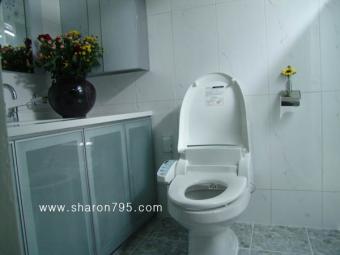
a luxury toilet (link to 'Sharon')
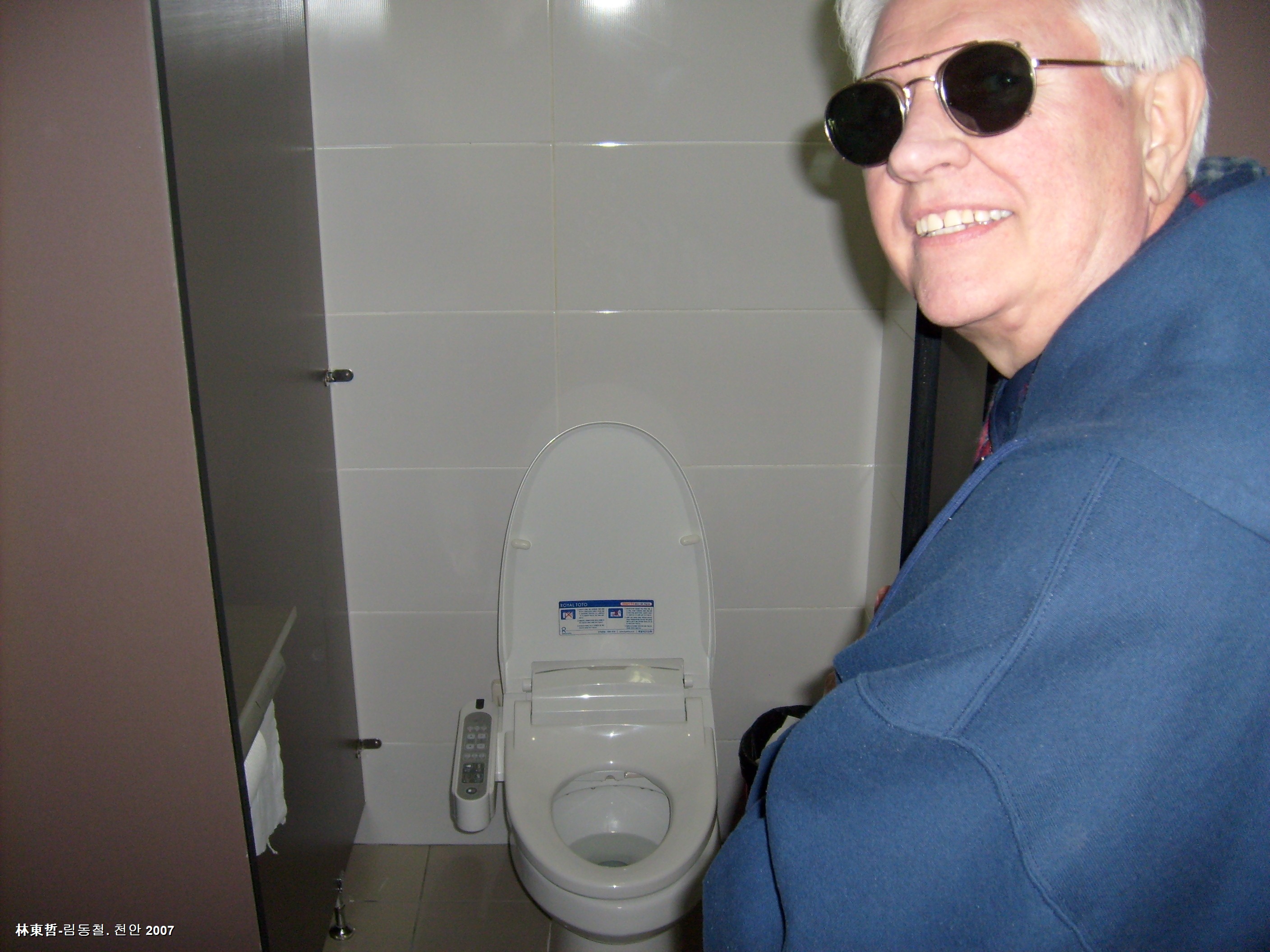
A luxury toilet in my last high school
There seems to be some discrepancy about whether toilet paper should be used before activating the bidet. Some sources suggest ‘wiping away’ excess matter, some suggest ‘patting’ it partially clean, which I guess means removing any ‘crumbs’, while others opt for the immediate activation of the anal shower unit. I guess it all depends on the consistency of your crap and certainly, while you might be able to ‘pat’ a bum clean that has just expelled the remnants of a Korean diet, a western diet will render a much stickier, chocolaty mess totally impervious to anything but a vigorous wiping. The luxury of a hands-free crap, of cleaning your backside without any form of manual intervention is probably only possible on a diet high in fibre and as most waygukins who eat Korean food on a daily basis, will testify, this is achieved when what you expel looks much the same as when ingested. If the contents of your toilet bowl resemble last nights kimchi-stew, your bowels are blessed with ‘well-being’ and a bidet will free your hands completely.
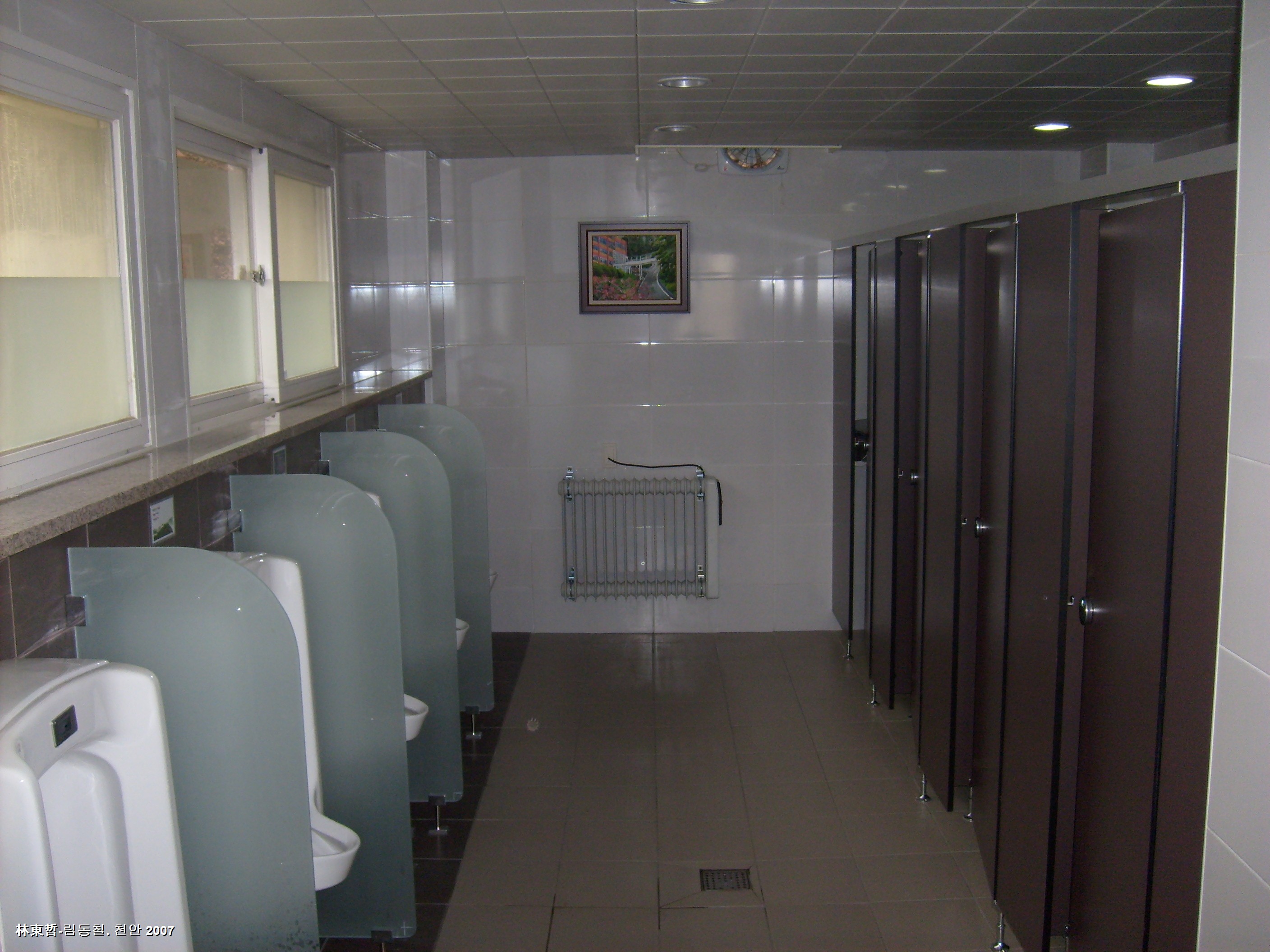
High School toilets, when kids clean them themselves they are less tempted to piss or shit on the floor
And often other luxurious bathroom innovations can be found. I worked in one academy where a kids toilet had been designed and not only were there a miniature urinal, sink and sit-down toilet, but the room itself was less than two meters high and the door by which you entered was miniature. The entire bathroom was like something from a doll’s house.
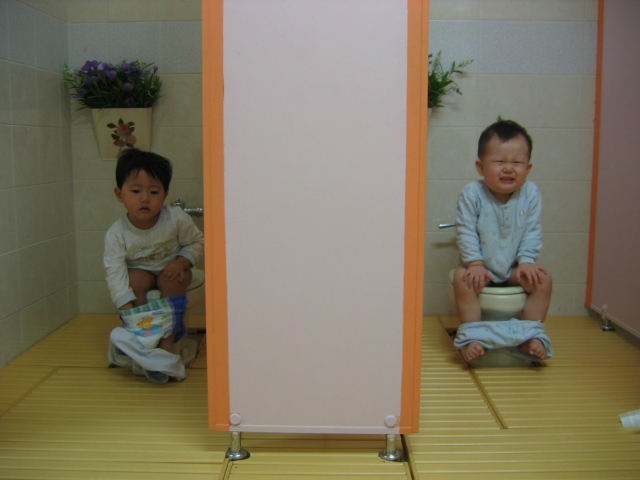
toilets for kids
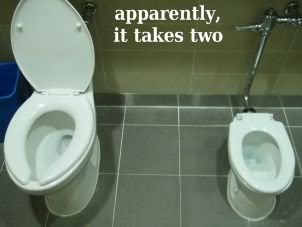
great idea
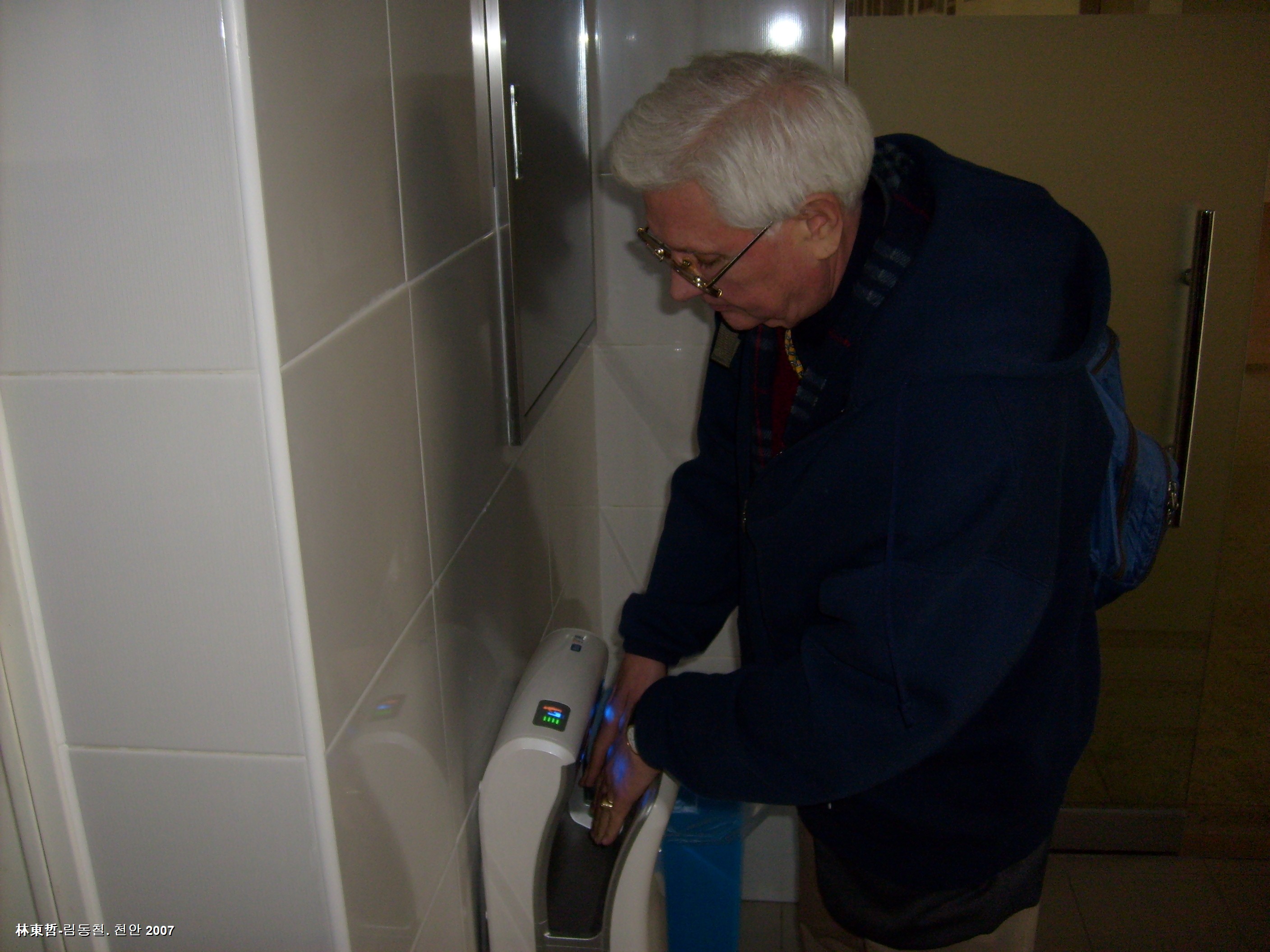
For super clean hands, even after crapping 'hands-free' style, nothing purges loitering microbes like the ultra-violet hand dryer.
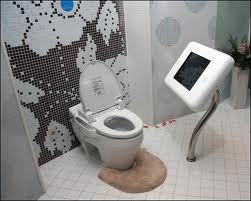
Korean toilets, the shape of things to come...
There is so much more to Korean toilets and ablutions than squat loos and lack of toilet paper and putting up with a little discomfort, which could just as well occur ‘back home’ seems to distract some many bloggers not just from what else is out there, but also the usefulness of their experience as a subject. So, next time you find yourself caught short and in a squat toilet with no tissue paper…

and then go write about it!
Related Articles
- Squat for a healthier poop (mnn.com)
- Toilets: Japan power behind throne (search.japantimes.co.jp)
© 林東哲 2010 Creative Commons Licence.
Quality of Life
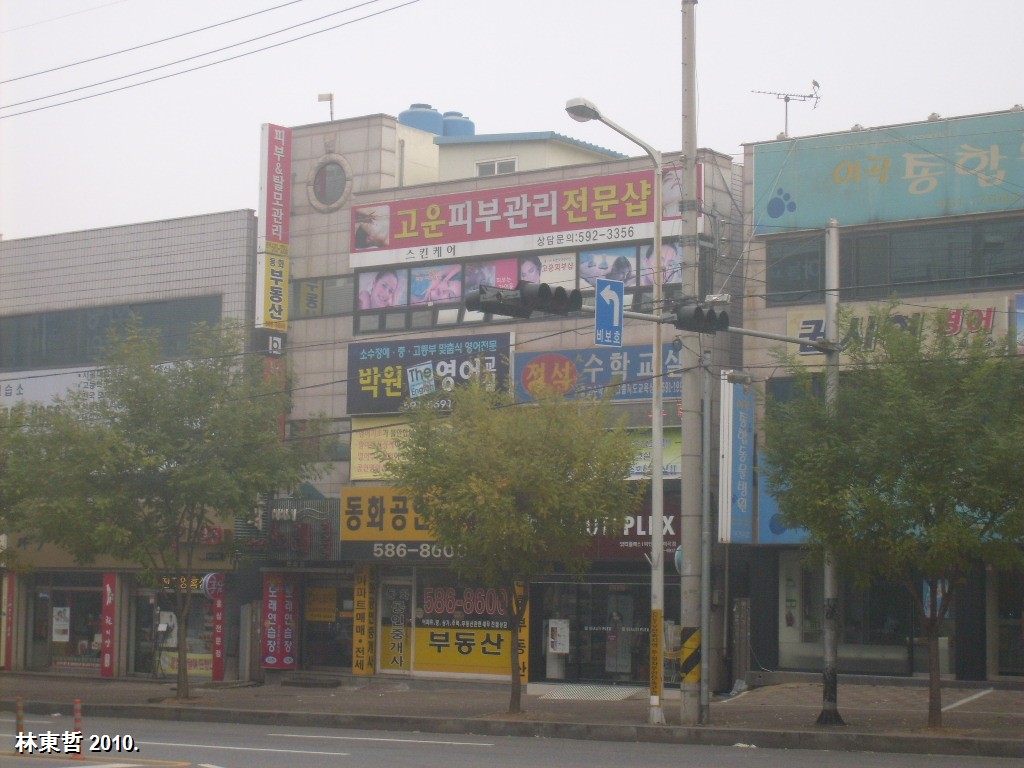
고운 Skin Clinic, and to the right (hidden by tree) an animal hospital. Both less than 1 minutes walk from my one-room
One reason I find Korea a more enjoyable place to live is that they have not yet learnt to be as efficient money grabbers as some western countries. Yes, Korea is capitalist but it is certainly not as aggressively exploitative as the UK or indeed much of the western world. Of course, bad things happen in Korea, like anywhere else, and without doubt political and corporate corruption exist here as much as in Britain where a ‘forgiving’ population has effectively pardoned the recent greedy excesses of politicians. The things I like in Korea are possibly destined to disappear in the greed which seems to epitomize aggressive capitalism but until then, here some of the benefits I enjoy.
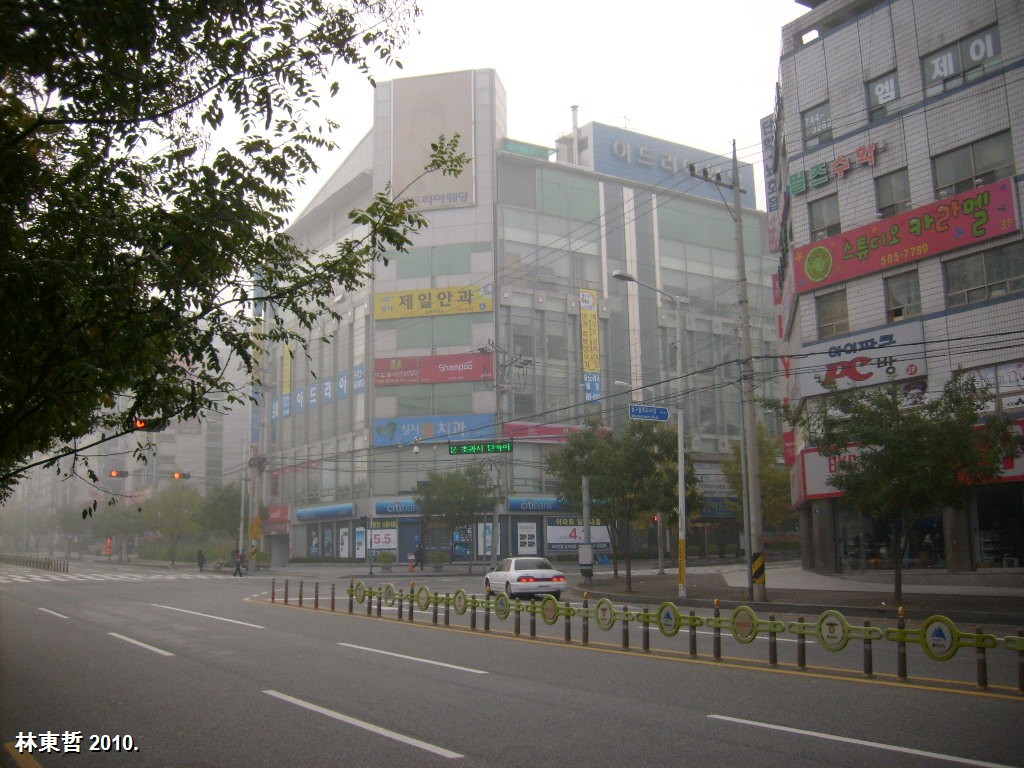
'Best' ophthalmic clinic and 'Beauty' Dentist - 2 minutes walk from my one-room
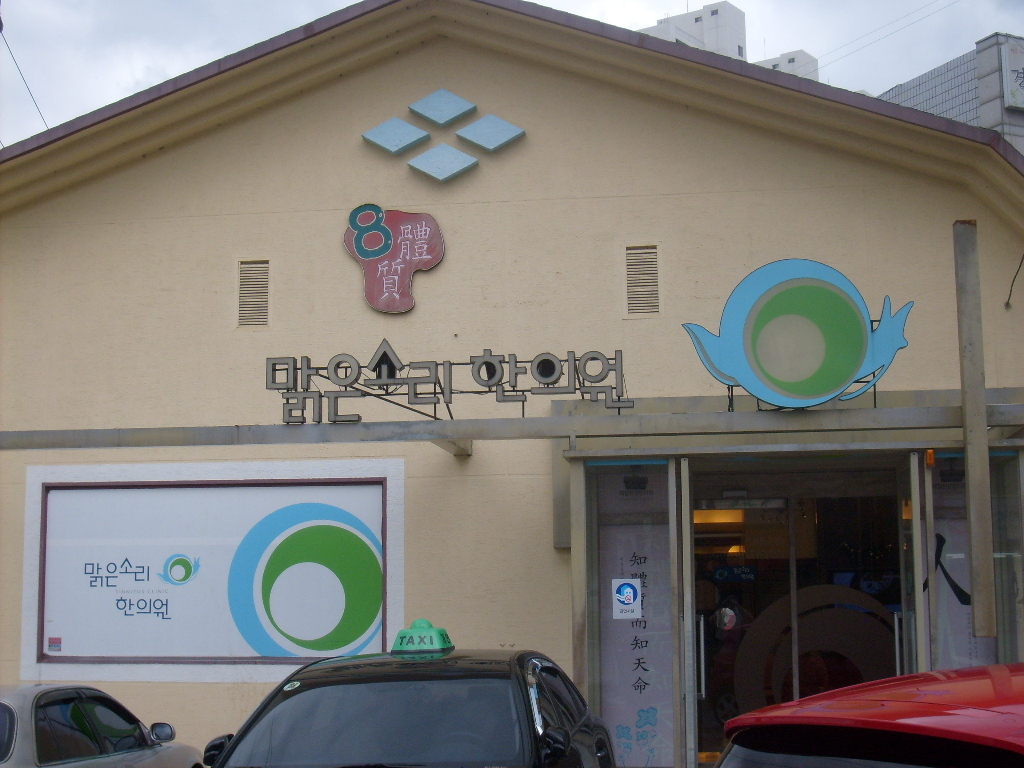
a tinnitus clinic less than 30 seconds from my one-room

specialist hospital some 4 minutes walk from my one-room
I love the idea of ‘service’ (서비스) that shops and restaurants offer to loyal customers. A few weeks ago I recorded and wrote about the ‘concessions’ I earned (see: Freebies) in a seven-day period, and which amounted to 20.000 Won (£10). I had free onion rings, quite a number of free beers, garlic bread, small bottles of vitamin drink and was given 1000 Won (50 pence) discount for medicine, by my pharmacist. Being given a ‘service’ immediately puts you, the customer, in a ‘ special relationship’ with the business and though you can reject it and immediately ‘shop’ elsewhere, it is rewarding and re-energizes my belief that humans are not all money grabbers. There is much more a sense in Korea that a customer is important primarily because smaller businesses vastly outnumber the large ones where in terms of customer numbers, your individual allegiance is unimportant. In Home-Plus or Tesco’s UK, my own opinions and importance are marginal and quite often the response to my complaints summarized as: ‘your expectations and tastes are obviously higher than the average customer.’ With a multitude of small businesses in the form of shops, restaurants, markets and street vendors, your importance as an individual customer in Korea, is of more significance. The practice of being able to negotiate a discount for large purchases is an added bonus.
I’m crap at wrapping gifts but in Korea this is a complimentary service and I’m sure the wrappers have had special training. In the UK gifts are usually only wrapped at Christmas and in the season of goodwill, the biggest hypocrisy of all given it’s the greediest period of the whole year, you can expect to be charged for the service. When I hand over £3-4 (6000-8000 Won) for the wrapping of a gift which I have just paid £40 (80000 Won) I really feel ripped-off. You can shop your entire life at small businesses in the UK and in all but the rarest of occasions can you ever expect reward for your loyalty.
six assistants in one opticians store
On my last visit to the UK, almost a year ago, both my local supermarket, Tesco’s, which in Korea masquerades as ‘Home-Plus, and one of the large, do-it-your-self stores, B and Q, were introducing automated checkouts. As I stood in a queue in B and Q, a number of assistants were on hand to help familiarise customers with the new machinery that would no doubt put some of them out of work. Shopping in either of these stores is unpleasant as the are both gargantuan warehouses where cameras outnumber staff 10-1 and seeking help requires several laps of the premises only to find the teenage assistant has no idea where anything is. The automated checkout had been programmed to welcome customers and provide basic instructions and I was pleased to hear a number of people in the queue voice displeasure at yet another facet of customer services being relegated to a brainless machine. Despite the fact the moaning will achieve nothing and that by this time next year the automated checkout will be fully accepted, I too voiced my dissent. Of course, what separates me from other customers is that not only are my ‘expectations higher than the average customer,’ but the lengths I am willing to go in revolt verge on the lunatic. My Luddite tendencies would not think twice about squirting superglue in the slot designed for a credit card and I can wage a solitary regime indefinitely. Gramsci once suggested that even shopping is a political activity and I can take mine to the extreme.
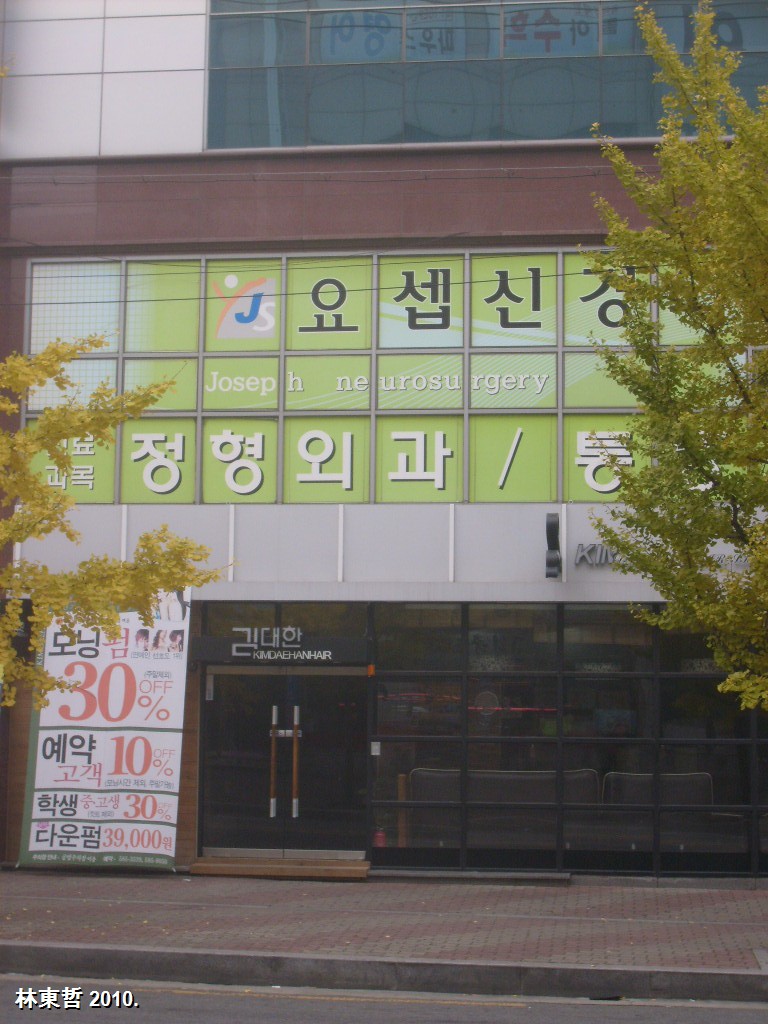
3 minutes walk from my one-room, directly opposite my academy - 'Joseph' neurosurgery
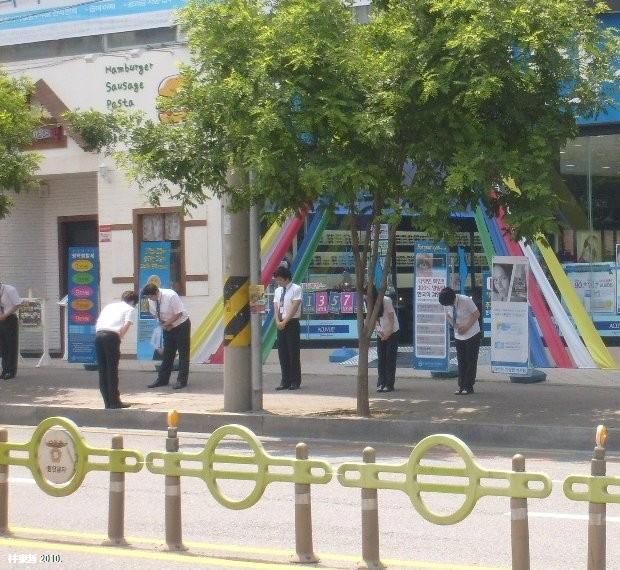
When I went shopping yesterday, in my local E-Mart, I counted 4 pairs of staff on duty at each point of entry onto a level of the supermarket. As customers entered a level they were greeted with synchronised bows and verbally welcomed. Apart from the checkout assistants in stores not yet fully automated in the UK, eight members of staff is probably about the number employed on the entire shop floor of a British supermarket. In Korea, customer support isn’t a luxury but an expectation and there are always a couple of staff employed for every section of shelves and assistance is never more than a few meters away. Parking your car, a subject a broached in Ear Piece Mania, can entail as many as 10 parking assistants all of whom are trained in the intricacies of the bizarre hand signals used within Korean car parks. In the UK and many other places, customer support and adequate staff to assist shoppers, are either relocated in somewhere like India or have been viciously culled in the drive to maximize profits.
The first of an army of car parking attendants encountered in parking your car in the supermarket car park
Several years ago a faulty USB port on my computer damaged my camera and electronic dictionary but this was no worry. Most companies, especially ones such as Samsung, Iriver, and mobile phone manufacturers, have service centers in every major town. For eighteen months, one of the Daegu service centers for Samsung was next to my academy, until it moved a five-minute walk down the road. Regardless, there will be a number of other Samsung centers in the city. Iriver, the manufacturer of both my MP3 and my palm reader are twenty minutes down the metro-line and the service center for my Nurian electronic dictionary, is five minutes away by bus. So, whenever I have had some problem, customer support is on hand, easily accessed and the product repaired and back in my possession within days and possibly quicker. On two occasions, mobile phone problems were repaired while I waited. When I recently had my camera repaired in the new Samsung service center, it took three days and when I went to collect it, it was wheeled out from the an adjacent room on what I can only describe as a cake trolley. Much the same support is available for computer problems and a computer service shop is located less than two minutes from my one-room. Meanwhile, in order to keep frustrated customers at bay and continue operating a second-rate service, a token service at best, UK service centers are located in the furthest corners of the country and require your faulty goods to be ferried away by courier service. And to ensure they can operate a slow service that is cheap to run, all public interface is removed and the call center relocated to Bombay or Bangladesh.
directly behind my academy, 'Future' urology clinic above which is my doctor
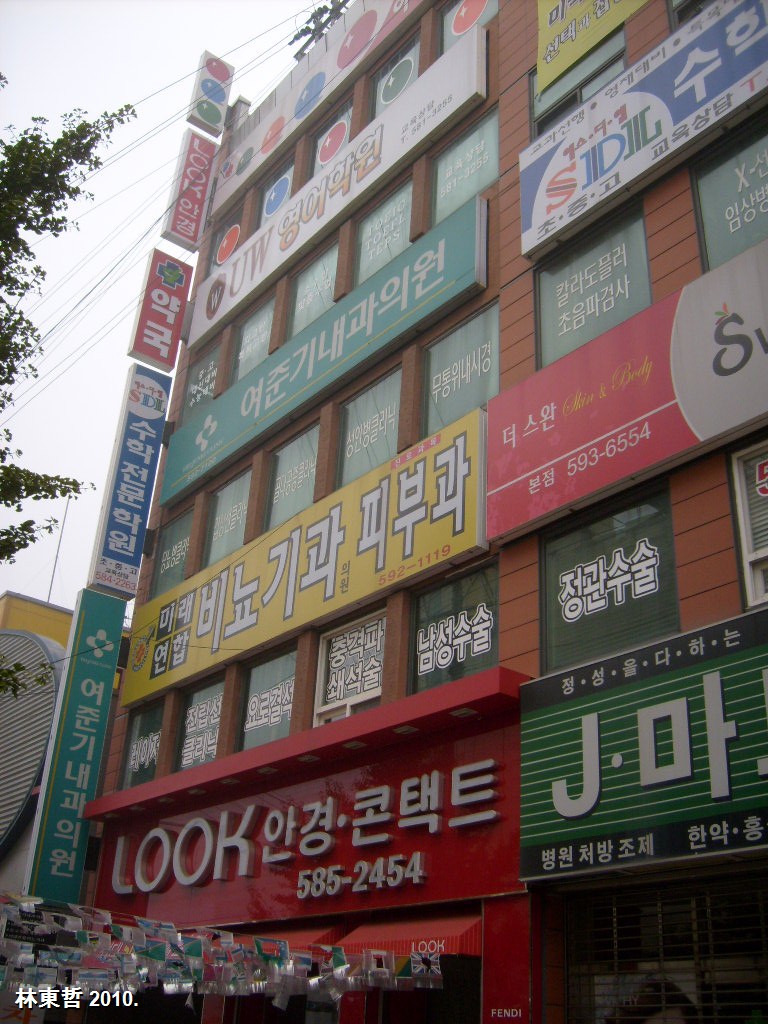
Korean medical care is efficient and there are more doctors and medical facilities within a six-minute walking radius of my one room than there are be in my entire home town. Indeed, 4 hospitals are within a five-minute walk, and in less time than it takes me to walk to work, three minutes, I can reach two ophthalmologists, 6 opticians, urology, cardiology, neurology and ENT clinics, and a women’s’ health center. In addition, there are probably 5 dentists, a number of skin clinics, and a dietitians and two veterinary clinics. Remember, Korea is much more up than out and one high-rise block can contain more facilities than an entire British street where commercial businesses traditionally and almost exclusively, occupy the ground floor. A few weekends ago, the husband of one of my colleagues needed an MRI scan after though I’m told there are a limited number of such facilities in the city, he was able to get a scan on the day he needed one and at a cost of 111.000 Won (£56) after deducting the amount provided by insurance. My colleague actually moaned that this was too expensive. Visiting the doctor involves a wait of no more than an hour and I don’t need to make an appointment. Even without Korean medical insurance the cost of a visit is no more than 7000 Won (£3.50) while the cost with insurance, is an ‘extortionate’ £1.50. And the greatest advantage for anyone living in or near a Korean city or big town, is that most medical needs do not interrupt your daily life. When I have needed anything other than minor medical assistance in the UK, I have usually had to travel a substantial distance and then sit in various queues for several hours. All clinics in Korea have tasteful waiting areas with televisions, complimentary tea and coffee etc, and very often a couple of computers with free internet access. Admittedly, I hear and have seen examples of doctors and nurses not following universal procedures, but back home despite our rigorous rituals hospitals are still plagued with skin eating viruses and for every account of bad practice I experience or read about on the Korean peninsula, I can match them with corresponding ones from the UK. At least when I spot something unsavory in the Korean system, I do so in comfortable surroundings, with a complimentary coffee while watching the television and all without sitting in long queues which have necessitated taking the day off work.
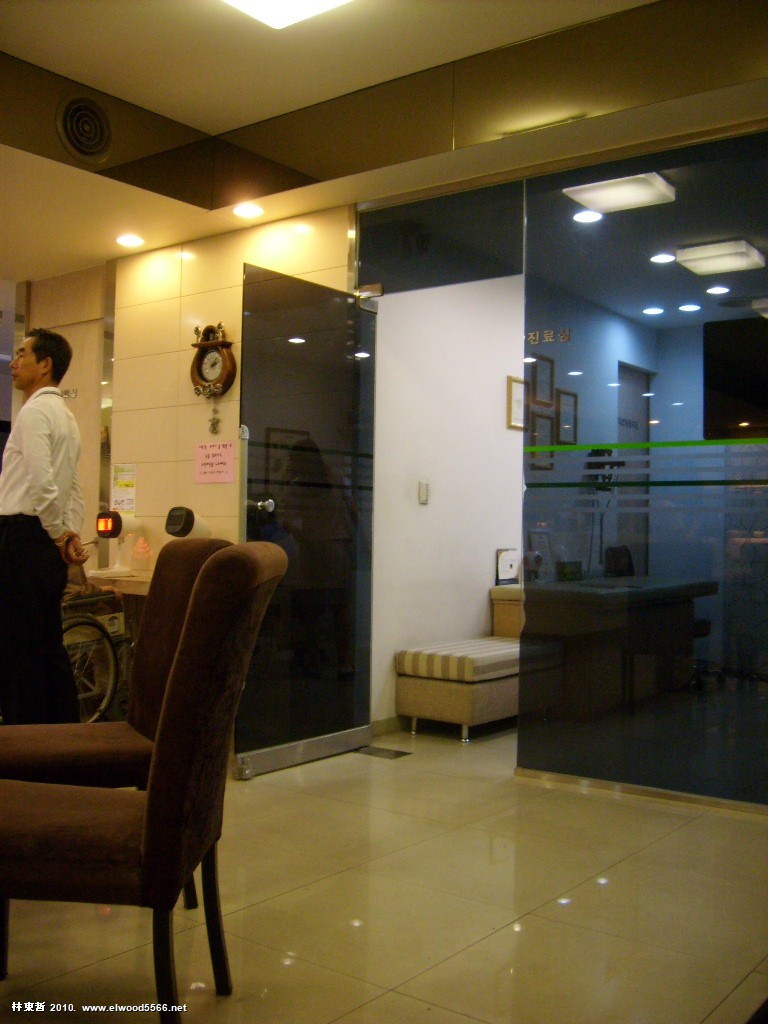
a sneaky shot of my local ophthalmic clinic

a wide variety of side dishes usually replenished at no cost
With eating is my main pleasure, the ample amounts side dishes that accompany a Korean meal and which can usually be re-ordered at no extra cost, is enjoyable. The recent cabbage shortage (Ersatz Kimchi in a State of Emergency) saw prices rise to 10000 Won (£5) for a large cabbage and caused subsequent problems with kimchi production but rather than just hike the cost up, and subsequently leave it high even after production costs have fallen, as happened a few years ago with petrol prices in the UK, most restaurants in my area decreased kimchi and salad amounts and to compensate increased the portions of meat. My local bo-sam restaurant (보쌈) doubled the slices of pork from 7 to 14 and has only recently reduced the number as the price of vegetables, and most especially cabbage, has decreased. In restaurants, chilled water in summer, and warm water in winter are complimentary and a can of coke is usually the same price whether chilled or not. In recent years, especially in hot weather, it has become a trend in the UK to charge up to as much as 1000 Won (50p) extra for the privilege of a cold drink, especially in extremely hot weather.

A Samsung service center
In Britain, unless shoes are leather it is difficult getting them repaired and for items like trainers you don’t repair them at all. Over the years we have been encouraged to sling things out and replace them as soon as they are worn. In Korea you can easily have the worn collars of shirts reversed and repairing shoes with rubber soles, including trainers, is easy. I had my rubber shoes soled and heeled almost a year ago whereas in the UK I would have been compelled to throw them in the bin.
Need a pair of glasses? It would probably work out cheaper to fly to Korea and buy a few pairs than pay the excessive charges levied in the UK. There is no charge for the eye examination and the price of frames begin at about 15.000 Won (£7). I have three pairs of glasses and all have frames costing less than 20000 Won (£10). Koreans love colourful frames and the range available, extensive. Cleaning cloths and cases for glasses are all free and the cleaning clothes cute and decorated. A pair of varifocal glasses, with the glass graduated so they look like ordinary glasses, costs around 200.000 Won (£100) and outside one of the opticians within a minutes walk of my one-room stands a special electrical device which you can use to clean your glasses. It’s free to use! Since optical care was privatized in the UK, the British have been abused by high street companies ripping them of. You can easily pay in excess of £300 (600.000 Won) for a pair of varifocals but the monopoly held by such greedy companies is being seriously threatened with the emergence of online opticians.
There are many flaws in the Korean system and I probably turn a blind eye to many of them, but with all the advantages I have outlined, plus a national tax of around 3.3%, (my monthly bills, including tax, all amount to a grand total less than that I would pay for the lowest of my monthly utility bills in the UK), I do not feel I am being fleeced or financially raped. Unlike many western countries, quality of life doesn’t cost and arm and leg.
Further Links
© 林東哲 2010 Creative Commons Licence.
Memory Lane
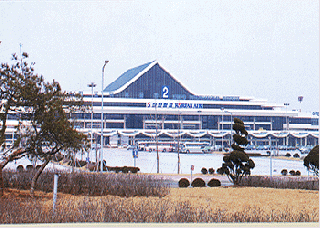
Kimpo Airport
I often mention how rapidly Korea is changing. I have only lived here four and a half years, spread across ten years, so in comparison to friends who have over twelve years experience, I’m somewhat of an infant. I would love to have been here fifteen or twenty years ago, when Korea was truly a country where other than American soldiers, few ventured. ‘Fat ‘has arrived in Korea, an observation I often point out in my posts on bathhouses, and EPIK has brought an army of teachers into schools to such an extent our uniqueness has been lost. And no doubt those who first came to Korea in the 90’s will have noticed even greater changes.
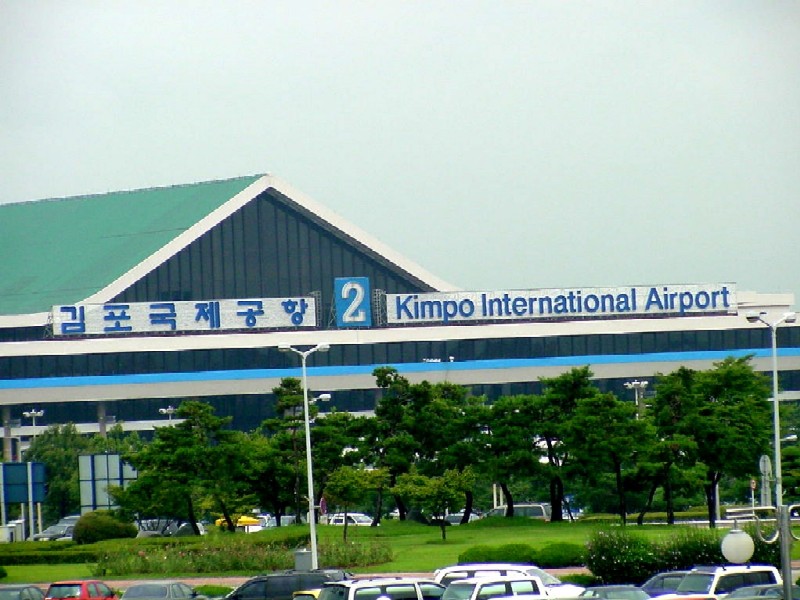
Kimpo in 2000
When I arrived in Korea in September 2000, Inch’on International Airport was still being built and looking back, it is quite incredible to think that the piddly sized Kimpo was the country’s major airport. Kimpo was basically one big room through which people arrived and departed and I’m sure it’s bigger today than it was ten years ago. Few restaurants had English menus and on every street corner were ‘video shops’ renting the latest videos. The internet contained little information on Korea in terms of cooking, culture or history, zilch on hanja and very little on Korean. Few teachers had air-conditioning and for those in English academies, split schedules, a common practice, meant the 6 hours you’d been led to believe you’d end up teaching in Korea, were probably closer to 8 or 9. Maybe it is still the same in some language academies, but class sizes were big, sometimes twenty students packed in small classes and often with no air-conditioning. There were fewer academies and my school, the largest in the area, occupied three floors of a large building. There were few resources, wall sockets often didn’t work and only a couple of tape players if they did and if you complained you were simply told to read to the kids. Most of the westerners I remembered meeting at the time seemed to work under similar conditions. Back then, university posts really were the cream of jobs with significantly more pay than other types of teaching and before the recent changes in bureaucracy, transferring from one town to another or one school to another, was easy.
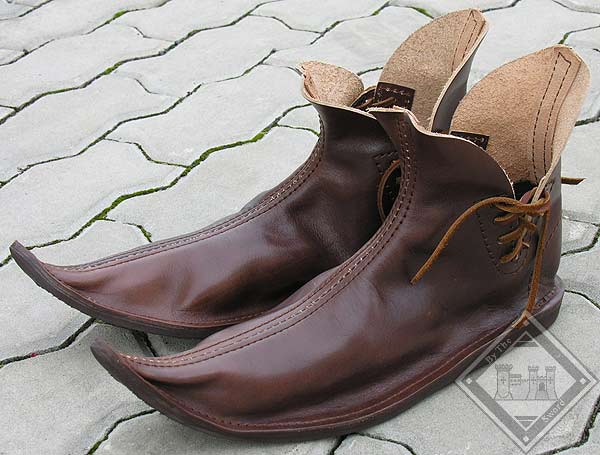
If you had a pair of shoes like this in 2000, you were 'sexy.'
Big shoes were the fashion on young lads. By ‘big’ I mean long and so long that I thought I easily find a pair of English size 13’s. Indeed, they were so long, a little like the old ‘winkle-pickers,’ that they turned up and gave them a medieval appearance. On younger boys, even very young ones, a long forelock on the side of the head was tinted gold meanwhile their teeth were black. While older children seemed to have good dental hygiene, milk teeth were seen as unimportant and many of my younger students had black baby teeth. Today, this is something I rarely see.
Coffee beans or ground beans were hard to buy and I remember a coffee filter machine in supermarkets attracted small audiences and if you wanted a bottle of wine, if you could afford it and could find it, they were stored in a glass cabinet and the choice very limited. It seemed everyone wanted English lessons and were willing to pay for the privilege and being stopped and asked if you would teach privately, was an almost daily occurrence. In my diary for Saturday 18th of November, 2000, I wrote:
Here (KFC in Song-So) I met a man who wanted English lessons and said he would take me sightseeing to temples in return for lessons. Then a boy of about 11 came and talked to me and introduced me to his little brother. Later, yet another stranger came up and asked if I would read stories in his kindergarten and I said I would ring him on Monday.
The KFC near Han-song Plaza has closed and is now a stationary store in which the glass stairs are still embossed with Colonel Saunders’ face, but in the last two years I haven’t once been asked to teach privately by strangers in restaurants or on the street. I used to teach a few privates on a Sunday and would earn around a 100 000 Won an hour for teaching a small class of 3 or 4 students.
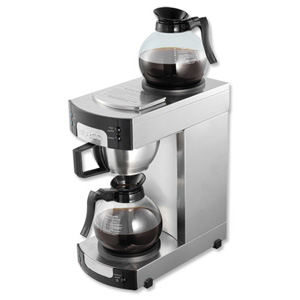
at one time were were as novel as coffee-filter machines and wine
Your presence, especially with children, was often enough for people to stop, gasp and gawk at you in awe. Only yesterday, a boy of 14 told me how he remembers seeing westerners when he was four years old and how he would be filled with excitement. Few schools had resident foreign English teachers and what foreigners existed were a novelty. Many of the children, and some adults, you met ten years ago had never spoken to a foreigner. Then there was the starring… I remember times when the constant starring stressed me to such an extent, I’d occasionally step into a recess or doorway for a break. Unlike today, when a solitary passenger stares lazily from a busy bus, a westerner on the street would turned every head. I imagine it was even more intense in the early 90’s and 80’s and probably not much different to an experience I once had on a station platform in Delhi, in 1984, when a crowd so large gathered to stare at my friend as he opened a map, that after a few minutes you couldn’t see him. In the Korea of today, you are noticed and not much else and it rarely causes excitement or stops people in their tracks.
A few weeks ago I was up Warayong Mountain in Song-So, Daegu; I’d stopped for a coffee at a small stall almost at the summit and was attempting a conversation with a woman sat on the next bench along. I noticed a couple of small children coming down into the clearing where we sat and around which were various communal exercise machines. Suddenly, their faces broke into excitement and they started running and skipping towards my seat. For a moment, it was the kind of reaction I remember on my first visit when kids would run up and then stand and stare, or might bravely attempt to say hello or stroke the hairs on a bared arm. However, ten years later and the focus of their attention isn’t me but the dog sat beside the woman with whom I am talking. The children skip up to it and lavish it with as much excitement and attention as they’d once have given a foreigner. It isn’t even a real dog but one of those ‘handbag pooches’ which look more like a wisp of cotton-wool on straw legs. I could have understood if it had been a real dog, a labrador or sheep dog, but this pathetic specimen! I realised in that instant that this is what it has come to; a miniature poodle now commands more attention, is more interesting and exotic than a foreigner. I am not exaggerating when I add that despite my height and size, and sitting right next to them, they didn’t even notice me.

a puff of wind and it's dead
Amongst all these changes however, one convenient constant; unlike the rest of the world prices have changed little. I bought a hanja dictionary in 2000 at a cost of 15.000 Won and in exactly the same store, nine years later, the same book cost 15.500 Won. That’s an increase of 25 pence in UK sterling! Quite amazing!
© 林東哲 2010 Creative Commons Licence.
A Day of Reckoning – 'Suneung' (수능)

D Day countdown
As I write, across Korea thousands of third year high school students, known as ‘go-sam’ (고삼), will be religiously counting down the days. Some began the count at ‘D Day minus 365,’ others, more traditionally, began at ‘D Day minus 100.’ Today, is ‘D Day minus 21.’ And within the space in which I have written this post, in exactly three weeks time, the futures of thousands of teenagers will have been significantly determined.
‘D Day’ itself will present about 600.000 of the nation’s ‘go-sam’ students, with one of, if not the most, important experiences of their lives and certainly their most important exam. The suneung (수능) or CSAT (College Scholastic Ability Test) is the Korean, standardized test taken by all final year high school students and although some alternatives are now offered, and more are supposedly on the way, for most students it is the sole qualification required for entry into Korean universities.
Of all the standardized tests globally, the suneung is seen as one of the most rigorous. The path towards that moment of academic reckoning begins in elementary school and every step in the development of academic ability from infant study onwards, is a preparation for the suneung.
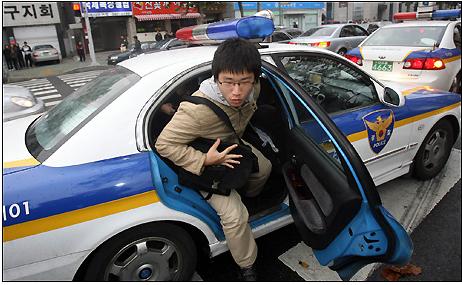
a late arrival is given a police 'escort'
Taken on the second or third Thursday in November, the suneung temporarily transforms the face of Korea and on the day there is a sense that the entire nation is backing the candidates. The transformations are a reflection of the pivotal role education plays in society and despite the professed importance other nations give to ‘education,’ in most, only a national catastrophe or war would be sufficient to suspend capitalism or national defence. In Korea education stops everything, back in Scumland UK, it stops nothing and I can remember sitting the equivalent of the suneung exam to the accompaniment of persistent rifle fire from the nearby military base.
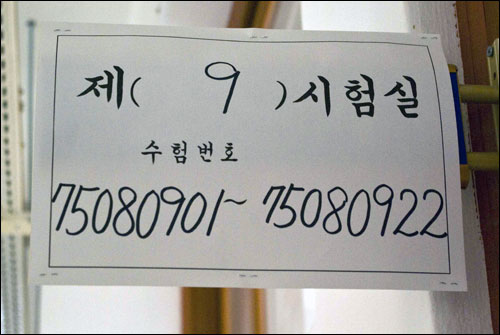
The Korean equivalent of Room 101
The exams last one day and are divided into a number of periods during which exams are taken in subjects such as: maths, social studies, English, sciences, vocational studies and foreign languages. The exams are largely multi choice. To guarantee candidates arrive in school armed with equipment, entry permits, a ‘fighting spirit’ and ready to do their best, a range of national procedures and contingencies come into effect:
♦All other students begin school after 9.am.
♦To help ensure transport system work to maximum efficiency, many businesses begin work at 10am. This includes the Stock Exchange! Yes, there’s only one Stock Exchange, it’s in Seoul and probably nowhere near a school, but it’s the thought that counts. For a few moments the success of students is of more importance than the economy.
♦During the periods when listening test are being conducted, planes cannot land at airports and those waiting to land have to circle above 10.000 feet. Even air-force movements are curtailed, within reason, to ensure silence at the appropriate times.
♦Korea Electric Power Corps places 4000 workers on standby in the event of power failures and each examination center, of which there are about a 1000, is sent a technician to monitor power supplies and await any emergency.
♦Police assist on the roads approaching schools and are also on hand to transport students who’ve encountered problems. Nerves thwart the plans of the best intentioned candidates.
♦Since 1993, there has been no evidence of suneung questions being leaked. In the days immediately prior to D-Day, specially selected professors are imprisoned in a hotel, denied any form of contact with the outside world, the hotel windows blacked out, and equipped with a library of resources, they formulate the exam questions. No doubt the hotel is 5 star, but nonetheless, they are kept in solitary confinement until the exams are officially over.
♦Schools are also supplied detectors with which to scan students for devices, hand-phones etc, which could be used to cheat.
♦Female teachers in high schools on the day of Suneung are not allowed to wear high heeled shoes or perfume.

'suneung exams transport support' provided by the military

Police support
Beyond official and bureaucratic procedures adopted to ensure both fairness and a conducive examination atmosphere, a host of other practices have developed aimed to improve the chances of success. Eating anything sticky on or before ‘D Day’ is believed to enhance ones luck. Sticky things cling to the wall and do not fall and so by chewing on toffee (엿), or sticky rice cake (찰떡), it is hoped you grades will hold fast and not slip into the gutter. Conversely, eating anything slimy, such as seaweed soup (미역 국) might incur bad luck and see your chances for the university of your choice slipping away. At the same time, one must avoided uttering any word expressing failure, falling, dropping, sinking, sliding or slipping. The reason obvious; if it’s muttered, it might happen. Parents and relatives will travel to mountain temples to say prayers and leave slips of paper on which are written the names of loved candidates, or they will attend special services in churches where small Bibles can be purchased in which you stick a photo of your son or daughter, all in the hope of currying divine favour. I doubt many believe success or failure is determined by the consistency of ones food, use of language or even prayer but anything which can be used to bolster the spirit is a valid psychological weapon in the quest for exam success and highlights the desperate measure to which the importance of exam success drives individuals.

Parents praying for the exam success of their children. I did the same thing here with a friend's family in 2001.
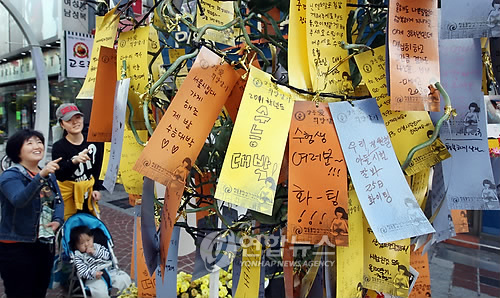
messages of good luck at the start of the final 100 day countdown
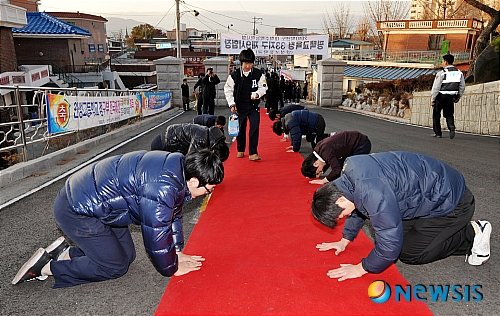
'go-sam' students being greeted by their juniors on exam day
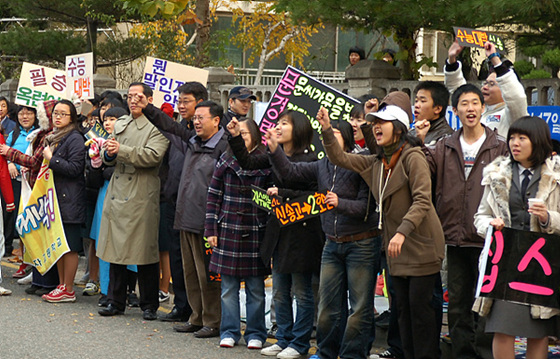
plenty of rousing support

supporters
On D-Day, parents will crowd around school gates, some will pray and other will hold their Buddhist bracelets in reverent anticipation. Candidates are often greeted by 1st and 2nd grade students as they arrive. Colourful banners wishing students good luck are waved and sometimes juniors will perform the full bow at the feet of those about to be tested. It is also common for juniors to rally the spirits of their stressed seniors by singing rousing songs before the exams commence. My last high school had almost 2000 students and it raised the hackles to hear 1200 boys singing in unison from all the classrooms under the 3rd floor, where the suneung candidates waited for their exams to commence.
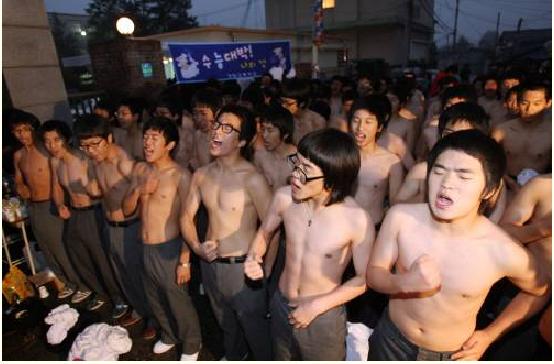
Boys singing after the completion of exams

a mother prays at the school gates
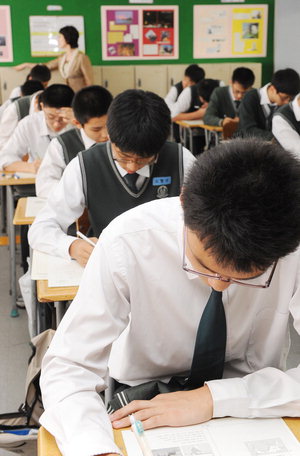
The exam
And when the exams finish, all the text books and notebooks used by the students throughout the year are unceremoniously tossed from the go-sam windows, often on the 3rd floor. Of course, the pressure isn’t off as from 6pm onwards, newspapers can publish exam questions and the agonizing process of self assessment begins until the results are finally released. And of course, as with every exam in Korea, only those with perfect scores are allowed to feel any satisfaction and even this is down played.
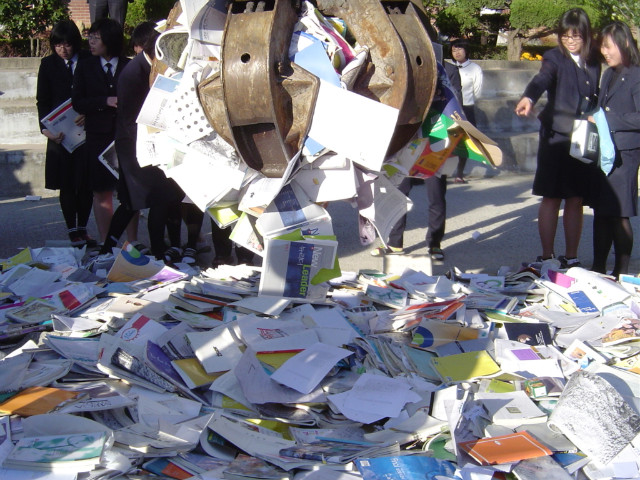
legitimate vandalism

relieving stress
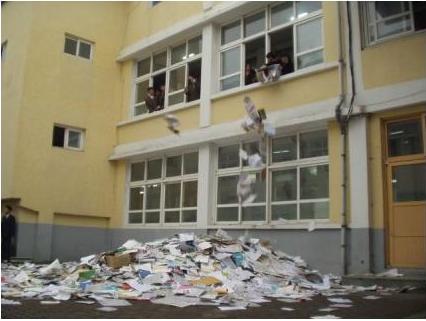
Finally!
Undoubtedly, Korea has one of the best educated populations globally and though we might want to qualify the nature of that ‘education,’ we cannot dispute their success in terms of literacy and the sciences. Objective subjects and languages are much easier to assess. When it comes to the arts and subjective thinking, Korea has problems but however flawed or misguided we might perceive the Korean education system, it has facets worthy of admiration and parts perhaps worthy of emulation. Coming from Scumland UK, where dumbing-down is fashionable, bone-idleness excused, and the fruits of study and erudition watered down into a melee where belly dancing becomes an academic pursuit which has parity with mathematics or physics, it is refreshing to work in a culture where education has too much significance rather than little at all.
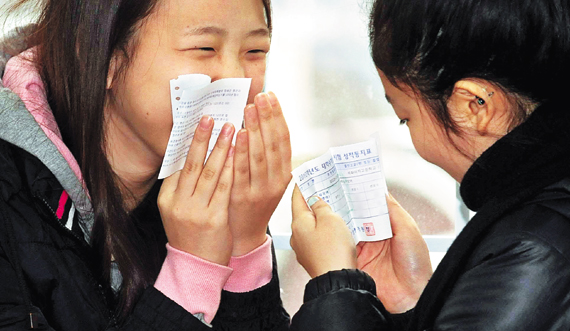
results
To all 2010 go-sam (고삼) students about to face the suneung, ‘fighting’ (화팅!)
Related Articles
♦ For a selection of video clips giving a general idea of the various suneung activities
© 林東哲 2010 Creative Commons Licence.
Tissue Trauma

Not suitable for pumpkin people
I was cooling off last night in the cold pool at the bathhouse. With the evenings still a little warm, at least if you’re western, the cold pool is still not too cold. Many Koreans started wrapping themselves up three weeks ago. The memi (매미) only had to stop singing, at just under 29 degrees, for some to start complaining about ‘the cold.’ The last memi I heard was on Saturday 25th of September and given Daegu is one of the warmest parts of Korea throughout the year, I would imagine the Memi stopped singing earlier, further north.
The following week, was still warm and I sweated in class despite the use of air conditioning and a fan but already some students had begun shimfing about it being cold. ‘Teacher! Teacher! I cold! Turn off air-con!” They whined. Like it’s fucking 28 degrees Celsius! That week I really enjoyed walking home in the evening because there was just the tiniest touch of coolness floating in the air. Suddenly there were only a handful of people on the street in short-sleeved shirts. And now it’s mid-October, I notice my shower is a little too uncomfortable to use without increasing the temperature. For the last few months even the coldest setting had become warm. And in my school some teachers have already started that typically Korean custom of wearing a coat all day long.
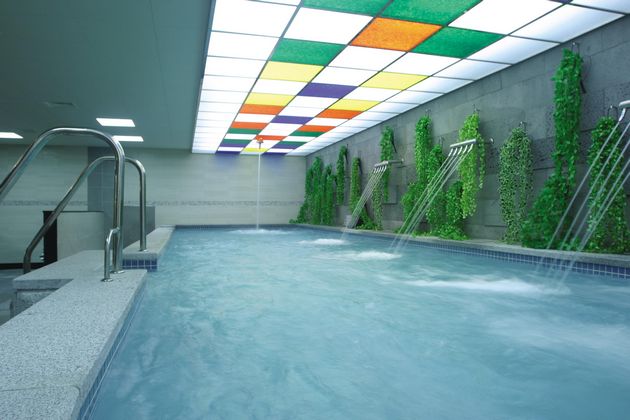
cooling off
So, in the bathhouse the cold pool (냉탕) is empty. Six weeks ago it was at its busiest. A friend I haven’t seen for a while came and spoke to me. He’s slightly older than me and incredibly fit. He has a short stocky body and is a regular in the gym where he runs for 45 minutes on the treadmill, at a fast pace. He has this habit of entering the cold pool, which you can just about swim in, by springing over its side and into the water. Most of the schoolboys don’t do that and instead enter by the steps or climb into the pool.

tissue trauma
We chat for a while, me draped over the pool ledge and him standing. Then he takes his leave and tells me he wants to have a shower and will come back and join me. As he turns around, I notice a white flash from his buttock and walking into brighter light realise he has a few inches of toilet paper dangling out of his crack. I grin to myself and then momentarily ponder which is the greater embarrassment, a bogey hanging out of your nose or residue bog paper clamped between your checks like an insistent napkin.? Instantly, I choose the bog paper because you can so easily tell someone they have a bogey hanging, you simply touch your nose in a particular manner, and they will understand; it’s a discrete and universally understood hand sign. But how do you convey to someone they have paper hanging out their arse? There’s no universal ‘sign’ and I wouldn’t want to risk saying anything in Korean which might compound the problem. Do you discretely touch your buttocks or point around to them?
Without actually verbalizing the problem, I would imagine the only way you could draw attention to it would be to tug on it, like yanking a doorbell or pulling the chain of a toilet! You wouldn’t want to tug on it too much or it might pull out and who knows what’s on the other end or how much might be dragged out. Best is probably a small tug, just enough to announce a presence rather than raise an alarm. By the time I’d finished pondering, the dilemma was over and he was safely in the shower where the offending bog paper, sloughing down the backs of his legs, started its voyage to the drain. And luckily for him, I don’t think anyone else noticed.

envirnomentally friendly method

all too often the problem in Korea
© 林東哲 2010 Creative Commons Licence.


 Elwood 5566
leave a comment