Korean Language – Project in the Process

you might find it... then again you might not
I am no authority on the Korean language, in fact, despite my study, when I generally speak Korean, Koreans look at me in dumbstruck confusion. I’m sure the experience is common.
Back in 2000, when I first experienced living in Korea, there was little on the internet either in terms of Korean language, history (other than the Korean War) and culture. Indeed, if you wanted to write Korean on a computer outside Korea, you had to buy Microsoft Proofing Tools. Korean language courses and dictionaries, certainly in the UK, were few and far between. It’s not really surprising, despite my having traveled fairly extensively, I can put dates to the first four Koreans I met before coming to Korea: Richard Koo, 4th degree Taekwon-do, instructor, Twickenham, London, 1979, Rhee Ki Ha, 8th degree, August 1988, a student in a British school in 1994 and a student in the Philippines in 1996. My university, which boasted 14% overseas students (in 1989), had no Korean students between 1988-1992 and it was a similar situation in a subsequent university in London, where I was a ‘live-in,’ hall of residence counselor, between 1992 and 1996. My house in the UK, only a fifteen minute walk from my original university of study, now boasts a small Korean community and you can even buy kimchi in the campus supermarket.
An early scarcity of anything Korean taught me to record even basic words and I continued this practice up until about 5 years ago. Now, I record only words which are obscure and absent from dictionaries because you can guarantee if you don’t, that when you need them, they’ll have been forgotten. I do exactly the same with hanja. Information in relation to Korea is so new, that dictionaries often contain mistakes, misinformation or simply do not list a word you might be searching. As an example, ‘persimmon,’ ‘peach’ and ‘chili’ appear in most dictionaries but there are there are several different types of each. Persimmon can be bought very sort, soft, hard, and dried and all have different names which are not so easily tracked down. The problem regularly occurs and though you can ask people to clarify, experience has taught me they too, often make mistakes or simply don’t know the answers.
So, I have decided to place a small dictionary ‘page,’ accessed through my side-bar, to list words that are obscure and/or interesting. Of course, they are a personal list and like anyone else learning Korean, each of us has a batch of words pertinent to our own interests and experiences. However, it can be shared and added to and corrected by anyone who is interested and is prepared to send a comment. Most words I will generally look up in my mediocre dictionary, and will always check in an online dictionary such as Babblefish. However, often words I want translating, are simply not there. I do not intend this resource to be for anything other than obscure words and words often missing from dictionaries because their is no direct English equivalent. You can access Interesting and Obscure Korean here.
 © Nick Elwood 2010 Creative Commons Licence.
Five Second Hanja (5) Day – 날-일 (sun, daily, Japan)

날-일-Day
Another easily remembered pictogram. With a slight twist of the imagination, ‘Day’ resembles the sun and is the character used for days of the week, eg: Friday – 금요일, and Birthday – 생일. It is also used for sun, Japan and daily.

Get the idea?
This series of posts is not aimed to teach hanja, I am not in the least qualified for such a task, but to simply highlight some of the important and simpler characters. For information on stroke order, radicals and the two elements of a character (spoken – meaning), I suggest you obtain a dictionary such as; A Guide to Korean Characters.
© 林東哲 2010 Creative Commons Licence.
Five Second Hanja (4) Small – 작을-소

Small
This character, meaning small or little, is common on menus denoting a smaller portion.

Small
This series of posts is not aimed to teach hanja, I am not in the least qualified for such a task, but to simply highlight some of the important and simpler characters. For information on stroke order, radicals and the two elements of a character (spoken – meaning). I suggest you buy a dictionary such as; A Guide to Korean Characters.
© Nick Elwood 2010 Creative Commons Licence.
For Pied and Dabbled Things

fascinating - or ''just' (그냥)?
Back in Scumland UK, the greatest disruption to a lesson would be two students having a fight, possibly assaulting the teacher or simply a student calling you a ‘fucking wanker.’ In Korea, a similar level of disruption is achieved if an insect flies into the classroom. No! I’m not referring to a gigantic hornet or a preying mantis; pandemonium can be unleashed by a simple house fly. On such occasions, students will duck their heads and even move to the other-side of a class and until the insect is removed or killed, all teaching is likely to cease. I know students, teenage boys, who will squeal and panic, if a butterfly flutters into the classroom.
I have seen some beautiful butterflies in the mountains, some the size of small birds with brightly coloured wings. As a schoolboy, my fondness for butterflies was inspired through collecting and trading cards that came with a packet of Brooke Bond PG Tips Tea. Although I’ve noticed dragonflies are admired, some kids even hate butterflies, one of the most majestic and harmless of insects. In Korean, it seems many people relegate most bugs to the same category as cockroaches.

Launched by Brooke Bond (tea) in 1963, this series of cards probably inspired my interest in butterflies
Koreans seem to have a general dislike not just of insects, but bugs in general and ‘bug’ is the preferred term as this precludes having to differentiate between insects and arachnids and many other creepy crawly things. Indeed, terms such as ‘insect’ and the characteristics they exhibit do not seem as easily understood as they might be in the west. The problem of nomenclature, despite biological taxonomy, is obviously cultural but I wonder to what extent it reflects a general disregard for nature in general, especially in a society which has so rapidly become highly urbanized.
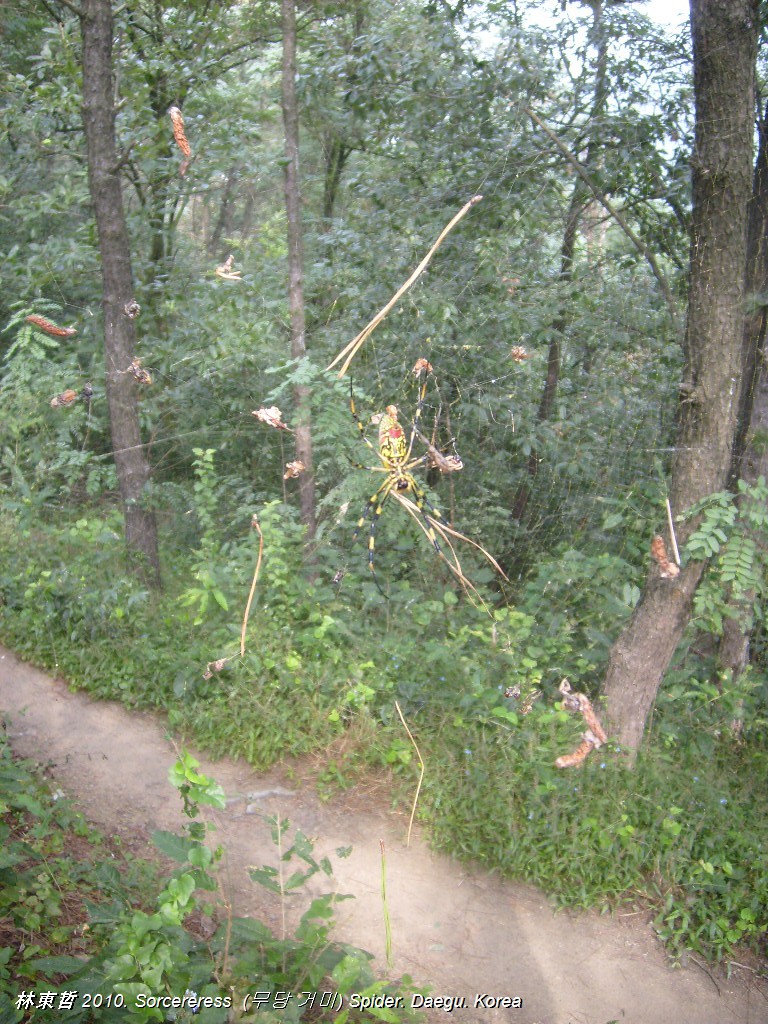
'Just' (그냥) a spider!
Korean students, and many adults I know, seem not just oblivious to nature, but indifferent and unmoved by it. Of course, I am making a sweeping generalization and fully aware many Koreans are quite the obverse as I often come across Korean nature, and nature photography blogs on the internet, but I nonetheless experience different attitudes from students and friends than I would back home. Several years ago, on a mountain trail in Ch’eonan, I was privileged to see a fox posing in profile. My fellow teachers all insisted that either foxes do not exist in Korea or that I must have seen a cat. You simply cannot confuse a cat with a fox, especially having seen the fox motionless and in profile! Every child will give you the correct name when you describe a magpie, one of the most common birds even in urban areas, but describe a jay, a common sight in the mountains, and most will have no idea of its name (산까치). The impressive sorceress spider (무당 거미), with their expansive webs dusted in a powdery yellow, and abdomens emblazoned with red and yellow markings, to all but one of the people I asked, were ‘just’ (그냥) spiders. Wasps and hornets suffer a similar fate and are often clumped together as bees (벌). And then I’m told figs trees don’t grow in Korea when there are several growing in my vicinity.
The reason I am so keen as to Koreans attitudes about nature is that most dictionaries fail to distinguish species and sub-species and hence I am compelled to make inquiries. I often encounter problems trying to discover the Korean word for particular animals or plants. For example, Koreans have a number of different names for ‘octopus’ (낙지, 문어) and will often insist that they are different from each other but this difference has more to do with ‘octopus’ as a food, rather than ‘octopus’ as a species. In Britain, we have a similar problem with ‘sardines’ and ‘pilchards,‘ both different size herrings and most of us differentiate them by the shape of can they are bought in. Sardines, as juvenile pilchards, come in small flat tins whereas the adult pilchard, comes in a round can. I doubt many Brits are capable of differentiating between sardines and pilchards in any other way than by the type of can they occupy when dead and ready to eat.

This is a pilchard
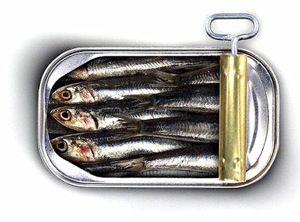
This is a sardine
Differentiating between rats and mice is also problematic and if you tell a Korean you had a mouse in your house, or even had one as a pet, they will recoil in horror. Despite ‘mice’ having a distinct name (생쥐), they are conflated with rats (쥐) and only by describing a rat as having a long leathery tail, can you be understood. Exactly the same occurs with chipmunks (줄무늬 달암쥐) and squirrels (달암쥐) both of which are described as ‘squirrels.’ (다람쥐) Yes, chipmunks are a form of squirrel but they are quite distinct from squirrel squirrels. Indeed, several online dictionaries I consulted identified both squirrels and chipmunk, as squirrels and despite chipmunks being common in the nearby mountains, most people I asked either did not know what they were or simply identified them as ‘squirrels.’

A rat - big, dirty and loves sewers and shite
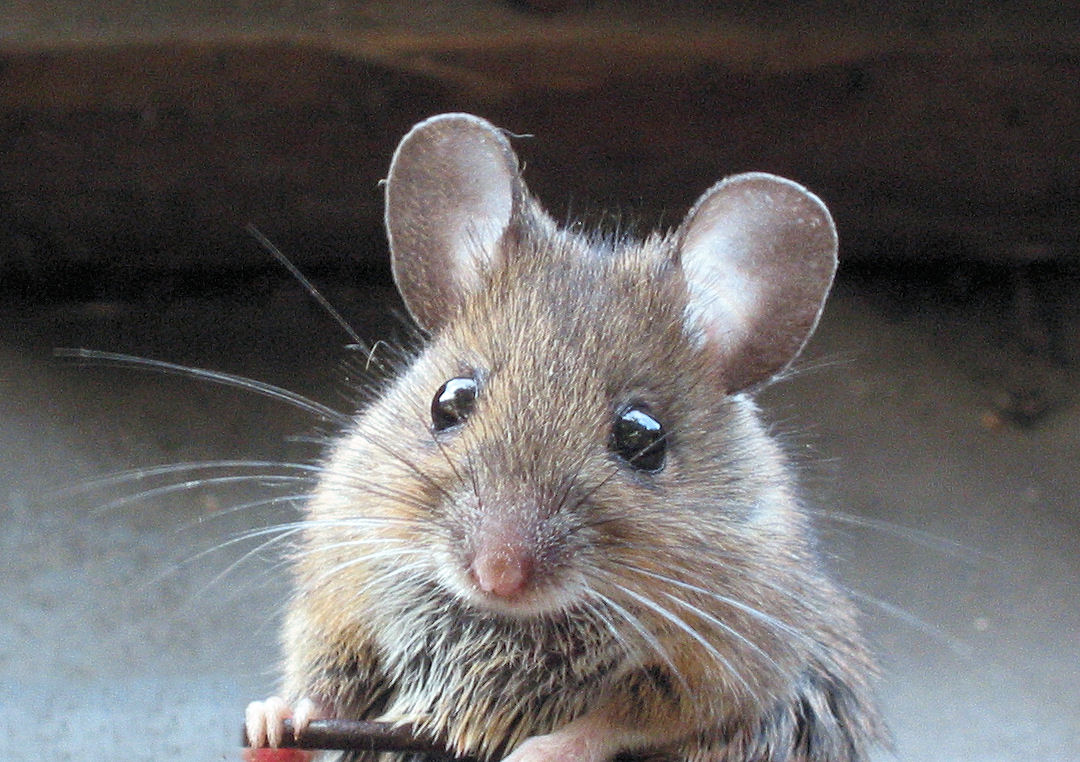
This is a mouse - small, cute, lives in fields and is a veggie
On another occasion I was with friends in the Kayasan Mountains and noticed what looked like clumps of mistletoe high in the trees. I was excited because I’d not seen mistletoe in Korea and it was prolific and thick. Mistletoe is a parasitic plant which grows in the uppermost branches of trees, the seeds being deposited via bird droppings. Not only did my friends have no idea what is was, but they weren’t very interested. As we were coming down the mountain, I noticed bags of ‘clippings’ being sold to make tea and was able to confirm it was mistletoe (겨우사리).

mistletoe can be seen growing in clumps in the high branches (Kayasan, Heinsa)
In early summer, I was looking at plants, along with a close friend, being sold by a street vendor. She was quite impressed that I was able to identify tomato, aubergine, thyme, rosemary and courgette seedlings as well as larger jade and citrus plants. She had no idea that tomato plants have a distinct smell that is imparted onto your hands if your touch them. My poor friend could only identify a chili plant and asked the vendor to name the plants to corroborate my claims.
It worries me that so many young Koreans are uninterested and uninspired by nature, if not fearful of it, because the easiest means by which species will disappear, is when there is no regard for them. In dystopian novels such as Huxley’s, Brave New World, Zamyatin’s, We, and to a lesser extent, Orwell’s, 1984, nature is perceived as abhorrent, distasteful, imperfect and dirty and hence requiring banishment beyond the confines of ‘civilization.’ Once there is a general dislike, or simply disregard for nature, or even people, and before you know it, the damage has been done. All political and social atrocities are born out of an attitude of dislike, disinterest or loathing and the same can be said of environmental atrocities.
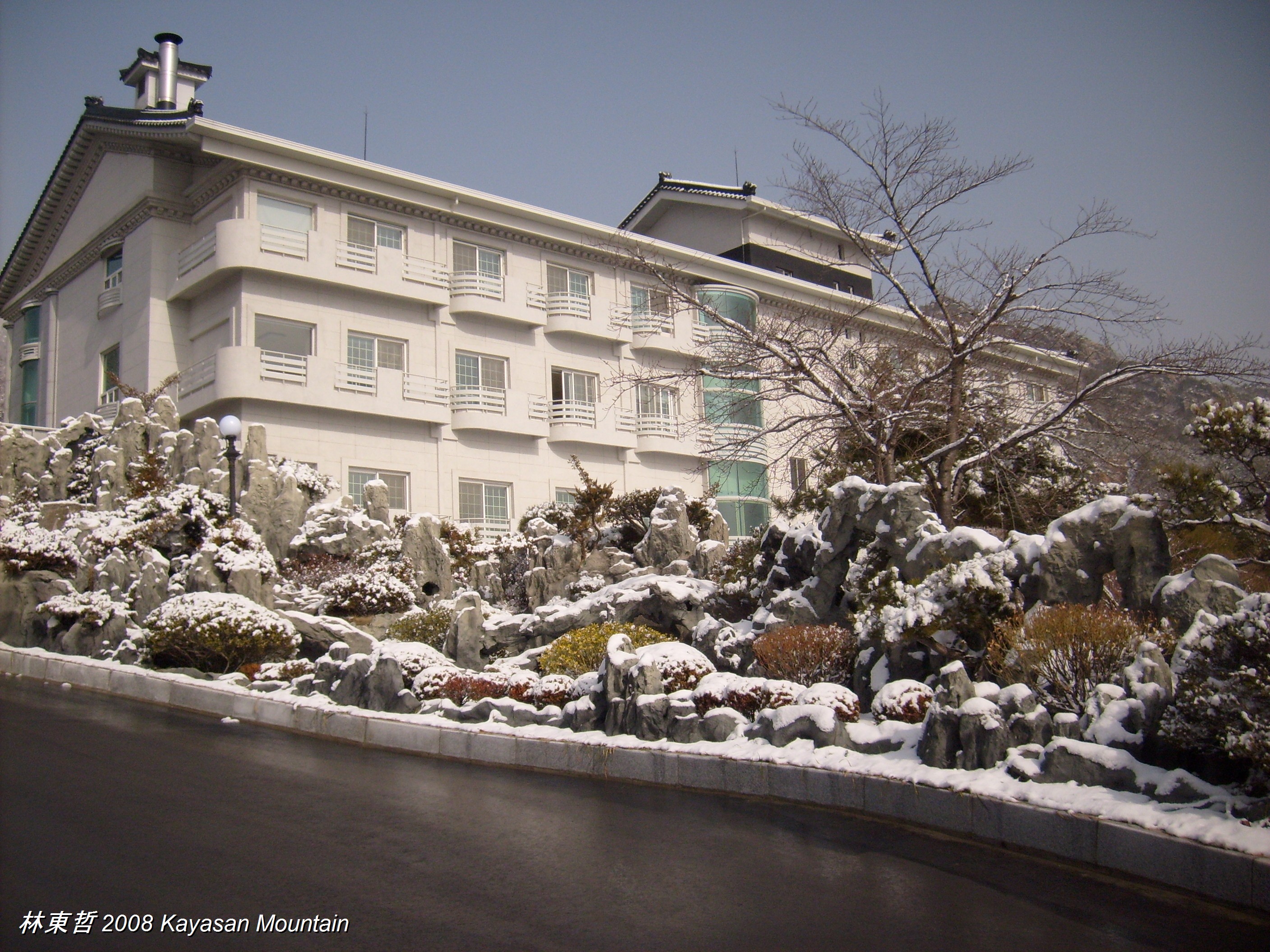
The impressive Kayasan Hotel
In Kayasan Mountain, behind the impressive Kayasan Park Hotel, next to the nature trail entrance, is a natural history museum in which are housed an extensive collection of insects which are either extinct or endangered. Some of the insects, all dead and mounted, are of gargantuan proportions, some as much as three or four inches long. The gargantuan insects that once lived in the mountains of Korea, with their chunky exoskeletons and long antennae, fascinated not just me but the numerous Korean children, ooo-ing and ah-ing around me; ironically, the same children who yelp, scream and panic when a house fly buzzes into the classroom. It seems that for many, nature only has the power to inspire wonder and awe when it’s dead, mounted, sanitized and safe.
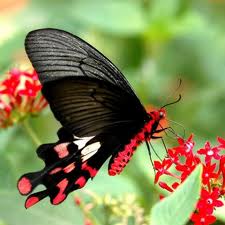
Capable of causing panic!
© Nick Elwood 2010 Creative Commons Licence.
Five Second Hanja (3) Month, Moon – 달-월
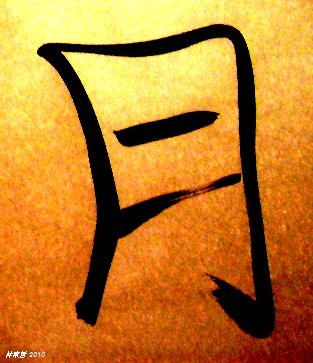
month, moon - 달-월
A pictogram of a crescent moon with two clouds traversing the center. As a pictogram it probably would have been slightly rotated.

Sometimes a little leap of the imagination is required for the pictogram's meaning to materialise
This series of posts is not aimed to teach hanja, I am not in the least qualified for such a task, but to simply highlight some of the important and simpler characters. For information on stroke order, radicals and the two elements of a character (spoken – meaning). I suggest you buy a dictionary such as; A Guide to Korean Characters.
© Nick Elwood 2010 Creative Commons Licence.
Jabbering
I’ve been making a concentrated effort to improve my Korean because of late I’ve been bored stupid talking to Koreans. On more than one occasion, I’ve actually been quite rude to people in an attempt to avoid talking. It’s nothing personal and indeed quite the contrary, I can withstand a Korean talking at me for hours on end without waning, but what bores me the most is having to listen to my own drivel. I have developed a range of conversation topics where I can impart my ideas and maybe even respond to a few questions, but unless I can keep control of the ‘conversation,’ I am basically fucked!

Well, a little, perhaps...
My boring litany revolve around being English, being a teacher, learning Korean and hanja, having a taekwondo black-belt, George Bush, and food. I have others, but these are fairly central. Each conversation topic has a number of branches and each of these, sub-branches but very quickly the conversation will reach a point where I no longer hear key words and don’t have the vocabulary or grammar to go further. At this point it is time to jabber.
My Korean skills improve at a laboriously slow rate but my ability to appear knowledgeable, to appear as if I understand every spoken word, and to ‘jabber,’ have been catapulted to perfection. When it comes to the art of jabbering, my kung-fu is strong!
Jabbering shouldn’t be underestimated or treated with derision as it is an integral part of learning another language. First of all, to jabber, you have to be able to use at least a small percentage of the language. Secondly, you have to recognise various tones of voice because you need to respond to these appropriately. Most importantly, you have to be able to differentiate questions and statements. Thirdly, your skills at reading body language, and using it yourself, are crucial.
Provided both parties give the appearance of understanding a conversation, this is achieved by strategically interjecting words such yea’ (예) and ‘really’ (찐자) at appropriate points, by occasionally stating that you don’t understand a word, even though in reality you haven’t understood the last five minutes conversation, making the correct body language, and generally latching onto any word you do recognise, and then repeating it, you can ‘converse’ for hours. It would seem that two humans,from totally different cultures will tolerate a lengthy dialogue in which only a small percentage of the conversation is mutually understood, provided the charade is successfully performed. Indeed, two hours of mutual jabbering can be quite rewarding.
If a person is willing to jabber with you, and you with them, it is perhaps indicative of a mutual liking for each other and it should be pursued as a friendship could develop. I am often amazed, and saddened, that I have some very close Korean friends with whom I jabber and yet am still only capable of making ‘small talk.’ I’ll happily talk to any Korean in my attempts to improve my abilities but having to listen to my own drivel has become tiresome.
© Nick Elwood 2010 Creative Commons Licence.
Five Second Hanja (2) Mountain – (메-산)

mountain - 메-산
Looks like the character
The character for ‘mountain,’ a simple pictogram depicting three mountains.
This series of posts is not aimed to teach hanja, I am not in the least qualified for such a task, but to simply highlight some of the important and simpler characters. For information on stroke order, radicals and the two elements of a character (spoken – meaning). I suggest you buy a dictionary such as; A Guide to Korean Characters.
© Nick Elwood 2010 Creative Commons Licence.
Five Second Hanja (1) Big-Large (큰-대)
大
This character is very common and means big or large. Originally a pictogram, it is easily remembered as a representation of a person holding their arms outstretched, as you might do when telling someone how big something is.

(큰-대) Remove the outstretched arms and you're left with person (사람-인)
Found in restaurants, place names, rock inscriptions as such as well as Korean names.
Dae-gu – 大邱
Dae-chon – 大田
Dae-Han-Min- Guk (대한민국) – 大韓民國
Dae-Po – (artillery) – 大砲
This series of posts is not aimed to teach hanja, I am not in the least qualified for such a task, but to simply highlight some of the important and simpler characters. For information on stroke order, radicals and the two elements of a character (spoken – meaning). I suggest you buy a dictionary such as; A Guide to Korean Characters.
© Nick Elwood 2010 Creative Commons Licence.
ks
|
一 |
Dragonfly Days (물잠자리)
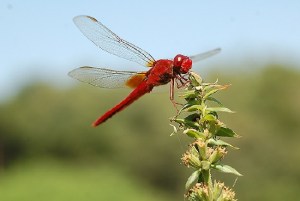
A male 'chili dragonfly' (고추잠자리). This type appear is common in early October
Mid August and the dragonflies (잠자리) are hovering over puddles and pools of water. There are several ‘flushes’ of dragonfly with another in early autumn. I suspect these are collectively known as ‘water dragonflies’ (물잠자리) irrespective of actual specie. Sometimes you can see them in large numbers erratically darting here and there. Some are probably damselflies (실잠자리) which are distinguished from dragonflies in much the same way as butterflies are from moths, in that when resting a dragonfly’s wings are 90 degrees to its body, in contrast, a damselfly’s wings rest along the body itself. Dragonflies can fly in six directions, up, down, forwards, backwards and side to side.
Bright blue damselflies and deep brown reddish dragonflies seem to be particularly prominent around my area of Daegu at present.

A damselfly (실잠자리)
Clicking this link will take you to David Hasenick’s photo gallery which besides hosting some excellent photos of dragonflies, also has a number of other Korean categories.
While searching for information on Korean dragonflies, I discovered a ‘list’ of the variations in Korean regional dialect for ‘dragonfly.’
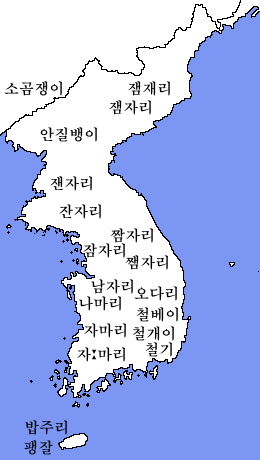
'Dragonfly' - regional variations in dialect
© Nick Elwood 2010. This work is licenced under a Creative Commons Licence.
A Hanja Classic – The Thousand Character Classic (천자문-千字文)
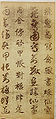
천자문
For students, The Thousand Character Classic (천자문 – 千字文) is a central text in learning hanja and appears in various publications and formats. Written in China, by Zhou Xingsi who lived between 470-521 AD, it comprises 250 phrases each containing 4 characters. Although it is unclear when the Ch’oen Cha Mun ( The Thousand Character Classic) first appeared in Korea, its use in learning hanja dates back to 1583.
The Ch’oen Cha Mun has appeared as a cartoon and forms the basis of numerous comic books with a didactic purpose. I recently found this excellent pocket size edition.
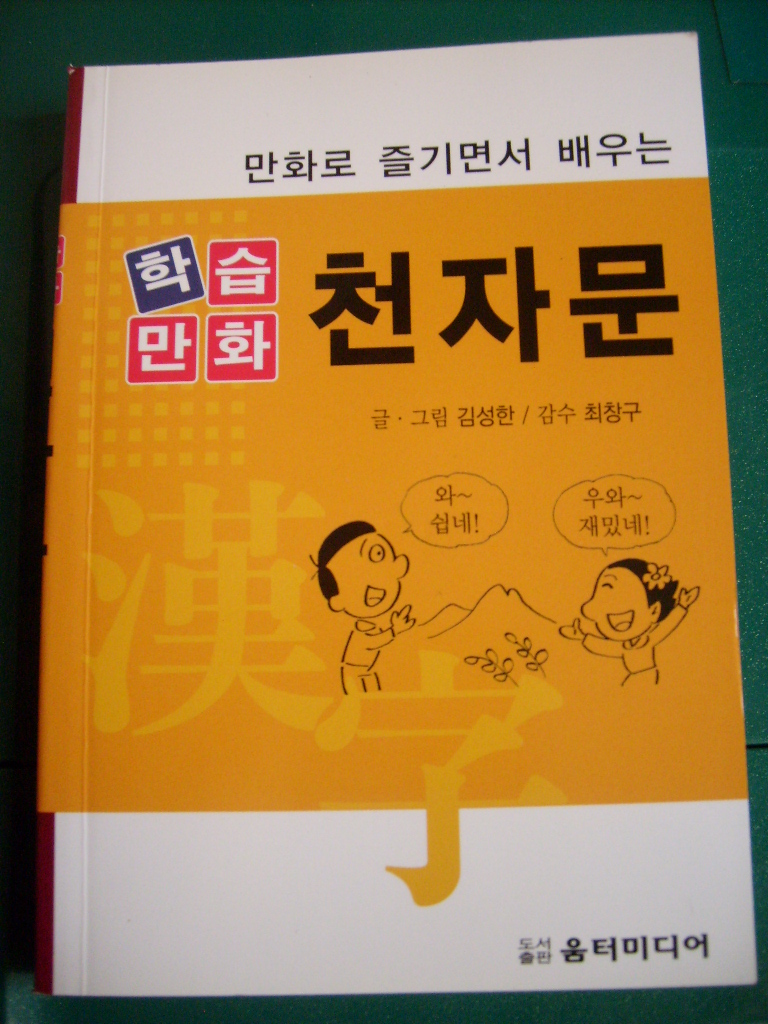
Pocket size Ch'oen Cha Mun
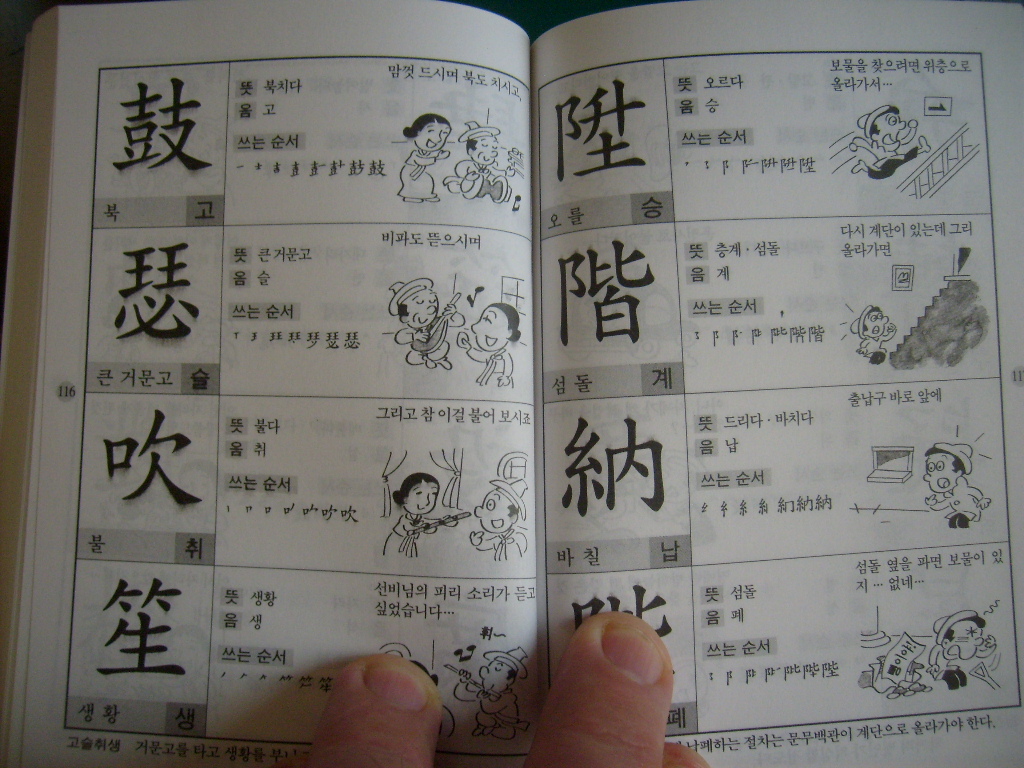
Clear text but as would be excpected, no English translation
Cost – 5000 Won.
© Nick Elwood 2010. This work is licenced under a Creative Commons Licence.


 Elwood 5566
leave a comment