
Minimal Intervention – Toilet Technology
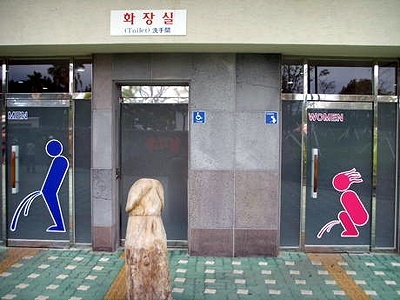
but what;s inside is a gamble
This month the Korean census is being compiled and on Sunday afternoon I was visited by a friendly woman who took my details. Handing me the census form to complete, I sat at my desk by the front-door while she knelt on her knees so her shod feet hung over the small entrance where you leave your shoes. From that position she could just manage to offer me assistance without taking her shoes off and entering my one-room proper. With her at my feet looking up, I felt a little like a Buddha.
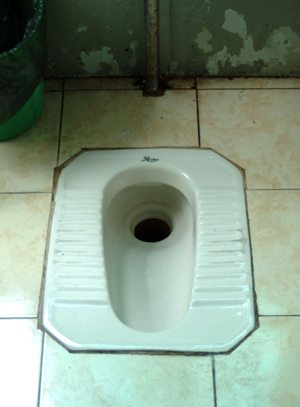
an unpleasant experience and even worse if there's no toilet paper
One of the questions on the census asked if my ‘one-room’ toilet is ‘sit-down’ or ‘squat’ and it would seem that the ‘sit-down’ toilet is more desirable or ‘classy’ than a ‘squat’ job and this might suggest that the proliferation of such toilets is part of the ‘westernization’ of Korea. Not only are Koreans being encouraged to eat western shit in the form of fast-food, but they are being encouraged to expel it whilst seated. I’ve had my fair share of squatting in countries like India and Morocco and having to do so in Korea always reminds me of unpleasant digital incursions necessitated by a lack of toilet paper. Of course, Korea has toilet paper, or at least it’s available but if you’re using a toilet away from home there is a probability that both the toilet you are forced to use and you yourself, are tissue-less and hence a digital dredging will be required. Last time I encountered such a situation I was fortunate that both a hose lay in the cubicle and a handkerchief in my pocket (Emergency Dump)
Personally, the idea of squat toilets are rich in unpleasant associations but they do offer some advantage on the seated toilet bowl. Firstly, they conform to the Korean ideal of ‘well-being’ in that they ideally align the body to provide the greatest expulsion of waste and in the process help reduce or retard the development of hemorrhoids. Secondly, much less ‘skinship’ is required squatting and most notable are the fact you don’t have to sit on what is a public seat and neither do you have to reach for the sheets from a communal toilet roll. Nothing is worse than having to sit on those stainless steel toilets in British public conveniences which look great if regularly cleaned, but when not are tarnished with stains of unspeakable origins.
I notice many K-bloggers don’t like squat toilets but for those who have traveled and have more than one frame of reference, even the worst Korean public toilets aren’t that bad; they actually have partitions and doors, are usually made of porcelain, have running water, and there’s never a sea of shit six feet from your backside. Regardless of where you are in the world, shitting anywhere but in your home is a gamble and the worst you can expect in Korea is a lack of toilet paper, some bad smells and the need to squat. And unlike some of the more ‘developed’ countries in which I’ve traveled, you’re unlikely to encounter anything ‘seedy.’ I once wet for a piss in a toilet in Denver and what I witnessed can be left to the imagination. Yes; Korean public toilets often lack toilet paper and they can be basic and require that you squat but in the scale of things this isn’t that bad. But Korea is full of surprises and it is just possible to discover that the emergency toilet is not only impeccably clean but creatively designed. Last winter, on my way to Seoul, the bus pulled-in at what in the UK would be ‘motorway services.’ The gents toilet was amazing with a large central, glass atrium which filled the toilet with natural light and under which a large garden flourished. There were even a number of showers. Many bloggers seem to think Koreans have a monopoly on dirty toilets and not only could I cite truly unpleasant toilet experiences, but also that you don’t necessarily need to travel beyond Britain or the USA to find them. I’ve taught in British schools where students would piss or shit on the floor because they thought it amusing and I have even seen examples where kids would jam a whole toilet roll in the ‘S’ bend and then cap it with a shit. Every country has unclean toilets and a lack of toilet paper does not make a toilet ‘dirty’ it just means you should have carried tissues with the same zeal in which you carry a bottled water in summer.
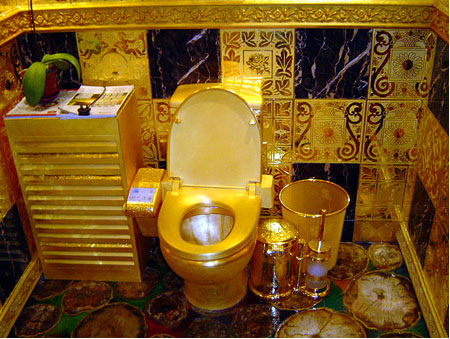
a luxury toilet
I am tempted to refer to the toilet on which you sit as ‘comfortable.’ Of course, this is a culturally orientated value judgment as Koreans do not find squatting, either on a toilet or waiting for a bus, uncomfortable. It isn’t that a Korean wouldn’t want to read a book or newspaper while squatting, but that to do so seated is preferable. The difference is much the same between that of a stool and an armchair; a stool is great for milking a cow or weeding the garden but if you want to watch TV or read a novel, an armchair is much nicer.
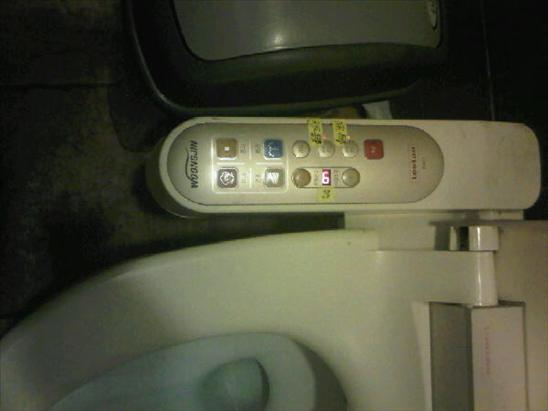
control console
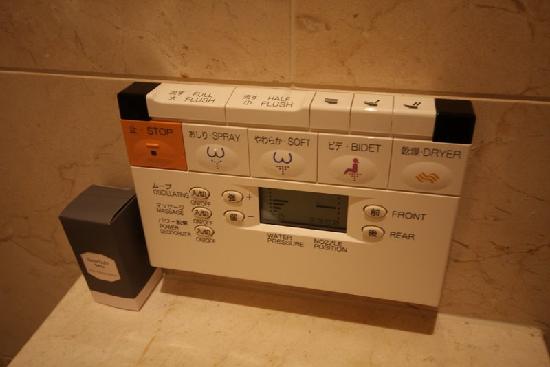
alternative control console
Basically, Korea has four classes of toilet which may be designated squat, seated, luxury-seated and deluxe-seated. The three classes can be further classified by four bands based on cleanliness: very bad, bad, okay, super nice. The UK, on the other hand, only has one class of toilet, ‘seated’ and though UK toilets can be ‘super nice’ in terms of cleanliness, I have yet to witness a ‘luxury’ or ‘deluxe’ toilet though it’s been rumoured for a long time that the Queen has one.
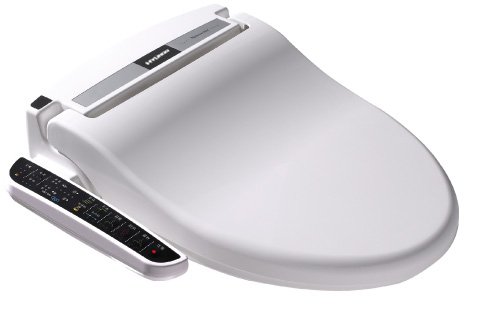
Hyundai's electronic bidet
Both Korea and Japan have taken the western style toilet and transformed it into a luxury item which has invested bathrooms and toilets with the same comfort one would expect in a bedroom or front room. If the ubiquitous British toilet is suitable for reading and relaxation, the Korean luxury toilet provides the comfort in which to enjoy the marathon epics of Tolstoy and Wagner. Many Koreans households now have toilets fitted with an additional tier which is plumbed and wired-in to create a crapper with the same sophistication as the Starship Enterprise. Among the state of the art additions are features such as a toilet lid which raises and closes at the touch of a button or even automatically as you enter or leave the toilet. Koreans love heat under them and so a heated toilet seat is ideal. Cleaning you arse properly never really caught on in the UK and only on the rarest occasions have I ever seen a bidet in a British home. A recent survey revealed 1 in 4 British commuters had fecal matter on their hands (Telegraph. UK) which would suggest either sinks by a toilet are a rarity or us Brits wash our hands in the toilet bowl before flushing it. Meanwhile, over 70% of Japanese households have a bidet and Korea is rapidly catching up.
Korean toilet fixtures provide a high-tech control console from which to activated a bidet and by which the temperature, force, and location of the spray are controlled. Once douched, an anal-dryer kicks-in and blow-dries the entire area. So, far, only one digit has been required to complete a procedure that formally required at the very minimum, an entire hand. Equipped with musical accompaniment, the ability to automatically inject a variety of scents into the air as well as instantly sucking out foul smells from almost the exact point of their origin, deluxe models sanitize the entire process and take poo-ing where no one has gone before.
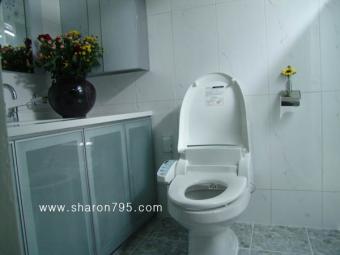
a luxury toilet (link to 'Sharon')
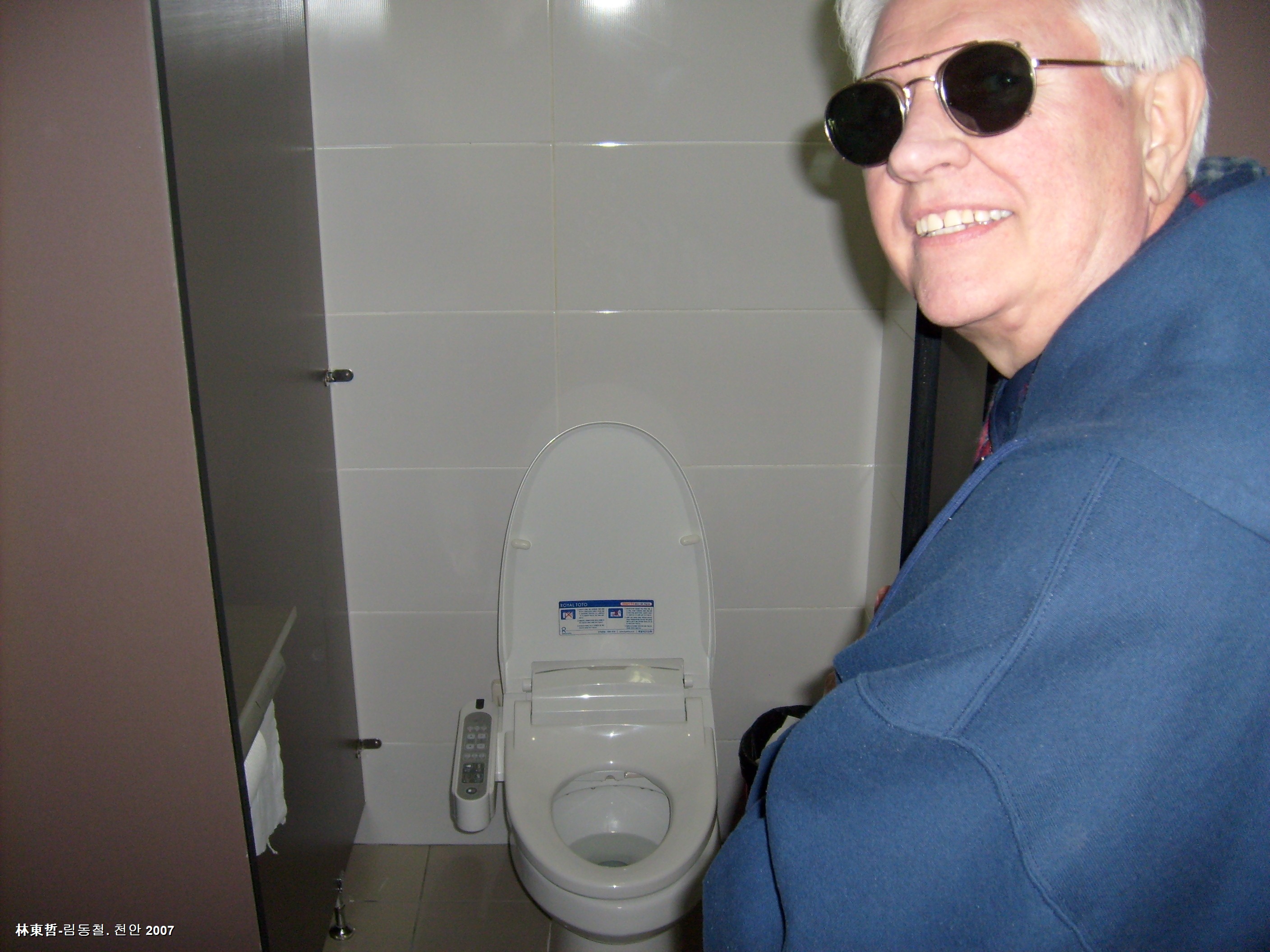
A luxury toilet in my last high school
There seems to be some discrepancy about whether toilet paper should be used before activating the bidet. Some sources suggest ‘wiping away’ excess matter, some suggest ‘patting’ it partially clean, which I guess means removing any ‘crumbs’, while others opt for the immediate activation of the anal shower unit. I guess it all depends on the consistency of your crap and certainly, while you might be able to ‘pat’ a bum clean that has just expelled the remnants of a Korean diet, a western diet will render a much stickier, chocolaty mess totally impervious to anything but a vigorous wiping. The luxury of a hands-free crap, of cleaning your backside without any form of manual intervention is probably only possible on a diet high in fibre and as most waygukins who eat Korean food on a daily basis, will testify, this is achieved when what you expel looks much the same as when ingested. If the contents of your toilet bowl resemble last nights kimchi-stew, your bowels are blessed with ‘well-being’ and a bidet will free your hands completely.
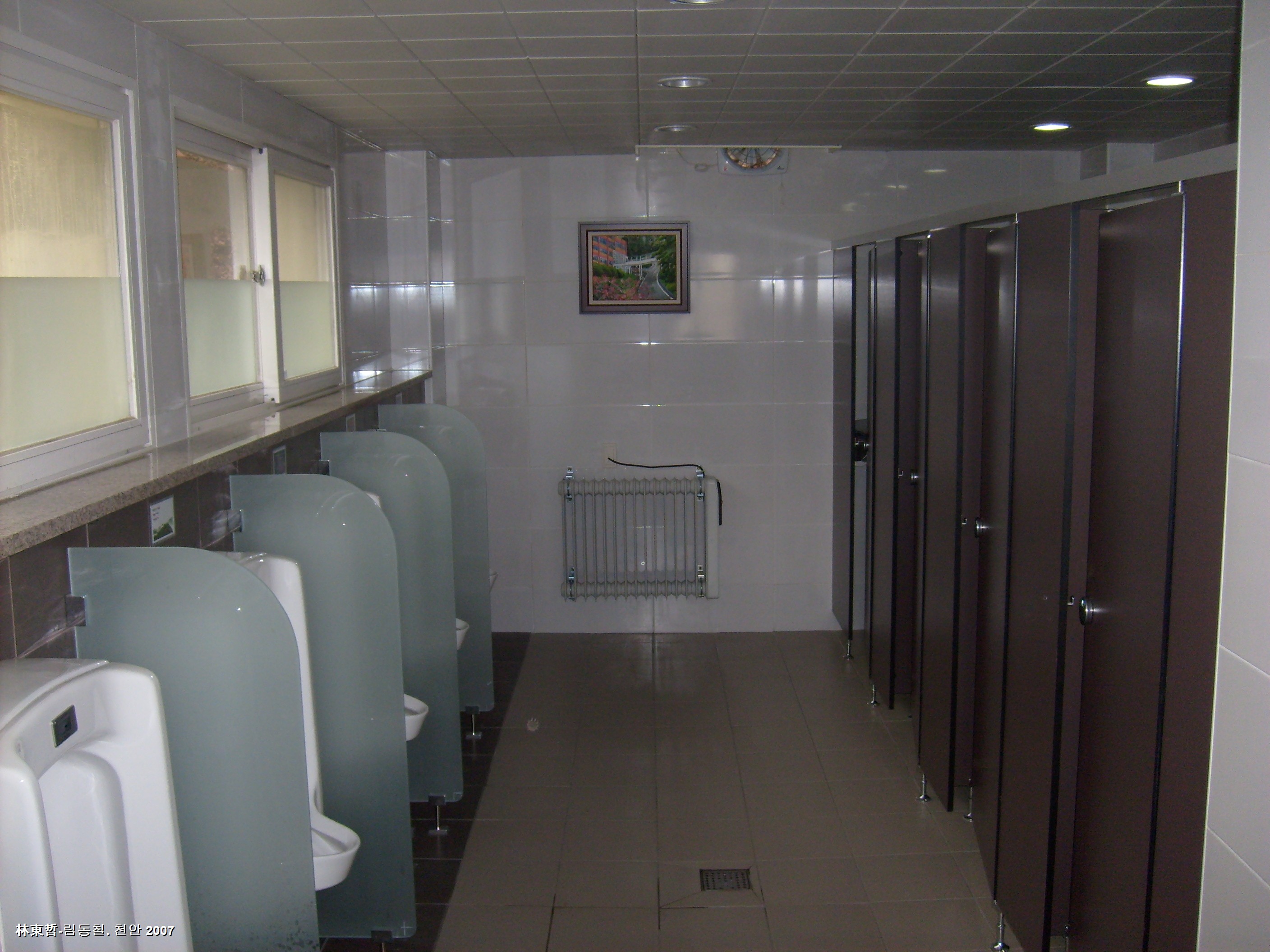
High School toilets, when kids clean them themselves they are less tempted to piss or shit on the floor
And often other luxurious bathroom innovations can be found. I worked in one academy where a kids toilet had been designed and not only were there a miniature urinal, sink and sit-down toilet, but the room itself was less than two meters high and the door by which you entered was miniature. The entire bathroom was like something from a doll’s house.
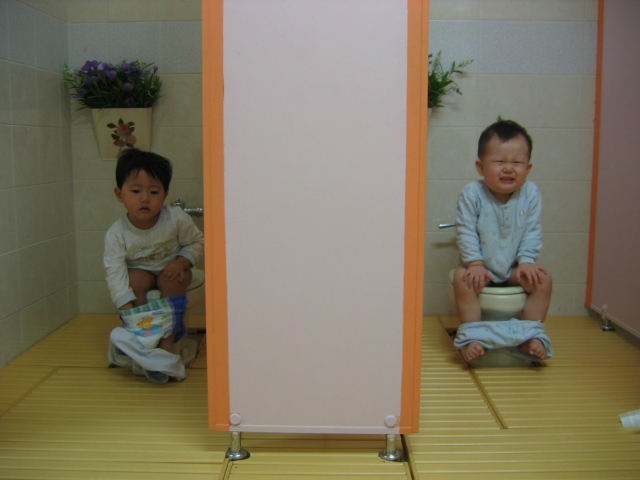
toilets for kids
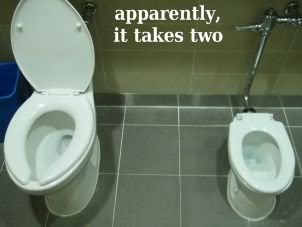
great idea
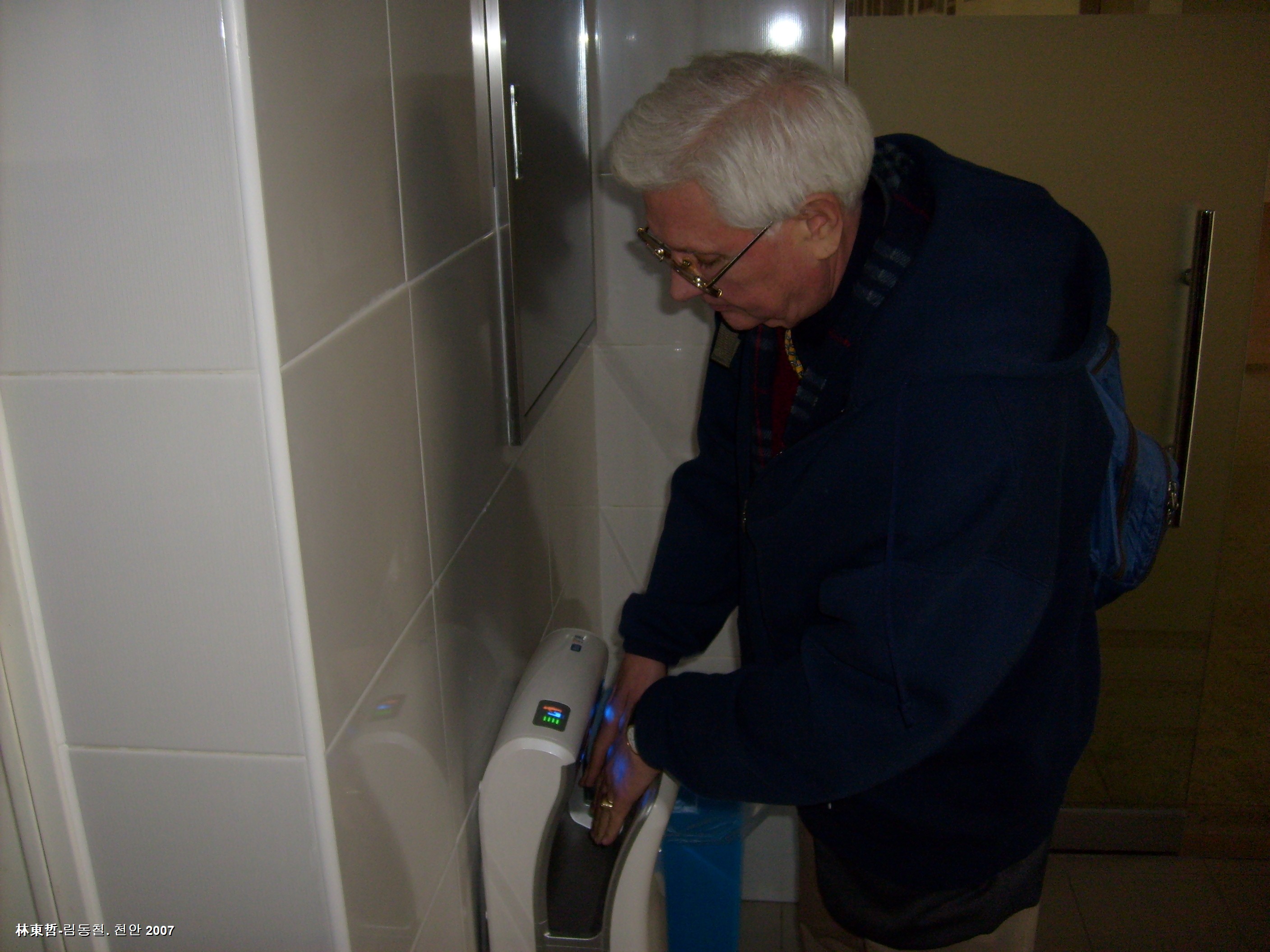
For super clean hands, even after crapping 'hands-free' style, nothing purges loitering microbes like the ultra-violet hand dryer.
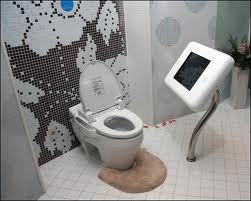
Korean toilets, the shape of things to come...
There is so much more to Korean toilets and ablutions than squat loos and lack of toilet paper and putting up with a little discomfort, which could just as well occur ‘back home’ seems to distract some many bloggers not just from what else is out there, but also the usefulness of their experience as a subject. So, next time you find yourself caught short and in a squat toilet with no tissue paper…

and then go write about it!
Related Articles
- Squat for a healthier poop (mnn.com)
- Toilets: Japan power behind throne (search.japantimes.co.jp)

© 林東哲 2010 Creative Commons Licence.
Five Second Hanja (8) Volcano – 화산

Volcano - 화산
The compound character for volcano is produced by combining ‘fire’ with ‘mountain.’
Simply highlighting some of the important and simpler characters. For information on stroke order, radicals and the two elements of a character (spoken – meaning), I suggest you obtain a dictionary such as; A Guide to Korean Characters.
© 林東哲 2010 Creative Commons Licence.
Quality of Life
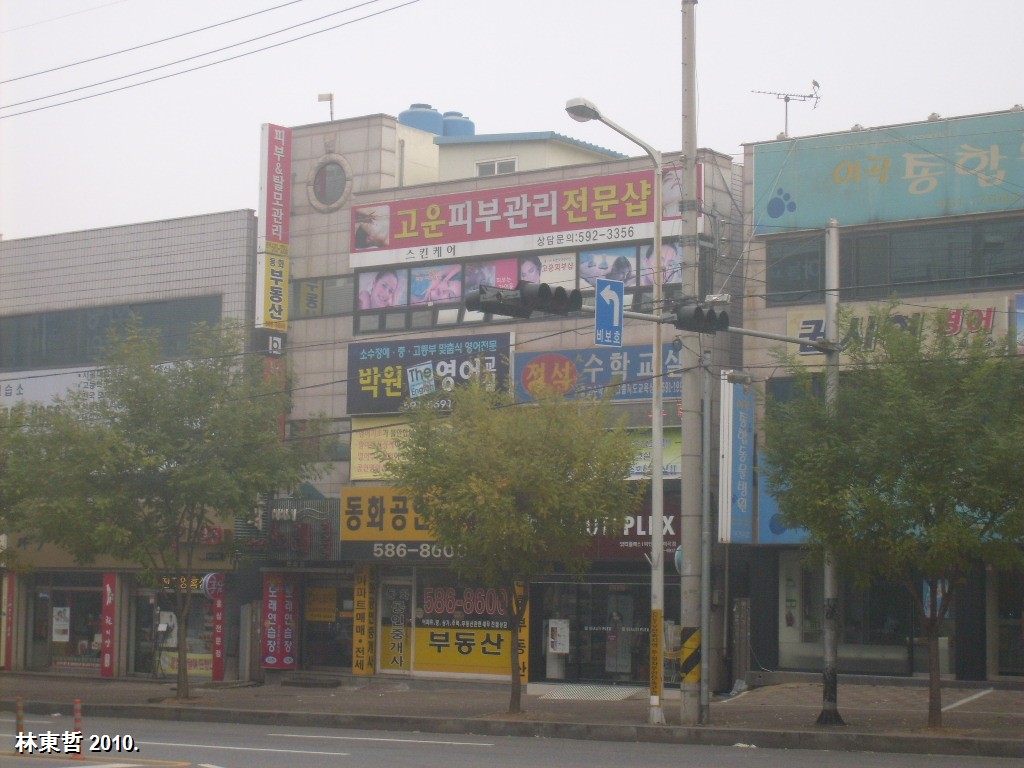
고운 Skin Clinic, and to the right (hidden by tree) an animal hospital. Both less than 1 minutes walk from my one-room
One reason I find Korea a more enjoyable place to live is that they have not yet learnt to be as efficient money grabbers as some western countries. Yes, Korea is capitalist but it is certainly not as aggressively exploitative as the UK or indeed much of the western world. Of course, bad things happen in Korea, like anywhere else, and without doubt political and corporate corruption exist here as much as in Britain where a ‘forgiving’ population has effectively pardoned the recent greedy excesses of politicians. The things I like in Korea are possibly destined to disappear in the greed which seems to epitomize aggressive capitalism but until then, here some of the benefits I enjoy.
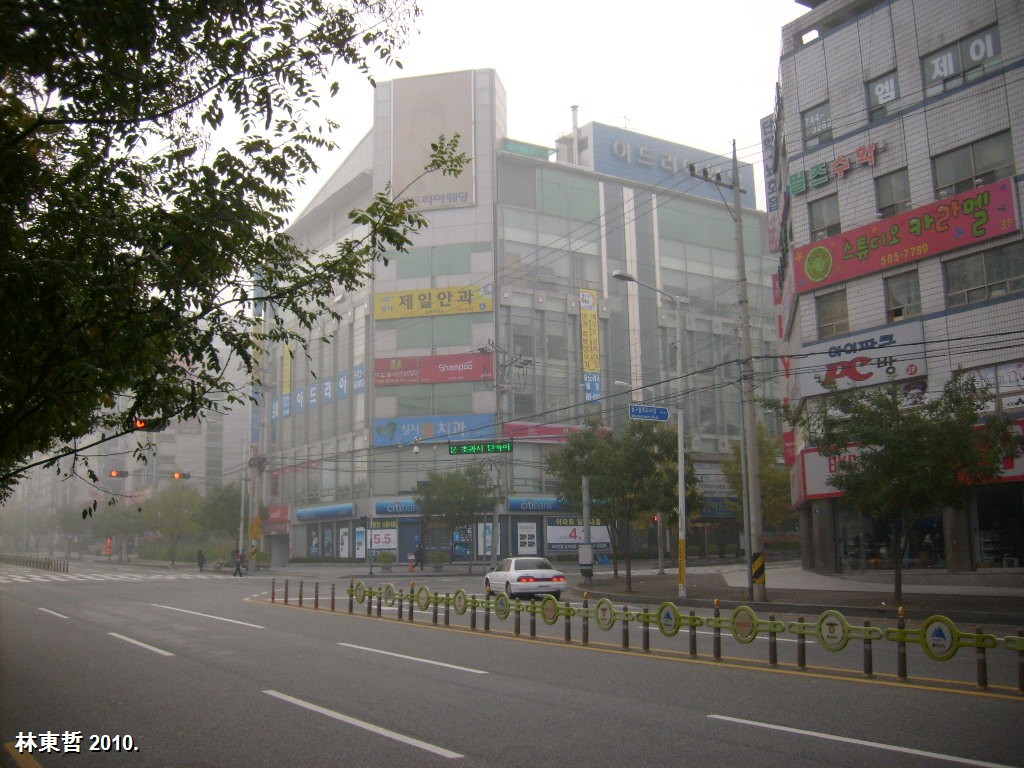
'Best' ophthalmic clinic and 'Beauty' Dentist - 2 minutes walk from my one-room
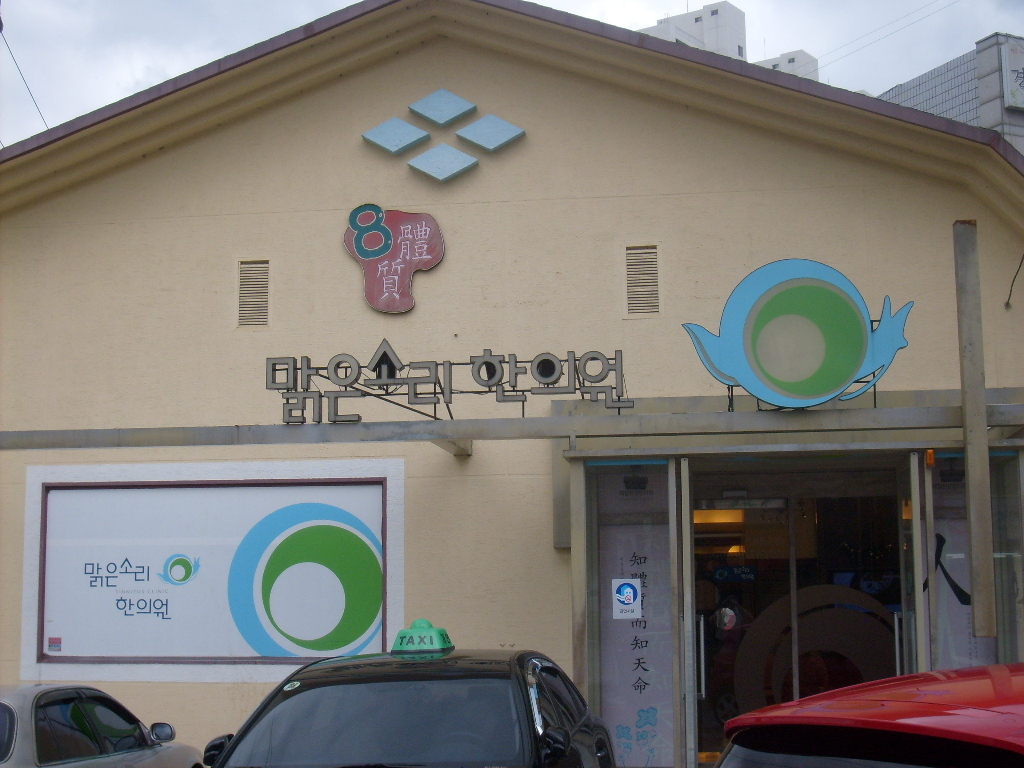
a tinnitus clinic less than 30 seconds from my one-room

specialist hospital some 4 minutes walk from my one-room
I love the idea of ‘service’ (서비스) that shops and restaurants offer to loyal customers. A few weeks ago I recorded and wrote about the ‘concessions’ I earned (see: Freebies) in a seven-day period, and which amounted to 20.000 Won (£10). I had free onion rings, quite a number of free beers, garlic bread, small bottles of vitamin drink and was given 1000 Won (50 pence) discount for medicine, by my pharmacist. Being given a ‘service’ immediately puts you, the customer, in a ‘ special relationship’ with the business and though you can reject it and immediately ‘shop’ elsewhere, it is rewarding and re-energizes my belief that humans are not all money grabbers. There is much more a sense in Korea that a customer is important primarily because smaller businesses vastly outnumber the large ones where in terms of customer numbers, your individual allegiance is unimportant. In Home-Plus or Tesco’s UK, my own opinions and importance are marginal and quite often the response to my complaints summarized as: ‘your expectations and tastes are obviously higher than the average customer.’ With a multitude of small businesses in the form of shops, restaurants, markets and street vendors, your importance as an individual customer in Korea, is of more significance. The practice of being able to negotiate a discount for large purchases is an added bonus.
I’m crap at wrapping gifts but in Korea this is a complimentary service and I’m sure the wrappers have had special training. In the UK gifts are usually only wrapped at Christmas and in the season of goodwill, the biggest hypocrisy of all given it’s the greediest period of the whole year, you can expect to be charged for the service. When I hand over £3-4 (6000-8000 Won) for the wrapping of a gift which I have just paid £40 (80000 Won) I really feel ripped-off. You can shop your entire life at small businesses in the UK and in all but the rarest of occasions can you ever expect reward for your loyalty.
six assistants in one opticians store
On my last visit to the UK, almost a year ago, both my local supermarket, Tesco’s, which in Korea masquerades as ‘Home-Plus, and one of the large, do-it-your-self stores, B and Q, were introducing automated checkouts. As I stood in a queue in B and Q, a number of assistants were on hand to help familiarise customers with the new machinery that would no doubt put some of them out of work. Shopping in either of these stores is unpleasant as the are both gargantuan warehouses where cameras outnumber staff 10-1 and seeking help requires several laps of the premises only to find the teenage assistant has no idea where anything is. The automated checkout had been programmed to welcome customers and provide basic instructions and I was pleased to hear a number of people in the queue voice displeasure at yet another facet of customer services being relegated to a brainless machine. Despite the fact the moaning will achieve nothing and that by this time next year the automated checkout will be fully accepted, I too voiced my dissent. Of course, what separates me from other customers is that not only are my ‘expectations higher than the average customer,’ but the lengths I am willing to go in revolt verge on the lunatic. My Luddite tendencies would not think twice about squirting superglue in the slot designed for a credit card and I can wage a solitary regime indefinitely. Gramsci once suggested that even shopping is a political activity and I can take mine to the extreme.
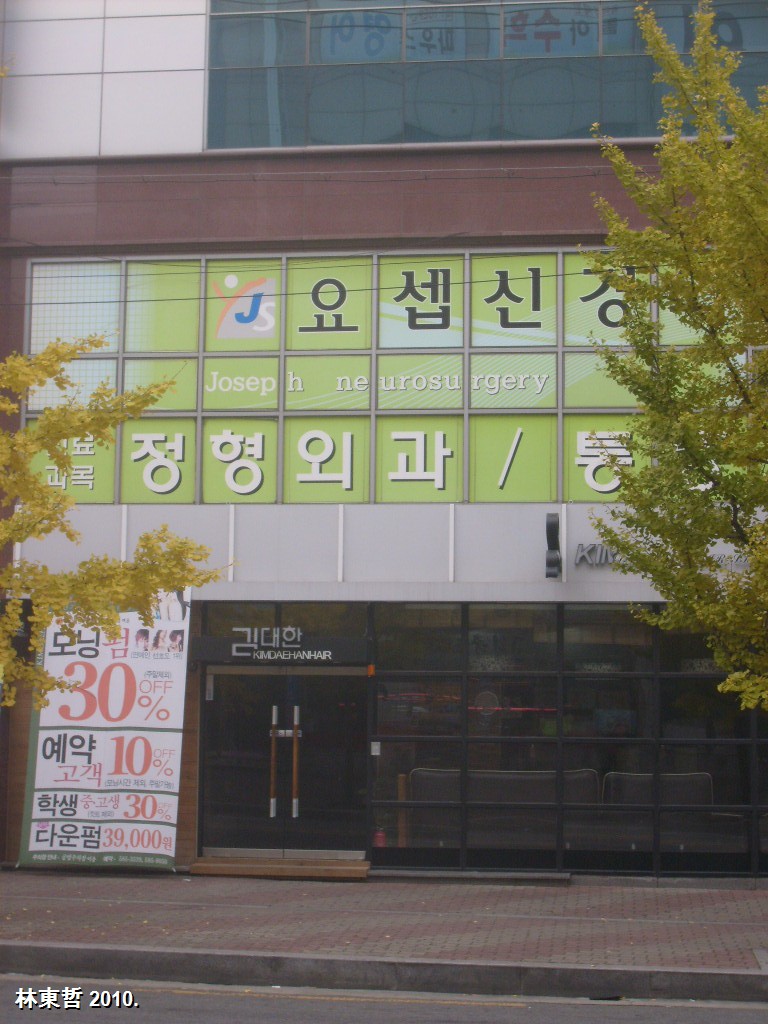
3 minutes walk from my one-room, directly opposite my academy - 'Joseph' neurosurgery
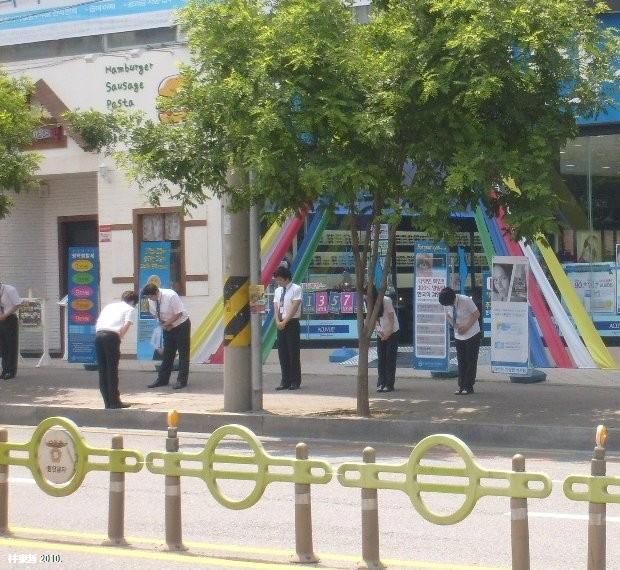
When I went shopping yesterday, in my local E-Mart, I counted 4 pairs of staff on duty at each point of entry onto a level of the supermarket. As customers entered a level they were greeted with synchronised bows and verbally welcomed. Apart from the checkout assistants in stores not yet fully automated in the UK, eight members of staff is probably about the number employed on the entire shop floor of a British supermarket. In Korea, customer support isn’t a luxury but an expectation and there are always a couple of staff employed for every section of shelves and assistance is never more than a few meters away. Parking your car, a subject a broached in Ear Piece Mania, can entail as many as 10 parking assistants all of whom are trained in the intricacies of the bizarre hand signals used within Korean car parks. In the UK and many other places, customer support and adequate staff to assist shoppers, are either relocated in somewhere like India or have been viciously culled in the drive to maximize profits.
The first of an army of car parking attendants encountered in parking your car in the supermarket car park
Several years ago a faulty USB port on my computer damaged my camera and electronic dictionary but this was no worry. Most companies, especially ones such as Samsung, Iriver, and mobile phone manufacturers, have service centers in every major town. For eighteen months, one of the Daegu service centers for Samsung was next to my academy, until it moved a five-minute walk down the road. Regardless, there will be a number of other Samsung centers in the city. Iriver, the manufacturer of both my MP3 and my palm reader are twenty minutes down the metro-line and the service center for my Nurian electronic dictionary, is five minutes away by bus. So, whenever I have had some problem, customer support is on hand, easily accessed and the product repaired and back in my possession within days and possibly quicker. On two occasions, mobile phone problems were repaired while I waited. When I recently had my camera repaired in the new Samsung service center, it took three days and when I went to collect it, it was wheeled out from the an adjacent room on what I can only describe as a cake trolley. Much the same support is available for computer problems and a computer service shop is located less than two minutes from my one-room. Meanwhile, in order to keep frustrated customers at bay and continue operating a second-rate service, a token service at best, UK service centers are located in the furthest corners of the country and require your faulty goods to be ferried away by courier service. And to ensure they can operate a slow service that is cheap to run, all public interface is removed and the call center relocated to Bombay or Bangladesh.
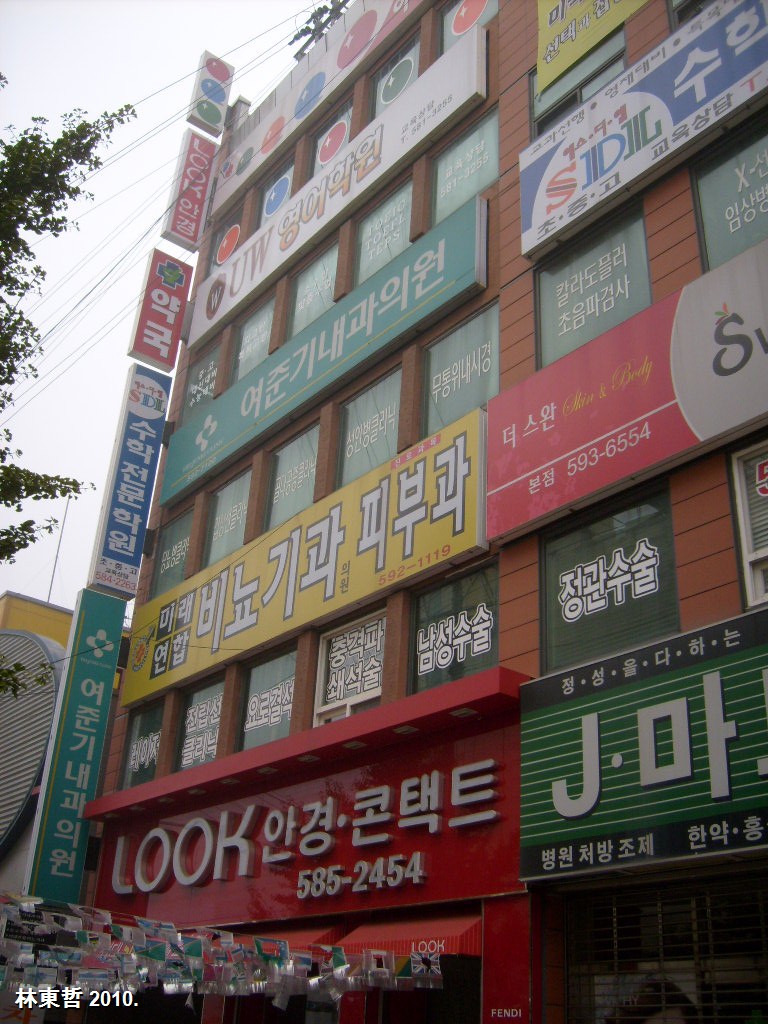
directly behind my academy, 'Future' urology clinic above which is my doctor
Korean medical care is efficient and there are more doctors and medical facilities within a six-minute walking radius of my one room than there are be in my entire home town. Indeed, 4 hospitals are within a five-minute walk, and in less time than it takes me to walk to work, three minutes, I can reach two ophthalmologists, 6 opticians, urology, cardiology, neurology and ENT clinics, and a women’s’ health center. In addition, there are probably 5 dentists, a number of skin clinics, and a dietitians and two veterinary clinics. Remember, Korea is much more up than out and one high-rise block can contain more facilities than an entire British street where commercial businesses traditionally and almost exclusively, occupy the ground floor. A few weekends ago, the husband of one of my colleagues needed an MRI scan after though I’m told there are a limited number of such facilities in the city, he was able to get a scan on the day he needed one and at a cost of 111.000 Won (£56) after deducting the amount provided by insurance. My colleague actually moaned that this was too expensive. Visiting the doctor involves a wait of no more than an hour and I don’t need to make an appointment. Even without Korean medical insurance the cost of a visit is no more than 7000 Won (£3.50) while the cost with insurance, is an ‘extortionate’ £1.50. And the greatest advantage for anyone living in or near a Korean city or big town, is that most medical needs do not interrupt your daily life. When I have needed anything other than minor medical assistance in the UK, I have usually had to travel a substantial distance and then sit in various queues for several hours. All clinics in Korea have tasteful waiting areas with televisions, complimentary tea and coffee etc, and very often a couple of computers with free internet access. Admittedly, I hear and have seen examples of doctors and nurses not following universal procedures, but back home despite our rigorous rituals hospitals are still plagued with skin eating viruses and for every account of bad practice I experience or read about on the Korean peninsula, I can match them with corresponding ones from the UK. At least when I spot something unsavory in the Korean system, I do so in comfortable surroundings, with a complimentary coffee while watching the television and all without sitting in long queues which have necessitated taking the day off work.
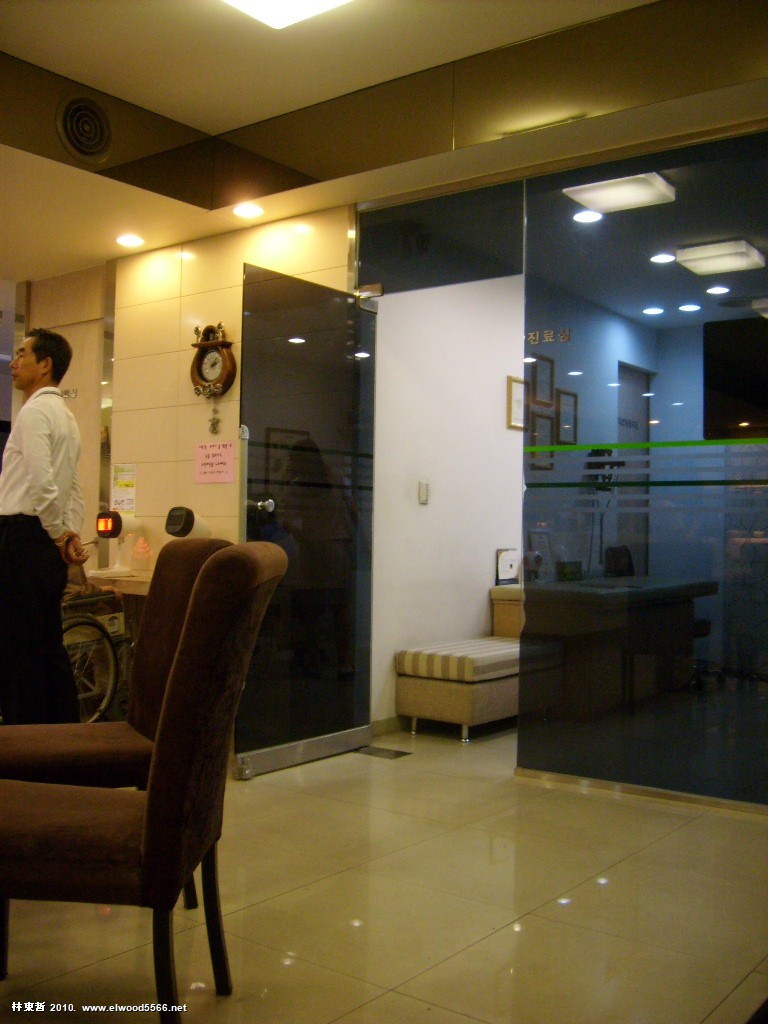
a sneaky shot of my local ophthalmic clinic

a wide variety of side dishes usually replenished at no cost
With eating is my main pleasure, the ample amounts side dishes that accompany a Korean meal and which can usually be re-ordered at no extra cost, is enjoyable. The recent cabbage shortage (Ersatz Kimchi in a State of Emergency) saw prices rise to 10000 Won (£5) for a large cabbage and caused subsequent problems with kimchi production but rather than just hike the cost up, and subsequently leave it high even after production costs have fallen, as happened a few years ago with petrol prices in the UK, most restaurants in my area decreased kimchi and salad amounts and to compensate increased the portions of meat. My local bo-sam restaurant (보쌈) doubled the slices of pork from 7 to 14 and has only recently reduced the number as the price of vegetables, and most especially cabbage, has decreased. In restaurants, chilled water in summer, and warm water in winter are complimentary and a can of coke is usually the same price whether chilled or not. In recent years, especially in hot weather, it has become a trend in the UK to charge up to as much as 1000 Won (50p) extra for the privilege of a cold drink, especially in extremely hot weather.

A Samsung service center
In Britain, unless shoes are leather it is difficult getting them repaired and for items like trainers you don’t repair them at all. Over the years we have been encouraged to sling things out and replace them as soon as they are worn. In Korea you can easily have the worn collars of shirts reversed and repairing shoes with rubber soles, including trainers, is easy. I had my rubber shoes soled and heeled almost a year ago whereas in the UK I would have been compelled to throw them in the bin.
Need a pair of glasses? It would probably work out cheaper to fly to Korea and buy a few pairs than pay the excessive charges levied in the UK. There is no charge for the eye examination and the price of frames begin at about 15.000 Won (£7). I have three pairs of glasses and all have frames costing less than 20000 Won (£10). Koreans love colourful frames and the range available, extensive. Cleaning cloths and cases for glasses are all free and the cleaning clothes cute and decorated. A pair of varifocal glasses, with the glass graduated so they look like ordinary glasses, costs around 200.000 Won (£100) and outside one of the opticians within a minutes walk of my one-room stands a special electrical device which you can use to clean your glasses. It’s free to use! Since optical care was privatized in the UK, the British have been abused by high street companies ripping them of. You can easily pay in excess of £300 (600.000 Won) for a pair of varifocals but the monopoly held by such greedy companies is being seriously threatened with the emergence of online opticians.
There are many flaws in the Korean system and I probably turn a blind eye to many of them, but with all the advantages I have outlined, plus a national tax of around 3.3%, (my monthly bills, including tax, all amount to a grand total less than that I would pay for the lowest of my monthly utility bills in the UK), I do not feel I am being fleeced or financially raped. Unlike many western countries, quality of life doesn’t cost and arm and leg.
Further Links
© 林東哲 2010 Creative Commons Licence.
A Touch of Tranquility – Update (1)
This article was originally published in Daegu Pockets in October 2010
All bathhouses have their own unique ambiances created by a combination of lighting, décor and design. Additionally, they differ in terms of what they offer. Bathhouses all have common features but every bathhouse provides something that differentiates it from other establishments in the vicinity.
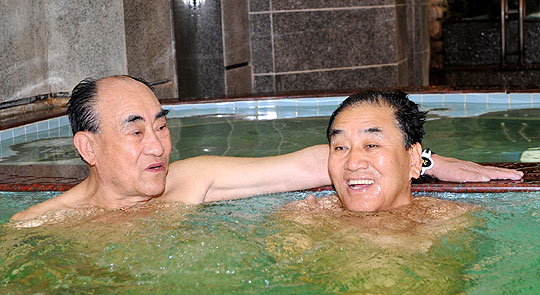
Poolside
Situated in the very heart of Song-So, in the Mega Town Complex, which not only dominates the area physically, but in terms of facilities, boasting a large cinema complex, buffet and pizza restaurant and numerous other amenities, Hwang-so has gradually grown on me. My first visit was on a cold, dark November morning when I arrived to find the premises packed with a class of school boys – not the kind of atmosphere you want at 5 am and on your visit to a bathhouse in a number of years. I found it small, noisy and claustrophobic and didn’t go back.
I have since learnt that if you want peace and tranquility it can be found in the center of this bustling building and that school-boy invasion a blip that can temporarily blight any bathhouse.
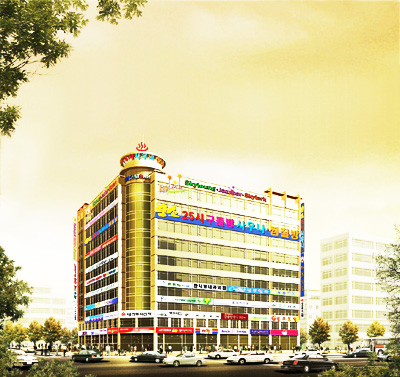
Song-So's 'Mega Town' Complex - I minute from my front door
The reception to both the male and female bathhouses are on the eighth floor and once you have stripped to your birthday suit it’s only a couple of paces into the bathing complex. Here you will find a very intimate atmosphere with black marble tiling, low lighting and even some slightly darkened areas. Hwang-so is certainly not a large bathhouse. Four central baths, all internally lit, provide a water massage pool, warm and hot pool, and a bubbling Jacuzzi with herb additives. A large cold pool occupies one end and completes the facilities found in every bathhouse. As for the complex’s specialties, you can enjoy a Japanese style cypress bath (히노끼탕) and my favourite, a humidity sauna (습식 사우나) where water sprays from the ceiling like the finest, warm rain and is so fine it hangs, caught in subdued lighting, like heavy mist. A massive rock bowl sits in one corner and is filled with cold water which you can throw over yourself when you get too warm. Additionally, the seats in this sauna are cut from tree trunks and their woody aroma scents the air. Adjacent, is a Swedish style pine sauna with very low lighting. I have come to really enjoy the tasteful complimentary additions such as, water features, rock, and chunks of pine tree, which occupy various nooks and crannies.
The changing area is fairly spacious with central slatted benches and sofas plus the usual television and a resident barber. From this area, the jjimjilbang, the clothed, mixed sex communal area, on the seventh floor, can be accessed.
Unless you simply want to shower, you should never frequent just one bathhouse anymore than you should eat one type of food. Different establishments provide different experiences and to capitalise on this you need to a few alternative which can be matched with your appropriate moods. Hwang-so has no poolside television or piped music and swimming or playing in the cold pool is not allowed. If you find yourself in Song-so with a hangover or simply want to relax, this is a great sanctuary. My only criticism, there is no sleeping area within the pool area.
Link for information and details on Hwang-So Sauna
© 林東哲 2010 Creative Commons Licence.

Monday Market – The Intricasies of Persimmon – 감
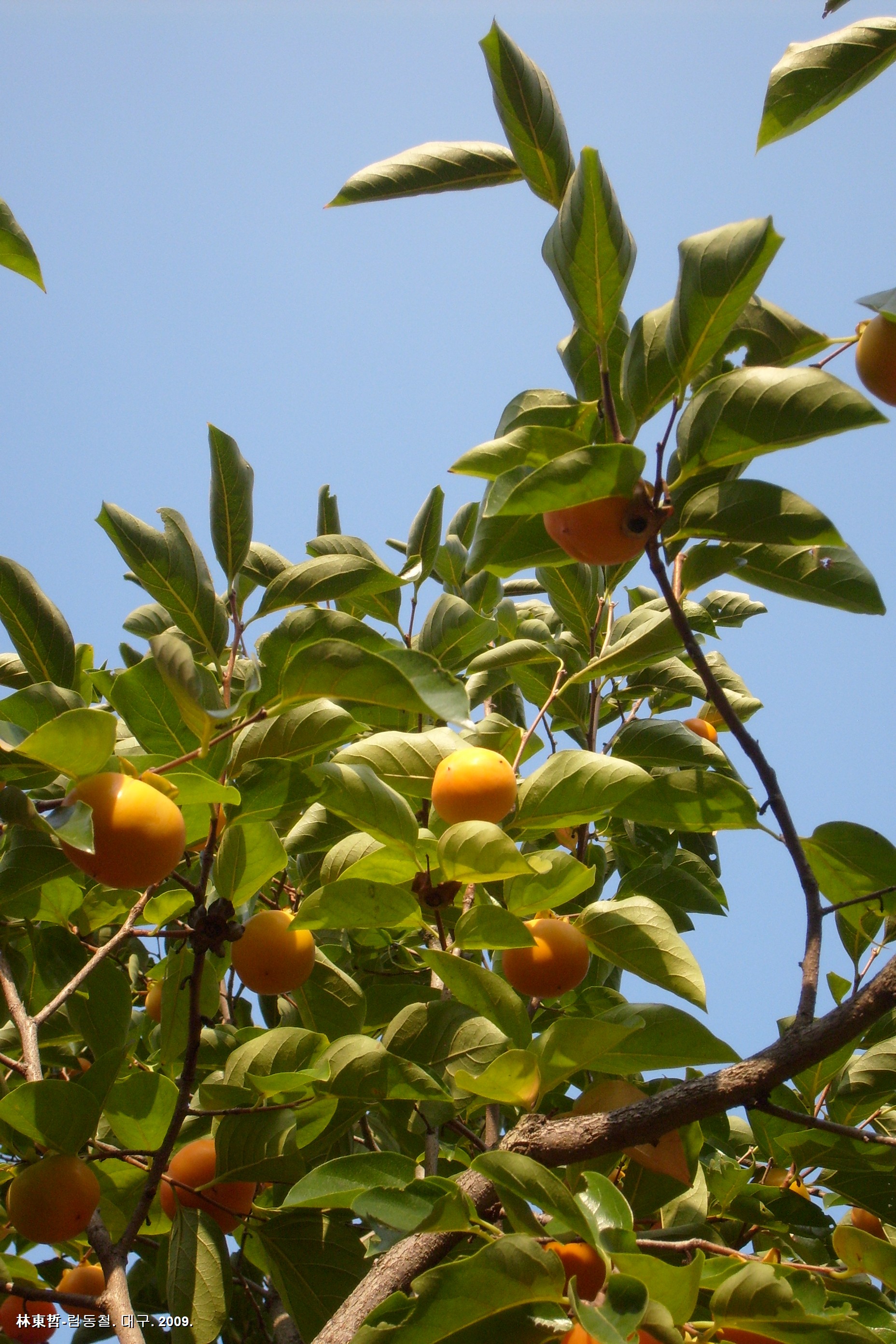
persimmon tree
You know the cold weather is well on its way when the various nuts and persimmon begin to appear in markets. Persimmon (감) appears in several varieties both astringent and non-astringent. The non-astringent variety is eaten hard, almost the same hardness as an apple, and the the astringent variety can only be eaten in a soft and pulpy state.
The harder, non-astringent variety is known as dan-kam (단감) and it is the smaller and rounder of varieties which is a much lighter orange often with a tint of green. At first glance it often resembles a slightly unripened, large tomato.

dan-kam 단감 persimmon

as dan-kam often appear in supermarkets
Hong-shi (홍시), are a much larger variety and a little heart shaped and they vary in softness between a ripe tomato and a very soft bag of jelly.
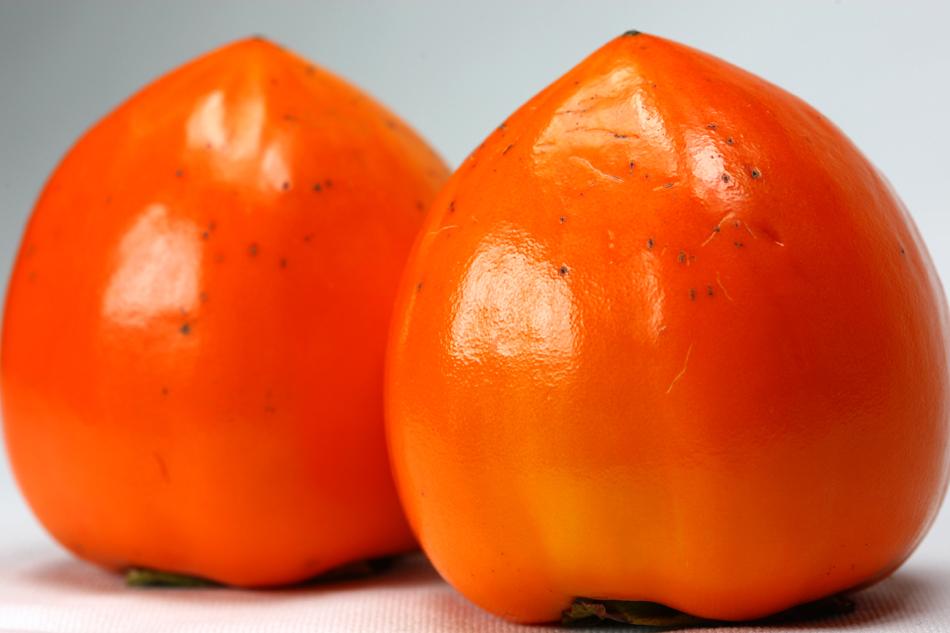
a hong-shi (홍시) persimmon, bright orange, large and heart shaped
Another soft variety, almost identical in taste and texture to the hong-shi, is the yeon-shi (연시). This is similar in shape to the dan-kam but much darker, brighter orange and soft.

yeon-shi 연시 similar in size to the dan-kam but eaten soft
Yeon-shi and hong-shi are very sweet and in their ripest state, resembling a bag of jelly, need to be transported with care as they burst very easily. Both types are perfect for freezing, losing non of their sweetness and I have had no problem keeping them well into spring. What flavour they do have is very mild but their jam-like innards are enjoyable.

an abundance of market yeon-shi. (The universality of green grocer's spelling; unless mistaken, these are not hong-shi and further, 'shi' is spelt incorrectly.
G’ot-kam (곶감) is a different astringent variety again and is usually dried. The fruits are often left hanging on trees to be bleeted by the first frosts which speeds up the ripening process prior to drying.They are quite delicious and similar to dried apricots.

got-kam 곶감
To confuse matters further, both hong-shi and yeon-shi can be bought unripened but they are not pleasant to eat and may cause stomach blockages (phytobezoars). In the unripened state they are known as daeng-kam (땡감) and should be allowed to ripen which can even take place at room temperature (around 20 degrees).
Persimmon Uses
Dan-kam is cut and eaten like an apple while softer versions can be cut as you would a boiled egg and scooped out. In Korea, you are privileged to buy persimmons that are super ripe and I quite like to simply puncture the skin and suck the innards out. It is a very enjoyable experience especially if the fruit is chilled.

persimmon sorbet (Independent UK)
You can also find persimmon sorbet and many some cafes serve hong-shi / yeon-shi smoothies which are quite delicious.
A Korean non-alcoholic drink is based on persimmon,
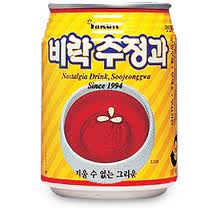
su-cheong-gwha
And then there is persimmon vinegar (감식초) which is what is known as a ‘drinking vinegar’ the drinking of which is seen as health promoting (Link on Korean ‘drinking vinegar).

persimmon vinegar (감식초)
Persimmon leaf tea (감잎차)
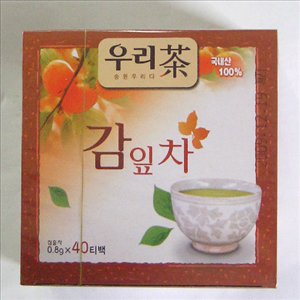
persimmon leaf tea
Some Interesting Persimmon Facts
♦Eating unripened persimmons causes 82% of the cases of phytobezoars, these being abdominal obstructions caused by ingested matter. Unripe perssimmons contain high amounts of the tannin shibuol which on contact with weak gastic acids polymerizes, thus causing an obstruction. Phytobezoar epidemics occur in areas where persimmons are grown and though surgery has sometimes been required to remove them, depolymerization is effected by drinking coca-cola. (see Wikipedia).
♦Recently, persimmon wood, related to ebony, has been used by by bowmen in the traditional manufacture of longbows.
♦Originally, persimmon wood was used to manufacture the highest quality golfing ‘woods’ before being largely replaced by ones made of metal.
♦A persimmon fruit is technically a ‘ true berry.’
♦Sharon Fruit is a trade name for the D. Kaki variety of persimmon which is ripened via chemicals. The Daily Mail article linked below gives some suggestions on using this but in the UK I have found this fruit quite expensive and unpleasant. Leaving the fruit to become soft didn’t seem to work and given they were the size of an egg, no substitute for soft persimmon. Sharon Fruit is definitely an ersatz version of persimmon.
♦And yet another fruit claimed to ward of heart attack. According to the Daily Mail (link below), Sharon Fruit can prevent clotted arteries. However, I’m skeptical as the research was carried out by Hebrew University in Jerusalem, and of course, the fruit is grown in this area.
Related Articles
- Enjoying persimmons from salads to dessert (sfgate.com)
- Seek Out New Life Forms – What is a Persimmon? (chicagoist.com)
- What do I do with Sharon Fruit? (Daily Mail UK)
- Sharon Fruit Reduces Heart Attack (Daily Mail UK)
- Persimmon Sorbet Recipe (Independent UK)
© 林東哲 2010 Creative Commons Licence.
Five Second Hanja (7) Fire – 불 – 화
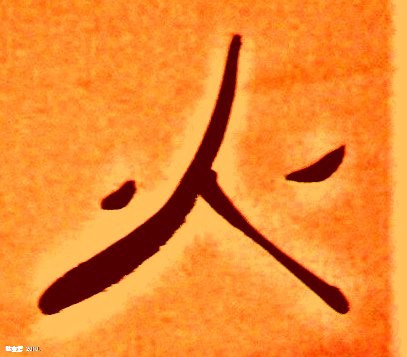
Pictogram. Fire

the similarities are obvious
Simply highlighting some of the important and simpler characters. For information on stroke order, radicals and the two elements of a character (spoken – meaning), I suggest you obtain a dictionary such as; A Guide to Korean Characters.
© 林東哲 2010 Creative Commons Licence.
Memory Lane
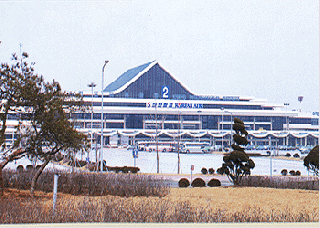
Kimpo Airport
I often mention how rapidly Korea is changing. I have only lived here four and a half years, spread across ten years, so in comparison to friends who have over twelve years experience, I’m somewhat of an infant. I would love to have been here fifteen or twenty years ago, when Korea was truly a country where other than American soldiers, few ventured. ‘Fat ‘has arrived in Korea, an observation I often point out in my posts on bathhouses, and EPIK has brought an army of teachers into schools to such an extent our uniqueness has been lost. And no doubt those who first came to Korea in the 90’s will have noticed even greater changes.
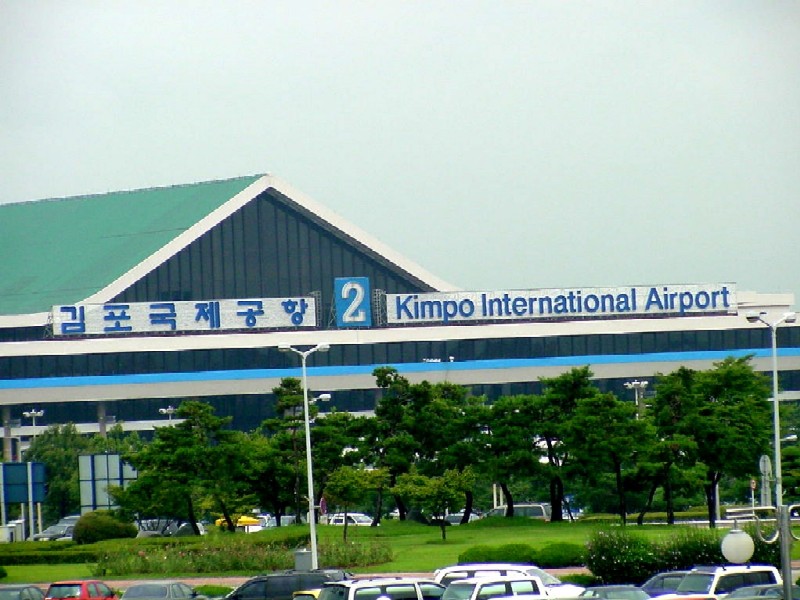
Kimpo in 2000
When I arrived in Korea in September 2000, Inch’on International Airport was still being built and looking back, it is quite incredible to think that the piddly sized Kimpo was the country’s major airport. Kimpo was basically one big room through which people arrived and departed and I’m sure it’s bigger today than it was ten years ago. Few restaurants had English menus and on every street corner were ‘video shops’ renting the latest videos. The internet contained little information on Korea in terms of cooking, culture or history, zilch on hanja and very little on Korean. Few teachers had air-conditioning and for those in English academies, split schedules, a common practice, meant the 6 hours you’d been led to believe you’d end up teaching in Korea, were probably closer to 8 or 9. Maybe it is still the same in some language academies, but class sizes were big, sometimes twenty students packed in small classes and often with no air-conditioning. There were fewer academies and my school, the largest in the area, occupied three floors of a large building. There were few resources, wall sockets often didn’t work and only a couple of tape players if they did and if you complained you were simply told to read to the kids. Most of the westerners I remembered meeting at the time seemed to work under similar conditions. Back then, university posts really were the cream of jobs with significantly more pay than other types of teaching and before the recent changes in bureaucracy, transferring from one town to another or one school to another, was easy.
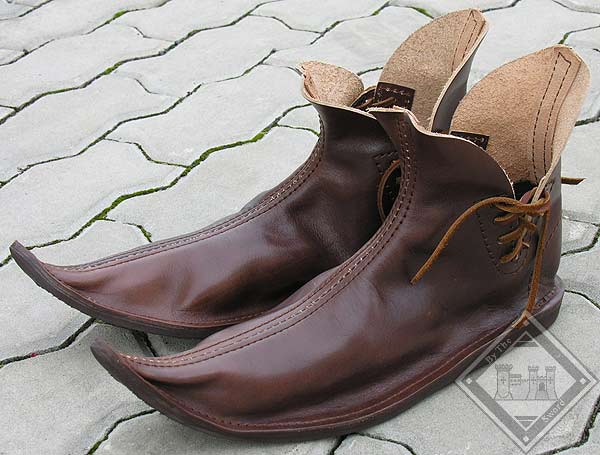
If you had a pair of shoes like this in 2000, you were 'sexy.'
Big shoes were the fashion on young lads. By ‘big’ I mean long and so long that I thought I easily find a pair of English size 13’s. Indeed, they were so long, a little like the old ‘winkle-pickers,’ that they turned up and gave them a medieval appearance. On younger boys, even very young ones, a long forelock on the side of the head was tinted gold meanwhile their teeth were black. While older children seemed to have good dental hygiene, milk teeth were seen as unimportant and many of my younger students had black baby teeth. Today, this is something I rarely see.
Coffee beans or ground beans were hard to buy and I remember a coffee filter machine in supermarkets attracted small audiences and if you wanted a bottle of wine, if you could afford it and could find it, they were stored in a glass cabinet and the choice very limited. It seemed everyone wanted English lessons and were willing to pay for the privilege and being stopped and asked if you would teach privately, was an almost daily occurrence. In my diary for Saturday 18th of November, 2000, I wrote:
Here (KFC in Song-So) I met a man who wanted English lessons and said he would take me sightseeing to temples in return for lessons. Then a boy of about 11 came and talked to me and introduced me to his little brother. Later, yet another stranger came up and asked if I would read stories in his kindergarten and I said I would ring him on Monday.
The KFC near Han-song Plaza has closed and is now a stationary store in which the glass stairs are still embossed with Colonel Saunders’ face, but in the last two years I haven’t once been asked to teach privately by strangers in restaurants or on the street. I used to teach a few privates on a Sunday and would earn around a 100 000 Won an hour for teaching a small class of 3 or 4 students.
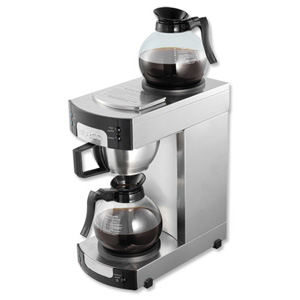
at one time were were as novel as coffee-filter machines and wine
Your presence, especially with children, was often enough for people to stop, gasp and gawk at you in awe. Only yesterday, a boy of 14 told me how he remembers seeing westerners when he was four years old and how he would be filled with excitement. Few schools had resident foreign English teachers and what foreigners existed were a novelty. Many of the children, and some adults, you met ten years ago had never spoken to a foreigner. Then there was the starring… I remember times when the constant starring stressed me to such an extent, I’d occasionally step into a recess or doorway for a break. Unlike today, when a solitary passenger stares lazily from a busy bus, a westerner on the street would turned every head. I imagine it was even more intense in the early 90’s and 80’s and probably not much different to an experience I once had on a station platform in Delhi, in 1984, when a crowd so large gathered to stare at my friend as he opened a map, that after a few minutes you couldn’t see him. In the Korea of today, you are noticed and not much else and it rarely causes excitement or stops people in their tracks.
A few weeks ago I was up Warayong Mountain in Song-So, Daegu; I’d stopped for a coffee at a small stall almost at the summit and was attempting a conversation with a woman sat on the next bench along. I noticed a couple of small children coming down into the clearing where we sat and around which were various communal exercise machines. Suddenly, their faces broke into excitement and they started running and skipping towards my seat. For a moment, it was the kind of reaction I remember on my first visit when kids would run up and then stand and stare, or might bravely attempt to say hello or stroke the hairs on a bared arm. However, ten years later and the focus of their attention isn’t me but the dog sat beside the woman with whom I am talking. The children skip up to it and lavish it with as much excitement and attention as they’d once have given a foreigner. It isn’t even a real dog but one of those ‘handbag pooches’ which look more like a wisp of cotton-wool on straw legs. I could have understood if it had been a real dog, a labrador or sheep dog, but this pathetic specimen! I realised in that instant that this is what it has come to; a miniature poodle now commands more attention, is more interesting and exotic than a foreigner. I am not exaggerating when I add that despite my height and size, and sitting right next to them, they didn’t even notice me.

a puff of wind and it's dead
Amongst all these changes however, one convenient constant; unlike the rest of the world prices have changed little. I bought a hanja dictionary in 2000 at a cost of 15.000 Won and in exactly the same store, nine years later, the same book cost 15.500 Won. That’s an increase of 25 pence in UK sterling! Quite amazing!
© 林東哲 2010 Creative Commons Licence.
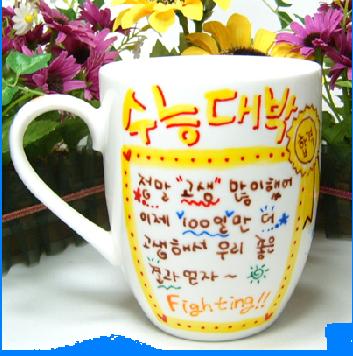


 Elwood 5566
leave a comment