Coffee Break – 'Well Being'
I can never buy biscuits without eating the whole packet shortly after purchase and hence buying them to accompany anything other than one coffee session, is doomed to failure. If the packet does manage to make it back into the cupboard it is probably because they are boring and even then, the chances are they will be consumed within the day.

a pleasantly surprising experience
You can expect your gluttony to be staunchly curbed with the Korean version of morning elevenses; sweet Potato and coffee make an excellent combination and one of my friends even dunks her spud in the brew. I prefer Maxim coffee mix but other varieties are probably just as good and I would imagine milk also provides a suitable accompaniment. Simply microwave the potatoes, sprinkle with a little water and eat, hot or cold with intermittent sips of coffee. The potatoes don’t keep long and discolour quickly. Sweet potato can be a little dry so its combination with coffee produces some enjoyable textures.
Incidentally, sweet potato eaten raw is also an interesting experience and has a highly nutty taste and a hard, crisp texture. Unlike biscuits, the chances are very high that your sweet potatoes will survive to last several morning coffee sessions.

© 林東哲 2010 Creative Commons Licence.
A Day of Reckoning – 'Suneung' (수능)

D Day countdown
As I write, across Korea thousands of third year high school students, known as ‘go-sam’ (고삼), will be religiously counting down the days. Some began the count at ‘D Day minus 365,’ others, more traditionally, began at ‘D Day minus 100.’ Today, is ‘D Day minus 21.’ And within the space in which I have written this post, in exactly three weeks time, the futures of thousands of teenagers will have been significantly determined.
‘D Day’ itself will present about 600.000 of the nation’s ‘go-sam’ students, with one of, if not the most, important experiences of their lives and certainly their most important exam. The suneung (수능) or CSAT (College Scholastic Ability Test) is the Korean, standardized test taken by all final year high school students and although some alternatives are now offered, and more are supposedly on the way, for most students it is the sole qualification required for entry into Korean universities.
Of all the standardized tests globally, the suneung is seen as one of the most rigorous. The path towards that moment of academic reckoning begins in elementary school and every step in the development of academic ability from infant study onwards, is a preparation for the suneung.
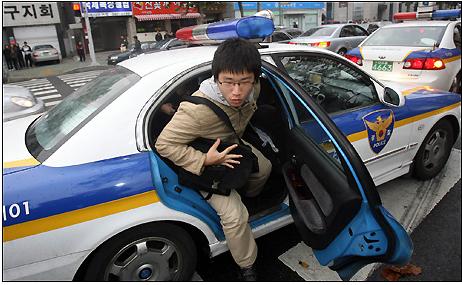
a late arrival is given a police 'escort'
Taken on the second or third Thursday in November, the suneung temporarily transforms the face of Korea and on the day there is a sense that the entire nation is backing the candidates. The transformations are a reflection of the pivotal role education plays in society and despite the professed importance other nations give to ‘education,’ in most, only a national catastrophe or war would be sufficient to suspend capitalism or national defence. In Korea education stops everything, back in Scumland UK, it stops nothing and I can remember sitting the equivalent of the suneung exam to the accompaniment of persistent rifle fire from the nearby military base.
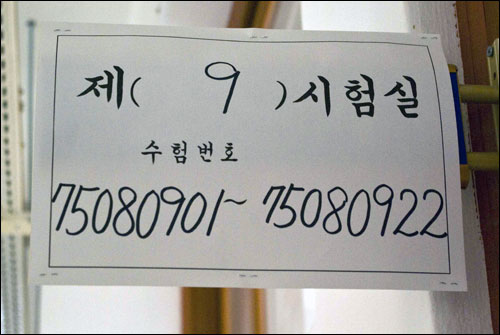
The Korean equivalent of Room 101
The exams last one day and are divided into a number of periods during which exams are taken in subjects such as: maths, social studies, English, sciences, vocational studies and foreign languages. The exams are largely multi choice. To guarantee candidates arrive in school armed with equipment, entry permits, a ‘fighting spirit’ and ready to do their best, a range of national procedures and contingencies come into effect:
♦All other students begin school after 9.am.
♦To help ensure transport system work to maximum efficiency, many businesses begin work at 10am. This includes the Stock Exchange! Yes, there’s only one Stock Exchange, it’s in Seoul and probably nowhere near a school, but it’s the thought that counts. For a few moments the success of students is of more importance than the economy.
♦During the periods when listening test are being conducted, planes cannot land at airports and those waiting to land have to circle above 10.000 feet. Even air-force movements are curtailed, within reason, to ensure silence at the appropriate times.
♦Korea Electric Power Corps places 4000 workers on standby in the event of power failures and each examination center, of which there are about a 1000, is sent a technician to monitor power supplies and await any emergency.
♦Police assist on the roads approaching schools and are also on hand to transport students who’ve encountered problems. Nerves thwart the plans of the best intentioned candidates.
♦Since 1993, there has been no evidence of suneung questions being leaked. In the days immediately prior to D-Day, specially selected professors are imprisoned in a hotel, denied any form of contact with the outside world, the hotel windows blacked out, and equipped with a library of resources, they formulate the exam questions. No doubt the hotel is 5 star, but nonetheless, they are kept in solitary confinement until the exams are officially over.
♦Schools are also supplied detectors with which to scan students for devices, hand-phones etc, which could be used to cheat.
♦Female teachers in high schools on the day of Suneung are not allowed to wear high heeled shoes or perfume.

'suneung exams transport support' provided by the military

Police support
Beyond official and bureaucratic procedures adopted to ensure both fairness and a conducive examination atmosphere, a host of other practices have developed aimed to improve the chances of success. Eating anything sticky on or before ‘D Day’ is believed to enhance ones luck. Sticky things cling to the wall and do not fall and so by chewing on toffee (엿), or sticky rice cake (찰떡), it is hoped you grades will hold fast and not slip into the gutter. Conversely, eating anything slimy, such as seaweed soup (미역 국) might incur bad luck and see your chances for the university of your choice slipping away. At the same time, one must avoided uttering any word expressing failure, falling, dropping, sinking, sliding or slipping. The reason obvious; if it’s muttered, it might happen. Parents and relatives will travel to mountain temples to say prayers and leave slips of paper on which are written the names of loved candidates, or they will attend special services in churches where small Bibles can be purchased in which you stick a photo of your son or daughter, all in the hope of currying divine favour. I doubt many believe success or failure is determined by the consistency of ones food, use of language or even prayer but anything which can be used to bolster the spirit is a valid psychological weapon in the quest for exam success and highlights the desperate measure to which the importance of exam success drives individuals.

Parents praying for the exam success of their children. I did the same thing here with a friend's family in 2001.
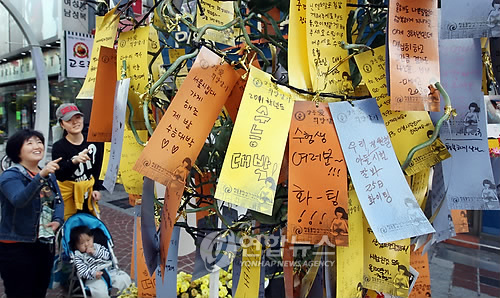
messages of good luck at the start of the final 100 day countdown
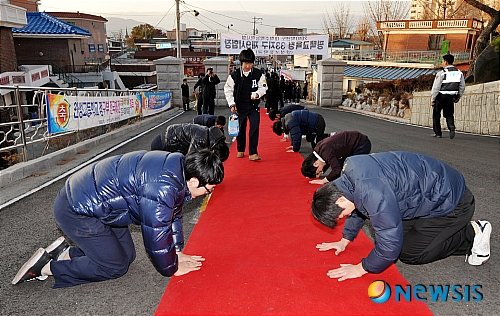
'go-sam' students being greeted by their juniors on exam day
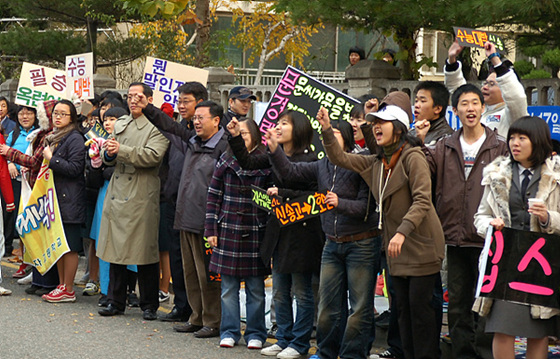
plenty of rousing support

supporters
On D-Day, parents will crowd around school gates, some will pray and other will hold their Buddhist bracelets in reverent anticipation. Candidates are often greeted by 1st and 2nd grade students as they arrive. Colourful banners wishing students good luck are waved and sometimes juniors will perform the full bow at the feet of those about to be tested. It is also common for juniors to rally the spirits of their stressed seniors by singing rousing songs before the exams commence. My last high school had almost 2000 students and it raised the hackles to hear 1200 boys singing in unison from all the classrooms under the 3rd floor, where the suneung candidates waited for their exams to commence.
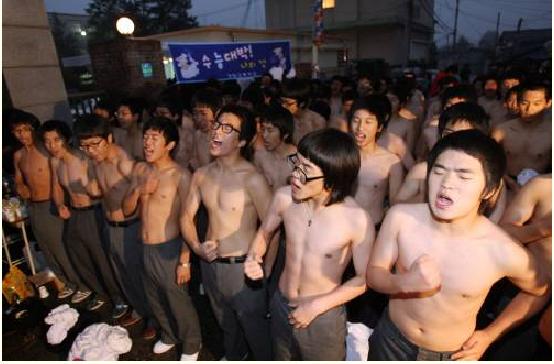
Boys singing after the completion of exams

a mother prays at the school gates
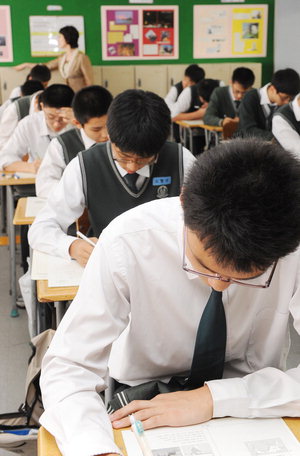
The exam
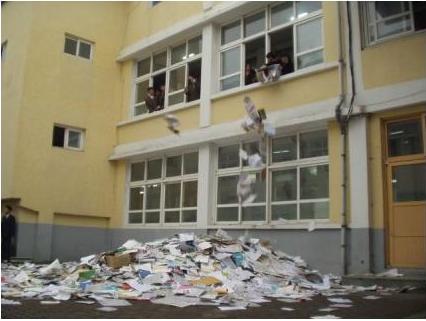
And when the exams finish, all the text books and notebooks used by the students throughout the year are unceremoniously tossed from the go-sam windows, often on the 3rd floor. Of course, the pressure isn’t off as from 6pm onwards, newspapers can publish exam questions and the agonizing process of self assessment begins until the results are finally released. And of course, as with every exam in Korea, only those with perfect scores are allowed to feel any satisfaction and even this is down played.
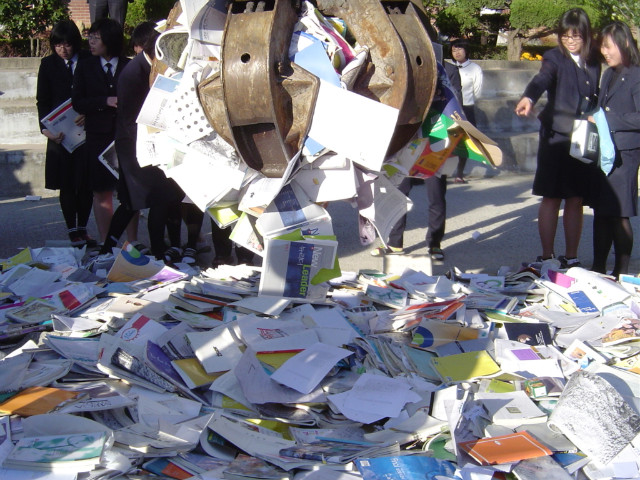
legitimate vandalism

relieving stress
Finally!
Undoubtedly, Korea has one of the best educated populations globally and though we might want to qualify the nature of that ‘education,’ we cannot dispute their success in terms of literacy and the sciences. Objective subjects and languages are much easier to assess. When it comes to the arts and subjective thinking, Korea has problems but however flawed or misguided we might perceive the Korean education system, it has facets worthy of admiration and parts perhaps worthy of emulation. Coming from Scumland UK, where dumbing-down is fashionable, bone-idleness excused, and the fruits of study and erudition watered down into a melee where belly dancing becomes an academic pursuit which has parity with mathematics or physics, it is refreshing to work in a culture where education has too much significance rather than little at all.
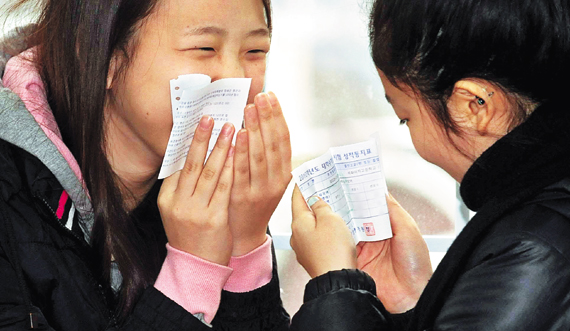
results
To all 2010 go-sam (고삼) students about to face the suneung, ‘fighting’ (화팅!)
Related Articles
♦ For a selection of video clips giving a general idea of the various suneung activities
© 林東哲 2010 Creative Commons Licence.
'All Things Bright and Beautiful' – Yeon-Ka-Shi (연가시) Parasitic Worms
Yesterday, as I was teaching, I felt some water fall onto my arm from the ceiling. For a moment I looked at it bewildered, unsure where it had come from and looking up deduced it was condensation falling from the vent of the air-conditioner. One of my students muttered some comment, the class laughing in response. I had no idea what he said but recognised one word; a word that immediately invokes revulsion: ‘yeon-ka-shi!’
If you ask Koreans, especially kids about the yeon-ka-shi (연가시), you are likely to be treated to a catalogue of horror stories. The yeon-ka-shi is a parasitic, ‘horsehair’ worm (nematomorpha) that spends part of its life in water where it finds its way into a host. Though some will tell you otherwise, the hosts are insects and not humans though there have been rare cases of human ‘infection.’ One recorded case involved a young girl who vomited up a dead worm. Her mother then took her to hospital where both her and the worm were examined. Now, how true this is I don’t know but I read the article, in fact a medical report, somewhere online and subsequently lost the link. However, the conclusion was that the girl must have drunk contaminated water, ie from a pond or puddle and the worm, killed by stomach acid was subsequently expelled in vomit – not a surprise as a gutful of puddle water is hardly comforting.
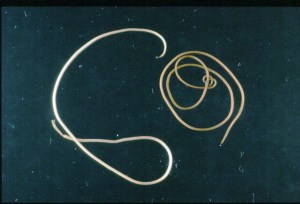
Link to video of worm (photo; Wiki)
I have been treated to numerous gross accounts of the yeon-ka-shi infecting humans, or how it turns insects into zombies which are subsequently driven to suicide. Other stories relate to the worms crawling out of the backside of insects and I have been warned not to stamp on the camel-cricket (곱등이) as this is a frequent host. The truth? Well, it does invade insects and it does crawl out of backsides and out of the abdomens of squashed hosts. There are plenty of gruesome videos recording this example of God’s sickening handiwork.
The size of these parasites in relation to their hosts is alarming. The next video apparently portrays a cricket committing suicide. How observers deduce it is suicide I don’t know. I’d have thought with this massive invasion rummaging around in its body, the cricket was totally out of its mind.
The natural world inspires both awe and horror but given the number and nature of horrific phenomena, it is truly testament to mankind’s stupidity that we should even dream of erecting and idolozing a creator capable of such perverse manifestations. One of a host of creations excluded from that naive polemic, All Things Bright and Beautiful.
© 林東哲 2010 Creative Commons Licence.
Camel Cricket – 곱등이- Rhaphidophoridae
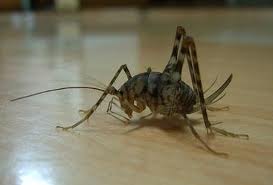
The rather ugly camel-cricket (곱등이)
Okay! Here’s a really ugly insect you might see seeking sanctuary as the weather gets colder. The camel cricket (곱등이) is a rather prehistoric looking insect related to the New Zealand weta. They are often found in caves and dark damp places and in some cases never see daylight but also reside in forests and buildings, especially basements. They are nocturnal and unlike other crickets (뀌뚜라미), do not chirp. They are characterised by long legs and antennae. Cave dwelling species, living in continual darkness have been known to eat their own limbs if food is scarce. Apart from their ugliness, they are harmless though their defence mechanism is to jump towards a threat rather than away from it.
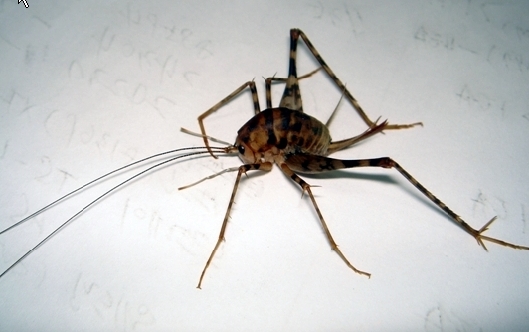
Probably one of the last insects you will see before winter
The Korean camel-cricket has a somewhat bad reputation as it is associated with the parasitic worm Koreans call the yeon-ka-shi (연가시).
© 林東哲 2010 Creative Commons Licence.
Five Second Hanja (6) Tree – 나무 – 목
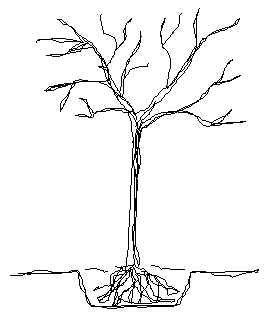
tree
A simple pictogram of a tree showing stem, roots, and branches. Only a small leap of the imagination is needed to visualize the character.
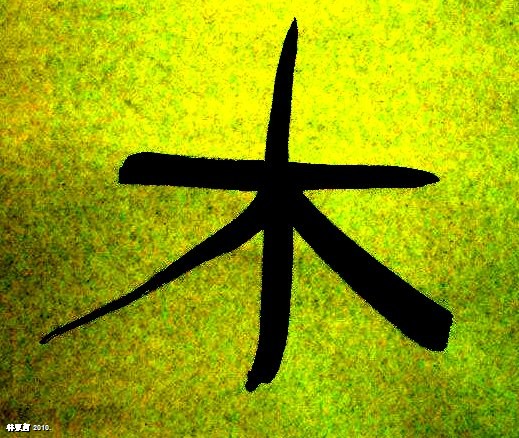
tree- 나무-목
This series of posts is not aimed to teach hanja, I am not in the least qualified for such a task, but to simply highlight some of the important and simpler characters. For information on stroke order, radicals and the two elements of a character (spoken – meaning), I suggest you obtain a dictionary such as; A Guide to Korean Characters.
© 林東哲 2010 Creative Commons Licence.
Laura -Korean Teenagers (3) Magical Moments
Korean school girls
Laura is perhaps one of the most pleasant girls in my school and I have now been teaching her for over 2 years. Her grades in her State school aren’t the best, which for Koreans is always 100%, but she excelled this year when she twice gained 100% in her English exams. As usual, she still comes to the academy wearing an assortment of scents and will thrust her wrist under my nose and ask my opinion. In the last few months however, she has learnt to use them with discretion and they no longer overpower the entire academy. Eye-liner is a recent addition but is only minimally applied and she doesn’t wear it in school; it isn’t allowed. Contact lenses, it seems, are tolerated and I have noticed a number of girls have started wearing them. I’m told a pair cost around 10.000 Won (£5). Although I’ve seen two girls in supermarkets with blue contact lenses, which actually looked attractive, the colours most girls seem to wear are either dark brown or more usually, black.

The Hanja character for 'innocence.'
In class one week, Laura and her friends told me the procedure for attracting a boy’s attention and then going on a date with them. The first part of the process is to offer the boy small gifts such as chocolate or candies. One of the most significant moments, and one a few girls seem to cherish, is when a boy they are interested in makes substantial eye contact. Once an interest has been established, photos might be exchanged by way of their mobile-phones. The aim of preliminary overtures is to secure going out with the boy, either on a trip to town or more significantly, a trip to the cinema. Such events give their friendship the status of ‘going out’ and it is from this date that teenagers start referring to their ‘sweetheart’ as a ‘boyfriend’ or ‘girlfriend’ and counting the days until their relationship reaches its hundredth day, a date which is usually celebrated (백일 – ‘100th day,’ is also celebrated a 100 days after a baby’s birth).
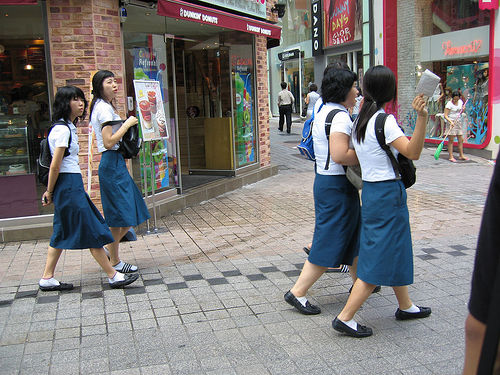
'Boy hunting'
The most significant part of going to a cinema is that soft drinks and popcorn are shared and Laura and her friends are quite excited when they talk about the ‘skinship’ involved in putting their hands in the large container of popcorn at the same time as their ‘boyfriend’ or their heads knocking or touching when drinking from straws in the same cup of drink.

...as long as there's room for two hands
Most of the girls in my academy, even ones older than Laura, who is 14 in western years, (Koreans are one year old the moment they are born), neither date boys nor express much interest in them. Indeed, despite its innocence and cuteness, many parents do not allow dating . Unlike the west, cinemas are not the venue for groping or fondling and such sexual intimacy does not seem to be anticipated or envisaged by anything other than university aged students. Boys the corresponding age of Laura profess much less interest in dating ‘rituals’ though some have crushes and I have only met a couple of boys who seemed interested in dating girls. Of course, this is only my limited observation.
Around the town young ‘sweethearts,’ probably Laura’s age and older are occasionally seen holding hands or having a meal together in a restaurant which is one of the ways in which a hundredth day celebration is marked.
Such ‘rituals’ seem trivial and naturally, they are played out in western culture, however, in Korea they are vastly more significant because more intimate physical affection between the sexes, even between adults, is frowned upon. No doubt this may be changing but other than holding hands, petting and kissing in public is a non-event. That Korean teenagers are not likely to engage in sex before adulthood, a phenomenon backed up by Korea possessing among the world’s lowest figures for teenage pregnancy and sexual transmitted diseases, places more significance on events such as eye contact and non-sexual intimacy. The very most the average teenager can expect in terms of any intimacy before adulthood, is probably a kiss on the cheek. Korean teenagers, unlike their western counterparts are under no pressure to either be, or appear to be, sexually active. Further, it seems Korean teenagers are quite scathing of the character of teenagers, boys or girls, who do engage in sexually activity while still school children.
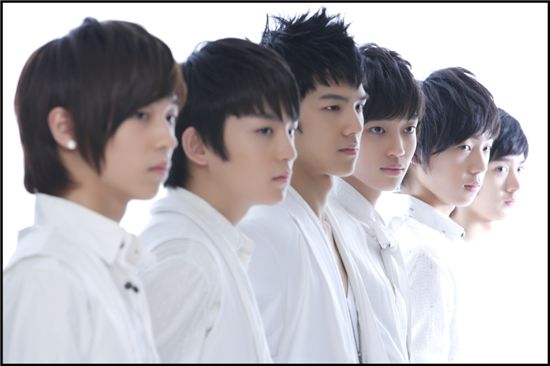
height is crucial, looks secondary
And what are the criteria for a suitable ‘boyfriend?’ As with older girls I have talked to, height is crucial and ideally the boy needs to be 10 cm taller than the girl. I have been told this is because the boy needs to be taller than the girl should she wear high heels. Boys need to be attractive, kind, considerate towards the girl, funny and smart. Not all the girls think alike and a few said they would consider a boy shorter than themselves or one academically weak.
© 林東哲 2010 Creative Commons Licence.
Interlude (1) – 홍시 – Soft Persimmon
They’re like a bright orange bag of jelly, the shape of a tennis ball and although they’re relatively tasteless, basically just very sweet, there is something pleasant about them. Like a number of Korean foods, the most noted probably being octopus, one ‘product’ can have several different names rather like the English ‘grape,’ when dried, can be a ‘currant,’ ‘raisin,’ or ‘sultana.’ While persimmons, are generally called, ‘kam’ ( 감), the specific name for the highly ripened variety is, ‘hong-shi’ ( 홍시). ‘Yeon-shi’ (연씨) is a similar soft variety but smaller and rounder.

'hong-shi; - like a bag of jelly
© 林東哲 2010 Creative Commons Licence.
And Koreans Think They're Hot!

the hottest Korean chillies, the ch'eong-ryang chilli (청량고추)
I’ve always been a chilli-head and enjoyed trying the different chillies that have come my way. I often find it amusing that Koreans assume a westerner will find Korean food too hot where if anything, personally, I find it too mild. In Great Britain, an acquaintance with very hot food is something many of us have experienced, thanks to Indian and Thai restaurants.
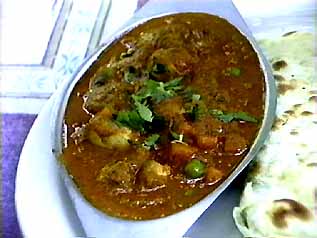
fiery
Take the famous vindaloo, a curry from Goa, India, which uses malt vinegar, potato and is probably the hottest, widely available curry in the UK. A ‘tindaloo‘ is occasionally on Indian restaurant menus but this is probably either a vindaloo spiced-up with Scots bonnet, habanero or naga chillies, all among the hottest of all chillies available or an equally, very hot curry from Bangladesh. The hottest curry likely to be found in a curry house, is a ‘phall‘ though this does not appear on menus as regularly as a vindaloo. A decent vindaloo will start your nose running and produces an after burn which when you next go to the toilet, can be quite painful.

Scots Bonnets in various stages of ripeness and potency
Scots bonnets and habaneros, which are related and similar in appearance, share a score on the Scoville Scale of between 100.000-350.000. Until recently, these chillies were often cited as the world’s hottest but several other chillies, cross breeds, now hold this honour. The Guinness Book of Records recorded the Naga Jolokia, (or Bhut Jolokia) chilli, from Bangladesh and Assam, as the hottest ever recorded, in 2007, reaching 1,041,427 on the Scoville Scale. However, the Jolokia is about to be knocked off its perch by the recent appearance of the ‘Infinity chilli,’ bred in Grantham, Lincolnshire, England, by Nick Wood.
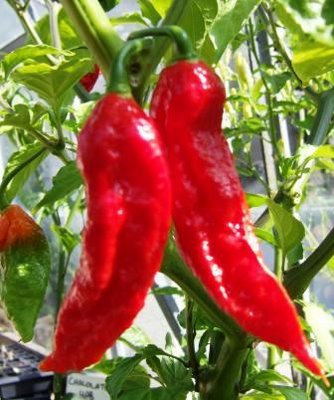
Jolokia, over a million on the Scoville Heat Scale

Nick Woods, breeder of the 'Infinity Chilli'
So, let’s put this in context; a bell pepper rates 0. SHU (Scoville Heat Units), while a Jalapeno scores between 2.500-8.000 SHU. Most people rate the Jalapeno as the first of the ‘hot’ chillies and it used as a bench mark against which to rate other varieties. For example, Tabasco Original Hot Sauce, is 50% the heat of a Jalapeno, making it very mild, and scoring 2.500 SHU. The habanero scores 100.00-350.000 and is around 70 times hotter than the jalapeno. I’ve seen a friend weep in agony after he chopped a habanero and then rubbed his eyes. With a Scoville Heat Unit of 1,041,427, the Bhut/Naga Jokolia is 208.29 times hotter than the jalapeno and 400 times hotter than Tabasco Original Hot Sauce – which by now, is as mild as milk.
Scoville scores over one million takes us into the realms of atomic chillies and while their raw culinary use begins to wane, their potential in sauces and as paint stripper, increases. The ‘Infinity chilli’ scores 1,176,182 SHU putting it around 100.000 units beyond the Jokolia. Anything hotter can no only be bought as a sauce or more likely as a food additive or pure capsaicin crystals. The heat however, is still on the rise!
Scott Roberts, a Missouri based chilihead has compiled an extensive list of sauces and chillies listing their Scoville ratings and comparisons with the jalapeno. He lists many ‘sauces’ exceeding a million Scoville units and includes, purely for interest, police pepper spray which scores between 3 and 5 million SHU, 1000 times hotter than a jalapeno. And just to give you a taste of how hot, ‘hot’ can get: at 6 million, Crazy Uncle Jester’s The Jester Sauce, 1200 times hotter than a Jalapeno and about the same as the British made, Dragon’s Blood sauce, made from the Naga Jolokia.

6.4 million SHU
Many of the highest rated ‘sauces,’ increasingly pure capsaicin suspended in oil or, in unadulterated crystal form, are collectors items, numbered and signed and in limited editions. The products are potentially dangerous and need careful handling. ‘Blair,’ a New Jersey based company, is probably one of the most rated for its line of connoisseur, high SHU scoring sauces many of which are collector’s items.

Founded by Blair Lazar
Blair’s 2007 Halloween Reserve, at 13.5 million SHU and 2700 stronger than a jalapeno, sold out within six hours of going on the company’s website. The 2009 Reserve was selling at $300 a bottle and apart from the fiery content, the bottle was a hand blown pumpkin.
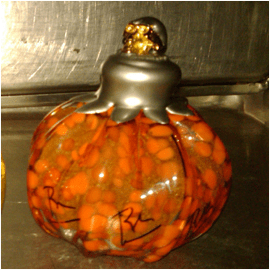
2700 times hotter than a jalapeno and at $300 a bottle.
At the top of the list, Blair’s 16 Million Reserve; pure capsaicin at 16 million SHU and 3200 times hotter than a jalapeno. On the, Scott Roberts website, Scott quotes:
“Blair’s 16 Million Reserve is the latest in the line of reserves from Blair. This reserve bottle contains 1ml of pure capsaicin crystals. 16 Million Reserve is not to be consumed or even opened without using extreme caution. Only 999 of Blair’s 16 Million will be produced, so get yours quick!”
And where do Korean chillies rate, I hear you ask? Well, despite copious searching, I can find no Scoville scores for the chillies you would usually buy in Korea. Certainly, the ‘cucumber chilli’ (오이고추) would rate only marginally above a bell pepper, at around 100-1000 SHU. The standard green chilli used in Korea probably rates between a Serrano (10.000-23.000 SHU and about 4.6 times hotter than a jalapeno) and the Thai pepper (50000-100.000 SHU). The hottest Korean chilli is the ch’eong-ryang chilli (청량고추), which I would estimate to be approximately between that of a hot Thai pepper and the bird’s-eye chilli (100.00-225.000 SHU and around 45 times hotter than a jalapeno). Certainly, Korean chillies fall substantially lower in heat than the habanero type chilli.
Some Chilli Facts
In Mexico chilli juice was used to wean a baby off the nipple.
If your mouth is on fire, water or beer will only temporarily cool your mouth. The best aid is milk as even a minimal amount of oil is enough to coast the lining of the mouth and reduce the burning sensation.
If you like the taste of chillies rather than the heat, oily or creamy based food will reduce the heat of chilli and allow the flavour to come through. Carbonara with chilli is fairly common in Korea and you can easily jack-up the chilli content to levels that would scorch your mouth in other, less oily or creamy, Korean foods.
Removing seeds from chillies will reduce their heat.
And finally, to finish with:

Lindt; a superior brand of chocolate. The chilli really works!
Chilli Related Sites
The Hot Zone (USA) Excellent chilli related blog.
UK Chile Farm (UK) suppliers of Wet Fart Chilli Sauce and Ass in the Tub Chilli Sauce.
Related Articles
- New chilli could take world record, say producers (independent.co.uk)
- New “Infinity Chili” Sounds Hotter Than Homer Simpson’s “Insanity Pepper” | Discoblog (blogs.discovermagazine.com)
- Phaal Curry Challenge – Curry with a Side of Pain (odditycentral.com)
- Couple sue after Mega Death sauce hospitalizes son (boston.com)
- A Perk of Our Evolution: Pleasure in Pain of Chilies (nytimes.com)
© 林東哲 2010 Creative Commons Licence.
The Rose of Sharon – 무궁화 – National Flower of Korea
Despite the ‘Rose of Sharon’s,‘ grand, popular names, ‘the immortal flower’ and ‘everlasting flower,’ I always have a slight loathing when I see one, which is everyday as one grows right outside my one-room. My loathing is totally unfounded.
Korea’s national flower, ‘the Rose of Sharon‘ (Hibiscus syriacus), comes from a deciduous shrub the flower of which bears a striking resemblance to that of the tree mallow ( Lavatera arborea or Malva dendromorpha) which is native to much of Europe.

flower of the tree mallow

National flower of Korea (무궁화) 'Rose of Sharon.' This was actually the first flower of the year on this plant (July 5th 2010).
Both plants are shrubs and have soft pink flowers of the same size set in a five petal arrangement. The five petals are significant in terms of the ‘Rose of Sharon’ as they symbolise Korea and appear in numerous official and unofficial emblems.

the five petals of the Rose of Sharon

an important symbol
The Korean name for the flower, mu-gung-hwa (무궁화), combines two words, ‘mu-gung’ (무궁) meaning ‘immortal’ or ‘everlasting,’ and ‘hwa’ (화) meaning ‘flower.’ It really is the case that the flower is long lasting and the same flowers will bloom all summer and into autumn, closing every evening and bursting back into flower as the sun rises. The ‘Rose of Sharon,’ associates the plant with Syria, where it supposedly originated but personally, I prefer the Korean name as it reminds one of the tenacity which is reflected in so many aspects of Korean culture and landcape. ‘Tenacity,’ is both one of the tenets of ITF (International Taekwon-do Federation) and WTF (World Taekwondo Federation) taekwondo, and a theme in my post on the wood carvings I photographed in Pal-gong-san National Park, Daegu. Historically, The flower was first cited in Korean text around 1400 years ago and hence has a long standing historical tradition making it ideal for its reference in the Korean National Anthem.

flower variations
I watched the mu-gung-hwa outside my one-room all year, from the appearance of the first buds until mid-August, when some blight shriveled the leaves and killed the flowers. Given its association with ‘immortality,’ this was a disappointment serving to remind me of the realities of life.

My one-room mugunghwa in May
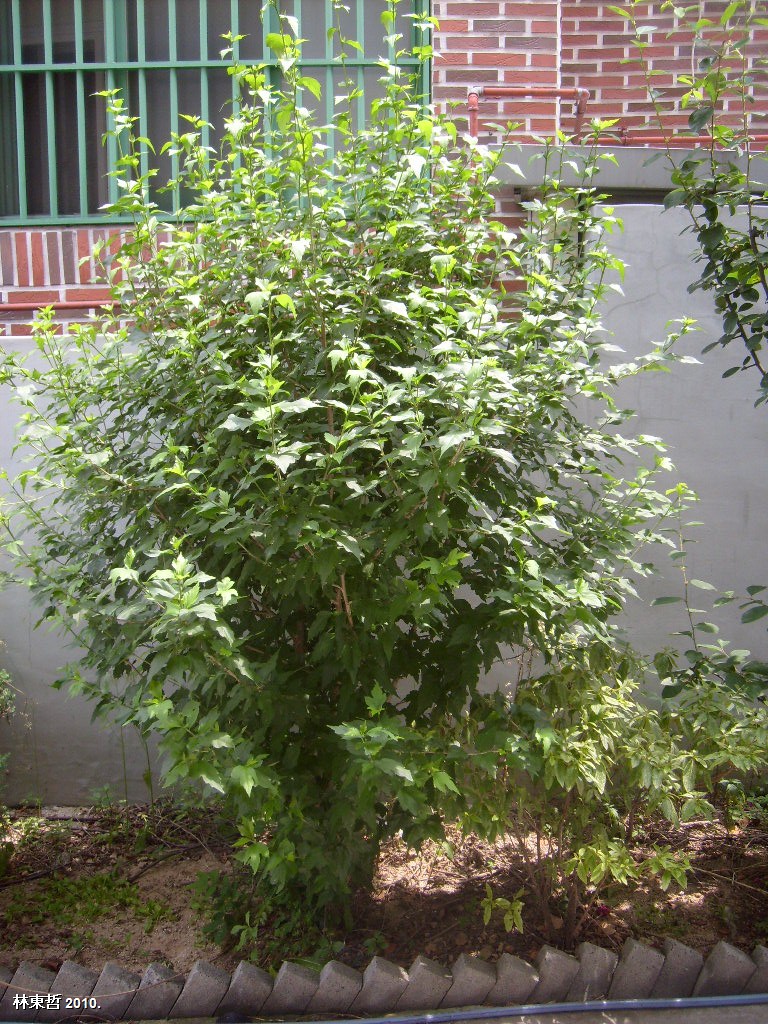
June 15th

July 5th and the first blooms
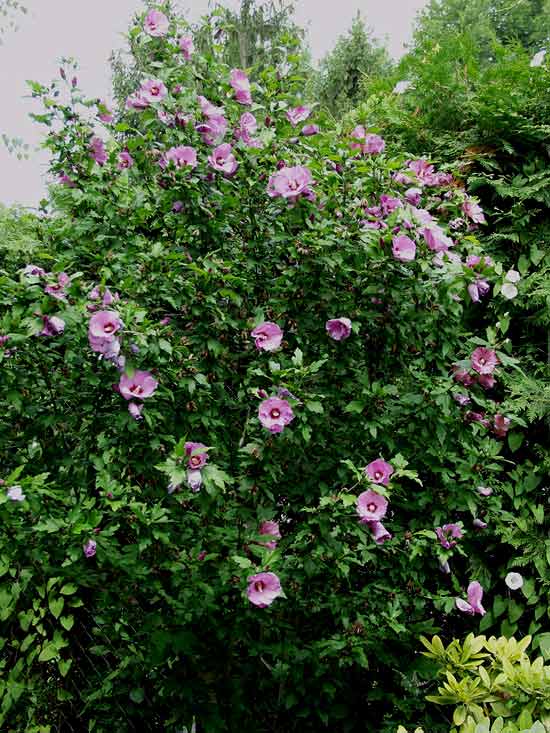
in full bloom
And why do I have an irrational loathing for the mu-gung-hwa? Because it so closely resembles the tree mallow which is a prolific shrub especially in coastal regions of Southern England. Several years ago, a friend gave me a small cutting which I planted in my front garden and within three years it had grown into a large shrub, blocking the light in my front window and necessitating constant pruning. No matter how vigorously you prune it to the ground, it springs back in mockery and within weeks needs to be re-attacked.
Footnote
The mugunghwa-ho (무궁화호), is the cheapest type of Korean train service and is often the only service on some lines.
© 林東哲 2010 Creative Commons Licence.
Monday Market – Peaches 복숭아
Like the persimmon, which is just starting to appear, peaches have different names for different types: some are hard, some medium and the most prized, very soft, is white.
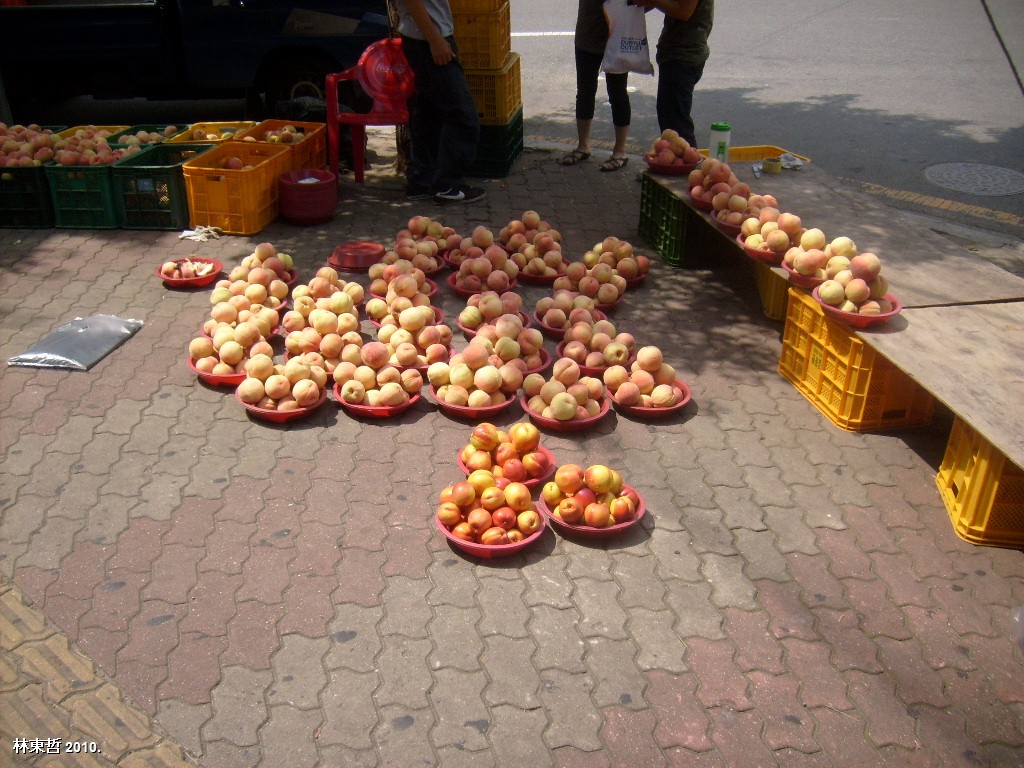
Peaches towards the end of the season
© 林東哲 2010 Creative Commons Licence.


 Elwood 5566
2 comments