Mountain Obsessions
I keep saying fat has arrived in Korea but of course truly fat Koreans are still rare and nothing compared with the fatties of the USA or UK. Generally, Korean fatness is chubby rather than humongous but no doubt this will gradually change. In a recent OECD report, Korea was placed 30th in terms of obesity in the world’s top 33 most economically developed countries.

Sunday, 5.51 am and the restaurant has customers
On Sunday morning I decided to walk up the mountain and watch the sunrise. I wasn’t quite early enough and actually reached the point where the mountain trail begins, as dawn was breaking, at about 6 am. But on leaving my house I was greeted by total darkness. Of course, it’s never quite quiet in Korea and near my house a 24 hour restaurant had customers who were either finishing off last night’s party or having an early breakfast. Even the small park by my house had a few visitors.
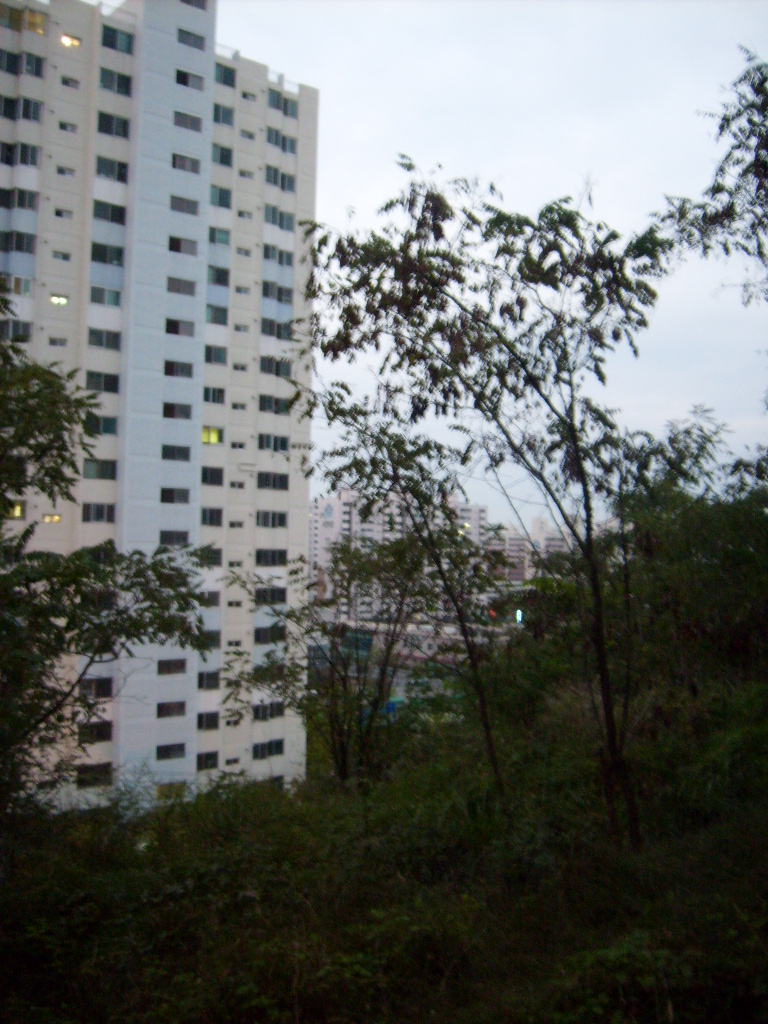
Sunday morning, 6.04 am and it's light

7.40 am Tuesday morning
The point at which Warayong mountain trail begins is directly opposite the municipal sports center and swimming pool with adjacent football pitches and tennis courts. As dawn broke there was already a football match underway and around the pitches I counted twenty two people briskly walking. As is usual in Korea, they were mostly middle-aged and older.
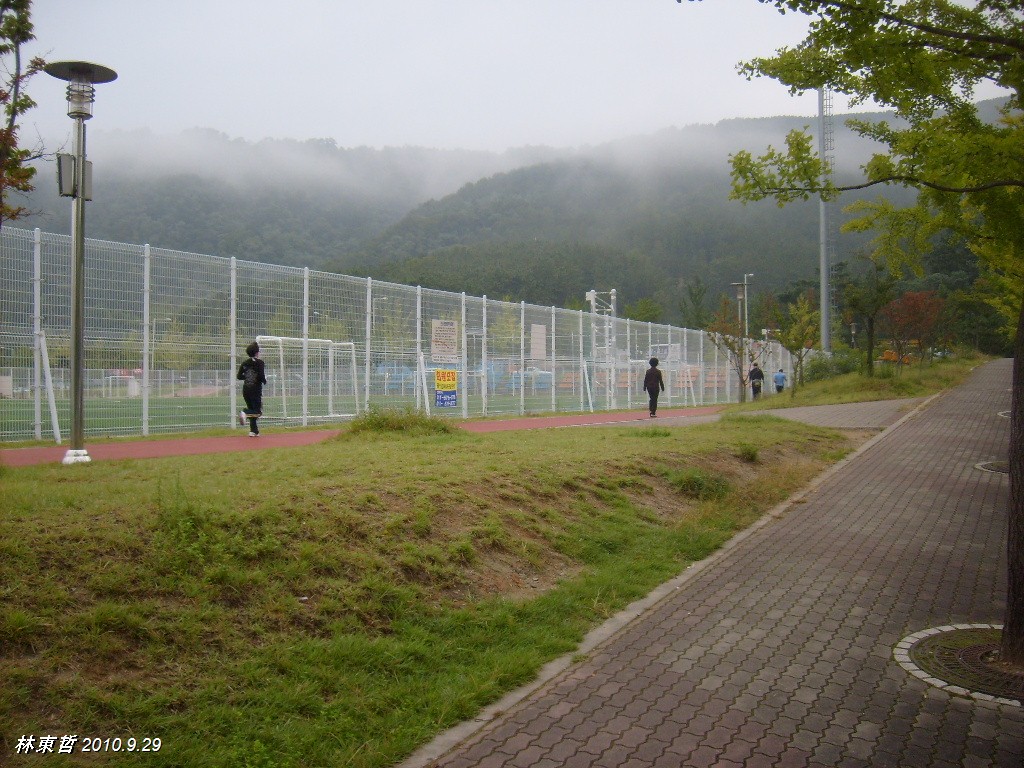
7.40 am Tuesday. Jogging and walking

6.53 am the the first peak (Dragon's Head, 용두)
Even early in the morning there are people on the trail. Koreans are quite obsessed with mountain walking and even the big climbs, up larger mountains, are perceived as a walk rather than gruesome exercise. Most Koreans have the paraphernalia necessary for a trek in any season and in any weather: walking boots, breathable clothing, hats, water bottles, walking sticks and hankies or towels to mop up the sweat. Once in the mountains, especially in the morning, it’s not unusual to hear people doing a Korean type of yodel and I have even heard someone practicing a trumpet.
After reaching the Dragon’s Head (용두), the crown of the Warayong Mountain, I walked a little further to where the refreshment stall is and there find twenty people, again mostly middle aged and over, working out on the exercise machines as well as a number of people waiting for the vendor to start serving.

This was taken on the Saturday

a mountain vendor

the long shadows of autumn
Children or young people are not as prolific on the mountain trails, they are usually too busy studying but in fairness, many will do one of the various martial arts or other sports. Walking up the mountain taxes me enormously and I frequently have to stop and catch my breath. However, I have yet to see a Korean pensioner as knackered by the mountain climb as I am. Indeed, for most Koreans, the Dragon’s Head is the point at which you begin stationary exercises, or climb the next peak, in either case, it is a warm-up. For me however, it signifies the climax of my exercise routine and once I have had a little sit down and a cup of coffee, it’s downhill all the way home.
 © Nick Elwood 2010 Creative Commons Licence.
'Red-Eye' – Conjuctivitis
I can remember outbreaks of this infection in previous summers and it is often associated with bathhouses where water is unchlorinated. However, it is also a problem in schools and universities. and is especially problematic in Daegu. If you get an itchy eye which subsequently turns pink or red, you may have one of the numerous forms of ‘red-eye.’ The link provides a list of symptoms for the various types ‘red-eye‘ and suggestions to help prevent further contamination. For many students, a severe case of ‘red eye‘ is welcomed as it often results in an impromptu vacation – a real vacation where both school and hakkwon attendance is suspended. Currently, one of my students has been absent from school for two weeks.
I continued teaching as the 9 days of the worst part of my infection were around chu-sok (추석) and only involved two days teaching but I avoided any contact with students and their hands were sprayed with anti-bacterial spray on arriving and leaving the school and leaving my classroom.
© Nick Elwood 2010 Creative Commons Licence.
Chu-Sok Cheesecake
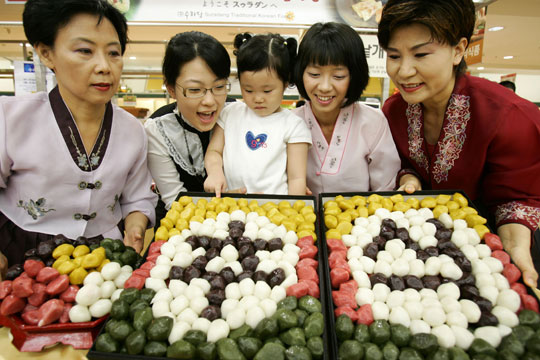
The second most important holiday – ch’u-soek (추석)
The Lurpax was back on the shelves in E-Mart and after spending exactly 9 days with a bad case of ‘red eye,’ otherwise known as conjunctivitis, I was in need of something comforting. My right eye flared up on Friday the 17th ruining my weekend and subsequently ruining the ch’u-soek holiday (추석, September 21st-23rd) as well as the following weekend. So, on the Saturday morning I had to go to my doctor who subsequently sent me to the ophthalmic hospital. Back home in Scumland UK, I’d probably have waited 4 days to see a doctor and procedures would have thrown my plans into the liquidizer. But in Daegu, there’s an eye hospital every few blocks and doctors and opticians in every block and I can easily accommodate visits to the clinic without any disruption to my plans. The eye hospital is approximately 200 paces from my front door! Just as well as I’ve had to re-visit the clinic every third day. The infection seems to be dwindling but this morning, sat in the doctor’s chair with my head in some contraption, I felt like Alex DeLarge and though there was an absence of Beethoven’s 9th Symphony, it is a strange coincidence that whilst in the waiting room, this is the music that has entertained me on my MP3 player (in fact the Liszt piano transcription). Once my head is in the constraining device, a lengthy telescope-cum-bazooka is aligned with my eye. All week he’s simply looked and prescribed medicine but today he starts poking my eye with what felt like a dental probe. Then, through eyes streaming with tears and blood, he shows me a cotton bud laced in this red gunk which is the infection membrane. Then I had to have a shot in the backside.

Alex DeLarge (Malcolm McDowell) in Clockwork Orange
It was only to be expected that my infection, which suspends using the gym or bathhouse, would concur with a major holiday, chu-sok (추석), the Korean equivalent of Thanksgiving, and I would imagine that by Monday, when normal work resumes, I will be mostly cured. There seems to be a ‘red-eye’ epidemic in Daegu and I have often seen it mentioned on the news. It seems especially prevalent in summer. At the clinic there were two families all of whom were infected and numerous other individuals with either one or two red eyes. I didn’t go out for several days but have since bought some dark glasses.

the ophthalmic clinic from my roof top (제일 안과)
So, after having my eyes attacked with a cotton bud, I went to the supermarket. The Lurpax talked to me, trying to convince me how delicious it would be on some toast and I would have bought it if a cheesecake on the nearby cake and bread stand hadn’t talked louder. I’ve eaten cheese cake only once in Korea and it was just like the traditional British cheese cake – the type with currents and full of mascarpone cheese. The cake is in a box and by Jupiter’s cock it looked very tasty!

real cheesecake, simple and unadulterated
It was pricey, 8000 Won (£4) but after a shit week and that cotton bud, plus I’d actually walked up the mountain before going to the eye-clinic, I felt I deserved it. I get home and make some fresh coffee and sit down to enjoy my belayed ch’u-soek treat and all the time the cheesecake is telling me how sexy it’s going to taste and how superbly creamy it’s going to be. And then comes the shock… where’s the fucking cheese? I cut the cake in half looking for it but the cheesecake seems to have lost half its namesake and comprises solely cake, extremely white, light cake! Nothing about it is cheesy and while it was probably a very delicious cake, it’s not a cheesecake and so, with a curse, I chuck it straight in the bin.
© Nick Elwood 2010 Creative Commons Licence.
Jabbering
I’ve been making a concentrated effort to improve my Korean because of late I’ve been bored stupid talking to Koreans. On more than one occasion, I’ve actually been quite rude to people in an attempt to avoid talking. It’s nothing personal and indeed quite the contrary, I can withstand a Korean talking at me for hours on end without waning, but what bores me the most is having to listen to my own drivel. I have developed a range of conversation topics where I can impart my ideas and maybe even respond to a few questions, but unless I can keep control of the ‘conversation,’ I am basically fucked!

Well, a little, perhaps...
My boring litany revolve around being English, being a teacher, learning Korean and hanja, having a taekwondo black-belt, George Bush, and food. I have others, but these are fairly central. Each conversation topic has a number of branches and each of these, sub-branches but very quickly the conversation will reach a point where I no longer hear key words and don’t have the vocabulary or grammar to go further. At this point it is time to jabber.
My Korean skills improve at a laboriously slow rate but my ability to appear knowledgeable, to appear as if I understand every spoken word, and to ‘jabber,’ have been catapulted to perfection. When it comes to the art of jabbering, my kung-fu is strong!
Jabbering shouldn’t be underestimated or treated with derision as it is an integral part of learning another language. First of all, to jabber, you have to be able to use at least a small percentage of the language. Secondly, you have to recognise various tones of voice because you need to respond to these appropriately. Most importantly, you have to be able to differentiate questions and statements. Thirdly, your skills at reading body language, and using it yourself, are crucial.
Provided both parties give the appearance of understanding a conversation, this is achieved by strategically interjecting words such yea’ (예) and ‘really’ (찐자) at appropriate points, by occasionally stating that you don’t understand a word, even though in reality you haven’t understood the last five minutes conversation, making the correct body language, and generally latching onto any word you do recognise, and then repeating it, you can ‘converse’ for hours. It would seem that two humans,from totally different cultures will tolerate a lengthy dialogue in which only a small percentage of the conversation is mutually understood, provided the charade is successfully performed. Indeed, two hours of mutual jabbering can be quite rewarding.
If a person is willing to jabber with you, and you with them, it is perhaps indicative of a mutual liking for each other and it should be pursued as a friendship could develop. I am often amazed, and saddened, that I have some very close Korean friends with whom I jabber and yet am still only capable of making ‘small talk.’ I’ll happily talk to any Korean in my attempts to improve my abilities but having to listen to my own drivel has become tiresome.
© Nick Elwood 2010 Creative Commons Licence.
Five Second Hanja (2) Mountain – (메-산)

mountain - 메-산
Looks like the character
The character for ‘mountain,’ a simple pictogram depicting three mountains.
This series of posts is not aimed to teach hanja, I am not in the least qualified for such a task, but to simply highlight some of the important and simpler characters. For information on stroke order, radicals and the two elements of a character (spoken – meaning). I suggest you buy a dictionary such as; A Guide to Korean Characters.
© Nick Elwood 2010 Creative Commons Licence.
Shaman Spider (무당 거미)
I’ve had an infection or ‘red-eye’ and haven’t been able to use the gym or bathhouse so instead I’ve been walking up Warayong Mountain (Wikipedia location) in Song-So.
I noticed a wasp nest on a tree and watched it over several mornings. These wasps are much smaller than European ones.

wasp nest
This is the shaman spider (무당 거미), which is often translated as ‘sorcerer.’ In English it is known as the golden banana spider or joro spider (nephila clavata). ‘ It probably measured about three inches long and can inflict a mildly painful but non-deadly bite. Autumn signals the mating season for spiders and these beautiful, if not scary looking specimens are also cannibalistic. The female is larger than the male and has red markings towards the back, underside of her abdomen.

Female shaman spider (무당 거미) nephila clavata

female shaman spider with distinctive red markings on the underside of abdomen.

the nephila family spin one of the largest size webs – often in excess of 2 meters.
The web was about 4 feet across and slightly yellow in colour and at one point I walked into a supporting strand. It did not break and I noted at the time how resilient it was. Apparently, genes from this spider have been injected into silk worm cocoons and as a result they subsequently produce a much stronger silk. This product is being launched on the market, in the form of extra durable socks, in 2010.
© Nick Elwood 2010 Creative Commons Licence.
Five Second Hanja (1) Big-Large (큰-대)
大
This character is very common and means big or large. Originally a pictogram, it is easily remembered as a representation of a person holding their arms outstretched, as you might do when telling someone how big something is.

(큰-대) Remove the outstretched arms and you're left with person (사람-인)
Found in restaurants, place names, rock inscriptions as such as well as Korean names.
Dae-gu – 大邱
Dae-chon – 大田
Dae-Han-Min- Guk (대한민국) – 大韓民國
Dae-Po – (artillery) – 大砲
This series of posts is not aimed to teach hanja, I am not in the least qualified for such a task, but to simply highlight some of the important and simpler characters. For information on stroke order, radicals and the two elements of a character (spoken – meaning). I suggest you buy a dictionary such as; A Guide to Korean Characters.
© Nick Elwood 2010 Creative Commons Licence.
ks
|
一 |
A Squirt of Fusion

So scrumptious.....roast pork and roast potatoes
Every now and then I like a little blow out, partly as I love food and secondly, because I miss food associated with British culture. Unfortunately, few Korean foods fulfill the requirements necessary to satisfy the cultural preferences of my British palate. Flour, potato, oil, butter, bread, milk and cheese, plus copious quantities of meat, are missing from most Korean meals. Though I love Korean food, most can be described as ‘just…’ (그냥), meaning okay, satisfying, but not scrumptious. Of course, this is just my personal opinion and some waygukin may actually think a few bean sprouts chucked in boiling water compares to delights of Thai, Tom Yum or New England Clam Chowder.
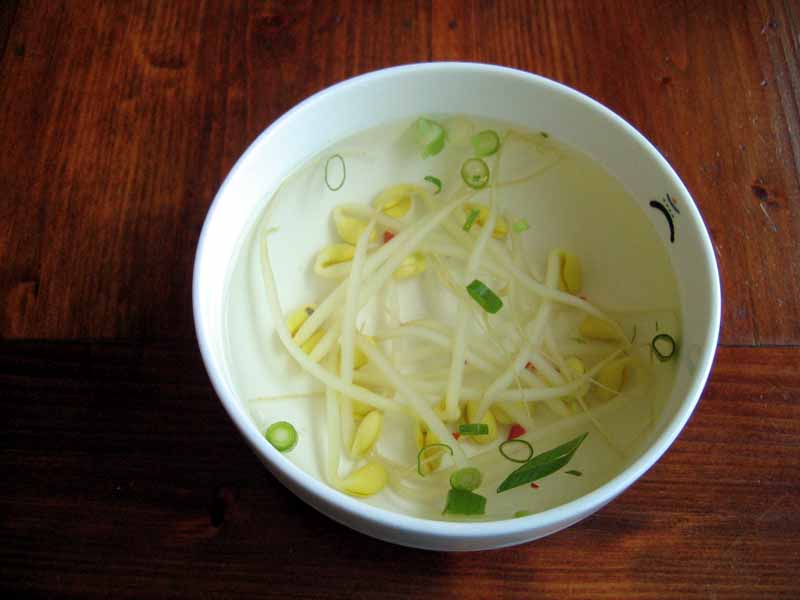
bean sprout soup (콩나물 국)
I have attended a number of ‘feasts’ in Korea and find the word as much an exaggeration as is the description ‘delicious.’ All too often Koreans will describe something as ‘delicious,’ but the moment your hypothetically offer them a choice between what ever the topic is and a Big Mac, and the Big Mac usually wins. Ironically, the Big Mac isn’t even a delicious example of a hamburger. Yesterday, one of my students told me he ‘loved’ bean sprout ‘soup’ (콩나물 국) and that it is ‘delicious’, but considering the boy is a little chubby, I suspect if it were a choice between bean sprout ‘soup’ or fried chicken, he’d choose the chicken. The Korean ‘feasts’ I have experienced could only be deemed such if you were on the brink of starvation, which is their possible origins, and comprised of the typical ‘just’ category foods such as: seaweed soup, five grain rice, and various kimchi. Sorry, but when you’re told your going to a ‘feast’ and your fed boring ban-chan (side dishes), it’s a bit of an anti-climax.
For most of my life in Korean, my cultural urges lay dormant and I find great satisfaction and pleasure in Korean cuisine but every so often I feel compelled to satiate deeper cravings and will seek out possible alternatives.
Pizza, unless it’s from Pizza Hut, Dominoes or Vince is usually disappointing; the cheese is that stretchy crap with no flavour. I once ordered a pizza with the cheese piped in the crust but when it arrived saw it was a ‘well being’ version. I order pizza so infrequently that when I do want one I don’t want ‘well being.’ Worse, the cheese had been made healthy by adulterating it with sweet potato. When Koreans make a pizza, the final touch always seems to involve squirting it with an assortment of gunk and sweet mustard and jam like sauces are all in vogue. And the final insult to any pizza, a perversion, are fruit toppings. Vince Pizza, which actually makes a fairly okay pizza, makes one topped with fruit. In Korea, with toppings such as bulgogi and sweet potato, often subsequently squirted in sweet gunk, the pizza is the epitome of fusion food.
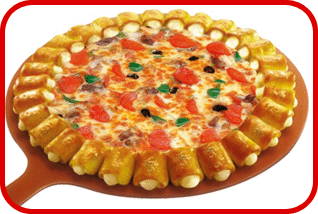
cheese-less cheese

A pizza squirted in sweet gunk
Occasionally I like a sandwich though mayonnaise is always a requirement as this replaces the lack of butter. However, I have to keep a close eye out as my local GS25 occasionally adds jam to a ham, ‘cheese’ and salad sandwich.
Corn Dog, isn’t too bad until it’s dunked in sugar and squirted with tomato sauce.
Pork Cutlet, don-gasse (돈까스) is one food that often quells my urges. This food originates from Japan where it is called tonkatsu but considering the German influence on Japanese 19th century society, I wonder if its origins are Germanic. Tonkatsu first appeared in Japan in the late 19th century and is similar to jagerchnitzel and Wiener schnitzel. It has been further fusionised by the addition, in the center, of that stretchy cheese-less cheese, and often, on the edge of the plate. an adornment of tinned, diced fruit.

Don-gasse (Tonkatsu - 돈까스) Recipe link via photo (in Korea)

Korean style - 돈까스
Ironically, if I’m absent from Korean food for too long, I begin to suffer a pon farr like yearning for kimchi, and more unusual Korean Fayre.
© Nick Elwood 2010 Creative Commons Licence.
A 'Sick' Site

Learning to swear in English
On the subject of teaching swear words to language learners…
When I lived in Germany I had some friends who attended a dinner party hosted by a high-ranking officer. At the party were a couple of middle-aged Germans who had been trying to improve their English . There was a tense silence when, as the port was being passed down the table, one of the Germans declared, proudly and loudly, ‘vat a facking gut dinner!’ Teaching swear words can have severe repercussions!
My humour is childish but I don’t really care: laughing is good for you and a hearty laugh every day is as beneficial as a little work out.
So, when I accidentally fell onto a Korean produced vodcast focusing on teaching Koreans how to swear, I was rather interested. I was reminded of my first hakkwon experience back in 2000, where one teacher would invent lyrics to the songs that were slowly driving him mad. One day he called me into his class after he’d changed the words of a song from:
‘I’m clicking cat, how do you do? I’ve got the loveliest smile for you…’
Into:
‘I’m clicking clit, how do you do? I’ve got the creamiest clit for you…’
Yes! It was very unprofessional but watching a class of 5 year olds sing a song about ‘clit’s and ‘creamy pussies’ was absolutely hilarious. It’s no justification, but somehow the tedious classes and money grabbing boss who insisted teachers only taught one letter of the alphabet every two weeks, and who treated you badly, diminished any sense of loyalty, responsibility or professional ethic.
Watching a Korean teacher swear in English is just as funny and I’ve replayed the vodcast several times giggling at the incongruity of a Korean (with an accent), saying words like ‘bitch’ and ‘fucking.’ If he was a Korean without a Korean accent it wouldn’t be the least funny. And when he then tells his students not to use swear words, but to listen for them, so that you ‘know what the western bastard is saying,’ all the time with the word ‘fucking’ incorrectly spelt on the blackboard – well, I’m laughing even more. Personally, I’ve never heard the word ‘sick’ used to mean ‘good’ but maybe that’s an Americanism.

Learning to swear in English
I’ve since discovered the Blog, Brian in Jeollanamdo extensively covered this vodcast back in July 2010, and with some pertinent comments, but I nonetheless thought it worth including.
© Nick Elwood 2010 Creative Commons Licence.
Bathhouse Basics (8): The ‘Special Event Pool’ (이벤트탕)

- a ‘special event pool’ (이벤트탕)

I’ve always found e-bente-tangs to be the biggest disappointment in bathhouses and always a tongue-in-cheek anti-climax. I can remember sitting in e-bente-tangs in the past, waiting for something to happen and rarely anything did. Most often, the ‘event’ I anticipated was already in play. Don’t let the title mislead you, e-bente-tang are much like the ‘Korean holiday,’ or ‘final exam,’ by which I mean they are usually the opposite of what they claim to be.

- Special event pools outside

E-bente-tang are smaller sized pools which are usually mid range in terms of temperature and which have some added feature such as: coloured or scented water or coloured lighting radiating from within the pool. They may also uses a combination of features or have the capabilities of a jacuzzi.The most frequent colours are green, red or blue and the most common scents are ginseng, lavender, berry, herb, mugwort (쑥) and pine.

- Coloured water ‘event’ pools’

Despite being less eventful than the name suggests, e-bente-tang are great places to relax and are often one of the pools in which you can languish for long periods without getting too hot or cold. The addition of coloured water or aromas adds a touch of pampering to the experience.
© Nick Elwood 2010 Creative Commons Licence.


 Elwood 5566
2 comments