Han-Song Bathhouse (한성) Song-So, Daegu

Han Song Bathhouse, Song-So, Daegu
(First visited in April 2001 – last visited October 27th 2012) Han Song is not the most modern of bathhouses but being the third sauna I ever visited, the other two now closed, it has a special affection for me. It is directly next to the school I worked in when I was in Song-So in 2000 and 2003 and I wallowed in its water every afternoon for a year and from time to time, I still pay it a visit.
It is a smallish sized bathhouse with friendly staff and fresh towels. I have a very sensitive nose and find not all towels smell fresh. I stopped using one gym because its towels smelt of marmite (similar to Australian ‘Vegemite’). In the bathhouse, the ceiling could do with a clean and some paint here and there and occasionally the drains are a little smelly. Apart from being a little old, Han-Song is clean and tidy. One of my favourite amenities here, and one which makes a visit worthwhile, is the salt sauna which has charcoal walls and small logs to sit on though you usually need to drape a towel over them as they can burn your backside.There is also a hot tub usually containing an enormous tea bag of green tea and the temperature is at the hot end for a hot tub.
The changing room, open planned, is bright and clean with large lockers and central slatted benches. The rest area is again open planned with comfortable sofas and a television. There are also adjacent sleeping rooms. Very close to several apartment blocks, Han Song can get busy and it seems frequented by a clientele that are seriously into cleaning. I see much less lazing here and a lot more serious scrubbing with the Italy Towel.

Han Song, Song So, Next to a small Home Plus Store
Location – from the Mega Town complex, (Lotte Cinema), down towards Keimyung University, passing McDonalds on your left with Baskin Robbins directly opposite. A few minutes work further and you will see a Tesco, Home Plus store, a small one; if you face Home Plus the bathhouse entrance is on your left with a small flower shop at the top of the stairs on the 1st floor (ground floor). The payment booth is on the third floor, next to the women’s bathhouse while the men’s bathhouse is on floor 4. (Wiki Map link )
Times – Very early morning, around 5.30 – until 8 or 9 pm. Double check opening and closing times as they occasionally change. It is closed on Tuesdays.
Facilities – bathhouse.
Jjimjilbang – none.
Bathhouse (men) – around 25 stand up shower facilities and around the same number of sitting down shower units, event pool, (이벤트탕) which is a jacuzzi, hot green tea pool ( 열탕), large cold pool (냉탕), larger jade bath (옥탕), jade steam room, bamboo sauna, salt room (소금방) with charcoal walls, sleeping area with infra-red heating and jade sauna, heated sleeping area. A television is located in the dry sauna.
Other Amenities – Large relaxation area room (휴게실) with television and sofas. Sleeping room with blankets and wooden head rests. Hairdresser and shoe shine. A sports complex and bowling alley are in the same building.
Cost – 4500 Won often free tickets given for future visits.
Ambiance – relaxing when not busy. Mid-level lighting, could be cleaner but not unpleasant. Great for the salt room!
Address – next to a Tesco, Home Plus convenience store.
Waygukin – Over a 12-year period, I have only ever seen 2 westerners, an American boy and a Mexican student, both back in 2001.
Han Song Updates
 © 林東哲 2010 Creative Commons Licence.
Beating Boknal 4 – Water water everywhere
I’ve abandoned the e-bente-tang for the duration of high summer and like some maggoty hippo I spend my time floating about in the cold pool.

refreshing
Water, in all its forms is wonderful and is only truly appreciated in summer. After or during an intense and sweaty workout, when bodily fluids have been rung out of the body, water is the only drink, barring neutral beverages like cereal teas, that have the potential to satiate a hungry thirst with such intense pleasure. Only in summer, when heat and humidity make an extra drain on the body, and when water both replenishes diminishing levels and lowers soaring temperatures, is water truly appreciated. In the heat of heat summer there are times when you suck in water with such force, living in the moment it is experienced, that it can cascade down your chin and splash down your chest in the most refreshing manner, a manner that at any other time of the year would be uncomfortable. These are the moments when the experience of quenching your thirst are orgasmic in proportion. Despite all their silly claims, sweetened, gaseous drinks utterly fail to pleasure the body and mind with as much intensity as a does a simple glass of icy water.

cooling
And you know the heat of summer is here when your shower water is set to cold and yet is almost warm. Wonderful water washing over your body, flushing away sweat and grime and swathing you in its refreshing coolness. And in the bathhouse the cold pool, for so many months a test of endurance and toleration, becomes a revitalizing cocoon of luxury to be lingered in. Now only the ice room remains to effectively chill a body punished by heat and humidity and even this induces pleasurable sighs and ecstatic exhalations. For months, as I wallow in the e-bente-tang, the ice room and cold pool lay predominantly dormant with visitors enduring their extremes with spartan conviction. Now they are bustling with life, the pool a busy maelstrom of splashing youngsters and lazing adults. In the ice room I sweep shards of ice into my palms, like snow, and rub them over my face until they are reduced to trickles of icy water.

beautiful
And the water in all it’s variations talk and sing to me like an enormous symphony; water hissing from the enormous cauldron in the steam room, swooshing its vent in a hot vapour, the burbling of the jacuzzi, the persistent dripping of water from a myriad of locations, of water lapping against the sides of their containers stirred by some movement, splashes echoing in colourful variation reflecting their intensity, the roar of the power shower as it blasts out it’s freezing water. A world of water purges my senses and fractures, like a thumping gong, the sights and sounds of humanity and within that persistent liquid modulation a pool of tranquility from which a multitude of thoughts are stirred and caressed.

tranquil
© Nick Elwood 2010. This work is licenced under a Creative Commons Licence.
Beating Boknal 3 (복날) The Handkerchief
I don’t think I sweat anymore than any other Europeans who are unused to heat and humidity but I’ve noticed Koreans aren’t particularly tolerant of sweaty bodies. If your sweating in confined spaces, such as the escalator, people will often back off. When the weather is at its most unpleasant I need to mop my brow every few minutes, and if I don’t , sweat can cascade off the face with embarrassing consequences. Handkerchiefs have definitely gone out of fashion in the UK but here in Korea there is a fantastic array of coloured cloths all ideal for mopping a sodden brow.

cc
I probably have around 25 handkerchiefs and at between 1000-2000 Won, you can easily afford to buy one if you’ve forgotten to slip one in your pocket. The best place to buy them are at the ‘dollar’ shops which sell Tupperware food boxes, and a host of other miscellaneous household items.
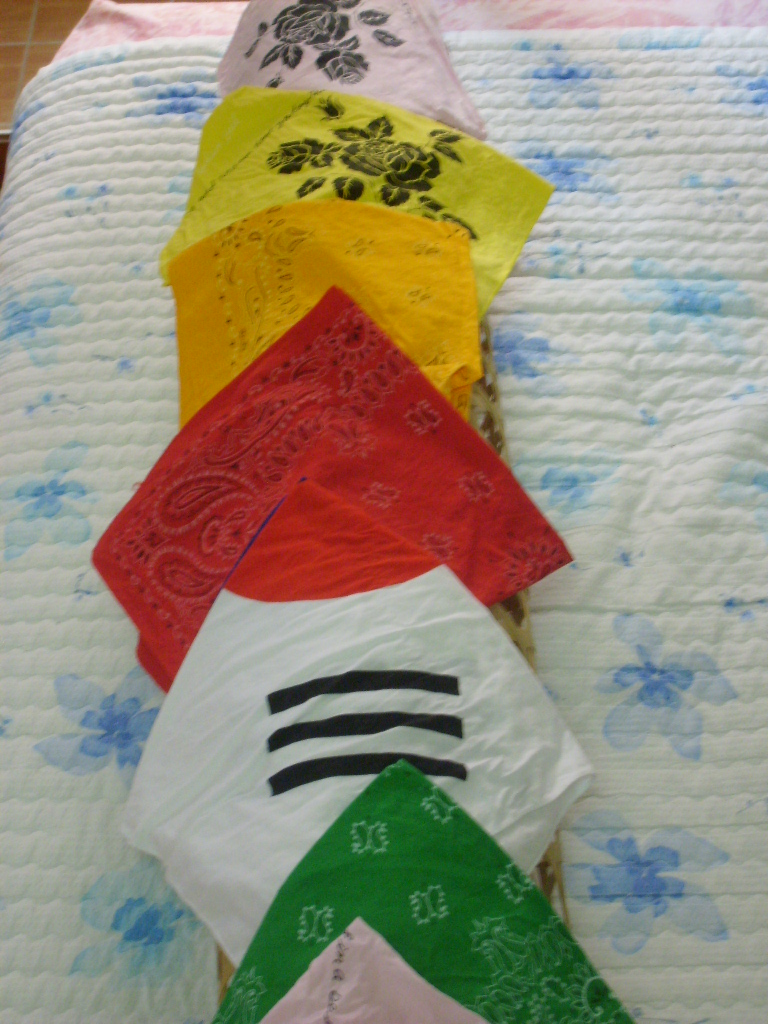
I don't believe in ironing!
In the heat of summer they are great wrapped around your neck at night to help prevent your neck getting clammy, or wrapped around your forehead as you trek up a mountain. The only thing you shouldn’t do with them is use them to blow your nose as Koreans would find this quite disgusting! If a handkerchief isn’t sufficient to soak up your spillage, hand-towels are an ideal upgrade.
© Nick Elwood 2010. This work is licenced under a Creative Commons Licence.
Beyond the Blog – An Idiot’s Tale
An Idiot's Tale
If you can take the bad language or dodgy opinions, one of the most entertaining K-blogs, if not blogs per-se, is An Idiot’s Tale. The shit floating in bogland is extensive and finding material which actually grips you, and Mr Wonderful grabs you by the bollocks, is rare. An Idiot’s Tale definitely meets my criteria as a writer and has an ability to say in a sentence something I might drag out to a paragraph. Even though I don’t agree with all his comments or particularly like the things he writes, I love the way he says them. And unlike other writers he isn’t afraid to be outspoken or controversial, which may of course be part of his plan but in doing so he provides a refreshing change.
Too many blogs are simply badly written travel diaries, often written for mummy and daddy or mates back home and often full of misinformation. How many more posts do we need on mud festivals or the latest girl band? Other blogs, often over rated, simply give information everyone knows once they’ve lived here a short time and while they might have an occasional use, are in reality no more the product of a ‘writer’ than is a bus timetable. It seems you become an expert on Korean society the moment you launch your first post, even if you’ve only been here a week. And everyone is a writer! Blogs provide the perfect place to blag about ones credentials. Yesterday, I found a blog where the author gave a complete run down of their CV: journalist, newscaster, playwright, writer, poet, teacher, Phd educated, bla, bla, bla… What the fuck are you doing teaching English in Korea? Worse, his blog was shite!
Unlike so many other bloggers, Mr Wonderful doesn’t claim to be a writer, indeed he seems to shun such a label and yet comes closer than most to actually being one. Not only is he able to take something as mundane as a mud festival and say something different about it, but the bizarre background image he has painted, through characters such as Dragon Lady, Children of the Rice, Jughead and Queen Elephant, are highly evocative. Mr Wonderful has created a strange world, you glimpse it through cracks, a photo here, a reference there; it’s a shady world hovering between dream and reality, a world that seems a little sleazy or seedy, of darkened PC bangs, drunken stupors and dirty bodies. The intrigue of An Idiots Tale, its allure, lies in the fact that you can’t establish whether is fantasy or fact – this is one masterful stroke of creativity. I still laugh at the strange and evocative phrases he uses – ‘off to the paddy’ field, ‘toad juice,’ get some coin.’
As for political correctness, An Idiot’s Tale kicks it straight out the window. No one is beneath being ridiculed and he has taken the Kings of the K-blogs and re-christened them. I’m Sorry, but I find Clissy Snowfrake such a funny name even though I know it’s origins transgress political correctness. If Mr Wonderful is insulting to others, he is equally as insulting to himself and only this week describes his new haircut as giving him the appearance of a ‘dick with ears.’

A dick with ears
I like An Idiot’s Tale because it is short and punchy, offensive, provocative, rude, ignores the conventions of political correctness and has the ability to say so much in so little space and in this sense bears an affinity with Roketship. I like it because like a soap drama, it is full of bitchiness and intrigue all of which can be drifted in and out of, easily. Most of the blogs I read don’t inspire me to write or inspire me to write about them. An Idiot’s Tale does both. Though I know Mr Wonderful would despise me for trying to form a ‘circle jerk,’ I’m pissed of my blog isn’t in his Hall of Shame. If there’s one place I value it being, it’s there.
© Nick Elwood 2010. This work is licenced under a Creative Commons Licence.
Beating Boknal 2 (복날) Summer Foods
What do you eat when the memi are screaming and sweat is dribbling down your back and sides? There are numerous seasonal specials (보양식) which fall into the categories of either ‘hot’ or ‘cold.’ The ‘cold’ approach is probably the most popular with westerners and drinking cold drinks, eating ice cream and salads are the methods we are most likely to adopt to remain comfortable. Koreans however, stand this notion on its head when they consume ‘hot’ food to consume body heat hence fighting fire with fire. The ‘hot’ food is generally ‘hot’ in terms of temperature rather than chillies and would be similar to stuffing your face on the hottest English afternoon with a hearty casserole and dumplings; something we’d generally eat only in the depths of winter. In Korea, it isn’t a case of one or the other and most Koreans will mix the two extremes in an attempt to beat the heat. Bo-yang-shik (height of summer foods – 보양식) are seen as beneficial in either improving ones toleration of hot, muggy weather, or in cooling one down.

Boknal (복날)
Boknal (복날) is a period of around twenty days which are based on the lunar calendar and this year began on July 19th (ch’obok -초복). There are three days (sambok – 삼복) which Korean perceive as the hottest and they are ten days apart. This year, 2010, sambok are respectively, July 19th (ch’obok – 초복), July 29th (Jungbok – 중복), and August 8th (malbok – 말복). I hate the heat and especially dislike humidity but unfortunately I live in Daegu, the hottest part of Korea in the summer and the warmest in winter. This week the temperature has been as high as 37 and so the memi are particularly noisy.
Through Boknal, and on each of the consecutive sambok day it is a tradition to eat some form of special food, usually one of the ‘hot’ types such as sam-kye-tang (삼게탕 – chicken ginseng soup), or dog stew (po-shin-tang – 보신탕), but cold meals, buckwheat noodle soup (냉면 – naengmyon), or soya bean milk noodles (콩국수 – kongkuksu), are also popular.
For some, mostly older men, dog stew is a favourite and in addition to the belief it fortifies one against hot weather, it is also one of the numerous foods which are supposed to enhance male sexual stamina. I recently spoke to a friend who is quite adamant that dog stew and dodok (더덕 – codonopsis lanceolata) give him a harder erection. I eat dodok everyday and haven’t noticed anything but then I’m 54 and he’s 25. As for the dog stew, I’ll pass. I ate it for the first time with the aforementioned friend and his father, in 2000. I wasn’t enamored to it. First, I couldn’t get the image of little dogs out of my head and then there was the ‘starter,’ small bits of dog skin wrapped on a bone so that when barbecued they whirled around it. Trying to make a pouch on a platter look pretty seemed to make it more difficult to eat. I have no problem with eating any kind of animal yet have a dormant ethical problem with eating animals – per se! I would imagine many people share this weak-willed position. To be honest, I have to snigger at those waygukins who condemn Koreans for eating dog and yet raise no criticism of their own culture where eating rabbit is accepted. Koreans usually find the idea of eating rabbits distasteful. Tell Koreans you’ve eaten rabbit and quite a few will insist, ‘it’s a pet!’ As Herodotus said, ‘nomos is King of all!’ The dog issue tends to inflame passions but what should be remembered is that it is not the eating of dog that should be the offense, but the alleged manner in which they are slaughtered. And though some may argue dogs have a special relationship to humans, this is a culturally specific relationship and not one of universal, eternal properties. Personally, I’d rather have a pig for a pet than a dog. In 2001, my one room had no air conditioning and the dog stew did nothing noticeable to fortify my constituency against heat and humidity and certainly never stirred my passions.

This is my sam-kye-tang. (Click photo for link to the Queen of Korean cooking, Maangchi) )
Sam-kye-tang is one of my favourites though I prefer eating it in the winter. At lunch time that small chicken, the wadge of gluttonous rice and a gallon of broth, simply bloat my belly and start me sweating profusely. But it is delicious in the Korean sense of the word. I occasionally make sam-kye-tang if I feel tired or have a cold.
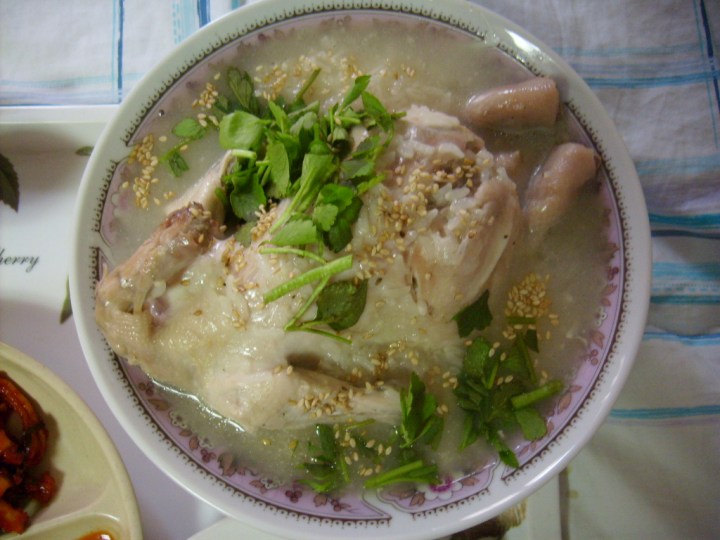
Wholesome (Maangchi link)
And I would find kong-kuk-su (콩국수) mightily refreshing if not packed with noodles. I enjoy the icy soya milk broth, with its slightly salty tang but those noodles don’t do me any good. I don’t know why it is but kong-kuk-su always seems to be served in large portions while naengmyon (냉면), for example, is often served in a smaller portion.

Soya broth milk noodles (Link to Maangchi)
Mul-naeng-myon (물냉면) is my boknal baby! I can eat this on a hot lunch time and then walk on into work without breaking into an excessive sweat. I love the tangy combination of vinegar, salt and sugar and have a hard job keeping the broth in my freezer if I have made a batch. I can remember the first time I ate naengmyon; it was on a hot Sunday afternoon, in early August, after a mountain hike in Song-So. I quite disliked it! What a freaking horrid combination; watery broth with a clump of sticky buckwheat noodles that are impervious to mastication and almost impossible to eat without sucking the whole clump up. And then there’s the slice of pear, and the ice cubes and as for the lonely, wafer thin slide of beef, you’d think it had fallen in the bowl from another meal – it’s appearance a mistake! Naengmyon is sweet, and salty, and tangy – is it a dessert or a savoury meal? And as for the vinegar and mustard which are added to it… Since then, mul-naeng-myon, and particularly Pyongyang mul-naeng-myon, have grown on me. If you have never eaten it, it must sound quite gross but when the weather is scorching hot and your covered in sweat, it is one of the most delicious and refreshing meals. Even the sound of the ice cubes tinkling and jingling against the sides of the stainless steel bowl in which it is traditionally served, are refreshing.
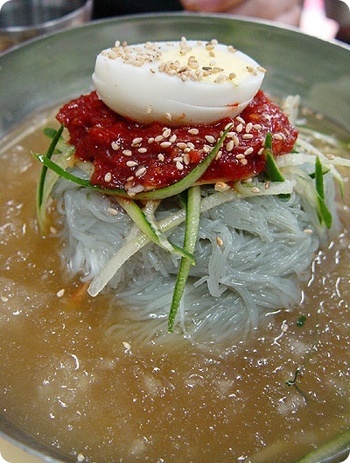
Mul naengmyon (물냉면) 시원해요!
I suppose naengmyon is the sort of food you eat at a heightened sense of reality, especially if you’ve just come down from a mountain – a feat which always seems harder than going up, and at a point when you’re body and mind feel good, it’s scorching hot and humid and you’re sweating profusely. Enjoying naengmyon at this point is an integral part of the summer experience and so I never enjoy it, or feel a need to eat it, in the middle of winter. To truly enjoy naengmyon it has to be hot, boknal hot, horribly humid, you have to be sweating and you have to be tired. Naengmyon shares a lot in common with Pimms No 1, that British summer drink, only ever drunk outside under the sun, and accompanied by ice, slices of cucumber, summer fruits and mint. One should never drink Pimm’s indoors or in winter and though this might be deemed snobbery, Pimm’s only really seems to ‘work’ when this is observed.
Finally, and wonderfully refreshing, is patpingsu (받빙수). This is rice cake, sweetened tinned fruits, red beans, and condensed milk on a bed of flaked ice which is often topped with spray cream. There are many variations of this refreshing ‘dessert.’

Patpingsu – usually shared with friends (받빙수) (click photo link to Hangook Summer)

Green tea patpinsu (photo link to Hangook Summer)
Other means of beating boknal
cereal teas
iced coffee
silver summer trousers
handkerchiefs and towels
ice rooms and cold pools
cold showers
hand fans
© Nick Elwood 2010. This work is licenced under a Creative Commons Licence.
Peaches – Monday market
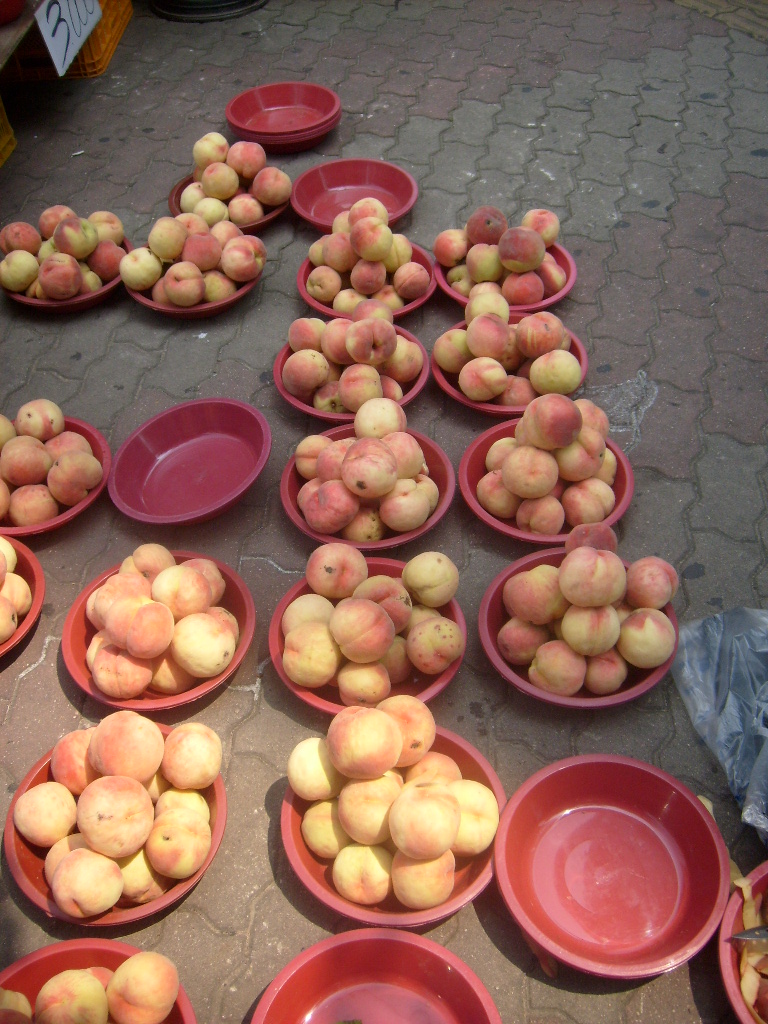
Looking at the Peaches
Koreans have this habit of eating fruit that I wouldn’t classify as ripe. Of course, it’s cultural but when I bought a ‘box’ of delicious looking peaches I discovered they were like cricket balls – hard! They do the same with persimmon. Yea, I should have poked them before purchase but didn’t. I like peaches soft and juicy. Currently, they’re sitting in my fridge in the hope they might ripen. Putting them on the window ledge is out of the question as it will attracts those annoying little ‘day flies’ which prevent you leaving any fruit or vegetable peelings in the bin for more than a couple of hours. White peaches are really delicious but I haven’t seen any this year and they are always more expensive.
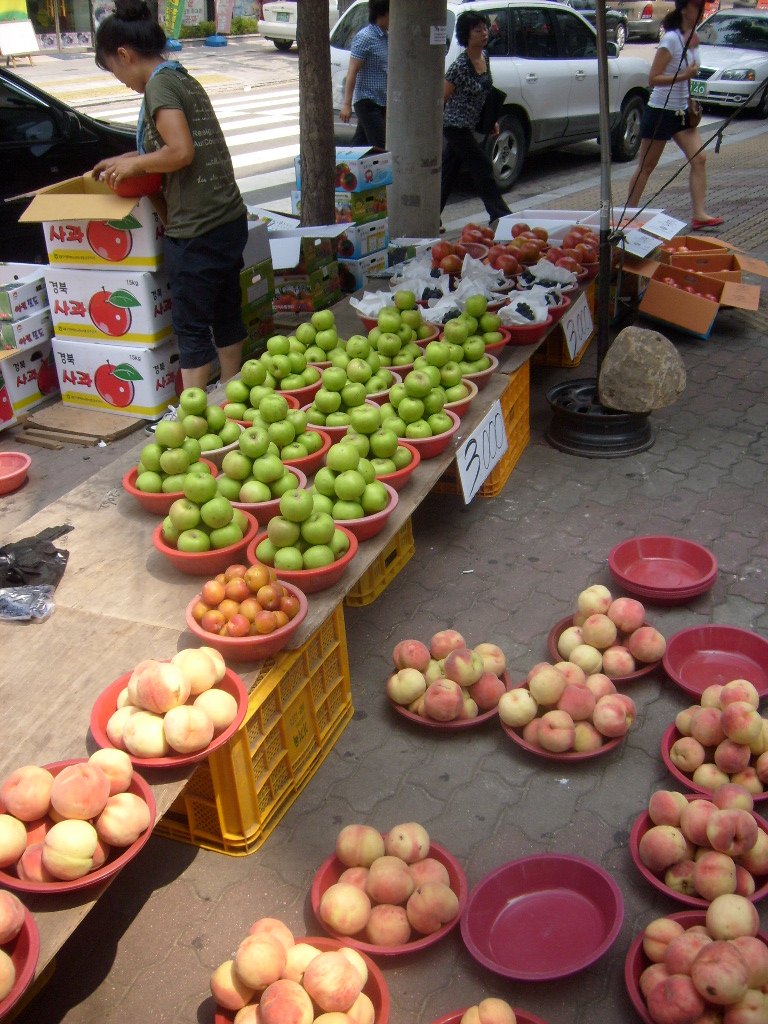
The tomatoes are even bigger than a few weeks ago and are now bigger than the first of the green apples – perhaps it’s because of all the rain.

Massive tomatoes
© Nick Elwood 2010. This work is licenced under a Creative Commons Licence.
Bathhouse Basics 6: The Wooden Pillow (mok-ch'im – 목침)

Rest your weary head on a wooden pillow (목침)
The wooden head rest (pillow) is a common site in bathhouses and jjimjilbang. Obviously, a cotton pillow in a sauna would be a little grotty as laying your head on the sweat of the previous user isn’t very appealing. Hence the mok-ch’im (목침). Though they look quite uncomfortable, it is surprising how quickly you can adapt to them and for a little snooze they are perfect.
Bathhouse and jjimjilbang head rests are usually standard blocks made out of a hardwood and very often made from hinoki cypress, however, they do come in a range of other designs and can cost over 40.000 Won. More expensive mok-ch’im can be made to measure.
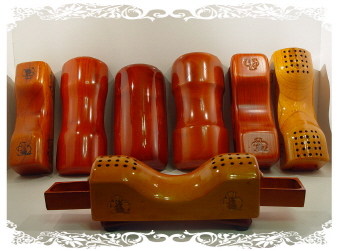
Various wooden pillow (order link)

'Tailor made' mok ch'im.

The antithesis of my memory foam pillow
Okay, they may not be everyone’s idea of a comfortable, but many years ago I learnt to sleep on the floor – without a mattress. When you body has learnt to sleep in positions which distribute your weight evenly across your body, which takes a few months, and which can be transited between subconsciously, sleeping on the floor is amazingly comfortable, far more so than a bed! Maybe the wooden pillow just needs perseverance!
© Nick Elwood 2010. This work is licenced under a Creative Commons Licence.
Bo-ssam (보쌈)

Bo-ssam
Bo-ssam is one of my favourite Korean dishes. It consists of slices of steamed pork wrapped in a vegetable leaf. ‘Ssam’ (쌈) refers to the practice of wrapping food in leaves, laver bread (김) or thinly sliced mooli, etc. This style of eating is popular with sam-kyeop-sal and bulgogi as well as raw fish or meat. A wide variety of leaves are used – chard, beetroot, sesame, lettuce, Chinese cabbage, steamed Chinese cabbage, steamed western cabbage, and numerous others.
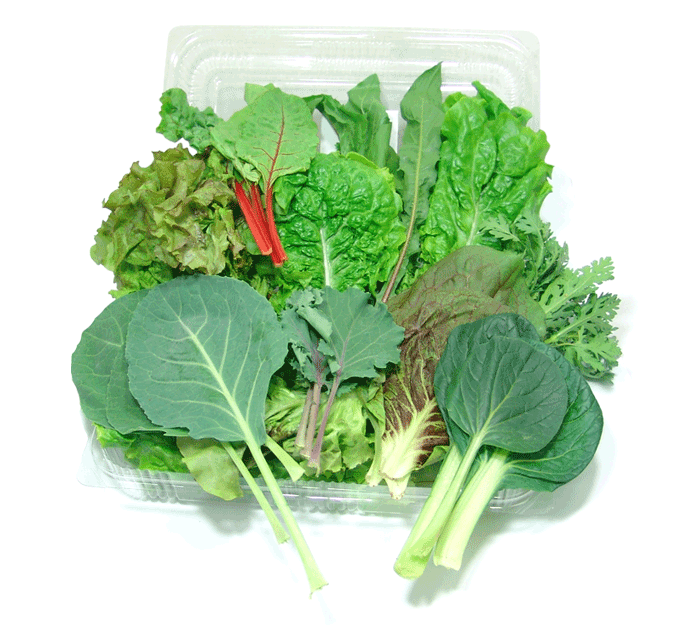
Various leaves

filling a leaf (쌈)
Bo-ssam pork is often shoulder, loin or belly pork and the recipes vary greatly. Often a large number of ingredients are used including, beer. The pork has a smooth, almost creamy taste and is accompanied with sweet kimchi – often containing oyster, ssamjang paste, sliced raw garlic, salted shrimp, and an assortment of other side dishes.

The main components of bo-ssam

Delicious
Many restaurants serve Bo-ssam for one person and you can assume this if the price is around 6000 Won.
© Nick Elwood 2010. This work is licenced under a Creative Commons Licence.
Cambodia – Summer Break
Many years ago, Monthy Python lambasted British holiday makers abroad and at home as eating only fish and chips, drinking Watney’s Red Barrel and wearing a knotted handkerchief on their heads while on the beach. I’ve only traveled on package type holidays twice, in 1986 to Tangier, Morocco, and in 2009, to the Canaries and though I spotted no handkerchiefs or even saw Watney’s Red Barrel beer, there was a proliferation of restaurants, fish and chip shops, ‘English’ sandwich bars, ‘English’ Sunday dinners and ‘English’ pubs aimed at the less adventurous. I’ve even had friends who refused to eat rice because they deemed it ‘foreign.’
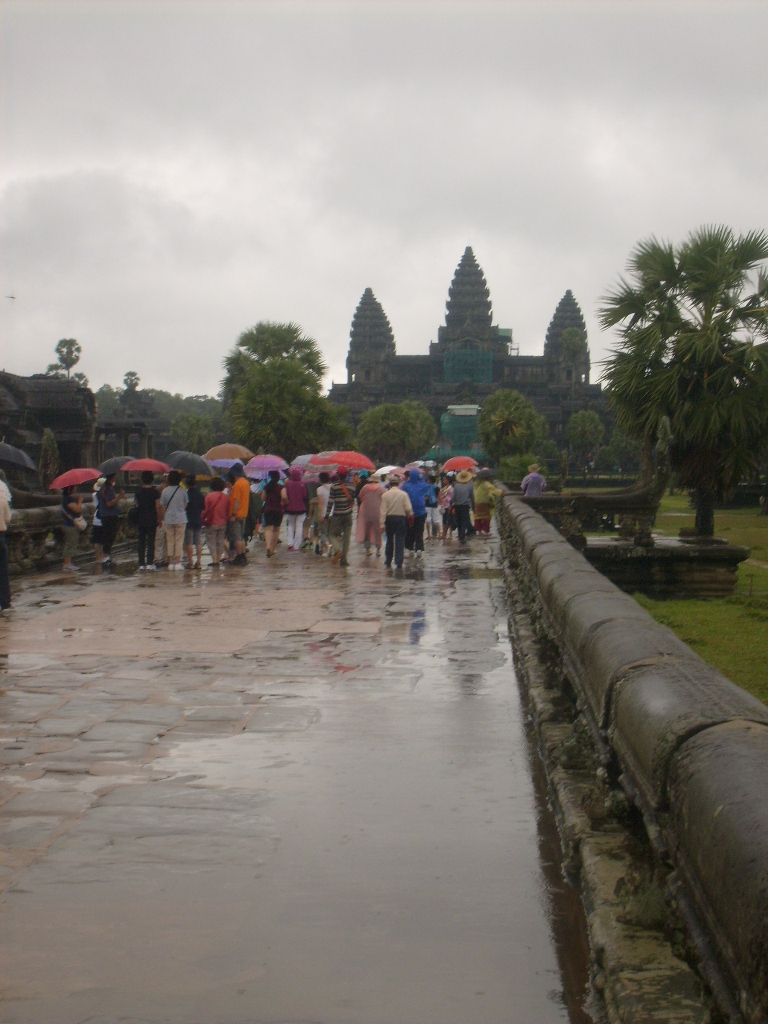
Angkor Wat
Traveling to Siem Reap, Cambodia with a Korean package holiday provide an interesting insight into Koreans abroad as well as the expected adventure of being in another country. Even before I’d paid for my ticket the tour company advised me to pack ramyeon and cans of tuna because Cambodian food ‘wasn’t tasty.’
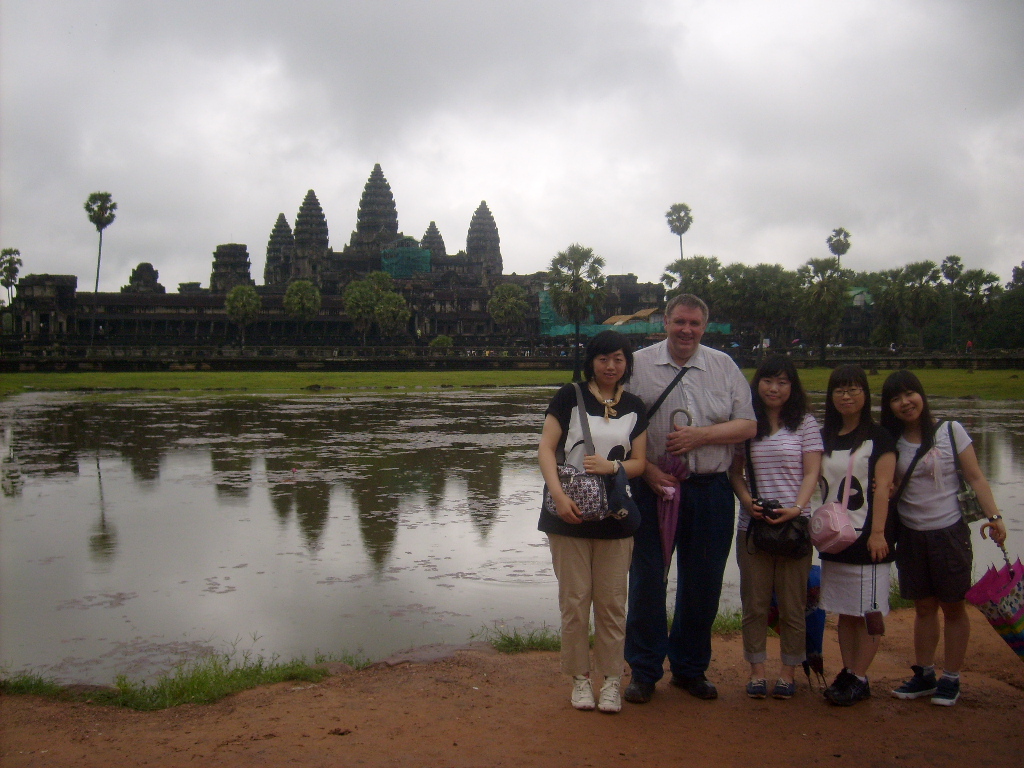
Angkor Wat's towers
For many years, an old school friend of mine was the local milkman and after he’d told me he was off on his fourth trip to Cyprus, I asked whether he went to the Greek or Turkish part of the island? Since the re-unification of Germany, many people regard Korea as the only remaining divided country but Cyprus was divided in two, in 1974 and remains so to this day with the Turkish part only recognised as being Turkish, by Turkey. My school friend laughed at my question and told me he had no idea which part of the island he went, he simply went to get pissed. Unlike many Brits, who seek lazing in the sun with a beach or pool on-hand, and who are content to spend two weeks in a resort which could be Spain, Portugal, Turkey or even Cyprus, but the destination of which is unimportant because they have little or no desire to actually see anything beyond the confines of what is basically a holiday camp, my Korean tour was a whirled wind of exhausting activity from dawn until dusk.
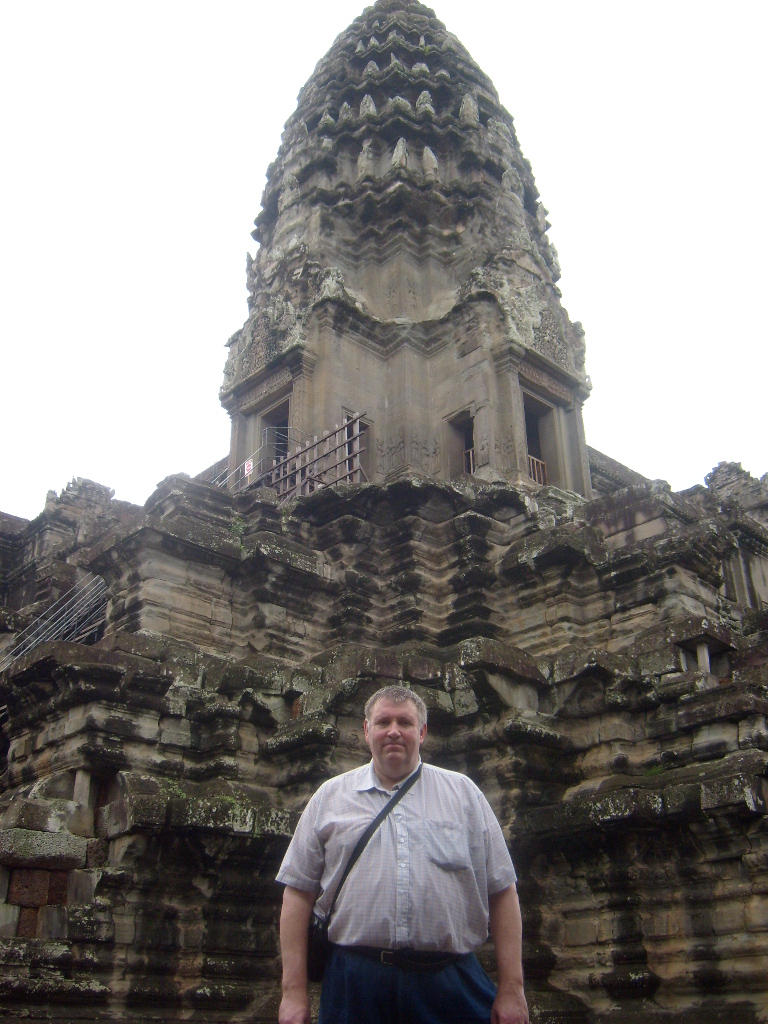
Innermost Angkor Wat
My hotel, Angkor Goldiana, was large and apart from a couple of westerners, the clientele were predominantly Korean. The hotel had a large, enticing swimming pool but during my five-day vacation, I failed to see anyone use it. The same can be said of the bar. At 8 am every morning the various tour groups assembled in the lobby to depart on sightseeing trips and most didn’t return until the late afternoon. Most tours included evening activities so by the time you did get back to your hotel room, you were exhausted. Touring under the organisation of a Korean tour company is a little short of being a student where ‘free time’ is almost unheard of.
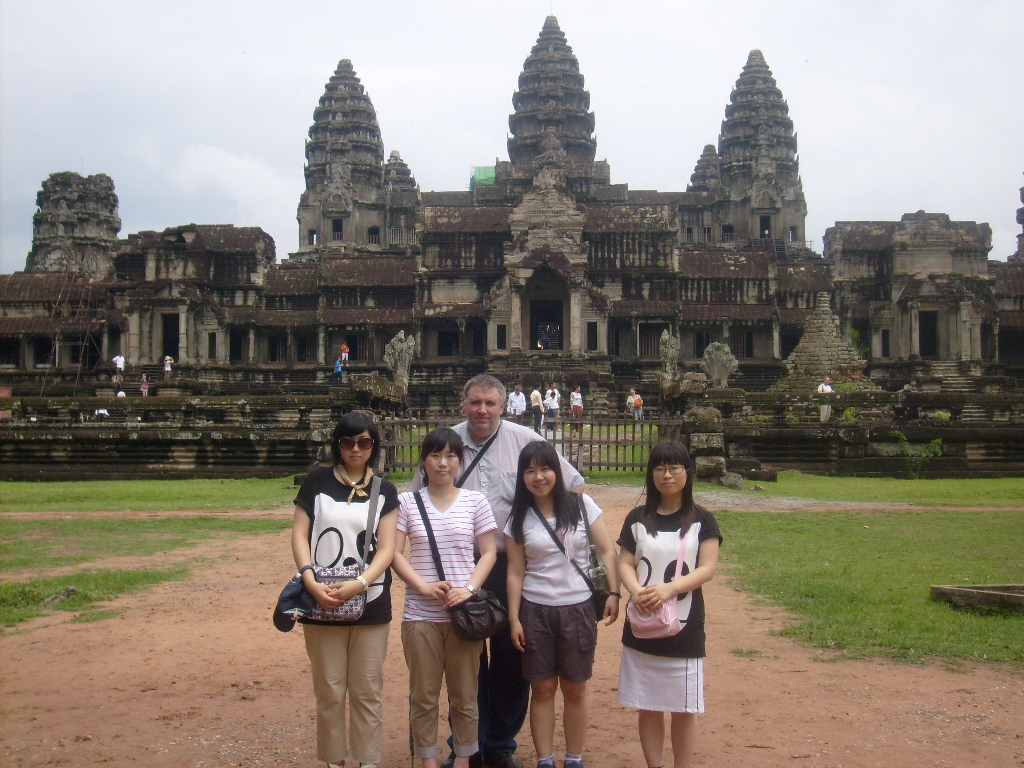
The far west end of the temple
All but one meal was Cambodian, the remainder were all Korean and included Pyongyang naengmyon (cold noodles) Korean barbecue, Bulgogi (fire beef), kimchi stew, chicken feet, fried spicy squid and the usually side dishes and ever-present kimchi. All of our food, bar the Cambodia meal and breakfasts, were served in local Korean restaurants.
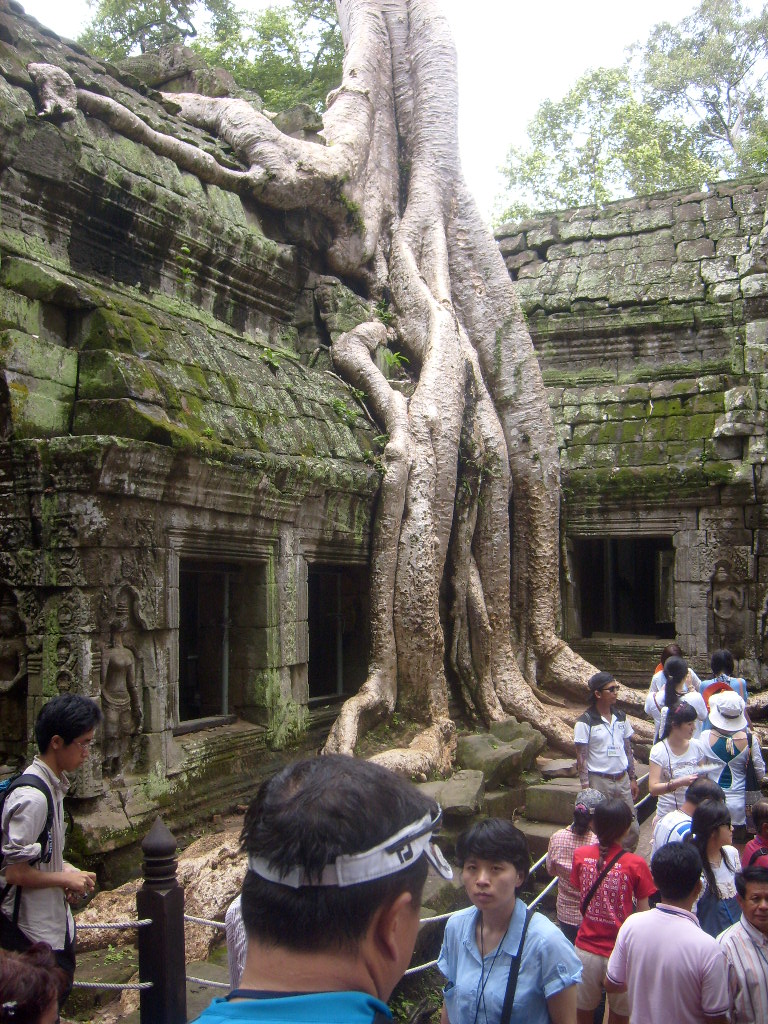
Ta Prohm Temple showing the bizarre spung tree
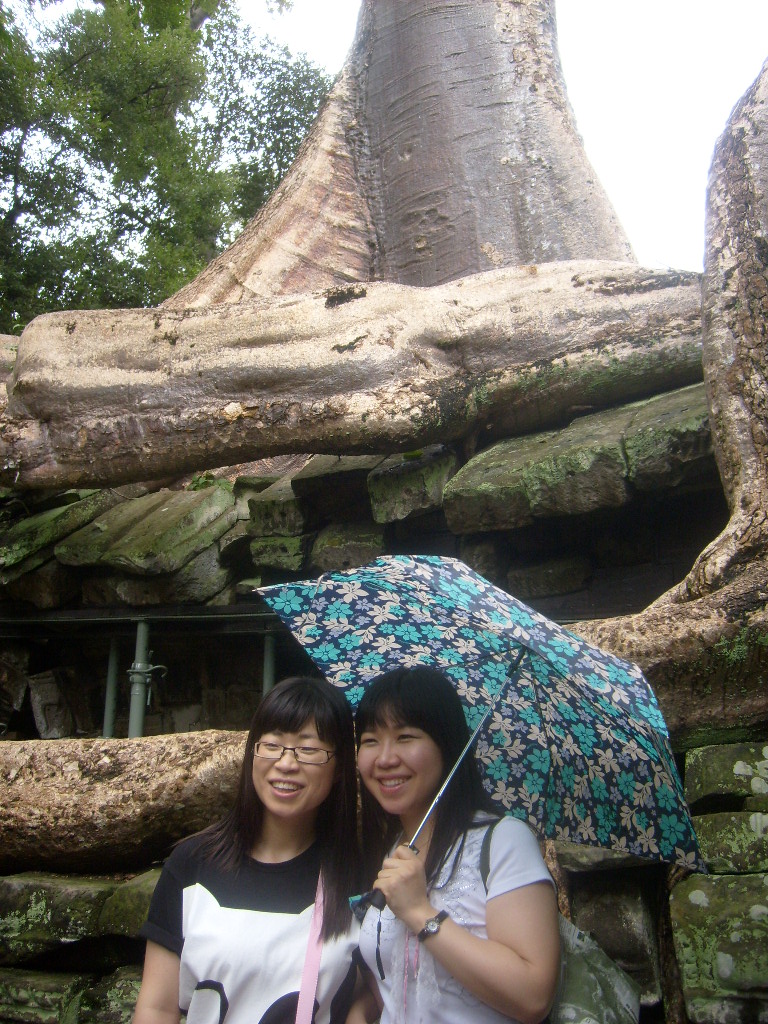
The colossal root system of the spung tree
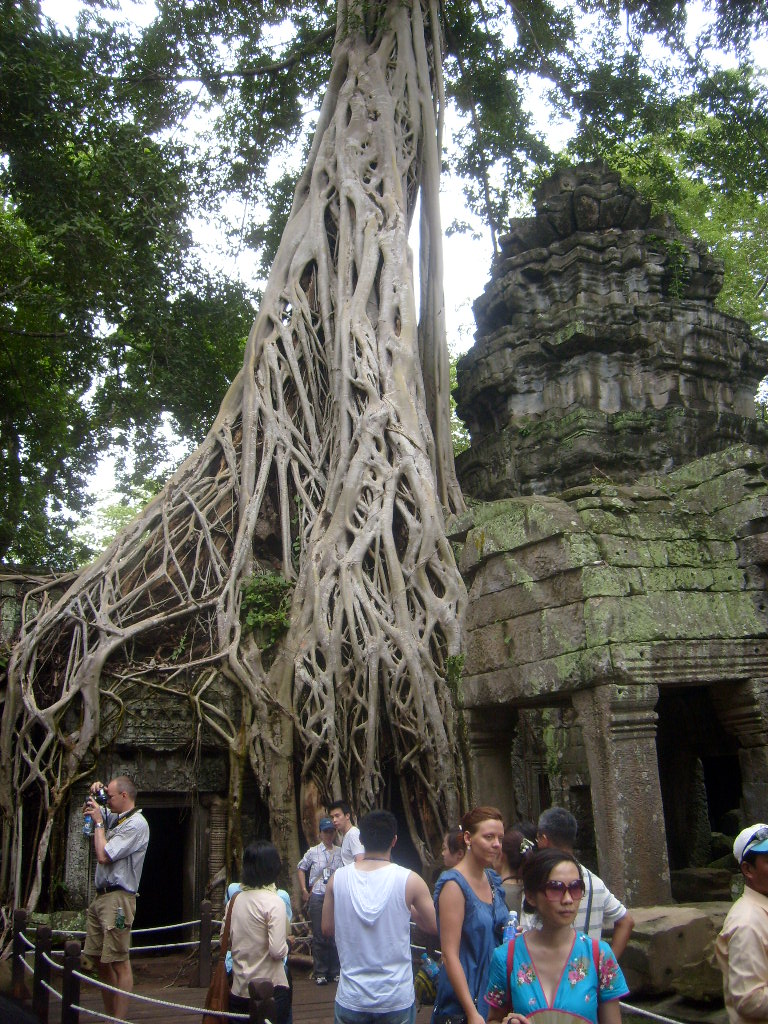
Gothic-style roots (spung tree)
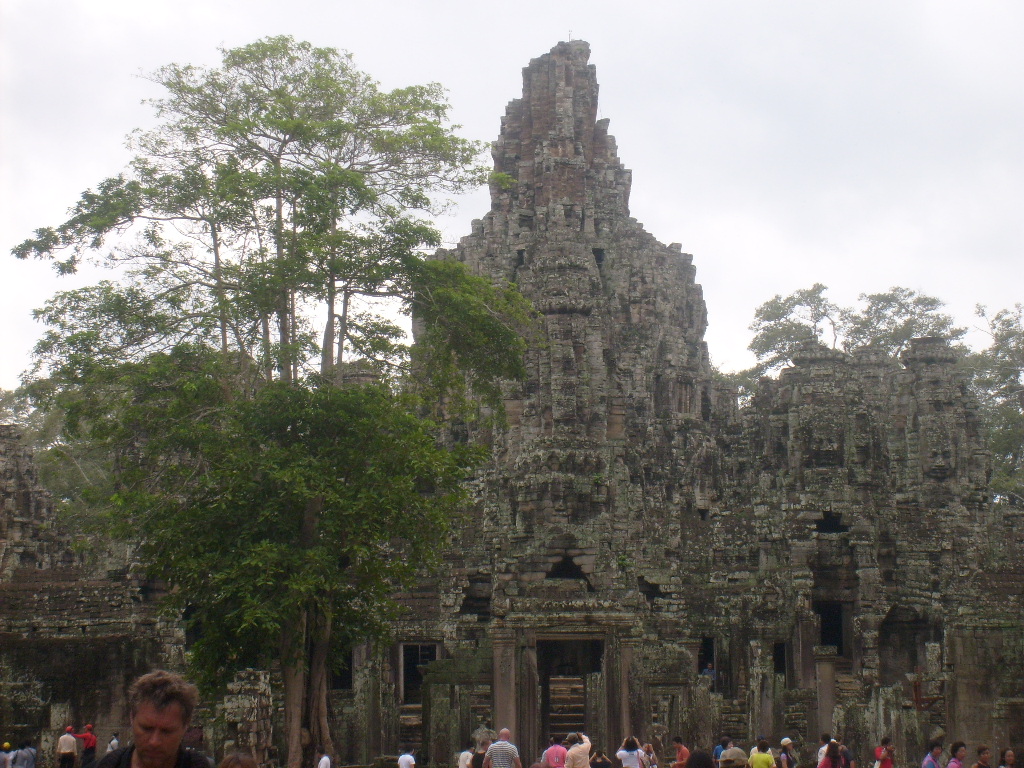
A wall of antiquity - Angkor Thom
The first excursion of day one took us straight to the renowned Angkor Wat complex and after spending most of the morning here we went to four other temples in Angkor. The heat and humidity were draining but even after some eight hours of walking my Korean companions were eager to climb a large hill to visit another temple; Phnom Bakheng. Needless to say, apart from a very few westerners, the majority of those enduring the climb were Koreans.
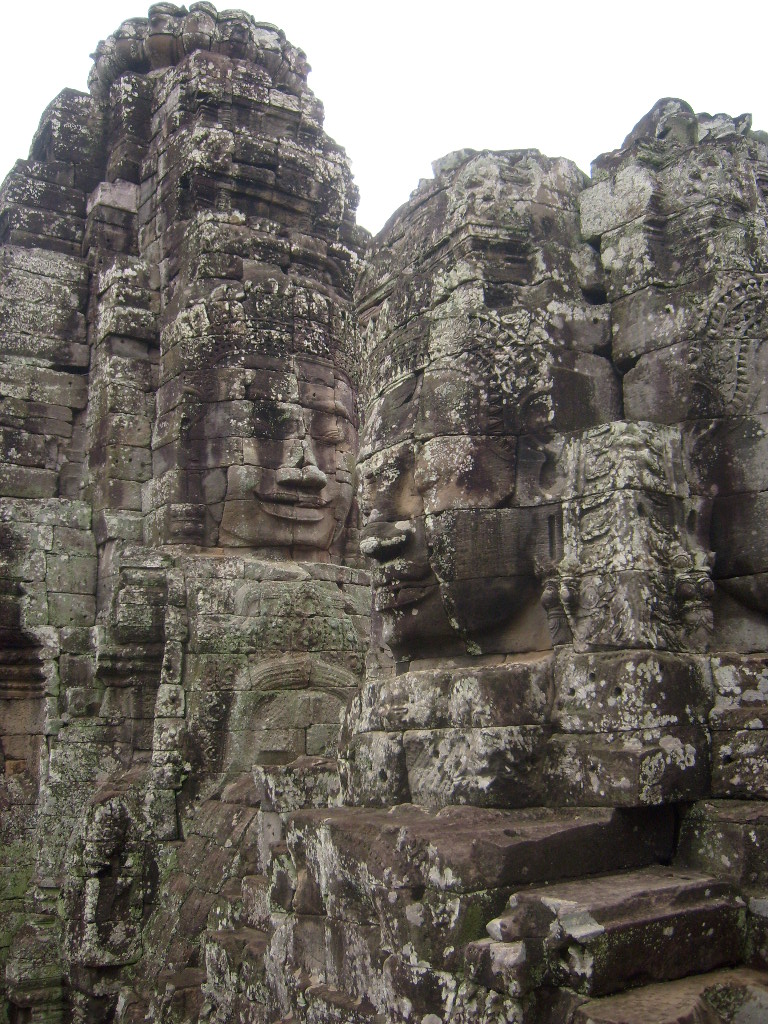
A few of the many faces of Angkor Thom
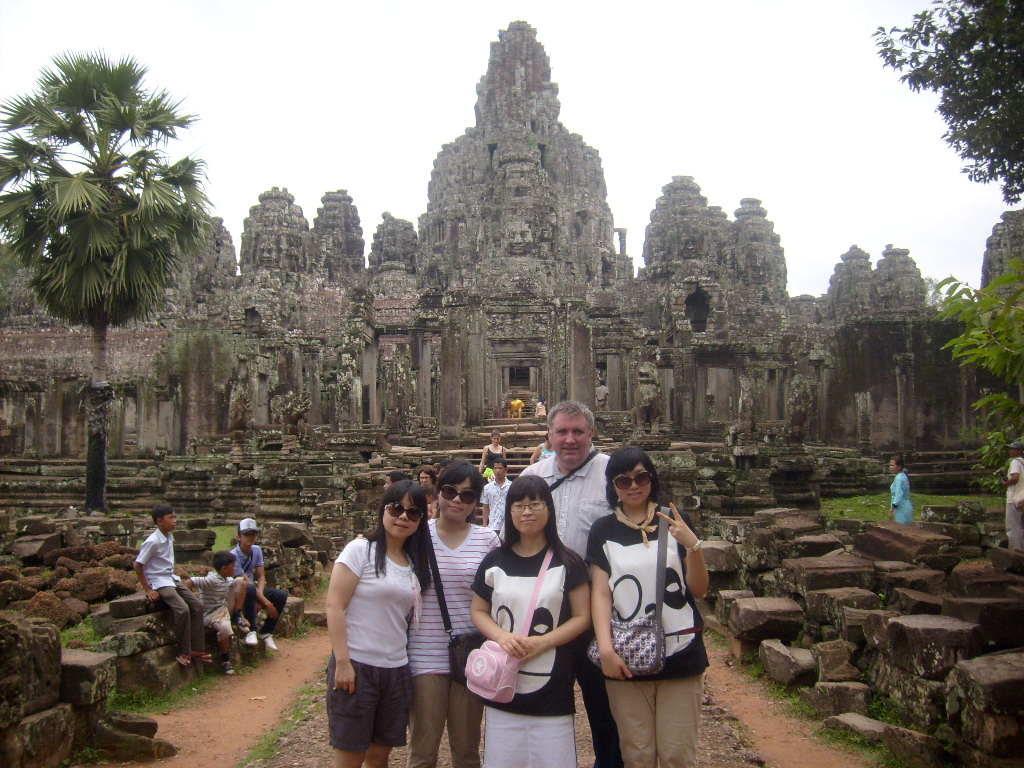
Leaving Angkor Thom
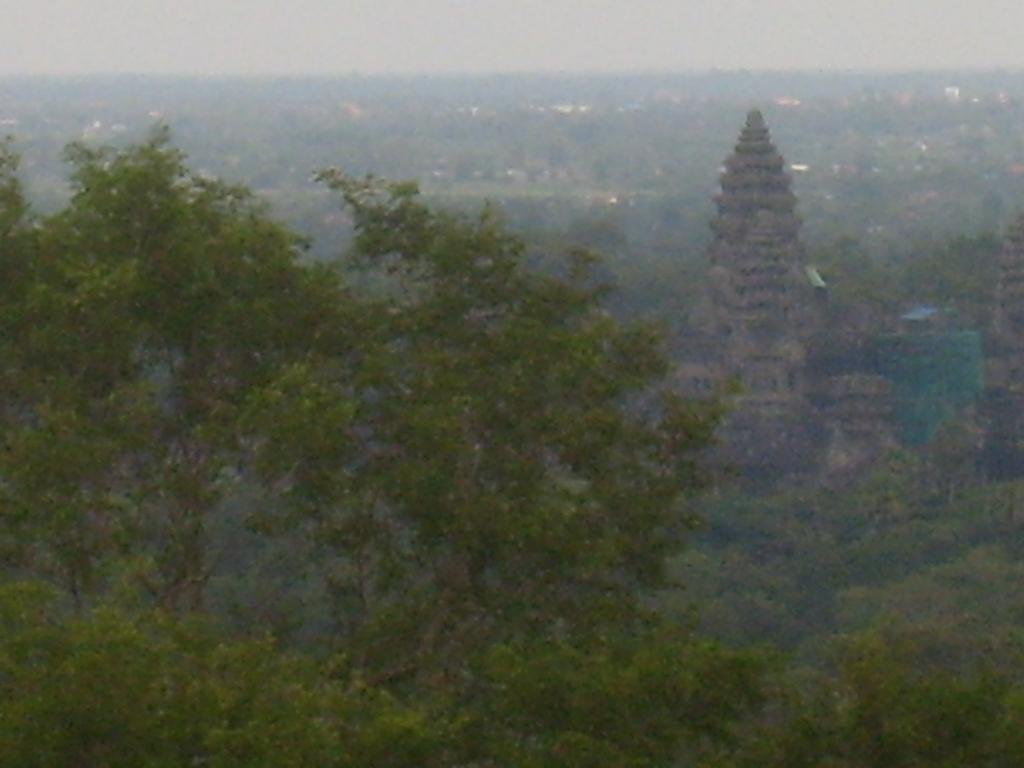
Angkor Wat from the top of Phnom Bakheng

Boat people on Tonle Sap
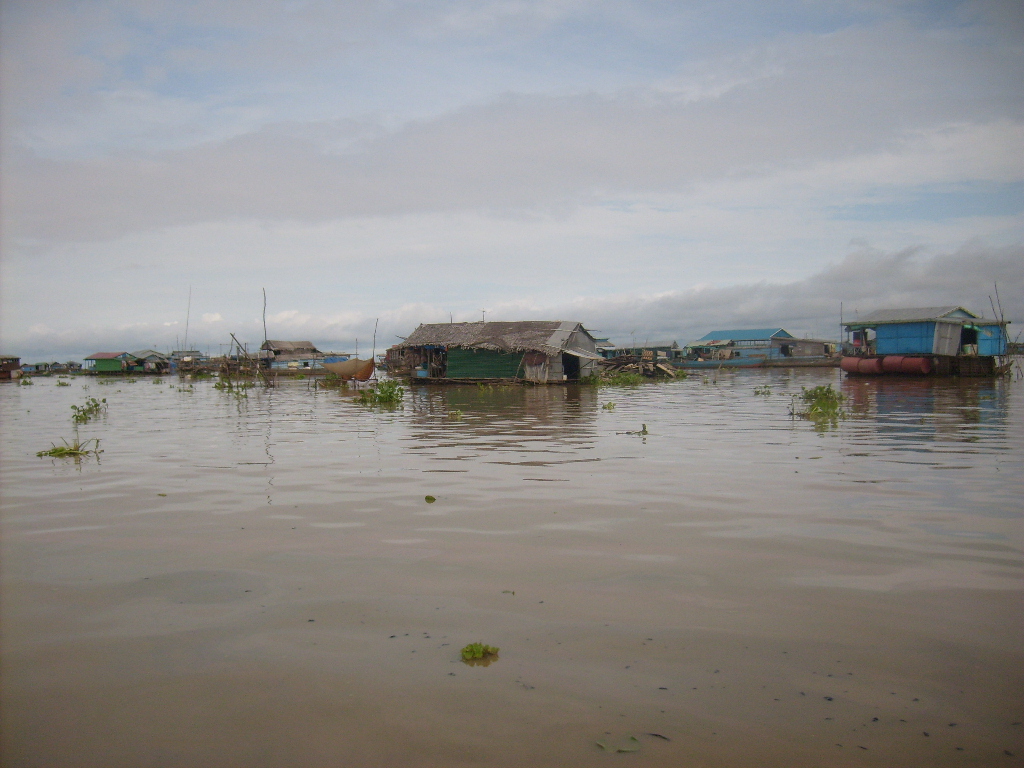
Tonle Sap
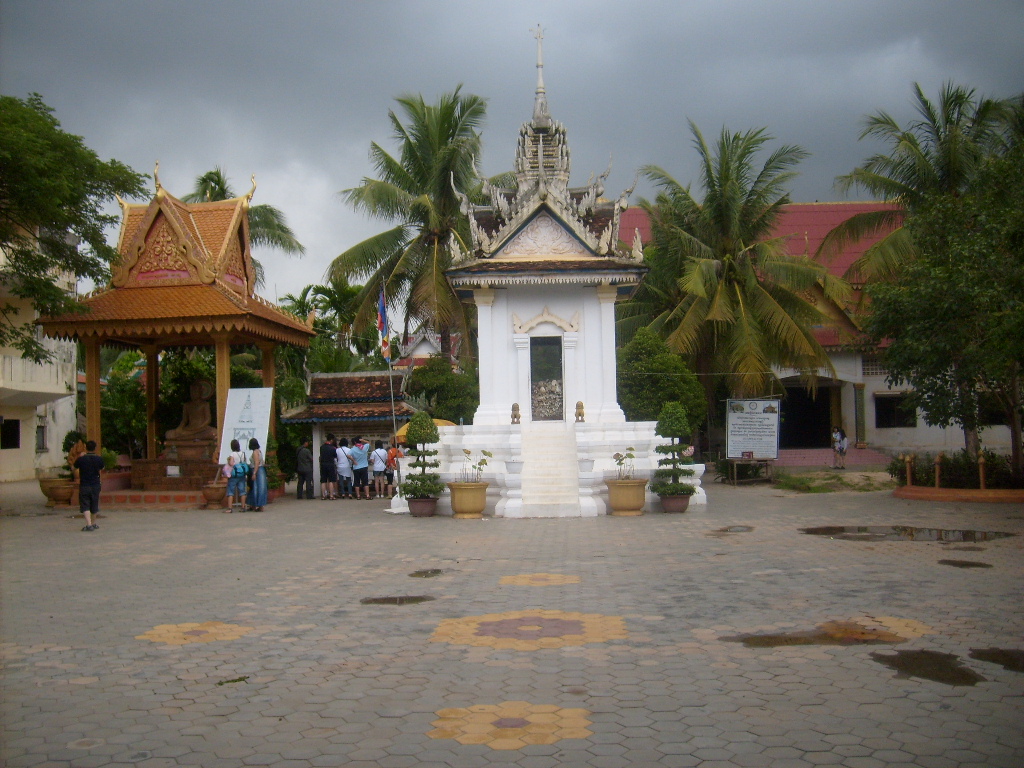
A reminder of Cambodia's part. Victims of the 'Killing Fields' at Wai Thmei Stupa. Siem Reap

Two days before this photo was taken, 26 July 2010, Kang Kek Lew was sentenced to 35 years imprisonment for his role as head of the Khmer Rouge Special Branch. He was charged for personally overseeing the torture and death of 15.000 men, women and children.

Cambodian kids at West Baray, singing a Korean children's song, taught to them by our guide.
Places visited:
Royal Cambodian Independence Park
Wat Thmei temple and stupa to the victims of the killing fields.
cambodia – http://en.wikipedia.org/wiki/Cambodia
The Korean tour company was Modu Tours and provided an excellent service.
© Nick Elwood 2010. This work is licenced under a Creative Commons Licence.
Migwang Bathhouse on a Sunday Morning

Bathhouse view over city
I’ve been in Cambodia for a few days and today was the first opportunity in over a week to wallow in the e-bente-tang (이벤트탕). I was visiting Migwang jjimjilbang in Song-So, Daegu. Though a Sunday morning at 8.45am, it was the quietest I have known it and quieter than the odd occasions when I have been in the bathhouse at 3 or 4 am.
Today it’s 35 degrees and even at 8.15 the memi were screaming from passing trees. At this time of year, with the screaming in chorus, you can hear them in a taxi with the windows closed. As is usual in hot weather, I head straight for the cold pool once I have had a shower and shave, but today I noticed something very special. I often joke to my friends about the e-bente-pool and tell them how I lay waiting for them to start spinning or jiggling up and down, but they never do. The very term ‘e-bente’ is a bit of an anti-climax and in the English use of the word merely adding a smell to the water doesn’t really constitute an ‘event.’ An ‘event’ implies something out of the ordinary or special. The very first time the complex management added an aroma to the water constituted an event which subsequently became a normal feature and a bit of a ‘non-event.’ Today however, I noticed the water has been coloured deep pink to complement the ‘herb’ aroma. So, by-passing the cold pool, I head straight for some pink pampering. Hardly much of an ‘event,’ but after waiting for over a year for something to happen, anything is better than nothing.
As I’m wallowing, I suddenly become aware of other subtitle changes. The ceiling has been cleaned and new pattern section as been placed above the central baths. In the cold pool, I discover a ledge has been built against the far wall and is big enough to sit on. One this, at intermittent spaces of about a meter, big enough to park my fat arse, are various devices which look like various kinds of fountain; I can’t tell as I don’t think it has been finished yet. Above these are multi-coloured light fittings. It looks like the lights and fitting may comprise a new water feature. Migwang is obviously doing well financially as every holiday new items miraculously appear. Several months ago the gigantic tropical islands photos surrounding the cold pool were replaced with new ones, the tiles in the high-powered shower replaced with ones of sunflowers, and a long strip of jagged paving stone, to walk on and stimulate the soles of the feet, a torture Koreans’ seem to enjoy, was installed.

Bathhouse overlooking city
By 11 am, the bathhouse is busier and I’m treated to a display of some guy doing a complete taekwondo workout. Another guy, cooling in the cold pool, directly behind the guy exercising, is treated to a peek up his back passage when, on several occasions, he stretches downwards to put his head between his knees and place the palms of his hands flat on the floor. In the e-bente-tang a teenage boy and his dad are caressing each other. The dad is sitting between his sons outstretched legs while his son pummels his shoulders and massages his back. They wrestles in the water for a while, wrapping their legs around each other and at one point, the boy bites his father’s toe. When they watch the TV together, I notice how close they sit to each , almost like lovers, their heads are almost touching; I notice them later on when they are walking between the pools either hand in hand or with their arms around each other. I wish I could have had such intimacy with my father; I don’t think I ever massaged his shoulders or scrubbed his back and sitting that close to each other, as adults, even when clothed, would have been uncomfortable. If you see anything sexual in such a reflection you’re clearly a dirty waygukin with a perverted mind!

Ohhhhh! Summer’s heavenly haven
There is another teenage boy with his dad, probably about 14 and he has got the most enormous dick: if you watch the faces of other men as the boy passes them, you can see them peek at it. When they’re sitting in the e-bente-tang, the boy makes several visits to the ice-room where collecting a handful of ice, he takes it back into the pool and commences to massage it over his father’s head. In typical Korean fashion, his father makes loud noises to express his pleasure at the sensation.
© Nick Elwood 2010. This work is licenced under a Creative Commons Licence.


 Elwood 5566
4 comments