Feeling a little Dicky

작은 고추가 맵다! Big things come in small packages
I haven’t been to the bathhouse lately as I’ve been feeling a bit dicky after a mild touch of food poisoning and I’ve been giving some thought to the topic of dicks. It’s the fault of the GS 25 convenience store near my one room which has a tendency to hire attractive students who lure me into their domain partly because of the motto worn on the back of their jackets, fresh, friendly, fun, but also because I usually fancy something hot before bed. The latest boy also wears a pink badge which says, ‘I love you.’ They should pay him extra money to wear the jacket and badge. Those kids are crappily paid, something like 4000 Won (£2) an hour, and I’m aware I could probably lure them with some extra won, if I was in some seedy dump like Tangier or Tijuana, but no one has any free time here and besides, vibrant economies tend to put a damper on the extremes driven to by financial desperation.

Small and hot
Clacton on Sea in Essex, UK! Now there’s a place as seedy as dirt holes like Tangier or Tijuana. You don’t have to travel with a passport to find economic, intellectual and cultural poverty if you’re British, Clacton provides it all. I’ve taught in most of the senior schools in ‘Clacky,’ an experience enough to terminate any interest in teaching as a career. Here’s a snippet from a diary entry for February 2000.
I don’t enjoy my contract day as I feel responsible for the classes. It’s much more fun when I just do cover. It was an okay day but the lads in my last class, Year 10, bottom set business studies (my pet hate) spent most of the time messing around. There were only four of them and I’m sure a couple of them are prostitutes – Clacton is that sort of place and I believe that the Macdonalds in the town center is where you pick them up. The boys sit with their knees wide apart, one keeps tugging at his dick and their conversation is usually about sex.
‘Do you fancy ‘him,’ Paul?’ asked one boy hitching his head to indicate me.
‘If he’s got the money.’ Later, Paul asked me to sign his report. ‘Go on, Sir, give me a good one. Just a few good comments to keep my parents off my back. I’ll do anything you want.’ I looked at him and raised my eyebrows. ‘Even that,’ he replied. A few weeks ago I over heard this boy say he’d like to be a male prostitute. His friend asked if he’d do it with men. He told him he’d do it with anybody as long as he got paid.
I could probably pick up a local faecalapod in Clacky with as much ease as you could in Tangier, except I’m not into dirt or STI’s and the hottest thing I’m going to pick up in GS25 in Song-So is a cup of hot chocolate. The new boy is skinny and he reminds me of a former student. Because of centuries of genetic isolation, Koreans tend to look much more like each other than we mongrel wayukins. Even beyond the black hair and dark eyes, I tend to note similarities in a passing stranger with the features of old friends or former students. I don’t know if there been any research done on the subject but sometimes I think there must be less than 15 basic appearances from which most Koreans slightly deviate.
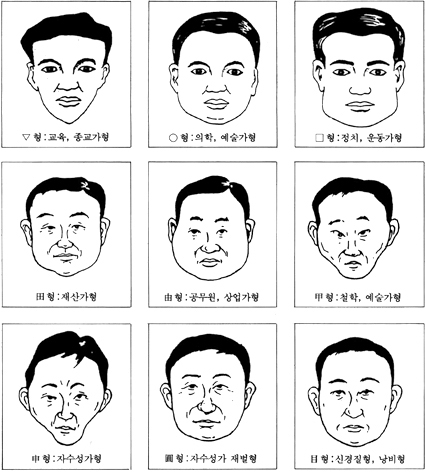
Phrenology
The skinny lad won’t last long, the students in the store tend to change about every three months. It must be a frigging bore of a job working through the night and I’ve no idea what’s on their pads ‘n’ pods but some of them seem to spend the whole evening on them and will instantly discard them as they jump to attention, when you walk into the store. Some read books but even then there is usually a pad or pod in sight.
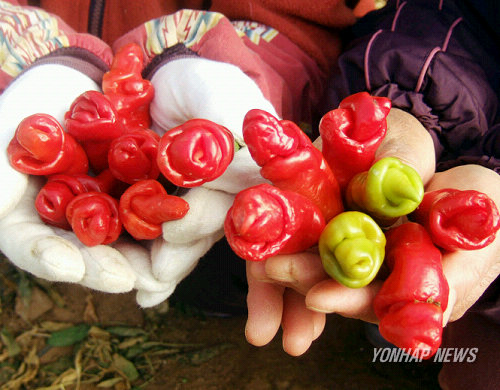
'Peter Peppers' or 'Chilli Willies' - though they may be look-a-likes (Yonhap News)
And of course, it’s chilli season. Talking of willies, phallic shaped chillies are probably a freak of nature in Korea but in Louisiana and Texas, USA, a type of chilli, the ‘Peter Pepper’ or ‘Chilly Willy,’ is renowned for producing consistently cheeky chillies. The website ‘Chilli Willy®‘ markets the appropriate seeds, provides growing tips and hosts a regular photo competition. Do they have the same kick? I’ve no idea but in Korea it’s a well-known idiom that the smallest chillies are the fiercest (작은 고추가 맵다). Globally however, Korean chillies are far from the hottest or smallest. For a wealth of information on the world of the hottest chillies visit: http://www.scottrobertsweb.com/scoville-scale.php

A genuine 'Chilli Willi®'

© Nick Elwood 2010 Creative Commons Licence.
Season of the Memi

Arrival
I’ve been waiting to hear the first memi (매미) of the season and was particularly eager to note whether my bollocks were stuck to my legs and sweat trickling down my back in rivulets. The memi ‘sings’ from 29 degrees (84 degrees Fahrenheit) and above. Currently, they will be making their way from the ground up into the trees, ready to start their summer song. I’ve only seen the occasional solitary memi moving up a tree but stumbled across a video of several hundred moving up a trunk. (Link to Korean memi video)
I heard the first memi at 1400 as I was taking a photo of a pomegranate tree and when I realised what it was, I made a mental note – my balls weren’t stuck to my leg and I wasn’t sweating. Not surprising really as I’d only been out of my apartment for less than two minutes and my room had been fairly cool!

Midnight memi
I actually managed to capture the very first call before it finished. You can hear the ‘song’ here but I recommend you turn your volume down as I was surprised how loud the recording is. A memi singing in your ear hole, or through your speakers, can have a capacity of 120dB, enough to cause permanent damage to your sense of hearing.
In summer the memi (매미 – cicada) sing with intensity, in actual fact their song begins at 84 degrees Fahrenheit (29.4 C) and dominates the summer. This was a recording of the first memi of the year, I heard on July 8th. When the memi are screaming, you know it’s high summer.
On Hearing the First Memi of Summer 2010: Flicka Video
On Hearing the First Memi of Summer 2010: MP3
Footnote
From the pomegranate tree near my apartment to my school is 3 minutes walk, and by the time I was half way there another memi screamed from a passing tree. At that point, sweat was trickling down my back and face, my nether regions were stuck to one leg. Summer is definitely here!
© Nick Elwood 2010 Creative Commons Licence.
Related Articles
The Sounds of Silence – Noisy Eating
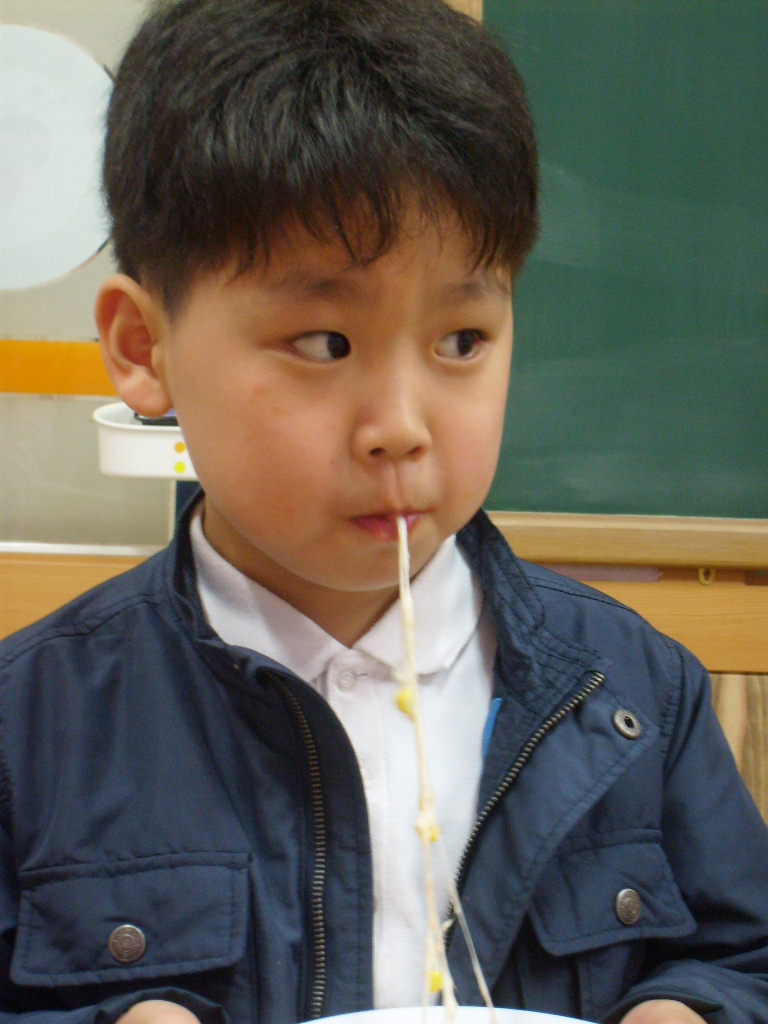
Slurp slurp, smack, smack...
I was watching the kids in my school eating around a table. The usual format presided with bouts of animated talking and then silence. Koreans talk much less than westerners during a meal as it suggests enjoyment but the silent periods are never really silent because another means of expressing pleasure with food is to produce little noises of contentment as you eat. I was reminded of a friend back home who cringes whenever I eat toast in his presence. Eating toast silently is impossible, unless you’re into that Americanism of dipping it into your coffee the same way we British dunk their biscuits. Even with the moistest mouth, or lavishly lagged in rich butter, toast crunches and it so happens such noises seriously disturb my friend, so much so that I can only ever eat it comfortably when he’s in another room.

Toast and butter
I love butter and in England melt a fat wadge of it into mashed potatoes, along with some milk and occasionally a raw egg, and always melt a knob or two on carrots, brussel sprouts or peas. I’ve lost a considerable amount of weight in Korea as milk, bread and butter, basically diary products, no longer form a staple part of my diet. At one time all three kick started my day along with oil, bacon and egg and there were probably as many calories in my English breakfast as there are in my current, daily Korean menu. My weekly shopping in England included a pack of butter, a pint of milk a day, a large loaf and about 1 litre of oil a month. And then there was the meat! Nothing less than two big pork chops for dinner, or a large piece of chicken. I rarely fry any food so oil, only ever sesame, is reduced to about a litre a year. My consumption of meat, without any exaggeration is at least 5 times lower than it was back home while my consumption of vegetables is significantly up. Currently, I will eat an entire large carrier bag of spinach a week and one enormous water melon; the water melon alone takes more calories to carry to my apartment than will be contained within it. Most surprisingly of all is that my consumption of rice, the staple food in Korea, is much lower than when I lived in England. A portion of rice in Korea is not much more than a handful, the amount contained within one of those small stainless steel dishes. Whenever I’m served rice back home the amount can be as much as 4 times greater than this and the quality is poor. For most of my life rice has simply been rice with a few major divergences: pudding rice and sushi rice being the most obvious. But when you live on good quality rice for a few years you really notice how tasteless ‘British’ rice is. Even the upmarket brands are bland but in fairness Koreans probably see a potato as a potato and for most Koreans the epitome of french fries are the shit served by Macdonald’s. Jersey new potatoes with a sprig of mint and coated in creamy butter! Now there’s an orgasm!

Pass the tissues!
Shopping in a Korean supermarket, even the big ones like Home Plus (Tesco) or E-Marte is boring and totally functional. There are few microwave meals, no meat pies, few jars or cans of cook-in sauces padded out with soya and corn by-products, little but fish, fruit and spam existing in cans, an absence of almost anything but yogurt and ice cream in the form of deserts and frozen goodies are limited. Only in Korea can I go shopping for an item and leave the premises only having bought that item. In the UK, if you enter a supermarket the chances are you will leave with far more than you originally planned to buy. Of course, there are ample goodies in a Korean supermarket, probably of more appeal if you are Korean, but as a westerner with a penchant for pastry, dairy and meat products, the choices are limited.

Creamy
My greatest weakness is butter and by that I mean real butter and not that fake crap verging on margarine that for over a decade we were hoodwinked into believing was healthy until it transpired the trans-fatty acids they contained were just as bad for you as real creamy fat. Thankfully, Like Korean cheese, Korean butter, if you can get hold of it, is generally shite. I was at a buffet restaurant a year ago and tucked in a corner was a toaster and butter; indeed two types of butter, herb and garlic. I almost wet myself I was so excited. There I was, surrounded by barbecued meats, smoked duck, smoked salmon, fried rice and even fried chicken, and the first thing I go for is some toast and butter. The butter was rather pale, not deep yellow like Irish butter tends to be but more like French butter but this is no bad sign as pale butter can be extremely creamy. You can imagine my disappointment when after attaching a fat slice of butter to my hot toast, I discover its ‘well being shit’, butter made with water or some fat-free substitute that turned the toast to exactly the same consistency you get dunking it in coffee and which is ideal for the elderly and those whose mouths are predominantly gum. It made no toast crunching sound and disgusted, I discarded it next to the toaster and headed straight for some fried chicken.

I'm looking for the cream!

Korean stainless steel rice bowl - fits in your palm!
In the last three years I have eaten one pack of butter! Imagine my glee when I discovered a pack of Danish Lurpak butter in the cooler cabinet at my local E-Marte! It was expensive, 6000 Won (£3) but I was in need of a little comfort and reminiscing and after putting it in my basket bought a loaf of bread. I’d been given a toaster by a friend in Ch’eonan and 18 months later, it still lay packed in a box in a corner of my veranda. Lurpak is almost white in colour and is unsalted but is deliciously creamy. The pack was consumed within 36 hours, a frightfully naughty luxury and I haven’t bought one since and the toaster, boxed up, has gone back to the veranda.

Cabbage and rice cake spicy stew - korean kids favoutire
Sat at the table with my students, who have just made spicy cabbage stew (떡볶이), I suddenly become aware of their noisy eating, a symphony of sucking, smacking, slurping, sighing, clicking, and chewing. When I first arrived in Korea, I didn’t particularly enjoy eating with Koreans because they tend to make the eating noises you hear in documentaries where some micro camera is inserted deep into a nest of ants or termites and the sounds subsequently amplified. When eating with gusto, Koreans parade the entire gamut of possible eating noises some of which are so juicy and over excited, they are almost sexual. Ten years ago I hated those noises in the same way my friend hated the unavoidable sound of munching toast. Sitting there watching their happy faces as they sigh loudly, because they’ve eaten too much, or fanning their mouths because they’ve deliberately made the stew too spicy, I realise I now find their noises both consoling and cute. I spent years scolding my nephew because he tends to eat in a manner somewhere between a salamander and an insect. Maybe it’s time to cut him some slack!
© Nick Elwood 2010 Creative Commons Licence.
Curds (묵) – Monday Market

Stunted by the rocky soil, you will rarely see an Oak as magnificent as those found in England
A few years ago a former boss took me to lunch at restaurant, the usual formality for talking shop and often a sign that your schedule is about to change or that you’re going to be asked to do something not in your contract. Other than it was ‘Klingon’ in style, I can’t remember what we ate. My first encounter with any form of Korean food was in 1997 when I visited several restaurants in both Hong-Kong and Manilla and I can’t remember too much about those experiences either other than there being many side dishes, one of which was some strange, but inoffensive jelly-like food served in slices.

Acorn curd - 도토리묵
Enjoying many Korean foods are dependent on an acquired ‘taste.’ Kimchi, for example, both stinks and tastes pretty gross to most people first time, but with continued exposure one begins to realise the subtle variations between different kimchis. Eventually you begin to develop a preference for one particular form of kimchi. In one sense the multi-faceted aspects of kimchi, the combinations of heat (chilli), saltiness, sourness, tartness, sweetness, the viscosity of the sauce, the fracturability of the cabbage, the blend and persistence of fish sauce, garlic and ginger, the aroma, and these are only some of the features, make its enjoyment every bit as sophisticated as that of wine.

Supermarket curds - more expensive and watery than the market varieties.
While kimchi has taste there are a number of Korean foods which are tasteless and which on first exposure prompt the question, ‘why?’ Most first timers to Korean cuisine, for example, will find those watery soups ornamented with a few strands of bean sprout, totally pointless until you realise the way intermittent spoonfuls cleanse the palate and transform the texture of rice in the mouth. A few Korean foods initially have no taste at all but if persevered with, an appeal begins to develop. Other foods, such as cold noodles (냉면) require exposure to the energy draining Korean summers to initiate an appeal much in the same way Pimms No 1 does in the UK. I can no more enjoy a Pimms No 1 in winter than I can cold noodles. And then there are those seemingly pointless curds or jellies.
In the restaurant with my boss, and amidst some of the Klingon delicacies, was a plate of what looked like the jelly thing I’d last eaten in a Korean restaurant in Hong-Kong. Sliced into slippy cubes, I remembered the dexterous chopstick skills required to pick it up; too much pressure on the cube and it is cut in two and too little and it flops onto the floor or cascades down your shirt. My boss was quite impressed, in fact he was very impressed, but not with my chopstick skills, more with the fact that I’d just eaten a slice of raw liver! That too was tasteless but there is a limit to how far I want to go initializing new appreciations and raw offal is not really one of them.

Acorn curd (도토리묵) in the market
Curds or jellies appear in various guises and while they are fairly tasteless, their appeal lies in their texture which in the context of a Korean meal with numerous side dishes, can be ‘interesting.’ The most common curd is probably acorn (도토리묵) and it is often accompanied with a tangy soy based sauce. (도토리묵 무침). Personally, I find the market produced curd both cheaper and tastier looking than the somewhat more watery-looking packeted varieties produced by supermarkets. On more than one occasion I have muddled my Korean words and asked for ‘eagle curd’ (독수리묵).

Buckwheat curd mu-ch'im (메밀묵 무침)
Other curds include:
Buckwheat (메밀묵) which is often slightly heavier in texture

Supermarket seaweed curd (미역묵)
Black rice
Mung Bean (녹두묵)

Yellow Mung Bean (노랑묵 or 황보묵) this version, coloured with gardenia, is traditionally associated with the Cheolla province.
Curds are fairly easy to make and powders can be bought in most supermarkets.

Acorn powder
Acorn curd in particular is seen as a very healthy food and is believed to be beneficial in weight loss. Not a great surprise really as I doubt anyone would want to eat it alone and it’s hardly a food to pig out on! It probably has the same diet potential and calorific content as water! The Korean company Skinfood market an acorn face pack. If you are keen to start investigating the secret power of acorn, here is a jumping off point….
© Nick Elwood 2010 Creative Commons Licence.
New York, New York

New York, New York, is a franchise restaurant where the menu differs substantially between one restaurant and another. Currently, New York, New York, Song-So, Daegu, is my favourite western style restaurant and it does an excellent pork steak topped with pineapple and blueberry sauce, and one half of a delicious, almost roast potato. I think it’s probably pan-fried but it comes close to roast. Since getting pally with the owner I now get 1 whole roast potato. And, the Korean fried rice (벅금밥) compliments the pork chop and blue berry very well. Yes’ it’s still ‘pusion pood’ (fusion food) but only just. The meal is usually served with kimchi and pickles but as these appear on a side dish, if you push them to one side, you can almost imagine you’re back home. If the ‘pusion’ element doesn’t bother you, you can try the Korean rice wine (막갈리) cocktail, 4000W (£2) and served with strawberry and pineapple.

Ground floor
From my experience, apart from a burger bar, New York, New York is the only restaurant I’ve eaten in which doesn’t provide chopsticks. Eating kimchi with a fork is weird, like something out of The Twilightzone. The ambiance is great, if not a little fake, with plastic geraniums but the extensive wine racks contain wine, the lighting is suitably subdued and as always the army of staff are attentive and generous. Considering the price, around 8000W (£4), for a very nice meal, a few plastic geraniums don’t bother me and I console myself with the fact they are actually in bloom. This week a waiter asked if I had any requests for the sound system. Ah, the music! Why is it that places with tasteful interiors go and ruin them by splurging shit music into the air. A rap version of, The Wheels on the Bus Go Round and Round, was slowly beginning to irritate me. The choice of music can be a little variable and swing from rap crap to Mozart and Sinatra, in an instant. Overall, the atmosphere certainly suits Sinatra. Then, on the window ledges are real branches of wood, standing in large glass vases filled with chunks of cookie and cream-looking rock and topped with water. The plastic plants are the sort that are realistic enough to provoke both conversation and are difficult to distinguish as fake , especially with real branches. Last week I noticed the branches had all sprouted leaves and yet still had plastic botanical Borg implants. Quite bizarre.
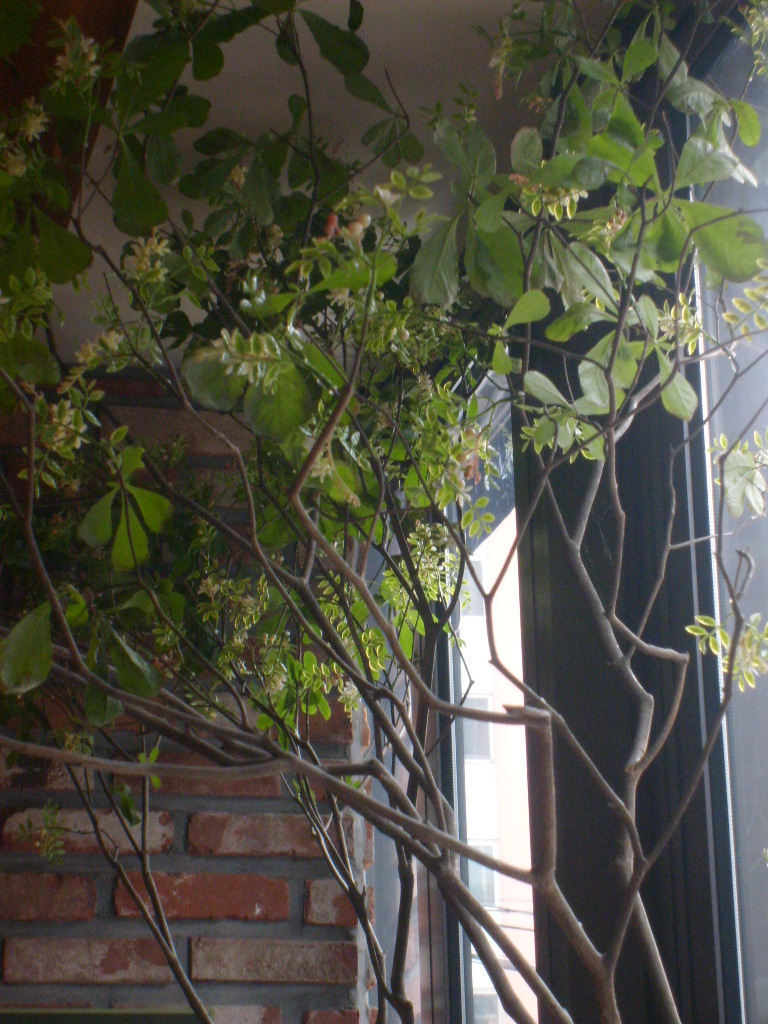
Bizarre Borg technology – plant plastic pushion
New York New York, Song-So is a few minutes walk from the Song-So Industrial Complex subway station. Go past E-Marte, turn right at the end of E-Marte on the crossroad, and it’s on your left half way up the hill and equidistant between Migwang Sporlex , on the crest of the hill, and E-Marte, on the cross-road. (Wiki Map Link) THIS CLOSED DOWN IN JUNE 2011!
Conversely, for some spacious swank, try the New York, New York, (Wedding) at Susong-gu, Daegu.

Susong-gu – swanky

Entrance
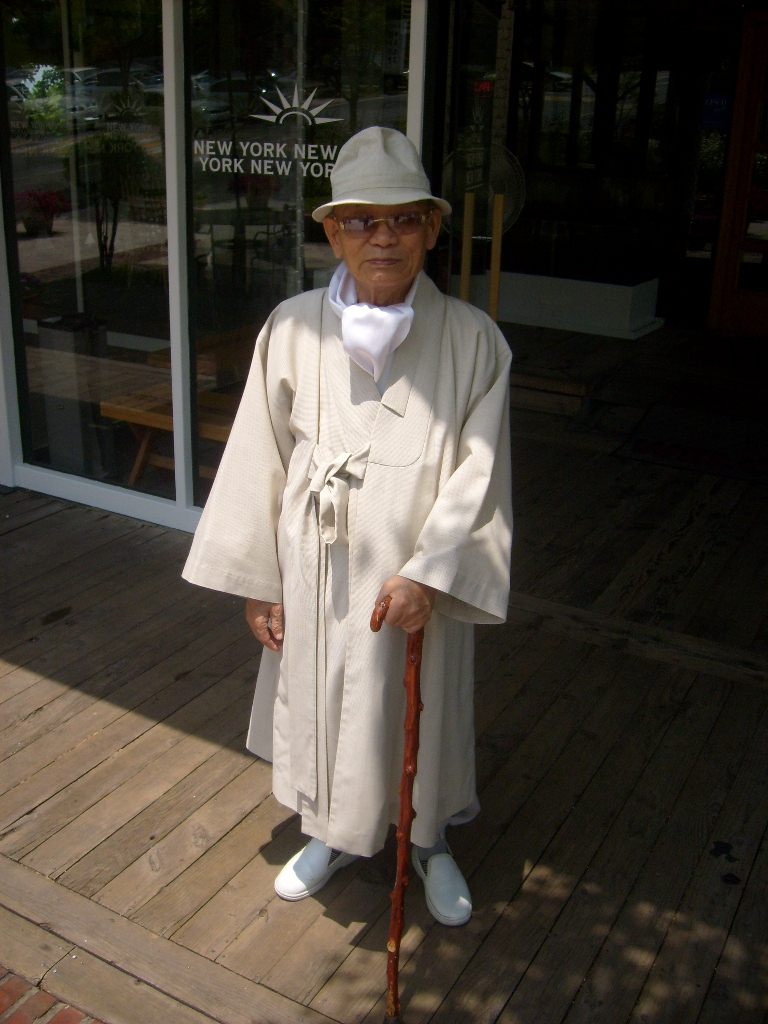
A monk (수님)

Beautifully designed

Water feature
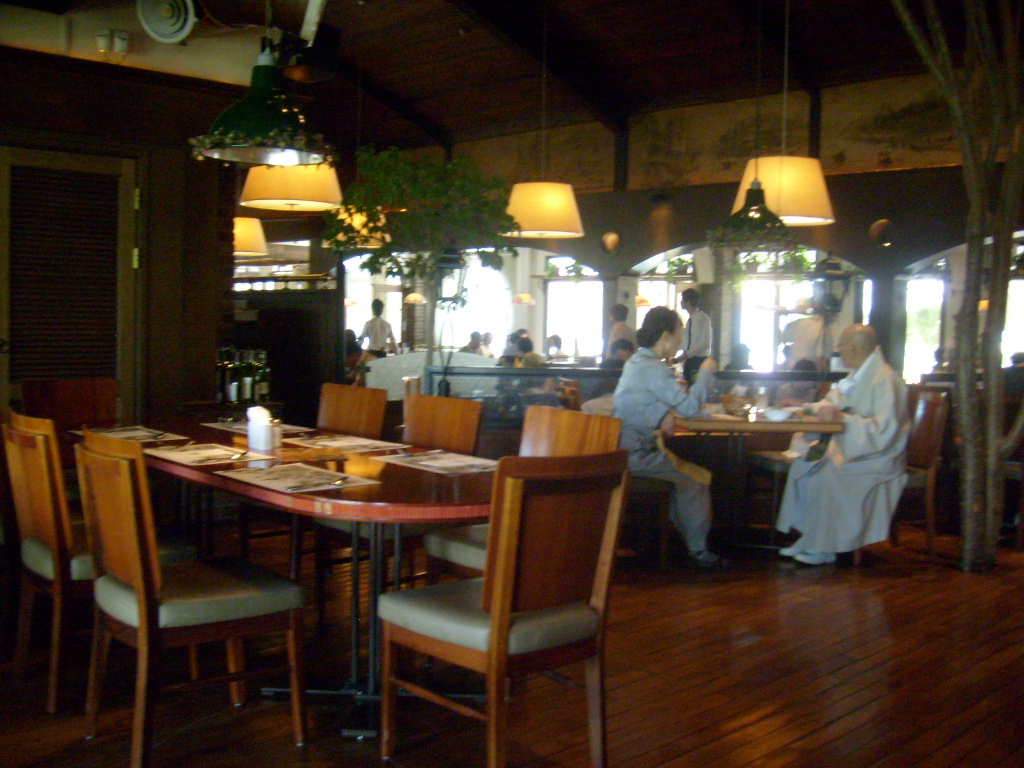
The restaurant is very large

Entrance fountain
© Nick Elwood 2010 Creative Commons Licence.
The Song So ‘New York, New York’, closed in 2011
Migwang Spolex (Jjimjilbang), Daegu, Song-So. (미광스포랙스)
Migwang Spolex (미광, 성서, 대구)
First visited February 2009. Last visited September 28th 2012. Migwang Spolex is my favourite local jjimjilbang, bathhouse sports complex. Migwang has five stories of amenities including squash courts, billiard rooms, and a very well equipped and friendly gymnasium. It is very clean and has well laundered towels which smell fresh. The bathhouse, a large one, is one to enjoy and relax in rather than to use solely for washing and cleaning. Sunday afternoons and holidays can be very busy. The gym is very well equipped and spacious and home to many Muscle Marys, especially in the evenings. In summer, the ice rooms, of which there are two, one in the bathhouse and one in the jjimjilbang, are a refuge from the summer heat and humidity. I particularly like the changing areas as there are very roomy and with small poofes on which to sit while putting on socks’ etc – I hate having to do that sat on the floor or while trying to balance on one leg. Friendly staff.
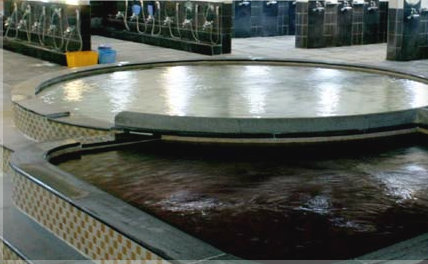
The ‘event’ and warm pool (male)
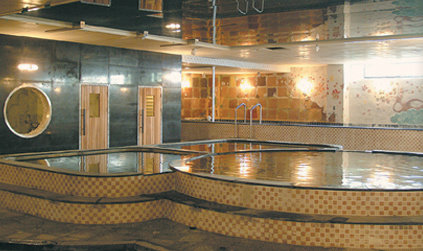
The warm and hot pools in the female complex
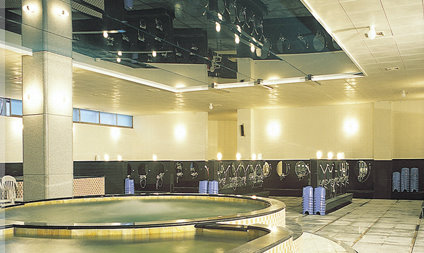
Women’s facility
Unlike many other businesses in Korea, many which simply border on existing, I think Migwang is doing very well, financially. I’m told it has over 1000 members with a monthly membership. More to the point, I notice Migwang regularly installs or renovates features during major holidays. A new ceiling and what looks like a new water feature is currently being built (October 2010). However, the water feature seems to have stopped mid program. In April 2011 new poofes appeared. Migwang is always impeccably clean and the staff very friendly – oh, apart from some grumpy old guy!
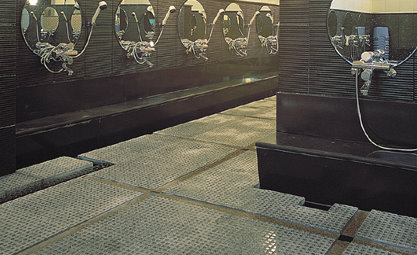
Migwang’s sit down shower units
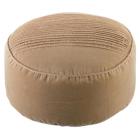
This is what the British call a ‘poofe.’
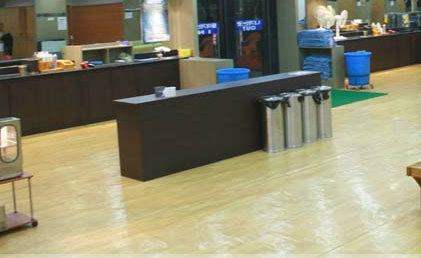
The male ‘powder’ room
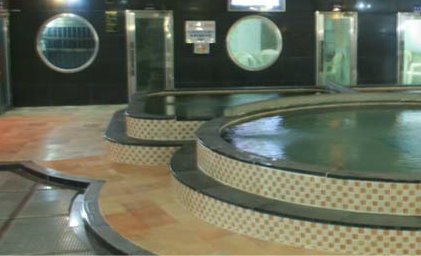
The warm pool with the pine, steam and ice room (L-R) in the background. A large TV sits above the central circular window
Plan
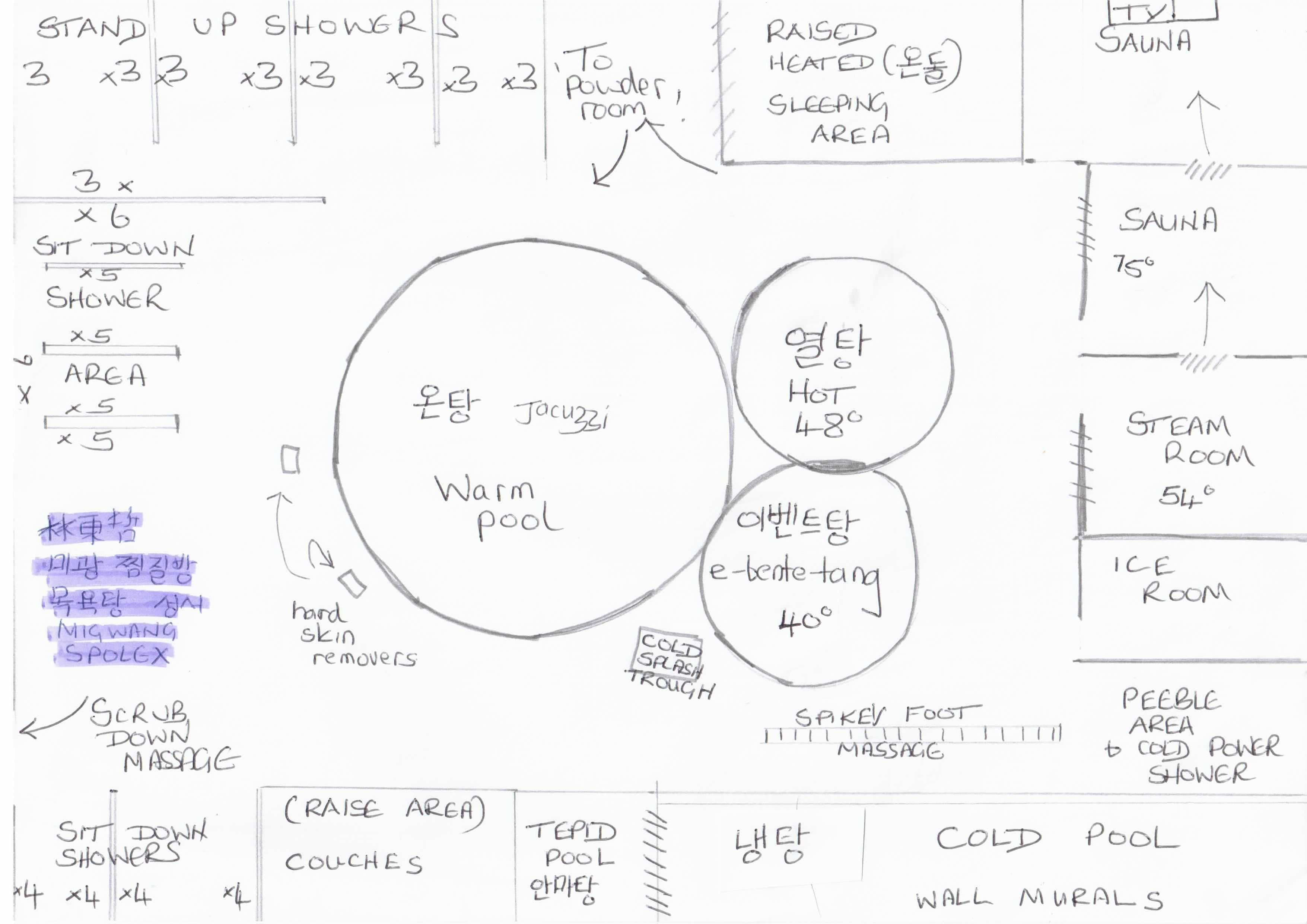
Migwang Spolex. Bathhouse Design (male)
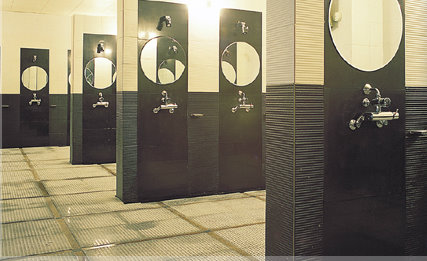
The stand up showers (male)
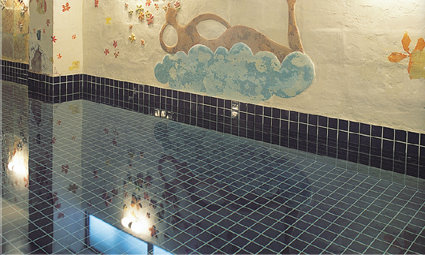
The women’s cold pool
Location – five minutes walk from the Song-So (성서) industrial Complex subway station and just 2 minutes walk from E-Marte. Come out E-Marte, turn right, turn right again at the cross roads and walk to the crest of the hill where the road bears left. The complex sits on the turning on the left hand side. (Wiki Map link )
Times – 24 hour jjimjilbang and bathhouse. Gym open from around 6 am Mon-Sat until around 11 pm. Sundays 8 am – 8 pm. Double check opening and closing times as they occasionally change.
Facilities – 2nd floor, reception, women’s bathhouse, women’s hair dressers. 3rd floor jjimjilbang, 4th floor men’s bathhouse, 5th floor gymnasium. Also squash facilities, martial arts, aerobics classes etc.
Jjimjilbang – ice room, various saunas, sleeping rooms, children’s play area, refreshments and food, small pc room, televisions, etc.
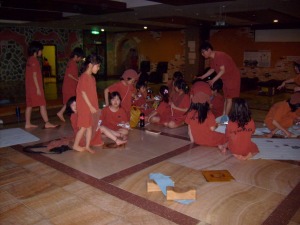
Jjimjilbang area
Bathhouse (men) – around fifty stand up shower facilities and around the same number of sitting down shower units, event pool, (이벤트탕), hot pool (열탕), large warm pool with jacuzzi (온탕), large cold pool (냉탕), small tepid pool (안마탕), ice room, steam room, 2 jade saunas, relaxation area, heated sleeping area. Large changing room with television and sofas. Televisions are also located in front of the e-bente-tang and hot pool, and in one sauna room but which can be viewed via from the other saunas.
Cost – bathhouse 5500 Won, jjimjilbang 7000 won. Monthly all-inclusive (including the gym) once a day usage, 100.000 Won (£50).
Others – hairdressers, massage and rub downs, parking, associated buffet restaurant opposite (Arden Hills), and Screen Golf Range. Various seasonal discounts. Very close to E-Marte and from there the Song-So Industrial Complex subway station, and surrounded by various restaurants and some excellent coffee shops Vincent Van Gogh, Hands Coffee, Sleepless in Seattle). The barbers now seems to offer massage, haircut and shave all being a euphemisms for a hand-job – cost 30.000Won. Barber’s is closed on Monday and residency of the barber’s now seems to shift between the actual barber and the ‘girls’
Ambiance – relaxing, mid-level lighting, subdued television, very clean, very comfortable, friendly.
Waygukin – I’m gradually seeing more and more westerners here. For a year I didn’t see any, but in the last year I have seen a total of 5. Some just shower, while others use the pools, some are friendly, some clearly do not want to speak.
Address – Daegu, South Korea, 1250-14번 지 (behind E-mart)
Website – (Migwang Spolex Website Link)
Migwang Updates
Migwang on a Sunday Morning (August 1st 2010.)
© 林東哲 2010. Creative Commons Licence.
Beach Bum Teachers
I took a walk around Keimyung University, Daegu, and passed a couple of plastic professors one of whom wore a three piece suit and the other, white trousers, jacket and a Panama hat. True there were a few casually dressed waygukins kicking about but I assume these to be students so as not to spoil my myopic view of the world.
Keimyung is a beautiful campus and supposedly, one of the ten most attractive campuses in Korea. I was lucky enough to have attended Essex University in the UK, and indeed own a house only 15 minutes walk from the campus. As a first year student in halls of residence, my room looked out over Wivenhoe Park which was the subject and title for John Constable’s 1816 painting. I never really appreciated the importance of beautiful surroundings and university campus life until I subsequently studied in London where the University probably owned one tree – everything else being brick and tarmac.

For a year, this was my view as I ate breakfast
Swanning about in a boater or three piece suit with a dickie bow, even if you’re professorship is plastic, is so much more sophisticated with a beautiful campus as a backdrop. True, Oxford and Cambridge aren’t set in beautifully rural settings but the sense of the numinous imparted by ancient architecture is just as effective and maybe more so.
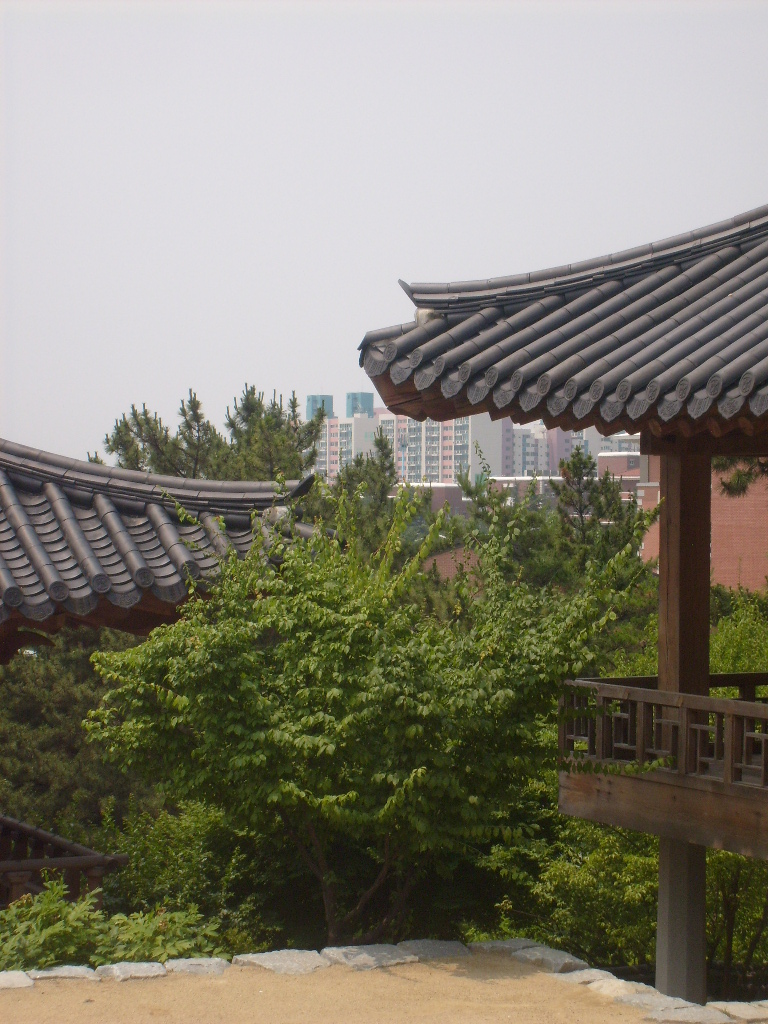
Keimyung traditional architecture and the distant city
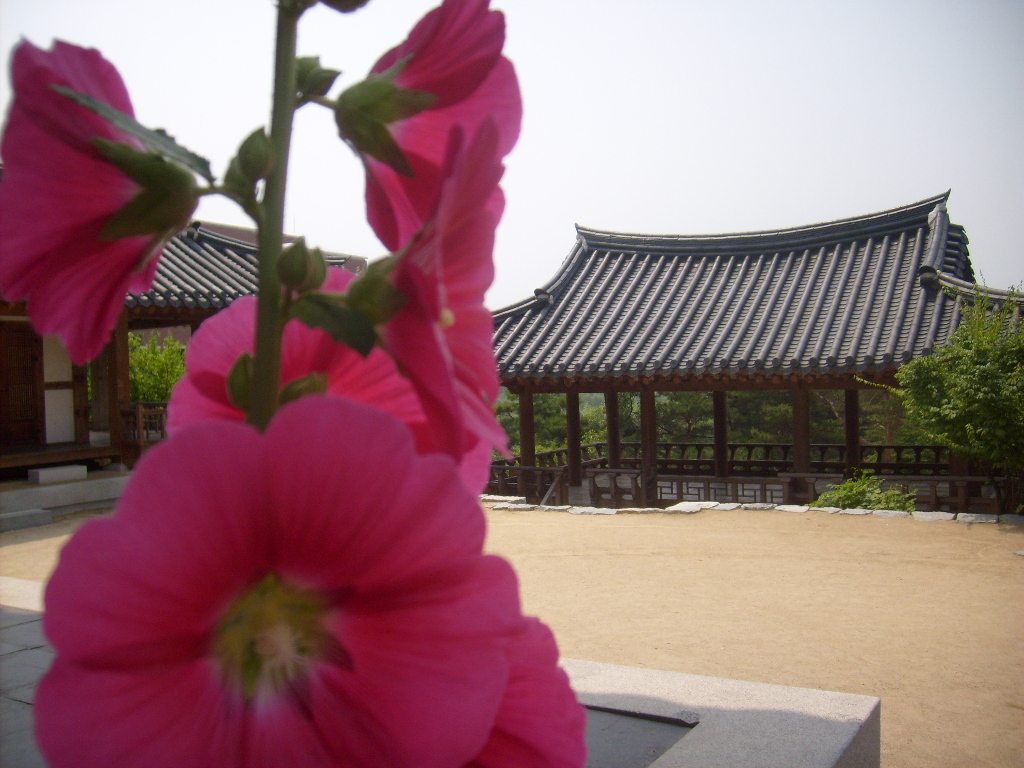
Traditional and modern typify Keimyung campus
Two miles down the road from Keimyung, in Song-So, there are no boaters or dickie-bows. When you’re teaching in a haggwon a three piece suit is an overstatement. Around Song-So’s haggwons the predominate form of dress for teachers is casual and hence cargo shorts, shorts, flip flops, vests and all manner of clothing suitable to a Thai beach, building site or the set of a Pirates of the Caribbean movie, are common.
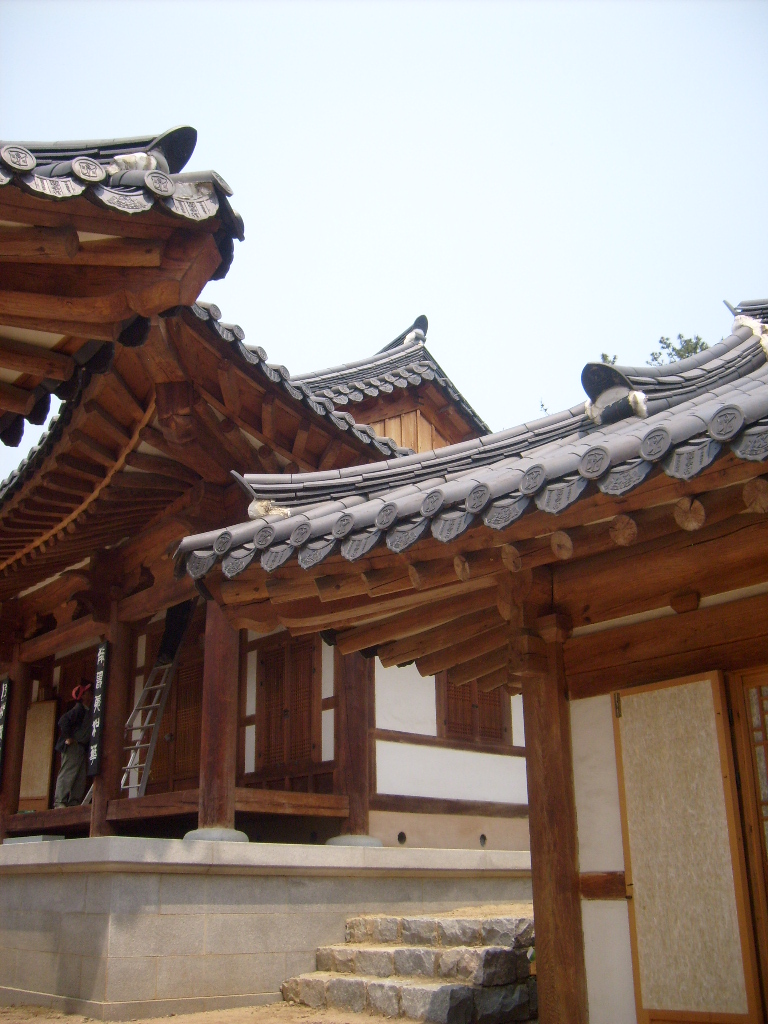
Traditional architecture
Now, I come from Britain where the weather is notoriously shitty and where you can generally wear the same type of clothing all year. The same thickness of jeans material will suffice throughout the year but may be a little warm in summer but the need for three types of clothing, basically, winter, summer and spring/autumn, as in Korea, is not necessary. However, in many parts of Canada and Australia, and definitely the USA, the summer temperatures and even precipitation are not a lot different to that of Korea. I used to play in a military band and have marched through Calgary, Canada, in a temperature of 44 degrees and I wore full ceremonial uniform and not a pair or cargo shorts and flip flops. I remember Washington DC being very uncomfortable and air conditioning, something of a domestic rarity in the UK, was a necessity. What I didn’t see however, were Americans or Canadians going to work, certainly not professional work, dressed like beach bums.
I get annoyed seeing westerners going into schools dressed like they’re on vacation and see it as a form of racism and symptomatic of cultural ignorance. In my high school, and in haggwons in which I have taught, the dress code, set by co-workers, certainly wasn’t beach wear. Eighteen months ago, we hired a Canadian gyopo (교포). He had never lived or worked in Korea and spoke little Korean but would turn up for work wearing torn jeans which he wore so far past his hips his boxers were constantly on display. Meanwhile, his hems were worn away from having been constantly walked on. Dressing like a shit-bag puts immense pressure on haggwon bosses and while some, like bosses everywhere, are tossers and deserve it, many are decent and well meaning. Neither is it fair on Korean co-workers when foreign staff dress for a beach party while they dress, like professionals, for work.
If I were employing a waygukin, I’d certainly want to see a photo and I’d probably want to ask: what they would intend to wear to school? If they can get themselves to school via the shower and shaver, and if they piss it up every evening? But then I’m inclined to fascism! Easier, I’d probably employ waygukin’s with professional teaching qualifications beyond the month long TEFL, ESL certificate and who’d actually had real jobs to both check out references and as a means of assuming they will be acquainted with what to wear to work, and how to behave in work. You read so many gripes about westerners not being treated fairly and while a lot are genuine, many will be the result of waygukins who treat working in Korea as part of a backpacking holiday. It is disrespectful, even racist to treat your host culture with less consideration than you would you own culture, regardless of your personal opinions, more so when there is little or no difference between them in terms of work place etiquette and its associated expectations.
© Nick Elwood 2010 Creative Commons Licence.
and besides cooking rice…
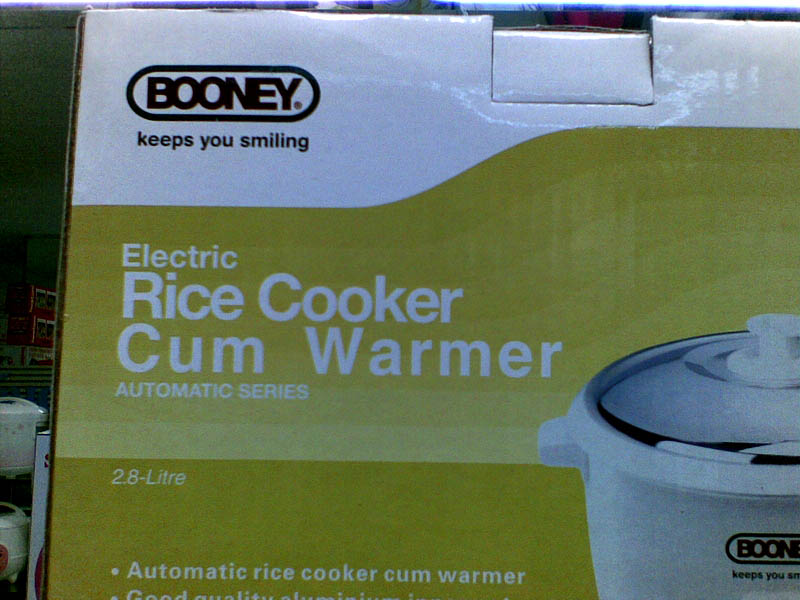
Don't forget to wash it out after!
© Nick Elwood 2010 Creative Commons Licence.
Laura – Korean Teenagers (2)
It’s the exam season and the atmosphere in school and even on the street is down. I don’t particularly like this time of year as it disrupts classes and makes planning an impossibility. In classes some students are so tired that effective teaching isn’t possible and you really notice the mood of students, some ride it fairly well and others are up and down and unpredictable. And all the kids are tested, from the youngest right through to high school students.

I haven’t seen too much of Laura lately but unlike Ben, she is usually fairly consistent in her temperament and always has a smile. This week, after asking me to comment on her latest perfume (which is actually her mother’s), she coyly tells me she has a boyfriend, and…. that he has kissed her! That it was only on her cheek doesn’t dampen her happiness. She takes out her mobile phone and proudly shows me the album she has created featuring him. In one photo, she excitedly explains he’d just had a shower and his hair, still wet, was sticking up. She is so excited at the captured image, which she describes as ‘cute,’ that she blushes and her eyes actually flutter.
Saturday was a ‘play Saturday’ (놀토) which of course, at this time of year, it’s not as any free time is used for studying. I met Laura on the street on Friday evening, as I was going home. She was going to a ‘reading room’ which are ‘libraries’ solely for study and which, like the PC rooms, are constantly open. When I asked what time she would go home she told me 2 am. Most perverse of all is she’s smiling as she tells me. ‘And what will you do tomorrow?’ I ask. ‘Study,’ she replies laughing. Korean innocence!


 Elwood 5566
leave a comment