Celebration of the First Full Moon

Full moon
Sunday the 28th of February (2010) is the celebration of the new year’s first full moon. (대보름). This occurs on the 15th day of the lunar new year. I was wondering why the markets and supermarkets were suddenly full of nuts, walnuts being the most popular, and discovered that one of the celebration’s traditions is to crack open nuts with one’s teeth as this is supposed to guarantee their health throughout the coming year. Other traditions include mountain climbing, especially to see the rising moon as well as eating five grain rice (오국밥). Yakshik (약식), a tasty rice cake containing chestnuts, pine nuts, honey and sesame oil, is also eaten. Celebration is more noted in rural areas where dried grass is burnt. Originally, this occurred between rice fields and was probably a means of killing insect pests.
Oranges Galore – Monday Market
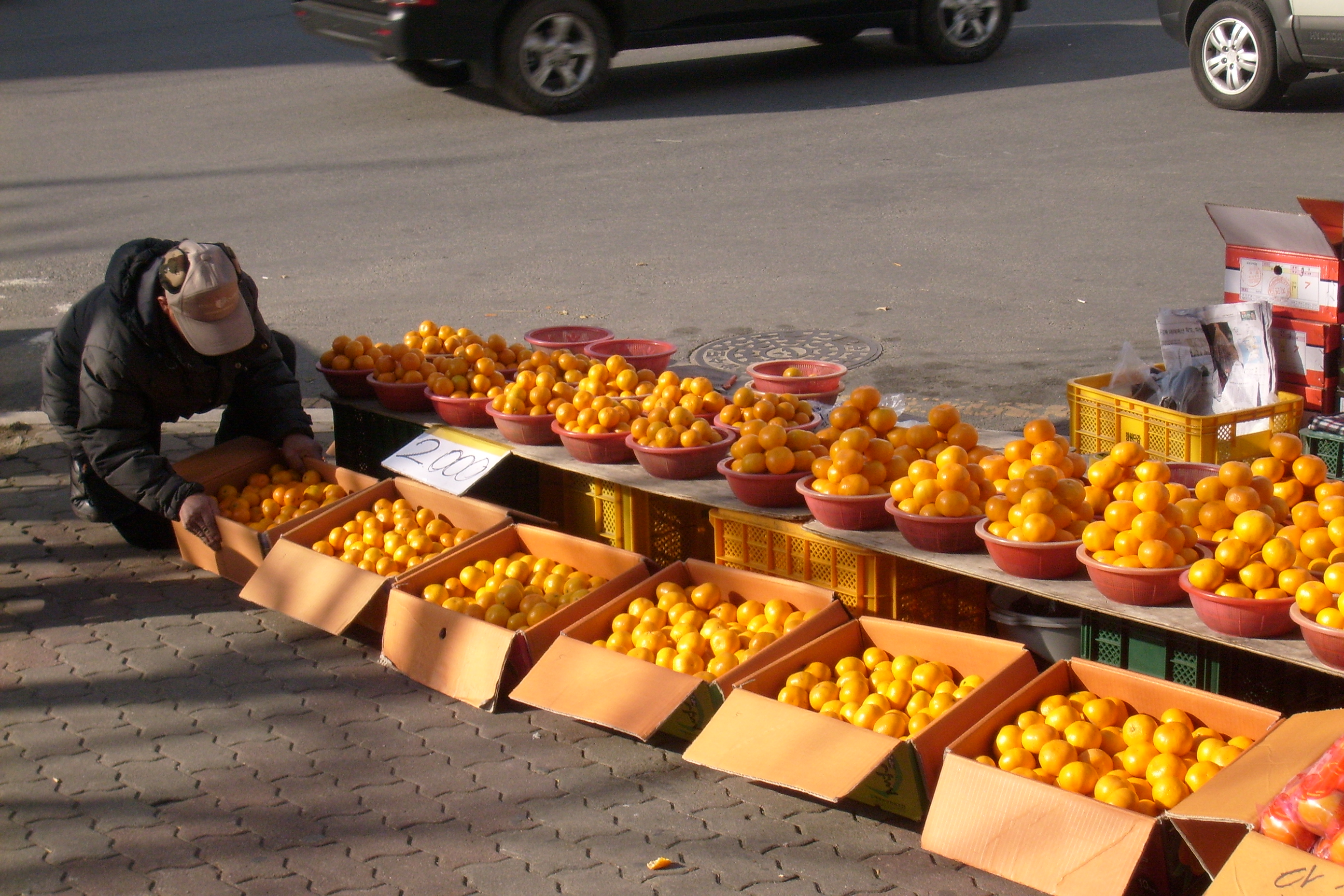
Chejudo Mandarins
I forgot to mention the mandarins/tangerine variety of orange in my post before Christmas. Usually from the sub-tropical Chejudo, the southern most island, these are delicious. They are usually sold at varying prices with the sweetest being more expensive. However, even the cheaper ones can be relied upon to be persistently sweeter than mandarins/tangerines sold in the UK. A general distinguishing feature of Chejudo and oriental mandarins/tangerines is that they are loose-skinned and seedless. Their name derives from the bright robes worn by the elite mandarins of China and the fruit was formerly reserved especially for the mandarin class. Mandarin and tangerines sold in the UK are often not loose-skinned or seedless, are often yellower and can be tart. These are probably imported from the likes of Morocco. which was the first county to export the fruit to the UK. I have to say, I can eat the Chejudo variety as easily as I would chocolate.

© Nick Elwood 2010. This work is licenced under a Creative Commons Licence.
Back to the Treadmill
새해 복 많이 받으세요! ‘Happy New Year.’ I’ve been practicing this for the last week knowing that it’s a phrase I can’t use for another year. I returned from the UK with a nasty cough, several weeks ago. My first job when I returned was to buy a new PC monitor to replace the car size contraption sitting on my desk. I bought a 23 inch plasma screen from E-Mart at 198.oooW (£111 sterling) which was around the same price as one I recently bought in the UK. Luck would have it that two days later my antediluvian hard drive decided to pack in. I don’t have much patience with inanimate objects and after kicking it and administering it a hefty palm heel strike, I proceeded to smash the DVD loading trays with a six-foot bo (a martial art staff). I must admit I lost it for a few moments and was surprised I didn’t suffer coronary. In my defence however, my defunct hard drive had plagued me all year and the work I can now do in a day, previously took me three. I have a fleeting suspicion that when I tried to reboot it, I may have inadvertently turned off my monitor and diagnosed the lack of activity as death. By the time I had viciously assaulted it, it was quite useless.
Half an hour later and a PC technician was installing a new PC in my apartment. A local PC shop, like most other services and facilities, is only a two-minute walk from house. I brag about the convenience of Korea when I’m back home and though I think services and culture here outstrip what’s on offer in the UK, I am especially well located. The unit cost 424.000W (£237 sterling) and as usual, the call out installation was free. In addition, he uploaded all the programs I use with the operating system and Word 7 in English. In rip-off-Britain and probably most of the western world, the Microsoft Word Package alone would have cost me a hundred pounds. I have no sympathy for money grabbing Microsoft and the constant changes of software, deliberately made incompatible with operating systems or other software, are analogous to having to buy a new car every time the road markings are changed or re-painted.
I spent two intense weeks re-organising the various blogs I write and nursing an annoying cough which has almost cleared up. This morning I decided it was time to start doing some exercise so, at 7.30, I walked the 5 mins to a local sports complex, a five storey complex owned by the father of one of my students. I plan to give a full account of this facility at a later stage as Korean bathhouses and jjimjilbang, a speciality of mine, warrant some lengthy posts. The gym, situated on the top floor is luxurious and not representative of all Korean gym facilities. Naturally this is reflected in the fee. My last gym, actually on the floor under my school, was both a little grotty and tended to pump out pop music, in competition with the TV’s mounted on the treadmill machines, at such a volume your MP3 was rendered useless. Pak Sang-il is the trainer usually on duty when I train. He’s a lad of about 24 and like many Korean men he is gentle and attentive. In summer he would regularly bring me new towels when I was sweating on the treadmill or top up my water bottle with cold coffee or water. Often, he beckons me into his office for breakfast; sometimes fruit, boiled chicken or hard-boiled eggs. And when I ‘m aching or have tight muscles, like many Korean men, he thinks nothing of massaging my legs or back. Many westerners would interpret this as a sign of homosexuality and probably find the intimacy threatening.
유가 자
On the day I left for the UK he gave me an especially big hug. Pak Sang-il is quite masculine with a good body, six-pack, pec’s and muscles that many men would love to posses. The combination of masculinity and effeminate personality, which is probably the best way to describe it, make an alluring combination and again, a combination that characterises many Korean men. I have trained enough in gyms in the UK and taekwon-do schools throughout Europe to know that such intimacy is deemed suspect and if anything, the combination of men and gyms usually results in increased aggression and machoism.
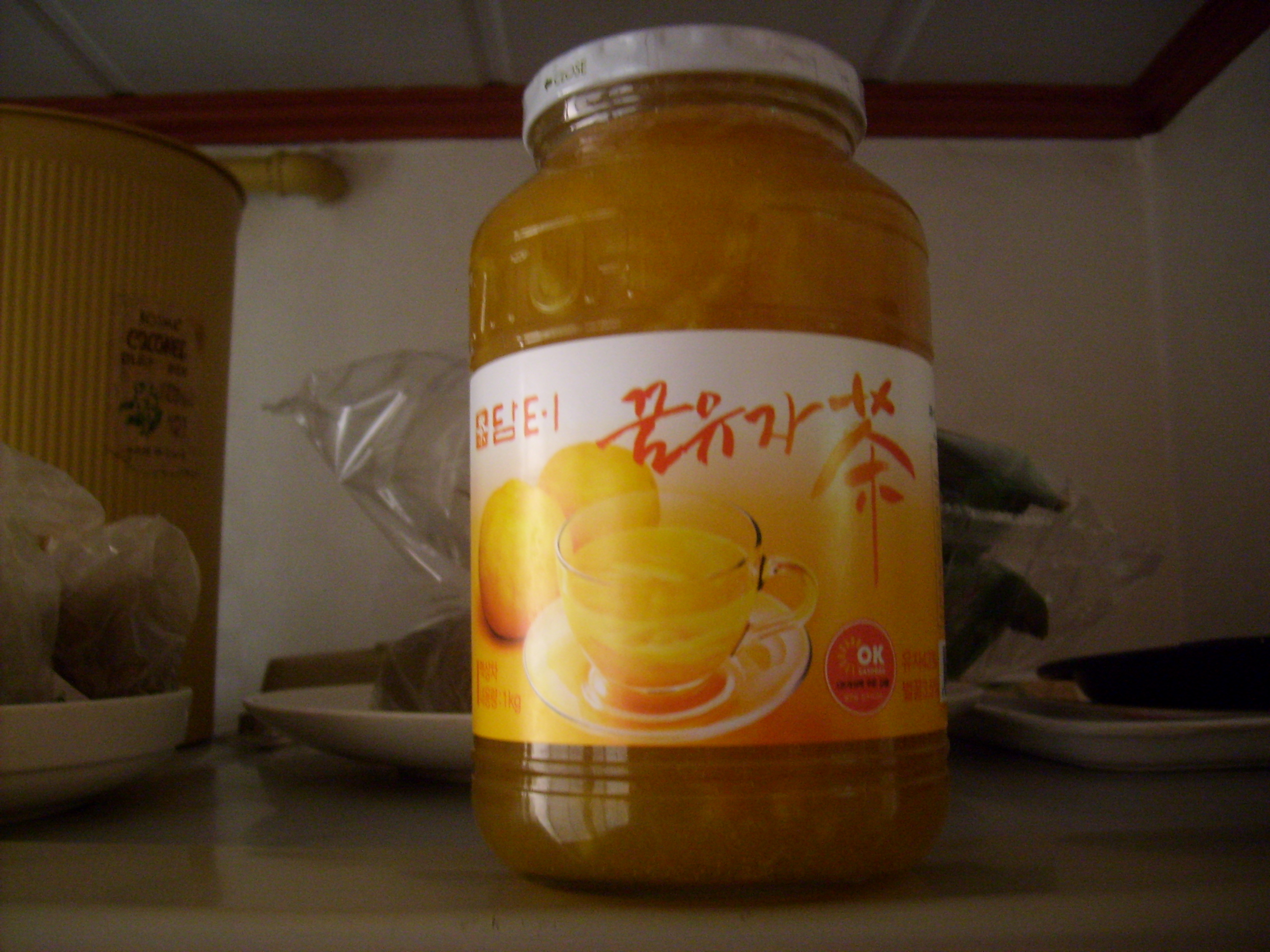
I took Pak Sang-il a large pineapple as a small gift, not an unusual thing to do in Korea. After my session we had a coffee in his office and he told me he had ‘thought a lot about me’ and ‘wanted to see me’. No! Nothing homo-ey! This is Korea and men can be quite intimate both physically and verbally without it implying they are gay. So, he insists that after my visiting the bathhouse, on the floor below, I return to his office. When I finally oblige him he presents me with a jar of grapefruit tea neatly wrapped up. It resembles jam and is a remedy for bad coughs and sore throats. Accompanying the tea is a handwritten note wishing me good health and a Happy New Year. Then, as I step into the lift, he shyly thrusts a hard-boiled egg into my palm. ‘You haven’t eaten breakfasts,’ he reminds me.

Pak Sang-il's note
© Nick Elwood 2010. This work is licenced under a Creative Commons Licence.
Sanitised Santa

A few years ago, I read an article about how one large city in Canada recruits and trains Father Christmas employees almost a year before they are employed. The Father Christmases are stringently vetted and then undergo training to make sure they are ‘politically correct’ in behaviour and communication and have been upgraded to whatever latest jargon is on the PC agenda. You know what it’s like: one minute they’re fussing over how wicked it is to say ‘Afro-Caribbean’ instead of ‘African Caribbean,’ or reminding us how insulting it is to use the term ‘brainstorm,’ but all of them use the term ‘Chinese New Year‘ instead of ‘Lunar New Year.’ At least if you’re an African-Caribbean wickedly called an ‘Afro-Caribbean,’ half of this term is correct. At least you’ve been located in the correct continent but if you’re Japanese, Korean or Thai, et al, ‘Chinese New Year’ totally ignores your culture. So, banned by the PC police from asking small children what ‘mummy and daddy’ are going to buy them for Christmas, the potential Father Christmases have to ask what ‘mummy or daddy, or their guardian or carer ‘ are going to buy them. Next, they are trained not to make any form of physical contact with children and to make sure that when with children, they are in full view of other adults. I would imagine they are forbidden from putting hands in their pockets as they too probably have to be in constant full view of parents, carers, guardians and the hidden security camera installed to safeguard companies. And the ride on Santa’s knee or parked in his lap? Most definitely out! Another aspect of childhood poisoned and perverted by the PC lobby!
- Sanitised Santa
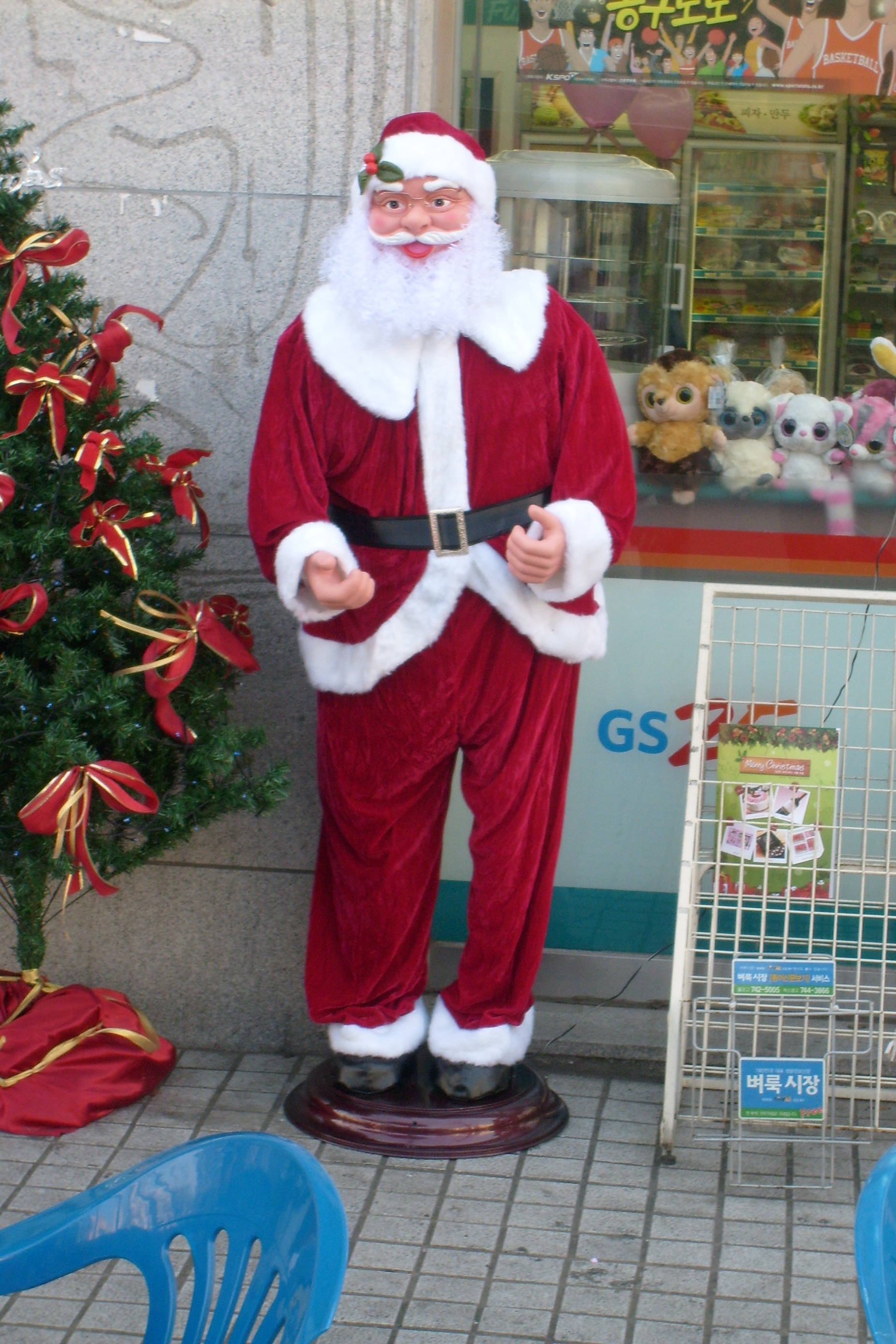
Such a process, vetting, training seminars etc, for several hundred Father Christmases is no doubt expensive but, I might have just the solution. I discovered this Santa on a cross-road outside a 24 hours store in Daegu. This automated Father Christmas is perfect for working with children. He can be stored away with his companions and brought out a week before needed; no vetting, no seminars and no law suits.
The Korean Santa will put all fears to rest. First, other than the ability to make a ridiculous chuckle, he is mute. Gone are the worries that a pervy Santa might upset a child by using un-politically correct terms or worse, mouth or mutter obscene suggestions. And the plastic, toothless mouth, apart from smelling pleasant is incapable of licking, kissing or pouting. Being mute, the Korean Santa can be employed from Baghdad to Boston with no worry about foreign languages. Fixed to the spot by a small plinth, he cannot run away and is permanently available for questioning, stoning or lynching, should the need arise.
Being thin, any potential caverns or hidey holes made possible by overhanging bellies and large tunics are removed. The Korean Santa is incapable of hiding kiddies, or swiftly pulling even the smallest of them under his tunic. While The Korean Santa can move his hips and arms, albeit it in a rather jerky and amusing manner, almost as if stricken by BSE (Mad Cow Disease), such movements are small and limited and minimise and prevent any possibility of hands slipping onto, or groping in, those places they shouldn’t. And the final and most significant advantage is that the standing posture not only makes the need for a grotto redundant but avoids the possibility that some children might actually enjoy sitting on Santa’s lap.
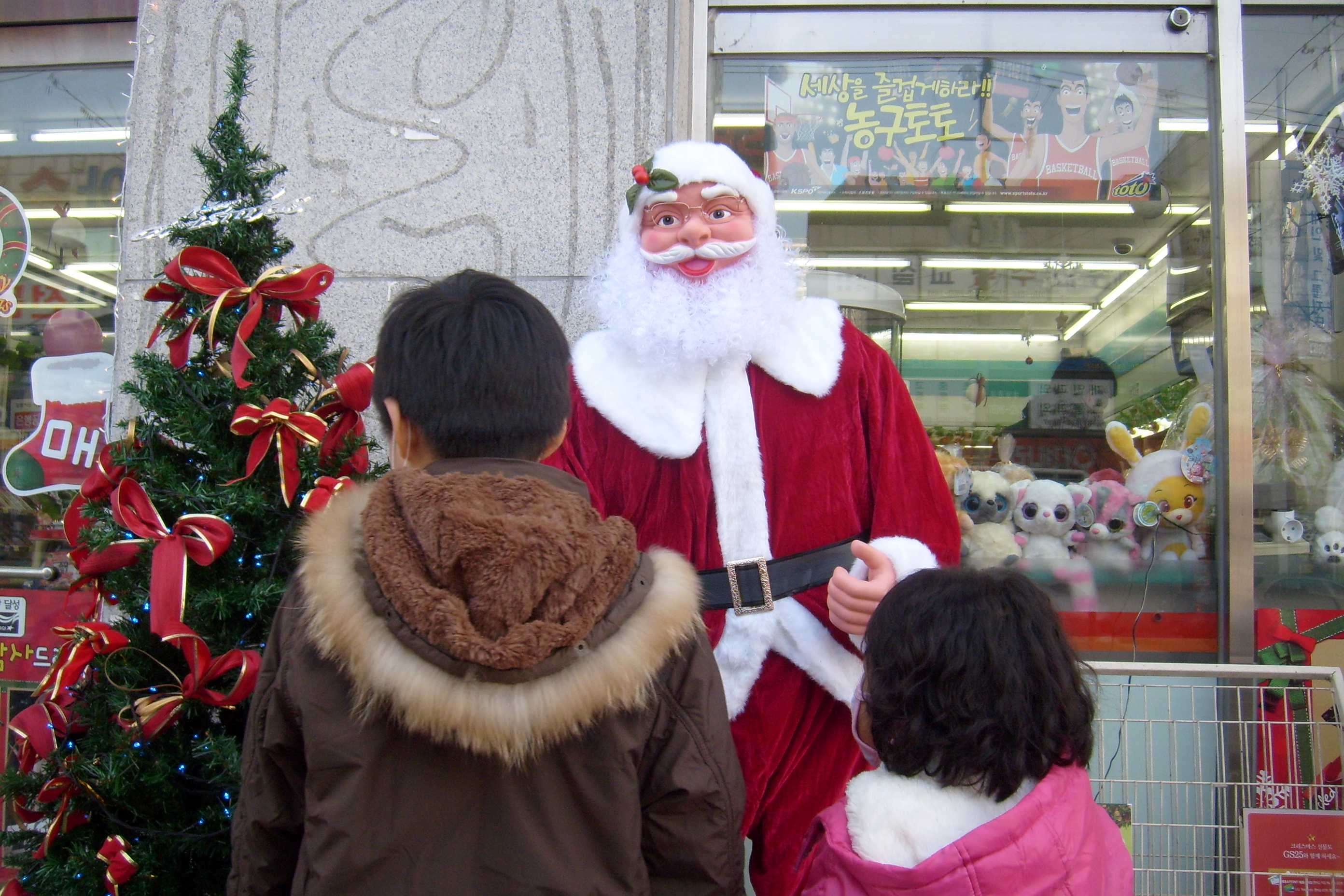
And packet-less!
© Nick Elwood 2010 Creative Commons Licence.
Winter – Monday Market
I intended making a visual collection of seasonal fruit and vegetables as they appear and was going to start this in spring, I decided to start earlier.

Persimmon (홍시)
Persimmon (also known as Sharon Fruit. 감, 땡감, 반시, 홍시/연시,꽃감.) Early December and the Persimmon season is over but these ones I bought a few weeks ago. Currently I have around 60 Persimmon in my freezer. Persimmon is called Kam and like the octopus, there are three types each called by a different name which can be confusing. Kam range from hard to very, very soft. If you like sweet and gooey you’ll love the hongshi, sometimes spelt yonshi. This is the softest persimmon and appears in late summer to early winter. It is very delicate, like a fragile bag of water. Unlike the other types of persimmon, which I don’t eat often, these can be easily frozen. They are delicious cold, simply slice the skin and squeeze and scoop out the jam-like innards. Some coffee shops serve hongshi smoothie. You can also buy dried persimmon, rather like dried apricots but with less flavour. I’m told persimmon is quite high in calories – which is usual as anything delicious tends to be calorie laden.
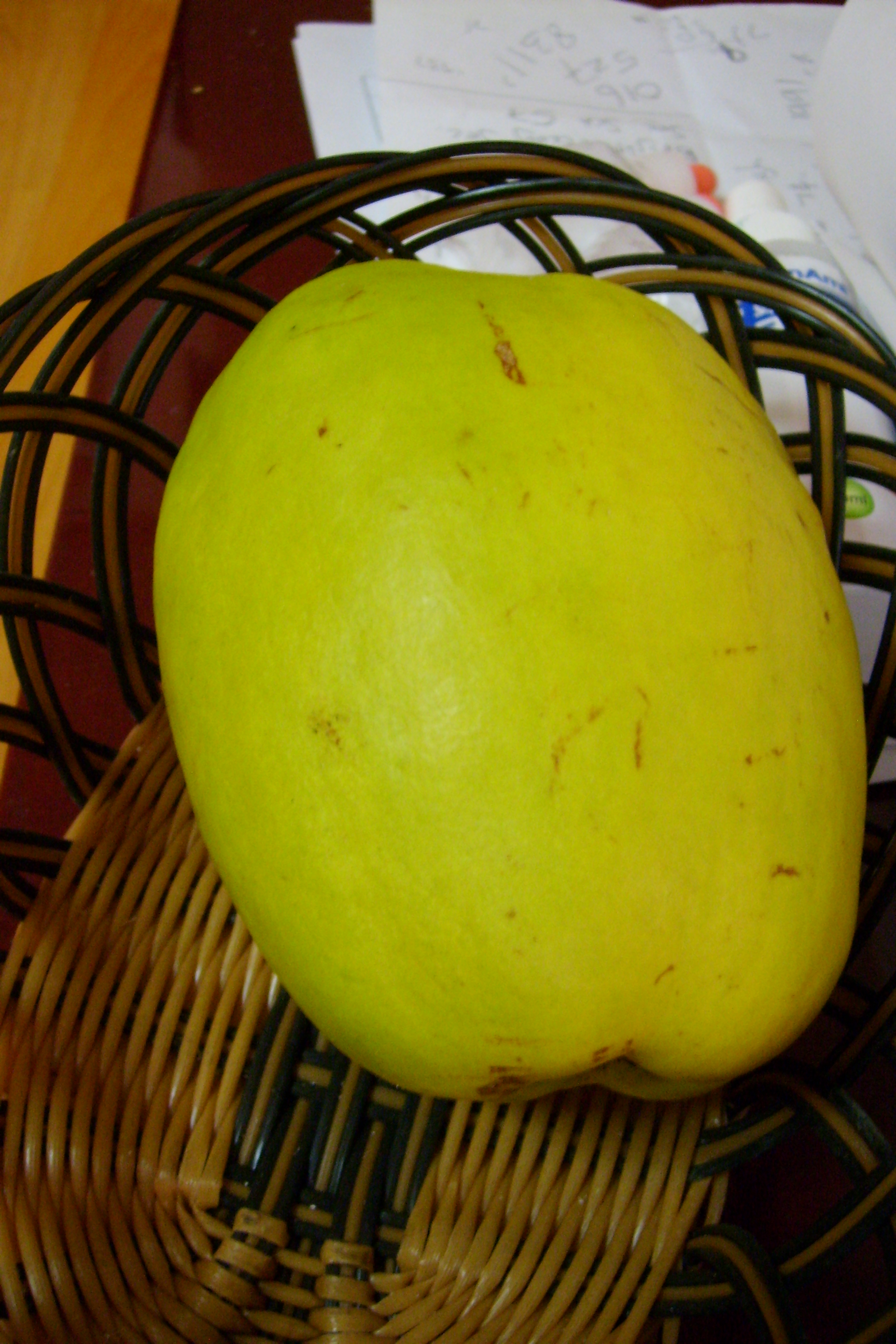
Oriental quince. (모과)
The Oriental Quince (Moghwa. 모과) , is used for its fragrance which is slightly appleley. It has a waxy skin. They do scent small areas like cars and small rooms but unless you dangle them under your nose, they’re pretty useless in larger spaces – but they look good. Moghwa appear in late summer and early winter. Make sure there are no small holes in them as these will contain worms. I had one with a small hole which were fruit flies front door, a piece of gum blocked future access and entombed any inhabitants. If you turn the fruit regularly it should keep into the spring. The moghwa is used in oriental medicine and can be used to make tea.

Daegu, famous for its apples (사과)
Apples. (사과) I live in Daegu which is renowned for apples and Daegu apples are truly delicious. In England, I rarely eat apples partly as there are so many varieties I never know which ones I like and because they can never be relied upon to be tasty. I suppose the variations in British weather result in fruit which can be sweet one moment and sour the next. Daegu apples are never sour and they are never fluffy or soft. Some are truly massive in proportions. Recently, a Korean teenager told me that had Snow White been Korean, she wouldn’t have died because Koreans always peel the skin off apples and pears. (and the witch, so he said, put the poison on the skin). In England we tend to wash them, if we can be bothered, and eat them with the skin on – a habit many Koreans find odd.

Cabbages (배추)
My God! I nearly forgot the most important seasonal product of all… The Cabbage – usually called a paech’u (배추) As with most imported fruits and vegetables which I might buy back home, the Chinese Cabbage ( which I think is a pak choy – or maybe its a bok choy???), is a piddly little thing which usually sits in the palm of your hand, is almost pure white and has no green leaves and cost W2000. In Korea when the cabbage season is at its peak, some are colossal in size and this week in the market they cost around W1000 each which is about 50 pence in sterling. Two will make me enough kimchi for several months. Check inner leaves for signs of caterpillar.
An occasional site, especially in more rural areas, are large vats of paech’u being salted ready for making kimchi. Indeed, in street markets at this time of year you can buy kimchi which has already been soaked in salted water.

Salted cabbages in Cheonan
- My Winter 2009 kimchi (배추 김치)
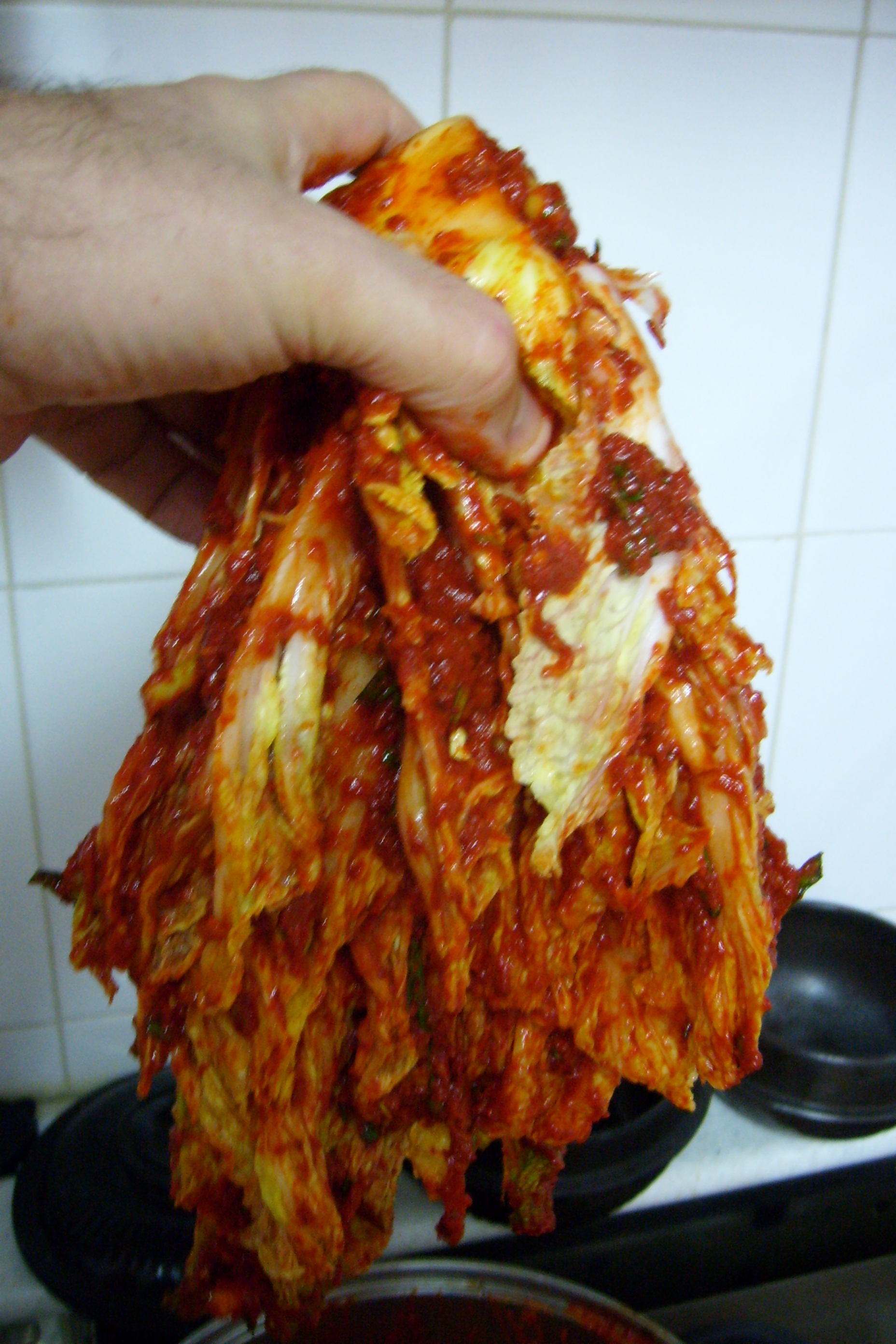
Paech’u after being salted and pasted with kimchi paste. Yes, it looks like something from a road accident but it tasted delicious!
persimmon – 감, hard – 땡감, between soft and very soft -반시, very soft – 홍시 or 연시, and dried – 꽃감. Oriental Quince (moghwa) – 모과, apple – 사과, Chinese cabbage – 배추.
© Nick Elwood 2010 Creative Commons Licence.
Definetly 'Ji Ji' (지지)
For the last few weeks I’ve been paying attention to the contents of my dustpan after I have swept my studio floor and run the ‘magic mop’ over it. The ‘magic mop’ has a disposable cloth attached to the head to which dust and most other debris firmly sticks. I noticed a long time ago that you can’t flick anything on a Korean floor without it reappearing some days later, stuck to the sole of your naked foot or clinging to your sock. Grains of rice, once hardened are especially annoying.
In Europe at least, and especially in Britain, carpets are often the preferred choice for floors and in some aspects they are wonderful because they absorb most small debris. ‘Sweep it under the carpet,’ an idiom I am often asked to explain, really isn’t necessary with small things as you can deposit them on the floor and at most all you need do is rub you foot over it a few times to permanently erase whatever was underfoot. All bodily bits, small scraps of food, cigarette ash etc, are banished forever in the pile of your pretty carpet.
Ten years ago I moved into a new house in England and after a year decided to rip up the carpets that had lain on the front room floor for well over a decade. Even after months and months of hoovering the floor and liberally sprinkling it with various scented and odour eating carpet powders, I was never able to feel comfortable sprawling out in front of the TV. The carpet was old but it never actually looked dirty and the unpleasantness I felt probably arose from the fact that I occasionally detected odours emanating from it, odours which weren’t unpleasant but weren’t mine. You wouldn’t want to wear a stranger’s unwashed clothes so why would you want to lay on their ancient carpets, carpets ’worn’ by several families. Even after meticulous cleaning, I regularly wrestled lengthy black hairs embedded within the pile. They were of Greek extraction because Greek students had lived in the house, some three years before I moved in.
When the carpet was eventually dragged out of the house, departing in a dusty cloud, the wooden floor on which it had lain was covered in a thin coat of what looked like sand except it was finer and softer and most likely organic in origin. The carpet had acted like a filtration system so that only the finest particles escaped through to the floor boards. Once hoovered you could see the small spaces between the boards were caked with dirt that had been compressed into them over many years. This had to be gouged out with a knife before I could sand the boards. Once the front room and dining room were rid of carpeting and the floors washed, scrubbed, scrapped, sanded and treated with linseed oil, the need to dust became a monthly rather than weekly routine.
The decision to banish the muck absorbing carpet, and to subsequently ban outdoor shoes from inside the house, was finally made after I noticed a small brown thing on the floor. I smoked marijuana at the time and on two occasions I had discovered dope on the floor though one discovery turned out to be either dog shit or a clinka that had fallen out of my nephew’s nappies. This mistake only transpired when I inhaled the joint I had rolled from it. Needless to say anything brown and lumpy and laying on the floor I assumed to be dope before anything else. Though I suspected what it was, it needed confirming. I sniffed it and instantly retched – cat shit, the worst carnivore shit of all!
Ten years ago, the streets around my house were liberally ornamented with piles of dog shit. I know because I used to stick small cocktail flags in them to draw attention to them; it was a form of social protest. When walking to work I would count the passing turds and often, in just half the street, I would count as many as thirty. I had some intimate relationships with the turds in my street: one had been laid in the furthest corner of my lawn, just under the privet bush. I couldn’t fail but notice it as it was large and shaped more like a small cow pat than one of those curled and tapering whippy whirl turds that Korean kids are so expert at drawing. In 2000, when I first arrived in Korea, I wondered why so many ice creams were drawn on tables especially as the Baskin Robbins opposite my haggwon, scooped ice cream out of large tubs rather than deposited it whirled. Only the smallest dog could have manoeuvred its arse into the required position under the privet bush to deposit the poop, a Korean size handbag dog for example, but this specimen’s owner had to be big.
I watched that turd for an entire summer and well into winter, witnessing its transition from a wet mess to one with a crusty top, rather like a pie that then turned white after an infection by some strain of turd eating mould. Eventually, internally atrophied and dehydrated by a hot summer, it collapsed into itself. Gradually absorbed into the ground around it, it disappeared but by that time it was late winter. Back on the pavements, I even began to recognize individual dog’s shite and could sometimes trace their various daily messings down the street. One example, a particularly big deposit was almost orange in colour. I imagined the owner, walking their dog in the anonymity provided by the early morning darkness, allowing it to shit in one spot and the next day dragging it a little further down the road so as to share the messes equally around the neighbourhood. As dogs like to do their business in the same place, I would imagine that the moment the dog started to squat on its hunches the owner had to drag it further before letting it spill its backside onto the pavement. I estimated the owner probably took a month to circumnavigate the crescent before the dog had to poop in approximately the same place and if even house numbers were the victims one month and odd house numbers the next, the cycle could have been extended over two months. Despite the copious piles dotted about the street you never saw an owner allowing their dog to foul the pavement so, never trust dog owners who walk their dog in the dark.
Some owners were equally as considerate and seemed to think it was acceptable for their dog to shit on the road. For several days, as I ate breakfast, I was treated to the view of another enormous turd, strange how they all seem to have been enormous, as it was squelched all over the tarmac by passing cars. Neighbours who made their dogs pooh on the road probably perceived themselves as good citizens while those who used the pavements were anti-social. Eventually I put a rather hostile placard on my front lawn and several neighbours then did the same; instantly, the appearance of new turds ceased and those remaining were old and in various stages of atrophy, dehydration and decay. I kept counting the turds walking to work however, as the number of deposits beyond the borders of my placard’s influence had significantly increased.
I’m digressing: My point is Europeans and especially the British prefer to wear outdoor shoes inside their house which is a custom I find horribly disgusting and more so if you have carpets which act as toilet paper to the soles of your poohey shoes. There was so much shit on the streets around my house, and there still is, that natural decay and rain swirled it everywhere so that even if the ground looked clean, you could guarantee it was coated in canine faecal matter. Wearing shoes indoors, when so many dogs foul the pavements is a disgusting habit.
I don’t think I’ve ever seen a dog turd on a Korean street and even if there were it would only be a little thing as most Korean dogs are handbag dogs and incapable of passing anything more than a few pellet sized faeces. And yet Koreans never wear shoes inside their houses and often don’t wear them in workplaces.
When you live in a room which is barren of carpets your awareness of your own bodily debris grows. When you have a carpet you assume that the bit of nail you blow onto the carpet, or the bogey you roll and flick onto that beautiful Axeminster, simply vanishes. I can flick a toe nail across the room and know that in a day or two it will reappear in my dustpan along with a grain or two of rice, a few hairs and other bits of fluffy stuff. Occasionally I’ll spit out a nail to deliberately see when and where it will re-emerge.
I’ve noticed there are rarely any hairs on the central part of the floor because these are blown to the edges of the room by the draft from open windows and passing bodies and for some reason, the biggest trap of body hair are the sliding door groves. Every few weeks I need to clean these out. Pubic hair has the most amazing ability to float into places like your fridge or kitchen work-surface and though you might find this abhorrent and are thankful that your carpet seizes them before they become visible, I’d rather see the occasional curly devil on a plate or in the fridge than lurking in the pile of some horrid carpet, rotting slowly among years of bodily refuse, embedded and matted with all sort of unthinkable crap, dead skin cells, bogeys, shoe dirt, dog and cat muck, grit, rain water etc, etc. And then, thinking we are being hygienic, we sprinkle the carpet with floor powders that temporarily scent the air. What happens to them once they have embedded themselves in the carpet? I doubt such powders disappear.
I live alone and so my observations are based on my own bodily sheddings but how greater the pollution if you live with other people or a family and have pets. Carpets are such filthy things and what we do with them is not much different to that other dirty British habit, thankfully disappearing, of blowing gunge out your nose and into a hanky which you then keep warm and moist in your pocket, the perfect environment for viruses and bacteria, before putting your face back into it and snorting out another load. Having a carpet on your floor is a little like sleeping in the same bedding without ever washing it.
Cleaning a carpetless room is a joy because it’s effortless and now Samsung have even marketed a robotic floor cleaner that cleans your floor when you are out. Everything is exposed in a Korean room as there are few true hiding places. And if you want to wash the floor or give it an occasional scrub or douse it in bleach, well that too, is easy. Carpets can’t be washed and I’m sure all carpet shampoo does is drive the dirt deeper and enliven their parched innards. There is probably a surge in a carpet’s bacterial and fungal population following a shampoo.
In Korea, many westerners don’t remove shoes indoors preferring to stick to their own customs and there are others, myself included, who will occasionally wear shoes on their floor if for someone reason they have to return briefly indoors because they’ve forgotten something. This is a habit I am trying to break but when you’re in a rush it is difficult. You very, very rarely see Koreans walk on their living space floor wearing shoes, not even for a few seconds. I have noticed that on the odd occasion I have breached Korean custom, I have subsequently felt the deposited dirt left by my shoes, when barefooted. You can’t see it but it’s there despite the fact you only walked on the floor for a few seconds.
Korean students, especially younger ones, will sometimes cringe and tell me how dirty I am if I suck my pen. Often they will shout ‘ji ji’ (dirty) which is the word used to small kids and in the same category as English words like ‘pooh pooh’, ‘wee-wee’ and ‘tinkle’. If sucking a pen is a little ‘ji ji’ then having a carpet or rug is infinitely dirtier, indeed it is positively filthy! Next time you flick some item onto your Korean floor, just remember, it’ll be back!
지지 – dirty – (but a word used to small children), haggwon – 학원 – a private school like a homework club or after school study center.

carpetless
Buk-il Boys’ High School. Mon. 17th Sept, 2007. (Korean Accounts 2)

Boys arriving at school: note the boys ‘on duty’ checking the uniforms of arriving students and also the boys saluting the school entrance.
I was up early in the morning and left the house at 7.15 to find my way to the school. Ted and Mr Chǒng had given me directions last night and they were fairly straight forward. From my apartment, which is in a row of one room apartments with its own separate glass door entrance, the school is up a hill. Ted had told me there was a short cut but that to save getting lost that in the morning I should take the long route. The first part of my walk took me past the small shop I had visited last night which I now noticed stood beside another dog soup restaurant. Then I passed a triangular shaped paddy field where Ted had told me to take a right turn. Then I simply had to walk straight up the hill passed a number of small shops and cross a main road to find the school entrance.
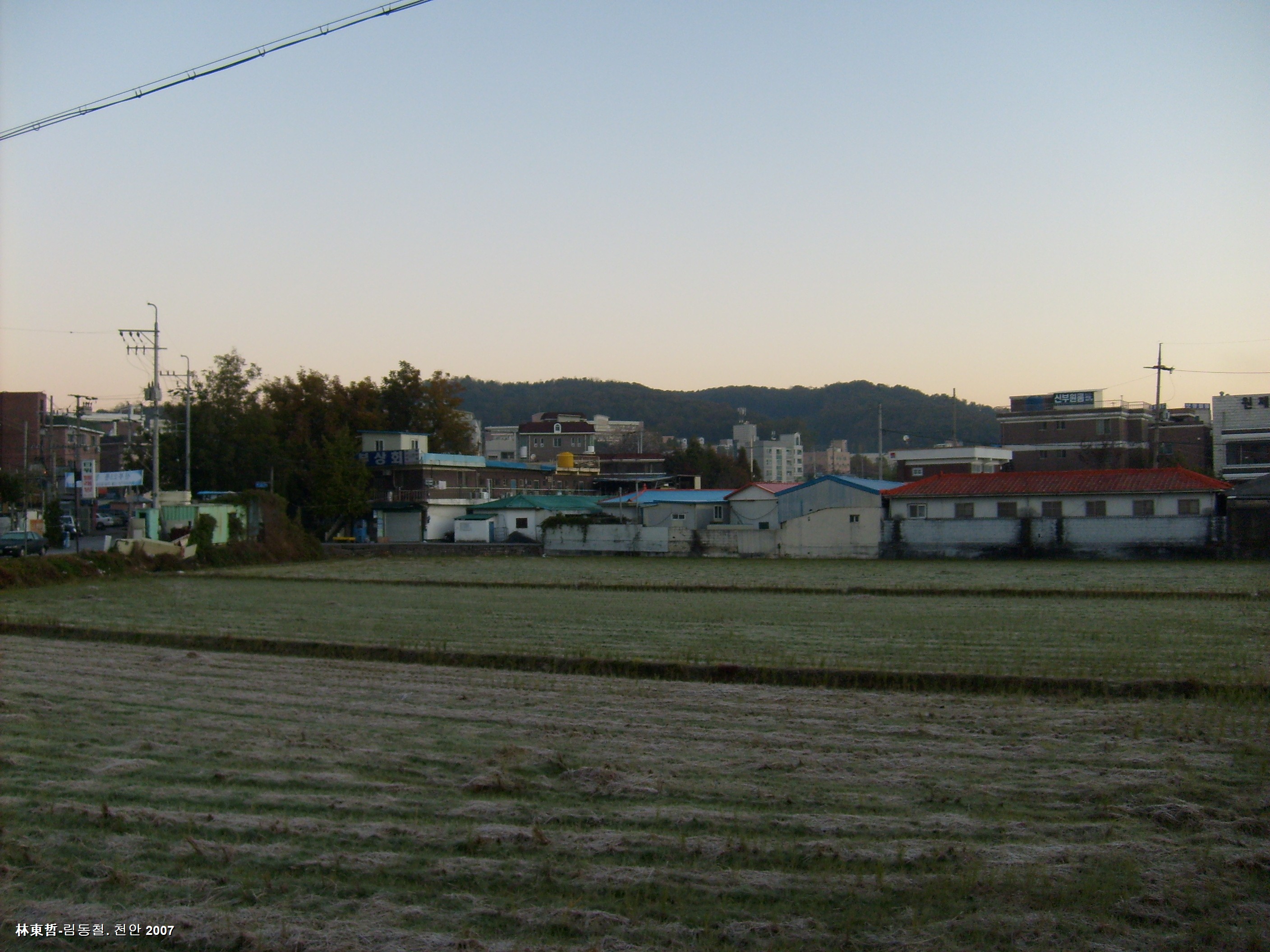
Across the paddy field towards my ‘house.’ The school can just be seen in the background
The hill up to Bukil (北一) isn’t that steep but in the heat and humidity I was soaking wet before I was even half way. There was a long string of boys behind me and I didn’t want to have to start conversations on the hill. I was so exhausted by the time I had walked only halfway up the hill that I turned off the road and caught my breath by the school’s baseball diamond. I had forgotten that Koreans, even youngsters, tend to plod up hills and don’t rush like westerners do but in my rush to get to school, and not knowing how long it would take me, I walked at a fair pace. I would have remained longer recuperating at the baseball diamond had I not seen another westerner in the distance and decided to carry on up the hill.
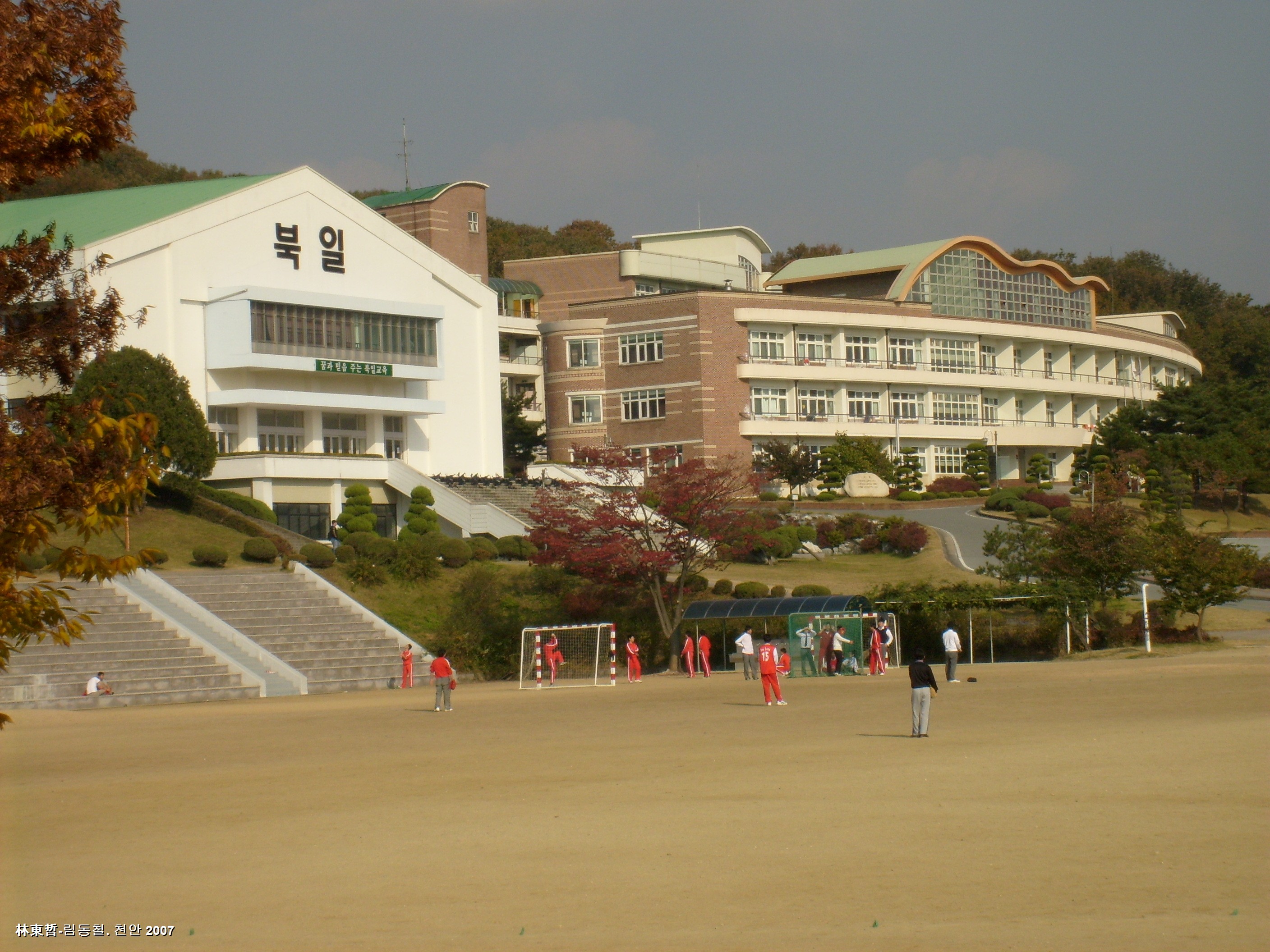
The boys’ gym, on the left, and adjacent girls’ high school
Further up the hill four boys stood ‘at ease’ across the road and as I passed them they stood to attention and bowed at me. A number of boys were doing press ups or burpees on the pavement. At the top of the hill, where the school entrance is situated, three teachers, all armed with sticks stood on duty. I noticed that as the boys passed this point they saluted the school.
The road up to the school, which at the time I didn’t pay much attention to, is lined with trees, cherry trees. At the bottom of the hill there are two enormous sets of iron gates, one for the boys’ school entrance and one for the girls’ school. Between the gates is a sort of guard room and to the side of this, on the boys side of the entrance is the most massive mirror. I have since noticed large mirrors in quite a few places in the school. Beside the road leading up to the school are two terraces, the first contains a number of tennis courts, the second contains the typical sandy parade cum sports which has a number of wisteria entwined arbours and drinking water fountains around its edge. Any British person, especially a teacher is tempted to call this area a play ground but one never sees youngsters playing in it and it is an arena employed more for physical training, assembling the entire school and used by the boys to play various sports. At the head of this arena and opposite the school façade, stands a large, covered podium. In between the back of this and the school façade is the most beautiful garden with pine trees cut and shaped in the traditional Korean manner. A large sculpture stands to the side of the entrance.
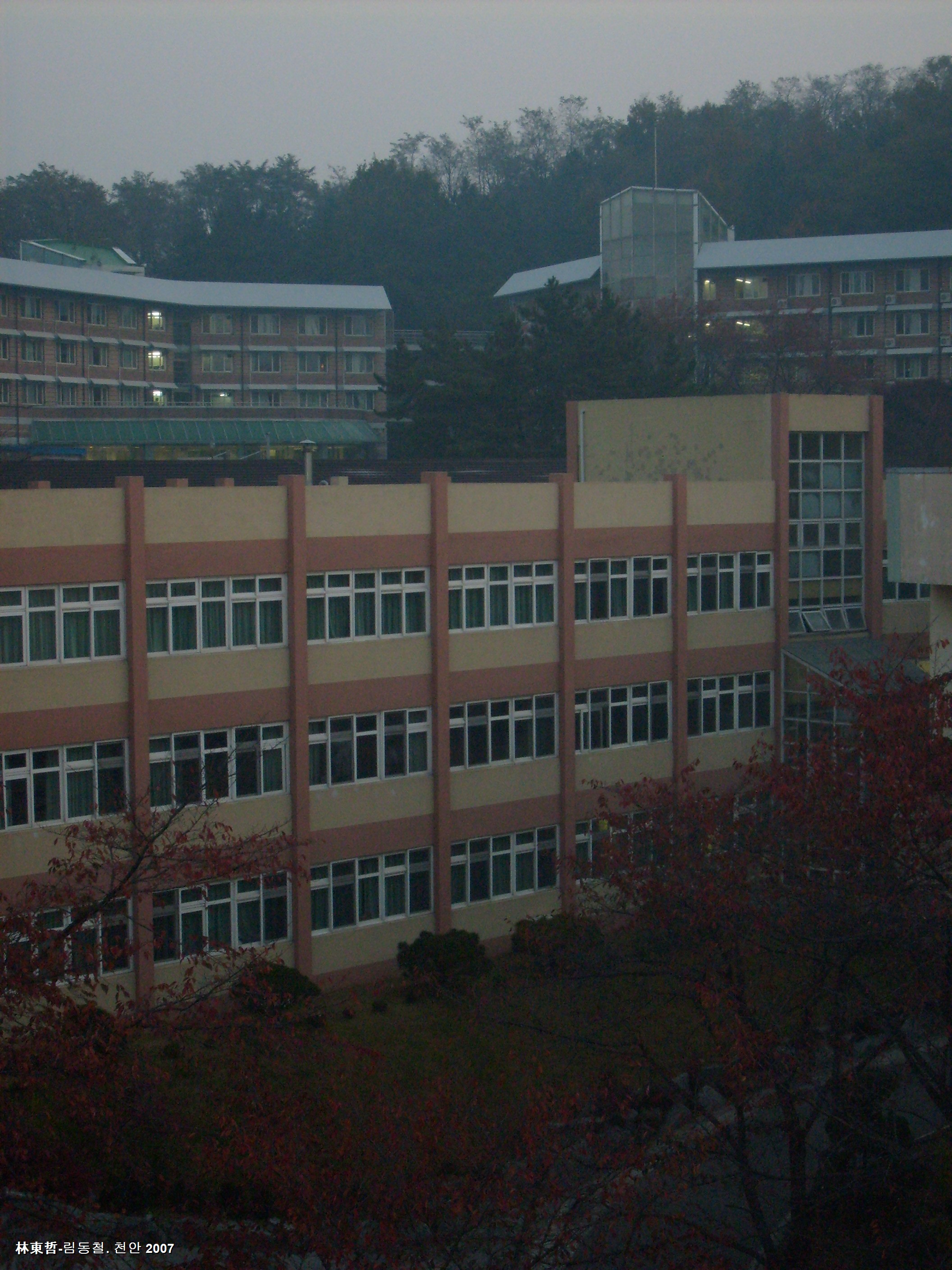
The boys’ dormitories
When I arrived at the front of the school Mr Kim was already waiting for me. I was absolutely exhausted and being soaked in sweat and wanting to compose myself before being introduced to anyone else, I asked to be shown the nearest restroom.
There is no time wasting with Korean employment procedures, no time for getting acquainted with systems or methods and neither are any individuals allocated to look after your needs. I don’t know whether or not this is because Koreans have tended to have very little experience of foreign travel or simply because they are ignorant or disinterested in your needs. I have always found that in Korea one has to discover aides and sympathetic helpers from among one’s colleagues. I think that after meeting Mr Kim on the entrance steps to the main building, and after exchanging a few pleasantries, I was taken straight to the humanities department where I was shown my desk and computer and then handed a class timetable. I was introduced to CM, my fellow English speaker. Next I was taken to the teachers meeting room for the typical Monday morning schools briefing. I met the school Principal and then had to give a five minute talk about myself. It was now 8.20 in the morning and I was due to start a class at 9.10am. Looking back on this I cannot belief that just after 10 hours of being in Korea and only after having been in a school for one hour forty minutes, I should then begin teaching.
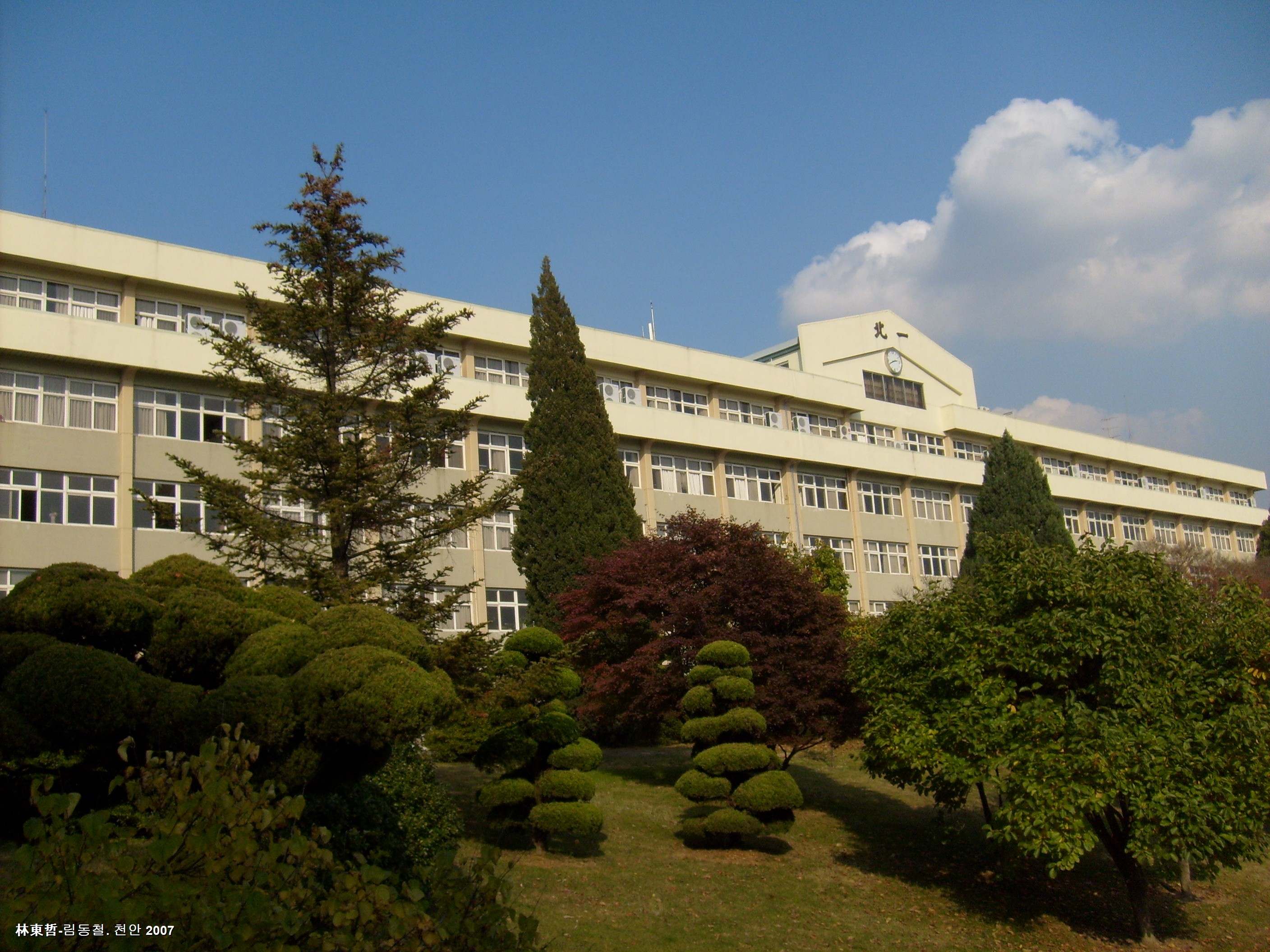
the school’s facade was very attractive
CM, whose name is Claude Montgomery Tidwell, is a rather distinguished looking American who is in his early sixties. Like so many older teachers in Korea, especially the ones who have taught in Universities, as CM has, he dresses in that stereotypical fashion reminiscent of Oxbridge; bow ties, tank tops, blazers and tweed jackets and silk ties are all part of his wardrobe. I recently meet a Professor from Ch’ǒnan Dangook University, who I automatically assumed was English; he was dressed entirely in tweeds, had a silk bow tie, a carved walking stick, which wasn’t for show as he did have a lame leg. I quickly discovered he was from New England and I remember his name as it so suited his attire; it was Michael Huntingdon. Of course few of these ‘professors’ are professors in the British sense of the word. In the UK a professorship is not a teaching position but a position of prestige and status within a department. It is a title conferred on distinguished academics. I have not had experience around Korean English university teachers before but they do like to refer to themselves as ‘professor,’ using it as a prefix to their name. This is obviously a western affectation as Koreans use the title (교수) as a suffix in much the same manner as we use post-nominals. Further, the ‘title’ seems to be one that western teachers will use as a means of identity even after they have left university teaching in the same way it would be used in the UK. However, I would probably do the same if I was teaching in a university.
I had four classes on this day and they all went perfectly. Before each lesson, the class captain stands up and calls the class to attention. All the boys then sit up straight with their hands on their thighs. Next they are given an order to bow. It is possible to begin a class here the very second the bell is sounded which is amazing and so unlike degenerate schools back in the UK.
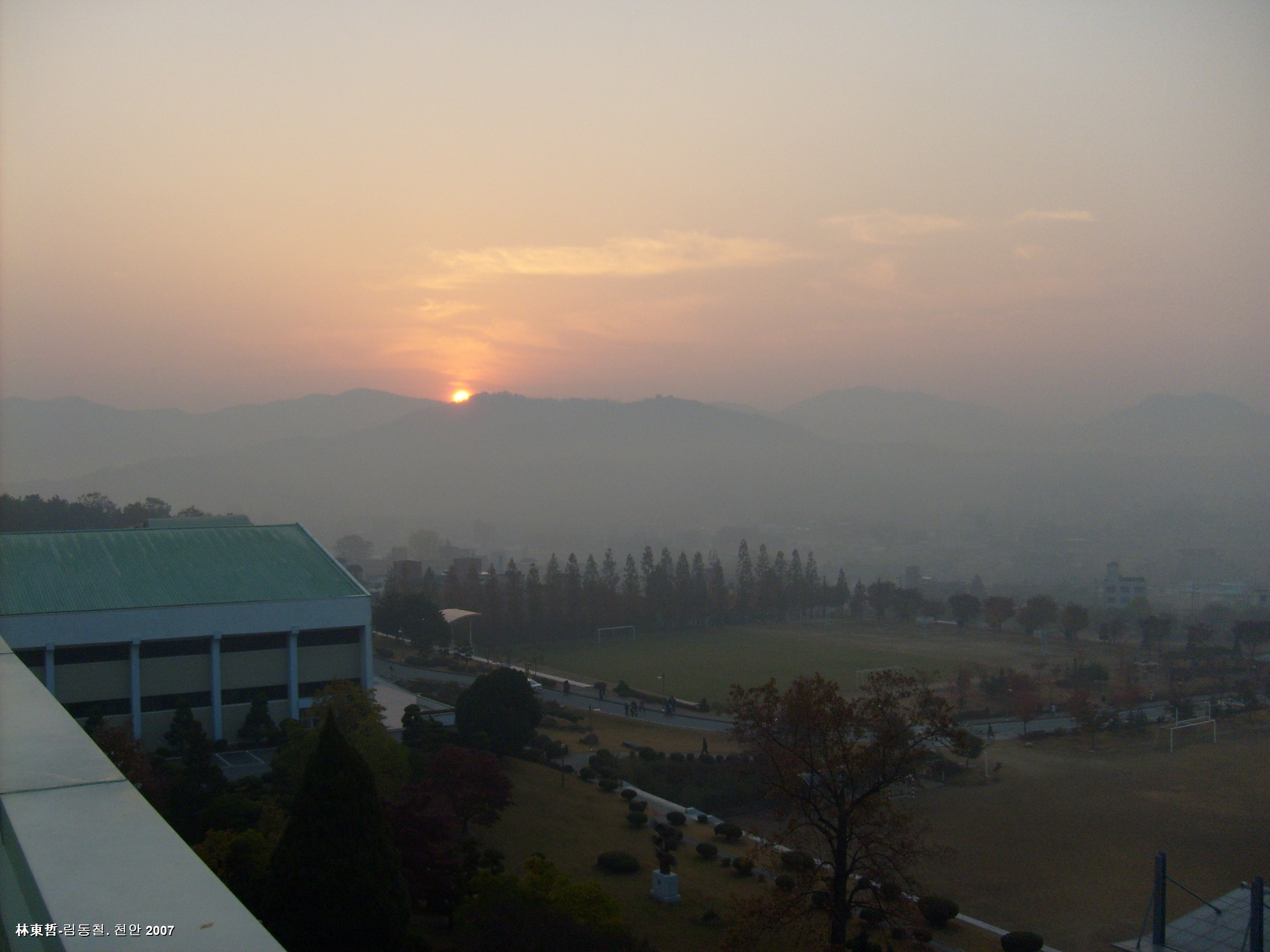
Sunrise from the school roof
My small apartment, in a complex called Roseville One Rooms, is about a ten minute walk from the school, and is situated in an area of Ch’ǒnan called Shin Bu Dong (신부동). My area consists of a number of ‘one room’ complexes and the nearest land mark is known as Tower Golf. Here there is a large golf range and also a sauna (목욕탕). There are also a number of dog soup restaurants in my vicinity. The daytime heat is very uncomfortable and initially I did not enjoy walking to and from school or even around the school as there are 6 floors and no lifts in the main building. In the first few weeks I didn’t really explore my immediate area though I quickly discovered where the nearest supermarket was – a Lotte Mart which is a short drive from my apartment. To be truthful, I was quite exhausted at the end of a day and didn’t relish going into town or walking around in the heat exploring.
©Amongst Other Things – 努江虎 – 노강호 2012 Creative Commons Licence.
Written September 2007
Ch’eonan.September 2007. (Korean Accounts 2)
I arrived at Inch‘on airport, Seoul on Sunday 15th of September. I was supposed to be being met by one of the teachers from the school but this plan was abandoned a few days before I departed and they asked me if I could travel to Ch’ǒnan (天安市). The journey from London to Seoul was tiring and in total lasted about 32 hours. I spent 3 hours waiting at Dubai airport. I arrived in Seoul feeling very tired and after a little hassle managed to find a bus that travelled to Ch’ǒnan. The duration of this journey was about one hour fifteen and for most of the journey, which began as dusk was falling, it rained heavily. I had hoped that Ch’ǒnan might be a little less westernized than was Daegu because in the short walk from my apartment there to my old school I passed Baskin Robbins, MacDonalds and KFC. Well, my bus left the highway at the edge of the city and within a minute we were passing through the centre of the town where I know the bus terminal was located and as we approached it we passed The Outback Steakhouse, Baskin Robins, Dunkin Donuts, Macdonalds, KFC and as we turned into the terminal, I could see a Burger King a little way off in the distance.
It was raining heavily as I wearily lugged my bags off the bus and headed for the nearby shopping mall where I left my bag with an attendant and went to find a phone booth. By the time I returned Ted, the guy with whom I’d had most of my communication regards the school, was just entering the mall followed, moments later, by Mr Chǒng. From here I had to drag my bag through the rain to a suitable spot where Mr Chǒng could meet us with his car. Once he arrived we drove up to the school which didn’t seem too far away but I couldn’t really see much as everything was in darkness however, I could tell it was at the top of a hill. Turning the car around, we drove back down the hill and crossed the main road onto a rough track of a road on which stood a dog soup restaurant. It seemed only a minute or two from here to where my apartment is.
It was somewhat depressing arriving at my accommodation in darkness, tired, and in the middle of a storm that I later discovered was the edge of a typhoon. Though I now like my room, at first viewing it appeared dingy and uninviting. A large double bed stood in one corner and at the feet of this was a large number of boxes. Ted announced to me that the boxes would be picked up in a day or two but I’m not stupid, this is Korea and unless Ted is here himself to move them, they will be here for weeks on end. I wasn’t really pleased with how Ted announced this as a statement of fact rather than a request. Mr Chǒng and Ted stood looking around the room, praising it and were especially pleased with the double bed, which I must add, having since slept in it, is very comfortable, however, what captivated my attention the most wasn’t the lovely bed, but the grungy grey pillow and duvet that lay in a pile on the bed. The pillow was particularly disgusting as it had slobber marks all over it. I immediately knew that I wouldn’t be sleeping in Ted’s dirty laundry this evening. When they left I investigated the room further and though it was clean, I was quite amazed that neither Ted nor Mr Chǒng had seen fit to put any water in the fridge, leave me a little milk or wash my bedding. Ted had even beamed with a touch or pride when I opened the refrigerator door and saw a lonely, atrophied potato and onion. A soon as they left I walked down the road and discovered a small shop where I bought some noodles, milk and shampoo and as soon as I returned home and had unpacked, I put the dirty bedding in the washing machine. I eventually washed the bedding twice and they have since been transformed from a colour I thought was grey to pure white.
©Amongst Other Things – 努江虎 – 노강호 2012 Creative Commons Licence.
Written September 2007
October 2002. (Korean Accounts 2)
I had tonsillitis which kept me in bed for three days. I’ve never had tonsillitis before and it was pretty unpleasant. On the first evening I thought I was going to die – I was just freezing cold and couldn’t stop shivering. The next day I managed to go to the doctors – a friend of Mr Joe, who is an ear, nose and throat specialist. I went to him knowing he would contact Joe and tell him I was ill. I’ve taught the doctor’s son and daughter on many occasions. I love the Korean medical system as which doctor you go to depends on your ailment. There are cardiologists, neurologists, urologists etc all over the town. There must be fifty doctors within easy walking distance of my house. Anyway, Dr Um (음) had all the equipment for examining your throat and it more resembled a dentists than a doctors. He poked things onto my tonsils and sprayed stuff on them and I got a penicillin injection straight away. I then went back the next day for another one and within a few days the infection had cleared up.
On the Saturday I went with U Chun, Ga-in and U-no to a big clothes market in the city centre. It was massive as Daegu is a major textiles centre. There was everything and at quite good prices and quality. We ate lunch in a pulgogi restaurant and then I went back home to teach some private classes.
I only have an hour of kindergarten a day but I absolutely hate them. I have five children aged 4 – Buddy, Betty, Anna, David and Jenny. Anna is a real macho little girl and I really like her and David is quite cute but the other girls are shut down and psychologically damaged – like so many Korean girls. Da Hae is still at the school, is still dribbling and still can’t really speak any English. I just go into the class, sit in my chair and call the kids to me, I have no interest or enthusiasm, I am not enthusiastic and I’m sure Sunny, the Korean teacher, thinks I’m a frigging moron. Sometimes the work for them is way too difficult. Today I had to read them a story and Buddy got really confused because the word ‘jet’ was used instead of airplane. I asked the Korean teacher to explain the confusion to him but she said we can’t speak Korean to them. If she hadn’t been there I would have explained in Korean but they really hate you talking any English in a class even if the kids don’t understand or are totally confused.
I have been doing Taekwondo but have to train in the mornings at 7 0’clock. The place is always busy. I have found a relatively quiet place and this morning I saw a praying mantis up close. Ji-won’s final exams are looming and he is stressed out. Whoever heard of a stressed out 18 year old but he actually has a bad stomach due to it. David told me that twice a year Korean school kids are given envelopes to shit in and they have to take a sample of their crap to school so it can be tested. This week we had to celebrate Halloween which was funny as I moaned constantly about it being an example of American Imperialism. It seems all the kindergartens in Song-So were doing the same thing.
I’ve eaten in a pogo restaurant several times. Pogo (복어) is puffer which can be poisonous and for which the chefs have to have a special licence.
POST-SCRIPT TO KOREAN ACCOUNTS PART 2
No further entries were made whilst in Korea. My timetable became so hectic that I had time for little else. The stress was quite crushing and I am surprised the journey to Korea did not make me ill. My bout of tonsillitis strained relationships between Mr Joe and I. During my five day illness, he never bothered to see how I was and nobody was sent to check on me. Indeed, he made several phone calls to my landlord to ask when I was coming to work. When I eventually went back to Di Dim Dol, he ‘ordered’ me back to work. ‘Ordered,’ was the actual word he used. I ended up having the most enormous row with him at the end of which I resigned.
My resignation didn’t really affect my trip and I resigned from the school in late December but remained on until Matt visited me in January. I actually returned to the UK the same day as Matt. If I remember rightly, Matt stayed with me in my apartment for 10 days. I seem to remember we left Korea on Sol (설) which is New Year’s Day. No further diary entries were made until 2006.
©Amongst Other Things – 努江虎 – 노강호 2012 Creative Commons Licence.
Written Nov 2002
Return to Korea (Korean Accounts 2. 2002-2003)
I arrived back in Korea, in September 2002, after agreeing with Mr Joe that I would do a six month contract. After my former mistrust of Joe, it might surprise you I returned to work for him but I suppose my feelings towards him mellowed and in addition, I really wanted to return for an extended spell. In the year since I was last in Korea, much has changed. Now there are many more westerners than there were two years ago. The evidence of westernization is striking and there are even more Macdonald’s burger bars, Baskin Robbins ice cream parlours, Pizza Huts and Burger Kings. On the main road through Song So, that leads to Kemyoung University, in addition to the MacDonalds and KFC, there is now a Baskins Robbins parlour, a second one is presently being built, and a Pizza Hut. All these facilities are within a 10 minute walk of my front door. I am also sure that I am seeing more fat Korean kids than I did before.
I am living just around the corner from my old apartment and in fact I could have looked out my former bedroom window onto the side of the building I am now living in. This time I am in a one bedroom apartment which is next to a Chinese Medicine establishment and looking directly onto a barbecue restaurant and restaurant which is being built and as yet has not opened.
Pak Jun-hee and his family left the old restaurant where I spent every Saturday evening teaching Ji-won. I don’t think the restaurant, which was behind the Shin-woo (신우) supermarket on the main road leading directly down to the university, was bringing in custom. They have moved to a restaurant just around the corner from where I live which is just a few doors down from the bakers and the Hapkido School. The restaurant is very small and sells pork (삼겹살) or beef barbecue. Even though the restaurant can be very busy, I think the returns are less than adequate and the family is struggling a little.
I have been up Warayong Mountain several times with Pak Jun-hee and though it is a struggle to get to the top it was well worth it. Warayoung is the mountain which lies directly behind Song So. Last weekend was the Korean festival of Chu-sok and so we had Friday off. The weekend was a bit boring as all my Korean friends headed off to their family tombs. However on Sunday, after our mountain climb, Pak Jun-hee, took me to his house. It is in an apartment on the 10th floor of an apartment overlooking the street his restaurant is on. It was a special occasion as I have never been here before. The house was smallish but comfortable and as usual very open planned. There was a cabinet with a lot of liquor miniatures in them as Sun-hee collects these and then quite a few large jars, like parfait jars, with various fruits in them pickled in alcohol – these are Pak Jun-hee’s. Ji-won was really excited to see me and showed me his room – simply a bed on the floor, his work desk and books. Apart from some teddy bears, his sister’s room was much the same – a complete lack of pop posters, fashionable clothes, music systems, computers and all the consumerist crap that western teenagers have to have. What was more interesting was that rather than their rooms being dens in which to hide themselves away and pretend to be individual – their rooms were completely open to the house. I don’t think privacy is such an important issue here. Sun-hee returned from town and cooked us some food and then I watched a Tarzan movie with Ji-won and his sister. This week Pak Jun-hee started a new job. In the mornings he goes to work on a construction site. He leaves home at 6am, returns home at 6pm (all for around 30 pounds a day), and then in the evening works in his restaurant which Sun-hee closes at around 4 am. They are saving money for Ji-won to go to university. What a life! And I moan at having to work anymore than 6 hours a day.
The exam period for middle school kids (13-15 years old) is here and it so noticeable; the streets are teeming with kids going to and from the Hakwons. They study in these until 11 or 12 pm and in Di Dim Dol, my school; they can buy cakes and noodles because they do not have time to eat a meal at home. I have had several private classes cancelled though I still get paid for the lesson. This week in the elementary schools (7-12 year olds) sports day and as always everything in Korea happens at the same time. The kids sit in classes with stamps on their arm telling you whether they came 1st, 2nd, or 3rd in the various competitions – running, jumping, dancing etc.
At the moment my routine is really good; in the morning I study Korean, then I go for lunch, then to the mokyuktang (Han Song), and then work. I finish work at 8 pm, go straight to Pak Jun-hee’s to eat and at 10 pm I do some private lessons. My Korean and Hanja are really improving. I sat in the green tea bath at the mokyuktang on Friday talking, to an old man and managed to learn that he was 68, weighed 65 kilos, was 1 meter 60 tall, had three sons, one which lived in the USA, that he was a grandfather and had been the Los Angeles. We got talking as he said he recognised me from another mokyuktang bath house and the whole interaction excited me as he spoke no English at all.
Several times a week U-chun and I meet up and spend time chatting in a restaurant. We have been visiting this place which sells oysters – nothing but oysters and for around £10 pounds you can have a big meal for two – usually something like oyster tempura, smoked oysters and oyster soup served with a variety of salads, kimchees and ray fish in spicy sauce. (This restaurant was originally a North Korean restaurant that we visited on our first get together, back in 2000. I re-visited for oysters, several times in 2009 but it has since closed.)
Yesterday David and I went down to the part of Song-so near Kemiyoung University. I wanted to buy a CD as I have been listening to the same music for almost six weeks. Then we went to this excellent restaurant down near the university. It was supposed to be a Spanish style place but there was nothing Spanish about it at all. The place was really weird – just a sort of cocktail bar and restaurant with nothing but sofas and tables. A rather large room just filled with big comfy sofas. David (이영선) said Korean’s think this place is western and he was surprised at my expression when we entered because it isn’t western at all. We ate squid and octopus fried rice and Japanese style pork cutlet.
I do get a bit pissed off at the way Koreans laugh whenever I try to speak Korean. Even U-chun will sometimes have a little giggle. In a private class the other day, I mentioned my arm was sore and the two boys burst into a fit of giggling. One of the boys, Kim Young-jun (김영준) is a bit slow at telling the time and I told U-chun (유천) that he’s a bit slow. She teaches him maths privately. ‘Oh! He’s stupid.” she said. ‘I regularly have to hit him or make him stand in the corner of my front room with his arms above his head.’
Like I said, everything was going well but in Korean things can always change. On Monday, I discovered that the Tasmanian teachers in Di Dim Dol, Matt and Debbie, had done a bunk and left the country over the week-end. Well, now I have been told that tomorrow and until further notice, I must work the hours 10-12am, 1-2pm, 3-8pm! I wasn’t too pleased. When I got home I went to Pak Jun-hee’s and he could tell I was angry but he calmed me down. Later I decided to write a letter and outline my concerns. In the morning I didn’t go to work and handed the letter to Keith as he went to the kindergarten. I then met U-chun and we spent the morning at Baskin and Robbins. A bit of ice cream cheered me up. I had told the school I wouldn’t be going to work until 3pm and that I would work their hours for 2 weeks and then decide what I was going to do. When I went to school, Nell the kindy head, called me into her office to discuss things. The turnout was that I have a slightly longer break in the afternoon but to be honest the quality of my life is shit. Now I work 10-12am, 1-2, 3.50pm or 4.35-8pm. I don’t really have time to do anything substantial and there is no time to train as by the time I get home there is really only enough time to eat, socialise or study for an hour and then go to bed. The problem is Joe is running two schools with one set of teachers and things will get worse in October and November when Nana and Wendy leave.
There has been a lot of stuff on the TV here about five boys who disappeared 11 years ago. Anyway, the boys are known as the ‘frog boys’ (개구리 소년) because on the day they disappeared, they were going to collect frogs. They lived right behind where I live and went into the Warayoung Mountain where they disappeared. There have been loads of police around and several thousand soldiers were drafted in as the boys bodies have been discovered buried and with what might potentially be bullet holes in their skulls. For the last few weeks they have been gradually piecing together each boy’s skeleton. One boy’s coat was tidied at the cuffs. It’s on the TV every evening and has gripped the nation as it has been a mystery here what happened to them and of course the boys’ parents have been on TV. It has been very sad.
When I ask Koreans about this incident they approach it in quite a strange way. I think events like this are so rare that they don’t really have a rationale for them. When I ask Koreans what they think happened I get responses like, ‘they were murdered’, or even stranger, ‘perhaps they were murdered.’ Really!?’ To suggest the boys might have been sexually abused isn’t the first or even second conclusion Koreans come to. The police seem to have had a history of naivety in the investigation. A few weeks ago they suggested the boys had frozen on the mountain despite it being March when they disappeared and them being not too far from home. (The fact they were buried didn’t seem to make any difference.) The boys were found in an area that at one time was close to an army training camp and they now think that a boy may have been accidentally shot by a soldier and then the other boys shot to cover up the incident up.
I went for 4 sessions of acupuncture on my arm as I have had a slight pulled muscle in it for several months. In total the treatment cost me £30 pounds this being exactly 4 times cheaper than getting treatment in Wivenhoe plus several sessions lasted over 2 hours. Now I know why Korean doctors have empty offices as all the problems which clog up the western surgery, the back problems, pulled muscles, etc all go to traditional centres in search of relief. Let’s face it; western doctors are crap at dealing with such problems. Anyway, the treatment seems to have worked but what was most interesting was that I had had another strain in my back which has niggled me for nearly two years. I had treatment earlier in the year back in the UK and after two sessions with there was no improvement. I didn’t notice popping when they manipulated my spine. The Korean doctor, using exactly the same technique, popped my entire spine and the problem disappeared.
I haven’t seen too much of Ji-won as in less than four weeks he has his exams and the whole of Korea is counting down until the day they begin. These exams are known as the ‘goa sam su neung’ (고삼수능) and are the final year exams of high school students. For very many young Koreans this will be one of the most important days of their lives. We went to the PC rooms (PC 방) last week and they had to ask me if I gave Ji-won permission to be there as it is illegal for under 19 years old’s to be in them after 10pm. I have also found out that in some schools, boys are not allowed to have hair more than 3cm long and it is not to be dyed. They are also not allowed to wear trousers any narrower than 7cm at the ankle. Ji-won told me one of his friends was beaten for having highlights in his hair when it was in fact grey streaks -yes – some Korean kids have natural grey streaks in their hair and there is a Korean term for this. One of my private students, Hyun-min (현민), arrived at my apartment barely able to walk. His hair had been more than three centimetres long and so he, and a few other boys, had to strip down to their boxers and run around the sports five times and then do fifty squats. Hyun-min (현민) is 18!
©Amongst Other Things – 努江虎 – 노강호 2012 Creative Commons Licence.
Written Sept 2002


 Elwood 5566
leave a comment