Monster Tomatoes – Monday Market

Tomatoes
For almost a month now, beefsteak tomatoes, the largest tomato of the family, have been in abundance in the street markets. They are truly enormous though they lack the sweetness of smaller varieties. Compared to Britain, the hotter weather, intense June-July rain fall and a long sunny day, are all factors which greatly increase the speed at which plants in Korea grow.

A box costs between 5000-8000 Won (£2-50-£4)

This work is licenced under a Creative Commons Licence.
Burdock 우엉 Monday Market
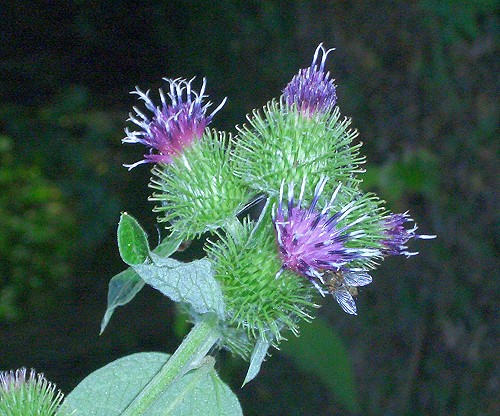
Greater-Burdock
Recognize this plant? If you’re British, it is fairly common and though simply a thistle to many, burdock, is a household name to most adults over 40. Burdock is a biennial plant the flower heads of which are burrs. When I was a boy these were infamous for sticking to your clothes and hair. However, since the advent of paedo-paranoia and personal computers, I would imagine younger generations have little experience of them. Incidentally, it were these burrs and the plant seeds that inspired George de Mestral to investigate their properties in the 1940’s and which subsequently led to the invention of Velcro.

Cross section showing the extensive taproot.
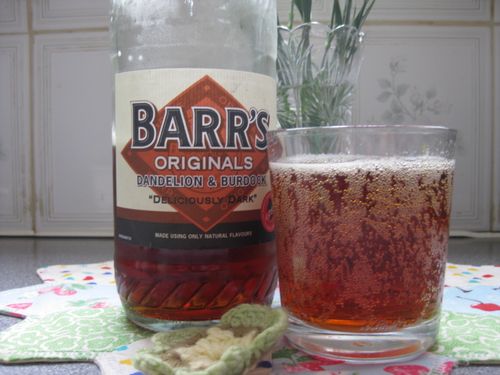
Childhood memories
In Britain, Burdock is probably most renowned as an ingredient in Dandelion and Burdock drink which has been popular in the UK since the 13th century and though it never had the same appeal as Coca-Cola or Pepsi, it joins the ranks of cult classics such as Tizer and Irn Bru. Burdock has various uses in herbal medicine. In Britain, it was also used as a food but today this practice lies in the domain of the more adventurous. (Burdock recipes UK)

probably more popular in the North of England and Scotland

a cult classic
In Korea, burdock taproot is a fairly common sight both in street markets and supermarkets and a bundle of whole root (통우엉),will cost around 2000-3000 Won (£1-£1.50.) The roots are used to make various side dishes and as a vegetable in soups etc.
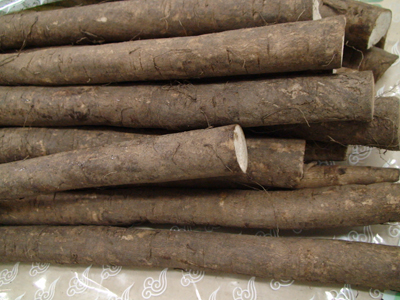
Burdock taproot
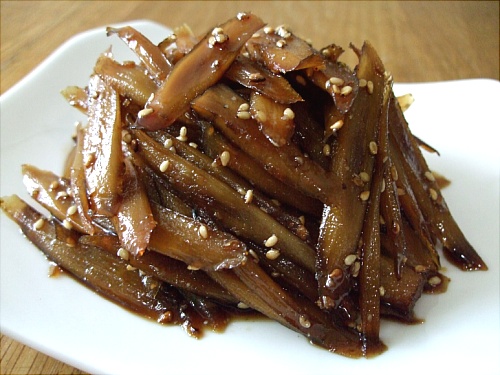
Burdock as a side dish
Burdock root as a pleasant taste, is slightly crunchy with a little woody texture and a nutty-earthy taste.
This work is licenced under a Creative Commons Licence.
Monday Market Ban Ch'an (반찬)
Basically, ban ch’an (반찬) is the collective term for the extensive number of side dishes which can accompany a Korean meal. This most noted of these being kimchi (김치) but of course, there are many different types of kimchi. I used to buy my ban ch’an in E-Marte but have discovered it is much cheaper to buy in street markets, or even cheaper if you make it yourself.

A small selection of what is available
Monday Market: Ot. 옻. Rhus Verniviflua

Ot (옻) costing 2000W (£1)
I’ve had some difficulty trying to find information on this ‘food.’ I’m not even sure how categorise it. The closest relative ‘food’ I can relate it to is cinnamon, which is a bark and a spice but Ot (옻), Rhus Verniviflua (Toxicodendron vernicifluum), is chunk of log and isn’t spicy. It is related to the poison ivy family and can cause skin irritation. When I first ate chicken and ot soup, I was warned it might upset my stomach but suffered no ill effects. It is a regular ingredient in chicken-ginseng soup (삼게탕).
Most information on Ot seems related to its use as a lacquer that is traditionally used in Korea and Japan to coat wooden chopsticks but also a range of other items, including fountain pens. The lacquer technique takes great care to apply and is extremely durable and beautiful and in this context the plant is referred to as the ‘lacquer tree.’
Ot can be seen in street markets where it is sold in a variety of sizes. It is boiled in soups and obviously removed before eating though smaller pieces of wood may be left in situ to be discarded at the table. It is also used to make a particular type of both bean and red pepper paste. In chicken-ginseng soup it provides the slightly bitter background taste.
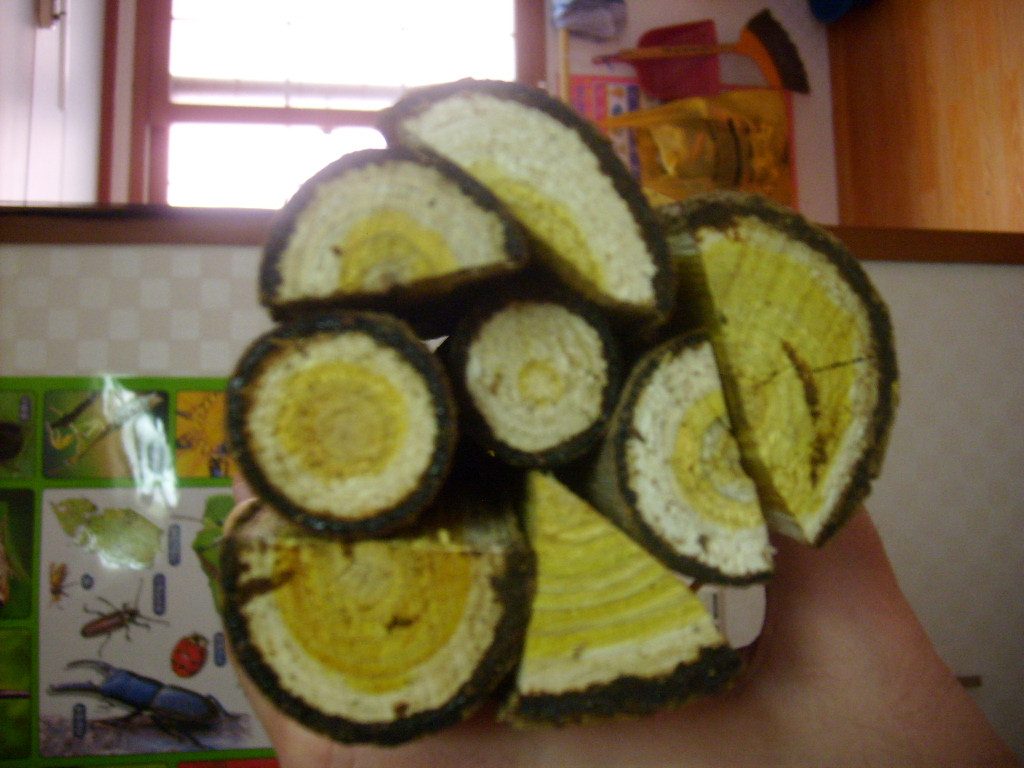
Nothing beats a log in your soup

Ot bean paste (된장)
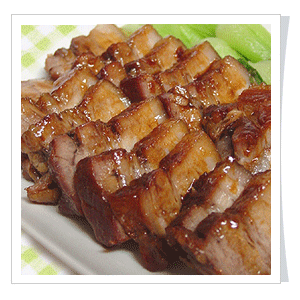
ot barbecued pork (옻 삼겹살)
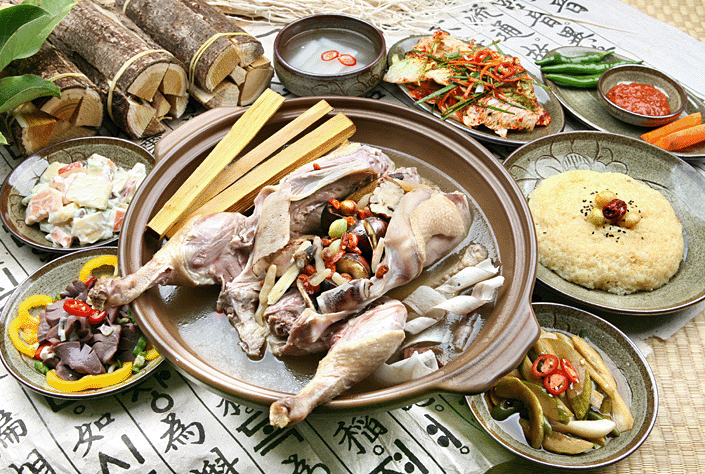
Ot as an integral ingredient in chicken ginseng soup. (삼게탕)

Ot as used to make a highly beautiful lacquer
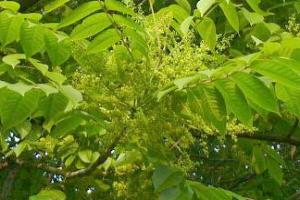
ot as it grows
Ot is also used as an oriental medicine but extensive information is difficult to find in English. If making chicken-ginseng soup, ot is one of the dried ingredients available in packets costing around 4000Won (£2) and available widely.

dried ingredients for chicken ginseng soup (삼게탕)
Monday Market: Sesame Leaf (갰잎) Perilla Frutescens

A field of sesame. (갰잎) Perilla Frutescens. (Ch'eonan) September.
I used to pass a field of sesame everyday on my way to school in Ch’eonan (천안). In the late summer, you could always smell the scent in the air especially in the muggy weather or when it was raining. The scent of sesame is quintessentially Korean. I feel in love with sesame leaves the first time I ate them though I often hear wayguks (meant endearingly), say they don’t like them. Being a fat twat, I eat most things. Indeed, after my first visit to Korea I grew sesame in my garden for a couple of years. Yes, they have a distinct taste and smell both more pronounced than the other types of leaves used to ‘parcel’ the components of a Korean barbecue. In addition, their texture, slightly furry and definitely more ‘leafy’ than lettuce, distinguishes them.

Sesame leaves with boiled pork. (보쌈)
Sesame, in all its forms, as a vegetable, kimchi, as seeds, oil and powder are an essential part of Korean cooking. The leaves are available throughout the year in portions reflecting the weather of that particular growing year. Late summer is when they are most abundant and at their largest in size, approximately the span of a large, adult hand.
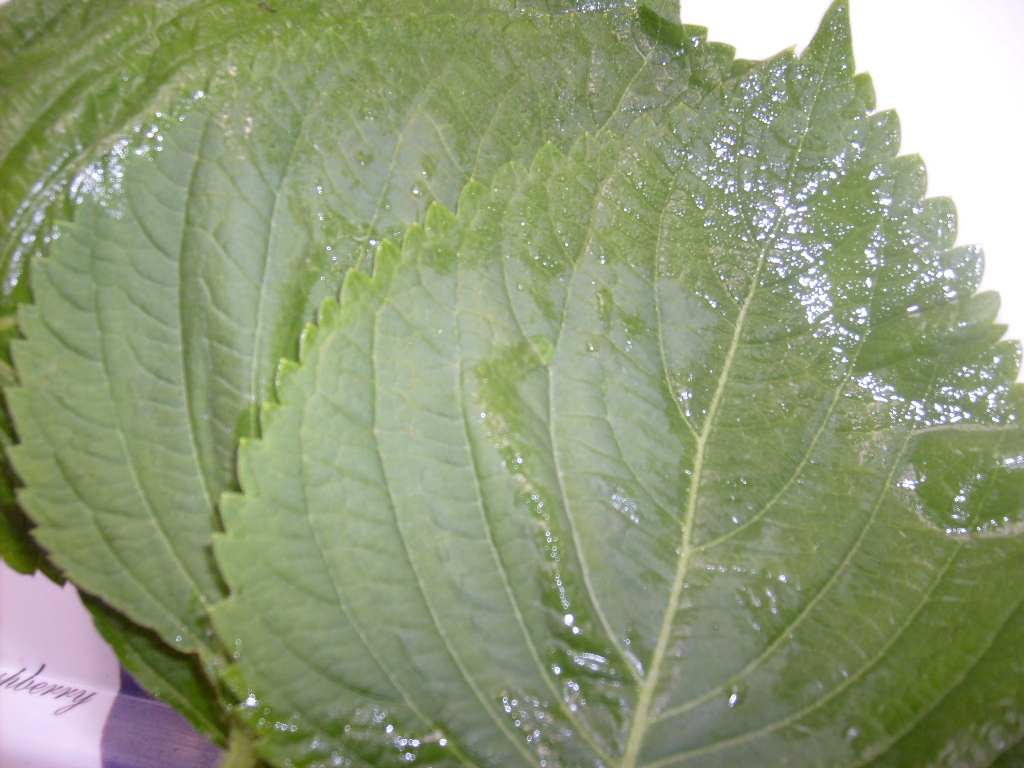
Washed leaves of sesame
The leaves can also be made into a kimchi and pickled though I find the process laborious. In supermarkets they are often sold washed in bags, or more traditionally, as in the street markets, in small bundles, folded in half and bound with a piece of twine. While not particularly tasty on their own, they are excellent when used as a wrap – provided of course, you like them in the first place. My favourite parcel – meat of some kind, a little boiled rice, raw garlic and cabbage kimchi or bean paste – delicious!
Monday Market. Aralia Elata – 두룹
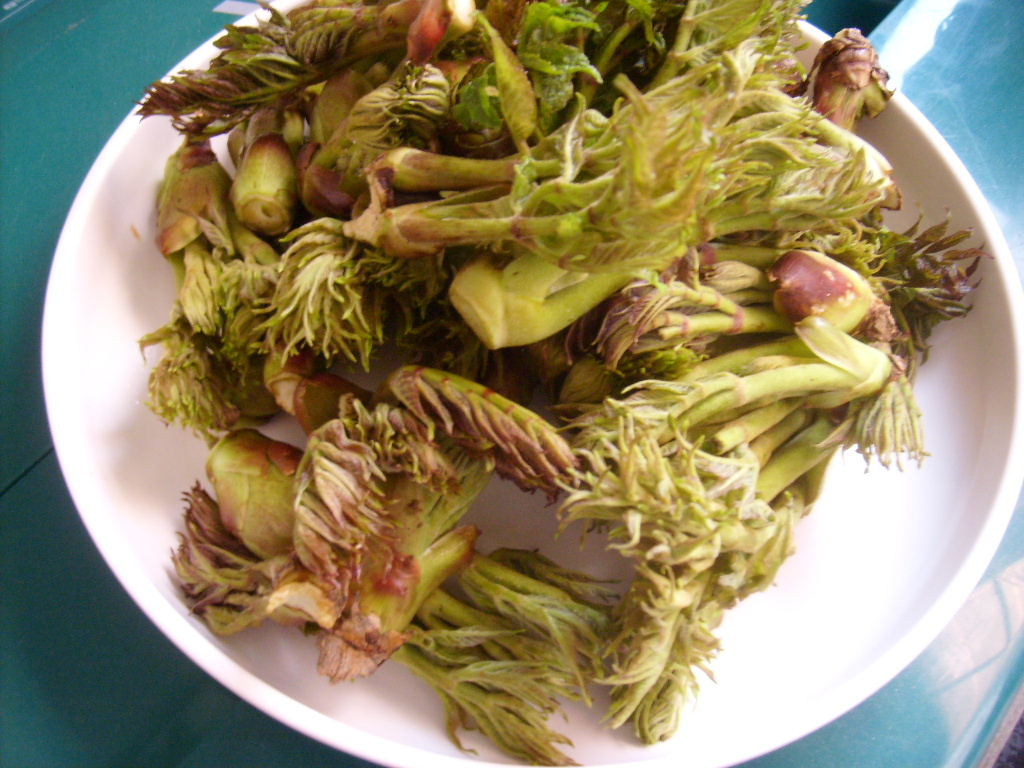
Shoots of the mountain green, Aralia Elatia. Durup (두룹)
It took me a bit of work to track down the details of this tasty mountain green which is currently in season. Durup (두룹 나무) is a deciduous tree which is rather attractive but for commercial purposes cultivation is ‘under-glass’ using small branches. The stems are thorny and the fresh young shoots, the edible part, appear in street markets and supermarkets between March and May. If you buy them from the old ladies on the street they cost about 10.000Won for a large bag of probably in the region of a hundred shoots. I noticed that in E-Marte about 6 shoots cost around 2000Won.

Aralia Elata the tree. (두룹 나무)
There are a number of ways to use durup but it is especially tasty, washed and dropped into boiling water and cooked in the same way you would broccoli. A short vigorous boil means the stems are slightly crunchy. I made a dip of a little mayonnaise, red pepper paste (고추장), and corn syrup (물엿). However, they are also used in soups, in pancakes and battered and deep fried.

A durup shoot (두룹)

Durup and dip

Durup and pancake
I don’t want to overrate this too much, I mean, how delicious is broccoli or cabbage unless swimming in butter? But honestly, this was as equally ‘tasty’ as broccoli with a somewhat nutty, asparagus-like taste. With a small bowl of dip I ate a large bowl for breakfast and then went back to the kitchen to eat what was left. Definitely worth trying! (more durup info here)
Monday Market -Sea Squirt – (멍게) Subphylum Urochordata, also called Tunicata

Looks like a wart infested hand-grenade
Is it a ‘hand-grenade,’ ‘scrotum,’ ‘boil,’ ‘mess’? Actually, it’s a sea squirt and as it’s too easy to write this sea food off with unpleasant similes, I won’t. Out of water, the sea squirt is an ugly thing usually eaten raw (회). It is a fairly common sea food, especially in spring and is actually an animal that eats by sucking in water from which it filters out food. It remains fixed in one place and doesn’t move. In their natural habitat they are strangely beautiful.

Bizarre but beautiful

Market mong-gae (멍개)

Delicious?
Their taste? Um…?! Well, yea! They probably grow on you like many Korean foods some of which have little taste but are nonetheless appealing! Mong-gae, is slimy and has a taste reminiscent of mild detergent. It has recently had some interesting publicity due to its apparent anti-cancer properties. Often it is served on a bed of ‘sliced’ jellyfish. So, rather than simply read about it, go and try it! In my local seafood restaurant it costs about 15.000Won (c£7 sterling)
Winter – Monday Market
I intended making a visual collection of seasonal fruit and vegetables as they appear and was going to start this in spring, I decided to start earlier.

Persimmon (홍시)
Persimmon (also known as Sharon Fruit. 감, 땡감, 반시, 홍시/연시,꽃감.) Early December and the Persimmon season is over but these ones I bought a few weeks ago. Currently I have around 60 Persimmon in my freezer. Persimmon is called Kam and like the octopus, there are three types each called by a different name which can be confusing. Kam range from hard to very, very soft. If you like sweet and gooey you’ll love the hongshi, sometimes spelt yonshi. This is the softest persimmon and appears in late summer to early winter. It is very delicate, like a fragile bag of water. Unlike the other types of persimmon, which I don’t eat often, these can be easily frozen. They are delicious cold, simply slice the skin and squeeze and scoop out the jam-like innards. Some coffee shops serve hongshi smoothie. You can also buy dried persimmon, rather like dried apricots but with less flavour. I’m told persimmon is quite high in calories – which is usual as anything delicious tends to be calorie laden.
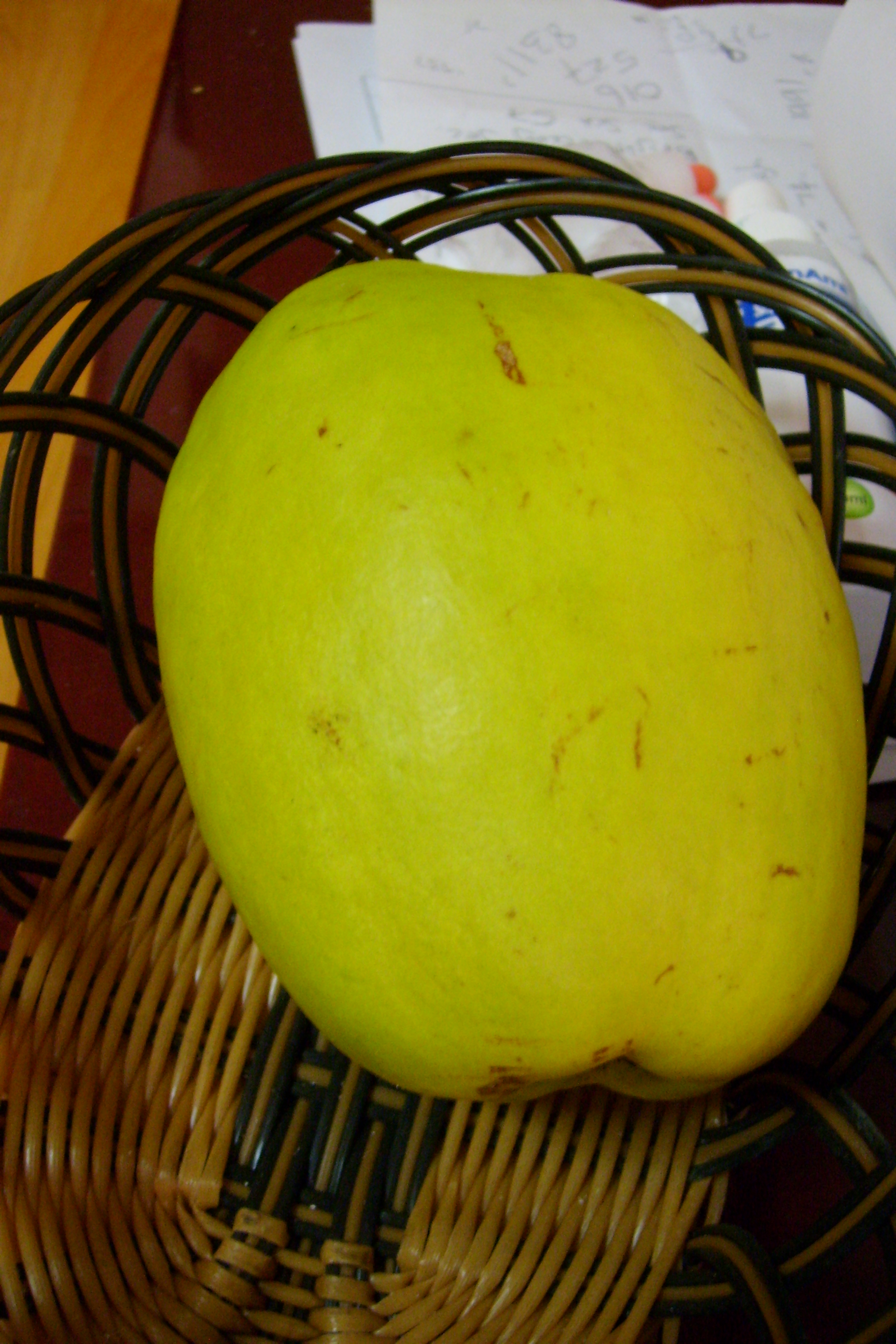
Oriental quince. (모과)
The Oriental Quince (Moghwa. 모과) , is used for its fragrance which is slightly appleley. It has a waxy skin. They do scent small areas like cars and small rooms but unless you dangle them under your nose, they’re pretty useless in larger spaces – but they look good. Moghwa appear in late summer and early winter. Make sure there are no small holes in them as these will contain worms. I had one with a small hole which were fruit flies front door, a piece of gum blocked future access and entombed any inhabitants. If you turn the fruit regularly it should keep into the spring. The moghwa is used in oriental medicine and can be used to make tea.

Daegu, famous for its apples (사과)
Apples. (사과) I live in Daegu which is renowned for apples and Daegu apples are truly delicious. In England, I rarely eat apples partly as there are so many varieties I never know which ones I like and because they can never be relied upon to be tasty. I suppose the variations in British weather result in fruit which can be sweet one moment and sour the next. Daegu apples are never sour and they are never fluffy or soft. Some are truly massive in proportions. Recently, a Korean teenager told me that had Snow White been Korean, she wouldn’t have died because Koreans always peel the skin off apples and pears. (and the witch, so he said, put the poison on the skin). In England we tend to wash them, if we can be bothered, and eat them with the skin on – a habit many Koreans find odd.

Cabbages (배추)
My God! I nearly forgot the most important seasonal product of all… The Cabbage – usually called a paech’u (배추) As with most imported fruits and vegetables which I might buy back home, the Chinese Cabbage ( which I think is a pak choy – or maybe its a bok choy???), is a piddly little thing which usually sits in the palm of your hand, is almost pure white and has no green leaves and cost W2000. In Korea when the cabbage season is at its peak, some are colossal in size and this week in the market they cost around W1000 each which is about 50 pence in sterling. Two will make me enough kimchi for several months. Check inner leaves for signs of caterpillar.
An occasional site, especially in more rural areas, are large vats of paech’u being salted ready for making kimchi. Indeed, in street markets at this time of year you can buy kimchi which has already been soaked in salted water.

Salted cabbages in Cheonan
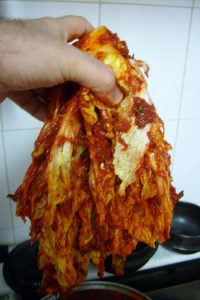
- My Winter 2009 kimchi (배추 김치)
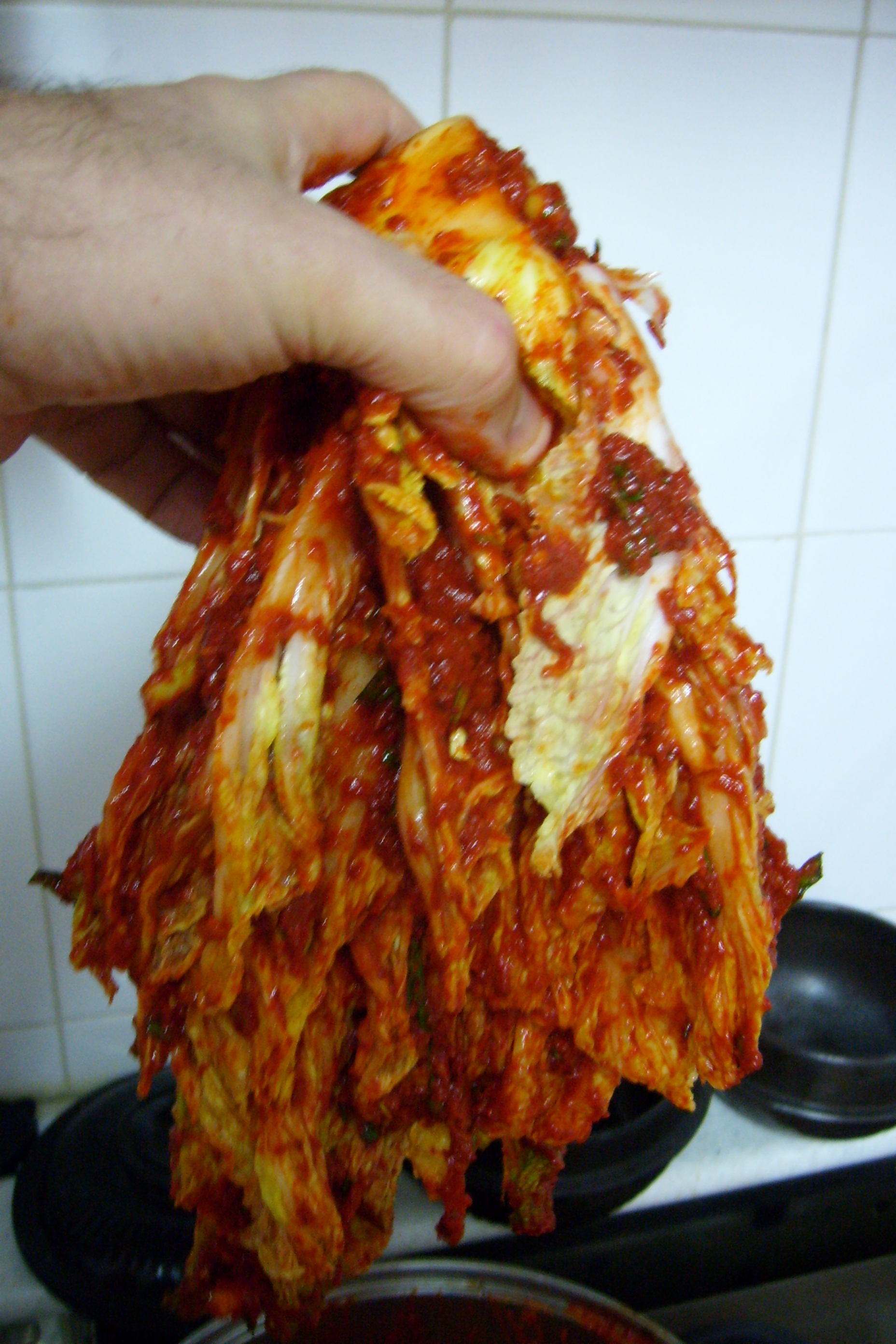
Paech’u after being salted and pasted with kimchi paste. Yes, it looks like something from a road accident but it tasted delicious!
persimmon – 감, hard – 땡감, between soft and very soft -반시, very soft – 홍시 or 연시, and dried – 꽃감. Oriental Quince (moghwa) – 모과, apple – 사과, Chinese cabbage – 배추.
© Nick Elwood 2010 Creative Commons Licence.


 Elwood 5566
leave a comment