The Aegukga. Korea’s National Anthem
As a military musician with fifteen years service, I am probably more acquainted than most, with national anthems. My Regiment, formed in 1695, the same year Handel and J.S Bach were born, was the 5th Royal Inniskilling Dragoon Guards and was one of England’s most distinguished cavalry regiments. Stationed in Germany for almost ten years, we played in many parts of Europe, Canada and countless official engagements. Playing national anthems was an important and diplomatic part of our musical duties and because our Colonel in Chief was King Leopold of Belgium, we also played the Belgian anthem, La Brabançonne along with God Save the Queen at regimental engagements. Despite having played many anthems, I fell in love with Korea’s the first time I heard it.
1. One Verse Orchestral version, slower tempo, no vocals
The Aegukga is certainly patriotic and though brief, its melody, rivals the likes of Sibelius (Finlandia) and Elgar (Pomp and Circumstance No 1). Naturally, the patriotism is largely the product of the successful manner in which the music has been conflated with imagery symbolic of Korea. My first exposure to the Aegukga was through the various television company productions in which were paraded cultural icons such as the mugunghwa (무궁화 – national flower), Buddha, King Sejeong, sporting celebrities, the Taeguk-gi (태극기 – Korean flag), Mount Baekdu-san (백두산) and Dokdo (독도) which were, and continue to be interpolated with imagery of Korean scenery, the seasons, traditional practices, technology and urban, rural and military scenes. A four minute exposure to an official TV company Aegukga is an ideological tour de force of and the anthem noble enough to provide a canvass which unites quite disparate themes.
2. Anthem of one verse with chorus featuring a prominent tenor line which differs from the usual version. Some interesting alterations in orchestration. The Verse begins with standard choir while the refrain is given at first to a children’s choir and then both choirs
Like the anthems of many countries, it is composed in a western style and nothing in melody or harmony is suggestive of East Asia. The composer, Ahn Eak-tai (안익태), 1906-1965, had studied initially in Japan, and later, USA, Vienna and in Budapest under none other than Zoltan Kodaly. Originally he studied the trumpet but his primary instrument was to become the cello, eventually playing with the Cincinnati Symphony Orchestra. His Symphonic Fantasy Korea was submitted to a competition in Carnegie Hall, around 1936 after which it was performed in many countries, often under his baton. The central theme from this work he later arranged as the Aegukga (애국가) which would replace the anthem’s original melody, Auld Langsyne, by presidential Decree, in 1948.
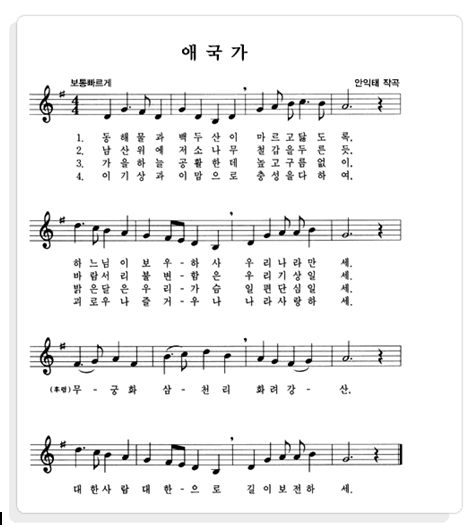
3. All verses, most common orchestration with transliteration and one version of its translation
Unlike many national anthems, the lyrics avoid the pompous deferential guff where country and state are conflated in a figure head and as a result the embodiment of Korea character in a range of imagery has a broad appeal. The Provisional Government of the Republic of Korea (1919–1945) in Shanghai, China adopted the lyrics as their national anthem. The same lyrics, dating from 1896, are still used today.
4. Anthem with soprano and tenor soloists
5. Anthem with transliteration and one version of its translation
Ahn Eak-tai’s (안익태) hymn-like anthem, is wonderful in that the expansive melody provides a perfect accompaniment for the lyrics and even as a non-Korean I experience a thrill when the second part of the refrain, culminating with a cymbal crash, announces, ‘Great Korean People’ (대한 사람).
6. Full anthem with usual orchestration but with a children’s choir.
7. Part of Ahn Eak-tai (안익태) original Symphonic Fantasy Korea (1935)
Korean Lyrics for the Aegukga
東海 물과 白頭山이 마르고 닳도록
하느님이 保佑하사 우리나라 萬歲
(Refrain) 無窮花 三千里 華麗 江山
大韓 사람 大韓으로 길이 保全하세
南山 위에 저 소나무 鐵甲을 두른 듯
바람서리 不變함은 우리 氣像일세
가을 하늘 空豁한데 높고 구름 없이
밝은 달은 우리 가슴 一片丹心일세
이 氣像과 이 맘으로 忠誠을 다하여
괴로우나 즐거우나 나라 사랑하세

© 林東哲 2011 Creative Commons Licence.


 Elwood 5566
7 comments