Memi Update – (매미)Continuing my obsession…

Hot...
Two weeks ago (August 23, 2010), when the temperature in Daegu, the hottest part of Korea, hit 36 degrees, the memi (매미-cicadas) chorus screamed from the pomegranate tree and bushes near my one-room. I made a recording in exactly the same location as I recorded the first memiI heard, on July 7th, of this year. There was one day, Saturday 30th of August, when it was refreshingly cool with little humidity and a fresh breeze. That was a strange day as the memi were silent. It’s an interesting feeling to leave your one-room and the sanctuary of air-conditioning, to step out into intense sunlight that actually seems to have weight, and be surrounded all the time by muggy humidity and that incessant scream from the trees. In the two recordings here you can hear the different levels of intensity. In the second recording, on one of the hottest days of the year, the memi song was verging on painful.
Alternative Links
Link to Flickr video: On Hearing the First Memi of Summer, 2010
Link to Flickr video: Memi in Full Chorus August. 2010.
 © Nick Elwood 2010 Creative Commons Licence.
Giving Summer the Finger
Goodbye to all that!
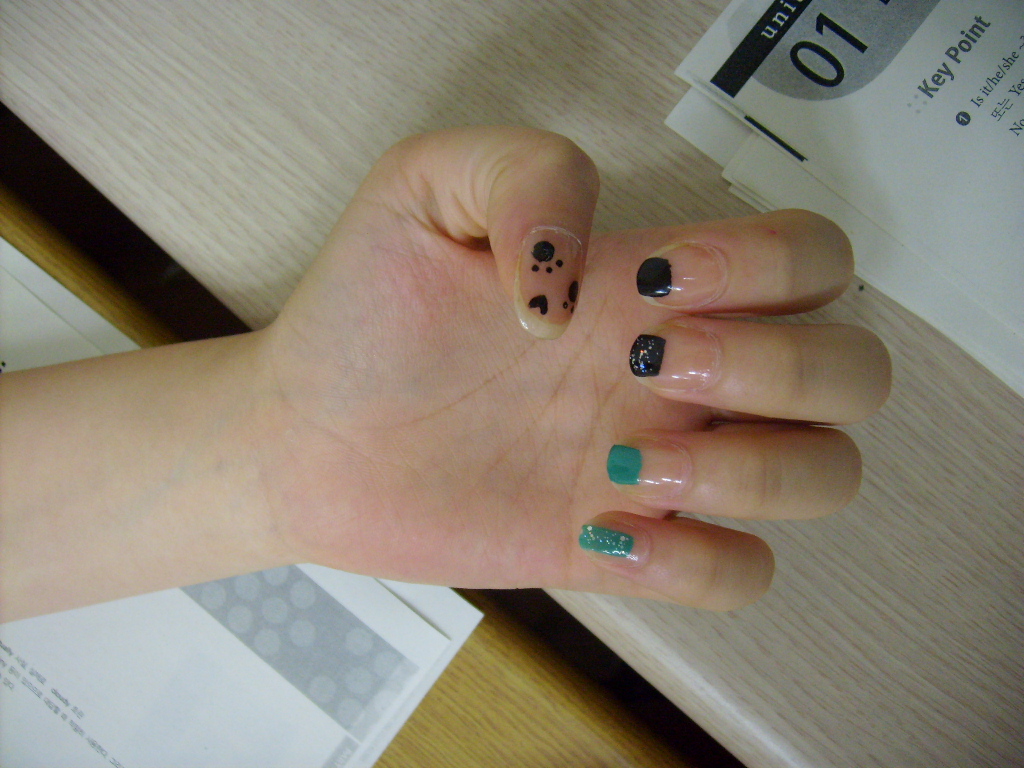
The summer holidays finished last week and one of my students notes in his diary.’This week school finished and we had to change our hair and faces.’ Gone are the ‘poodle perms‘ the vibrantly painted finger nails, ear-rings, temporary tattoos, and dyed hair. Unlike many western countries where teachers battle with hair styles and make up, in Korea it’s all removed before the term starts. Of course, Koreans will tell you the same battle ensues in their schools but they are skirmishes in comparison. I’ve taught one boy who was forced to run 10 times around the sandy ‘parade ground’ in only his boxers because his trousers legs were too narrow, and a beating because your hair is a centimeter too long isn’t uncommon. And the ‘budgerigar club’ that exists in every British secondary school (ages 12-16), little cliques of girls who sit for hours on end brushing each others hair, moronically starring in mirrors and slapping on cheap make-up like little Jezebels, all during lessons, is in its infancy.

Painted nails

A little re-touch needed
The irony, of course, is that school never really finished and the vacation that was, was never really a vacation. One of my students spent the entire summer at a cram but claimed he loved it. Packing your son or daughter off for the entire summer isn’t what I’d do if I was a parent. Another boy spent two weeks in a military boot camp, ‘thanks, mum!” Another three students, siblings, spent the entire summer in an English school in the Philippines but their English is no better than when they left. So, with summer drawing to a close it’s back to the study routine, constant tests, the after school classes and reading rooms and don’t forget piano lessons and taekwon-do! As for the poor the third year, high school students (고삼), they have the biggest exam (수능) of their lives looming. An exam which will not only determine their academic future but very possibly the background of their future partner as well as their occupation. DD (‘D’ Day), and that’s exactly how Koreans identify it, is 76 days away and every third year student will be counting. Their vacation was great! They didn’t have one!
© Nick Elwood 2010 Creative Commons Licence.
Grapes – 포도. Monday Market

Grapes – Autumn is approaching!
With the scent of black grapes drifting on the air, you know that autumn is not to far off. Korean grapes are quite different from varieties available in Europe; the skins are much thicker and slightly chewy and often removed. The flesh is juicy and sweet and the seeds, big, crunchy and bitter. As a fruit, I certainly prefer the seedless variety but the juice of Korean grape, usually the Kyoho grape, is ‘thicker’ and carries both the scent and taste of the grape British children will be familiar with. Personally, the smell and taste of Korean black grapes always reminds me of Pez candy, which was popular when I was a child. Korean grape juice is very popular as is Welch’s Grape Juice. Welch’s is an American company which uses a variety of grape, Concord, which is similar to the Kyoho grape.

Korean black grape juice
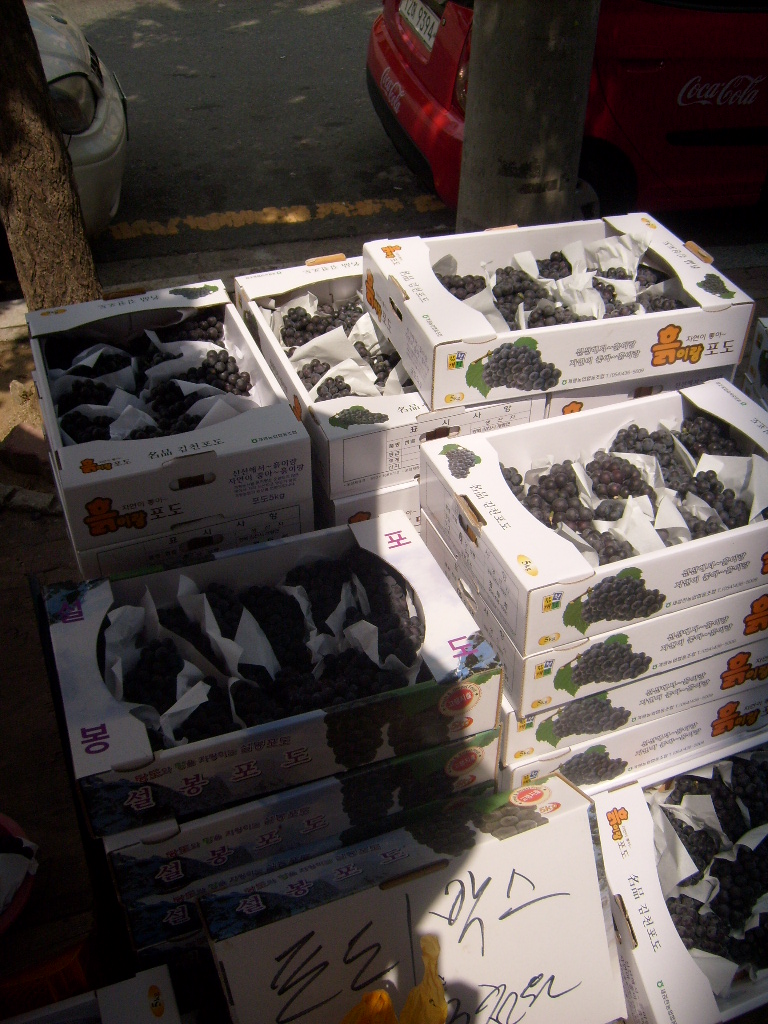
Grapes, fat and juicy
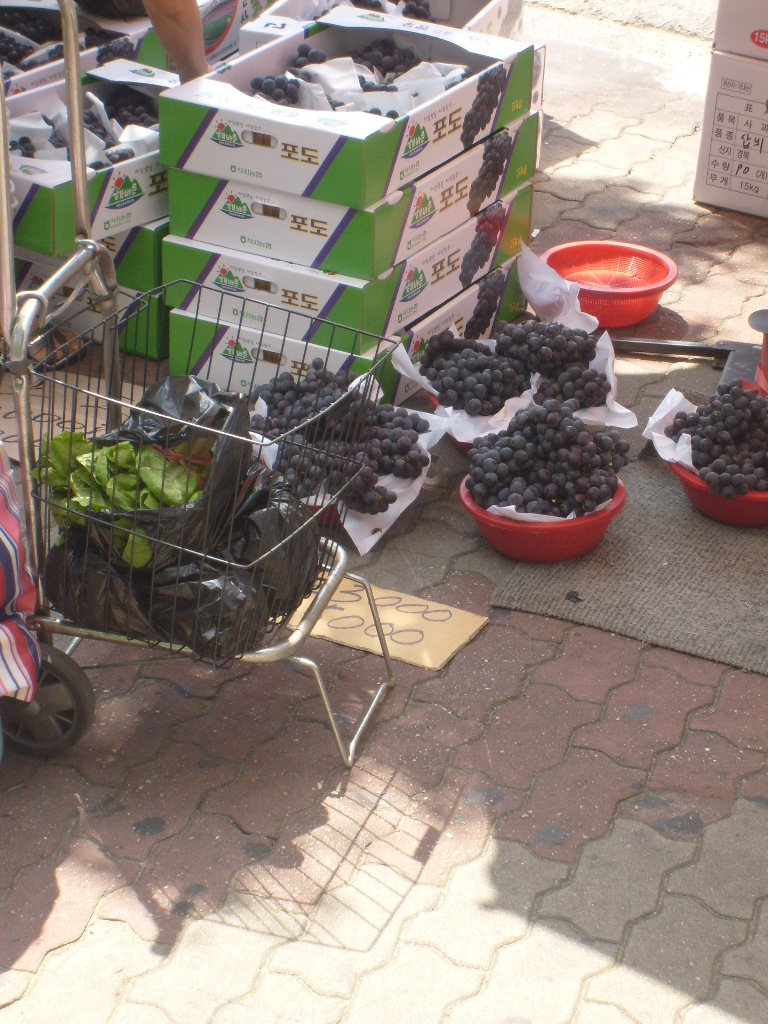
Grapes in the shade

Remember Pez?
© Nick Elwood 2010 Creative Commons Licence.
Boring Boryeong and 'Waygukin Wankers'

Spot the Korean
Let me get my disclaimer out the way to begin with! Yes! there are plenty of decent, thoughtful and interesting waygukins in Korea and some may very well have visited Boryeong, but this post isn’t about them. This post is about the other types of waygukin, the ‘waygukin wanker’ types who generally ignore other westerners, have no significant Korean friends, have boarded the bus to Boryeong, and like to moan about Korean people and culture about which they like you to think they know everything.
I occasionally ‘rant’ about the unfriendly nature of many waygukins in Korea, it’s one of my minor idee-fixe. Two weeks ago, I had this idea to start a ‘waygukin wanker of the month,’ post in which I’d feature a photo of one of the numerous wankers around Song-So who will totally blank you if you pass them. I’ve lived in the building next to one for almost two years but even if we pass on an empty street, shoulder to shoulder, he will ignore me. I said hello on one occasion but he simply diverted his gaze to the floor and mumbled inarticulately. So, on one hot Friday afternoon, I stood for an hour waiting to get his photo but unfortunately he failed to turn up and missed the chance to be immortalized on my pages. I haven’t seen him for two weeks and am beginning to assume he must have gone back to wherever. Good riddance! However, there are plenty of other candidates to replace him.

Courtesy of Roketship (link)
Maybe ‘waygukin wankerism’ is a disease, possibly contagious, and if so, one of the most potent sources of contamination has got to be the Boring Boryeong Mud Festival. Bogland is full of boring accounts written by waygukin who assume they know all about Korea once they set foot on Korean soil and whose search for the spirit of Korea, it’s traditions and an understanding of the Korean psyche, lead them to splash about in a bit of dirt chucked over a sheet of plastic on one of the only holidays of the year. If I had a list of a 100 things I want to do in Korea, the Boryeong Mud Festival wouldn’t even be on it. Even one of my closest Korean friends, who is 25, said it was disappointing with watered down wishy-washy mud piped onto plastic sheeting. But, he was impressed with the army of waygukins as he felt they provided the festival an international atmosphere.
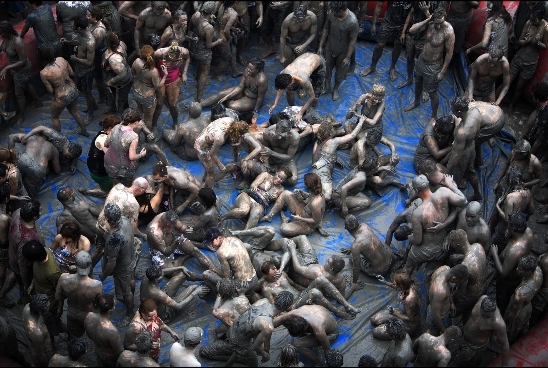
Lovely plastic sheeting
Boryeong is as typically Korean as the Costa del Sol is Spanish or, Tijuana is Mexican and any place which attracts an army of waygukins should instantly loose its appeal especially because it’s the sort of ‘safe’ crap you do on a 18-30 cheapo package holiday to some place with bags of sun, sand, sangria and bouncing tits. It doesn’t attract interest because it’s Korean but because it’s the hip place for waygukins to go and which can be blagged about to mates afterwards. Those who like Boryeong probably find appeal in the likes of: Ko Phi Phi Le, the Costa del Sol or Costa Med, and Ibiza and other shitty destinations catering for the unadventurous, en-masse. I find it amusing how so many foreigners will cue to take the bus to Boryeong yet are terrified of a trip to the local bathhouse which will provide a far more rewarding insight into Korean life.
Talking to a waygukin or two is fine, except most can’t talk, and having a beer with one is even better, I desperately miss the sense of humour, but slopping about in diluted mud with a million of them!! No thanks! I came to Korea to escape wanky-ways and in particular wanky British culture, which doesn’t mean I don’t want talk or socialise with English speaking westerners per-se. I’m always on the look out for new friends but finding a western human who will talk is difficult. The last waygukin I swapped phone numbers with, declined an invitation to the cinema because he believed Koreans would perceive two men together as gay.
Boryeong should be towards the bottom of the ‘to do list’ but I suppose Korea is now such an easy country to live in, bilingual signs and menus, tourist information booths, a wealth of information on the internet that didn’t exist 8 years ago, a modern international airport, all the major fast food chains, etc, that gone are the days when only the more adventurous risked coming here. It’ll soon be time to move on!
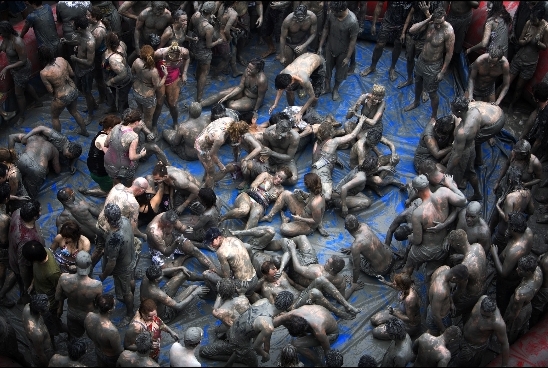
Too many westerners! YouTube link
© 林東哲 2010 Creative Commons Licence.
Korean Teas: Barley Tea – (보리차)
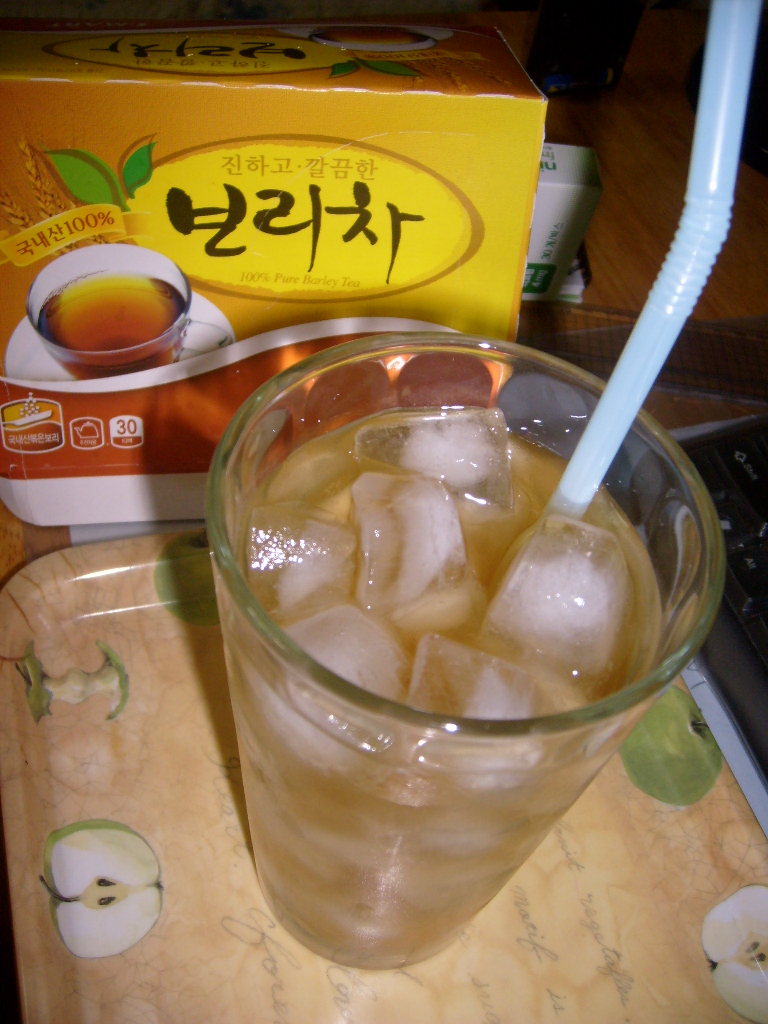
Sugar Puff water minus the sugar
Specifics: A cereal tea made from roasted barley. The tea can be made from commercially available roasted barley of purchased in tea bags ranging from single cup size to larger bags sufficient to make a litre.
Perhaps this drink, more than any other, reminds me of Korea, especially if I drink it in the UK. When I’m living in the UK a store of barley tea (보리차) or the closely related corn tea (옥수수차), are always on my shopping list. Some drinks don’t ‘transport’ well; soju for example, needs Korean weather, Korean food and a Korean ambiance to be fully appreciated but most of the cereal teas both taste the same and don’t seem out-of-place a couple of thousands miles from their point of origin.
Barley tea, made from roasted barley, can be bought as whole grain, in tea bags or already bottled. I have drunk most of the bottled varieties and don’t like them as they are often bitter and naturally, some preservative has been added. The tea bags however, make a decent drink. You can drink barley tea both hot or cold. I seldom drink it hot but along with my favourite ‘tea,’ mistletoe (겨우사리), have a two liter bottle in my fridge most of the time. Like all Korean teas, they are ‘just’ (그냥), so don’t expect anything startling. It lacks any tartness and has a mild barley taste, reminiscent of sugar-less Sugar Puffs. However, at quenching your thirst in hot weather or after a workout, Barley tea, like many other ‘teas,’ are superior to any sugary chemical concoction and infinitely cheaper (unless you buy it bottled). I tend to use a large tea bag per 1.5 liters, in the case the tea is almost the same darkness as milk-less conventional teas but I suspect many Koreans drink it much weaker.
© Nick Elwood 2010 Creative Commons Licence.
Hanyorum – High Summer (한여름)

Hanyorum in Daegu - stifling!
Hanyorum (한여름) is the period of high summer and generally occurs in early August when the changma (장마) has moved North into Manchuria. Hanyorum is typified by high temperatures, reaching 38 degrees Fahrenheit, (100 degrees Celsius), in the afternoons and hot and humid nights.
One characteristic of hanyorum is the appearance of crickets (귀뚜라미), though you are more likely to hear them than see them. I both saw and heard crickets yesterday (August 24th), though they may have been chirping earlier than this. Crickets differ from grasshoppers (메뚜기) in that they are nocturnal and the song of both differ from the omnipresent scream of the cicadas (매미).

A cicada - or memi (매미). The sound of summer!
Grasshoopers (메뚜기), which some Koreans enjoy eating, are diurnal insects and their chirp is often drowned by the memis’ summer shriek, so you need to listen carefully to hear them. Their chirp is more noticeable when there is a lull in the memi scream. They are bright or vivid green, have antennae which are always shorter than their body, and long wings which when in flight are often coloured.
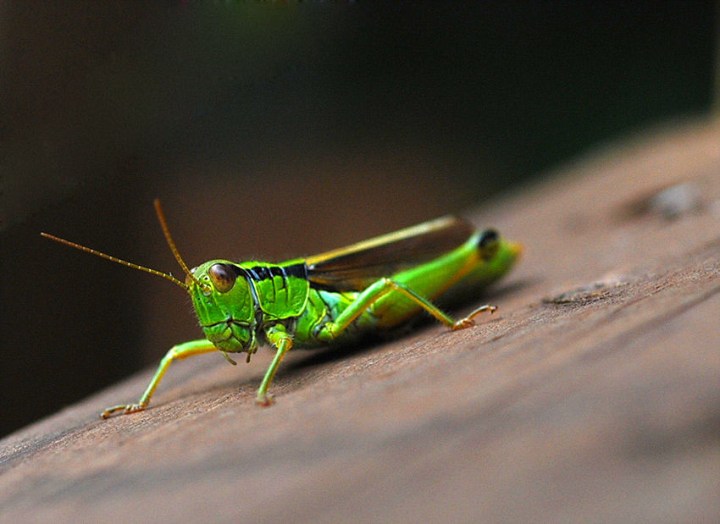
Grasshopper - (메뚜기). Mmmm- delicious!
Crickets (귀뚜라미), are nocturnal and as such require darker camouflage, usually pale green or brown. Their antennae are often the equivalent length of their abdomen and have atrophied or even absent wings and hence, do not fly. They also have ears located on their legs in the form of a white spot or mark. In hanyorum, the chirping of crickets (귀뚜라미) fill the evening air and as such they chirp at lower temperatures than the memi. While memi (cicadas) start screaming at 29 degrees Celsius, the cricket will chirp at cooler temperatures, as low as 13 degrees Celsius. Using Dolbear’s Law (based on Snowy Tree Crickets), it is possible to work out the approximate temperature in Fahrenheit by counting a cricket’s chirps over 14 seconds and adding 40. An interesting if not useless equation unless you happen to have a cricket in isolation, but on one or two occasions, I have had one chirping inside my ‘one room.’

Cricket (귀뚜라미). The clearly visible ears, located on the legs, and absence of wings distinguish it from the grasshopper.
Interesting links and sources:
Telling a grasshopper from a cricket
© Nick Elwood 2010. This work is licenced under a Creative Commons Licence.
Korean Teas: Summer Refreshment – Korean Bamboo Leaf Tea (대잎 차)
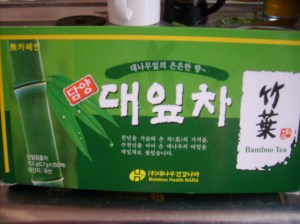
Bamboo leaf tea
Specifics: A leaf tea available in tea bags but not easy to find. Specialist deli type shops often stock it.
In summer, I prefer water or a chilled, non sweetened cereal drink or a tea as a refreshment. My favourite is probably mistletoe tea (겨우살이) but a close contender is bamboo leaf tea (데잎 차) The tea comes in bags which can be a little difficult to find though it can be bought in other forms. I couldn’t buy the bags in my local E-Mart or Home Plus but I know two small delicatessen type shops which sell them.
I have to be honest, making the tea is hit and miss and I still haven’t worked out the best way to make it. Several times I have made a very refreshing brew but repeating this seems temperamental and on some occasions the tea has been almost tasteless. When right however, the flavour is subtle and distinct and bears a similarity to mistletoe – a very mild lemony tang without any tartness or bitterness.
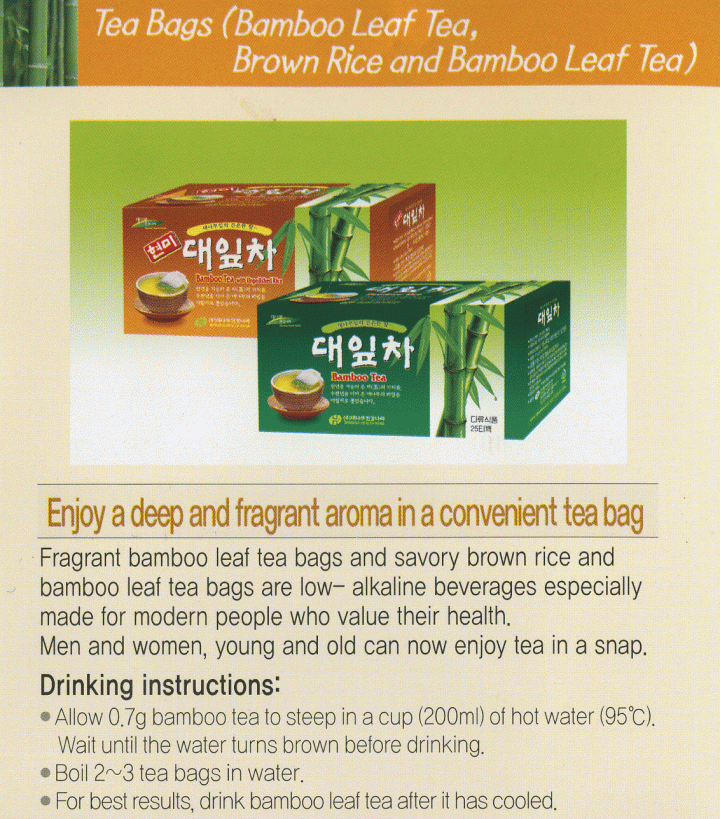
Not to be confused with Green bamboo leaf - green tea - which is from China!
Like most things that taste ‘just,’ (그냥), bamboo leaf tea has those beneficial qualities,’ it is supposedly a detoxicant and can even help you lose weight. Don’t get me wrong, I love these types of tea but can draw a distinction between refreshing and delicious. A high quality milkshake is delicious – bamboo water is ‘just’ but on a hot day or a sweaty training session, the milkshake comes second.
© Nick Elwood 2010. This work is licenced under a Creative Commons Licence.
Dragonfly Days (물잠자리)
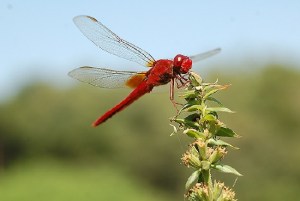
A male 'chili dragonfly' (고추잠자리). This type appear is common in early October
Mid August and the dragonflies (잠자리) are hovering over puddles and pools of water. There are several ‘flushes’ of dragonfly with another in early autumn. I suspect these are collectively known as ‘water dragonflies’ (물잠자리) irrespective of actual specie. Sometimes you can see them in large numbers erratically darting here and there. Some are probably damselflies (실잠자리) which are distinguished from dragonflies in much the same way as butterflies are from moths, in that when resting a dragonfly’s wings are 90 degrees to its body, in contrast, a damselfly’s wings rest along the body itself. Dragonflies can fly in six directions, up, down, forwards, backwards and side to side.
Bright blue damselflies and deep brown reddish dragonflies seem to be particularly prominent around my area of Daegu at present.

A damselfly (실잠자리)
Clicking this link will take you to David Hasenick’s photo gallery which besides hosting some excellent photos of dragonflies, also has a number of other Korean categories.
While searching for information on Korean dragonflies, I discovered a ‘list’ of the variations in Korean regional dialect for ‘dragonfly.’
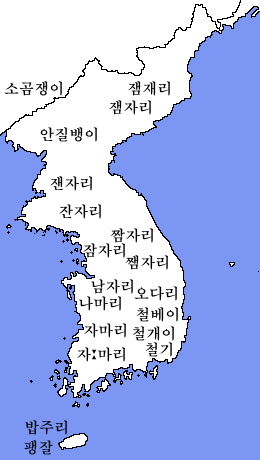
'Dragonfly' - regional variations in dialect
© Nick Elwood 2010. This work is licenced under a Creative Commons Licence.
Beating Boknal 4 – Water water everywhere
I’ve abandoned the e-bente-tang for the duration of high summer and like some maggoty hippo I spend my time floating about in the cold pool.

refreshing
Water, in all its forms is wonderful and is only truly appreciated in summer. After or during an intense and sweaty workout, when bodily fluids have been rung out of the body, water is the only drink, barring neutral beverages like cereal teas, that have the potential to satiate a hungry thirst with such intense pleasure. Only in summer, when heat and humidity make an extra drain on the body, and when water both replenishes diminishing levels and lowers soaring temperatures, is water truly appreciated. In the heat of heat summer there are times when you suck in water with such force, living in the moment it is experienced, that it can cascade down your chin and splash down your chest in the most refreshing manner, a manner that at any other time of the year would be uncomfortable. These are the moments when the experience of quenching your thirst are orgasmic in proportion. Despite all their silly claims, sweetened, gaseous drinks utterly fail to pleasure the body and mind with as much intensity as a does a simple glass of icy water.

cooling
And you know the heat of summer is here when your shower water is set to cold and yet is almost warm. Wonderful water washing over your body, flushing away sweat and grime and swathing you in its refreshing coolness. And in the bathhouse the cold pool, for so many months a test of endurance and toleration, becomes a revitalizing cocoon of luxury to be lingered in. Now only the ice room remains to effectively chill a body punished by heat and humidity and even this induces pleasurable sighs and ecstatic exhalations. For months, as I wallow in the e-bente-tang, the ice room and cold pool lay predominantly dormant with visitors enduring their extremes with spartan conviction. Now they are bustling with life, the pool a busy maelstrom of splashing youngsters and lazing adults. In the ice room I sweep shards of ice into my palms, like snow, and rub them over my face until they are reduced to trickles of icy water.

beautiful
And the water in all it’s variations talk and sing to me like an enormous symphony; water hissing from the enormous cauldron in the steam room, swooshing its vent in a hot vapour, the burbling of the jacuzzi, the persistent dripping of water from a myriad of locations, of water lapping against the sides of their containers stirred by some movement, splashes echoing in colourful variation reflecting their intensity, the roar of the power shower as it blasts out it’s freezing water. A world of water purges my senses and fractures, like a thumping gong, the sights and sounds of humanity and within that persistent liquid modulation a pool of tranquility from which a multitude of thoughts are stirred and caressed.

tranquil
© Nick Elwood 2010. This work is licenced under a Creative Commons Licence.
Beating Boknal 3 (복날) The Handkerchief
I don’t think I sweat anymore than any other Europeans who are unused to heat and humidity but I’ve noticed Koreans aren’t particularly tolerant of sweaty bodies. If your sweating in confined spaces, such as the escalator, people will often back off. When the weather is at its most unpleasant I need to mop my brow every few minutes, and if I don’t , sweat can cascade off the face with embarrassing consequences. Handkerchiefs have definitely gone out of fashion in the UK but here in Korea there is a fantastic array of coloured cloths all ideal for mopping a sodden brow.

cc
I probably have around 25 handkerchiefs and at between 1000-2000 Won, you can easily afford to buy one if you’ve forgotten to slip one in your pocket. The best place to buy them are at the ‘dollar’ shops which sell Tupperware food boxes, and a host of other miscellaneous household items.
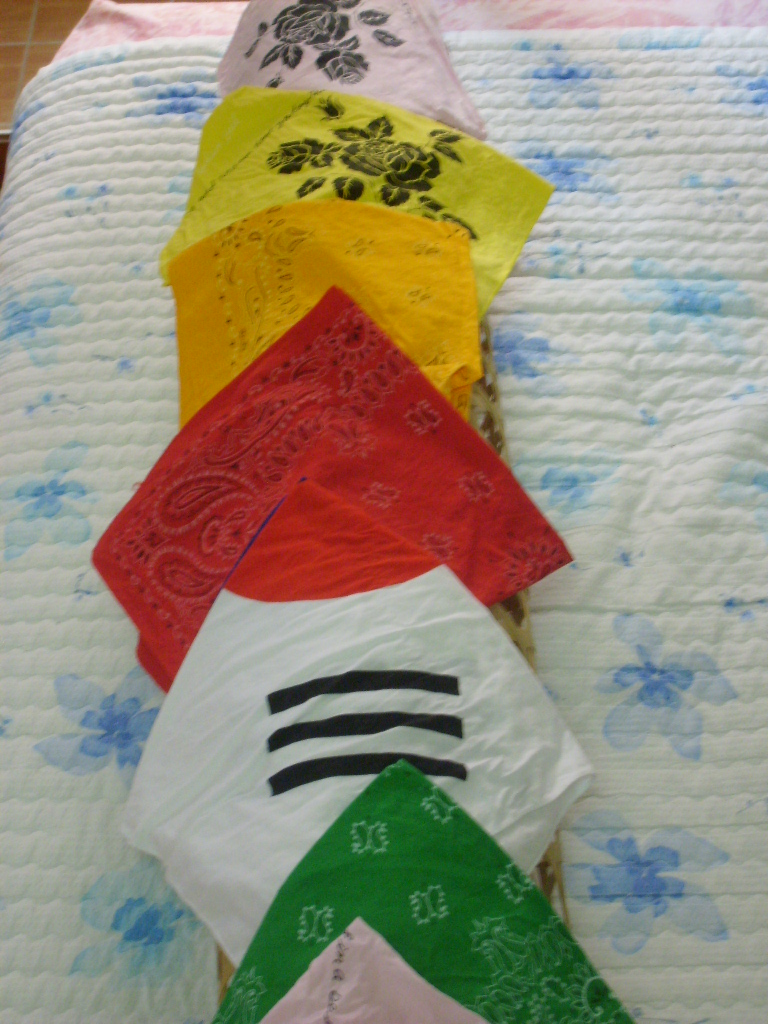
I don't believe in ironing!
In the heat of summer they are great wrapped around your neck at night to help prevent your neck getting clammy, or wrapped around your forehead as you trek up a mountain. The only thing you shouldn’t do with them is use them to blow your nose as Koreans would find this quite disgusting! If a handkerchief isn’t sufficient to soak up your spillage, hand-towels are an ideal upgrade.
© Nick Elwood 2010. This work is licenced under a Creative Commons Licence.


 Elwood 5566
2 comments