That Fiery Little Penis and Cocks of Greater Dimensions
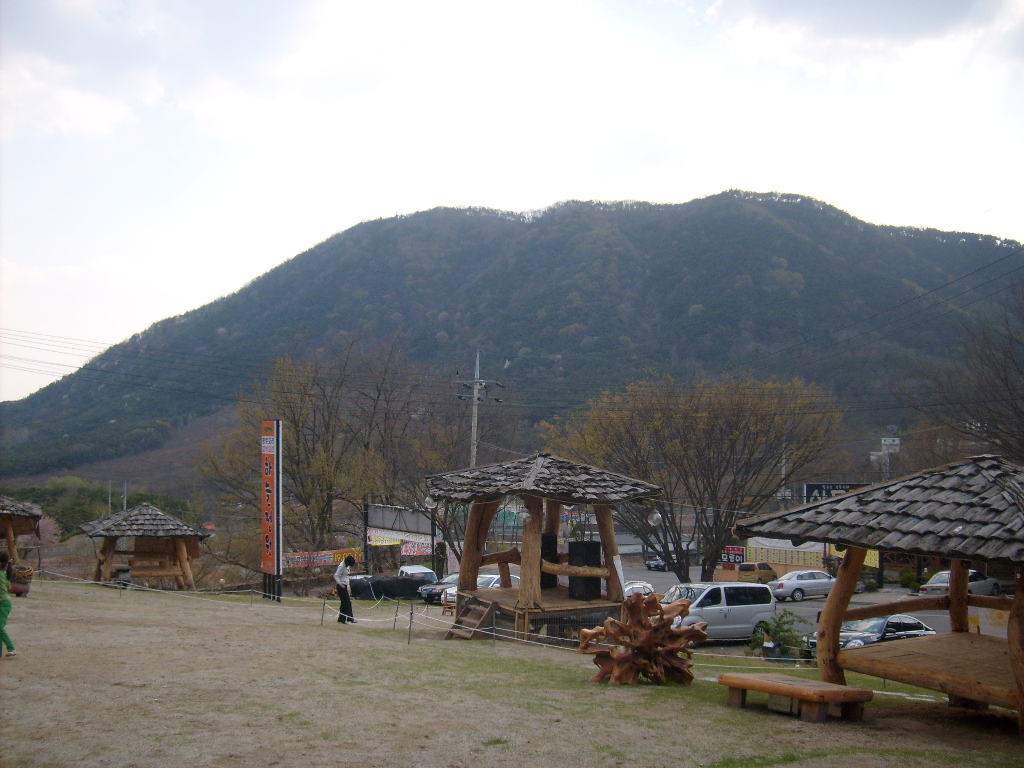
고추산 Just opposite Penis Paradise in Palgongsan National Park. Daegu.
Last year the place was full of cocks, some of the biggest I’ve seen in Korea and at one point a great number of them were loitering about outside an adjacent restaurant just waiting to be picked up. Some were even for sale and as I have little self-confidence, the thought had crossed my mind that, the only way I am going to get to chomp on Korean cock, is to pay for it. Cocks in public! Not the sort of behaviour you expect in Korea! The choice was amazing, young ones, old ones, thin, fat, bent, tapering. Well, you can read about my ‘adventures’ in Saturday’s Post, Palgongsan National Park – Penis Paradise, where you will also find some photos of gigantic Korean cock!
Needles to say I was salivating, not from what you’d expect, but because next door the sizzling aroma of barbecuing duck wafted on the spring breeze. Now, the other day, using my limited Korean, and despite all my studying, limited it is, I was telling a shop assistant that my hobby was food. I ‘d been walking around town with one of those bright yellow E-Mart bags from which sprung three enormous tendrils of burdock (우엉) . As it’s the first time I’ve bought whole burdock, I’m a bit surprised at the flexibility in those tendrils, having presupposed they were more rigid, and so they bounce about crazily. Korean passers-by give my tendrils a second glance because no foreigner buys those weird roots. I’m quite proud of my bouncing burdock and am on the look out for one of those unfriendly westerners who constantly pass me by without ever saying hello or smiling. Smug wankers don’t talk because they like you to feel they’re totally at home in Korea even though they all eat in MacDonald’s and speak little Korean. Anyway, my burdock is a trump card, a sort of ‘fuck-you!’ However, there are no foreigners about and so I make a mental note to walk about town on a regular basis with burdock sprouting from my bag, like I’m taking out a pet.

Lee Hee-ho (이히호), my friend's youngest son
The shop assistant is bemused at my burdock and I tell her I’m making a side-dish with it. She’s even more impressed when I tell her I can make kimchi. She asks me if cooking is my hobby so I stroke my belly, ‘of course,’ I reply. ‘Can’t you tell?’ And as I laugh the burdock in my bag is wibbling, like it is laughing too. Well, my point is that food is probably my greatest hobby and I doubt many people prefer some culinary pleasure to sex but I do. I once wouldn’t answer my door to gratify the sexual urges of a very handsome boy because I was tucking into a curry. Of course, I could have let him in, we could have shared it but I don’t like threesomes. He banged on the door for a while then gave up and probably went and had a wank, or found someone else to do stuff with – of which there was never a shortage in the army. When you’re young you think that sex with an Adonis will always be available, that your pulling power will never be diminished. It’s only when you are older you regret letting such things slip past. If I could go back in time I’d have chucked the curry in the bin and opened the door. I stroke the burdock reminiscently and note their almost semi-rigid state. His name was Lance Elcock!
So, back at Penis Paradise, the barbecuing duck smells delicious and I am starving hungry. I can catch up with the cocks later. Now, I’m with my Korean friend David (이영선) and his family. I’ve known David for ten years and he’s one of my best friends. I’ve been taking a few photos of his sons, one aged 5 and the other is almost a year old in western reckoning. After feasting my eyes on those fat cocks around the corner, I find it a little amusing when his youngest son begins to chomp on a cock he’s picked up and so I grab my camera ready for some hot shots. He licks the end a few times, a little unsure what to expect, then removes it from his mouth and looks down on it with apprehension. A strand of saliva slips onto it which my camera is too slow to capture. Then he begins sucking on the tip and I await the moment when I might capture his surprise. Oooo, here it comes! He grimaces a few times but doesn’t stop sucking until the full force hits him, when suddenly, he starts wailing.
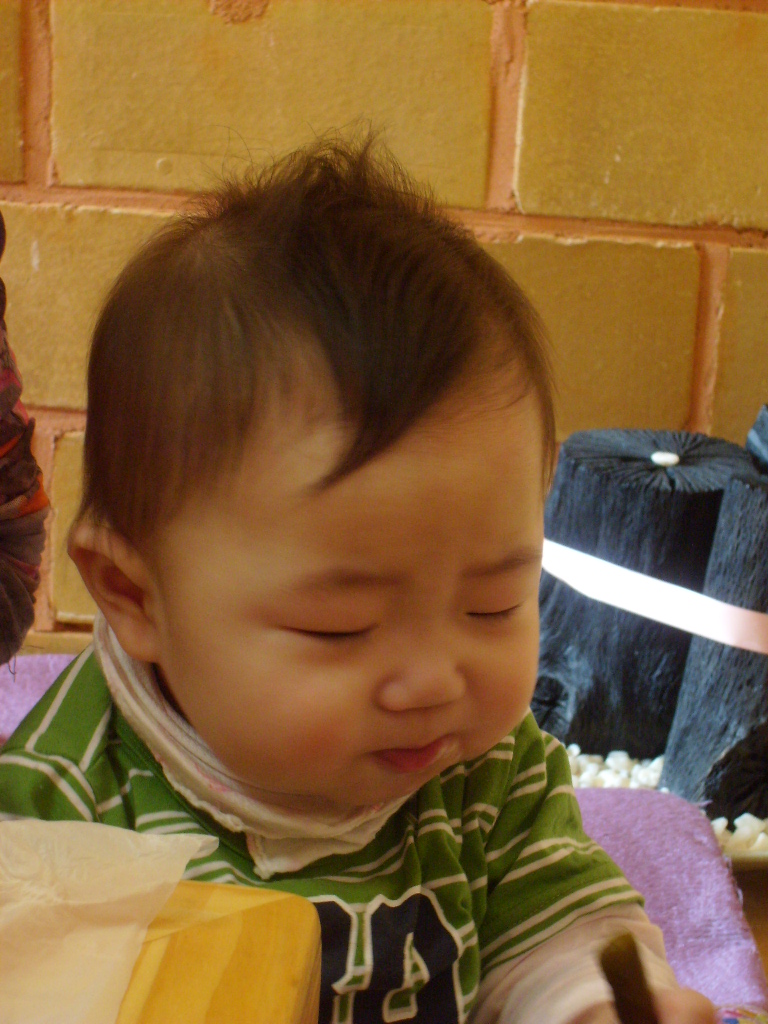
Mmm...not too sure!

Another nibble!
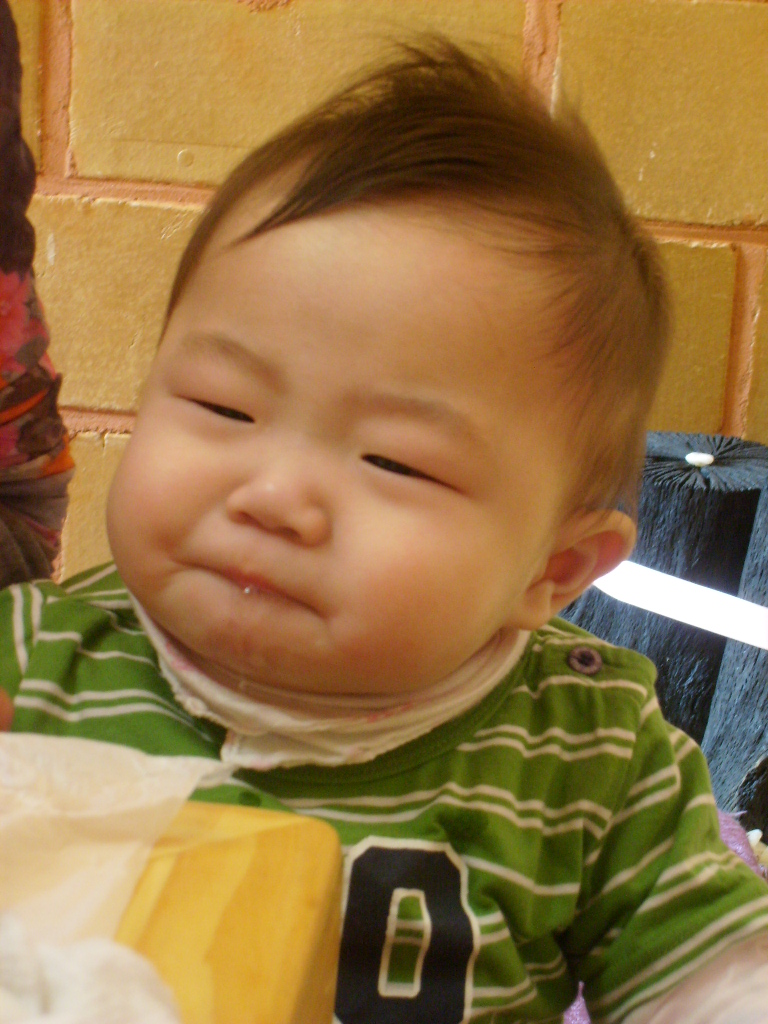
Whang! It's hot!
I feel quite bad because I’d sat, watched and photographed as the little boy munched on a very hot, small chili, the hot ones generally being the smallest. So now you know that in Korea, a ‘cock’ (고추) refers to both the vegetable and a penis. Actually, Koreans have an idiom which I know intimately well as I repeat it when feeling inadequate in a bathhouse: the smallest chillies are the fiercest! (작은 고추가 맵다) Because I’d only just entered where we were eating, my friends busy poking and prodding the barbecue while I had been ‘around the corner’, I assumed they knew what he was doing. Maybe I wasn’t thinking… Eating a chili! Quite natural for a Korean, I thought.
Magnolias (목련) and 'Sudden Spring Colds' (꽃샘추위)

The glorious magnolia (목련) provides a sure sign that spring is here. This is one of my favourite flowers but unfortunately, as magnificent as it looks with large, waxy, petals, it’s has a strange, low-key, chemical scent. Early spring is typified by cool or cold mornings and evenings and increasingly warmer days but temperatures can change suddenly – a phenomenon known as (꽃샘추위). From my understanding this means ‘sudden spring colds’ or, what in English we might call ‘cold snaps’ except a cold snap can occur throughout the year. Any further insight into this term would be appreciated.
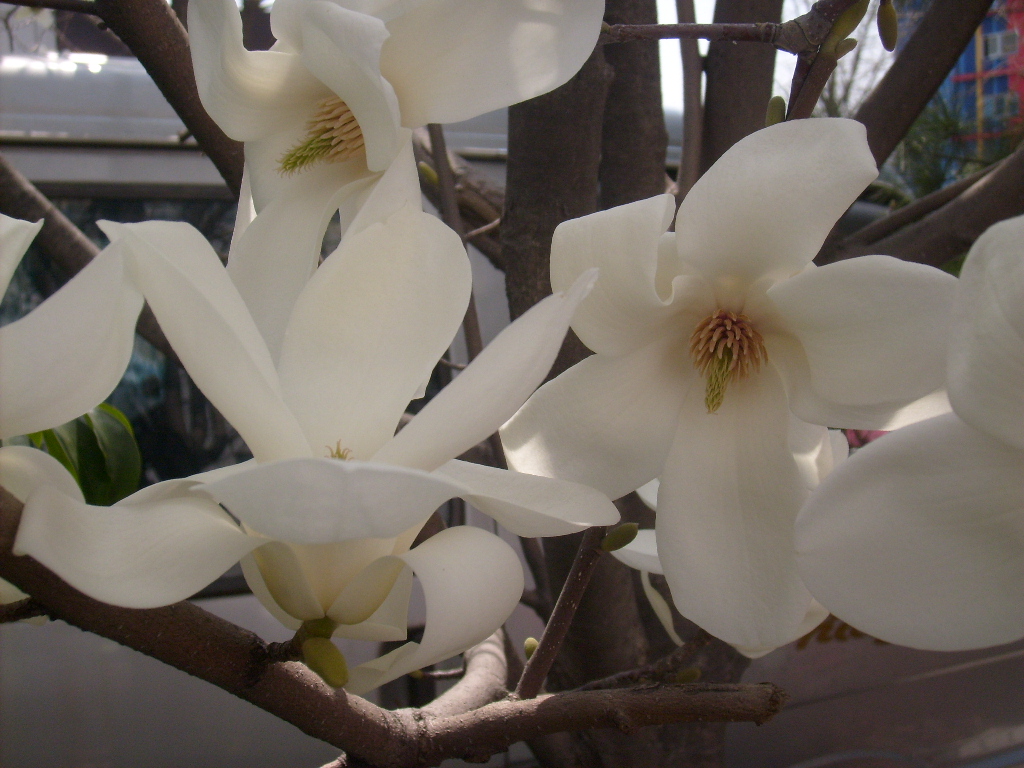
Magnolias
Samil Public Holiday. March 1st
(삼일 운동) Samil – (3-1) relates to March 1st 1919, which saw the emergence of the Korean Independence Movement. On this day, Korean independence fighters declared their independence from the colonial rule of Japan. The Japanese having been in occupation of Korea since 1910. The declaration, sparked widespread processions and demonstrations which Japanese authorities harshly supressed. In one village. Jeam-Ri, all male sympathizers were herded into a church and then burnt. However, in the aftermath the Japanese authorities changed some of their policies especially those deemed particularly obnoxious by the independence fighters. Military police were replaced with a civilian police force and a limited press freedom was allowed. The march 1st Movement was significant in the establishment of the Republic of Korean Provisional Government, in Shanghai, in April 1919.
For those interested in taekwon-do, especially the patriotic and original taekwon-do as practiced by the ITF, the history of which seems unknown here in Korea, Samil is the name given to one of the advanced patterns. The pattern contains 33 movements which represent the original 33 patriots who planned and penned the declaration.
Celebration of the First Full Moon

Full moon
Sunday the 28th of February (2010) is the celebration of the new year’s first full moon. (대보름). This occurs on the 15th day of the lunar new year. I was wondering why the markets and supermarkets were suddenly full of nuts, walnuts being the most popular, and discovered that one of the celebration’s traditions is to crack open nuts with one’s teeth as this is supposed to guarantee their health throughout the coming year. Other traditions include mountain climbing, especially to see the rising moon as well as eating five grain rice (오국밥). Yakshik (약식), a tasty rice cake containing chestnuts, pine nuts, honey and sesame oil, is also eaten. Celebration is more noted in rural areas where dried grass is burnt. Originally, this occurred between rice fields and was probably a means of killing insect pests.
Winter – Monday Market
I intended making a visual collection of seasonal fruit and vegetables as they appear and was going to start this in spring, I decided to start earlier.

Persimmon (홍시)
Persimmon (also known as Sharon Fruit. 감, 땡감, 반시, 홍시/연시,꽃감.) Early December and the Persimmon season is over but these ones I bought a few weeks ago. Currently I have around 60 Persimmon in my freezer. Persimmon is called Kam and like the octopus, there are three types each called by a different name which can be confusing. Kam range from hard to very, very soft. If you like sweet and gooey you’ll love the hongshi, sometimes spelt yonshi. This is the softest persimmon and appears in late summer to early winter. It is very delicate, like a fragile bag of water. Unlike the other types of persimmon, which I don’t eat often, these can be easily frozen. They are delicious cold, simply slice the skin and squeeze and scoop out the jam-like innards. Some coffee shops serve hongshi smoothie. You can also buy dried persimmon, rather like dried apricots but with less flavour. I’m told persimmon is quite high in calories – which is usual as anything delicious tends to be calorie laden.
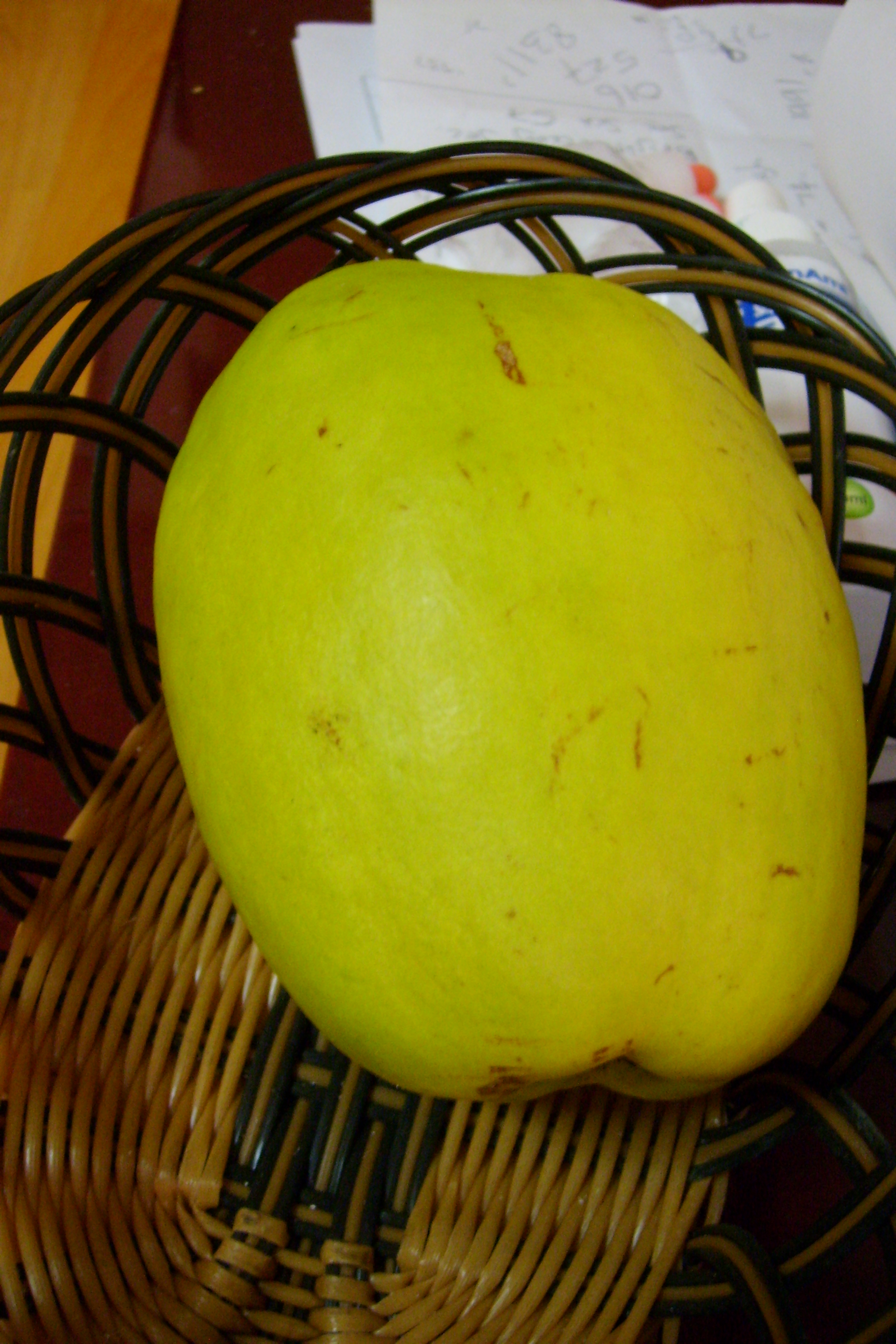
Oriental quince. (모과)
The Oriental Quince (Moghwa. 모과) , is used for its fragrance which is slightly appleley. It has a waxy skin. They do scent small areas like cars and small rooms but unless you dangle them under your nose, they’re pretty useless in larger spaces – but they look good. Moghwa appear in late summer and early winter. Make sure there are no small holes in them as these will contain worms. I had one with a small hole which were fruit flies front door, a piece of gum blocked future access and entombed any inhabitants. If you turn the fruit regularly it should keep into the spring. The moghwa is used in oriental medicine and can be used to make tea.

Daegu, famous for its apples (사과)
Apples. (사과) I live in Daegu which is renowned for apples and Daegu apples are truly delicious. In England, I rarely eat apples partly as there are so many varieties I never know which ones I like and because they can never be relied upon to be tasty. I suppose the variations in British weather result in fruit which can be sweet one moment and sour the next. Daegu apples are never sour and they are never fluffy or soft. Some are truly massive in proportions. Recently, a Korean teenager told me that had Snow White been Korean, she wouldn’t have died because Koreans always peel the skin off apples and pears. (and the witch, so he said, put the poison on the skin). In England we tend to wash them, if we can be bothered, and eat them with the skin on – a habit many Koreans find odd.

Cabbages (배추)
My God! I nearly forgot the most important seasonal product of all… The Cabbage – usually called a paech’u (배추) As with most imported fruits and vegetables which I might buy back home, the Chinese Cabbage ( which I think is a pak choy – or maybe its a bok choy???), is a piddly little thing which usually sits in the palm of your hand, is almost pure white and has no green leaves and cost W2000. In Korea when the cabbage season is at its peak, some are colossal in size and this week in the market they cost around W1000 each which is about 50 pence in sterling. Two will make me enough kimchi for several months. Check inner leaves for signs of caterpillar.
An occasional site, especially in more rural areas, are large vats of paech’u being salted ready for making kimchi. Indeed, in street markets at this time of year you can buy kimchi which has already been soaked in salted water.

Salted cabbages in Cheonan
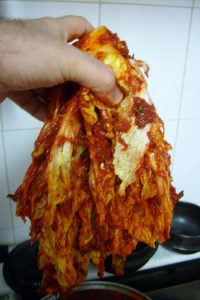
- My Winter 2009 kimchi (배추 김치)
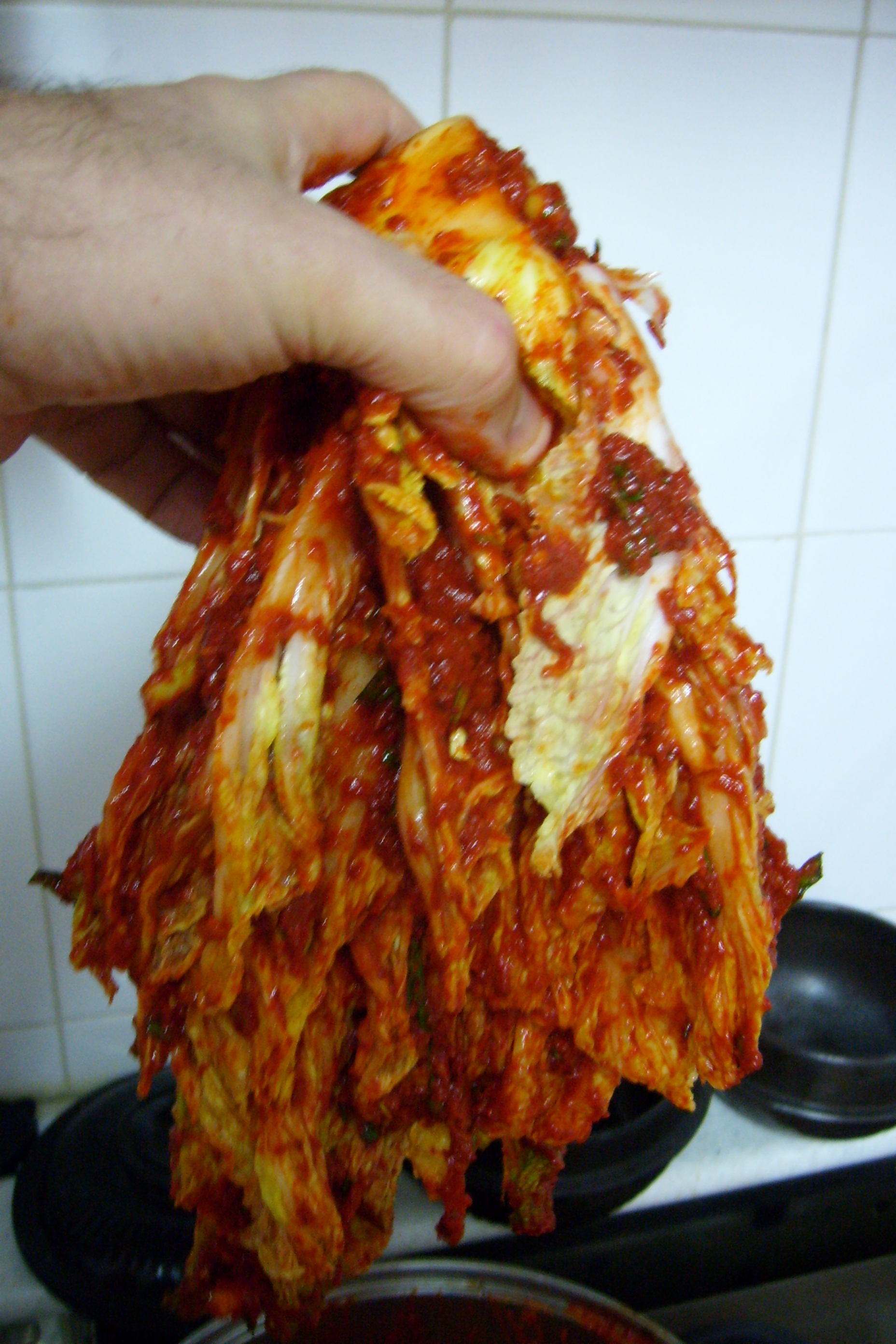
Paech’u after being salted and pasted with kimchi paste. Yes, it looks like something from a road accident but it tasted delicious!
persimmon – 감, hard – 땡감, between soft and very soft -반시, very soft – 홍시 or 연시, and dried – 꽃감. Oriental Quince (moghwa) – 모과, apple – 사과, Chinese cabbage – 배추.

© Nick Elwood 2010 Creative Commons Licence.
Definetly 'Ji Ji' (지지)

For the last few weeks I’ve been paying attention to the contents of my dustpan after I have swept my studio floor and run the ‘magic mop’ over it. The ‘magic mop’ has a disposable cloth attached to the head to which dust and most other debris firmly sticks. I noticed a long time ago that you can’t flick anything on a Korean floor without it reappearing some days later, stuck to the sole of your naked foot or clinging to your sock. Grains of rice, once hardened are especially annoying.
In Europe at least, and especially in Britain, carpets are often the preferred choice for floors and in some aspects they are wonderful because they absorb most small debris. ‘Sweep it under the carpet,’ an idiom I am often asked to explain, really isn’t necessary with small things as you can deposit them on the floor and at most all you need do is rub you foot over it a few times to permanently erase whatever was underfoot. All bodily bits, small scraps of food, cigarette ash etc, are banished forever in the pile of your pretty carpet.
Ten years ago I moved into a new house in England and after a year decided to rip up the carpets that had lain on the front room floor for well over a decade. Even after months and months of hoovering the floor and liberally sprinkling it with various scented and odour eating carpet powders, I was never able to feel comfortable sprawling out in front of the TV. The carpet was old but it never actually looked dirty and the unpleasantness I felt probably arose from the fact that I occasionally detected odours emanating from it, odours which weren’t unpleasant but weren’t mine. You wouldn’t want to wear a stranger’s unwashed clothes so why would you want to lay on their ancient carpets, carpets ’worn’ by several families. Even after meticulous cleaning, I regularly wrestled lengthy black hairs embedded within the pile. They were of Greek extraction because Greek students had lived in the house, some three years before I moved in.
When the carpet was eventually dragged out of the house, departing in a dusty cloud, the wooden floor on which it had lain was covered in a thin coat of what looked like sand except it was finer and softer and most likely organic in origin. The carpet had acted like a filtration system so that only the finest particles escaped through to the floor boards. Once hoovered you could see the small spaces between the boards were caked with dirt that had been compressed into them over many years. This had to be gouged out with a knife before I could sand the boards. Once the front room and dining room were rid of carpeting and the floors washed, scrubbed, scrapped, sanded and treated with linseed oil, the need to dust became a monthly rather than weekly routine.
The decision to banish the muck absorbing carpet, and to subsequently ban outdoor shoes from inside the house, was finally made after I noticed a small brown thing on the floor. I smoked marijuana at the time and on two occasions I had discovered dope on the floor though one discovery turned out to be either dog shit or a clinka that had fallen out of my nephew’s nappies. This mistake only transpired when I inhaled the joint I had rolled from it. Needless to say anything brown and lumpy and laying on the floor I assumed to be dope before anything else. Though I suspected what it was, it needed confirming. I sniffed it and instantly retched – cat shit, the worst carnivore shit of all!
Ten years ago, the streets around my house were liberally ornamented with piles of dog shit. I know because I used to stick small cocktail flags in them to draw attention to them; it was a form of social protest. When walking to work I would count the passing turds and often, in just half the street, I would count as many as thirty. I had some intimate relationships with the turds in my street: one had been laid in the furthest corner of my lawn, just under the privet bush. I couldn’t fail but notice it as it was large and shaped more like a small cow pat than one of those curled and tapering whippy whirl turds that Korean kids are so expert at drawing. In 2000, when I first arrived in Korea, I wondered why so many ice creams were drawn on tables especially as the Baskin Robbins opposite my haggwon, scooped ice cream out of large tubs rather than deposited it whirled. Only the smallest dog could have manoeuvred its arse into the required position under the privet bush to deposit the poop, a Korean size handbag dog for example, but this specimen’s owner had to be big.
I watched that turd for an entire summer and well into winter, witnessing its transition from a wet mess to one with a crusty top, rather like a pie that then turned white after an infection by some strain of turd eating mould. Eventually, internally atrophied and dehydrated by a hot summer, it collapsed into itself. Gradually absorbed into the ground around it, it disappeared but by that time it was late winter. Back on the pavements, I even began to recognize individual dog’s shite and could sometimes trace their various daily messings down the street. One example, a particularly big deposit was almost orange in colour. I imagined the owner, walking their dog in the anonymity provided by the early morning darkness, allowing it to shit in one spot and the next day dragging it a little further down the road so as to share the messes equally around the neighbourhood. As dogs like to do their business in the same place, I would imagine that the moment the dog started to squat on its hunches the owner had to drag it further before letting it spill its backside onto the pavement. I estimated the owner probably took a month to circumnavigate the crescent before the dog had to poop in approximately the same place and if even house numbers were the victims one month and odd house numbers the next, the cycle could have been extended over two months. Despite the copious piles dotted about the street you never saw an owner allowing their dog to foul the pavement so, never trust dog owners who walk their dog in the dark.
Some owners were equally as considerate and seemed to think it was acceptable for their dog to shit on the road. For several days, as I ate breakfast, I was treated to the view of another enormous turd, strange how they all seem to have been enormous, as it was squelched all over the tarmac by passing cars. Neighbours who made their dogs pooh on the road probably perceived themselves as good citizens while those who used the pavements were anti-social. Eventually I put a rather hostile placard on my front lawn and several neighbours then did the same; instantly, the appearance of new turds ceased and those remaining were old and in various stages of atrophy, dehydration and decay. I kept counting the turds walking to work however, as the number of deposits beyond the borders of my placard’s influence had significantly increased.
I’m digressing: My point is Europeans and especially the British prefer to wear outdoor shoes inside their house which is a custom I find horribly disgusting and more so if you have carpets which act as toilet paper to the soles of your poohey shoes. There was so much shit on the streets around my house, and there still is, that natural decay and rain swirled it everywhere so that even if the ground looked clean, you could guarantee it was coated in canine faecal matter. Wearing shoes indoors, when so many dogs foul the pavements is a disgusting habit.
I don’t think I’ve ever seen a dog turd on a Korean street and even if there were it would only be a little thing as most Korean dogs are handbag dogs and incapable of passing anything more than a few pellet sized faeces. And yet Koreans never wear shoes inside their houses and often don’t wear them in workplaces.
When you live in a room which is barren of carpets your awareness of your own bodily debris grows. When you have a carpet you assume that the bit of nail you blow onto the carpet, or the bogey you roll and flick onto that beautiful Axeminster, simply vanishes. I can flick a toe nail across the room and know that in a day or two it will reappear in my dustpan along with a grain or two of rice, a few hairs and other bits of fluffy stuff. Occasionally I’ll spit out a nail to deliberately see when and where it will re-emerge.
I’ve noticed there are rarely any hairs on the central part of the floor because these are blown to the edges of the room by the draft from open windows and passing bodies and for some reason, the biggest trap of body hair are the sliding door groves. Every few weeks I need to clean these out. Pubic hair has the most amazing ability to float into places like your fridge or kitchen work-surface and though you might find this abhorrent and are thankful that your carpet seizes them before they become visible, I’d rather see the occasional curly devil on a plate or in the fridge than lurking in the pile of some horrid carpet, rotting slowly among years of bodily refuse, embedded and matted with all sort of unthinkable crap, dead skin cells, bogeys, shoe dirt, dog and cat muck, grit, rain water etc, etc. And then, thinking we are being hygienic, we sprinkle the carpet with floor powders that temporarily scent the air. What happens to them once they have embedded themselves in the carpet? I doubt such powders disappear.
I live alone and so my observations are based on my own bodily sheddings but how greater the pollution if you live with other people or a family and have pets. Carpets are such filthy things and what we do with them is not much different to that other dirty British habit, thankfully disappearing, of blowing gunge out your nose and into a hanky which you then keep warm and moist in your pocket, the perfect environment for viruses and bacteria, before putting your face back into it and snorting out another load. Having a carpet on your floor is a little like sleeping in the same bedding without ever washing it.
Cleaning a carpetless room is a joy because it’s effortless and now Samsung have even marketed a robotic floor cleaner that cleans your floor when you are out. Everything is exposed in a Korean room as there are few true hiding places. And if you want to wash the floor or give it an occasional scrub or douse it in bleach, well that too, is easy. Carpets can’t be washed and I’m sure all carpet shampoo does is drive the dirt deeper and enliven their parched innards. There is probably a surge in a carpet’s bacterial and fungal population following a shampoo.
In Korea, many westerners don’t remove shoes indoors preferring to stick to their own customs and there are others, myself included, who will occasionally wear shoes on their floor if for someone reason they have to return briefly indoors because they’ve forgotten something. This is a habit I am trying to break but when you’re in a rush it is difficult. You very, very rarely see Koreans walk on their living space floor wearing shoes, not even for a few seconds. I have noticed that on the odd occasion I have breached Korean custom, I have subsequently felt the deposited dirt left by my shoes, when barefooted. You can’t see it but it’s there despite the fact you only walked on the floor for a few seconds.
Korean students, especially younger ones, will sometimes cringe and tell me how dirty I am if I suck my pen. Often they will shout ‘ji ji’ (dirty) which is the word used to small kids and in the same category as English words like ‘pooh pooh’, ‘wee-wee’ and ‘tinkle’. If sucking a pen is a little ‘ji ji’ then having a carpet or rug is infinitely dirtier, indeed it is positively filthy! Next time you flick some item onto your Korean floor, just remember, it’ll be back!
지지 – dirty – (but a word used to small children), haggwon – 학원 – a private school like a homework club or after school study center.

carpetless


 Elwood 5566
leave a comment