Nudism; Korea – Normal, UK – Kinky
I’ve spent 8 years looking at Korea through an understanding of British culture and now I’m living in the UK, my observations are shaded by my interaction with Korean society.
In the summer, just before I left Korea, my gumdo master suggested we take our students to a spa for an outing. A ‘spa’ in Korea is a water park. My first question was, ‘what do you wear in a spa?’ Of course, I knew the answer, a bathing costume; it just needed confirming. A little wave of nausea washed over me. I’ve become so used to nude bathing that the idea of wearing anything other than nothing is ‘pyontae’ – which in Korea means ‘perverted’ though a closer, not so stringent translation is probably ‘sick’ or ‘gross.’
Now, this revelation, a complete turnaround to how I originally envisaged a bathhouse experience, is strange partly because that despite being gay, I don’t find the bathhouse in the least an erotic encounter. This fact quite confuses some people whom obsess that a bathhouse has got to be an erotic experience for a gay man. Perhaps this obsession reveals more about them than it does me. Indeed, I’ve never really found the experience erotically engaging. Naturally, I’m aware of handsome or attractive bathers but that’s where it stops. Conversely, I find clothed bathing far more sexually intriguing because it leaves something to the imagination. Nudity is noble and levelling while bathing in a costume is simply sad and repressive. In the end, we didn’t take the kids to a spa and I was pleased because I would have felt more awkward, more body conscious strolling around in bathing shorts.
One of the most notable revelations on returning to the UK is that any mention of nude bathing and the fact you find it superior to clothed bathing, even in a segregated environment, instantly labels you a ‘nudist’ or ‘naturist’ both of which for many British people carry overtones of ‘kinkiness.’ In summer, I meet up with a friend who spent 4 years in Daegu. I think I may have introduced him to bathhouse culture and over the years we explored numerous bathhouses and jjimjilbang in and around Daegu. When he visited, we travelled part of the east coast and arrived at St Osyths Beach, near Clacton.
St Osyths Beach is one of those seaside towns that epitomise the ghastly side of British culture. Really, its nothing other than a sprawling caravan park with a row of glitzy amusement arcades, a few restaurants and a bar. The restaurants serve decently priced food in good proportions but the quality is lacking. You can buy a foot long sausage and chips for a couple of pounds but I don’t think the sausage contains any meat and if it does it’s mechanically rescued and engorged with some form of edible padding; bread perhaps.
Part of the beach is quite pleasant but if you walk only a hundreds towards the ‘nudist beach’ it rapidly deteriorates into a bomb zone. Clearly, some structures or an esplanade originally stood on this stretch which had subsequently been bombed flat or smashed by an enormous tsunami. The rubble has never been removed and large chunks of concrete lay embedded in the sand decorated by patches of paving and the odd rusty, iron girder. The beach was strewn with rubbish, beer cans, broken glass and the likes and ornamented by a great swampy expanse which smelt like an enormous drain and sat between the footpath and the beach.
We spent several hours in the nude beach trying to recapture the luxury of Korean bathhouse bathing. Having walked some twenty minutes from the caravan park area, the beach becomes sandy and clean with dunes stretching far along the isolated coastline. Bathing in the sea wasn’t that pleasant; the water is murky and the floor a constantly shifting bed of shingle that at times was sharp.
It was high summer, holiday season, but the beach wasn’t too busy and here and there sat or bathed real naturists. You could distinguish real naturists from those with other motives because they made eye contact and occasionally communicated with us, perhaps smiling or commenting on the hot weather. What marred the occasion were the number of perverts frequenting the beach – all men! They fell into two categories, those tolling the beach-line who simply paraded up and down and those hiding between the dunes eager to eye up whatever it was that attracted them.
One character, wore a complete body stocking which covered all but his hands, feet and head and he minced along the path between the beach and the dunes sporting a lttle hand-bag. Another, paraded up and down fully aroused and every twenty or so paces would keep himself ‘pumped’ with a vigorous fondling. Yet another, trolled the water’s edge wearing a mid-riff T-shirt from which was attached a piece of cord subsequently tied to his nether regions. This ‘reign’ was somewhat tight and as he walked his T-shirt pulled on the reign and his penis reared upwards as if a dinky sized My Little Pony was nestled in his crotch. Meanwhile, in the dunes, heads constantly popped up and peered about like pink periscopes before submerging.
Despite my years of Korean bathhouse bathing, in an all male environment, I felt uncomfortable with the kind of behaviour paraded on this beach. I doubt there were any punters under 25, apart maybe from a few women in pairs and you certainly wouldn’t want to bring children here. The whole experience was tainted by the parading perverts and hidden colony of leering meer cats.
Back in Wivenhoe
In July 2015, I left Korea after 8 years (10 years total) and returned to Wivenhoe, in Essex, UK. Why? I’m still asking myself! Korean life was so relaxed and familiar but I missed my friends and family back home. I think I would have stayed in Korea permanently if it had been possible for foreigners to buy property or to live in the country without having to exit every 3 months and return with an updated visa.
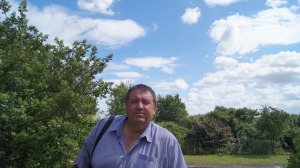
Layer Marney July 2015
Hardest of all, was saying goodbye to my gumdo Master, Kwon Yong-guk. I had trained with him everyday for almost four years. When I eventually stepped on to the Seoul-bound trained, in Daegu, we both had tears in our eyes. However, leaving Korea in 2015 was quite different from leaving in 2001; with the internet and the likes of Facebook and Skype, staying in contact is easy and I video chat with him most weeks. In 2001, the primary mode of contact was via e-mails or the likes of Messenger and a Christmas phone call, Seoul to UK, in 2000, cost me £80.
Before I left Korea, I already had an inkling of what I was going to miss, and I very much do. Most of all I miss Koreans. In particular, I miss young people. Korean towns and cities are filled with children and teenagers and street life is enlivened by their routines. Further, Korean culture is coloured by the broad range of amenities provided for them: PC rooms, Kids Cafes, jumping rooms, noraebang (singing rooms) and play areas in restaurants. Even amenities which in the UK would be predominantly for adults are equally frequented by children and young people. Where in the UK, do you see children or teenagers eating together, unsupervised, in anything but the likes of MacDonalds or KFC? And of course, in Korea, children haven’t yet been indoctrinated and corrupted by the idea that their bodies’ are a source of sexual attraction to lusting adults and especially lusted over by those who were formerly trusted, such as relatives, teachers, politicians and the clergy. Britain is now a very scary place for the child and indeed any adult whose interactions with a youngster are misinterpreted. Indeed, so central to the British psyche are concerns of child sexual abuse, to the point of obsession, that it suggests either a very unhealthy national preoccupation, or worse, one that is rooted in the human condition.
Then, I miss Korean men; ever since I experienced life in Germany, I’ve always found a great swath of the British male population to be horribly brute. Indeed, to be fair, male or female, the British character is typified by vulgarity, aggressiveness and violence. This character is predominantly a product of the working-class tradition of which it is currently politically correct to deny the existence or influence of and yet we see the class dichotomy paraded for entertainment in the likes of Downtown Abbey, East Enders and the intrigues of the royal family. Few Brits would deny the existence of a British upper class, but to correspondingly talk of a ‘working class’ has become as socially uncomfortable as flying the Union Jack over your house. I have met Koreans whom I dislike but I’ve yet to meet a Korean man who is brute or vulgar, let alone a brute or vulgar female. It is wonderfully liberating to walk busy streets surrounded by predominantly feminine men or youths rather than having to negotiate the complex variations of the British psyche where one man is a gentleman, the next, some slob with his hands stuffed down the front of his trackies and the next some male looking female who is foul-mouthed and muscled.
I miss being really clean, ‘clean’ in the same way you can be in Korea and I’m not claiming all Koreans have the same standards. Swimming pools, spas or sauna are not a daily part of British life. Unless you live within 20 mins of a bathing complex, most of us don’t enjoy water or cleansing as entertainment. On the contrary, bodily hygiene in Britain tends to be functional procedure especially as many British homes don’t have a bathroom suitable for cleaning your body in a truly comprehensive manner. And Korea is bursting with restaurants, coffee shops, street food and markets. In six months back in the UK, I’ve eaten out twice. It’s simply too expensive to eat out at a decent restaurant twice a day. Of course, I’m living in a large village rather than in a city but even if I go into town, population approx. 122.000, there isn’t a great deal to do and the quality of resources and culture is impoverished. One big problem with Britain is that so many of the things you would do on a daily basis in Korea, and without a second thought, are not just expensive luxuries in the UK, but by comparison, are second-rate. Trains are slow and dirty even when they are high-speed intercity trains but no British trains are truly ‘high speed’ because the ancient infrastructure limits speeds to 125 mph, maximum.
There are some pleasant aspects of being back in the UK though I don’t feel they compensate for living in both an impoverished culture and among so many with brute and vulgar sensibilities. I enjoy damp air, green fields, eccentricity (which in Korea is frowned upon), birds and houses with gardens… and that’s about it. I actually thought I’d be able to be more positive but on reflection that’s all I can muster.
I have no doubt my posts here will commence with ones of a comparative nature before they broaden out into other topics.
Korean Bathhouse Worldwide
USA (Click photos for link to homepages)

USA. Oregon, Jade Sauna

King Spa Chicago and Dallas. USA

© 林東哲 2010 Creative Commons Licence.
Korean Bathhouse and Jjimjilbang Tips

Come on in!
Ready to take that plunge? No doubt, many will have no worries entering a bathhouse but if the experience is likely to stress you, here are some tips.
BEFORE YOU GO
1. Sometimes, fitness centers have adjacent bathhouses and jjimjilbang. If this is the case you can use the sports facilities a few times in order to familiarise yourself with everything before using the bathhouse.
2. Male and worried about willy size? Don’t be! I’ve seen toddlers with cocks bigger than mine and no one pays much attention. Or you could try adding an extra centimeter by trimming surrounding hair. I once read that every forty pounds lost, assuming you are that fat to begin with, increases the appearance of size by one inch. One the other hand, if you’re as fat as I am an extra few stone would supply enough lagging to provide an overhang sufficient to hide it completely.
WHEN TO GO
1. Choose a quiet time for you first encounter. Early morning, eg. 5 am, though anytime before 7am on the weekends is good. Alternatively, if the establishment closes, a good time to attend is on a weekend a couple of hours before closing time.
2. Avoid public holidays, unless you’re prepared for a full house and avoid both ‘play Saturdays’ (놀토) when there are no schools, and school, university vacation periods. Sunday is often the busiest day.
WALKING THE PLANK TO THE POOLS – this is the scariest part
1. Keep a watch on. It’s really useful as a diversionary play thing should you feel uncomfortable. If you fiddle with it nonchalantly as you walk to the baths, it will help distract you from the glances of other punters.
2. On your first encounter you’ll probably head straight for the bathhouse complex blotting out everything on the way. Try to remember to pick up a towel and a wash cloth, usually located around the complex entrance. This can be used the same way as your watch when you get stressed or ultimately, to bury your face in.
3. Male and worried about willy size? Give your dick a quick stretch before setting off on the walk of shame.
ONCE INSIDE – you’ve made it!
1. Get straight under a stand up shower and get wet. The water will occupy you as you gather your senses for some exploration and familiarization.
2. Remember, if you head straight for the showers which are situated at floor level, you will have to sit on a bucket sized seat. All bathhouses have regular, standing showers which provide a good vantage point to familiarise yourself with the bathhouse layout and practices and don’t necessitate sitting in an undignified position.
3. Soap, towels, toothpaste are all provided. If you drop the soap and find this embarrassing, park your arse in a corner before bending down, or with your knees together, bend with the knees and not from your waist. Alternatively, rapidly kick the soap into the drain and ignore it.
4. When you get up from the bucket seat, roll slightly onto one butt check and then onto the other before standing up as this breaks any pockets of suction between your arse and the seat.
5. Don’t stand up after sitting on a towel without whipping the towel from under you as you stand. Failure to do this will cause it to stick to your butt.
GETTING OUT
1. If you remember to take a towel in with you can use this to sit in a convenient spot and dry off prior to leaving. On your first visit you will probably want to escape quickly and this will be prolonged if you are dripping wet. If there is an ice room, five minutes sat in this, especially in summer, will quickly dry you off but this procedure has a detrimental effect on males.
2. If you get to this point, well done!
Good luck! I’d love to hear other suggestions!
I apologise for their being a lack of tips for females but as of yet I have never been in a female bathhouse. Suggestions welcomed!
© 林東哲 2010 Creative Commons Licence.
Bathhouse and Jjimjilbang reviews

Reviews and info
I don’t intend this page to provide any more than brief information on my local amenities. I am too lazy to go further afield. Hence information, always changing and subjective by nature, is largely confined to Daegu and in particular, the Song-So area. When I use a facility I record basic details and perhaps some of my feelings towards the establishment. Remember, things change rapidly in Korea and even if an establishment remains around for any duration you can guarantee some features have changed.
I have provided a wikimapia link for most establishments.
If you are interested in the design of bathhouses I have a page with detailed plans that provides an easy means of comparison.
I notice on search results numerous inquiries into gay activity in bathhouse and jjimjilbangs, etc. I will add a note if I see anything but being useless at such behaviour and not even looking for it, my pages are not the place to look for such information.
Feel free to post any observations.
CLICK PHOTOS FOR LINK TO ITS REVIEW AND FURTHER INFORMATION
DAEGU

Daegu subway map (click for legible resolution)
LINE 1(SOUTH TO NORTH)
DAEGOK 대곡 LINE 1
JINCH’EON (진천) LINE 1

The Su-mok-won Saeng Hwal On Ch’eon complex

Na Seong Hawaii
WOLBAE 월배 LINE 1. WITHIN WALKING DISTANCE OF WOLBAE SUBWAY.

Wonderful Spa Land. Sports, golf, jjimjilbang and a ‘milky bubble bath’
SANGIN LINE 1
WOLCHON LINE 1
SONGHYEON LINE 1
DAEMYEONG LINE 1. (MIGHT BE A BIT OF A WALK – BEST GET A TAXI FROM HERE)

Home Spa World, Apsan. Very large and luxurious with swimming pool, fitness, golf, yoga and jjimjilbang.
CH’EON-CHI-WON PO-SEOK SAUNA (천지원 보석 사우나) 1 MINUTE FROM EXIT 4

Ch’eonchiwon Po-seok Sauna, health club and jjimjilbang
BANWOLDANG (반월당) LINE 1 AND 2. WITHIN WALKING DISTANCE OF SUBWAY

Greenvill, Banwoldang: jjimjilbang,
DONG DAEGU STATION (동대구) LINE 1. WITHIN WALKING DISTANCE OF MAIN RAILWAY STATION

Goong Jeong Lavender near Dong Daegu Station: cave pool, roof garden, Dead Sea Pool,
LINE 2 (WEST TO EAST)
DASA (다사) LINE 2. WITHIN WALKING DISTANCE OF DAESHIL OR DASA SUBWAYS

Hyu Lim Won: jjimjilbang, large massage pool, new facilities, parking,
SONG SEO (성서) LINE 2. WITHIN WALKING DISTANCE OF SEONG-SEO INDUSTRIAL COMPLEX SUBWAY

Migwang Spolex: large complex, golf, sports, jjimjilbang, mogyoktang, ice rooms, squash, billiards, parking, associated buffet restaurant

Hwang So: intimate bathhouse and large jjimjilbang, sport complex, next to Mega Town’s Lotte Cinema Complex

Han Song, near MacDonalds. Older, friendly establishment with salt sauna
YONGSANDONG (용산동) LINE 2. WITHIN WALKING DISTANCE OF YONGSAN SUBWAY

Dream Sauna, next to Home Plus: bright, salt sauna and yellow earth sauna

Sam Jeong Oasis Sauna. Behind Lotte Castle:

Jade Sauna in Yongsandong: small, very clean,
OUTSIDE DAEGU
(KYONGSANGBUKDO) 경상북도

Kayasan Hotel with a beautiful bathhouse with scenic views
DECEASED SAUNAS
- Po Sot, Song-so
INCHEON
Airport Mokyoktang and jjimjilbang.
© 林東哲 2011 Creative Commons Licence.
Korean Bathhouse Links

where foreigners fear to tread
Posts on Bathhouse and JJimjilbang Female Perceptive
Naked in a Jjimjilbang: For a woman’s perspective on using a bathhouse (which is mistakenly described as a jjimjilbang). Excellent account.
Dragon Hill: This famous jjimjilbang, situated in Seoul, is one of the largest and plushest in the world.
First Contact: An interesting account of a trip to a bathhouse, from a nun!
In a Korean Bathhouse: an account of a trip to a bathhouse.
Horror in the Bathhouse: This is a well written account of a first trip to a bathhouse which has a special allure as it was written in 2001 when the reception to waygukin in a bathhouse, was quite different from that of 2010.
Conquering the 쨤질방 – actually the author is conquering the 목욕탕.
Who Would Have Guessed (March 2011) from Away We Go – a first time account
Experiencing Dragon Hill Spa (Dec. 2010) from Gone Seoul Searching – a review of Asia’s largest bathhouse and jjimjilbang.
Tales of the World: Get Naked, from The Waiting (2012).
Posts on Bathhouse and Jjimjilbang.
Male Perspective
Getting Clean (Feb. 22nd 2009) From: Tony in Korea – another account of a first time visit to a bathhouse
Saunas and Jjimjilbang in Korea (March 2011) from, Jonny on the Road
A Peek into a Seoul Bathhouse (April 28th 2011) from – The Korea Times. A touching account of a Korean grandfather’s bathhouse experience which both traverses generations and culture.
Sleeping at Incheon Airport (April 25th 2011) From Jonny on the Road – an insight in what looks to be a luxurious experience.
Bathhouses in Seoul – My Favourite Jjimjilbang (2015) – let Christine take you on a video tour of the jjimjilbang.
Blogs Dedicated to Bathhouse and JJimjilbang
JJimjilbang and Sauna – information on various facilities and events.
General Information on Jjimjilbang
36 Hours in Seoul (NY Times)
First Time Jjimjilbang: How to visit a Korean bathhouse. A good comprehensive insight into using a jjimjilbang. (2015 – Lonely Planet)
Korean How-to Guide: Jjimjilbang in 5 easy steps. An step by step guide and some links to a few central location jjimjilbang. (2013)
A Look at Korea’s Culture from the Bathhouse (2014) The New York Times extensive expose of Korean bathhouses.
How to use a Korean Spa (2015) From Eat Your Kimchi, a popular vlog series which many expats in Korea use.
Korean Bathhouse and the Children’s Age limit Dilemma (2013) An interesting account from Koreabang.
Links to Bathhouse Information Globally (Non Korean)
There Is a separate page for Korean style bathhouses outside Korea
The American-Korean Bathhouses: A Review
A Funhouse Floating in a Korean Spa (2009). A reveiw of Inspa World, College Piont, Queens, New York. This review is from the New York Times.
Spa Castle, New York. Their website revamped in 2016.
Links to Bathhouses in History
..
Filched Comments on Bathhouses Culture
POSITIVE
1) I’ve been here almost 6 years and haven’t gone. No nerve. Plus I’d rather go with someone who knows the ropes than faking it by myself. I’m not much into public nudity – I hated public showers back home too…at the gym etc
2) I was deeply squeamish about ‘exposing’ myself in group situations in Canada, all my life. As if there was something indecent about it — a weird indoctrination that ‘private parts’ must be kept hidden. Plus the fear of lurking glances & anxiety that ‘average’ didnt measure up! Well phooey on that nonsense. From my first visit to the bath houses here I’ve felt liberated from self-consciousness about my body. It is what it is & I’m comfortable in it. Most Koreans are very relaxed about same-sex nudity & discretion is the norm — everyone just goes about their own business.
(Maybe a little different on the women’s side? Friends tell me Korean women can be quite open in their scrutiny & comments, but most of my friends just shrug it off.)
It’s a neat feeling when you can be naked in front of strangers & not give it a second thought. I was in a spa the day Kim Dae-jung flew to North Korea to meet Kim Jong-il, we were maybe 50 naked men & boys standing glued to the tv as DJ walked across the runway & the two of them shook hands. We all spontaneously applauded & several older men wiped away tears. Unforgettable.
Or the time I was in a hot-springs showering next to a western friend on his first visit & I’d forgotten my shampoo. The look! & then the laughter, when I asked him, Can I bum a squirt?
3) I was exactly the same before…then my roommate took me to the bath house in our neighborhood and I was hooked. The nudity thing wears off fast, and its rejuvenating. I go every day to my local bath house and once a week to the spa in Busan (onchinjang). Its just the best.
4) I love the bathhouse. Same, at first, I was so hesitant… Just to be naked in front of so many strangers. And yes my chest is noticeably larger than any Korean woman I’ve ever met. So there were body issues, but I went with a friend one time and have no qualms about returning (and have since that time).
The first two times I didn’t wear my contacts (because of all the steam), so it was actually good not being able to see anything in close focus. And not being able to notice if anyone was really staring. But the funny part was, I was stared at less than when I have clothes on. A little akward meeting another foreigner there, but I’ve experienced weirder things in Korea. Had a blast befriending some young girls and playing around and showing them some swimming moves (in the cool pool).
So my advice. You’ve got to experience a bathhouse AT LEAST once while in Korea. If you don’t like it, then fine. But I’m sure a lot of people will find they love it and go back again and again. So try to go when you first get here and not towards the end of your contract, because you will probably regret not going earlier. I know I did.
5) Give it a try just once and you’ll be hooked. I’ve been here since fall of ’99 and I think it was 4 years later I finally went into one. Worked at a hagwon with both a health club and a sauna in the basement of the building. Didn’t have to teach until 2 pm on MWFs, so guess what I did 3 times a week? Yep, first one, then the other … best way to be nice to your body. Well, second best, anyway …
6) I wish the staff knew enough English to tell the foreigners who insist on wearing their underwear in the pools to go away tho.
NEGATIVE (By predominantly Pumpkin People)
1) What about the staring? I get stared at enough with my clothes on. I hate to think what it would be like once I’m naked. What are other chicks experiences? my boss has said she goes every Sunday, and has invited me to go with her, but i am rather nervous about wandering around naked with everybody pointing and looking at me.
2) The staring does not go away; you just don’t notice it after a while. There is nothing worse than having light-coloured pubic hairs and a larger than average “you-know-what” and having pansy Korean men staring at and talking about your hardware like a drooling Liberace fan. You want to see a white man’s “yoo-hoo”? Check the Internet you pyontai… I wouldn’t go anymore…
3) I heard a story about this chick from South Africa who went to a bath house in Seoul. She was scrubbing away when an ajima pulled out a camera and took a photo of her!!! That story has well and truly put me off going to a bath house!
4) I’m with the Wall on this one: I used to go pretty regularly, and loved it, but having guys check out and comment on my tackle every single time became a bit much. They wouldn’t even look at my face for Christ’s sake. So I’d stare back in the same fashion. It is true, you know, what they say about Asian measurements . . .
5) And my 02. worth. Korean bathhouses? Dirty. Think abut this for a minute.
The hot and cold pools. The water is NOT filtered. You have people who scrub their body and DON’T rinse off and still jump into the pools. I’ve seen it and I’m sure you have also. Leave the sauna, sweat pouring off you and hop into the cold pool! I have never seen a sauna in Korea that filters the water. It gets changed once or twice a day. Japan? Yes the water is filtered and cleaned. Not Korea. I know a few people who caught the crabs in these saunas. The blankets in the sleeping rooms are not washed daily. The towels that the saunas give you to dry off usually are not washed in hot water. I’m not bad mouthing Korea saunas, I have been to a few but most are dirty. Even the fancy looking saunas that are expensive to enter do not filter the hot/cold pool water. People are peeing in them also. I’d think twice. The saunas are good things but many are lacking customers who use good hygiene. If you are lucky enough, you might have been using one when it was being cleaned. I was and never did return.
6) I’ve always been a little apprehensive about the whole thing of going to a spa. All of the other waygooks are talking about how there’s the whole “people comment on my ‘Western-sized’ tool”. This causes apprehension because as a waygook, I have a smaller-than-average. So, I may get some “why is he so small for being white?” comments. It’s all silly insecurity but alas…
7) I’ve also been here since 2001 and have never gone. I’m not into sausage fests. I work out every day and shower at home. The room of soapy Koreans just doesn’t appeal to me.
8) I went once and was the opposite of being hooked!
© 林東哲 2010 Creative Commons Licence.
Land of the Rapidly Swelling Belly
I suppose, after almost ten years living in Korea that you begin to take things for-granted. With the arrival of summer and many teenagers wearing skin-tight, knee-length shorts, I’d forgotten just how skinny so many boys are. And to compound matters, I’ve just returned from the UK where every other teenager is a lard-arse. Statistically the average Korean, weighing around 124 pounds, is one of the lightest in comparative world statistics. The current average weight in the UK is 152 pounds. Despite this, Koreans are gaining weight quicker than most other nations and I’m not surprised because western style junk-food has invaded Korea at every level. It is fairly common knowledge that once a food store opens in a neighborhood, that over time the average weight of people in the immediate area increases. Well, in the last year the block on which I live, which previously had one MacDonald’s and one Dominoes Pizza, now has four more western style junk-food outlets. Yes, you read correctly! Four! In less than a four-minute walk I can pass two MacDonald’s, a KFC, Lotteria and a Dominoes Pizza. And unlike the UK, every one of them delivers to your door. The newest MacDonald’s, actually directly in front of my one-room, is open 24/7. And with the block itself and the blocks immediately around it housing around 10 private academies, you can imagine that everywhere I look I see Korean kids stuffing burgers in their faces.

‘Minute-food’ in a Korean market
The trend for western style food is just as voracious in supermarkets. My local E-mart, four minutes walk from my one room and also housing a MacDonald’s, now has cooler cabinets filled with microwaveable pre-made meals. Food I cooked 8 years ago, such as numerous fish stews where you bought a pack with all the fresh ingredients, squid, octopus, live shellfish, tofu, vegetables and a packet of spice paste, (and this is only one example) have disappeared and now the same cabinet contains a wide range of ready-made stews and soups in plastic packets. And there are totally new additions: curries with nan bread, racks of ribs, packs of Peking duck. Even one of Korea’s most cherished soups, and one of the easiest to make, samkaetang (ginseng chicken), has been conveniently packeted.
Meanwhile, in small convenience shops I can buy chocolate that wasn’t in Korea ten years ago. Some 8 years ago in the UK several chocolate manufactures were being criticized for producing the most enormous bars of chocolate. Bars which in my childhood were 3-4 inches long are now 5-6. Mar’s and ‘Snickers’ were examples of the sizing-up of confectionery. I don’t know what happened about the debate but I do know that not only do you only ever see the super-size bars in the UK, but Snickers is now available in most Korean ‘corner’ shops.
Then there’s the size of meals – now, don’t get me wrong, I’m a glutton, I love eating and I can eat lots but when I now return to the UK I’m staggered by portion sizes. I do once remember shocking some Koreans buy buying the entire family of five a pot of ice cream each in Baskin Robbins, something they considered outrageous. It wasn’t even a big pot but the smallest dinky one, probably containing one scoop. I’m used to eating between 5-7 scoops on my own and I don’t consider this particularly gluttonous. Koreans will share a five scoop pot between as many people able to sit around the table. In the UK, a normal size portion of cod and chips would feed a Korean family. The cod, always a foot long, hangs over the edges of the plate and the mountain of chips, piled on top cascade onto the table. Indeed, there are usually so many chips they tumble off the plate and if you add a roll, mushy peas and curry sauce, not only can you enter calorie-overload but need another plate. Actually, it would be easier to eat British size fish and chips from a bucket!
Over the years I’ve often written about the absence of fatties in bathhouses! Well, they have definitely arrived and I usually there are people proportionately fatter than me and often they are kids. While many kids, especially boys are super skinny, a growing number are pudgy, soft and in the bathhouses and naked usually look like pillows.

Red bean paste filled bungoppang. In this case, and uniquely, its crab rather than the traditional fish shape. Far less calories than a mega-Snickers and with some roughage.
Meanwhile in the UK the weight-debate is almost exclusively perceived as a problem concerning individuals who are always deemed lazy, lacking will-power, emotionally weak while the solutions presented are mostly more of the same guff, new diets, exercise, changes in lifestyle, etc. Watching the fattening up of Korea it becomes very clear the process is deeply rooted at a social level and is about the food fads we buy into via advertising. Gary Linneker for example, a famous UK footballer, spent years advertising Walker’s crisps (potato chips) to youngsters and many high-profile celebrities, often sporting icons, advertise beer and soft drinks. And of course, both MacDonalds and Coca-cola advertise through major sporting events such as the Olympics. Then we have to consider the effective of Hollywood and the constant barrage countries like Korea face when American (western) cultural values are constantly pedaled It was only 10 years ago in the UK that the government sanctioned candy companies producing coupons on bars of chocolate that could be used by schools to buy sporting equipment. Oh, and then there was that insidious chemical refreshment Sunny D, that swept through the UK the coupons of which supplied school basketballs.
I often find the morons who perceive weight gain at a predominantly individual level, and who constantly harp on about personal choice and discipline, a little like those who blame the rise of breathing-problems on the fact individuals choose to breath rather than on the increase of pollutants in the atmosphere.
Of course, Korea has its own fast-food, known as minute-food (boon-shik) but much of this isn’t actually that unhealthy. I wouldn’t put bibimbap and kimpap in the same league as pizza and hamburger and much street food, minute food, is sold in small portions and are snacks rather than meals. In the Korean street where one is never far from a street vendor selling the likes of odeng, and bungoppang, the cost of food is much less than that of western-style fast food places. Despite this, the big fast-food franchises are never empty. Unfortunately, as Korea becomes increasingly westernized we have to acccept ever increasing waist-lines.
Camp Vernon, British Columbia, 1984

The Main Gate possibly as we may have known it as this one dates from mid-1984. (www.armycadethistory.com)
I stumbled across some photos of the band from the History of the Vernon, Army Cadet, website. The band stayed in Vernon, British Columbia, Canada, for approximately a week, in the summer of 1984. I’ve since discovered Camp Vernon, where we were barracked, has been one of the most important Canadian, Army Cadet Summer Training Centres (ACSTC) since 1949.

An aerial view of Camp Vernon (www.armycadethistory.com)
I don’t remember too much about our official engagements but vividly remember off duty time because it was predominantly spent lounging around the shore of Lake Okanagan. Some 50 kilometers separate Vernon from the town of Kelowna, both situated on the lake and the area is probably the most spectacular I have ever experienced. The sky was big and blue, the rolling foothills of the Rockies surrounded us, the air was fresh and clean and the lake, enormous, was edged with yellow sand. It was truly idyllic! At some point we took part in a parade in Camp Vernon and we also played in the Kelowna Regatta. I remember mornings spent lazing under shady trees in a nearby park and a radio interview I took part in with Mick Henderson, for Okanagan Radio. I distinctly remember the interview, in the back of a mobile radio van on the edge of Lake Okanagan, because I made some reference to the crappy piccolo I was having to play. It really did have an elastic band on it to force a key to work and the plating had all worn off. It was a total relic, badly out of tune, leaky and a couple of keys, certainly the f sharp key, didn’t work. Shortly after our return to Osnabruck, Mick decided to buy me a new one.

Lake Okanagan 1984. (www.armycadethistory.com)

On the square (www.armycadethistory.com)
I remember our barracks, large, wooden billets and I think we shared rooms with some of the cadets but I think NCO’s had their own rooms. The SNCO’s were probably in the mess. It was a busy camp and the mess hall had to operate shifts to feed the hundreds of cadets but the food was good. The ‘parade’ square was enormous and both on it and around the edges were cadres of students practicing drill, often with a chant, being shouted across an adjacent assault course or learning various other field skills.
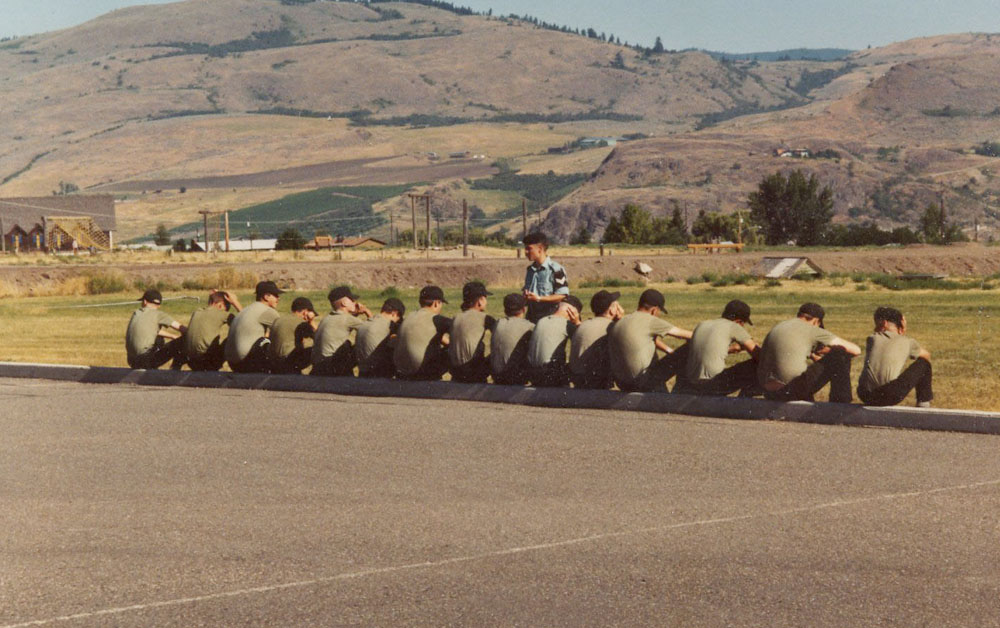
The edge of the square (www.armycadethistory.com)
On parade, we wore ‘whites’ with flat caps rather than helmets and I remember they couldn’t get me a jacket my size so I had to wear a chef’s jacket that wasn’t quite long enough and had a slightly strange collar. Martin Doughy dubbed me the ‘Barbecue Major’ ( I was a corporal at the time).

On the ‘parade’ square in Camp Vernon (www.armycadethistory.com)

I was far back right. You can see the short jacket! (www.armycadethistory.com)

Judging by the shadow, it must have been early evening (www.armycadethistory.com)
I think we went to Vernon because of some connection with Fort Garry Horse though they are based in Winnipeg. However, I am not sure!
I discovered the photos: here.
© 努江虎 – 노강호 2014 Creative Commons Licence.
A Cup of Coffee and Patriotism
Any of my Korean students will fetch me a cup of coffee if asked and occasionally they will buy me one from one of the numerous coffee shops in my area. I’m reminded of the time, when as a new teacher in my first post, I had taken a coffee into my classroom and when I came to drain the dregs discovered a couple of drawing pins lurking therein. I only took cups into my classroom on a few occasions and quickly decided it was dangerous to drink from a cup left in the presence of students. I also learnt to check any seat before sitting as upturned drawing pins were also a common means of abusing staff. Even a jacket I once left on the back of my chair was removed, thrown on the floor with my opened wallet and bank cards discarded on top. I can narrate these events to Korean students and they will be mildly shocked but there are some ‘stories’ I wouldn’t dream of attempting to narrate as they are simply too shocking for naive Korean sensibilities: boys masturbating under desks, on one occasion a boy flashed his dick to a female colleague, or girls giving boys oral sex in view of the staff room.
Recently (now a year or two ago) however, an event occurred in a British school in which a boy stuffed his penis and testicles in a female teacher’s coffee mug, took a photo of his exploit and then posted the photo on his Facebook account. The teacher subsequently drank from the cup before discovering what had happened. Unfortunately the only major link I can find for the article is at the Sun, Britain’s crappiest, and most widely read daily newspaper. I originally read it on MSN News. Incidentally, another incident in the same week involved a girl putting laxative in teachers’ coffee. I had difficulty telling the cock and sac story to all but a few very close Korean friends and certainly couldn’t explain it to a class of Korean 16 year olds whom I can mortify by simply sucking my pen. They would not be able to comprehend why any student should behave in such a manner and would see only disgust and depravity in the act. However, I could easily tell it to British 13 year olds many whom would find it funny and a valid reprisal to make on a teacher. Indeed on the MSN comments associated with the news report, some individuals questioned why a teacher would have a cup in the classroom while some simply claimed a teacher deserved such treatment.
I wondered where those ESL teachers come from who claim Korean kids are as bad as British kids given there are so many blogs and books written by full-time British teachers who are appalled by the current standards. Indeed, it’s usually only school managers and those who’ve had to prostitute their personal integrity to gain promotion, those who live in self-denial in order to maintain their sanity and preserve at east a little self-respect, or the lucky few in truly decent schools, who will deny that something is seriously amiss. I could form a small club with the number disgruntled teachers I know and I’ve known a number of excellent teachers who’ve left the profession because it excessively frustrated them. The idea of returning to British shores to teach fills me with dread.

a monitor cleans my board and replenishes chalk before every class
Britain is not the worst country in the world so why pick on it and not a really bad country? The point is I’m not incensed by the inadequacies of other countries! I don’t’ own their passports: I’m British and I’m forced to write that on official forms and documents. When it comes to learning we encourage students to accept criticism as a means of bettering their ability but many people erect a brick wall when it comes to the criticism of their nation. I’m not unpatriotic, conversely I am patriotic. (Indeed, at one time ‘patriotic’ encompassed the criticism of your country as it was borne out of good intention and the desire for your country to better itself). And of course, I have been socialised in the UK, I speak English, I have an ancestry in the British Isles. Everything about me is British and more specifically, English.
When I have lived abroad for long periods, especially in radically different cultures, I start yearning for England: English mist, damp mornings, English rain, green grass, decent tea, an English Christmas, Oh!… and the wonderful sounds of Elgar, even though I hate the nationalism it has come to represent. I miss those orchestral marches with their majestic dignity that is so vividly depicted by the characteristic combination of clarinets in their rich chalmeau register fortified by the cellos and in the background the pizzicato pulse of basses. There is no hurry, the pace is relaxed and only the British have quick marches which are so leisurely you can almost hear the snort of immense cavalry horses. And when the little timpani roll climaxes with the brush of cymbals, a thrilling, gentle ‘tushhhh,’ an orgasmic tremor, evoking a tiny tinkle of brass, breast plates, dangling swords and medals, how staggeringly imperial! The culmination of an epoch of world domination depicted not by Sousarian vigour; its thrashing cymbals, blasting trombones amidst the bling-bling sparkle of patent leather, staybright and plastic, but by sublime subtlety. And what of roast beef, bitter, lazy English villages and English eccentricity? When I’m away from England, Britain, for too long, there is a yearning, almost at the genetic level which reminds me of my roots and kindles what little allegiance I have. I too am British and this memory, this imaginative kindling is my England and ultimately the place, for better or worse, I feel at home. In this context one can argue it is very patriotic to voice a concern that it has a scummy façade, that it is not aspiring to be better either in terms of its physical being or in the nature of its citizens.

A British cavalry band trundles through the snow
©努江虎 – 노강호 2013 Creative Commons Licence.
The Life of Keiko Fukuda
Keiko Fukuda, the world’s highest ranking female judoka, died on February 9th 2013, just a few months short of her 100th birthday. She was the last living student of judo’s founder, Kano Jigoro. She held the rank of ninth dan and though she was awarded 10th dan by the USA Judo Federation, the Japanese Kodokan refused to ratify it. The Kodokan barred any woman from holding a rank above 5th dan, which Fukuda obtained in 1953. It wasn’t until 1972 that the Kodokan granted her 6th dan making her the first woman to be promoted beyond 5th dan.

Keiko Fukuda – a truly inspirational figure
My interest in this wonderful woman was sparked when I stumbled across a documentary, ‘Be strong, be gentle, be beautiful,‘ that was being made about her lifelong contribution to judo. I subsequently posted an article about her in 2012 (link). Fukuda’s dedication to the art was outstanding but what compelled me to write were the numerous mindless responses carried in Youtube’s comments archive. Anyone who posts comments criticising an elderly person carrying a dan grade and who subsequently claims they could easily ‘knock her down,’ totally misses the subtleties of ‘do.’
I believe the documentary about Fukuda was completed and given a public viewing, in her presence, in 2012. Fukuda lived in the USA, and died at her home in San Francisco.
©Amongst Other Things – 努江虎 – 노강호 2013 Creative Commons Licence.
Related articles
- Keiko Fukuda (telegraph.co.uk)
- Judo Trailblazer Keiko Fukuda Has Died Aged 99 (femaleimagination.wordpress.com)


 Elwood 5566
2 comments