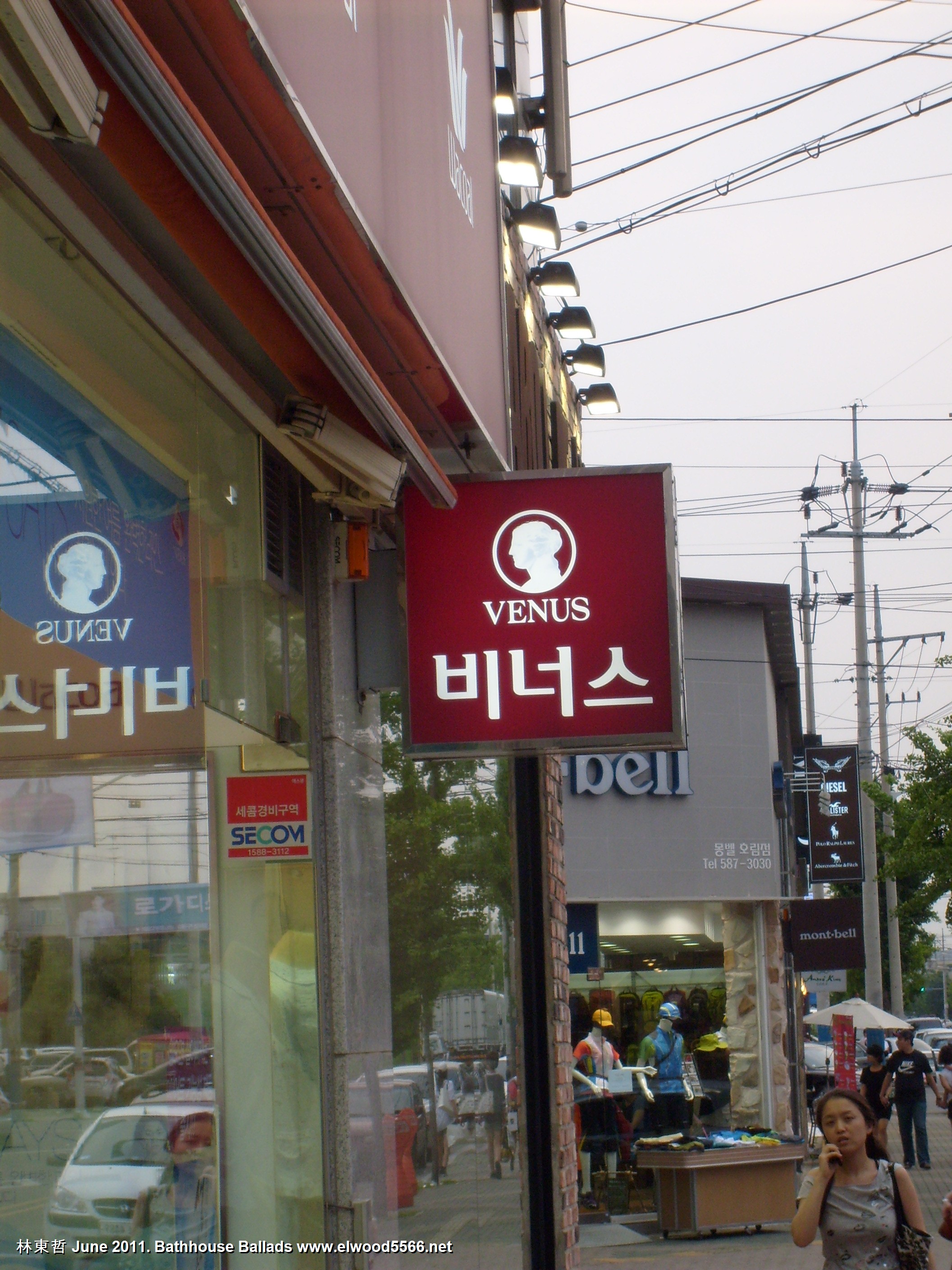
Most Likely Made in China

When looking good means expensive, shite quality. Converse made in China!
When I was a boy of about 10, I would walk to school with a simple draw string PE bag in which you kept your sports clothes, including a pair of black, slip-on plimsolls. They were all made in China and even then we used to joke about Chinese quality but they were cheap and lasted the year. Little were we to know that in years to come the top fashions and brand items would all come from China, and probably from the very same factories that made our simple, black pumps. Today, China is the point of origin, if not for many products, then for their component parts and while the big companies berate the production of imitation, especially of their precious logos, and denounces them as poor quality, think nothing of shifting production to countries which have the lowest production cost, pay the least to workers and use the cheapest materials.
I’ve recently noticed students wearing training shoes which no longer have traditional laces and which I imagine will quickly wipe out that dumb-ass ‘in-the-hood’ habit of wearing sneakers and basketball boots with enormous tongues and the laces left undone. A new piece of shoe technology, the Boa Closure Device, replaces the need to tie laces, or not, as the case may be, to the simple turning of a knob and considerably advances shoe technology.
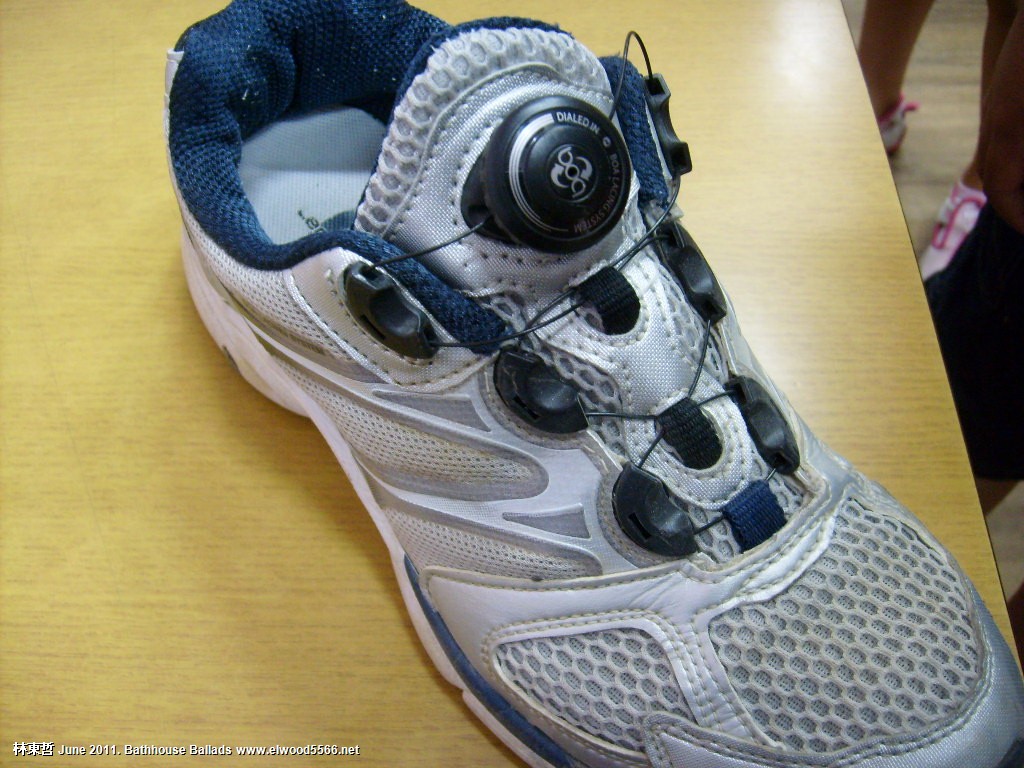
A leap into the 21st century
In the Moda Outlet, in the Industrial Complex of Song-so, Daegu, a significant number of the walking boots and trainers on sale utilise the Boa device. I noticed that while new lace technology is popular in the USA, it currently seems only available on cycling shoes in the UK. No doubt it will hit British shores at sometime in the future.
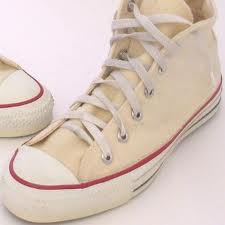
Converse quality, made in USA, is now a collector’s item
I can’t help but make a snipe at Converse which is popular in the UK and Korea. I wore them in the late 1970’s and throughout the 80’s when they were produced in the USA. I actually wore them for taekwondo while training outside and a pair would usually last around two years before the soles or heels gave out. Considering I trained most afternoons for several hours at a time, they were severely put to the test especially with spinning type kicks where all the body weight is on one foot.

most likely made in China!
Around 1988, it was difficult to buy a pair in the UK as their production moved to S. Korea. Since then, considerably cheaper labour cost has seen the production shift to China. Of course, when Converse Korean-made trainers appeared on the shelves in the UK, they were subsequently more expensive and worse, I discovered a marked reduction in quality. In 2001, Converse were bought by Nike and the quality deteriorated further with the traditional 2 ply canvas being replaced by single ply textile. The life expectancy of a pair was around a year and you no longer need to worry about the heels or soles giving out, long before that the cheapo, micro-thin toe-cap will degrade until your big toe bursts out. Converse! They sure look good but they are expensive shite and like most Nike products produced by a cheap labour force, a rip off.

© 林東哲 2011 Creative Commons Licence.
The Secret World of Bathhouse Interiors
It’s always difficult finding photos of bathhouse interiors; the reasons being obvious. However, I have recently discovered how to capture photographs and render them into the correct format. The photographs have been placed in their respective locations but I thought it useful to post them here as they provide a much clearer insight into bathhouse interiors. The additions are for Goong Cheon Lavender, Migwang Spolex and Wonderful Spa Land.

the unique Dead Sea bath at Goong Cheon Lavender
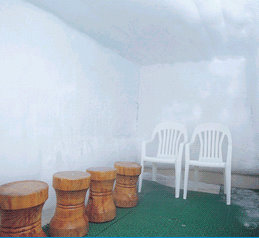
the ice sauna (Goong Cheon Lavender)
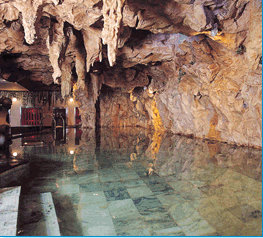
Lavender’s cold water cave
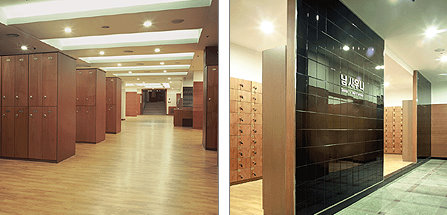
Large and spacious changing facilities (Lavender)
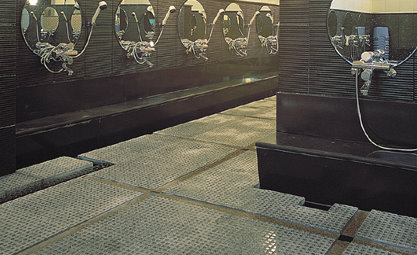
Migwang’s sit down shower units
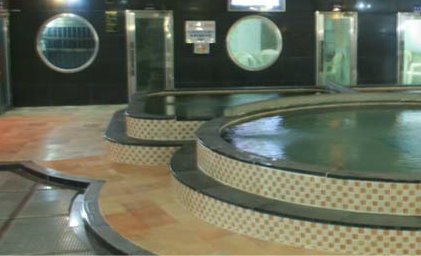
The warm pool with the pine, steam and ice room in the background. A large TV sits above the central circular window (Migwang Spolex)
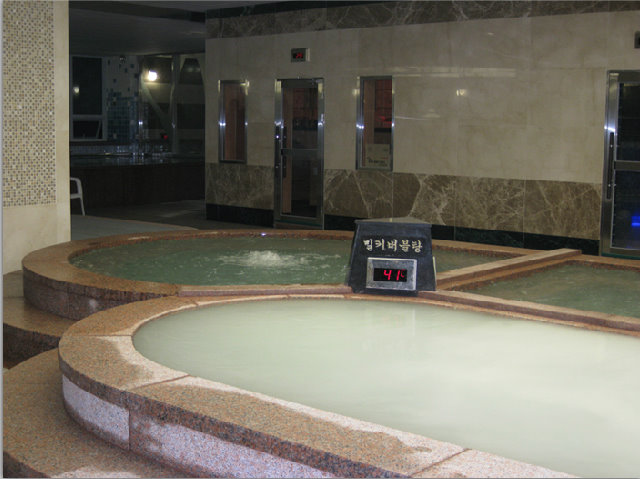
Wonderful Spaland’s luxurious ‘milky bubble tang’ with two ‘event’ pools in the background
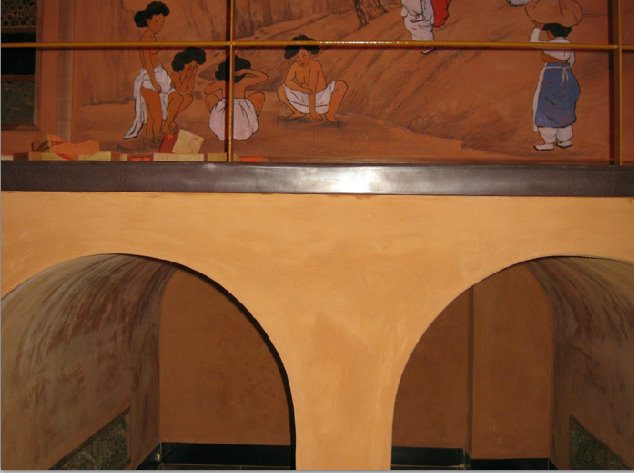
The tiered yellow clay room – for sleeping (Wonderful Spaland)
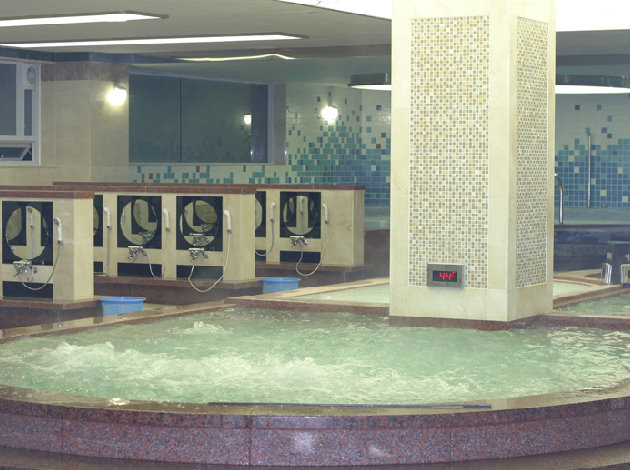
Wonderful Spaland’s warm pool
© 林東哲 2011 Creative Commons Licence.
Images of Innocence (5) – James
James, is eight years old and my youngest student. He sleeps in a tent in his bedroom with three teddy bears, one named Aloo. Here’s his story.
© 林東哲 2011 Creative Commons Licence.
Where Nature Fills the Air

The Korean Jay - 산까치

Podcast 84
Maybe it’s the nature of the information and blogs I read but there seems to be some agreement that Korean young people have less interest or awareness of the nature around them than their British peers. I have met so many Koreans who do not know the name for the beautiful Jay (산까치) that flashes through the trees on the slopes of mountains, do not know that there are several species of woodpecker (딱다구리) or do not know which tree produces an acorn. Subsequently, it has taken me years to grope my way to knowing the correct names for a bumble bee, wasp and a hornet. Because many Koreans are not reliable at classifying and differentiating wildlife, I’m often forced to use photographs on the internet but I have learnt to be cautious as even here anomalies can appear. And I don’t think I’ve ever met a British kid who hates butterflies – but I know several Korean teenagers who positively detest them.

The smallest of Korean woodpeckers - the pygmy woodpecker (쉬딱다구리)

(산호랑 나비) The swallow-tail, 'mountain tiger,' terrifies some boys I know
Living in the city, as I do, it doesn’t take long to forget the beauty of the countryside and worse, to begin to generalise that Koreans, all Koreans, are ignorant of nature. The ignorance, I now realise, is solely mine and having hung around the city too long, where most of my students and friends have been born and bred, I have forgotten that a significant part of the population live in the country. I rarely meet any enthusiasm for wildlife among those Koreans I know and even though they love hiking, the mountains are not really conducive to walking ‘off trail,’ or random exploration. The mountain trails are always busy and as the borders between the human world and the ‘wild,’ provide only a window into the diversity of Korean nature. However, ask Koreans about the camel cricket (곱등이), thread worms (연가시) or cockroach (바퀴벌레) and you elicit animated, revolted responses.
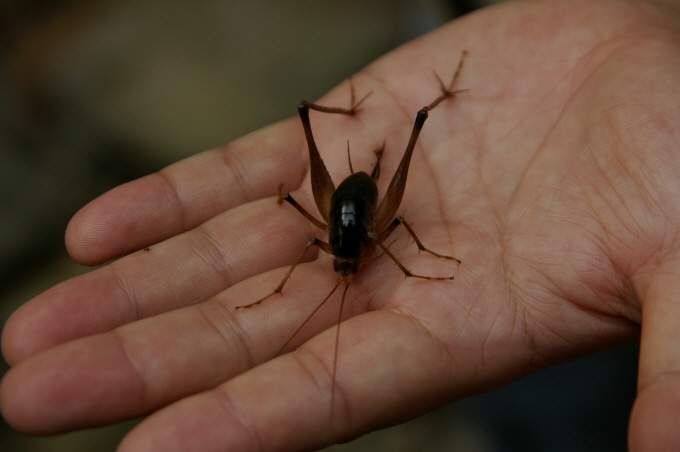
for many Koreans, the camel cricket (곱등이) is probably more revolting than the cockroach partly because of the thread worm it is often believed to be infested with (연가시)
I recently saw a bumble bee (호박벌레) while with a Korean friend and it terrified him. The sight of it actually caused him to step backwards. It was on the floor and suffering the common bumble bee problem, of not being able to take off. It was at the start of spring and in cooler weather they need to ‘warm-up,’ much like cars or humans in the cold. I put my hand down and let it climb on my finger and raising my arm skywards, it was able to launch itself, first plummeting before finally gaining altitude and eventually soaring away on the breeze. My friend was shocked I had dared let it on my hand, not because it could have stung me, which bumble bees rarely do, but because it was ‘dirty,’ but he’s city born and city bred. To date, this is the only bumble bee I’ve seen in Korea. In the UK, one often hears rumours that some of London’s inner city kids have no idea where potatoes come from and have never actually seen a cow. However, I wouldn’t be fool enough to make generalizations from such myopic observations as I seem to have done in Korea where I have prejudged most Koreans to be disinterested in nature and wildlife.
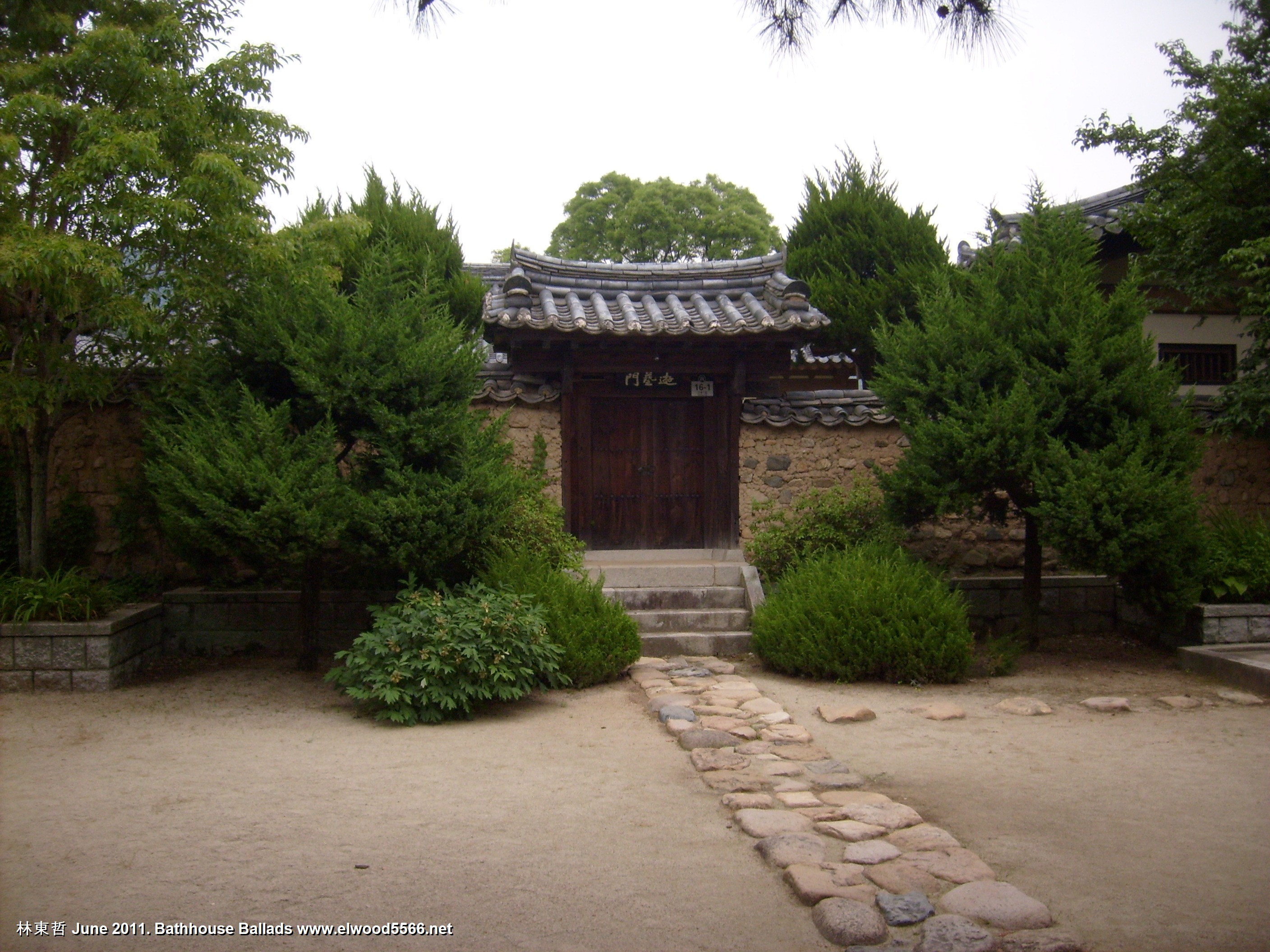
Hwa-won clan village
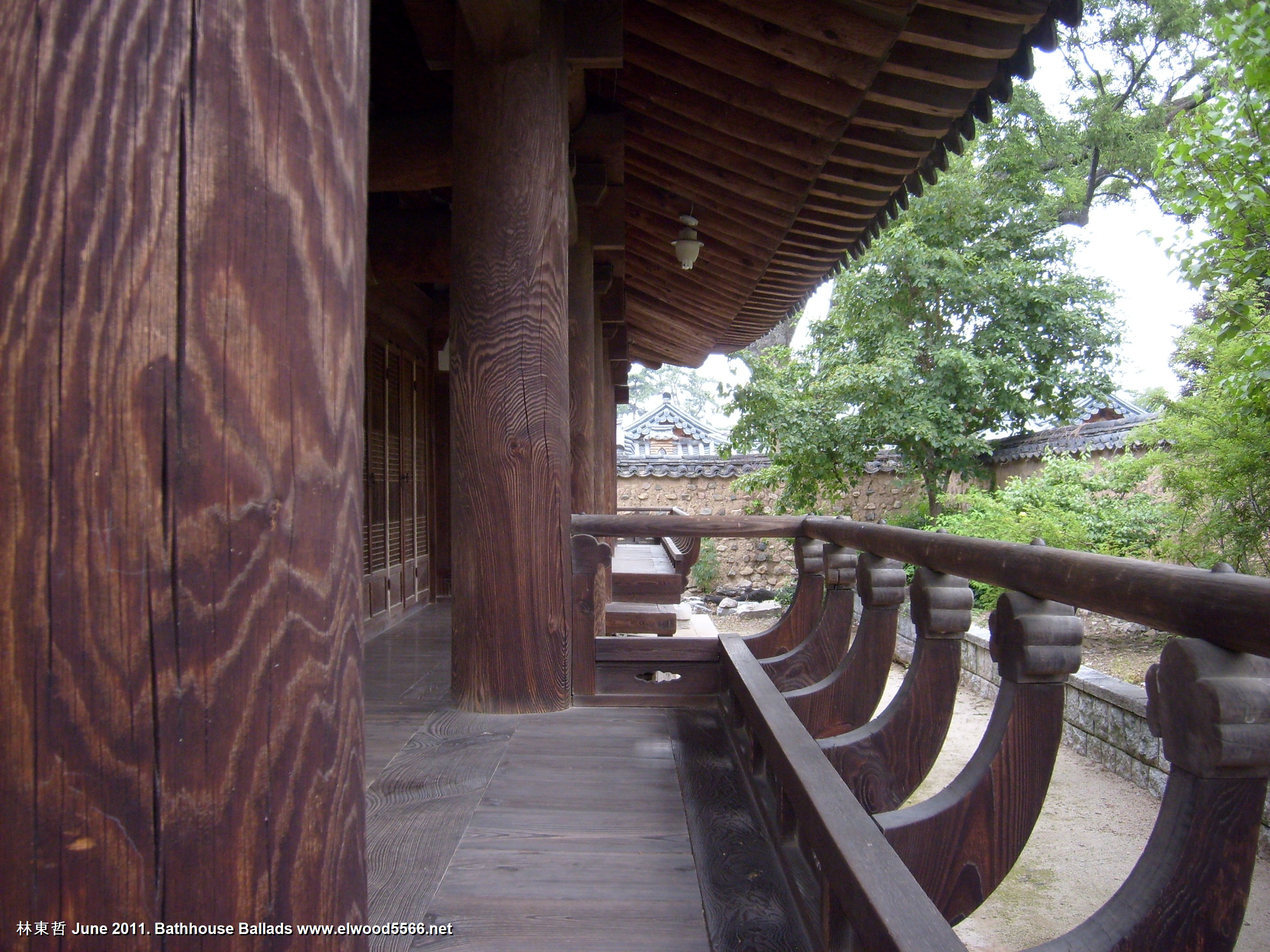
The main building of the complex
Last week, I spent the morning no more than a twenty-minute car drive from bustling Song-so, in the area of Hwa-won. I’m with a friend whose teenage cousin lives in the area and who is able to tell me the names of wild life not just in Korean, but English. Although the city is blocked from view by one mountain, and the fact it lies only a few kilometers away, the distance might as well be a few hundred kilometers and our teenage guide is definitely more rural than high-rise townie. When I spot a preying mantis in the grass, only a few inches long, he deftly picks it up between finger and thumb, in a manner which seemed practiced and was as excited with it as I was. Okay, I know this is one Korean and that my perception of the relationship between Koreans and nature is being radically transformed by him, but there is farmland as far as I can see; is it really possible to live in such an environment without imbuing some knowledge of and passion for, the surrounding beauty?
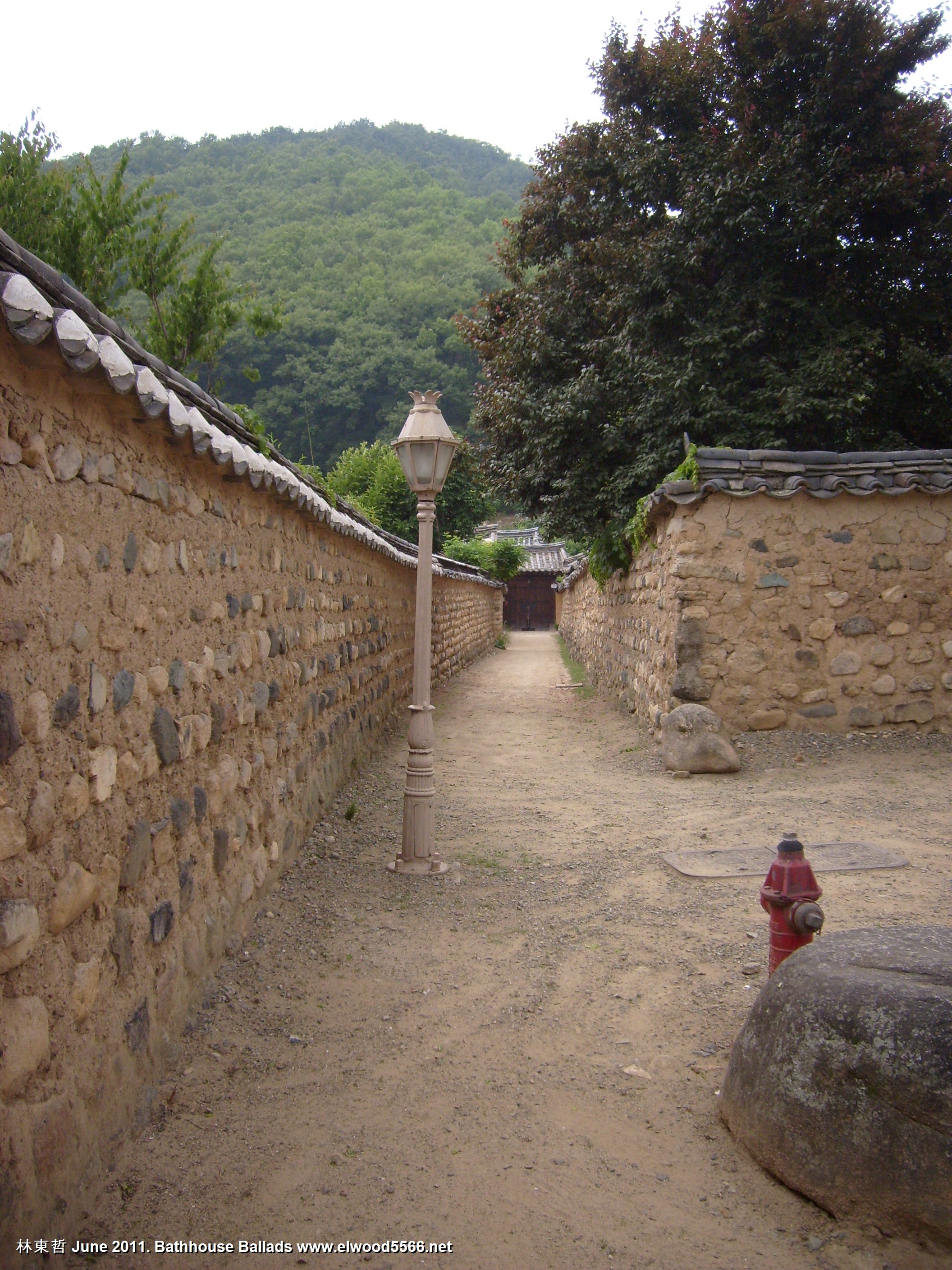
one of the quaint side streets
The number of times that Korea evokes in me a heightened sense of reality, where I am reminded of the uniqueness of my experience and how amazing it is to be in a culture thousands of miles away from my own, has diminished. Not only is Korea crawling with other waegs, myself included, but it has gradually become home from home. The internet, Skype, messenger, and a foreign EPIK teacher in every school has tamed the ‘Hermit Kingdom’ and brought it much closer to West than it was ten, twenty or thirty years ago. And a browse across the Klogosphere tends to dampen the numinous when it is stirred because a zillion others, just like myself, are having a similar experience. But I remember the times I was inspired by my first glimpse of the Milky Way from Korea, my first rice paddy and experienced the break of dawn from the top of a small mountain. Such moments were uplifting, somewhat mystical and quite moving and all the more so in the absence of the internet and an army of fellow foreigners, both of which dull the uniqueness of your experience.
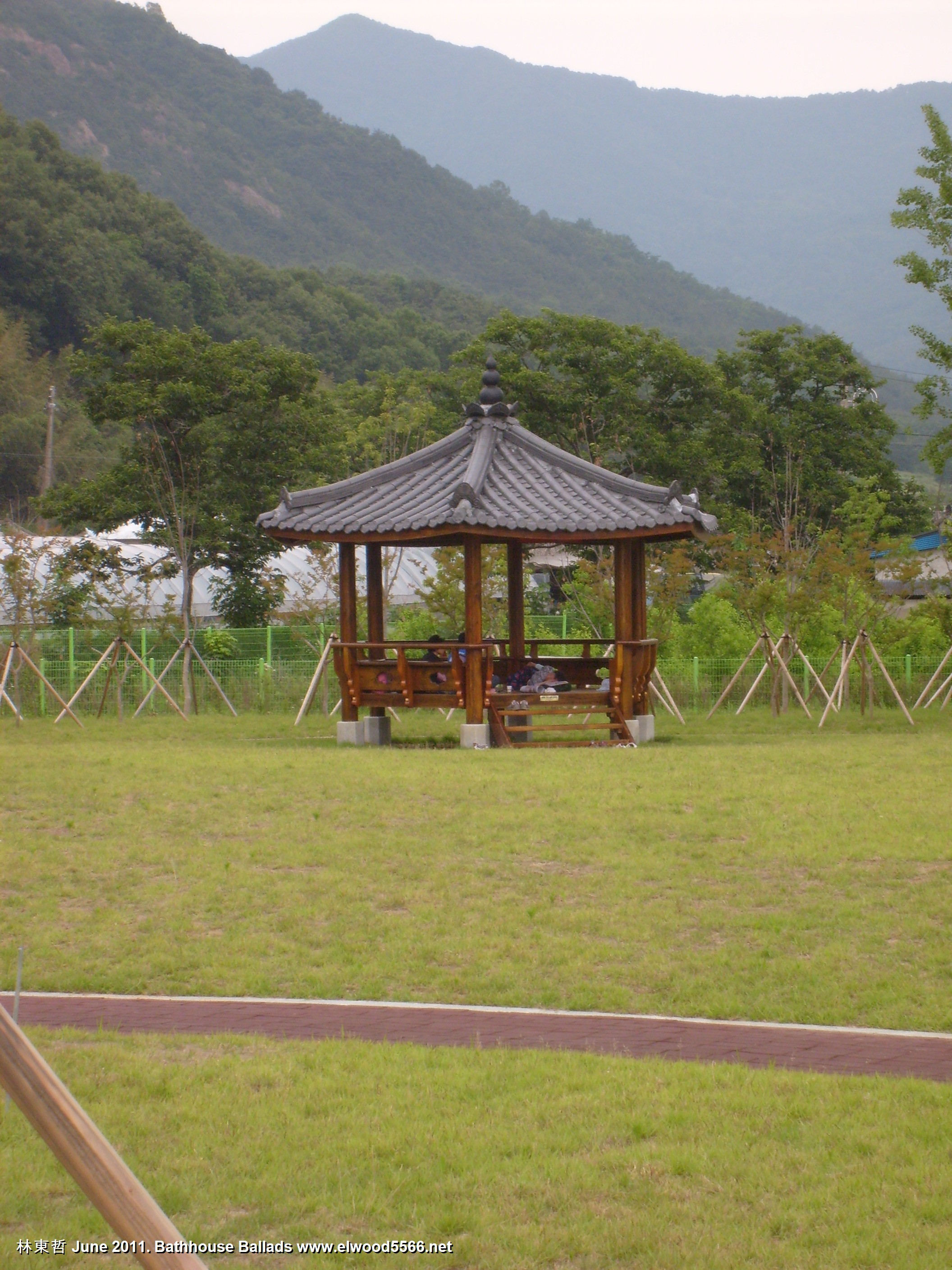
locals chilling under a chong-cha
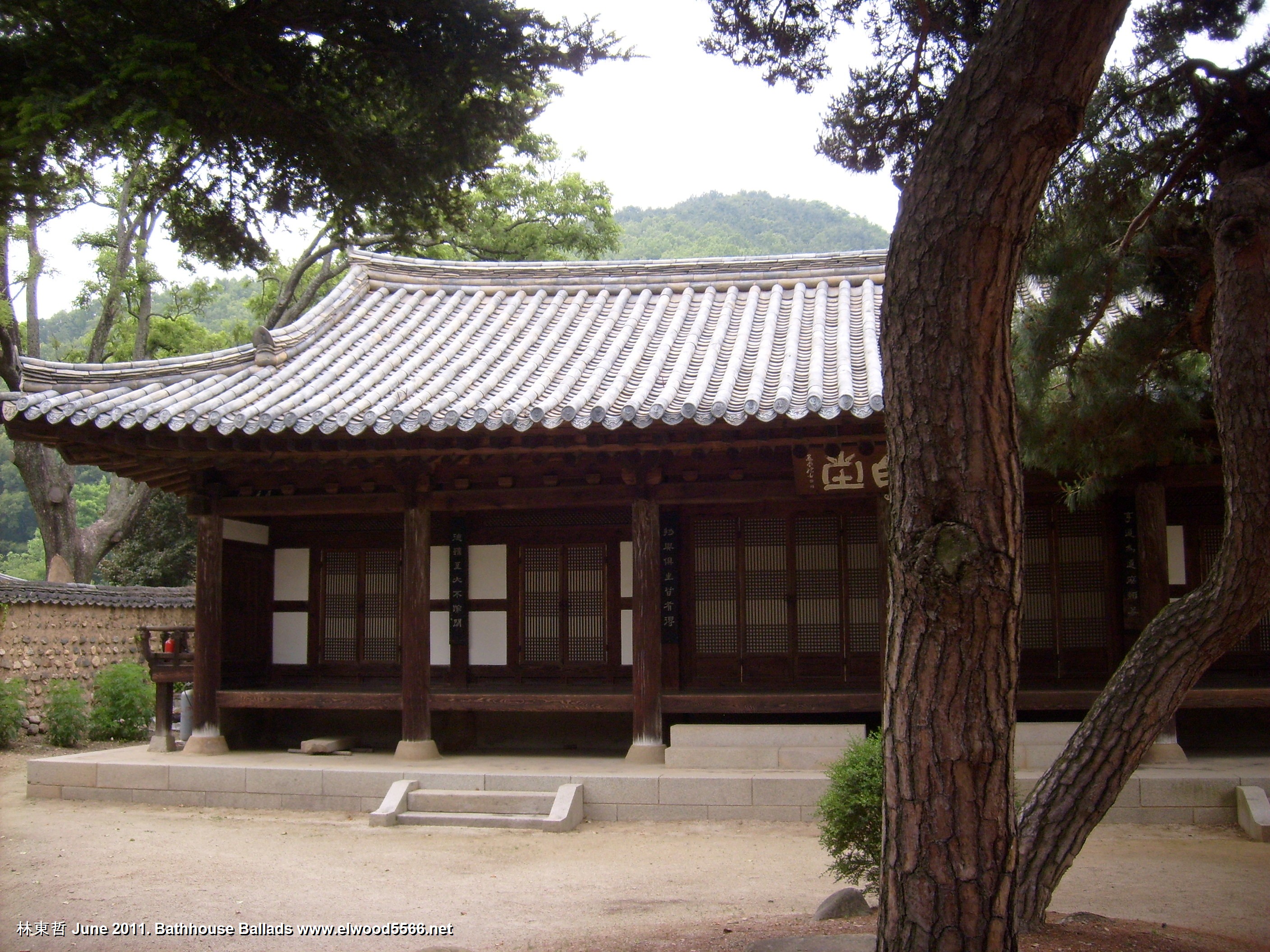
Hwa-won clan village, main building and former yang-ban residence
In the base of the Hwa-won valley, the rice paddies are flooded and newly planted with crops. In the distance I heard not just the first cuckoo in late spring, but my very first Korean cuckoo per-se; and all around the air frantically buzzed with busy insects. Of course, the season of the memi has yet to come as the weather is still cool. What was most incredible however, was the air; it was alive with the scent of grass, wild flowers and the humidity of the paddy. I don’t think I’ve ever experienced such an alive and pregnant smell and it was so heady and rich I snorted it loudly, laughing to myself in what was almost giddy glee. I suspect, if I were to spend more time in this environment, I would quickly discover locals with a love for and knowledge of the nature around them. There was far more to discover here in the broad valley than up the mountain manacled by a trial frequented by an army of hikers.
And I am gradually coming to realise that perhaps Koreans aren’t as ignorant of nature as I had at first thought and now suspect I have been drawing conclusions about them based on the assumption that a bumble bee or hornet are universally significant. If I asked British people about camel crickets and memi, I could arrive at exactly the same conclusion…
© 林東哲 2011 Creative Commons Licence.
Kimchi Bubble and Squeak – Fusion Kimchi
Bubble and Squeak was a favourite dinner when I was a boy and was one of those meals in which you could use various leftovers. It is an English food that along with most other typically English meals, toad in the hole, faggots, mince and onions, etc, you rarely find in a restaurant.
Here is a recipe for bubble and squeak using kimchi. As always the recipe is a template and I have provided some ideas for variations.

kimchi bubble and squeak (recipe link)
INGREDIENTS
•1 pound of potatoes
•salt and pepper
•1 cup of chopped kimchi
•water
•oil (lard)
•1 onion – chopped
METHOD
1. Boil the potatoes for 25 minutes, drain and mash (butter, milk, cream etc, can be added). Of course using left over potatoes is perfect. Add salt and pepper.
2. Mix the kimchi and mashed potatoes.
3. Fry the onion in a little oil in a heavy frying pan
4. Add the potato and kimchi mix to the pan and press down until it is like a cake – cook for 15 minutes.
5. Remove from the Pan onto a plate keeping the shape as much as possible. Make sure to scrape out the frazzled and burstled bits from the bottom of the frying pan. Re-oil the pan, heat, and put contents back in the pan, this time, upside down. Cook for 15 minutes.
6. Serve with an egg and/or bacon, sausages and or or with tomato, brown or Worcestershire Sauce. How about some cheese sprinkled on top or simply a sprinkling of sesame seeds and a little sesame oil. Just use your imagination.
OBSERVATIONS
My mother and grandmother never patted it down but just cooked it in the pan turning it every five minutes or so and scraping the frazzled bits, folding them into the mixture. It is the frazzled potato and cabbage which are the most enjoyable.
VARIATIONS
Bacon is a great addition at stage 3.
For a full fat version use lard in the frying process and add milk or cream and butter to the potato at stage 1.
©Amongst Other Things – 努江虎 – 노강호 2012 Creative Commons Licence.
Wonderful Spaland – Where Heaven Comes Cheap (원드풀 스파낸드)
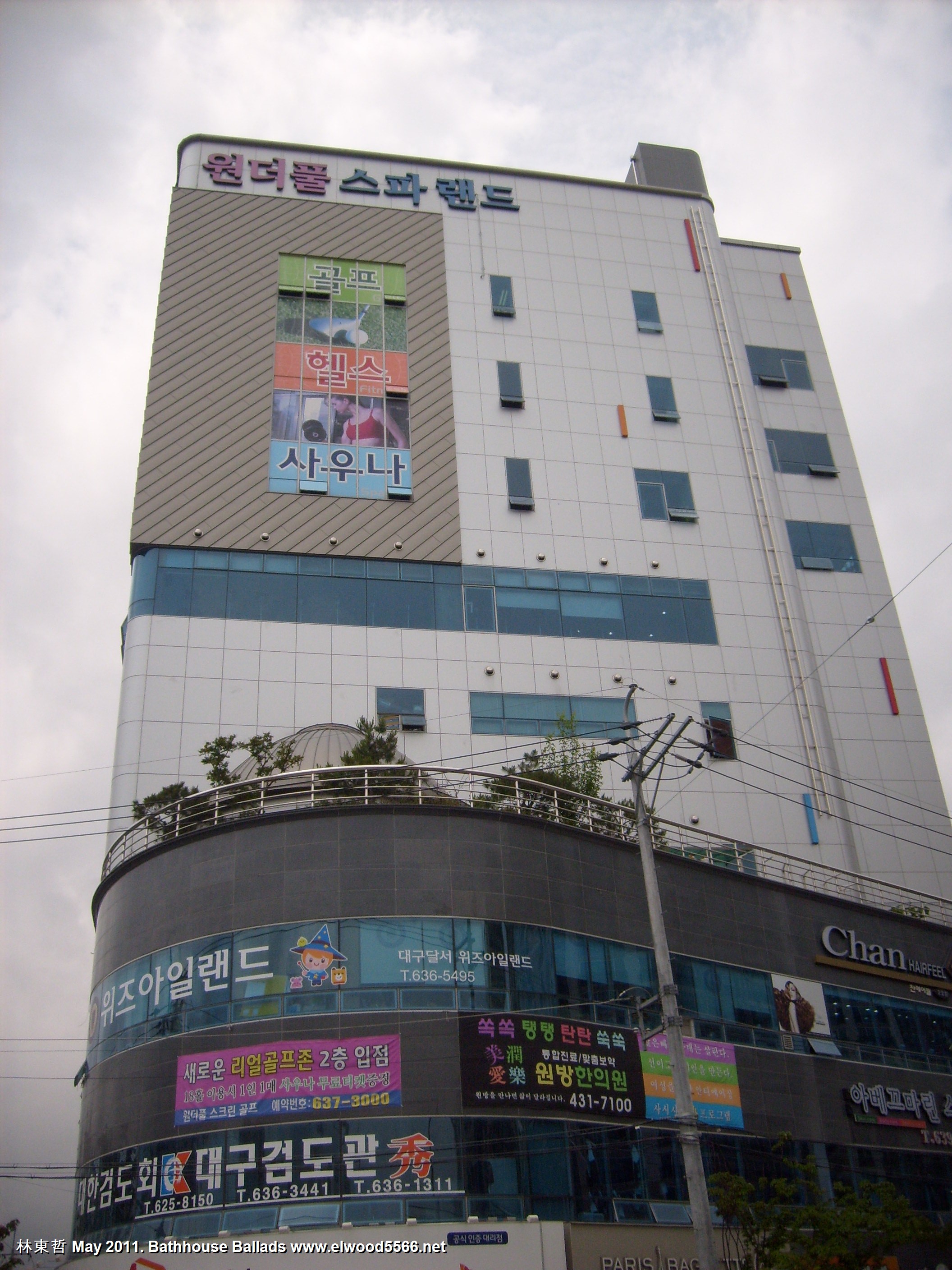
on the opposite side of the roof are the large golfing nets – visible from quite a distance
(First visited on May 20th 2011. Last visited on 15th September 2012) You know a bathhouse can be designated ‘luxury’ when you visit on consecutive days, even when you are impeccably clean, and during your stay spend substantially more time in the pools and saunas than engaged in ablutive processes. It’s my opinion, but currently, I consider Wonderful Spaland, Wol-Seong-Dong, as one of the best bathhouses in Daegu, and certainly what I would rank as a’ luxury bathhouse’ where one goes to relax, spend time with friends and do more than simply get clean. It’s failing are few and trivial. First, it isn’t a 24 hour establishment and second, it has no jjimjilbang. I can live with that! However, it does have several floors dedicated to golf, a large fitness center and besides being impeccably clean, is fairly new.
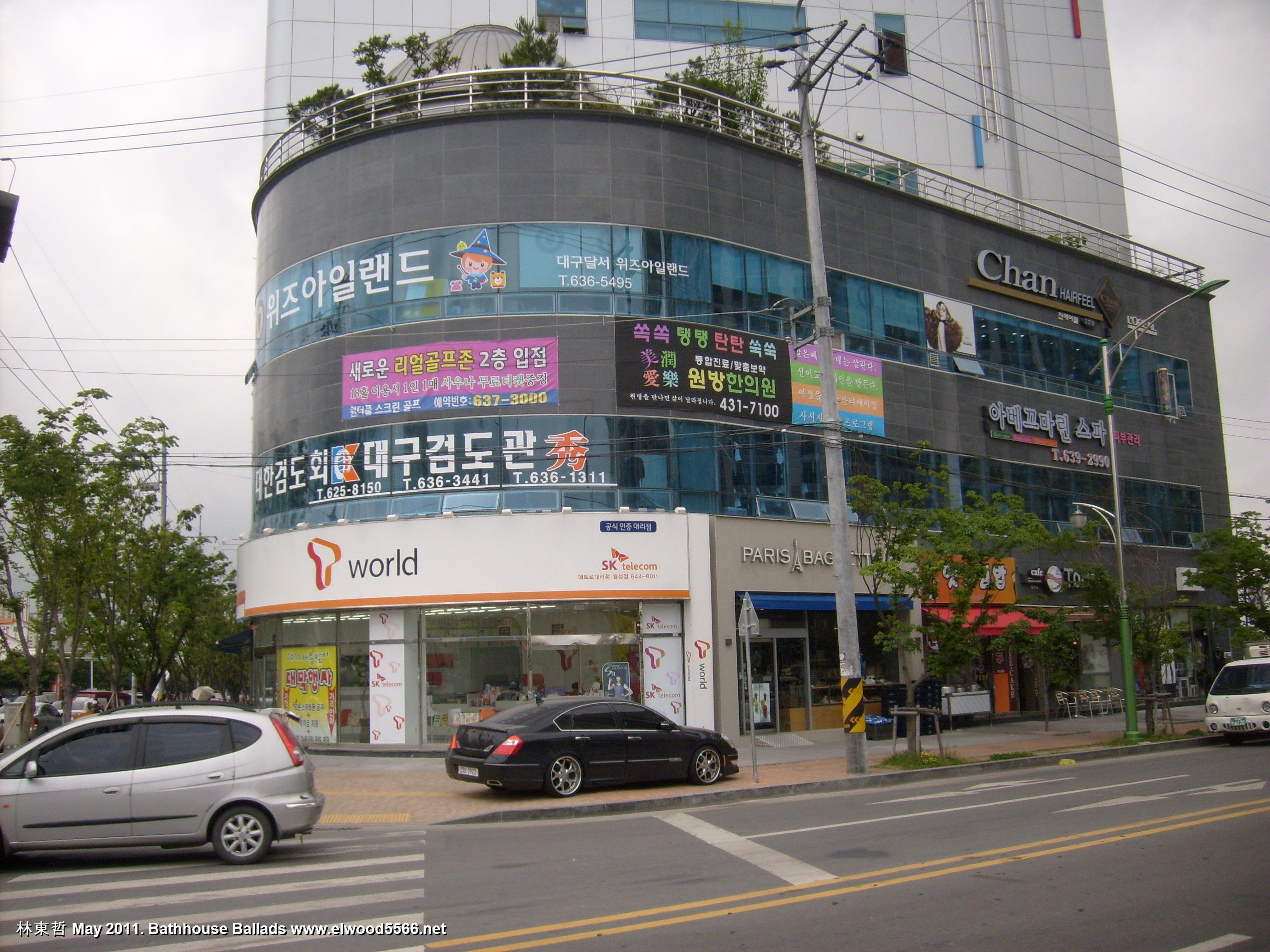
entrance
I often joke about how bathhouse ‘event pools’ are event-less. Personally, pretty coloured water, even with a few bubbles gurgled through it, doesn’t constitute much of an event. And so often, the added aromas are scent-free. In Wonderful Spaland you can expect a surprise and on my last visit the scent of one pool lingered on my skin for a few days.
Wonderful Spaland’s luxurious ‘milky bubble tang’ – the yellow clay sauna is on the left and the Roman mosaic sauna to the right
The tiered yellow clay room – for sleeping
The Wonderful complex is slightly on the edge of the built up area of Wol-Seong-Dong and noticeable by the green golfing nets on its roof. A large foyer on the ground floor, next to a Paris Baguette, welcomes visitors. The changing area (male) is bright and very spacious with decent size lockers, barbers and shoe shine. This is probably one of the largest bathhouses I’ve been to and there are plenty of areas to enjoy. The event pool was a ruby-red brew of intense red ginseng opposite which was ‘milky bubble bath’ with beautifully silky soft water. The bath really does look like a vat of milk. Other pools included hot (열), warm (온) and a second event pool, which on various visits has included lavender and mugwort additives. The largest pool (안마) comprises about 25 massage facilities with 6 different types of massage. Next is the cold pool (냉), significantly colder than many other establishments and very bracing. In another corner is a partitioned area where slatted wooden panels provide privacy so that large sliding doors can be opened reducing the temperature to that of the outside. Though not strictly a no-ch’eon (노천), which is usually fully outside, this is what it is often called. Nearby is a salt sauna (소금 사우나), small sleeping area and a fantastically intense oak charcoal bath (짬나무 / 목초탕).
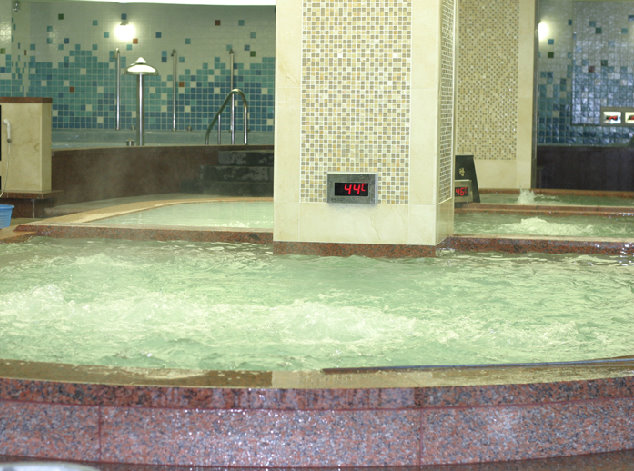
The warm pool with a large overhead TV screen beyond which is the milky bubble tang (left) and two ‘event’ pool on the right

information brochure side 1
Alongside the pools are 4 large saunas: a three leveled yellow mud sleeping sauna (황토), a steam sauna (안개) and a pine sauna (핀란드). However, the most enjoyable was the Roman sauna (로만 사우나), a large circular room with a conical ceiling. The entire room, a large mosaic at the center of which is a boxed-in steam vent. The entire room and conical ceiling where either covered in mosaic or various ‘jewels.’ However, the crowning feature was the heady scent of cinnamon and what might possibly have been aniseed. The humid aroma, blasted intermittently out of the large steam chamber seemed to shift and shade between the two key notes with spells when they seemed to blend equally.

information Brochure side 2
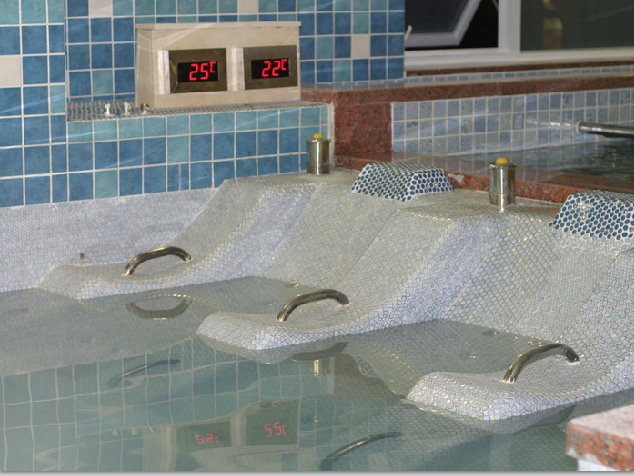
the massage benches, one of a battery of 6 different massages facilities with 26 individual massage stations
I have to say, I have a sensitive nose and there was something almost ‘trippy’ in the Wonderful Spa Land olfactory experience so much so that I feel disappointed by its absence in other bathhouses. If you’re only going to visit one bathhouse during your stay in Daegu, this is at the top of my recommendations and while you body relaxes, you can guarantee your nose will be subject to a comprehensive and pleasurable workout.
warm pool, milky bubble tang (left) and ‘event’ pool (right) The fourth pool, of which only the edge is in sight
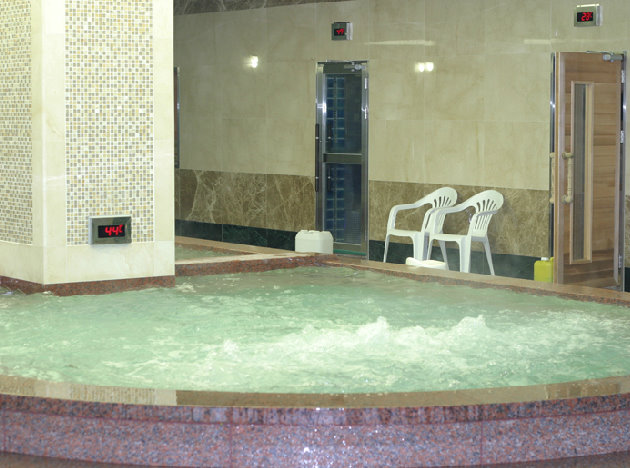
The warm pool with the Roman (mosaic) sauna on the left and the pine (Finland) sauna on the right
Location – Daegu, Wol-Seong-Dong (Wikimapia link ) near Wolbae Subway. It is within easy walking distance of Wolbae subway and by taxi from Lotte Cinema in Song-so, it is 5000 Won. A taxi from Wolbae subway will be little more than 2500 Won. It is also on the route of the 655 bus (Daegu Metropolitan City Bus Guide). (The brochure above has a small map).
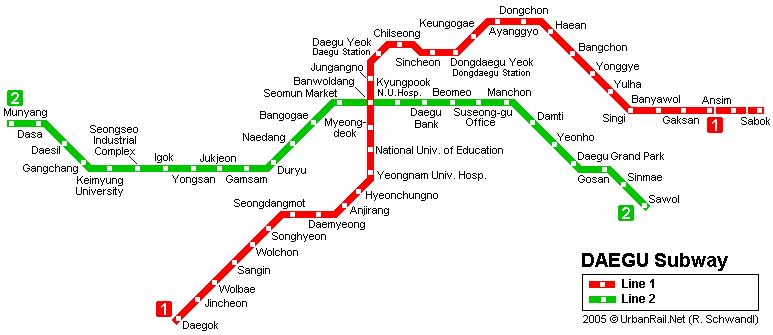
click to enlarge. Wolbae – line 1
Rating – Luxury
Times – 0500=2300
Facilities – car parking, screen golf, golf driving area, fitness training, first floor Paris Baguette, coffee shop, small restaurant.
Jjimjilbang – No jjimjilbang
Bathhouse (men) – around 65 sitting down and twenty standing up
Cost – Bathhouse – 5500 Won
Others – hairdressers, shoe shine, massage and rub downs, various seasonal discounts, numerous televisions. About a five minute walk from the ‘meat fest’ barbecued buffet restaurant, Gong-Ryong (공룡 – ‘Dinosaur.).
Ambiance – new, impeccably clean, busy at peak times, wonderful aromas permeating the whole complex, comfortably bright but with darkened yellow mud sauna and quieter, exposed to outside, no-ch’eon (노천)
Waygukin – none
Address – Wol-Seong-Dong, Tel: 053-565-7000
Website – Wonderful Spaland Website Link
Layout (Male Bathhouse)
Updates
Wonderful Spaland – a Little Less Wonderful. Update 1 (October 2011. Bathhouse Ballads)
© 林東哲 2011 Creative Commons Licence.
Tinker, Tailor, Soldier, Sailor – First Birthday Celebrations (돌잔치)
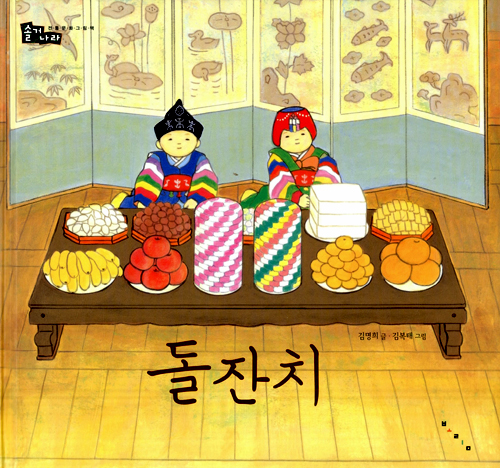
the first birthday party – when baby is 2
Poverty and hardship have left deep impressions on the Korean cultural landscape many of which are still evident today. Korean food, often reflects former economic hardships which is one reason why black-noodles (자짱면) is still a favourite when students graduate. Though many families now go to elaborate buffet restaurants, black-noodles are still eaten to mark graduation as it was at one time considered a ‘luxury’ food. The obsessions Koreans have with food, which might be expected if you are starving, almost matches the British obsession with the weather, the result of living in an unpredictable climate. I am still not used to responding appropriately when a Korean asks me if ‘I’ve eaten’ and on so many occasions still reply with a list of what comprised my last meal or perceive it as the opening for an invite to dine together. Instead, they are really inquiring as to my general well being but so ingrained has this become that for some, even this is not implied and the comment reduced to a basic nicety void of any real meaning and synonymous to British observation about the weather. Historically however, it developed at a time when many people were starving and was a question of much deeper significance. Dog stew (보신탕), silk worm (번데기), grasshopper (메뚜기) and a whole range of roots, woods and barks, many of which grow in the UK (shepherd’s purse 냉이, burdock 우엉, ㅡmugwort 쑥, etc, but which are no longer commonly used), reflect the former scarcity of food.
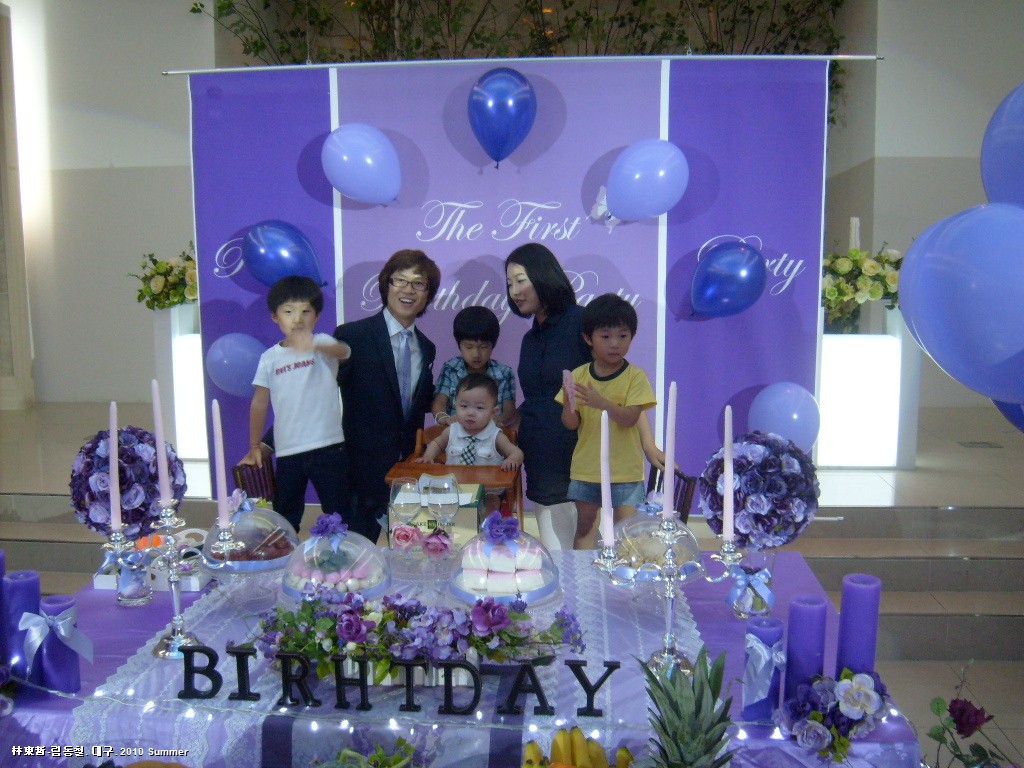
a lavish affair – Lee On-yu’s (이온유) 1st birthday. Hee-ho, On-yu’s older brother, who was the subject of an earlier post, is on the far right (Diary of a Little Boy)
Former high infant mortality rates can be attributed to the custom of a child being one year of age upon being born and with infancy and childhood being so precious, when circumcision was introduced to the peninsula, in the 1950’s, it was an ordeal sparred babies and infants and instead postponed to early adolescence. In 2006, Korea was cited by a UN report (link) of having the world’s lowest infant mortality rate of 3 (3 in 1000) compared to 45 in 1970. A further development of the high infant mortality rate was the importance of a child’s first birthday celebration (돌잔치), when in Korean reckoning they are two years old.
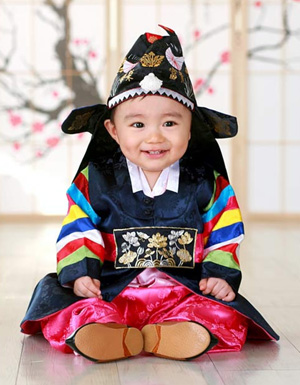
traditional first birthday attire – the dol-bok (돌복)
45 deaths per thousand within the first year doesn’t seem high until you consider that currently, 49 deaths per 1000 is the global average and that today’s most poverty stricken countries have infant mortality rates of around 50 per 1000. The fear your baby may have been one of the unfortunate led to babies, pre and post natal mothers being secluded until deemed healthy. The threats to life weren’t just from disease but also from famine and the wide swings in the Korean climate. Even today, circumcision is usually carried out in the winter rather than the summer vacation where the incredibly high humidity prolongs healing and increases the chances of infection.
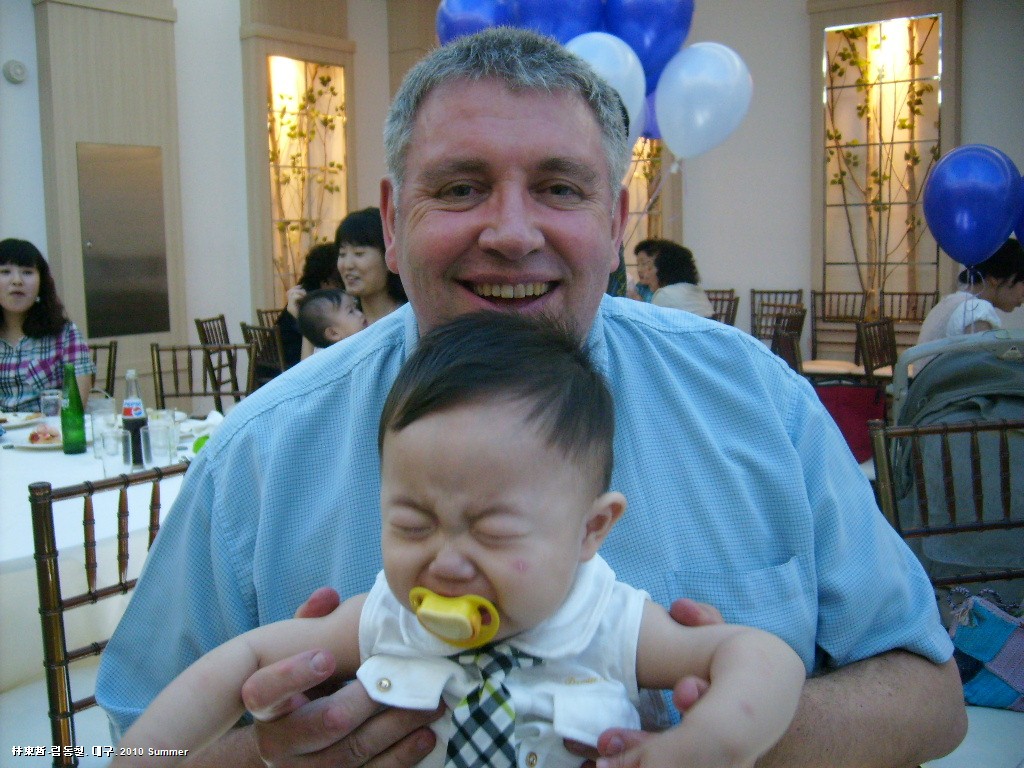
Un-yu. The microphone he played with suggests he might be a future singer – he was certainly in good voice here
The first significant event to celebrate was a child’s 100th day celebration, the baek-il (백일). However, as might be expected, this was a fairly low-key affair and the baby wasn’t ‘publicly’ paraded. On the child’s first birthday, at two years of age, it was time for parents to present their baby to the world and hence the lavish dol-jan-ch’i (돌잔치) celebration.
In today’s affluent Korean society, this event usually takes place in a large, specifically designed function room to which families and friends are invited. Historically, and traditionally, the celebration varied depending on local custom. Today, the baby maybe be casually dressed or might be attired in the highly colourful dol-bok (돌복) which differ according to gender. An elaborate buffet is provided which, along with the usual food one might expect, are foods of a more traditional and symbolic nature.

what will it be?
Now the child has survived the most threatening period of childhood, it is time to ponder what they might achieve in life and hence one of the most important parts of the celebration is when the baby is sat on a traditional duvet, propped by pillows and surrounded by objects which if played with or handled, predict the child’s future. The objects include:
pen, brush, book or calligraphy set – scholar
bow and arrow – warrior/soldier/strength (not as common as in the past)
rice cake – rich or possibly unintelligent
money -rich
thread – long life
ruler, scissors, needle – dexterous
However, numerous other gifts might appear, such as a microphone for a potential singer or a gold ball for a golf player. Nowadays, you seem to be able to add what you want.
The first birthday party has a long tradition and there are numerous variations to the celebrations which I have not done justice to in this short account. A good starting point for more in-depth information can be found at Wikipedia.
© 林東哲 2011 Creative Commons Licence.
Usually Cabbage (but whatever) Bean Paste Soup (배추 된장국)
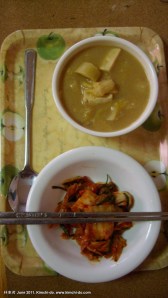
Chinese leaf bean paste soup – surprisingly delicious and healthy
Key Features: a healthy side dish, breakfast or lunch, adaptable, which is chilli and kimchi free. It also contains no oil.
Ten years ago there was a big fad in the UK for a miracle diet known as ‘The Cabbage Soup Diet.’ I actually lost over 17 pounds in 10 days but as far as diets go it was doomed to failure. The first week, as your body lost water, your weight correspondingly plummeted. However, after a week or so, the rapid reduction leveled out and with it the realization that while the grim regime was bearable if the pounds fell off, it was torture if they didn’t.
The diet revolved around the most disgusting concoction you could possibly make with decent ingredients: cabbage, onion, tinned tomato, green pepper, celery and a stock cube. For the first three days the soup was consumed for every meal and you could enjoy as much of it as you liked. It was so gross I would liquidize it and drink a pint of it in a few gulps. The smell and taste were nauseous and so it was taken like a medicine. By the third evening, you could eat a jacket potato and a knob of butter the size of which wasn’t stipulated – hence it tended to be large. The cabbage soup destroyed any pleasure in eating and guaranteed failure was not only terminal, but when real food could be accessed it would be consumed with a vengeance.
Bean paste soup with Chinese leaf cabbage (Napa) is a Korean classic and probably contains only slightly more calories than the infamous and ghastly diet soup. It is however, infinitely tastier. As you will see in the ‘alternatives’ section, cabbage can be substituted by with other items.
I know many people are put-off Korean food because they think everything is spicy or contains kimchi. This is one of the myths surrounding Korean cuisine, the greatest of which is the myth that Korean regularly eat dog. Here is an example of a Korean soup which uses neither kimchi nor any form of chilli. While it might not qualify for Westerners as dinner, served with rice, side dishes or even alone, it is an excellent breakfast or lunch. It often accompanies other meals as a side dish where it is shared.
There are countless variations on this soup. Using this basic recipe, I often use chopped pork or cubes of tofu. Similarly, you can also add chilli. The shepherd’s purse can also be omitted.
MY DEFINITIVE RECIPE
1 cup = 180ml. T=tablespoon (15ml), d=dessert spoon (10ml) t=teaspoon (5ml)
This recipe is ideal for one, or as a side dish – double ingredients for each additional person
SHOPPING LIST
1 cube (4 cloves) of crushed garlic.
Half a medium onion or leek
0.5t of dashida (다시다) or a stock cube
1,5 T of bean paste (됀장)
1 cup of Chinese cabbage leaves, previously blanched outer leaves are good.
Shepherd’s purse (냉이) about a third of a cup.
3-4 cups of water
1T flour or rice flour (optional)
See also suggested accompaniments at the bottom of the page.
EQUIPMENT
Ideally as an earthenware pot or ‘ttukbeki’ (뚝배기) or a heavy bottomed sauce pan.
RECIPE
In a heavy bottomed pot or Korean earthenware ‘ttukbeki,’ place:
1. 3 cups of water and all other ingredients. (7 ingredients)
2. Bring to a hard boil for 5 minutes and then reduce to a simmer for a further twenty minutes.
3. Optional – mix the flour in a little cold water and add to the soup. Stir for two minutes and serve.
SERVING SUGGESTIONS: Serve with an accompanying bowl of rice and side dishes. It can also be served as a side dish with other dishes.
ONGOING NOTES:Try using a small amount of pork, or diced tofu. You can also substitute cabbage spinach, crown daisy, chrysanthemum (쑥갓 ), burdock leaf (우엉) or mugwort (쑥).
© 努江虎 – 노강호 2012 Creative Commons Licence.
Kimchi Omelette – Fusion Kimchi
Key Features: easy and quick to cook, adaptable, Korean fusion, snack or fusion side dish
I’m constantly on a diet and freeze anything I might be tempted to eat when feeling peckish. So, one evening, feeling a little hungry I looked in the fridge to see what items might possibly make a quick snack. Five different pots of kimchi and a couple of eggs were all that confronted me.
So, I whisked two eggs and then added some chopped kimchi. The result was quite delicious.
MY RECIPE
1 cup = 180ml. T=tablespoon (15ml), d=dessert spoon (10ml) t=teaspoon (5ml)
This recipe is ideal for one – double ingredients for each additional person
SHOPPING LIST
2 eggs beaten in a bowl
Half a cup of finely chopped kimchi
1t of sesame oil.
1t of sesame seeds
a little ordinary oil – just enough to stop the egg sticking to the pan
See variations and suggestions at the end of the recipe.
EQUIPMENT
Frying pan and bowl
RECIPE
1. Fry the chopped kimchi for a few minutes in a little ordinary oil.
2. Fold kimchi into the beaten egg
3. Put the mixture back in the frying pan
4. Drizzle a little sesame oil and a sprinkle of sesame seeds just before turning the omelette.
Serve with a little tomato sauce or whatever takes your fancy.

kimchi omelette


 Elwood 5566
leave a comment