The Last Taboo
 Recently, I changed my routine so I often go to my favourite bathhouse (목욕탕) after I finish work, around 8.pm, rather than in the morning. However, I prefer the morning as it is quieter and unless it’s a holiday or a weekend there are rarely any kids or university students. As I lay in the ‘special event bath,’ this week scented with lavender, another westerner entered. In four years of fairly daily bathing, this is only the second time I have seen a westerner in a bath house. He probably saw me but as usual, didn’t acknowledge my presence. Most westerners will walk straight passed you even on an early Sunday morning when the streets are empty. I’ve given up being friendly as a cold shoulder is the usual treatment if you are polite. There are exceptions, of course, but this has been my experience. I didn’t particularly want him talking to me anyway; I don’t mind being naked in front of Koreans but have never relished the idea of bumping into a westerner when nude as we tend to be critical and judgmental about nudity and the bodies of others as well as our own. In reality, the westerners who do use bathhouses, especially if alone, probably have healthier attitudes to bodies than those who avoid them. I don’t think he felt particularly comfortable in my presence as he left after only a few minutes which was a shame as, my apprehension aside, it would have been a good opportunity to exchange experiences.

Usually, I have to wiggle my backside like a gigantic duck in order to disengage that little seat from my bum.
I don’t think he was a bathhouse novice, either. From the lavender bath in which I was relaxing, I could see him drying off in the area immediately beyond the bathhouse exit. He had no problem bending over to dry his feet and calves and did so without maneuvering his backside into a corner, thus censoring that most private place from public view. One of my remaining inhibitions, though not as acute as it was, is exposing or touching this area in public. Perhaps I need to set myself the task of prostrating myself 5 times a session and soaping my backside in a position where my neighbours can see, as a therapy to neutralise this remaining inhibition. I would like to squat right down, Korean fashion, and give my entire undercarriage a thorough scrubbing, if it were not for the fact that I find deep squatting both easy to topple over in and difficult to stand up from. I have enough problems standing after sitting on the bucket sized seat from which you wash yourself as often it remains stuck to my arse as I stand. Then, if it clangs to the floor, it attracts unwanted attention. I have a similar, though quieter problem, if I sit on a towel as this too will remain in the grip of my buttocks, as I stand. The term, ‘taking in washing’, which is used to describe the backside’s ability to grip things, usually underwear, comes to mind, but bathhouse furniture and towels is taking it too far! Maybe it’s my arse, I don’t know and I’ve never paid much attention to what Koreans do after sitting on a towel. I have a niggling suspicion that the propensity for my buttocks to grip towels and seats, even the large plastic type, similar to the ones we use in gardens in the UK in summer and which are often found in the steam rooms and saunas, have more to do with my dimensions than my ethnicity; I have a large arse to put it mildly. Of course, I don’t know how other westerners conduct themselves in a bathhouse as I’ve never observed any but I would imagine that many would find it disconcerting to drop the soap and have to pick it up. This chap was quite at ease, as at ease as the Koreans around him, at prostrating himself right in front of the glass doors to the bathhouse and in full view of everyone lounging in the baths. Whoever he was, he left the bathhouse with my admiration.
 © Nick Elwood 2010 Creative Commons Licence.
Am I Really That Dumb?

Korean alaphabet
I think I must be pretty dumb when it comes to learning foreign languages though the skills I do have are clearly above average. I claim this because recently, European Union research highlighted only 5% of British people can count to 20 in a foreign language. Apparently, Americans fair worse! As I can count to 20 in 4 languages, though in two that’s all I can do, I can designate myself a polyglot.
Anyone who has lived in Korea long enough and is battling to learn the language will have met those ‘linguists’ who seem to have picked the language up in a few weeks. Don’t they depress you! I met a chap last summer who told me he’d learned the Korean alphabet in ‘a couple of hours!’ My God! I’ve been struggling with it for years. When I tried to clarify whether he meant he was familiar with it or could actually read it, he insisted his abilities were sufficient to read text though not understand it. I remember another passing acquaintance, a very colourful character, who insisted the language was ‘easy’ and all you had to do was add ‘yo’ onto the end of everything – which also included English words. And then there are those who tell you their level even though they don’t go to classes and have never been assessed. Of course, they’re never a beginner like you are and usually pitch themselves at ‘intermediate’ or if a little humbler, ‘lower intermediate.’ This always reminds me of the cartoon character Peggy, from King of the Hill, who says she has: ” an IQ of 180, give or take a few points because she assessed herself.”
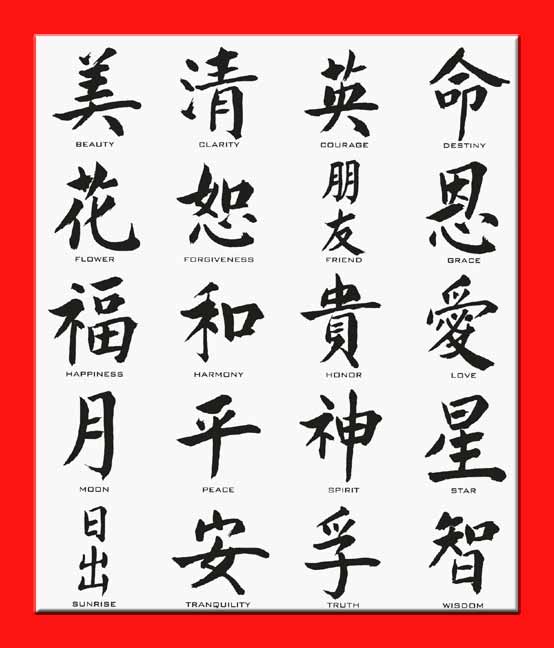
No language is easy and Korean, with a totally different alphabet, three speech levels, honorifics, dialects, the numerous pronunciation exceptions created by certain sound combinations and then the fact that many sounds, ㄷ ㅌ ㄸ ㄱ ㅋ ㄲ ㅓ, to name a few, cannot be rendered by an English equivalent. Or at least this is my humble understanding. So it is neither ‘Daegu’ or ‘Taegu’ and indeed the only way to write the city’s name free of ambiguity is as 대구. Of course, if you want to be really flash you can write it in hanja, 大邱. Recognising sounds is another skill and one I find my weakest. The way Koreans cut short particular final consonants often causes me great confusion so I end up muddling ‘ginger’ with ‘thinking’ and ‘acorn curd’ with ‘eagles.’ Asking the market stall owner how much the ‘eagle curd’ is or, if they have any ‘thinking?’ raises eyebrows. And ‘persimmons’ I am always confusing with ‘liver.’ Talking of 감 and 간, I still find it difficult to hear 홍시 and 혼시. The thought I am a slow learner suddenly intensifies as I remember a two-hour session trying to hear and replicate ㄲ as in ‘꿀” (honey). And if you really want to test your ability to use the Korean alphabet try spelling the most difficult words of the lot – English loan words. I find broccoli, coat, shirt and yogurt especially awkward. Yogurt! Now is that 요구르트 or 요그르트 or even 요구르터?
Hanja
No matter how hard you study Korean you will constantly meet those who can speak it better than you. I don’t mean the pretentious linguist types who master the basics in five minutes – you rarely hear them speaking unless it’s in English and telling you how easy Korean is, but those with a genuine talent for languages and who have also made an effort. You read about those who study every moment they can, running on the treadmill listening to dialogues or reciting conversations as they walk to work. It takes me all my effort not to fall off the treadmill and on the pavement, at least in the city, one needs all mental faculties to avoid being smashed to pieces by one of the numerous meals on mopeds maniacs. However, if you really want to impress people, Hanja has few foreign followers. You will have to learn Korean for a few years to truly impress other westerners but with Hanja you can do it with a handful of characters. I’ve met westerners who could speak fairly good Korean but didn’t know any Hanja and I know Korean adults whose Hanja skills are rudimentary. I currently know around 600 characters but at anyone time will have forgotten around a third of them and many of the characters comprising this third will change on a daily basis. The educated Korean should know approximately 1,800 characters; 900 learned in middle school and another 900 in high school. I’ve spent ten years, on and off, studying Hanja – all a total waste of time especially as with every 5 new characters I learn I tend to forget three or four old ones. If I can study Hanja for another 30 years I ‘ll be ‘averagely educated.’ Some of my Koreans friends try to suggest that it is not how many characters I know that is important but that fact I study them. Personally, learning Hanja is a little like learning Latin or Greek, an exercise of the mind but with attractive squiggly little patterns. At the end of the day, Hanja provides few benefits to my spoken Korean but it certainly impresses both westerners and Koreans and to be honest I do get a little thrill when I see some characters and actually recognise them.
I take my hat off to those individuals who can communicate in Korean at any level especially as there are plenty of foreigners living in Korea who see no point at all in learning the language. I even know one teacher, with post-graduate qualifications, who insisted he came to Korea to better understand Korean culture and not to learn Korean. But those who warrant my greatest respect are those individuals who have mastered the intricacies of Korean from a Speak Korean in Five Minutes, (paper back, 50 pages, no cassette), read on the flight to Korea.
Sanitised Santa
A few years ago, I read an article about how one large city in Canada recruits and trains Father Christmas employees almost a year before they are employed. The Father Christmases are stringently vetted and then undergo training to make sure they are ‘politically correct’ in behaviour and communication and have been upgraded to whatever latest jargon is on the PC agenda. You know what it’s like: one minute they’re fussing over how wicked it is to say ‘Afro-Caribbean’ instead of ‘African Caribbean,’ or reminding us how insulting it is to use the term ‘brainstorm,’ but all of them use the term ‘Chinese New Year‘ instead of ‘Lunar New Year.’ At least if you’re an African-Caribbean wickedly called an ‘Afro-Caribbean,’ half of this term is correct. At least you’ve been located in the correct continent but if you’re Japanese, Korean or Thai, et al, ‘Chinese New Year’ totally ignores your culture. So, banned by the PC police from asking small children what ‘mummy and daddy’ are going to buy them for Christmas, the potential Father Christmases have to ask what ‘mummy or daddy, or their guardian or carer ‘ are going to buy them. Next, they are trained not to make any form of physical contact with children and to make sure that when with children, they are in full view of other adults. I would imagine they are forbidden from putting hands in their pockets as they too probably have to be in constant full view of parents, carers, guardians and the hidden security camera installed to safeguard companies. And the ride on Santa’s knee or parked in his lap? Most definitely out! Another aspect of childhood poisoned and perverted by the PC lobby!
- Sanitised Santa
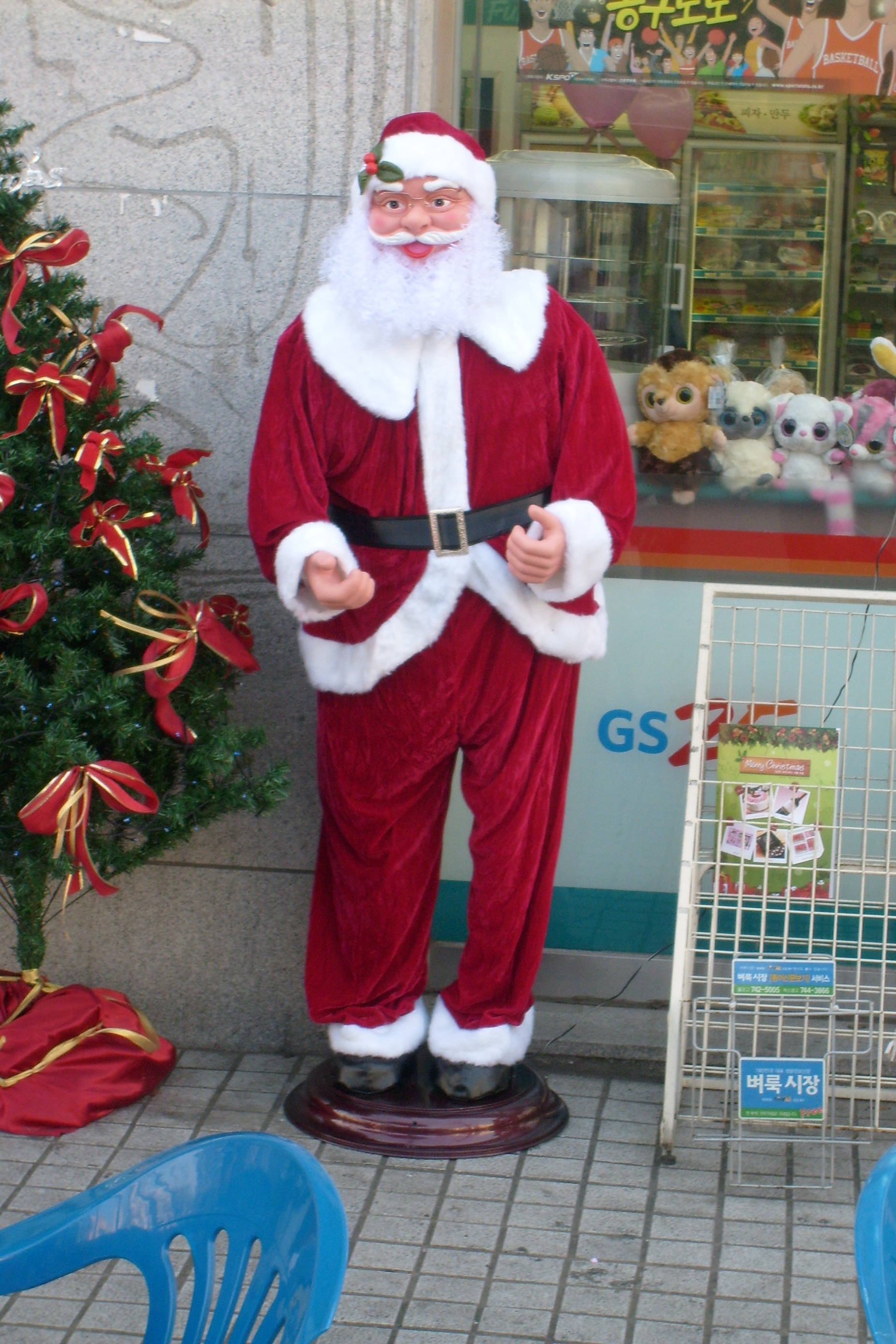
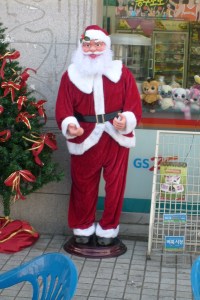
Such a process, vetting, training seminars etc, for several hundred Father Christmases is no doubt expensive but, I might have just the solution. I discovered this Santa on a cross-road outside a 24 hours store in Daegu. This automated Father Christmas is perfect for working with children. He can be stored away with his companions and brought out a week before needed; no vetting, no seminars and no law suits.
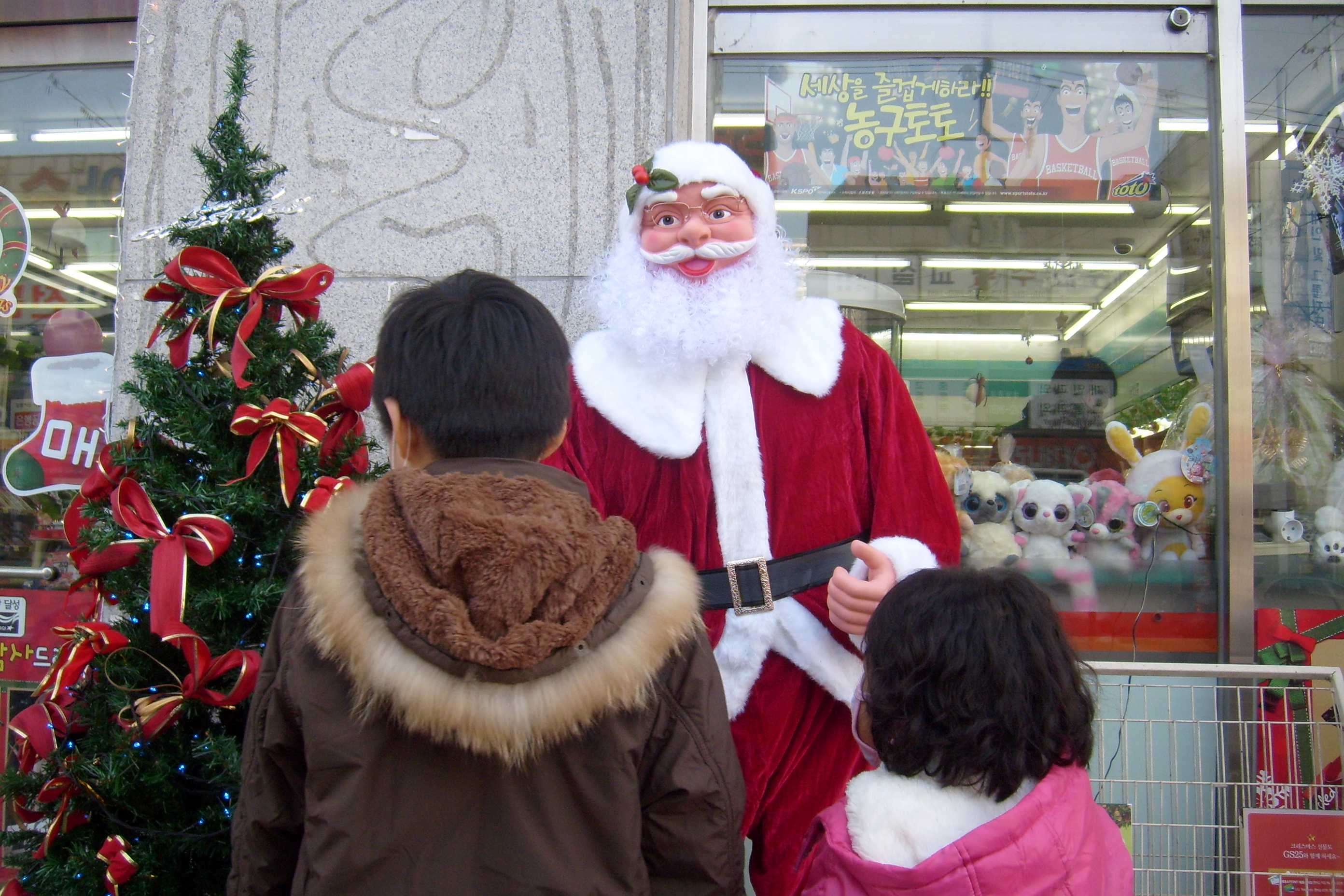
The Korean Santa will put all fears to rest. First, other than the ability to make a ridiculous chuckle, he is mute. Gone are the worries that a pervy Santa might upset a child by using un-politically correct terms or worse, mouth or mutter obscene suggestions. And the plastic, toothless mouth, apart from smelling pleasant is incapable of licking, kissing or pouting. Being mute, the Korean Santa can be employed from Baghdad to Boston with no worry about foreign languages. Fixed to the spot by a small plinth, he cannot run away and is permanently available for questioning, stoning or lynching, should the need arise.
Being thin, any potential caverns or hidey holes made possible by overhanging bellies and large tunics are removed. The Korean Santa is incapable of hiding kiddies, or swiftly pulling even the smallest of them under his tunic. While The Korean Santa can move his hips and arms, albeit it in a rather jerky and amusing manner, almost as if stricken by BSE (Mad Cow Disease), such movements are small and limited and minimise and prevent any possibility of hands slipping onto, or groping in, those places they shouldn’t. And the final and most significant advantage is that the standing posture not only makes the need for a grotto redundant but avoids the possibility that some children might actually enjoy sitting on Santa’s lap.
And packet-less!
© Nick Elwood 2010 Creative Commons Licence.
Definetly 'Ji Ji' (지지)
For the last few weeks I’ve been paying attention to the contents of my dustpan after I have swept my studio floor and run the ‘magic mop’ over it. The ‘magic mop’ has a disposable cloth attached to the head to which dust and most other debris firmly sticks. I noticed a long time ago that you can’t flick anything on a Korean floor without it reappearing some days later, stuck to the sole of your naked foot or clinging to your sock. Grains of rice, once hardened are especially annoying.
In Europe at least, and especially in Britain, carpets are often the preferred choice for floors and in some aspects they are wonderful because they absorb most small debris. ‘Sweep it under the carpet,’ an idiom I am often asked to explain, really isn’t necessary with small things as you can deposit them on the floor and at most all you need do is rub you foot over it a few times to permanently erase whatever was underfoot. All bodily bits, small scraps of food, cigarette ash etc, are banished forever in the pile of your pretty carpet.
Ten years ago I moved into a new house in England and after a year decided to rip up the carpets that had lain on the front room floor for well over a decade. Even after months and months of hoovering the floor and liberally sprinkling it with various scented and odour eating carpet powders, I was never able to feel comfortable sprawling out in front of the TV. The carpet was old but it never actually looked dirty and the unpleasantness I felt probably arose from the fact that I occasionally detected odours emanating from it, odours which weren’t unpleasant but weren’t mine. You wouldn’t want to wear a stranger’s unwashed clothes so why would you want to lay on their ancient carpets, carpets ’worn’ by several families. Even after meticulous cleaning, I regularly wrestled lengthy black hairs embedded within the pile. They were of Greek extraction because Greek students had lived in the house, some three years before I moved in.
When the carpet was eventually dragged out of the house, departing in a dusty cloud, the wooden floor on which it had lain was covered in a thin coat of what looked like sand except it was finer and softer and most likely organic in origin. The carpet had acted like a filtration system so that only the finest particles escaped through to the floor boards. Once hoovered you could see the small spaces between the boards were caked with dirt that had been compressed into them over many years. This had to be gouged out with a knife before I could sand the boards. Once the front room and dining room were rid of carpeting and the floors washed, scrubbed, scrapped, sanded and treated with linseed oil, the need to dust became a monthly rather than weekly routine.
The decision to banish the muck absorbing carpet, and to subsequently ban outdoor shoes from inside the house, was finally made after I noticed a small brown thing on the floor. I smoked marijuana at the time and on two occasions I had discovered dope on the floor though one discovery turned out to be either dog shit or a clinka that had fallen out of my nephew’s nappies. This mistake only transpired when I inhaled the joint I had rolled from it. Needless to say anything brown and lumpy and laying on the floor I assumed to be dope before anything else. Though I suspected what it was, it needed confirming. I sniffed it and instantly retched – cat shit, the worst carnivore shit of all!
Ten years ago, the streets around my house were liberally ornamented with piles of dog shit. I know because I used to stick small cocktail flags in them to draw attention to them; it was a form of social protest. When walking to work I would count the passing turds and often, in just half the street, I would count as many as thirty. I had some intimate relationships with the turds in my street: one had been laid in the furthest corner of my lawn, just under the privet bush. I couldn’t fail but notice it as it was large and shaped more like a small cow pat than one of those curled and tapering whippy whirl turds that Korean kids are so expert at drawing. In 2000, when I first arrived in Korea, I wondered why so many ice creams were drawn on tables especially as the Baskin Robbins opposite my haggwon, scooped ice cream out of large tubs rather than deposited it whirled. Only the smallest dog could have manoeuvred its arse into the required position under the privet bush to deposit the poop, a Korean size handbag dog for example, but this specimen’s owner had to be big.
I watched that turd for an entire summer and well into winter, witnessing its transition from a wet mess to one with a crusty top, rather like a pie that then turned white after an infection by some strain of turd eating mould. Eventually, internally atrophied and dehydrated by a hot summer, it collapsed into itself. Gradually absorbed into the ground around it, it disappeared but by that time it was late winter. Back on the pavements, I even began to recognize individual dog’s shite and could sometimes trace their various daily messings down the street. One example, a particularly big deposit was almost orange in colour. I imagined the owner, walking their dog in the anonymity provided by the early morning darkness, allowing it to shit in one spot and the next day dragging it a little further down the road so as to share the messes equally around the neighbourhood. As dogs like to do their business in the same place, I would imagine that the moment the dog started to squat on its hunches the owner had to drag it further before letting it spill its backside onto the pavement. I estimated the owner probably took a month to circumnavigate the crescent before the dog had to poop in approximately the same place and if even house numbers were the victims one month and odd house numbers the next, the cycle could have been extended over two months. Despite the copious piles dotted about the street you never saw an owner allowing their dog to foul the pavement so, never trust dog owners who walk their dog in the dark.
Some owners were equally as considerate and seemed to think it was acceptable for their dog to shit on the road. For several days, as I ate breakfast, I was treated to the view of another enormous turd, strange how they all seem to have been enormous, as it was squelched all over the tarmac by passing cars. Neighbours who made their dogs pooh on the road probably perceived themselves as good citizens while those who used the pavements were anti-social. Eventually I put a rather hostile placard on my front lawn and several neighbours then did the same; instantly, the appearance of new turds ceased and those remaining were old and in various stages of atrophy, dehydration and decay. I kept counting the turds walking to work however, as the number of deposits beyond the borders of my placard’s influence had significantly increased.
I’m digressing: My point is Europeans and especially the British prefer to wear outdoor shoes inside their house which is a custom I find horribly disgusting and more so if you have carpets which act as toilet paper to the soles of your poohey shoes. There was so much shit on the streets around my house, and there still is, that natural decay and rain swirled it everywhere so that even if the ground looked clean, you could guarantee it was coated in canine faecal matter. Wearing shoes indoors, when so many dogs foul the pavements is a disgusting habit.
I don’t think I’ve ever seen a dog turd on a Korean street and even if there were it would only be a little thing as most Korean dogs are handbag dogs and incapable of passing anything more than a few pellet sized faeces. And yet Koreans never wear shoes inside their houses and often don’t wear them in workplaces.
When you live in a room which is barren of carpets your awareness of your own bodily debris grows. When you have a carpet you assume that the bit of nail you blow onto the carpet, or the bogey you roll and flick onto that beautiful Axeminster, simply vanishes. I can flick a toe nail across the room and know that in a day or two it will reappear in my dustpan along with a grain or two of rice, a few hairs and other bits of fluffy stuff. Occasionally I’ll spit out a nail to deliberately see when and where it will re-emerge.
I’ve noticed there are rarely any hairs on the central part of the floor because these are blown to the edges of the room by the draft from open windows and passing bodies and for some reason, the biggest trap of body hair are the sliding door groves. Every few weeks I need to clean these out. Pubic hair has the most amazing ability to float into places like your fridge or kitchen work-surface and though you might find this abhorrent and are thankful that your carpet seizes them before they become visible, I’d rather see the occasional curly devil on a plate or in the fridge than lurking in the pile of some horrid carpet, rotting slowly among years of bodily refuse, embedded and matted with all sort of unthinkable crap, dead skin cells, bogeys, shoe dirt, dog and cat muck, grit, rain water etc, etc. And then, thinking we are being hygienic, we sprinkle the carpet with floor powders that temporarily scent the air. What happens to them once they have embedded themselves in the carpet? I doubt such powders disappear.
I live alone and so my observations are based on my own bodily sheddings but how greater the pollution if you live with other people or a family and have pets. Carpets are such filthy things and what we do with them is not much different to that other dirty British habit, thankfully disappearing, of blowing gunge out your nose and into a hanky which you then keep warm and moist in your pocket, the perfect environment for viruses and bacteria, before putting your face back into it and snorting out another load. Having a carpet on your floor is a little like sleeping in the same bedding without ever washing it.
Cleaning a carpetless room is a joy because it’s effortless and now Samsung have even marketed a robotic floor cleaner that cleans your floor when you are out. Everything is exposed in a Korean room as there are few true hiding places. And if you want to wash the floor or give it an occasional scrub or douse it in bleach, well that too, is easy. Carpets can’t be washed and I’m sure all carpet shampoo does is drive the dirt deeper and enliven their parched innards. There is probably a surge in a carpet’s bacterial and fungal population following a shampoo.
In Korea, many westerners don’t remove shoes indoors preferring to stick to their own customs and there are others, myself included, who will occasionally wear shoes on their floor if for someone reason they have to return briefly indoors because they’ve forgotten something. This is a habit I am trying to break but when you’re in a rush it is difficult. You very, very rarely see Koreans walk on their living space floor wearing shoes, not even for a few seconds. I have noticed that on the odd occasion I have breached Korean custom, I have subsequently felt the deposited dirt left by my shoes, when barefooted. You can’t see it but it’s there despite the fact you only walked on the floor for a few seconds.
Korean students, especially younger ones, will sometimes cringe and tell me how dirty I am if I suck my pen. Often they will shout ‘ji ji’ (dirty) which is the word used to small kids and in the same category as English words like ‘pooh pooh’, ‘wee-wee’ and ‘tinkle’. If sucking a pen is a little ‘ji ji’ then having a carpet or rug is infinitely dirtier, indeed it is positively filthy! Next time you flick some item onto your Korean floor, just remember, it’ll be back!
지지 – dirty – (but a word used to small children), haggwon – 학원 – a private school like a homework club or after school study center.

carpetless
Return to Korea (Korean Accounts 2. 2002-2003)
I arrived back in Korea, in September 2002, after agreeing with Mr Joe that I would do a six month contract. After my former mistrust of Joe, it might surprise you I returned to work for him but I suppose my feelings towards him mellowed and in addition, I really wanted to return for an extended spell. In the year since I was last in Korea, much has changed. Now there are many more westerners than there were two years ago. The evidence of westernization is striking and there are even more Macdonald’s burger bars, Baskin Robbins ice cream parlours, Pizza Huts and Burger Kings. On the main road through Song So, that leads to Kemyoung University, in addition to the MacDonalds and KFC, there is now a Baskins Robbins parlour, a second one is presently being built, and a Pizza Hut. All these facilities are within a 10 minute walk of my front door. I am also sure that I am seeing more fat Korean kids than I did before.
I am living just around the corner from my old apartment and in fact I could have looked out my former bedroom window onto the side of the building I am now living in. This time I am in a one bedroom apartment which is next to a Chinese Medicine establishment and looking directly onto a barbecue restaurant and restaurant which is being built and as yet has not opened.
Pak Jun-hee and his family left the old restaurant where I spent every Saturday evening teaching Ji-won. I don’t think the restaurant, which was behind the Shin-woo (신우) supermarket on the main road leading directly down to the university, was bringing in custom. They have moved to a restaurant just around the corner from where I live which is just a few doors down from the bakers and the Hapkido School. The restaurant is very small and sells pork (삼겹살) or beef barbecue. Even though the restaurant can be very busy, I think the returns are less than adequate and the family is struggling a little.
I have been up Warayong Mountain several times with Pak Jun-hee and though it is a struggle to get to the top it was well worth it. Warayoung is the mountain which lies directly behind Song So. Last weekend was the Korean festival of Chu-sok and so we had Friday off. The weekend was a bit boring as all my Korean friends headed off to their family tombs. However on Sunday, after our mountain climb, Pak Jun-hee, took me to his house. It is in an apartment on the 10th floor of an apartment overlooking the street his restaurant is on. It was a special occasion as I have never been here before. The house was smallish but comfortable and as usual very open planned. There was a cabinet with a lot of liquor miniatures in them as Sun-hee collects these and then quite a few large jars, like parfait jars, with various fruits in them pickled in alcohol – these are Pak Jun-hee’s. Ji-won was really excited to see me and showed me his room – simply a bed on the floor, his work desk and books. Apart from some teddy bears, his sister’s room was much the same – a complete lack of pop posters, fashionable clothes, music systems, computers and all the consumerist crap that western teenagers have to have. What was more interesting was that rather than their rooms being dens in which to hide themselves away and pretend to be individual – their rooms were completely open to the house. I don’t think privacy is such an important issue here. Sun-hee returned from town and cooked us some food and then I watched a Tarzan movie with Ji-won and his sister. This week Pak Jun-hee started a new job. In the mornings he goes to work on a construction site. He leaves home at 6am, returns home at 6pm (all for around 30 pounds a day), and then in the evening works in his restaurant which Sun-hee closes at around 4 am. They are saving money for Ji-won to go to university. What a life! And I moan at having to work anymore than 6 hours a day.
The exam period for middle school kids (13-15 years old) is here and it so noticeable; the streets are teeming with kids going to and from the Hakwons. They study in these until 11 or 12 pm and in Di Dim Dol, my school; they can buy cakes and noodles because they do not have time to eat a meal at home. I have had several private classes cancelled though I still get paid for the lesson. This week in the elementary schools (7-12 year olds) sports day and as always everything in Korea happens at the same time. The kids sit in classes with stamps on their arm telling you whether they came 1st, 2nd, or 3rd in the various competitions – running, jumping, dancing etc.
At the moment my routine is really good; in the morning I study Korean, then I go for lunch, then to the mokyuktang (Han Song), and then work. I finish work at 8 pm, go straight to Pak Jun-hee’s to eat and at 10 pm I do some private lessons. My Korean and Hanja are really improving. I sat in the green tea bath at the mokyuktang on Friday talking, to an old man and managed to learn that he was 68, weighed 65 kilos, was 1 meter 60 tall, had three sons, one which lived in the USA, that he was a grandfather and had been the Los Angeles. We got talking as he said he recognised me from another mokyuktang bath house and the whole interaction excited me as he spoke no English at all.
Several times a week U-chun and I meet up and spend time chatting in a restaurant. We have been visiting this place which sells oysters – nothing but oysters and for around £10 pounds you can have a big meal for two – usually something like oyster tempura, smoked oysters and oyster soup served with a variety of salads, kimchees and ray fish in spicy sauce. (This restaurant was originally a North Korean restaurant that we visited on our first get together, back in 2000. I re-visited for oysters, several times in 2009 but it has since closed.)
Yesterday David and I went down to the part of Song-so near Kemiyoung University. I wanted to buy a CD as I have been listening to the same music for almost six weeks. Then we went to this excellent restaurant down near the university. It was supposed to be a Spanish style place but there was nothing Spanish about it at all. The place was really weird – just a sort of cocktail bar and restaurant with nothing but sofas and tables. A rather large room just filled with big comfy sofas. David (이영선) said Korean’s think this place is western and he was surprised at my expression when we entered because it isn’t western at all. We ate squid and octopus fried rice and Japanese style pork cutlet.
I do get a bit pissed off at the way Koreans laugh whenever I try to speak Korean. Even U-chun will sometimes have a little giggle. In a private class the other day, I mentioned my arm was sore and the two boys burst into a fit of giggling. One of the boys, Kim Young-jun (김영준) is a bit slow at telling the time and I told U-chun (유천) that he’s a bit slow. She teaches him maths privately. ‘Oh! He’s stupid.” she said. ‘I regularly have to hit him or make him stand in the corner of my front room with his arms above his head.’
Like I said, everything was going well but in Korean things can always change. On Monday, I discovered that the Tasmanian teachers in Di Dim Dol, Matt and Debbie, had done a bunk and left the country over the week-end. Well, now I have been told that tomorrow and until further notice, I must work the hours 10-12am, 1-2pm, 3-8pm! I wasn’t too pleased. When I got home I went to Pak Jun-hee’s and he could tell I was angry but he calmed me down. Later I decided to write a letter and outline my concerns. In the morning I didn’t go to work and handed the letter to Keith as he went to the kindergarten. I then met U-chun and we spent the morning at Baskin and Robbins. A bit of ice cream cheered me up. I had told the school I wouldn’t be going to work until 3pm and that I would work their hours for 2 weeks and then decide what I was going to do. When I went to school, Nell the kindy head, called me into her office to discuss things. The turnout was that I have a slightly longer break in the afternoon but to be honest the quality of my life is shit. Now I work 10-12am, 1-2, 3.50pm or 4.35-8pm. I don’t really have time to do anything substantial and there is no time to train as by the time I get home there is really only enough time to eat, socialise or study for an hour and then go to bed. The problem is Joe is running two schools with one set of teachers and things will get worse in October and November when Nana and Wendy leave.
There has been a lot of stuff on the TV here about five boys who disappeared 11 years ago. Anyway, the boys are known as the ‘frog boys’ (개구리 소년) because on the day they disappeared, they were going to collect frogs. They lived right behind where I live and went into the Warayoung Mountain where they disappeared. There have been loads of police around and several thousand soldiers were drafted in as the boys bodies have been discovered buried and with what might potentially be bullet holes in their skulls. For the last few weeks they have been gradually piecing together each boy’s skeleton. One boy’s coat was tidied at the cuffs. It’s on the TV every evening and has gripped the nation as it has been a mystery here what happened to them and of course the boys’ parents have been on TV. It has been very sad.
When I ask Koreans about this incident they approach it in quite a strange way. I think events like this are so rare that they don’t really have a rationale for them. When I ask Koreans what they think happened I get responses like, ‘they were murdered’, or even stranger, ‘perhaps they were murdered.’ Really!?’ To suggest the boys might have been sexually abused isn’t the first or even second conclusion Koreans come to. The police seem to have had a history of naivety in the investigation. A few weeks ago they suggested the boys had frozen on the mountain despite it being March when they disappeared and them being not too far from home. (The fact they were buried didn’t seem to make any difference.) The boys were found in an area that at one time was close to an army training camp and they now think that a boy may have been accidentally shot by a soldier and then the other boys shot to cover up the incident up.
I went for 4 sessions of acupuncture on my arm as I have had a slight pulled muscle in it for several months. In total the treatment cost me £30 pounds this being exactly 4 times cheaper than getting treatment in Wivenhoe plus several sessions lasted over 2 hours. Now I know why Korean doctors have empty offices as all the problems which clog up the western surgery, the back problems, pulled muscles, etc all go to traditional centres in search of relief. Let’s face it; western doctors are crap at dealing with such problems. Anyway, the treatment seems to have worked but what was most interesting was that I had had another strain in my back which has niggled me for nearly two years. I had treatment earlier in the year back in the UK and after two sessions with there was no improvement. I didn’t notice popping when they manipulated my spine. The Korean doctor, using exactly the same technique, popped my entire spine and the problem disappeared.
I haven’t seen too much of Ji-won as in less than four weeks he has his exams and the whole of Korea is counting down until the day they begin. These exams are known as the ‘goa sam su neung’ (고삼수능) and are the final year exams of high school students. For very many young Koreans this will be one of the most important days of their lives. We went to the PC rooms (PC 방) last week and they had to ask me if I gave Ji-won permission to be there as it is illegal for under 19 years old’s to be in them after 10pm. I have also found out that in some schools, boys are not allowed to have hair more than 3cm long and it is not to be dyed. They are also not allowed to wear trousers any narrower than 7cm at the ankle. Ji-won told me one of his friends was beaten for having highlights in his hair when it was in fact grey streaks -yes – some Korean kids have natural grey streaks in their hair and there is a Korean term for this. One of my private students, Hyun-min (현민), arrived at my apartment barely able to walk. His hair had been more than three centimetres long and so he, and a few other boys, had to strip down to their boxers and run around the sports five times and then do fifty squats. Hyun-min (현민) is 18!
©Amongst Other Things – 努江虎 – 노강호 2012 Creative Commons Licence.
Written Sept 2002
Blue Belt Grading – May 1-16th, 2001 (Korean Accounts 2000-2001)
On Saturday, I met U-chun. During the period of the middle school exams she is working seven days a week and this situation will continue in all hagkwons until May 12th when the exams finish. She works from 2pm until midnight on six days a week and on Sundays works from 9am until 3pm. I am writing this diary On May 1st which is a public holiday for Buddha’s birthday but as you can expect, the hagkwon teachers are working today, as are many of their pupils. None of them will get a day’s holiday in lieu which is so typically Korean.
We wandered around E-Mart for a while so I could question her on what is what. It was my turn to buy lunch today and I chose a restaurant near MacDonalds, one I had passed many times before and one where you sat at tables and not on the floor. I never find sitting on the floor comfortable as I can’t get my long legs under the low tables. We ordered a seafood meal which was cooked at our table in large frying pans built into the table. The meal looked fairly Klingon but tasted very good. First the chef put water in the pan and then a massive stack of seafood consisting of crab, prawn, squid, squid roe, shellfish and octopus. This was topped with vegetables and red pepper paste. There was easily enough for four people and when the pan was half empty some noodles were added to it. The meal took us over an hour to eat and as U-chun had to go back to school, we left quite a bit. It was a pricey meal costing 24000W (£15) but we really enjoyed it.
The video player in our house, which is a pile of shit and has been playing up ever since I have been here, eventually died after I bashed it with my fist. A cassette was left in it and to get it out we had to dismantle it rather forcefully. However, Mr Joe replaced it without any questions; but of course, the replacement video isn’t new and is the size and weight of a computer hard drive. It must be at least ten years old. Matt is pleased as his sole entertainment is lying in bed, (even when it’s hot), with a packet of cigarettes, a bottle of coke, some Pringles and a couple of videos.

every day as my mini-bus passed an apartment, this little boy would bow
I went to Pak Ji-won’s this evening. He was really excited as he is off on his school picnic this week. He is spending four days at Mount Sorak in the north east of the peninsula, not too far from the 38th parallel. It is the third highest mountain in Korea. Although Ji-won’s is almost 18 (17 UK age), he was like a little boy looking forward to Christmas. I happened to bump into him and his class mates as they were shopping at E-Mart, on Sunday. They had two trolleys full of apples, oranges, Korean crisps and coke. I did my shopping and as I was leaving the supermarket I noticed them waiting outside the store entrance. Ji-won’s wasn’t with them and I sat opposite and observed them for a little. I tried hard to imagine what it must be like to be a Korean teenager going on your one big school trip. Korean and western cultures are so different that it is impossible for a westerner to become Korean. Ten years living in France, Germany or the USA would be enough to make you a native, provided you immersed yourself in that culture but too many differences exist between Korean and the west. Many of these differences are born out of childhood socialization. The boys were all excited in a way only Korean kids can be. Affectionately, they draped themselves over each other. I wondered how much this excitement was scripted knowing that once schooling is finished life becomes even more prescriptive, regimented and seconded to work. As much as I respect and admire and have fallen in love with the Korean psyche, I find their lives horribly myopic: the nightmare of schooling, which for Ji-won’s is some seventy hours of study a week, the brief reprise of university followed by army service for the boys, followed by the bondage of marriage. I really think that in Korea, education, like football in the west, has become one of the main forms of social control.
I am still going to the mokyuktang several times a week and still enjoy it. I have discovered the various types of pools and the properties they are supposed to have. Both mokyuktang I use have green tea baths which are believed to be good for the skin. There is usually also a herb bath as well as a bubbly Jacuzzi. I am now completely relaxed preening myself in the drying area where I put on hair gel, clean my ears with cotton buds and help myself to the various skin creams and skin bracers. All this is performed naked and in a roomful of other preening men. I even dry my balls with the hair dryer, something I have learnt from observation though I haven’t directed it up my arse which is something I have seen several men do. I am able to stay in the sauna much longer than when I first started – even when it is over 100 degrees. One mokyuktang provides a huge pot of salt in the steam room which you rub all over your body. In another steam room I often sit on the floor cross legged or do stretching exercises as the heat is conducive to stretching. Stretching exercise is regularly practised by young and old alike in the steam room.
I had only had my purple belt about twelve days when I was told I would be grading for my blue belt. In fact, I have only worn my purple belt three times and had washed it over the weekend to take the stiffness out of it. I was training during the week when there was a pre-grading class and everyone was asked to run through their patterns. Though I knew my pattern well, (대국오창), there were some errors that needed ironing out. Master Bae, the head instructor, took me through it and pointed out a few minor errors and told me I would be performing the pattern the following evening. He then told me I would be taking my black belt exam in August or perhaps a little earlier.
Now I have got to say that some of the kids in Di Dim Dol treat me strangely. I think some of them find it odd having a coloured belt training beside them who is old enough to be their father. If you do come across adults in the dojang are either instructors or black belts. In one of my classes in Di Dim Dol school there is a boy called Jake who was in a few of my first Taekwondo classes. I suppose he is about 13 and naturally, he is a black belt. In an English class it emerged I did Taekwondo at the Songham School and I could deduce from the conversation he was having that he peers were asking him what belt I wore. Well, he quite took the piss out of me and mimicked to them I was stiff and couldn’t kick well. It hurt me a little and I was annoyed as some of the kids were laughing. As he was leaving the class I pulled him to one side and thrust the Songham oath in his face. I made him repeat some of the lines which referred to mutual respect, team spirit and working together. He was embarrassed, put his head down and apologised. Then there is another boy called Jordan who I have taught several times and is another black belt. Even though we have trained in the same Taekwondo class he refuses to say hello to me. Whenever he sees me he looks at me as if I am mad. I ran through my patterns thirty times on the day of the grading and as I am one of the lowest belts in the class, I was called up fairly early in the grading. Well, I was really on form and I performed a really powerful pattern with a massive ‘kia’ at the conclusion which quite made the youngsters sat close to me jump. My ‘kia’ had been pretty Pathetic until fairly recently. Anyway, Master Bae said something after I had finished and the whole class applauded me. Afterwards, the little Fat kid who can’t do sit-ups came up, held his thumb up and said, ‘poomse choayo.’ (‘good pattern’). Then Jordan, the boy who had never spoken to make, came up to me and bowed. Ever since this, whenever he arrives or leaves my lessons at Di Dim Dol School, the waves and smiles at me.
I am now fitter than I have ever been since I took my black-belt in 1982. In some ways I am fitter. I cannot believe how terribly unfit I was when I arrived in Korea as a big fat blob. My experience here is quietly unfolding and it is an experience that I have people interested in Martial arts dream of. It was a pure fluke I came to Korea at all and I could have ended up in any number of countries. I don’t think it’s pretentious that and I give myself a lot of credit and respect for the way in which I walked into a Korean Taekwondo school looking like a lump of lard, surrounded by kiddies and teenagers and set about undertaking a training regime which humiliated me. My only response to this was to grin stupidly and try harder.
On Friday evening Ryo Hyu-sun took me to Woobang Tower Park. First we went to McDonald’s and had a burger and then we walked around the park for several hours. There were loads of young people skateboarding and roller blading. Just as you’d expect here, they were peaceful, un-offensive and friendly. We had a coffee at one of the park cafes and I saw a couple of men who were most certainly gay. It certainly made me realize how miss gay company as I haven’t met or spoken to a gay person since I’ve been here. One couple walked past me. One of the men, perhaps in his late twenties or thirties was dressed like John Travolta and wore a white suit. He had a hairdo and a very camp, practiced lip pout. He walked with an incredibly pouncy wiggle and I would have excused his effeminacy had he not been carrying this tiny little handbag dog. Handbag dogs are very fashionable here and even Dong-soo (박동수), my Taekwondo instructor, wants one. However, the fact that the dog had fluffy ears that were dyed pink aroused my suspicions. Right now, I’d love to have some gay company, even those horribly superficial gays that I usually detest back home.
In Yong San Dong I had the morning of cleaning up piss, which I must say, is something rare here. First of all, Dong-seop wet himself. He performed his usual stint of pissing into his trousers at the urinal; then I got back to my classroom to discover little Song-joon looking flustered and gripping his dick. Then I notice he is sat in a puddle of piss so I have to take him to the toilet, wash him and get him to change his pants and trousers. He has the most amazingly tiny pecker but I shouldn’t mention this as it is lynching material in the west. But hey! This is Korea and the day’s not over. Next, I have to get a bucket and cloth and mop up the piss on and around his seat. I have to stress, piss problems are very rare in Korea kindergarten classes and only ever seem to be experienced by boys. Just as I finish this is Matt and Amy, (a Korean teacher), come into my class and ask me to look at a boys balls. He had just been kicked between the legs, was holding himself and crying.
‘ Why can’t you do it?’ I ask. Matt begs me to do it goading me with the fact I know something about balls and first aid. We pull the boys pants down and I make a private joke to Matt about the antics of Monsieur Jelle Fangre as I’m checking the lad still has two balls. One of them has disappeared so we bounce him up and down on his heels until it reappears. After that he is fine and within minutes he is running around. When I wrote these diary notes up, back in the UK and some years later, I was tempted to edit this experience simply as we have a total obsession with anything to do with the bodies of little kids. If an English toddler suffered the same experience nobody would help them for fear of accusations – even if there were a crowd of adults present. Personally, I do not think this an attitude reflects a caring society. On several occasions I know Becky, my niece, has been left to sit nursing a painful splinter as no member of staff are allowed to touch her. Kids are left suffering until a parent arrives.
On Saturday U-chun and I found a really nice Japanese restaurant which specializes in pork fillet served with pickles, sauce and udong noodles. The restaurant is new and typically Japanese with contrasting black and white colours and minimalist use of furniture. A group of boys came in and had a birthday party during which they sang the Korean version of ‘Happy Birthday’ which is sung to the same tune we use in the west.
In the evening I met Pak Ji-won who told me all about his picnic in Mount Sorak. Jun-hee had put two bottles of soju in his bag and this behaviour seems pretty standard as a right of passage. Ji-won was very animated as he told me how he and his friends got a little drunk and how he fell over a friend’s bed and almost got caught by his teachers. He told me one of his friend’s was sick on another friend as they slept in bed. He told me how Korean students will remember the High School picnic for the rest of their lives – ‘until the day they die,’ were his exact words, spoken in English. He said this without any severity or weight and in a way only the young can talk about death. Jun-hee, his father, meets up with his old school friends every six months and there have been occasions when I have since met his childhood friends. This practice is standard among Korean males at least who refer to their closest childhood friends as ‘gochu chingoo’ (고추친구). ‘Gochu’ (고추) is the Korean word for a ‘chilli pepper’ but it is also a simile for a penis. I believe it is still a tradition in Korea, though not necessarily widely practiced nowadays, to hand a bunch of chillies on the front door of a house when a boy is born. ‘Chingoo’ (친구) is the Korean for ‘friend’ or ‘circle’ and so the phrase can be translated as ‘penis friends.’ Jun-hee told me all his old friends know what each other’s dick is like. I am sort of detecting that nakedness in Korea is seen to promote a deeper level of friendship between two people naturally as a result of the sharing of intimate experiences. Jun-hee and Ji-won keep asking me to accompany them to the mokyuktang. I certainly sense I have a different level of friendship with U-no and Lee Seong-gyu, both with whom I have bathed with. Even men who I don’t know but recognise from the mokyuktang all say hello to me in the street; one man even squeezed my arm as he last saw me. Nudity is certainly a wonderful social leveler.
I had a long chat with Pak Dong-soo during his weekly English lesson, this time about his experiences in the army. It sounded ghastly! Six weeks of basic training in winter and all living in one tent next to a river in which they drank and bathed. A week of exercise, a week of intensive Taekwondo training, a week of making bobby-traps and a week of shooting fire arms. Every day included strenuous runs. Interestingly alcohol, in the Korean army, is illegal!
©Amongst Other Things – 努江虎 – 노강호 2012 Creative Commons Licence.
The Kaya Mountains and Kyeong-Ju. Friday April 6th, 2001 (Korean Accounts 2000-2001)
On Sunday Pak U-chun (박유천) and her husband, U-no (소유노), picked me up and drove me to their apartment. Here I spent several hours giving Ga-in and her cousin, Min-ju (민주), an English lesson. As usual, U-chun had prepared a meal and this time we had bibimbap (비빔밥) which is boiled rice, vegetables and red pepper paste. Afterwards, we drove out to the Dasa (다사) area of Daegu and met Min-ju’s parents in a cafe there.

Me, Ga-in, Min-ju and Yu-no in 2001
The cafe was a traditional building made of mud. Inside, even though the walls were mud, there was electric lighting and even sockets in the wall. The inside was large and there were candles everywhere which had been allowed to drip onto the woodwork to form interesting shapes. Outside was a small stage for live music. We drank beer accompanied by dried snacks, including squid, my favourite and pa’jon. Pa’jon, also known as Korean pancake, is strips of leek fried in a mung bean pancake which is eaten in strips dipped in soy sauce. My favourite drink at the moment is dong dong ju. This is a farmers’ drink and is usually homemade as it ferments in the bottle and cannot easily be marketed. The colour of this drink various from milky white to creamy yellow and I am told it is a drink you either love or hate. Often, ginseng has been added to it. A little while later, U-chun asked if I wanted to go to the sauna, apparently there was one right next to the café and part of their premises. We went outside to the small mud hut adjacent the cafe, and which is known as a hwan toa bang. Inside, a bamboo mats covered the floor on which two children lounged, their faces dripping in sweat. The room was filled with the smell of pine as pine needles and cones were strewn around the outer edge of the bamboo floor. The room itself was heated by a burner that used pine logs. At first the dry heat was intense but before long all of us were strewn out on the floor relaxing. We stayed in the hwan toa bang for some twenty minutes before returning to the cafe. It was an interesting experience and I am told hwan toa bangs are even fired up during the hot summer months.
On Monday lunchtimes I have started going to another go to another mokyuktang, as the one I usually use is closed. In less than a month I have made over 15 trips to mokyuktangs. On this visit one of the attendants asked if I wanted a rub down and I bravely said yes. This was something I was intending to do but at a much later date – why wait. For the rub down you lie naked on a couch and have warm water poured all over you before being rubbed vigorously all over, and I mean all over, by an abrasive cloth. They rub your crotch and up your bum crack. As the attendant progresses from one side of your body to another, you have to adopt certain positions by putting you arm of legs in various positions. The attendant wore boxer shorts which were wet and on quite a few occasions I could feel his dick resting on my arm. The whole procedure is performed publicly and with a conversation in progress.
Life at Di Dim Dol gets more and more boring everyday with exactly the same routine and the same books. I am beginning to wonder if I can really teach here for another five months. I am even considering if I should go back home early.
Thursday was a public holiday, this time for ‘Arbor Day” when it is believed anything planted will flourish. The teachers from Di Dim Dol were all wishing me a ‘happy holiday’ as if I were departing on a two week vacation. I told them it wasn’t a holiday but simply a day off and not even that as they would have to make up for lost time by working on the coming Saturday. Regardless, most of them see it as a holiday. Pak U-chun and her family picked me up from my apartment at ten in the morning and we drove out of the city towards Sang-ju (상주) and the Kaya mountains which lie further north in the province of Kyongsangbookdo (경상복도). Travelling in Korea is interesting as you travel along the highways which are situated in the and between the valleys which are surrounded by farms, rice paddies and enormous cloches. Small yellow melons not much larger than the size of a pear have just appeared on the markets and I recently read that the appearance of these melons is a traditional sign that spring is well under way. Anyway, these melons are one of the main products of the province and were on sale from many small markets stalls on the twisting road that led from the highway to the mountains. Often small lorries, filled with the melons, were parked in lay-bys.
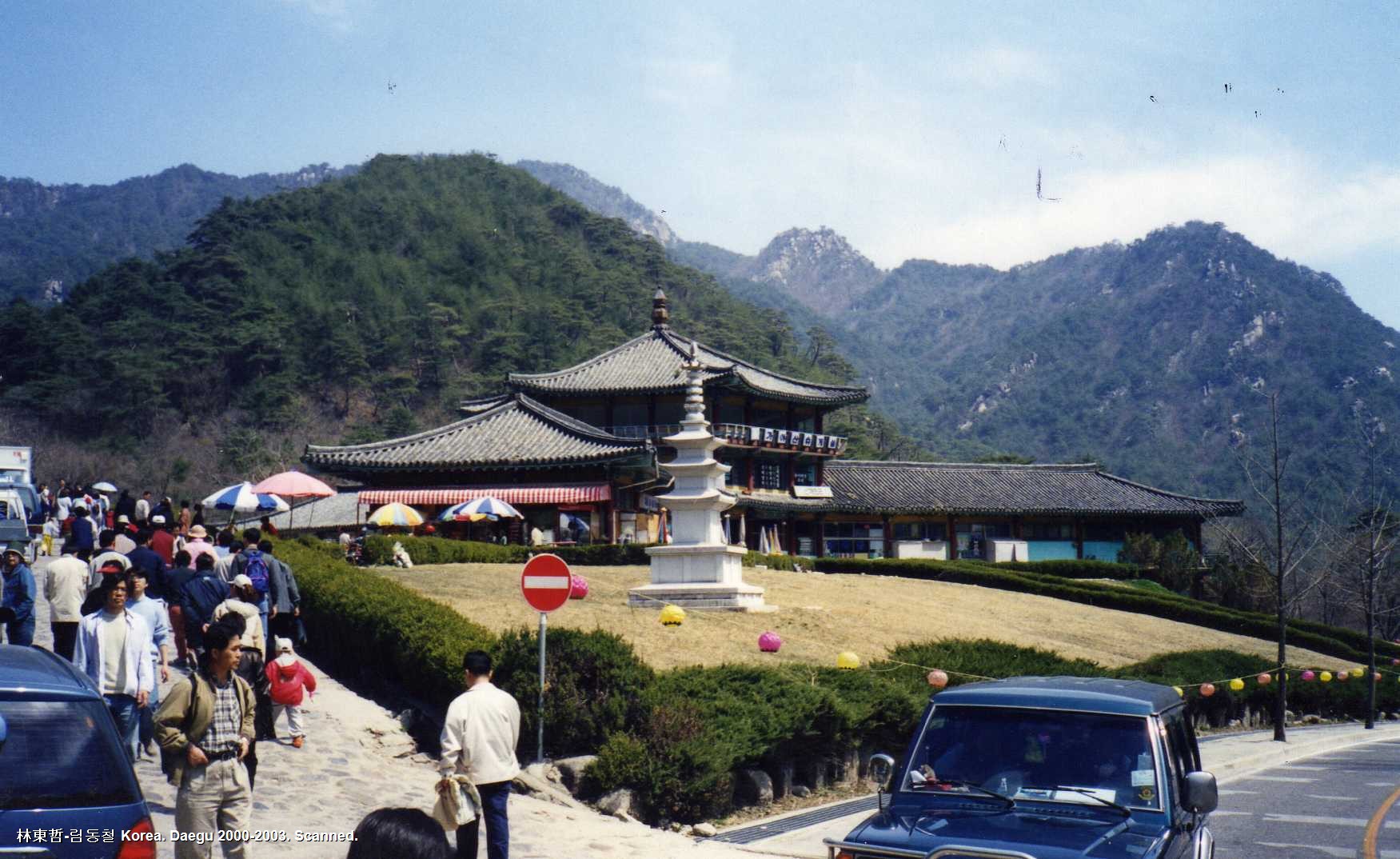
the start of the walk up to Heinsa Temple in the Kaya Mountains (2001)

beside the main temple in Heinsa (2001)
The scenery was absolutely beautiful as the lilacs were almost in full bloom. In Daegu they were already in full flower. Everywhere, cherry blossom (벚꽃) and yellow forsythia (개나리) coloured the hillside. Spring blossom, in Korean, is known as pom namu (봄 나무). Up in the mountainside you could see the various shades of green from emerging foliage speckled here and there by dashes of pink and yellow. One flower, particularly common, was the national flower of South Korea, adopted after the liberation. This flower, Hibiscus Syriacus, known also as the Rose of Sharon and in Korean mugunghwa (무궁화). The atmosphere in the car was wonderful and Ga-in and Min-Ju were excited at the various sights. We climbed the mountain for quite a while, the little car straining when suddenly, out of the right hand side of the vehicle, the peaks of the mountain range appeared. It was a breath taking sight; the jagged peaks of bare rock were highlighted against a bright blue sky. Almost at the top of the range, there was an observation point where we stopped and took some photos. In the small car park were several farmers selling various fruits and vegetables. I took a photograph of some elderly women sat among their produce. One made a fuss of me and said she was too ugly to photograph, but she wasn’t, she was beautiful and she reminded me how lucky people are who still have mothers and grandmothers. I wanted to take a photograph of them sat naturally but instead they sat upright, hands on knees and all looked very serious.
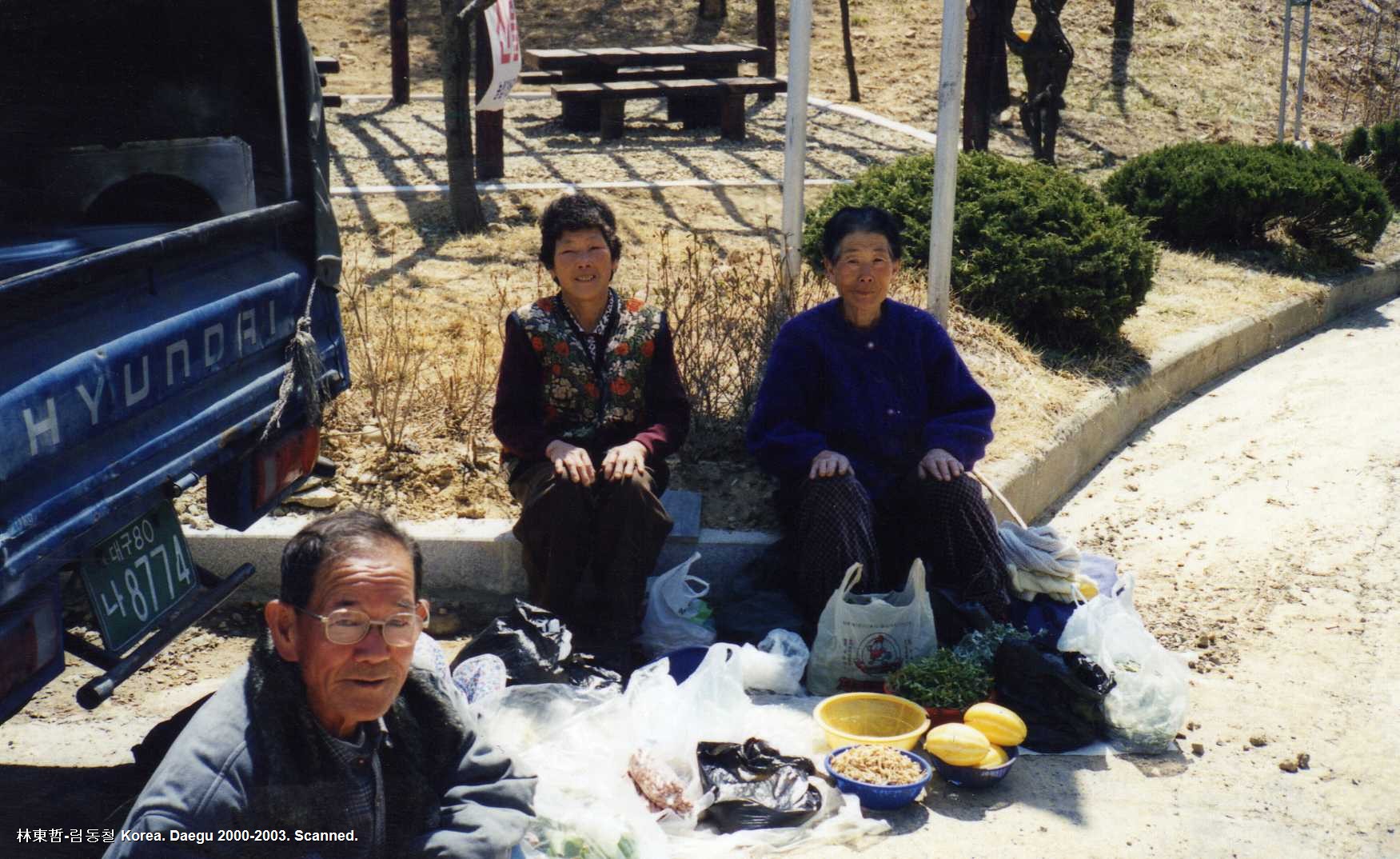
roadside traders on the road up to Heinsa Temple – Kaya Mountains (2001)
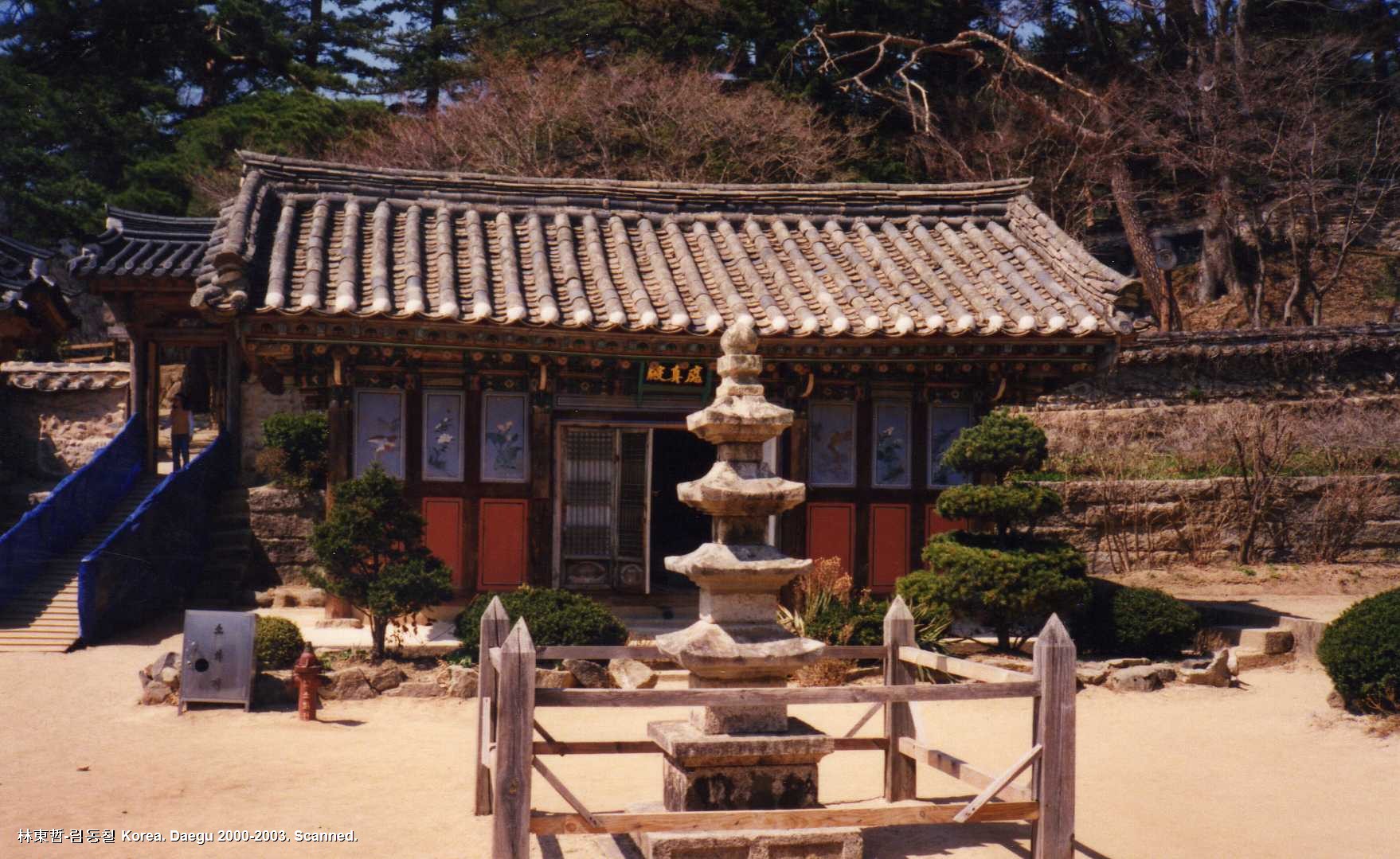
a stupa in the large forecourt before the main temple (2001)
We were now in the heart of the Kayasan (가야 산) national park and in U-no’s little car we travelled down from the observation point into another valley before climbing back up into more mountains towards the Haeinsa (해인 사) temple. May 1st in the lunar calendar this year marks the celebration of Buddha’s birthday and so the roads in the park were edged with yellow, red and purple lanterns which at night are lit. The park was impeccably clean, not a piece of litter anywhere. We passed through a number of small villages where up in the surrounding hillside people could be seen tidying up their relatives tombs after the long winter. Arbour Day is one of the days when people walk up to their relatives tombs, tidy them and then present offerings which involve paying their respects by prostrating themselves on the ground, forehead to earth.

note the bees nest hanging from the side of the head
At many places on route to the temple, there were interesting sights. Small stupas, small pagoda constructions which house the spirit of Buddha dotted the landscape. We stopped at a larger sight where there was a small temple nestled up in the hillside. At the foot of the hill, just off the road and through some trees, stood an enormous statue of a Buddha flanked on either side by stupas. In front of the Buddha ran a burpling river which meandered down from the mountain. Stupas are common across the Buddhist world but Korean ones are very distinct with small bells hanging from the corners of each protrusuion. The stupa tapers into a pointed spire. Like other Buddha statues I had seen in Korea, a large stone like ‘hat’ sat on his head, from this one hung a large bees’ nest. From the nearby temple drifted the sound of a monk chanting and striking his small, spherical wooden percussion instrument made from hollowed out oak. It makes a hypnotic sound when continual tapped. Behind the Buddha was wall housing twenty or so class cases each containing a life-size Buddha in a different pose. In front of the statue stood a stone table where visitor placed offering of food for the monks, bags of rice or fruits and nuts. Those making offerings lit joss sticks and then prostrated themselves in front of the Buddha. There were several elderly women who had been busy prostrating themselves for the entire 20 minutes of our visit. U-chun told me a respectable number of prostrations is ten but if you want to be particularly devoted you perform 180. This is no mean feat as a complete prostration begins and ends from a standing position.

Min-ju and I (2001)
Eventually, after a further journey, we parked the car in a large car park high in the mountains and joined the enormous conga of people progressing up to Haeinsa Temple. The walk talks about an hour. In places the climb was quite steep. One of the first sites we stopped at was a pond, called the -Yong-ji. This lay just outside the entrance to the Haeinsa complex. According to the legend, seven sons wanted to become monks and left home to travel to Haeinsa. Later, longing for her sons, their mother travelled the long distance to visit them but as they had already taken their vows, they could not see her in person. Instead, they looked at each other’s reflection in the pond.
The temple complex was full of fascinating sights. The elaborate art work of the central temple, which housed a golden Buddha, consisted of intricate patterns of blue, green, orange and gold. Inside the main temple, monks prayed in front of the large golden Buddha, the air scented by both spring and incense. The Haeinsa Temple, was built in the Shilla (57bc-935ad) period though it was destroyed by a fire and rebuilt in the 15th century. The temple houses the Triptaka Koreana which is the most extensive Buddhist text and is written on 82000 wooden engravings. The text is in the process of being translated. The wooden engravings are housed in outhouses surrounding the main temple.

Pak Yu-chun and her family (2001)
After spending several hours in the temple, we walked down the mountain and headed to a picnic area further into the Kayasan range. Koreans love to picnic and are well equipped with picnic mats, barbecues and baskets and when the finish, they meticulously tidy away all their mess. U-chun had cooked pulgogi and chap’che – a fried noodle dish with pork and beef through it. As usual the meal was accompanied with kimchee. After the meal we drove back to Daegu.
On Saturday, the Yon San Dong school had planned a staff trip to Kyong Ju (경주). Matt and I took a taxi down to the school to meet the mini bus. All the western teachers went except for Lisa who never seems to want to mix with anyone but who, in fairness, has been ill during the week. She continually moans anyway, so perhaps is it a good thing. There were four Korean staff coming with us, To-yung, Amy, Meg (who has a mouthful of wonky, impacted teeth and who looks like one of the Cenobite’s from Clive Barker’s ‘Hellraiser,’) and Qui-Aie. We all brought packed lunches and set off in high spirits. I can’t remember if I have previously mentioned the significance of Kyong Ju, but it was at one time the capital of the Shilla (57bc-975ad) dynasty. Between approximately 40bc and 400ad the peninsula was divided into three kingdoms – the Shilla, Koguryo and Paekche. Around 400ad, the Shilla dynasty, situated in the east and militarily very powerful, overthrew the other kingdoms and united the peninsula. The Shilla dynasty ruled until approx 900ad. Needless to say the area is full of interesting sights and it is particularly famous for its spring blossoms.
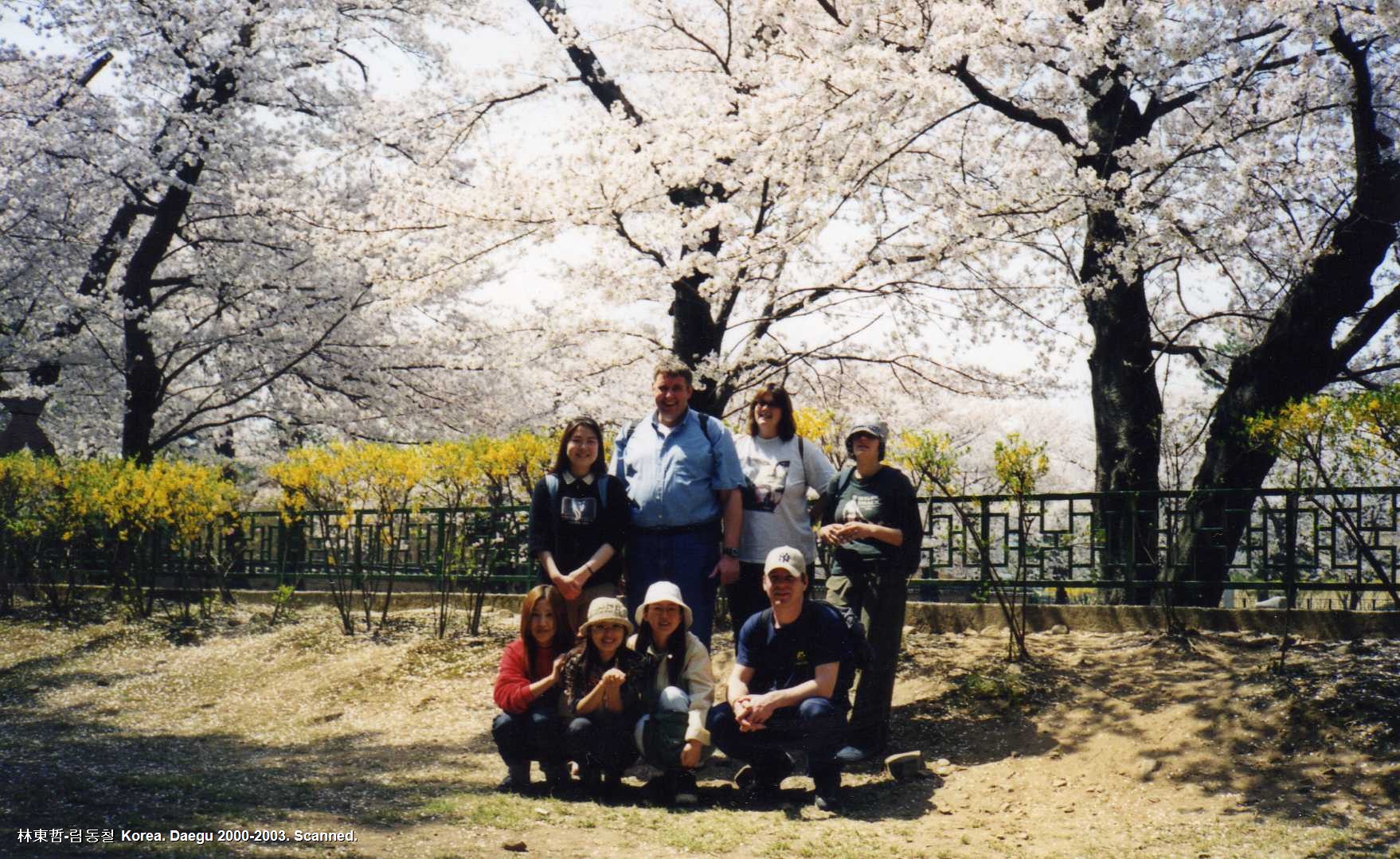
Back – Qui-aie, me, Pauline, Angelin. Front – ?,? Angel, Matt, (2001)
Kyong Ju isn’t a large city but when we arrived it was teeming with people on bicycles hired from one of numerous shops. Matt shared a tandem with the Cenobite and the rest of us all hired standard bicycles and headed off to the nearby Shilla tombs. The most impressive tomb in the site we visited was the Heavenly Horse Tomb. Though several other tombs lay in the same location, only this tomb had been excavated and inside a coffin and 15 items, including a sword of 98cm long. The tombs are all large mounds and the Heavenly Horse Tomb had been hollowed out so we were able to walk around inside it. Nearby was the oldest observatory in Asia and this was a large circular building made of stone. From here we went to the Kyong-ju National Museum which lay next to the Anapj (Goose and Lake). In 1972 the lake was temporarily drained and over 41.000 artefacts were found which now appear in the museum. Outside the museum was a large bell known as the Emelie Bell. Apparently this bell was cast in the ninth century and its unusual tone is attributed to the fact that a baby was thrown into the smelting metal during its casting.
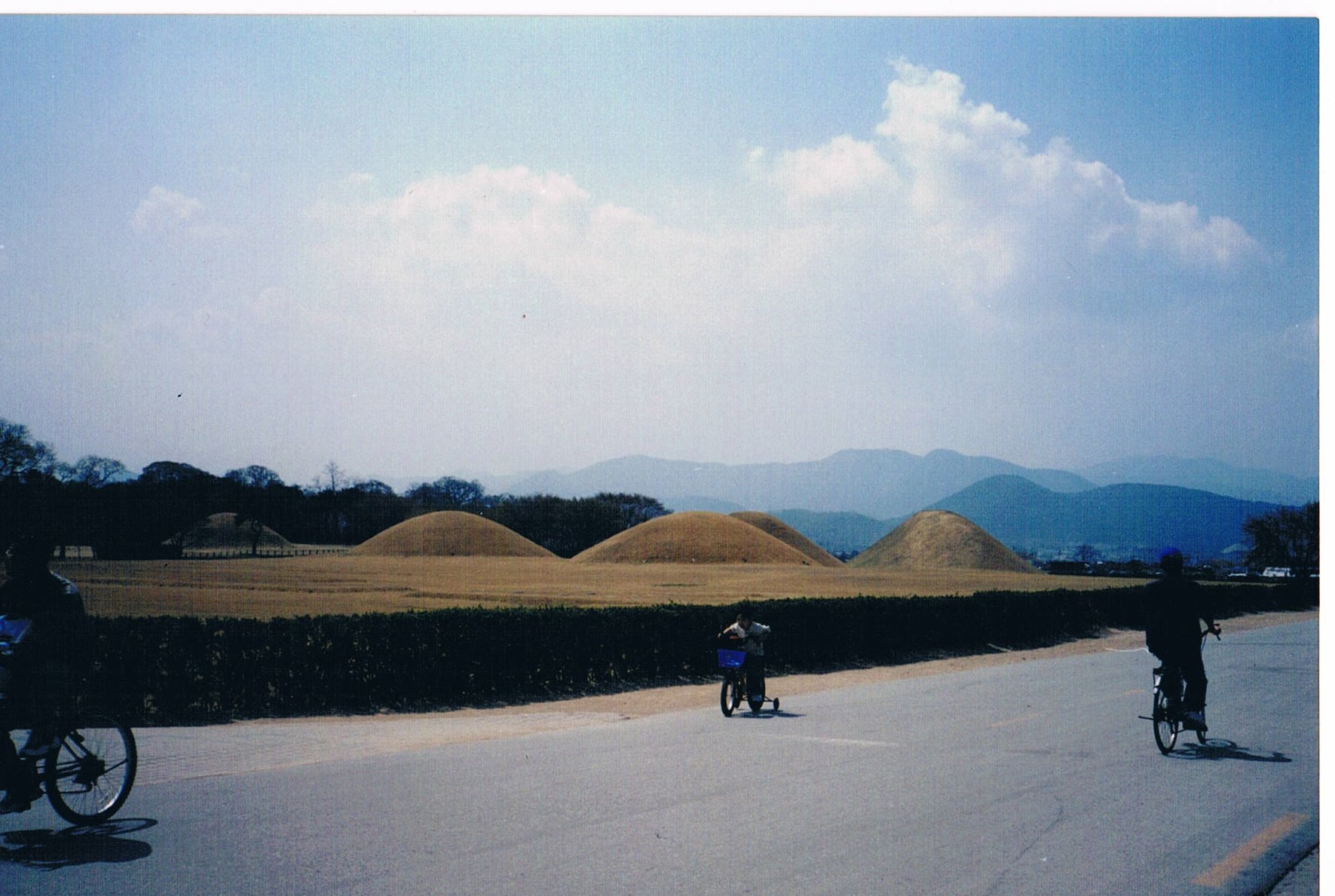
Tombs of Kings
We ate lunch in the gardens of the museum and then set of to visit a large lake outside the town. The cycle took ages and all along the route cherry blossom showered onto us like snow whenever a breeze blew. Pauline found the cycle strenuous and no matter how many times we asked where we were going, how long the cycle was likely to take, or how far it was, our host Koreans avoided our questions. After an hour or so cycling, Matt decided to stop and complain. We had all become split up and there were thousands of other cyclists travelling in both directions along our route. Despite our protestations, Qui-Aie wanted to push ahead and as soon as she saw Pauline struggling in the distance, she continued cycling with renewed vigour. I actually think it was part of her master plan to stop us getting together and moaning. After about another fifteen minutes, we reached this large lake which sat on top of a hill. All around the edge of the lake the cycle path could be traced by the line of cherry blossom. At the far end of the lake stood an enormous pagoda which I later discovered was a Hilton Hotel. On a large grass bank teeming with relaxing Koreans, we sat and had some refreshments bought from nearby stalls. We thought we would be able to sit and enjoy the beautiful scenery but under the leadership of ‘Hitler Tours,’ other plans were afoot.

the cycle up to the edge of the lake – under a canopy of blossom (2001)
All to soon Qui-aie and the other Koreans ushered us to continue cycling towards the Hotel. It was an awkward cycle as the path an narrowed and was packed with walkers and cyclists in an enormous conga that seemed to travel in both directions unbroken, around the lake. As is natural, Koreans didn’t get stressed with the incompetent cyclists who frequently blocked out passage or slowed our journey. I don’t think Koreans are very well organised in terms of driving on the roads, walking in packed supermarkets or cycling. Mopeds and motorbikes can be seen everyday using the pavements and I regularly see potential accidents about to occur. In busy supermarkets they will push and shove each other in order to squeeze through little gaps. They do exactly the same when driving yet rarely do they loose their tempers or get stressed. Matt and I have a time limit when we shop in a supermarket – usually about half an hour, after which we deteriorate into a frustrated state. On the path around the lake there seemed no consensus about which side of the pavement to cycle on and it seemed total chaos to us westerners. We cycled for another half an hour, making painfully slow progress and on the few occasions on which I stopped to take a photograph, I was made to feel I was wasting time. Next, I suggested we stop because we had lost Pauline. Twenty minutes later and she appeared in the distance and immediately, Qui-aie jumped on her bike. Matt wouldn’t get on his and was looking very cross.
‘Are you alright?’ I asked. He didn’t look up.
‘If there’s one thing I fucking hate it’s being asked if I’m alright when I’m fucking not,’ he snarled. Qui-aie was still trying to prompt us to cycle and I said we were going to wait for Pauline so she could take a break.
However, it wasn’t long before Qui-aie was leading us towards the fast approaching hotel. Soon, the path turned away from the lake. Our Korean guides, ‘Hitler Tours,’ grouped up ahead and were busy talking. I joked that they were probably deciding whose job it was going to be to tell us that we still had another few hours cycle ahead of us. Suddenly, To-yung told us we were turning towards the town and that we would be back at the minibus in some 20 minutes. We were momentarily relieved as this is Korea and Koreans and often lacking in organisation.
After more cycling, I noticed that the fairground wheel which had lain behind the hotel now lay behind us and that we were in fact travelling towards Kyong-ju but by the longest route; around the perimeter of the lake. We were some two hours cycle away from the point at which we had arrived at the lake’s shore. Here we were in this beautiful location with cafes and boat rides and wonderful sights and all we were doing was racing amongst a huge conga of cyclists and walkers. At one point there was an enormous hold up and bikes were knocking into each other all over the place – which no one minded except us westerners. When some silly Korean in front of us, braked for no reason and then blocked our way we cursed but the facial expression of the perpetrator was one of innocence and bewilderment. There was a long lay-by next to us, lines with market stalls, not one Korean in the enormous hold up, broke ranks to circumnavigate the jam. I moved into the empty road, calling for Angela to follow me and within minutes there was a long clear path in front of us. For some fifteen minutes we flew down the almost empty path and when we reached the main road at the bottom, we had to wait forty minutes before we all re-grouped. Angela spent our time leering at sexy Korean lads and we both agreed that westerners are mutant mongrels by comparison. Our hair is assorted colours and textures, we have pallid skin, yellow teeth and we are usually fatter than Koreans.
The rest of our party eventually appeared, free-wheeling down the hill towards us but they did not look very happy, apparently, they had waited for us assuming we must have got held up. By now a tense silence had developed between the Korean and foreign teachers. We arrived back in Kyong-ju city centre, tired and with sore backsides but of course, once we had handed our bicycles back, ‘Hitler Tours’ wouldn’t allow us time to get a coffee or an ice-cream. Instead, it was straight back and onto the bus! Back in Song-so the foreign teachers went for a drink in the Elvis Bar which isn’t far from Kemyoung University. Tomorrow, April 8th, is Pauline’s birthday.
On Wednesday I went to the doctor’s to get my gout pills and to have Bill, the hernia, checked out. Bill hasn’t been bothering me lately though he is still there and pops in and out with a sort of squidgy, jelly-like feeling. Doctor Lee always wants to have a chat and practice his quite competent English. I asked him to check Bill out as I was worried it might be a cancer of something. I have multiple cancers at the moment and develop new ones regularly. He looked at me quite strangely when I told him this and so I had to explain that whenever I get a headache, a pain or a blemish, I assume it’s a potential cancer. He got to work with the ultra-sound and then showed me, by way of the monitor, that a small lump of fat was moving between different layers of my stomach muscle. He assured me it wasn’t a hernia or anything serious. I love my trip to the doctors as he is the first doctor I have ever had that actually I actually refer to as ‘my doctor.’ He genuinely seems interested in me and always asks if there is anything else wrong with me or anything he can do. No matter how long I take at the doctors, no matter whether five minutes or fifty minutes, the cost is always 10.000W which is less than five pounds. Even if one assumes the cost of living to be four less than in the UK, that puts my doctor’s fee at around £20. When my mother went to a specialist over five years ago she was charged £60. My doctor is actually an internal medicine specialist! It’s strange that my health seems more protected and guaranteed here in Korea than it is is the smug world of the ‘developed west.’ Even the poodle parlours here offer a better service than does the British NHS! Teachers like Matt and Angela from New Zealand all prefer the Korean medical system. We all seem to have access to drugs and medicine seen as too expensive to provide freely in our home countries. After my monthly trip to my doctor I went and relaxed at the sauna. I have been going to the mokyuktang several times a week.
My Taekwondo has been progressing very well and now it is warmer I have suffer less injuries. Spring is almost over and already we have had temperatures in the 80’s. Korea has a spring and autumn of only three weeks or a month and has long winters and summers. The blossom has fallen from the trees and now the streets around Song So are being lined with pink and yellow lanterns in readiness for Buddha’s birthday (May 1st of this years lunar calendar). I often train for forty five minutes at lunchtime either stretching at home or in my club. My stretching programme has paid off and I am able to do exercises I haven’t done for fifteen years or so. I can sit in a hurdler’s straddle and almost put my head on my knee and I can sit on my knees and lean right back so my shoulders are on the floor. From this position I can do sit-ups. My axe kick, one of my favourite and formerly most devastating kicks, is almost as good as it was when I took my black belt. I now have a purple belt and my blue belt exam I will take in a few weeks time. After blue, I will have brown, red, red and black belts to take before I can finally take my black belt exam. I would be quite content to go home with a brown belt but gaining a black belt is within my grasp. I realise how unfit I have become in the last four years – all due to sitting at a computer writing and riding a motorcycle. It has taken me a lot of effort to get fitter and a few months ago I was going to give up Taekwondo for good.
©Amongst Other Things – 努江虎 – 노강호 2012 Creative Commons Licence.
Mogyuktang Observations Plus – Tuesday 3rd April, 2001 (Korean Accounts 2000-2001)
Now I am getting quite relaxed using the mokyuktang, I am beginning to discover a different aspect to them. Regularly, I use the steam room and sauna, only for a short while, and after that I go and sit in the cold pool. The process of going from very warm to cold has the most amazing effect on the mind. I experience a strange taste in the back of my throat and start to feel a little dizzy after which my mind becomes calm and floaty. The whole sensation is rather like a little drug hit. In this state, which is very pleasant, I notice other men just sat around all in their own little worlds. If such an institution existed in the west it would probably be polluted with pop music. The mokyuktang is filled with music which when in the right state is wonderfully relaxing. It is the music of running, splashing and spraying water. If you sit at one end of the cold bath you can look down of the mirror-like surface of the pool and really enjoy the state of calm the experience induces. When you get out of the cold pool you have to be a little careful as your body is slightly wobbly and I have noticed, men usually get out of this pool and sit awhile on the edge of the pool before moving to another bath. I still can’t believe I’m naked in a place full of other naked people and have even started sitting on the floor of the steam room, cross legged.

Han Song Bathhouse, Song-So. The third Bathhouse I visited. It became my regular bathhouse in 2001.
It is interesting watching the interaction between children and their fathers; last week a young boy and girl sat playing beside their father. Young children bring toys to the pool and between being scrubbed and scrubbing their father’s back, they run around enjoying the water and playing. They were fairly interested in me and for quite a while they stared whenever they thought I wasn’t watching them.
One day there were two lads in the mokyuktang, probably in their early twenties and most likely from the local university. As is usual, one sits behind the other on the low plastic seats which look like upturned washing-up bowls, and then they take it in turn to scrub each others’ back. There was an old man in one corner of a pool and one of the lads went over to him and scrubbed his back for him. I was hoping he might volunteer to do mine but I was out of luck. A visit to the mokyuktang would give any artist a deeper insight into the human body and I find it amazing watching naked bodies from an aesthetic perspective. It is fascinating how they are designed and how the muscles interact and are articulated and how the human body is structured and proportioned.
At taekwon-do on Tuesday evening, I discovered the school oath is being replaced. I was rather annoyed as it was the first evening I had been able to recite it at the same speed as the Korean students. A new oath hung on the wall and is to be used from now on and so I will have to learn this. As my body has become fitter and more agile, I am able to exert myself more in classes. The sessions are grueling! I hadn’t realised how unfit I had become after three years of writing. Pak Dong-soo spent sometime during a lesson working out on the bag; he is beautiful to watch and can do flying kicks well over six foot high. He moves like a bird.
The English teaching I am doing is becoming increasingly boring. Last week, in one class I went berserk and smashed my stick on a table. This is the third stick I have broken in three months. I called for a senior teacher and he came along and shouted at them. The kids are not disruptive but more inattentive and chatty. Sometimes it is impossible to get their collective attention and sometimes I just despair – especially after a long day. It doesn’t help that I rant and shout as Koreans find such displays of emotive behaviour unpleasant and deem it to be a loss of self control – which of course it is.
Fridays are a drag as I teach in another kindergarten and have no time for lunch. There are days when I observe something that I realise gives me a greater understanding of the Korean psyche. In the kindergarten, when I pass out a handout, the kids all gather around me. There is rarely any pushing, they just stand passively in front of you with both hands extended and wait for you to place the handout directly into their hands. One day, I was watching two boys who came into the PC bang (room). They were eating an ice-cream which consists of a plastic ball, a little larger than a snooker ball, with a built in straw. Both of them just stood in the middle of the room, passively sucking. They sucked in a way so totally different from how children might suck or eat an ice-cream in the West, without the greed and voracious consumerism. If there is one thing I am learning about my culture, it is how vulgar, greedy and selfish it is. English kids are always on the want, they are always squabbling over possessions and in particular, over food. In six months of teaching in Korea, I haven’t once seen a fight or seen one child strike another. In my kindergarten class last week, which is held in a small school situated in an apartment complex, the Korean teacher left the room briefly. Suddenly fifteen or so little children converged on me eager to stroke the hair on my arms, which fascinates them. Some wanted to stroke my hair, a few wanted to pat my belly. Korean children can be quite beautiful in both features and mannerisms.
After a hideous class at Di Dim Dol, I went and sat at the table Nana and I share outside Joe’s office. Lisa was there for her afternoon class. I started moaning about my lesson and she immediately started complaining loudly.
“Korean children have no manners. They’re rude, ignorant, and need training.” I almost told her to shut-up.
“No! They’re not rude!” I replied. ‘They are usually well mannered, polite and very gentle. Yes’ they run around between classes and don’t recognise your personal space but that’s cultural.”
The other day she told me how she has this tone of voice she reserves for ‘foreigners!’ She then went on to say she had a ‘men-sahib’ attitude towards Koreans which confirmed my suspicions about her having a colonial attitude.
On Friday it snowed heavily for most of the morning and suddenly it has turned cold and wintry. In the evening Ryo Hyu-sun took me for a meal, we had pork barbecue and a few bowls of dong dong ju (동동주) after which we went for a walk in a nearby park. The cheery blossom and lilac are in full blossom despite the cold recess.
©Bathhouse Ballads – 努江虎 – 노강호 2012 Creative Commons Licence.
More Mogyoktang Observations – March 26th, 2001 (Korean Accounts 2000-2001)
Today at the mokyoktang a boy of about 11 or 12 came in which was quite unusual as usually children are at school. However, I noticed he had a rub down from one of the masseurs and this is done on a couch to one side of the central bathing area. The whole procedure was quite intimate with the boy lying naked and the masseur rubbing away at his body with an abrasive cloth. This procedure lasted about twenty minutes as during it I visited the steam room and several saunas.
I was interested just to see how intimate the rub was as in the future I might dare to have one. In addition, I was also interested to see if adults were treated any different from children. At one point the masseur jammed his knee on the boys inner thigh and sort of splayed him so he could rub his crotch. The idea of a stranger having this much access to a child without their parent’s there would be deemed abhorrent in the west and it quite disheartens me that we are so fucked up about this in our society. When I was having my final shower, a cold one which I take to lower my body temperature so I am not sweating when I leave the mokyoktang, the boy was sat upright and the masseur was rubbing his neck and face. The masseur, was naked too!
After I have had my cold shower, I spend five minutes in the drying room. This is pamper city and a few of my gay friends would love this facility. The rooms are always long and with large mirrors on the walls which takes more getting used to than the other naked men around you. There are large fans on the table tops which you can direct on your wet body and also hair dryers. I have noticed many men using the hair dryers to dry their pubic hair and I have also started doing this. On the surrounding tables are a range of lotions, hair creams, body conditioners and after shave. I put several concoctions on my face and then use some hair cream. Combs are lying on the bench tops or you can take one from the comb sterilising machine.
I quite like watching Korean men preen as they do so in such a totally faggy way. Today there was an elderly man next to me who combed his hair in a really fruity way and then rubbed various lotions onto his face. Finally, he daintily patted his face and hair with a towel. There is always a huge stack of lovely clean, white towels and you can use as many of these as you wish. I am still surprised at the vigour with which Koreans preen themselves, they trim their nails, trim their nasal hair, poke at their ears with cotton buds and when they leave, pick up their newly polished shoes from the shoe cleaner at the premises’ entrance. I have noticed the hairs on my arms and legs disappearing from the amount of scrubbing they have been receiving. I have realised that Koreans preen and clean their bodies with as much vigour and enthusiasm as we in the west might apply to our cars or motorbikes.
I had wondered what it would be like to meet someone you work with, by accident, in a mokyoktang. I didn’t have to wait long to find out. Last week I was having my first shower after my arriving at the closest mokyoktang to my apartment. As I was still a little shy I hung around in the shower until there weren’t too many people in my path before walking over to the large pool. There was only one other person in the pool as I could clearly see the top of their head. Well, just as I had stepped up onto the parapet, this person, at the far end of the pool, waved and shouted my name. It was Lee Seong-gyu (이성규) from Di Dim Dol hakgwon. It was actually quite an amusing experience to be caught totally naked and in full view by a friend. Anyway, Lee Seong-gyu and I have now met several times and bathed together. It is handy having a friend as they can rub and scrub your back for you.

Song-gyu and I, in 2001. I still bump into him in saunas ten years later! Incidentally, my trainers were New Balance, unheard of in Korea then but which 12 years later are the most popular training shoe on the market.
In the steam room of one mokyoktang there is always a large box of salt on the seats and salt is strewn all over the floor. I have noticed it is used for scrubbing your body rather like an aggressive ex-foliate.
I have just had lunch in a small restaurant I have been frequenting for the last week. For several months now I have been doing my own cooking and learning how to cook Korean food but to be honest, it’s far cheaper eating out! I ate pokkum bap (복음 밥), a sort of fried rice with an egg on top. As I left the restaurant, one of the chefs, a woman in her thirties or forties, and who seems to have developed an interest in me, gave me a slice of fruit. I asked if it was an apple and when I bit into it I discovered it was some sort of parsnip. The street on which the restaurant is situated is very close to my home and is flanked on both sides by maple trees which are just starting to leaf. The air was warm even though it was 8pm and dark. Spring seems to have been jumped as the weather is suddenly as warm as it would be on an average summer’s day in Britain. On my way home, I walked past the local hapkido school where I could hear kids chanting out the rhythm to some exercise which was interrupted, intermittently, by loud slaps from the mat.

Chi-woo, I imagine he’s now almost in high-school
Korean children are beautiful! Everyday Chi-woo (이치우) sits on my lap on the journey to the school. He always gives me a kiss on the cheek and teaches me how to count in Chinese. Korean uses both Korean and Chinese counting systems. In fact, Korean numbers only go as far as 99. Some things are counted in Chinese, others in Korean. There is rarely competition between the children and they share sweets and treats. Even at four years of age they are impeccably ordered and will put their toys away at the end of playtime and then pick up any paper or mess on the floor. At lunchtime they all help with laying the tables and clearing away. None of the children smell of piddle or shitty pants and they are all toilet trained – at least as far as going for a crap. This week however, two boys in my class pissed themselves. Dong-seop (동섭) left my class for a ‘shee’ (씨) and came back leaving pissy footprints on the carpet. I should have gone to the toilet with him for he had pulled down his trousers and long johns and then pissed into them. The same thing happened with a new boy called Seong-jun (성준). The next day I made sure I went with them and when they stood with their pants down I stuck my knee into their backs so they pissed into the urinal.
Da-hae (다해), the brain-dead moron, has suddenly come out of her shell and every morning she runs up to me for a hug. She still dribbles. The other day I noticed pen marks on a wall and I jokingly motioned for her to salivate over them – with her tongue. Amusingly, she went to do this. I had rarely heard Da-hae (다해) speak up until about a month ago and in fact she has a really deep, gruff voice rather like the monster-girl in the Exorcist.
Last week there was an open day for the parents and each class in turn had respective parents watching the lesson. My class went fantastically well. I just did the same sort of things I do every morning: counting, reciting the days of the week, singing songs and doing some alphabet and written work. I choose to do work the children could manage so as to show their parents’ they had learnt something. Afterwards, I talked to each parent in turn with Precious interpreting for me. Koreans like you to be intimate with their children and they could clearly see I had a good relationship with them. I think they left feeling impressed and afterwards, Precious told me my class had been the best. However, complaints had been made about Matt and Angela’s classes. Apparently, parents didn’t think they had much control and their biggest gripe was with their earrings, shoddy clothes and unkempt hair. Some mornings, Angela looks like a scarecrow with bits of fluff and paper in her hair and with it messy all over. Mr Joe asked me if he should take them down town and buy them some new clothes.
I went to my doctor last week, about Bill, my small umbilical hernia. He has a new surgery close to the E-Mart which he proudly introduced me to. He has a new endoscope, an ultra sound, an x-ray room and various other rooms. The waiting room was beautiful with ornamental plants, a large fish tank and a station to make tea and coffee. I was in his office over forty-five minutes and had an ultra-sound on my stomach which I watched on his monitor. He tells me I have a small muscular tear which should clear up of its own accord but so far it hasn’t done I’m sure if it was a hernia he would have noticed it as he clearly showed me thew tear on the screen and estimated its size. The consultation cost me W10.000, just under five pounds and I didn’t have to wait any more than five minutes to see him. He is the first doctor I have had that I can truly call, my doctor.
My weekends are very busy and there are always friends trying to take me out or visit me. In fact, I hardly have any spare time at weekends now. Last weekend I met Pak U-chun and her daughter, Ga-in. We met downtown, in the area known as Ex-Milano, where we visited lots of shops and just walked around talking. Korean children are rarely any nuisance and are used to spending time with adults. We walked around the Buddhist area where there are shops which sell clothes for monks, calligraphy brushes and paper and then moved into the more fashionable part of town. As on previous visits, a demonstration was in progress and as usual it was ordered. There were perhaps two hundred demonstrators sat in rows in a large pedestrian intersection. Many westerners here, whether civilian, military or teachers are usually an embarrassment and dress like slobs and are usually loud and in your face. We ate the most wonderful meal in a restaurant that specialises in spicy chicken which is cooked on a barbecue at your table. After, we went for an ice-cream at a Baskin Robbins.
©Bathhouse Ballads – 努江虎 – 노강호 2012 Creative Commons Licence.
My Inauguration into Korean Bathhouse Culture – March 1st 2001. (Korean Accounts Part 1. 2000-2001)
On Korean Independence Day, (Sam-il, March 1st), I went to U-chun’s sister’s house with her daughter, Ga-in and her husband, U-no. They live in Changwon (창원) which sits between Masan in the west, and Pusan in the east. They arrived at my apartment in two cars as her sister, her husband and their daughter, Min-ju, are all traveling to Changwon where another one of their sisters lives. It was great to get out of Daegu and to travel in a direction I had not been before. U-chun has five sisters and the one we are visiting has a husband who is an officer in the army and hence they live in married quarters. The quarters were outside the city and everywhere, as it is Independence Day, hung the national flag, the daeguk gi (대국 기).

Ga-in (Olivia), in 2001 (Sam-il)
U-chun’s sister’s family live on the top floor of the apartment block so there was a great view of the surrounding countryside.
On the journey to Changwon, U-chun asked me what three things I wanted to do before I left Korea. I said I wanted to eat pondeggi which is steamed silk worm cocoons, eat dog soup (보신탕) and go to a bathhouse (목욕탕 ). Now I have no great desire to eat cocoons or dog, but I do think I should fleetingly sample them before I leave. As for the bathhouse, which in Korean is called a mokyoktang, all that is stopping me is a fear of nudity and an insecurity at my own physique. Nana outright refuses to visit one and this is now his fifth year in Korea. Most westerners I meet here have not been to them and many don’t even know they exist. I am drawn to them simply as I am afraid of them and see them to be Korean enclaves.
Anyway, U-chun laughed and said that they were planning to visit a bathhouse this afternoon. There was a strange plummeting sensation in my stomach, like I was suddenly falling at a very fast rate. At first I thought she was joking and then I tried to tell her that I was planning to visit one in the final week or so of my year I Korea. She didn’t seem to understand!
At U-chun’s sister’s house we drank cold green tea and then walked to a nearby restaurant. There were perhaps fifteen of us all together and of course, I was the centre of attention. We were served fish, a very ugly fish which I suspect was monk fish (악귀) as its mouth was massive. Several fish were placed on our tables, all smothered in noodles and drenched in red pepper paste. I didn’t really enjoy it. As always, there were a variety of side dishes one of which was a selection of very chewy meat. I asked U-chun what it was and her and her husband grinned. ‘it’s ddong chip.’ She replied. Now, my knowledge of the Korean language isn’t extensive but I do understand the word ‘ddong’ (똥) as this word I found written all over desks in my classrooms in my first week in Korea. The word was usually written under a drawing of a turd that curled upwards into a little point rather like Mr Whippy ice-cream. ‘Chip’ (집) is simply Korean for house. So I was eating chicken’s arse! Korean food is very often Klingon in nature and I didn’t eat anymore from that bowl.
After the meal we walked to a nearby traditional potter’s work house. The outside of the building was a regular concrete structure but the interior had be decorated to resemble and old, traditional lodging and work place. There were wooden rafters on the ceiling with a papery material stretched over them. Wooden posts had been sunk into the floor and the walls were paneled in wood. Everywhere was covered in Chinese characters and in one room they were even on the walls and ceiling. The potter sat at a wheel making various objects which were later to be fired and put on display. We ordered some dongdong-ju (동동주) which we drank from traditional gourd bowls. I would love a recipe of this drink as we have nothing like it in the west. It is a creamy rice wine which hasn’t been strained and which seems to be the tipple of peasants and farmer folk. As we were walking back to the apartment block, reeking of smoke from the wooden fires in the potter’s shop, U-chun told me the next stop was the bathhouse. Suddenly, the sinking feeling returned.

Sam-il 2001, in a traditional restaurant and potter’s shop on the day of my first visit to a Korean bathhouse
In U-chun’s sister’s apartment, I was offered the choice of staying with the women to play games, or going to the mokyoktang with U-no and two other male relatives. I couldn’t stay with the women without losing face, though they wouldn’t have minded, and so I decided to swallow my pride in the mokyoktang. I was really nervous but I wasn’t going to back out of the experience. At the mokyoktang in Changwon, on my inaugural visit, I immediately saw a few men who were proportionally fatter than I was and any insecurities about the genital department quickly evaporated when I realised that there were very little differences between people. I was quite honoured when two strangers volunteered to scrub my back for me but it was a weird experience. It was wonderfully liberating to be naked with other men and boys and not feel in anyway assessed or eyed up. Nudity in the west is always accompanied with sexual overtones or notions of masculinity which detract from the experience’s potential pleasures. Next to me a boy of about fourteen rubbed his father’s back and then the father rubbed his. I had a slight shock when the boy lay down and his father began rubbing his son’s chest and then moving his dick and balls to one side, scrubbed his groin. The boy then did the same to his father.
My only qualm on my first visit to the mokyoktang, besides squatting on one of those little seats, was bending over to pick up the soap. I felt this a far to undignified act to perform. U-no spent almost an hour scrubbing himself and I did notice that when the boy beside me was having his back scrubbed, a small line of dead, grey skin was being stripped off. Koreans actually have a word for this skin, ‘dae (때) which translates as ‘dirt.’ The abrasive cloths they use, which come is several gradients are almost like sandpaper. When we left the mokyoktang, U-no said to me, Nick! You are a new man now!’ I think he meant it in the sense I was clean but I interpreted it more mentally as the experience was a landmark in my visit to Korea and in my personal development. It was an experience that quite liberated me but has remained an experience I can only enjoy in Korea.
I have since been in three different mokyoktang premises and they are all fairly similar in what they have to offer. The changing rooms are large and opened planned and there is usually a television around which people sit naked or dressed either drying off or recuperating after the session as it can quite tire you. When you go from the changing room area to the bathing area you have no security at all as you are totally naked. Everything is supplied for you and so you have to walk past the relaxation area without even the safety of a face cloth or towel. I actually felt so naked that even my watch and dog tags gave me some minuscule sense of security.
Once in the bathing area there are plenty of high powered showers which you can adjust from freezing cold to scorching hot. Next there are rows of showers where you sit down on a small plastic stool which is not much bigger than a washing-up bowl. In front of you, as you sit, is an enormous mirror and it is here that you do most of your scrubbing clean. One my first visit I avoided these showers as the seat is so low to the floor that even if you have a relatively small belly, it is highlighted. Soap, toothpaste, razor blades, salt – for scrubbing your teeth, towels, abrasive body cloths are all provided. In the bathing area are usually a number of pools which would include a hot pool, a cold pool, a warm pool and often a Jacuzzi. Around these are a number of rooms such as a steam room and various saunas. In some mokyoktang houses are shower cubicles which blast your body from a hundred different vents with ice cold water.
I have fallen in love with the Korean mokyoktang and not for any seedy reason. In fact, since I started this diary entry I have made six trips to different establishments around Song So (성서). First of all, no one ogles at you. Koreans, by their nature will have a little inquisitive stare but will look away very quickly as starring is considered rude. I surmise that Koreans will have seen thousands of bodies by the time they become adults and everything I have to offer, other than Caucasian looks, will have been seen many times before. The mokyoktang, experience has given me a deeper insight into the Korean psyche. Koreans are impeccably clean and have a very healthy attitude towards nudity and physicality albeit within gendered confines. Many of the insecurities that exist in the west I should imagine are unknown here. I doubt few teenage boys or men grow up worrying about the size of their penis. I can remember the hatred I had as a teenager when it came to school showers and there were many of us that used to try and dodge them. For some perverse reason showers only ever seemed to be enforced around the age of puberty. Korean mokyoktangs are full of men and boys of all ages who visit with their friends or alone and obviously have no worries about nudity. When I last taught PE in an English school, probably around 2003, boys undressed underneath enormous towels and even one boy saw another naked both observer and seen were deemed ‘gay’. How pathetic!
In the week following my visit, one of the foreign teachers from the Yon San Dong school suffered an emotional trauma over an experience she had in her classroom. One of the bosses of the school, a guy we call ‘Scary Hat Man, as he always wears the ridiculous looking stetson, was playing with Mr Jo’s youngest son. She saw him playfully pinch the boy between the legs. The event traumatised her and she was sat crying inconsolably. She ranted on about leaving Korea and that she couldn’t work in a school wear a boss was a child abuser. Recently, the relationship between the foreign teachers in the school has been a little strained and Matt and I tried telling her that you couldn’t judge on western attitudes. I have read that Korean adults will often feel a young child between the legs to determine if it is a girl or a boy and that this is quite acceptable. Further, several infant boys have pinched me between the legs and run away laughing, this has happened more than once. Another common behaviour is for children to clasp their hands together with their index fingers protruding, and then to poke you up the backside. This is always accompanied with the Konglish (mixed English and Korean) exclamation, ‘Ddong Injection!’ (‘shit injection!’) This is always a group activity, or perhaps I should say attack, and is always accompanied with laughter. When I told her about the father who moved his son’s dick and balls to one side to scrub his groin, she promptly shook her head and said ‘I don’t want to hear this!’ Her attitude is annoying as I feel that when she is in my class I have to censor the way I act though I have no interest in feeling a kiddies crotch. I am just concerned she may interpret my sitting a child on my knee or touching a child as ‘sexual.’
Another thing I have started doing here, in order to live the Korean experience, is making slurping noises when I eat and making those throaty noises when my nose or chest is blocked. Loudly clearing your nose in the mokyoktang gutter is quite acceptable and actually enjoyable. It provides a wonderful sense of personal freedom though I am sure such habits will cease when I return to the UK.


 Elwood 5566
2 comments