It’s all in the Touch – Skinship. (스킨십)

This week, I was invited to the apartment of a student’s father who, after a soju session, happened to find me alone, eating dinner in a small restaurant. I’d been both training and to the bathhouse and at 10.10pm, after an intense day, I didn’t really want to party. Unlike many in a similar state of being a little tipsy, he refrained from coaxing me into drinking and so, feeling in control, I agreed to accompany him to his apartment. Needles to say, my dinner was paid for. Outside, on the street, he led me by the hand and throughout the hour or so we sat on the floor in his apartment, surrounded by his family, he kept giving me ‘high fives’ after which he’d hold my hand, interlocking his fingers around mine or squeezing my palm with both his hands and every so often, in a slightly inebriated fashion, he’d say ‘Nick, I love you,’ or ‘Nick, you are my friend.’
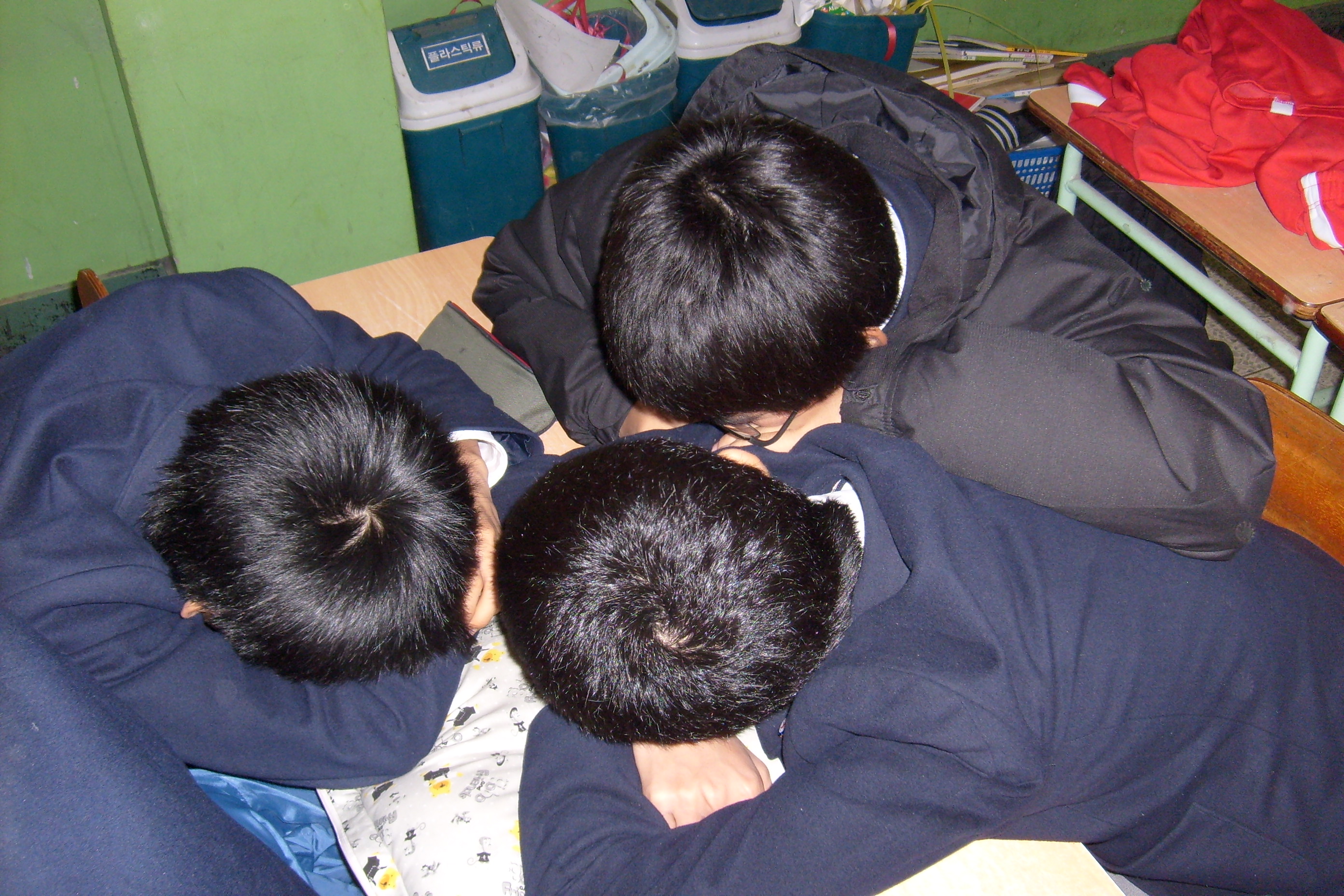
A communal pillow
I can imagine how intensely invasive such situations can be for many western men. From the age 18 to 27, I lived in West Germany and in my free time I trained with friends in a taekwondo school. Although most of the students were German, a fair few were Turkish and whenever they shook your hand, which as is the custom in Germany, was upon every meeting, they’d shake it and continue to hold it. It seemed they held it for minutes and as each second passed, I could feel my body tensing. Worse however, was when they began caressing it between their hands until with temperature rising, you could feel your palm becoming horribly clammy. Today, such innocent intimacy doesn’t bother me and I can as easily initiate it as be the recipient; but, if I think back to my first experiences of such behaviour, I can relive the horror. Without any doubt, it was invasive, almost like going in your zipper, but of course, you couldn’t pull your hand away, that would have been quite rude. And despite the fact my friends and I were only 18 or 19, that we’d never been to university and were soldiers, we had enough experience to know the discomfort stemmed from a simple clash of cultures. It just had to be endured. By the time I returned to England some years later, I wasn’t shocked when a Kenyan friend held my hand in Richmond, London, on a busy Saturday afternoon.
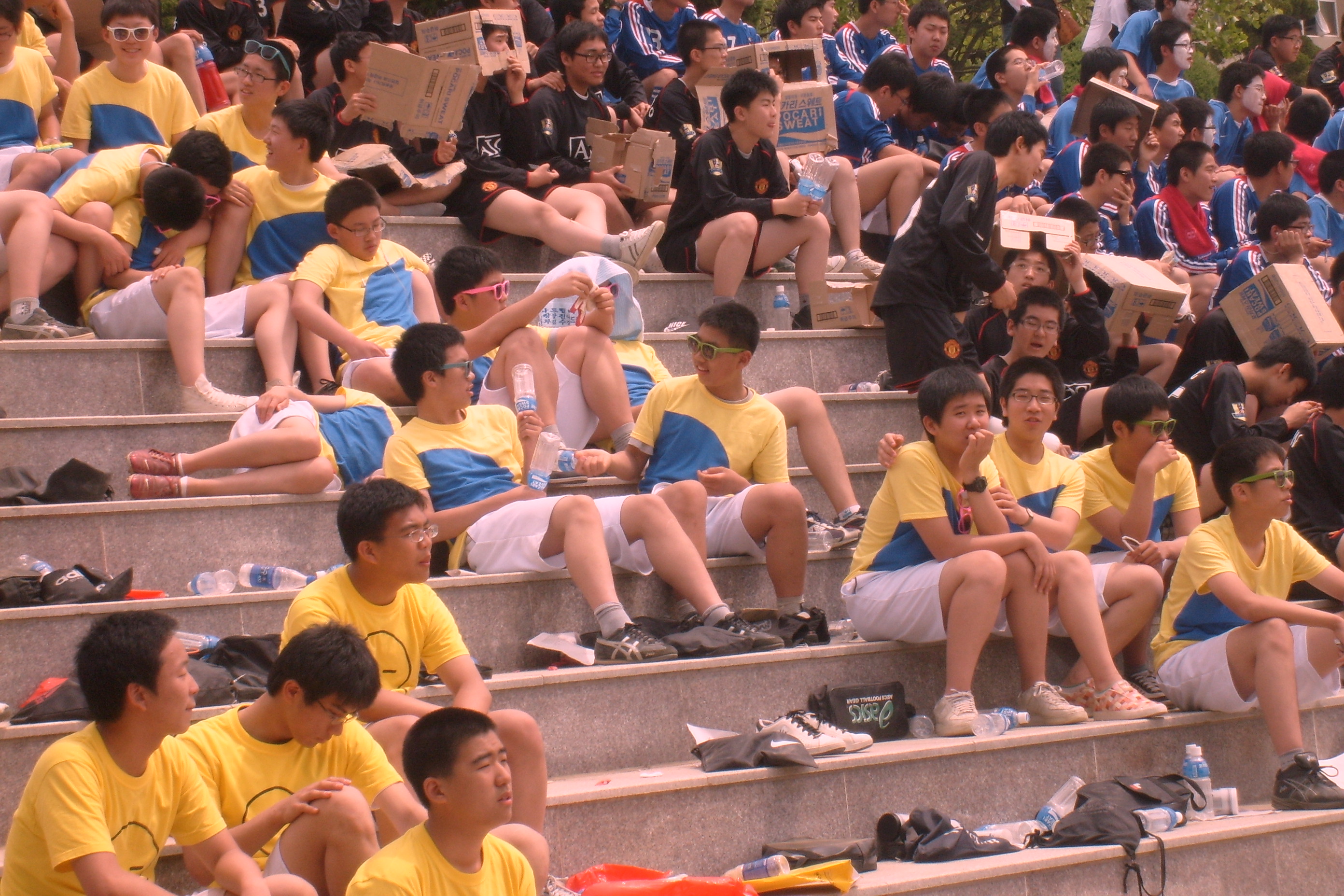
Skinship
Within a Korean context, my new friend, Jae-seong'(재성), is behaving quiet naturally and his intimacy should not for one moment be construed as sexually motivated. In a male to male setting, Koreans are much quicker to initiate ‘skinship,’ than are British or North Americans and when initiated it is quickly upgraded to a level we would construe as ‘almost sexual,’ ‘certainly suggestive,’ and ‘definitely alarming.’ Men and boys sharing umbrellas, arms draped over each other shoulders, sometimes holding hands, that’s the sort of stuff homos do! I googled ‘skinship’ prior to writing this entry and the fifth reference on the very first site, Urban Dictionary, began: ‘disturbingly intimate skin-to-skin relationship between adolescent boys in Japan.’ This value judgment itself struck me as disturbing. However, more judgments were to follow:
(a new English teacher in Japan working in a junior high school) ”Man, I went into one of my classes today, and this one boy was sitting on the lap of another one right there and he had his one hand in his half-buttoned down shirt feeling up the other boys chest, and with the other hand he was playing with the other boys hair. Both of them seemed fine with it, and nobody else seemed to care at all. And I knew both of the kids have girlfriends because I talk to them after class. It was so weird…”
(a veteran English teacher) ”It’s called ‘skinship.’ I don’t know why, but they all love that shit over here.”
I am tempted to dismiss such comments as I know some people can be blind to travel, that travel doesn’t necessarily broaden the mind. I met a very pleasant fellow countryman a few weeks ago. We were roughly the same age, both ex army, having in fact served at the same time and in the same area, both professional school teachers and with a lot in common. He had only been in Korea a few weeks so I pass no judgment on him, but when I asked if he’d like to go to the movies, he rapidly declined assuming Koreans would think two men watching a film together, gay! I have to ask myself whether I’m weird to find the intimacy of skinship endearing and should the hostility and masculine bravado I am accustomed with back home, be preferable? That girls can be intimate with each other without being labeled ‘lesbian’, while for boys the only opportunity for physical contact is generally through a contact sport, in my opinion epitomizes the lives of insects, where every other insect, even of ones own species, is a potential threat.
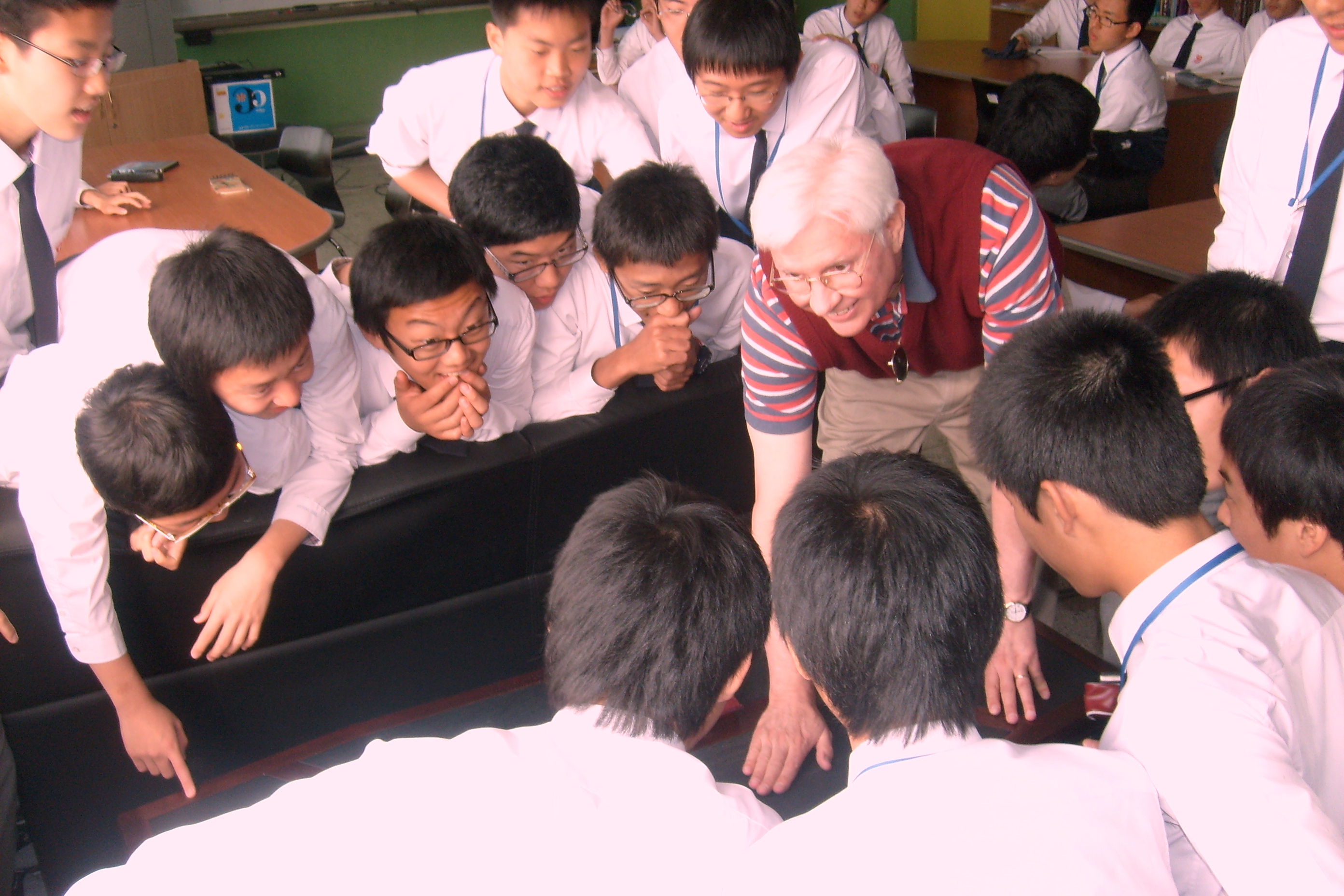
‘hierachical collectivism’
‘Skinship,’ is both a Japanese and Korean concept, derived originally from the relationship between mother and baby where physical contact is an important bonding process. The term is used to describe general intimate physical contact, as between parents and children, as well as more a more sexual expression involving petting, especially between teenagers. The Korean term, an example of Konglish, appears to differ in practice from Japanese ‘skinship’ as it is practiced between men, and especially teenage boys. It involves a range of common and not so common practices including: draping arms over each other, sharing umbrellas, sitting in each other’s laps, massaging, stroking, toying with each other’s hair, holding hands, playing with fingers, resting head on another’s lap or thigh, playing with ears, etc, etc. It can also be used to describe bonding with someone through sports or games and which are often common practices among business men.
In the west, I have always found that even cursory physical contact between people, for example, touching of an arm or shoulder, signifies a deeper level of relationship. I can remember touching the arms of parents on parents evening in schools 10 years ago, parents whom I only met once, yet seemed to have an empathy with, which resulted in the fleeting touching of a hand or arm. And I have noted in the past, that a short cut to bonding is through physical touch but its initiation has to be mutual and stress free for it to be successful. Of course, physical contact and its importance in bonding, form the basis of courses designed to promote workplace relationships – those courses where a partner has to fall backwards and you catch them or some such activity.
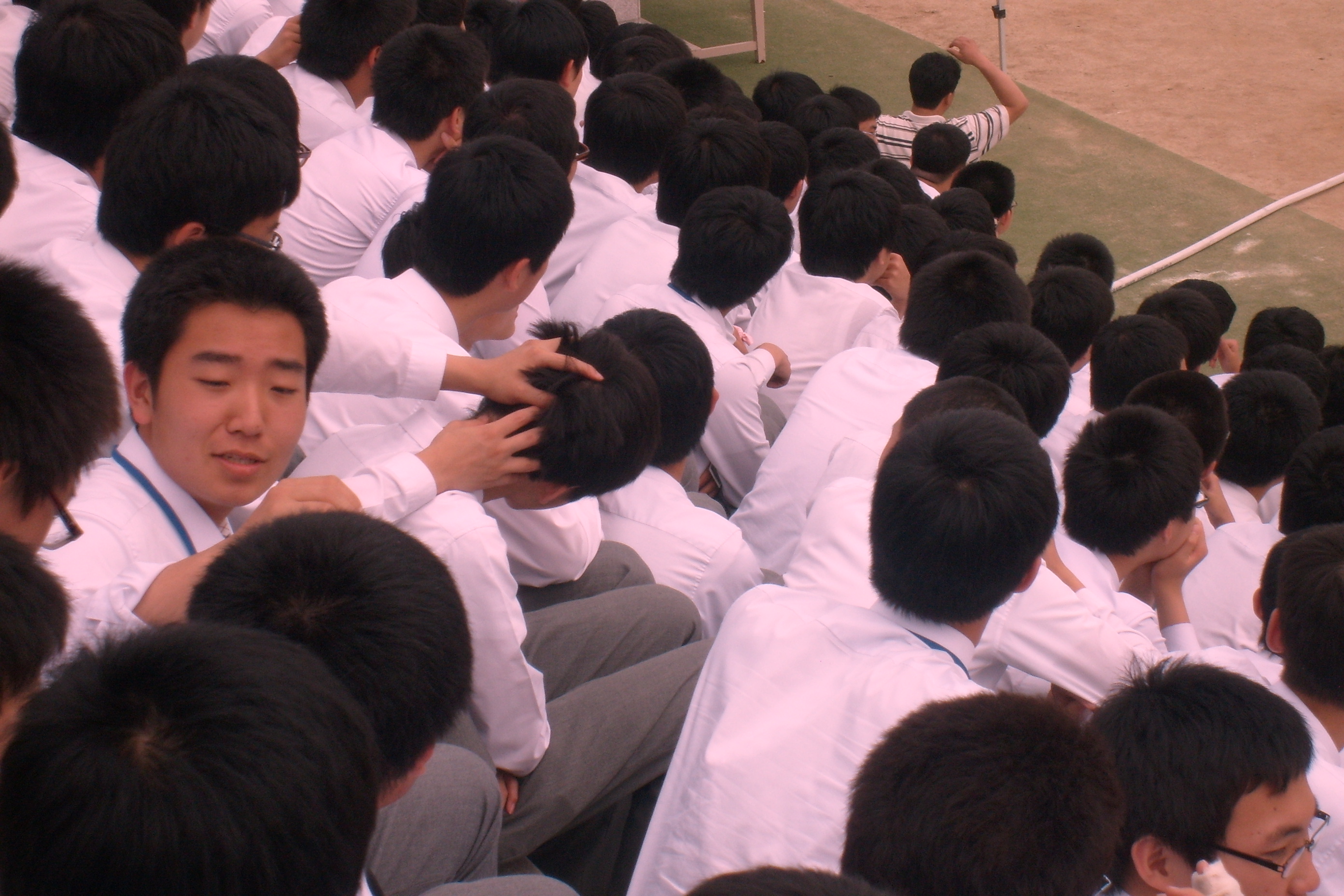
Normal behaviour
However, digressing momentarily, forced intimacy can occasionally have a negative effect. I recall, once going to a friend’s birthday party. She was English but practiced an Indian religion and along with twenty or so other friends, sat in a large and busy North London restaurant, and ‘forced’ to sit in designated seats next to people you didn’t know, we had to close our eyes, turn to the person next to us and then simultaneously, begin feeling the contours of each other’s face. The cringingly stressful procedure was accompanied by new age whale music. Oh, my God! It was horrible! Not because of the intimacy but because you knew the rest of the restaurant were watching you in disbelief. Then we had to turn to the other partner and massage their shoulders. All I could think was, Karl Marx’s grave is just down the road and I’ve never seen it! There’s a time and place for physical intimacy, for skinship but not in a busy restaurant on a Friday night to the serenade of migrating humpbacks.
So, after a coffee, some strawberries, some holding of hands and intertwining of fingers, I actually feel closer to Kim Jae-seong than several hours earlier. Already, he’s inviting me to the beach at Pusan and even suggest a date. The chances are it will materialise. And then he progresses to ask me if Id take his son to the UK when I go on my next holiday. I agree and then to make light of it, as I know it’s probably the soju talking, I joke about how he’d fit in my bag. And meanwhile Ben, his son, is eagerly taking a photograph of me and muttering ‘ that his friends won’t believe his teacher has been to his house.’
I have probably taught more students back in the UK than in Korea but I have never sat in a parent’s house, I have never been invited into a parent’s house, I have never socialized with a parent, I have never been invited on a trip with them, I have never had a student photograph me because they needed proof a teacher had been in their house, I have never had a student hold my hand or do anymore than fleetingly touch me, and the same goes for a parent, and neither parent or student has really ever wanted to associate with me. And all in instance I feel both a yearning to be back home with my friends and family and a sense that this is home. Certainly, it is where I’m valued.

© 林東哲 2010 Creative Commons Licence.
A Little 'Outing'

Not suitable for Pumpkin people
I don’t want to turn this blog into a critique and rant about that shitty country from which I come, namely the UK. I have already expended considerable resources writing the backbone of two books focusing on my experiences of both British education and British culture. When faced with new experiences, especially ones culturally orientated, it is difficult, if not impossible, not to relate them to the culture with which you are most familiar. I’m not particularly bothered about accusations of being a ‘kimcheerleader,’ I have lived long enough and had enough experiences to have confidence in my opinions though I’m may not always be right. I am unashamedly a Koreaphile and reaching this acknowledgment has grown out of my relationship with Korea. Unlike a patriotic stance, which is conferred simply by being born in a country, my allegiance may change and won’t remain static and nonjudgmental. There is nothing particularly wrong with patriotism until it suggests that those who are not are inferior, mistaken, or traitorous. I prefer to give my loyalty to that I find most rewarding, especially in terms of quality of life. Why else would I elect to work thousands of miles from home for a salary inferior to that I could earn in Britain as a high school teacher. Despite all the flaws with Korean society, and there are many, I have much greater respect and admiration for this small country than I do for washed out Britain. We might have a monarchy and an intriguing past, but Britain is a dirty, insular country whose once proud, if not questionable history and culture, is currently being swept aside in a politically correct invasion that condemns anything British while humbling before everything alien. The country for which I served fourteen years in the military forces, is now ruled by the values of the lowest strata of society and if you take any pride in something British or English you are a racist. Celebrate Christmas and you are suspect but come Hanukkah or Diwali and you can light your candles with pride and everyone has to be reverent. Every cultural import into Britain has been canonised while the native culture is systematically demonized.
Recently, I was reading a post on Chris Backe’s AKA, Chris in Korea, in which readers were asked to respond to a photograph. ‘Are you racist?’ Chris asks. The post was interesting and sparked some lively commentary but what amused me most was that before I had even read the article, I had judged the photo, ‘typically British!’ Indeed, by British standards, and talking as an ex-squaddie, the photo was somewhat tame; nice pair of shoes, looks like his pants (not jeans), are pressed and a clean white shirt! The chances, are if I met this guy when sober, assuming of course, he is pissed, he’d probably be a decent chap. Hang around Daegu even at past midnight and kids from school, in uniform, are still to be seen going home from the hagwons, study rooms and even high schools. In my home town, Crappy Colchester, many adults avoid the town and that’s early evening! Pissed up people in the gutter, predominantly the same age as Korean high school students, puking and fighting on the streets, are now a common site in most British towns and a point of social and political concern. The ‘pissed up’ includes, pissing in public, fighting , vandalism and general anti-social behaviour all of which are menacing. Most unpleasant is a tension which pervades town centers and many other places, throughout most of the day, though specifically at night and which is the result of uniquely British form of aggression.

Is Korea making you racist? (from AKA Chris in Korea)
My point? There is an ugly side to Britain, especially in terms of gender where men, especially working class men, and despite all attempts to render a facade of equality, Britain is still class divided, have to appear masculine, ie: aggressive, sexually rampant, staunchly heterosexual and prolific boozers. And now, many women behave in the same Brutish way. It is difficult not to compare my Korean experiences with those internalized through my socialization in, and experience of, British culture. No doubt there are plenty of horrid Korean men but I have experienced far more nasty Brits as a bouncer in a McDonald’s, in a town of 155.000 people, than on the streets of Daegu with a population somewhere around 3 million. Even on holiday in a quaint little German ‘dorf,’ my spaghetti ice cream was interrupted by the lurching appearance of a distant Brit ‘lad’ and two accompanying trollopes, arms wrapped about their breasts, flimsily dressed and tottering on high heels. Even before they were close enough to aurally confirm our suspicions, their gait and their body language unequivocally announced, Brits were in town!
I regularly find Korean men endearing and compared to many British men, they are both camp and effeminate. I do not intend this as a slur but as a compliment as I wish British men could temper their particular obnoxious form of masculinity. Personally, I find something uniquely British in photographs of individuals such as Wayne Rooney, and Vinny Jones who, even when not snarling an expletive, look like they just staggered out of prehistory. One reason I can’t abide watching movies starring Vinny Jones is his nastiness is too accurate, too realistic a facet more likely to do with his character than his acting ability. Yes, there are countless exceptions and Beckham is much nicer but the problem football is having with homophobia, and the fact there are so few, if any, famous ‘out’ football players is a reflection of the games dominating masculine attitudes. Of course, I realise Korea is far from accepting of homosexuality, but at least Korean men aren’t so obsessively homophobic as to aspire to a model of masculinity the purpose of which, as in the west, is to both to deflect any suggestions of homosexuality in the ‘owner’ and to suggest it by contrast, in others. This might not be the intention but it is certainly how it operates. In general, Koreans might have a dislike for homosexuality but that’s where it ends and their dislike isn’t turned into an obsession which subsequently becomes a mandate and ubiquitous template for male behaviour.

definitely Brit

A common expression of Brit masculinity
When you work in a British high school it is highly apparent that British boys are under enormous pressure to appear both masculine and anti-intellectual. I have taught many British boys who are vile humans and who you could tell were vile before you even attempted teaching them. Yet, I have still to meet a Korean teenager who I can predict is going to be a violent criminal. And when it comes to girls, Brits seem experts at producing promiscuous trollopes obsessed only with make up, tarty fashions and sex. Our rates of teen alcohol consumption, sexually transmitted infections and teenage pregnancy, all some of the highest in Europe, are testament to my vitriolic comments. Snarled at, threatened, abused, assaulted or jeered at , I have no experience of in Korea, but ask British teachers about their experiences, especially non-managers in non-selective schools, and it quickly becomes apparent such behaviour is general rather than exceptional.

And that's just the women!
Having thus painted a fairly lengthy account of the Britain with which I am acquainted, I naturally find Korean ‘masculinity’ intensely refreshing and in many respects something to both celebrate and take hope in.
© 林東哲 2010 Creative Commons Licence.
Ten Tips for Taking the Plunge
So you want to go to the bathhouse but have reservations.? Read on…

Once you’re naked and the same as everyone else, the apprehensions that originally plagued you gradually, though not completely, begin to lift. I wore my military dog tags and a watch on my first occasion and, for the next few months, continued to do so on subsequent visits. These became invested with a new sense of worth as for some ridiculous reason, I didn’t feel totally naked wearing them. As psychological props, there came a stage several months or maybe even weeks later, when they were no longer necessary and I clearly remember deciding to leave them in the changing room and finally go completely naked. Initially, I missed them because I used to fiddle with them or glance at my watch obsessively, when I felt uncomfortable.

You might want to avoid that white bucket seat on your first visit!
Ironically, my first visit to a bathhouse was on Independence Day, March 1st 2001 (삼일). I traveled with my best friend, my boss, whom I now work for, to visit her family in Changwon (창원). The bathhouse visit had been unplanned and presented to me as a choice, the other being to stay at home and play games with the women. I decided, for the sake of my image, to accompany the 5 men, all related and one of whom my friend’s husband. They were all sympathetic to my novice status and were especially thoughtful and empathetic. Despite my trepidations and the fact I had been wanting to have this experience, my diary comments, were positive and my only apparent fears were bending down to pick up the soap, a little unease at being the only adult who wasn’t circumcised and sitting in that ‘undignified’ position on the little plastic stool. One of my friends even scrubbed my back which though strange was endearing and made me feel both part of our group and bathhouse community. What surprised me most however, was the depth of intimacy between fathers and their sons, an intimacy which went far beyond scrubbing backs. It seemed there were no taboos.

No gigantic towels to hide under
Under the shower next to me, a boy of 13 or 14, lay on the floor while his father vigorously scrubbed him. This included holding aside the boy’s genitals while he scrubbed his groin and, when the boy rolled over onto his stomach, he scrubbed his buttocks. When this was finished, they traded places and the procedure was reversed. I have since seen this performed countless times, in many other bathhouses and in all possible variations. Though no longer surprised, I’m always aware of the cultural differences that in the West deems this intimacy, not just sexual, but a perversion. Yet in Korea, I find such ‘rituals’ bonding, even cute. When leaving the bathhouse, one of my friends proudly informed me, I was now ‘a new man.’ I don’t know whether he meant physically or mentally and while there was no doubt I felt impeccably clean, most notable was a sense that I had overcome a deep-seated fear.
One trip to a bathhouse however, wasn’t enough to defeat my inhibitions or to satisfy my curiosity about this cultural phenomenon. A few weeks later, another friend took me sightseeing in the mountains which culminated in a visit to some form of bathhouse. Of course, I had no idea of this at the time and assumed that we were visiting a mountain foot clinic, as my friend, Hyo-son, was a foot doctor. I imagined I was going to have a foot massage and then perhaps a meal at the small restaurant situated on one side of the building. After being introduced to the establishment’s hosts and a teenager, I was ushered to a changing room and then, via a series of isolated English words and hand gestures, instructed to undress. So, I began stripping off, assuming my friend, Hyo-son, was going to join me. Instead, the three of them stood chatting and ignored me until I was naked. Then, like a lamb being led to the slaughter, Hyo-son coaxed me by the hand into a shower room. More hand signals follow and I take a shower while they stand in the doorway and continue their conversation. Meanwhile, confused, I begin muttering to myself, a habit which manifests when I am in intense, embarrassing situations. Next, I am led through a small bathhouse in which there are perhaps 5 men. In the far corner of the room is what I now know to be a mud sauna (황토방 ). Looking like a gigantic wasps nest, this is basically a small room built out of yellow mud which when dried, houses a dry sauna. I was instructed to enter the sauna through a flap on the floor – a flap similar to the ones used to allow the passage of a cat into and out of its house, and not much bigger. Any remaining pride was dispelled as I got onto all fours and proceeded, pig-like into the sauna. Beyond humiliation, I lay on the sauna matting laughing aloud in total disbelief at events. Sometime later, the teenager was sent to summon me and I re-emerged, on all fours. I was directed for another shower and then, in the bathhouse section, and with my little entourage all present, I was instructed to lay in an enormous stone bath which was already being filled with what looked like dark green slime. The bath was hot, but every time I tried to dangle my arms over the sides of the bath, or move myself out of the water, the boy pushed me back. Then Hyo-son began massaging my body with an enormous tea bag which smeared a herbal smelling paste over me . I was thankful when the water rose to a sufficient depth to cover me completely. Even to this day, I don’t know whether this was a mud or herb bath or perhaps even both but several showers were required to remove the slimy residue from my body. After a period of relaxation in the small bathhouse, I was finally able to dress and join the group in the restaurant.

And permanently accompanied by a symphony of water
I can empathize with anyone facing apprehensions about taking the plunge into this strange world. Ironically, even after such experiences, I remain apprehensive about swimming pools and changing rooms in the UK where there is always a sense that either something sexual or aggressive is about to happen. What shades and informs such experiences is the culture from which it stems. Back home, the body is dominated by a sort of fascism, predominantly external but also internally generated, which classifies and critiques bodies according various categories. Sometimes I hear myself commenting on individuals and not necessarily in a negative manner but negative ones I don’t like partially as one target of criticism is my own body. The most obvious category for western men of course, is dick size. On this subject, I don’t truly know what significance Koreans place on penal proportions, but I would imagine that bathhouse culture renders any pretty unimportant. There may be some variations in dimensions but you quickly learn they’re all basically the same and it’s all pointless and unfair anyway as the winners are invariably 13-year-old skinny boys whose accompanying bodies are still 10 and in which any triumph, if there is any, is temporary. When the clothes are off and we are reduced to our basic components, everything is demystified.
As an ex-gay man, I have to add that bathhouses are fairly unsexy. I’m not saying nothing ever appeals to me, on the contrary, I am very aware of attractive looking males, but what is most bizarre is that even from my first visit to a bathhouse, the experience was non sexual. Ironically, this is one of the most fascinating aspects of my bathhouse experiences, as my sense of liberation stems not just from shedding my clothes, but from shedding that most dominant and basic urge. Necessary as that urge is to the proliferation of humanity, in individual terms it is probably the most wasteful, driving us like lemmings in the selfish pursuit of satiating our own chemical impulses, consuming our time, diverting our attention and draining our energies in the process. I’m talking as a single man, in my fifties, of course, were I in a romantic situatiom, I wouldn’t be so dismissive; but I don’t think I miss the mark accusing this urge of being the most greedy in its wants and least rewarding once they have been acquired. And Oh! Isn’t it a merry-go-round; once satiated it’s only a matter of time before it rears its head again and we’re compelled onto that journey to nowhere. What an utter waste of human energy! Well, don’t ask me how, but in the Korean bathhouse those urges are extinguished. Rent apart is that conflation of nudity and sex, for me at least, so that I can enjoy nudity and the equality and liberation it brings without the sexual urge kicking in and can do so while appreciating the occasional beauty that passes my way. Cocks are really only interesting when hidden and once they are flopping about all around you, other things become of more interest – the trickling of water on old man’s skin, the contours of someones hip, the interplay of someone’s muscles, someone with a belly fatter than mine, a father bathing their baby, the sounds of water – it can be anything.

Cute!
Friends often ask me why there are no such establishments back home or what might happen if one were opened. I could write a substantial amount in response but basically, I wouldn’t enjoy bathing in a western context and certainly not in a British one. A gay bathhouse would terrify me but then I was never very good at being gay!! Besides, I’d hate being eyed up by someone like me and I quite pity all my victims back in the days when I was lecherous! My home town has a spa facility but the need to wear bathing costumes immediately seems restrictive and puerile. Several years ago, when it ran single sex naked sessions, it attracted so many gay men seeking sex, it subsequently reintroduced costumes. Recently, I’ve considered nudism in the UK as I am tempted to believe attitudes among nudists might be healthier. This consideration has grown out of an awareness that while in Korea, attending a bathhouse imposes no social judgment, in Britain it would label me either ‘gay’ or as some kind of ‘swinging nudey.’ Unfortunately, while we conflate sex with nudity, bathhouses, spas, and places of semi nudity will continue to encourage all mannerisms of sexual activity, passive and active.
Ready to take that plunge? No doubt, many will have no worries entering a bathhouse but if the experience is likely to stress you, here are some tips.
1. Keep a watch on. It’s really useful as a diversionary play thing should you feel uncomfortable.
2. Choose a quiet time for you first encounter. Early morning, eg. 5 am, though anytime before 7am on the weekend is good. Alternatively, if the establishment closes, a good time to attend is on a weekend a couple of hours before closing time.
3. Avoid public holidays, unless you’re prepared for a full house and avoid both ‘play Saturdays’ (놀토) when there are no schools, and school and university vacation periods.
4. Sometimes, fitness centers have adjacent bathhouses and jjimjilbang. If this is the case, you can use the sports facilities a few times in order to familiarise yourself with everything, before using the bathhouse.
5. On your first encounter you’ll probably head straight for the bathhouse complex blotting out everything on the way. Try to remember to pick up a towel and a wash cloth, usually located around the complex entrance. These can be used the same way as your watch, when you get stressed or ultimately, to bury your face in.
6. Remember, if you head straight for the showers which are situated at floor level, you will have to sit on a bucket sized seat. All bathhouses have regular, standing showers which provide a good vantage point to familiarise yourself with the bathhouse layout and practices and don’t necessitate sitting in an undignified position.
7. Soap, towels, toothpaste are all provided. If you drop the soap and find this embarrassing, park your arse in a corner before bending down, or with your knees together, bend with the knees and not from your waist. Alternatively, rapidly kick the soap into the drain and ignore it.
8. If you remember to take a towel in with you, you can use this to dry off, prior to leaving. On your first visit you will probably want to escape quickly and this will be prolonged if you are dripping wet. If there is an ice room, five minutes sat in this, especially in summer, will quickly dry you but this procedure has a detrimental effect on males.
9. Male and worried about willy size? Instantly add an extra centimeter by trimming surrounding hair. I once read that every forty pounds lost, assuming you are that fat to begin with, increases the appearance of the size, by one inch. One the other hand, if you’re as fat as I am, an extra few stone would supply enough lagging to provide an overhang sufficient enough to hide it completely.
10. Of course, there is nothing to prevent you wearing a swimming costume and I have known people do this. They were women so I never actually witnessed reactions. I’d imagine you would attract far more attention wearing something than going naked and besides, no matter how good-looking you are, you’d look a total twat.
Good luck. If you too have suggestions, please add them here. Thanks
© 林東哲 2010 Creative Commons Licence.
Related Articles
- Because we’re worth it. – Busan, Korea Rep. (travelpod.com)
- Seungri and Taeyang put on a naked show at a sauna? (allkpop.com)
Bathhouses are Gay!
I frequently hear or see this comment and consider it the dumbest a westerner could make! Anyone who comes to Korea and doesn’t try a bathhouse is denying themselves an experience rich in its uniqueness and in its ability to afford you a very intimate glimpse of Korean culture. I have probably attended a bathhouse 3 times a week for a period of almost 4 years and in all that time I have only seen 3 western people in bathhouse, 2 adults and a boy. Neither have the numerous westerners I worked with over this period attended one with me. I am no bathhouse guru and there will be foreigners living in Korea far more experienced in this pursuit than I, but turning to my own culture, we certainly have a terrifying fear of nudity.
In UK schools, the practice of showering after sports was phased out around 15-20 years ago. Cutting the heating bill was a good way to save cash even if it meant that students, especially boys, spent the day putrefying in their own sweat. No one seemed to mind especially as showering was only ever enforced when one started puberty and felt uncomfortable being naked. And one common feature of many schools was that boys usually had to undress in front of each other while girls were often, but not always, afforded some privacy. From my own experiences and conversations with other men, there is an agreement that male changing rooms are often charged with a bizarre juxtaposition of the erotic and aggressive. When I last taught in an English High School, around 2003, I had to take several classes of boys preparing for swimming lessons. Each boy was equipped with the most enormous towel of sufficient proportions to cover a single bed. I have several female friends who told me stories about convent life where, after sport or swimming, girls were required to shower in, and undress, under large smocks designed to hide their bodies. This was exactly the same except this wasn’t a catholic school! It wasn’t even Church of England. Most of the boys were around thirteen or fourteen and their bodies were still puny but hidden from the neck down, the material enveloped them twice and doubly guaranteed that not the slightest naked thigh, knee or even elbow should be inadvertently exposed. All the boys were skilled at holding secure the neck of their towelling smock from within its confines, while the remaining free hand, buttocks, hips and knees, shimmied their underwear off and then pulled on their swimming shorts – and this in the reverse order when changing back into uniform. Some boys were unfortunate enough to have restrictive, ordinary size towels and if they slipped or were insufficient to hide their bodies and they were exposed, not only were they mortified but so too was any boy who happened to glimpse what lay under that towel. Then a string of accusations were spat forth declaring the observed and any unfortunate observers, ‘gay.’ In Britain, certainly among school boys, to either see another boy’s dick or for yours to be seen, implies homosexuality. This juvenile attitude is similar to the ones levied at Korean bathhouses and seems to be a western attitude rather than one confined to British men. Of course, nothing could be further from the truth.

if you think bathhouses are ‘gay’ you totally misunderstand Korean social practices
To be honest, in Britain, I too find nudity or even semi nudity uncomfortable. We seem adept at criticizing the bodies of others and many of us, myself included, have been imbued with various attitudes towards the body and nudity. Ironically, I feel more human as a naked, fat foreigner, in a Korean bathhouse, than I do wearing shorts in a British swimming pool. In addition to our internalized assumptions about bodies, we conflate both nudity with sex and same-sex nudity with homosexuality. I am sure that something sexual must occasionally occur in Korean bathhouses, probably in specific bathhouses, but I have never witnessed anything of a sexual nature.
My first experience of bathhouse culture was in 2001, when I was visiting Masan with friends. I was asked which three things I’d like to do before leaving Korea. I replied: I wanted to try dog stew, silk worm and go to a bathhouse. My stomach almost hit the floor when my friend smiled and told me we’d probably visit a bathhouse that very afternoon. The whole experience terrified me but I swallowed my pride and went through with it and then, when back in Daegu, I made myself go to other establishments. I still feel a little uneasy entering a bathing complex probably as I have a negative image of my own body but I have never been made to feel uncomfortable. Koreans will all peak at you but once they’ve looked you up and down you blend in with the other clientele. As usual, if you should make eye contact with them while they are peaking, they will instantly look away.
On the streets of Korea the novelty of foreigners is rapidly declining and I find my presence attracts far less attention than it did 10 years ago. I find it boring that my presence on the street is almost non eventful though I would imagine in rural areas we are still a novelty. Most establishments, bars, restaurants, shops etc, have learned to accommodated foreigners. In many restaurants, menus are available in Korean and English but ten years ago you were only likely to find this in fast food restaurants. I can even remember Pohang bus terminal’s arrival and departure board only being in Korean. If you want to experience the Korea relatively unchanged by the presence of westerners then bathhouses are an ideal location. I am still fascinated by this cultural phenomenon as it has afforded me a far deeper insight into Korean life than probably any other experience. Bathhouses expose not just our bodies but the differences between the Korean and western psyche. Most obvious of course, is the attitude to nudity. I would imagine Korean’s have seen every permutation possible in the human body before they even reach their teens and the traumas our teenagers associate with puberty are minimized in Korea. Also exposed is the level of intimacy that Koreans share not just with their immediate family but with friends and strangers. That horrid male macho-ism that is magnified when western males are in changing rooms or semi naked, a mechanism used to assert masculinity as well as heterosexuality, is absent in a Korean context. To get naked with your friends doesn’t require mitigating the homosexual implications by playing some aggressive sport beforehand. Koreans can sit close to each other, touch each other and even clean each other without any fears of being misunderstood. The most exposed behaviour though, and one that would shock many westerners, is the intimacy shared between fathers and their sons as well as older men and younger people in general. I doubt there are many westerners who would allow their 10-year-old to go to a bathhouse unaccompanied let alone allow them to have an intimate scrub down by a bathhouse attendant who may very well be a stranger to that child. This situation was highlighted several years ago when a youth taekwondo team visiting from the UK was put in a very awkward position when their hosts took the British kids and instructors to a bathhouse. How do you explain to Koreans that in your culture, this activity would be illegal and that children and adults naked together, even if immediate family, is treated with great suspicion and constitutes one enormous taboo.

Cooling off
The most interesting aspect of a bathhouse experience is that it not only exposes Korean culture to the foreign observer, but also exposes you to the nature of your own culture and encourages you to reflect on many taken for granted assumptions and practices. Using bathhouses has given me a deeper insight into both Korean and British culture. On my return to Korea after a holiday, my first task is to take myself into a bathhouse. I have come to perceive communal bathing and the intimacy practiced around it as natural and certainly healthy, both physically and mentally and concurrently, I have come to realise the unhealthy nature of western attitudes where natural human relationships have been moralised if not perversified. To deem bathhouses ‘gay’ is a moral statement in that it suggests ‘not natural,’ ‘wrong’ and ‘unhealthy.’ In the UK, we have already embarked on a brave new future where the most innocent of associations with a minor is suspect and where even the most checked, verified and scrutinized professionals have to be permanently policed. In Britain, I do not think we are too distant from a future where any form of communication with a minor, outside that of the family and school, will be classified as a potential crime and sufficient to call the police.
© 林東哲 2010 Creative Commons Licence.
The Changing Face of Song So
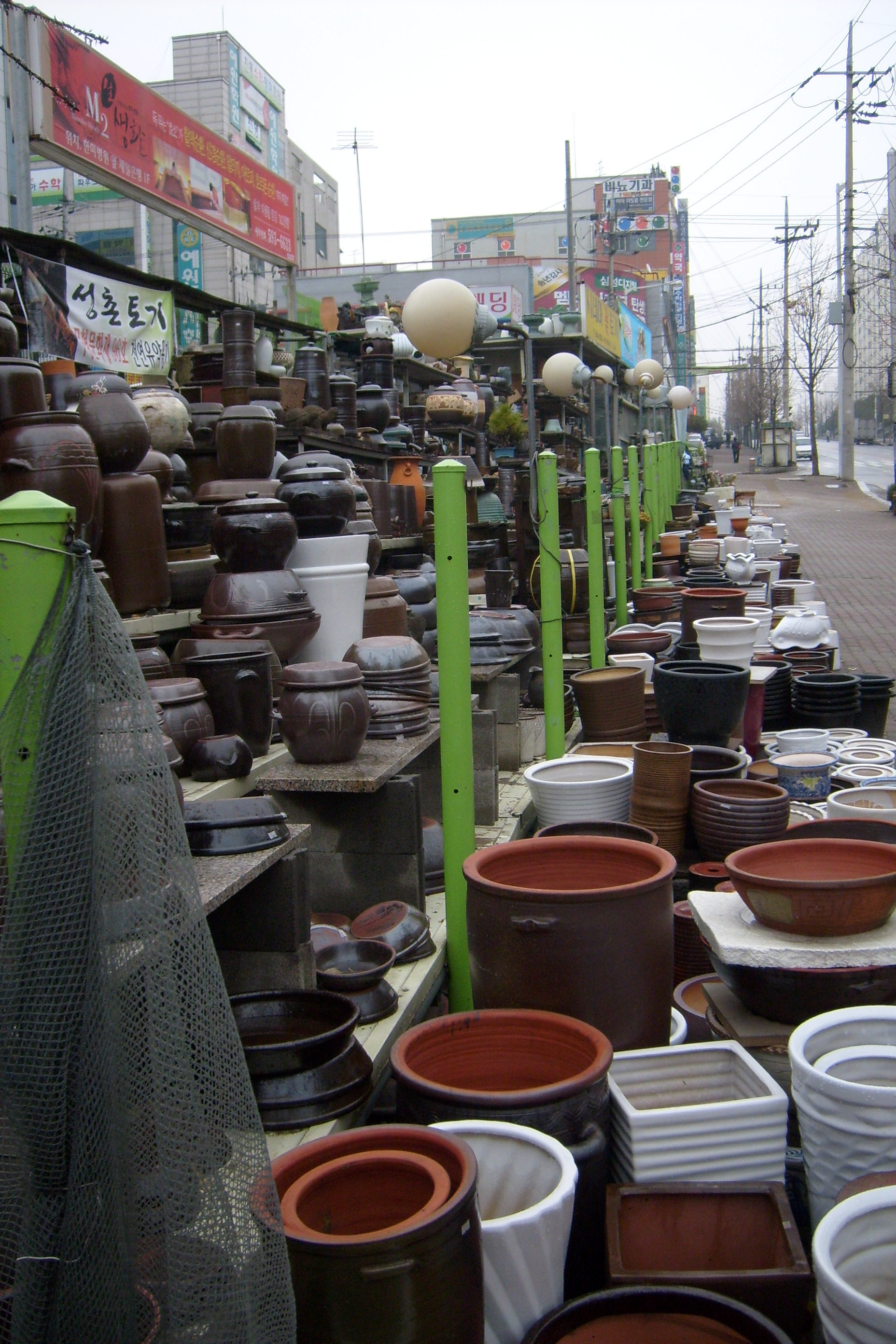
Ceramic store
When I first experienced Korea, in 2000, I remember a chemist shop on the corner where I lived which used to stack vitamin drinks outside the store, in front of the windows. The drinks were in boxes and used to remain there throughout the night. Anyone wishing to steal a box would have had little difficulty. Today, the store is a plush American styled bar which may even be called ‘Friends’ and the chances are that next year it will be a restaurant or internet cafe. I remember the boxes of drinks well as I ways always tempted to steal one. I never did and don’t think I ever intended to but clearly, there is something in the western psyche that prompts one to steal anything which isn’t chained down. This observation I base on my own immoral character, as well as on the characters of fellow westerners, from New Zealand, Australia and the USA, who all admitted that if something isn’t secured it warrants being stolen. I know electrical stores which stack new refrigerators outside the store, flush against the windows, and street vendors, some who are friends, will often leave microwaves, food, small televisions and many items in their little plastic tents over night. All easy pickings for anyone with a pair of scissors or penknife and a will to steal. Leaving property in situations where it could be stolen is clearly not a major concern in Korea and the practice of leaving things unattended or stepping out of premises temporarily, without locking up, is widespread.
Several months ago I went shopping at 6.30 in the morning and apart from the food hall, on the ground floor, the other 3 floors were all void of staff and despite some display being draped with covers, the majority of goods, clothes, sports equipment etc, were visible. Once again that little urge to steal presented itself, but I resisted. I still find it amazing that a large department store leaves its isles open and unguarded overnight. I’m sure cameras were present but I doubt stealing something would have been all that difficult.
Of course, I’m not suggesting that in Korea crime does not exist as it does and on one occasion, I was the victim; but I do feel one is less likely to be a victim in Korea than in the UK, my home country and beyond any doubt, one is much less likely experience physical violence. Several years ago my neighbours in the UK moved house and their old property remained vacant for almost a week prior to new occupants arriving. In their front garden they left two, large ceramic plant pots. Late one evening, just as I was going to bed, I heard a car stop adjacent to my house and looking out the window, I watched a silhouetted figure emerge from the car, dart across the front garden to steal the two pots. My neighbourhood in the UK has one of the lowest crime rates in the UK but it doesn’t stop plant pots or garden sheds from being stolen and rape and the occasional unprovoked, violent assault, all occur from time to time. My home town has a population of 35.000 compared to Daegu which has around 3 million.
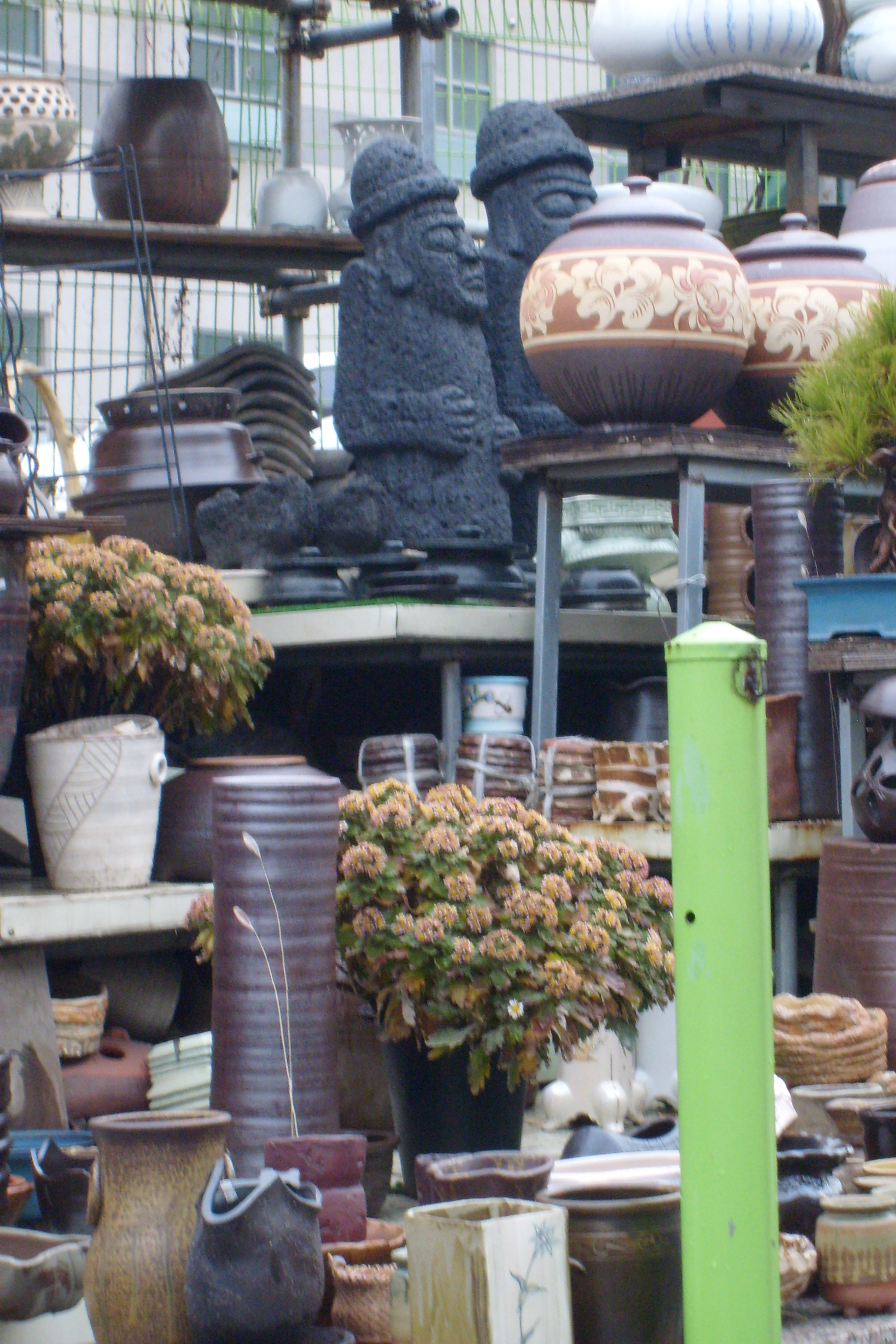
Ceramics
Much of the crime suffered in the UK however, and a crime I feel especially absent in Korea, is the vandalisation and destruction of property for no apparent reasons. A significant element in our society has a bent for destroying, wrecking, maiming or ruining anything which belongs to someone else and there seems to be a correlation between the amount of affection put into what ever it was that was targeted, and the relish with which it is destroyed. Grave stones, bowling greens, and especially attractive gardens seem currently in vogue. If you can assault the victims emotions, committing the crime seems all the more pleasurable.
In 2000, when I first worked in Song So (성서), Daegu, the KFC next to my school had a life-size model of Colonel Saunders stood outside the store. As it was Christmas, he’d been jollied up in a Santa outfit and even had a walking stick hanging from his wrist. Neither the model nor the stick were secured and remained in situ until he was de-jollied sometime in the New Year. In my home town in the UK, a similar model has to be secured by a chain to prevent it being stolen and it is not left out at night. If vandals attempted to remove the UK model and found it chained their tempers would be inflamed and they would simply smash it to pieces. Back in Korea, Colonel Saunders remained outside the store, unfettered, 24 hours a day. No one thought to carry him a mile or so down the road, for some silly prank; or to rip his arms off or kick his head off; and no one thought it necessary to steal his cane and subsequently use it to smash a shop window or terrorize a passer-by. But then the fast food restaurants in my high street have to employ bouncers and at one time, whilst a student at university, I worked as one for almost a year.
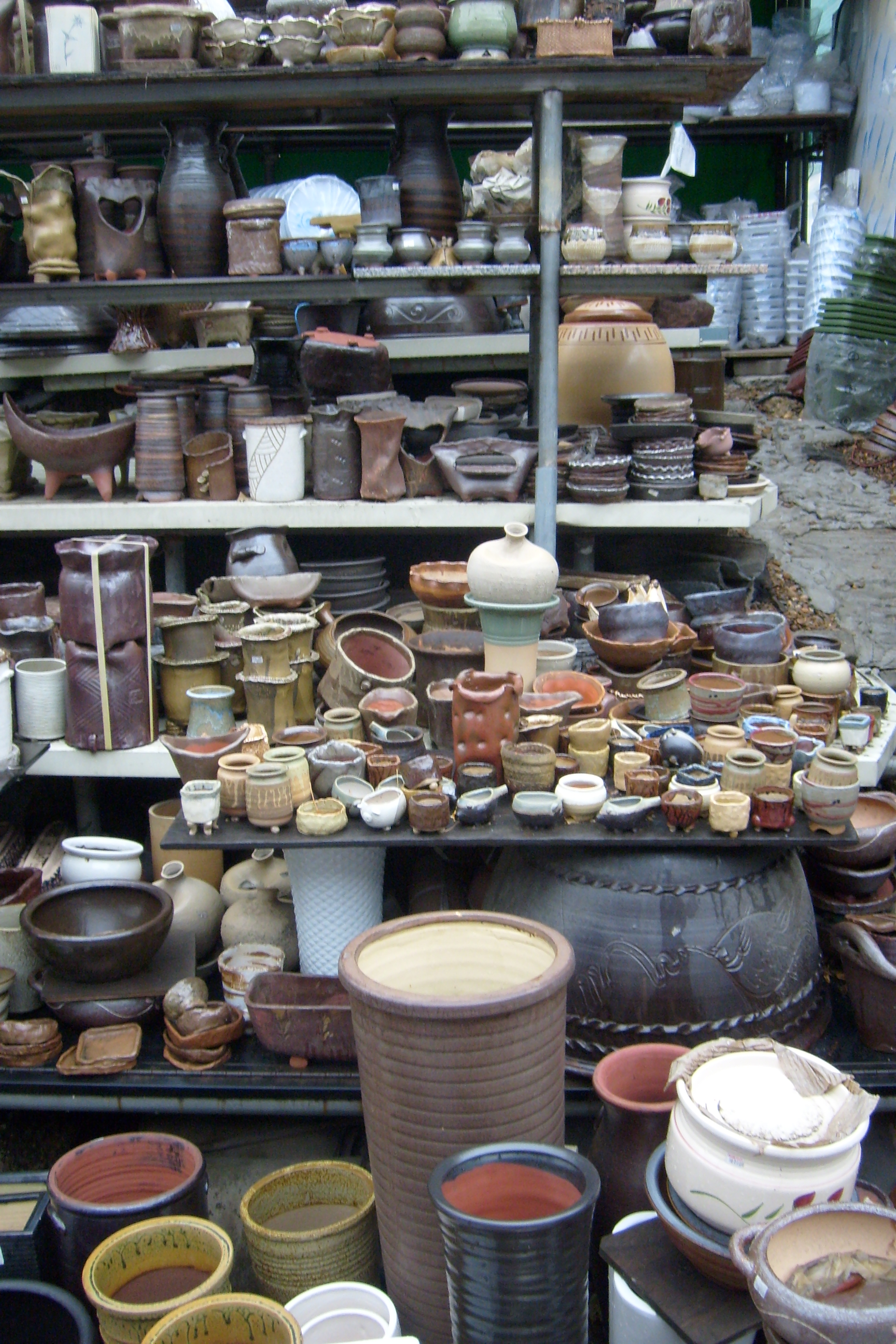
Kicking these about would feel great when pissed!
And in Korea, students as young as 7, usually with mobile phones dangling from their necks, bring their parents’ ATM cards to school to pay their monthly fees. Nonchalantly, they hand them over to staff and no one seems concerned or worried that the kids might lose them, use them or that the staff might make notes of their details or overcharge them. As for their mobile phones? Often expensive and the latest in the range, who would want to steal them? Every one simply trusts each other to do the right thing. I’m sounding like a Kimcheerleader but back home a little kid with an expensive mobile would assaulted and robbed.
Almost opposite my school is a garden center which sells a vast range of ceramic items all of which are stored outside the shop. This business is one of the longest surviving in my part of Song So and has been here since at least 1999. The road on which it stands is fairly quiet, especially in the evening and at one time, prior to building projects, several vacant lots nestled besides its borders which occasionally hosted 24 hours soju tents. Even to this day, I am amazed that the place has never been vandalized or that drunks have never decided to kick over a few pots. I think the photos do the premises justice and as you can see, there are thousands of items all displayed in tiers and completely open to the public. Though there seems to be the supports for a fence fronting the premises and though I pass by here every day, I have never seen evidence of vandalism.
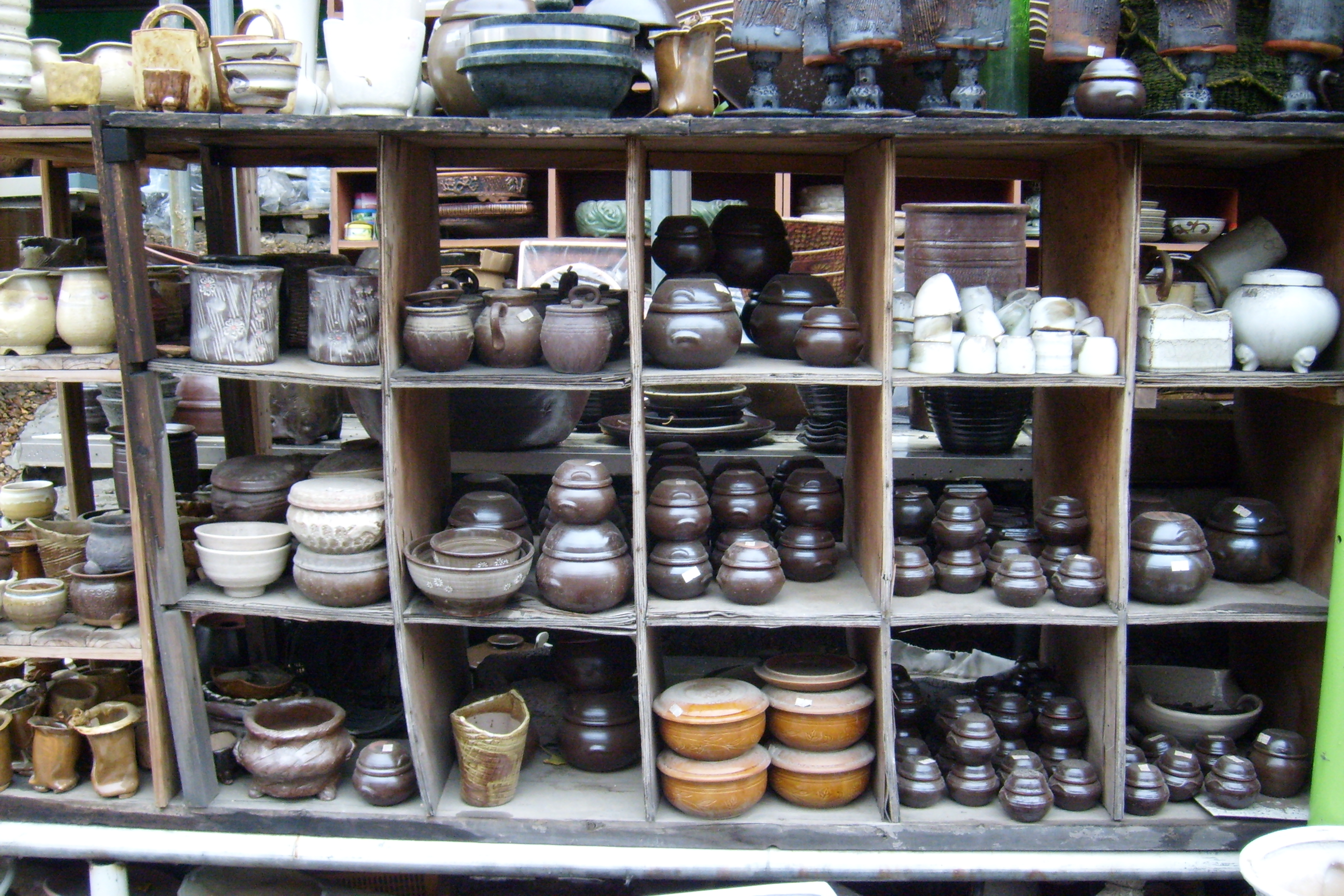
Open to the ‘elements’ 24/7
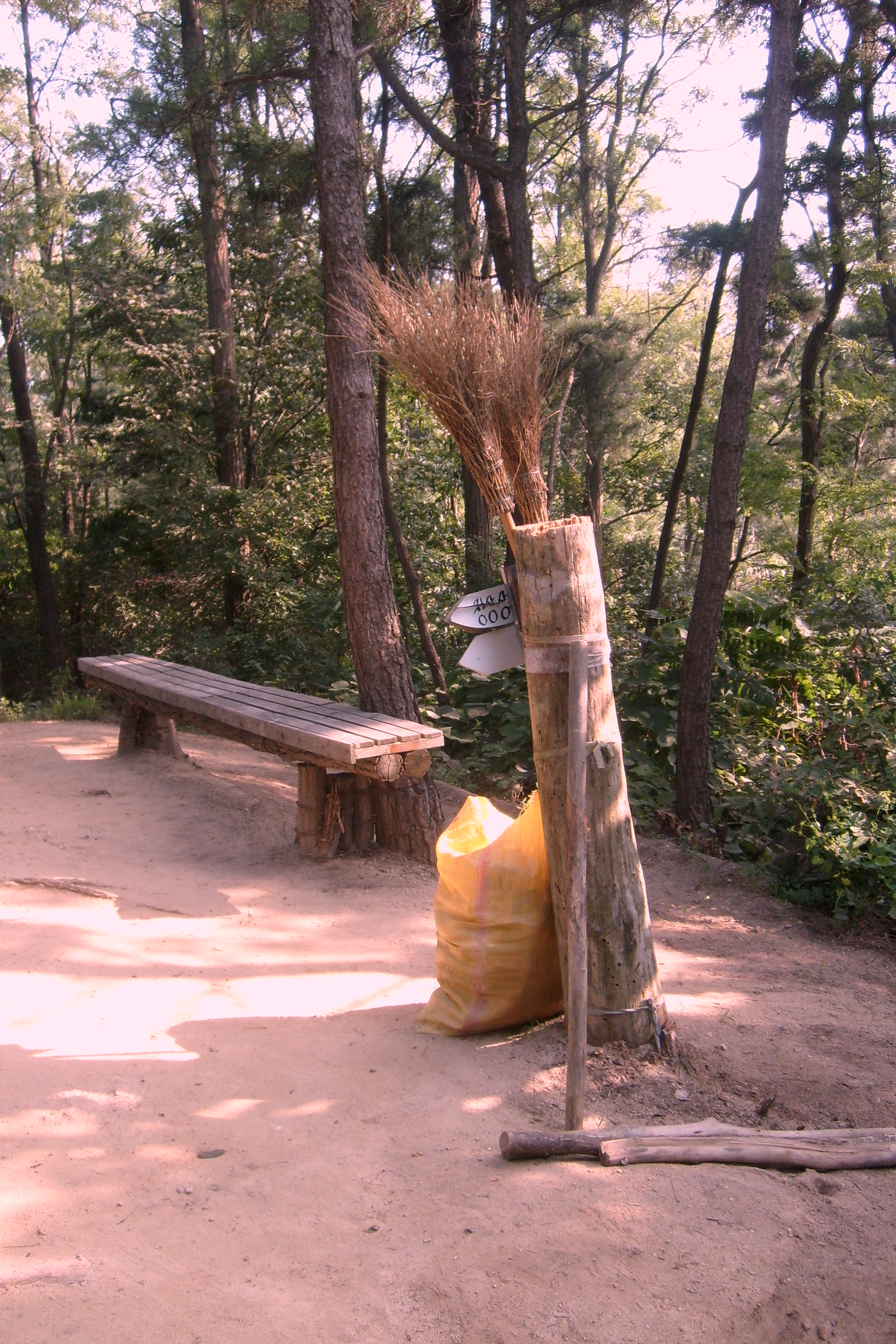
Wooden bokken and brooms
It is not unusual to see people, usually elderly, who will stop and pick up a piece of litter in the street but perhaps the best example of mutual respect and community spirit can be found on mountain trails where small gyms are customarily established, usually on or close to mountain peaks. I have used such gyms in both Cheonan and Daegu and in the mountains verging Song-So, Daegu, I have used two. The closest to my apartment, perhaps a 30 minute, I have used on and off over ten years. Here you will find a number of exercise facilities provide by the local authorities but which have been augmented by items carried to the top by local people. A clock has been secured to a tree, numerous weights, exercise hoops and an exercise bench. None of these items are chained or secured in place. In Ch’eonan, someone had provide stout bokken (wooden kendo sticks made of a durable wood) and on a sturdy tree stump fixed rubber tyres. Frequently, I sat and watched individuals swing the bokken from one side to the other in order to strike the tyres with powerful blows. And nearby was a waste bin and numerous brooms for sweeping the little gym clean. The clock on top of the Song-So mountain impresses me the most as this has been here for ten years though it may not be the same one. Irrespective, no one has thought to smash it or hurl the weights or dumbbells down the steep path which leads to the mountain summit.
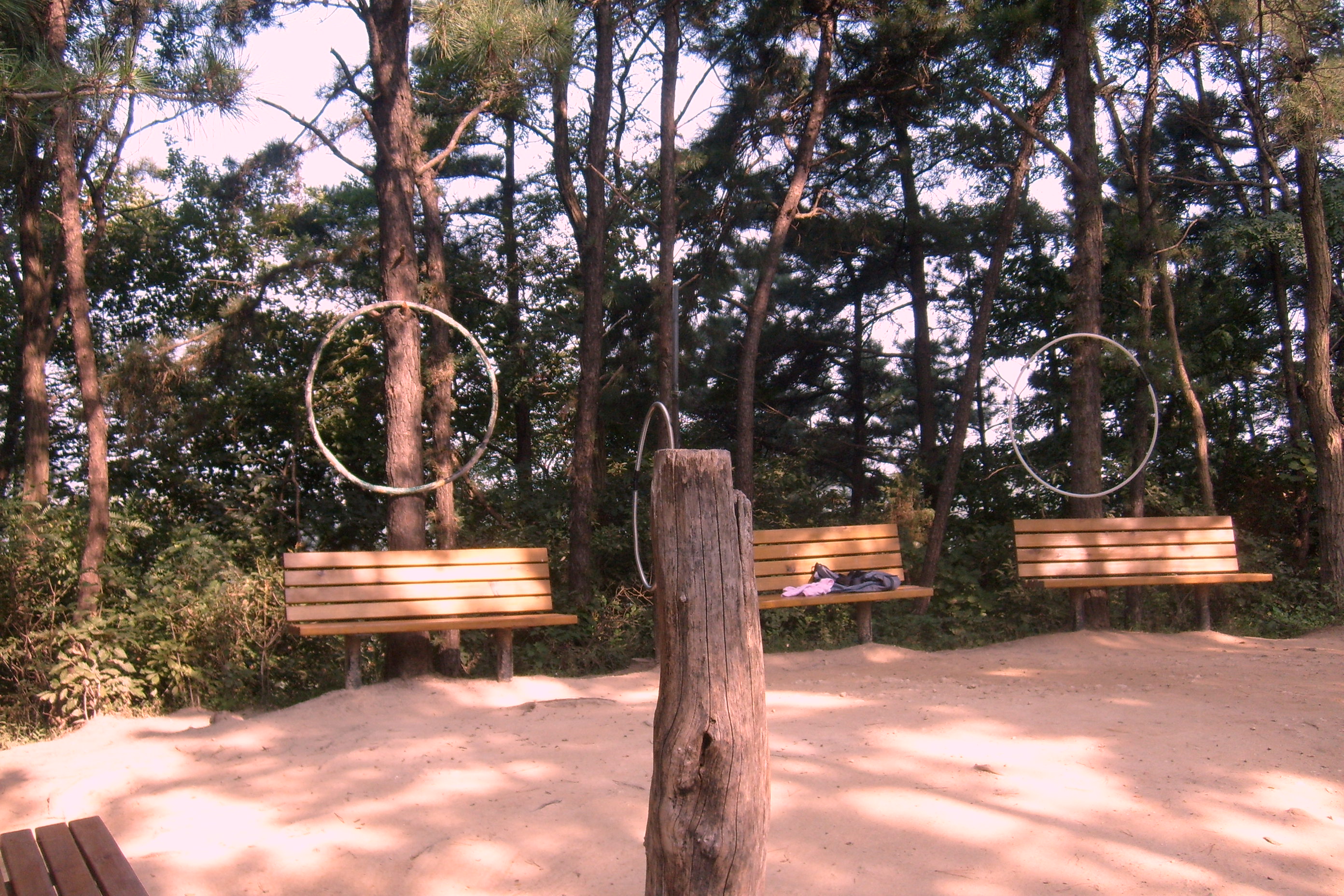
A bokken striking post and exercise hoops
That you can set something delicate on the side of the road or in a small clearing on a secluded mountain summit and leave it in the knowledge it will neither be stolen nor vandalized, is a testament, a trophy, to the nature of the people living around you.
© Nick Elwood 2010 Creative Commons Licence.
The Last Taboo
Recently, I changed my routine so I often go to my favourite bathhouse (목욕탕) after I finish work, around 8.pm, rather than in the morning. However, I prefer the morning as it is quieter and unless it’s a holiday or a weekend there are rarely any kids or university students. As I lay in the ‘special event bath,’ this week scented with lavender, another westerner entered. In four years of fairly daily bathing, this is only the second time I have seen a westerner in a bath house. He probably saw me but as usual, didn’t acknowledge my presence. Most westerners will walk straight passed you even on an early Sunday morning when the streets are empty. I’ve given up being friendly as a cold shoulder is the usual treatment if you are polite. There are exceptions, of course, but this has been my experience. I didn’t particularly want him talking to me anyway; I don’t mind being naked in front of Koreans but have never relished the idea of bumping into a westerner when nude as we tend to be critical and judgmental about nudity and the bodies of others as well as our own. In reality, the westerners who do use bathhouses, especially if alone, probably have healthier attitudes to bodies than those who avoid them. I don’t think he felt particularly comfortable in my presence as he left after only a few minutes which was a shame as, my apprehension aside, it would have been a good opportunity to exchange experiences.

Usually, I have to wiggle my backside like a gigantic duck in order to disengage that little seat from my bum.
I don’t think he was a bathhouse novice, either. From the lavender bath in which I was relaxing, I could see him drying off in the area immediately beyond the bathhouse exit. He had no problem bending over to dry his feet and calves and did so without maneuvering his backside into a corner, thus censoring that most private place from public view. One of my remaining inhibitions, though not as acute as it was, is exposing or touching this area in public. Perhaps I need to set myself the task of prostrating myself 5 times a session and soaping my backside in a position where my neighbours can see, as a therapy to neutralise this remaining inhibition. I would like to squat right down, Korean fashion, and give my entire undercarriage a thorough scrubbing, if it were not for the fact that I find deep squatting both easy to topple over in and difficult to stand up from. I have enough problems standing after sitting on the bucket sized seat from which you wash yourself as often it remains stuck to my arse as I stand. Then, if it clangs to the floor, it attracts unwanted attention. I have a similar, though quieter problem, if I sit on a towel as this too will remain in the grip of my buttocks, as I stand. The term, ‘taking in washing’, which is used to describe the backside’s ability to grip things, usually underwear, comes to mind, but bathhouse furniture and towels is taking it too far! Maybe it’s my arse, I don’t know and I’ve never paid much attention to what Koreans do after sitting on a towel. I have a niggling suspicion that the propensity for my buttocks to grip towels and seats, even the large plastic type, similar to the ones we use in gardens in the UK in summer and which are often found in the steam rooms and saunas, have more to do with my dimensions than my ethnicity; I have a large arse to put it mildly. Of course, I don’t know how other westerners conduct themselves in a bathhouse as I’ve never observed any but I would imagine that many would find it disconcerting to drop the soap and have to pick it up. This chap was quite at ease, as at ease as the Koreans around him, at prostrating himself right in front of the glass doors to the bathhouse and in full view of everyone lounging in the baths. Whoever he was, he left the bathhouse with my admiration.
© Nick Elwood 2010 Creative Commons Licence.
Sanitised Santa
A few years ago, I read an article about how one large city in Canada recruits and trains Father Christmas employees almost a year before they are employed. The Father Christmases are stringently vetted and then undergo training to make sure they are ‘politically correct’ in behaviour and communication and have been upgraded to whatever latest jargon is on the PC agenda. You know what it’s like: one minute they’re fussing over how wicked it is to say ‘Afro-Caribbean’ instead of ‘African Caribbean,’ or reminding us how insulting it is to use the term ‘brainstorm,’ but all of them use the term ‘Chinese New Year‘ instead of ‘Lunar New Year.’ At least if you’re an African-Caribbean wickedly called an ‘Afro-Caribbean,’ half of this term is correct. At least you’ve been located in the correct continent but if you’re Japanese, Korean or Thai, et al, ‘Chinese New Year’ totally ignores your culture. So, banned by the PC police from asking small children what ‘mummy and daddy’ are going to buy them for Christmas, the potential Father Christmases have to ask what ‘mummy or daddy, or their guardian or carer ‘ are going to buy them. Next, they are trained not to make any form of physical contact with children and to make sure that when with children, they are in full view of other adults. I would imagine they are forbidden from putting hands in their pockets as they too probably have to be in constant full view of parents, carers, guardians and the hidden security camera installed to safeguard companies. And the ride on Santa’s knee or parked in his lap? Most definitely out! Another aspect of childhood poisoned and perverted by the PC lobby!

- Sanitised Santa
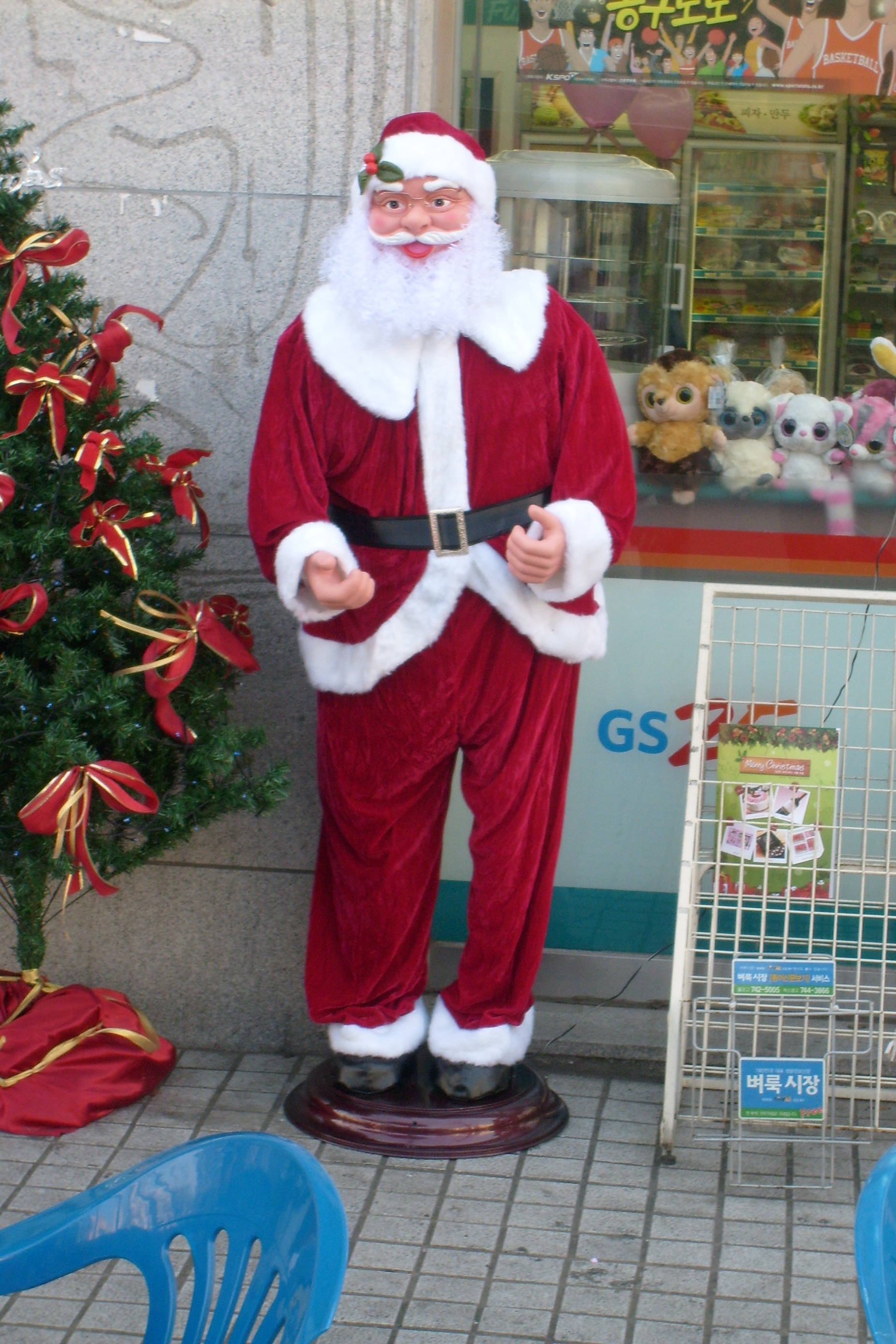
Such a process, vetting, training seminars etc, for several hundred Father Christmases is no doubt expensive but, I might have just the solution. I discovered this Santa on a cross-road outside a 24 hours store in Daegu. This automated Father Christmas is perfect for working with children. He can be stored away with his companions and brought out a week before needed; no vetting, no seminars and no law suits.
The Korean Santa will put all fears to rest. First, other than the ability to make a ridiculous chuckle, he is mute. Gone are the worries that a pervy Santa might upset a child by using un-politically correct terms or worse, mouth or mutter obscene suggestions. And the plastic, toothless mouth, apart from smelling pleasant is incapable of licking, kissing or pouting. Being mute, the Korean Santa can be employed from Baghdad to Boston with no worry about foreign languages. Fixed to the spot by a small plinth, he cannot run away and is permanently available for questioning, stoning or lynching, should the need arise.
Being thin, any potential caverns or hidey holes made possible by overhanging bellies and large tunics are removed. The Korean Santa is incapable of hiding kiddies, or swiftly pulling even the smallest of them under his tunic. While The Korean Santa can move his hips and arms, albeit it in a rather jerky and amusing manner, almost as if stricken by BSE (Mad Cow Disease), such movements are small and limited and minimise and prevent any possibility of hands slipping onto, or groping in, those places they shouldn’t. And the final and most significant advantage is that the standing posture not only makes the need for a grotto redundant but avoids the possibility that some children might actually enjoy sitting on Santa’s lap.
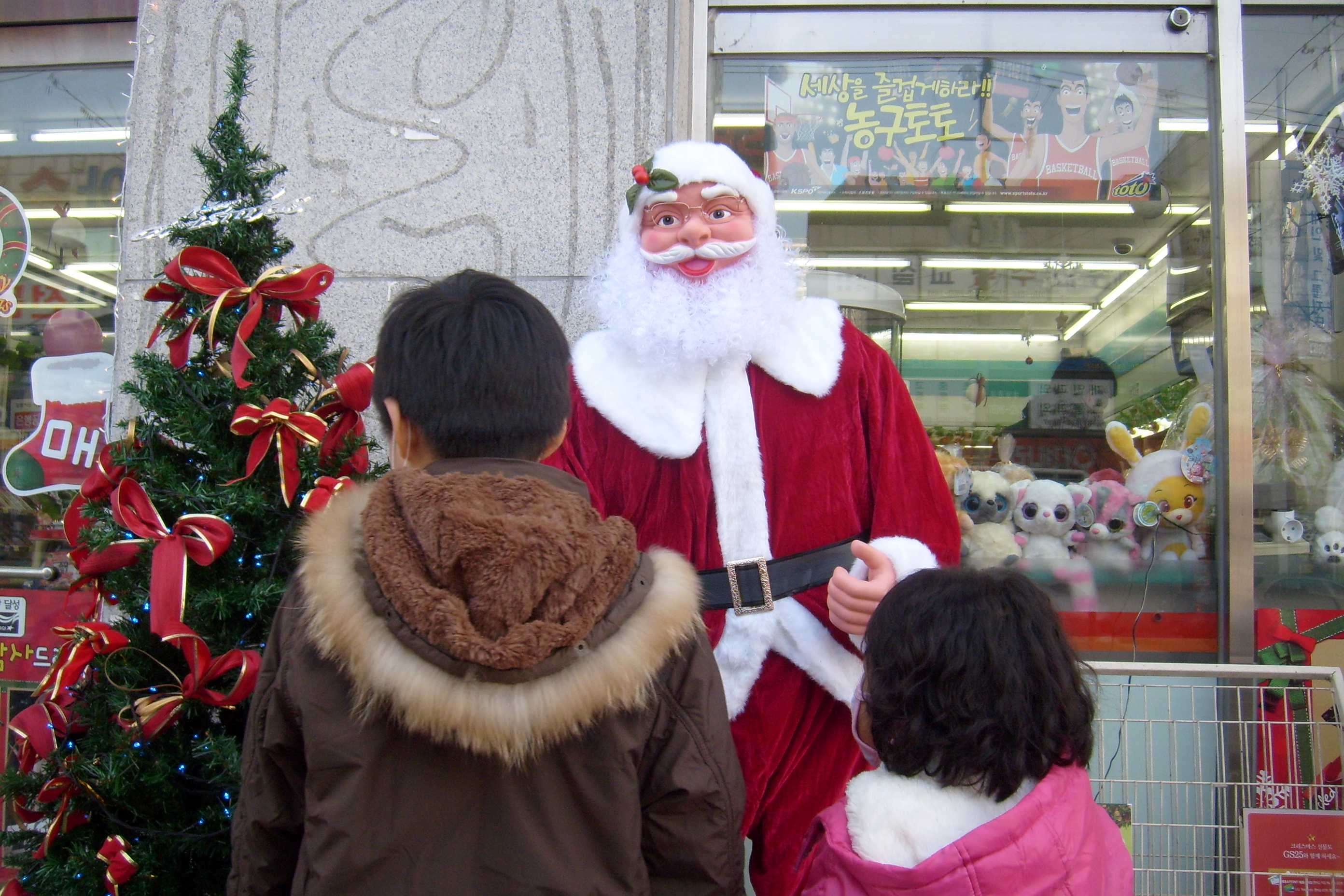
And packet-less!
© Nick Elwood 2010 Creative Commons Licence.
Definetly 'Ji Ji' (지지)
For the last few weeks I’ve been paying attention to the contents of my dustpan after I have swept my studio floor and run the ‘magic mop’ over it. The ‘magic mop’ has a disposable cloth attached to the head to which dust and most other debris firmly sticks. I noticed a long time ago that you can’t flick anything on a Korean floor without it reappearing some days later, stuck to the sole of your naked foot or clinging to your sock. Grains of rice, once hardened are especially annoying.
In Europe at least, and especially in Britain, carpets are often the preferred choice for floors and in some aspects they are wonderful because they absorb most small debris. ‘Sweep it under the carpet,’ an idiom I am often asked to explain, really isn’t necessary with small things as you can deposit them on the floor and at most all you need do is rub you foot over it a few times to permanently erase whatever was underfoot. All bodily bits, small scraps of food, cigarette ash etc, are banished forever in the pile of your pretty carpet.
Ten years ago I moved into a new house in England and after a year decided to rip up the carpets that had lain on the front room floor for well over a decade. Even after months and months of hoovering the floor and liberally sprinkling it with various scented and odour eating carpet powders, I was never able to feel comfortable sprawling out in front of the TV. The carpet was old but it never actually looked dirty and the unpleasantness I felt probably arose from the fact that I occasionally detected odours emanating from it, odours which weren’t unpleasant but weren’t mine. You wouldn’t want to wear a stranger’s unwashed clothes so why would you want to lay on their ancient carpets, carpets ’worn’ by several families. Even after meticulous cleaning, I regularly wrestled lengthy black hairs embedded within the pile. They were of Greek extraction because Greek students had lived in the house, some three years before I moved in.
When the carpet was eventually dragged out of the house, departing in a dusty cloud, the wooden floor on which it had lain was covered in a thin coat of what looked like sand except it was finer and softer and most likely organic in origin. The carpet had acted like a filtration system so that only the finest particles escaped through to the floor boards. Once hoovered you could see the small spaces between the boards were caked with dirt that had been compressed into them over many years. This had to be gouged out with a knife before I could sand the boards. Once the front room and dining room were rid of carpeting and the floors washed, scrubbed, scrapped, sanded and treated with linseed oil, the need to dust became a monthly rather than weekly routine.
The decision to banish the muck absorbing carpet, and to subsequently ban outdoor shoes from inside the house, was finally made after I noticed a small brown thing on the floor. I smoked marijuana at the time and on two occasions I had discovered dope on the floor though one discovery turned out to be either dog shit or a clinka that had fallen out of my nephew’s nappies. This mistake only transpired when I inhaled the joint I had rolled from it. Needless to say anything brown and lumpy and laying on the floor I assumed to be dope before anything else. Though I suspected what it was, it needed confirming. I sniffed it and instantly retched – cat shit, the worst carnivore shit of all!
Ten years ago, the streets around my house were liberally ornamented with piles of dog shit. I know because I used to stick small cocktail flags in them to draw attention to them; it was a form of social protest. When walking to work I would count the passing turds and often, in just half the street, I would count as many as thirty. I had some intimate relationships with the turds in my street: one had been laid in the furthest corner of my lawn, just under the privet bush. I couldn’t fail but notice it as it was large and shaped more like a small cow pat than one of those curled and tapering whippy whirl turds that Korean kids are so expert at drawing. In 2000, when I first arrived in Korea, I wondered why so many ice creams were drawn on tables especially as the Baskin Robbins opposite my haggwon, scooped ice cream out of large tubs rather than deposited it whirled. Only the smallest dog could have manoeuvred its arse into the required position under the privet bush to deposit the poop, a Korean size handbag dog for example, but this specimen’s owner had to be big.
I watched that turd for an entire summer and well into winter, witnessing its transition from a wet mess to one with a crusty top, rather like a pie that then turned white after an infection by some strain of turd eating mould. Eventually, internally atrophied and dehydrated by a hot summer, it collapsed into itself. Gradually absorbed into the ground around it, it disappeared but by that time it was late winter. Back on the pavements, I even began to recognize individual dog’s shite and could sometimes trace their various daily messings down the street. One example, a particularly big deposit was almost orange in colour. I imagined the owner, walking their dog in the anonymity provided by the early morning darkness, allowing it to shit in one spot and the next day dragging it a little further down the road so as to share the messes equally around the neighbourhood. As dogs like to do their business in the same place, I would imagine that the moment the dog started to squat on its hunches the owner had to drag it further before letting it spill its backside onto the pavement. I estimated the owner probably took a month to circumnavigate the crescent before the dog had to poop in approximately the same place and if even house numbers were the victims one month and odd house numbers the next, the cycle could have been extended over two months. Despite the copious piles dotted about the street you never saw an owner allowing their dog to foul the pavement so, never trust dog owners who walk their dog in the dark.
Some owners were equally as considerate and seemed to think it was acceptable for their dog to shit on the road. For several days, as I ate breakfast, I was treated to the view of another enormous turd, strange how they all seem to have been enormous, as it was squelched all over the tarmac by passing cars. Neighbours who made their dogs pooh on the road probably perceived themselves as good citizens while those who used the pavements were anti-social. Eventually I put a rather hostile placard on my front lawn and several neighbours then did the same; instantly, the appearance of new turds ceased and those remaining were old and in various stages of atrophy, dehydration and decay. I kept counting the turds walking to work however, as the number of deposits beyond the borders of my placard’s influence had significantly increased.
I’m digressing: My point is Europeans and especially the British prefer to wear outdoor shoes inside their house which is a custom I find horribly disgusting and more so if you have carpets which act as toilet paper to the soles of your poohey shoes. There was so much shit on the streets around my house, and there still is, that natural decay and rain swirled it everywhere so that even if the ground looked clean, you could guarantee it was coated in canine faecal matter. Wearing shoes indoors, when so many dogs foul the pavements is a disgusting habit.
I don’t think I’ve ever seen a dog turd on a Korean street and even if there were it would only be a little thing as most Korean dogs are handbag dogs and incapable of passing anything more than a few pellet sized faeces. And yet Koreans never wear shoes inside their houses and often don’t wear them in workplaces.
When you live in a room which is barren of carpets your awareness of your own bodily debris grows. When you have a carpet you assume that the bit of nail you blow onto the carpet, or the bogey you roll and flick onto that beautiful Axeminster, simply vanishes. I can flick a toe nail across the room and know that in a day or two it will reappear in my dustpan along with a grain or two of rice, a few hairs and other bits of fluffy stuff. Occasionally I’ll spit out a nail to deliberately see when and where it will re-emerge.
I’ve noticed there are rarely any hairs on the central part of the floor because these are blown to the edges of the room by the draft from open windows and passing bodies and for some reason, the biggest trap of body hair are the sliding door groves. Every few weeks I need to clean these out. Pubic hair has the most amazing ability to float into places like your fridge or kitchen work-surface and though you might find this abhorrent and are thankful that your carpet seizes them before they become visible, I’d rather see the occasional curly devil on a plate or in the fridge than lurking in the pile of some horrid carpet, rotting slowly among years of bodily refuse, embedded and matted with all sort of unthinkable crap, dead skin cells, bogeys, shoe dirt, dog and cat muck, grit, rain water etc, etc. And then, thinking we are being hygienic, we sprinkle the carpet with floor powders that temporarily scent the air. What happens to them once they have embedded themselves in the carpet? I doubt such powders disappear.
I live alone and so my observations are based on my own bodily sheddings but how greater the pollution if you live with other people or a family and have pets. Carpets are such filthy things and what we do with them is not much different to that other dirty British habit, thankfully disappearing, of blowing gunge out your nose and into a hanky which you then keep warm and moist in your pocket, the perfect environment for viruses and bacteria, before putting your face back into it and snorting out another load. Having a carpet on your floor is a little like sleeping in the same bedding without ever washing it.
Cleaning a carpetless room is a joy because it’s effortless and now Samsung have even marketed a robotic floor cleaner that cleans your floor when you are out. Everything is exposed in a Korean room as there are few true hiding places. And if you want to wash the floor or give it an occasional scrub or douse it in bleach, well that too, is easy. Carpets can’t be washed and I’m sure all carpet shampoo does is drive the dirt deeper and enliven their parched innards. There is probably a surge in a carpet’s bacterial and fungal population following a shampoo.
In Korea, many westerners don’t remove shoes indoors preferring to stick to their own customs and there are others, myself included, who will occasionally wear shoes on their floor if for someone reason they have to return briefly indoors because they’ve forgotten something. This is a habit I am trying to break but when you’re in a rush it is difficult. You very, very rarely see Koreans walk on their living space floor wearing shoes, not even for a few seconds. I have noticed that on the odd occasion I have breached Korean custom, I have subsequently felt the deposited dirt left by my shoes, when barefooted. You can’t see it but it’s there despite the fact you only walked on the floor for a few seconds.
Korean students, especially younger ones, will sometimes cringe and tell me how dirty I am if I suck my pen. Often they will shout ‘ji ji’ (dirty) which is the word used to small kids and in the same category as English words like ‘pooh pooh’, ‘wee-wee’ and ‘tinkle’. If sucking a pen is a little ‘ji ji’ then having a carpet or rug is infinitely dirtier, indeed it is positively filthy! Next time you flick some item onto your Korean floor, just remember, it’ll be back!
지지 – dirty – (but a word used to small children), haggwon – 학원 – a private school like a homework club or after school study center.

carpetless
A Peaceful City, Feb 28th, 2001 (Korean Accounts 2000-2001)
Once a week at the taekwondo school we practice tae kuk kkwon (태국권). During one class Pak Dong-soo performed a set which took several minutes to perform. It was really quite beautiful as he moved slowly from one position to another without and wobbling and with absolute grace. The next day we did a weapons training session. Increasingly, I am beginning to see martial arts training in Korea as the training ground for boys prior to their national service. The lessons on fairly relaxed and there is a lot of banter between students and instructors which of course, I don’t understand. There are a number of girls who train in the school and they don’t take any crap from the boys. Sometimes I seem to detect more aggression between the girls and boys than between the boys themselves.
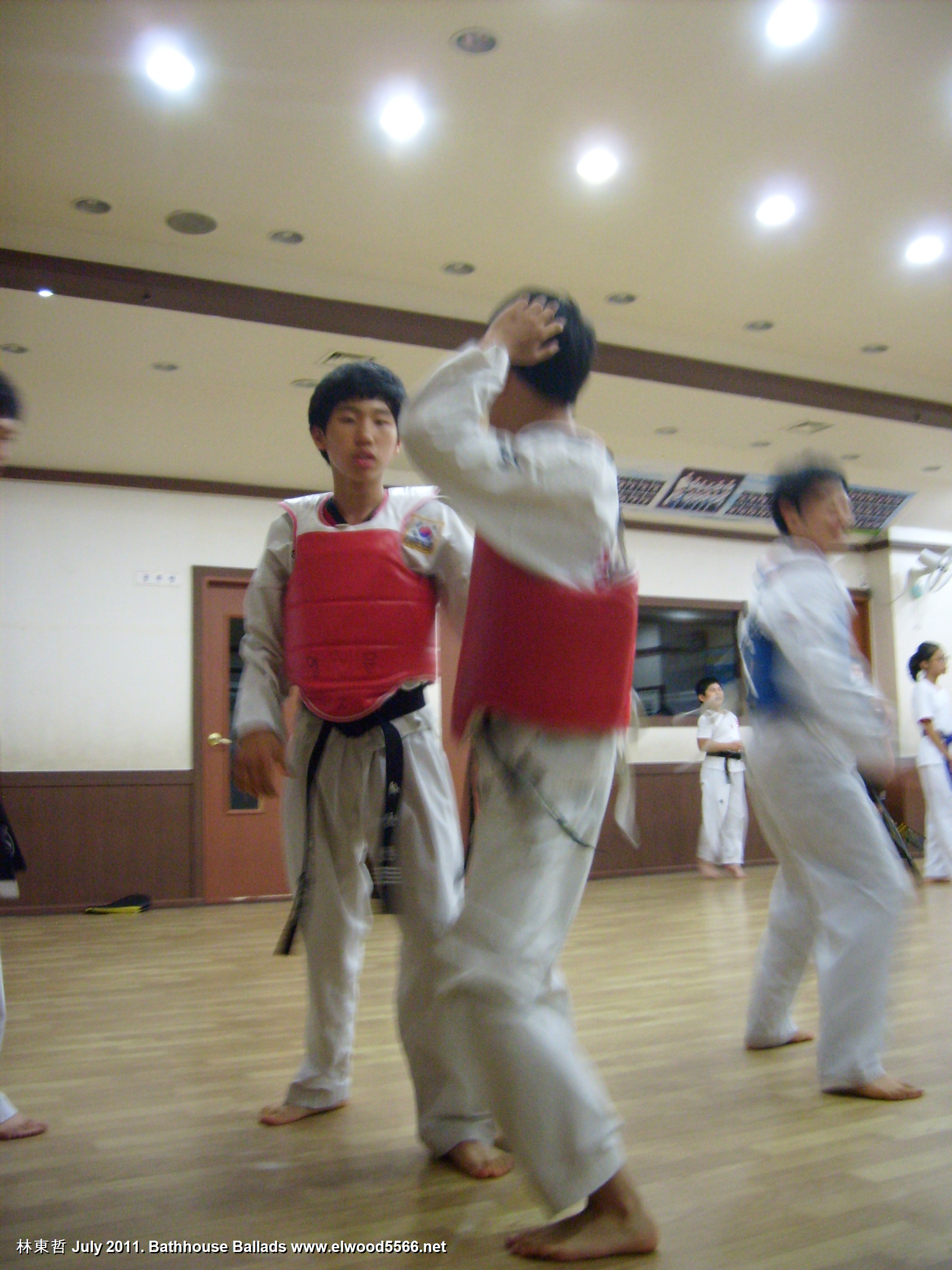
two fourth dan boys in my local taekwondo school (2012)
One aspect I really like about being in Korea, and something other foreign teachers also mention, is being able to go out in Korea without being on your guard. Although I have lived in Wivenhoe for two years, I have only ever been into Colchester in the evening on two occasions. The atmosphere on the High Street, in the evening is threatening and aggressive, crowds of marauding youths, with slaggy, cheap girls who regardless of weather wear flimsy clothes. Then there are the aggressive men and youths who strut around swearing, usually drunk and looking primarily for sex and if that can’t be found the frustration will be vented by a punch-up. You daren’t make eye contact with these men or lads as to do so is to challenge their pathetic sexuality. God! So many straight men are disgusting and even many of my straight friends are quick to disassociate themselves from them. We British like to believe we are an educated society but by and large this is a myth. The masses are just as stupid and ignorant as they have been in the past and it is for political reasons they have been kept this way. I am not claiming Koreans are superior, most of the world is full of stupid people but it is wonderful to walk the streets of a busy city without fear of being assaulted or abused by football yobs, drunken louts, lads looking for trouble. Despite the fact I live above two bars, neither of which close until well after midnight, I haven’t witnessed a brawl or argument or even heard drunken revelry.


 Elwood 5566
14 comments