Definetly 'Ji Ji' (지지)

For the last few weeks I’ve been paying attention to the contents of my dustpan after I have swept my studio floor and run the ‘magic mop’ over it. The ‘magic mop’ has a disposable cloth attached to the head to which dust and most other debris firmly sticks. I noticed a long time ago that you can’t flick anything on a Korean floor without it reappearing some days later, stuck to the sole of your naked foot or clinging to your sock. Grains of rice, once hardened are especially annoying.
In Europe at least, and especially in Britain, carpets are often the preferred choice for floors and in some aspects they are wonderful because they absorb most small debris. ‘Sweep it under the carpet,’ an idiom I am often asked to explain, really isn’t necessary with small things as you can deposit them on the floor and at most all you need do is rub you foot over it a few times to permanently erase whatever was underfoot. All bodily bits, small scraps of food, cigarette ash etc, are banished forever in the pile of your pretty carpet.
Ten years ago I moved into a new house in England and after a year decided to rip up the carpets that had lain on the front room floor for well over a decade. Even after months and months of hoovering the floor and liberally sprinkling it with various scented and odour eating carpet powders, I was never able to feel comfortable sprawling out in front of the TV. The carpet was old but it never actually looked dirty and the unpleasantness I felt probably arose from the fact that I occasionally detected odours emanating from it, odours which weren’t unpleasant but weren’t mine. You wouldn’t want to wear a stranger’s unwashed clothes so why would you want to lay on their ancient carpets, carpets ’worn’ by several families. Even after meticulous cleaning, I regularly wrestled lengthy black hairs embedded within the pile. They were of Greek extraction because Greek students had lived in the house, some three years before I moved in.
When the carpet was eventually dragged out of the house, departing in a dusty cloud, the wooden floor on which it had lain was covered in a thin coat of what looked like sand except it was finer and softer and most likely organic in origin. The carpet had acted like a filtration system so that only the finest particles escaped through to the floor boards. Once hoovered you could see the small spaces between the boards were caked with dirt that had been compressed into them over many years. This had to be gouged out with a knife before I could sand the boards. Once the front room and dining room were rid of carpeting and the floors washed, scrubbed, scrapped, sanded and treated with linseed oil, the need to dust became a monthly rather than weekly routine.
The decision to banish the muck absorbing carpet, and to subsequently ban outdoor shoes from inside the house, was finally made after I noticed a small brown thing on the floor. I smoked marijuana at the time and on two occasions I had discovered dope on the floor though one discovery turned out to be either dog shit or a clinka that had fallen out of my nephew’s nappies. This mistake only transpired when I inhaled the joint I had rolled from it. Needless to say anything brown and lumpy and laying on the floor I assumed to be dope before anything else. Though I suspected what it was, it needed confirming. I sniffed it and instantly retched – cat shit, the worst carnivore shit of all!
Ten years ago, the streets around my house were liberally ornamented with piles of dog shit. I know because I used to stick small cocktail flags in them to draw attention to them; it was a form of social protest. When walking to work I would count the passing turds and often, in just half the street, I would count as many as thirty. I had some intimate relationships with the turds in my street: one had been laid in the furthest corner of my lawn, just under the privet bush. I couldn’t fail but notice it as it was large and shaped more like a small cow pat than one of those curled and tapering whippy whirl turds that Korean kids are so expert at drawing. In 2000, when I first arrived in Korea, I wondered why so many ice creams were drawn on tables especially as the Baskin Robbins opposite my haggwon, scooped ice cream out of large tubs rather than deposited it whirled. Only the smallest dog could have manoeuvred its arse into the required position under the privet bush to deposit the poop, a Korean size handbag dog for example, but this specimen’s owner had to be big.
I watched that turd for an entire summer and well into winter, witnessing its transition from a wet mess to one with a crusty top, rather like a pie that then turned white after an infection by some strain of turd eating mould. Eventually, internally atrophied and dehydrated by a hot summer, it collapsed into itself. Gradually absorbed into the ground around it, it disappeared but by that time it was late winter. Back on the pavements, I even began to recognize individual dog’s shite and could sometimes trace their various daily messings down the street. One example, a particularly big deposit was almost orange in colour. I imagined the owner, walking their dog in the anonymity provided by the early morning darkness, allowing it to shit in one spot and the next day dragging it a little further down the road so as to share the messes equally around the neighbourhood. As dogs like to do their business in the same place, I would imagine that the moment the dog started to squat on its hunches the owner had to drag it further before letting it spill its backside onto the pavement. I estimated the owner probably took a month to circumnavigate the crescent before the dog had to poop in approximately the same place and if even house numbers were the victims one month and odd house numbers the next, the cycle could have been extended over two months. Despite the copious piles dotted about the street you never saw an owner allowing their dog to foul the pavement so, never trust dog owners who walk their dog in the dark.
Some owners were equally as considerate and seemed to think it was acceptable for their dog to shit on the road. For several days, as I ate breakfast, I was treated to the view of another enormous turd, strange how they all seem to have been enormous, as it was squelched all over the tarmac by passing cars. Neighbours who made their dogs pooh on the road probably perceived themselves as good citizens while those who used the pavements were anti-social. Eventually I put a rather hostile placard on my front lawn and several neighbours then did the same; instantly, the appearance of new turds ceased and those remaining were old and in various stages of atrophy, dehydration and decay. I kept counting the turds walking to work however, as the number of deposits beyond the borders of my placard’s influence had significantly increased.
I’m digressing: My point is Europeans and especially the British prefer to wear outdoor shoes inside their house which is a custom I find horribly disgusting and more so if you have carpets which act as toilet paper to the soles of your poohey shoes. There was so much shit on the streets around my house, and there still is, that natural decay and rain swirled it everywhere so that even if the ground looked clean, you could guarantee it was coated in canine faecal matter. Wearing shoes indoors, when so many dogs foul the pavements is a disgusting habit.
I don’t think I’ve ever seen a dog turd on a Korean street and even if there were it would only be a little thing as most Korean dogs are handbag dogs and incapable of passing anything more than a few pellet sized faeces. And yet Koreans never wear shoes inside their houses and often don’t wear them in workplaces.
When you live in a room which is barren of carpets your awareness of your own bodily debris grows. When you have a carpet you assume that the bit of nail you blow onto the carpet, or the bogey you roll and flick onto that beautiful Axeminster, simply vanishes. I can flick a toe nail across the room and know that in a day or two it will reappear in my dustpan along with a grain or two of rice, a few hairs and other bits of fluffy stuff. Occasionally I’ll spit out a nail to deliberately see when and where it will re-emerge.
I’ve noticed there are rarely any hairs on the central part of the floor because these are blown to the edges of the room by the draft from open windows and passing bodies and for some reason, the biggest trap of body hair are the sliding door groves. Every few weeks I need to clean these out. Pubic hair has the most amazing ability to float into places like your fridge or kitchen work-surface and though you might find this abhorrent and are thankful that your carpet seizes them before they become visible, I’d rather see the occasional curly devil on a plate or in the fridge than lurking in the pile of some horrid carpet, rotting slowly among years of bodily refuse, embedded and matted with all sort of unthinkable crap, dead skin cells, bogeys, shoe dirt, dog and cat muck, grit, rain water etc, etc. And then, thinking we are being hygienic, we sprinkle the carpet with floor powders that temporarily scent the air. What happens to them once they have embedded themselves in the carpet? I doubt such powders disappear.
I live alone and so my observations are based on my own bodily sheddings but how greater the pollution if you live with other people or a family and have pets. Carpets are such filthy things and what we do with them is not much different to that other dirty British habit, thankfully disappearing, of blowing gunge out your nose and into a hanky which you then keep warm and moist in your pocket, the perfect environment for viruses and bacteria, before putting your face back into it and snorting out another load. Having a carpet on your floor is a little like sleeping in the same bedding without ever washing it.
Cleaning a carpetless room is a joy because it’s effortless and now Samsung have even marketed a robotic floor cleaner that cleans your floor when you are out. Everything is exposed in a Korean room as there are few true hiding places. And if you want to wash the floor or give it an occasional scrub or douse it in bleach, well that too, is easy. Carpets can’t be washed and I’m sure all carpet shampoo does is drive the dirt deeper and enliven their parched innards. There is probably a surge in a carpet’s bacterial and fungal population following a shampoo.
In Korea, many westerners don’t remove shoes indoors preferring to stick to their own customs and there are others, myself included, who will occasionally wear shoes on their floor if for someone reason they have to return briefly indoors because they’ve forgotten something. This is a habit I am trying to break but when you’re in a rush it is difficult. You very, very rarely see Koreans walk on their living space floor wearing shoes, not even for a few seconds. I have noticed that on the odd occasion I have breached Korean custom, I have subsequently felt the deposited dirt left by my shoes, when barefooted. You can’t see it but it’s there despite the fact you only walked on the floor for a few seconds.
Korean students, especially younger ones, will sometimes cringe and tell me how dirty I am if I suck my pen. Often they will shout ‘ji ji’ (dirty) which is the word used to small kids and in the same category as English words like ‘pooh pooh’, ‘wee-wee’ and ‘tinkle’. If sucking a pen is a little ‘ji ji’ then having a carpet or rug is infinitely dirtier, indeed it is positively filthy! Next time you flick some item onto your Korean floor, just remember, it’ll be back!
지지 – dirty – (but a word used to small children), haggwon – 학원 – a private school like a homework club or after school study center.

carpetless

Buk-il Boys’ High School. Mon. 17th Sept, 2007. (Korean Accounts 2)

Boys arriving at school: note the boys ‘on duty’ checking the uniforms of arriving students and also the boys saluting the school entrance.
I was up early in the morning and left the house at 7.15 to find my way to the school. Ted and Mr Chǒng had given me directions last night and they were fairly straight forward. From my apartment, which is in a row of one room apartments with its own separate glass door entrance, the school is up a hill. Ted had told me there was a short cut but that to save getting lost that in the morning I should take the long route. The first part of my walk took me past the small shop I had visited last night which I now noticed stood beside another dog soup restaurant. Then I passed a triangular shaped paddy field where Ted had told me to take a right turn. Then I simply had to walk straight up the hill passed a number of small shops and cross a main road to find the school entrance.
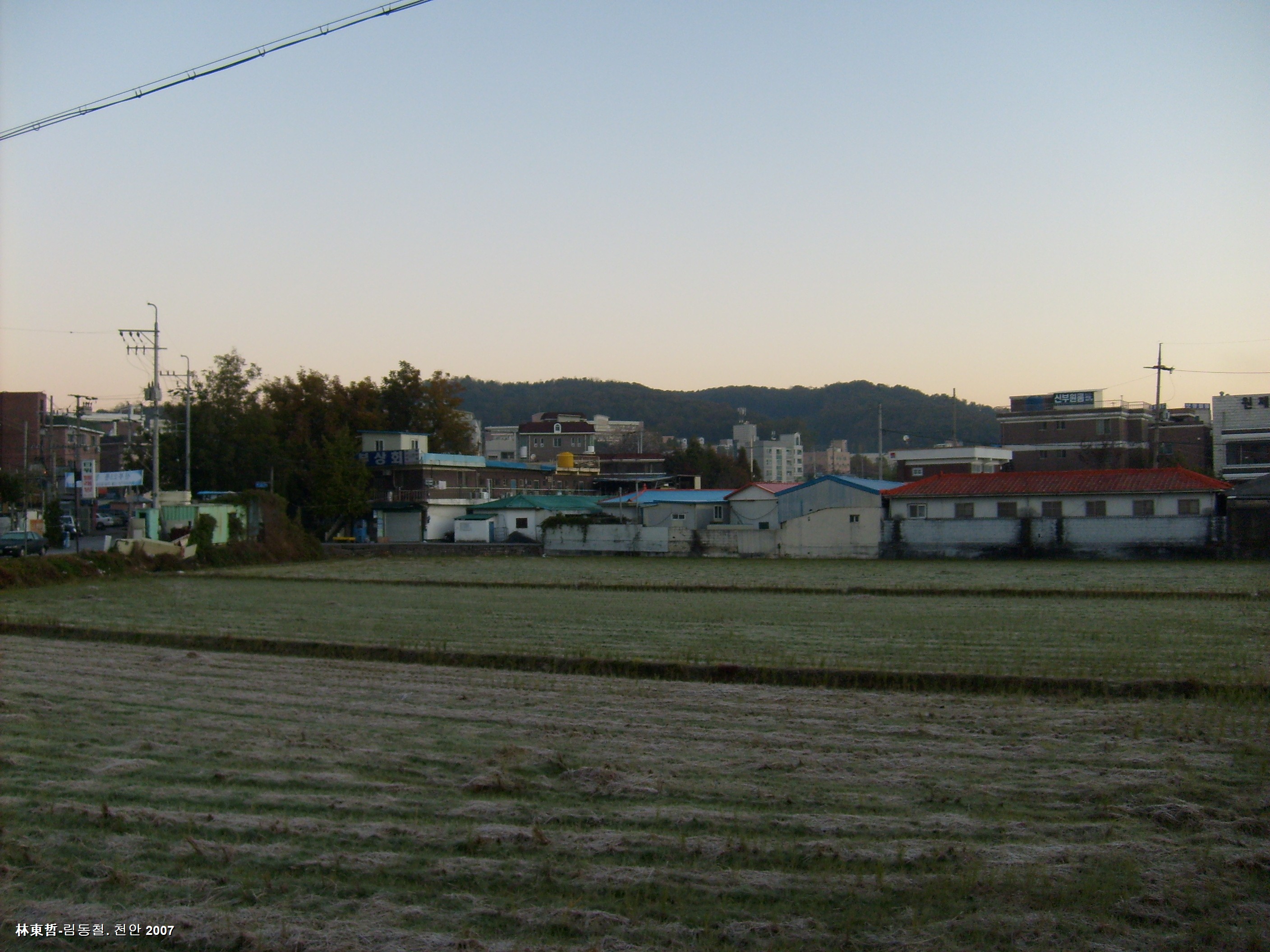
Across the paddy field towards my ‘house.’ The school can just be seen in the background
The hill up to Bukil (北一) isn’t that steep but in the heat and humidity I was soaking wet before I was even half way. There was a long string of boys behind me and I didn’t want to have to start conversations on the hill. I was so exhausted by the time I had walked only halfway up the hill that I turned off the road and caught my breath by the school’s baseball diamond. I had forgotten that Koreans, even youngsters, tend to plod up hills and don’t rush like westerners do but in my rush to get to school, and not knowing how long it would take me, I walked at a fair pace. I would have remained longer recuperating at the baseball diamond had I not seen another westerner in the distance and decided to carry on up the hill.
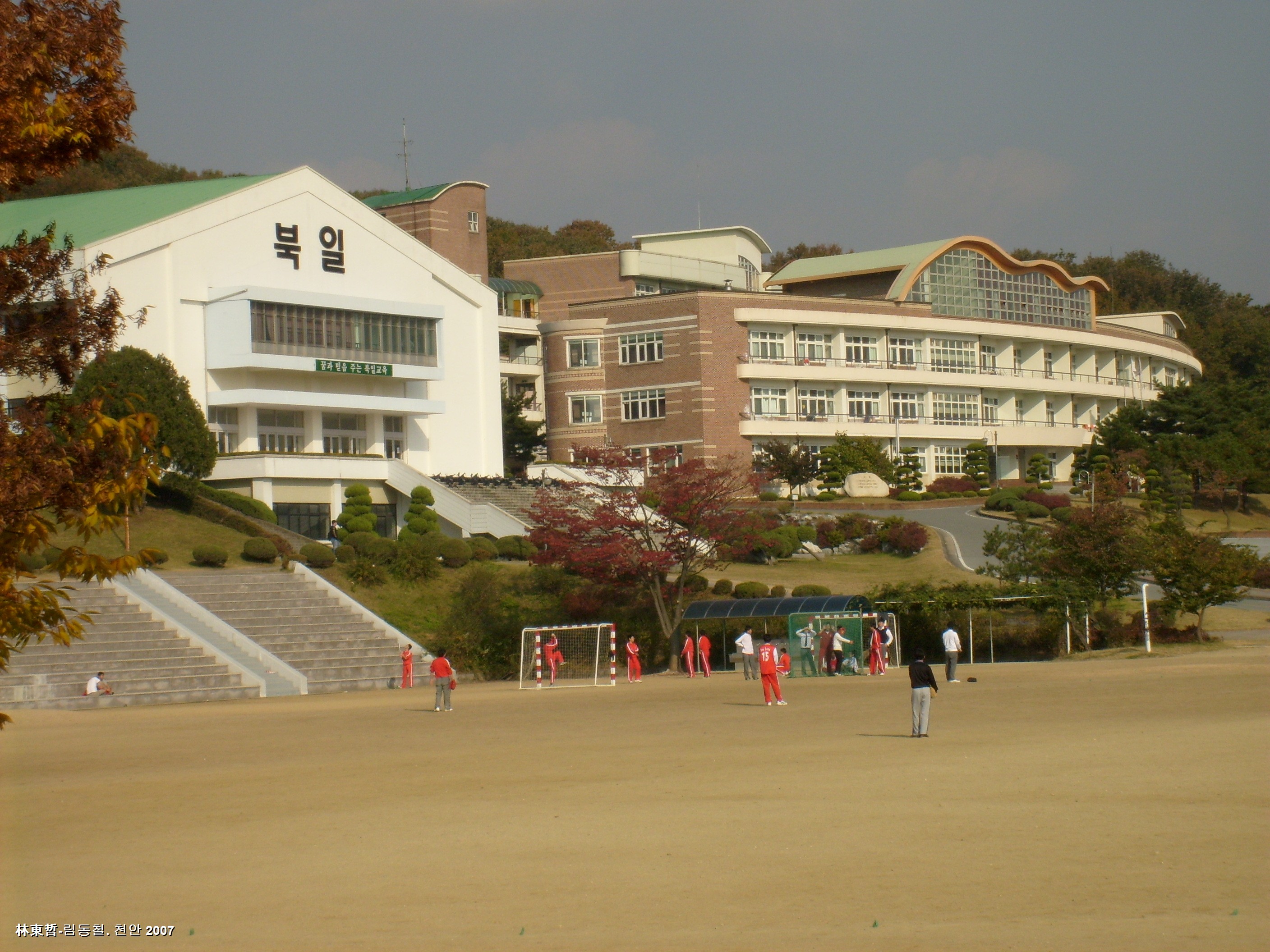
The boys’ gym, on the left, and adjacent girls’ high school
Further up the hill four boys stood ‘at ease’ across the road and as I passed them they stood to attention and bowed at me. A number of boys were doing press ups or burpees on the pavement. At the top of the hill, where the school entrance is situated, three teachers, all armed with sticks stood on duty. I noticed that as the boys passed this point they saluted the school.
The road up to the school, which at the time I didn’t pay much attention to, is lined with trees, cherry trees. At the bottom of the hill there are two enormous sets of iron gates, one for the boys’ school entrance and one for the girls’ school. Between the gates is a sort of guard room and to the side of this, on the boys side of the entrance is the most massive mirror. I have since noticed large mirrors in quite a few places in the school. Beside the road leading up to the school are two terraces, the first contains a number of tennis courts, the second contains the typical sandy parade cum sports which has a number of wisteria entwined arbours and drinking water fountains around its edge. Any British person, especially a teacher is tempted to call this area a play ground but one never sees youngsters playing in it and it is an arena employed more for physical training, assembling the entire school and used by the boys to play various sports. At the head of this arena and opposite the school façade, stands a large, covered podium. In between the back of this and the school façade is the most beautiful garden with pine trees cut and shaped in the traditional Korean manner. A large sculpture stands to the side of the entrance.
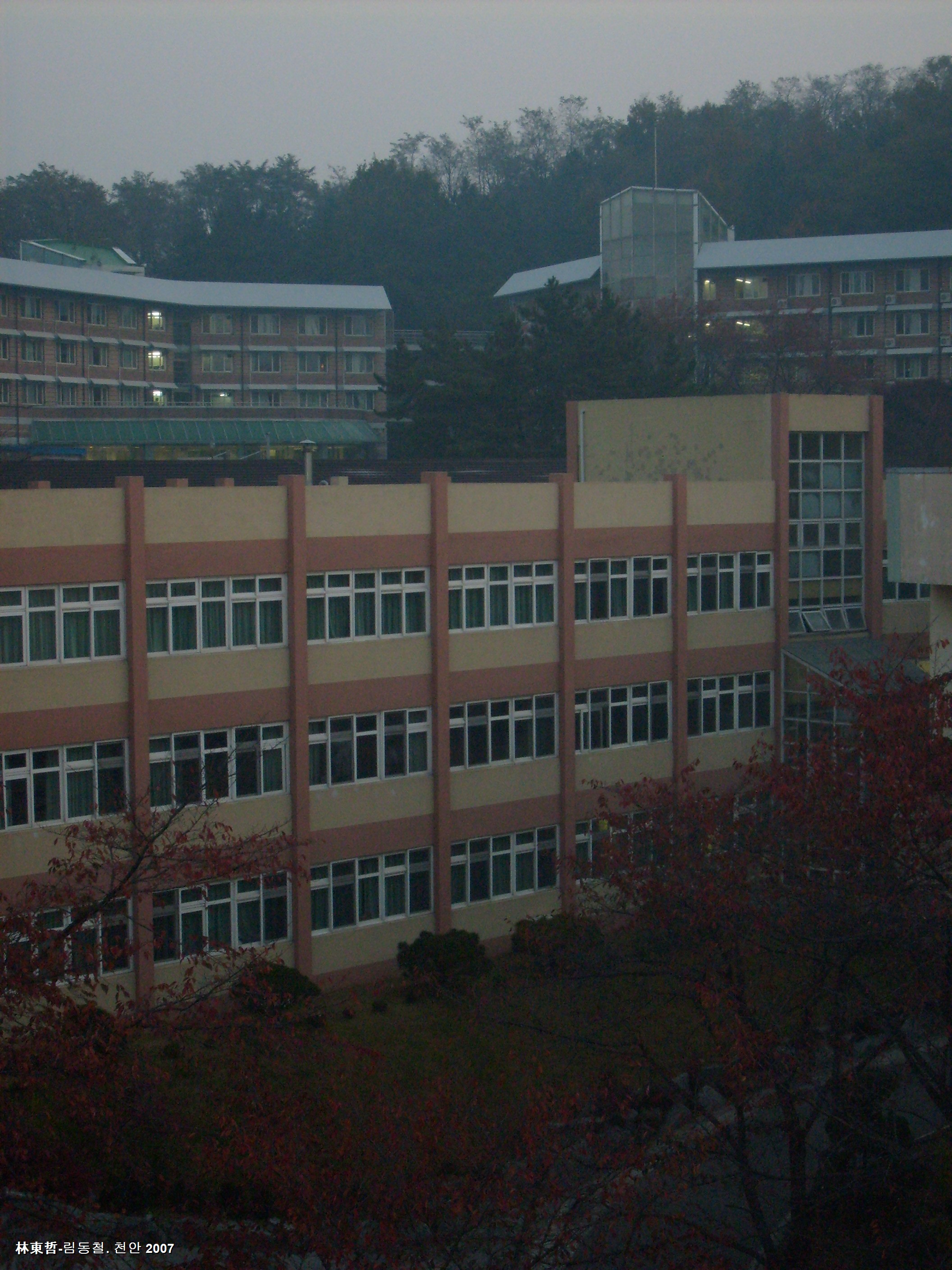
The boys’ dormitories
When I arrived at the front of the school Mr Kim was already waiting for me. I was absolutely exhausted and being soaked in sweat and wanting to compose myself before being introduced to anyone else, I asked to be shown the nearest restroom.
There is no time wasting with Korean employment procedures, no time for getting acquainted with systems or methods and neither are any individuals allocated to look after your needs. I don’t know whether or not this is because Koreans have tended to have very little experience of foreign travel or simply because they are ignorant or disinterested in your needs. I have always found that in Korea one has to discover aides and sympathetic helpers from among one’s colleagues. I think that after meeting Mr Kim on the entrance steps to the main building, and after exchanging a few pleasantries, I was taken straight to the humanities department where I was shown my desk and computer and then handed a class timetable. I was introduced to CM, my fellow English speaker. Next I was taken to the teachers meeting room for the typical Monday morning schools briefing. I met the school Principal and then had to give a five minute talk about myself. It was now 8.20 in the morning and I was due to start a class at 9.10am. Looking back on this I cannot belief that just after 10 hours of being in Korea and only after having been in a school for one hour forty minutes, I should then begin teaching.
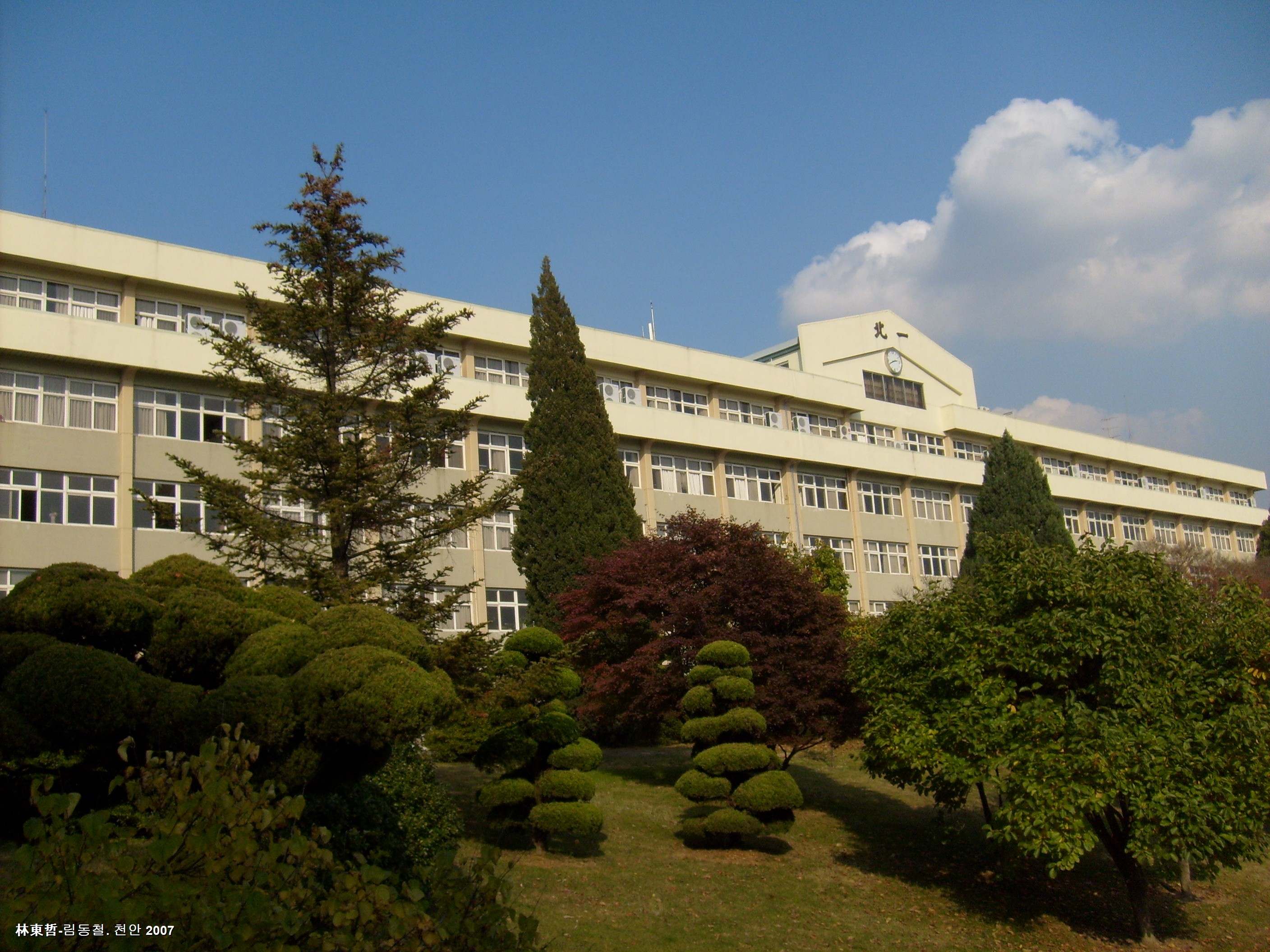
the school’s facade was very attractive
CM, whose name is Claude Montgomery Tidwell, is a rather distinguished looking American who is in his early sixties. Like so many older teachers in Korea, especially the ones who have taught in Universities, as CM has, he dresses in that stereotypical fashion reminiscent of Oxbridge; bow ties, tank tops, blazers and tweed jackets and silk ties are all part of his wardrobe. I recently meet a Professor from Ch’ǒnan Dangook University, who I automatically assumed was English; he was dressed entirely in tweeds, had a silk bow tie, a carved walking stick, which wasn’t for show as he did have a lame leg. I quickly discovered he was from New England and I remember his name as it so suited his attire; it was Michael Huntingdon. Of course few of these ‘professors’ are professors in the British sense of the word. In the UK a professorship is not a teaching position but a position of prestige and status within a department. It is a title conferred on distinguished academics. I have not had experience around Korean English university teachers before but they do like to refer to themselves as ‘professor,’ using it as a prefix to their name. This is obviously a western affectation as Koreans use the title (교수) as a suffix in much the same manner as we use post-nominals. Further, the ‘title’ seems to be one that western teachers will use as a means of identity even after they have left university teaching in the same way it would be used in the UK. However, I would probably do the same if I was teaching in a university.
I had four classes on this day and they all went perfectly. Before each lesson, the class captain stands up and calls the class to attention. All the boys then sit up straight with their hands on their thighs. Next they are given an order to bow. It is possible to begin a class here the very second the bell is sounded which is amazing and so unlike degenerate schools back in the UK.
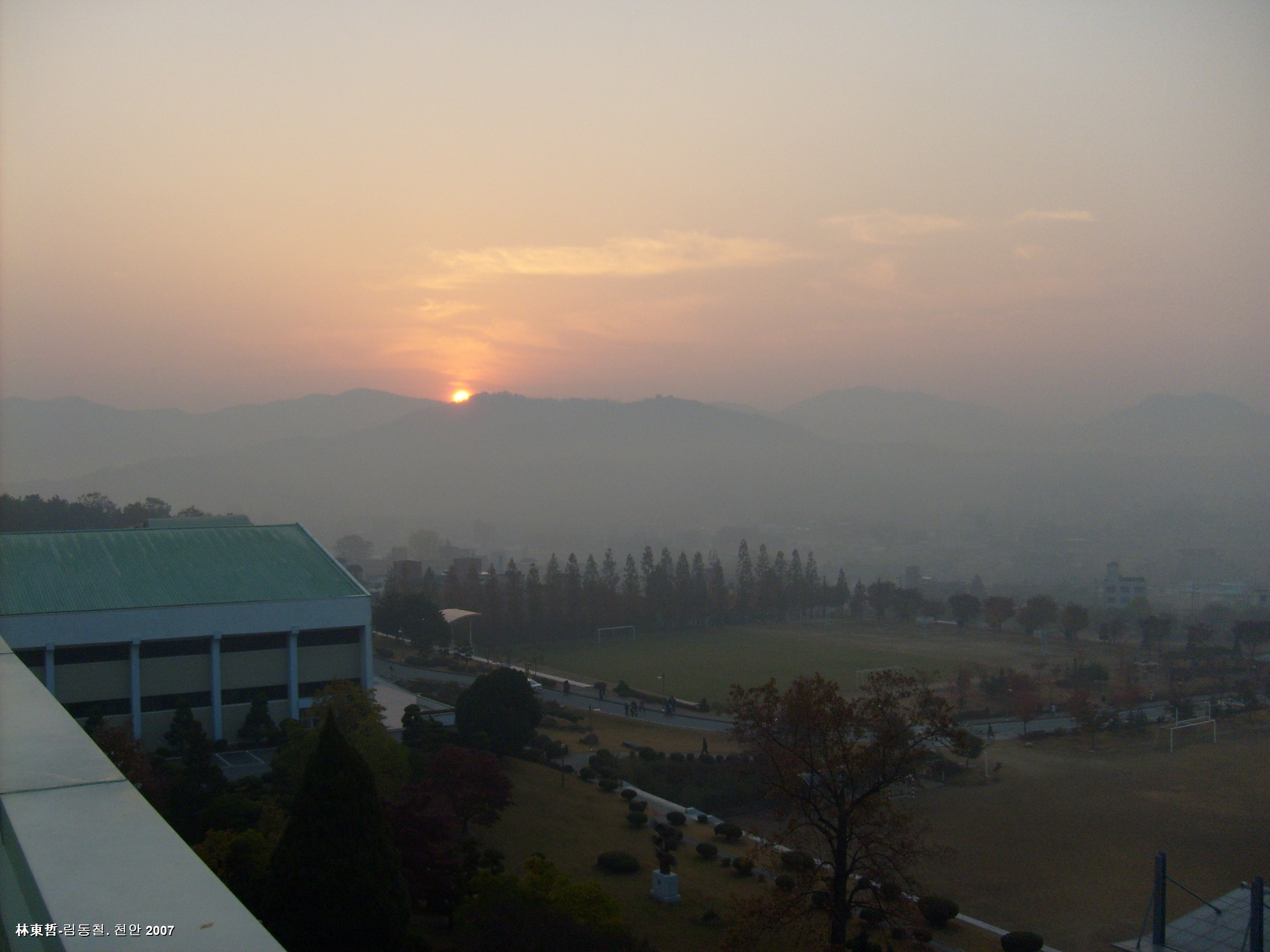
Sunrise from the school roof
My small apartment, in a complex called Roseville One Rooms, is about a ten minute walk from the school, and is situated in an area of Ch’ǒnan called Shin Bu Dong (신부동). My area consists of a number of ‘one room’ complexes and the nearest land mark is known as Tower Golf. Here there is a large golf range and also a sauna (목욕탕). There are also a number of dog soup restaurants in my vicinity. The daytime heat is very uncomfortable and initially I did not enjoy walking to and from school or even around the school as there are 6 floors and no lifts in the main building. In the first few weeks I didn’t really explore my immediate area though I quickly discovered where the nearest supermarket was – a Lotte Mart which is a short drive from my apartment. To be truthful, I was quite exhausted at the end of a day and didn’t relish going into town or walking around in the heat exploring.
©Amongst Other Things – 努江虎 – 노강호 2012 Creative Commons Licence.
Written September 2007
Ch’eonan.September 2007. (Korean Accounts 2)
I arrived at Inch‘on airport, Seoul on Sunday 15th of September. I was supposed to be being met by one of the teachers from the school but this plan was abandoned a few days before I departed and they asked me if I could travel to Ch’ǒnan (天安市). The journey from London to Seoul was tiring and in total lasted about 32 hours. I spent 3 hours waiting at Dubai airport. I arrived in Seoul feeling very tired and after a little hassle managed to find a bus that travelled to Ch’ǒnan. The duration of this journey was about one hour fifteen and for most of the journey, which began as dusk was falling, it rained heavily. I had hoped that Ch’ǒnan might be a little less westernized than was Daegu because in the short walk from my apartment there to my old school I passed Baskin Robbins, MacDonalds and KFC. Well, my bus left the highway at the edge of the city and within a minute we were passing through the centre of the town where I know the bus terminal was located and as we approached it we passed The Outback Steakhouse, Baskin Robins, Dunkin Donuts, Macdonalds, KFC and as we turned into the terminal, I could see a Burger King a little way off in the distance.
It was raining heavily as I wearily lugged my bags off the bus and headed for the nearby shopping mall where I left my bag with an attendant and went to find a phone booth. By the time I returned Ted, the guy with whom I’d had most of my communication regards the school, was just entering the mall followed, moments later, by Mr Chǒng. From here I had to drag my bag through the rain to a suitable spot where Mr Chǒng could meet us with his car. Once he arrived we drove up to the school which didn’t seem too far away but I couldn’t really see much as everything was in darkness however, I could tell it was at the top of a hill. Turning the car around, we drove back down the hill and crossed the main road onto a rough track of a road on which stood a dog soup restaurant. It seemed only a minute or two from here to where my apartment is.
It was somewhat depressing arriving at my accommodation in darkness, tired, and in the middle of a storm that I later discovered was the edge of a typhoon. Though I now like my room, at first viewing it appeared dingy and uninviting. A large double bed stood in one corner and at the feet of this was a large number of boxes. Ted announced to me that the boxes would be picked up in a day or two but I’m not stupid, this is Korea and unless Ted is here himself to move them, they will be here for weeks on end. I wasn’t really pleased with how Ted announced this as a statement of fact rather than a request. Mr Chǒng and Ted stood looking around the room, praising it and were especially pleased with the double bed, which I must add, having since slept in it, is very comfortable, however, what captivated my attention the most wasn’t the lovely bed, but the grungy grey pillow and duvet that lay in a pile on the bed. The pillow was particularly disgusting as it had slobber marks all over it. I immediately knew that I wouldn’t be sleeping in Ted’s dirty laundry this evening. When they left I investigated the room further and though it was clean, I was quite amazed that neither Ted nor Mr Chǒng had seen fit to put any water in the fridge, leave me a little milk or wash my bedding. Ted had even beamed with a touch or pride when I opened the refrigerator door and saw a lonely, atrophied potato and onion. A soon as they left I walked down the road and discovered a small shop where I bought some noodles, milk and shampoo and as soon as I returned home and had unpacked, I put the dirty bedding in the washing machine. I eventually washed the bedding twice and they have since been transformed from a colour I thought was grey to pure white.
©Amongst Other Things – 努江虎 – 노강호 2012 Creative Commons Licence.
Written September 2007
October 2002. (Korean Accounts 2)
I had tonsillitis which kept me in bed for three days. I’ve never had tonsillitis before and it was pretty unpleasant. On the first evening I thought I was going to die – I was just freezing cold and couldn’t stop shivering. The next day I managed to go to the doctors – a friend of Mr Joe, who is an ear, nose and throat specialist. I went to him knowing he would contact Joe and tell him I was ill. I’ve taught the doctor’s son and daughter on many occasions. I love the Korean medical system as which doctor you go to depends on your ailment. There are cardiologists, neurologists, urologists etc all over the town. There must be fifty doctors within easy walking distance of my house. Anyway, Dr Um (음) had all the equipment for examining your throat and it more resembled a dentists than a doctors. He poked things onto my tonsils and sprayed stuff on them and I got a penicillin injection straight away. I then went back the next day for another one and within a few days the infection had cleared up.
On the Saturday I went with U Chun, Ga-in and U-no to a big clothes market in the city centre. It was massive as Daegu is a major textiles centre. There was everything and at quite good prices and quality. We ate lunch in a pulgogi restaurant and then I went back home to teach some private classes.
I only have an hour of kindergarten a day but I absolutely hate them. I have five children aged 4 – Buddy, Betty, Anna, David and Jenny. Anna is a real macho little girl and I really like her and David is quite cute but the other girls are shut down and psychologically damaged – like so many Korean girls. Da Hae is still at the school, is still dribbling and still can’t really speak any English. I just go into the class, sit in my chair and call the kids to me, I have no interest or enthusiasm, I am not enthusiastic and I’m sure Sunny, the Korean teacher, thinks I’m a frigging moron. Sometimes the work for them is way too difficult. Today I had to read them a story and Buddy got really confused because the word ‘jet’ was used instead of airplane. I asked the Korean teacher to explain the confusion to him but she said we can’t speak Korean to them. If she hadn’t been there I would have explained in Korean but they really hate you talking any English in a class even if the kids don’t understand or are totally confused.
I have been doing Taekwondo but have to train in the mornings at 7 0’clock. The place is always busy. I have found a relatively quiet place and this morning I saw a praying mantis up close. Ji-won’s final exams are looming and he is stressed out. Whoever heard of a stressed out 18 year old but he actually has a bad stomach due to it. David told me that twice a year Korean school kids are given envelopes to shit in and they have to take a sample of their crap to school so it can be tested. This week we had to celebrate Halloween which was funny as I moaned constantly about it being an example of American Imperialism. It seems all the kindergartens in Song-So were doing the same thing.
I’ve eaten in a pogo restaurant several times. Pogo (복어) is puffer which can be poisonous and for which the chefs have to have a special licence.
POST-SCRIPT TO KOREAN ACCOUNTS PART 2
No further entries were made whilst in Korea. My timetable became so hectic that I had time for little else. The stress was quite crushing and I am surprised the journey to Korea did not make me ill. My bout of tonsillitis strained relationships between Mr Joe and I. During my five day illness, he never bothered to see how I was and nobody was sent to check on me. Indeed, he made several phone calls to my landlord to ask when I was coming to work. When I eventually went back to Di Dim Dol, he ‘ordered’ me back to work. ‘Ordered,’ was the actual word he used. I ended up having the most enormous row with him at the end of which I resigned.
My resignation didn’t really affect my trip and I resigned from the school in late December but remained on until Matt visited me in January. I actually returned to the UK the same day as Matt. If I remember rightly, Matt stayed with me in my apartment for 10 days. I seem to remember we left Korea on Sol (설) which is New Year’s Day. No further diary entries were made until 2006.
©Amongst Other Things – 努江虎 – 노강호 2012 Creative Commons Licence.
Written Nov 2002
Return to Korea (Korean Accounts 2. 2002-2003)
I arrived back in Korea, in September 2002, after agreeing with Mr Joe that I would do a six month contract. After my former mistrust of Joe, it might surprise you I returned to work for him but I suppose my feelings towards him mellowed and in addition, I really wanted to return for an extended spell. In the year since I was last in Korea, much has changed. Now there are many more westerners than there were two years ago. The evidence of westernization is striking and there are even more Macdonald’s burger bars, Baskin Robbins ice cream parlours, Pizza Huts and Burger Kings. On the main road through Song So, that leads to Kemyoung University, in addition to the MacDonalds and KFC, there is now a Baskins Robbins parlour, a second one is presently being built, and a Pizza Hut. All these facilities are within a 10 minute walk of my front door. I am also sure that I am seeing more fat Korean kids than I did before.
I am living just around the corner from my old apartment and in fact I could have looked out my former bedroom window onto the side of the building I am now living in. This time I am in a one bedroom apartment which is next to a Chinese Medicine establishment and looking directly onto a barbecue restaurant and restaurant which is being built and as yet has not opened.
Pak Jun-hee and his family left the old restaurant where I spent every Saturday evening teaching Ji-won. I don’t think the restaurant, which was behind the Shin-woo (신우) supermarket on the main road leading directly down to the university, was bringing in custom. They have moved to a restaurant just around the corner from where I live which is just a few doors down from the bakers and the Hapkido School. The restaurant is very small and sells pork (삼겹살) or beef barbecue. Even though the restaurant can be very busy, I think the returns are less than adequate and the family is struggling a little.
I have been up Warayong Mountain several times with Pak Jun-hee and though it is a struggle to get to the top it was well worth it. Warayoung is the mountain which lies directly behind Song So. Last weekend was the Korean festival of Chu-sok and so we had Friday off. The weekend was a bit boring as all my Korean friends headed off to their family tombs. However on Sunday, after our mountain climb, Pak Jun-hee, took me to his house. It is in an apartment on the 10th floor of an apartment overlooking the street his restaurant is on. It was a special occasion as I have never been here before. The house was smallish but comfortable and as usual very open planned. There was a cabinet with a lot of liquor miniatures in them as Sun-hee collects these and then quite a few large jars, like parfait jars, with various fruits in them pickled in alcohol – these are Pak Jun-hee’s. Ji-won was really excited to see me and showed me his room – simply a bed on the floor, his work desk and books. Apart from some teddy bears, his sister’s room was much the same – a complete lack of pop posters, fashionable clothes, music systems, computers and all the consumerist crap that western teenagers have to have. What was more interesting was that rather than their rooms being dens in which to hide themselves away and pretend to be individual – their rooms were completely open to the house. I don’t think privacy is such an important issue here. Sun-hee returned from town and cooked us some food and then I watched a Tarzan movie with Ji-won and his sister. This week Pak Jun-hee started a new job. In the mornings he goes to work on a construction site. He leaves home at 6am, returns home at 6pm (all for around 30 pounds a day), and then in the evening works in his restaurant which Sun-hee closes at around 4 am. They are saving money for Ji-won to go to university. What a life! And I moan at having to work anymore than 6 hours a day.
The exam period for middle school kids (13-15 years old) is here and it so noticeable; the streets are teeming with kids going to and from the Hakwons. They study in these until 11 or 12 pm and in Di Dim Dol, my school; they can buy cakes and noodles because they do not have time to eat a meal at home. I have had several private classes cancelled though I still get paid for the lesson. This week in the elementary schools (7-12 year olds) sports day and as always everything in Korea happens at the same time. The kids sit in classes with stamps on their arm telling you whether they came 1st, 2nd, or 3rd in the various competitions – running, jumping, dancing etc.
At the moment my routine is really good; in the morning I study Korean, then I go for lunch, then to the mokyuktang (Han Song), and then work. I finish work at 8 pm, go straight to Pak Jun-hee’s to eat and at 10 pm I do some private lessons. My Korean and Hanja are really improving. I sat in the green tea bath at the mokyuktang on Friday talking, to an old man and managed to learn that he was 68, weighed 65 kilos, was 1 meter 60 tall, had three sons, one which lived in the USA, that he was a grandfather and had been the Los Angeles. We got talking as he said he recognised me from another mokyuktang bath house and the whole interaction excited me as he spoke no English at all.
Several times a week U-chun and I meet up and spend time chatting in a restaurant. We have been visiting this place which sells oysters – nothing but oysters and for around £10 pounds you can have a big meal for two – usually something like oyster tempura, smoked oysters and oyster soup served with a variety of salads, kimchees and ray fish in spicy sauce. (This restaurant was originally a North Korean restaurant that we visited on our first get together, back in 2000. I re-visited for oysters, several times in 2009 but it has since closed.)
Yesterday David and I went down to the part of Song-so near Kemiyoung University. I wanted to buy a CD as I have been listening to the same music for almost six weeks. Then we went to this excellent restaurant down near the university. It was supposed to be a Spanish style place but there was nothing Spanish about it at all. The place was really weird – just a sort of cocktail bar and restaurant with nothing but sofas and tables. A rather large room just filled with big comfy sofas. David (이영선) said Korean’s think this place is western and he was surprised at my expression when we entered because it isn’t western at all. We ate squid and octopus fried rice and Japanese style pork cutlet.
I do get a bit pissed off at the way Koreans laugh whenever I try to speak Korean. Even U-chun will sometimes have a little giggle. In a private class the other day, I mentioned my arm was sore and the two boys burst into a fit of giggling. One of the boys, Kim Young-jun (김영준) is a bit slow at telling the time and I told U-chun (유천) that he’s a bit slow. She teaches him maths privately. ‘Oh! He’s stupid.” she said. ‘I regularly have to hit him or make him stand in the corner of my front room with his arms above his head.’
Like I said, everything was going well but in Korean things can always change. On Monday, I discovered that the Tasmanian teachers in Di Dim Dol, Matt and Debbie, had done a bunk and left the country over the week-end. Well, now I have been told that tomorrow and until further notice, I must work the hours 10-12am, 1-2pm, 3-8pm! I wasn’t too pleased. When I got home I went to Pak Jun-hee’s and he could tell I was angry but he calmed me down. Later I decided to write a letter and outline my concerns. In the morning I didn’t go to work and handed the letter to Keith as he went to the kindergarten. I then met U-chun and we spent the morning at Baskin and Robbins. A bit of ice cream cheered me up. I had told the school I wouldn’t be going to work until 3pm and that I would work their hours for 2 weeks and then decide what I was going to do. When I went to school, Nell the kindy head, called me into her office to discuss things. The turnout was that I have a slightly longer break in the afternoon but to be honest the quality of my life is shit. Now I work 10-12am, 1-2, 3.50pm or 4.35-8pm. I don’t really have time to do anything substantial and there is no time to train as by the time I get home there is really only enough time to eat, socialise or study for an hour and then go to bed. The problem is Joe is running two schools with one set of teachers and things will get worse in October and November when Nana and Wendy leave.
There has been a lot of stuff on the TV here about five boys who disappeared 11 years ago. Anyway, the boys are known as the ‘frog boys’ (개구리 소년) because on the day they disappeared, they were going to collect frogs. They lived right behind where I live and went into the Warayoung Mountain where they disappeared. There have been loads of police around and several thousand soldiers were drafted in as the boys bodies have been discovered buried and with what might potentially be bullet holes in their skulls. For the last few weeks they have been gradually piecing together each boy’s skeleton. One boy’s coat was tidied at the cuffs. It’s on the TV every evening and has gripped the nation as it has been a mystery here what happened to them and of course the boys’ parents have been on TV. It has been very sad.
When I ask Koreans about this incident they approach it in quite a strange way. I think events like this are so rare that they don’t really have a rationale for them. When I ask Koreans what they think happened I get responses like, ‘they were murdered’, or even stranger, ‘perhaps they were murdered.’ Really!?’ To suggest the boys might have been sexually abused isn’t the first or even second conclusion Koreans come to. The police seem to have had a history of naivety in the investigation. A few weeks ago they suggested the boys had frozen on the mountain despite it being March when they disappeared and them being not too far from home. (The fact they were buried didn’t seem to make any difference.) The boys were found in an area that at one time was close to an army training camp and they now think that a boy may have been accidentally shot by a soldier and then the other boys shot to cover up the incident up.
I went for 4 sessions of acupuncture on my arm as I have had a slight pulled muscle in it for several months. In total the treatment cost me £30 pounds this being exactly 4 times cheaper than getting treatment in Wivenhoe plus several sessions lasted over 2 hours. Now I know why Korean doctors have empty offices as all the problems which clog up the western surgery, the back problems, pulled muscles, etc all go to traditional centres in search of relief. Let’s face it; western doctors are crap at dealing with such problems. Anyway, the treatment seems to have worked but what was most interesting was that I had had another strain in my back which has niggled me for nearly two years. I had treatment earlier in the year back in the UK and after two sessions with there was no improvement. I didn’t notice popping when they manipulated my spine. The Korean doctor, using exactly the same technique, popped my entire spine and the problem disappeared.
I haven’t seen too much of Ji-won as in less than four weeks he has his exams and the whole of Korea is counting down until the day they begin. These exams are known as the ‘goa sam su neung’ (고삼수능) and are the final year exams of high school students. For very many young Koreans this will be one of the most important days of their lives. We went to the PC rooms (PC 방) last week and they had to ask me if I gave Ji-won permission to be there as it is illegal for under 19 years old’s to be in them after 10pm. I have also found out that in some schools, boys are not allowed to have hair more than 3cm long and it is not to be dyed. They are also not allowed to wear trousers any narrower than 7cm at the ankle. Ji-won told me one of his friends was beaten for having highlights in his hair when it was in fact grey streaks -yes – some Korean kids have natural grey streaks in their hair and there is a Korean term for this. One of my private students, Hyun-min (현민), arrived at my apartment barely able to walk. His hair had been more than three centimetres long and so he, and a few other boys, had to strip down to their boxers and run around the sports five times and then do fifty squats. Hyun-min (현민) is 18!
©Amongst Other Things – 努江虎 – 노강호 2012 Creative Commons Licence.
Written Sept 2002
Kumi – April 13-29th, 2001 (Korean Accounts Part 1)
On Friday, just as I was leaving Di Dim Dol School, Young-seop stopped me and told me that starting next week, I was due to teach in another school and would have to travel one and a half hours to get there, this would mean leaving Song So at 8.30am. At the time, I was just going downstairs to meet Lisa in KFC. Naturally, I went nuts! I’ve told Joe over and over that I like to be consulted and given advanced warning. However, Joe always uses Young-seop as his lacky. The problem has been caused because Lisa has a weeks holiday which she planned well in advance. She and Nana have been giving pronunciation and phonetics classes to Korean, English teachers at various schools and have been paid extra money for doing this. It turns out, Lisa had asked those organising the courses, how long the courses were likely to last and she was told they were a block, six-week stint, ending on April 13th. Well, for whatever reasons, the courses don’t seem likely to finish before April 20th and Lisa’s husband is coming out to visit and of course, he has flights booked. About a week ago, Mr Joe started moaning to me about Lisa and how awkward she was and that he was going to tell Young-seop to tell her she couldn’t have any time off. Meanwhile, Nana told me he clearly heard the course organisers say the course was due to end of April 13th. Of course, this confusion is typically Korean – Koreans have no concept of free time or of holidays.
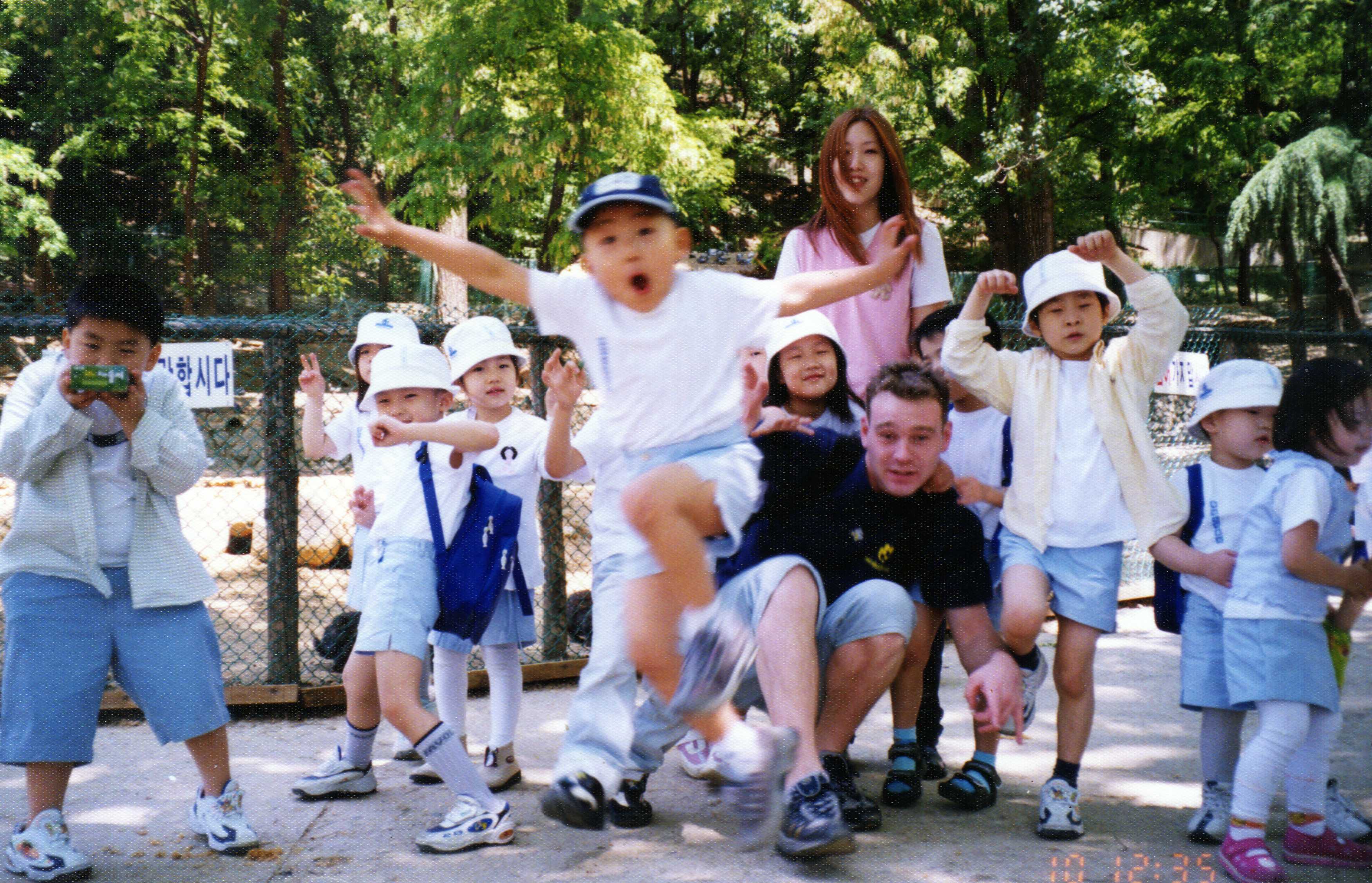
Matt at Woo Bang Park, now E-World (2001)
Well, I moaned to Young-seop and gave him an earful as he provided each excuse. First of all, he said they had waited until now to tell me in the hope Lisa would cancel her husband’s flight. Like she is really going to lose a million Won (£500) after a fuck-up on Mr Joe’s part! Then he said they had hoped Lisa would change her mind and decide to work.
‘But her husband is coming out to visit, what do you expect him to do; stay a home all day?’
The Korean attitude towards your free time and your work is one of the main things that pisses me off about Korea. Firstly, you have no free time – at least Korean workers don’t. Any time you might not be working is clearly seen as a privilege that can be taken away whenever your boss needs you. All the hagkwons in Song So are at the moment teaching for seven days a week and are open until past 11.pm. Parents pay no extra money for the extra classes as it is expected for hagkwons to give extra tuition prior to exam periods. As there are so many hagkwons in tight competition they all conform to similar teaching schedules. Of course, teachers aren’t paid any extra money for working seven days a week. I have almost stopped using the phrase, ‘have a nice weekend,’ as the concept doesn’t really exist here. The phrase’ ‘thanks God it’s Friday,’ needs to be modified to, ‘thank God it’s the second Friday in the month’ (ie, 놀토 – ‘play Saturday)
In Korea, everything is seconded to work and any shifts in routine are expected to be accommodated wholeheartedly. I can remember when I first arrived in Daegu, when Tony picked me up from the airport; I asked him what Mr Joe was like and he replied that he didn’t like him as he was always issuing orders and expecting everyone to drop everything on his command. Now I understand what he meant. Even Nana has become accustomed to it and well, if a King can learn to take orders, what chance do I have. Later in the week, when I moaned to Nana about the situation, he told me to calm down, to accept it. He kept saying this was ‘an emergency’ and that ‘we all needed to help out.’ ‘An emergency,’ I told him, was simply a threat to Joe’s bank balance.
The other thing that annoys me about Koreans is that they adhere to the Confucian ideals which stress the importance of the family. Well, this ideal only seems to operate if you are Korean. I get quite infuriated at the way people like Joe and Young-seop do not for one moment consider that western teachers are around 5000 miles from home, have no family with them, are living in a strange culture and have few friends. When I first arrived in Daegu I was left alone in my flat for a whole weekend; no one came to take me out or show me where to go for provisions. Nobody had been delegated to look after the interests of foreign teachers. No one showed me where to bank my pay or how to use a bus. All any of us were told on our arrival was where and when we were to start work. Even though our contracts stipulate we receive health insurance none of us have it – few English teachers do. When I asked about this, Joe managed to make up a load of excuses one of which was that if we wanted health insurance we would have to pay about £200 for it to be backdated until the date we arrived. It is quite pathetic the lengths to which Joe will go to save a pittance.
I moaned and moaned at Young-seop about Joe decision to send me to teach in another town and asked him when Joe was likely to confirm it – if indeed, he intended to confirm it! Nana is going to Andong (안동) in the morning and Lisa is about to go on holiday and naturally, any planning I need to do will be expected to be done in my time; none of it was be built into my working day even to compensate for the inconvenience of short notice. However, I knew I would end up having to do it. Worse, I had this fleeting sense that it didn’t mater what the work involved, I’d be able to bullshit my way through it.
I went to meet Lisa down in the KFC restaurant and told her what had happened, stressing that none of it was her fault. She really is a stupid cow! She insists he classes call her, ‘Miss Lisa,’ and I suspect that she thinks that by replacing her surname with her first name, and prefixing it with, ‘Miss,’ she is ‘cool.’ She’s a stupid cow because she has the disgusting colonial streak in her. She never has a good word to say about Korea or Koreans and more than once her language has belayed the fact she is a racist!
‘What time does your bus pick you up after classes?’ I asked her.
‘Whenever they bloody want. Sometimes they are there waiting and toot the horn at me. At other times I have to wait forty minutes! I mean, me,’she almost screamed, eyes bulging. ‘Me! Having to wait forty minutes for a fucking Korean!’
Earlier this week I caught a boy writing on the blackboard in one of my classes. He was writing in Korean and though I couldn’t understand the meaning, I could read the letters. He had written, Di Dim Dol donun Kil lim dol (디딤덜 도는 길임덜) Di Dim Dol is the name of the school and has something to do with a stepping stone; ‘Donun’ means ‘or’ and this I could understand. When I asked the boy what it meant he put his pencil on the floor and demonstrated that it meant something to do with tripping or falling over. How appropriate.
On Saturday afternoon I went shopping to E-Mart with Matt. I bought some smoked salmon and was quite excited as I haven’t seen this in Korean shops before. The pack cost 9000W which is around £5 but there was probably 500 grams in the pack, if not more. I had planned to eat it on my own as Matt doesn’t particularly like seafood but in the end I decided to take it to Ji-won’s as it would be an interesting experience to share it with them.
Ji-won’s family had never eaten smoked salmon and were eager to try it. Sun-hee, Ji-won’s mother, brought out a pile of assorted leaves, some wassabi, chilli and garlic. Then the salmon was placed in the centre of the table and we all tucked into it with chopsticks. I wasn’t going to ruin the delicate taste of that lovely salmon with wassabi. The salmon was very lean and very smooth and creamy in taste.
Koreans are notoriously bad at advertising things in English. You’d think that when they write English on shop facades, posters or leaflets that they’d consult native English speakers but they don’t and consequently you see many funny examples. The blurb on the packet of salmon claimed it was from the ‘fresh, clear blue waters of the North Atlantic’ but somewhere else it said it was from the Pacific Ocean. Anyway, there was a little write-up on the packets which read:
Around June to September, in a something sun, 3-5 year old well-grown salmon that have brilliant gesture and swim through sea and river along the blue and dear coast of the Pacific Ocean have very good quality of flesh and taste so good and have got praised as food of low-calorie. More than one century salmon has got praise of epicures all over the world. Salmon taste from soft to strong with many nutrients and special pink colour flesh create fantastic mood and taste.
A few more examples of Konglish (Korean-English) I have recently seen include: ‘Hair Deciener Shop’ (a hair salon), then there is ‘Twin Twon Coffee Shop which I can only presume is meant to read ‘Twin Town.’ Even better is ‘Shitty Pizza,’ obviously meant to read ‘City Pizza.’ There is also a boy in one of my classes who wears a t-shirt on which there is a large ‘20’ under which is written, ‘Sporty, Young and Milky.’
I wasn’t looking forward to this week as I am having to travel to Kumi to give lessons to Korean, English teachers. I wrote a quick lesson plan at the kitchen table, shortly after getting up. There are a few things I am unsure about and I really need to consult Nana or Lisa but if there is one thing you learn very quickly here, it is the art of bullshit. Young-seop and Mr Chey picked me up from outside my house at 8.30 am and we headed off to Kumi. It was great to get out of Daegu, especially on a working day. With spring well underway, the countryside is changing from day-to-day. In the rice fields you can see the bright green shoots of this year’s crop emerging. I wasn’t in the least bit nervous at having to give a lecture on phonetics to a group of thirty teachers. I have learnt that simply being a native English speaker gives you an immense authority and besides, most Koreans are not very good at spoken English and this includes Korean English teachers. When I explained where I had come from in the UK, ‘near Oxford’ was the best description, there was a murmur of awe which surprised me a little. They would never have heard of Aylesbury or Colchester. Surprisingly, I really enjoyed the session and I performed really well. After the lecture, if that’s what you could call it, Young-seop and Mr Chey took me for lunch in a rather posh restaurant; Young-seop said he was paying. We had bulgogi and there were plenty of side dishes including mong gae, or a sea squirt. This is a sea thing that looked rather like an orange-pinky, bloated heart. There were small nodular bits all over it which looked like tiny lips from which I suppose it squirted water. When cut open the flesh resembled that of a ripe mango. I tried it but didn’t really like it. The initial taste was that of detergent. Mr Chey clearly relished them as he sat sucking the flesh off the noddly skin, the juice running down his chin in a manner that would have been perfect for a Klingon. I arrived back in Song So with half an hour before I had to start teaching my regular classes at Di Dim Dol.
I managed to go training that evening but gave up on Tuesday as I was just too tired. On Tuesday, after the class, we drove to another restaurant and had bulgogi. When Young-seop went to the toilet, I told Mr Chey I was going to pay for the meal. Mr Chey told me Mr Joe was paying for our meals after the classes – so much for Young-seop making out he was paying! My new culinary experience today was hepari – jellyfish. It had a texture and taste of cold vermicelli noodles and was fairly inoffensive.
The internet cafe (PC 방) I have used ever since I arrived here has suddenly closed. I am a little annoyed at this as the woman who ran it used to keep pestering me for English lessons and there were many people I only ever saw in the cafe. I met her on the pedestrian crossing the day before Arbour Day and she told me the cafe would be shut for the day. Well, that was a month ago and later Matt and I noticed it had been completely gutted. Businesses seem to come and go in Korea and a business you can use one day can be gone the next. It would have been polite to tell us the PC room was permanently closing given the hours we spent in there. (I was to meet this woman in 2008, near my one room. I wouldn’t have recognised her but she recognised me. In the interim, she went to Canada for a few years and on return opened a hagkwon near MacDonalds – Wales English School – it is still there as of 2012.)
On Wednesday evening, after Taekwondo, I was going home when I met David (이영선) who is one of Nana’s adult students and who had several weeks ago led me home under his umbrella. He wanted to take me for a drink so we went to Mr Seven which is next to my house. David is very attractive, is 24 years old and a bloody Christian! Finding that out put a dampener on our meeting. However, like other Korean Christians, he doesn’t ram it down your throat. He seemed very interested in why I wasn’t married – more so than other Koreans and he phrased his questions quite differently to the way I am normally interrogated. At one point he asked me if I preferred men and later asked that if I could marry either a man or a woman, which gender I would choose. I came out to him making him the first Korean to know my sexuality and he wasn’t in the least perturbed. Indeed, he continued to ask me many more questions. He kept telling me ‘humans aren’t perfect.’
On Thursday the Letter and Sound School took the kids to Daegu Art and Culture Centre. Ot was a beautiful day and the centre is situated in the shadow of Mount Apsan. There were loads of middle school kids who gawped at me in awe and who muttered ‘waaaa’ which is the Korean equivalent of ‘wow’ as I walked past them. Many were fascinated by my size and several boys eagerly shook my hand or bowed deeply. At one point a crowd of children gathered around me with several lining up to shake my hand while others pointed and stroked the hairs on my arm. Other patted my stomach – Korean people, and especially children, are a lot more apt to be physical than are westerners. Such behaviour, I have become totally used to.
Taking our kids around the centre was a nightmare as there were a number of pottery exhibitions and on one occasion I watched in terror as a ceramic vase tottered precariously. On the whole and as would be expected, the kids behaved well.
At lunchtime we drove out to Woobang Tower park to have a picnic. We found a spot under a large tree as the temperature today was in the eighties and by far the hottest day we have had so far. Koreans love picnics and all have picnic knick-knacks. I was fascinated with their little picnic mats, all highly coloured and designed either for adults or children. Then there were the picnic hampers and little coloured boxes with chopsticks in them. Of course none of us westerners had prepared a picnic as no one had been bothered to tell us we were going to have one! However, Koreans always share their food so none of us went hungry.
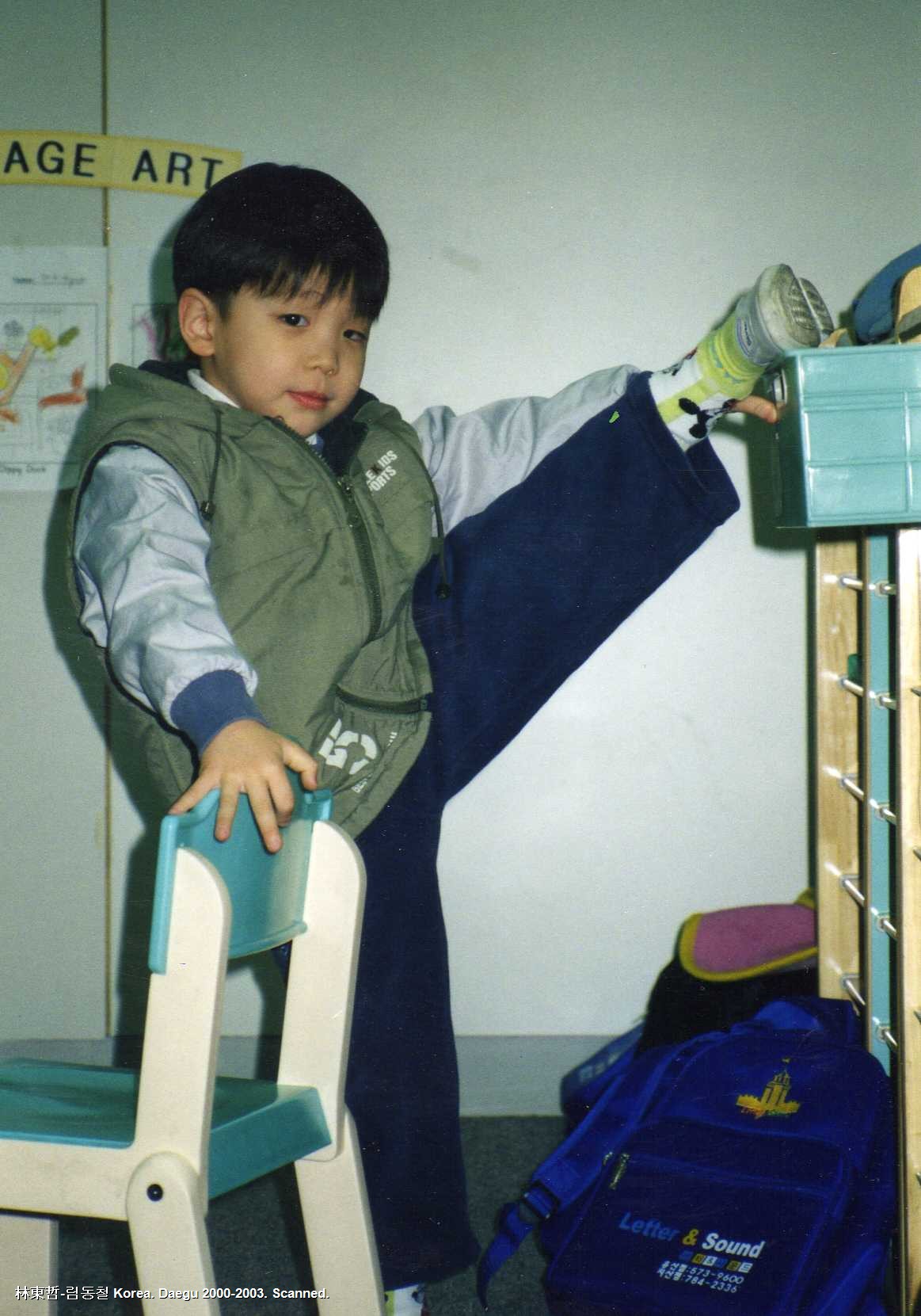
‘My Little Man’ – Jeong-Hoon
Jeong-hoon (중훈), a little boy in my class has become very attached to me. He is a skinny little boy who is always hot as he simply cannot sit still and is always having to climb over things or is running around. Like a lot of the boys here he is already learning Taekwondo and is incredibly flexible. When he is standing you can lift out sideways (side kick position) until his heel is facing the ceiling. I call Jeong-hoon, ‘my little man’ as he is always willing to do little jobs for me. In the mornings, if someone is missing, he will go and find them and he is always willing to go and fill the water jug or do other little jobs. He loves speaking English and knows all of the songs on the tapes we have. Anyway, at the picnic Jeong-hoon clears a space for me to sit next to him on his little mat. The very first thing he does when he opens his Mickey Mouse picnic hamper is to pass me some of his food. Most of the kids had kimbap which is pretty boring and which is a food you’d never pig-out on. Jeong-hoon’s hamper however, had KFC chicken nuggets in it! Lovely oily, western food! Mmm, as Homer Simpson would say. Typically, Jeong-hoon wasn’t into it – how conveniently Korean! He ate one, or rather he nibbled at it and the others he passed to me or the other kids sat nearby. No wonder he is so skinny!
I have spent a considerable amount of time watching Korean kids eat food and they approach it in quite a different manner to westerners. Boys in particular eat very different to western boys or men where their eating habits would be considered effeminate. Korean boys nibble food and they do not focus on it in the ravenous way we do. The Di Dim Dol school has started selling cakes during the break times as the middle school kids are currently in school for about 15 hours a day and have little to eat. I bought a small sort of Swiss roll a few days ago which a rapidly unwrapped and savagely devoured in the manner western men often eat. The whole roll, which wasn’t very big, would have disappeared in about three mouthfuls and it was probably as I was sinking my teeth into the second mouthful, when my eyes were rolling like a shark’s when its jaw is locked around its prey, that I noticed this girl stood watching me in totally shock – her jaw had actually dropped. I don’t think she had ever seen anyone eating in such a frenzied manner. In fact, it was just another example of what filthy, dirty scum us westerners are. The next day I tried to eat my Swiss roll like a Korean – not looking at it, not rolling my eyes, and by taking little nibbles and eating them in a passive manner as if drinking water when not in the least but thirsty.
All the Korean kids passed their food around at the picnic and when we had finished eating they all tidied up with little need of spurning from the adults.
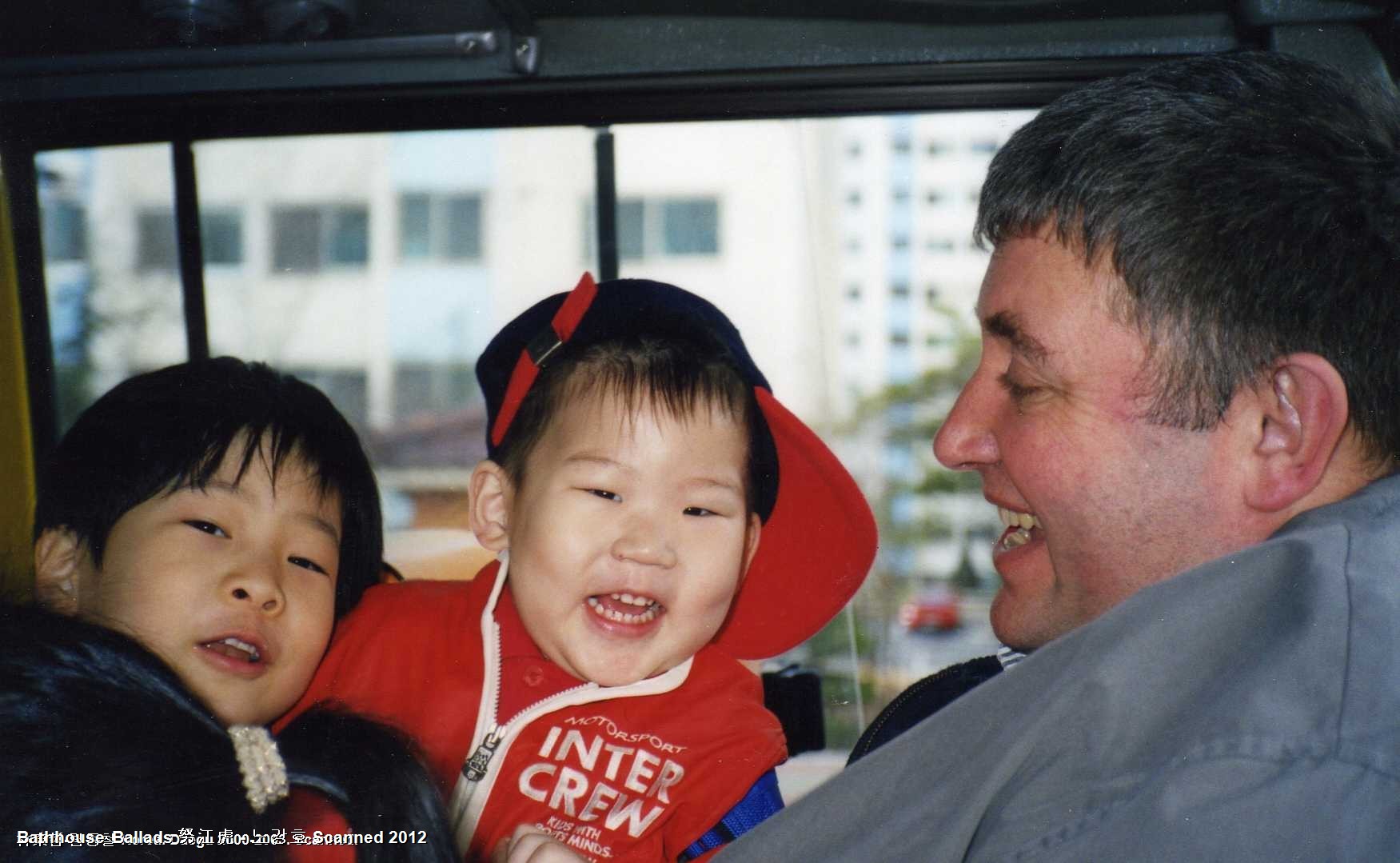
Lee Chi-wu – an incredibly intelligent boy
Matt and I have been having fun with little Lee Chi-Woo (이치우) on the bus. Of late we have been playing games with him which are sure going to increase our chances of going to hell. We take it in turn to whisper some obscenity into his ear and he then gets three attempts at repeating it correctly. We’ll say something like ‘cunt’ or some other offensive obscenity and if Amy, the young Korean teacher who is actually dating Young-seop turns around, attracted by our hoots of laughter, we immediately start saying Chinese numbers to him and pretend our game is innocent. Lee Chi-Woo (이치우) is able to say words like ‘clitoris’ and even simple phrases like ‘anal intrusion’ with amazing precision. He has also mastered, ‘filthy, dirty, western scum’ which is the phrase we use to refer to ourselves. Even after a visit to the mokyuktang I feel dirty in comparison to Koreans. Matt and I both believe you cannot wash or scrub away the grime associated with being western. It is a grime that transcends our physical being and exists at levels genetic, cultural, psychological and historical. We make jokes to Lee Chi-Woo about Doctor Jelly Finger, jokes which in the west would earn us a lynching. Doctor Jelly Finger has metamorphosed into Monsieur Jelle Fangre which we pronounce with a French accent after which we briefly suck our index fingers. Matt is convinced we are going to hell! If you say “Monsieur Jelle Fangre” to Lee Chi-Woo he will innocently respond by sucking his index finger like a lollypop. Matt and I find this perversely amusing. We have also taught him to say “Jelle Fangre, Chwuseyo” – “Please give me a jelly finger!” The next cruel game we play, which Matt claims I instigated, but which I know was his sick invention, is to tell Lee Chi-Woo he cannot leave the bus when it arrives at the school. Matt told him this every morning for a week. Just as we arrived at the school he would turn to Lee Chi-Woo and with a sad expression on his face, and a sombre voice, say:
“Chi-Woo. Chi-Woo. You not come! Only we go. You stay here. You not go school today.” Lee Chi-Woo then starts to get upset and begins to clamber over the seats of the bus. The following week he stopped sitting with us and I think we have traumatized him so we have both stopped teasing him. However, a week later and Matt started teasing him again and this time Lee Chi-Woo started crying. After this we modified the game so he knows when we are teasing. When Matt now tells him he can’t leave the bus, Lee Chi-Woo calls him a ‘bad man’ (나쁜 사람).
On Friday I had my final session at Kumi; it went really well and the class told me they had enjoyed the sessions immensely. I had to rush back to Song So in time for my kindergarten classes at one of the apartment schools. It only took us twenty minutes to reach Daegu and I spent most of it cowering in the back seat as we were travelling at 120-140kms per hour. Once the kindergarten class was over I was faced with a four-hour stint at and arrived back home at 8pm, quite wrecked.


 Elwood 5566
3 comments