Monday Morning Market – Tofu (두부)
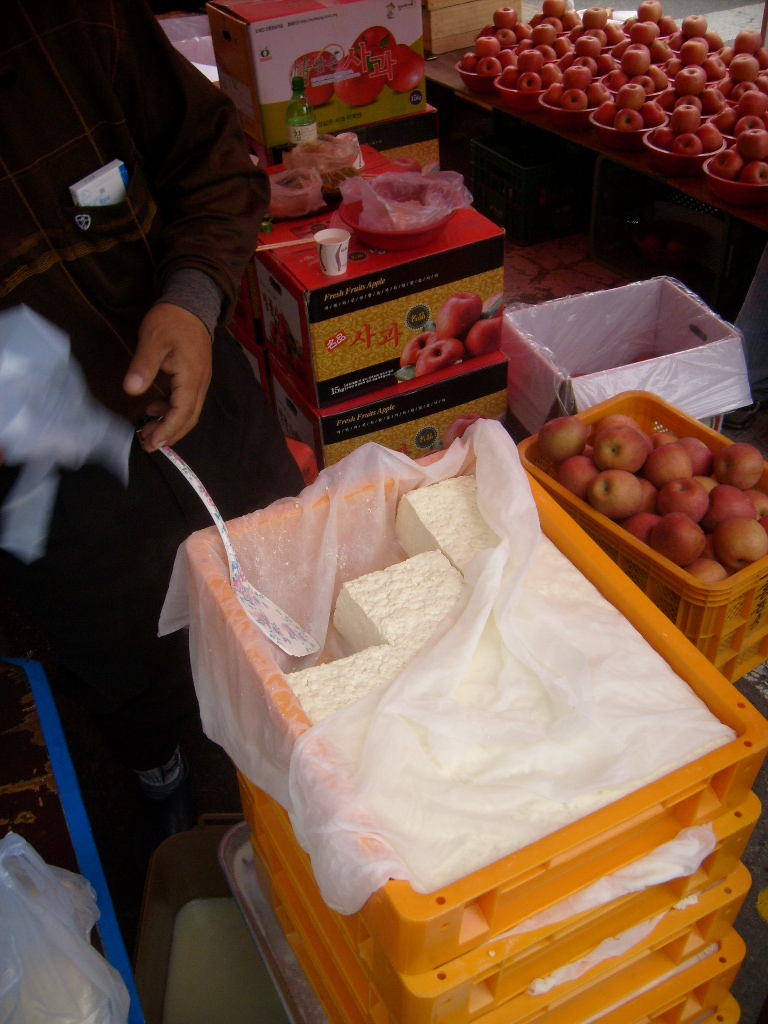
Monday morning market. Steaming tofu (두부)
Back home, some of my friends don’t particularly like tofu and it’s hardly surprising as its crap; its expensive and sold in amounts not much bigger than a bar of soap. It’s never fresh, totally tasteless and apart from being packaged in cartons that don’t require storage in a refrigerator, I suspect it contains chemical preservatives. In Britain, tofu is about as oriental as a pizza in Korea, is Italian. This is quite natural of course, it is not a particularly popular food.
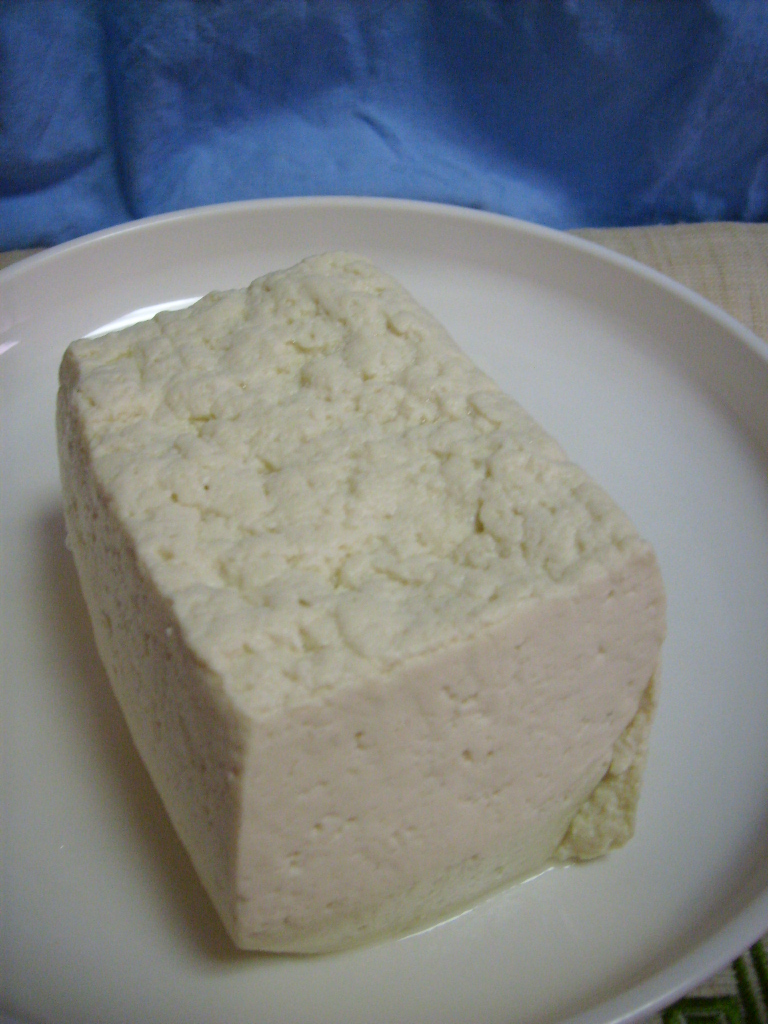
두부
Every Monday morning, I buy my tofu at the street market in Song-So. The block, which is about a third smaller than a house brick, costs 1000 Won (5o pence sterling), and it will last me a week used predominantly in soups. It is aslo very nice fried with sesame oil, sprinkled with sesame seeds and accompanied with a little soy sauce.
The tofu is always warm when bought and indeed, when I sliced this cake to put in the fridge, it was still steaming. What I like most is the smell when warm, somewhat like steamed milk, but this is lost the moment it cools. Eaten warm it is pleasant though it’s hardly bursting with flavour. Like a number of other Korean foods, oak curd for example, (도투리 묵), I think the appeal lies in the texture and their combination with other textures and flavours.
Tofu deteriorates very quickly if kept in the plastic bag in which it was bought. The best way to keep it is to place it in a plastic container filled with cold water. You can store this in the fridge and if you change the water every few days, it will easily last a week.

Strawberries and Musk Melon – Monday Market
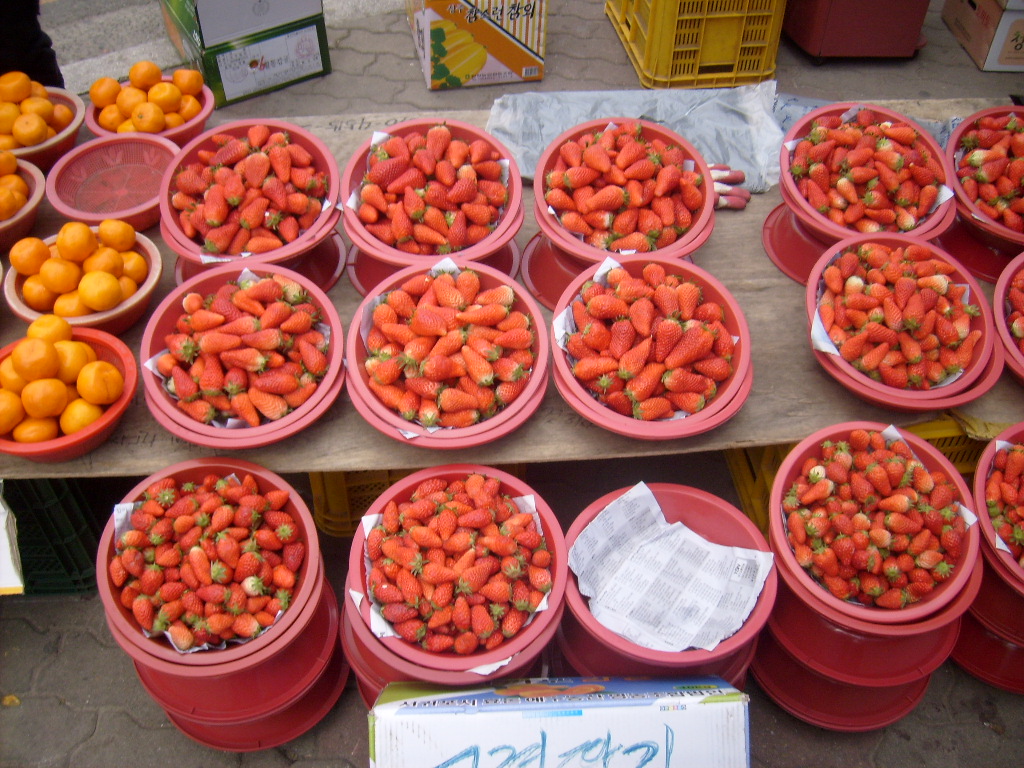
딸기
Ahh, the smell of these strawberries was delicious. A common sight now spring is here as is the musk melon. The strawberries can be fairly large, some the size of golf balls.
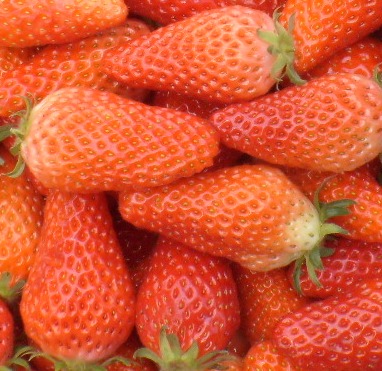
Syrupy sweet
Musk melon is okay but personally, I don’t find it as delicious as the much larger, and sweeter, honeydew melon.

참외
Shepherd's Purse (냉이)

Shepherd's Purse (Capsella bursa-pastoris)
With the approach of spring many seasonal ‘vegetables’ are appearing on the streets and one of the most common is Shepherd’s Purse. This costs about 2000W (£1 sterling) for a large bunch and can be bought from the elderly women who usually sit on the pavements selling various ‘vegetables.’ I haven’t yet seen it in my local E-Mart. Two of my Korean friends didn’t even know the name for this ‘vegetable’ and neither did they know how to use it. My best Korean friend is a total muppet when it comes to cooking so a much younger colleague gave me instructions. Shepherd’s Purse grows in the UK where for most people it would probably be classified as a weed and indeed when I initially tried it in a soup it tasted as one might imagine boiled grass to taste. Subsequent experiences revealed a subtle taste which some students describe as ‘medicine.’ However, not giving up easily, I have cooked this several times and find it pleasant.
Shepherd’s Purse doesn’t seem to keep long, even in the fridge and it will need washing and the small roots trimmed off. If you buy a bagful this job is tedious! Subsequent purchases, I prepared, chopped and then put in a plastic zip bag in the freezer. It makes a subtle addition to bean paste soup (된장찌개)and is quite often used with oyster soup. I have also used it in fish soup (해물탕). Shepherd’s Purse won’t win any taste awards and although I haven’t quite decided the extent to which I like it, it does provide a distinct but gentle background flavour.
Additional Note
(Three weeks later) Shepherd’s Purse has grown on me. In bean soup it definitely provides a pleasant flavour. I decided to buy some more later in the week. It keeps well stored in the freezer.
FURTHER INFORMATION
Monday Market – Shepherd’s Purse (March 2011)

© Nick Elwood 2010 Creative Commons Licence.
Oranges Galore – Monday Market
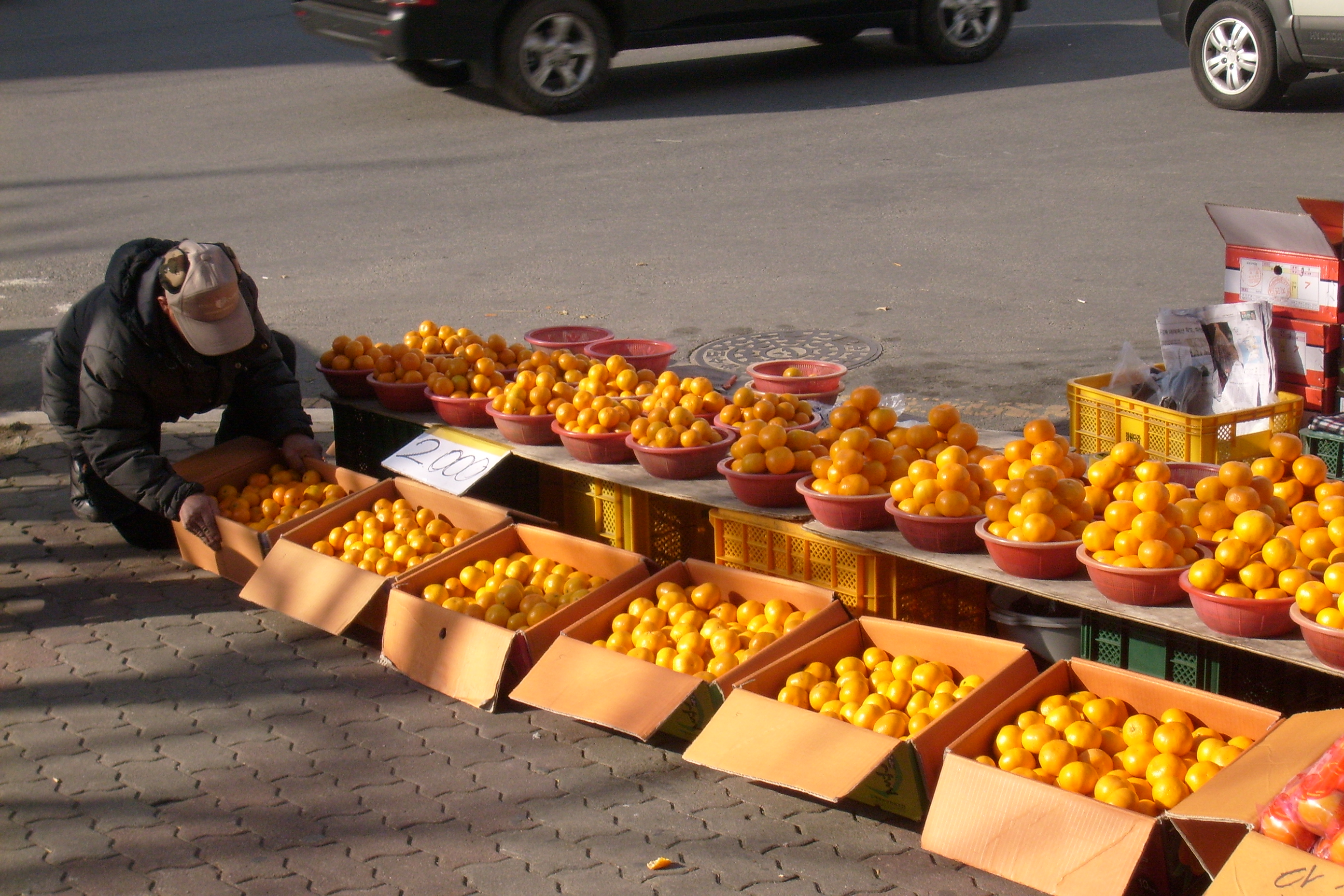
Chejudo Mandarins
I forgot to mention the mandarins/tangerine variety of orange in my post before Christmas. Usually from the sub-tropical Chejudo, the southern most island, these are delicious. They are usually sold at varying prices with the sweetest being more expensive. However, even the cheaper ones can be relied upon to be persistently sweeter than mandarins/tangerines sold in the UK. A general distinguishing feature of Chejudo and oriental mandarins/tangerines is that they are loose-skinned and seedless. Their name derives from the bright robes worn by the elite mandarins of China and the fruit was formerly reserved especially for the mandarin class. Mandarin and tangerines sold in the UK are often not loose-skinned or seedless, are often yellower and can be tart. These are probably imported from the likes of Morocco. which was the first county to export the fruit to the UK. I have to say, I can eat the Chejudo variety as easily as I would chocolate.
© Nick Elwood 2010. This work is licenced under a Creative Commons Licence.
Winter – Monday Market
I intended making a visual collection of seasonal fruit and vegetables as they appear and was going to start this in spring, I decided to start earlier.

Persimmon (홍시)
Persimmon (also known as Sharon Fruit. 감, 땡감, 반시, 홍시/연시,꽃감.) Early December and the Persimmon season is over but these ones I bought a few weeks ago. Currently I have around 60 Persimmon in my freezer. Persimmon is called Kam and like the octopus, there are three types each called by a different name which can be confusing. Kam range from hard to very, very soft. If you like sweet and gooey you’ll love the hongshi, sometimes spelt yonshi. This is the softest persimmon and appears in late summer to early winter. It is very delicate, like a fragile bag of water. Unlike the other types of persimmon, which I don’t eat often, these can be easily frozen. They are delicious cold, simply slice the skin and squeeze and scoop out the jam-like innards. Some coffee shops serve hongshi smoothie. You can also buy dried persimmon, rather like dried apricots but with less flavour. I’m told persimmon is quite high in calories – which is usual as anything delicious tends to be calorie laden.
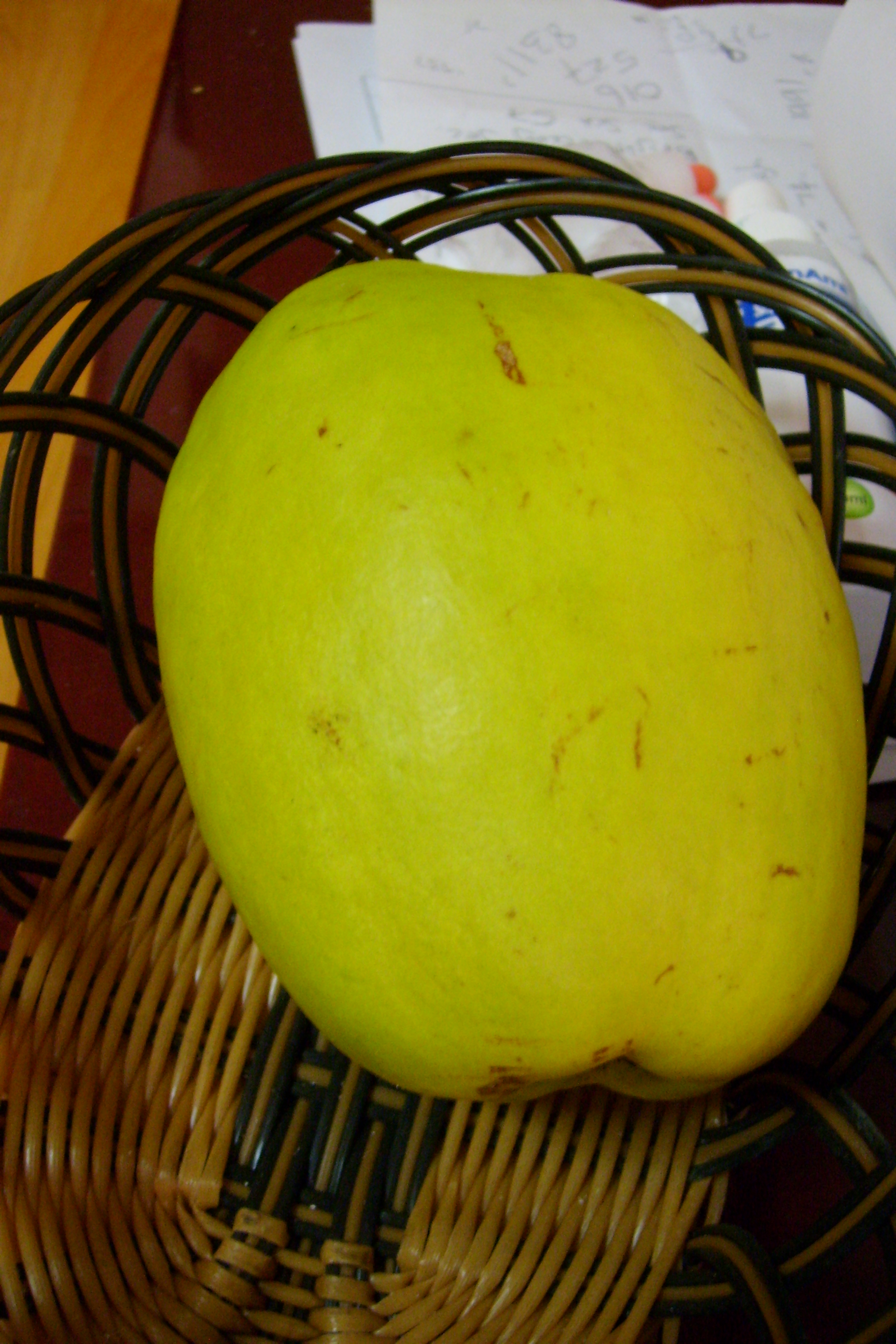
Oriental quince. (모과)
The Oriental Quince (Moghwa. 모과) , is used for its fragrance which is slightly appleley. It has a waxy skin. They do scent small areas like cars and small rooms but unless you dangle them under your nose, they’re pretty useless in larger spaces – but they look good. Moghwa appear in late summer and early winter. Make sure there are no small holes in them as these will contain worms. I had one with a small hole which were fruit flies front door, a piece of gum blocked future access and entombed any inhabitants. If you turn the fruit regularly it should keep into the spring. The moghwa is used in oriental medicine and can be used to make tea.

Daegu, famous for its apples (사과)
Apples. (사과) I live in Daegu which is renowned for apples and Daegu apples are truly delicious. In England, I rarely eat apples partly as there are so many varieties I never know which ones I like and because they can never be relied upon to be tasty. I suppose the variations in British weather result in fruit which can be sweet one moment and sour the next. Daegu apples are never sour and they are never fluffy or soft. Some are truly massive in proportions. Recently, a Korean teenager told me that had Snow White been Korean, she wouldn’t have died because Koreans always peel the skin off apples and pears. (and the witch, so he said, put the poison on the skin). In England we tend to wash them, if we can be bothered, and eat them with the skin on – a habit many Koreans find odd.

Cabbages (배추)
My God! I nearly forgot the most important seasonal product of all… The Cabbage – usually called a paech’u (배추) As with most imported fruits and vegetables which I might buy back home, the Chinese Cabbage ( which I think is a pak choy – or maybe its a bok choy???), is a piddly little thing which usually sits in the palm of your hand, is almost pure white and has no green leaves and cost W2000. In Korea when the cabbage season is at its peak, some are colossal in size and this week in the market they cost around W1000 each which is about 50 pence in sterling. Two will make me enough kimchi for several months. Check inner leaves for signs of caterpillar.
An occasional site, especially in more rural areas, are large vats of paech’u being salted ready for making kimchi. Indeed, in street markets at this time of year you can buy kimchi which has already been soaked in salted water.

Salted cabbages in Cheonan
- My Winter 2009 kimchi (배추 김치)
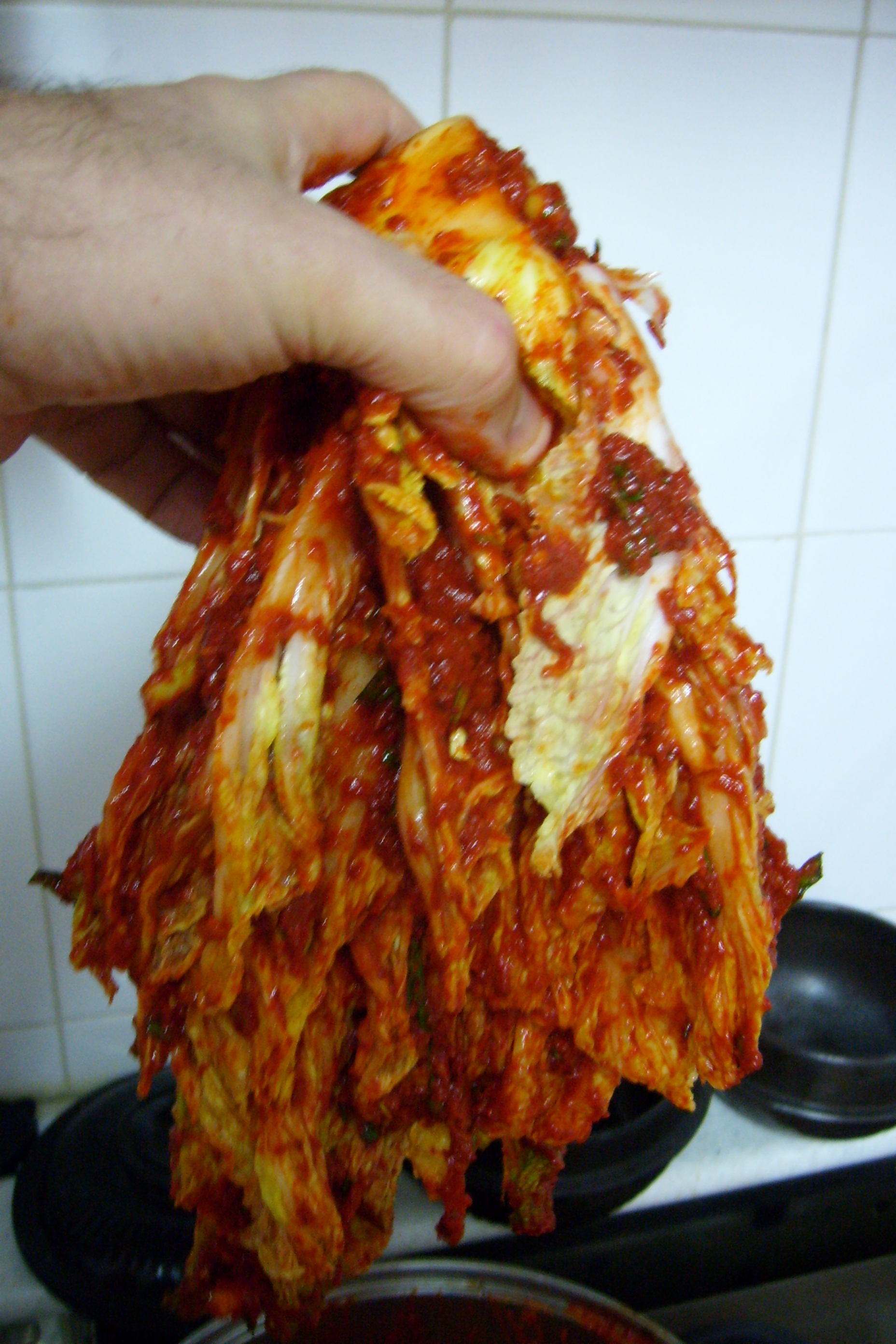
Paech’u after being salted and pasted with kimchi paste. Yes, it looks like something from a road accident but it tasted delicious!
persimmon – 감, hard – 땡감, between soft and very soft -반시, very soft – 홍시 or 연시, and dried – 꽃감. Oriental Quince (moghwa) – 모과, apple – 사과, Chinese cabbage – 배추.
© Nick Elwood 2010 Creative Commons Licence.
My Discovery of the Existence of Bathhouses – January 18th – 22nd, 2001 (Korean Accounts 2000-2001)
On the first day of the Chinese New Year (설날), Ryo Hyu-sun (료휴선) took me to the cinema. We watched Proof of Life with Russell Crowe and Meg Ryan. I was expecting to have to sit in really cramped seats but there was ample leg room. Afterwards we wandered around the city centre in the area known as Milano which is at the very heart of the city. This area is teeming western designer label stores and up-market malls. We ate ddokpogi (떡볶이) in a small back street cafe. Korean eating establishments usually focus on one food type and this was the speciality of this restaurant. A larger gas burner is placed on your table and the ingredients added. These included shredded Chinese lettuce, mushrooms, carrots, giant rice noodles the size of your finger, smaller noodles, whole eggs and squares of a sort of pancake made from powdered fish which is called odeng (어댕). Mandu (만두), which are small stuffed pancakes or dumplings are also added. Water and some condiments are added and then the burner lit. You then stir the meal until it is ready to eat when it is accompanied by none other than kimchi as well as a kimchi made with mooli known as moo-kimchi (무김치). Ddokpogi is served by many of the street vendors that crowd the sidewalks of Korean cities. These are usually served in a pint paper cup with a large cocktail stick to eat the fat noodles. Restaurant ddokpogi however, is much more tasty. Once the meal is finished a waitress then put some oil in the pan, adds rice, condiments and kim which is layered, salted seaweed. This is then boiled up with a copious serving of red pepper paste.

Hyo-sun’s mum and dad, Lunar New Year, 2001
Afterwards, Ryo Hyu-sun took me to his parent’s house. They live in a traditional style house in a part of Song So with which I was unfamiliar. All Ryo Hyu-sun’s relatives were there. The children wore their traditional hanboks (한복) which are baggy, very colourful and made from a sort of silk-like material. Ryo Hyu-sun’s mother must be in her late 60’s but sat on the floor cross-legged with an impeccably straight posture. She could sit in this position and touch her nose to the floor. Several other relatives arrived and took it in turns to prostrate themselves on the floor in front of his mother and father. Then a meal was served, of pig brain and pig’s trotters. I avoided the brains but the trotter meat was fine. We also drank soju but one that had been suspended over the year in a bottle containing ginseng. Then we ate the traditional rice cake soup (칼국수). After eating we played yut which is a traditional festive game played sat around a mat with several sticks which are thrown. By this time I had been sat on the floor for four hours and my legs were sore but visiting a family on such an important day was well worth the experience.
I haven’t trained in the Song So (WTF) school for almost three weeks as the routine of Letter and Sound in Yon San Dong has sapped my energy.
The heat in the building, as in most buildings, is stifling and I have discovered many westerners have a problem with scabby noses, dry skin and cracked feet. The temperature at Letter and Sound just knocks the energy out of you. My kindy class is so unresponsive that I have stopped trying to teach them. I spend the first session in the morning just talking to them – they seem quite happy with that. As I mentioned earlier, my name in school is Bilbo Baggins. The kids find that quite amusing and often call me Bilbo songsaeng-nim which is the Korean for teacher or sir. During my first few weeks at Letter and Sound I discovered that when the kids knew my name they called it out whenever and wherever they saw me. Not only would I hear my name being called all day wrong, with a slightly incorrect inflection more like Neek, and in tiring choruses, but then I would hear in at the weekend or evening when I was shopping or out walking. Neek! Neek! I would hear called from passing busses or from some building window. Bilbo is much more impersonal.
I have been teaching Pak Ji-won English at his parent’s restaurant in Song So. I enjoy teaching him as I can also have discussions with him and that certainly makes a change from singing Annie Apple or Bounshey Ben songs. Sometimes our lessons go on for several hours and then I will talk to his father over a bowl of my favourite drink, dongdong-ju which is a strange, milky rice wine alcoholic drink, before going home. Ji-won is both incredibly camp and very good-looking. Being camp is no slur here and in fact most of the young men move and behave in a way that would bring their sexuality into question in the West. They drape themselves over one another, walk around leaning on one another or holding hands and are basically very gentle (note- skinship). Ji-won shuffles around his father’s restaurant like a geisha girl, holding his forearms parallel to the floor and with his wrists bent. One day I asked him how he felt about having to go into the army as all men here do 24-27 months conscription. He told me he was excited as he was looking forward to the exercise as being a high school student entailed long inactive hours sat at a desk. He also said he was looking forward to firing guns and driving tanks but that he didn’t want to go to war or kill people. Korean lads often join the army with other friends and can be billeted together and perhaps this explains the rank of military police I saw one day in Daegu, many of whom were holding hands with each other. One day he told me how he loved my body. I found this amusing as I find it quite repulsive and he explained how he likes the fact I am broad, tall and strong. Then he asked me to go to the bath house (목육탕) with him and of course, here bathing is performed naked. I would love to experience communal baths, and not for any seedy reason – it must be quite a strange feeling to bathe naked in public. It would be strange, if not embarrassing to meet pupils and colleagues starkers and to have to bow and chat to them so perhaps I’ll do this in another town, Andong (안동), perhaps? It’s bad enough being stared at when clothed (note – this is my first mention of bathhouses. I was in Korea almost three months before I learnt of their existence – remember – there was little or nothing on the internet on such subjects).
I often try to imagine the image Koreans must have of themselves and each other considering they look, or at least appear to look so much more identical than do westerners. They must have an incredible sense of ‘racial’ individuality, of togetherness. While they tend to differ in height – and some Koreans are as tall as me (1.99cm), there are few fat Koreans and of course they all have dark hair, eyes and similar complexions. Many Koreans have no protrusion at the back of their heads like we do in the west and a Korean child’s head feels very strange.
©Bathhouse Ballads – 努江虎 – 노강호 2011 Creative Commons Licence.
Kindy Life – Jan 1st – 20th, 2001 (Korean Accounts 2000-2001)
Kindergarten classes finish at 2pm and we then have to start hagwon classes straight away. The kindergarten is soul-destroying as we follow that stupid Letterland syllabus and the resources are not suitable for kids whose first language is not English. Then of course, to make things more boring, most of the kids know the alphabet anyway but we are still compelled to teach it from the beginning.
Jo told me to make sure we took a whole month to do the letters ABC and within ten days of dragging lessons out the kids, all had finished their work books. Last Monday, I said to Precious, which is the adopted English name of the young woman who is both a teacher and receptionist at the school’s front desk, that I needed the next workbook but she said I had to keep the kids on the current one, the ‘Annie Fucking Apple’ workbook, for the next month! The activities are fine for kids who have weak spatial skills but the colouring in letter ‘A’s’ or ‘B’s’ is a totally useless activity. One boy copied a line of ‘A’s’ in eight seconds. I’m sure some kids could complete the entire workbook in half an hour.
The videos cannot be understood as the vocabulary is too complex or the English too confusing. One moment something is called a ‘puppy,’ next moment it is a ‘dog’ and the books are full of lengthy words which might be understood by a native English speaker but not by an ESL (English as a Second Language) student.
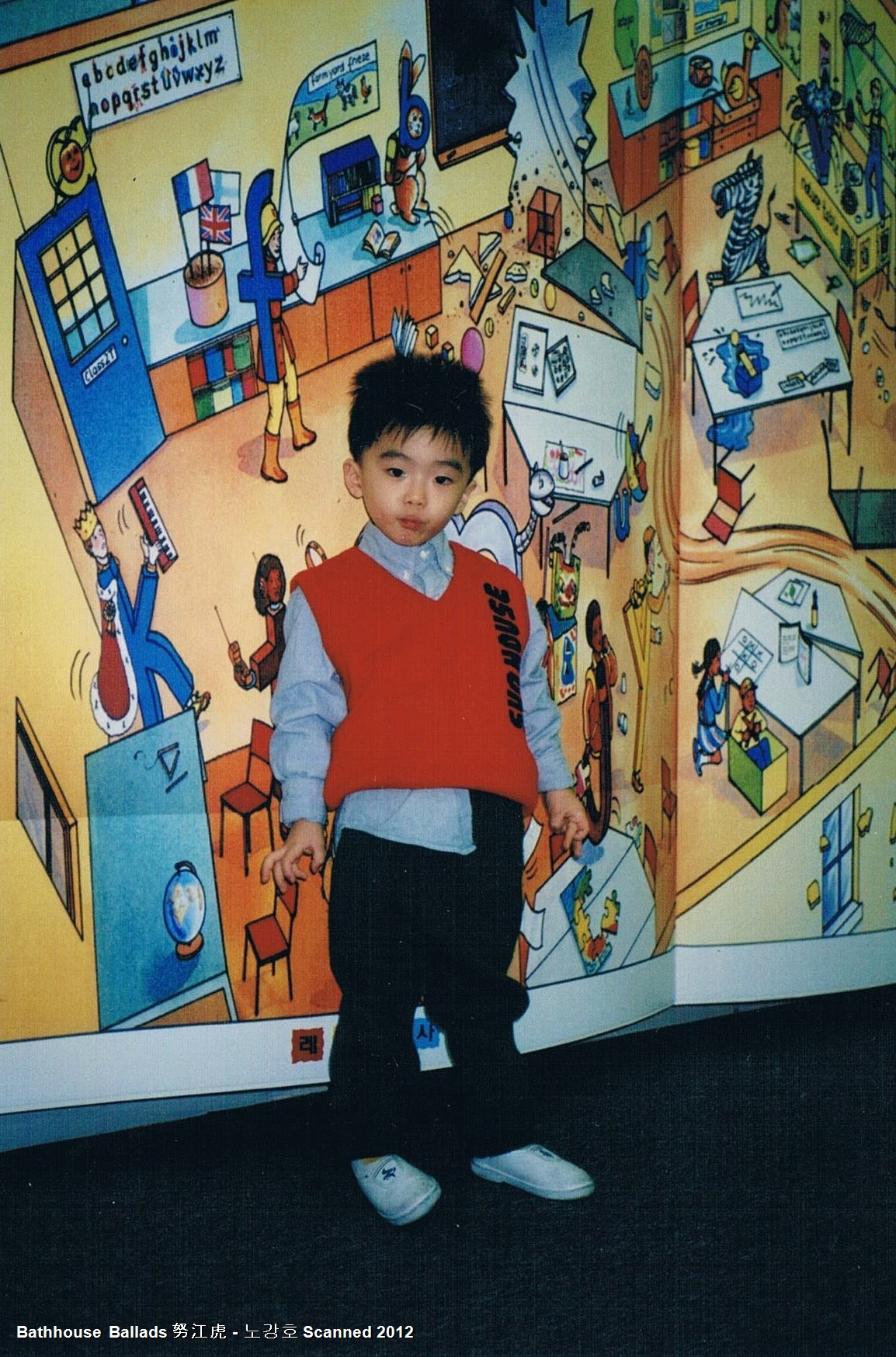
Deok-hyeon, terrified to enter my classes – many kids back in 2000 had never seen a real foreigner
There is another boy who is supposed to be in my class except he hasn’t yet attended, his name is Deok-hyun (덕현). I terrified him the first time he attended the school and every time I went near him he screamed. He was petrified of coming into my class and when we initially managed to get him in he sat trembling. Eventually he ran out of the class and has since spent almost two weeks sitting in the reception with Precious. Whenever I walked past he runs away and hides.
I have settled into the teaching life at Letter and Sound and have noticed how my girls are all brain-dead. I don’t know what Koreans do with many of the girls but it is quite criminal as a noticeable proportion of them are morons. For example, whenever I asked Da-hae (다해) a question she starts to slaver and dribble all over the table. Then she proceeds to eat the edge of her desk or the cuff or her coat or jumper. Precious has told me that one the bus in the mornings she forever has to tell Da-hae to stop licking the windows. In every class I have girls who fail to communicate with me or are petrified by my simple questions. When I ask them something easy to answer, and then given them a hint, they stare off at a tangent and refuse to speak to me. I have noticed how most of the girls who do this are the ones dressed in pink or with fluffy furry clothing and it reinforces my belief that there is a link between being clinically brain-dead and make-up, the colour pink and My Little Pony paraphernalia. Of course we destroy and undermine the potential of female personalities in the west but here it seems much more acute. In fact if I taught girls in the UK who acted in this manner I might assume they’d been abused in some way but then the Korean girls will have been mentally abused. It is quite sad how many girls second themselves to boys and men.
Matt, Angela and Pauline refer to my class as ‘The Cabbage Patch.’ After lunch, which we serve to the kids in their classrooms, I will help Precious clean up the room. It has now become common practice for us to make jokes about where Da-hae (다해) was sat as there will be a patch of drool and licky food smears. Out of my three boys one is normal while Deok-hyun (덕현) is constantly running out of my classes as he is terrified of me. Dong-seop has started competing with Deok-hyun for the attention of Precious and has also started to have crying fits at the start of each day.
So far I’ve managed to avoid taking kids for a piss – the boys at least. The girls I don’t mind as much as they are surprisingly independent at this task. Boys however, are quite different. However, this week Dong-seop wanted me to take him for a piss. Koreans kids use the word ‘shee’ (씨) which translates into something like ‘tinkle’ or ‘wee wee’ as whenever I use it in front of Korean adults it promotes laughter. Dong-seop started making the gesture for wanting a piss, which is to make stabbing motions towards to their crotch with the palms open. It is quite a funny gesture and is always done with both hands. I was forced to take him as there were no other adults around. When we got to the urinal I was hoping he would do it himself but little Korean boys will usually just stand there as they are used to their parents doing everything for them. I had to pull down his trousers, and then his long johns however, before I could get them fully down he started pissing into them.
On the Chinese New Year we had three days off which happened to fall on a Tuesday, Wednesday and Thursday. Of course, in Korea you wouldn’t expect to be given even the Monday or Friday off by your boss, let alone both days. Koreans don’t seem to complain or even be bothered about this themselves. On the Monday evening I meet Ryo Hyu-sun and a friend of his and together we went to the bar, Mr Seven, which is next to my apartment. They asked me what I wanted to eat and I said I didn’t mind. This wasn’t a sensible thing to do as next moment we were served a communal plate of chicken feet in spicy red pepper sauce. At first I thought they were prawns but when I lifted one out of the sauce it wobbled grotesquely from the end of my chopsticks. I ate a few just to be polite and all the time had to suppress an urge to chuck up. All the bones seem to have been removed from the feet but they still had bits of gristle in them or maybe that was the bones but regardless, there was a continual crunching in my mouth and throughout the duration I couldn’t help how much chicken shit each little foot had trodden in. Whenever Koreans drink alcohol there is food on the table and they consider it unhealthy to drink without constantly nibbling.
When it was about one in the morning, and after another of Ryo Hyu-sun’s friends had joined us, we went to one of the numerous soju tents known as pojangmacha (포장 마차) which are doted all over the place. These are simply red and white or blue and white stripped plastic tents which stand on disused land or parking lots. They are large with entrances and plastic windows and inside they are heated by kerosene heaters which remind me of living under canvas in the army. The owner of this tent, a middle-aged man and his wife, had a small portion of the tent where they sleep and watch TV as these tents are open 24 hours a day. We must have spent an hour in Mr Seven discussing the merits of cod soup and cod roe (대구탕,알탕). Incidentally, Daegu, is also the Korean for cod. Ryo Hyu-sun kept telling me how delicious these soups were and no sooner had we sat down in the soju tent, pojangmacha when a gas burner was brought to our table and a communal bowl of soup prepared. The soups were quite tasty but then we were huddled around the kerosene heater with an outside temperature of minus 10, pissed and hungry. Even a packet of dehydrated soup would have been something to talk about. Koreans make several assumptions about their culture. The first is that their food is hot and spicy. Koreans are always saying to me, ‘Oh Nik, that meal is very hot!’ or “Nik! That is too spicy for you!’ Another assumption is that their food is delicious. I see their assumptions as a form of racism and whilst I don’t find them terribly insulting they are irritating. I am aware their assumptions are just that and are borne out of naivety rather than malice. Few Koreans have traveled abroad and the country is lacking in western restaurants. Of course MacDonald’s and ‘Kay Pi Shi’ (KFC) are here but there a few Indian, Thai or Mexican restaurants. Most Koreans think their food is too hot for westerners and are surprised if you eat rice noodle soup (떡보기) without complaining about how hot it is. They look at you in awe if you dare eat a raw chilli or glove of garlic at the meal table. As yet I haven’t eaten one Korean meal that is hot, I mean hot like vindaloo or hot like Mexican food. Generally Korean food is comfortably hot. I would love to see a Korean eating a Scot’s bonnet chilli or a habanero. Spicy hot in Korea is one that burns at both end! Then there is the assumption Korean food is spicy – well that’s not really true. Yes, it’s spicy hot-ish but it certainly isn’t spicy. I am sure other spices exist here but the only ones I have experienced are ginger, cinnamon, garlic. Combining a wide range of spices, as in Indian cuisine, is not the essence of Korean cooking and everything is served with copious amounts of either red pepper paste (고추장) or red pepper powder. Matt and I were talking about Korean food at school last week, as we were eating lunch and everything at the table contained some form of red pepper. The kimchi is loaded with it, it was copious in my meal and Matt’s soup and it was in all three of the various pickles at our table. You can rarely eat Korean food without eating some form of red pepper or chilli. Despite this Koreans will tell you their food is spicy. Well it’s hot but the only spice in it is chilli, that’s the only spice in anything.
As for kimchi, Koreans are obsessed with it. Kimchi is a national ‘dish’ and is a form of pickled cabbage a little similar in its properties to sauerkraut. It is made with Chinese leaf cabbage. The other main ingredient of kimchi is of course, red pepper powder along with garlic, ginger, various spring onions a form of fish sauce similar to Thai fish sauce and grated mooli which in Korea is called moo. Kimchi is served with almost everything and I can think of few meals with which it is not an accompaniment. In many meals it is a vital component along with rice or as the basis for soup. You can also buy kimchi flavoured noodles and crisps. If you mention kimchi to some children they get very animated and so far I have only met one child that doesn’t like it. I have been asking children their views on kimchi in my classes and on one occasion the kids became really excited when I said I liked it. Now I have to admit it but when I writing this diary in Korea, I hated the stuff. I would only eat small amounts of it and usually only as an accompaniment mixed with other things I thought it smelt disgusting, and a juxtaposition of something like a blend of flatulence aromas and something rotting. Now I love it and in fact I am pretty expert at making it. Many Koreans have been impressed by my skill at making this condiment. Neither have I really found Korean food delicious, at least not delicious in the same way as one might enjoy Chinese, Thai or Indian food but I do find it very satisfying.
It is amazing watching the kindergarten children eating their meals as their behaviour differs drastically to that of western kids. Korean children, even the very young ones, don’t start eating a meal until it is all served. There is no squabbling over who has a bigger portion and if one child asks for something extra the others don’t all follow suit. The children then all eat in silence apart from these rather unpleasant insect-like noises they make such as juicy clicking noises, smacking of lips and slurping. They eat so slowly and with intensity as if the flavours and consistency of every mouthful is being pondered. Finally, when finished, they take their tray to the reception, clean it and put it back in the rack. All this is done without being prompted.
Many of the kindy kids are three or four years old and yet I haven’t noticed pissy or foetid smells lingering on them. So far, I haven’t had to take any kids for a crap, and I don’t want to, but in the UK you would expect to take such children for a pooh every now and then. Korean children are impeccably clean but their teeth are often bad and I have noticed the worse a child’s teeth are, the richer the parents seem to be. The kids at the up market Letter and Sound seem to have significantly more rotten milk teeth than corresponding kids from Di Dim Dol. Despite this however, Korean adults all seem to have decent teeth.
(note – the pojangmacha (포장 마차) I visited stood where Lotte Cinema was subsequently built. At the time, this area was a huge vacant lot with several soju tens permanently stood on its edges. On my third trip to Korea, in 2005, the site was already under construction. Pojangmachas were common on vacant lots between buildings even in built-up areas; indeed, one lay not too far from MacDonald’s in Song-So. The vacant lots have rapidly disappeared and soju tens are becoming a rarer sight.
Bathhouse Ballads chronicles many aspects of my life in South Korea. Kimchi Gone Fusion focuses on ‘the way of the pickled cabbage’ while Mister Makgeolli is dedicated to Korean rice wine.
©Bathhouse Ballads – 努江虎 – 노강호 2011 Creative Commons Licence.
A New Rice Cooker (Teacher) Arrives from Australia – Sunday December 10th (Korean Accounts 2000-2001)
At the taegeukkweon this week, (태극권 – is a Korean form of tai chi which is taught twice a week as part of my taekwondo classes), one of the boys was hit with a padded stick used to simulate a club attack. I don’t know what the boy had been doing but the instructor, Mr Park, struck him three times across the back of his legs. The boy, aged about 12, started crying and had his head bowed and Mr Park seemed to be telling him to stand in the ready position. The boy ignored him and so he was beaten. Eventually he complied and the class continued.

a rice cooker and a teacher share a lot in common in Korea
On Thursday, Mr Jo asked me if I would go to the railway station with him to meet a teacher arriving from New Zealand. He wanted me to go there at eight in the evening and as I wasn’t going training, I agreed. Nothing in Korea is simple, at least not in my school and after waiting at the school to be collected by Mr Jo, I discover she isn’t arriving until nine. Nine-thirty arrived and still there was no sign of Mr Jo and then Miss Pak, the school secretary, told me she was arriving at eleven. Next, Mr Jo arrives with a change of plans and sent another teacher to collect the new teacher and decided to take Nana and I for dinner. We went to one of the many restaurants near the school, a sort of cross between a drinking house and a restaurant and there were western style tables to sit at. Before the drinks arrived at our table Mr Jo started telling us about some of his plans and I quickly sensed something else was afoot (note – Koreans initiate business meetings through food and drink). I had originally arranged to meet this Korean woman, a teacher in the school, for dinner, at 10.pm, her name is Pak U-chun (박유천 – 12 years later, she was to become my boss). As soon as I told Mr Jo I was supposed to be meeting her he telephoned her on his mobile and cancelled our meeting. He then decided we should meet at 10.am but I was supposed to be giving Dong-soo (박동수) an English lesson then. Nana suggested I phone him and cancel the meeting but I quickly retorted that I didn’t have his phone number. Nana’s next suggestion was that I should simply not turn up for Dong-soo (박동수). Jo got up and went to the toilet and I told Nana that I didn’t want to cancel my plans on the whims of Jo. When Mr Jo returned, we agreed to meet at 10.45 next morning.
If I was pissed off with Jo, I was even more pissed off when the meal arrived as it was totally Klingon and disgusting. What I thought was a purple bean curd (note – probably my early under standing of acorn curd, 도토리묵) and octopus turned out to be raw lived and stomach. Then there was this thick, white gloopy soup which resembled ejaculate. The liver and tripe I passed aside and the soup actually made me gag. However some recognizable meat and vegetables arrived for us to cook on the pot at our table and this was quite tasty (note – I’ve gradually become more accustomed to Korean food but there are still some foods I don’t enjoy and raw liver and stomach or good examples).
As we drank more soju (소주), Mr Jo’s plans began to unfold and it transpires that he wants Nana and I to go to his new Letterland school tomorrow to start planning the Letterland system. The trouble with the Korean way of business is that you have to be very careful about committing yourself through the influence of alcohol and do you even have a choice?
By the time we left the restaurant we’d drunk several bottles of soju (소주) and beer and despite this Jo drove us to a noraebang (노래 방) almost adjacent my flat. We spent several hours here singing and I must have ordered 7 or 8 rounds of beer. Next morning I had a bad hangover and had lost my voice.
(note- I’ve learnt that a number of Korean bosses treat you like a ‘rice cooker’ and once you have a problem or don’t function as they want and you’re simply replaced with another wayguk. Others bosses are quite the opposite!)
©Bathhouse Ballads – 努江虎 – 노강호 2011 Creative Commons Licence.
Further References
When the Cuckoo Dies (Bathhouse Ballads, June 2010)
Do You Remember Ding Ding Dang? – Monday, November 27th 2000 (Korean Accounts 2000-2001)
This evening Nana and I went out with Roger who works at a school called Ding Ding Dang (note – in 2000, Ding Ding Dang was a major English academy franchise – certainly around Daegu – it now seems to have disappeared). We went to a marinated pork restaurant. I do like Korean food but it seems void of fat, sugar or salt though I am sure salt is used in the kimchi process. A Korean meal never seems to fill you and they don’t seem to eat large quantities of meat. There are restaurants everywhere, some serve noodles, or barbecues which can be pork or beef, or chicken but usually you don’t find pork and beef alongside chicken. Then there are places which serve kimbap (김밥) – fish stick or cheese rolled in rice and covered in seaweed. One of my favourites is ddeokpogi (떡볶이) which is various size noodles, with a boiled egg and cabbage served in a hot spicy sauce. This also has a strange fish strips in it, called odeng, made from powdered fish. Often a plate of ddeokpogi (떡볶이) is crowned with mandu (만두) pancakes. A big plate of this in a restaurant is usually shared and costs only a few pounds.
Tonight however, we had pork barbecue and all the side dishes but there was some kind of noodle side dish with very strange little green things in them which resembled scrunched up testicles and we couldn’t fathom which animal or anatomical part they came from. I have since discovered these are a sea product, mideodeok (미더덕) but I’m still not sure whether they are animal or vegetable. They are often found in kimchi-chi-gae. We drank a few bottles of soju and the bill came to 10.000 won each which is around six pounds.
On Monday I was back in school after giving Dong-soo his English lesson. I went to taekwon do in the evening and all was going well until I pulled a fucking hamstring in my left leg. It happened right at the end of the class. Almost at exactly the same time as I pulled it, Dong-soo told me I was to be graded the following evening by Master Bae.


 Elwood 5566
leave a comment