An Autumn morning in the Rose Garden (장미공원)

blaze of autumn
In Autumn, you can often kick or push a small tree and the leaves fall like snow. Last weekend I noticed several people , mostly couples, kicking trees and then getting all excited as they stood in the brief leaf storm. In England, the air to usually too damp for the leaves to turn crispy and English leaves, sodden, soggy and sloppy, are notorious for sabotaging our rail network. Indeed, in just a few days the trees in one road, golden yellow, have been blown barren by a bitter wind that bites your face. In my UK garden, the defoliation of summer’s leaves is a long and slow process and even late December some leaves will have avoided being blown off.
These photographs were taken on or around 18th of November, which is actually winter rather than autumn, when most of the trees still had leaves and they were at their most dramatic. Most were taken around 7.30 in the morning with a frost over the ground and light mist in the air.

autumn colours

Autumn across the rose garden

contrasts

while I took these photos, suneung was just about to begin

the chong-cha (정자) at the rose garden's center
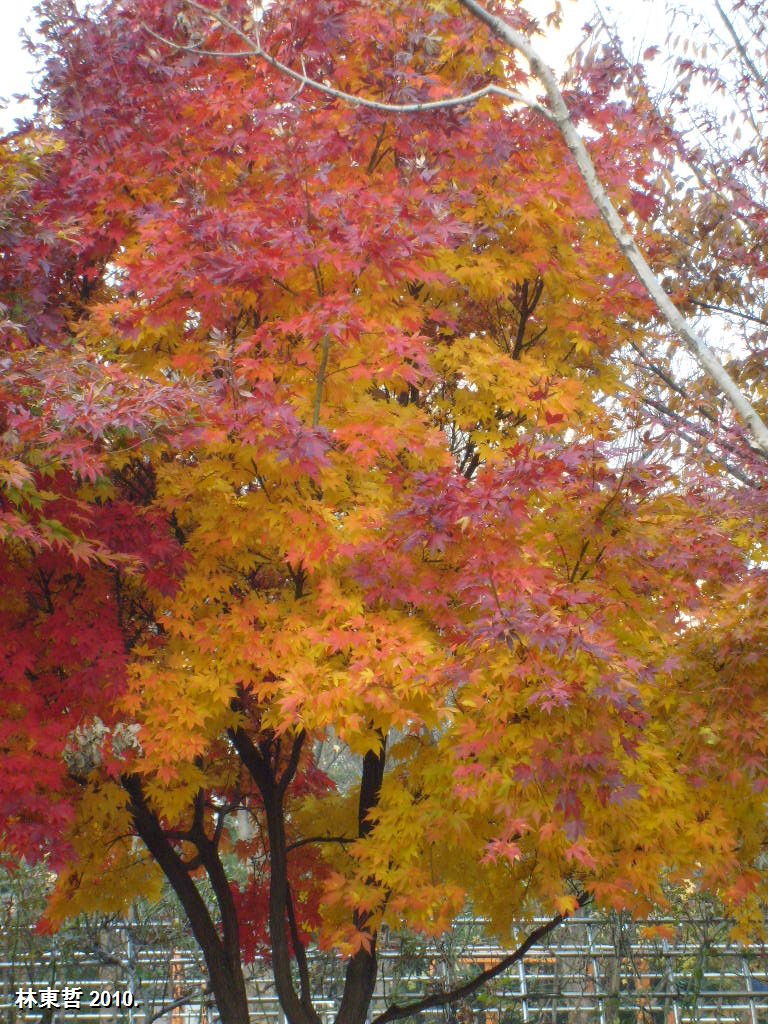
it's easy to see why the hanja character for autumn, is a combination of tree and fire
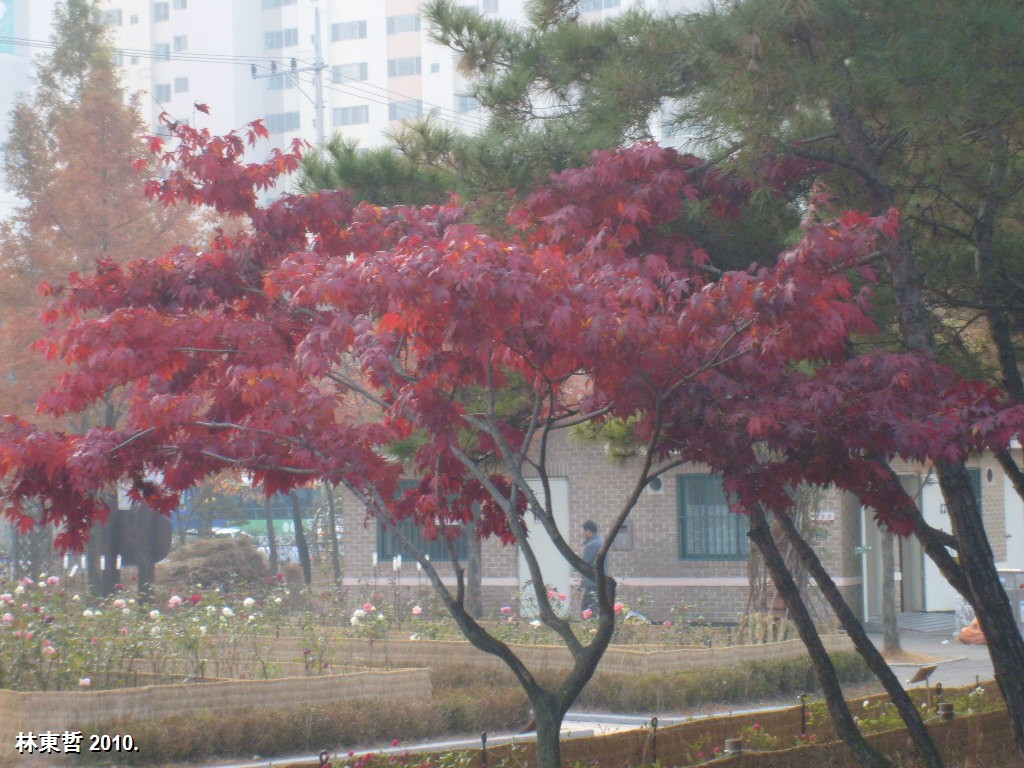
another blaze

rose, high rise and mountain

in the background is the boys' high school where the suneung was about to start

rose and high rise
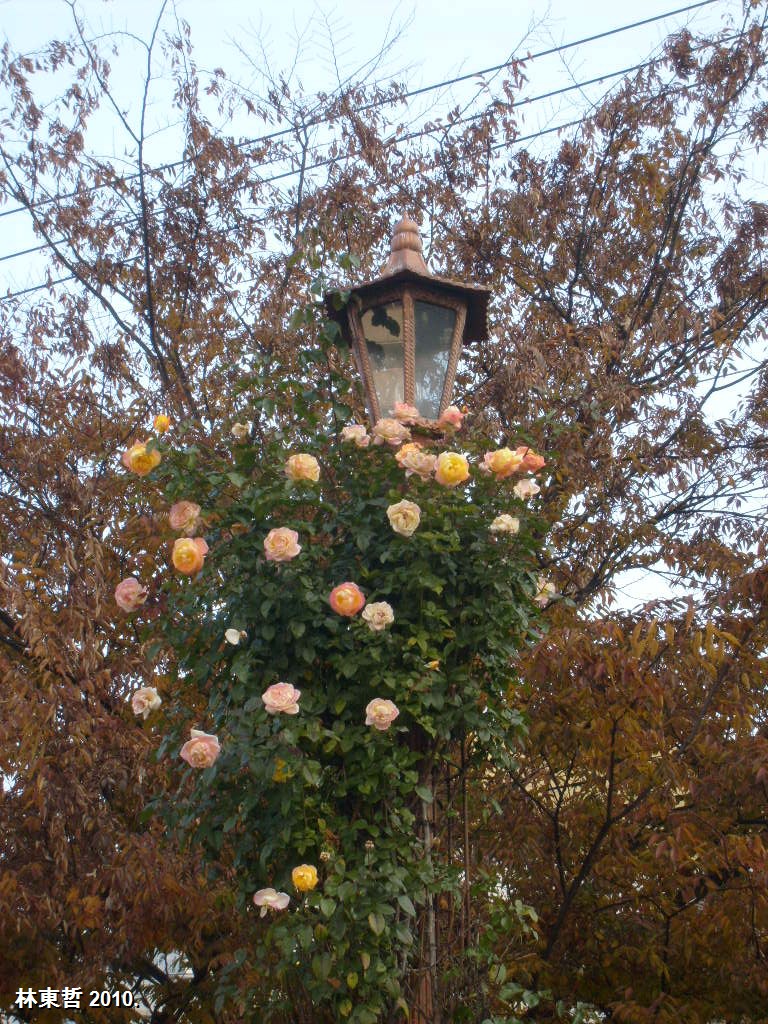
and then home

© 林東哲 2010 Creative Commons Licence.
Comparing the Intensity of the Memi (매미) Song Across Summer
This is just a boring snippet for those interested in insects and in particular, the memi (cicada – 매미). Suprisingly, my posts on the memi have attracted considerable hits so I have put the three video-clips together. Before watching, I’d advise you turn down your volume, especially if you are wearing headphones. The memi song can damage your hearing!
All vodcasts were recorded in the same location at approximately the same time of day.
© 林東哲 2010 Creative Commons Licence.
Monday Market -Oriental Quince (모과) Chaenomeles sinensis

oriental quince bonsai
Another portent that winter is approaching is the appearance of the oriental quince, mo-ghwa (모과). Unlike the quince found in parts of Europe and North Africa where its uses, depending on climate and hence proportions, span from making jams and jelly to a substitute potato, the oriental quince is mostly used in oriental medicine and as tea. However, the mo-ghwa’s predominant use is as an ornamental air freshener. Don’t expect wonders! It won’t clear the smell of fried mackerel or unpleasant toilet odours and neither is one potent enough to scent an entire room but for scenting corners or enclosed spaces, a car being ideal, they are successful. I have one sitting on my desk and it subtly scents that corner of my room.

moghwa (모과)

by the bowl
Moghwa have a very waxy skin in which the scent is contained and they sort of look quite attractive. The scent is similar to that of a fruity apple. The cost varys from about a 1000 won upwards and ideally you should buy one unblemished as these will last well into spring. Supermarkets often sell them in a small basket.
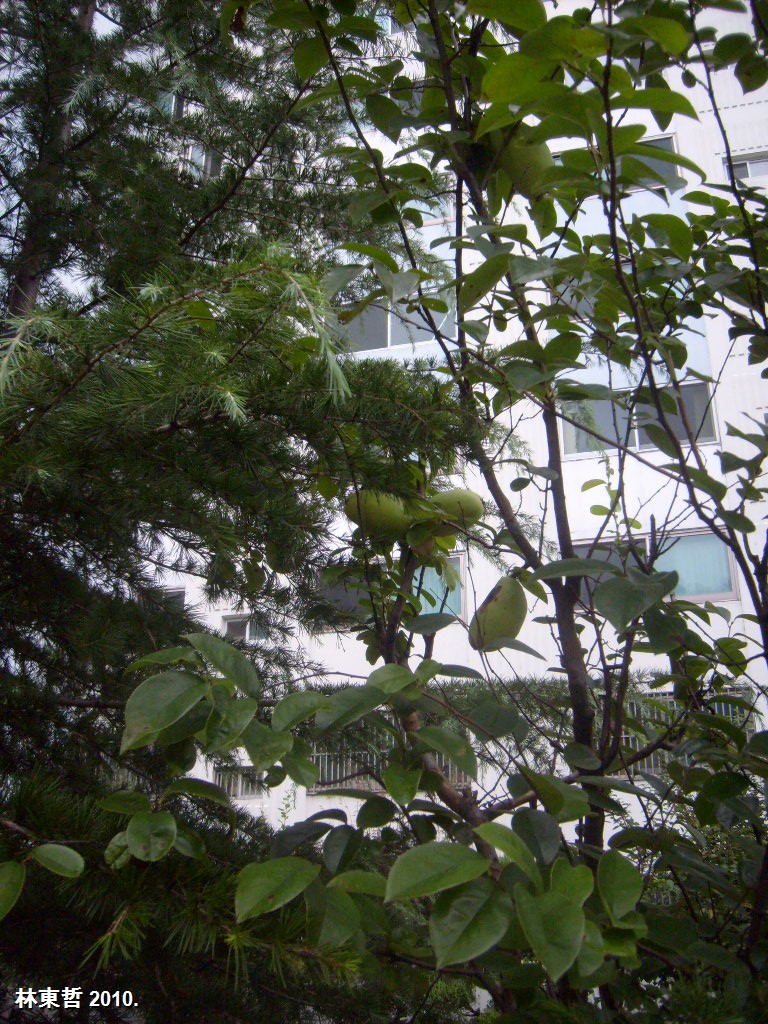
oriental quince tree and fruit
At this time of year one can see many trees bearing fruits, dae-ch’u, unhaeng (ginkgo), persimmon and Asian pears, for example. However, it is illegal to pick fruits from any tree on sidewalks or parks as the trees are not public property.
When buying one, especially from street vendors where they are much cheaper, avoid ones with blemishes or other forms of damage. A good moghwa will last the entire winter and into spring but a badly chosen one can be brown and rotted within a few weeks!
© 林東哲 2010 Creative Commons Licence.
'All Things Bright and Beautiful' – Yeon-Ka-Shi (연가시) Parasitic Worms
Yesterday, as I was teaching, I felt some water fall onto my arm from the ceiling. For a moment I looked at it bewildered, unsure where it had come from and looking up deduced it was condensation falling from the vent of the air-conditioner. One of my students muttered some comment, the class laughing in response. I had no idea what he said but recognised one word; a word that immediately invokes revulsion: ‘yeon-ka-shi!’
If you ask Koreans, especially kids about the yeon-ka-shi (연가시), you are likely to be treated to a catalogue of horror stories. The yeon-ka-shi is a parasitic, ‘horsehair’ worm (nematomorpha) that spends part of its life in water where it finds its way into a host. Though some will tell you otherwise, the hosts are insects and not humans though there have been rare cases of human ‘infection.’ One recorded case involved a young girl who vomited up a dead worm. Her mother then took her to hospital where both her and the worm were examined. Now, how true this is I don’t know but I read the article, in fact a medical report, somewhere online and subsequently lost the link. However, the conclusion was that the girl must have drunk contaminated water, ie from a pond or puddle and the worm, killed by stomach acid was subsequently expelled in vomit – not a surprise as a gutful of puddle water is hardly comforting.
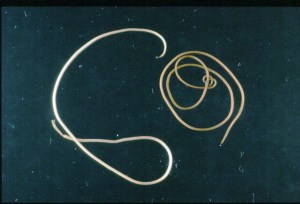
Link to video of worm (photo; Wiki)
I have been treated to numerous gross accounts of the yeon-ka-shi infecting humans, or how it turns insects into zombies which are subsequently driven to suicide. Other stories relate to the worms crawling out of the backside of insects and I have been warned not to stamp on the camel-cricket (곱등이) as this is a frequent host. The truth? Well, it does invade insects and it does crawl out of backsides and out of the abdomens of squashed hosts. There are plenty of gruesome videos recording this example of God’s sickening handiwork.
The size of these parasites in relation to their hosts is alarming. The next video apparently portrays a cricket committing suicide. How observers deduce it is suicide I don’t know. I’d have thought with this massive invasion rummaging around in its body, the cricket was totally out of its mind.
The natural world inspires both awe and horror but given the number and nature of horrific phenomena, it is truly testament to mankind’s stupidity that we should even dream of erecting and idolozing a creator capable of such perverse manifestations. One of a host of creations excluded from that naive polemic, All Things Bright and Beautiful.
© 林東哲 2010 Creative Commons Licence.
Camel Cricket – 곱등이- Rhaphidophoridae
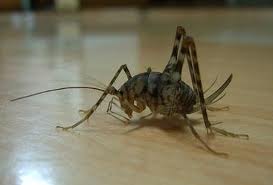
The rather ugly camel-cricket (곱등이)
Okay! Here’s a really ugly insect you might see seeking sanctuary as the weather gets colder. The camel cricket (곱등이) is a rather prehistoric looking insect related to the New Zealand weta. They are often found in caves and dark damp places and in some cases never see daylight but also reside in forests and buildings, especially basements. They are nocturnal and unlike other crickets (뀌뚜라미), do not chirp. They are characterised by long legs and antennae. Cave dwelling species, living in continual darkness have been known to eat their own limbs if food is scarce. Apart from their ugliness, they are harmless though their defence mechanism is to jump towards a threat rather than away from it.
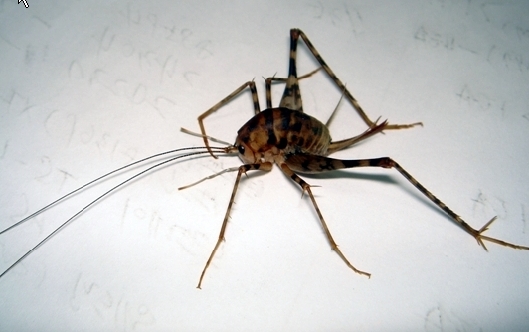
Probably one of the last insects you will see before winter
The Korean camel-cricket has a somewhat bad reputation as it is associated with the parasitic worm Koreans call the yeon-ka-shi (연가시).
© 林東哲 2010 Creative Commons Licence.
The Rose of Sharon – 무궁화 – National Flower of Korea
Despite the ‘Rose of Sharon’s,‘ grand, popular names, ‘the immortal flower’ and ‘everlasting flower,’ I always have a slight loathing when I see one, which is everyday as one grows right outside my one-room. My loathing is totally unfounded.
Korea’s national flower, ‘the Rose of Sharon‘ (Hibiscus syriacus), comes from a deciduous shrub the flower of which bears a striking resemblance to that of the tree mallow ( Lavatera arborea or Malva dendromorpha) which is native to much of Europe.

flower of the tree mallow

National flower of Korea (무궁화) 'Rose of Sharon.' This was actually the first flower of the year on this plant (July 5th 2010).
Both plants are shrubs and have soft pink flowers of the same size set in a five petal arrangement. The five petals are significant in terms of the ‘Rose of Sharon’ as they symbolise Korea and appear in numerous official and unofficial emblems.

the five petals of the Rose of Sharon

an important symbol
The Korean name for the flower, mu-gung-hwa (무궁화), combines two words, ‘mu-gung’ (무궁) meaning ‘immortal’ or ‘everlasting,’ and ‘hwa’ (화) meaning ‘flower.’ It really is the case that the flower is long lasting and the same flowers will bloom all summer and into autumn, closing every evening and bursting back into flower as the sun rises. The ‘Rose of Sharon,’ associates the plant with Syria, where it supposedly originated but personally, I prefer the Korean name as it reminds one of the tenacity which is reflected in so many aspects of Korean culture and landcape. ‘Tenacity,’ is both one of the tenets of ITF (International Taekwon-do Federation) and WTF (World Taekwondo Federation) taekwondo, and a theme in my post on the wood carvings I photographed in Pal-gong-san National Park, Daegu. Historically, The flower was first cited in Korean text around 1400 years ago and hence has a long standing historical tradition making it ideal for its reference in the Korean National Anthem.

flower variations
I watched the mu-gung-hwa outside my one-room all year, from the appearance of the first buds until mid-August, when some blight shriveled the leaves and killed the flowers. Given its association with ‘immortality,’ this was a disappointment serving to remind me of the realities of life.

My one-room mugunghwa in May
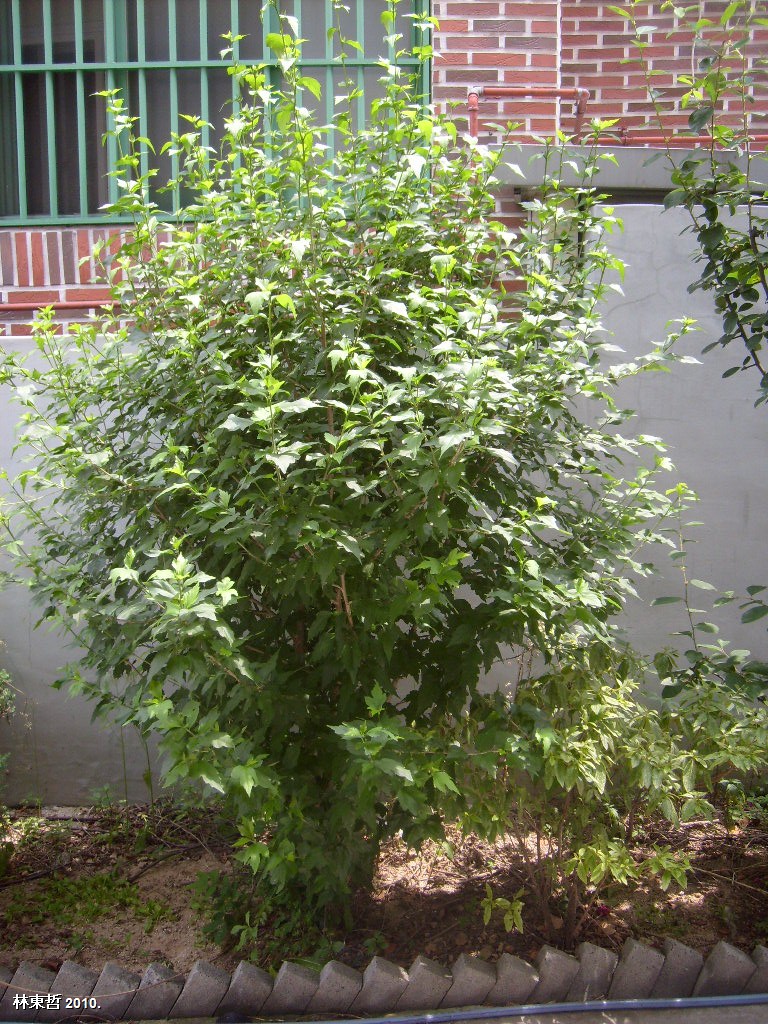
June 15th

July 5th and the first blooms
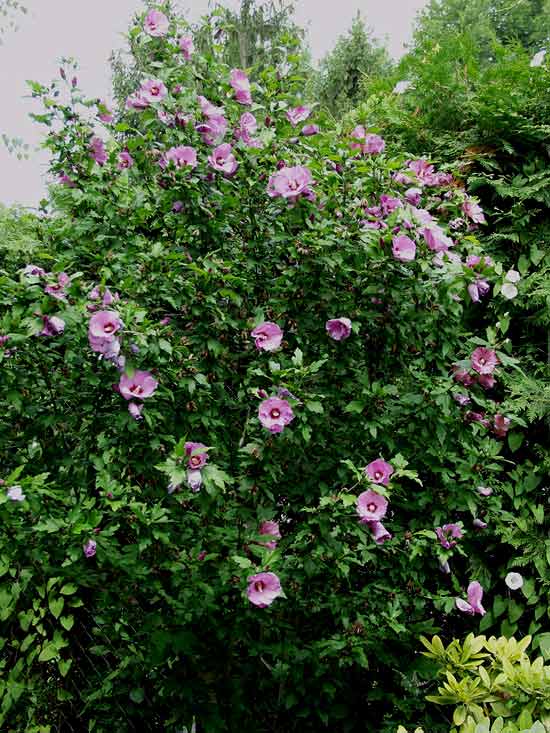
in full bloom
And why do I have an irrational loathing for the mu-gung-hwa? Because it so closely resembles the tree mallow which is a prolific shrub especially in coastal regions of Southern England. Several years ago, a friend gave me a small cutting which I planted in my front garden and within three years it had grown into a large shrub, blocking the light in my front window and necessitating constant pruning. No matter how vigorously you prune it to the ground, it springs back in mockery and within weeks needs to be re-attacked.
Footnote
The mugunghwa-ho (무궁화호), is the cheapest type of Korean train service and is often the only service on some lines.
© 林東哲 2010 Creative Commons Licence.
Monday Market – Peaches 복숭아
Like the persimmon, which is just starting to appear, peaches have different names for different types: some are hard, some medium and the most prized, very soft, is white.
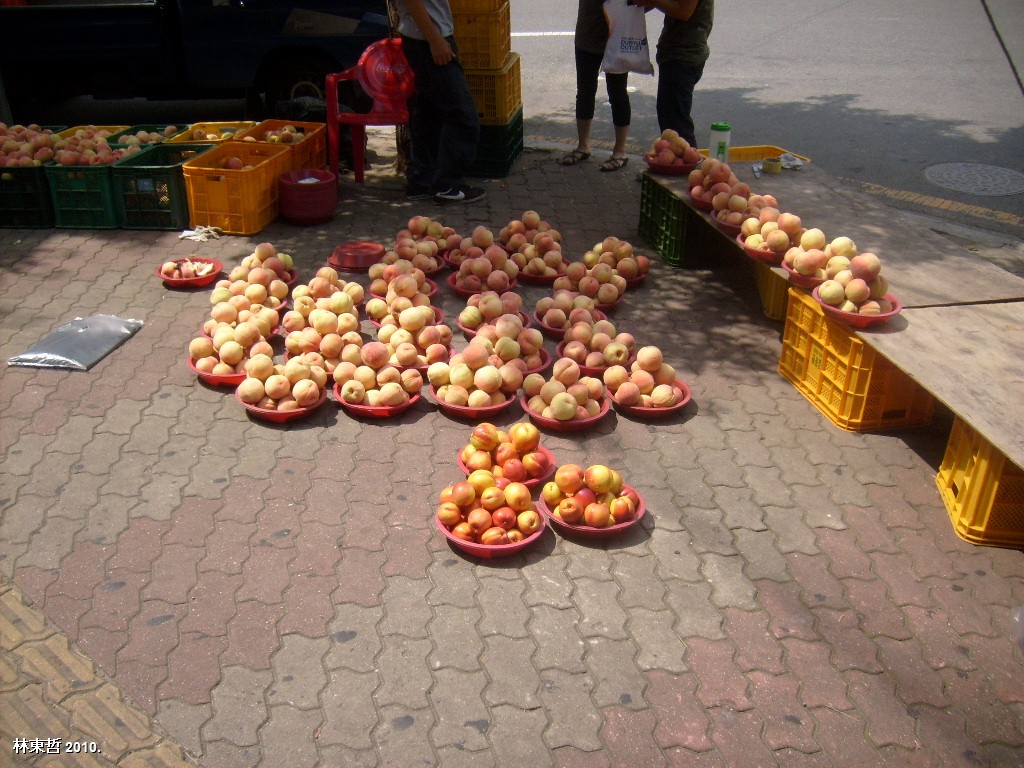
Peaches towards the end of the season
© 林東哲 2010 Creative Commons Licence.
Cricket Song (귀뚜라미)
I captured the sound of a lonesome cricket (귀뚜라미) on a recent trip up the mountain.
© 林東哲 2010 Creative Commons Licence.
Sorcerer Spider Webs (무당거미)
There were from my last mountain trip at the end of September. The ‘sorcerer or ‘shaman’ spider (무당거미) webs all measured around 1.5 meters in diameter. (These spiders have a number of other names)
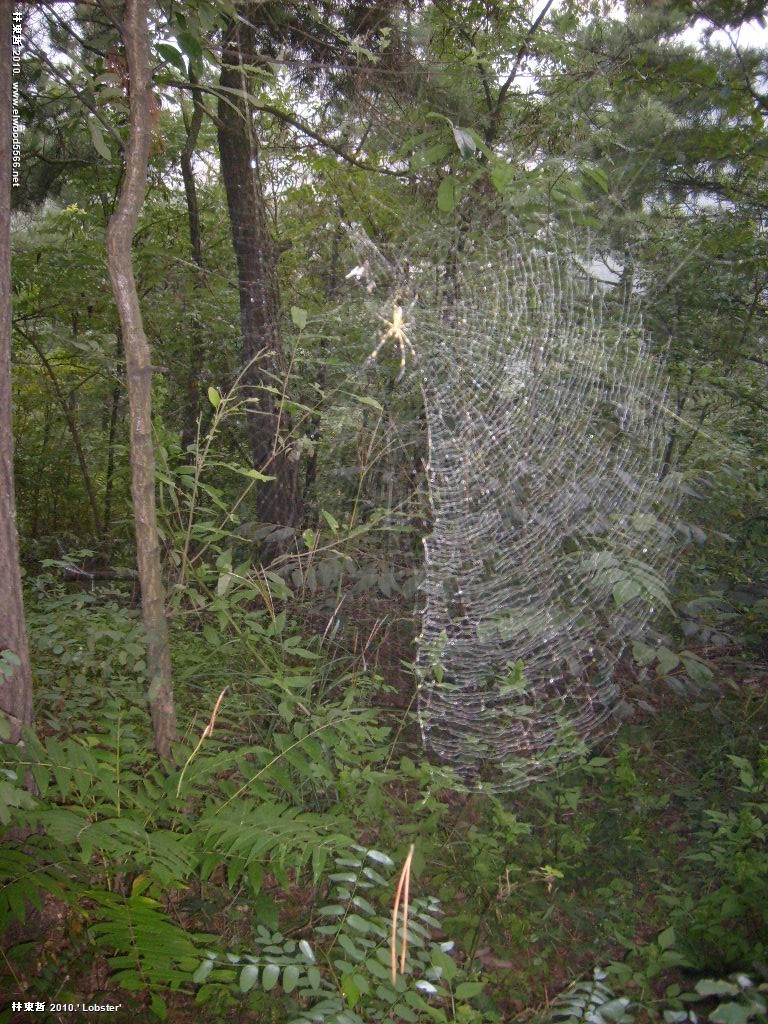
male sorcerer spider (무당거미)
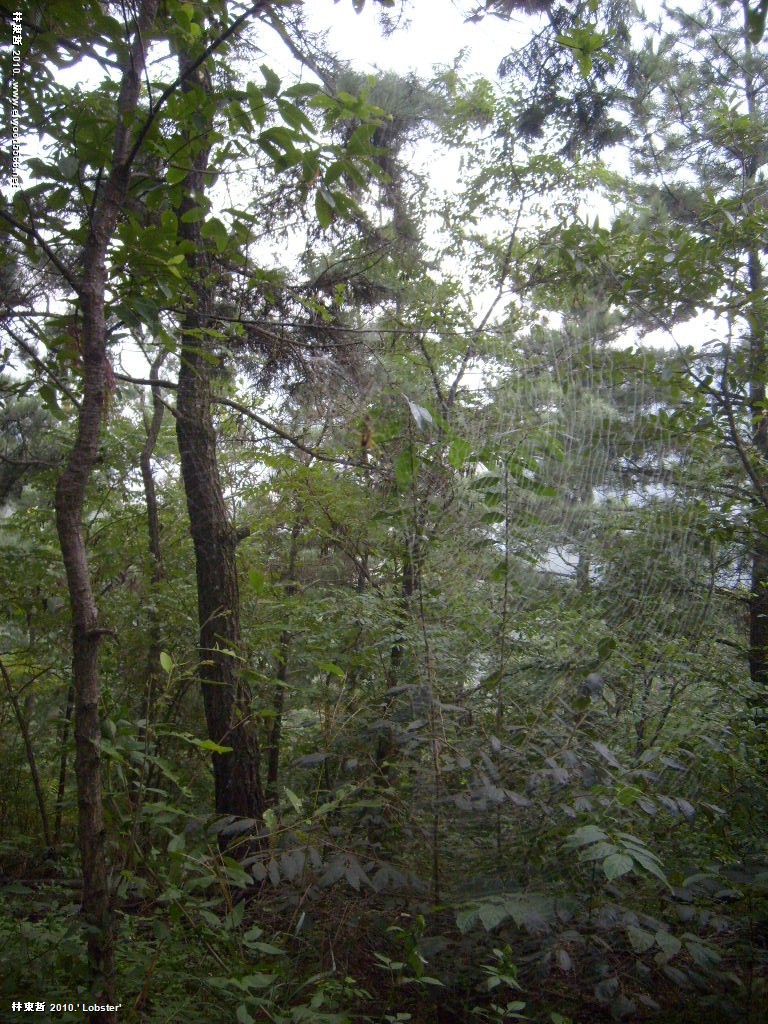
the sorcerer spider has one of the strongest and largest known webs
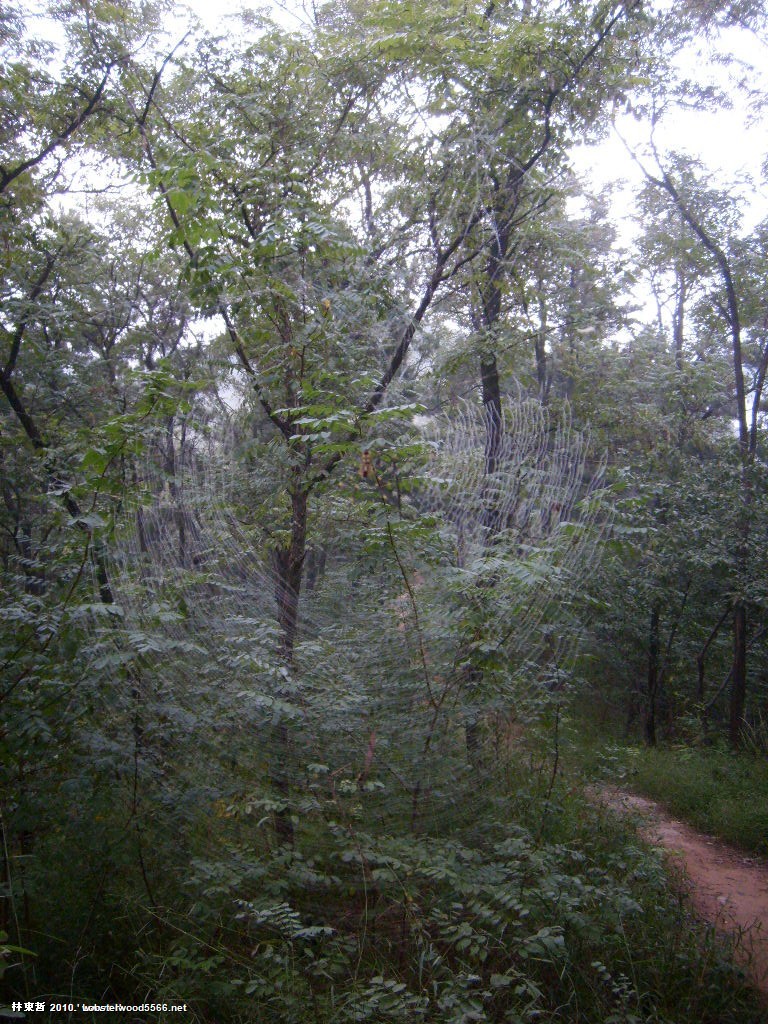
Often the web has a greeny-yellow tinge
© 林東哲 2010 Creative Commons Licence.
Spotted Darter Dragonflies (고추잠자리)
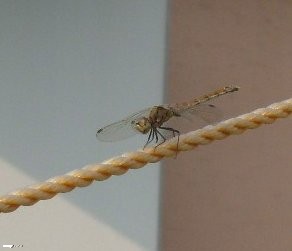
Female 'chili dragonfly' lazing in the sun
October sees the second flush of dragonflies, the first being around mid-summer. The specie dominating this flush is the ‘Spotted Darter,’ (definetly –Sympetrum and possibly – Depressiusculum). In Korean these are known as ‘chili dragonflies’ (고추잠자리) as the males are bright red. Unfortunately, my one-room roof seemed only to attract females.
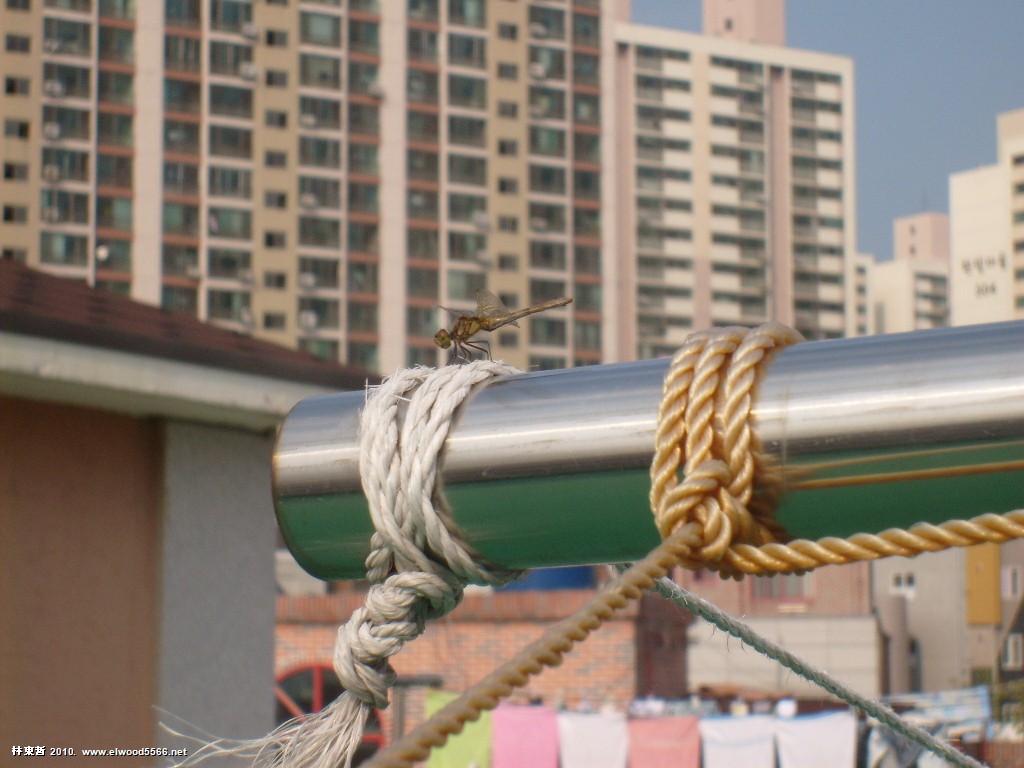
a temporary rest
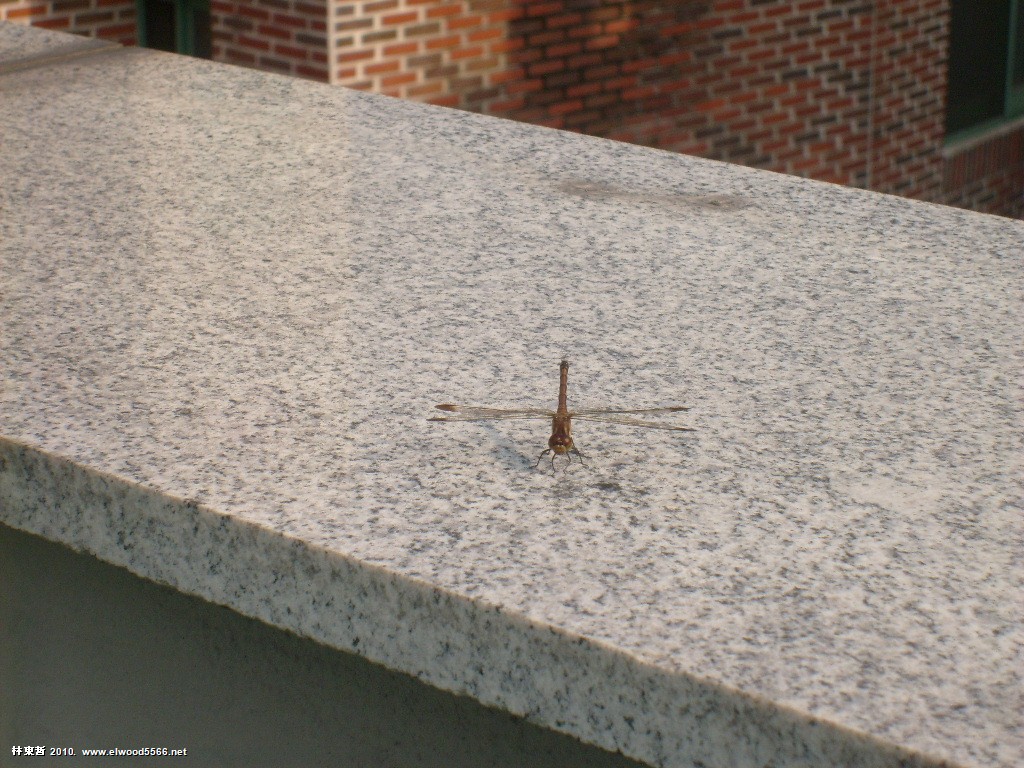
the male is bright red in colour
© Nick Elwood 2010 Creative Commons Licence.


 Elwood 5566
leave a comment