Curds (묵) – Monday Market

Stunted by the rocky soil, you will rarely see an Oak as magnificent as those found in England
A few years ago a former boss took me to lunch at restaurant, the usual formality for talking shop and often a sign that your schedule is about to change or that you’re going to be asked to do something not in your contract. Other than it was ‘Klingon’ in style, I can’t remember what we ate. My first encounter with any form of Korean food was in 1997 when I visited several restaurants in both Hong-Kong and Manilla and I can’t remember too much about those experiences either other than there being many side dishes, one of which was some strange, but inoffensive jelly-like food served in slices.

Acorn curd - 도토리묵
Enjoying many Korean foods are dependent on an acquired ‘taste.’ Kimchi, for example, both stinks and tastes pretty gross to most people first time, but with continued exposure one begins to realise the subtle variations between different kimchis. Eventually you begin to develop a preference for one particular form of kimchi. In one sense the multi-faceted aspects of kimchi, the combinations of heat (chilli), saltiness, sourness, tartness, sweetness, the viscosity of the sauce, the fracturability of the cabbage, the blend and persistence of fish sauce, garlic and ginger, the aroma, and these are only some of the features, make its enjoyment every bit as sophisticated as that of wine.

Supermarket curds - more expensive and watery than the market varieties.
While kimchi has taste there are a number of Korean foods which are tasteless and which on first exposure prompt the question, ‘why?’ Most first timers to Korean cuisine, for example, will find those watery soups ornamented with a few strands of bean sprout, totally pointless until you realise the way intermittent spoonfuls cleanse the palate and transform the texture of rice in the mouth. A few Korean foods initially have no taste at all but if persevered with, an appeal begins to develop. Other foods, such as cold noodles (냉면) require exposure to the energy draining Korean summers to initiate an appeal much in the same way Pimms No 1 does in the UK. I can no more enjoy a Pimms No 1 in winter than I can cold noodles. And then there are those seemingly pointless curds or jellies.
In the restaurant with my boss, and amidst some of the Klingon delicacies, was a plate of what looked like the jelly thing I’d last eaten in a Korean restaurant in Hong-Kong. Sliced into slippy cubes, I remembered the dexterous chopstick skills required to pick it up; too much pressure on the cube and it is cut in two and too little and it flops onto the floor or cascades down your shirt. My boss was quite impressed, in fact he was very impressed, but not with my chopstick skills, more with the fact that I’d just eaten a slice of raw liver! That too was tasteless but there is a limit to how far I want to go initializing new appreciations and raw offal is not really one of them.

Acorn curd (도토리묵) in the market
Curds or jellies appear in various guises and while they are fairly tasteless, their appeal lies in their texture which in the context of a Korean meal with numerous side dishes, can be ‘interesting.’ The most common curd is probably acorn (도토리묵) and it is often accompanied with a tangy soy based sauce. (도토리묵 무침). Personally, I find the market produced curd both cheaper and tastier looking than the somewhat more watery-looking packeted varieties produced by supermarkets. On more than one occasion I have muddled my Korean words and asked for ‘eagle curd’ (독수리묵).

Buckwheat curd mu-ch'im (메밀묵 무침)
Other curds include:
Buckwheat (메밀묵) which is often slightly heavier in texture

Supermarket seaweed curd (미역묵)
Black rice
Mung Bean (녹두묵)

Yellow Mung Bean (노랑묵 or 황보묵) this version, coloured with gardenia, is traditionally associated with the Cheolla province.
Curds are fairly easy to make and powders can be bought in most supermarkets.

Acorn powder
Acorn curd in particular is seen as a very healthy food and is believed to be beneficial in weight loss. Not a great surprise really as I doubt anyone would want to eat it alone and it’s hardly a food to pig out on! It probably has the same diet potential and calorific content as water! The Korean company Skinfood market an acorn face pack. If you are keen to start investigating the secret power of acorn, here is a jumping off point….

© Nick Elwood 2010 Creative Commons Licence.
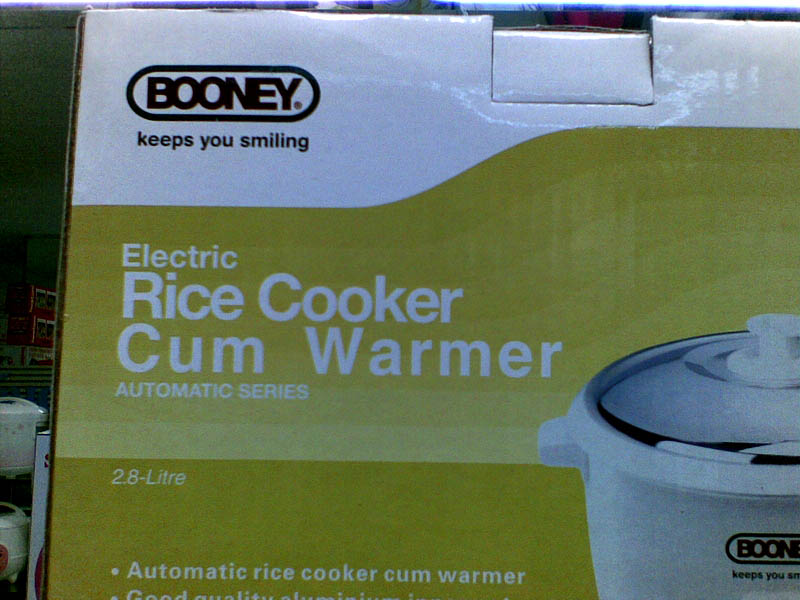
and besides cooking rice…
Don't forget to wash it out after!
© Nick Elwood 2010 Creative Commons Licence.
When the Cuckoo Dies

Cute Cuckoo
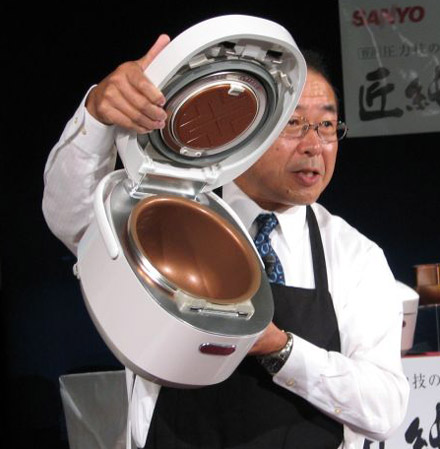
Sitting in my kitchen is a cuckoo rice cooker; it’s pink, not my first choice of colour but at the time of purchase there were only 2 smaller rice cookers both identical, both pink. It sits on a shelf either on duty or turned off but generally it is turned on for months at a time only being ‘stood down’ while I refill it. I suppose it’s one of my most fundamental and important cooking implements, certainly more useful than a microwave even in the absence of an oven, and yet I treat it with little regard. Occasionally it will get a clean, inside and out though last time I opened the lid in anticipation of a clean, I forgot about it and a few days later discovered it was still operating.
My refrigerator, air conditioner and washing machine all warrant the luxury of some consideration because they are problematic to replace and any breakdown would cause a major inconvenience. In an attempt to prolong their lives I regularly adjust the fridge temperature, so as not to over work it, or I will use the fan instead of the air conditioner and then washing machine I will occasionally treat to lime dissolving powder. However, I am aware that all are prone to failure and steel myself for that moment. The poor little cuckoo, as cute as it is, doesn’t even get a look in! I wouldn’t dream of boiling rice in a pan to prolong its life and when it dies it will be chucked in the bin without sadness or ceremony and a replacement, another cuckoo, will be in situ within a few hours of terminal failure.
A lot of teachers in Korea probably feel like cuckoos. I arrived for my first spell in Korea in late August 2000 and looking back over my diary I had deduced an attitude towards foreigners, and especially English teachers, within my first day. I arrived at Kimpo International Airport in the late evening, believing I was going to Ilsan to teach middle to high school age students, a condition agreed upon before I accepted a post. The next day, I was dragged to five different schools in what was clearly an attempt to sell the Letterland system and I was the cuckoo being used to promote it. Even in the car being driven between schools, neither of my hosts saw fit to give me any commentary as I gawked in awe at a culture far removed from my own. And when I asked when I was going to be taken to my school, or what it was like, or where it was, their English suddenly seemed to evaporate. Not much after 10 am and the jet lag began to kick in and in one school I feel asleep in the bosses office. Despite knowing nothing about the Letterland system, a book was thrust into my hand in several schools and I was asked to talk to ‘teach’ the kids. In the evening I was taken back to Kimpo Airport and while I sat intermittently sleeping my hosts were busy on their mobile phones. After an hour of nothing they burst into life and hurried me to a ticket booth and before I knew it I was boarding a plane for Daegu and a post that involved teaching elementary school and kindergarten.
Introducing the new English teacher.
I can imagine the discussions prior to my arrival: ‘If you collect the new cuckoo at Kimpo you can borrow it for the day. Take it around some prospective clients and turn it on, get it to do some work, show it off! Just being a western cuckoo will impress them! Then, in the evening, when you are finished, pack it onto the last plane bound for Daegu and we can have it collected from the airport.’
On my third stint in Korea, teaching in Ch’eonan, I arrived on a Sunday evening, in early September. My new boss collected me at the airport and then took me to my one room. I had to spend my first night sleeping in unwashed bedding with the previous teacher’s dribble stained pillow. It was like sleeping with a stranger; I could smell the guy all night and without a doubt his bedding hadn’t been washed for months. It was horribly humid and no one had thought to put a bottle of water in the fridge, or some toilet paper in the bathroom. When I asked if the school could arrange for me to have internet access, I was simply told it wasn’t possible. The school also took the liberty of billeting me alongside 36 boxes which belonged to the outgoing teacher who was planning to return to Korea at sometime in the future. The boxes took up a third of my floor space and transformed what could have been a fairly pleasant, if not small one room complex, into a warehouse. After a few months they were a daily reminder of my cuckoo status and on more than one occasion I launched a barrage of kicks against them or stabbed them in a crazed carving knife attack. Eventually, I tore a few open and tossed the contents about my room, then claimed I’d been burgled. The next day the school provided a small truck to move the boxes into the school. But guess who supplied the labour?
Just like the cuckoo rice cooker, the cuckoo teacher should have no special needs or requirements. once un-boxed the cuckoo should be ready to function until failure when it can be chucked out and replaced.
Just like you never bother to tell your cuckoo what your plans are or give it some notice prior to activation, many Korean bosses spring things on you at the last moment – often through the school secretary. One boss would occasionally drag me to other towns, always under the pretense of sightseeing and we’d suddenly pull into a school. After meeting the principal and being given a brief tour and lunch, it would then be ‘sprung’ on me that I had to teach for an hour. In the UK we call this kind of teaching ‘door knob teaching’ as generally you have no idea what your supposed to be doing until you enter the classroom.
In the Ch’eonan high school, foreign teachers would arrive at school to find it was a day off or all the staff except you would be in casual clothes because it was a sports day. The status of rice cooker is no more obvious than when you are ill – the equivalent of your cuckoo being broken and of course, carting it to the nearest service center is beyond the question. When I had a particularly nasty flu and had to stay in bed three days, my first boss didn’t even bother to call in and see me and on the third day sent the landlord to summon me. When I returned to school he pointed to the classrooms and simply shouted, ‘do your duty!’ I called him a ‘fucking wanker!’ and promptly resigned. Rice cookers aren’t supposed to talk back! An accident, long illness or some similar calamity and you realise very quickly how disposable you are.
On occasion I’ve been quite proud of my cuckoo, partially because its cute but also because it has a novelty value as they are fairly rare back home. And likewise, there are times when bosses will wheel out foreign teachers to show off. When my high school had a contingent of teachers visiting from the USA, for negotiations concerning a potential partnership, we were summoned to the principal’s office, a space approximately twice the size of a classroom, and were prompted to chat and be friendly while the press took photos. Another boss hated any foreign teacher speaking or learning Korean, except when potential parents were visiting when he’d giggle and ask you to introduce yourself in Korean. I was never quite sure whether he did this to impress parents or provide them a little humour.
Unlike my cuckoo, which firmly belongs to me, teachers are almost seen as public utilities. Every English-speaking waygukin will have experienced those fleeting interactions with passers-by who will use you to speak English or nudge their kids forward for a free lesson. Whereas I am the only person accessing my cuckoo, every Korean sees it as legitimate to finger my buttons. Even when we are ‘stood down’ we frequently get turned back on.
A few years ago I bought a rice cooker in the UK, it’s crap as it cooks rice and then automatically turns itself off as it has no ‘warm’ mode and hence, can’t be so easily abused. As much as I love Korea and enjoy teaching, I often wish I were similarly designed.
© Nick Elwood 2010 Creative Commons Licence.
Monday Market Ban Ch'an (반찬)
Basically, ban ch’an (반찬) is the collective term for the extensive number of side dishes which can accompany a Korean meal. This most noted of these being kimchi (김치) but of course, there are many different types of kimchi. I used to buy my ban ch’an in E-Marte but have discovered it is much cheaper to buy in street markets, or even cheaper if you make it yourself.

A small selection of what is available
Fat is Here
A Bathhouse Ballad
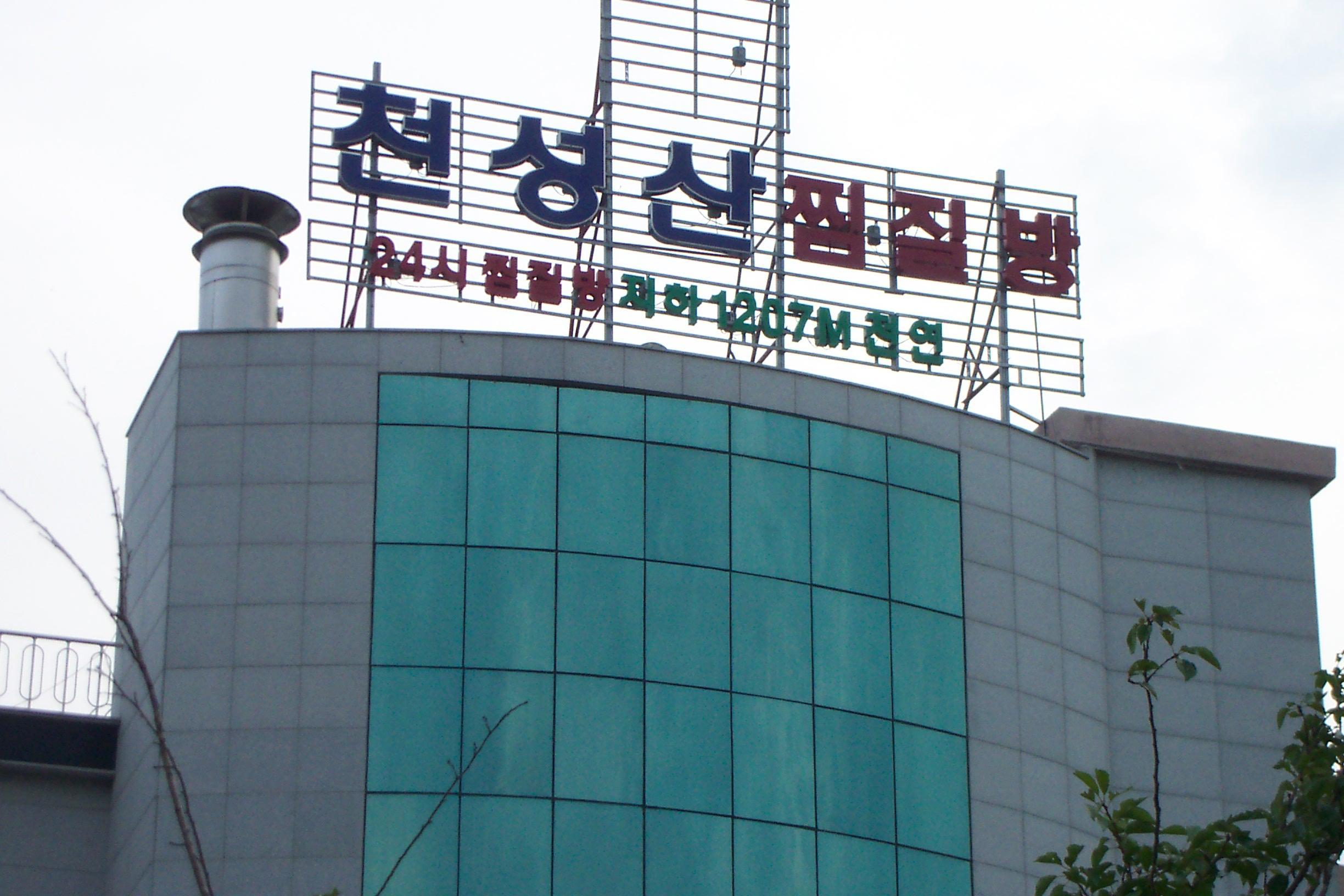
In the ebente-tang, the aroma of the day is lavender (라벤더). I’m wallowing while I see some guy stood in the cold pool snot-up into his hand and casually just wash it off – into the pool water. Filthy twat! I occasionally take in a mouthful of that water, I guess most people do and, I open my eyes underwater! Pissing in the baths is one thing, at least you are unaware of people doing it, but if you’re going to snot up, be discrete! The snotting incident made me wonder if the water is filtered. It is certainly changed on a regular basis and probably filtered. Neither is it chlorinated but as most people shower before entering the baths this doesn’t bother me. I can remember seeing a few turds in British swimming pools but despite the chlorinated water, I wasn’t going to swim anywhere near them! Often I notice children, usually unaccompanied, get straight into a bath without showering. Last Thursday, which was the eve of Buddha’s birthday, and a public holiday, there were about 10 teenagers running around. Usually, adults get irritated by raucous behaviour but the atmosphere was jovial and I noticed several men lounging in surrounding pools watching them and smiling. There was a definite holiday spirit; they held the door shut to the ice room door trapping friends inside and threw bowls of freezing cold water at each other. For almost an hour the bathhouse, the noisiest I have ever heard it, despite it not being very busy, resonated with their laughter. Then a fat guy walked in and I started thinking…
At one time, when there were few other wayguks around, I used to be the fattest man in Song-So and one of my companions, a woman from Australia, was probably the fattest woman. Though she was excellent company, I hated walking around with her. A fat person, especially one who is 1.95 cm tall, attracts attention but two fat people together, well, the assumption is they are a couple and that all western wayguks are fat. Two fat wayguks together loose their identity in the conflation that reduces them to, ‘they’ and ‘fat.’ If you’re sweating, unable to buy clothes that fit, if you’re seen eating, if you don’t like walking up four floors to your place of work, well, it’s all because you’re fat! And eating an ice-cream in public! No wonder you’re fat! I happen to take size 14 (UK) shoes. You can’t buy them in Korea, apart from perhaps in Seoul. And the reason my feet are so big, despite being the leanest parts of my body? I’m fat, of course! When Koreans see a fatty or a fatty couple, this is how they probably think, and I assume this, as in the west, it is how we think. Even if I see a fat person eating an ice cream on a hot summer’s day, even if I am eating one myself, my immediate thought is, ‘go on a diet, fat arse!’ Two fat people with backsides like hippopotami, holding hands on the beach front promenade, and wobbling like jelly… ‘gross! The contradictory nature of my thought, doesn’t even sully the flavour of my ice-cream.
Maybe I’m paranoid, but when my fat female friend and I took a taxi, along with two petit Koreans, and her and I ended up sitting on the same side of the cab, it was clear what caused the problem, and it wasn’t paranoia! The window on our side of the taxi looked directly onto the tarmac while the opposite window framed the full moon. After a hundred meters and a few grating sounds from some part of the vehicle now in contact with the road, the taxi driver evicted us.
In 2000, and probably until fairly recently, I was the fattest person I ever saw in a bathhouse. Even proportionately, no Korean ever came close to my dimensions. This isn’t because I have the girth of Jabba the Hutte, but because Koreans were, and to some extent still are, smaller than westerners. My diary pages from that period provide several references to there being a distinct lack of fat people. In the school at which I taught there was one fat boy, I even remember his name, Jack; a photo of him hangs in my bedroom bathroom, back in the UK. In my taekwondo school was another chubby. Neither boys were particularly fat and today, just ten years later, would be classified as fairly normal.
I need no helpers for this size portion!
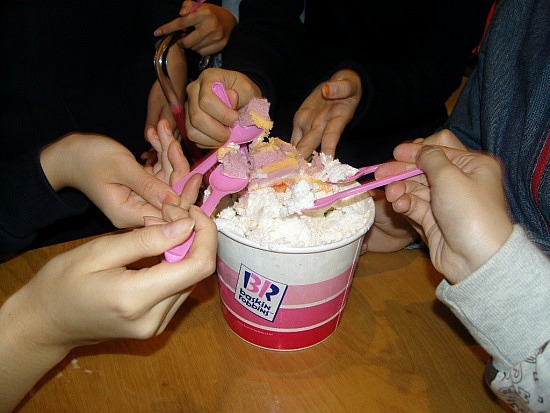
In the last few months, I have noticed that on almost every visit to a bathhouse there are one or two Koreans proportionately the same size and sometimes fatter than I. Very often, other fatties are kiddies. Burger bars, fried chicken, Baskin Robbins, Dunkin Donut and plenty of other western style fast food outlets have proliferated, and the price Korea is paying, especially their youth, is the bulging waistline. Ten years ago I went into a Baskin Robbins in downtown Daegu. I was with a Korean friend and her daughter and when I arrived at their table with a tray containing three, what I considered ‘normal’ size ice creams, they starred in amazement. One tub, they told me, would have been enough for all three of us but to me, they were the sort of size you would buy yourself back home. In the ten years interim, I now have two Baskin Robbins within a 7 minutes walk of my home and occasionally I will treat myself to an 11.000Won (£5.50), pot of ice cream. I think it holds about 5 scoops. I can easily eat this and could also finish off one of their larger buckets. Even if I buy the smaller pot, smaller than a Macdonald milkshake cup, staff will ask how many spoons I want. Shame prevents me from replying’ ‘one’ so, pondering in thought for a moment, as if counting the number of people back home waiting for me to deliver, I reply, ‘four.’
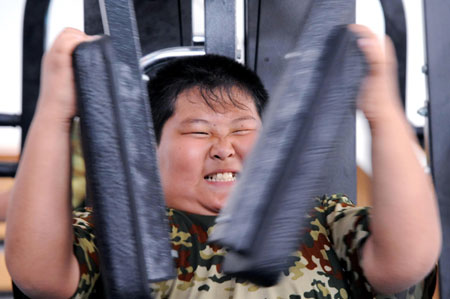
Along with the western fast food diet, fat has finally arrived in Korea
Korean proportions are always piddly and I’m not really into the act of sharing my food, especially ice cream. I don’t think I’ve ever eaten a Korean meal, even at a buffet restaurant, and left feeling properly stuffed, stuffed western style where you can’t breathe properly and feel you’ve mutated into an enormous maggot. In the west, there are countless times I’ve gone for a meal and reached the point where Mr Creosote, in Monty Python’s, The Meaning of Life, cannot eat another chocolate wafer. But in the midst of a Korean public, usually much skinnier than I, being a fatty fills me with guilt and curbs my glutenous instincts. The fatties I now see around me at the bathhouse, and who attract more attention than I because, they are Korean and fat, which is novel, and not wayguk western and fat, which is common, certainly know what it feels to be ‘stuffed’ and all I am left pondering, as I wallow in my scented bath, feeling more like a warthog than large bottomed hippopotamus, is how do you pig out on Korean food? Fat has finally arrived and the blubberier it becomes, the slimmer I feel.
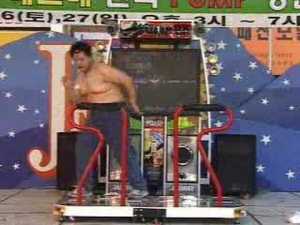
Link to Crazy Fat Korean Video
Sushi (회) and Sashimi (초밥) The briefest introduction
Many westerners conflate sushi and sashimi but the preparation and contents of each are quite different. Without offending Koreans, westerners also use the Japanese words to describe these food styles.
sashimi (회) – is uncooked and always fish and it is eaten with various leaves and sauces, the most common of which is wasabi (와사비), a stark hot, horseradish sauce. Fish, often in quite large amounts, is placed in a leaf after being dipped in a sauce and garnished, for example with sliced, raw garlic. The leaf is then formed into a ball and eaten. Basically, anything that lives in the sea can appear on a plate of sashimi (회).
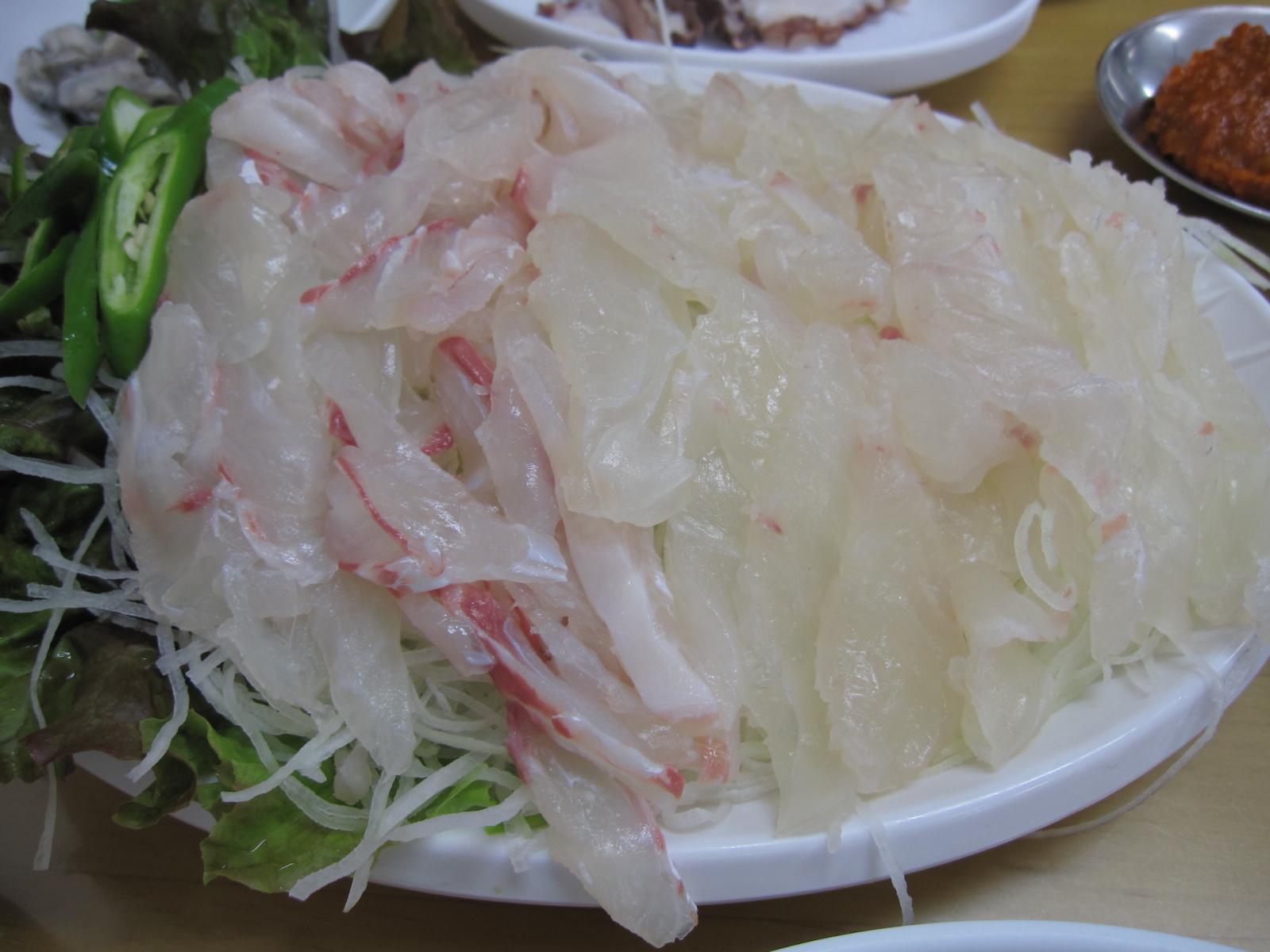
sashimi always fish - always raw (회)
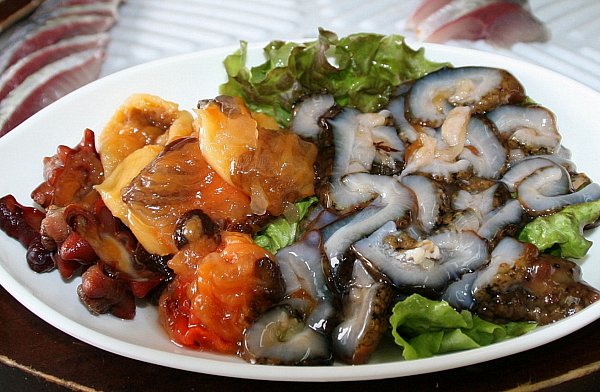
sashimi - more adventurous!
Sushi (초밥) – is vinegared rice formed into bases and topped with fish that is often cooked. Sushi can use non fish toppings such as tofu or lava seaweed.
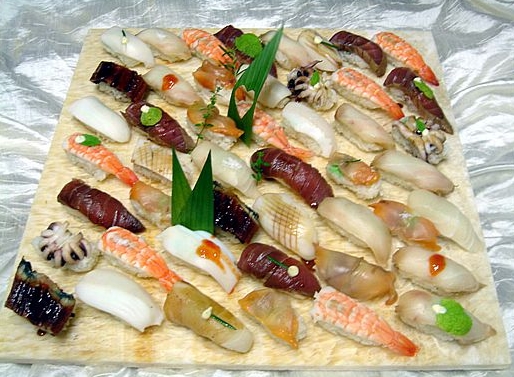
Sushi (초밥) - often cooked and sometimes no fish at all
Bill Bursts Out, May 17th-June 16th, 2001 (Korean Accounts 2000-2001)
Well, it’s now June 16th and I haven’t written a diary entry for just over a month. Everything was going so well and I had just passed when I discovered Bill is an umbilical hernia! I am quite annoyed at my frigging doctor, even though I like him as even with his ultrasound he couldn’t make a proper diagnosis. This was just another medical blunder in my life which serves to reinforce my lack of faith in the profession. I had been telling him for two months that I suspected Bill wasn’t a simple muscle tear. Anyway, I didn’t have any medical insurance. Nana and I had been asking Joe for it ever since I arrived and I have since discovered this is a common ploy amongst bosses of foreign English teachers even though insurance is stipulated in the job adverts. Joe told us we would have to pay six months back money to get the insurance. I am pissed off with Joe as he gambled with my health.
Within three days I was back in the UK where I eventually had the operation done privately at the British Hernia Clinic. The operation cost £1250 and it is outrageous you can only get quick healthcare if you pay for it. Even for this price my treatment was shoddy and indeed I left the Imperial College Hospital, London, where I had the operation, without being given any dressings and only four pain killers. My welcome pack when I entered the hospital clearly said I would get after care and even the phone line number they supplied, claiming it was a 24 hour service, wasn’t! I had to pay for a morning paper and the sandwich I was administered shortly after my operation was bog standard quality and comparable to any supermarket sarny.
In all I spent a month in the UK and stayed at Fiona’s house as the room in my house was being let to Donna. I spent the first few days at Fiona’s in some discomfort as the hernia was stitch repaired as it was right on my belly button. Had it been to the left or right of my navel they would have used a mesh repair on it. Hence the wound feels very tight.
My flight back to Korea was hideous as my seat was so narrow. I had to wedge myself into it and then the seat belt was so tight I could hardly do it up. As always, my thighs pressed so tightly against the inside of the arm rests that I couldn’t operate the remote controls efficiently and the seat kept slipping into a recline position. On several occasions the stewardess asked to return the seat to an upright position. When it came to eating I had to adopt skippy-like mannerisms. Eventually I had to sit on the stairs for a few hours (the plane was a Boeing 747). How ridiculous! After paying £500 for a ticket you are actually more comfortable sitting on the stairs. Of course, children travel half price and babies get on-board for free and this infuriates me. One of the stewardesses made the mistake of telling me I should travel business class! Fucking bitch! I quickly told her that if the airline can fly children free and for half price they should at least provide for taller and, or, fatter passengers. Some kiddies were even flying in business class and had those enormous thrones to sit in.
I arrived in Seoul with a sore back as I had spent several hours sitting in one of the seats normally reserved for crew – a seat that pulled down and was more like a padded bench. I had to feign a bad stomach to get this but it did have a consolation as it had a small curtain you could pull around yourself. At Inch’on I immediately took the transfer bus to Kim’po National Airport. When I first arrived in Korea, Kim’po was the international airport but within a few months of my arrival the ultra modern international airport at Inch’on was opened. Kimp’po, in comparison is a tiny airport and this perhaps reflected Korea’s former insular position in the world. Inch’on is clearly a reflection of Korea’s present status and I have to say it is a massive airport that is very user-friendly. The journey from Inch’on to Kim’po is enjoyable as you cross an enormous expanse of flat marshes with occasional jagged projections of rock. I suspect this area is part of an enormous estuary and I have since read that the land is being reclaimed at the expense its ecological importance as breeding grounds for birds.
The closest hotel to Kim’po National was fully booked so I took a taxi to a nearby hotel called the White Hotel. At first I thought it might be a ‘love hotel’ as there was a selection of pathetic heterosexual porn videos in the lobby. ‘Love hotels’ are a Korean institution and are where businessmen visit for extra-marital sex. They can often be spotted as the car park entrance has a green curtain, consisting of strips of plastic, which helps to conceal the identity of visiting men. The reception was staffed by a rather sexy lad of about 24 who immediately wanted to practice his English on me. We spent over two hours talking and at first I thought he might be gay and had to remind myself I was back in Korea. The hotel cost 35.000W which works out at about £20 a night which was quite cheap given how close I was to Kim’po airport. In the morning, after a good lie in, I took a taxi to the airport. The Kim’po airport departure hall was pervaded by this odd smell which I couldn’t quite identify. At first I thought it was the smell of alcohol, the sort of smell that heavy drinkers exude but suddenly I identified it; it was the smell of garlic. As I hadn’t dosed up on garlic for over a month, the smell was very noticeable. One rarely smells garlic on someone else’s breath if they themselves have eaten it. The whole of Korea is pervaded with this smell as everyone eats garlic, if not raw as a side dish, then in copious amounts within kimchee.
It was just my luck that there was a pilot strike that day and there were no flights out of Seoul. I made a few inquiries and then took a taxi to the central railway station only to discover that the driver was taking me to the central bus terminal. However, the tour of Seoul was interesting as it sprawls on, seemingly endlessly. I saw the Han River and even when into the Itaewon district which is quite famous for the city’s tourists and visitors. Eventually I arrived at the central railway station and bought a ticket to Daegu. My limited Korean, which I seemed to forget quickly in the UK, soon came back to me. I travelled on the Samaul Express in which seats are automatically reserved when you buy your ticket. This procedure is something which still has to arrive in the UK even though there was such a system operating in Germany in 1982. The train was spotless and had regular passenger information in both Korean and English. My journey to Daegu cost £10 which, even if you triple to make the price somewhat equitable with the UK cost of living, works out very much cheaper than in the UK. I had to pay £13 just to travel from Liverpool Street Station to Heathrow but then according to a paper I read a few weeks ago, the UK has one of the most expensive rail networks in Europe. Every ten minutes or so, someone passed selling drinks, ice-cream or food. The trip offered a fantastic oppostunity to see countryside that was new to me. The north-east is much flatter than is Daegu and its environs. I noticed the rice fields have begun to change from drab brown to a vivid green. The weather was more humid than when I left Korea a month ago but this might partly be explained by my being on the coast. Since my return I have noticed how everyone is waiting for the arrival of the monsoon period, which is known as the jang ma (장마) and this is supposed to arrive around Sunday 23rd of June.
When I arrived in Daegu I took a taxi straight to Letter and Sound in Yon San Dong Yon San Dong as I was anxious to see everyone. Lisa has handed in her notice and Pauline is shortly due to go on holiday to New York. Most of my class were subdued at seeing me and next morning Lee Chi-woo refused to sit on my lap. I suppose a month is a long time in a three year old’s frame of reference. However, Jeong-hoon’s face broke into a wide grin when he saw me and he ran up and hugged my legs. It seems nothing much has changed since I left. On Wednesday I started back teaching though I didn’t see Mr Joe until Thursday afternoon. He came into one of my classes and hugged me in front of the class which was a very un-Korean thing to do. However, he is not in the least embarrassed at not having provided me with health insurance. When I asked about getting paid holiday money he began nit picking about a day off I had had at Christmas and then started to dispute whether my holiday entitlement was ten days or two weeks. My contract said two weeks! Considering I had lost all my savings it was quite pathetic of him and even though there is something I like about him I am still going to pour a cup of coffee into the back of one of his computers before I leave.
©Amongst Other Things – 努江虎 – 노강호 2012 Creative Commons Licence.
The Kaya Mountains and Kyeong-Ju. Friday April 6th, 2001 (Korean Accounts 2000-2001)
On Sunday Pak U-chun (박유천) and her husband, U-no (소유노), picked me up and drove me to their apartment. Here I spent several hours giving Ga-in and her cousin, Min-ju (민주), an English lesson. As usual, U-chun had prepared a meal and this time we had bibimbap (비빔밥) which is boiled rice, vegetables and red pepper paste. Afterwards, we drove out to the Dasa (다사) area of Daegu and met Min-ju’s parents in a cafe there.

Me, Ga-in, Min-ju and Yu-no in 2001
The cafe was a traditional building made of mud. Inside, even though the walls were mud, there was electric lighting and even sockets in the wall. The inside was large and there were candles everywhere which had been allowed to drip onto the woodwork to form interesting shapes. Outside was a small stage for live music. We drank beer accompanied by dried snacks, including squid, my favourite and pa’jon. Pa’jon, also known as Korean pancake, is strips of leek fried in a mung bean pancake which is eaten in strips dipped in soy sauce. My favourite drink at the moment is dong dong ju. This is a farmers’ drink and is usually homemade as it ferments in the bottle and cannot easily be marketed. The colour of this drink various from milky white to creamy yellow and I am told it is a drink you either love or hate. Often, ginseng has been added to it. A little while later, U-chun asked if I wanted to go to the sauna, apparently there was one right next to the café and part of their premises. We went outside to the small mud hut adjacent the cafe, and which is known as a hwan toa bang. Inside, a bamboo mats covered the floor on which two children lounged, their faces dripping in sweat. The room was filled with the smell of pine as pine needles and cones were strewn around the outer edge of the bamboo floor. The room itself was heated by a burner that used pine logs. At first the dry heat was intense but before long all of us were strewn out on the floor relaxing. We stayed in the hwan toa bang for some twenty minutes before returning to the cafe. It was an interesting experience and I am told hwan toa bangs are even fired up during the hot summer months.
On Monday lunchtimes I have started going to another go to another mokyuktang, as the one I usually use is closed. In less than a month I have made over 15 trips to mokyuktangs. On this visit one of the attendants asked if I wanted a rub down and I bravely said yes. This was something I was intending to do but at a much later date – why wait. For the rub down you lie naked on a couch and have warm water poured all over you before being rubbed vigorously all over, and I mean all over, by an abrasive cloth. They rub your crotch and up your bum crack. As the attendant progresses from one side of your body to another, you have to adopt certain positions by putting you arm of legs in various positions. The attendant wore boxer shorts which were wet and on quite a few occasions I could feel his dick resting on my arm. The whole procedure is performed publicly and with a conversation in progress.
Life at Di Dim Dol gets more and more boring everyday with exactly the same routine and the same books. I am beginning to wonder if I can really teach here for another five months. I am even considering if I should go back home early.
Thursday was a public holiday, this time for ‘Arbor Day” when it is believed anything planted will flourish. The teachers from Di Dim Dol were all wishing me a ‘happy holiday’ as if I were departing on a two week vacation. I told them it wasn’t a holiday but simply a day off and not even that as they would have to make up for lost time by working on the coming Saturday. Regardless, most of them see it as a holiday. Pak U-chun and her family picked me up from my apartment at ten in the morning and we drove out of the city towards Sang-ju (상주) and the Kaya mountains which lie further north in the province of Kyongsangbookdo (경상복도). Travelling in Korea is interesting as you travel along the highways which are situated in the and between the valleys which are surrounded by farms, rice paddies and enormous cloches. Small yellow melons not much larger than the size of a pear have just appeared on the markets and I recently read that the appearance of these melons is a traditional sign that spring is well under way. Anyway, these melons are one of the main products of the province and were on sale from many small markets stalls on the twisting road that led from the highway to the mountains. Often small lorries, filled with the melons, were parked in lay-bys.
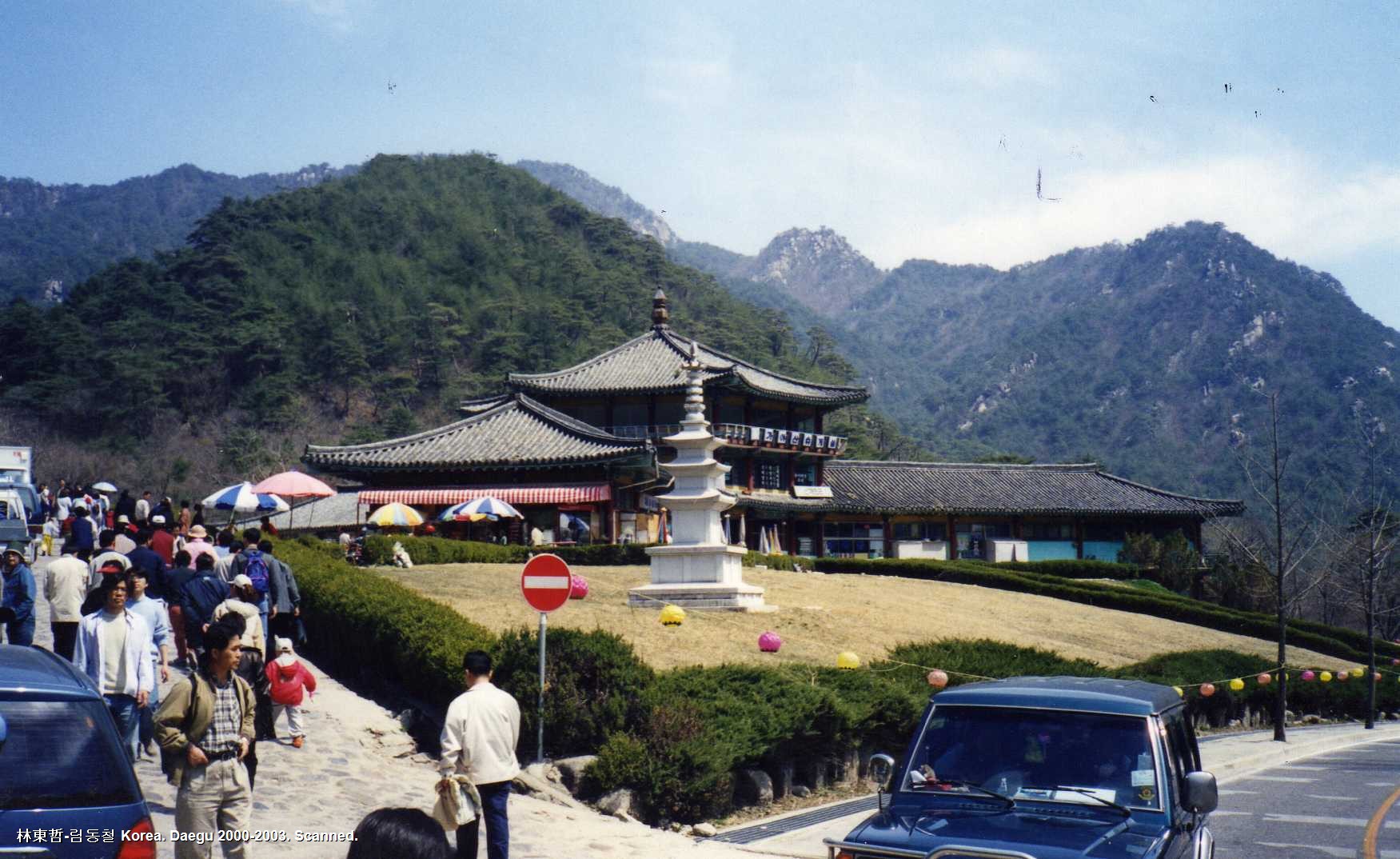
the start of the walk up to Heinsa Temple in the Kaya Mountains (2001)

beside the main temple in Heinsa (2001)
The scenery was absolutely beautiful as the lilacs were almost in full bloom. In Daegu they were already in full flower. Everywhere, cherry blossom (벚꽃) and yellow forsythia (개나리) coloured the hillside. Spring blossom, in Korean, is known as pom namu (봄 나무). Up in the mountainside you could see the various shades of green from emerging foliage speckled here and there by dashes of pink and yellow. One flower, particularly common, was the national flower of South Korea, adopted after the liberation. This flower, Hibiscus Syriacus, known also as the Rose of Sharon and in Korean mugunghwa (무궁화). The atmosphere in the car was wonderful and Ga-in and Min-Ju were excited at the various sights. We climbed the mountain for quite a while, the little car straining when suddenly, out of the right hand side of the vehicle, the peaks of the mountain range appeared. It was a breath taking sight; the jagged peaks of bare rock were highlighted against a bright blue sky. Almost at the top of the range, there was an observation point where we stopped and took some photos. In the small car park were several farmers selling various fruits and vegetables. I took a photograph of some elderly women sat among their produce. One made a fuss of me and said she was too ugly to photograph, but she wasn’t, she was beautiful and she reminded me how lucky people are who still have mothers and grandmothers. I wanted to take a photograph of them sat naturally but instead they sat upright, hands on knees and all looked very serious.
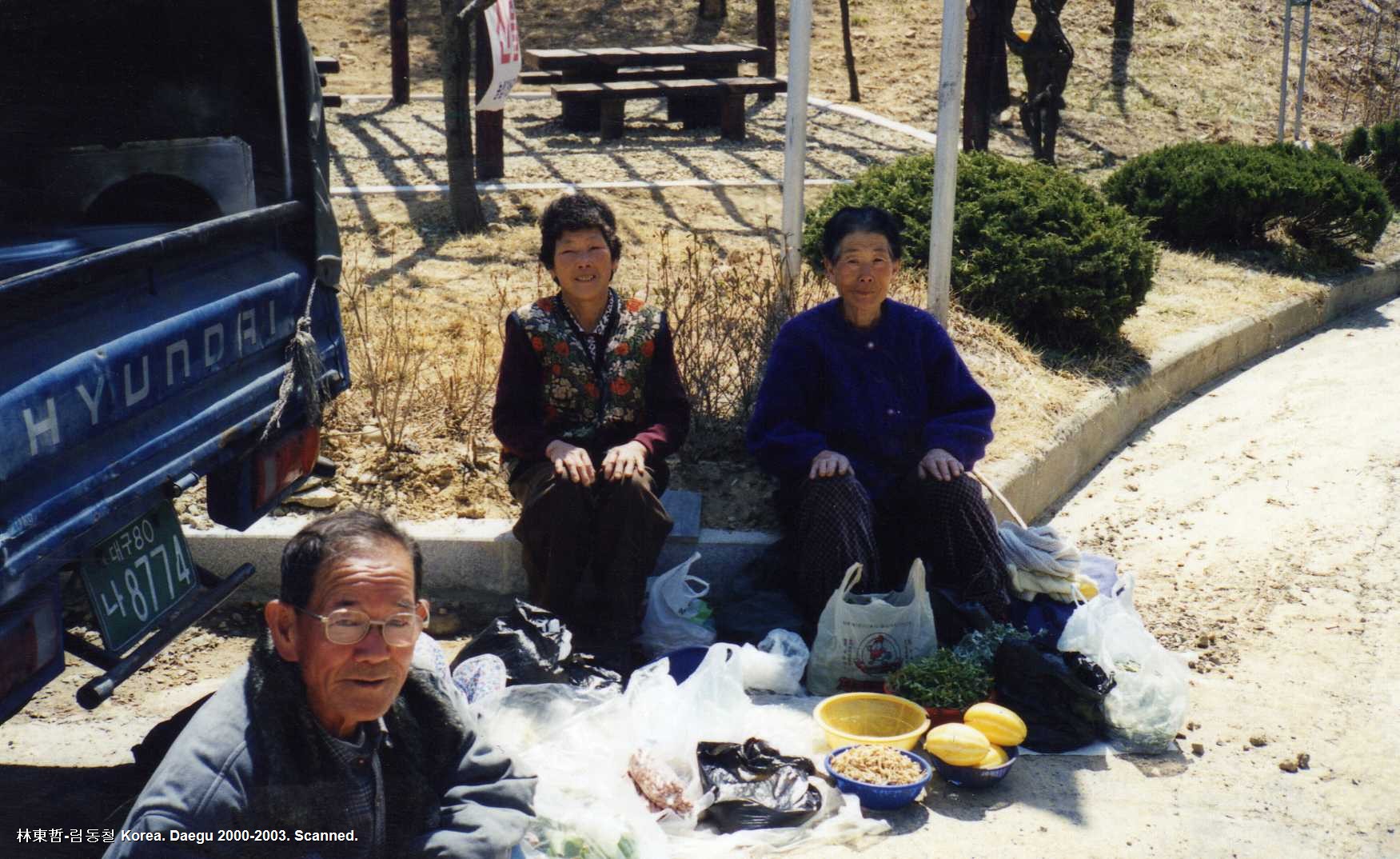
roadside traders on the road up to Heinsa Temple – Kaya Mountains (2001)
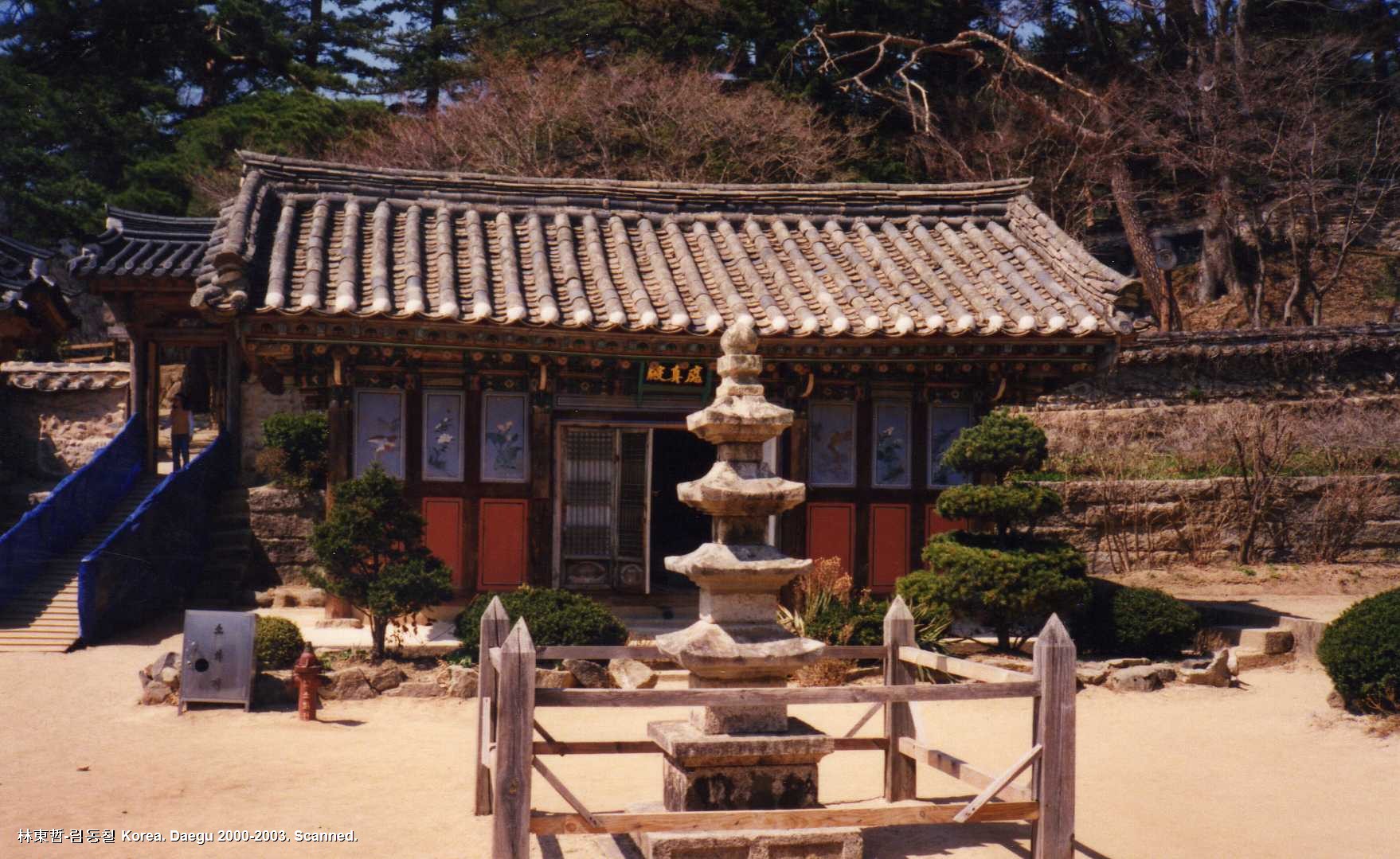
a stupa in the large forecourt before the main temple (2001)
We were now in the heart of the Kayasan (가야 산) national park and in U-no’s little car we travelled down from the observation point into another valley before climbing back up into more mountains towards the Haeinsa (해인 사) temple. May 1st in the lunar calendar this year marks the celebration of Buddha’s birthday and so the roads in the park were edged with yellow, red and purple lanterns which at night are lit. The park was impeccably clean, not a piece of litter anywhere. We passed through a number of small villages where up in the surrounding hillside people could be seen tidying up their relatives tombs after the long winter. Arbour Day is one of the days when people walk up to their relatives tombs, tidy them and then present offerings which involve paying their respects by prostrating themselves on the ground, forehead to earth.

note the bees nest hanging from the side of the head
At many places on route to the temple, there were interesting sights. Small stupas, small pagoda constructions which house the spirit of Buddha dotted the landscape. We stopped at a larger sight where there was a small temple nestled up in the hillside. At the foot of the hill, just off the road and through some trees, stood an enormous statue of a Buddha flanked on either side by stupas. In front of the Buddha ran a burpling river which meandered down from the mountain. Stupas are common across the Buddhist world but Korean ones are very distinct with small bells hanging from the corners of each protrusuion. The stupa tapers into a pointed spire. Like other Buddha statues I had seen in Korea, a large stone like ‘hat’ sat on his head, from this one hung a large bees’ nest. From the nearby temple drifted the sound of a monk chanting and striking his small, spherical wooden percussion instrument made from hollowed out oak. It makes a hypnotic sound when continual tapped. Behind the Buddha was wall housing twenty or so class cases each containing a life-size Buddha in a different pose. In front of the statue stood a stone table where visitor placed offering of food for the monks, bags of rice or fruits and nuts. Those making offerings lit joss sticks and then prostrated themselves in front of the Buddha. There were several elderly women who had been busy prostrating themselves for the entire 20 minutes of our visit. U-chun told me a respectable number of prostrations is ten but if you want to be particularly devoted you perform 180. This is no mean feat as a complete prostration begins and ends from a standing position.

Min-ju and I (2001)
Eventually, after a further journey, we parked the car in a large car park high in the mountains and joined the enormous conga of people progressing up to Haeinsa Temple. The walk talks about an hour. In places the climb was quite steep. One of the first sites we stopped at was a pond, called the -Yong-ji. This lay just outside the entrance to the Haeinsa complex. According to the legend, seven sons wanted to become monks and left home to travel to Haeinsa. Later, longing for her sons, their mother travelled the long distance to visit them but as they had already taken their vows, they could not see her in person. Instead, they looked at each other’s reflection in the pond.
The temple complex was full of fascinating sights. The elaborate art work of the central temple, which housed a golden Buddha, consisted of intricate patterns of blue, green, orange and gold. Inside the main temple, monks prayed in front of the large golden Buddha, the air scented by both spring and incense. The Haeinsa Temple, was built in the Shilla (57bc-935ad) period though it was destroyed by a fire and rebuilt in the 15th century. The temple houses the Triptaka Koreana which is the most extensive Buddhist text and is written on 82000 wooden engravings. The text is in the process of being translated. The wooden engravings are housed in outhouses surrounding the main temple.

Pak Yu-chun and her family (2001)
After spending several hours in the temple, we walked down the mountain and headed to a picnic area further into the Kayasan range. Koreans love to picnic and are well equipped with picnic mats, barbecues and baskets and when the finish, they meticulously tidy away all their mess. U-chun had cooked pulgogi and chap’che – a fried noodle dish with pork and beef through it. As usual the meal was accompanied with kimchee. After the meal we drove back to Daegu.
On Saturday, the Yon San Dong school had planned a staff trip to Kyong Ju (경주). Matt and I took a taxi down to the school to meet the mini bus. All the western teachers went except for Lisa who never seems to want to mix with anyone but who, in fairness, has been ill during the week. She continually moans anyway, so perhaps is it a good thing. There were four Korean staff coming with us, To-yung, Amy, Meg (who has a mouthful of wonky, impacted teeth and who looks like one of the Cenobite’s from Clive Barker’s ‘Hellraiser,’) and Qui-Aie. We all brought packed lunches and set off in high spirits. I can’t remember if I have previously mentioned the significance of Kyong Ju, but it was at one time the capital of the Shilla (57bc-975ad) dynasty. Between approximately 40bc and 400ad the peninsula was divided into three kingdoms – the Shilla, Koguryo and Paekche. Around 400ad, the Shilla dynasty, situated in the east and militarily very powerful, overthrew the other kingdoms and united the peninsula. The Shilla dynasty ruled until approx 900ad. Needless to say the area is full of interesting sights and it is particularly famous for its spring blossoms.
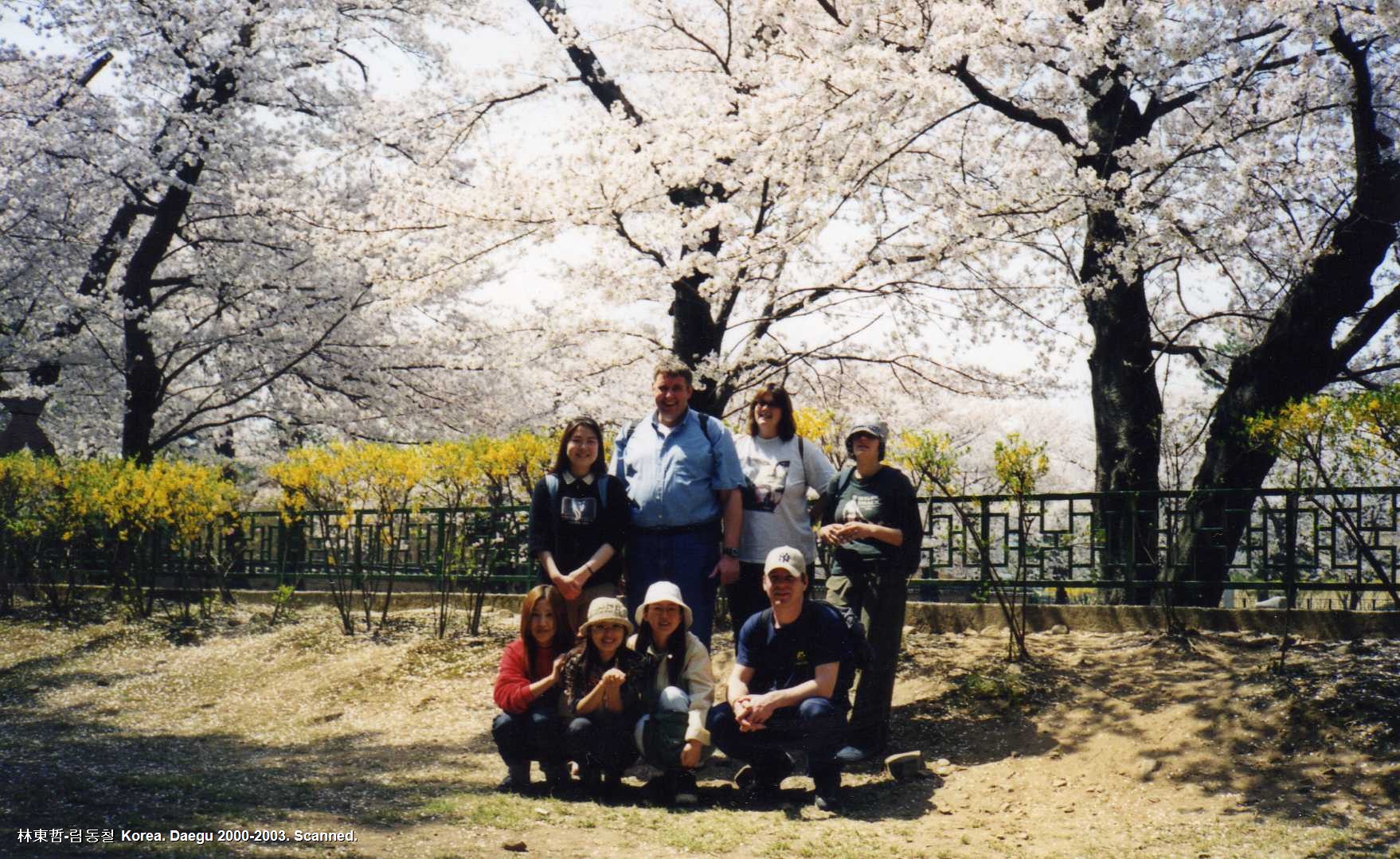
Back – Qui-aie, me, Pauline, Angelin. Front – ?,? Angel, Matt, (2001)
Kyong Ju isn’t a large city but when we arrived it was teeming with people on bicycles hired from one of numerous shops. Matt shared a tandem with the Cenobite and the rest of us all hired standard bicycles and headed off to the nearby Shilla tombs. The most impressive tomb in the site we visited was the Heavenly Horse Tomb. Though several other tombs lay in the same location, only this tomb had been excavated and inside a coffin and 15 items, including a sword of 98cm long. The tombs are all large mounds and the Heavenly Horse Tomb had been hollowed out so we were able to walk around inside it. Nearby was the oldest observatory in Asia and this was a large circular building made of stone. From here we went to the Kyong-ju National Museum which lay next to the Anapj (Goose and Lake). In 1972 the lake was temporarily drained and over 41.000 artefacts were found which now appear in the museum. Outside the museum was a large bell known as the Emelie Bell. Apparently this bell was cast in the ninth century and its unusual tone is attributed to the fact that a baby was thrown into the smelting metal during its casting.
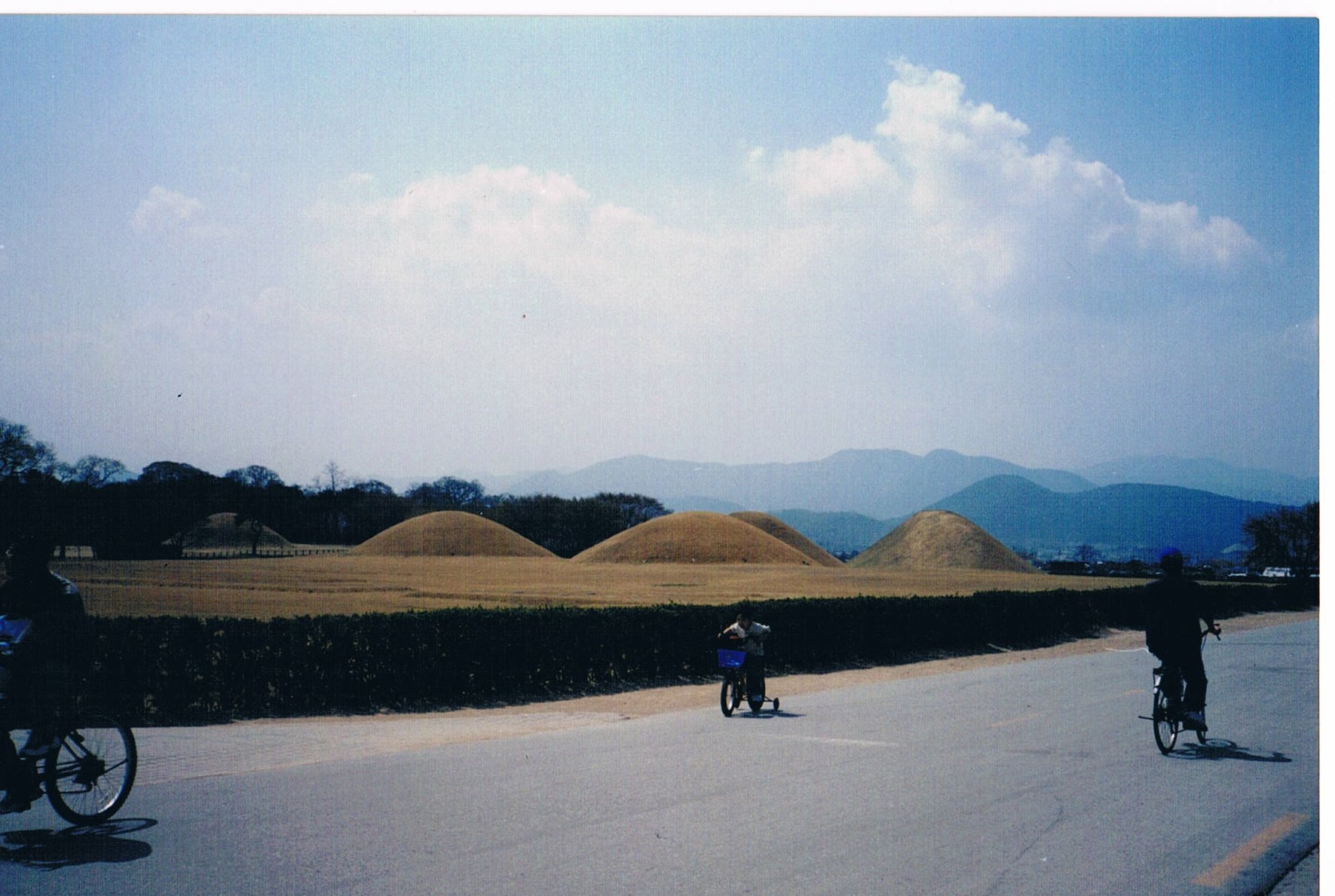
Tombs of Kings
We ate lunch in the gardens of the museum and then set of to visit a large lake outside the town. The cycle took ages and all along the route cherry blossom showered onto us like snow whenever a breeze blew. Pauline found the cycle strenuous and no matter how many times we asked where we were going, how long the cycle was likely to take, or how far it was, our host Koreans avoided our questions. After an hour or so cycling, Matt decided to stop and complain. We had all become split up and there were thousands of other cyclists travelling in both directions along our route. Despite our protestations, Qui-Aie wanted to push ahead and as soon as she saw Pauline struggling in the distance, she continued cycling with renewed vigour. I actually think it was part of her master plan to stop us getting together and moaning. After about another fifteen minutes, we reached this large lake which sat on top of a hill. All around the edge of the lake the cycle path could be traced by the line of cherry blossom. At the far end of the lake stood an enormous pagoda which I later discovered was a Hilton Hotel. On a large grass bank teeming with relaxing Koreans, we sat and had some refreshments bought from nearby stalls. We thought we would be able to sit and enjoy the beautiful scenery but under the leadership of ‘Hitler Tours,’ other plans were afoot.

the cycle up to the edge of the lake – under a canopy of blossom (2001)
All to soon Qui-aie and the other Koreans ushered us to continue cycling towards the Hotel. It was an awkward cycle as the path an narrowed and was packed with walkers and cyclists in an enormous conga that seemed to travel in both directions unbroken, around the lake. As is natural, Koreans didn’t get stressed with the incompetent cyclists who frequently blocked out passage or slowed our journey. I don’t think Koreans are very well organised in terms of driving on the roads, walking in packed supermarkets or cycling. Mopeds and motorbikes can be seen everyday using the pavements and I regularly see potential accidents about to occur. In busy supermarkets they will push and shove each other in order to squeeze through little gaps. They do exactly the same when driving yet rarely do they loose their tempers or get stressed. Matt and I have a time limit when we shop in a supermarket – usually about half an hour, after which we deteriorate into a frustrated state. On the path around the lake there seemed no consensus about which side of the pavement to cycle on and it seemed total chaos to us westerners. We cycled for another half an hour, making painfully slow progress and on the few occasions on which I stopped to take a photograph, I was made to feel I was wasting time. Next, I suggested we stop because we had lost Pauline. Twenty minutes later and she appeared in the distance and immediately, Qui-aie jumped on her bike. Matt wouldn’t get on his and was looking very cross.
‘Are you alright?’ I asked. He didn’t look up.
‘If there’s one thing I fucking hate it’s being asked if I’m alright when I’m fucking not,’ he snarled. Qui-aie was still trying to prompt us to cycle and I said we were going to wait for Pauline so she could take a break.
However, it wasn’t long before Qui-aie was leading us towards the fast approaching hotel. Soon, the path turned away from the lake. Our Korean guides, ‘Hitler Tours,’ grouped up ahead and were busy talking. I joked that they were probably deciding whose job it was going to be to tell us that we still had another few hours cycle ahead of us. Suddenly, To-yung told us we were turning towards the town and that we would be back at the minibus in some 20 minutes. We were momentarily relieved as this is Korea and Koreans and often lacking in organisation.
After more cycling, I noticed that the fairground wheel which had lain behind the hotel now lay behind us and that we were in fact travelling towards Kyong-ju but by the longest route; around the perimeter of the lake. We were some two hours cycle away from the point at which we had arrived at the lake’s shore. Here we were in this beautiful location with cafes and boat rides and wonderful sights and all we were doing was racing amongst a huge conga of cyclists and walkers. At one point there was an enormous hold up and bikes were knocking into each other all over the place – which no one minded except us westerners. When some silly Korean in front of us, braked for no reason and then blocked our way we cursed but the facial expression of the perpetrator was one of innocence and bewilderment. There was a long lay-by next to us, lines with market stalls, not one Korean in the enormous hold up, broke ranks to circumnavigate the jam. I moved into the empty road, calling for Angela to follow me and within minutes there was a long clear path in front of us. For some fifteen minutes we flew down the almost empty path and when we reached the main road at the bottom, we had to wait forty minutes before we all re-grouped. Angela spent our time leering at sexy Korean lads and we both agreed that westerners are mutant mongrels by comparison. Our hair is assorted colours and textures, we have pallid skin, yellow teeth and we are usually fatter than Koreans.
The rest of our party eventually appeared, free-wheeling down the hill towards us but they did not look very happy, apparently, they had waited for us assuming we must have got held up. By now a tense silence had developed between the Korean and foreign teachers. We arrived back in Kyong-ju city centre, tired and with sore backsides but of course, once we had handed our bicycles back, ‘Hitler Tours’ wouldn’t allow us time to get a coffee or an ice-cream. Instead, it was straight back and onto the bus! Back in Song-so the foreign teachers went for a drink in the Elvis Bar which isn’t far from Kemyoung University. Tomorrow, April 8th, is Pauline’s birthday.
On Wednesday I went to the doctor’s to get my gout pills and to have Bill, the hernia, checked out. Bill hasn’t been bothering me lately though he is still there and pops in and out with a sort of squidgy, jelly-like feeling. Doctor Lee always wants to have a chat and practice his quite competent English. I asked him to check Bill out as I was worried it might be a cancer of something. I have multiple cancers at the moment and develop new ones regularly. He looked at me quite strangely when I told him this and so I had to explain that whenever I get a headache, a pain or a blemish, I assume it’s a potential cancer. He got to work with the ultra-sound and then showed me, by way of the monitor, that a small lump of fat was moving between different layers of my stomach muscle. He assured me it wasn’t a hernia or anything serious. I love my trip to the doctors as he is the first doctor I have ever had that actually I actually refer to as ‘my doctor.’ He genuinely seems interested in me and always asks if there is anything else wrong with me or anything he can do. No matter how long I take at the doctors, no matter whether five minutes or fifty minutes, the cost is always 10.000W which is less than five pounds. Even if one assumes the cost of living to be four less than in the UK, that puts my doctor’s fee at around £20. When my mother went to a specialist over five years ago she was charged £60. My doctor is actually an internal medicine specialist! It’s strange that my health seems more protected and guaranteed here in Korea than it is is the smug world of the ‘developed west.’ Even the poodle parlours here offer a better service than does the British NHS! Teachers like Matt and Angela from New Zealand all prefer the Korean medical system. We all seem to have access to drugs and medicine seen as too expensive to provide freely in our home countries. After my monthly trip to my doctor I went and relaxed at the sauna. I have been going to the mokyuktang several times a week.
My Taekwondo has been progressing very well and now it is warmer I have suffer less injuries. Spring is almost over and already we have had temperatures in the 80’s. Korea has a spring and autumn of only three weeks or a month and has long winters and summers. The blossom has fallen from the trees and now the streets around Song So are being lined with pink and yellow lanterns in readiness for Buddha’s birthday (May 1st of this years lunar calendar). I often train for forty five minutes at lunchtime either stretching at home or in my club. My stretching programme has paid off and I am able to do exercises I haven’t done for fifteen years or so. I can sit in a hurdler’s straddle and almost put my head on my knee and I can sit on my knees and lean right back so my shoulders are on the floor. From this position I can do sit-ups. My axe kick, one of my favourite and formerly most devastating kicks, is almost as good as it was when I took my black belt. I now have a purple belt and my blue belt exam I will take in a few weeks time. After blue, I will have brown, red, red and black belts to take before I can finally take my black belt exam. I would be quite content to go home with a brown belt but gaining a black belt is within my grasp. I realise how unfit I have become in the last four years – all due to sitting at a computer writing and riding a motorcycle. It has taken me a lot of effort to get fitter and a few months ago I was going to give up Taekwondo for good.


 Elwood 5566
1 comment