The Pleasure of a Deadly Dolsot (돌솥)
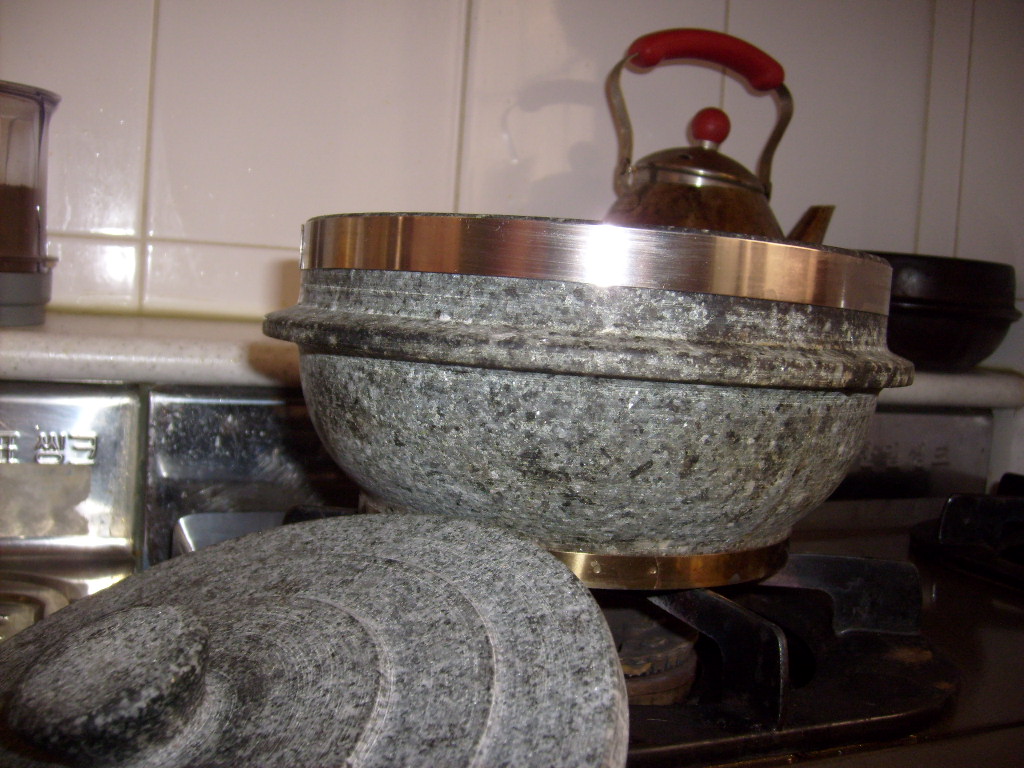
a solid rock dolsot (돌솥)
It looks like a mushy mess when mixed up and the first time you experience it you probably discard the crispy rice that frazzles in the bottom of the dish. It was one of my first culinary experiences in Korea but it instantly made an impression and on almost on every occasion I eat it I am nostalgically transported back to that inaugural introduction. Dolsot bibimbap is basically ‘stone-pot mixed rice’ (돌솥 비빔밥) and the reason for the stone pot, the ‘dolsot,’ is that it can be heated to a searing temperature and continues cooking as you eat. Indeed, cooking and eating with a dolsot demands caution and in restaurants the heavy bowl is often encased in a wooden holder to prevent injury.
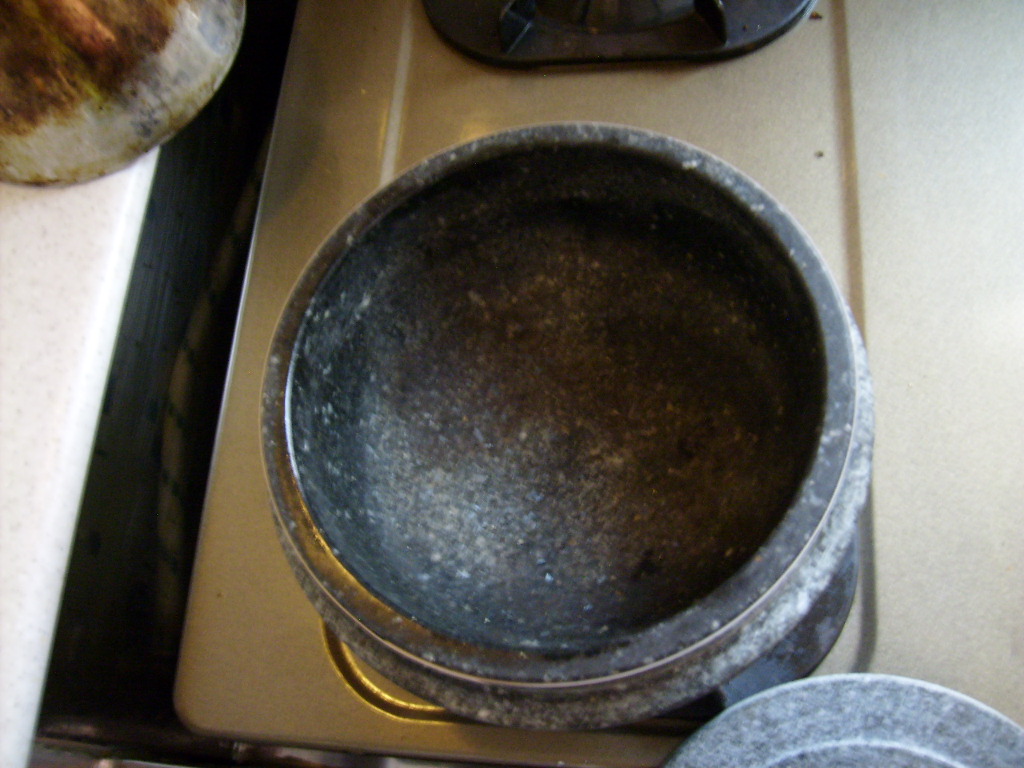
slightly rough texture and heavy
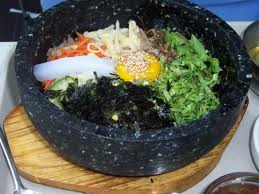
dolsot bibimbap
The ‘bibimbap,’ which can alternatively be eaten in a normal bowl without searing properties and using cooked rice, without a raw egg, usually consists of vegetables, meat or fish and a sauce based on red pepper paste (고추장) but there are numerous personal and regional variations. The ingredients are placed on top of the rice in an aesthetic manner and you mix them with sauce at your table. Though it looks quite messy when mixed, it is delicious. One advantage of the dolsot version is that rice is seared to a crisp on the bottom of the bowl forming what Koreans call nurungji (느룽지). My first introduction to toasted rice which is capable of cracking your teeth was through a friend’s mother who at breakfast one morning politely plied me with all the scrapings from the bottom of a dolsot bowl. Being in her late sixties and emerging from a Korea quite different from today, she relished nurungji and passing it to a guest was an honour. At the time however, I didn’t understand the significance. Often, nurungji crust is served in a bowl with warm water and at first doesn’t seem too much different from drinking boiled rice water in which a handful of rice has been steeped but like so many Korean foods, it grows on you. If I go to one of my favourite restaurants and they have run out of nurungji, I am always a little disappointed.
nurungji (누룽지) in a wooden holder
If you want to make your own dolsot bibimbap you can easily buy a bowl in markets and supermarkets. I recently bought one in E-Marte and it cost 33.000 (about £16). I’ve read numerous accounts of bowls that leak or are cracked and it seems that small cracks are acceptable but mine is unblemished. A dolsot pot often has a metal strip around the neck and base, is grey or blackish in colour and is slightly rough to the touch; it should not be confused with a ‘ddukbaegi’ (뚝배기) which is a much lighter earthenware pot which is usually glazed.
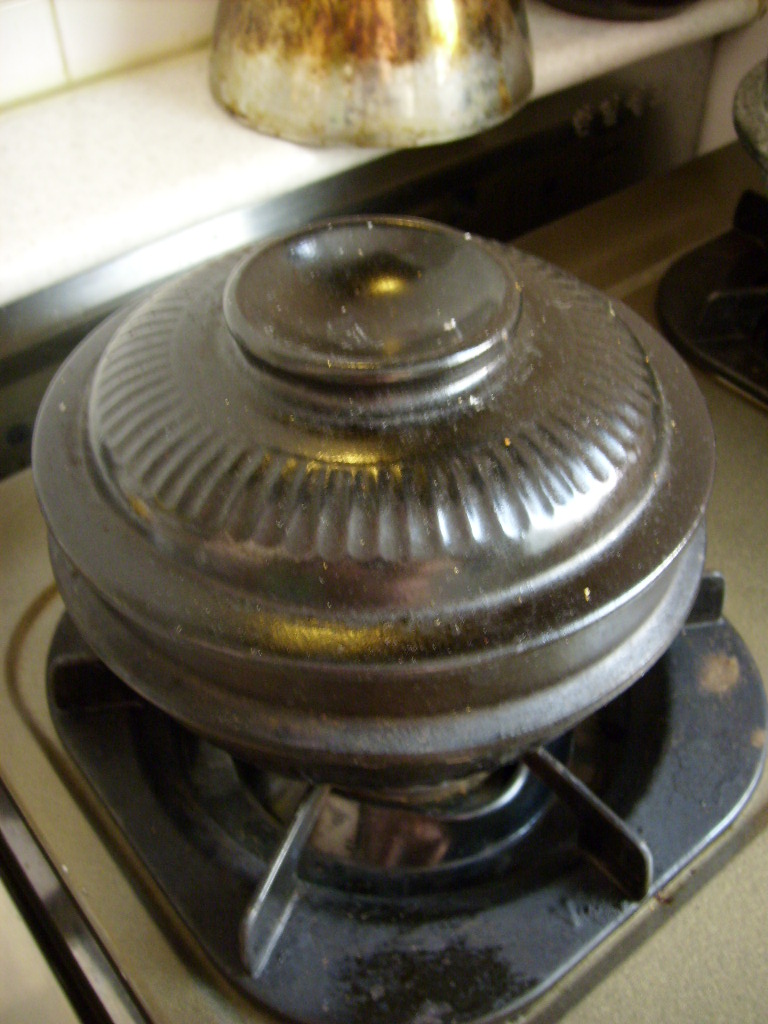
a ddukbaegi – not to be confused with a dolsot
If you want to make truly decent dolsot bibimbap you need a dolsot and not a ddukbaegi; not only can a dolsot be heated to a far higher temperature but it retains the heat for much longer. My ddukbaegi is off the boil the moment I turn off the gas range and is cold by the time I’ve eaten from it. The dolsot however, requires small amounts of water to be poured into the bowl as you are eating as the contents are still cooking and hence dehydrating. Even after fifteen minutes, water poured into the bowl will instantly bubble and spit when it contacts the base and the dolsot needs time to cool down before it can be manhandled.
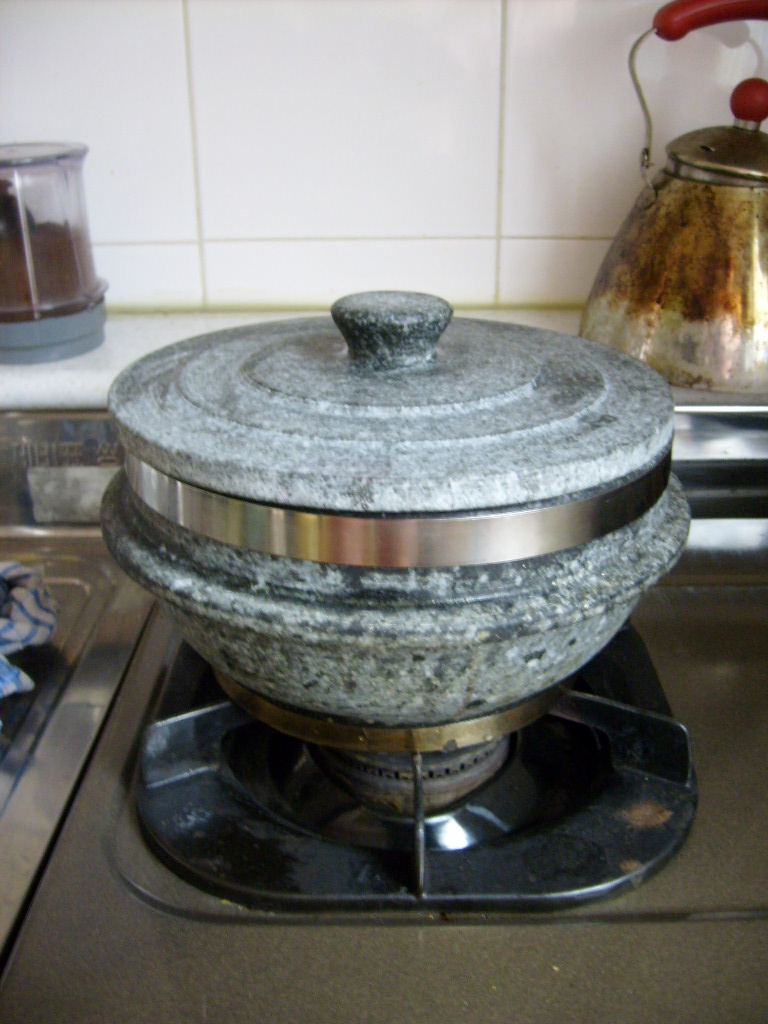
waiting for action
One tip for cleaning the bowl is to use coarse grain salt and a cloth which very effectively rips off any adhesion. You cannot use this method on a ddukbaegi because of the smooth surface. As I have stressed, the dolsot demands caution when using it and I always worry about inadvertently lifting the lid off the pot as I would a usual cooking pot. I have never done this with a ddukpaegi but the temperature of the dolsot is infinitely greater. You can buy a simple device for picking up hot ddukpaegi (I’m not sure of dolsot but safety would demand using two hands because of their weight).
I do not know how much quality varies but I notice that you can buy a dolsot the same size (18cm) as the one I purchased in E-Mart for as little as 19.000 Won (£10). There are also different sizes, 16cm, 20cm, 22cm (HonsuMart.com)
There is no mistaking the dolsot is deadly. It has the potential not just to scold the user but if dropped on the toes it will easily break them. And another downside to enjoying its contents is the heat; the bibimbap is so bloody hot you need half an hour to eat it! But the risks are well worth it!

© 林東哲 2011 Creative Commons Licence.
I Don’t Mind Fat People – I Have a Fat Neighbour!
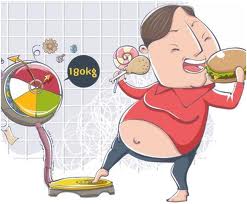
Currently, Korea has one of the lowest levels of obesity in the world, but things are rapidly changing

podcast 77
I’m a fat arse and not particularly ashamed of it but then it’s much easier being fat if you’re male. This week I’ve had a difficult time being large as I’ve injured my knee and with the snow and ice have had to take taxis to work. I only work three or four minutes from where I live but I’ve noticed a pattern with what is probably a case of tendinitis in that if I rest it gets better, if I walk it aggravates it and hence I am trying to rest as much as possible. The problem is compounded because constant hobbling has already put strain on other muscles and joints and they too have joined the rebellion.
But the hard time I am currently suffering doesn’t just concern the extra pressure that weight puts on the joints but the extra pressure that you incur socially as a result of being fat. I haven’t bothered to go to the hospital as I immediately know their first response will be to tell me to loose weight. Frankly, an obvious response but one that is usually made and which is both a euphemism for attributing you with the blame and also a means of gloating over your predicament because you’ve taken too much pleasure in food. I see much of the attack made on fat people, especially in Britain where the debate is front page news, as a form of schadenfreude and largely media induced. Even two pharmacists have very kindly told me I should eat less.
Many people simply have no grasp of the problems involved in being overweight and are apt to make the most asinine comments. Fat people know they should loose weight, they know they should eat less, and they probably know more about healthy eating than many professionals and probably more than you. It should be clear to any sensible person that the trends in weight gain witnessed in numerous countries with diverse cultures between them goes deeper than individual lack of will power or not knowing that a stick of carrot is healthier than a pack of lard, and is rooted in an array of social factors.

Most kids would prefer this to a quarter pounder and fries!
There is a concern with obesity in Korea, but fatness is still very much in its infancy. However, the number of fast-food establishments grows and the number of convenience foods available in supermarkets rapidly expands. McDonald’s plan to have 500 restaurants situated in Korea by 2015 (Korea JoongAng Daily March 2010). Worse, they intend increasing the number of schools participating in their ‘after school program’ which includes lessons on healthy eating. At this stage, I want to tear my hair out because parents actually send their kids to these programs, schools and politicians actually help facilitate their dissemination and teachers actually deliver their content. Any parent who allows a corporation like McDonald’s to take a hand in the ‘education’ of their kids needs arresting for child abuse and subsequently requires sterilization. As for the politicians, schools management and teachers… shame on you! In Britain, parents who are overweight or have overweight kids are slammed and ridiculed by the media and a moronic public who fiddle with themselves over the ‘successes’ of celebrities who have lost weight by undergoing expensive gastric surgery but ignore how McDonalds, (and others companies such as BP, Sunny Delight, Flora, etc) get a foot in schools with after school clubs, painting and story competitions, promotional goods or school equipment etc, etc. Yes, it might be innocuous, but as innocuous as booking a paedophile for a kid’s party. I know McDonalds encourage healthy eating but that’s the ploy to get the kids in the restaurant. Have you ever taken a hungry kid in McDonald’s and then satisfied them with a couple of slices of bagged apple? The ‘apple’ gimmick works all round: it’s the passport for McDonald’s to get a foot in the door of schools, for parents, politicians and those loco parentis it absolves them of guilt and shame and for kids it’s a ticket into a McDonald’s store where they will quickly demand burgers, fries and milkshakes with the apple dipper bag either discarded on the tray with the wrappers or taken away as a snack.
McDonald’s – where foods are transformed into toy-like things in the attempt to secure future consumer loyalty
This week, my boss and a friend were excitedly talking about some shopping they had bought in E-Mart which included a new range of microwave meals such as bokkumbap and black noodles. The line in microwaveable fast food has been almost nonexistent and I was immediately reminded of supermarkets back in the UK where a substantial portion of the store is devoted to gargantuan freezers providing an enormous range of microwaveable food. Unlike convenience stores in Korea, UK versions such as Tesco One Stops provide a large range of unhealthy foods: frozen burgers, burgers ready to microwave, frozen curries, rolls and sandwiches, various pies, pasties, pizzas, microwave French fries and sausage rolls. I haven’t even mentioned the fast food available in cans! I can only snack in my local GS25, there are only ever one or two sandwiches, a few kimbaps and the remainder mostly crisps and drinks and you certainly couldn’t furnish enough to make a meal. There are no mega pound bars of chocolate and biscuits come in piddly little packets and/or are individually wrapped – which sort of kills the fun! However, I could eat very unhealthily on a daily basis on the junk from my local Tesco One Stop. In terms of supermarkets, the same differences exists except greatly magnified. In a western supermarket there are plenty of unhealthy options to lure me and they are usually instant or at the very most require bunging in a pan or microwave. In Korea, there are plenty of goodies available but only if you assemble them with a recipe – which if you do is healthier because to produce the item requires physical activity. And in Korea I don’t even have a can opener!
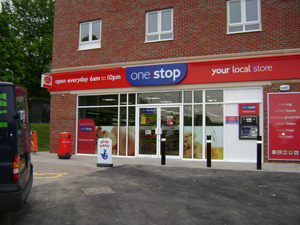
Imperial Tesco – the One Stop
Living in Korea makes you more aware of the unhealthy nature of western eating habits and trends which the obesity debate in the UK generally overlooks. There is a stupid assumption that the nature of how we shop, what is available, and the impact of advertising haven’t changed in the last hundred years and that all that has happened is that people, the weak willed or working class, are ‘eating too much and exercising less.’ I very much suspect that not only has the production and consumption of food radically changed, but what foods contain, what fillers and padding now adulterate them, are recent exploitations.
the ultimate in ersatz, Hershy’s chocolateless chocolate
I love chocolate, but rarely buy it in Korea firstly because it is often that shite American type Hershey’s chocolate which in comparison to Belgian or Swiss chocolate, is totally chocolate-less and ersatz and secondly; it looks like chocolate, smells like chocolate, but there’s hardly any chocolate in it at all (and I know there are exceptions). Secondly, the bars are too small and thin. Crunchy for example is wafer thin. Other brands come in small packets or involve unwrapping each piece. In the UK, where chocolate is one up from Hershey’s but still pretty crappy,we now have bars of chocolate that are so big you could knock someone out with one, bludgeon them to death and the little bars of chocolate I remember from my childhood, Mars Bar, Kit-Kat, Twix, Marathon, etc, are now enormous bars that you eat single-handed. The accusations manufacturers were promoting obesity by producing such enormous bars has been rectified by dividing the bar into two segments, each the same size as the original single bar, and wrapping it in one wrapper. Divided or not it still amounts to twice the amount of chocolate! And burgers have increased in size. I remember when a Whopper or Big Mac was the ultimate burgers. The Big Mac was so big it had to be sold in a box. Now it’s in a wrapper and though it still looks big it’s not the dead weight of a double quarter-pounder let alone a triple quarter-pounder. A double quarter-pounder is almost one-third more calories than a Big Mac. I also remember when the Whopper, now known as the Original Whopper (710 calories), was the largest Burger King had to offer and was provided in a box with a fold down side so you could slide it into your mouth. The Original Whopper, a massive burger in the 1980’s, is now small compared to the almost 1000 calorie-laden Double Whopper Sandwich.
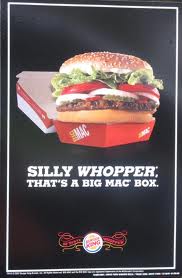
I have to admit, this is clever
If I was to be able to see the size of meals my family ate when I was a boy, I’d probably be shocked. I’m sure I eat as much meat in one UK meal now as my entire family ate in one meal when I was young. Of course, what one eats is an individual choice but if I buy a bar a chocolate that has two segments, I find it hard not to eat them both. However, if there were only one segment in the packet, I’d have been content. If you put a pound of meat on my plate I’m probably going to eat it or at least I will eat more than I would have if you’d only given me 4 ounces. I know it’s my individual choice that makes me consume but I don’t need help to do so. I have eventually come to the conclusion that I am overweight largely because I’ve been a single person in a family orientated consumer society. The packet of biscuits for a family of four are the biscuits I buy for one and it’s the same with most food that is packaged. However, it’s much easier food shopping for one in Korea as biscuits, chocolates and even tins of tuna are available in smaller portions. (Ironically, with toilet paper, washing-up liquid and washing powder, it’s the opposite). Meanwhile, the enormous Snicker bars, containing two segments, have arrived on Korean shores as has it’s cousin, the Snickers ice cream bar.
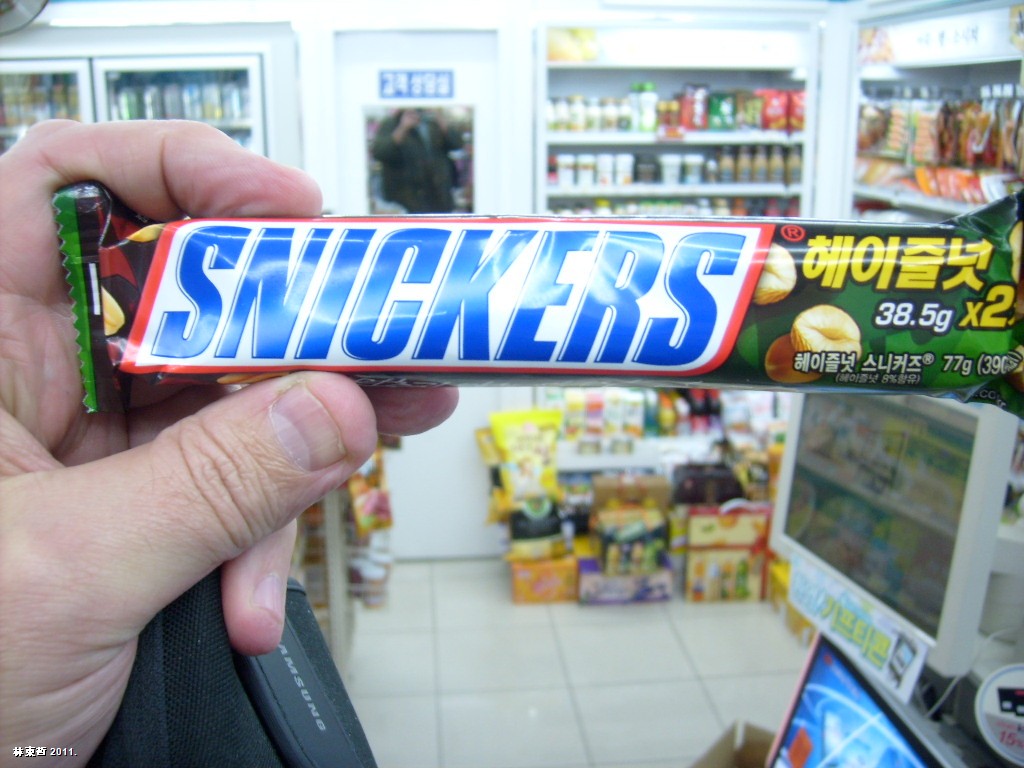
Welcome to Korea!
So, when I ask my pharmacist for some pain killers for a sore knee, she very kindly tells me I should lose weight. She almost whispers it with an accompanying smile. I want to call her a ‘fucking nosey bitch!’ but I like her and her lack of tact is cultural. However, the audacity catches me unaware and momentarily transfixed, I stare at her gormlessly. There is a sudden mellowing of my mental processes; lose weight? Why hadn’t I thought of that before? Such snippets of professional wisdom, the result of years of intense study, woke me to my senses. I never realised that people within normal weight parameters never suffer injured knees! Have you ever seen a skinny person limping or a grey-haired skinny requiring a walking stick? No! Knee problems only ever affect fatties and clearly injuries such as ‘athlete’s knee’ and ‘tennis elbow’ are sarcastic terms for anything but a sporty person’s ailments.
© 林東哲 2011 Creative Commons Licence.
Related Articles
- Negative attitudes toward fat bodies going global, study finds (eurekalert.org)
- Stigma against fat people becoming global (news.bioscholar.com)
More Than Words can Say
Preamble. One of my friends, who is actually my boss, has a daughter who has recently been accepted into the top high school for English, in Daegu. Gaining entrance was highly competitive and as such local middle schools can nominate only a limited number of applicants, based on their student population. Her school nominated 6 students but she was the only one to pass the entrance procedure. Not only did she have to compete with a large number of students from her school, but then with students from all over Daegu. Nominated students then had to endure a rigorous selection process held over two weekends the first of which included a fifty minute essay and a question paper. The results of the first weekend provided the final batch of applicants who on the following weekend were subject to group debates and an individual interview.
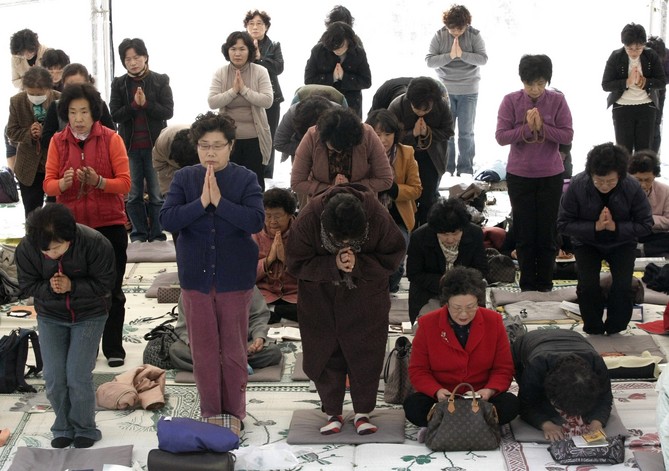
Korean mothers pray for their children’s exam success
On Wednesday, when the results were released, my boss was hooting with delight and for the remainder of the week the atmosphere in school was hyper. I could probably have canceled my classes and gone home and she wouldn’t have minded. On Friday, I was given a cash bonus and thanked for the extra work I’d volunteered to help her daughter succeed.
Now, this isn’t really the point of this post. After being handed my bonus, as usual in an unsealed envelope and presented with two hands, we walked to a nearby cafe and on the way my boss stopped on several occasions to talk to women she knew and during each brief interaction told them of her daughter’s success. Suddenly my sociologist’s head was activated as I noticed some fleeting, but very interesting behaviour. Perhaps mothers share a special empathy but on two different occasions the conversing women held their clasped hands to their chests and emitted this strange squeal. I noticed it instantly and almost asked, ‘what the fuck are you doing? Perhaps it was just coincidence or maybe it really is a shared habit – I’ve no idea. The squeal, sounded in unison lasted only a few seconds and is quite hard to describe. It was certainly joyous but in a totally feminine manner. Being a musician, I have a fairly good ear and the strangest aspect of each occurrence was how their squeals rapidly attuned themselves to one pitch so that for a few seconds both were squealing the same note. In that instant, and it was an instant, they seemed to share an understanding, to mutually empathize.
All cultures have their own variations of body language and of sounds, guttural and otherwise that can’t be located in dictionaries. Probably the cutest Korean one I know is when someone doesn’t know something or is unsure and they the touch the back of their head and inhale slightly between their teeth. In a very strange way the shared squeal, their faces and the way they preciously clasped their hands at their chests, conveyed far more emotion and intimacy than their spoken words. Was it a coincidence or is this a gender based, non-verbal, socially shared form of communication?
© 林東哲 2011 Creative Commons Licence.
My World
Spring was in the air last weekend and in one of the small apartment ‘parks’ near my one room, people were sat in a large group chatting and eating snacks. Nearby, an little old lady was sat where she is everyday, with an assortment of vegetables. Two high school boys are about to pass her – you can just see the light gray colour of their trousers. On the side of the road you can see a stall selling oranges. On a Sunday this area is home to a number of market stalls one of which is under the dark blue tarpaulin near one of the school boys.
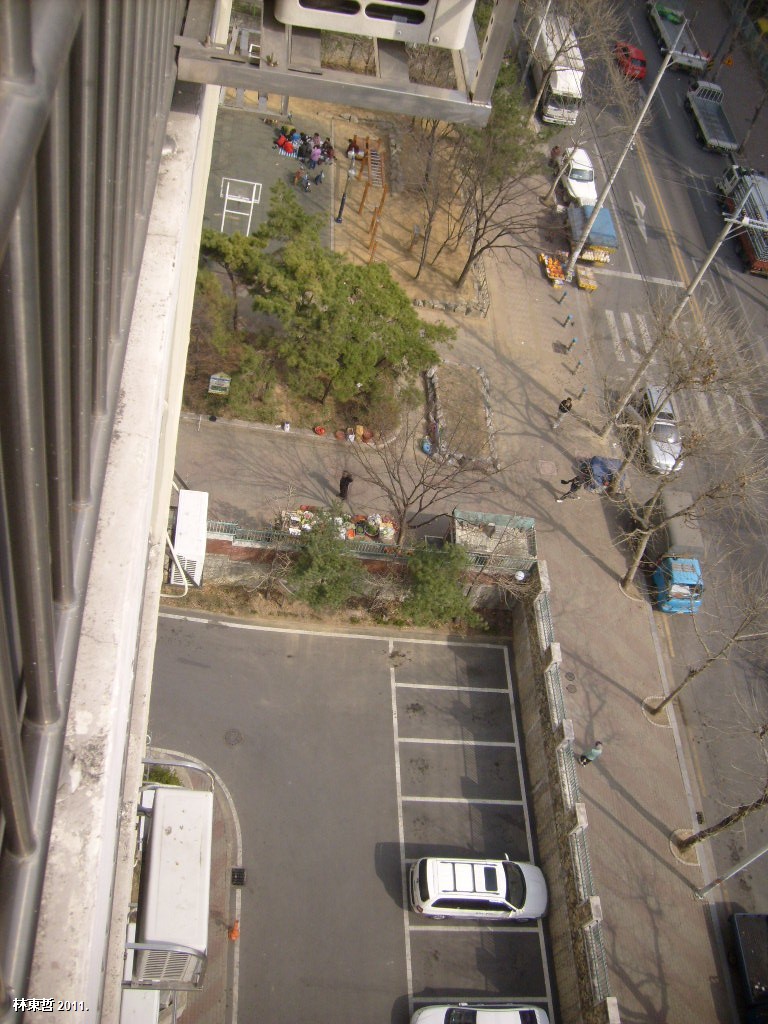
Spring is in the air
Within the photo below are three one rooms I have lived in during 2000-2001, 2003-2004 and 2008-2011. All of them are roughly along the center axis of the 3-4 story buildings. My current one room has a green roof and is just beyond (diagonally to the left), the bright yellow, 3 story stairwell. A small tower perched on top of a roof sits between the yellow stairwell and my building further in the distance. An area of 3-4 story buildings contains some small businesses and many one and two room type accommodations.
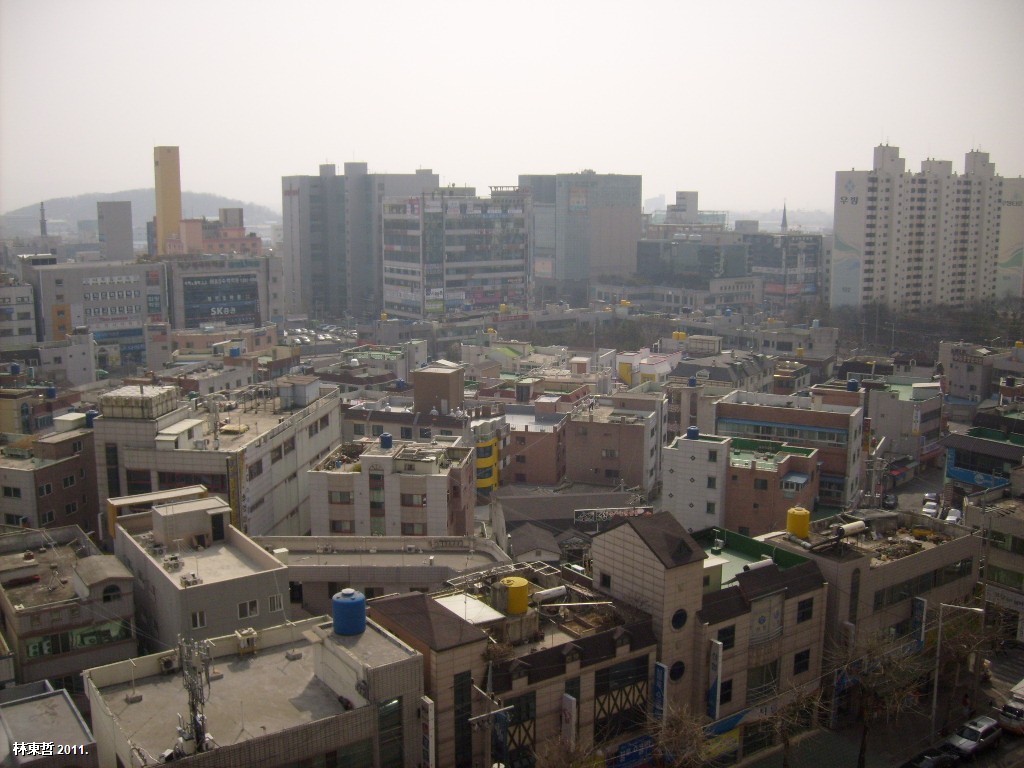
I live just to the left and diagonally of the small tower – a green topped, flat roof.
In the photo below, on the left and running into the distance, is a small street which on a Monday is occupied by a market. This street will contain large stalls with canopies while the small street behind it (to the right), is packed with little old ladies who at the most have a large umbrella. This is my favourite place to buy vegetables. Stalls will also throng the main road at the front of the photo. Slightly beyond the BYC sign, on the left, is my school with E-mart a little further. BYC is a strange shop selling underwear, pajamas and other clothes. It is a large shop with a lot of space and for years it has looked like it is going out of business. However, it is one of the only surviving business that was here back in 2000.
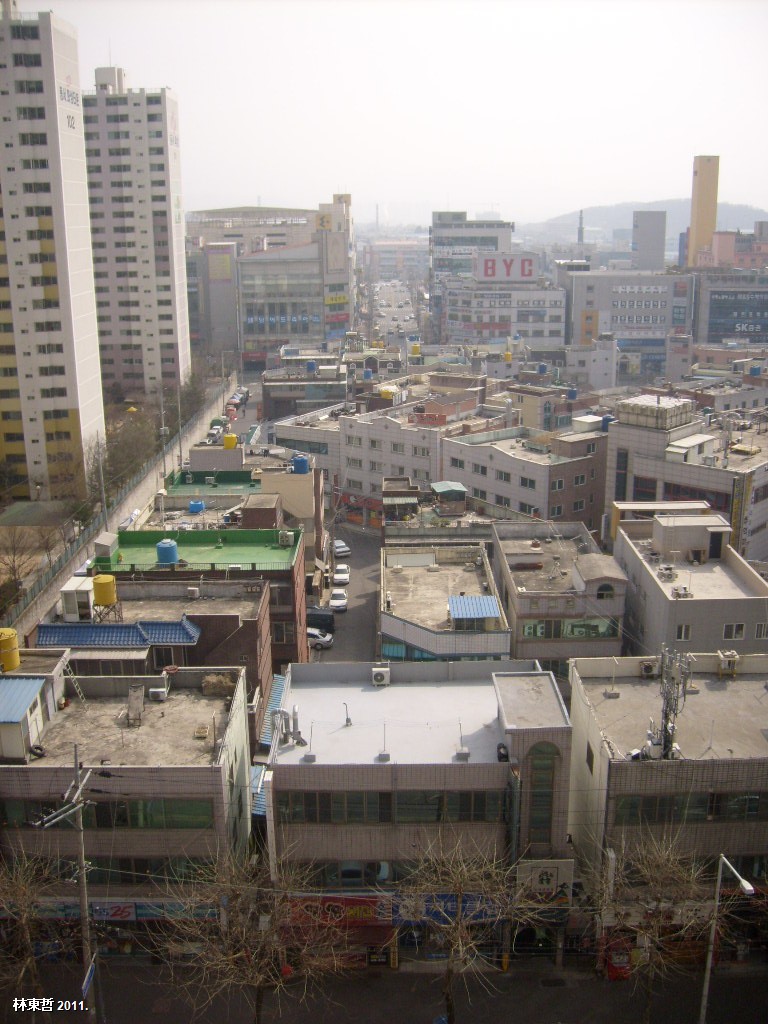
Ginkgo trees line the main road in the foreground shading it in the summer
Contained within 90% of the photo is most of my weekly life. There is large multi complex cinema, countless restaurants including sashimi and sushi restaurants, pizzerias and a seafood buffet. There are probably 10 coffee shops, a supermarket, 2 ophthalmic surgeons, a nerologist, a urologists, a womens clinic, around 5 opticians, 3 tailors, 2 launderettes and countless other businesses.
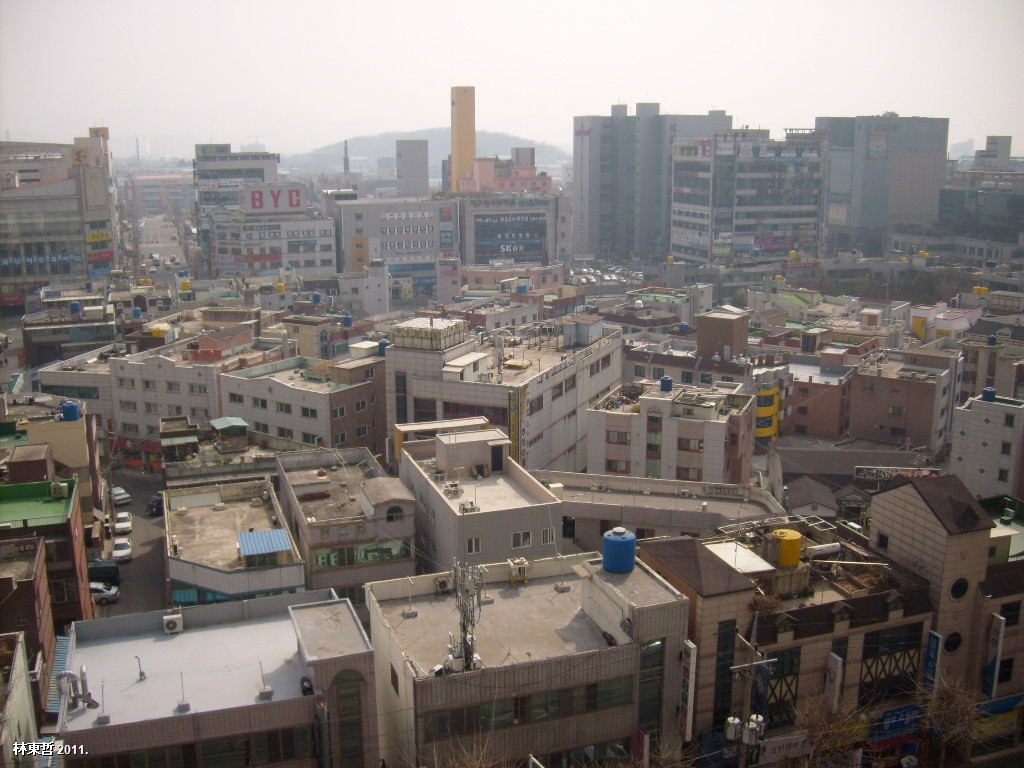
my entire world – apart from my favourite bathhouse
The photos were taken from one of my friends apartments and I have taken photos on numerous occasions from this location. At night the view is particularly colourful.
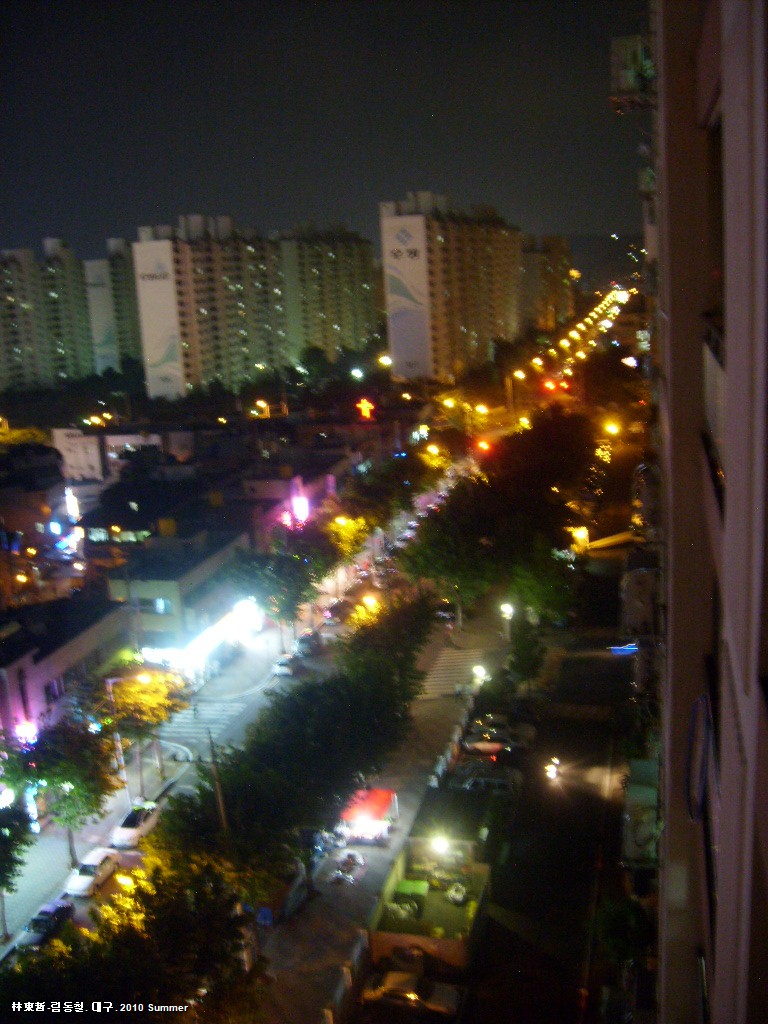
The view in summer and at night (2010)
© 林東哲 2011 Creative Commons Licence.
Five Second Hanja (13) Gate; Family (문-문)
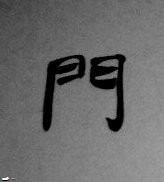
gate, door: family, school, sect (문)
This was the first hanja character I learnt as being sat next to the emergency exit on my first flight to Korea, it stared down at me for some 12 hours. As a pictogram it is self explanatory.
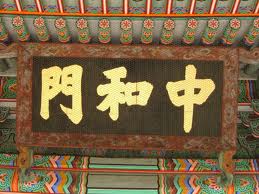
door to attaining peace and harmony
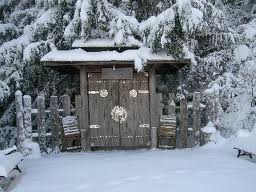
winter scene
© 林東哲 2011 Creative Commons Licence.
Finding a Pathology to Fit the Procedure – Circumcision (포경)
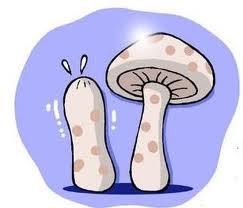
a sometimes used image on Korean urology websites
podcast 76
Mention ‘whaling’ (포경) to Korean men and most will cross their legs in pain while boys about to go to middle school (at about 13) , and perhaps some about to go to high school (16), will turn white with fear. ‘Whaling’ is a touchy subject and it is during the lengthy winter vacation that the cull reaches its peak. In Korean, ‘po-kyeong’ is a homonym attributed to the hunting of whales and of the widespread practice of circumcision, (포경 수슬), and in this case, as I will explain later, it is a misnomer. Finding information about or attitudes towards this subject are difficult and very little is available in English. That Korea has the world’s highest rate of secular circumcision is rarely acknowledged and the practice is generally associated with the USA.
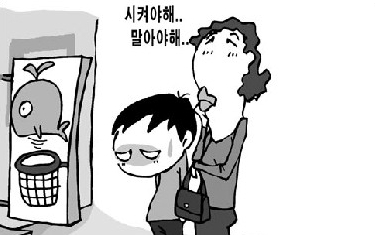
it needs to be…you don’t have to…
However, attitudes are changing. I recently spoke to two men (one 27 the other 32), who explained that while they didn’t blame their parents for undergoing circumcision, they are nonetheless angry it had been performed. Both felt the procedure resulted in a reduction in sensation and given boys are well into puberty by the time they have the operation, their claims are perhaps more valid than those from American audiences where it is usually performed neo-natal and where men are not really qualified to make qualitative comparisons. One friend clearly remembers his circumcision and the fear invoked in anticipation even though it is done under local anaesthetic. I have discovered Korean boys tend to be more squeamish about injections than girls and this is hardly surprising given that you are either anticipating multiple injections in your dick or in a cold sweat recalling the memory. Both men are adamant that it will be their sons who choose whether or not to be circumcised.
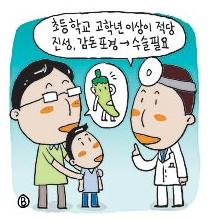
once you’re out of elementary school you need a circumcision
The circumcision debate is a great subject for exposing how dumb people really are. There is nothing intrinsically superior about a circumcised dick and the aesthetics attributed to penal status are largely derived from whatever is the most accepted social custom. Circumcision looks ‘weird’ to many Europeans as much as a foreskin looks ‘weird’ to many Americans. Meanwhile, a Filipino boy might be proud of his new circumcision (pagtutuli), which isn’t really a circumcision at all, while both Americans and Europeans are likely to consider it reminiscent of an accident incurred with a meat grinder. Beauty might be in the eye of the beholder but the beholder is significantly influenced by their social and cultural milieu. In the USA where radical circumcision, including the unnecessary and extraneous removal of the frenulum, have several decades’ dominance, cultural values have transformed wonky stitches and chewed up scar tissue into aesthetically pleasing damage which in the least is seen as an enhancement and at the extreme deemed natural. If a society can eradicate the botched and overzealous circumcisions many American males have been subject to, making them ‘disappear’ with far greater success than any cosmetic surgery or skin cream, just imagine how it could transform attitudes to acne, obesity and aging.
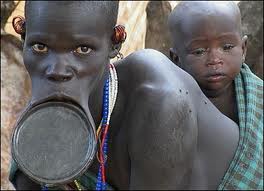
beauty is culturally informed
Then there is the ridiculous argument that circumcision protects one from HIV and STI’s. Well, maybe there is some medical evidence to support this but I suspect it is spurious or simply invalid. When rates of circumcision in the USA were almost at a peak, in the 1980’s, HIV was able to infect a significantly large number of people. Surely the answer lies in safer sexual practices rather than in an amputation which leaves the recipient under the assumption that a circumcision is as good as a condom in terms of safer sex.
Circumcision has a long history of being a cure for something and when not the foreskin has been identified as a cause of immorality and perversion. The ‘benefits’ of circumcision, apart from the obvious, which ironically is currently one of the most contested, namely that it reduces sensitivity, include: reducing a tendency to masturbation (Athol Johnson, Lancet, London, April 7, 1860), cures polio and reduces masturbation, (Dr. Lewis Sayre, USA, 1870), reduces masturbation (J.H. Kellogg, USA, 1877. Not only did he advocate circumcision, but that it be performed without anesthetic, a trend that continued in the USA until recently.), reduces lethal diarrhea (AAP, USA, 1880’s advocating routine neo-natal circumcision), cited as cure for bed-wetting, syphilis and tuberculosis (Dr P.C Remodino, 1893), will reduce syphilis by 49% (Dr. Jonathan Hutchinson, London, Lancet. 29th December,1900), will prevent cancer, masturbation and syphilis (A. Wolbarst, USA 1914), will prevent HIV in Africa (Halperpin and Bailey, Lancet, London 1999). Not only has there been a crusade against the foreskin for several hundred years, but its possession has been associated with physical and moral degeneracy. Remodino accused it of being a ‘moral outlaw.’ From the 19th century onwards, and repeatedly, a tight foreskin (phimosis) has been attributed with promoting masturbation (an immorality) and circumcision presented as its cure. Even as late as 1935, circumcision was being advocated to curb the sins of self abuse.
Nature intends that the adult male shall copulate as often and as promiscuously as possible, and to that end covers the sensitive glans so that it shall be ever ready to receive stimuli. Civilization, on the contrary, requires chastity, and the glans of the circumcised rapidly assumes a leathery texture less sensitive than skin. Thus the adolescent has his attention drawn to his penis much less often. I am convinced that masturbation is much less common in the circumcised. [Cockshut RW. Circumcision (letter). Br Med J. 1935; 19 October: 764.]
And perhaps the greatest exposé of how dumb nations can be is when parents fall for the shite spouted a ‘medical’ profession which benefits financially from the procedure. In the USA, the procedure produces approx $400 million dollars profit a year in addition, foreskins are sold to biotechnology and cosmetic companies.
Despite the obviously irrational cruelty of circumcision, the profit incentive in American medical practice is unlikely to allow science or human rights principles to interrupt the highly lucrative American circumcision industry. It is now time for European medical associations loudly to condemn the North American medical community for participating in and profiting from what is by any standard a senseless and barbaric sexual mutilation of innocent children. [Paul M. Fleiss. Circumcision. Lancet 1995;345:927.]
At a time when neo-natal circumcision has declined drastically in Australia, the USA and Canada, it should be wholly anticipated that in any country where medical procedures are paid for by the patient or parent, that claims will now be made that mass circumcision will reduce transmission rates of HIV and sexually transmitted infections. The USA is one of the most poxed up countries in the world, and the most poxed up in the developed world and incredibly high rates of circumcision have done nothing to curb this. Whatever your particular view on the topic, the decision to be circumcised or not should ultimately rest with the consenting individual especially when medical claims are spurious and made in the interests of profit.

and yes, some facecreams really are manufactured from redundant foreskins
Korean circumcision, influenced by the USA’s involvement on the peninsula during the Korean War, is widespread and by the age of conscription most men are circumcised. However, Korean medical ‘care’ has made a significant leap affixing a pathology to the procedure and the most commonly used term for circumcision, ‘po-kyong’ (포경) isn’t really an operation but the condition a circumcision will cure. When Korean boys and young men head off for session with the scissors, it is because they have been led to believe foreskins are inherently tight and in need of amputation. Indeed, po-kyong (포경 수슬) is simply phimosis and if you have a foreskin it is naturally phimotic and requires removing – once you’ve paid the fee! The word for circumcision proper is ‘hal-lye’ (할례) but its usage to describe the procedure is much less common.
So, a few weeks ago I overhear that, ‘Tom is going for his circumcision,’ except what is really said is, ‘Tom is going for his tight ‘foreskin operation.’ And I think, like the majority of boys, he probably hasn’t got a tight foreskin at all. However, the debate about medical ethics vs. profiteering and the pros and cons of the procedure has a long way to go especially in a society where conformity is a perquisite. With a pathology already affixed to the procedure, and a few more claims waiting in the wings, whaling is a lucrative business and for the foreseeable future the victims are not just parents and boys, but social integrity.
RELATED ARTICLES ON THIS SITE
Summer Snippet (an inside view of Korean circumcision)
© 林東哲 2011 Creative Commons Licence.
Bathhouse Basics (14) The Massage Pool (안마탕)
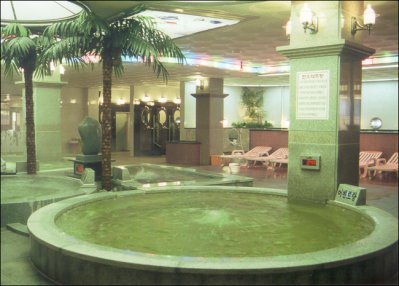
one variety of massage pool (안마탕)
The an-ma-tang (안마탕 – massage pool) appears in various guises. In some bathhouses this can be a large pool with a wide variety of hydrotherapy ‘stations.’ In such bathhouses large massage-baths will provide water massage to every part of the body including the soles of your feet. Usually they consist of some form of cubicle in which you stand or lay and after activating a button, are subject to powerful jets of water which will massage a particular area. Smaller pools produce massage jets at a lower intensity and over which you have to maneuver whatever part of your body is in need of treatment. Sometimes the pool has only one activation button and so the experience is shared while other pools have a number of individual births in which you lay and your own activation button.
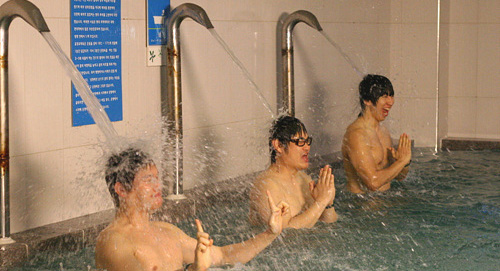
power showers, ideal for relieving tense back and neck muscles
These pools are great for treating muscular problems though for spinal related aches and pains, cold pools often have a very powerful shower that once activated you can move under to allow your spine and back to be thoroughly pummeled. There is a great variety in the nature of massage pools ranging from ones that are little other than jacuzzi, to ones that seem to vibrate intensely and rumble you internal organs producing an effect that feels like your are about to produce an enormous fart, to others which are powerful enough to give you an enema should you inadvertently put your backside in the line of fire.
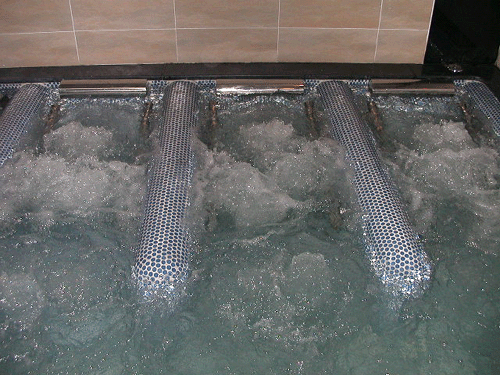
individual massage ‘births’
In Song-So, West Daegu, Migwang (미광) has a small massage pool but an excellent power shower in the cold pool. Hwang-So (황소) has a small ‘rumble’ type pool with 4 individual ‘berths.’ Meanwhile, the new jjimjilbang in Dasa (다사), Hyu-Rim-Won (휴림원), which is a short taxi or subway ride from Song-So Industrial Complex, has a very large and complex massage pool.
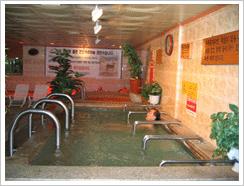
relaxing
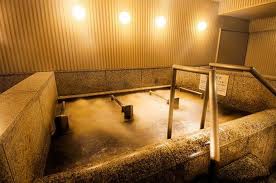
an-ma-tang (안마탕)
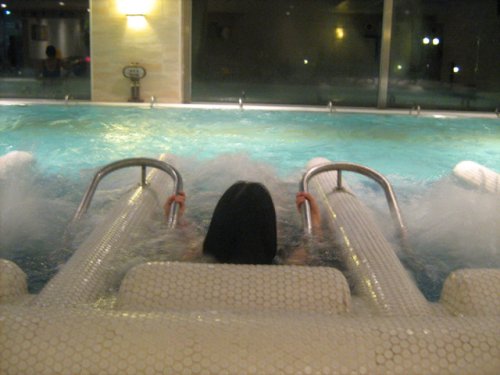
and with a window view
© 林東哲 2011 Creative Commons Licence.
A Few of my Favourties
I’m feeling lazy today and so I’ve posted a few of my favourite photos focusing on bad translations, most from Engrish.com.

5th place: This one is 'ten a penny' and I noticed today one of my local restaurants is serving 'crap meat spaghetti'
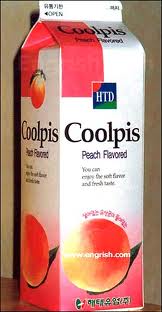
4th place: One away from Pocari Sweat'

3rd place: 'Yes, I can't' would have been a closer direct translation

2nd place: really?
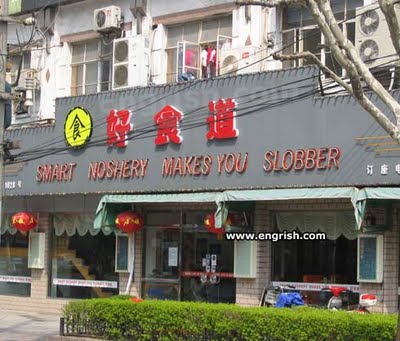
1st place: an 'all you can eat restaurant,' perhaps?
Just…(그냥) Funny Responses
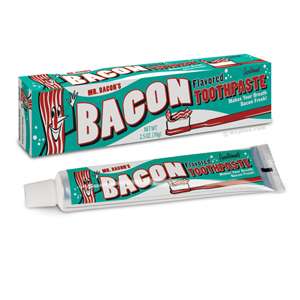
is this for real?
So, I gave one of my classes a quiz yesterday afternoon and a number of questions were on completing sequences. ‘Sunday, Saturday, Friday?’ I ask one student. ‘He replies, ‘yesterday!’
Later, I ask a student to describe ‘toothpaste.’ His answer, ‘toothbrush sauce!”
© 林東哲 2011 Creative Commons Licence.
Skewered King Oyster Mushroom (새송이 산적)
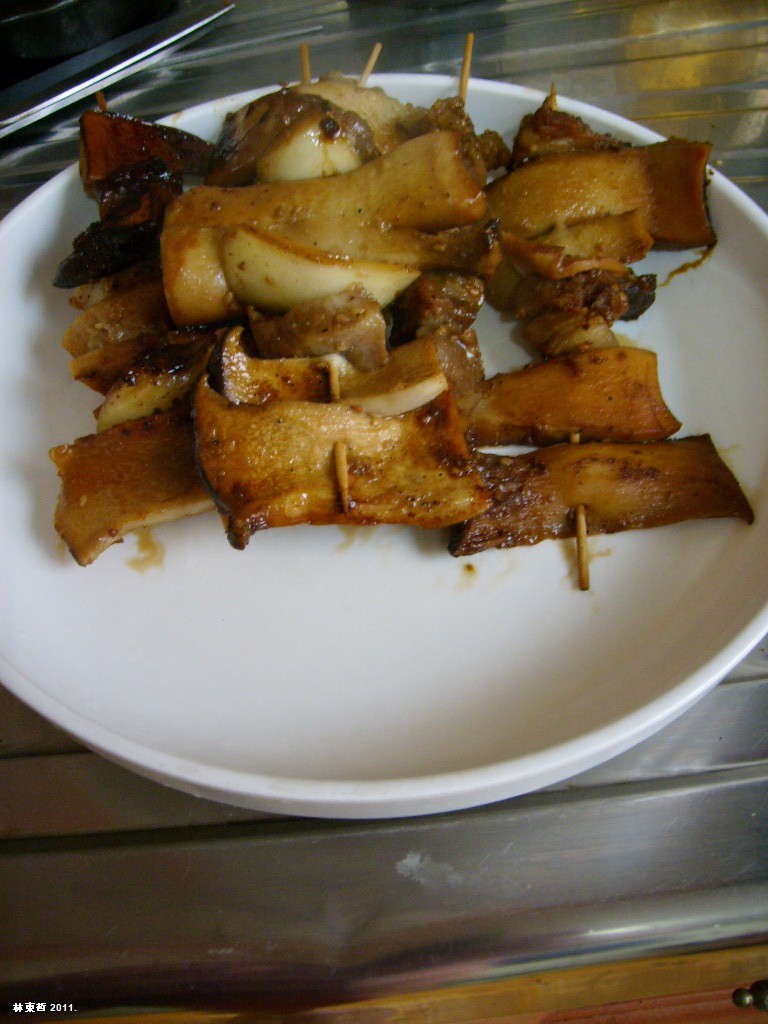
skewered king oyster mushrooms (새송이 산적)
Skewered mushrooms king oyster mushrooms (세송이) are delicious and easy to make. It’s a versatile side dish which can be adapted to suit vegetarians and lends itself to experimentation.

the king oyster is quite a meaty mushroom
You will need:
1. Around 4 king oyster mushrooms
2. Half a pound of beef or pork (but I guess it could be prawns or chicken)
3. 4 table spoons of soy sauce
4. 2 tablespoons of sugar
5. a couple of chopped spring onions
6. chopped garlic
7. sesame salt (or salt and some toasted sesame seeds)
8. black pepper
9. Skewers

wooden skewers (산적코지)
METHOD
1. Boil the mushrooms for a minute and then slice lengthwise about an eight of an inch thick.
2. Slice the meat the same way
3. Make a marinade of all the remaining ingredients and let mushrooms and meat stand in this for 2 hours.
4. Skewer meat and mushrooms alternately and broil them.

meat and marinade – add the mushrooms

skewered and ready to broil
© 林東哲 2011 Creative Commons Licence.


 Elwood 5566
leave a comment