Memi Update – (매미)Continuing my obsession…

Hot...
Two weeks ago (August 23, 2010), when the temperature in Daegu, the hottest part of Korea, hit 36 degrees, the memi (매미-cicadas) chorus screamed from the pomegranate tree and bushes near my one-room. I made a recording in exactly the same location as I recorded the first memiI heard, on July 7th, of this year. There was one day, Saturday 30th of August, when it was refreshingly cool with little humidity and a fresh breeze. That was a strange day as the memi were silent. It’s an interesting feeling to leave your one-room and the sanctuary of air-conditioning, to step out into intense sunlight that actually seems to have weight, and be surrounded all the time by muggy humidity and that incessant scream from the trees. In the two recordings here you can hear the different levels of intensity. In the second recording, on one of the hottest days of the year, the memi song was verging on painful.
Alternative Links
Link to Flickr video: On Hearing the First Memi of Summer, 2010
Link to Flickr video: Memi in Full Chorus August. 2010.
 © Nick Elwood 2010 Creative Commons Licence.
Feeding Mummy's Milk

Fab!
I’m often amazed at the blunders Koreans make in translating English and anyone who has lived in Korea even a short time will have amassed some great examples. In my writing, I write little Korean but I strive to make sure my spelling is correct. Conversely, many Koreans are quite happy to widely publicise something in crappy English, probably under the assumption that if you can tag an English sentence on your product or business sign, it is invested with greater authority. The gaff isn’t so bad, and can even be cute, on a mug or bar of chocolate; I have an old notebook on my desk on which is an enormous strawberry which a couple of years ago, when new, was scented. A caption under it reads: I’ve got a loaf of strawberries.’ But my favourite, from a packets of smoked salmon, reads:
‘Around June to September, in a something sun, 3-5 year old well-grown salmon that have brilliant gesture and swim through sea and river along the blue and dear coast of the Pacific Ocean have very good quality of flesh and taste so good and have got praised as food of low-calorie. More than one century salmon has got praise of epicures all over the world. Salmon taste from soft to strong with many nutrients and special pink colour flesh create fantastic mood and taste.’

Nursery rhymes
Ironically, the crappy English actually spurs my taste buds in anticipation of that creamy, special pink flesh, unfortunately eaten many years ago. But when the ‘company’ or individual is involved in English education or aspires to be ‘educated’, it becomes a glaring error upon which an astute reader is going to base a value judgment. Online commentary on anything regarding education demands careful checking in terms of vocabulary, grammar and spelling and should one make even the slightest mistake, it can be expected that no matter how sound the argument, your credibility will be vaporized.
I quite like nursery rhymes! No! I don’t wander around my one-room singing them to myself but as a musician, I have an appreciation for their catchy melodies. The English composer Roger Quilter wove a very successful overture, a Children’s Overture, out of nursery rhymes which I frequently happened to play as a flautist in the British Army. Quilter was a student of the extremely eccentric Australian composer, Percy Grainger.
A year ago I bought a a set of two CDs in E-Mart, badly named, English Chants and of course, a nursery rhyme is nothing like a chant. However, out of the 160 songs, I thought I was sure to find a few of use especially with classics like Humpty Dumpty, Hickory Dickory Dock and Polly put the Kettle on, included.
It was only in a bout of boredom that this week, I perused the titles of the other songs:
Time to stetch – your guess is as good as mine but I’ll go for ‘stretch’.
Going to the friend’s house – no comments!
Going to the Pediatrician, Going to the ENT Doctor and Going to Orthodontist, presume the child is both acquainted with medical terminology and of a sickly disposition.
Going the Department – I can only guess is meant to be a ‘store.’
It’s a snack time – it amusing.
Want to go Potty – Who? Hilarious
Going Back from School – simply confusing!
On birthday – and whose birthday might that be?
But the king of all gaffs is, Feeding Mommy’s Milk. One still has to ask, ‘feeding mommy’s milk’ to whom? And the lyrics are classic:
Are you hungry? Are you hungry?
Feed mummy’s milk
And taste it good.
Sucking. Sucking. Sucking. Sucking
Mummy’s milk is good.
Are you done?
Hear it for yourself – drinking a glass of milk, especially with a straw, will never be the same again!
Click link below:
© Nick Elwood 2010 Creative Commons Licence.
Emergency Dump!
You’re not supposed to write pooh stories! Actually, a few months ago someone made some nasty comments about an article I wrote about pooh humour. Anyone who has a problem with pooh stories is simply anal and needs to loosen up! Anyone who has traveled outside the domain of Club Med 18-30, anyone who has had to eat a drastically different diet or squat and then clean their bum from a tin can of water using their hand, knows the subject can be very entertaining and is well worth writing about, for all sorts of reasons.
Every Friday, I eat lunch with my boss; not an occasion to talk about pooh! Usually we go somewhere a little further afield than the area in which we live. I’d woken up early and started working straight away and didn’t each breakfast until around 11 am, which was no problem – except I’d cooked bean soup (된장 치게) and eaten it with some kimchi and acorn curd (두투리묵). The fuse for such food, especially without rice, depends on the individual, but mine is about an hour. If liquids are consumed, and I’d had several cups of coffee, it can be as little as 45 minutes. But I so engrossed in my writing, I was completely oblivious to my mistake.

Pooh on a bag
My boss calls at 11.30 and we drive off to the area fronting Keimyung University. Fifteen minutes later and we are sat in chicken bar. Its predominantly a beer bar that sells chicken by night and predominantly a chicken bar that serves beer in daylight hours, they’re all over Korea. The chicken is drenched in spicy sauce, or is fried in batter or perhaps served with a sweet soy sauce and a beer swishes it down nicely but, I never drink before work.
I’d felt the warnings on the brief walk to the restaurant but it hadn’t clicked and I was thinking they’d disappear but they actually intensified. I began to perspire. There was the panic too, because you know that when in the grip of needing to defecate you will do it anywhere; in your pants, squatting behind a car in public and even bent over in your bedroom holding your backside in a plastic shopping bag. This is almost my fourth year in Korea and I’ve never had to crap in any other toilet than my own unless in a hotel or the comfort of someone’s home. I’ve never had to take my chances on the street where, unless owned by nice restaurants or western style eateries, you can guarantee toilets are going to be grim.

About to explode!
There have only been a two occasions in my life when the fuse has been so short that I’ve only had seconds to find a toilet. Once was in Osnabruck, Germany, after a military exercise when all the toilets in my barrack block were occupied. I had to pooh in a carrier bag in my bedroom and that was illuminating as you never realise how hot and heavy a pooh can be until you hold one in a bag. The next occasion was some 20 years later, again in Germany, in a small town close to Bonn. That was out of the blue; one moment I was fine walking through a quaint little village with a small stream running through the center of it, next moment I had seconds to find a toilet. My third ordeal had just started!
‘I’ve got to use the loo!’ I announced and immediately made for the back of the restaurant. We should have chosen a more up-market location as the toilet was shared by several establishments and not easily reached. I found it with thirty seconds to spare and of course, not only was it a squat down job but there was no toilet paper. But I’m good, ex-military good and before I’d even got to the door and discovered conditions, I’d covered my options. My jeans and shoes were off within seconds and having already spotted the hose in the small garden that lay close by; I turned it on an dragged it into the toilet wedging the gushing end down the drain just inside the toilet door. Then, I closed the door, took off my boxers and a second later, in one expulsion, my late breakfast was reincarnated. As I was hosing my arse and swishing the bean soup into the sewers of Daegu, I suddenly realised what had caused my upset – my badly timed, watery breakfast! Drying my arse on one of the large hankies I use in hot weather, I quickly got dressed, repositioned the hose and washed my hands. Although the toilet was was grotty the soap was actually quite nice. I hadn’t even got my feet wet and neither had I crapped on my heels which is always a danger on a squat loo and is why I take my pants off! And by the time I got back to my table, a lovely plate of spicy chicken awaited.
© Nick Elwood 2010 Creative Commons Licence.
Giving Summer the Finger
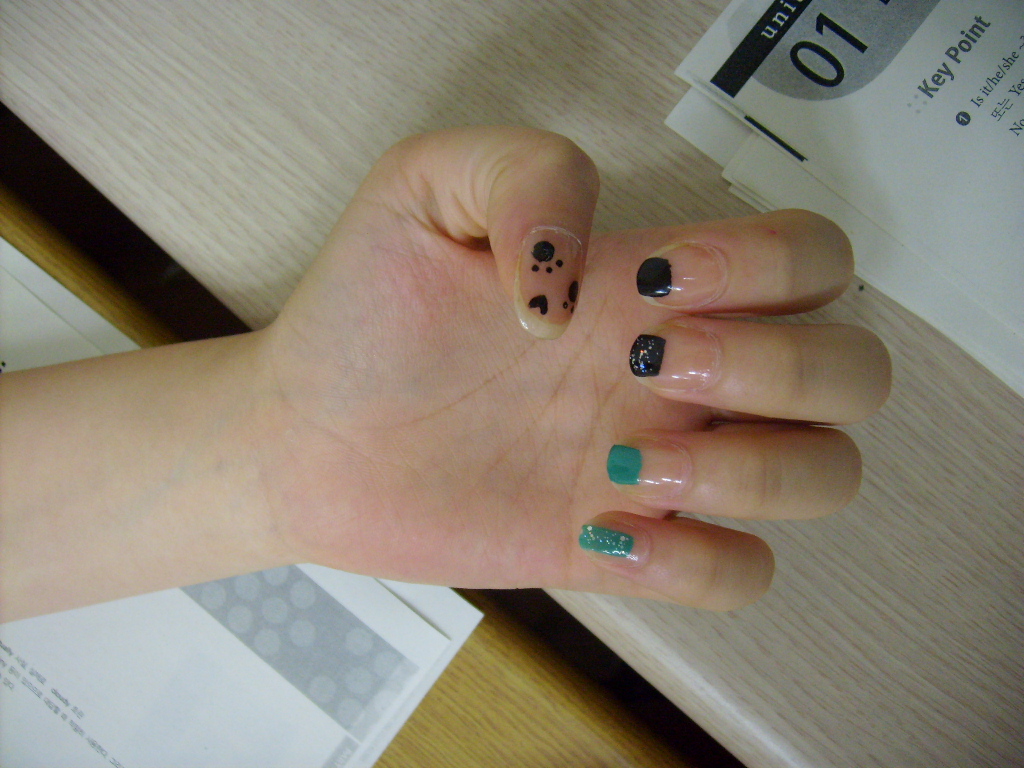
Goodbye to all that!
The summer holidays finished last week and one of my students notes in his diary.’This week school finished and we had to change our hair and faces.’ Gone are the ‘poodle perms‘ the vibrantly painted finger nails, ear-rings, temporary tattoos, and dyed hair. Unlike many western countries where teachers battle with hair styles and make up, in Korea it’s all removed before the term starts. Of course, Koreans will tell you the same battle ensues in their schools but they are skirmishes in comparison. I’ve taught one boy who was forced to run 10 times around the sandy ‘parade ground’ in only his boxers because his trousers legs were too narrow, and a beating because your hair is a centimeter too long isn’t uncommon. And the ‘budgerigar club’ that exists in every British secondary school (ages 12-16), little cliques of girls who sit for hours on end brushing each others hair, moronically starring in mirrors and slapping on cheap make-up like little Jezebels, all during lessons, is in its infancy.

Painted nails

A little re-touch needed
The irony, of course, is that school never really finished and the vacation that was, was never really a vacation. One of my students spent the entire summer at a cram but claimed he loved it. Packing your son or daughter off for the entire summer isn’t what I’d do if I was a parent. Another boy spent two weeks in a military boot camp, ‘thanks, mum!” Another three students, siblings, spent the entire summer in an English school in the Philippines but their English is no better than when they left. So, with summer drawing to a close it’s back to the study routine, constant tests, the after school classes and reading rooms and don’t forget piano lessons and taekwon-do! As for the poor the third year, high school students (고삼), they have the biggest exam (수능) of their lives looming. An exam which will not only determine their academic future but very possibly the background of their future partner as well as their occupation. DD (‘D’ Day), and that’s exactly how Koreans identify it, is 76 days away and every third year student will be counting. Their vacation was great! They didn’t have one!
© Nick Elwood 2010 Creative Commons Licence.
‘Flower Boy’ Flesh – The Quest for the Tastiest Dumpling. 박재범 (Jay Park)
My female students largely advise me on which boys are the sexiest but the problem I find with Korean youth fashion is that celebrity boys tend to have a range of images rather than one. So, in some photos they look rough and ready, in others more like throwbacks to the UK of the 1980’s, typified with big hair and frills and at the furthest extreme, their campness borders on transgenderism. In the middle and toying with the androgynous, is handsome or pretty.
I have to admit, I have little interest in Korean pop music (K-pop) and like the western equivalent, most of it is superficial shite. However, the K-pop industry, is one of the largest pop industries in the world and in terms of production and choreography, incredibly well produced and slick. There are undoubtedly plenty of other sites providing information, gossip and images of the current ‘artists’ and the purpose of this corner of Bathhouse Ballads is purely, and superficially, to introduce a little eye candy and a light, visual insight into the ‘Flower Boy’ phenomenon. (Clicking the following link will give you background information on the significance of ‘Flower Boys’ and ‘Tastiest Dumplings.‘)

Jay Park (박재범) – Handsome or Pretty? Or even pretty handsome!
One of the tastiest dumplings qualifying for Flower Boy Flesh is Jay Park (박재범), a 22 year-old 3rd generation Korean from the USA. Jay Park is surrounded by scintillating intrigue all of which can be read at Wiki. He even topped the Twitters chart on the day of the Oscar Awards. He sang in the boy bands 2pm and 2am and currently is pursuing other projects.

Mmm…getting a little too 80’s. That collar thing is a too Wham.

Getting tougher
Korea meets the Ghetto. Not my scene! I think the tats are temporary which is cool because permanent tats are rank. Only flower boys can wear temporary tats but the Catholic theme is horribly tacky and on a par with blessed furniture spray and luminous rosary beads. Hopefully a shower excommunicates it. The hair is horrid and the side-panels on his head remind me of a skinny Mr T from the ‘A Team.’ Educated in the USA, he probably knows all about naughty things like drugs, being disrespectful, underage sex and sexually transmitted diseases, though looking Korean one can have hope that he is really a nice boy. He can certainly look it but unfortunately, not on this occasion.

Mr T. Blinged to the max in the days before bling was bling.
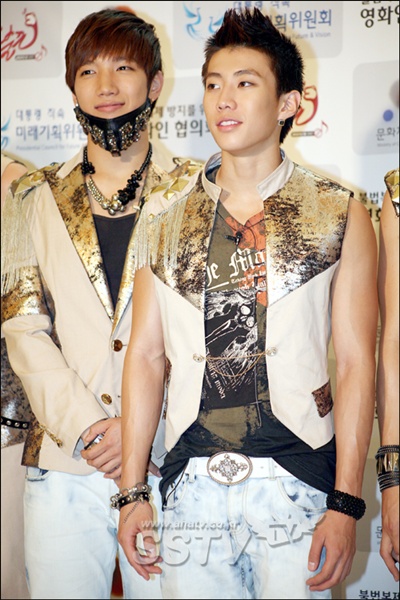
Are you looking at the same thing as I am? What the fuck is it?
Okay, Jay is looking pretty pretty and somewhat handsome but my attention is drawn to that thing the other guy is wearing. What the fuck is it? A fancy face mask? A sequined gas mask? A fake beard? One of those things a belly-dancer might wear or is it possibly one of the Wonder Girl’s, Satan’s Panties? Whatever it is, it looks kinky and completely kills Jay’s handsome physog. Thank God he isn’t wearing one!

Handsome? Probably!
And then you notice the silly thing on his head which instantly reminds me of the Korean habit for spoiling something tasty, like putting jam on a cheese, ham and salad sandwich or dipping your hot-dog in sugar!

Dominant! Say no more!
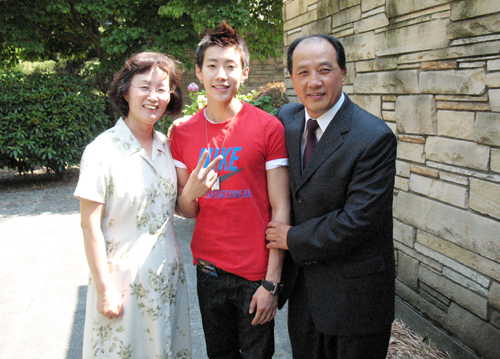
Somewhat cute – but it’s not Jay Park but Nich-khun
And finally, for a glimpse under his T-shirt…

Revealing – the tastiest dumpling!
Links for Jay Park:
© Nick Elwood 2010 Creative Commons Licence.
Grapes – 포도. Monday Market

Grapes – Autumn is approaching!
With the scent of black grapes drifting on the air, you know that autumn is not to far off. Korean grapes are quite different from varieties available in Europe; the skins are much thicker and slightly chewy and often removed. The flesh is juicy and sweet and the seeds, big, crunchy and bitter. As a fruit, I certainly prefer the seedless variety but the juice of Korean grape, usually the Kyoho grape, is ‘thicker’ and carries both the scent and taste of the grape British children will be familiar with. Personally, the smell and taste of Korean black grapes always reminds me of Pez candy, which was popular when I was a child. Korean grape juice is very popular as is Welch’s Grape Juice. Welch’s is an American company which uses a variety of grape, Concord, which is similar to the Kyoho grape.

Korean black grape juice
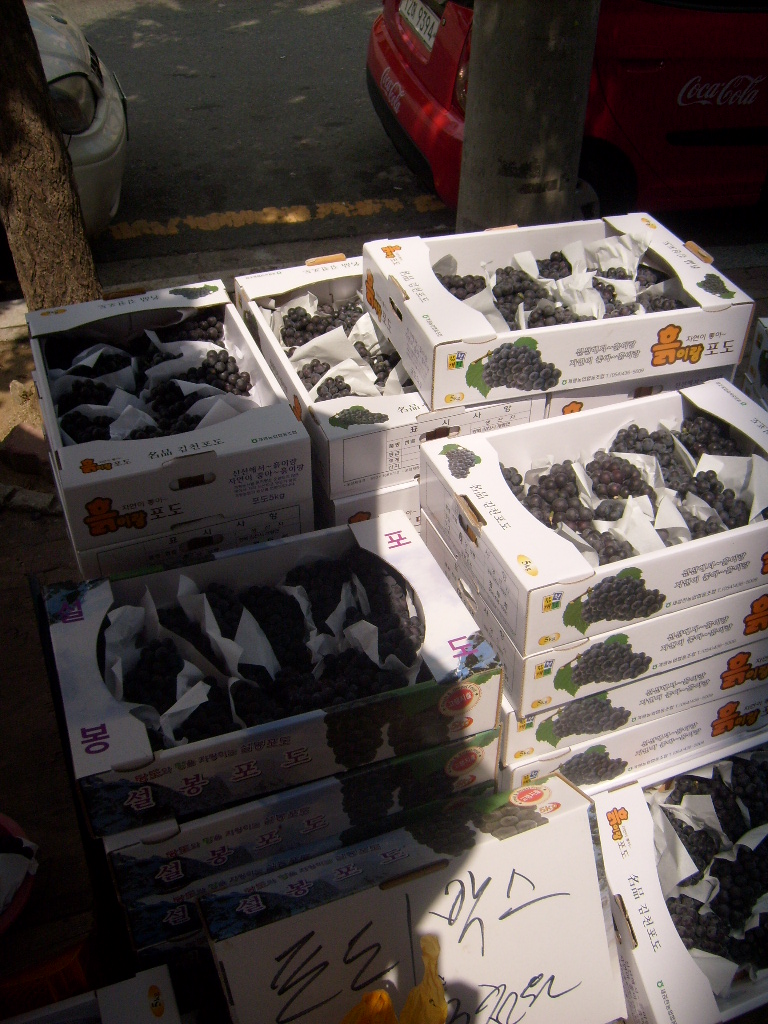
Grapes, fat and juicy
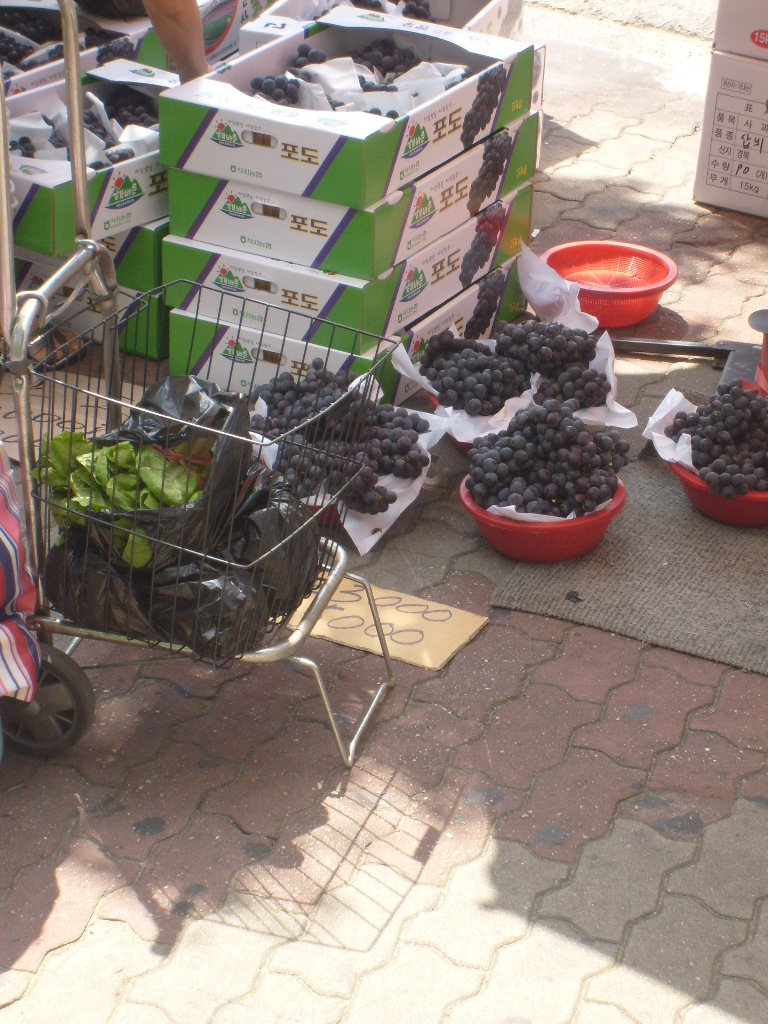
Grapes in the shade

Remember Pez?
© Nick Elwood 2010 Creative Commons Licence.
Kimchi-ism
It smells bad, it can taste revolting, and is a major cause of conflict in university accommodation kitchens worldwide, where the sharp smell oozing from refrigerators upsets non-Koreans. It hangs on your breath with greater offence and persistence than any French gastronomical delight. Garlic can certainly be rude but enhanced and enlivened by numerous chemical processes and suspend in cabbage water and the pungent juices of fermented anchovy, the power to offend becomes a chemical and biological capability. Nothing is polite about it, it is totally ‘in your face’ in its onslaught of your taste buds, nasal passages and doesn’t look too pleasant either. It lacks any refinement or subtlety and amongst ‘offensive’ foods ranks as a weapon of mass destruction. You wouldn’t gorge or binge on it, indeed I wouldn’t even call it delicious and I could certainly live without it. If I were to be isolated on a dessert island for a year it wouldn’t be on my list of essential items. And yet paradoxically, it is one of the most exciting taste sensations in the world. If there is one food so aptly capable of defining a nation, so synonymous with a people, it is cabbage kimchi(배추 김치).
There are many types of kimchi, and of those types many variations, and of those variations many permutations depending on a range of factors. Kimchi is one of numerous Korean, fermented foods, others including makkalli, bean paste (된장), and soy sauce (간장). Only when kimchiis old enough for the initial processes of fermentation to have ceased, will the flavour be consistent. At all other times, you can’t eat the same kimchi twice as the taste is always in a state of transition. Canned and packeted kimchi are available but these should only ever be eaten as a last resort. Canned kimchi, often from China, is especially disgusting!

Welcome to Korea!
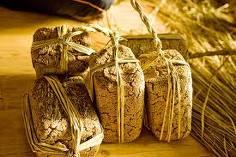
Traditional fermented beans (메주)
The most popular type of kimchi, and the one most armed in terms of offensive capability, is cabbage kimchi (배추 김치). Cabbage is well known for its powers to unleash unpleasant odours once its fibers have traversed the intestinal tract and are approaching a transmuted reincarnation via the human Cloaca Maxima. With cabbage kimchi however, your digestive organs can take a break as most of the chemical process which release those aromas, have already been activated and are in a chemical flurry approximate to final stages of processing via the large intestine. Indeed, I would go as far as suggesting that function of that plastic Tupperware tub or kimchi pot in which kimchi is stored upon being made, is basically a portable large intestine containing the numerous biological processes. In that Pandora’s box of mischief: the most infamous kiss-killer of all, garlic, is present in its most potent form, crushed! Added to this is minced ginger, a Korean type of chive (실파) and mooli (무) which while not individually notorious, collectively possess powers of repetition which help strengthen the garlic and intensify its potency. Even at this stage, a burp of this concoction is lethal. Added to this, is the cabbage which after having been submersed in salted water, is already chemically active.
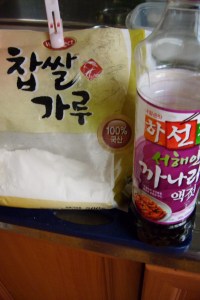
Kkanari - fish sauce - the concentrated odour of a million sweaty feet
The addition of fish sauce, (액젓) famous across the Asia, which is another fermented product made from anchovy or kkanari (까나리 – sand lance), completes the recipe. Of all the noxious odours added to kimchi, anchovy or sand lance sauce is the most vile. I’ve often entertained myself by inviting guests to sniff an open bottle as I’m casually cooking, with a little encouragement such as: ‘smell this, it’s lovely,’ or, ‘this has got to be my most favourite smell.’ Usually, a good whiff will propel them back a few meters with as much force as would a couple of hundred volts of electricity. Once amassed and fizzling away, the flavours and smells blend in a process which can last a considerable amount of time, depending on temperature.
Comparing the kimchi pot (김치독) or Tupperware tub to a colon is not an exaggeration. I have slept in the same room as as my gestating kimchi and in the first week of fermentation, gasses produced within the Tupperware colon would cause the lid to pop-off about once every twenty-four hours. If this occurred at night, the escaped aroma was initially enough to wake me. I have since become quiet comfortable sleeping in the same room as fermenting kimchi and find the smell highly evocative – ironically, not evocative of life in Korea, but life back in the UK where living with friends necessitated containing kimchi smells to my bedroom and not the shared kitchen.
Kimchi encapsulates Korea at many levels. Many countries have a national food with which they are identified: Italy – pizza, Germany – sausages or sauerkraut (which is also fermented cabbage), France – smelly, soft cheeses, frog legs, snails and cordon-bleu cooking, England – fish and chips, roast beef and tea, Scotland – shortbread and haggis, but few have the ability to represent their nation with such precision as does kimchi. While kimchi comes in blaze of spicy colour, the foods of other nations, delicious as they are, remain purely monochrome.
Kimchi is a pot-pourii of Korea, a culinary collage of so many integral Korean elements – garlic, ginger, Korean chili powder (고추 가루), mooli (무) and fish sauce. These ingredients are the basis of almost all Korean cooking and representative of so much of the peninsula’s farming. You can hardly step in a direction without seeing pots of chili, patches of mooli and even on the mountains sides I’ve seen small plots painstakingly hoed out of the rocky soil, blossoming with such vegetables. Local variation on the cabbage kimchirecipe, as well as banchan side dishes in general, and most other Korean foods, adds a further interesting dimension. While many national foods are now factory produced, often resulting in grossly inferior products (shortbread is a good example), kimchi, even when sold in markets, is homemade and its production evokes a great sense of pride. Korean women, and even some men, are proud of their kimchi making prowess and whenever a gift of kimchi is given, it should be respected.
The making of kimchi is very much determined by the seasons with particular kimchibeing made at certain times of year, and for cabbage kimchi, this is late Autumn to early winter. One of my most memorable images of Korea was seeing an enormous stack of Chinese cabbage (배추) outside Shinoo Supermarket, in Song-So, swathed in wintry mist and beside which a couple of store workers huddled around a bonfire burning on the pavement. I’ve never see such a sight since. And when it is time to make kimchi, members of the family or friends, sometimes communities, females more than males, are brought together.
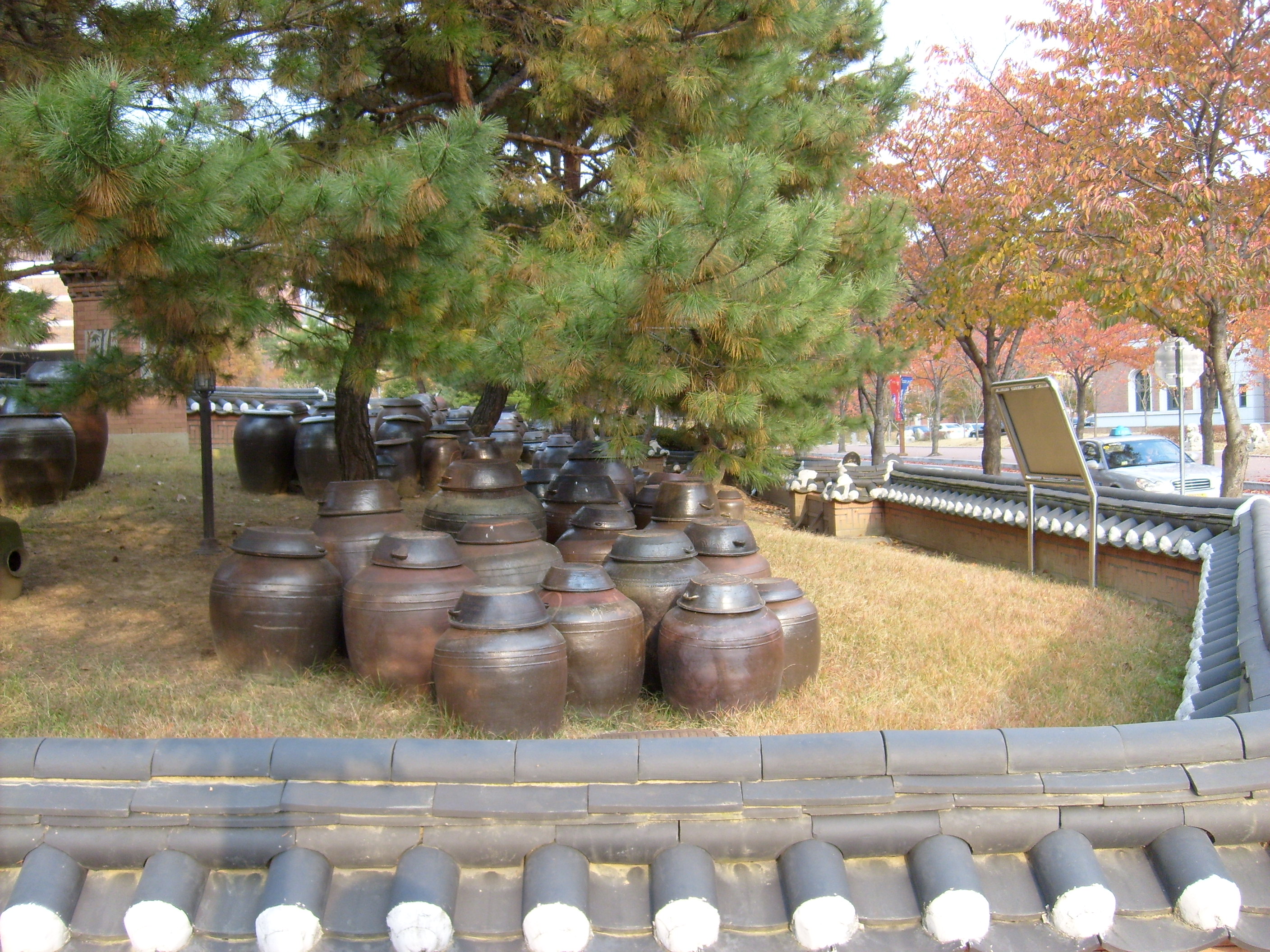
Kimchi pots (김치독) at Keimyung University
There is always a random element in kimchi production, something beyond the control of the ‘cook’, and hence tasting the final product is always an exciting moment. Like making English tea, you can follow the recipe and time the brewing meticulously, but the production is influenced by factors beyond the recipe, it might be the temperature, the humidity or the quality of ingredients of that particular season. Part of the fun involved in kimchi making is the pursuit of perfection in the light of random influences. And if the kimchi itself isn’t synonymous with Korea, the pots (김치독) in which it is traditionally stored, can be seen sitting in vacant corners, on rooftop and apartment verandas across the entire peninsula. The kimchi pot is as Korean as soju, mountain temples and the cawing of the magpie and their production an ancient and noble art. But the making of kimchihas also kept abreast of modern developments. Kimchi has traveled into space and the kimchi refrigerator is now a popular sight in many Korean homes.

My kimchi 'colon'
Learning how to make kimchi and any of the extensive range of side dishes collectively known as banchan (반찬) and of which cabbage kimchi is the King, is difficult. In my area of Daegu are three small shops which produce homemade banchan but they staff don’t like being photographed or watched whilst working. My grandmother, the daughter of a Scottish baker, was just as defensive about her shortbread which was superior to any factory produced shortbreads.
Waygukins and Koreans alike will never grasp the potential of their smelly delicacy until they are able to eat and smell it in isolation, basically, outside of Korea. Like, garlic, the best defense from the offensive smell is to ingest it yourself and once you do that you no longer notice it. You can walk in and out of Koreans homes and their restaurants and never really smell kimchi and yet the whole nation reeks of it and everywhere everyone chuffes out its pungent odours. The only reason you don’t smell it is partly because you have acclimatised to it and because you eat it. I remember arriving at Kimpo International Airport after a holiday, and as I walked into the arrivals hall I suddenly noticed the smell of kimchibut no sooner had I noticed it, than it disappeared. But if you visit Korean friends in the UK, or they visit your house, the odour of kimchiand of garlic is very strong and even unpleasant. I often notice how Korean Air and Emirates, provide Korean meals and kimchi on flights into Seoul and wonder if this is to acclimatise passengers to the guff of garlic and kimchi, prior to landing.
The taste of kimchi has a bizarre appeal and every Korean has a liking for a particular type; for some it’s fresh kimchi in which the fermentation hasn’t really started, for others it’s the tangy bite of old kimchi which draws your tongue like cold tea or strong red wine. And it can be used in a multitude of ways: barbecued, added to stews, used for soup, put into pancakes, fried with rice, minced into hamburger patties, rinsed in water and added to cold soups chilled with ice cubes. When the fermentation process has stopped, and kimchi is left standing, sometimes for months, it is often attacked by a glueppy white mold which lays over the uppermost leaves. At this stage the kimchi is at its sourest and is ideal for cooking kimchi stew (김치찌개), the mold simply being washed off. I don’t think any westerner truly enjoys kimchi first time, but the more we familiarise ourselves with its guises, idiosyncrasies and long and ancient history, the more entrenched our love affair with it becomes and the more we defend it to those barbarians who claim it stinks or tastes revolting!

Kimchi Stew
Twisting and weaving into Korea’s distant past, like one of the gnarled and knotted roots on the mountains, Kimchi, like its people, has endured and adapted. Originally it wouldn’t have contained chili, this being an addition sometime after 1500, when the chili plant arrived in Korea. Of all the foods capable of representing a nation, kimchi is the most personal, the most intimate and the most capable of embodying Korea. It transcends simply being a product of the soil, its production etches out a seasonal calendar, it brings families and communities together, it provides both national and regional identity with space for a little individual flare, and at tables across the country people bond as individual batches are critiqued, compared and celebrated. Even the frosty bite of winter and the hot balmy days of hanyorum (high summer) have a role to play in determining the flavour. In the past, Koreans believed that the foods that suited individuals best were the ones grown in the soil in which their ancestors had both toiled and been buried. It was the ‘fruits’ of the soil which powered families across the generations. When companies produce canned kimchi, or even packeted kimchi, they grossly miss the mark because not only is it supposed to be alive and active, but it has to be Korean. Dead kimchi, kimchi castrated of its chemical process is not kimchi and indeed Koreans have taken foreign kimchi producers to international court over such issues. You can eat French brie or Camembert made in Spain and probably not notice a difference, but kimchi that is dead or not even from Korea, is simply not kimchi.
Useful Resources:
Beyond the Blog – Maangchi: Queen of Korean Cooking
© Nick Elwood 2010 Creative Commons Licence.
Bathhouse Basics (7): The Naeng Tang (Cold Pool 냉탕)

The naeng tang (냉탕)
If there is one pool, usually the biggest, you are guaranteed to find at every bathhouse (목욕탕), it is the naeng tang (cold pool – 냉탕). Naeng tang are also often the deepest pool in bathhouses, usually as deep as an average adult’s waist and with the pool length, long enough to be able to swim in.

The cold pool (냉탕)
In summer, they are wonderfully refreshing and for many bathhouse goers, moving between a hot sauna or hot pool to the cold pool is a great sensation. Lounging in the cold pool on a hot summer’s day, before you exit the bathhouse complex to ‘powder’ and dress, will help delay the inevitable onset of sweating.
The temperature of naeng tang pools tend to vary between establishments though this is probably more noticeable in summer. Many bathhouse pools and sauna display their associated temperatures but this is not so common with naeng tang. Throughout the hot summer the cold pools are busy and their size and depth means they are often the playground of boys and even university students.

My favourite pool
In mid-winter however, the fact they are freezing means getting into one can require Spartan constitution; they are cold enough to knock the breath out of your lungs. Often the pool has a large shower which can be turned on by an adjacent button and which is powerful enough to massage your back and shoulders. Its force takes a little getting used to.
© Nick Elwood 2010 Creative Commons Licence.
Boring Boryeong and 'Waygukin Wankers'

Spot the Korean
Let me get my disclaimer out the way to begin with! Yes! there are plenty of decent, thoughtful and interesting waygukins in Korea and some may very well have visited Boryeong, but this post isn’t about them. This post is about the other types of waygukin, the ‘waygukin wanker’ types who generally ignore other westerners, have no significant Korean friends, have boarded the bus to Boryeong, and like to moan about Korean people and culture about which they like you to think they know everything.
I occasionally ‘rant’ about the unfriendly nature of many waygukins in Korea, it’s one of my minor idee-fixe. Two weeks ago, I had this idea to start a ‘waygukin wanker of the month,’ post in which I’d feature a photo of one of the numerous wankers around Song-So who will totally blank you if you pass them. I’ve lived in the building next to one for almost two years but even if we pass on an empty street, shoulder to shoulder, he will ignore me. I said hello on one occasion but he simply diverted his gaze to the floor and mumbled inarticulately. So, on one hot Friday afternoon, I stood for an hour waiting to get his photo but unfortunately he failed to turn up and missed the chance to be immortalized on my pages. I haven’t seen him for two weeks and am beginning to assume he must have gone back to wherever. Good riddance! However, there are plenty of other candidates to replace him.

Courtesy of Roketship (link)
Maybe ‘waygukin wankerism’ is a disease, possibly contagious, and if so, one of the most potent sources of contamination has got to be the Boring Boryeong Mud Festival. Bogland is full of boring accounts written by waygukin who assume they know all about Korea once they set foot on Korean soil and whose search for the spirit of Korea, it’s traditions and an understanding of the Korean psyche, lead them to splash about in a bit of dirt chucked over a sheet of plastic on one of the only holidays of the year. If I had a list of a 100 things I want to do in Korea, the Boryeong Mud Festival wouldn’t even be on it. Even one of my closest Korean friends, who is 25, said it was disappointing with watered down wishy-washy mud piped onto plastic sheeting. But, he was impressed with the army of waygukins as he felt they provided the festival an international atmosphere.
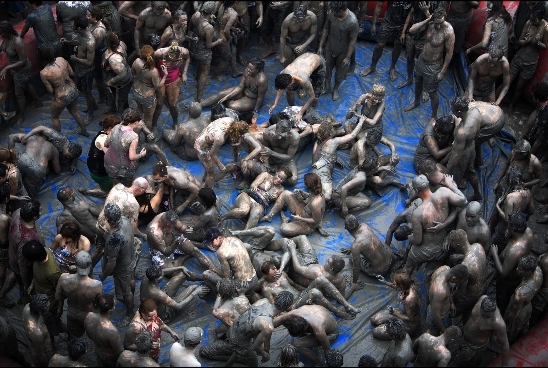
Lovely plastic sheeting
Boryeong is as typically Korean as the Costa del Sol is Spanish or, Tijuana is Mexican and any place which attracts an army of waygukins should instantly loose its appeal especially because it’s the sort of ‘safe’ crap you do on a 18-30 cheapo package holiday to some place with bags of sun, sand, sangria and bouncing tits. It doesn’t attract interest because it’s Korean but because it’s the hip place for waygukins to go and which can be blagged about to mates afterwards. Those who like Boryeong probably find appeal in the likes of: Ko Phi Phi Le, the Costa del Sol or Costa Med, and Ibiza and other shitty destinations catering for the unadventurous, en-masse. I find it amusing how so many foreigners will cue to take the bus to Boryeong yet are terrified of a trip to the local bathhouse which will provide a far more rewarding insight into Korean life.
Talking to a waygukin or two is fine, except most can’t talk, and having a beer with one is even better, I desperately miss the sense of humour, but slopping about in diluted mud with a million of them!! No thanks! I came to Korea to escape wanky-ways and in particular wanky British culture, which doesn’t mean I don’t want talk or socialise with English speaking westerners per-se. I’m always on the look out for new friends but finding a western human who will talk is difficult. The last waygukin I swapped phone numbers with, declined an invitation to the cinema because he believed Koreans would perceive two men together as gay.
Boryeong should be towards the bottom of the ‘to do list’ but I suppose Korea is now such an easy country to live in, bilingual signs and menus, tourist information booths, a wealth of information on the internet that didn’t exist 8 years ago, a modern international airport, all the major fast food chains, etc, that gone are the days when only the more adventurous risked coming here. It’ll soon be time to move on!
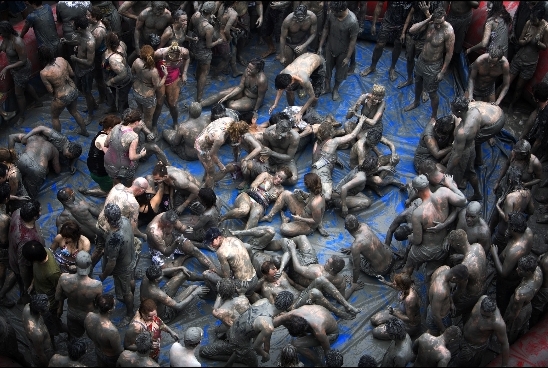
Too many westerners! YouTube link
© 林東哲 2010 Creative Commons Licence.
‘Waygukin Wanker’ Hub
My post: Boring Boryeong was in the pipeline for almost 3 weeks and I hesitated to publish it as I wasn’t sure if the lack of communication I have in Korea with other waygukin was something to do with me. Then I read a post in Hamish Nelson’s, Bongdam South Korea and I realise other waygukins notice it as well. For all the interaction I have with fellow westerners, I might as well be back in Britain because you are ignored there, too, except back home you expect it! When you only pass a couple of westerners a day, a little politeness would be friendly. The irony is that often when I do get an unfriendly waygukin to speak, they then moan to me about how unfriendly Korean culture is….boh-hoo-hoo, wanker! Go home!
I am now going to add links to any posts here, which deal with the subject of unfriendly westerners.
Thanks Hamish! Your post is first! I will now hit the publish key!
POSTS FOCUSING ON UNFRIENDLY, SLOVENLY WESTERNERS.

Link to Roketship
Roketship is an excellent source of humour on the experiences of living and working in Korea.
Prestige Korea . Don’t Greet Other Foreigners on the Street
© Nick Elwood 2010 Creative Commons Licence.


 Elwood 5566
2 comments