The Rainy Season (장마)
The rainy season, known as the changma (장마) has arrived and will last most of June and July after which the hanyorum (한여름), the hottest period of summer with high humidity and temperatures reaching 38 degrees, will set in. The changma will produce 60% of Korea’s annual rainfall in less than 2 months. This period is typified by torrential rain which provides a momentary coolness before the humidity rises uncomfortably. Daegu is the hottest part of Korea during the summer.

Rainy season chaos
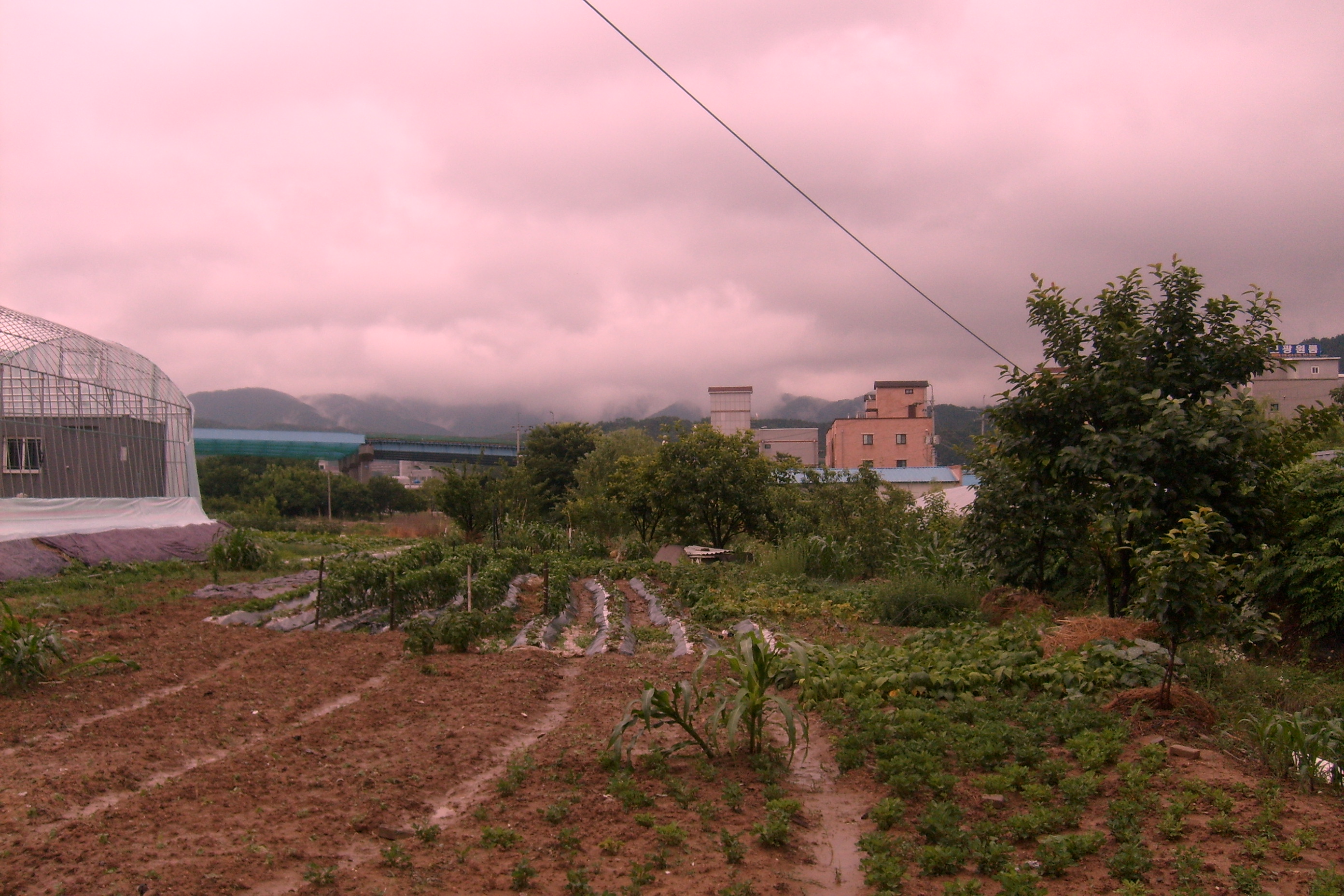
Start of Chang ma June 17 2008, Ch'eonan
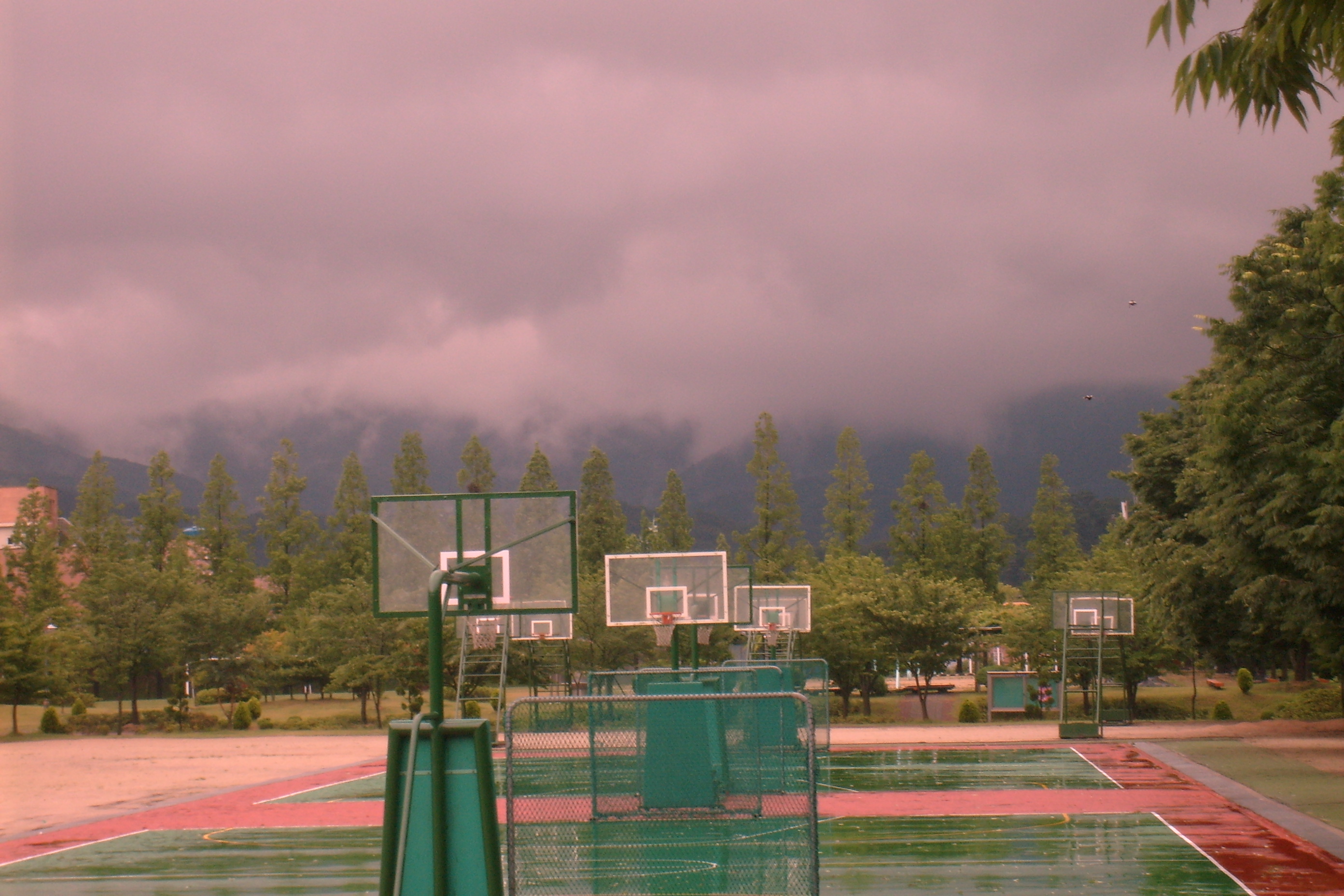
Rainy season over the basketball courts. June 17, 2008 Ch'eonan
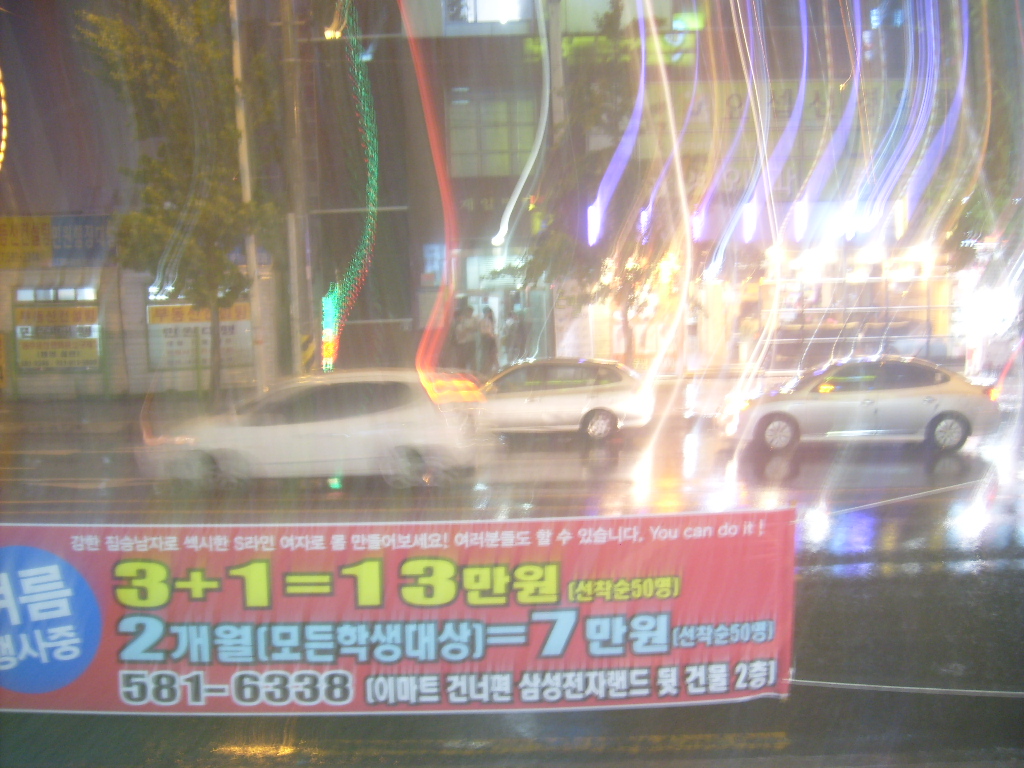
Start of the rainy season, Daegu, June 15th, 2010

This work is licenced under a Creative Commons Licence.
Useful Hanja Sources 漢字
Hanja
I am absolutely no authority on hanja, the 1800 Chinese characters which have entered the Korean language and appear fairly frequently in newspapers and on hoardings. Everything I have learned about hanja has been self taught and probably pretty pointless given that I could have used my time increasing my Korean spoken ability – which despite much endevour is still totally at the totally beginner level. So, the sole purpose of any posts on this blog is to share information with others who are struggling to find meaning in those beautiful squiggles. This process is fraught with problems as I have never had the luxury of a ‘teacher’ who has been adept enough in English to render character meanings with precision and clarity and hence I find myself dragging bits of information from various sources few of which are designed for purely English speaking people.
There are numerous children’s television programs designed to teach children hanja, all of course, in Korean, and often based on the Thousand Character Classic. (千字文), as is a children’s play.
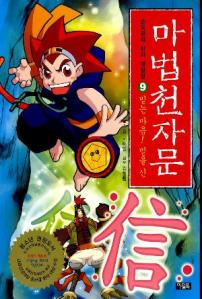
Link to: '문법천자문' Advert for the series book based on the 'Thousand Character Classic'
I’m quite sure this comic series has been produced for television and I’m currently trying to track it down. Another useful source, a series of lectures for adults, can be found on Daum. As expected, it is in Korean. (http://pino.peeringportal.co.kr/pino/install/check.htm) The Daum site has a number of lectures and if the blue pop up blocks the screen, press the white characters (이곳) and then the blue arrow exposed underneath.
A book is also available which is used in many middle and high schools (생활 한자 쓰기 교본) which cost about 5000 Won. It provides fairly straight forward visual guides lines for the balancing of the various components within a character. This is is particularly useful for more complex characters.
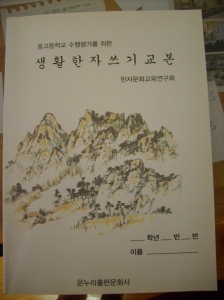
Middle school and high school hanja book. (2007)

Useful for the visual guide to balancing internal components of more complex characters
The most important aspect of trying to learn hanja is writing characters out. It’s probably not possible to learn hanja, unless you have a photographic memory, without writing them – hundreds of times! As with all other forms of writing resources, for English, maths, music etc, Korean bookstores and stationers provide a vast range of various types of hanja writing exercise books.
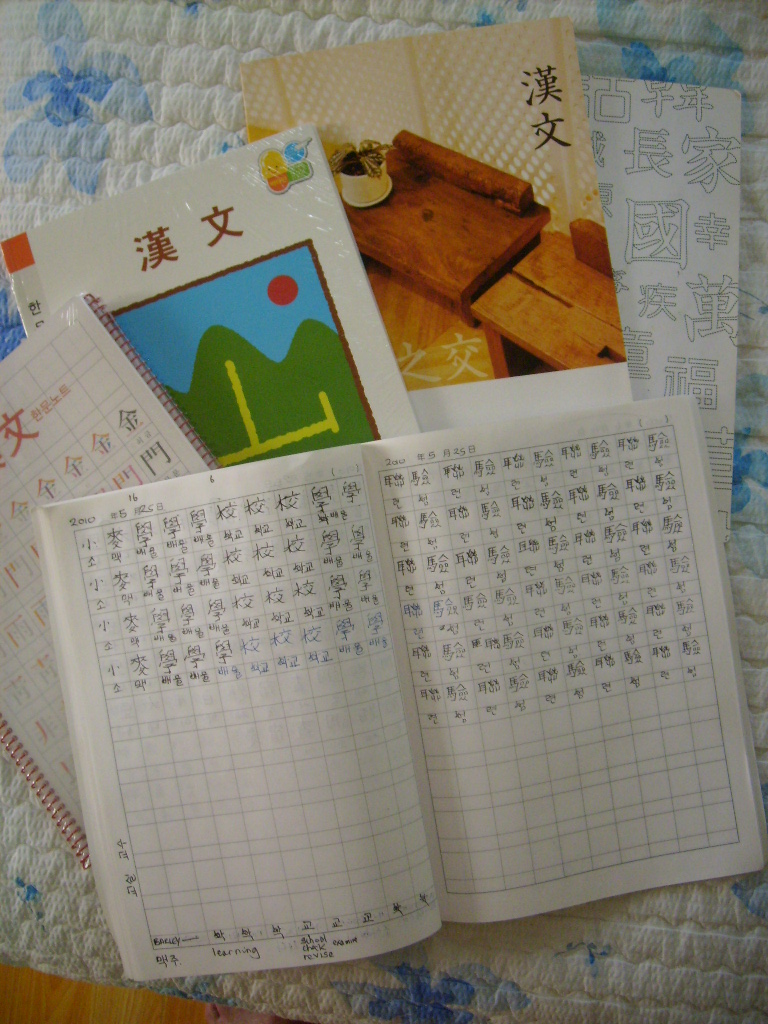
Exercise books for writing hanja
This work is licenced under a Creative Commons Licence.
Oriental/Japanese Apricot (매실. 梅實) Prunus Mume, and some uses

- Oriental Apricot/plum (매실)

June, and Japanese Apricot is available in the street markets and in supermarkets. A very large bagful costs about 20.000 Won (£10) and in E-Marte 1-5 kg costs 7.500 Won. The apricot (매실) appears across Asia and is used as a delicious sweet drink, flavours various alcoholic drinks most notably plum wine, it can be pickled or salted,in China it is used in the making of plum sauce and it is also made into a tea. It has plummy-almondy taste. The juice is also common as a household remedy for an upset stomach.
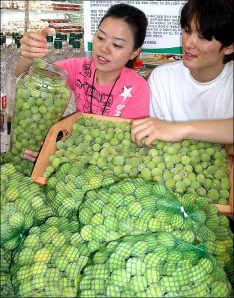
- Around 20000 Won a bag


- Non alcoholic but delicious
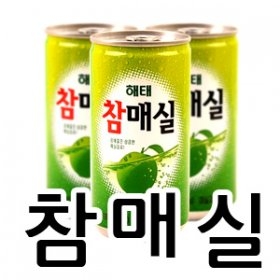
Making either Japanese Apricot juice or alcohol is straight forward. For juice, simply put the fruit into a container with the equivalent weight of sugar. Do exactly the same for the alcoholic version except cover it with soju. The sealed container should then be stored for 3 months.
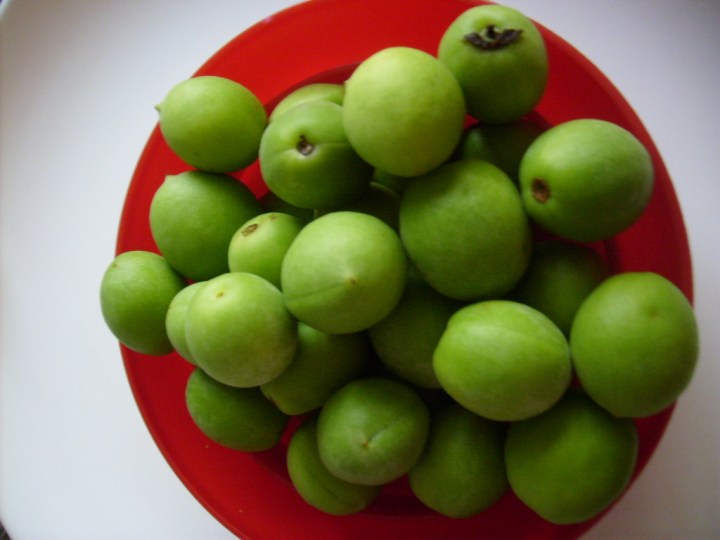
- Pretty boring in this condition

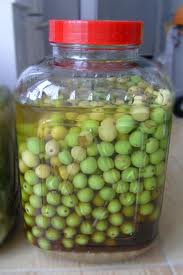
- Homemade alcohol and juice
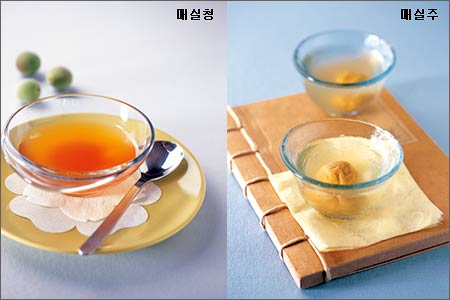
- Refreshing

This work is licenced under a Creative Commons Licence.
Death and Diet by Watermelon

Watermelon (수박)
Years ago, I watched a documentary about the problems of policing in that scummy slip of coastline on the southern Spanish coast, infamous as the holiday destination of 4.5 million Brits holiday makers and 350.000 homeowners, the Costa del Sol; aka The Costa del Crime due to the disproportionate number of British criminals in residence to evade to British law. The Costa del Sol is one sprawling Conga of destinations well-known to most British people even when they have never set foot on Spanish soil and know little about local life: Marbella, Fuengirola, Alicante, Torremolinos, and Benidorm. Formerly all isolated beautiful fishing villages, they now form one vomit ridden strip stretching from Malaga down to Los Alzacares and providing all the comforts of British culture, the bars, fish and chips, sandwiches, Sunday roasts and enough English-speaking people to attract that particular brand of clientele whose idea of a holiday is sitting on a packed beach in an environment as English as Clacton but with guaranteed sun and cheap booze.
In all fairness, the coast provides a haven to other European plebs and criminals and within the context of policing, this was the subject of the documentary. On the particular evening the cameras were rolling, and following the difficulties faced by local police, a group of Danish lads were arrested for swimming naked in their hotel pool, some Brits lads were menacing locals with knives and some drunken Scandinavians were throwing water melons off the top of their hotel onto the street below.All were young men and all were drunk!

British criminals on permanent vacation on the Costa del Sol
‘Brits with knives’ seemed typically nasty while the nude swimming and water melon bombing were amusing – until I started carrying water melons back to my Korean apartment. I’ve never bought a water melon in the UK and though you can buy them, usually in Mediterranean type delis, I don’t think they are as popular as other types of melon, the smaller varieties such as honeydew and cantaloupe. Having to lug watermelons home on a weekly basis, naturally, it dawns on me not only how heavy they are, but how catastrophic the effect of one landing on your head from 1o floors above. Suddenly, wielding a knife doesn’t seem quite so bad as bombing pedestrians with a weighty watermelon, an act I had formerly dismissed as amusing and harmless.
Water melons are one of the most common fruits in Korea over the summer and are currently my favourite especially when cold and crispy. They are supposedly highly beneficial as an antioxidant and have numerous other acclaimed benefits. With approximately 21 calories per 100g they are a healthy snack though I suspect I probably eat around half a kilo before I go to bed. (link for information on Korean watermelon).
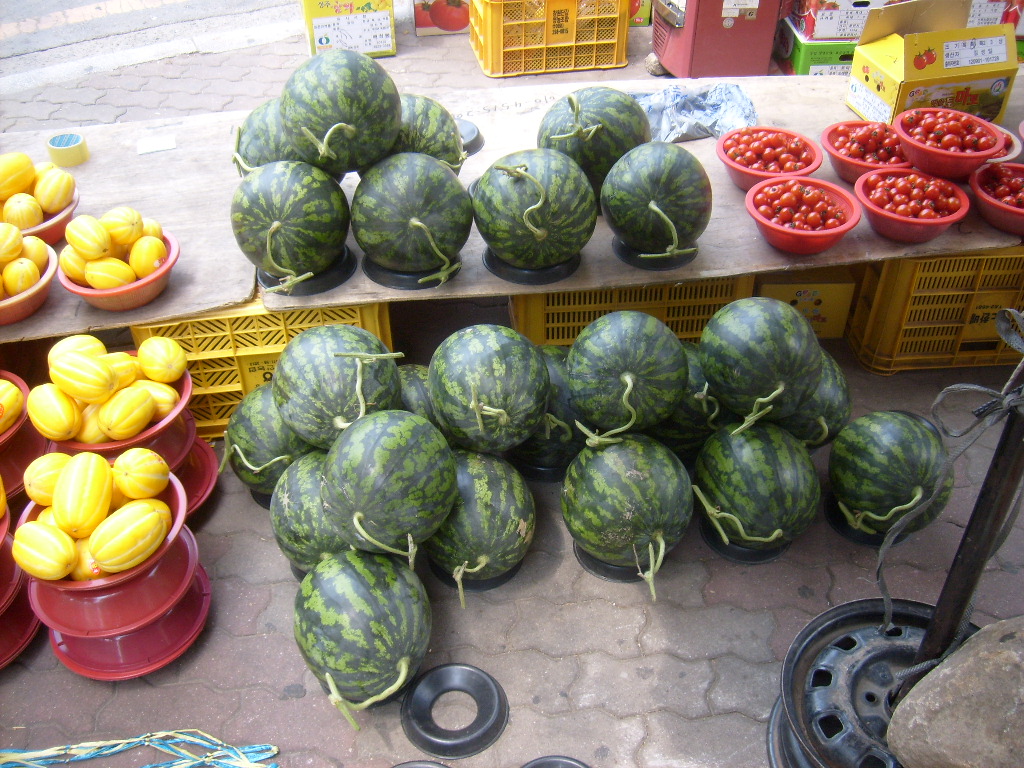
Summer fruits
This work is licenced under a Creative Commons Licence.
Bathhouse Basics 4. The Bucket Seat
I have seen only a handful of westerners in bathhouses though if I were in downtown Seoul I’d probably see more but one thing I have yet to see is a waygukin sitting on a bucket seat!
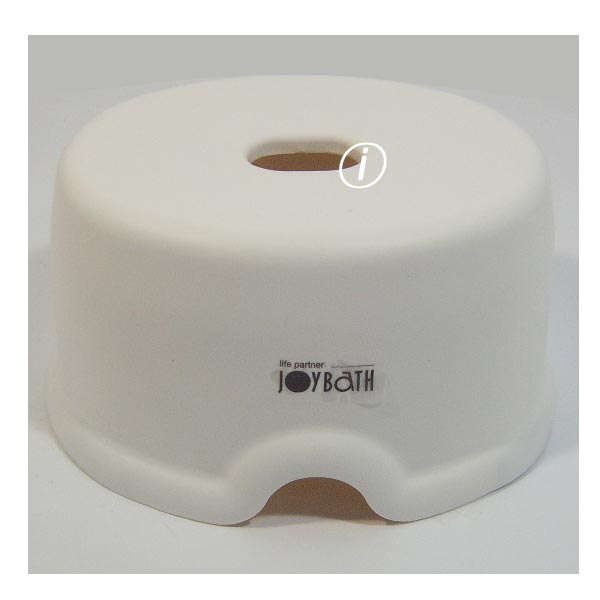
A Bathhouse 'bucket' seat.
In orange
These are simple plastic seats the size of a bucket and on which you sit at the sit down shower units. Bathhouses always have stand up shower units and rows of sit down facilities. Initially, I avoided sitting as I felt the squat position required undignified but you quickly adjust. Koreans often spray the shower over the top of them before sitting and often, once they have finished using them. Some Koreans also sit on the floor especially when cleaning their feet.
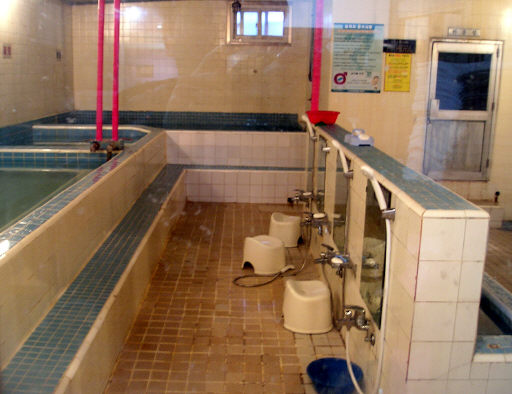
Bathhouse sit down shower units
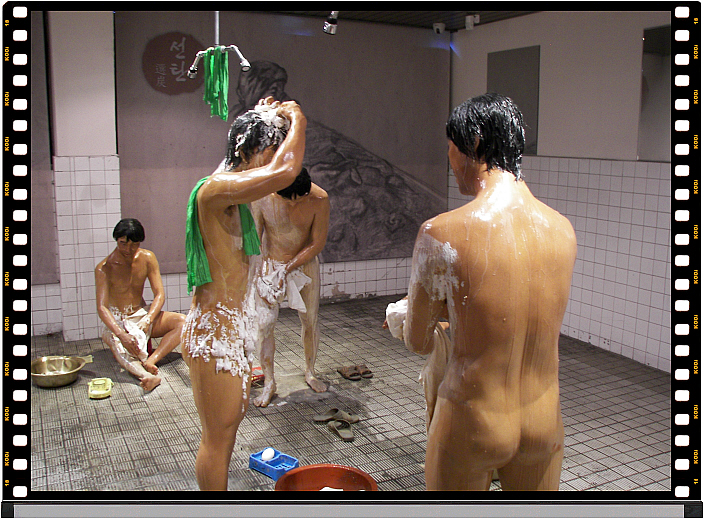
Sitting on the floor is also common
This work is licenced under a Creative Commons Licence.
Ben – Korean Teenagers (2) and other stuff…
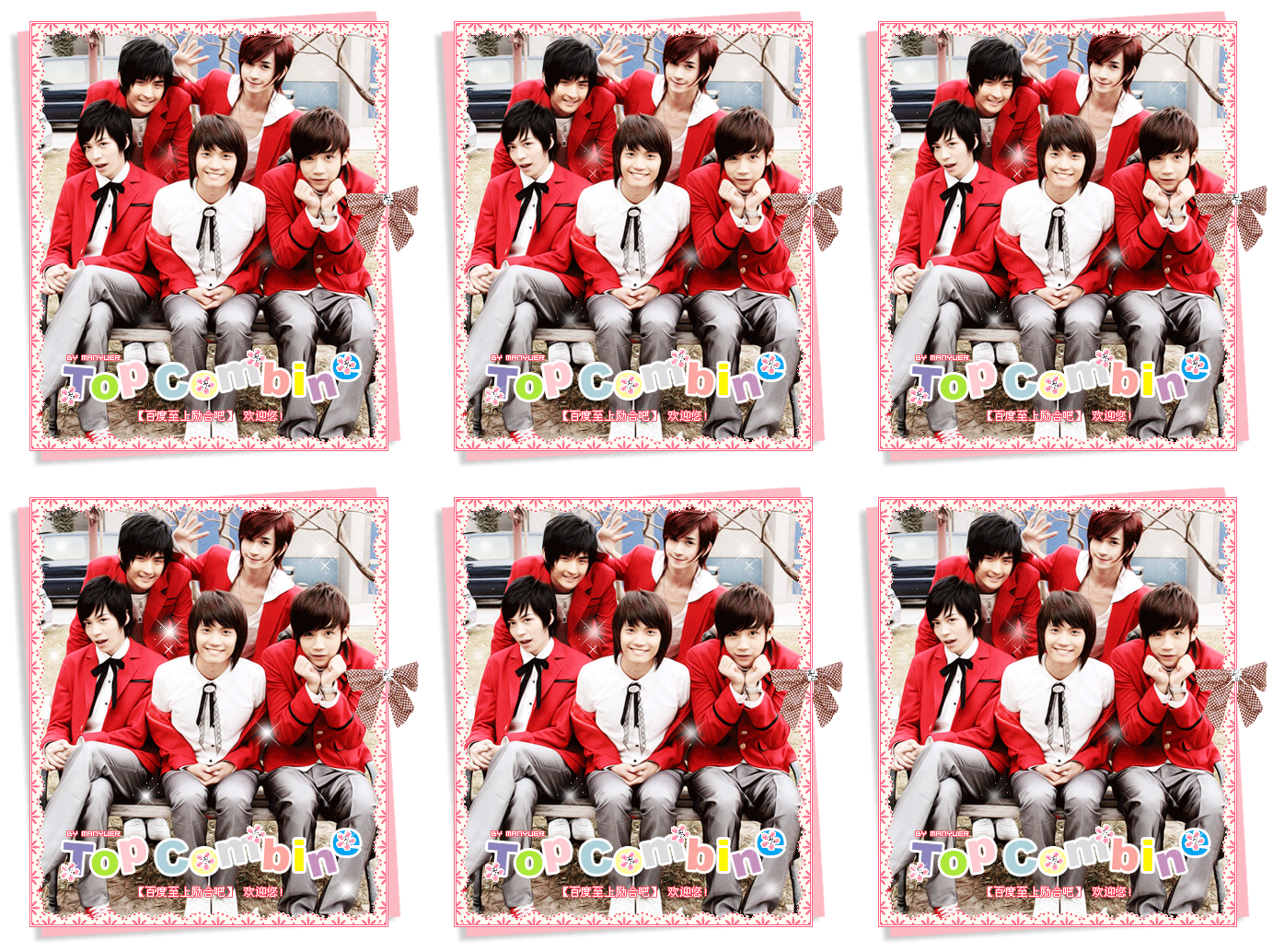
Japanese youth icons: 'Camp' is not a universal recognition
I’m always intrigued by the campness and expressions of skinship displayed by Korean men and boys. In a class today, Mark, one of my 16-year-old students was leaning across his desk to write his name on a sheet of paper. Meanwhile, two boys behind him start stroking his arse and putting their fingers in the waistband of his boxers, his shirt having ridden up to expose them. Mark doesn’t even twitch even as one of the lads put his hand right under his crotch. Earlier in the lesson, and this has happened on more than one occasion, I noticed Mark’s arm behaving in a very suspicious manner in the proximity of the boy’s lap sat next to him. Of course, any suspicions are solely in my own dirty western imagination as Korean teenagers always appear to be totally innocent in terms of sexual behaviour.
I remember when I taught a class of 13-14 years olds in a British Boys’ school and was constantly noticing lads with erections. So prolific were these manifestations I nicknamed the class, ‘erection city.’ And boys wanking in class? One of my colleagues, a female teacher, walked around the side of a boy’s desk only to see him, grinning in a manner that suggested he anticipated some erotic development, with his erection exposed and being toyed in his hand. There were even occasions when I caught boys with their hands on the front of each others trousers. There was an obsession with penises and sex throughout the school and even the head teacher, a seedy character, used to shower with Year 9 boys when the weather was hot, or interrogate them in lessons about issues such as masturbation and puberty. Penises were everywhere, drawn on desks, scrawled on walls, in books and constantly referred to. Some went beyond scrawling and meticulous in detail, were clearly the result of much study, observation and affection.
I used to teach religious education and the class text books we used had penises graffitied in appropriate places wherever possible. When they couldn’t be inserted naturally they were simply drawn sprouting from foreheads. And distance was no barrier for these fantastical phalli; even when bodies were at the extremes of opposing pages, immense penises connected them. I kept a copy of the most graffitied text-book as the creativity and imagination of the boys was staggering. In parts I was reminded of Hieronymus Bosch’s, Garden of Earthly Delights, which in the boys’ hormone-fired imagination, was exactly the landscape they were trying to express.

Hieronymus Bosch: The Garden of Earthly Delights
One of the photos depicted a priest offering a kneeling woman Holy Communion. What idiot designs a school book with such a photo! If boys hadn’t already graffitied the page, I would have to have done it on their behalf. So, a great monster of a penis miraculously sprouted from the front of his cassock, meandered into a suitable position to be held in his hand, obliterating the communal wafer and finally, was plugged into the woman’s face. More in line with the Catholic Clergies clandestine predilection for young lads, a more topical candidate might have been a kneeling boy. Meanwhile, the flanking attendants and congregation were suitably adorned with penises sprouting from under cassocks and from their foreheads. And in the air, a small chorus of body-less penises, hovering like wingless angels, jettisoned copious ejaculate wherever faces were visible and gagged and subsequently force-fed any open mouth. Manna from heaven! Graffitied cocks are seldom seen in Korea and personally, I’ve only seen three.
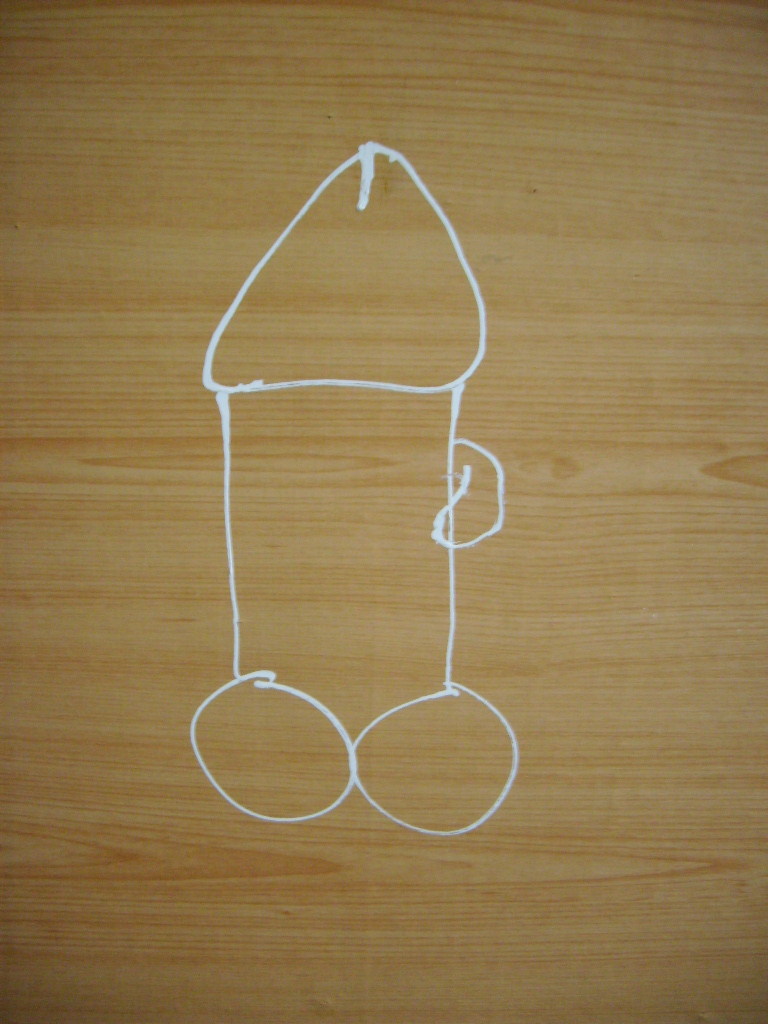
'Obscene' Korean graffiti - a rarity
In the UK, Ben, one of my students and an adorable boy, would be bullied for being a little faggot. Earlier in the year he dropped 2 marks from his English paper, scoring 98%. In the west, and rightly so, that’s an achievement worth celebrating but in Korea, if it’s not 100% it’s basically a fail. Even in essay competitions students who don’t win first, second, or third, will tell you they failed. Despite being the cream of their school and competing at province level, anything other than gold, silver or bronze is a failure. Distraught and ashamed, Ben spent an entire evening sitting alone, crying. Apprehensive about facing his parents, my boss had to comfort him and then drive him home. On this occasion, his ‘kibun’ was so damaged he couldn’t talk to me for several days.
Ben
More recently, he’s been quite excited. His dad has promised to buy him a puppy if he does well in the end of semester exams. Ben is ecstatic and is bouncing around the school like an amphetamine doped gazelle. ‘A puppy, a puppy,’ his constant cry. I’m thinking: a fucking puppy! The boy’s sixteen and he’s totally thrilled by the prospect. In the UK, his mind would be polluted with plans to simultaneously get pissed and loose his virginity.
Faggoty is fashionable!
My school, like my last high school is full of faggoty boys. One is a local champion in ballroom dancing. He’s 14 and always turns up at school meticulously dressed. He often wears a pair of trainers with laces the colour of his top. He obviously has a stash of coloured laces at home and I’ve noted his array include green, red, yellow and blue. Like many Korean students who don’t use a back pack, he uses a bag which is fairly common, and nothing short of a big handbag. Usually, he’ll mince into school with an arm extended like a tea-pot and from the crux of his elbow dangles his bag appropriately emblazoned with the logo, ‘Kamp.’ Last week he had a new pair of silver trainers and a matching black and silver baggy top with large lapels. I didn’t particularly like the top’s design as it reminded me of 80’s fashions and the clothes Wham used to parade in when singing shit like, Wake Me up Before you Go-Go. Besides ballroom dancing, he has a third degree taekwondo black-belt!

What...um.......yes!
Have you noticed the mincy little walk many Korean men have? The first time I saw a teenage boy mince, I was quite amused. I’ve since realised that mincing, basically walking with little steps while swinging the hips a little, is the product of wearing open back sandals. In my last high school boys had to wear sandals in school and there really is no better tool adept at emasculating males. If you want to feminise or at least androgynise men or teenage boys, simply force them to wear sandals, the type that have no back to them. You can’t run in them without taking small steps and as a result you shuffle along like a Geisha. Running up or down stairs is positively dangerous. In the same way you dispose a girl to femininity by making her wear a skirt and subsequently deterring her from the rough and tumble of boys pursuits, you emasculate boys with a pair of sandals. As a result, many Korean men mince even when wearing shoes.
Jason is another student I have taught for almost two years. He’s a quiet boy aged about 15 and who talks in a whisper. A few weeks ago he was asked to write an essay on what he would do if he could do anything he wanted, for one evening. His response eventually concluded with spending the night in a luxury hotel, and ordering room service to deliver him steak and lobster. My western brain clicked into action: 15-year-old boy in a hotel? on his own? lots of money? – naughty, naughty! Risky Business and all that stuff! But Jason avoided the alcohol, call girls and his luxury evening ended by watching TV, and having a double bed. ‘Double bed!’ I repeated suggestively. ‘Why do you want a double bed?’ I asked. His response was typically Korean; ‘to sleep in!’ ‘I laughed and was going to explain why, which of course is futile. Prostitutes, shagging, throwing parties when mummy and daddy are away, getting pissed – are all phenomena which exist at the furthest corner of Jacob’s universe. That’s where they belong until he is 19! The Garden of Earthly Delights, for a Korean student isn’t dependent on sex, alcohol or defying parents and all that is required to pave the way to paradise is no school and no homework! Meanwhile faggoty is fashionable, and mincy and kamp are cool and civilised.
This work is licenced under a Creative Commons Licence.
Bathhouse Basics 3: The Italy Towel
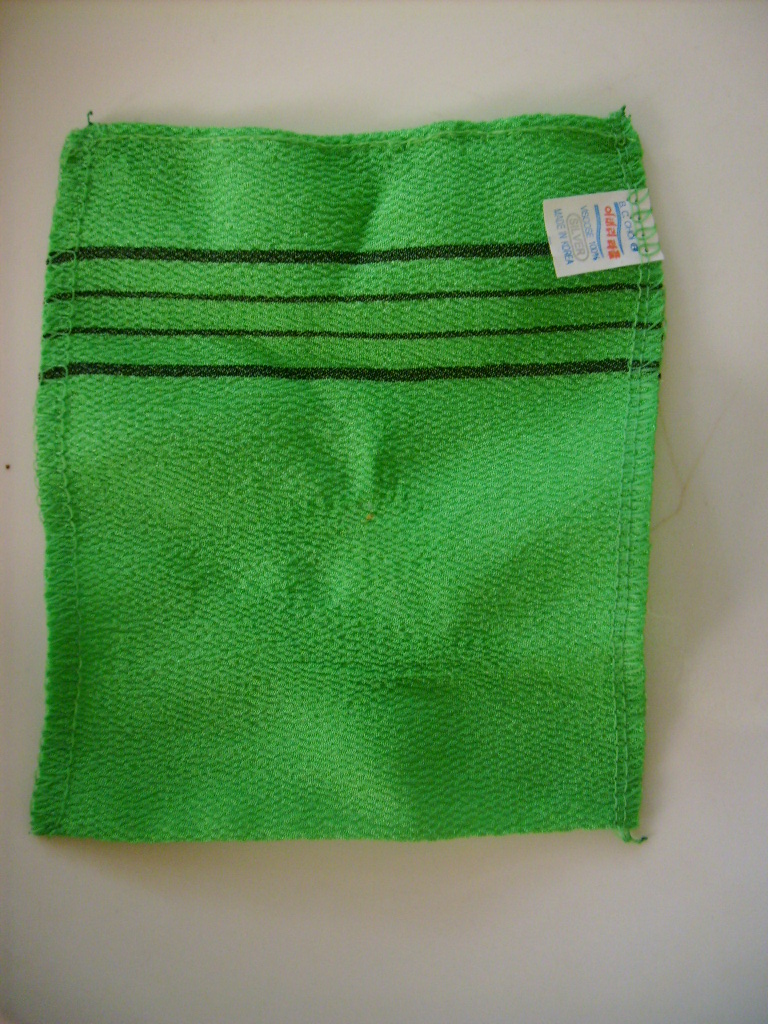
The Italy Towel. (이타리 타월)
Other than water, the Italy towel is probably the most universal item in a bathhouse and in some quarters, “Korea Design Heritage 2008,” has been ranked as number 5 among items over the last 50 years, which have defined Korea. Apparently, Gil Pil-gon who ran a textile factory in Pusan, discovered the cloths’ ex-foliating properties in a piece of fabric imported from Italy. The rest, as they say, is history.
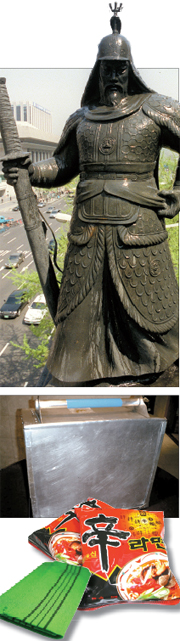
Defining icons, food delivery boxes, Nong-Shin ramyon and the Italy Towel.
Though available in a range of colours, the predominant colour is ‘silver,’ which is actually the green one. In addition, they all seem to be made by the same company, BC Choi and hence, the towels, manufactured in Korea, are 100% Korean! Like sandpaper, Italy Towels come in different gradients and these are denoted by the colour. ‘Pink is the least abrasive, followed by ‘silver’ (green) with the most abrasive and capable of removing the deepest ingrained grime, being yellow.
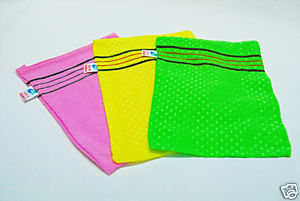
Other colours are manufactured, including red. The green one is actually described as 'silver.'
Italy towels are not to be confused with the larger version cloth which is also supplied in a bathhouse and which is usually red.
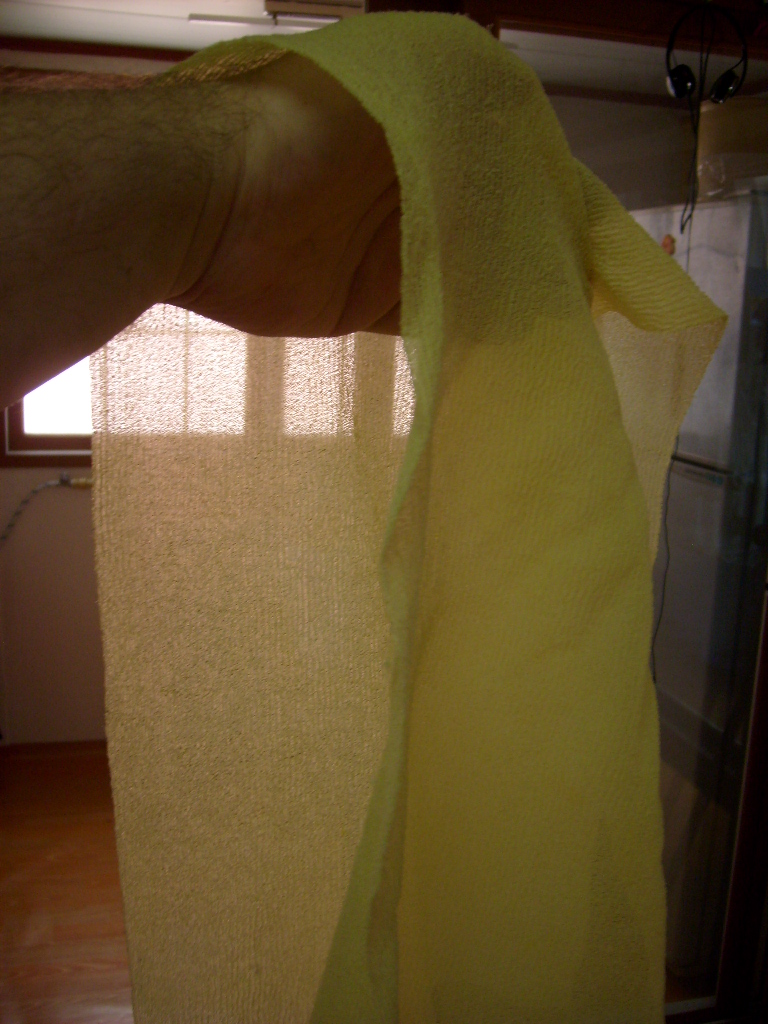
The larger, and milder, ex-foliating cloth
What typifies the Italy Towel is its size. My hand barely fits into it. The cloth is used to scrub the skin, usually in one direction, top to bottom and in straight lines and if used effectively a line of gray, dead skin is produced. The towel is fairly abrasive and needs to be used with caution on the face. Minimal soap is used in order to maximise the towel’s abrasive quality. Koreans will scrub their entire body with this cloth in a process which can last well over an hour.
If anyone accompanies you to the bathhouse, a friend or relative, it is natural for you to scrub each-other’s back. Usually you sit behind the person whose back you a rubbing, though people sometimes stand. For men, that your ‘partners’ dick is dangling in you face is no more of an issue than any other part of their body. Between men, one of the defining features of a ‘go-ch’u-ch’ingu’ (고추 친구), literally translated as a ‘penis friend,’ basically a close friend, is that penises are ‘acknowledged’ rather than shunned with fear. It is this tacit, sometimes even verbalised ‘acknowledgment’ which helps define a close, male relationship. In the western male, heterosexual psyche, a penis is threatening and ‘acknowledging’ your male friend has ‘one,’ seeing ‘it,’ talking about ‘it,’ and even being too close ‘it,’ have the potential to terrify. It is not at all uncommon to see a row of school boys or students all sat in a chain as they have their backs scrubbed while scrubbing the back of the person in front. Between family members the towel is used much more intimately and again, it is very common to see parents and children mutually scrubbing each other’s entire body. This is not restricted to small children. Mutual cleaning and the intimacy involved are an expression of the concept of ‘skinship.’
How often one should use the Italy Towel is a personal preference. If used frequently, the process can rub-away body hair – though I wouldn’t recommend this as a method of waxing. Some Koreans use it every few days, others once a week. Perhaps the best guide is simply whether or not you have a layer of skin which needs removing. I use a pumice stone on my feet regularly and if no skin is being removed I stop the process – this is perhaps the best guide to using the Italy Towel.
I have noticed that you can scrub yourself meticulously and regularly with the larger, less abrasive towel, the one usually provided free in all bathhouses, and that this does not remove dead skin with the effect of the Italy Towel. I was very surprised when after a period of not using an Italy Towel, a friend scrubbed my back and arms and then made a joke about how dirty I was. It is surprising what that little towel removes.
Unlike the larger cloth and towels for drying, the Italy Towel has to be purchased, costing about 1000 Won. I usually keep one for months at a time and have even seen the odd person use ones discarded in the used towel bin.
This work is licenced under a Creative Commons Licence.
Burdock 우엉 Monday Market
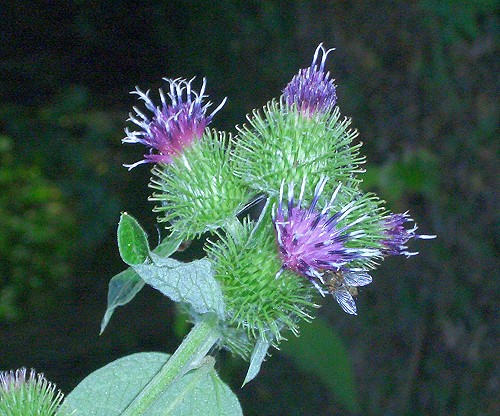
Greater-Burdock
Recognize this plant? If you’re British, it is fairly common and though simply a thistle to many, burdock, is a household name to most adults over 40. Burdock is a biennial plant the flower heads of which are burrs. When I was a boy these were infamous for sticking to your clothes and hair. However, since the advent of paedo-paranoia and personal computers, I would imagine younger generations have little experience of them. Incidentally, it were these burrs and the plant seeds that inspired George de Mestral to investigate their properties in the 1940’s and which subsequently led to the invention of Velcro.

Cross section showing the extensive taproot.
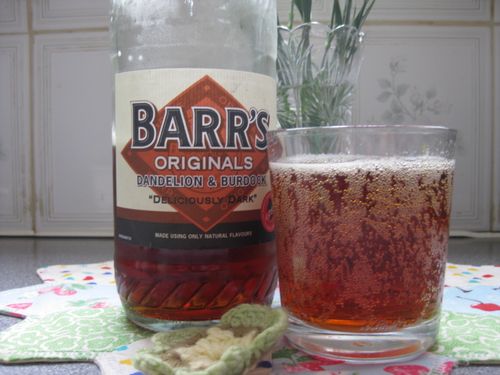
Childhood memories
In Britain, Burdock is probably most renowned as an ingredient in Dandelion and Burdock drink which has been popular in the UK since the 13th century and though it never had the same appeal as Coca-Cola or Pepsi, it joins the ranks of cult classics such as Tizer and Irn Bru. Burdock has various uses in herbal medicine. In Britain, it was also used as a food but today this practice lies in the domain of the more adventurous. (Burdock recipes UK)

probably more popular in the North of England and Scotland

a cult classic
In Korea, burdock taproot is a fairly common sight both in street markets and supermarkets and a bundle of whole root (통우엉),will cost around 2000-3000 Won (£1-£1.50.) The roots are used to make various side dishes and as a vegetable in soups etc.
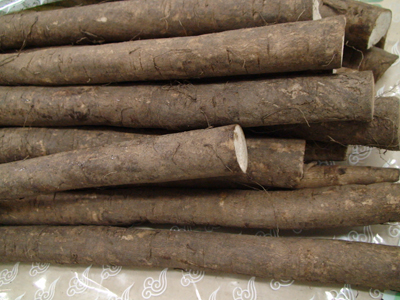
Burdock taproot
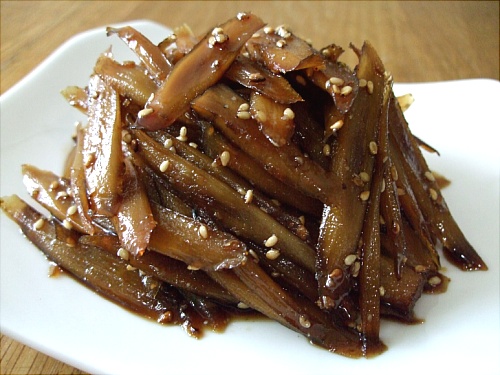
Burdock as a side dish
Burdock root as a pleasant taste, is slightly crunchy with a little woody texture and a nutty-earthy taste.
This work is licenced under a Creative Commons Licence.
Bogland Follow-up

Bogland
I’m tracking if any of my friends bother to read my blogs or indeed, if I actually have any friends. I recently uploaded one of those tagging widgets to my page which you can see at the bottom of my side bar. Every time someone visits my blog their country of origin is denoted by a flag. Every morning, before I even get out of bed, I turn on the computer and see if I have any new flags. Then I sit and browse through a number of K-blogs with my coffee. I really need a stiff drink, except I don’t drink, because there is definitely some shite lurking in Bogland. Sometimes, the shit is so bad it is can actually be useful. I am trying to learn Korean, I have been for years and so any sites which can improve my skills are of particular interest. Ten years ago you couldn’t even buy a decent book to help you learn Korean and there was nothing online. Now we are spoilt for choice. I subscribe to one website and to augment my learning visit a number of blogs and in particular those which function both as a diary and provide a Korean lesson.
This post is dedicated to all those twats who write blogs peppered with Korean words to which there is no given translation as if their audience, and more specifically, their mates back home, can actually speak and read Korean. Back in 2000, if you wanted to write with an east Asian script on your PC, if you had one, you had to buy Microsoft’s, Proofing Tools and online translators were basic in the least. A dictionary was essential except they were difficult to buy (in the UK) and very basic. The simplest way to impress your mates back home and give yourself Malinowskian credentials is to look-up a Korean word, eg, ‘train,’ stick it in Babblefish or some other translator, and then paste it into your text. ‘I got the 기차 to 대구 last 토요일,’ type blogs, are excellent for testing your knowledge of basic Korean words.
Then there are the copious reviews on restaurants and coffee shops. Anyone who has lived in Korea more than a few months should know that unless a corporate or franchise affair, the coffee shop or restaurant raved about today stands a very good chance of being a hand-phone shop in a few months time and a bakery within six. And then there are the blogs written as though Korea were some isolated little backwater, by authors who seem to think they’re Malinowski, except they’re a hundred years too late and tend to be uninspired by the mundane and oblivious to the unique. Of course, there is a wealth of insights to share with western audiences except most have been covered by a hundred other authors but there remain many ‘issues’ out there with hardly anything in print to highlight them. So, here is an example of a really naff style of blog writing:
Hello! 한국 is such a bizarre country. I have been in the Land of the Morning Clam’ for 6 months and am still having fun. Life in my 학권, ‘Venus English Phrontesterion,’ is really good except my bosses, 씻인석 시 and 식인숩 시, insist I speak without a 미국 accent. I have difficulty telling them 미국 사람 don’t have accents. Only 외국인 사람 speak with an accent!

Downtown Daegu
As you can see, I can now speak and write in 하국어. Are you impressed? Yesterday. This one is red inside. Later, we 팔 김밥 . This is a pancake parcel with a filling. It is served with a watery soup called 코물. 마니 마시티!
More next time!
석미왕 프럼 왕주.
Oh, my flag tagger! Very colourfully informs me I have had two visitors from the UK, where the majority of my friends and family live, and 5 from Russia where I know no one. Even if I wanted to, it seems I have no one to impress!
This work is licenced under a Creative Commons Licence.
When the ‘K’ doesn’t stand for Korea! (Impressing Mummy and Daddy with a Krap-blog)
More shite from Bogland
I just love this type of blog post…
Didn’t like this and deleted it!


 Elwood 5566
leave a comment