Boring Boryeong and 'Waygukin Wankers'

Spot the Korean
Let me get my disclaimer out the way to begin with! Yes! there are plenty of decent, thoughtful and interesting waygukins in Korea and some may very well have visited Boryeong, but this post isn’t about them. This post is about the other types of waygukin, the ‘waygukin wanker’ types who generally ignore other westerners, have no significant Korean friends, have boarded the bus to Boryeong, and like to moan about Korean people and culture about which they like you to think they know everything.
I occasionally ‘rant’ about the unfriendly nature of many waygukins in Korea, it’s one of my minor idee-fixe. Two weeks ago, I had this idea to start a ‘waygukin wanker of the month,’ post in which I’d feature a photo of one of the numerous wankers around Song-So who will totally blank you if you pass them. I’ve lived in the building next to one for almost two years but even if we pass on an empty street, shoulder to shoulder, he will ignore me. I said hello on one occasion but he simply diverted his gaze to the floor and mumbled inarticulately. So, on one hot Friday afternoon, I stood for an hour waiting to get his photo but unfortunately he failed to turn up and missed the chance to be immortalized on my pages. I haven’t seen him for two weeks and am beginning to assume he must have gone back to wherever. Good riddance! However, there are plenty of other candidates to replace him.

Courtesy of Roketship (link)
Maybe ‘waygukin wankerism’ is a disease, possibly contagious, and if so, one of the most potent sources of contamination has got to be the Boring Boryeong Mud Festival. Bogland is full of boring accounts written by waygukin who assume they know all about Korea once they set foot on Korean soil and whose search for the spirit of Korea, it’s traditions and an understanding of the Korean psyche, lead them to splash about in a bit of dirt chucked over a sheet of plastic on one of the only holidays of the year. If I had a list of a 100 things I want to do in Korea, the Boryeong Mud Festival wouldn’t even be on it. Even one of my closest Korean friends, who is 25, said it was disappointing with watered down wishy-washy mud piped onto plastic sheeting. But, he was impressed with the army of waygukins as he felt they provided the festival an international atmosphere.
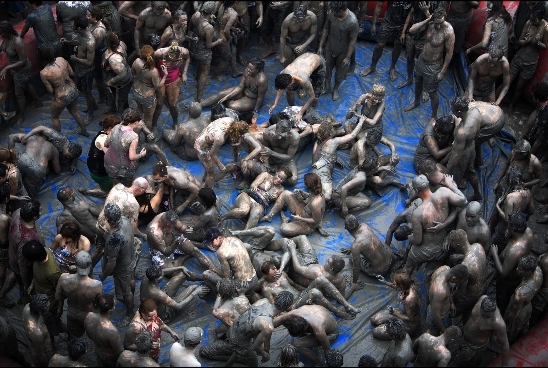
Lovely plastic sheeting
Boryeong is as typically Korean as the Costa del Sol is Spanish or, Tijuana is Mexican and any place which attracts an army of waygukins should instantly loose its appeal especially because it’s the sort of ‘safe’ crap you do on a 18-30 cheapo package holiday to some place with bags of sun, sand, sangria and bouncing tits. It doesn’t attract interest because it’s Korean but because it’s the hip place for waygukins to go and which can be blagged about to mates afterwards. Those who like Boryeong probably find appeal in the likes of: Ko Phi Phi Le, the Costa del Sol or Costa Med, and Ibiza and other shitty destinations catering for the unadventurous, en-masse. I find it amusing how so many foreigners will cue to take the bus to Boryeong yet are terrified of a trip to the local bathhouse which will provide a far more rewarding insight into Korean life.
Talking to a waygukin or two is fine, except most can’t talk, and having a beer with one is even better, I desperately miss the sense of humour, but slopping about in diluted mud with a million of them!! No thanks! I came to Korea to escape wanky-ways and in particular wanky British culture, which doesn’t mean I don’t want talk or socialise with English speaking westerners per-se. I’m always on the look out for new friends but finding a western human who will talk is difficult. The last waygukin I swapped phone numbers with, declined an invitation to the cinema because he believed Koreans would perceive two men together as gay.
Boryeong should be towards the bottom of the ‘to do list’ but I suppose Korea is now such an easy country to live in, bilingual signs and menus, tourist information booths, a wealth of information on the internet that didn’t exist 8 years ago, a modern international airport, all the major fast food chains, etc, that gone are the days when only the more adventurous risked coming here. It’ll soon be time to move on!
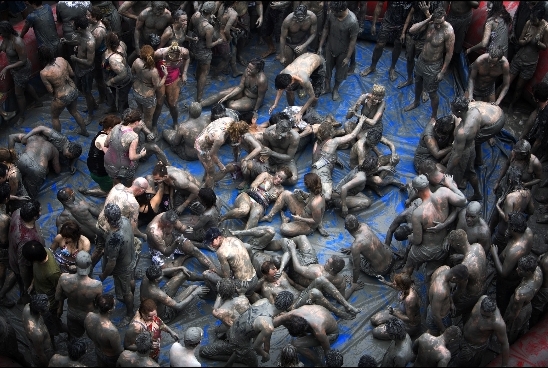
Too many westerners! YouTube link
 © 林東哲 2010 Creative Commons Licence.
Kids' Dictionaires
Whenever I use the Korean word ‘dong-sa’ (동사 – verb) in classes, kids will have a little giggle. Neither does it matter how softly I pronounce the ‘d’ and even almost annihilating it altogether, and saying ‘ong-sa,’ will be met with laughter. Well, my Korean is crap but adults don’t have a problem understanding it.
‘Shit’ is funny for Koreans probably because they’ve never had to smell it, but if you’re British you will undoubtedly recall numerous occasions when you’ve seen something strange on the carpet or on your shoe and like an idiot you’ve poked your finger in it, sniffed it, and then recoiled in horror.

Korean 'dirty' humour
For Koreans, stories and cartoons in which shit is either a central feature or a passing reference, are common. And because they haven’t had to sniff it as much as us Brits, because our pavements are notorious for being strewn in dog shit, it can even be cute and even pretty. There is a popular Korean book (강아지 똥) about the life and adventures of a sentient turd which ends up sprouting a little dandelion flower out of its head.

강아지 똥. A scatological version of the Ugly Duckling, story
And then there are the various references to shit: ‘shit flies’ (ddong-bari -똥 파리), chicken’s gizzards amusingly called a ‘dong-chip’ (똥집 – basically ‘shit-hole), as well as the habit kids have of poking their clasped fingers up your backside in a ‘ddong-ch’im’ (똥침 – a ‘shit injection/needle’).

Click picture to activate link
Only yesterday, I was asked what ‘ddong-ch’im’ was in English. ‘Perverted,’ I replied. I had to explain how strange we find the ‘dong-ch’im’ habit and while many waygukins will see it as cute, amusing, and harmless, myself included, I read two posts yesterday, where the authors, men of course, claimed they would ‘severely damage’ any kid who touched ‘that area.’ For western men, especially British and Americans, ‘that area’ is a powder keg of sensitivity and touching it likely to ignite all sorts of problems. It’s all silly of course, and culturally constructed! The male fear of their bottoms being touched and their over-protective attitudes towards them, are as ridiculous as women fearing spiders or mice. Get, real! You have to have a very insecure image of your own sexuality to find a little kiddy touching the back of your trousers, a threat! You can’t translate ‘dong-ch’im’ into English, not effectively, – ‘bum sting,’ ‘butt-stab,’ ‘anal-poke..;’ none of them really work and as they all carry sexual connotations, ‘ddong-injection’ or simply ‘dong-ch’im’ are probably the most effective renditions.

Cute, cartoon turds
As for associating food with anal passages, nothing is more likely to put me off. Cat shit, dog shit, I’ve smelt them all and any food which reminds me of that filthy orifice is unwelcome. I’ll only eat mak-chang ( 막창 – barbecued intestines) if I’m pissed as colonic conduits aren’t my thing unless severely minced, mashed and renamed a sausage. I’m even put off the idea of chicken feet (닭발) because they spend all day tramping on shite. Conversely however, I love sucking the juicy fat off of an English chicken’s ass, after it’s been plucked, basted and roasted, of course! This exception exists because the name, ‘parson’s nose,’ isn’t a reminder of its actual location or function. A Parson’s nose, the very point at which poop is birthed, is almost respectable and reminds me of Sunday afternoons as a child when being offered that fatty morsel for lunch, was a treat. Tastes are all socially constructed!
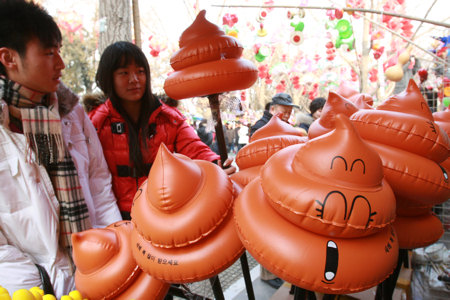
More 'turdy fun.'
While Koreans will tolerate ‘ddong’ and its various manifestations, the don’t like piss. They call piss, ‘dirty water,’ though I don’t particularly find it dirty. I’d much rather be pissed over than shat on, if forced into making a choice, and if ever I was shat on, being pissed over afterwards would be positively refreshing by comparison.

Middle school dictionary
I have three different student dictionaries and all of them of them contain drawings of the human anatomy. They quite interest me as in all three dictionaries, plus a similar poster on the wall of a classroom in my school, the bodies are androgynous. Shortly below the belly button, biology ceases and anything happening in this area does so by some assumed, magical process. In three of the four examples, the poop shoot continues down until it meets the world which is fairly important as the poop shoot is the source of so much Korean humour, but other than this, all other tubing and their associated mechanics, urinary and reproductive, have been censored.
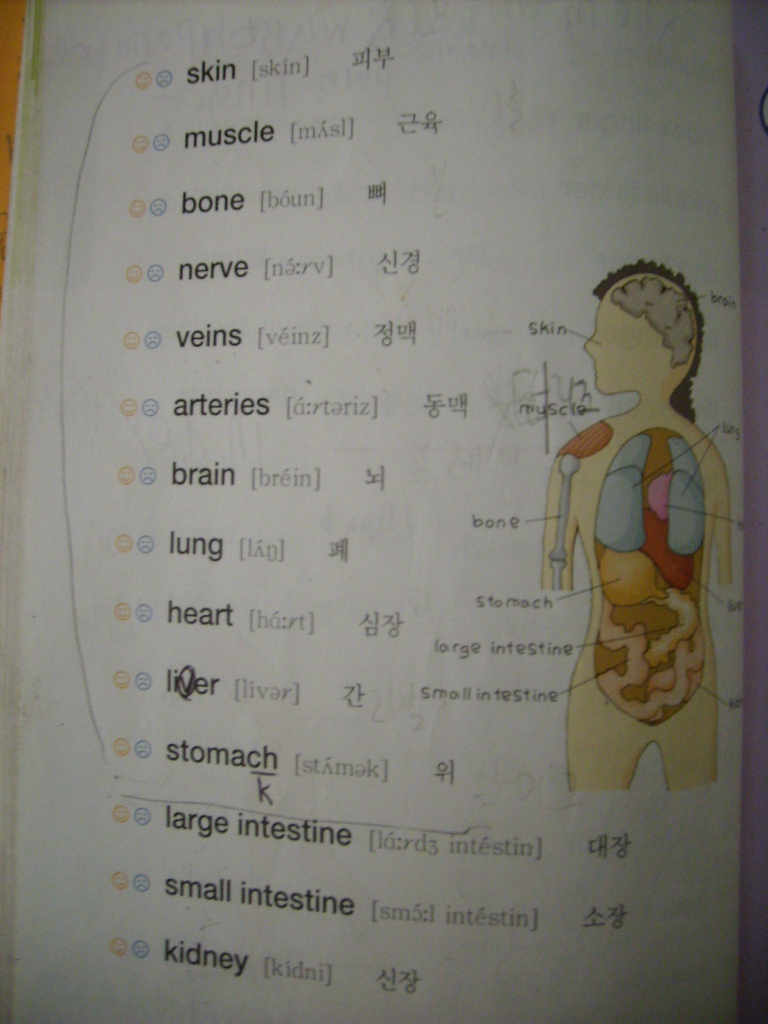
No poop shoot!
And while the drawings have all been denuded of rude bits and the dictionaries purged of anything sensitive, so as to limit speculation, analysis, discussion and questioning, there are instead a numbers of words English speakers rarely, if ever, use. I often have occasions to use words associated with reproduction and urination, as most English speakers will, but I have never used the word ‘scurf’, ‘ordure,’ ‘nose wax,’ or ‘eye wax.’ An understanding of what ‘wax’ is, is clearly missing when the translator defines ‘sleep,’ as ‘eye-wax.’ Indeed, ‘scurf’ and ‘ordure,’ I had to look-up in a dictionary as they are uncommon to me. I’m not even sure, without further consultation, how you would use ‘ordure.’ My ordure was tumultuous, perhaps? I need to ordurate? Whatever, I clearly like the word!
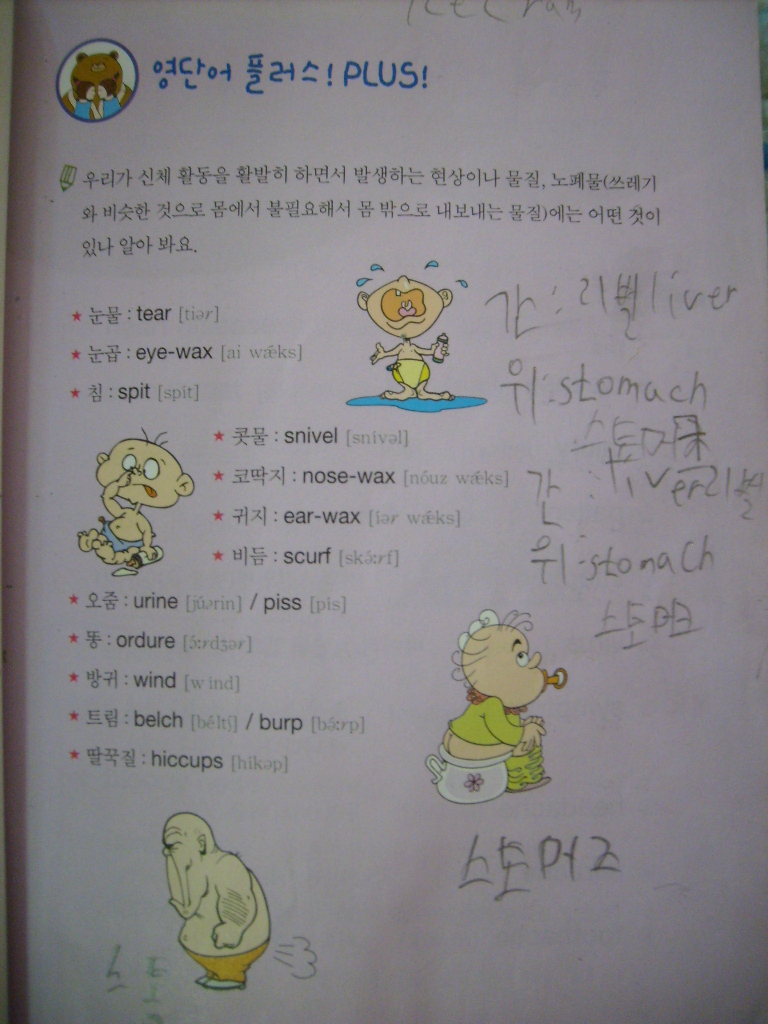
Redundant dirt
© Nick Elwood 2010. This work is licenced under a Creative Commons Licence.
Beating Boknal 2 (복날) Summer Foods
What do you eat when the memi are screaming and sweat is dribbling down your back and sides? There are numerous seasonal specials (보양식) which fall into the categories of either ‘hot’ or ‘cold.’ The ‘cold’ approach is probably the most popular with westerners and drinking cold drinks, eating ice cream and salads are the methods we are most likely to adopt to remain comfortable. Koreans however, stand this notion on its head when they consume ‘hot’ food to consume body heat hence fighting fire with fire. The ‘hot’ food is generally ‘hot’ in terms of temperature rather than chillies and would be similar to stuffing your face on the hottest English afternoon with a hearty casserole and dumplings; something we’d generally eat only in the depths of winter. In Korea, it isn’t a case of one or the other and most Koreans will mix the two extremes in an attempt to beat the heat. Bo-yang-shik (height of summer foods – 보양식) are seen as beneficial in either improving ones toleration of hot, muggy weather, or in cooling one down.

Boknal (복날)
Boknal (복날) is a period of around twenty days which are based on the lunar calendar and this year began on July 19th (ch’obok -초복). There are three days (sambok – 삼복) which Korean perceive as the hottest and they are ten days apart. This year, 2010, sambok are respectively, July 19th (ch’obok – 초복), July 29th (Jungbok – 중복), and August 8th (malbok – 말복). I hate the heat and especially dislike humidity but unfortunately I live in Daegu, the hottest part of Korea in the summer and the warmest in winter. This week the temperature has been as high as 37 and so the memi are particularly noisy.
Through Boknal, and on each of the consecutive sambok day it is a tradition to eat some form of special food, usually one of the ‘hot’ types such as sam-kye-tang (삼게탕 – chicken ginseng soup), or dog stew (po-shin-tang – 보신탕), but cold meals, buckwheat noodle soup (냉면 – naengmyon), or soya bean milk noodles (콩국수 – kongkuksu), are also popular.
For some, mostly older men, dog stew is a favourite and in addition to the belief it fortifies one against hot weather, it is also one of the numerous foods which are supposed to enhance male sexual stamina. I recently spoke to a friend who is quite adamant that dog stew and dodok (더덕 – codonopsis lanceolata) give him a harder erection. I eat dodok everyday and haven’t noticed anything but then I’m 54 and he’s 25. As for the dog stew, I’ll pass. I ate it for the first time with the aforementioned friend and his father, in 2000. I wasn’t enamored to it. First, I couldn’t get the image of little dogs out of my head and then there was the ‘starter,’ small bits of dog skin wrapped on a bone so that when barbecued they whirled around it. Trying to make a pouch on a platter look pretty seemed to make it more difficult to eat. I have no problem with eating any kind of animal yet have a dormant ethical problem with eating animals – per se! I would imagine many people share this weak-willed position. To be honest, I have to snigger at those waygukins who condemn Koreans for eating dog and yet raise no criticism of their own culture where eating rabbit is accepted. Koreans usually find the idea of eating rabbits distasteful. Tell Koreans you’ve eaten rabbit and quite a few will insist, ‘it’s a pet!’ As Herodotus said, ‘nomos is King of all!’ The dog issue tends to inflame passions but what should be remembered is that it is not the eating of dog that should be the offense, but the alleged manner in which they are slaughtered. And though some may argue dogs have a special relationship to humans, this is a culturally specific relationship and not one of universal, eternal properties. Personally, I’d rather have a pig for a pet than a dog. In 2001, my one room had no air conditioning and the dog stew did nothing noticeable to fortify my constituency against heat and humidity and certainly never stirred my passions.

This is my sam-kye-tang. (Click photo for link to the Queen of Korean cooking, Maangchi) )
Sam-kye-tang is one of my favourites though I prefer eating it in the winter. At lunch time that small chicken, the wadge of gluttonous rice and a gallon of broth, simply bloat my belly and start me sweating profusely. But it is delicious in the Korean sense of the word. I occasionally make sam-kye-tang if I feel tired or have a cold.
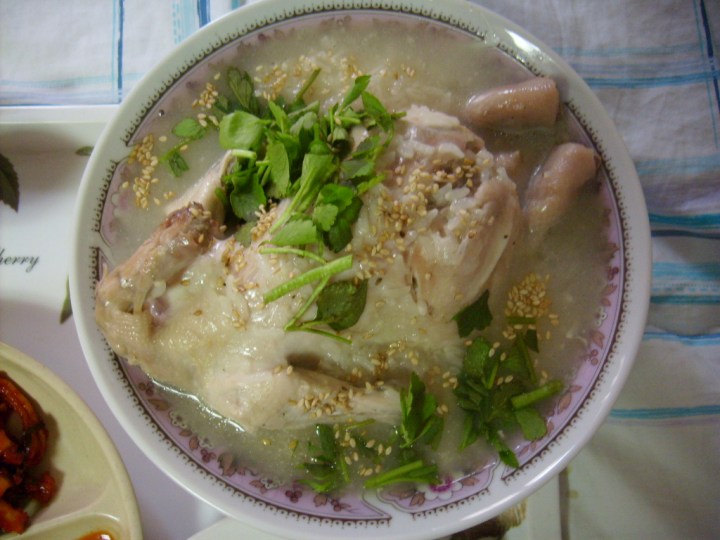
Wholesome (Maangchi link)
And I would find kong-kuk-su (콩국수) mightily refreshing if not packed with noodles. I enjoy the icy soya milk broth, with its slightly salty tang but those noodles don’t do me any good. I don’t know why it is but kong-kuk-su always seems to be served in large portions while naengmyon (냉면), for example, is often served in a smaller portion.

Soya broth milk noodles (Link to Maangchi)
Mul-naeng-myon (물냉면) is my boknal baby! I can eat this on a hot lunch time and then walk on into work without breaking into an excessive sweat. I love the tangy combination of vinegar, salt and sugar and have a hard job keeping the broth in my freezer if I have made a batch. I can remember the first time I ate naengmyon; it was on a hot Sunday afternoon, in early August, after a mountain hike in Song-So. I quite disliked it! What a freaking horrid combination; watery broth with a clump of sticky buckwheat noodles that are impervious to mastication and almost impossible to eat without sucking the whole clump up. And then there’s the slice of pear, and the ice cubes and as for the lonely, wafer thin slide of beef, you’d think it had fallen in the bowl from another meal – it’s appearance a mistake! Naengmyon is sweet, and salty, and tangy – is it a dessert or a savoury meal? And as for the vinegar and mustard which are added to it… Since then, mul-naeng-myon, and particularly Pyongyang mul-naeng-myon, have grown on me. If you have never eaten it, it must sound quite gross but when the weather is scorching hot and your covered in sweat, it is one of the most delicious and refreshing meals. Even the sound of the ice cubes tinkling and jingling against the sides of the stainless steel bowl in which it is traditionally served, are refreshing.
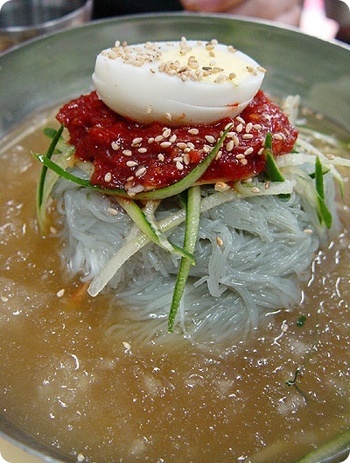
Mul naengmyon (물냉면) 시원해요!
I suppose naengmyon is the sort of food you eat at a heightened sense of reality, especially if you’ve just come down from a mountain – a feat which always seems harder than going up, and at a point when you’re body and mind feel good, it’s scorching hot and humid and you’re sweating profusely. Enjoying naengmyon at this point is an integral part of the summer experience and so I never enjoy it, or feel a need to eat it, in the middle of winter. To truly enjoy naengmyon it has to be hot, boknal hot, horribly humid, you have to be sweating and you have to be tired. Naengmyon shares a lot in common with Pimms No 1, that British summer drink, only ever drunk outside under the sun, and accompanied by ice, slices of cucumber, summer fruits and mint. One should never drink Pimm’s indoors or in winter and though this might be deemed snobbery, Pimm’s only really seems to ‘work’ when this is observed.
Finally, and wonderfully refreshing, is patpingsu (받빙수). This is rice cake, sweetened tinned fruits, red beans, and condensed milk on a bed of flaked ice which is often topped with spray cream. There are many variations of this refreshing ‘dessert.’

Patpingsu – usually shared with friends (받빙수) (click photo link to Hangook Summer)

Green tea patpinsu (photo link to Hangook Summer)
Other means of beating boknal
cereal teas
iced coffee
silver summer trousers
handkerchiefs and towels
ice rooms and cold pools
cold showers
hand fans
© Nick Elwood 2010. This work is licenced under a Creative Commons Licence.
Uncle Ernie's Daegu Antics Prompt a Rant
Uncle Ernie’s been at it again, this time in Daegu but he managed to escape to Japan before the police caught him. A little jigery-pokery in the pants of a few students and suddenly every one ‘loves’ kiddies and starts baying for those accused to be tortured, brutally beaten, executed or incarcerated for life. It’s basic, Witch-hunts and Pogroms for Dummies.
Twenty years ago the word ‘paedo’ didn’t exist and even today many people can’t spell the word and constantly use it incorrectly, often conflating pederasty with paedophilia. Of course, I’m on dangerous ground as the baying often insists that anyone not whipped into a raging frenzy and demanding draconian punishments for offenders, must be a paedo themselves. The parallels are obvious, Krystalnacht, the Salem Witch Trials, McCarthyism and the Spanish Inquisition.

Ernie at work in one of his guises - lovely hat
Fiddling with kids is bad and crimes involving rape and violence against children are terrible but get real! First, ‘fiddling all about,’ Uncle Ernie’s favourite pastime, usually committed at bedtime, is only a recent concern. Twenty years ago no one really gave it much attention. I can certainly remember a time when the media often reported cases of teenage boys who’d been fiddled with by ‘sexy’ housewives and reported in a manner which implied it was a wholesome, fun-frolicking experience that every boy fantasized and in which every dad could be proud that at the very least, their son wasn’t ‘queer.’ The Catholic Church, the ideal religion for committing a range of offences, including Ernie’s favourite, but additionally more heinous ones like buggery, violence and murder, are still trying to pay it as little attention as possible. If you want to commit crime and be happy and guilt free doing so, the Catholic Church provides a suitable ideological package and joining their club provides some lovely hats and costumes. Many of the world’s most notorious crime spots are countries where Catholic sentiment run rampant.
 Secondly, touching a kid’s todger or stroking their bottom is far less offensive than allowing them to die of starvation, lack of sanitation and water. Globally, we tolerate the death of 20.000 kids every day which over a number of years amounts to significant holocaust and many die at the hands of weapons manufactured in west. The US and UK are two of the world’s leading peddlers of kiddy death. Sensing some of the emotive guff written by those responding to pervy teachers, one might be led to belief we actually care about the welfare of kids. Unfortunately, nothing could be further from the truth. I call it ‘guff’ because the responses and their nature are largely orchestrated via the media and popular politically correct sentiment, a form of peer pressure.

Global perversion!
You want to castigate a child abuser, start with the ones who do it on a global scale and make mega bucks doing it. Arms dealers and manufacturers and their political lackeys are perverts of the highest magnitude and then there are the politicians and political systems which put profits before people – a perversion most people are happy to tolerate.

Perverts in arms - probably just leaving or entering a church
And changing the subject, how did Ernie manage to get his kids to undress? I can’t imagine for one moment my kids just stripping off if I told them to, let alone trying to undress them myself. Maybe he spoke fluent enough Korean to order them to do so but even then I would imagine you’d need to provide a motive and I’ve met few English teachers with such a capable command of Korean.
Ernie must have gone to school that day with both a prepaid passage to Japan and his letter of resignation and of course, knowing exactly what he was going to do.
I’ll frotage a few buttocks, stroke a couple of wieners, hand in my resignation, make a dash for Inchon and be in Tokyo in time for tea!
And he’s married with children? It’s probably true but fantastical enough to suspend any witch-hunt!
Being totally cool-headed and rational – it’s a pretty minor offense! If I had kids and I had to choose between one being squashed by a bus, blasted to pieces by a landmine, starving to death or being touched by Ernie…….well, only a fucking idiot would choose anything but the latter. Ernie’s fingers are definitely offensive but a far greater catalogue of atrocities exist and are endured by thousands of children every day – and most warrants not the slightest concern and can be intellectualised away via political and economic theories or simply deemed naive.

Real perverts have the power to define perversion
Hype aside, what remains to call for chemical castration, execution and all sorts of inquisition-style punishments are vague. The guy is possibly mad but in the small selection of emotive guff I’ve read, I’ve yet to see terms such as ‘mentally ill,’ or ‘crazy.’ Paedo crimes are currently of master label status and as such carry the verdict of guilty the moment even tainted by the label and sadly, even if subsequently proved innocent the association will remain. Shouldn’t such a predicament, comparative with other historical events, raise alarm bells?

Victim of a cluster bomb - a product of perversion and a contributing cause of around a million Iraqi deaths
I didn’t enjoy writing this post, ranting comes very easily to me and has probably lost me a number of friends and on this site I have a policy of avoiding blatant rants. The world is a depressingly sick place and our apathy contributes towards it. Paedo-paranoia is part of the bread and circuses hype which detract attention away from the real axes of evil!
Labour Party Turned a Blind Eye to Iraqi Casualties (Guardian UK. July 2010)
© Nick Elwood 2010. This work is licenced under a Creative Commons Licence.
Korean Teenagers' Wacky World of 'Vacation' Fashions
Just when you thought you knew the kids in your classes they turn up with hair dyed red, or sporting the poodle perm. It’s especially worse with the girls as an adult hair style forces you to acknowledge the fact they are young women and not the kids that they’ve appeared as all year. Yes, the summer ‘vacations’ have arrived and through the blurry haze of humidity and the incessant chirping of the memi, a weird wackiness prevails.

Vacation hair fashion
The perms, if that’s what you call them, as I’m not au fait with the methods of metamorphosis used by women, are heavily discounted over the school ‘vacations’ and cost as little as 20.000 W (£10). This year, common trends seem to involve tinting the hair with a touch of burgundy, a summer fashion common with boys as well as girls and of course, the perm, which has been popular for several years. While boys may grow their hair longer, or at least as long as you can grow it in around 40 days ‘vacation,’ girls often paint their nails in quite adventurous and beautiful ways. Along with the various hair styles is a concurrent rise is temporary tattoos. Most of these tend to depict fantasy book characters though unicorns seem to be particularly fashionable on younger girls. Blurred and blotchy tattoos declaring filial devotion to ‘Mum and Dad,’ or the British Bulldog, are as non-existent in Korea as tattoos in Chinese characters declaring the wearer to be ‘female’ (女), this being a frequently observed ‘fashion’ in the UK. And to accompany ‘grown-up hair styles a little leniency is given to earrings, rings and other forms of jewelery bar anything which pierces or punctures the face or drives studs through noses or tongues. The great thing about Korean kiddy vacation fashions is that they are temporary and as such have to wash-off, wash-out, come-off, cut-off or un-clip, which is the destiny they all face once the new term is looming. For kids it provides a period of self-expression and/or momentary madness which helps wash away the stresses and strains of the past academic year.
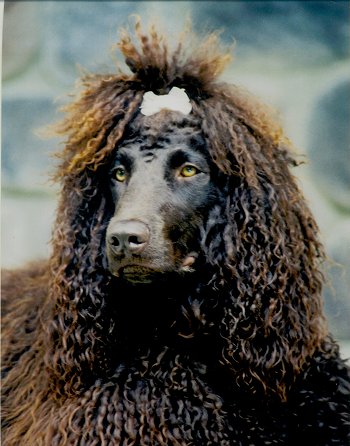
Vacation fashion - the shaggy perm

A little re-touch needed
I find the perms particularly unattractive. Korean hair, especially on youngsters, is wonderfully beautiful, full of lustre , body and that typically black-blue, black. The perm bakes and frizzles the life out of hair and the ensuing curls and kinks undermine rather than enhance the original appeal. Of course, I’m missing the point! ‘Vacation’ fashions are a symbol of freedom which I understand is precious especially as kids don’t really have a vacation. Only in Korea can you have a ‘vacation’ that isn’t really a vacation but not to worry, you can perm your hair and mutate into a spaniel look-a-like for your ‘vacation’ classes and summer school! Unfortunately, if your destined for a ‘vacation’ boot-camp you’re buggered! Personally, in the muggy sweat of summer the only comfortable hairdo is a number 4 buzz with a pair of hair clippers.

Love those locks!
© Nick Elwood 2010 Creative Commons Licence.
Ear Piece Mania
Have you noticed that it seems a trendy, usually in western style restaurants, to equip your staff with radio earpieces. I often eat in a couple of places where the CIA and Personal Protection Services collide and fully expect to see staff with the barrel of a revolver poking from the waistband. It would be understandable if there were only a few members of staff per restaurant, but in Korea it’s customer service overload.
Two of the restaurants I frequent involve parking in a supermarket where I am always amused by the directions provided to vacant parking. First, there is the manic series of Power Ranger poses that alert you to the fact you have to turn left to enter the parking facilities. Of course, directions are adequately posted on both the tarmac itself and on street signs and you can hardly miss the building; it’s five stories high! Korean drivers have a reputation for multi-tasking, mobile phone in one hand, sandwich in the other; so I guess the Power Ranger routine grabs the attention of even the most inattentive driver. And next, once in the car park building, you can enjoy being mesmerized by the glitzy-glamour gals and their sequined stetsons that stand to attention on the apex of every corner and provide you a selection of semi-sexual hand gestures. My favourite is the direction to, ‘dim your head lamps,’ which looks like sign-language for, ‘it’s snowing.’ Performing this motion for several hours a day would drive you potty, unless of course you’d dropped an acid tab which in tandem with the glitzy-gloves, would be an exhilarating experience. Simply parking the car has been facilitated by 10 student staff, and that was only as far as the first level, but no one’s complaining when an hour’s wages are just enough to buy you a coffee and bun.

The Power Range Poses for directing traffic to parking lot
In the restaurant, another batch of students are re-enacting Men in Black. It’s early lunchtime and despite the fact there are only three customers, there are nine waiters each adorned with an ear-piece! I remember when CB radio was a fad and it was common to listen ‘into’ police radios, for fun. I wonder if you can listen ‘into’ restaurant radios because I’d love to know what instructions are transmitted. Do individual waiters have a ‘handle?’ Do they follow standard radio protocol?
Han Man One calling Waiter Number 10, take order from table number 5. Over.
Han Man One calling Waiter number 6, deliver steak and banana jam, with portion of kimchi and pickle, to table 5. Over.
The radios remind me of a Burger King restaurant in Osnabruck, Germany, which installed radios where you made you order. Staff had to speak your order into the radio which then broadcast it to the staff ‘cooking.’ Not a bad idea except the staff doing the ‘cooking’ were less than a meter from the staff collecting the order, and sometimes the staff ordering would turn about and become the staff ‘cooking.’ It seems nothing could be done without speaking first into the radio-loud speaker contraption. Worse, the sound the radio produced, perhaps because of the proximity, was muffled and incomprehensible and so, ‘Whopper,’ sounded like, ‘wowa.’
Maybe the ear pieces transmit calming music to anesthetize staff when there are no customers or when staff outnumber them. Maybe they’re totally dead, simply window-dressing, because I never seen any staff directing waiters. I’d sure like to have a whirl on them, secretly – and if of course, I could speak Korean. One of the places I eat has the most handsome waiter and I’d love to say a few things directly into his ear-hole. Unfortunately, though the restaurant serves a rather delicious sausage, amusingly called ‘sausage on the bone’ as it has a spare rib painfully protruding from one end, the only sausage I want is not on the menu!
© Nick Elwood 2010. This work is licenced under a Creative Commons Licence.
A Hot Little 'Story'
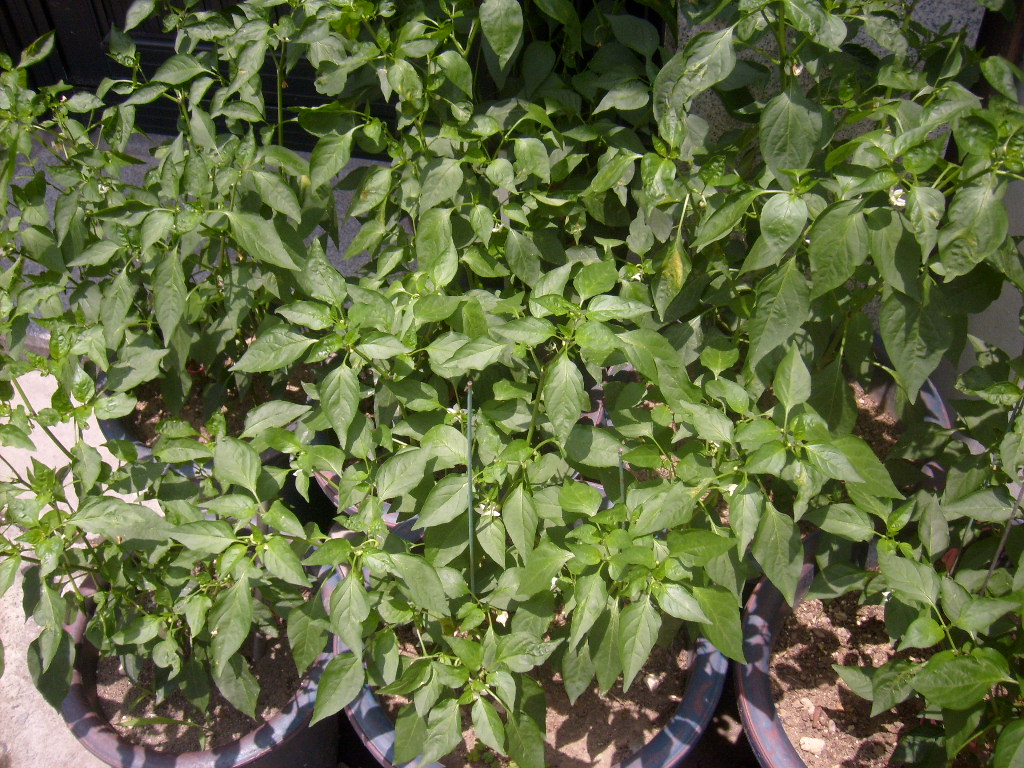
Chillies growing near my house
My neighbour, an elderly man in his seventies is annoyed. He lives in a house next to my one-room ‘villa’ and loves to garden. Wild sesame grows around the front of his house and often, as I am leaving my building, their scent is wafting on the breeze. Along the sides of his house are an abundance of chillies.
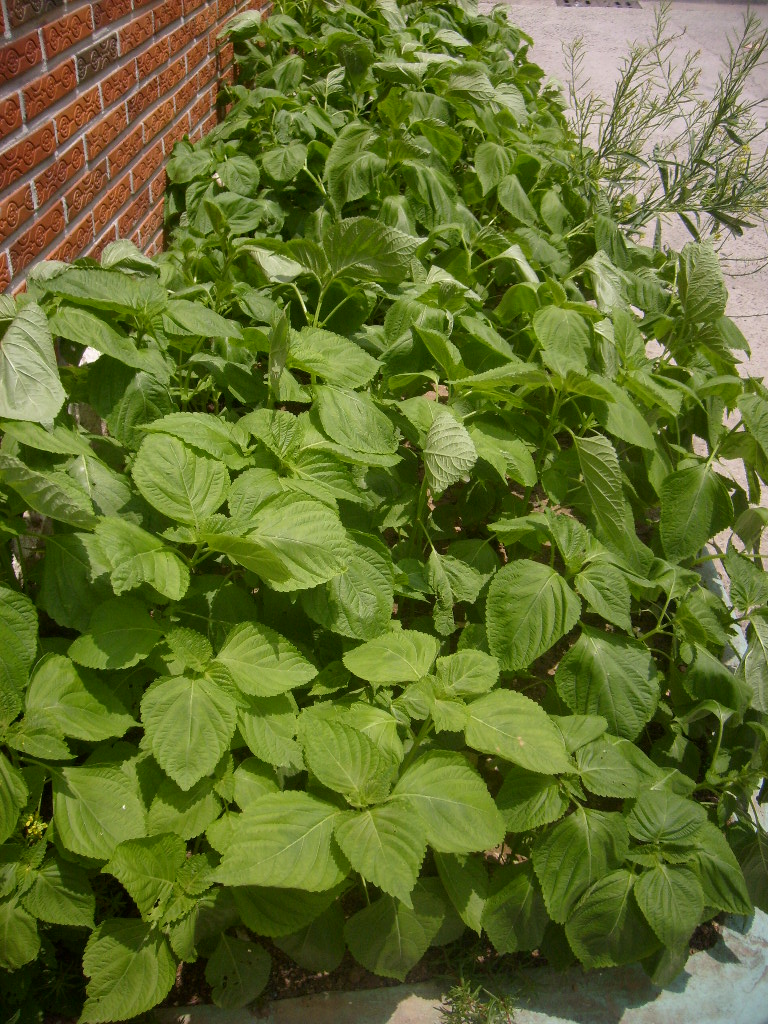
My neighbours sesame plants
While Koreans often surprise me with their ignorance of nature, most patches of spare land, especially between buildings in residential areas have been toiled in order to grow sesame, mooli or chilli. If not eked out of vacant soil, plant life is sustained in ceramic or plastic pots of sizes ranging from tiny to big enough to bathe in. I have even seen patches of cultivated land laboriously dug out of small patches on the mountain side.
My neighbour is angry because someone has pulled up a couple of his chilli plants; a clear transgression because to do so involves putting ones hand through the fence into what is clearly his property. My other neighbour, who owns the restaurant directly in-front of my one-room, finds the incident somewhat amusing as she claims his chillies only have a couple of fruits on each plant and yet the solitary chilli which sits, day and night in a pot beside the restaurant front door, has seven fat fruits on it and no one has seen fit to steal it.
I’m perturbed; such theft is too close to the type of theft rampant in the UK except the chilli garden wasn’t vandalised or the stolen plants strewn across the pavement and subsequently stamped into the tarmac in that obvious expression of joy at destroying another person’s labours. The theft, though minor, unsettles me because it undermines the pedestal on which I put Korea but this is only temporary; I am pondering the issue outside the GS25 store and it’s Saturday evening at 11.00 and young kids, some as young as 10 or 11, are still walking about unaccompanied by adults. I remind myself my analysis may be a little over enthusiastic but in the UK no child of 10, or even 14 is safe on a city street one hour before midnight and if they are out and about, individual or in groups, they are up to no good!
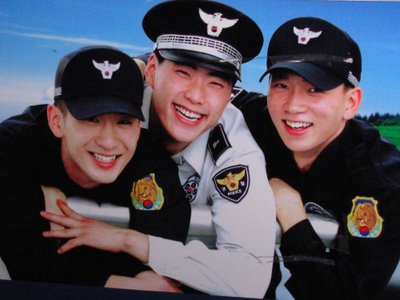
Unusual photo of Korean police
The ‘story’ has an amusing twist because the old man was so outraged by the theft of three plants that he telephoned the police – and guess what? They turned up to investigate – within the hour! Of course, there was nothing they could do but nonetheless it is incredible that such a matter should be both reported to the police and responded to, by them. I can imagine phoning the police in my hometown and telling them ‘someone had stolen three of my prized chilli plants.’ First they would either consider it either a joke or the complaint of an idiot because everyone knows the theft of a plant, other than a marijuana plant, is insignificant. And of course, the police probably wouldn’t respond. You can guarantee ‘crime investigation’ to occur if you are a big business but for most plebs who are victims of crime, you will have to be content with watching it on television. I had a motorbike stolen in London and it took them several days to turn up to gather the information part of which would be used to identify criminal patterns and the other to provide statistics designed to foster faith in the system and appease concerns over public spending. Most statutory professions in the UK are now predominantly concerned with bureaucratic and data collecting procedures designed to justify their own existence, after-which they deliver some secondary service to the public. ‘Statutory services’ should be renamed ‘secondary services’ as their current remit, basking in the shady, inconsistent world of statistics, clearly has a political agenda.
© Nick Elwood 2010 Creative Commons Licence.
Feeling a little Dicky

작은 고추가 맵다! Big things come in small packages
I haven’t been to the bathhouse lately as I’ve been feeling a bit dicky after a mild touch of food poisoning and I’ve been giving some thought to the topic of dicks. It’s the fault of the GS 25 convenience store near my one room which has a tendency to hire attractive students who lure me into their domain partly because of the motto worn on the back of their jackets, fresh, friendly, fun, but also because I usually fancy something hot before bed. The latest boy also wears a pink badge which says, ‘I love you.’ They should pay him extra money to wear the jacket and badge. Those kids are crappily paid, something like 4000 Won (£2) an hour, and I’m aware I could probably lure them with some extra won, if I was in some seedy dump like Tangier or Tijuana, but no one has any free time here and besides, vibrant economies tend to put a damper on the extremes driven to by financial desperation.

Small and hot
Clacton on Sea in Essex, UK! Now there’s a place as seedy as dirt holes like Tangier or Tijuana. You don’t have to travel with a passport to find economic, intellectual and cultural poverty if you’re British, Clacton provides it all. I’ve taught in most of the senior schools in ‘Clacky,’ an experience enough to terminate any interest in teaching as a career. Here’s a snippet from a diary entry for February 2000.
I don’t enjoy my contract day as I feel responsible for the classes. It’s much more fun when I just do cover. It was an okay day but the lads in my last class, Year 10, bottom set business studies (my pet hate) spent most of the time messing around. There were only four of them and I’m sure a couple of them are prostitutes – Clacton is that sort of place and I believe that the Macdonalds in the town center is where you pick them up. The boys sit with their knees wide apart, one keeps tugging at his dick and their conversation is usually about sex.
‘Do you fancy ‘him,’ Paul?’ asked one boy hitching his head to indicate me.
‘If he’s got the money.’ Later, Paul asked me to sign his report. ‘Go on, Sir, give me a good one. Just a few good comments to keep my parents off my back. I’ll do anything you want.’ I looked at him and raised my eyebrows. ‘Even that,’ he replied. A few weeks ago I over heard this boy say he’d like to be a male prostitute. His friend asked if he’d do it with men. He told him he’d do it with anybody as long as he got paid.
I could probably pick up a local faecalapod in Clacky with as much ease as you could in Tangier, except I’m not into dirt or STI’s and the hottest thing I’m going to pick up in GS25 in Song-So is a cup of hot chocolate. The new boy is skinny and he reminds me of a former student. Because of centuries of genetic isolation, Koreans tend to look much more like each other than we mongrel wayukins. Even beyond the black hair and dark eyes, I tend to note similarities in a passing stranger with the features of old friends or former students. I don’t know if there been any research done on the subject but sometimes I think there must be less than 15 basic appearances from which most Koreans slightly deviate.
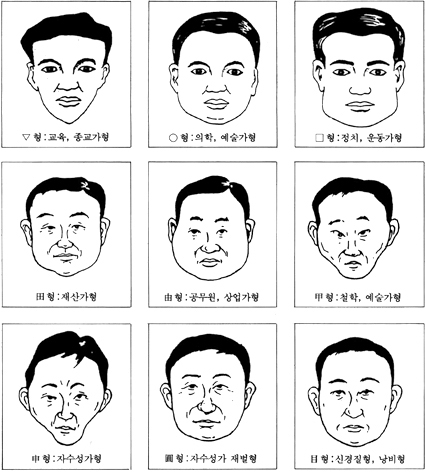
Phrenology
The skinny lad won’t last long, the students in the store tend to change about every three months. It must be a frigging bore of a job working through the night and I’ve no idea what’s on their pads ‘n’ pods but some of them seem to spend the whole evening on them and will instantly discard them as they jump to attention, when you walk into the store. Some read books but even then there is usually a pad or pod in sight.
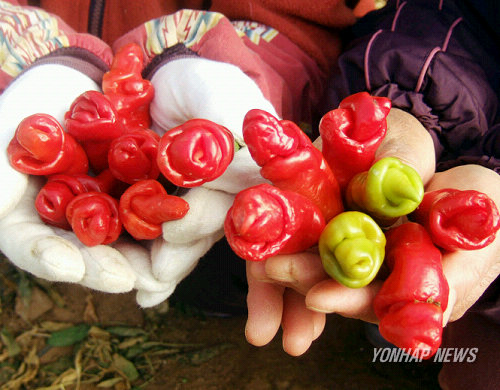
'Peter Peppers' or 'Chilli Willies' - though they may be look-a-likes (Yonhap News)
And of course, it’s chilli season. Talking of willies, phallic shaped chillies are probably a freak of nature in Korea but in Louisiana and Texas, USA, a type of chilli, the ‘Peter Pepper’ or ‘Chilly Willy,’ is renowned for producing consistently cheeky chillies. The website ‘Chilli Willy®‘ markets the appropriate seeds, provides growing tips and hosts a regular photo competition. Do they have the same kick? I’ve no idea but in Korea it’s a well-known idiom that the smallest chillies are the fiercest (작은 고추가 맵다). Globally however, Korean chillies are far from the hottest or smallest. For a wealth of information on the world of the hottest chillies visit: http://www.scottrobertsweb.com/scoville-scale.php
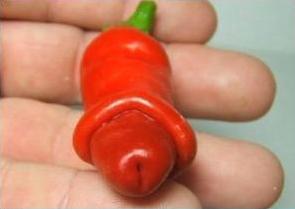
A genuine 'Chilli Willi®'
© Nick Elwood 2010 Creative Commons Licence.
The Sounds of Silence – Noisy Eating
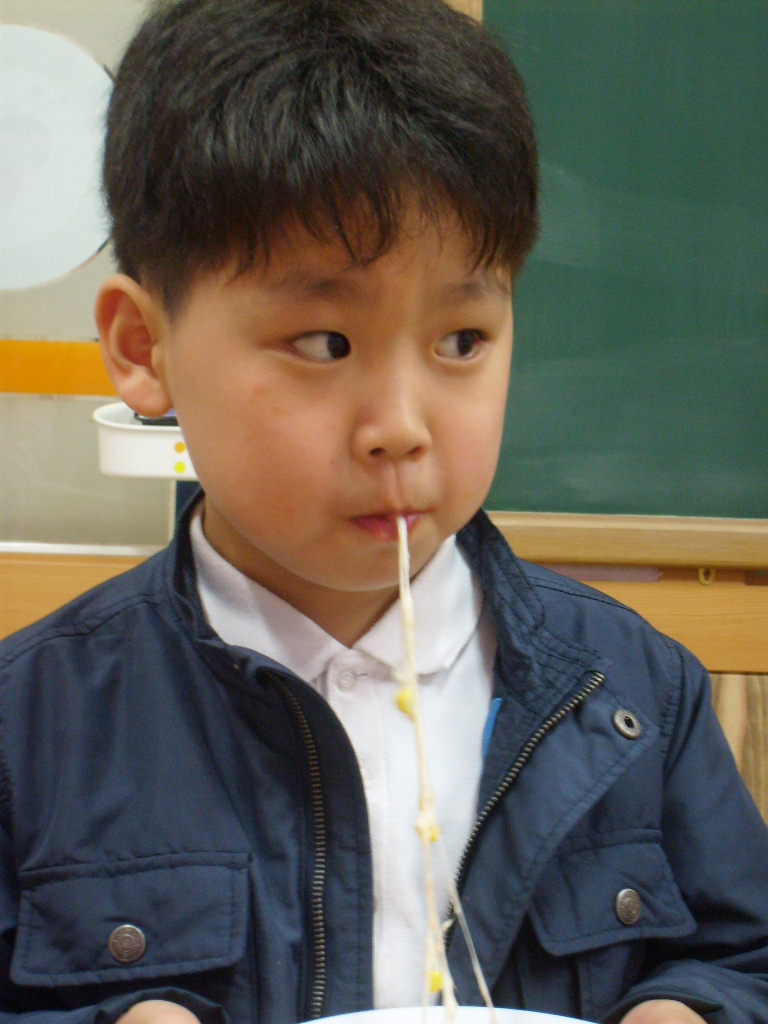
Slurp slurp, smack, smack...
I was watching the kids in my school eating around a table. The usual format presided with bouts of animated talking and then silence. Koreans talk much less than westerners during a meal as it suggests enjoyment but the silent periods are never really silent because another means of expressing pleasure with food is to produce little noises of contentment as you eat. I was reminded of a friend back home who cringes whenever I eat toast in his presence. Eating toast silently is impossible, unless you’re into that Americanism of dipping it into your coffee the same way we British dunk their biscuits. Even with the moistest mouth, or lavishly lagged in rich butter, toast crunches and it so happens such noises seriously disturb my friend, so much so that I can only ever eat it comfortably when he’s in another room.

Toast and butter
I love butter and in England melt a fat wadge of it into mashed potatoes, along with some milk and occasionally a raw egg, and always melt a knob or two on carrots, brussel sprouts or peas. I’ve lost a considerable amount of weight in Korea as milk, bread and butter, basically diary products, no longer form a staple part of my diet. At one time all three kick started my day along with oil, bacon and egg and there were probably as many calories in my English breakfast as there are in my current, daily Korean menu. My weekly shopping in England included a pack of butter, a pint of milk a day, a large loaf and about 1 litre of oil a month. And then there was the meat! Nothing less than two big pork chops for dinner, or a large piece of chicken. I rarely fry any food so oil, only ever sesame, is reduced to about a litre a year. My consumption of meat, without any exaggeration is at least 5 times lower than it was back home while my consumption of vegetables is significantly up. Currently, I will eat an entire large carrier bag of spinach a week and one enormous water melon; the water melon alone takes more calories to carry to my apartment than will be contained within it. Most surprisingly of all is that my consumption of rice, the staple food in Korea, is much lower than when I lived in England. A portion of rice in Korea is not much more than a handful, the amount contained within one of those small stainless steel dishes. Whenever I’m served rice back home the amount can be as much as 4 times greater than this and the quality is poor. For most of my life rice has simply been rice with a few major divergences: pudding rice and sushi rice being the most obvious. But when you live on good quality rice for a few years you really notice how tasteless ‘British’ rice is. Even the upmarket brands are bland but in fairness Koreans probably see a potato as a potato and for most Koreans the epitome of french fries are the shit served by Macdonald’s. Jersey new potatoes with a sprig of mint and coated in creamy butter! Now there’s an orgasm!

Pass the tissues!
Shopping in a Korean supermarket, even the big ones like Home Plus (Tesco) or E-Marte is boring and totally functional. There are few microwave meals, no meat pies, few jars or cans of cook-in sauces padded out with soya and corn by-products, little but fish, fruit and spam existing in cans, an absence of almost anything but yogurt and ice cream in the form of deserts and frozen goodies are limited. Only in Korea can I go shopping for an item and leave the premises only having bought that item. In the UK, if you enter a supermarket the chances are you will leave with far more than you originally planned to buy. Of course, there are ample goodies in a Korean supermarket, probably of more appeal if you are Korean, but as a westerner with a penchant for pastry, dairy and meat products, the choices are limited.

Creamy
My greatest weakness is butter and by that I mean real butter and not that fake crap verging on margarine that for over a decade we were hoodwinked into believing was healthy until it transpired the trans-fatty acids they contained were just as bad for you as real creamy fat. Thankfully, Like Korean cheese, Korean butter, if you can get hold of it, is generally shite. I was at a buffet restaurant a year ago and tucked in a corner was a toaster and butter; indeed two types of butter, herb and garlic. I almost wet myself I was so excited. There I was, surrounded by barbecued meats, smoked duck, smoked salmon, fried rice and even fried chicken, and the first thing I go for is some toast and butter. The butter was rather pale, not deep yellow like Irish butter tends to be but more like French butter but this is no bad sign as pale butter can be extremely creamy. You can imagine my disappointment when after attaching a fat slice of butter to my hot toast, I discover its ‘well being shit’, butter made with water or some fat-free substitute that turned the toast to exactly the same consistency you get dunking it in coffee and which is ideal for the elderly and those whose mouths are predominantly gum. It made no toast crunching sound and disgusted, I discarded it next to the toaster and headed straight for some fried chicken.

I'm looking for the cream!

Korean stainless steel rice bowl - fits in your palm!
In the last three years I have eaten one pack of butter! Imagine my glee when I discovered a pack of Danish Lurpak butter in the cooler cabinet at my local E-Marte! It was expensive, 6000 Won (£3) but I was in need of a little comfort and reminiscing and after putting it in my basket bought a loaf of bread. I’d been given a toaster by a friend in Ch’eonan and 18 months later, it still lay packed in a box in a corner of my veranda. Lurpak is almost white in colour and is unsalted but is deliciously creamy. The pack was consumed within 36 hours, a frightfully naughty luxury and I haven’t bought one since and the toaster, boxed up, has gone back to the veranda.

Cabbage and rice cake spicy stew - korean kids favoutire
Sat at the table with my students, who have just made spicy cabbage stew (떡볶이), I suddenly become aware of their noisy eating, a symphony of sucking, smacking, slurping, sighing, clicking, and chewing. When I first arrived in Korea, I didn’t particularly enjoy eating with Koreans because they tend to make the eating noises you hear in documentaries where some micro camera is inserted deep into a nest of ants or termites and the sounds subsequently amplified. When eating with gusto, Koreans parade the entire gamut of possible eating noises some of which are so juicy and over excited, they are almost sexual. Ten years ago I hated those noises in the same way my friend hated the unavoidable sound of munching toast. Sitting there watching their happy faces as they sigh loudly, because they’ve eaten too much, or fanning their mouths because they’ve deliberately made the stew too spicy, I realise I now find their noises both consoling and cute. I spent years scolding my nephew because he tends to eat in a manner somewhere between a salamander and an insect. Maybe it’s time to cut him some slack!
© Nick Elwood 2010 Creative Commons Licence.
Beach Bum Teachers
I took a walk around Keimyung University, Daegu, and passed a couple of plastic professors one of whom wore a three piece suit and the other, white trousers, jacket and a Panama hat. True there were a few casually dressed waygukins kicking about but I assume these to be students so as not to spoil my myopic view of the world.
Keimyung is a beautiful campus and supposedly, one of the ten most attractive campuses in Korea. I was lucky enough to have attended Essex University in the UK, and indeed own a house only 15 minutes walk from the campus. As a first year student in halls of residence, my room looked out over Wivenhoe Park which was the subject and title for John Constable’s 1816 painting. I never really appreciated the importance of beautiful surroundings and university campus life until I subsequently studied in London where the University probably owned one tree – everything else being brick and tarmac.

For a year, this was my view as I ate breakfast
Swanning about in a boater or three piece suit with a dickie bow, even if you’re professorship is plastic, is so much more sophisticated with a beautiful campus as a backdrop. True, Oxford and Cambridge aren’t set in beautifully rural settings but the sense of the numinous imparted by ancient architecture is just as effective and maybe more so.
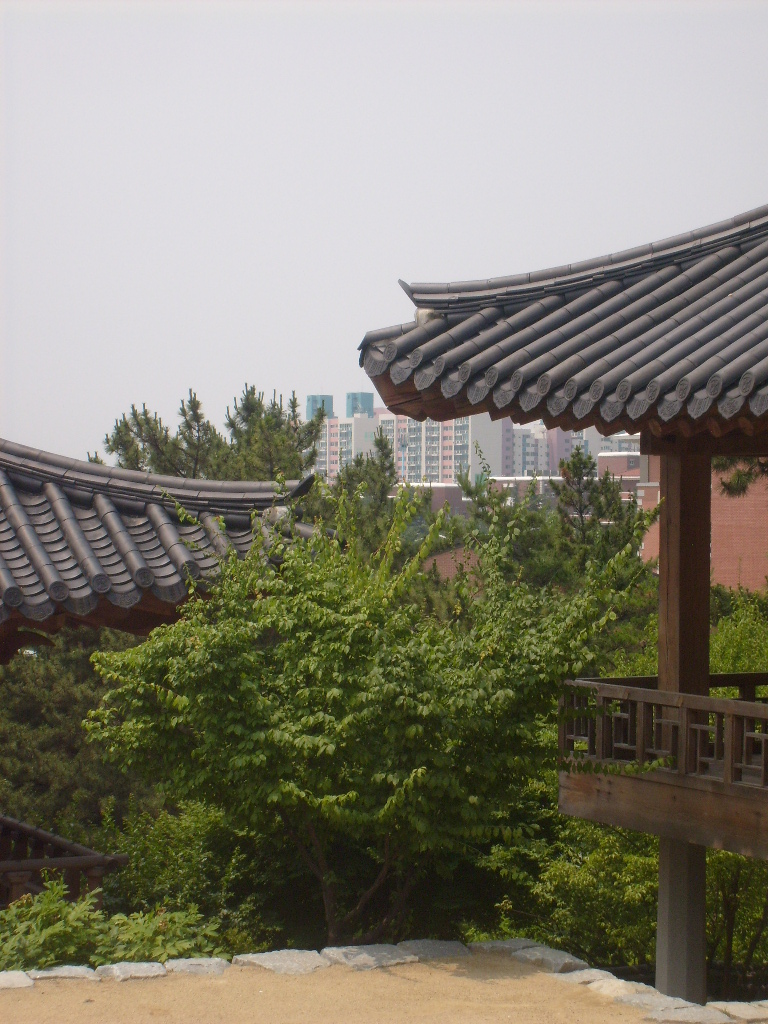
Keimyung traditional architecture and the distant city
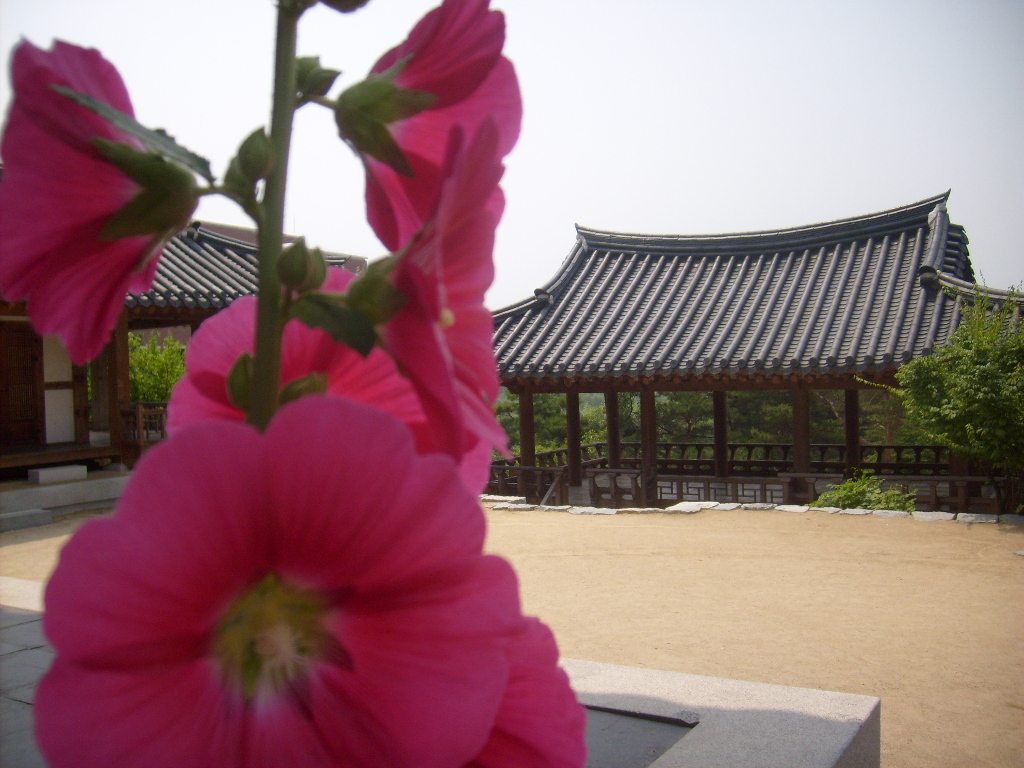
Traditional and modern typify Keimyung campus
Two miles down the road from Keimyung, in Song-So, there are no boaters or dickie-bows. When you’re teaching in a haggwon a three piece suit is an overstatement. Around Song-So’s haggwons the predominate form of dress for teachers is casual and hence cargo shorts, shorts, flip flops, vests and all manner of clothing suitable to a Thai beach, building site or the set of a Pirates of the Caribbean movie, are common.
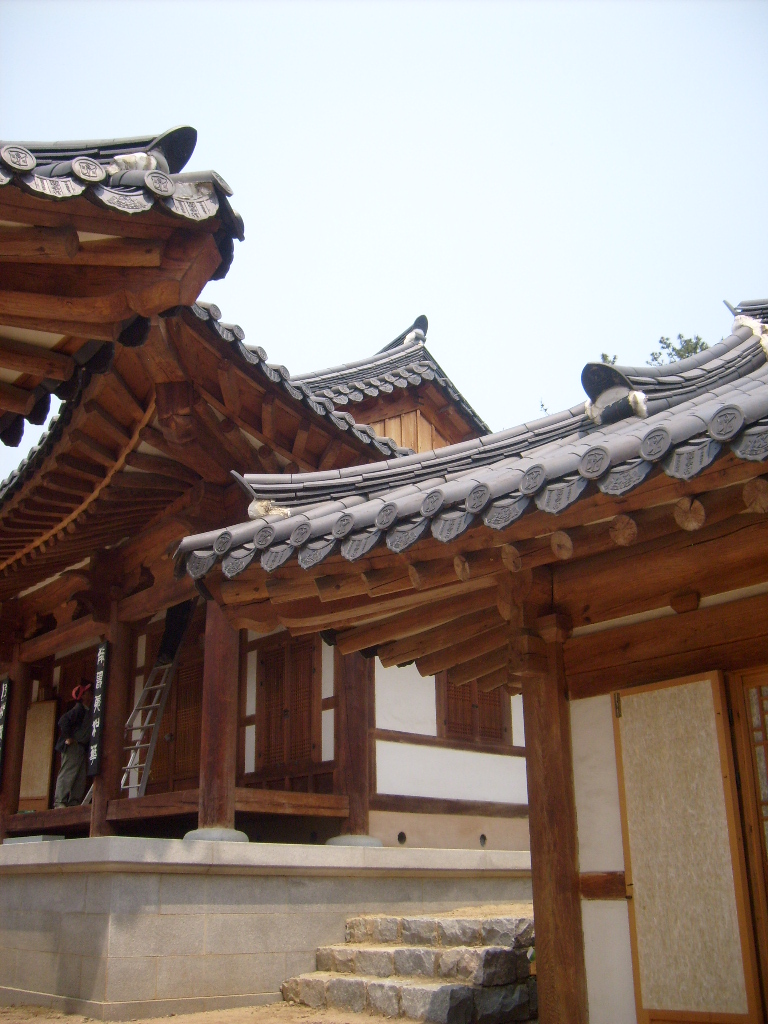
Traditional architecture
Now, I come from Britain where the weather is notoriously shitty and where you can generally wear the same type of clothing all year. The same thickness of jeans material will suffice throughout the year but may be a little warm in summer but the need for three types of clothing, basically, winter, summer and spring/autumn, as in Korea, is not necessary. However, in many parts of Canada and Australia, and definitely the USA, the summer temperatures and even precipitation are not a lot different to that of Korea. I used to play in a military band and have marched through Calgary, Canada, in a temperature of 44 degrees and I wore full ceremonial uniform and not a pair or cargo shorts and flip flops. I remember Washington DC being very uncomfortable and air conditioning, something of a domestic rarity in the UK, was a necessity. What I didn’t see however, were Americans or Canadians going to work, certainly not professional work, dressed like beach bums.
I get annoyed seeing westerners going into schools dressed like they’re on vacation and see it as a form of racism and symptomatic of cultural ignorance. In my high school, and in haggwons in which I have taught, the dress code, set by co-workers, certainly wasn’t beach wear. Eighteen months ago, we hired a Canadian gyopo (교포). He had never lived or worked in Korea and spoke little Korean but would turn up for work wearing torn jeans which he wore so far past his hips his boxers were constantly on display. Meanwhile, his hems were worn away from having been constantly walked on. Dressing like a shit-bag puts immense pressure on haggwon bosses and while some, like bosses everywhere, are tossers and deserve it, many are decent and well meaning. Neither is it fair on Korean co-workers when foreign staff dress for a beach party while they dress, like professionals, for work.
If I were employing a waygukin, I’d certainly want to see a photo and I’d probably want to ask: what they would intend to wear to school? If they can get themselves to school via the shower and shaver, and if they piss it up every evening? But then I’m inclined to fascism! Easier, I’d probably employ waygukin’s with professional teaching qualifications beyond the month long TEFL, ESL certificate and who’d actually had real jobs to both check out references and as a means of assuming they will be acquainted with what to wear to work, and how to behave in work. You read so many gripes about westerners not being treated fairly and while a lot are genuine, many will be the result of waygukins who treat working in Korea as part of a backpacking holiday. It is disrespectful, even racist to treat your host culture with less consideration than you would you own culture, regardless of your personal opinions, more so when there is little or no difference between them in terms of work place etiquette and its associated expectations.
© Nick Elwood 2010 Creative Commons Licence.


 Elwood 5566
2 comments