Emergency Dump!
You’re not supposed to write pooh stories! Actually, a few months ago someone made some nasty comments about an article I wrote about pooh humour. Anyone who has a problem with pooh stories is simply anal and needs to loosen up! Anyone who has traveled outside the domain of Club Med 18-30, anyone who has had to eat a drastically different diet or squat and then clean their bum from a tin can of water using their hand, knows the subject can be very entertaining and is well worth writing about, for all sorts of reasons.
Every Friday, I eat lunch with my boss; not an occasion to talk about pooh! Usually we go somewhere a little further afield than the area in which we live. I’d woken up early and started working straight away and didn’t each breakfast until around 11 am, which was no problem – except I’d cooked bean soup (된장 치게) and eaten it with some kimchi and acorn curd (두투리묵). The fuse for such food, especially without rice, depends on the individual, but mine is about an hour. If liquids are consumed, and I’d had several cups of coffee, it can be as little as 45 minutes. But I so engrossed in my writing, I was completely oblivious to my mistake.

Pooh on a bag
My boss calls at 11.30 and we drive off to the area fronting Keimyung University. Fifteen minutes later and we are sat in chicken bar. Its predominantly a beer bar that sells chicken by night and predominantly a chicken bar that serves beer in daylight hours, they’re all over Korea. The chicken is drenched in spicy sauce, or is fried in batter or perhaps served with a sweet soy sauce and a beer swishes it down nicely but, I never drink before work.
I’d felt the warnings on the brief walk to the restaurant but it hadn’t clicked and I was thinking they’d disappear but they actually intensified. I began to perspire. There was the panic too, because you know that when in the grip of needing to defecate you will do it anywhere; in your pants, squatting behind a car in public and even bent over in your bedroom holding your backside in a plastic shopping bag. This is almost my fourth year in Korea and I’ve never had to crap in any other toilet than my own unless in a hotel or the comfort of someone’s home. I’ve never had to take my chances on the street where, unless owned by nice restaurants or western style eateries, you can guarantee toilets are going to be grim.

About to explode!
There have only been a two occasions in my life when the fuse has been so short that I’ve only had seconds to find a toilet. Once was in Osnabruck, Germany, after a military exercise when all the toilets in my barrack block were occupied. I had to pooh in a carrier bag in my bedroom and that was illuminating as you never realise how hot and heavy a pooh can be until you hold one in a bag. The next occasion was some 20 years later, again in Germany, in a small town close to Bonn. That was out of the blue; one moment I was fine walking through a quaint little village with a small stream running through the center of it, next moment I had seconds to find a toilet. My third ordeal had just started!
‘I’ve got to use the loo!’ I announced and immediately made for the back of the restaurant. We should have chosen a more up-market location as the toilet was shared by several establishments and not easily reached. I found it with thirty seconds to spare and of course, not only was it a squat down job but there was no toilet paper. But I’m good, ex-military good and before I’d even got to the door and discovered conditions, I’d covered my options. My jeans and shoes were off within seconds and having already spotted the hose in the small garden that lay close by; I turned it on an dragged it into the toilet wedging the gushing end down the drain just inside the toilet door. Then, I closed the door, took off my boxers and a second later, in one expulsion, my late breakfast was reincarnated. As I was hosing my arse and swishing the bean soup into the sewers of Daegu, I suddenly realised what had caused my upset – my badly timed, watery breakfast! Drying my arse on one of the large hankies I use in hot weather, I quickly got dressed, repositioned the hose and washed my hands. Although the toilet was was grotty the soap was actually quite nice. I hadn’t even got my feet wet and neither had I crapped on my heels which is always a danger on a squat loo and is why I take my pants off! And by the time I got back to my table, a lovely plate of spicy chicken awaited.
 © Nick Elwood 2010 Creative Commons Licence.
Kimchi-ism
It smells bad, it can taste revolting, and is a major cause of conflict in university accommodation kitchens worldwide, where the sharp smell oozing from refrigerators upsets non-Koreans. It hangs on your breath with greater offence and persistence than any French gastronomical delight. Garlic can certainly be rude but enhanced and enlivened by numerous chemical processes and suspend in cabbage water and the pungent juices of fermented anchovy, the power to offend becomes a chemical and biological capability. Nothing is polite about it, it is totally ‘in your face’ in its onslaught of your taste buds, nasal passages and doesn’t look too pleasant either. It lacks any refinement or subtlety and amongst ‘offensive’ foods ranks as a weapon of mass destruction. You wouldn’t gorge or binge on it, indeed I wouldn’t even call it delicious and I could certainly live without it. If I were to be isolated on a dessert island for a year it wouldn’t be on my list of essential items. And yet paradoxically, it is one of the most exciting taste sensations in the world. If there is one food so aptly capable of defining a nation, so synonymous with a people, it is cabbage kimchi(배추 김치).
There are many types of kimchi, and of those types many variations, and of those variations many permutations depending on a range of factors. Kimchi is one of numerous Korean, fermented foods, others including makkalli, bean paste (된장), and soy sauce (간장). Only when kimchiis old enough for the initial processes of fermentation to have ceased, will the flavour be consistent. At all other times, you can’t eat the same kimchi twice as the taste is always in a state of transition. Canned and packeted kimchi are available but these should only ever be eaten as a last resort. Canned kimchi, often from China, is especially disgusting!

Welcome to Korea!
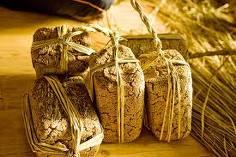
Traditional fermented beans (메주)
The most popular type of kimchi, and the one most armed in terms of offensive capability, is cabbage kimchi (배추 김치). Cabbage is well known for its powers to unleash unpleasant odours once its fibers have traversed the intestinal tract and are approaching a transmuted reincarnation via the human Cloaca Maxima. With cabbage kimchi however, your digestive organs can take a break as most of the chemical process which release those aromas, have already been activated and are in a chemical flurry approximate to final stages of processing via the large intestine. Indeed, I would go as far as suggesting that function of that plastic Tupperware tub or kimchi pot in which kimchi is stored upon being made, is basically a portable large intestine containing the numerous biological processes. In that Pandora’s box of mischief: the most infamous kiss-killer of all, garlic, is present in its most potent form, crushed! Added to this is minced ginger, a Korean type of chive (실파) and mooli (무) which while not individually notorious, collectively possess powers of repetition which help strengthen the garlic and intensify its potency. Even at this stage, a burp of this concoction is lethal. Added to this, is the cabbage which after having been submersed in salted water, is already chemically active.
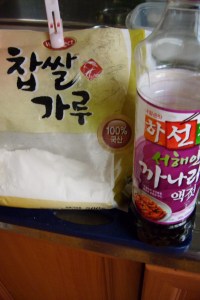
Kkanari - fish sauce - the concentrated odour of a million sweaty feet
The addition of fish sauce, (액젓) famous across the Asia, which is another fermented product made from anchovy or kkanari (까나리 – sand lance), completes the recipe. Of all the noxious odours added to kimchi, anchovy or sand lance sauce is the most vile. I’ve often entertained myself by inviting guests to sniff an open bottle as I’m casually cooking, with a little encouragement such as: ‘smell this, it’s lovely,’ or, ‘this has got to be my most favourite smell.’ Usually, a good whiff will propel them back a few meters with as much force as would a couple of hundred volts of electricity. Once amassed and fizzling away, the flavours and smells blend in a process which can last a considerable amount of time, depending on temperature.
Comparing the kimchi pot (김치독) or Tupperware tub to a colon is not an exaggeration. I have slept in the same room as as my gestating kimchi and in the first week of fermentation, gasses produced within the Tupperware colon would cause the lid to pop-off about once every twenty-four hours. If this occurred at night, the escaped aroma was initially enough to wake me. I have since become quiet comfortable sleeping in the same room as fermenting kimchi and find the smell highly evocative – ironically, not evocative of life in Korea, but life back in the UK where living with friends necessitated containing kimchi smells to my bedroom and not the shared kitchen.
Kimchi encapsulates Korea at many levels. Many countries have a national food with which they are identified: Italy – pizza, Germany – sausages or sauerkraut (which is also fermented cabbage), France – smelly, soft cheeses, frog legs, snails and cordon-bleu cooking, England – fish and chips, roast beef and tea, Scotland – shortbread and haggis, but few have the ability to represent their nation with such precision as does kimchi. While kimchi comes in blaze of spicy colour, the foods of other nations, delicious as they are, remain purely monochrome.
Kimchi is a pot-pourii of Korea, a culinary collage of so many integral Korean elements – garlic, ginger, Korean chili powder (고추 가루), mooli (무) and fish sauce. These ingredients are the basis of almost all Korean cooking and representative of so much of the peninsula’s farming. You can hardly step in a direction without seeing pots of chili, patches of mooli and even on the mountains sides I’ve seen small plots painstakingly hoed out of the rocky soil, blossoming with such vegetables. Local variation on the cabbage kimchirecipe, as well as banchan side dishes in general, and most other Korean foods, adds a further interesting dimension. While many national foods are now factory produced, often resulting in grossly inferior products (shortbread is a good example), kimchi, even when sold in markets, is homemade and its production evokes a great sense of pride. Korean women, and even some men, are proud of their kimchi making prowess and whenever a gift of kimchi is given, it should be respected.
The making of kimchi is very much determined by the seasons with particular kimchibeing made at certain times of year, and for cabbage kimchi, this is late Autumn to early winter. One of my most memorable images of Korea was seeing an enormous stack of Chinese cabbage (배추) outside Shinoo Supermarket, in Song-So, swathed in wintry mist and beside which a couple of store workers huddled around a bonfire burning on the pavement. I’ve never see such a sight since. And when it is time to make kimchi, members of the family or friends, sometimes communities, females more than males, are brought together.
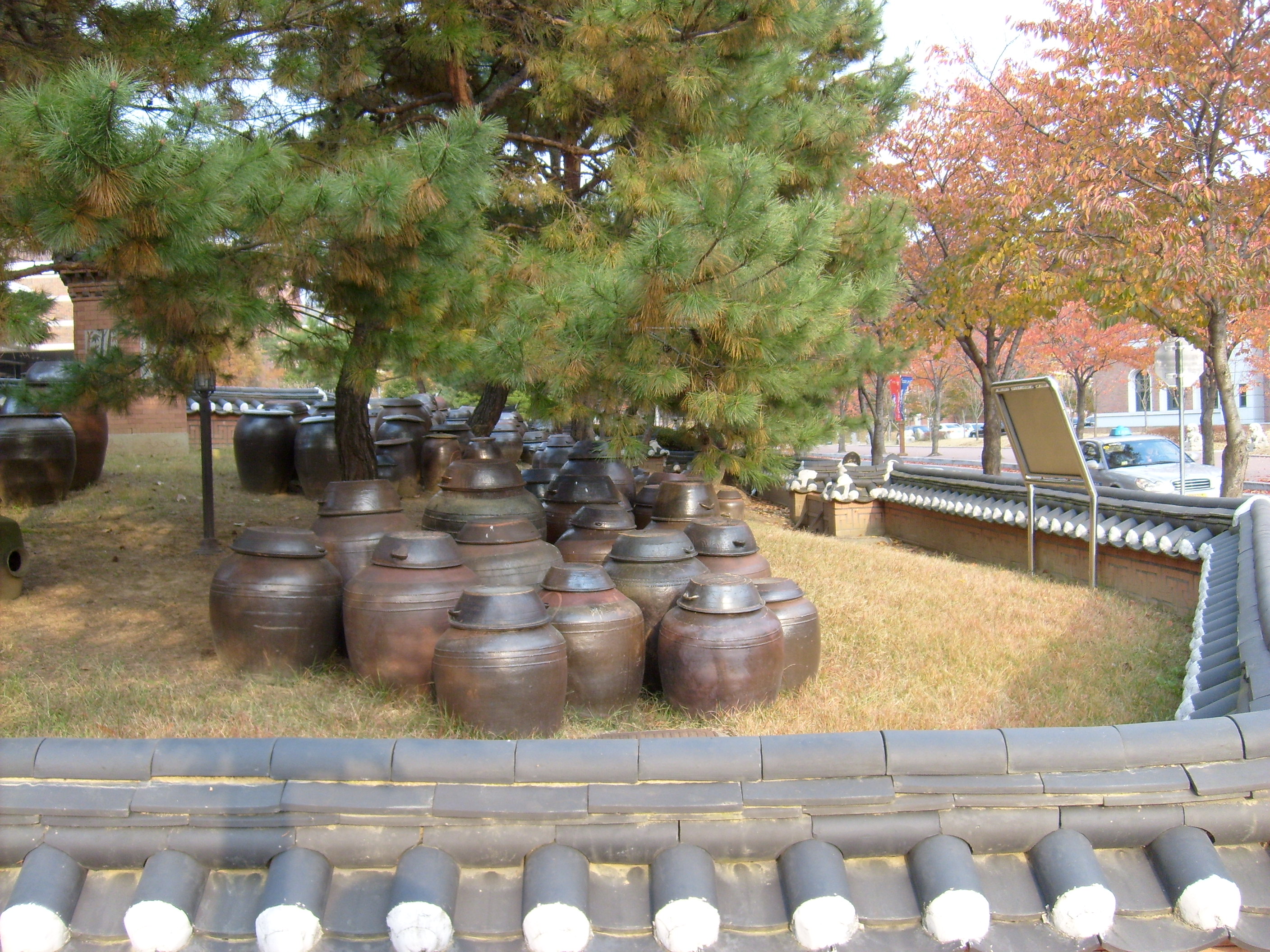
Kimchi pots (김치독) at Keimyung University
There is always a random element in kimchi production, something beyond the control of the ‘cook’, and hence tasting the final product is always an exciting moment. Like making English tea, you can follow the recipe and time the brewing meticulously, but the production is influenced by factors beyond the recipe, it might be the temperature, the humidity or the quality of ingredients of that particular season. Part of the fun involved in kimchi making is the pursuit of perfection in the light of random influences. And if the kimchi itself isn’t synonymous with Korea, the pots (김치독) in which it is traditionally stored, can be seen sitting in vacant corners, on rooftop and apartment verandas across the entire peninsula. The kimchi pot is as Korean as soju, mountain temples and the cawing of the magpie and their production an ancient and noble art. But the making of kimchihas also kept abreast of modern developments. Kimchi has traveled into space and the kimchi refrigerator is now a popular sight in many Korean homes.

My kimchi 'colon'
Learning how to make kimchi and any of the extensive range of side dishes collectively known as banchan (반찬) and of which cabbage kimchi is the King, is difficult. In my area of Daegu are three small shops which produce homemade banchan but they staff don’t like being photographed or watched whilst working. My grandmother, the daughter of a Scottish baker, was just as defensive about her shortbread which was superior to any factory produced shortbreads.
Waygukins and Koreans alike will never grasp the potential of their smelly delicacy until they are able to eat and smell it in isolation, basically, outside of Korea. Like, garlic, the best defense from the offensive smell is to ingest it yourself and once you do that you no longer notice it. You can walk in and out of Koreans homes and their restaurants and never really smell kimchi and yet the whole nation reeks of it and everywhere everyone chuffes out its pungent odours. The only reason you don’t smell it is partly because you have acclimatised to it and because you eat it. I remember arriving at Kimpo International Airport after a holiday, and as I walked into the arrivals hall I suddenly noticed the smell of kimchibut no sooner had I noticed it, than it disappeared. But if you visit Korean friends in the UK, or they visit your house, the odour of kimchiand of garlic is very strong and even unpleasant. I often notice how Korean Air and Emirates, provide Korean meals and kimchi on flights into Seoul and wonder if this is to acclimatise passengers to the guff of garlic and kimchi, prior to landing.
The taste of kimchi has a bizarre appeal and every Korean has a liking for a particular type; for some it’s fresh kimchi in which the fermentation hasn’t really started, for others it’s the tangy bite of old kimchi which draws your tongue like cold tea or strong red wine. And it can be used in a multitude of ways: barbecued, added to stews, used for soup, put into pancakes, fried with rice, minced into hamburger patties, rinsed in water and added to cold soups chilled with ice cubes. When the fermentation process has stopped, and kimchi is left standing, sometimes for months, it is often attacked by a glueppy white mold which lays over the uppermost leaves. At this stage the kimchi is at its sourest and is ideal for cooking kimchi stew (김치찌개), the mold simply being washed off. I don’t think any westerner truly enjoys kimchi first time, but the more we familiarise ourselves with its guises, idiosyncrasies and long and ancient history, the more entrenched our love affair with it becomes and the more we defend it to those barbarians who claim it stinks or tastes revolting!

Kimchi Stew
Twisting and weaving into Korea’s distant past, like one of the gnarled and knotted roots on the mountains, Kimchi, like its people, has endured and adapted. Originally it wouldn’t have contained chili, this being an addition sometime after 1500, when the chili plant arrived in Korea. Of all the foods capable of representing a nation, kimchi is the most personal, the most intimate and the most capable of embodying Korea. It transcends simply being a product of the soil, its production etches out a seasonal calendar, it brings families and communities together, it provides both national and regional identity with space for a little individual flare, and at tables across the country people bond as individual batches are critiqued, compared and celebrated. Even the frosty bite of winter and the hot balmy days of hanyorum (high summer) have a role to play in determining the flavour. In the past, Koreans believed that the foods that suited individuals best were the ones grown in the soil in which their ancestors had both toiled and been buried. It was the ‘fruits’ of the soil which powered families across the generations. When companies produce canned kimchi, or even packeted kimchi, they grossly miss the mark because not only is it supposed to be alive and active, but it has to be Korean. Dead kimchi, kimchi castrated of its chemical process is not kimchi and indeed Koreans have taken foreign kimchi producers to international court over such issues. You can eat French brie or Camembert made in Spain and probably not notice a difference, but kimchi that is dead or not even from Korea, is simply not kimchi.
Useful Resources:
Beyond the Blog – Maangchi: Queen of Korean Cooking
© Nick Elwood 2010 Creative Commons Licence.
Bathhouse Basics (7): The Naeng Tang (Cold Pool 냉탕)

The naeng tang (냉탕)
If there is one pool, usually the biggest, you are guaranteed to find at every bathhouse (목욕탕), it is the naeng tang (cold pool – 냉탕). Naeng tang are also often the deepest pool in bathhouses, usually as deep as an average adult’s waist and with the pool length, long enough to be able to swim in.

The cold pool (냉탕)
In summer, they are wonderfully refreshing and for many bathhouse goers, moving between a hot sauna or hot pool to the cold pool is a great sensation. Lounging in the cold pool on a hot summer’s day, before you exit the bathhouse complex to ‘powder’ and dress, will help delay the inevitable onset of sweating.
The temperature of naeng tang pools tend to vary between establishments though this is probably more noticeable in summer. Many bathhouse pools and sauna display their associated temperatures but this is not so common with naeng tang. Throughout the hot summer the cold pools are busy and their size and depth means they are often the playground of boys and even university students.

My favourite pool
In mid-winter however, the fact they are freezing means getting into one can require Spartan constitution; they are cold enough to knock the breath out of your lungs. Often the pool has a large shower which can be turned on by an adjacent button and which is powerful enough to massage your back and shoulders. Its force takes a little getting used to.
© Nick Elwood 2010 Creative Commons Licence.
Boring Boryeong and 'Waygukin Wankers'

Spot the Korean
Let me get my disclaimer out the way to begin with! Yes! there are plenty of decent, thoughtful and interesting waygukins in Korea and some may very well have visited Boryeong, but this post isn’t about them. This post is about the other types of waygukin, the ‘waygukin wanker’ types who generally ignore other westerners, have no significant Korean friends, have boarded the bus to Boryeong, and like to moan about Korean people and culture about which they like you to think they know everything.
I occasionally ‘rant’ about the unfriendly nature of many waygukins in Korea, it’s one of my minor idee-fixe. Two weeks ago, I had this idea to start a ‘waygukin wanker of the month,’ post in which I’d feature a photo of one of the numerous wankers around Song-So who will totally blank you if you pass them. I’ve lived in the building next to one for almost two years but even if we pass on an empty street, shoulder to shoulder, he will ignore me. I said hello on one occasion but he simply diverted his gaze to the floor and mumbled inarticulately. So, on one hot Friday afternoon, I stood for an hour waiting to get his photo but unfortunately he failed to turn up and missed the chance to be immortalized on my pages. I haven’t seen him for two weeks and am beginning to assume he must have gone back to wherever. Good riddance! However, there are plenty of other candidates to replace him.

Courtesy of Roketship (link)
Maybe ‘waygukin wankerism’ is a disease, possibly contagious, and if so, one of the most potent sources of contamination has got to be the Boring Boryeong Mud Festival. Bogland is full of boring accounts written by waygukin who assume they know all about Korea once they set foot on Korean soil and whose search for the spirit of Korea, it’s traditions and an understanding of the Korean psyche, lead them to splash about in a bit of dirt chucked over a sheet of plastic on one of the only holidays of the year. If I had a list of a 100 things I want to do in Korea, the Boryeong Mud Festival wouldn’t even be on it. Even one of my closest Korean friends, who is 25, said it was disappointing with watered down wishy-washy mud piped onto plastic sheeting. But, he was impressed with the army of waygukins as he felt they provided the festival an international atmosphere.
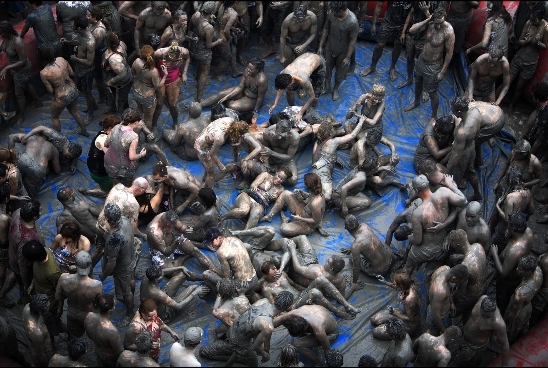
Lovely plastic sheeting
Boryeong is as typically Korean as the Costa del Sol is Spanish or, Tijuana is Mexican and any place which attracts an army of waygukins should instantly loose its appeal especially because it’s the sort of ‘safe’ crap you do on a 18-30 cheapo package holiday to some place with bags of sun, sand, sangria and bouncing tits. It doesn’t attract interest because it’s Korean but because it’s the hip place for waygukins to go and which can be blagged about to mates afterwards. Those who like Boryeong probably find appeal in the likes of: Ko Phi Phi Le, the Costa del Sol or Costa Med, and Ibiza and other shitty destinations catering for the unadventurous, en-masse. I find it amusing how so many foreigners will cue to take the bus to Boryeong yet are terrified of a trip to the local bathhouse which will provide a far more rewarding insight into Korean life.
Talking to a waygukin or two is fine, except most can’t talk, and having a beer with one is even better, I desperately miss the sense of humour, but slopping about in diluted mud with a million of them!! No thanks! I came to Korea to escape wanky-ways and in particular wanky British culture, which doesn’t mean I don’t want talk or socialise with English speaking westerners per-se. I’m always on the look out for new friends but finding a western human who will talk is difficult. The last waygukin I swapped phone numbers with, declined an invitation to the cinema because he believed Koreans would perceive two men together as gay.
Boryeong should be towards the bottom of the ‘to do list’ but I suppose Korea is now such an easy country to live in, bilingual signs and menus, tourist information booths, a wealth of information on the internet that didn’t exist 8 years ago, a modern international airport, all the major fast food chains, etc, that gone are the days when only the more adventurous risked coming here. It’ll soon be time to move on!
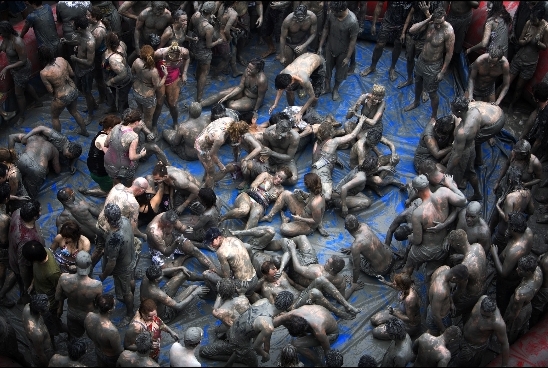
Too many westerners! YouTube link
© 林東哲 2010 Creative Commons Licence.
Kids' Dictionaires
Whenever I use the Korean word ‘dong-sa’ (동사 – verb) in classes, kids will have a little giggle. Neither does it matter how softly I pronounce the ‘d’ and even almost annihilating it altogether, and saying ‘ong-sa,’ will be met with laughter. Well, my Korean is crap but adults don’t have a problem understanding it.
‘Shit’ is funny for Koreans probably because they’ve never had to smell it, but if you’re British you will undoubtedly recall numerous occasions when you’ve seen something strange on the carpet or on your shoe and like an idiot you’ve poked your finger in it, sniffed it, and then recoiled in horror.

Korean 'dirty' humour
For Koreans, stories and cartoons in which shit is either a central feature or a passing reference, are common. And because they haven’t had to sniff it as much as us Brits, because our pavements are notorious for being strewn in dog shit, it can even be cute and even pretty. There is a popular Korean book (강아지 똥) about the life and adventures of a sentient turd which ends up sprouting a little dandelion flower out of its head.

강아지 똥. A scatological version of the Ugly Duckling, story
And then there are the various references to shit: ‘shit flies’ (ddong-bari -똥 파리), chicken’s gizzards amusingly called a ‘dong-chip’ (똥집 – basically ‘shit-hole), as well as the habit kids have of poking their clasped fingers up your backside in a ‘ddong-ch’im’ (똥침 – a ‘shit injection/needle’).

Click picture to activate link
Only yesterday, I was asked what ‘ddong-ch’im’ was in English. ‘Perverted,’ I replied. I had to explain how strange we find the ‘dong-ch’im’ habit and while many waygukins will see it as cute, amusing, and harmless, myself included, I read two posts yesterday, where the authors, men of course, claimed they would ‘severely damage’ any kid who touched ‘that area.’ For western men, especially British and Americans, ‘that area’ is a powder keg of sensitivity and touching it likely to ignite all sorts of problems. It’s all silly of course, and culturally constructed! The male fear of their bottoms being touched and their over-protective attitudes towards them, are as ridiculous as women fearing spiders or mice. Get, real! You have to have a very insecure image of your own sexuality to find a little kiddy touching the back of your trousers, a threat! You can’t translate ‘dong-ch’im’ into English, not effectively, – ‘bum sting,’ ‘butt-stab,’ ‘anal-poke..;’ none of them really work and as they all carry sexual connotations, ‘ddong-injection’ or simply ‘dong-ch’im’ are probably the most effective renditions.

Cute, cartoon turds
As for associating food with anal passages, nothing is more likely to put me off. Cat shit, dog shit, I’ve smelt them all and any food which reminds me of that filthy orifice is unwelcome. I’ll only eat mak-chang ( 막창 – barbecued intestines) if I’m pissed as colonic conduits aren’t my thing unless severely minced, mashed and renamed a sausage. I’m even put off the idea of chicken feet (닭발) because they spend all day tramping on shite. Conversely however, I love sucking the juicy fat off of an English chicken’s ass, after it’s been plucked, basted and roasted, of course! This exception exists because the name, ‘parson’s nose,’ isn’t a reminder of its actual location or function. A Parson’s nose, the very point at which poop is birthed, is almost respectable and reminds me of Sunday afternoons as a child when being offered that fatty morsel for lunch, was a treat. Tastes are all socially constructed!
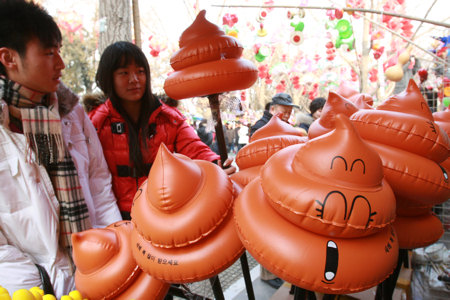
More 'turdy fun.'
While Koreans will tolerate ‘ddong’ and its various manifestations, the don’t like piss. They call piss, ‘dirty water,’ though I don’t particularly find it dirty. I’d much rather be pissed over than shat on, if forced into making a choice, and if ever I was shat on, being pissed over afterwards would be positively refreshing by comparison.

Middle school dictionary
I have three different student dictionaries and all of them of them contain drawings of the human anatomy. They quite interest me as in all three dictionaries, plus a similar poster on the wall of a classroom in my school, the bodies are androgynous. Shortly below the belly button, biology ceases and anything happening in this area does so by some assumed, magical process. In three of the four examples, the poop shoot continues down until it meets the world which is fairly important as the poop shoot is the source of so much Korean humour, but other than this, all other tubing and their associated mechanics, urinary and reproductive, have been censored.
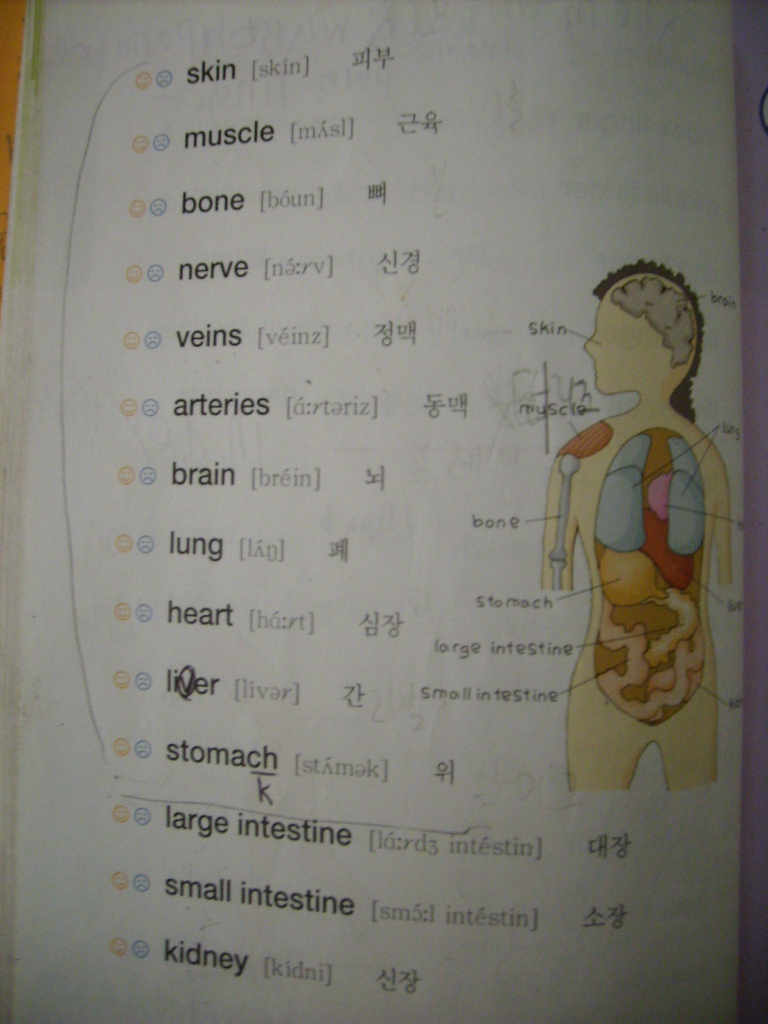
No poop shoot!
And while the drawings have all been denuded of rude bits and the dictionaries purged of anything sensitive, so as to limit speculation, analysis, discussion and questioning, there are instead a numbers of words English speakers rarely, if ever, use. I often have occasions to use words associated with reproduction and urination, as most English speakers will, but I have never used the word ‘scurf’, ‘ordure,’ ‘nose wax,’ or ‘eye wax.’ An understanding of what ‘wax’ is, is clearly missing when the translator defines ‘sleep,’ as ‘eye-wax.’ Indeed, ‘scurf’ and ‘ordure,’ I had to look-up in a dictionary as they are uncommon to me. I’m not even sure, without further consultation, how you would use ‘ordure.’ My ordure was tumultuous, perhaps? I need to ordurate? Whatever, I clearly like the word!
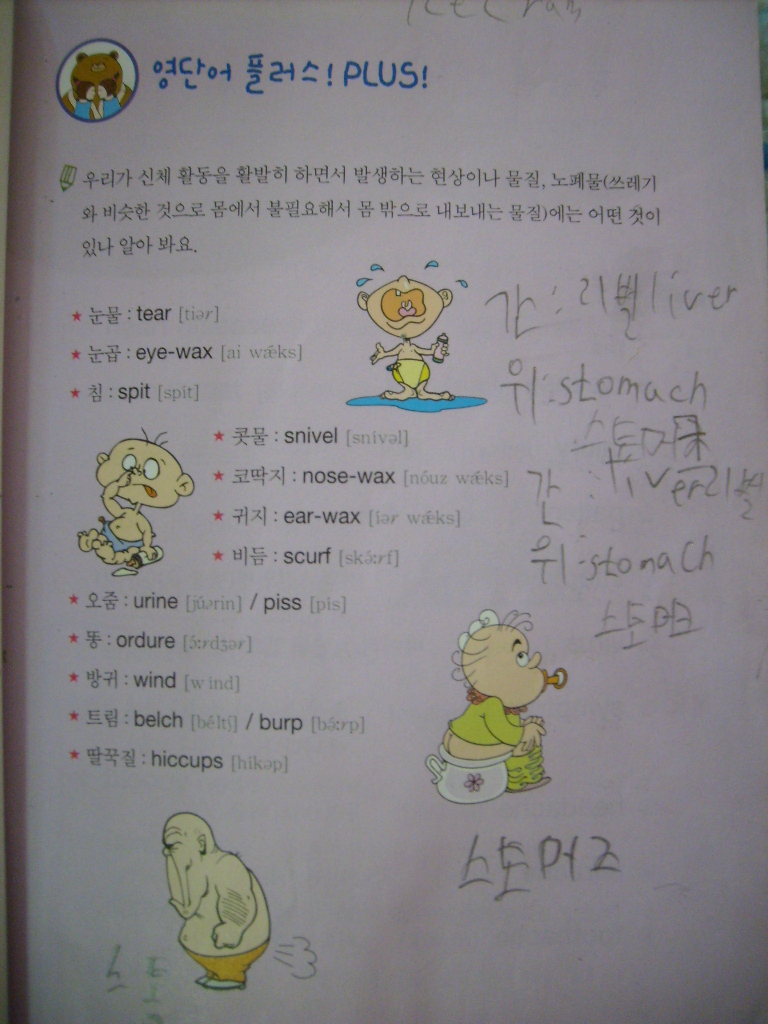
Redundant dirt
© Nick Elwood 2010. This work is licenced under a Creative Commons Licence.
Danger! Donuts!

Bathhouse
I enjoy reading other westerners accounts of the bathhouse experience as so often, and to varying degrees, they highlight how ‘fucked up’ we waygukins are. I’m just as ‘fucked’ as everyone else, though probably in a different way, as I only have a problem with nudity and changing rooms if I am in the west when I find they ooze a hostile atmosphere that seems a juxtaposition of hyper masculinity and homo-eroticism. And I am further ‘fucked’ because I now find semi clothed far more sexually appealing than totally naked and in you face.
I stumbled upon a commentary of a guy’s experiences in a bathhouse that was both open-minded and yet humorously exposed some reactions to the stranger observations bathhouses provide. Quote:

much nicer
We then had to soap up and shower down. An old man saw me struggling and helped me adjust the temperature of my shower, and even got me a fresh cloth to lather up with. After cleaning, we chilled in various hot tubs and saunas for about 30 minutes. Contrary to what I had heard from a female friend, nobody stared at me because I was a foreigner. This might be because men don’t give fuck about seeing other men naked. Personally, I got over seeing other men naked thanks to hockey change rooms, which can desensitize you to male nudity pretty quickly. I was feeling good about remaining unperturbed by this excessive nudity, because my colleague was worried I would not be able to handle all the male genitals/being naked in front of a hundred men. Then I saw a man doing push ups naked beside a man doing disgusting stretches I will never describe to anyone. At that point, I emphatically informed Mun-Gi I was ready to go.
I had to laugh because, as stark and to the point as it is, his comments capture some significant cultural differences. Unfortunately, the author of: I’m In Seoul but I’m not a Soldier, returned to Canada this month.
© Nick Elwood 2010. This work is licenced under a Creative Commons Licence.
Samjeong Oasis – Lotte Castle (용산동) Daegu.

삼정 오아시스
First visited August 14th August 2010. Last visited July 2nd 2012. This is a relatively new and very pleasant bathhouse with an adjoining health club located on the edge of the prestigious Lotte Castle Apartments. I have visited here several times and it is very clean. This is a good bathhouse to take a nap in as it has a pleasant raised sleeping area down the far wall and also a large sauna room in which the TV is located. This room is fairly humid and you can easily nod off laying on the floor. Next to this is a steam room with very high humidity. The steam must be pumped in or the boiler situated behind a wall as I didn’t see one. Personally, I love the enormous cauldron that bubble away in a corner and hiss out bursts of steam.
A smaller sauna with no humidity has a jade studded ceiling and the television in the adjacent sauna can be viewed through a window.
There are three central pools, basically a warm pool in the center with a hot pool at one end and a pool in which you lay and press a button to have jets of water squirted onto you spine and legs, at the other. The hot pool temperature varied between 38 degrees and 44 and it heated very quickly. This pool is at the hot and of the spectrum. Conversely, the large cold pool, is colder than some other bathhouses.
For my friend, this is his favourite local bathhouse with Migwang coming second. Personally, I prefer Migwang. Samjeong Oasis is certainly a great place to relax and nap but I find it a little bright and find the rectangular and very open plan, a little dull.
Plan

Sam Jeong Oasis. Yong San Dong. Bathhouse design. May 2011
Location – five to ten minute walk from the Tesco Home Plus at Yong San Dong (용산동). Samjeong Oasis sits behind Home Plus at the furthest right hand corner of the large apartment complex that lays behind the supermarket. (Wiki Map link )
Times – Unsure of timings but I believe the bathhouse is closed on Tuesdays.
Facilities – ground floor ticket booth, women’s bathhouse, men’s bathhouse, health club.
Jjimjilbang – none.
Bathhouse (men) – around twenty stand up shower facilities and fifty sitting down shower units, event pool, (이벤트탕), hot pool (열탕), large warm pool (온탕), large cold pool (냉탕), therapy pool, steam room, jade sauna, humid sauna with television, heated sleeping area. Changing room with television and benches.
Cost – bathhouse 5000 Won.
Others – massage and rub downs, shoe shine, health club, smoking room. Many nearby restaurants and shopping facilities.
Ambiance – relaxing, brightish, somewhat open planned and symmetrical. New and very clean.
Waygukin – Only my second visit but no foreigners.
Address –
Han-Song Bathhouse (한성) Song-So, Daegu

Han Song Bathhouse, Song-So, Daegu
(First visited in April 2001 – last visited October 27th 2012) Han Song is not the most modern of bathhouses but being the third sauna I ever visited, the other two now closed, it has a special affection for me. It is directly next to the school I worked in when I was in Song-So in 2000 and 2003 and I wallowed in its water every afternoon for a year and from time to time, I still pay it a visit.
It is a smallish sized bathhouse with friendly staff and fresh towels. I have a very sensitive nose and find not all towels smell fresh. I stopped using one gym because its towels smelt of marmite (similar to Australian ‘Vegemite’). In the bathhouse, the ceiling could do with a clean and some paint here and there and occasionally the drains are a little smelly. Apart from being a little old, Han-Song is clean and tidy. One of my favourite amenities here, and one which makes a visit worthwhile, is the salt sauna which has charcoal walls and small logs to sit on though you usually need to drape a towel over them as they can burn your backside.There is also a hot tub usually containing an enormous tea bag of green tea and the temperature is at the hot end for a hot tub.
The changing room, open planned, is bright and clean with large lockers and central slatted benches. The rest area is again open planned with comfortable sofas and a television. There are also adjacent sleeping rooms. Very close to several apartment blocks, Han Song can get busy and it seems frequented by a clientele that are seriously into cleaning. I see much less lazing here and a lot more serious scrubbing with the Italy Towel.

Han Song, Song So, Next to a small Home Plus Store
Location – from the Mega Town complex, (Lotte Cinema), down towards Keimyung University, passing McDonalds on your left with Baskin Robbins directly opposite. A few minutes work further and you will see a Tesco, Home Plus store, a small one; if you face Home Plus the bathhouse entrance is on your left with a small flower shop at the top of the stairs on the 1st floor (ground floor). The payment booth is on the third floor, next to the women’s bathhouse while the men’s bathhouse is on floor 4. (Wiki Map link )
Times – Very early morning, around 5.30 – until 8 or 9 pm. Double check opening and closing times as they occasionally change. It is closed on Tuesdays.
Facilities – bathhouse.
Jjimjilbang – none.
Bathhouse (men) – around 25 stand up shower facilities and around the same number of sitting down shower units, event pool, (이벤트탕) which is a jacuzzi, hot green tea pool ( 열탕), large cold pool (냉탕), larger jade bath (옥탕), jade steam room, bamboo sauna, salt room (소금방) with charcoal walls, sleeping area with infra-red heating and jade sauna, heated sleeping area. A television is located in the dry sauna.
Other Amenities – Large relaxation area room (휴게실) with television and sofas. Sleeping room with blankets and wooden head rests. Hairdresser and shoe shine. A sports complex and bowling alley are in the same building.
Cost – 4500 Won often free tickets given for future visits.
Ambiance – relaxing when not busy. Mid-level lighting, could be cleaner but not unpleasant. Great for the salt room!
Address – next to a Tesco, Home Plus convenience store.
Waygukin – Over a 12-year period, I have only ever seen 2 westerners, an American boy and a Mexican student, both back in 2001.
Han Song Updates
© 林東哲 2010 Creative Commons Licence.
Beating Boknal 4 – Water water everywhere
I’ve abandoned the e-bente-tang for the duration of high summer and like some maggoty hippo I spend my time floating about in the cold pool.

refreshing
Water, in all its forms is wonderful and is only truly appreciated in summer. After or during an intense and sweaty workout, when bodily fluids have been rung out of the body, water is the only drink, barring neutral beverages like cereal teas, that have the potential to satiate a hungry thirst with such intense pleasure. Only in summer, when heat and humidity make an extra drain on the body, and when water both replenishes diminishing levels and lowers soaring temperatures, is water truly appreciated. In the heat of heat summer there are times when you suck in water with such force, living in the moment it is experienced, that it can cascade down your chin and splash down your chest in the most refreshing manner, a manner that at any other time of the year would be uncomfortable. These are the moments when the experience of quenching your thirst are orgasmic in proportion. Despite all their silly claims, sweetened, gaseous drinks utterly fail to pleasure the body and mind with as much intensity as a does a simple glass of icy water.

cooling
And you know the heat of summer is here when your shower water is set to cold and yet is almost warm. Wonderful water washing over your body, flushing away sweat and grime and swathing you in its refreshing coolness. And in the bathhouse the cold pool, for so many months a test of endurance and toleration, becomes a revitalizing cocoon of luxury to be lingered in. Now only the ice room remains to effectively chill a body punished by heat and humidity and even this induces pleasurable sighs and ecstatic exhalations. For months, as I wallow in the e-bente-tang, the ice room and cold pool lay predominantly dormant with visitors enduring their extremes with spartan conviction. Now they are bustling with life, the pool a busy maelstrom of splashing youngsters and lazing adults. In the ice room I sweep shards of ice into my palms, like snow, and rub them over my face until they are reduced to trickles of icy water.

beautiful
And the water in all it’s variations talk and sing to me like an enormous symphony; water hissing from the enormous cauldron in the steam room, swooshing its vent in a hot vapour, the burbling of the jacuzzi, the persistent dripping of water from a myriad of locations, of water lapping against the sides of their containers stirred by some movement, splashes echoing in colourful variation reflecting their intensity, the roar of the power shower as it blasts out it’s freezing water. A world of water purges my senses and fractures, like a thumping gong, the sights and sounds of humanity and within that persistent liquid modulation a pool of tranquility from which a multitude of thoughts are stirred and caressed.

tranquil
© Nick Elwood 2010. This work is licenced under a Creative Commons Licence.
Beating Boknal 2 (복날) Summer Foods
What do you eat when the memi are screaming and sweat is dribbling down your back and sides? There are numerous seasonal specials (보양식) which fall into the categories of either ‘hot’ or ‘cold.’ The ‘cold’ approach is probably the most popular with westerners and drinking cold drinks, eating ice cream and salads are the methods we are most likely to adopt to remain comfortable. Koreans however, stand this notion on its head when they consume ‘hot’ food to consume body heat hence fighting fire with fire. The ‘hot’ food is generally ‘hot’ in terms of temperature rather than chillies and would be similar to stuffing your face on the hottest English afternoon with a hearty casserole and dumplings; something we’d generally eat only in the depths of winter. In Korea, it isn’t a case of one or the other and most Koreans will mix the two extremes in an attempt to beat the heat. Bo-yang-shik (height of summer foods – 보양식) are seen as beneficial in either improving ones toleration of hot, muggy weather, or in cooling one down.

Boknal (복날)
Boknal (복날) is a period of around twenty days which are based on the lunar calendar and this year began on July 19th (ch’obok -초복). There are three days (sambok – 삼복) which Korean perceive as the hottest and they are ten days apart. This year, 2010, sambok are respectively, July 19th (ch’obok – 초복), July 29th (Jungbok – 중복), and August 8th (malbok – 말복). I hate the heat and especially dislike humidity but unfortunately I live in Daegu, the hottest part of Korea in the summer and the warmest in winter. This week the temperature has been as high as 37 and so the memi are particularly noisy.
Through Boknal, and on each of the consecutive sambok day it is a tradition to eat some form of special food, usually one of the ‘hot’ types such as sam-kye-tang (삼게탕 – chicken ginseng soup), or dog stew (po-shin-tang – 보신탕), but cold meals, buckwheat noodle soup (냉면 – naengmyon), or soya bean milk noodles (콩국수 – kongkuksu), are also popular.
For some, mostly older men, dog stew is a favourite and in addition to the belief it fortifies one against hot weather, it is also one of the numerous foods which are supposed to enhance male sexual stamina. I recently spoke to a friend who is quite adamant that dog stew and dodok (더덕 – codonopsis lanceolata) give him a harder erection. I eat dodok everyday and haven’t noticed anything but then I’m 54 and he’s 25. As for the dog stew, I’ll pass. I ate it for the first time with the aforementioned friend and his father, in 2000. I wasn’t enamored to it. First, I couldn’t get the image of little dogs out of my head and then there was the ‘starter,’ small bits of dog skin wrapped on a bone so that when barbecued they whirled around it. Trying to make a pouch on a platter look pretty seemed to make it more difficult to eat. I have no problem with eating any kind of animal yet have a dormant ethical problem with eating animals – per se! I would imagine many people share this weak-willed position. To be honest, I have to snigger at those waygukins who condemn Koreans for eating dog and yet raise no criticism of their own culture where eating rabbit is accepted. Koreans usually find the idea of eating rabbits distasteful. Tell Koreans you’ve eaten rabbit and quite a few will insist, ‘it’s a pet!’ As Herodotus said, ‘nomos is King of all!’ The dog issue tends to inflame passions but what should be remembered is that it is not the eating of dog that should be the offense, but the alleged manner in which they are slaughtered. And though some may argue dogs have a special relationship to humans, this is a culturally specific relationship and not one of universal, eternal properties. Personally, I’d rather have a pig for a pet than a dog. In 2001, my one room had no air conditioning and the dog stew did nothing noticeable to fortify my constituency against heat and humidity and certainly never stirred my passions.

This is my sam-kye-tang. (Click photo for link to the Queen of Korean cooking, Maangchi) )
Sam-kye-tang is one of my favourites though I prefer eating it in the winter. At lunch time that small chicken, the wadge of gluttonous rice and a gallon of broth, simply bloat my belly and start me sweating profusely. But it is delicious in the Korean sense of the word. I occasionally make sam-kye-tang if I feel tired or have a cold.
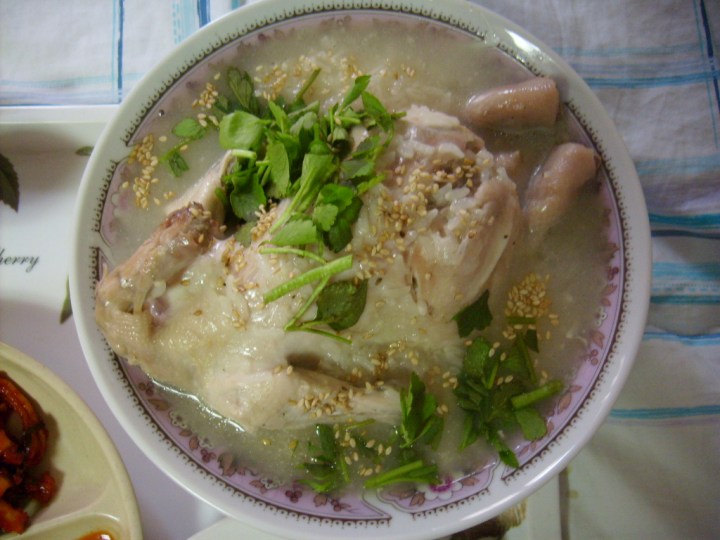
Wholesome (Maangchi link)
And I would find kong-kuk-su (콩국수) mightily refreshing if not packed with noodles. I enjoy the icy soya milk broth, with its slightly salty tang but those noodles don’t do me any good. I don’t know why it is but kong-kuk-su always seems to be served in large portions while naengmyon (냉면), for example, is often served in a smaller portion.

Soya broth milk noodles (Link to Maangchi)
Mul-naeng-myon (물냉면) is my boknal baby! I can eat this on a hot lunch time and then walk on into work without breaking into an excessive sweat. I love the tangy combination of vinegar, salt and sugar and have a hard job keeping the broth in my freezer if I have made a batch. I can remember the first time I ate naengmyon; it was on a hot Sunday afternoon, in early August, after a mountain hike in Song-So. I quite disliked it! What a freaking horrid combination; watery broth with a clump of sticky buckwheat noodles that are impervious to mastication and almost impossible to eat without sucking the whole clump up. And then there’s the slice of pear, and the ice cubes and as for the lonely, wafer thin slide of beef, you’d think it had fallen in the bowl from another meal – it’s appearance a mistake! Naengmyon is sweet, and salty, and tangy – is it a dessert or a savoury meal? And as for the vinegar and mustard which are added to it… Since then, mul-naeng-myon, and particularly Pyongyang mul-naeng-myon, have grown on me. If you have never eaten it, it must sound quite gross but when the weather is scorching hot and your covered in sweat, it is one of the most delicious and refreshing meals. Even the sound of the ice cubes tinkling and jingling against the sides of the stainless steel bowl in which it is traditionally served, are refreshing.
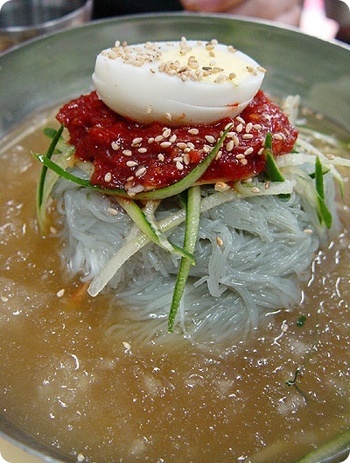
Mul naengmyon (물냉면) 시원해요!
I suppose naengmyon is the sort of food you eat at a heightened sense of reality, especially if you’ve just come down from a mountain – a feat which always seems harder than going up, and at a point when you’re body and mind feel good, it’s scorching hot and humid and you’re sweating profusely. Enjoying naengmyon at this point is an integral part of the summer experience and so I never enjoy it, or feel a need to eat it, in the middle of winter. To truly enjoy naengmyon it has to be hot, boknal hot, horribly humid, you have to be sweating and you have to be tired. Naengmyon shares a lot in common with Pimms No 1, that British summer drink, only ever drunk outside under the sun, and accompanied by ice, slices of cucumber, summer fruits and mint. One should never drink Pimm’s indoors or in winter and though this might be deemed snobbery, Pimm’s only really seems to ‘work’ when this is observed.
Finally, and wonderfully refreshing, is patpingsu (받빙수). This is rice cake, sweetened tinned fruits, red beans, and condensed milk on a bed of flaked ice which is often topped with spray cream. There are many variations of this refreshing ‘dessert.’

Patpingsu – usually shared with friends (받빙수) (click photo link to Hangook Summer)

Green tea patpinsu (photo link to Hangook Summer)
Other means of beating boknal
cereal teas
iced coffee
silver summer trousers
handkerchiefs and towels
ice rooms and cold pools
cold showers
hand fans
© Nick Elwood 2010. This work is licenced under a Creative Commons Licence.


 Elwood 5566
4 comments