Ben (3) Korean Teenagers
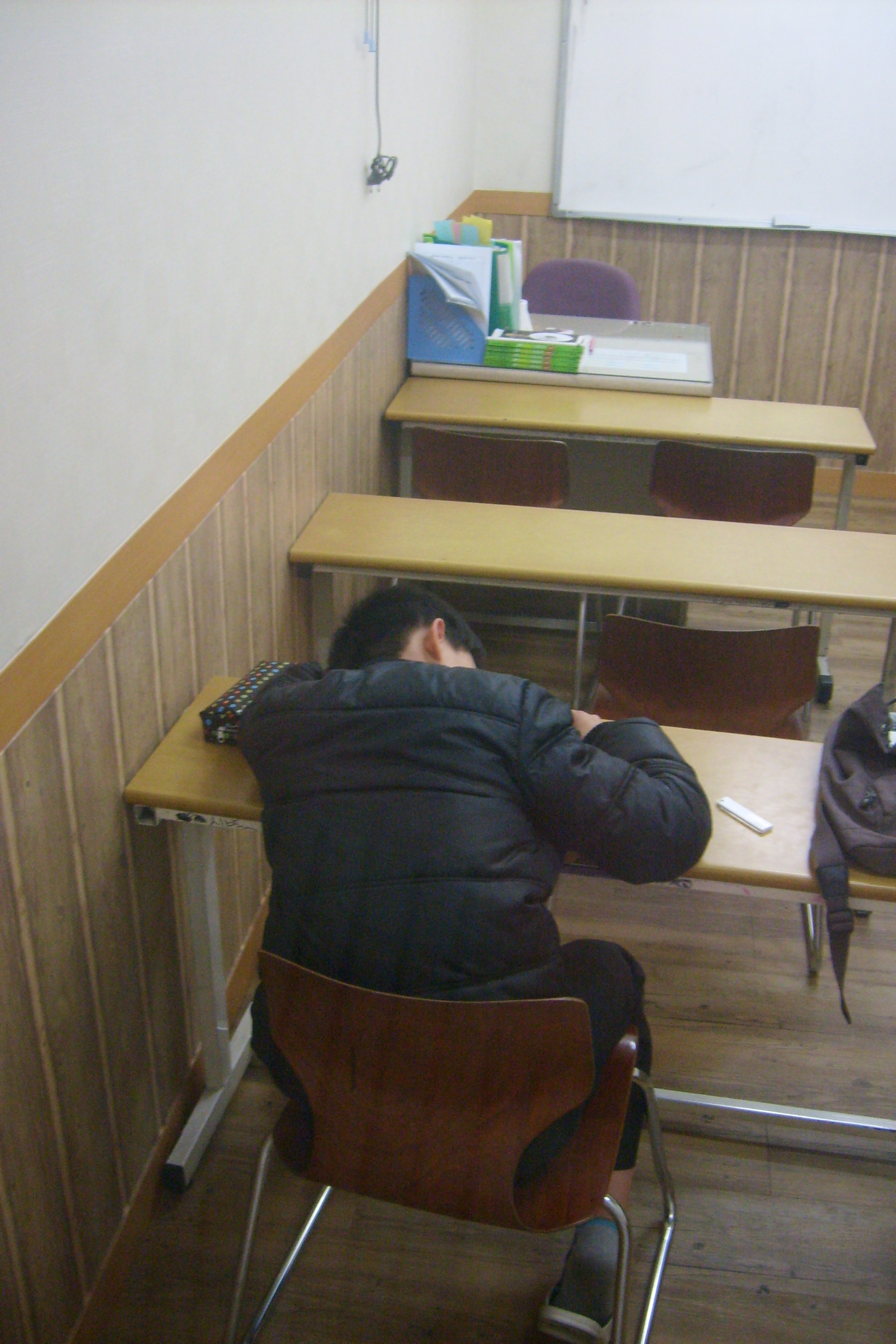
Ben on a low
Ben has been up and down lately. At the end of last term he was on a massive high after passing a string of exams with 100%. One evening, on the day he received the marks for his final set of exams, he was delirious with happiness and once again bouncing around the school declaring how he felt. In the UK I’d have assumed he was on drugs because British kids often down play any trait of intelligence as it can alienate them. And then, several days later, he finally got his reward for his efforts in the form of two small puppies. For the next week he constantly assaulted my boss and I by thrusting his hand-phone in our faces to show us the latest series of puppy pictures. His accompanying leitmotiv was ‘my puppies, my puppies,’ made all the more endearing by a mild speech impediment which renders, ‘puppies,’ ‘puppish.’
Once the joys of owning a couple of puppies had subsided however, he became markedly strange in class and seemed to flit between happy and almost depressed. Neither was he very responsive when you tried to draw him out of his mood or ask its cause. The cause was obvious and one we’ve encountered on a number of occasions. Ben’s class consisted of 6 girls and two boys and the other boy, Kyle, had left Daegu for the summer vacation to attend an intensive study school: the equivalent of an academic boot-camp. Hence the root of Ben’s mood swings was the fact he was the only boy in the class. Cherie and I tried to ride the problem for a little while but soon he was begging for us to make changes so he wouldn’t be alone.
In a Korean setting class dynamics can change drastically if someone is older or younger than the other students, or, in the case, is the wrong gender. Kids lively and confident one moment can be passive and introvert the next if a shift in personalities disadvantages them. Because peer groups are not so important for British children, such problems do not arise. British kids can easily accommodate friends or fellow classmates, older or younger than themselves and a gender divide is not as noticeable as it is in the Korean class room.

and on a high
Ben, who is 16, was disturbed enough at being the only boy in the class that despite his recent academic success, we feared we might loose him when suddenly, a new boy arrived who was ideal to place alongside him. Instantly, he returned to his old self and re-assumed his role as the class comedian but if ever the other boy is absent, he can quickly relapse into a sullen state. I’ve spent so much time slagging off teenagers in my other blogs, I’m consoled by the realization I don’t dislike teenagers, just the ones who are rotten and rotten teenagers in Korea are rare. Ben is what Koreans might call a ‘flower-boy,’ or identify as ‘pretty,’ neither term being derogatory, though he might well be when older. If anything, his body is built like a chopstick and he looks closer to twelve than sixteen, a point the girls in the class often tease him on, but both my boss and I would love him for a son. Reading other K-blogs, I know many teachers share a similar regard for the nature and personality of Korean children and teenagers.
 © Nick Elwood 2010 Creative Commons Licence.
A Hanja Classic – The Thousand Character Classic (천자문-千字文)
천자문
For students, The Thousand Character Classic (천자문 – 千字文) is a central text in learning hanja and appears in various publications and formats. Written in China, by Zhou Xingsi who lived between 470-521 AD, it comprises 250 phrases each containing 4 characters. Although it is unclear when the Ch’oen Cha Mun ( The Thousand Character Classic) first appeared in Korea, its use in learning hanja dates back to 1583.
The Ch’oen Cha Mun has appeared as a cartoon and forms the basis of numerous comic books with a didactic purpose. I recently found this excellent pocket size edition.
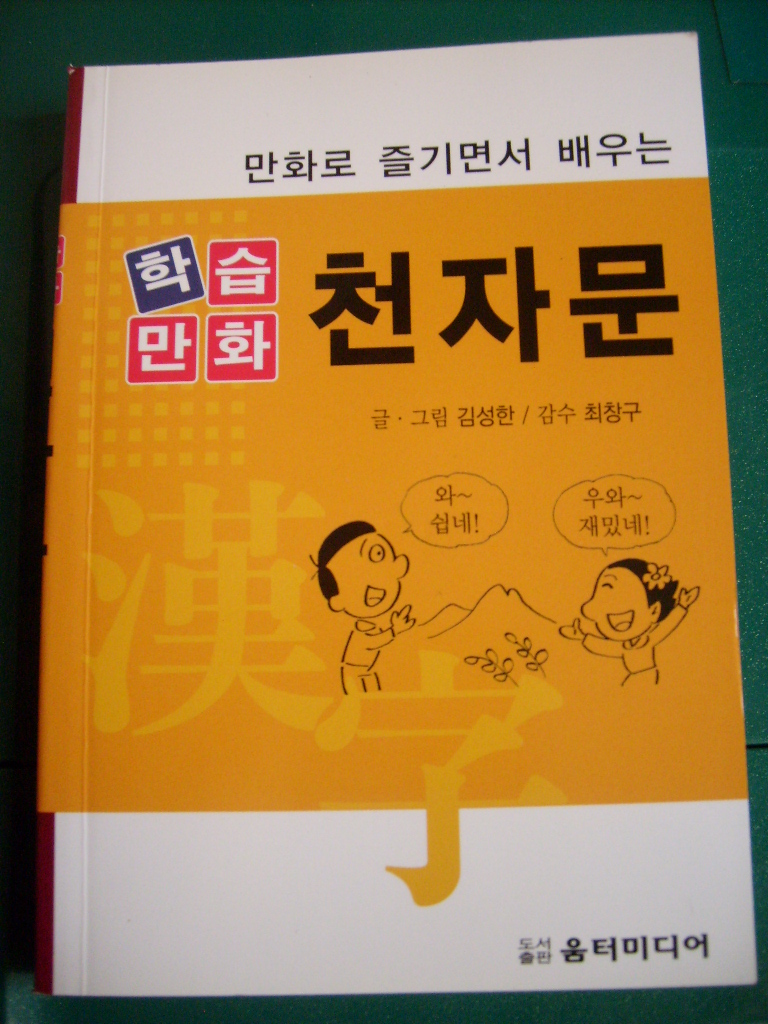
Pocket size Ch'oen Cha Mun
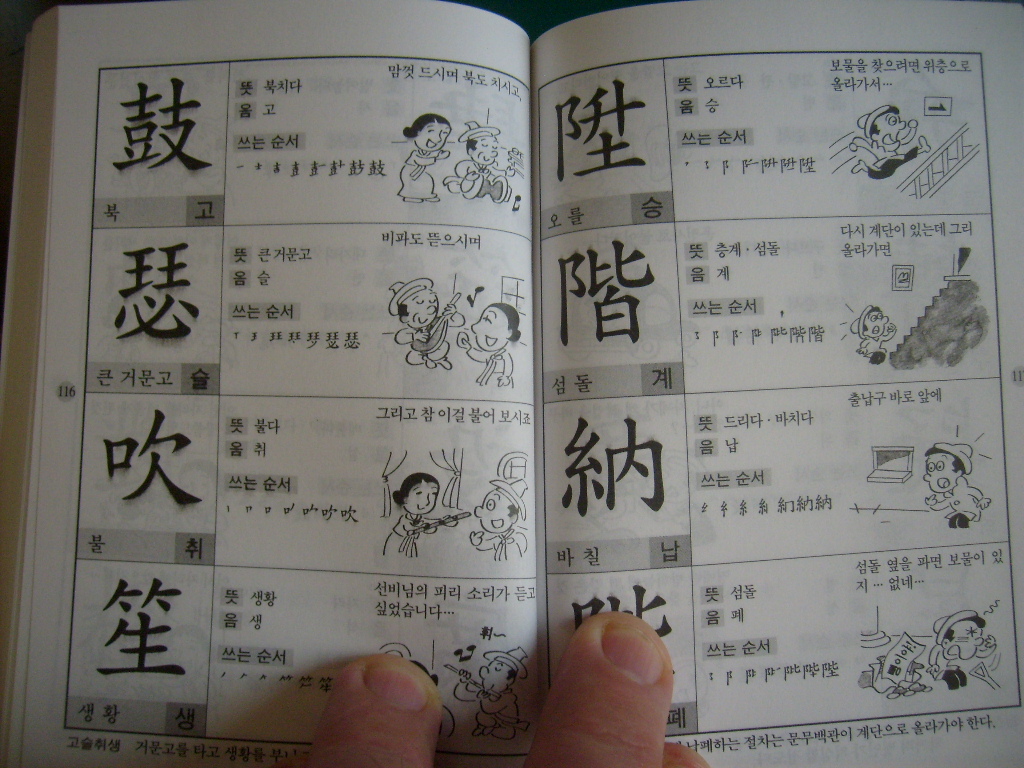
Clear text but as would be excpected, no English translation
Cost – 5000 Won.
© Nick Elwood 2010. This work is licenced under a Creative Commons Licence.
Uncle Ernie's Daegu Antics Prompt a Rant
Uncle Ernie’s been at it again, this time in Daegu but he managed to escape to Japan before the police caught him. A little jigery-pokery in the pants of a few students and suddenly every one ‘loves’ kiddies and starts baying for those accused to be tortured, brutally beaten, executed or incarcerated for life. It’s basic, Witch-hunts and Pogroms for Dummies.
Twenty years ago the word ‘paedo’ didn’t exist and even today many people can’t spell the word and constantly use it incorrectly, often conflating pederasty with paedophilia. Of course, I’m on dangerous ground as the baying often insists that anyone not whipped into a raging frenzy and demanding draconian punishments for offenders, must be a paedo themselves. The parallels are obvious, Krystalnacht, the Salem Witch Trials, McCarthyism and the Spanish Inquisition.
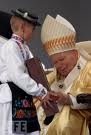
Ernie at work in one of his guises - lovely hat
Fiddling with kids is bad and crimes involving rape and violence against children are terrible but get real! First, ‘fiddling all about,’ Uncle Ernie’s favourite pastime, usually committed at bedtime, is only a recent concern. Twenty years ago no one really gave it much attention. I can certainly remember a time when the media often reported cases of teenage boys who’d been fiddled with by ‘sexy’ housewives and reported in a manner which implied it was a wholesome, fun-frolicking experience that every boy fantasized and in which every dad could be proud that at the very least, their son wasn’t ‘queer.’ The Catholic Church, the ideal religion for committing a range of offences, including Ernie’s favourite, but additionally more heinous ones like buggery, violence and murder, are still trying to pay it as little attention as possible. If you want to commit crime and be happy and guilt free doing so, the Catholic Church provides a suitable ideological package and joining their club provides some lovely hats and costumes. Many of the world’s most notorious crime spots are countries where Catholic sentiment run rampant.
 Secondly, touching a kid’s todger or stroking their bottom is far less offensive than allowing them to die of starvation, lack of sanitation and water. Globally, we tolerate the death of 20.000 kids every day which over a number of years amounts to significant holocaust and many die at the hands of weapons manufactured in west. The US and UK are two of the world’s leading peddlers of kiddy death. Sensing some of the emotive guff written by those responding to pervy teachers, one might be led to belief we actually care about the welfare of kids. Unfortunately, nothing could be further from the truth. I call it ‘guff’ because the responses and their nature are largely orchestrated via the media and popular politically correct sentiment, a form of peer pressure.

Global perversion!
You want to castigate a child abuser, start with the ones who do it on a global scale and make mega bucks doing it. Arms dealers and manufacturers and their political lackeys are perverts of the highest magnitude and then there are the politicians and political systems which put profits before people – a perversion most people are happy to tolerate.

Perverts in arms - probably just leaving or entering a church
And changing the subject, how did Ernie manage to get his kids to undress? I can’t imagine for one moment my kids just stripping off if I told them to, let alone trying to undress them myself. Maybe he spoke fluent enough Korean to order them to do so but even then I would imagine you’d need to provide a motive and I’ve met few English teachers with such a capable command of Korean.
Ernie must have gone to school that day with both a prepaid passage to Japan and his letter of resignation and of course, knowing exactly what he was going to do.
I’ll frotage a few buttocks, stroke a couple of wieners, hand in my resignation, make a dash for Inchon and be in Tokyo in time for tea!
And he’s married with children? It’s probably true but fantastical enough to suspend any witch-hunt!
Being totally cool-headed and rational – it’s a pretty minor offense! If I had kids and I had to choose between one being squashed by a bus, blasted to pieces by a landmine, starving to death or being touched by Ernie…….well, only a fucking idiot would choose anything but the latter. Ernie’s fingers are definitely offensive but a far greater catalogue of atrocities exist and are endured by thousands of children every day – and most warrants not the slightest concern and can be intellectualised away via political and economic theories or simply deemed naive.

Real perverts have the power to define perversion
Hype aside, what remains to call for chemical castration, execution and all sorts of inquisition-style punishments are vague. The guy is possibly mad but in the small selection of emotive guff I’ve read, I’ve yet to see terms such as ‘mentally ill,’ or ‘crazy.’ Paedo crimes are currently of master label status and as such carry the verdict of guilty the moment even tainted by the label and sadly, even if subsequently proved innocent the association will remain. Shouldn’t such a predicament, comparative with other historical events, raise alarm bells?
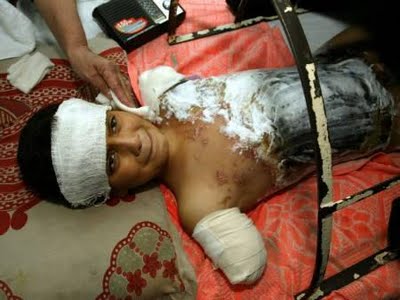
Victim of a cluster bomb - a product of perversion and a contributing cause of around a million Iraqi deaths
I didn’t enjoy writing this post, ranting comes very easily to me and has probably lost me a number of friends and on this site I have a policy of avoiding blatant rants. The world is a depressingly sick place and our apathy contributes towards it. Paedo-paranoia is part of the bread and circuses hype which detract attention away from the real axes of evil!
Labour Party Turned a Blind Eye to Iraqi Casualties (Guardian UK. July 2010)
© Nick Elwood 2010. This work is licenced under a Creative Commons Licence.
Korean Teenagers' Wacky World of 'Vacation' Fashions
Just when you thought you knew the kids in your classes they turn up with hair dyed red, or sporting the poodle perm. It’s especially worse with the girls as an adult hair style forces you to acknowledge the fact they are young women and not the kids that they’ve appeared as all year. Yes, the summer ‘vacations’ have arrived and through the blurry haze of humidity and the incessant chirping of the memi, a weird wackiness prevails.

Vacation hair fashion
The perms, if that’s what you call them, as I’m not au fait with the methods of metamorphosis used by women, are heavily discounted over the school ‘vacations’ and cost as little as 20.000 W (£10). This year, common trends seem to involve tinting the hair with a touch of burgundy, a summer fashion common with boys as well as girls and of course, the perm, which has been popular for several years. While boys may grow their hair longer, or at least as long as you can grow it in around 40 days ‘vacation,’ girls often paint their nails in quite adventurous and beautiful ways. Along with the various hair styles is a concurrent rise is temporary tattoos. Most of these tend to depict fantasy book characters though unicorns seem to be particularly fashionable on younger girls. Blurred and blotchy tattoos declaring filial devotion to ‘Mum and Dad,’ or the British Bulldog, are as non-existent in Korea as tattoos in Chinese characters declaring the wearer to be ‘female’ (女), this being a frequently observed ‘fashion’ in the UK. And to accompany ‘grown-up hair styles a little leniency is given to earrings, rings and other forms of jewelery bar anything which pierces or punctures the face or drives studs through noses or tongues. The great thing about Korean kiddy vacation fashions is that they are temporary and as such have to wash-off, wash-out, come-off, cut-off or un-clip, which is the destiny they all face once the new term is looming. For kids it provides a period of self-expression and/or momentary madness which helps wash away the stresses and strains of the past academic year.
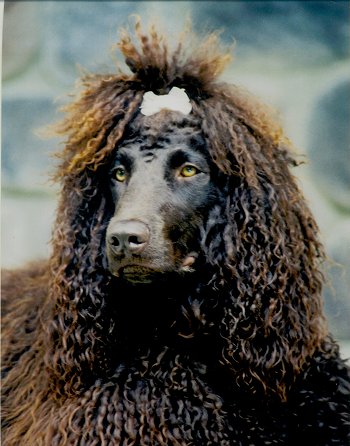
Vacation fashion - the shaggy perm

A little re-touch needed
I find the perms particularly unattractive. Korean hair, especially on youngsters, is wonderfully beautiful, full of lustre , body and that typically black-blue, black. The perm bakes and frizzles the life out of hair and the ensuing curls and kinks undermine rather than enhance the original appeal. Of course, I’m missing the point! ‘Vacation’ fashions are a symbol of freedom which I understand is precious especially as kids don’t really have a vacation. Only in Korea can you have a ‘vacation’ that isn’t really a vacation but not to worry, you can perm your hair and mutate into a spaniel look-a-like for your ‘vacation’ classes and summer school! Unfortunately, if your destined for a ‘vacation’ boot-camp you’re buggered! Personally, in the muggy sweat of summer the only comfortable hairdo is a number 4 buzz with a pair of hair clippers.

Love those locks!
© Nick Elwood 2010 Creative Commons Licence.
Beach Bum Teachers
I took a walk around Keimyung University, Daegu, and passed a couple of plastic professors one of whom wore a three piece suit and the other, white trousers, jacket and a Panama hat. True there were a few casually dressed waygukins kicking about but I assume these to be students so as not to spoil my myopic view of the world.
Keimyung is a beautiful campus and supposedly, one of the ten most attractive campuses in Korea. I was lucky enough to have attended Essex University in the UK, and indeed own a house only 15 minutes walk from the campus. As a first year student in halls of residence, my room looked out over Wivenhoe Park which was the subject and title for John Constable’s 1816 painting. I never really appreciated the importance of beautiful surroundings and university campus life until I subsequently studied in London where the University probably owned one tree – everything else being brick and tarmac.

For a year, this was my view as I ate breakfast
Swanning about in a boater or three piece suit with a dickie bow, even if you’re professorship is plastic, is so much more sophisticated with a beautiful campus as a backdrop. True, Oxford and Cambridge aren’t set in beautifully rural settings but the sense of the numinous imparted by ancient architecture is just as effective and maybe more so.
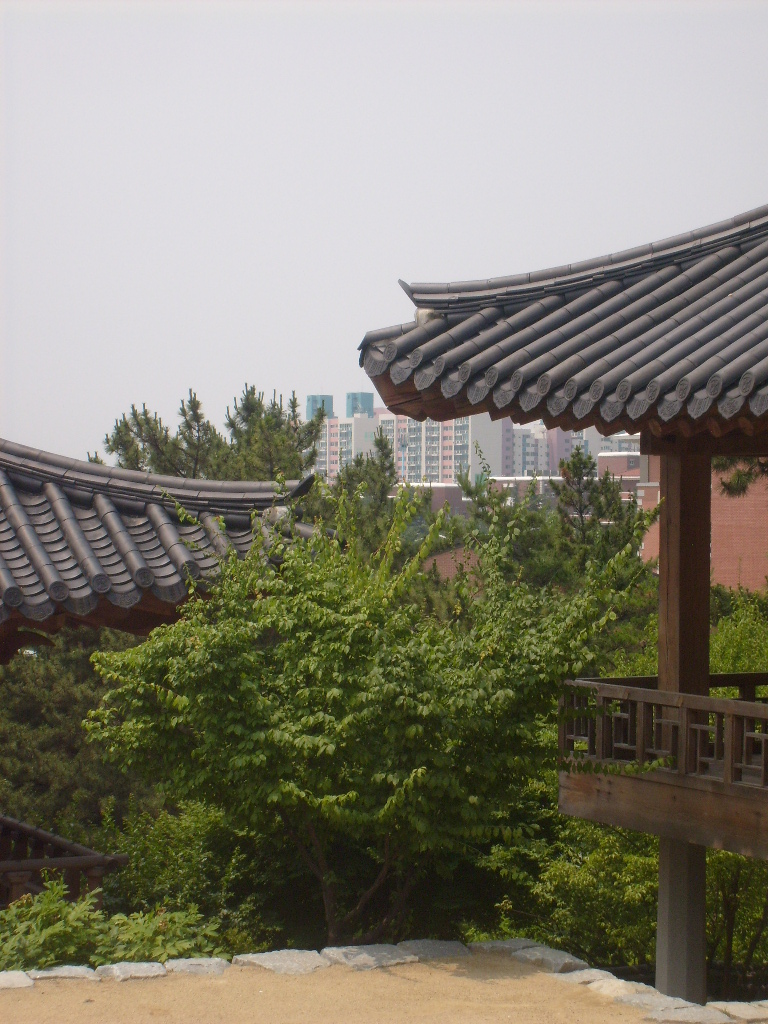
Keimyung traditional architecture and the distant city
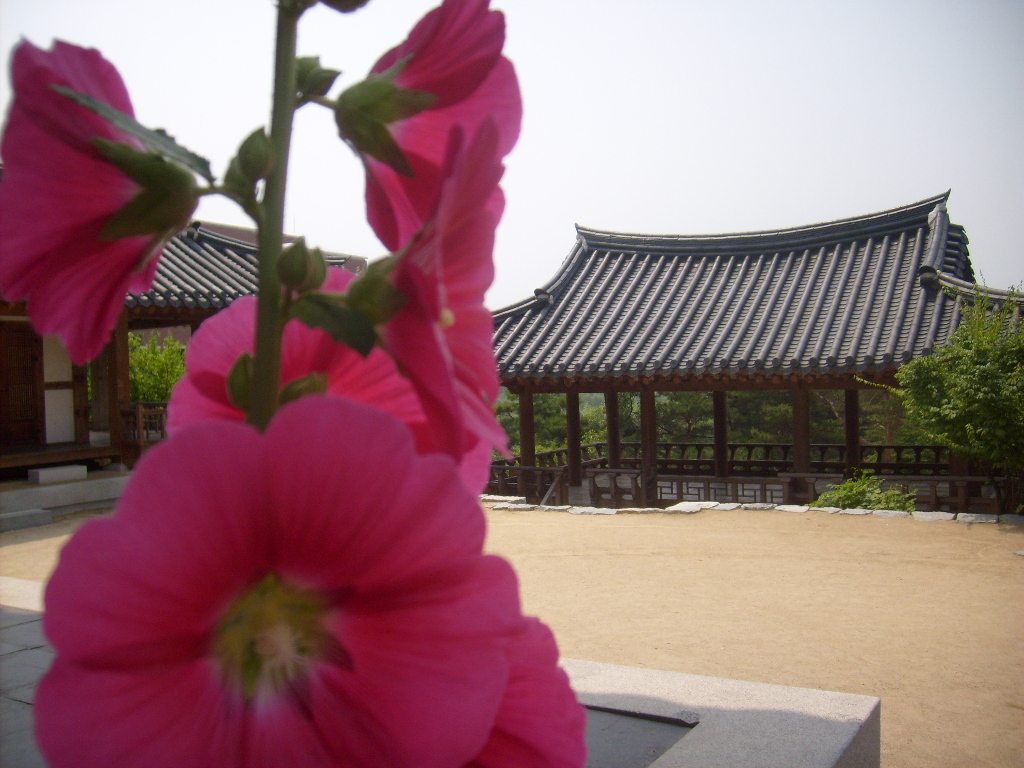
Traditional and modern typify Keimyung campus
Two miles down the road from Keimyung, in Song-So, there are no boaters or dickie-bows. When you’re teaching in a haggwon a three piece suit is an overstatement. Around Song-So’s haggwons the predominate form of dress for teachers is casual and hence cargo shorts, shorts, flip flops, vests and all manner of clothing suitable to a Thai beach, building site or the set of a Pirates of the Caribbean movie, are common.
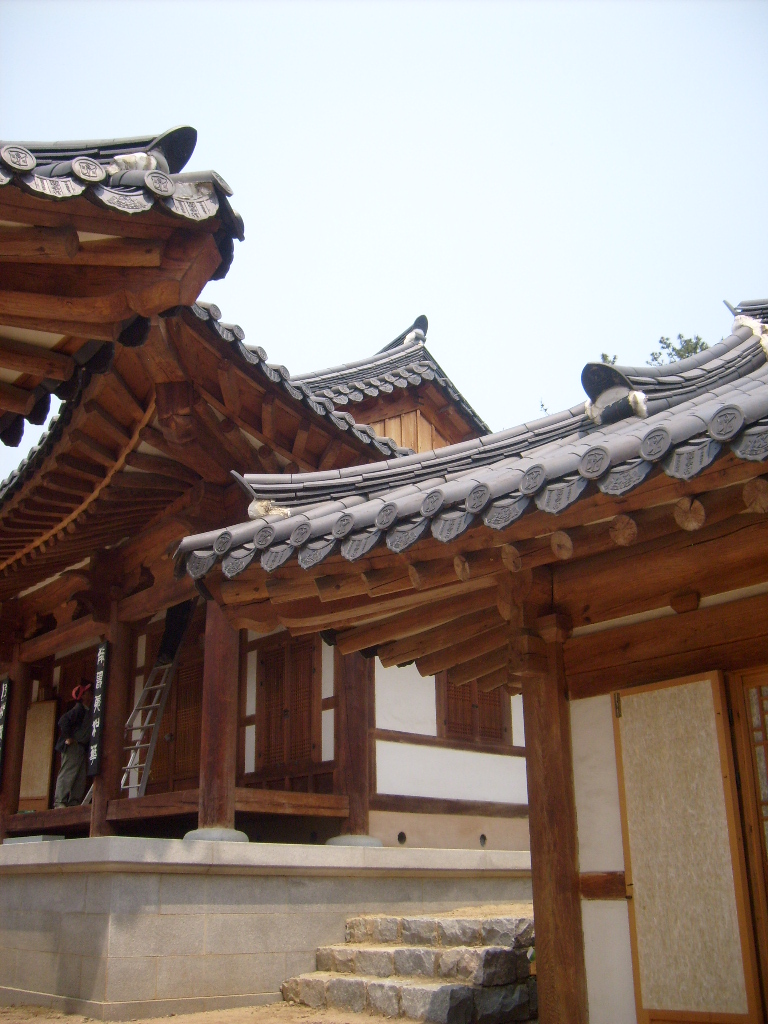
Traditional architecture
Now, I come from Britain where the weather is notoriously shitty and where you can generally wear the same type of clothing all year. The same thickness of jeans material will suffice throughout the year but may be a little warm in summer but the need for three types of clothing, basically, winter, summer and spring/autumn, as in Korea, is not necessary. However, in many parts of Canada and Australia, and definitely the USA, the summer temperatures and even precipitation are not a lot different to that of Korea. I used to play in a military band and have marched through Calgary, Canada, in a temperature of 44 degrees and I wore full ceremonial uniform and not a pair or cargo shorts and flip flops. I remember Washington DC being very uncomfortable and air conditioning, something of a domestic rarity in the UK, was a necessity. What I didn’t see however, were Americans or Canadians going to work, certainly not professional work, dressed like beach bums.
I get annoyed seeing westerners going into schools dressed like they’re on vacation and see it as a form of racism and symptomatic of cultural ignorance. In my high school, and in haggwons in which I have taught, the dress code, set by co-workers, certainly wasn’t beach wear. Eighteen months ago, we hired a Canadian gyopo (교포). He had never lived or worked in Korea and spoke little Korean but would turn up for work wearing torn jeans which he wore so far past his hips his boxers were constantly on display. Meanwhile, his hems were worn away from having been constantly walked on. Dressing like a shit-bag puts immense pressure on haggwon bosses and while some, like bosses everywhere, are tossers and deserve it, many are decent and well meaning. Neither is it fair on Korean co-workers when foreign staff dress for a beach party while they dress, like professionals, for work.
If I were employing a waygukin, I’d certainly want to see a photo and I’d probably want to ask: what they would intend to wear to school? If they can get themselves to school via the shower and shaver, and if they piss it up every evening? But then I’m inclined to fascism! Easier, I’d probably employ waygukin’s with professional teaching qualifications beyond the month long TEFL, ESL certificate and who’d actually had real jobs to both check out references and as a means of assuming they will be acquainted with what to wear to work, and how to behave in work. You read so many gripes about westerners not being treated fairly and while a lot are genuine, many will be the result of waygukins who treat working in Korea as part of a backpacking holiday. It is disrespectful, even racist to treat your host culture with less consideration than you would you own culture, regardless of your personal opinions, more so when there is little or no difference between them in terms of work place etiquette and its associated expectations.
© Nick Elwood 2010 Creative Commons Licence.
No Pain no Gain – The Korean Bootcamp

The ebente-tang (야벤트탕). Mugwort (쑥)
As the weather gets hotter I spend increasingly more time in the cold pool than in the e-bente-tang (이벤트탕) which today was scented with mugwort (쑥). In the cold pool (냉탕) it was so cold I found it difficult swimming underwater but in another few weeks, when we are right into that horrid monsoon, it will be a welcomed sanctuary.
In the cold pool a couple of boys are messing around a little noisily and so some middle-aged man asks them to be quiet. The boys are summoned to attention by the word ‘hakseng’,’ (학생 – student) and simply told to stop mucking about. A little later they have to be asked again though this time the man raps them on their heads with his knuckles. In pansy Britain that’s assault.
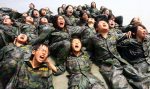
I’m thinking about Daech’eon (대천) which is on the west coast, not too far from Ch’eonan, and a beautiful stretch of beach. The freshmen boys in my last high school used to visit there in summer just after their end of semester exams. As beautiful as Daech’eon is, I imagine that whenever they are reminded of the place they will tremble and break out in a sweat. For them, Daech’eon was a place where you both met yourself and your limitations, a place from which you returned a different person and it was feared! In the months leading up to the summer I often heard mention of Daech’eon, always with a mix of reverence, fear and foreboding.
Kids can learn a lot from a smack around the head and some discomfort and pain. In the west we’ve molly-coddled kids to such an extent they’ve had to invent ‘extreme’ sports in order to make themselves feel alive. Anything potentially dangerous in the playground has been removed and that nasty hard and rough floor replaced with a comforting rubber mat. Of course, there’s nothing ‘extreme’ about their sports other than a scratched knee or bruised shins. ‘Extreme ‘is playing on a playground without the protective rubber floor, getting into the boxing ring or doing some of the more strenuous of martial arts with instructors who take pleasure in grueling sessions. In one taekwondo school I attended in Korea, the instructor put a ‘naughty boy’ in a headlock until the boy’s legs went limp and he flopped to the floor – that’s ‘extreme.’ Back in the UK I’ve trained in schools so strenuous, 200 front rising kicks and 200 hundred sit ups just for a warm up, that membership was limited to less than ten students – that’s ‘extreme.’ My military training was 12 weeks which included 6 weeks at a school of physical training. The day commenced with an eight mile run and the remainder was spent in the gymnasium – that was ‘extreme.’ Bungee Jumping would freak me out and definitely pump me full of dopamine especially as I’d be terrified the rope would break given my extreme weight. Personally, I see little ‘extreme’ about such ‘sports’ especially as they are associated with fun and a poncy lemonade, Mountain Dew, and anyone who aligns their personality with a carbonated corporate beverage is gullible and totally un-extreme.
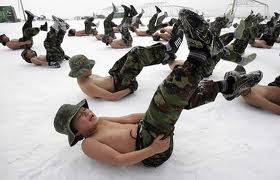
Most kids would think this ‘extreme’
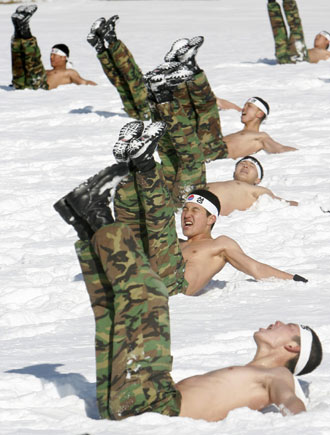
Korean special forces training – ‘extreme’
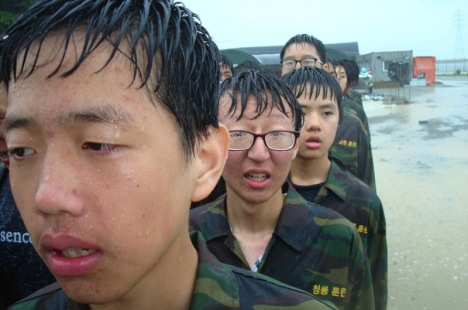
Facing your own limitations
In order to keep kids in post 16 education Britain, has introduced colleges of football, basketball, dancing, and most likely tiddly-winks. In contemporary teenagers’ jargon, most ‘extreme’ sports as well as the sports offered in sports colleges are ‘gay.’ Most British boys wouldn’t last the day in my last high school and they certainly wouldn’t last if subjected to a real training session. Many of the teenagers in British sports colleges have no idea what it takes to become a professional athlete because the ‘training’ they have been subject to is largely based on making it fun. By sanitizing all unpleasantness and removing all threats, kids are no longer forced to confront their own limitations, let alone attempt to push beyond them and in terms of both sport and academia, most are still crouched in the starting blocks.
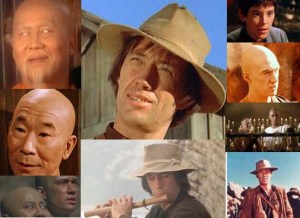
The TV Series ‘Kung Fu’
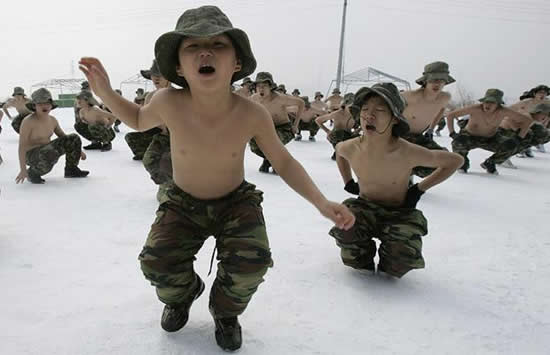
No Mountain Dew? Brutally Extreme!
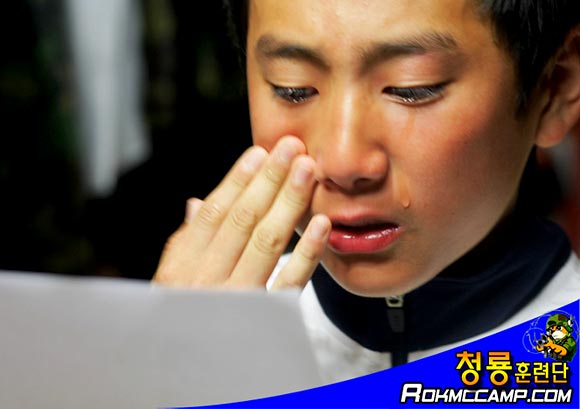
Boy crying as he reads letter from home (Link to Rokmccamp.com)
Permeating much of the general life philosophy of Korea, is a belief that through discomfort, even pain, we become stronger. I was aware of this ‘philosophy’ when I first started training in taekwondo in the 1970’s and it is an attitude prevalent throughout the east. In the opening sequences of the 1970’s, Kung Fu, Kwai Chang Caine (David Carradine) is seen taking the final initiation which marks him as a Shaolin monk, lifting a heavy cauldron of glowing coals between his arms. The cauldron bars his way forward and in moving it the symbols of the Shaolin Temple, the tiger and the dragon, are seared onto his forearms. The initiation is one of pain and marks the transition novice to master, from the hermitage of the monastery to life beyond its confines. Of course, the initiation, symbols and hot-pot are probably historical baloney but it made excellent TV and encapsulated much of the spirit of the time which included an intense interest in eastern mysticism, the orient and martial arts.
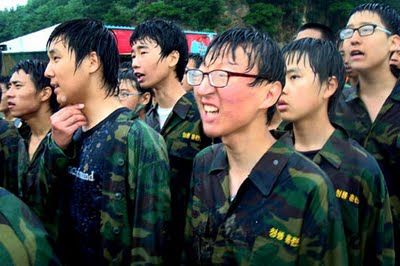
Perseverance (인내)

Team work
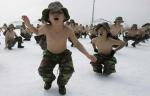
In the late 1970’s I remember reports and photos about the Japanese Karate team practicing punching solid surfaces while kneeling on broken glass. The glass must have been ground as anything other would be highly foolish. General Choi’s (최홍희) Taekwon-do ‘bible’ (the first book about taekwondo published in English) advocated training in the snow to develop ones resilience, something still undertaken by Korean soldiers and school kids where the philosophy of discomfort and pain strengthening the human ‘spirit’ is still alive and kicking. Indeed, the five tenets of both the ITF (International Taekwon-do Federation) and the WTF (World Taekwondo Federation) include: perseverance (인내), self-control (극기), and indomitable spirit (백절불굴).
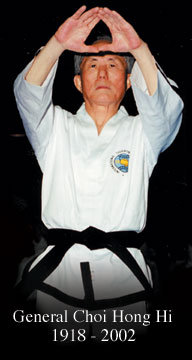
- A central figure in the history of Taekwon-do, ignored by the WTF
Korean teenagers often attend trips, organised by schools or private organisations, designed to bond them, develop leadership and strengthen the character and coming from both an ex-military and marital arts background, as much as I dislike macho-militarism, I belief there are some benefits in such pursuits. Without doubt my training in martial arts heightened my mental power and my ability to ‘tap into’ a superior mental state, now that I no longer train, is severely weakened. The heightened state of reality, caused by the body being flooded with endorphins, gives rise to a euphoria which can make a lasting impression on the mind and this state, though somewhat perverse to subject ones self to, is rewarding in itself. Confronting ourselves is a revealing experience.
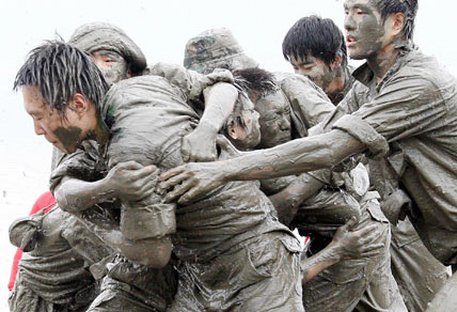
Getting messy hair – ‘extreme’
Part of the economic success of Korea has been attributed to the hard work and discipline of older generations. My closest friend often tells me about his childhood and the constant hunger he faced. His mother used to make dong-dong-ju (a rice wine alcohol) which he carted to the local market to sell. By western standards he is working class and for the ten years I have known him he and his wife have struggled to ensure their son and daughter had a good education and entered a decent university. For the last five years he has worked in a car factory in Ulsan and lives away from home returning only every second weekend. His wife runs a street pancake stall where she will freeze or sweat, depending on the season. I can think of few individuals back home who work as hard as they do but their experience is one shared by majority of Koreans who were children in the wake of the 1950’s. It is this hardiness which on the one hand is often attributed to Korean economic success and on the other, to the both the pampering of their children and the occasional desire to provide their children a taste of harshness that might make them better citizens or students.
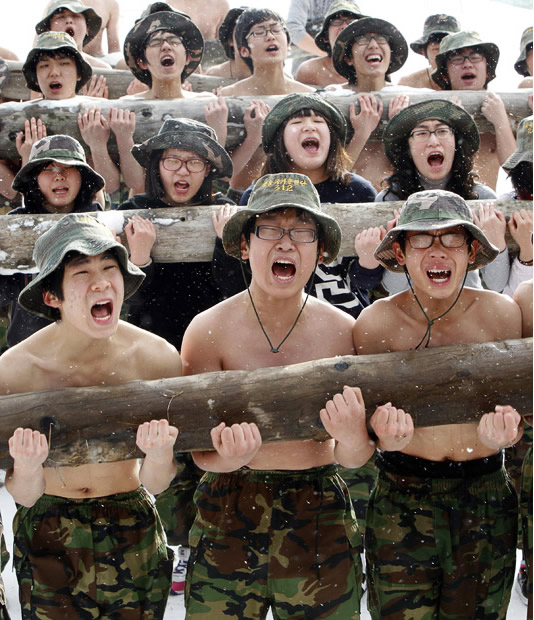
Korean Kids at a ‘camp’ near Asan
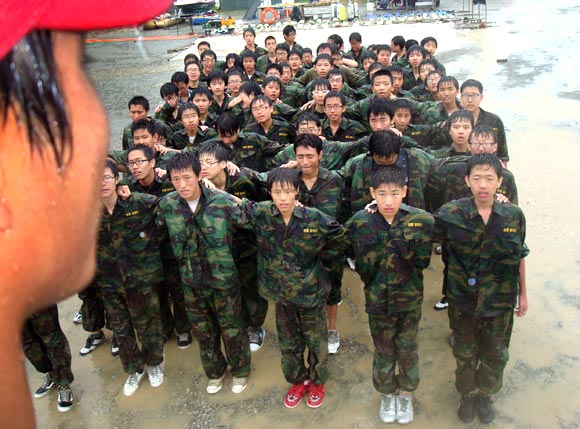
I’ve taught in English schools where you weren’t allowed to shout at children and had to ignore bad language unless aimed at you personally

Knowing your’re alive doesn’t happen very often
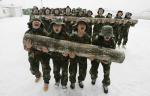
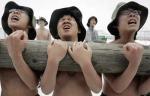
Across Korea are various ‘boot’ camps which specialize in providing today’s youth with a taste of hardship. The courses are designed to bond, facilitate team work, and develop perseverance and tenacity. Trekking up mountains, standing still for an hour, twice a day, military style discipline and exercises, training in snow, mud, rain or the sea are all common. Some of my middle school students recently went on a trip which involved sleeping on graves in the mountain without any adults – however, how widespread this is I don’t know. Sure, lots of people will see such training as harsh and wicked but for even the most average sports person or averagely talented person, facing your limitations is a common experience. While many of today’s rich and famous have ascended to stardom by virtue of a mixture of luck and looks, most of us will only achieve great things by guts and determination. As much as I dislike football, Beckham is talented but then he spent many hours hammering balls into goal to hone his skill. Molly-coddling kids and protecting them from facing themselves simply teaches them to be less than mediocre. In addition, discipline subjects children to the will of adults which is no bad thing. I’d rather live in a society where the kids are controlled than in one where they run amok doing exactly as they please.
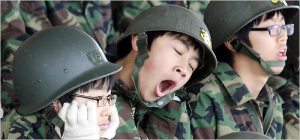
Link to New York Times article
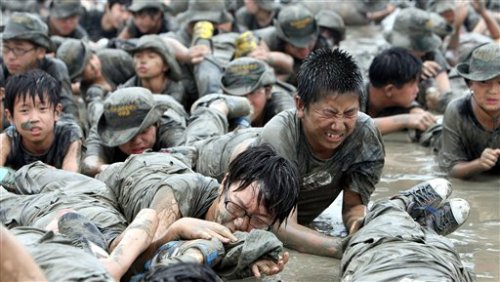
Indomitable spirit (백절불굴) And it does them good!
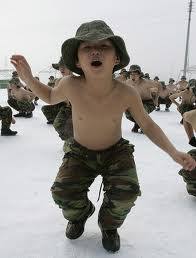
It’s only pain!
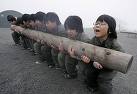
The British army stopped log training many years ago and burpees in the mid 1970’s.
All young men are required to undertake 24 months military service and for young boys this kind of training is a taste of things to come. Considering the relationships between North and South Korea, and the fact the war has never officially ending, conscription is a practical preparation for the unspeakable event. When your country prefers to wage war on distant shores, you can rely on a professional army but when the enemy is on your doorstep such luxuries evaporate.
Circumcision and the freshman summer camp were probably the two most feared events in the lives of the freshmen in my high school. The morning the buses rolled up onto the school grounds to cart them off was especially silent, as if an execution were about to be detailed. A week later they returned exhausted, sunburnt, bruised and very proud. All the boys were scarred, all had badly friction burned knees or elbows, there were cuts and bruises and a few returned with broken legs or arms. Though the boys still had two years of one of the most demanding schools systems in the world to endure, the friction burns, cuts and bruises, like the Shaolin tiger and dragon, were badges of belonging, symbols of esprit de corps. Daech’eon was an intensely private and intimate experience and once recovered, and confined to history, mention of that beach stirred memories and emotions and at such times I felt both an intruder and outsider. In a preface to one of his James Bond novels, Flemming writes: You only live twice; once when you’re born and once when you die. I think the Daech’eon boys, and any other kids who attend such boot camps, have already experienced a second brush with ‘living.’
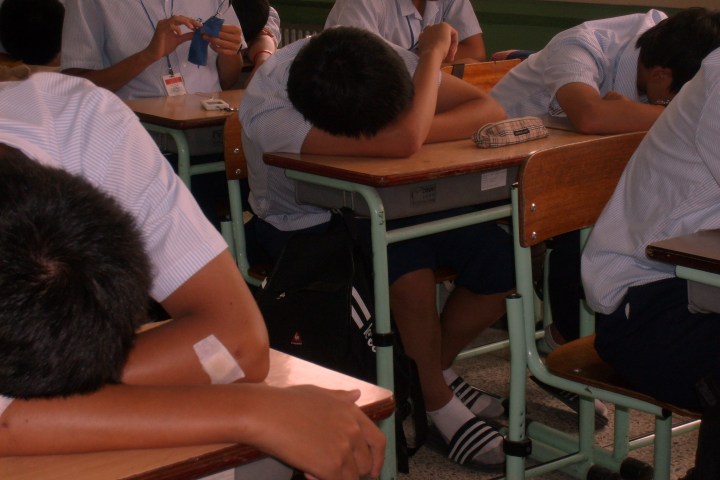
After the Daech’eon camp
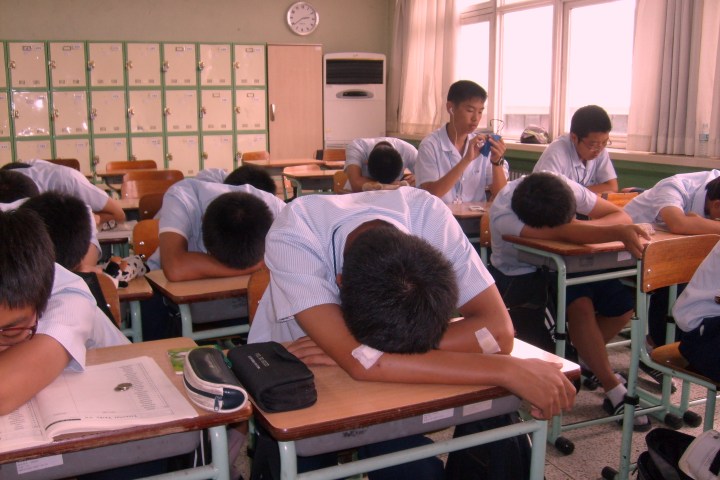
Tired
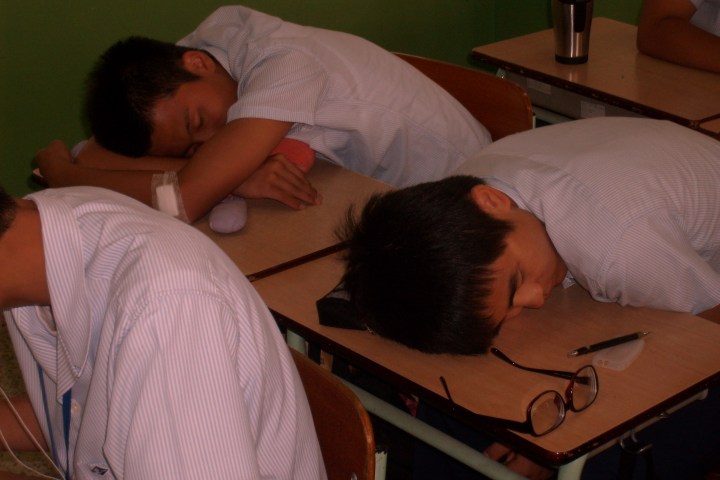
Post dopamine lull
LINKS TO VIDEO CLIPS OF KOREAN TEEN BOOT CAMPS
ITN News Report
Reuters 1
Reuters 2
Nocommenttv
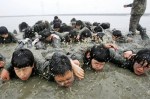
NTDTV
———————————————————————————————————————————–
LINKS TO WRITTEN ARTICLES ON KOREAN BOOT CAMPS
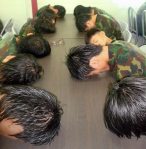
Jjujund. Translation from the Chicago Tribune Sept 2009
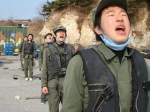
Link to ABC News
———————————————————————————————————————————————–
© 林東哲 2010 Creative Commons Licence.
Have Stick Will User It

Discipline Korean style
Has anyone teaching in high schools noticed that if a student is rude or disrespectful, they are generally the ones who have had a sojourn studying in the west – usually in the USA and much less frequently the UK? Now, before I get started, I am not saying that all Korean students who have studied outside Korea are tainted or that Koreans who have never studied abroad are never rude or disrespectful. With considerable experience teaching in the UK as well as experience in Korea, I am making comparisons based on my own experiences in addition to an awareness of the general standards of behaviour both in the UK and Korea.
First of all, I have never been fouled mouthed or insulted by Korean students. No Korean student has ever sworn or shouted at me and the only time I can recall when I was shown disrespect was on an isolated incident when a student addressed me in intimate level speech (반말). As my Korean is rudimentary, students may have been taking the piss and insulting all along but I have never been led to believe they were and even if this were the case it pales into insignificance in comparison to my experiences in the UK.
Before getting defensive about Britain or the USA, there are numerous blogs, and indeed books written by teachers appalled at the conditions under which they have to teach. I too have an extensive blog dedicated to teaching in the UK. There is a small but significant number of professional teachers working in Korea, all who have abandoned teaching in their home countries because of poor discipline, low standards, anti-intellectualism, dumbing down, violence and so forth. So, while there might be bad apples in Korea, they are not likely to attack you or call you a ‘fucking wanker,’ or indeed a ‘cunt.’ These are my experiences but I know many other teachers have had similar experiences and worse. No Korean student has never attempted to hit or spit at me. Indeed, when I was spat at in the UK, the headteacher didn’t even bother asking to see the boy and simply asked to see my planner. That was in Southborough Boys School, in Hook, Surbiton, where I quickly deduced that it was acceptable for a student to spit at a teacher if the lesson wasn’t deemed enjoyable. If I had been a more seasoned teacher at the time, I would have used the attack to claim psychological or physical injury and earned myself several months paid sick leave. Clacton County High School (CCHS) is another school where I’ve had students call me a ‘cunt’ or ‘a ”wanker’ and they were never reprimanded by management. Given the abysmal examples of leadership and staff support, I am not surprised standards are so low in the UK. Outing shit schools and shit practice is something all citizens should do especially when management in those establishments prefer to pretend nothing is amiss.
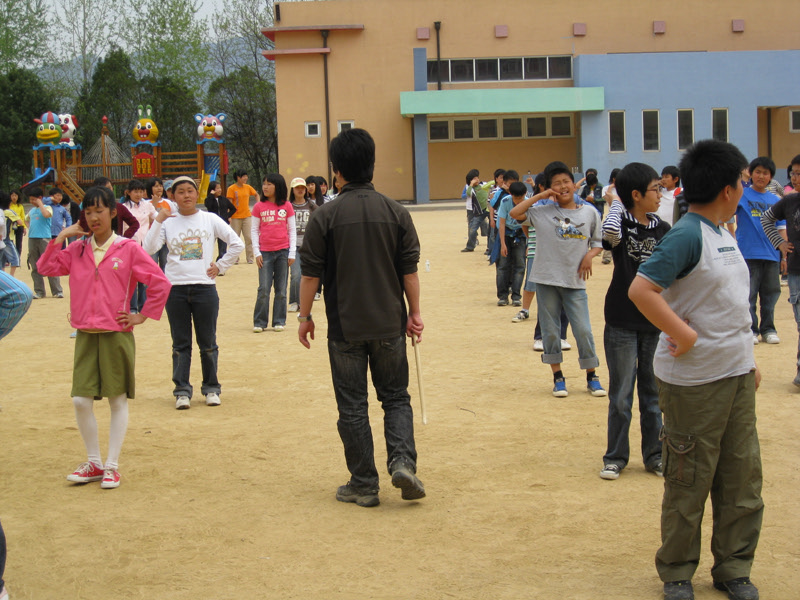
Korean teacher with stick
In Korea, I carry a stick, affectionately called ‘Billy.’ And occasionally, perhaps once a week, I will use it. I have never hurt a student with it though if I wanted to, this would be acceptable. My boss actually encourages me to hit students and I’m sure she sees it as a weakness on my part that I don’t do so more often. When students are being naughty, I’ll call for the stick. ‘Billy? Billy? Where are you?’ Then, I’ll poke around in my draw. Within seconds there is silence. ‘Billy, come on out! Someone’s arse needs a clout!’ Then, like un-sheathing Excalibur, I draw Billy from his lair and brandish him. Even with older students, this pantomime elicits a sigh of awe as if I really have drawn a sword or sparked-up a light saber.
Billy is pretty pathetic! Thirteen inches of stick not much thicker than a pencil and not very springy. Being six-foot six and large, I find him the perfect companion and actually traded him for real stick designed for pointing and striking which I’d bought for 5000 Won (£2.50). We have now been together for two years and at Christmas I took him back to the UK in order to treat him to a lick of linseed oil that I keep in my garage, for use on my front room floor. Ironically, I traded my real stick, which resembled the narrower end of a snooker cue, and which many high school teachers posses, with that of the smallest female teacher in a boys high school. Both of us preferred each others tool. Despite a recent oiling, Billy’s arthritic state spares the kids a real whacking as I am conscious of not snapping him in two.
By now, whatever the problem was has vanished or, if it is an issue of homework, the offender will be awaiting punishment. I always make lack of homework punishments quick and will strike without any prior warning. Sometimes, the offender actually thinks they’ve been spared. I usually hit them on the head. Yes, I know I shouldn’t, but for the PC brigade, anywhere is liable to cause injury and the safest place, on the bum or back of legs demand a sort of procedure, like bending over, which almost serves to ritualise the punishment and which I personally find a little pervy. And of course, Billy is too much of a light weight to have much effect in that area without the risk of being broken. So, the head it is! One short snap, never very hard and certainly much less damaging than the game Korean boys play where they do ‘rock, scissor, paper’ and the winner gets to ‘flick’ a finger on his opponents forehead.
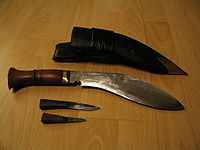
A Gurkha kukri, supposedly never sheathed without drawing blood
I usually treat Billy like a kukri, the Gurkha traditional knife, supposedly, never sheathed without first drawing blood. Last year, I threw a crazy with a class, probably the one and only crazy I’ve thrown in Korea. For a minute or so I shouted and screamed and smacked Billy on the desk. Two children started crying and the rest were terrified. That was a year ago, but one the odd occasion I need to call for Billy’s help, those students still in the class, and who remember that day, put their head in their hands in trepidation.
I actually find it difficult to hit a student and after striking them feel very bad if they start crying . As in the UK, if you are not careful kids make excuses for lack of homework on a weekly basis but Billy cures this problem instantly; no lectures, no debates, no pleading, no detentions or phoning parents, not wasting valuable time, just a thwack of Billy on the head and you can guarantee the issue will be resolved and a homework subsequently forth coming. Western teachers, fooled by the PC claptrap that corporeal punishment is barbaric, are misguided. If I make a joke and strike my stick on the head of a kid they will laugh but should I use the same force when angry, and the child’s ‘kibun’ is damaged, they will often have tears in their eyes. This should tell you how minuscule my punishment is! It is not the force of my stick hitting them that castigates and punishes them, but the loss of face within the class. Joking aside however, I witnessed some brutal punishments in my former High School.
In a Korean class, there is absolutely no mistaking who is the boss and this difference creates a chasm in standards between British and Korean schools. In Korea, the teacher is always boss and ultimately students know this. Korean kids will push their chances and intimidate you in their own Korean way but they know that they can be physically punished. British kids however, are equally aware that teachers can do nothing about bad behaviour. In many British schools, it is children who rule the class room and permit or hinder a lesson as they see fit. Bad management structures, of which students are unwittingly aware and will use to their advantage, have created schools where classroom teachers are powerless while managers can saunter into lesson and demand compliance because students know they have direct access to contacting their parents – a power usually denied non managers.
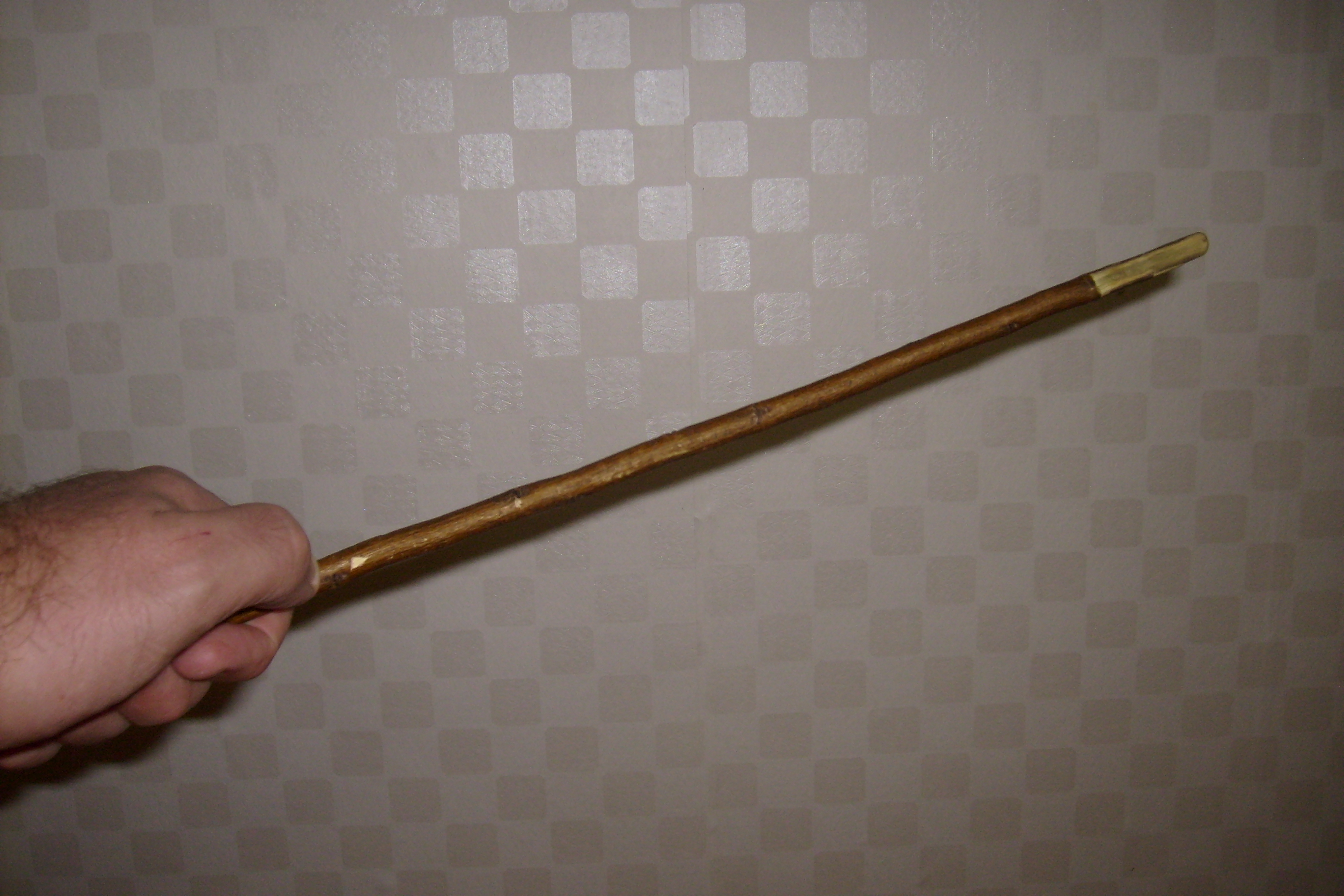
My stick, 'Billy.'
Ah, Korea. A different world where for most cases, even the most horrible student is an angel by comparison. And instead of being shunned like a leper when out shopping, Korean students want to introduce their parents to you or simply say hello. Today, a student’s mum bought me a large cake, last week I received a bag of six homemade soaps, and so forth. Anyone who has taught in Korea will have been presented gifts such as these. In the UK, I didn’t even get a fucking apple from the class creep! So, when I have been confronted by ‘disrespect’ from Korean students who have studied abroad, it’s more like ‘indifference’ and familiarity than lack of respect. I have frequently had to interview high school students and a substantial number of those who have studied abroad will slouch in front of you, talk to you in a familiar way and are the quickest to tut or talk back. On a few rare occasions, I’ve even heard them mutter expletives under their breath.
Experience of the west must have a profound effect on them as it exposes them to a range of experiences, not all of which are bad, which are denied them in Korea. Most will have been exposed to drugs, anti-intellectual attitudes, educational mores that encourage and prompt them to be sexually active, homosexuality, trans-gender, a society that empowers students well in advance of them being able to yield that power responsibly, and a system that often polarizes teachers and students and charges that relationship with antagonism and distrust most pertinent the notion that every adult is a potential perv. In the UK, Billy would have been assassinated! There is no doubt students would have sought him out when not in my company and snapped him in half. More disturbing, they would have done so with glee.
The Times Newspaper (UK), conducted a survey in 2008 which revealed a fifth of all teachers support the use of corporeal punishment. This week in New Zealand (May 15 2020), it was revealed half the population support the return of the cane especially in the light of figures highlighting the corresponding rise in crimes within school that has occurred since corporeal punishments was banned.
Ministry of Justice statistics for pre-teen violence released just last month also showed a disturbing trend. From 1998-2008, the number of police apprehensions for grievous/serious assaults by 10-13 year olds increased by more than 70%. For each of the most recent two years, there has been almost 1,000 apprehensions for 10-13 year olds for all violent offences, which include aggravated robbery, sexual violation, indecent assault, and serious assaults – an increase of a third since 1998. (link to NZNEWSUK)
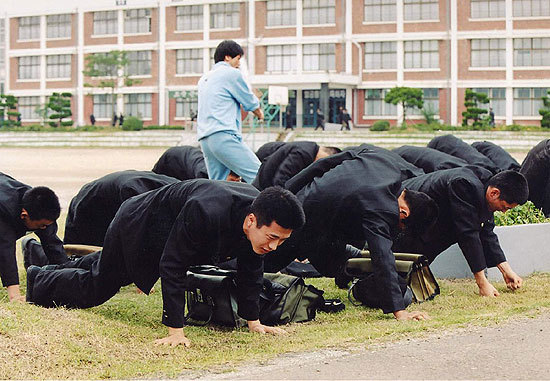
High School discipline: harsh but less severe than two years compulsory military service!
If you care for the development of children, the occasional smack is absolutely necessary. If my son or daughter were caught sticking their fingers in the electric socket, I would administer them a good clout as failure to instill in them the danger of doing this, puts their lives at risk. It is widely believed in Korea, that corporeal punishment reflects caring for youngsters’ development and the stick is often referred to as the ‘stick of love’. Personally, reflecting on some of the hideous scum I have had the misfortune to teach in the UK, it is clear we neither respect them, ourselves or other members of society – most notably other students. Of course British teachers can’t say they ‘love kids,’ not without having to spout a diatribe to explain themselves, which is just as well as judging by the scum we have allowed to pollute wider society, we clearly don’t. You will hear the phrase ‘spare the rod and spoil the child’ far more in Korea than you do in Britain. The politically correct lobby has compelled us to obsess about the rights of bad children and generally bad people in a plethora of contexts, has helped facilitate a society where all of us, including children, in one way or another, are now victims of, or held ransom by, the very scum we molly-coddled and subsequently empowered.
Postscripts
This is true, a few weeks ago my boss gave her class a vocabulary test. One of the words requiring translation into English was, ‘몽둥이.’ (stick). Two students answered, ‘Billy.’
I don’t know how long this link will remain on Daum, but here is a brief recording of a very disturbing, and brutal corporeal punishment.
http://tvpot.daum.net/clip/ClipView.do?clipid=13660273&lu=m_rc_main_recentcommentlist_10
Ben. Korean Teenagers (1)
Ben is one of my students. He is 15 or 16 and in his final year of middle school. Tomorrow he is off on his class trip, in this case to Sorak Mountain. He is in school early in the afternoon as his class has been let out and so he calls in for a few hours study, prior to buying ‘snacks,’ at the nearby E-Mart. The snacks he tells me, will include ramyon (Korean pot noodle), choco-pie, (Korean chocolate cake-biscuit things), crisps (what American refer to as ‘chips’) and drink.
It’s the first time I’ve seen him in uniform; gray trousers and jacket with matching gray waistcoat, and a white shirt with the typical burbery-type pattern on the inside of the collar and inner cuffs. On his breast pocket a green flash carries his Korean name, stitched in gold. He’s a skinny boy who in class we often refer to as ‘chopstick boy.’ Today he is incredibly happy, his ‘kibun’ repaired after his post exam despair, last Friday. He’s not just a little happy, he’s ecstatic and he keeps telling me he wishes he was going now.
Next, he starts to tell me about how he fell over in football at school today and had to go to the school ‘hospital.’ He pulls up his shirt cuff to reveal a scratch the length of his forearm. It bled so much he tells me; ‘there was blood everywhere.’ He understands the difference between a cut and a scratch but insists it bled a lot. Then I considered how skinny he is and thought the loss of a little blood for him might be catastrophic and won’t to tease him but am cautious. Koreans do not like being teased as we in the west do and a bit of fun can very quickly upset someone and then you’ll have to wait for another day to clear the air. However, as a rule, Ben doesn’t mind a joke. That reminded me of last year when I jokingly asked a student, Mark, to close his eyes and then, from about a foot from his ear, I pulled the rip cord of a firecracker. Mark almost jumped out of his chair and didn’t find it at all amusing. He sat crying for almost half an hour and there was nothing I could do to console him. The firecracker had made one big bang, not like other ones I’d set off and Mark claimed a bit of powder had hit his ear. Well, if I’d been teaching in the UK I would probably have lost my job. Next day I gave him a box of choco-pies. In the nest lesson we discovered the firecracker had been made in China and that they are notorious for being loud and unpredictable.
Wanted: A Plastic Professorship
Have you noticed its predominantly university teachers who hand you business cards? Fingering the little stash I’ve collected over the years, not one is from a Haggwon teacher. I’ve never owned business cards, but then as I’ve never sent a text message and only used an ATM machine once in the UK. I’m slightly odd.
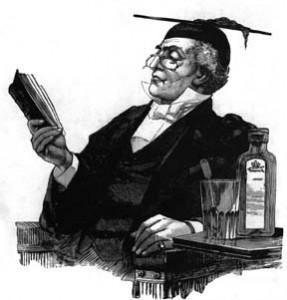
I pine, you pine, he pine, she pine!
I wouldn’t mind handing out a name card from a university, even a crap one but like most teachers, I would probably feel a little ashamed handing out something from an institution one notch up from a kindergarten or the kids’ party entertainer at Mac Donald’s. Even though haggwon and university pay are now fairly similar, in status there’s a world of difference between Coco the Clown’s English Academy and a University.
No matter how hard a haggwon tries to give itself credibility, names like ‘academy’ or ‘colleges’ don’t hide what most really are, factories (공장). ‘TOSS English‘ reads the bright neon strip over a college near where I live. Despite the amusing name, it must be successful as it has a fleet of mini buses and has been in situ for at least 8 years. However, back in the UK, ”Toss’ is slang for ‘shit’ or ‘masturbation.’ And then there’s ‘Kolon English Academy;’ Colon is the destination of the doctor’s digit when you have an extremely bad gut. Then there are the logos, the cap and mortar board, the pillars of some classical order column. Sometimes they use letters of the Greek alphabet which in the UK would be unrecognized to all but the students of British grammar schools.
In Britain, any awareness of the roots of western civilization is relegated to 5 or 6 year-olds and hence denuded of its significance as the cradle of western civilization. The invasion of ‘ ‘Greece” by Darius in 490BC and Xerxes, 480BC, had they succeeded, would have radically altered the face of western history possibly resulting in an Islamic Europe. Mention Thermopylae to most British people and it is now associated predominantly with a comic or a partly animated, fantastical movie. Many Korean kids can recite or narrate the Battle of Thermopylae or Marathon and some have even ‘explained to me how Socrates came to commit suicide. As a history teacher in the UK, I can put my hand on my heart and tell you I have never seen or heard any mention of Thermopylae , Marathon or Socrates in a British school. For various reasons, the most significant aspects of our history, often due to political imperatives, are demnatio memoriae. Koreans students certainly have more awareness of classical history than do their western peers and so the column, pediments, alpha and omega, and other little symbols of academia and learning are common but ironically, the ‘colleges’ they represent are as genuine as the Phrontesterion in Aristophanes’ The Clouds; the silly little ‘Thinkery’ where students bend over, bum holes gazing intently at the heavens in the quest for knowledge.
Much as I love Korea, their method of teaching English needs a total overhaul and the dependence on memorizing phrases, a number of which are clumsy and strange, needs scraping. Koreans have a similar attitude to teaching English as they do cooking bean paste soup. I’ve told several friends I add a dash of black pepper powder to my dwaen-jang. They were shocked and repeated ‘pepper’ several times as though I’d said I piss in it. Then they told me that black pepper wasn’t part of ‘the recipe,’ as if there is only one recipe, only one way to do it. Korean education is very successful, but their standard of English, despite the haggwons and schools, is dire. Perhaps if they treated English education more like ‘pushion pood (fusion food), squirting jam over pizzas, replacing mozarella with that stretchy, play cheese, or sweet potato and dipping bistro hotdogs in a concoction of syrup, mustard and red pepper paste, standards might improve. ”I’m pine,’ ‘Have a nice day,’ ‘pleased to meet you,’ ‘ drive you to suicide. And then there’s the constant American twang but that can wait until a future post!
Currently, I’m waiting for my business cards to arrive and they will probably carry my school’s logo, a cartoony character but I’m not particularly bothered. I’ve worked in enough language factories and a high school, to know that my boss has genuine intentions and besides, my loyalty is won because my conditions are probably superior to those of most university teachers whose pay is no longer way in advance of a haggwon teacher and whose holidays, at one time a guaranteed four months have been whittled down and interpolated with various obligations. My boss and her family have been close friends of mine for over ten years and have even vacationed with me in England. Though I would love to become a professor, albeit a plastic one, working in a university, for me at least, would be a step down.

A teacher from the Coco the Clown Phrontesterion of English. (I'm Pine and You)
Of course, most university teachers, instructors, give you a name card not because they teach in a university, but to impress on you the fact they are ‘professors.’ Professors are the officer class of Korean teachers with haggwon teachers relegated to ‘rank and file.’ Yes, I would probably do exactly the same but it is non the less amusing in its snobbery. Name cards of the highest status carry ‘professor’ in both Korean (교수) and hanja (敎授) in order to separate them from ones simply in English. I’d probably have mine embossed in gold. In reality however, it’s the knowledge and skills of a ‘professor’ I would like and not merely a hollow title. By English standards, I’m not too clear how it works in the USA, a ‘professorship’ is a position, ‘a chair,’ awarded to top academics and not a title conferred merely by teaching in a university. Despite the demise of standards in the UK and the ascendancy of ape values, you still read or hear of academics being ‘invited’ to a professorship.
What, by gad! No dickie?
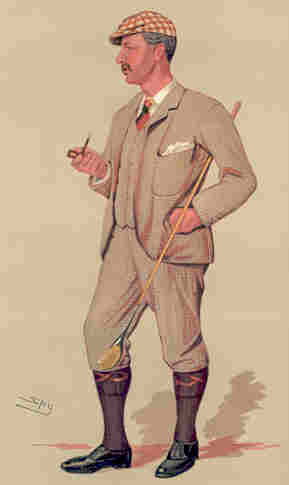
Last year I spent several days adjudicating a speaking competition with three professors all of whom gave me name cards. Two wore little silk dickie bow ties and the other a complete set of plus fours and matching walking cane. When I first saw him, from a distance, I thought it was Sherlock Holmes until I heard his American accent. He didn’t have a pipe but his plus fours were real and actually made of tweed. Ironically, I’d met this chap before, some 6 years previously when we worked together in an academy ‘factory.’ Before the plus fours and business card, and of course, ‘professorship,’ he used to turn up for work looking like a backpacker, his hair never combed and his clothes disheveled and scruffy. One day, I recall my old boss consulting me as to whether it was acceptable to offer to buy him some new clothes. If I’d known at the time what I now know I’d have simply suggested conferring a professorship upon him and buying him some appropriate name cards. The rest would have taken care of itself.
Even when I’ve known teachers who for one reason or another moved from university to hagwon, from the status of ‘plastic professor’ to that of a boring ‘teacher,’ they’ve initially introduced themselves, or been introduced to me as, ‘professor.’ Further, not only have they continued wearing the dicky bow, but they’ve insisted students call them by title.
I’m a snob, academia, the classics, the entire gamut from music, art literature to history, Oxford, Cambridge, public schools, grammar schools, dickie bows, waist coats and plus fours, professors, even plastic professors, I adore them all. When I was a boy, this was what constituted education and refinement and through out my twenties I aspired to it. Sadly, by the time I got to university, in my early thirties, the gown, mortar board and anything ‘classical,’ if not already on a heap in the college quad, were on their way! And now, well, every Tom, Dick and Harry have a degree – usually in hair dressing or business studies. As much as I mock plastic professors, tongue in cheek, a least the title sets you apart from the herd. Sadly, of all my university friends, some of whom are university lecturers, professors, some even renowned in academic circles, few embraced ‘the classical’ with any passion in little other than their individual subjects. I don’t want to leave my current occupation, that would be foolish, but secretly, I would love one of those business cards and the snobbery of calling myself a ‘professor.’ Is it possible to teach a lesson or two a week in a university, even a poxy one, and ‘earn’ the title ‘professor,’ or even ‘associate professor?’ If so, pathetic as it is, I want the job!”
I'm Pine! And you?
Are you an ESL teacher in Korea? Bored of teaching? Tired of asking the same questions day in and day out? Suicidal at hearing the same flat, dull and unemotional responses? Look no further! Simply download the PDF, copy and distribute to your students. Then sit back and enjoy the laugh.
I’M PINE is a mini dialogue for 3 characters designed to raise awareness of mispronunciation and provide some amusement for bored teachers. If you have the energy you can explain to your class the differences between, for example, ‘fine’ and ‘pine’ or you can simply hand out the script and let them get on with it.
I’M PINE
THE CHARACTERS SHOP KEEPER (SK) / MR FINE / MR FISH
FINE (Mr Fine walks into the Fish-shop)
SK Hello Mr Fine. How are you today?
FINE I’m pine and you?
SK I’m fine too. What would you like to buy? I have some lovely seafood this morning.
FINE Shi-pood! Ohh, Lovery! What have you got?
SK I have some nice fish, cod, and delicious mackerel.
FISH (suddenly Mr Fish walks in)
FINE I want some pish!
FISH Well, here I am Mr Pine. Good morning?
FINE Good morning Mr Pish, have you come for a pish.
FISH Well, Mr Pine you do look pine. Yes, I’ve come for a pish, I love a pish on a priday.
FINE Yes, pish is so tasty and lovery. I was going to have a presh pish but I think I might have a crap instead.
FISH What sort of crap do you like?
FINE I love big, fat brown ones, esperarry with big craws. A big crap boiled is best and better than a robster. Mmm, dericious. I like my pood presh. What sort of pish do you like Mr Pish?
FISH I love a long one. Long ones are more tasty. The longer the pish the better. Mmm, tasty. (MR FISH TURNS TO SK) Can I have a long pish please? Pish and pren-chee pry – dericious!
SK Pish and cherry pie? I wish you’d speak Engrish!
FINE And I want a big crap, a big brown crap that will fill my pot.
SK Ooooo! sorry gentlemen! You can’t pish here and you can’t crap! That’s tewibble, disgusting. If you want a pish or a crap go to the toilet!
FISH Pardon, I don’t understand. I only want a pish please.
FINE And I just want a crap, a big brown one.
SK You’re disgusting, nasty people. Go away!
FISH But, I don’t understand. This is a shi-pood shop.
FINE Yes, a pish shop is where you go for a crap.
FISH And a pish!
SK Go away! You’re very bad! Get out!
(Mr FISH and FINE walk down the road very confused why they could not buy fish or crab at a fish shop.)
FINE What a strange man Mr Pish. There are so many strange people. Last night I asked my neighbour if she’d like to see penus out of my window.
FISH How big was it? Was it ra-gee?
FINE Oooo! it was the big. Very big. I’ve never seen it so ra-gee.
FISH Was it shinny, too?
FINE Of course, Penus is always big and shiny.
FISH Was she excited? I would have been.
FINE No, she wasn’t excited at all. She was tewibbly frightened.
FISH What did you say?
FINE I said hurry, hurry Mrs Dick, you can see Penus out of my window and it is really big and shiny.
FISH What happened next?
FINE Her husband came to the door. ‘Puck you!’ He said, and hit me in the pace with his pist.
the end…


 Elwood 5566
2 comments