Korea 'Made Simple'
(This post refers to Chris Backe’s blog and uses the term ”made simple’ which bears a similarity to the title of Chris’ recent book on learning Korean, Korean Made Easy). My references to ‘Korea made simple’ have nothing to do with his excellent book )

waygookin - foreigner
I had a drink this weekend in a bar around the corner from where I live. Everything was going well until the place was invaded by fifteen foreigners who were all drunk and noisy. As they entered, only one acknowledged the presence of either myself, or the two westerners I was with. When we decided to leave, just a few minutes later, the same woman that had said hello, apologised for not having been friendlier, meanwhile, the rest of the crowd she was with, continued to blank us.
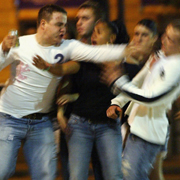
Scene from a Typicaly British high street
It seems that expat-sub-culture slang, recently highlighted by Chris Backe (Chris in Korea), describes our experience as that of, ‘being waygooked.’ Chris lists a number Korean words adopted by westerners to use as slang and all comprise the first and only words many westerners learn during their short stay in Korea. I am pleased to report I wasn’t aware of any other meanings than those of the original Korean.
A sub-culture lingo lurks in any foreign place with a substantial numbers of foreigners but without doubt, the increased numbers of foreigners now living in Korea, coupled with the internet and the high number of ESL teachers help to consolidate and disseminate its lexicon. Whilst some of the examples Chris cites are harmless and amusing, a ‘chunner’ for a thousand Won, ‘manner’ for 10.000 Won, for example, others are not just unpleasant, but suggest many come to Korea with cultural attitudes cast in stone and from which they judge everything Korean – generally in a negative light.
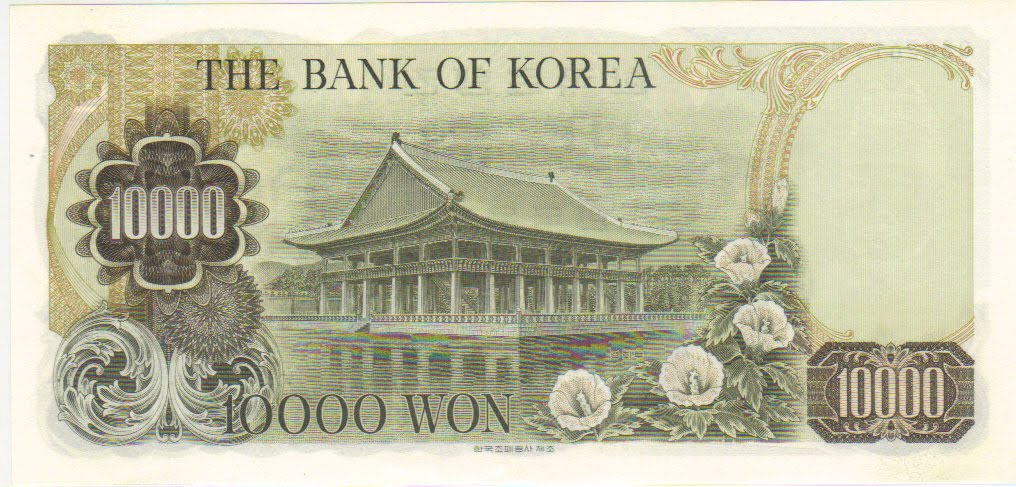
a 'manner' - 10000 Won
To use expat, sub-culture slang self reflectively, Korea has been well and truly ‘waygooked’ though it might be more appropriate to stick to English and simply use the word ‘invaded!’ As each one of us arrives on the peninsula the reception for subsequent ‘visitors’ is made less unique and more mundane. Anyone who was here just ten years ago, will testify how much Korea has changed. To allow westerners to interface with Korean culture, and in order to look progressive, Korea has been ‘made simple.’ Gone are the days when you were compelled to either try to learn Korean or enjoy taking a gamble as everything from menus to bus arrival and departure boards, are now bilingual. About the only item still to be ‘made simple’ is the train ticket. Western food is now available everywhere and it is now possible to eat in different restaurants everyday without being required to sit on the floor or use chopsticks. And a wealth of information relative to Korea grows at a rapid rate. Language packages, blogs, cultural information, official websites, cooking websites, all proliferate. The Daegu, Kyobo book store’s section on the Korea Language for foreigners now occupies ten times the space it did ten years ago and one of the most elusive aspects of Korean culture, notably hanja, now has a number of books designed specifically for English speakers. Learning about Korea has never been easier but in the process, acquiring that information has never been more boring and unchallenging. The diary I kept on a daily basis during my first visit to Korea, before the days of blogging, vlogging and podcasts was was written with a view to publication back in the UK and the audience were clearly western. Today, a high percentage of the audience who access this blog live on the peninsula and are themselves bloggers.
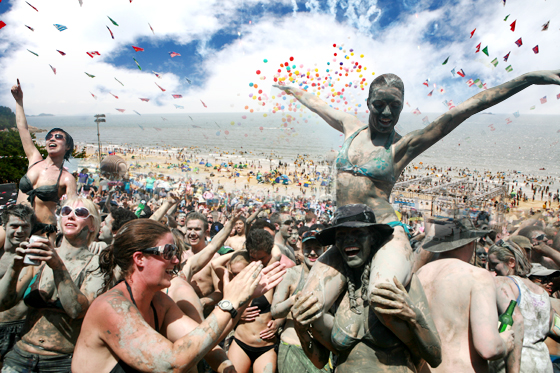
Boryeong, thogoughly 'waygooked'
Not too long ago, Korea needed to be discovered, it was elusive and mysterious and attracted a kind of foreigner with some spirit of adventure. I’m not saying that such individuals no longer come here, they do, but if you’re looking to ‘discover’ and ‘uncover’ things unique, as well as discover something about your own character, Korea is rapidly becoming a very safe option and ‘waygookinized’ almost, but not quite, to the same extent Thailand was ‘DeCaprionized.’ Soon the entire peninsula will posses as much potential to offer a unique experience as the Boring Boryeong Mud Festival. Not only can you research a wealth of information before you even buy passage, but you can communicate in various formats with those already here and discover just how safe it all is. And when you arrive you can pal-up, online and in reality, with a community predominantly doing the same thing you are – probably teaching. If I was setting out to Korea anew, it would be to somewhere like backwater Kangwondo or Ulundo and certainly not to any of the major cities which have now been saturated.
Yes, I am making a mountain out of a mole hill! I shouldn’t take it too seriously! But if anything is likely to make me leave Korea it is when it reaches a point where the experience of being here is not that different to being back-home. I came to Korea to experience its uniqueness and the more waygookins that come here, and I too am part of the problem, the more we connect and form a sub-culture, the more we adapt Korean to express our own predjudices (especially when so few of us can actually speak Korean), and assert a cultural superiority, the more unease I feel.
‘Ganging up’ with other foreigners to invade places, to ‘waygook’ them, is last thing I want to participant in and I certainly don’t want to be its victim. Many foreigners share such feelings and come to Korea to escape aspects of their own culture and to immerse themselves in a new one; ‘waygooking’ an environment is counterproductive to such objectives. And while I can chuckle at terms such as ‘chunner’ and ‘manner,’ and may well use them, other terms verge on either the culturally elite, or are racist. Korean ‘ajjumas’ can dress ‘loudly’ and those dollies that participate in high energy aerobic classes, decked out in glitzy leggings and multi-coloured, sequined apparel, are a constant source of interest rather than mockery. Back in the UK the dress code for a great number of younger women can be summarized as ‘vulgar and skimpy.’ For many Brits, fashion, which of course we think the ultimate, is on much the same level as that of some former soviet bloc nations. And yes, ‘ajjumas’ push and shove but this is a cultural difference and the way to diffuse your annoyance is to embrace it and simply shove back.
Yes, ajjumas can be somewhat exotic in the mish-mash of colours, but how much nicer and civilised that of a man-like female, covered in tattoos and with a mouth like a sewer. Where I live in the UK some of the females are very unpleasant. And Koreans can push and shove but I’ve never had one treat me with the anything like the level of aggression I would face on many a street in the UK. Meanwhile, here are some Korean words which can be adapted to describe some foreigners or indeed broader idiosyncrasies of western, or more specifically, British culture.
Sir-e-ki sa-ram – ‘dirty people’ who don’t wash properly especially as a report last year highlighted how as many as 40% of Brits don’t wash their hands after having a shit. ‘That businessman looks like a sir-e-ki saram‘ (he looks dirty or unclean).
Tre-shi ot – ‘trash clothes’ / ‘trash bag’ – the term used to describe the clothes worn by British people. ”The whole family wear tre-shi ot’ (the whole family dress like shit). This could aptly describe those teachers in Korea who go to work in cargo shorts and flip-flops.
Ch’ang n’yeo hak – ‘Prostitute girls’ – to describe the promiscuous manner in which many teenagers dress. (That crotchless thong makes your nine year old daughter look like a ch’ang n’yeo hak. (Basically, you little kid looks like a slapper!)

ch'ang n'yeo hak (prostitute student)
Bok pal-ip – ‘mouth explosion’ – to describe notoriously bad British teeth. ‘Look at the bok pal ip on him. (Look at his shit teeth)
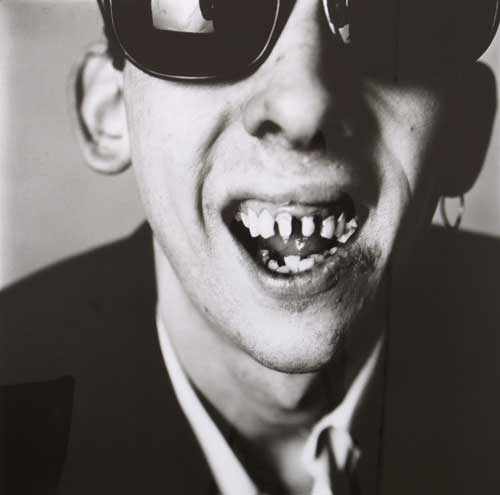
too gross to enlarge
Ddong mul pa-i-peu – ‘sewer pipe’ – a term used to describe both the physical and mental degeneracy of many British people – basically clean on the outside and filthy within. ‘Their kids are as wholesome as a ddong mul pa-i-peu.’ (The underwear might be clean but their contents house numerous infectious diseases).
ch’a-pi – chav – ‘most of the nation are ch’a-pi’ (most of the nation are chav).
di-pi-di – ‘dirty, violent , depressing” – DVD.
But I don’t mean to be offensive…

© 林東哲 2010 Creative Commons Licence.
Magic Mushrooms – The Mantle Mushroom (망태 버섯)
I rarely go anywhere without my camera and could guarantee that when it wasn’t in my bag I’d be confronted with something that needed capturing. Needles to say, last week, camera-less and in the mountains such an incident occurred. I’m fascinated by mushrooms and toadstools and back home in the UK have learnt to identify a number of interesting varieties with enough precision that I am happy foraging and eating the edible ones. My favourites are probably the Parasol Mushroom (큰갓 버섯), Shaggy Ink Cap and Puff Ball. I’ve seen Parasol Mushrooms (큰갓 버섯) several times in Korean mountains but never Puff Balls. I’ve never seen any of these mushrooms in markets but know the Parasol Mushroom is eaten as it is listed in one of my Korean recipe books.

Shaggy Ink Cap
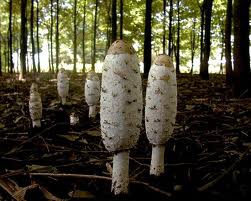
emerging Parasol Mushrooms (큰갓 버섯)
Although I’ve seen numerous varieties of stinkhorn, only ever in northern Germany, I have never seen any of the netted versions and do not think such types grow in the UK. When I caught a glimpse of vivid yellow in the undergrowth and discovered four pristine Netted (or Mantle) Stinkhorns (망태 버섯), I cursed myself for having no camera. Make no mistake about it! Stinkhorn mushrooms, even though edible, have a strong and rotting stench that will easily make you retch. Their purpose is to lure flies to that obscene helmet where they will trudge about picking up spores on their feet which they subsequently help disseminate.

The Common Stinkhorn (as found in Europe)
The Korean ‘mang tae’ mushroom is somewhat Gothic when cloaked in its bizzare mantle.

A Korean Mantle Mushroom (망태 버섯) Click photo for source
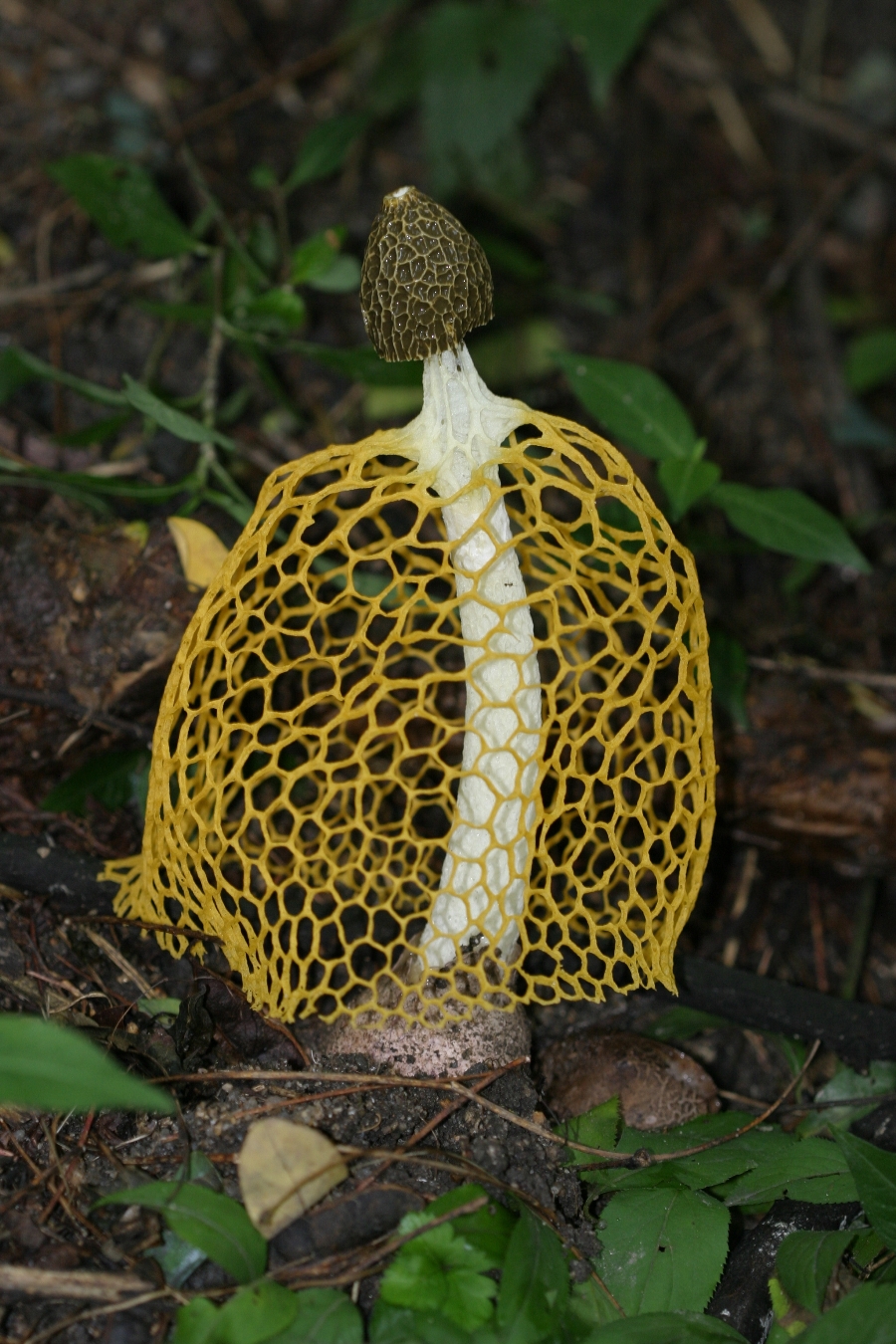
totally bizarre (click photo for source)

encountering this mushroom was a magical experience (click photo for source)

massed mantles (click photo for source)
Acknowledgments – the source of all photos can be traced by clicking on the actual photos.
© 林東哲 2010 Creative Commons Licence.
Bathhouse Basics (11) – Wet Sauna (습식 사우나)
This is simply a sauna in which the air is misted by what resembles a very fine, warm rain. The temperature in this sauna is less severe than in a steam room.
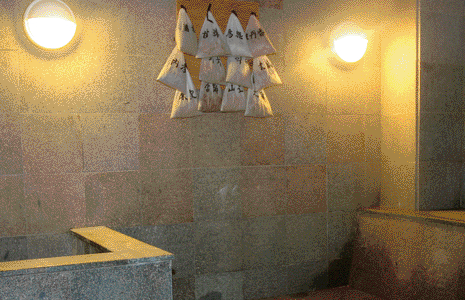
a wet sauna
© 林東哲 2010 Creative Commons Licence.
Just – Why You Shouldn’t Teach English in Korea
Well, my boss, who I have known for ten years, is fantastic but it goes on…

Video link
© 林東哲 2010 Creative Commons Licence.
Images of Innocence (1)

the hanja character for ‘purity’ (순수한)
In the prestigious boys high school in which I taught for a year, on sports day a class of first year students wore T-shirts on which was emblazoned the hanja character for ‘purity’ (순수한). Capturing the innocence of Korea students in writing is not only difficult, but contended; there will be many Koreans and westerns alike who see their proclaimed ‘purity and innocence’ as over rated or mistaken. But in Korea, I have never taught scum students, students who are vile human beings and whom if had to label, I would classify as violent, anti-intellectual, promiscuous, untrustworthy, grossly disrespectful, and foul-mouthed. Often they had parents who were equally as bad and in most of the UK schools in which I have taught have encountered boys and girls who basically epitomise what it is to be anti-social.
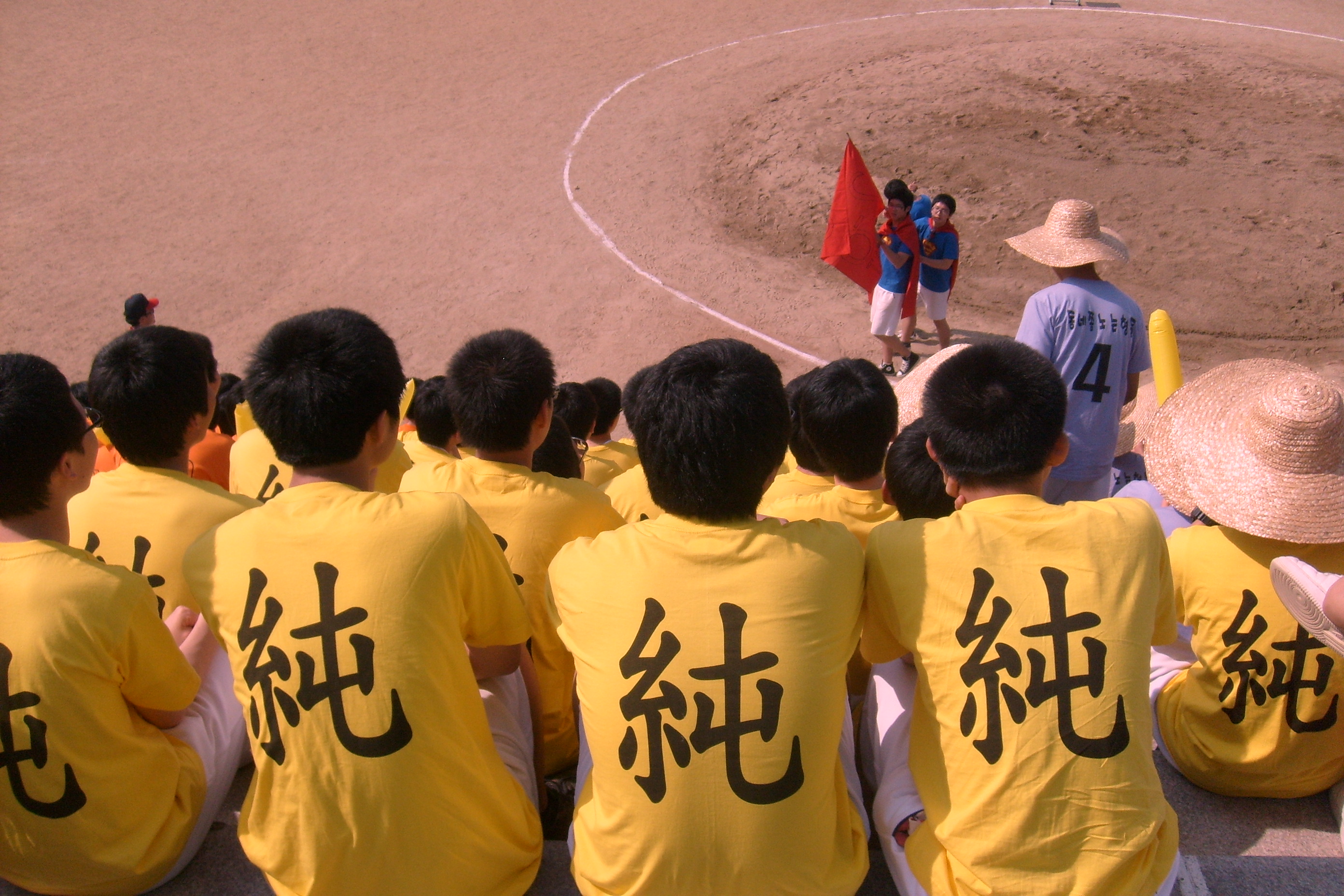
‘Pure’ – not a fashionable concept among British teenagers
Among most teenagers in Britain, ‘innocence and purity,’ which as usual we immediately associate with sexual conduct, but which I think Koreans would understand in a much broader context, is not something to be aspired to; indeed, I would suggest it is something to be shunned. I would absolutely agree that not all Korean students are angels and that there will exist some who could be classified ‘scum’ and I also agree that most British students are decent. I am suggesting, however, that standards and expectations in Korea are higher than in the UK and that associated values are currently much more effective in providing social cohesion, especially across generations. It is the values of Korean society that put the nation in the top echelons in terms of educational achievement, despite the systems pressures and flaws, and those values which produce a society with one of the world’s lowest rates of teenage pregnant, sexual activity and infection by sexually transmitted diseases.
Yes! Bad things happen in Korea and under the surface there is more nastiness than is immediately apparent. But unlike Britain, I have never seen a Korean girl of 13 giving a boy oral sex in the bike sheds and I have never taught or seen girls of 14, 15 or 16 who are pregnant. Instead of leaping to the defence of the moral and personal degeneracy of the west, which festers like an open wound and is visible at every level, instead of raising reminders that Korea too has a bad side, which I do not doubt, we need to acknowledge that in some spheres, Korean society is very successful and perhaps worthy of emulation.
© 林東哲 2010 Creative Commons Licence.
Five Second Hanja (11) Unify – Tong-il (통일)
Okay, it’s more complicated, but one of my favourite character combinations, and of significant importance in South Korea is, ”Tong-il.’ ‘Tong’ is the character for ‘govern,’ rule’; ‘unite’, ‘all’ while the single stroke on the right, is the character for, ‘one.’ Combined, they mean ”unification which naturally, is an emotive subject on the peninsula.

tong-il
‘Tong-il’ is also the 24th, and final pattern (tul, hyong) of the ITF (International Taekwon-do Federation) system.
Simply highlighting some of the important and simpler characters. For information on stroke order, radicals and the two elements of a character (spoken – meaning), I suggest you obtain a dictionary such as; A Guide to Korean Characters.
© 林東哲 2010 Creative Commons Licence.
Bathhouse Ballads at Facebook

Bathhouse Ballads at Facebook
I’ve gradually learnt how to manipulate stuff around Facebook. All posts are now added to the Bathhouse Ballads at Facebook. Use the link in the side bar on the right, or click the icon above, to enter Facebook site where you can follow posts.
© 林東哲 2010 Creative Commons Licence.
Street Vendors
One of the most common sights in Korea are the street vendors who peddle everything from snacks and vegetables, to meat, fish and bicycle repairs. There are many different kids of street vendors from the ones who travel around an area with a street market to people who pull up on the side of the road in small trucks from which goods are sold to the little old ladies who sit around towns with a selection of vegetables strewn on a sheet on the ground.
I’m a total sucker for the old ladies and will often stop to buy something though I’m told they’re not poor. Last week, I saw a woman from whom I regularly buy spinach, unload her groundsheet from the back of a new range rover-type vehicle, probably owned by her son, and then start laying out her cabbages and lettuces.

the crossroad by my school where the Monday Morning market meets E-Mart
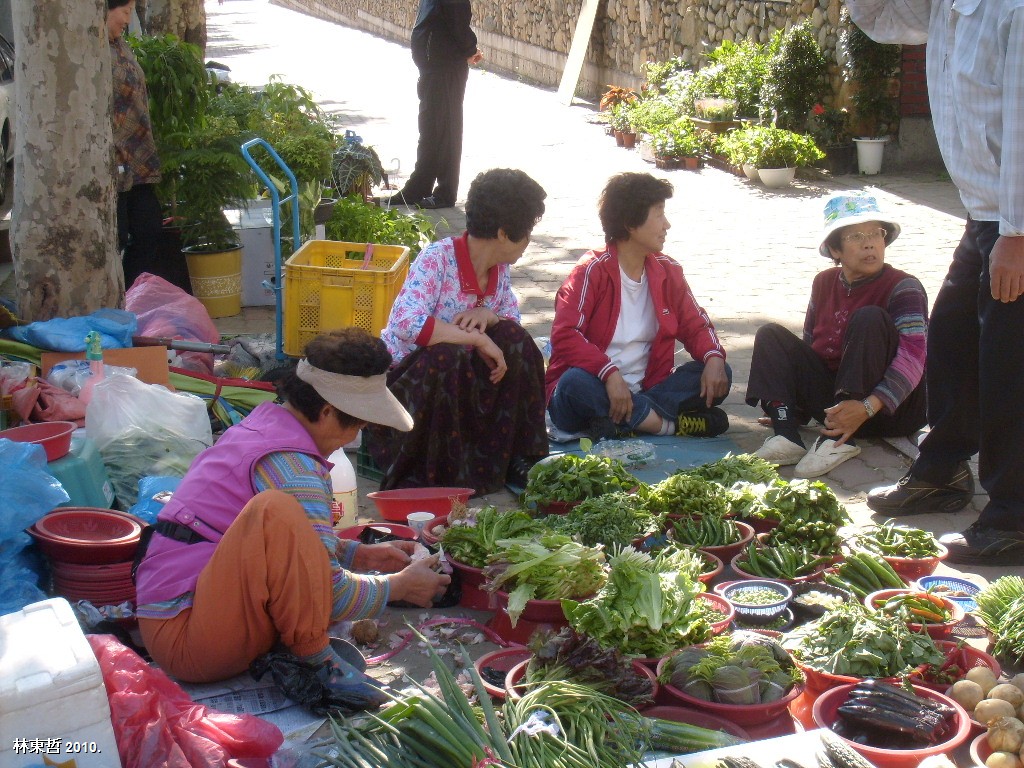
the grandmas are always laughing and a bottle of makalli (rice wine) is usually in the background
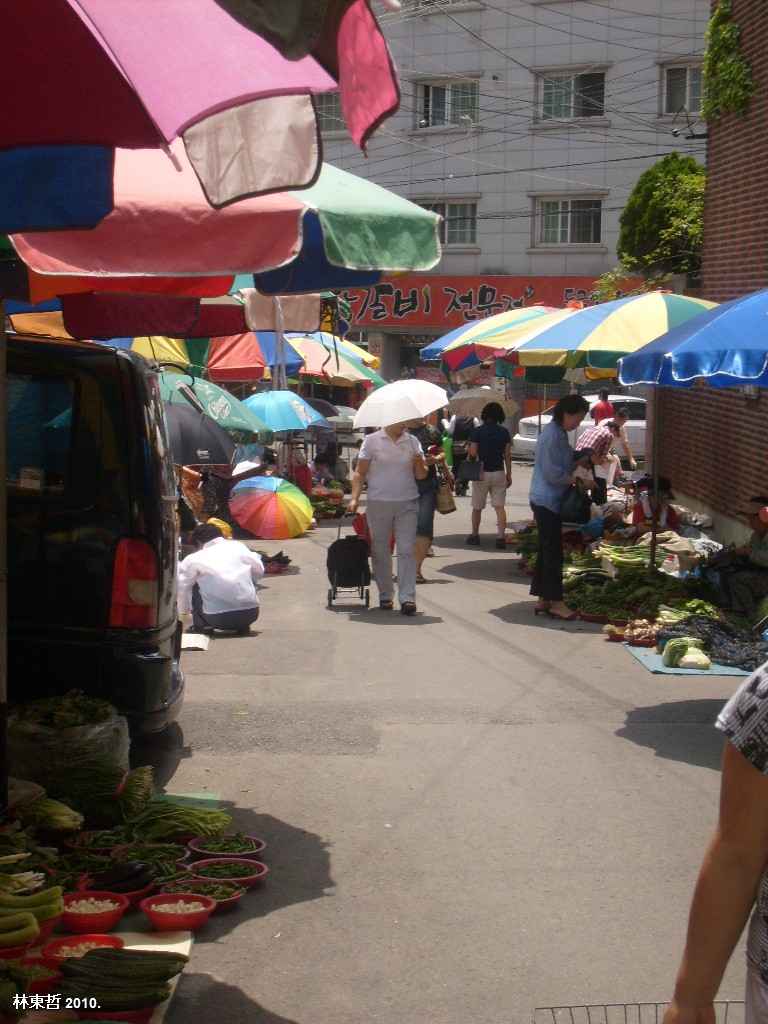
in the hear of Monday Morning market
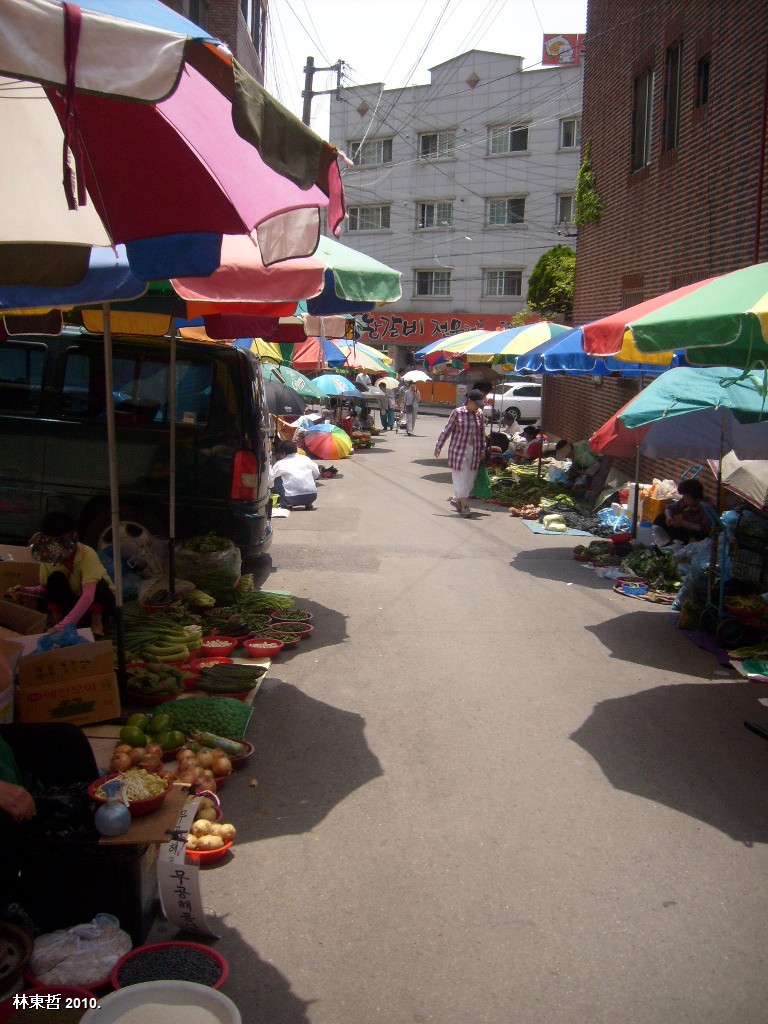
This side streets specializes in vegetables, curd, and beansprouts

Late summer

The market directly outside my school
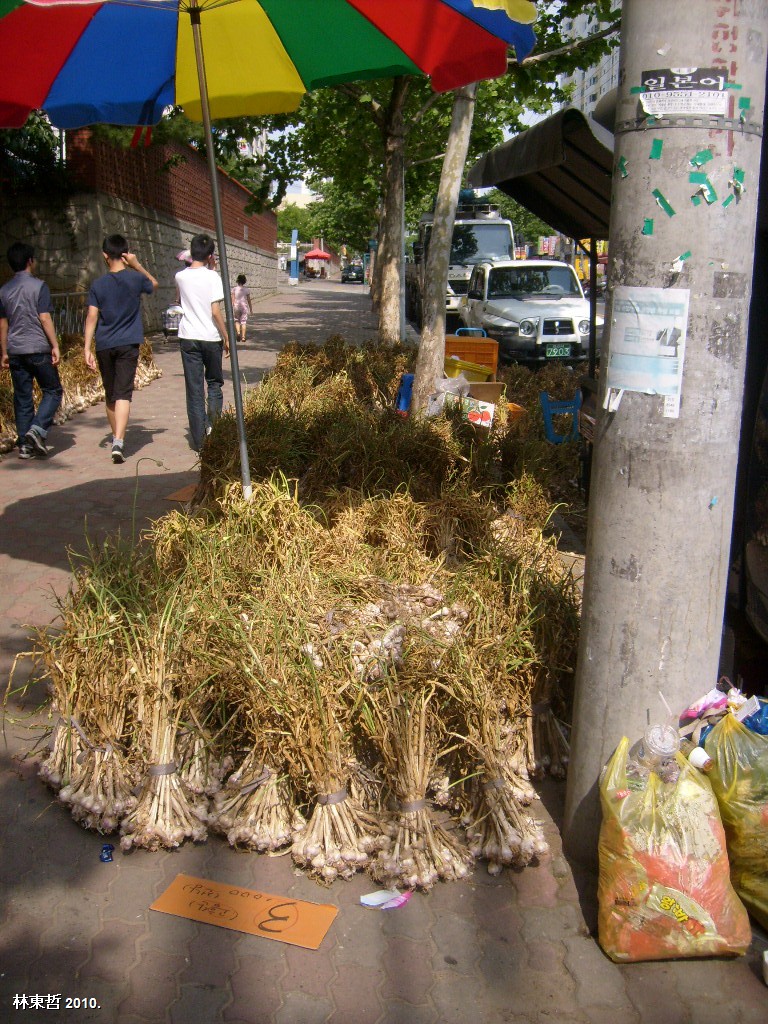
garlic in the Sunday market, the surrounding air was tainted with it’s smell
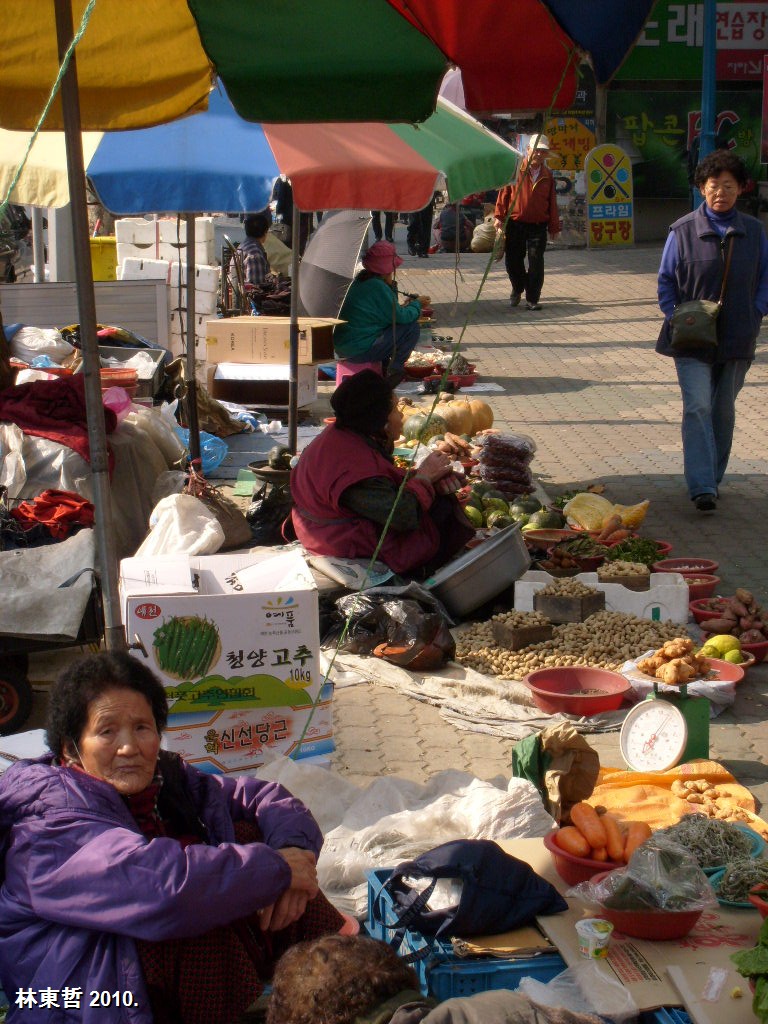
The street market outside Lavender Sauna, near Dong-Daegu KTX Station


in the rural town of Gor-Yang
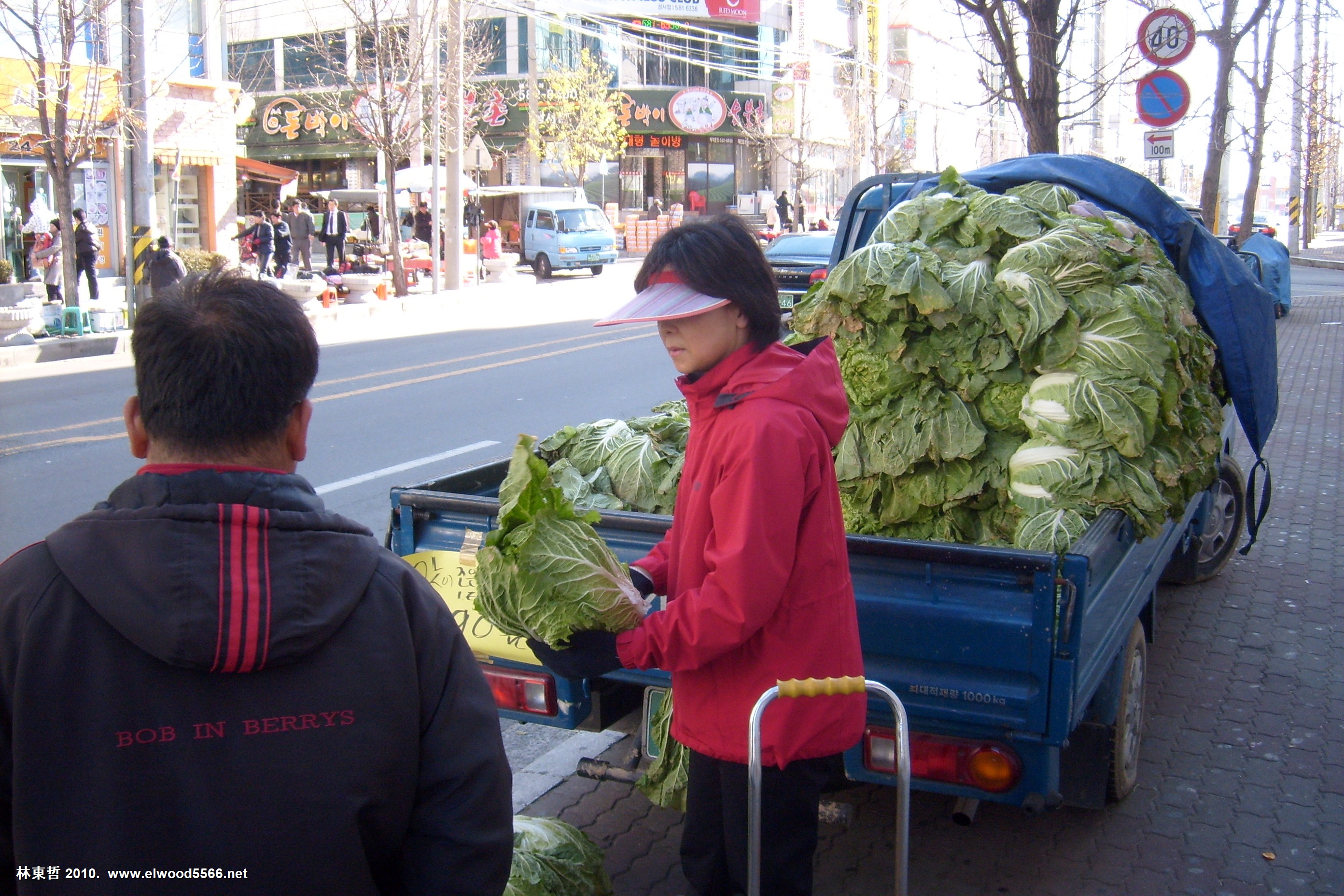
cabbages in a more abundant season – winter 2008
© 林東哲 2010 Creative Commons Licence.
The Ice Cream Store – Calgary
Sometime in the mid 1980’s we went to Calgary and stayed at a barracks in Calgary itself, as opposed Medicine Hat. We may have stayed in both locations, I’m not sure but we certainly stayed in a large barracks from which it was easy to get to town. A 15 minute or so walk from the barracks and there was an ice cream shop which sold the most amazing homemade ice-cream.

Calagary (198?) Eddy, Chris Wilkie, Lofty Elwood, Pete Middleton, Taff Coleman
This photo was passed to Facebook via ‘Smithy’ though I’m not sure if he took it. Those shorts certainly look severe and in the photo, far left, is Eddy. I’m sure Eddy wouldn’t mind me saying, but he was a man of contrasts; not the best looking of guys, in my opinion but seemingly gifted with a golden tongue that could enamor him to the most beautiful of women – often in droves. And could he waffle!!!
Eddy could never control his spending and had blown all his money within a few days of arriving in Canada. Mick gave me a loan on his behalf and I had to accompany him to meals and pay from his ‘allowance’ and each day I had to give him pocket money. This forced Eddy into the role of a sort of prostitute and for the duration of the tour he would clean your boots, iron your tights and do almost any other job to earn your loose change. Poor Eddy! We quite took advantage of his poverty and I can vaguely recall we made him do some shit jobs, not out of necessity but for entertainment. I can’t exactly recall , but I have a feeling Phil Watson was behind one or two. I remember Eddy would go to the PX, which was probably a 20 minute excursion in the heat of a prairie summer, to buy us coke or snacks and we would let him keep the change . So, one of our nasty entertainments was to compile a shopping list which left the most meager amount of change, and I mean like 10 cents, and see if he would go and get it – and poor Eddy would. And if that wasn’t humiliating enough, I remember Phil making him clean his boots as he lay on the bed wearing them.
This then reminds me of the night club I went into, when he was broke, and where he had meet a woman and temporarily moved in with her. She was an older woman and completely in love with ugly, no money Eddy. I recall we went back to her apartment where Eddy had made friends with her rather nasty cat – but that’s another story.
Can you add any more information or clarify anything which I can assimilate?
What was Eddy’s name?
Any details on him?
Lofty
© 林東哲 2011 Creative Commons Licence.
Bathhouse ‘Zen’ (Part 1)
I’m working through some ideas here and not only have another three parts to follow this post, but will make amendments here. If you want to add your views, more educated and sociological ones welcomed, please do so however, I won’t bother publishing the usual offensive crap that this kind of post sometimes generates. (Hence the pumpkin logo)
Not suitable for pumpkin people
Not too long ago, I joined the social networking site, Skinbook, a site for nudists. I had never considered myself a nudist and of course, in Korea I’m not. But once you head back home on a vacation you realise that bathing, even in a same-sex environment, is a form of nudism. So,while in Korea I regard myself completely normal and healthy but once I step off the plane in the UK , or even talk to some westerners here in Korea, I have to re-configure one of my pleasures and label it ‘partial nudism’ and of course, this then includes the slurs and innuendos associated with any form of nudity. What is a completely normal pursuit in one country is almost perversified in another. It is ironic that my home country, like the USA, has not just one of the highest rates of teen pregnancy in the world, but one of the highest rates of sexually transmitted diseases. In addition, children as young as 12 and 13 engage in sex and if they go to the doctor are granted anonymity and, child abuse in one form or another, is clearly a national pastime. Being judged by my own culture, and those who bring its attitudes to Korea is rather like being judged by the town’s most prolific pox spreading, pimp.

the hanja character for ‘nothing,’ ‘not having,’ (없을-무)
For a waygukin to really enjoy Korean bathhouses one has to divest themselves of the cultural baggage that prohibits or hinders one from fully capitalizing on what the experience has to offer. Though our cultural baggage may be similar, as between that of a Canadian and Scotsman, there are naturally differences that shape and inform the reception we have to going-naked in a same-sex, public environment. Some cultures are more relaxed than others and within and across cultures there are differing attitudes towards nudity and proxemics; some may be constrained by religious views, some may have very strong associations between nudity and sex, some may be more liberated due to upbringing. So, the point at which we each stand in relation to nudity and the various forms it appears in, differ. Despite the reference to ‘zen,’ (선), there is nothing deep or mystical in the Korean practice of public bathing any more than there is swimming in a public bathhouse in the UK and my use of the term is based on the loosest meaning and simply suggests the ability to enjoy the experience without being hindered by cultural baggage.
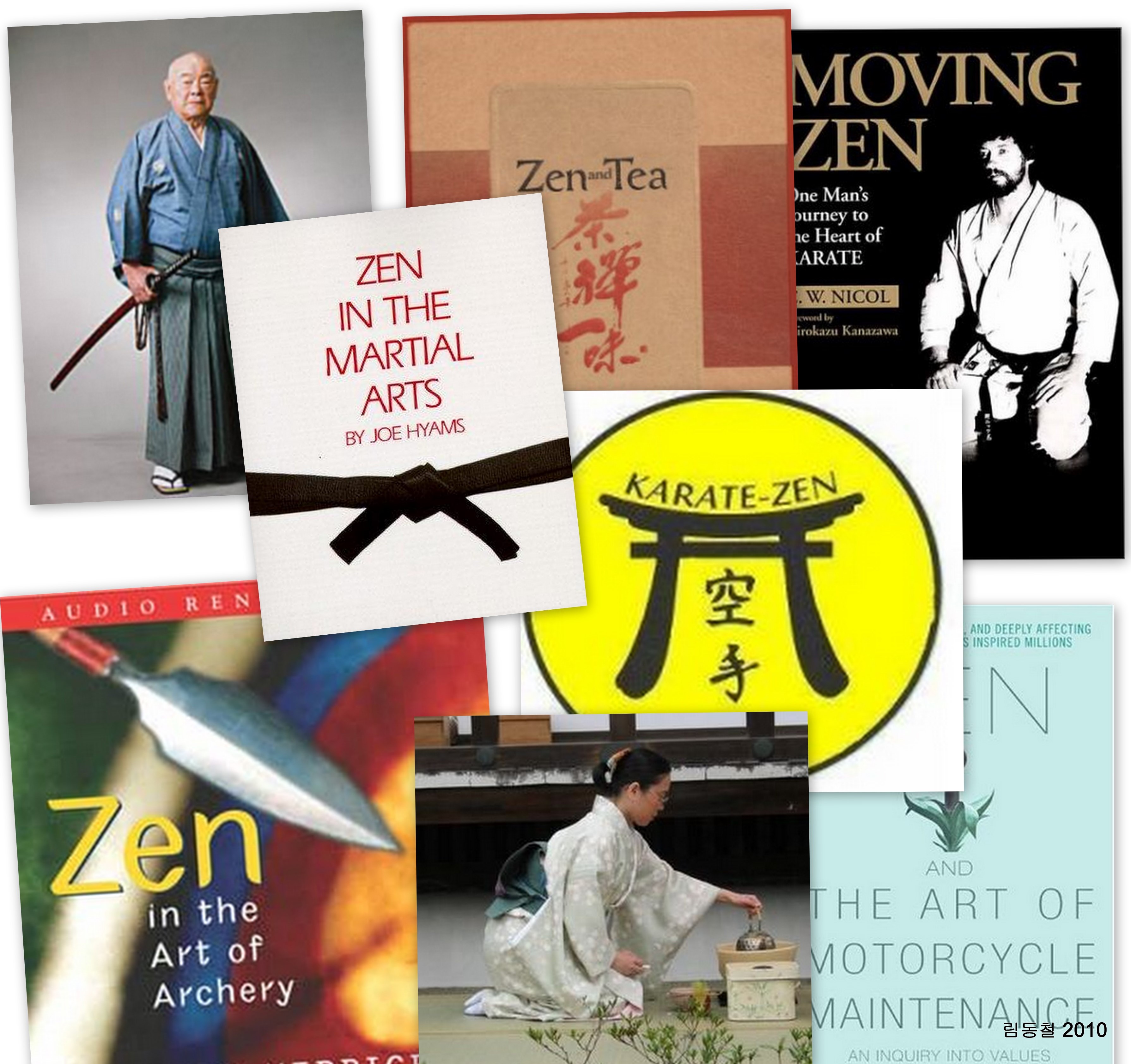
spheres of zen
For many, myself included, taking the first step into a bathhouse was a traumatic experience and certainly one I’ll never forget it! For others, nudity in the company of others is no different to being nude in isolation; many people are quite used to showering in a same-sex environment and if you play rugby in the UK, bathing in a large bathtub with your team, all naked, is a long-standing ritual. However, showering or bathing naked is quite different from other experiences a bathhouse will eventually confront you with, experiences which will test your levels of comfort and possibly expose the cultural baggage you still carry, but which you thought you’d ditched.
Let me give you a very recent example; I use bathhouses on a regular basis and my first introduction to them was almost ten years ago. However, while bathing less than three hours ago, I had two interesting reflections. I still do not feel comfortable with a close friend scrubbing my back and after a little analysis decided it was because in my culture such intimacy is more likely to occur as a prelude to sex and also because I am over weight and self-conscious. The second one occurred while we were in a sauna. The room is fairly large and is occupied by only my friend and I, yet when two new men enter the room, independent of each other, they sit on seats on either side of me. Meanwhile, my friend is laying on the floor, taking a nap. I am sat facing the television but they sit each looking directly at one side of my face, and to compound matters, their heads are less than three feet from mine and they sit with knees wide apart in a position that in western body language can convey a sexual meaning. Within the parameters of my culture, no only do their body positions establish a hostile or sexual tension between us, but a corresponding tension between themselves, as they are sat facing each other. And remember, they could have sat in any of three corners but instead chose to sit directly next to me. Even after years of bathing, little alarm bells jangled! Of course, neither are making aggressive or sexual suggestions and probably sat down without any conscious deliberation at all.
sk
While you might feel very ‘at-home’ naked in the bathhouse shower, or sat on your own in a corner of a pool, if you frequent bathhouses on a regular basis, the day will eventually arrive when:
♦You’re just steeping into a pool when you notice the person at the far end is a co-worker.
♦You drop the soap and need to bed over
♦You’re sitting on a bucket seat when a Korean friend begins a conversation, their dick dangling in your face
♦You end up talking to a friend who is sat on a bucket seat, while you are standing, your dick in their face
♦You’re asked to either scrub someone’s back or they offer to scrub yours
♦You enter a pool only to discover a couple of your students are staring at you
♦Your school or work decide to organise a trip to the bathhouse
♦You somehow end up having a full body scrub-down
If any of these scenarios are liable to make you feel uncomfortable, then you have not yet reached the state of ‘zen’ required to ensure your enjoyment is the ultimate possible and in which your reception of the experience is similar to that of a Korean. The cited examples, and there are others, highlight the point at which east and west differ and yet it is for this reason many people decide to live in Korea. (Surely it wasn’t just for the money!) The manner in which we approach this point of separation, or stay cocooned in our safety zone, is dependent the ability to suspend our own cultural mores and subsequently embrace those of Korean society. The fewer of these scenarios which trouble you, the closer you are in approximation to the manner in which a Korean perceives a bathhouse experience. If you can bend over in full view of bathers, poke your backside clean with soaped fingers, use the hair dryer on your pubic hair or do a series of exercises, naked and in front of an audience, you can award yourself a red-belt (the rank prior to a taekwon-do black belt) in bathhouse familiarity. And not only will you be better able to understand the Korean psyche, but you may also have a deeper understanding of the nature of your own society. Personally, I still have a long way to go but I’m getting there!
A Korean’s behaviour in a bathhouse has nothing to do with zen and with no barriers to overcome such a ‘state’ isn’t necessary. They simply behave in a manner which conforms to their social mores. Being outside this point of references, ‘zen’ is the mental ‘state’, or ‘attitude ‘we have to aspire to if we want to truly enjoy the experience and step closer to understanding the Korean psyche. In a ‘state ‘of ‘zen,’ a state of statelessness, you will have abandoned all cultural shackles and have no problem with your bum hole pontificating the heavens should you drop the soap. And when you can rationalize bathhouse culture without suggesting it is perverse, homo-erotic or ‘gay,’ as many westerners do, you will truly be in a state of enlightenment.
There are two parts involved in learning to enjoy the Korean bathhouse experience. The first involves ditching or suspending your own cultural baggage and all the assumptions it makes and judgments it levies. The second lies in embracing Korean attitudes towards same-sex nudity and bathing. Suspending the outrage of your own values is not always easy considering the British, for example, have a very long history of demonizing anything sexual. We have been imbued to perceive genitals as solely sexual and invested with the powers to pervert those who gaze upon them or even talk about them. Even the genitals of a baby are now perceived as sexual and that you cannot photograph or draw a naked baby, even your own, without the overwhelming realization that you are doing something terribly wrong, is alarming. And because nudity exposes what is deemed sexual, it has the potential to pervert and hence needs close control. As for ‘skinship,‘ a problematic enough concept for many westerners when clothed, when nude, it can only be rationalised as sexually motivated. Many young and liberal westerners like to think they are ‘progressive’ in their attitudes to sex and the body, but many, the moment confronted with the opportunity to be naked, it is revealed that they are not only terrified by it, but conflate it with sex. For many men, the idea of being naked with other men is repugnant. Ditching such silly attitudes, even if temporarily, is wonderfully liberating and frees you from centuries of oppression.
Disengaging your cultural shackles:
Over-coming the fear of your own body – in modern capitalism the body is a battle ground used to manipulate our dreams, aspirations, inadequacies and fears in the attempt, planned and unplanned, to spur us onto the treadmill that sees us seeking remedy in an array of consumer products. Products articulated around diet and exercise are lucrative and a nation riddled with guilt at being overweight or unhealthy, even if you’re not, is a nation ready to chuck money away in pursuing the latest fad. It’s a Machiavellian philosophy of ‘give ’em dreams and sell them shit.’ All too often, the first barrier to getting naked in public is the fear of being seen by others, of being exposed and then judged by the criteria of market forces. Obesity and being overweight are obvious but even our attitude to dick size is influenced by market forces; my spam box is constantly bombarded with adverts claiming to enhance the male appendage. When did you ever see an advert offering to reduce penile proportions? Porn actors are often rumoured to have dicks of Herculean proportions and any actor or celebrity who is discovered to have a little wiener, an average wiener, can expect ridicule. Societies have not all valued a big dick and at the height of Classical Athens, being well hung, and worse, well hung and circumcised, was considered very un-sexy. Among the classical statues and red pottery of the period – not a big cock among them unless it’s owned by a grotesque satyr. If you can find a penis poking from the loin of a Praxiteles, it probably fits the modern-day parameters of ‘average’ and this is often a euphemism for ‘small.’
I have frequently heard or read comments by westerner visitors to bathhouses, berating the bodies of everyone who is not minus 20, slim and sexy. Such people are ‘shocked’ or ‘appalled’ by the ugliness of others and see only attractiveness in the same way it is seen by Hollywood. Such attitudes are rooted in the assumption that if nudity is to be tolerated, it should at least be practiced by those who are sexually attractive because, as we all know, sex among fatties and oldies is a turn-off. It there’s one thing you learn in a bathhouse, it’s that we are more alike than unlike, regardless of age, size and condition. Overcoming a fear of exposing our bodies in a public forum is for many people a big step because of our own negative self images induced in us by our own culture. As a result, to overcome the fear is empowering.
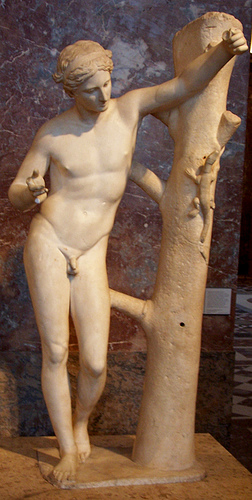
Apollo Saurodithonos (Lizard-killer). Possibly a Praxiteles original
Separating the conflation of sex and nudity – Western social mores conflate sex and nudity and this tradition, one with a long history, is always an obstacle faced by nudists in the west because public sentiment demonize or peversifies nudity on the grounds it is sexual. If you enjoy nudity it implies you do so for sexually motivated reasons and is likely to classify you with terms such as ‘kinky’ or ‘pervert.’ Male same-sex nudity bears the greatest brunt of this conflation especially when it suggests those involved are homosexual. And it is this conflation which informs the opinions of many a westerner opposed or fearful of bathhouse culture. If you start a conversation with many British men about Japanese bathhouses, which often do not segregate the sexes, the tone of the conversation becomes sexually orientated, many western men would love peep through a chink in a wall of a Japanese bathhouse and indeed, you can even download videos of such scenarios. It is therefore predictable that their assumptions about same-sex bathing is going to be articulated around sex and homosexuality. It is the intense conflation of sex and nudity in the western tradition that has given rise to the phenomena of gay bathhouses and in the minds of many people bathhouses are strongly associated with a homosexuality, hedonism and promiscuity. Unfortunately, in the west nudity is often invaded by those assuming it must be sexual and in pursuit of a quick thrill. My local hometown in the UK had to close male only, nude bathing sessions because the tone of the place slipped into seediness.
Overcoming the fear of nude children – On occasion when I have witnessed something interesting in a bathhouse involving non-adults and have dared to write about it, and especially if I have written about it without expressing anything but disgust and loathing, it has provided an opportunity for those with a pumpkin mentality to accuse me of perversion. Many people now recoil in horror at the thought of adults and non-adults sharing the same space especially when semi nudity or nudity is involved. In Britain, public changing rooms, those open planned types where everyone undressed in view of each other, have now disappeared. There are a number of individuals who will fear a bathhouse experience because Korean children use bathhouses and I have met and spoken with individuals who will not go to a bathhouse or jjimjilbang on trips organised by their schools. I once had to console a western teacher who cried uncontrollably because Korean Kindergarten teachers took kids to the toilet alone and without a second person in tow to ‘Big Brother’ the procedure. Once again, we are back to the conflation of sex and nudity and of the western obsession of seeking perversion wherever possible. Shouldn’t we be highly suspicious of societies that are obsessed with categorising non-adult nudity, solely by the label ’sexual’ and which cannot compel us only to do likewise.
I very often talk to Korean friends, male and female about cute kids I’ve seen in the bathhouse. Last week I was amused by a baby boy who could only just walk and who wore a pair of socks to prevent him slipping on the slippy floor. I can share this observation with Koreans without the need to add interjections to the effect I’m no pervert or that I’m not interested in baby boys. But to raise such issue to a western audience, especially as a man, and you invite the most vitriolic reprisals. I’m here reminded of the comments I saw posted on various sites in response to a Korean advert where baby boys appeared scrubbing each other’s backs in a bathhouse. Most did not see it as cute or amusing imagery but as sexual, perverse and exploitative. And neither were any genitals flashed for them to arrive at such twisted conclusions.
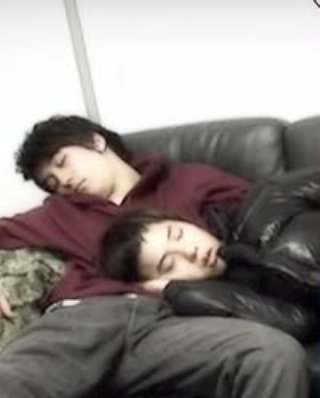
Redefining your proximity zone – Britain is often cited as one of the least tactile cultures. In Germany, for example, people shake hands on every meeting and not simply when meeting someone for the first time. The French of course, kiss each other on both cheeks. Many other cultures are much more tolerant in allowing males physical contact without the slur of them being ‘homosexual’ and in such societies body proxemics are much closer than they are in the UK or USA where between close friends, 1.5-4 feet define comfortable parameters. Intimate relationships operate between 0-15 inches. Many Koreans friends are quite comfortable operating at a distance of much closer than 15 inches and indeed of operating within a zone that many British people could only tolerate in a sexual relationship. In addition physical contact, ‘skinship,’ occurs not just more often, but for longer periods of time and much closer to the ‘parts’ we have been taught to avoid. It is not in the least unusual to see Korean friends lay down and put their head in their friends lap and I have even seen this in a bathhouse.
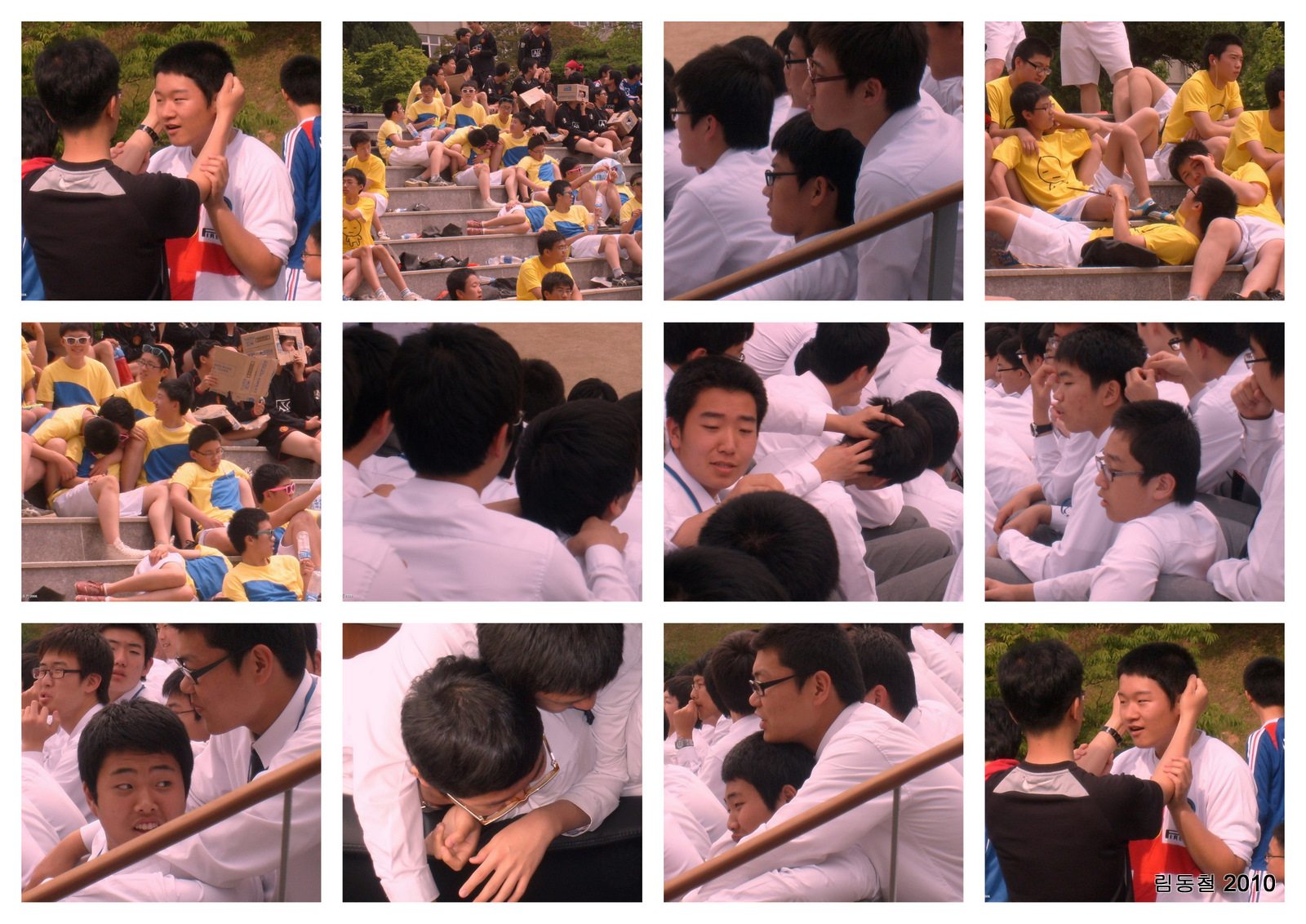
Korean ‘skinship’
Fully acknowledging nudity – many westerners are quite happy nude bathing because they manage to blank out the bits they find difficult to deal with or find offensive or repugnant. As long as it’s not in your face, or better still, as long as it’s in the zone of peripheral vision and can be ignored rather than acknowledged, many people can live with same-sex nudity. If you ask most men about the things they see in a changing room, even in locker room showers, and they will aggressively tell you they don’t look and I believe most of them don’t. And if they do the images are purged from their minds. As I have mentioned before, for a man to see a cock in the UK constitutes such a traumatic experience, unless of course you do happen to be gay, that it can potentially convince a man he is homosexual. It is only when a cock holds the same value as someone’s toes, or their nose, that you are free of this puerile conditioning. Learning to accept what nudism involves, the exposure of those parts you’d rather not acknowledge, is very much about confronting a deep-seated homophobia that assumes the penis is at all times a sexual object, which in western culture usually encompasses any penis whether it be flaccid, erect or even the redundant penis of a baby, and therefore, to consciously acknowledge the penis of another male is to engage in homosexual behaviour. I would further suggest, the fear of acknowledgment is both a means of consolidating a heterosexual identity or facade and avoiding either temptation or the revelation that one’s sexuality may not be what it seems.
When one is able to acknowledge those ‘offensive’ areas dispassionately, in a manner unfettered by emotions and obsessions and which no longer sees them as sexual but as parts with functions such as the nose or ears, and with corresponding qualities and attributes, interesting, quirky, large, etc, one has clearly transcended the myopic conditioning of culture. I would imagine experiencing nude bathing in a non segregated forum, as often practiced in Japan, and to do so with a similar ‘zen’ detachment would be highly enlightening. To achieve this does not mean that no one is appealing or beautiful or sexually attractive, but that this is no longer the primary manner in which you respond to the naked body. Learning to see nudity with ‘zen’ detachment, where the conflation between sex and nudity is separated, and the classification of others in terms of their sexual appeal, minimised, allows you not just to appreciate more fully other human beings, but to feel more human in the process.
© 林東哲 2010 Creative Commons Licence.


 Elwood 5566
5 comments