Suneung Thursday 18th of November 2010 ‘D Day’
On Thursday 18th of November, suneung (수능), I set off at 6.45 am to watch the arrival of students at Song-So High School. By the time I arrived, around 7.30, most of the students had passed through the gates but a large ground of parents and supporters, plus a lot of police, were still in place and students were still arriving. I hadn’t even stopped to watch when a cup of grapefruit tea was thrust in my hands and a few moments later a woman police-officer handed me some chocolate gold coins.

Song-So Boys High School

plenty of hot and sticky drinks
The event was a little disappointing as even by seven am many students have entered their schools and nothing special was happening outside the Song-So High School other than there being lots of police and plenty of people taking photographs.
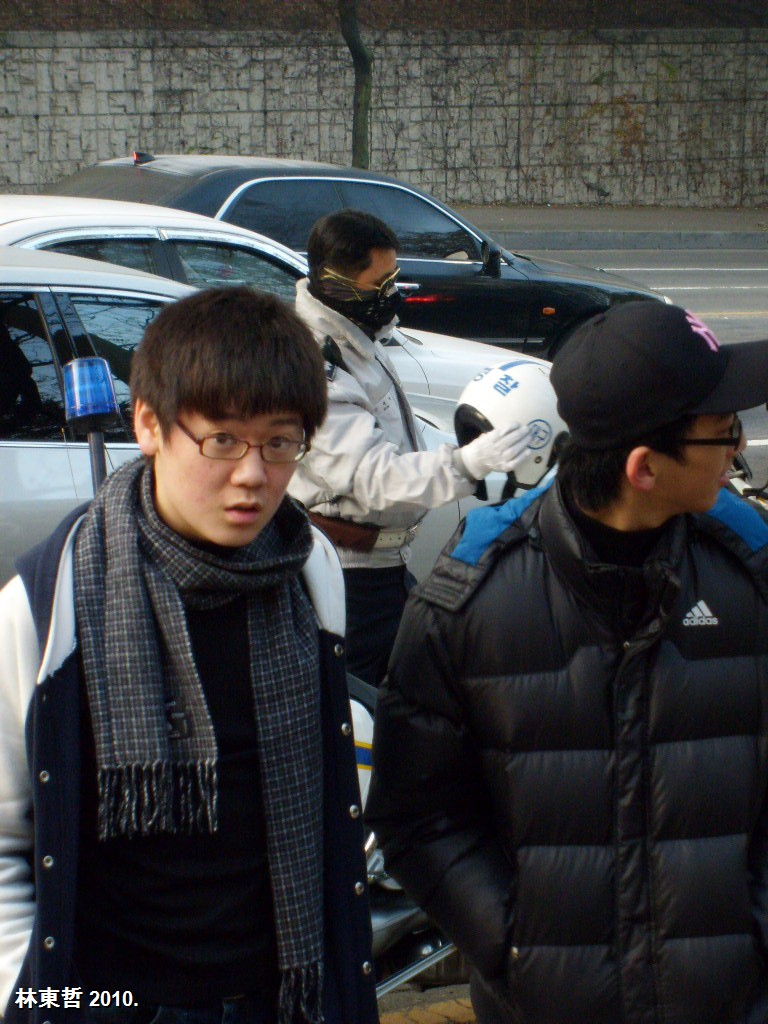
Students arriving
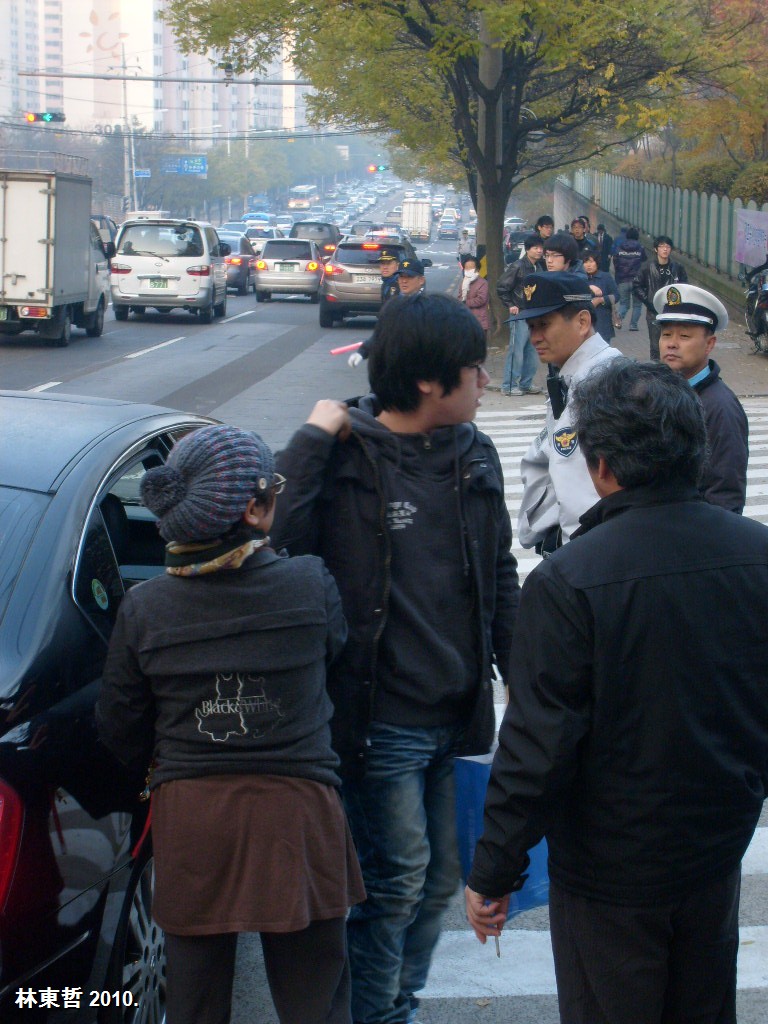
celebrity treatment

'Junior students rallying the third year candidates

Paying respects to exam candidates

a mother prays

sticking toffee on wall in the hope of success
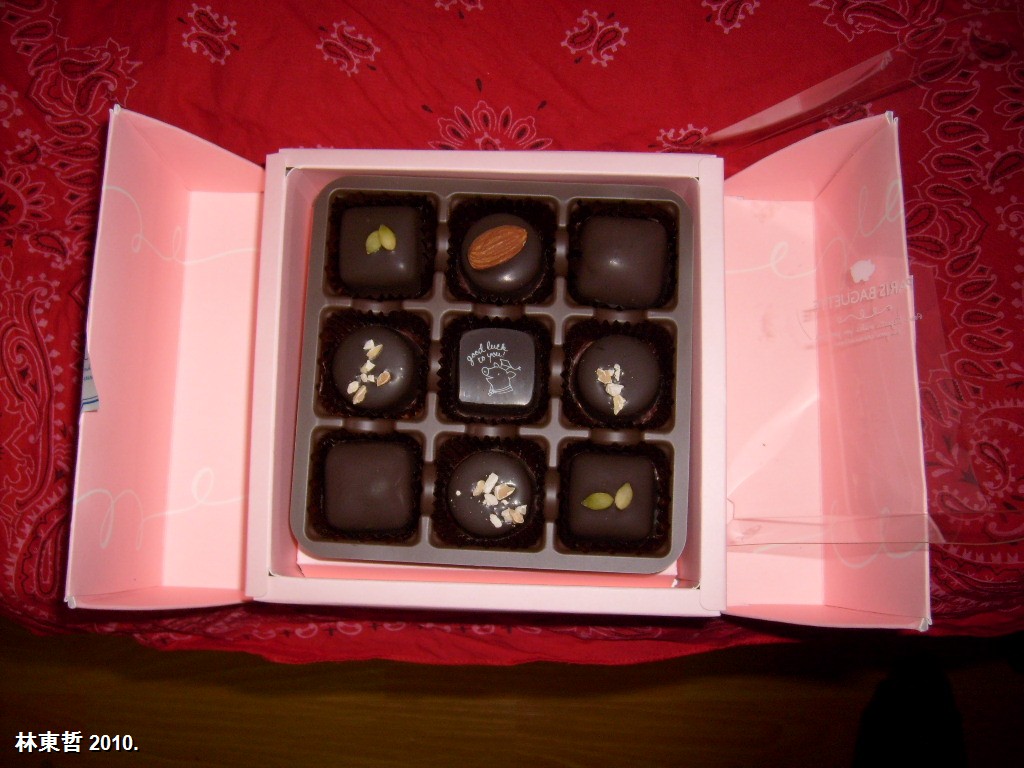
I bought some chocolates for an old student resitting suneung but I couldn't get hold of him on the phone to get his address. He's currently doing his military service. So, 박진영, if your reading this I hope you did well. As for the chocolates? They were truly gross and greasy ersatz chocolate the type of which predominates in the USA (eg, Hershey) '왝' But I still ate it!

© 林東哲 2010 Creative Commons Licence.
Learning to Love the ‘One Room’
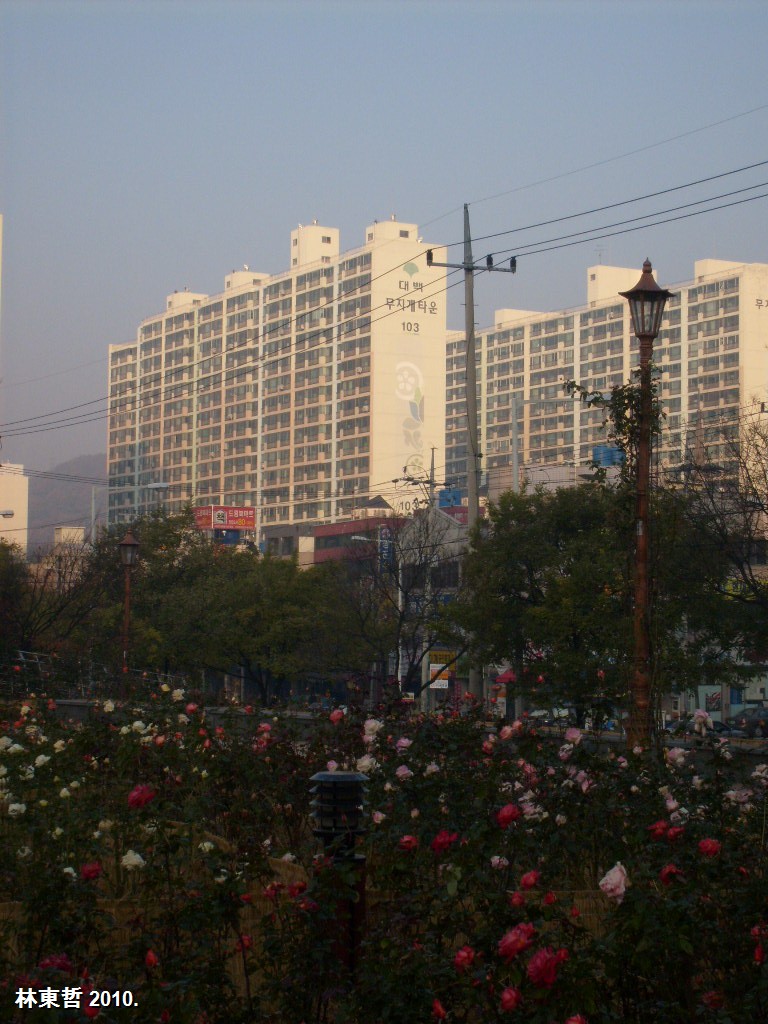
Song-so, Daegu
For a long time, I hated referring to my Korean accommodation as a ‘one-room’ and other terms I used to substitute it were either misunderstood or didn’t seem quite right. Koreans use the word ‘apartment’ in relation to the high-rise accommodation in which most live and it is rare to hear the word ‘house’ as so few of them exist. The houses you do find, often in the country or sandwiched between taller, city buildings are usually traditional or luxury versions. Apartments are associated with high-rises and though they can be pokey and small, especially in parts of Seoul where space is the most expensive, they are often extremely spacious. I clearly do not live in an ‘apartment.’ For awhile I used the term ‘studio-room’ or ‘studio-flat’ and though a few of my English-speaking Korean friends understood this, many others didn’t and personally, it didn’t seem appropriate. I have this notion that studio flats are grand, exclusive and the preferred accommodation of artists and opera singers.
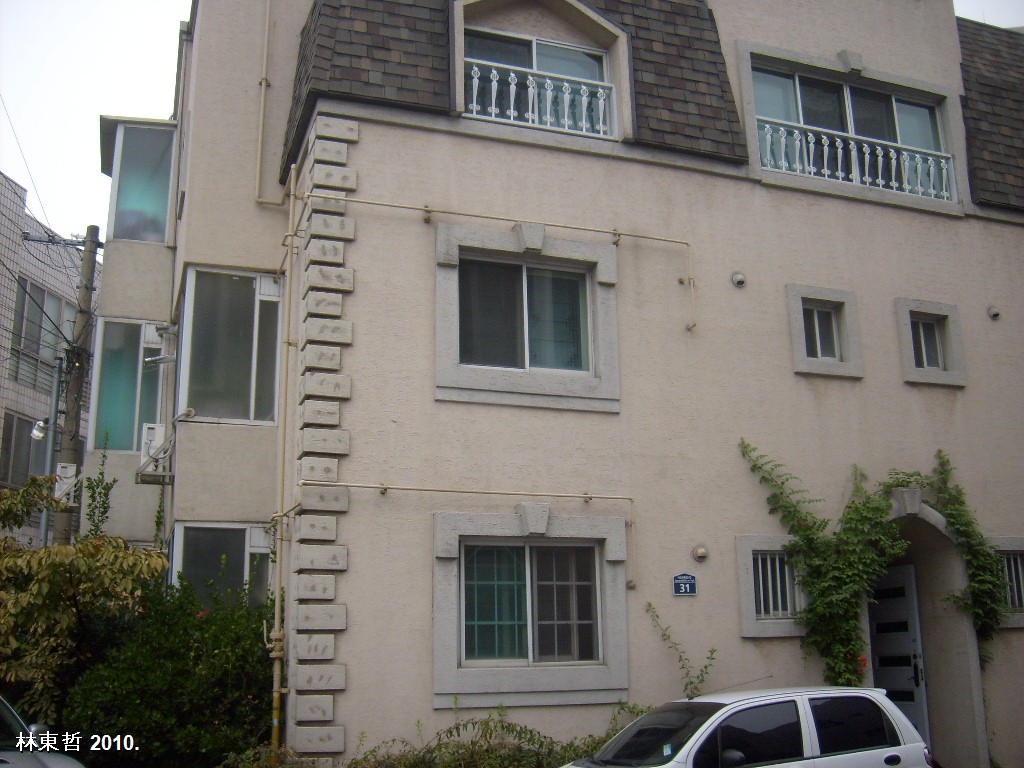
My barred one-room, Daegu 2003
Finding a suitable term to describe my accommodation, without using ‘one-room’, was difficult. ‘One-room’ seems such a pathetic term to use especially when you are anything over forty and invokes the same resonance in Korea as, ‘unmarried,’ ‘living-alone’ or being ‘childless,’ and in the UK, as the word bed sit. What a ghastly word! What shame it invokes! ‘Bedsits’ are the domains of the unemployed, of single people, those on low wages or youngsters just starting out in life. They are always gloomy, lit by yellowey lights and with stairs that creak, and then there’s the gas meter and dingy bedding of blankets, sheets, and quilt because the ‘bedsit’ is a relic term from the days before the popularity of continental quilts (duvets). But the ‘bedsit’ wasn’t just a manky dwelling; to many it represented a lifestyle as epitomised by Soft Cell’s, Bedsitter.
Sunday morning going slow
I’m talking to the radio
Clothes and records on the floor
The memories of the night before
Out in club land having fun
And now I’m hiding from the sun
Waiting for a visitor
Though no-one knows I’m here for sure
Dancing laughing
Drinking loving
And now I’m all alone
In bed sit land
My only home
The solution, is obvious! Don’t call your accommodation a ‘bedsit.’ Just because it’s small doesn’t mean it has to be grotty any more than it implies you have to lead a pointless hedonistic life.
‘One rooms’ come in all shapes and sizes and some are pretty shitty. Usually they are contained in buildings of two, three of four floors. I lived in a one room in Ch’eonan that was truly a one room. The toilet doesn’t seem to count and probably neither the kitchen but this example, clean and not altogether unpleasant, was simply one room. From the edge of my bed I could lean across to the sink and pull out a sliding table and from their I could prepare a meal, stand up and cook it without take more than half a pace, and then sit back down on the edge of my bed and eat it. Washing up simply involved standing up. My Ch’eonan ‘one-room’ was the ideal accommodation for an invalided person and if I so wished I could have pissed in the sink while stood in my bed. Indeed it was so small that if I’d piddled 360 degrees I could have hit ever wall. Prior to Ch’eonan I had a ‘one-room’ in Daegu and once again it was simply one room, bedroom and kitchen combined, with a separate toilet and shower. It lacked air-conditioning, something I now wouldn’t live without and though it wasn’t unpleasant, the fact I cooked a lot of mackerel at the time made it smell.
But there are perhaps worse types of accommodation. If you’re a waygukin a ‘two-room’ is perhaps worse as it involves sharing facilities with a co-worker. I spent a winter with a great chap from Ghana who happened to have the controls for the ondol heating in his room and he liked the temperature set at maximum. I slept on the floor at the time and the effectiveness of ondol heating is non the more obvious than when you can’t escape its intensity. Under a duvet, all heat is trapped and often there are no cool spots, such as you have with western style radiator heating, from which to escape the onslaught. I’d sneak the temperature down when he was out, he’d come home, put on two sets of thermal clothing, rack the temperature back up and climb under his duvet. He’d lived in Korea twelve years and like most Koreans, he hated the cold and anything under 25 degrees was classified an atomic winter.
How you might rate as ‘0.50 room,’ that is a one-room shared by two people, would depend on the extent you feel compensated by the luxury of regular sex and I’ve known couples share the tiniest of one-rooms. I like my space and space means a double bed. A shag is great but I’ve been too long as a sad-singly to want to sleep in the same bed as another human and besides, I snore!
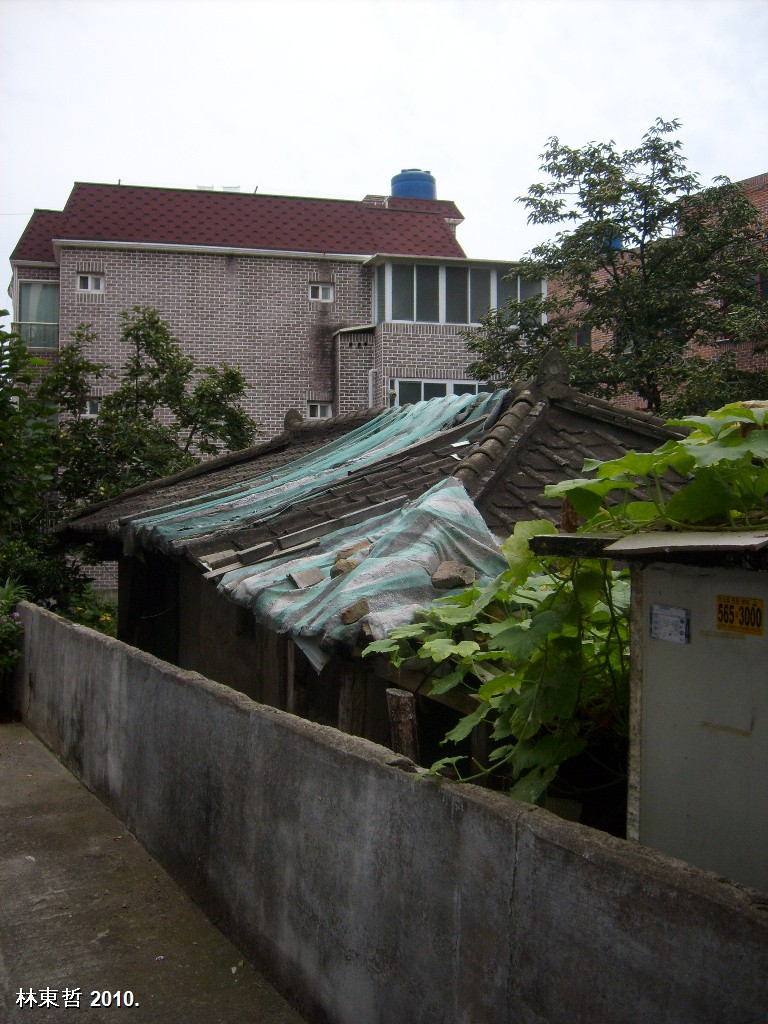
past and present
Eventually, you come to realise that Koreans don’t actually see anything significantly negative in a ‘one-room.’ As far as such rooms go I feel I am probably luckier than most. My present abode accounts for the combined area of 2.5 of my previous one-rooms and my kitchen is separate from my bedroom/study. It has also taught me the benefits of minimalism and heightened my awareness of the way we amass shit you don’t really need and of course, the more space you have the more you feel compelled to fill it. Back in the UK I have a house packed with junk and a substantial set of books shelves which host books and music I have had for years and never accessed. In Korea, a digital orientated life and two terabyte external hard drives have allowed me to acquire and store enough music and literature for the rest of my life and reduced the storage capacity a thousand fold. Yes, the future is getting smaller and upgrading to the latest formats is much more enjoyable especially when it involves denying greedy multi-billionaires even more money.
The worst thing about ‘one-rooms’ is they rarely have any view other than the concrete walls of the next building. If you’re on the ground floor the advantage you might have in being able to see the world beyond is ruined by the bars that turn such rooms into a prison cell. In ‘one-room’ land a computer is a necessity because your monitor can provide an appropriate background scene to offset the lack of any real view but one adapts very quickly and if you can imagine you’re in a spaceship or ship, claustrophobia can be minimized.
Links
Soft Cell: Bedsitter (link to youtube)
© 林東哲 2010 Creative Commons Licence.
D-Day and Korean Hooliganism

D-DAY!
Today is the day of the high school suneung examination (수능), which for third year students is not only the culmination of their schooling that largely determines their futures, but for many is the unofficial arrival of adulthood. The exam results are released in December followed by graduation, in the New Year.
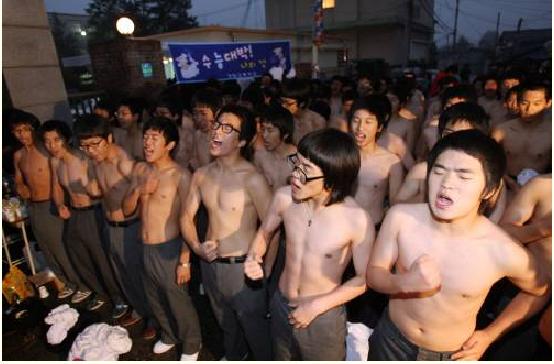
Boys cheering after finishing their exams
As I wrote previously (A Day of Reckoning), the effects of suneung reach deep into all levels of Korean society and provide an opportunity to both support students and celebrate with them. Suenung is very much a social event and first and second year students, and supporters congregate outside schools in the early hours of the exam morning where banners are waved, chants shouted, students cheered and encouraged. If ever Korean students are going to be rowdy or get drunk, which occasionally happens, it is likely to happen in the evening but as usual, it will be tame compared to western teenage rowdiness.
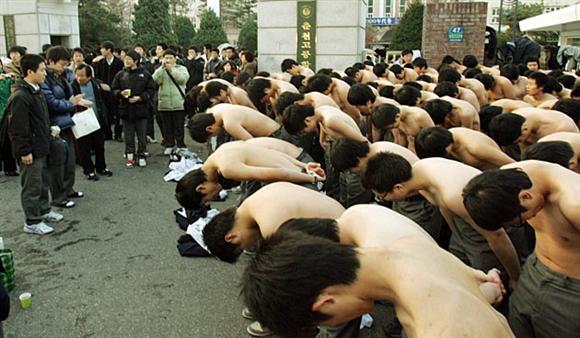
Too much excitement is quelled
If ever you see a group of British lads with their shirts-off, anywhere other than on a beach, you can expect rowdiness. British males, normally the Neanderthal type, pull their shirts of when England has won a football match or when they are drunk and it is all part of a display of revolting masculinity. If, on Thursday evening, you should witness a crowd of lads stripped to the waist outside a school, it won’t have anything to do with masculinity or aggression. However, lads with their shirts off is also viewed as coarse and improper by many Koreans. In a cute kind of way, taking off your shirt, perhaps tearing it up in the process, and then singing a round of songs with your classmates, is about as radical as Korean youngsters can get. And if you stand and watch you won’t be intimidated, assaulted or abused.
© 林東哲 2010 Creative Commons Licence.
Monday Market -Oriental Quince (모과) Chaenomeles sinensis

oriental quince bonsai
Another portent that winter is approaching is the appearance of the oriental quince, mo-ghwa (모과). Unlike the quince found in parts of Europe and North Africa where its uses, depending on climate and hence proportions, span from making jams and jelly to a substitute potato, the oriental quince is mostly used in oriental medicine and as tea. However, the mo-ghwa’s predominant use is as an ornamental air freshener. Don’t expect wonders! It won’t clear the smell of fried mackerel or unpleasant toilet odours and neither is one potent enough to scent an entire room but for scenting corners or enclosed spaces, a car being ideal, they are successful. I have one sitting on my desk and it subtly scents that corner of my room.

moghwa (모과)

by the bowl
Moghwa have a very waxy skin in which the scent is contained and they sort of look quite attractive. The scent is similar to that of a fruity apple. The cost varys from about a 1000 won upwards and ideally you should buy one unblemished as these will last well into spring. Supermarkets often sell them in a small basket.
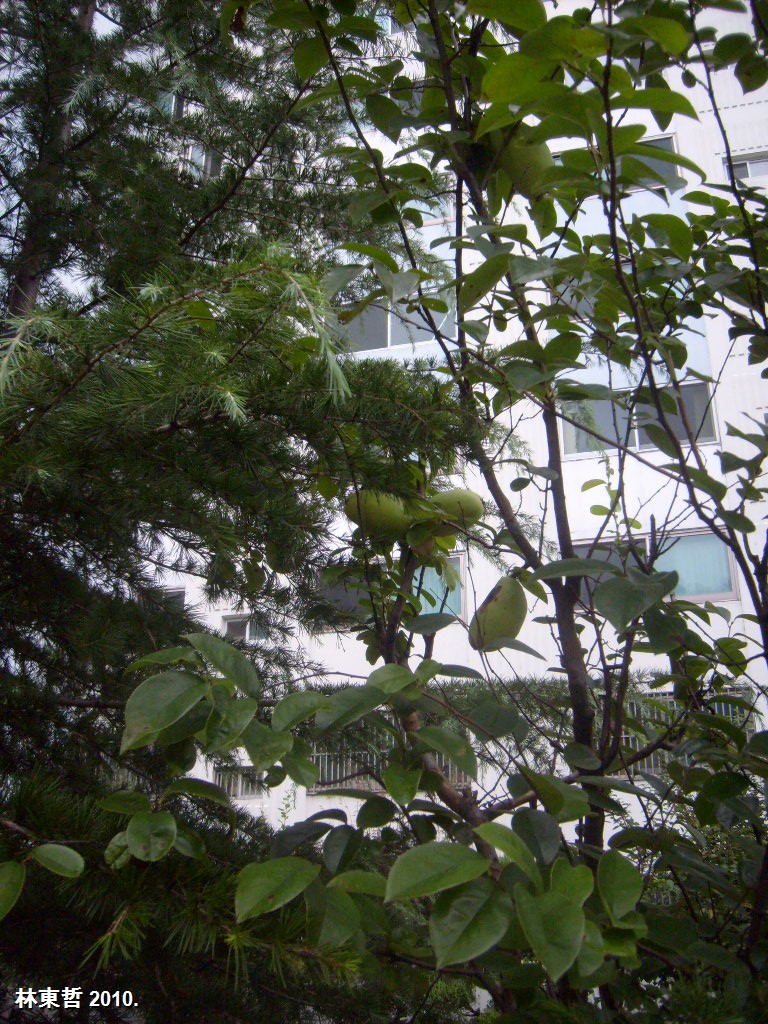
oriental quince tree and fruit
At this time of year one can see many trees bearing fruits, dae-ch’u, unhaeng (ginkgo), persimmon and Asian pears, for example. However, it is illegal to pick fruits from any tree on sidewalks or parks as the trees are not public property.
When buying one, especially from street vendors where they are much cheaper, avoid ones with blemishes or other forms of damage. A good moghwa will last the entire winter and into spring but a badly chosen one can be brown and rotted within a few weeks!
© 林東哲 2010 Creative Commons Licence.
Interlude (6) The coolest chili -the ‘cucumber’ chili. 오이고추
Okay, this is a really tasty chili with absolutely minimal heat probably just a few steps up from the green paprika (green pepper). It is usually slightly lighter in colour than hotter chillies, long and fat and fairly juicy. Rather boring on its own, but instantly transformed if dipped in ssam-jang (쌈장).
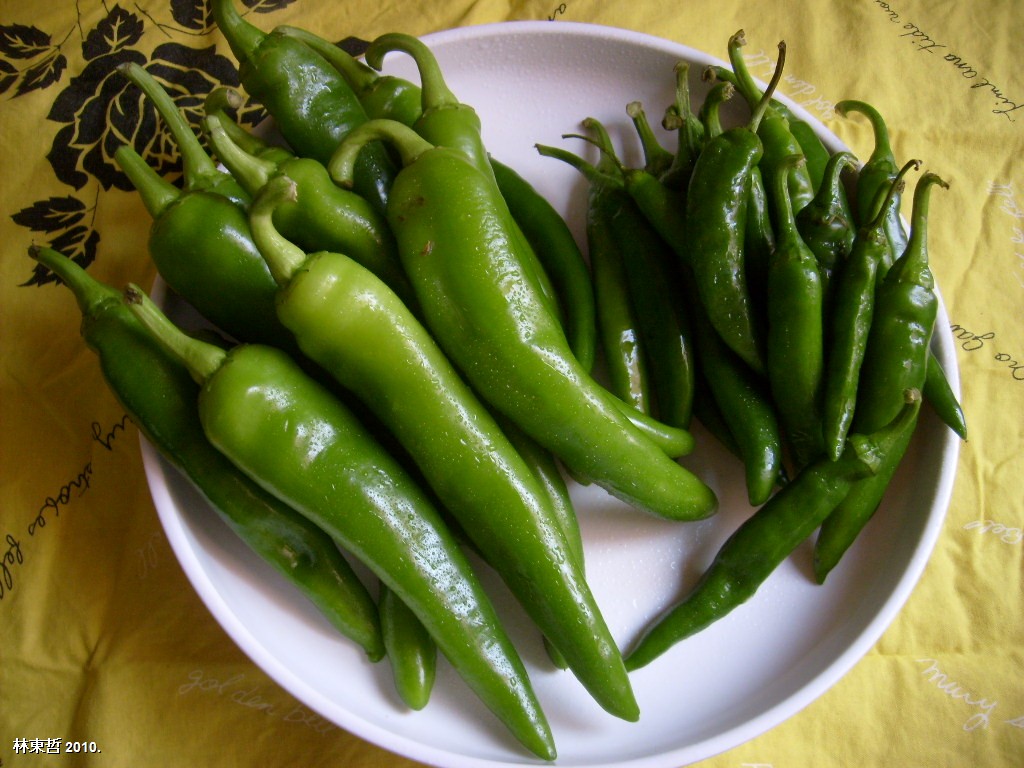
the 'cucumber' chili (left) and hottest Korean chili (청량)

'cucumber chili' (오이고추) and bean paste (쌈장) - an excellent combination
Ssam-jang (쌈장) is widely available and is usually in a green container differentiating it from other pastes. It is is a great dip for otherwise boring ‘well-being’ snacks such as carrot or celery.
ssam-jang (쌈장)
As someone permanently struggling with Korean these are my notes on words and phrases I find useful and which are usually not in a dictionary. Any amendments, recommendations or errors, please let me know.
© 林東哲 2010 Creative Commons Licence.
Interlude (5) and Suneung Countdown – 수능대박
D-Day Minus 3

Suneung Dae Pak (수능대박)
Dae-Pak (대박), means ‘awesome,’ ‘excellent,’ ‘jackpot,’ and so suneung dae-pak (수능대박) can be translated as ‘suneung jackpot,’ or, ‘have an awesome suneung.’ Of course, you still need the ‘fighting’ spirit. (화이팅!)
As someone permanently struggling with Korean these are my notes on words and phrases I find useful and which are usually not in a dictionary. Any amendments, recommendations or errors, please let me know.
© 林東哲 2010 Creative Commons Licence.
A Video Tour of Suneung
Suneung (수능) will take place on Thursday, this week (November 18th). Here is a selection of videos which give a taste of the activities that take place on what is the most important day in a Korean students life. The videos highlight the communal and commercial nature of the day.
VIDEO 1 Early Morning
Up early in the morning, supporters congregate ready to cheer the third year students (고삼), wave encouraging banners and pass around anything which is edible and sticky. Meanwhile, the exam candidates are focusing their mental energies on the day ahead.
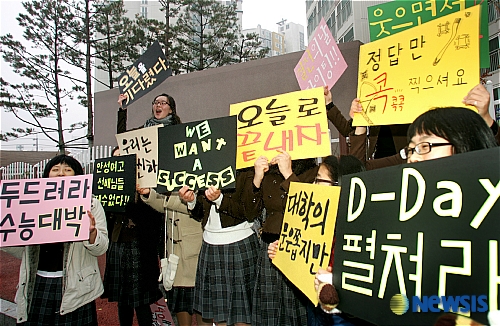
Click on photo to activate Daum site video clip. (2008)
VIDEO 2 Late Arrivals
With the exam about to start, and despite the absence of rush hour traffic, some students are destined to arrive with minutes to spare. To the cheers of well-wishers, they arrive by police car and on the back of motor-cycles.
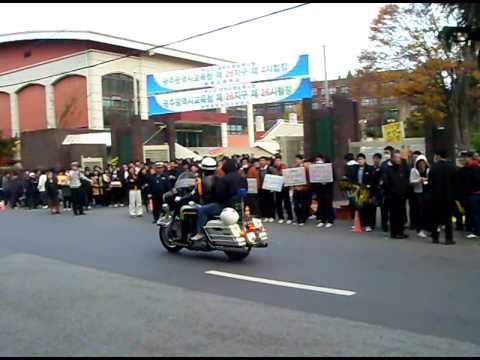
VIDEO 3 An Early Start
In this clip supporters arrive at 4.30 am. Lots of chanting and drum banging before the first candidates arrive, one carried on the back of an older brother. Meanwhile, mum straightens a candidates tie.
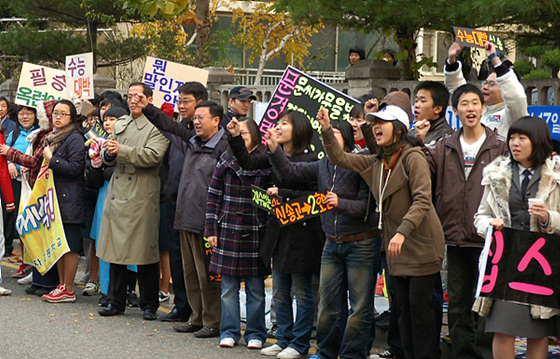
- Click on photo to activate Daum site video clip. (2007)
VIDEO 4 Commercialism
A collage of the commercial paraphernalia aimed at promoting the ‘fighting’ spirit as well as encouraging you to spend your money.

- Click on photo to activate Daum site video clip. (2007)
- Photo taken in my local bakers on November 13th, 2010.

VIDEO 5 Intermission
The best way to spend a five-minute break with suneung around the corner.
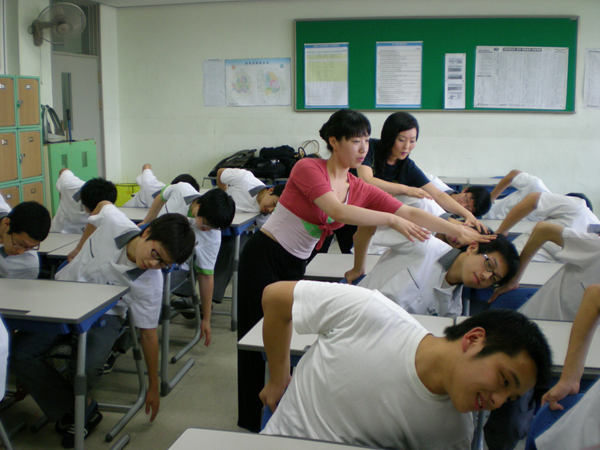
Click on photo to activate Daum site video clip.
Thanks to the owners of the clips, all taken from the Daum site.
© 林東哲 2010 Creative Commons Licence.
Interlude (4) Su-neung 수능
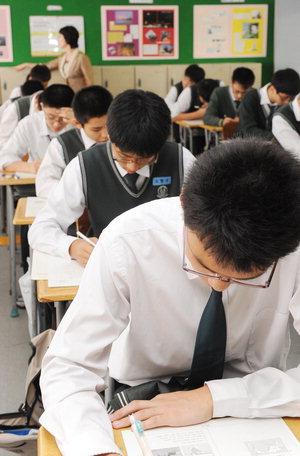
Su-neung
This word strikes trepidation into the heart of every Korean student, but most especially those who are third year high school students. The Su-neung exams take place every November, this year on Thursday 18th, and are the culmination of years and years of hard study – well for most students that is.
As someone permanently struggling with Korean these are my notes on words and phrases I find useful and which are usually not in a dictionary. Any amendments, recommendations or errors then please let me know.
© 林東哲 2010 Creative Commons Licence.
It's Kimchi Time – November 2010
Usually, around this time of year I make a new batch of kimchi. The last batch was made in May and since August or thereabouts, I have occasionally had to wash mold from the top leaves, which has been excellent in kimchi-stew. However, I didn’t really enjoy it as a side-dish. To be honest, my May batch had a bad start as once again the first process, salting the leaves, didn’t go well. This time I consulted a couple of grandmothers who recommended the coarsest salt. So, after finding two very tight, and heavy cabbages, at 6000 Won, (£3), I sprinkled the leaves with salt and rather than immerse them in water, just sprinkled a cup’s worth over the top. The cabbages took about 24 hours to completely flop but this might not be unusual as the temperature was quite cool, if not cold, in my kitchen.
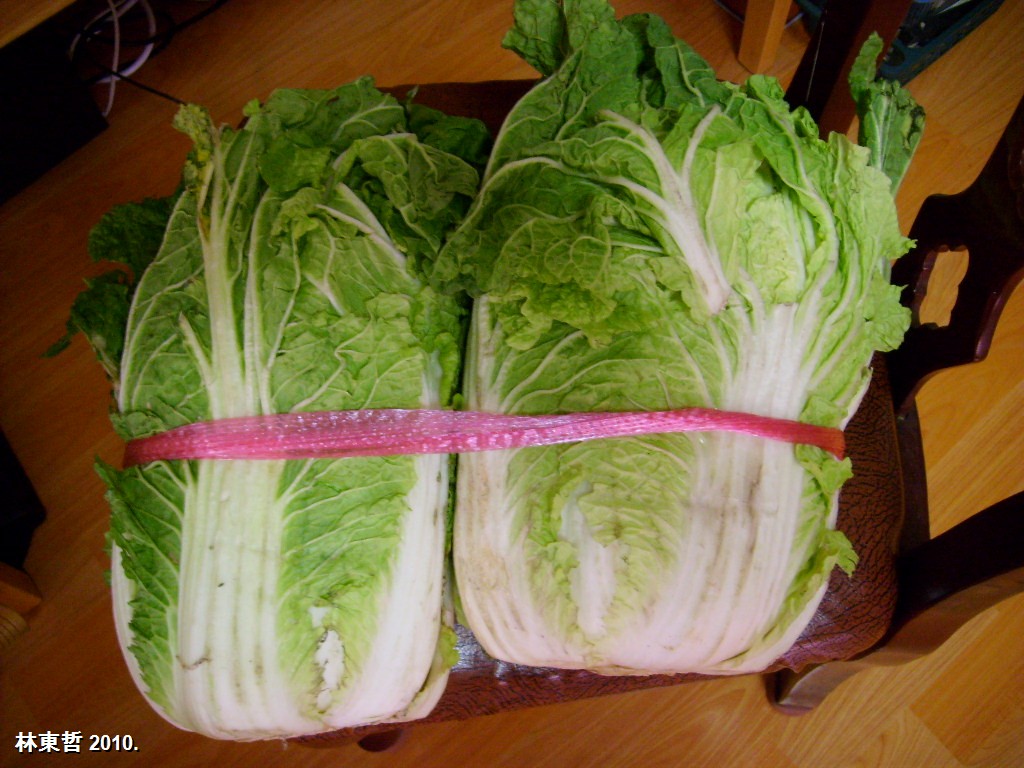
tight and heavy

salting process

suitably limp
I was also extra careful making the paste and this time used twice as much of everything except the fish sauce which I reduced a little. I was also careful to wash the salt off the cabbages and let them stand in water for an hour as in the past they have remained salty.

ready to paste the leaves
The sauce was slightly sweeter than usual and the consistency much thicker which I think was the result of carefully draining the leaves and using double the ingredients stipulated in Maangchi’s recipe. I didn’t alter the recipe and simply made double the amount. A few friends suggested it needs some additional salt which is fine as too little can be remedied but too much can’t.

the finished product
Don’t forget, for a great recipe for making kimchi, visit Maangchi.
Related Articles
- Emergency Chinese cabbage saves South Korean kimchi (telegraph.co.uk)
© 林東哲 2010 Creative Commons Licence.
Interlude (3) – The Hottest Chili – 청량고추
Ch’eong-ryang go-ch’wu (청량고추) is the hottest of Korean chillies and is small and dark green in colour. I approach any smaller chili with caution just in case it’s this variety. It is common throughout the year but specially so in Autumn (Link to post on chillies and the Scoville Heat Scale).
© 林東哲 2010 Creative Commons Licence.


 Elwood 5566
leave a comment