Korean Teas: Barley Tea – (보리차)
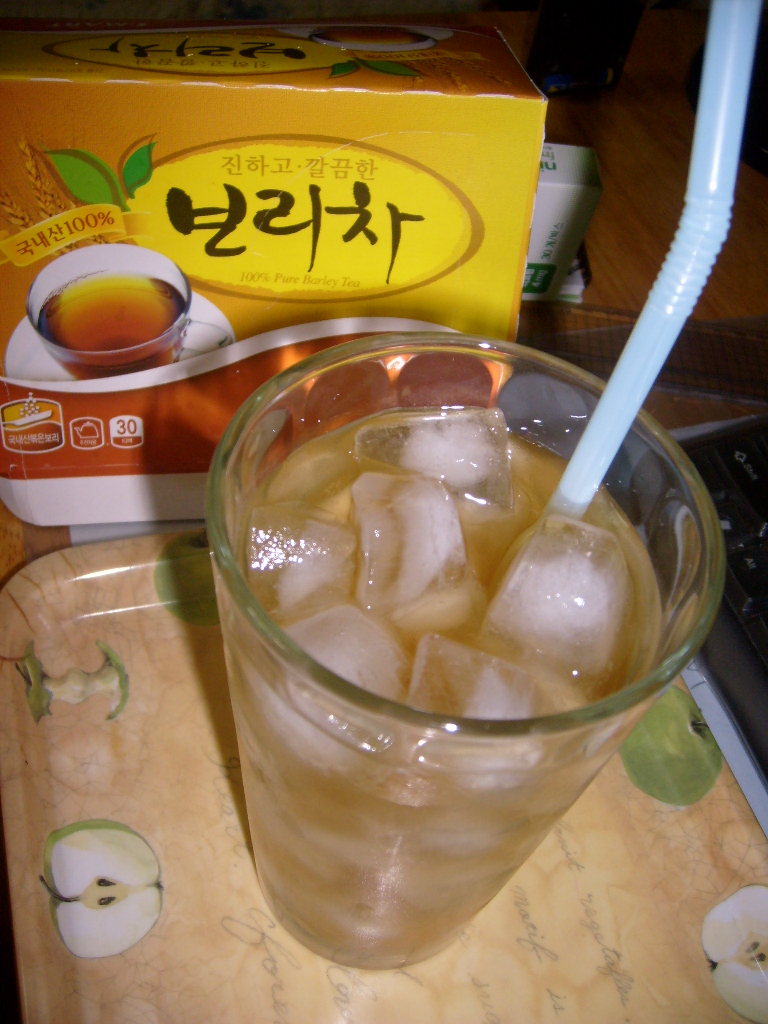
Sugar Puff water minus the sugar
Specifics: A cereal tea made from roasted barley. The tea can be made from commercially available roasted barley of purchased in tea bags ranging from single cup size to larger bags sufficient to make a litre.
Perhaps this drink, more than any other, reminds me of Korea, especially if I drink it in the UK. When I’m living in the UK a store of barley tea (보리차) or the closely related corn tea (옥수수차), are always on my shopping list. Some drinks don’t ‘transport’ well; soju for example, needs Korean weather, Korean food and a Korean ambiance to be fully appreciated but most of the cereal teas both taste the same and don’t seem out-of-place a couple of thousands miles from their point of origin.
Barley tea, made from roasted barley, can be bought as whole grain, in tea bags or already bottled. I have drunk most of the bottled varieties and don’t like them as they are often bitter and naturally, some preservative has been added. The tea bags however, make a decent drink. You can drink barley tea both hot or cold. I seldom drink it hot but along with my favourite ‘tea,’ mistletoe (겨우사리), have a two liter bottle in my fridge most of the time. Like all Korean teas, they are ‘just’ (그냥), so don’t expect anything startling. It lacks any tartness and has a mild barley taste, reminiscent of sugar-less Sugar Puffs. However, at quenching your thirst in hot weather or after a workout, Barley tea, like many other ‘teas,’ are superior to any sugary chemical concoction and infinitely cheaper (unless you buy it bottled). I tend to use a large tea bag per 1.5 liters, in the case the tea is almost the same darkness as milk-less conventional teas but I suspect many Koreans drink it much weaker.
 © Nick Elwood 2010 Creative Commons Licence.
Hanyorum – High Summer (한여름)

Hanyorum in Daegu - stifling!
Hanyorum (한여름) is the period of high summer and generally occurs in early August when the changma (장마) has moved North into Manchuria. Hanyorum is typified by high temperatures, reaching 38 degrees Fahrenheit, (100 degrees Celsius), in the afternoons and hot and humid nights.
One characteristic of hanyorum is the appearance of crickets (귀뚜라미), though you are more likely to hear them than see them. I both saw and heard crickets yesterday (August 24th), though they may have been chirping earlier than this. Crickets differ from grasshoppers (메뚜기) in that they are nocturnal and the song of both differ from the omnipresent scream of the cicadas (매미).

A cicada - or memi (매미). The sound of summer!
Grasshoopers (메뚜기), which some Koreans enjoy eating, are diurnal insects and their chirp is often drowned by the memis’ summer shriek, so you need to listen carefully to hear them. Their chirp is more noticeable when there is a lull in the memi scream. They are bright or vivid green, have antennae which are always shorter than their body, and long wings which when in flight are often coloured.
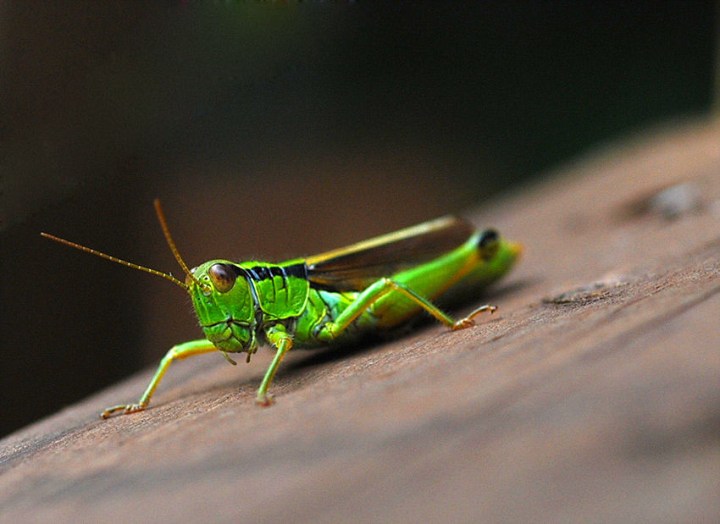
Grasshopper - (메뚜기). Mmmm- delicious!
Crickets (귀뚜라미), are nocturnal and as such require darker camouflage, usually pale green or brown. Their antennae are often the equivalent length of their abdomen and have atrophied or even absent wings and hence, do not fly. They also have ears located on their legs in the form of a white spot or mark. In hanyorum, the chirping of crickets (귀뚜라미) fill the evening air and as such they chirp at lower temperatures than the memi. While memi (cicadas) start screaming at 29 degrees Celsius, the cricket will chirp at cooler temperatures, as low as 13 degrees Celsius. Using Dolbear’s Law (based on Snowy Tree Crickets), it is possible to work out the approximate temperature in Fahrenheit by counting a cricket’s chirps over 14 seconds and adding 40. An interesting if not useless equation unless you happen to have a cricket in isolation, but on one or two occasions, I have had one chirping inside my ‘one room.’

Cricket (귀뚜라미). The clearly visible ears, located on the legs, and absence of wings distinguish it from the grasshopper.
Interesting links and sources:
Telling a grasshopper from a cricket
© Nick Elwood 2010. This work is licenced under a Creative Commons Licence.
Ben (3) Korean Teenagers
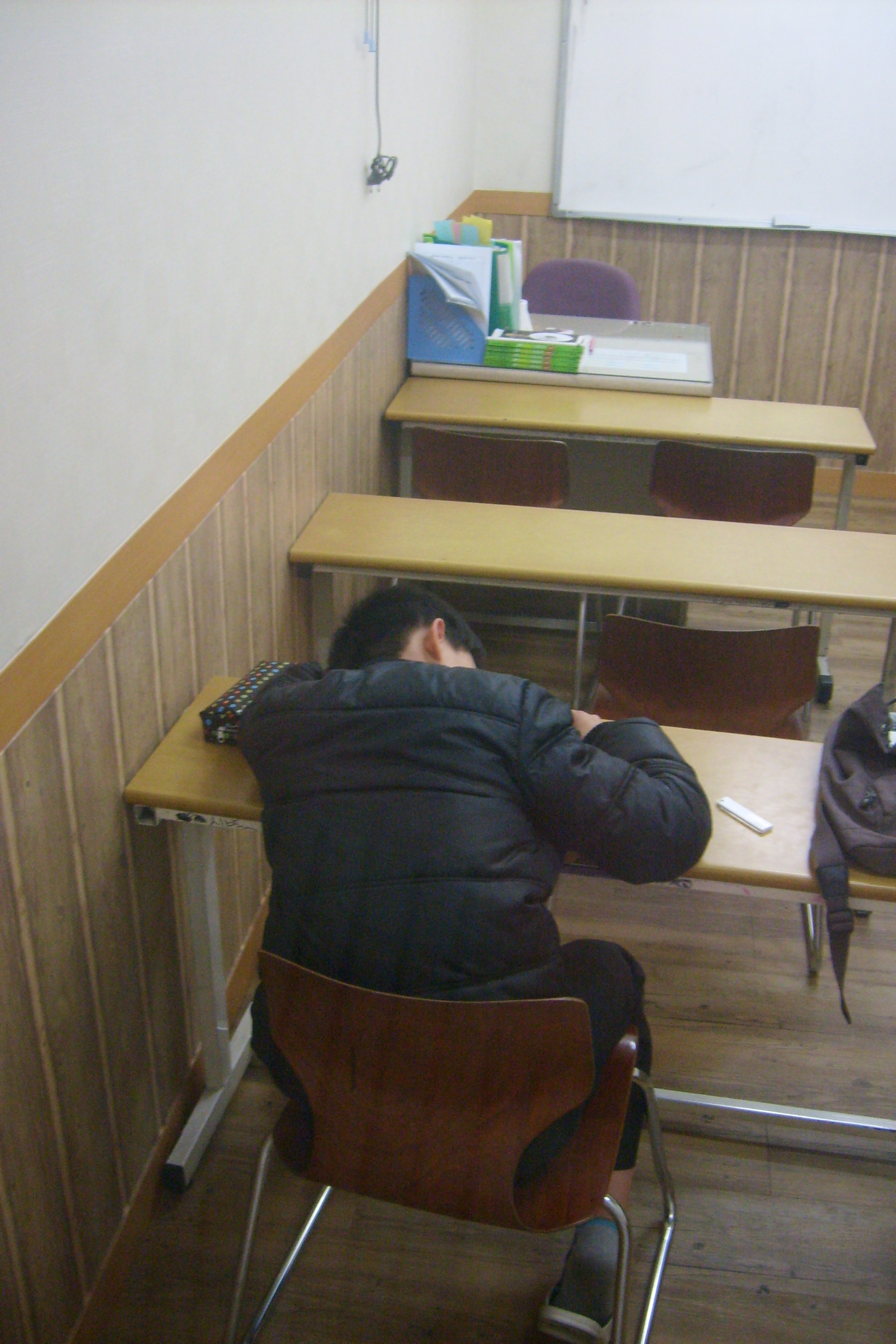
Ben on a low
Ben has been up and down lately. At the end of last term he was on a massive high after passing a string of exams with 100%. One evening, on the day he received the marks for his final set of exams, he was delirious with happiness and once again bouncing around the school declaring how he felt. In the UK I’d have assumed he was on drugs because British kids often down play any trait of intelligence as it can alienate them. And then, several days later, he finally got his reward for his efforts in the form of two small puppies. For the next week he constantly assaulted my boss and I by thrusting his hand-phone in our faces to show us the latest series of puppy pictures. His accompanying leitmotiv was ‘my puppies, my puppies,’ made all the more endearing by a mild speech impediment which renders, ‘puppies,’ ‘puppish.’
Once the joys of owning a couple of puppies had subsided however, he became markedly strange in class and seemed to flit between happy and almost depressed. Neither was he very responsive when you tried to draw him out of his mood or ask its cause. The cause was obvious and one we’ve encountered on a number of occasions. Ben’s class consisted of 6 girls and two boys and the other boy, Kyle, had left Daegu for the summer vacation to attend an intensive study school: the equivalent of an academic boot-camp. Hence the root of Ben’s mood swings was the fact he was the only boy in the class. Cherie and I tried to ride the problem for a little while but soon he was begging for us to make changes so he wouldn’t be alone.
In a Korean setting class dynamics can change drastically if someone is older or younger than the other students, or, in the case, is the wrong gender. Kids lively and confident one moment can be passive and introvert the next if a shift in personalities disadvantages them. Because peer groups are not so important for British children, such problems do not arise. British kids can easily accommodate friends or fellow classmates, older or younger than themselves and a gender divide is not as noticeable as it is in the Korean class room.

and on a high
Ben, who is 16, was disturbed enough at being the only boy in the class that despite his recent academic success, we feared we might loose him when suddenly, a new boy arrived who was ideal to place alongside him. Instantly, he returned to his old self and re-assumed his role as the class comedian but if ever the other boy is absent, he can quickly relapse into a sullen state. I’ve spent so much time slagging off teenagers in my other blogs, I’m consoled by the realization I don’t dislike teenagers, just the ones who are rotten and rotten teenagers in Korea are rare. Ben is what Koreans might call a ‘flower-boy,’ or identify as ‘pretty,’ neither term being derogatory, though he might well be when older. If anything, his body is built like a chopstick and he looks closer to twelve than sixteen, a point the girls in the class often tease him on, but both my boss and I would love him for a son. Reading other K-blogs, I know many teachers share a similar regard for the nature and personality of Korean children and teenagers.
© Nick Elwood 2010 Creative Commons Licence.
Kids' Dictionaires
Whenever I use the Korean word ‘dong-sa’ (동사 – verb) in classes, kids will have a little giggle. Neither does it matter how softly I pronounce the ‘d’ and even almost annihilating it altogether, and saying ‘ong-sa,’ will be met with laughter. Well, my Korean is crap but adults don’t have a problem understanding it.
‘Shit’ is funny for Koreans probably because they’ve never had to smell it, but if you’re British you will undoubtedly recall numerous occasions when you’ve seen something strange on the carpet or on your shoe and like an idiot you’ve poked your finger in it, sniffed it, and then recoiled in horror.

Korean 'dirty' humour
For Koreans, stories and cartoons in which shit is either a central feature or a passing reference, are common. And because they haven’t had to sniff it as much as us Brits, because our pavements are notorious for being strewn in dog shit, it can even be cute and even pretty. There is a popular Korean book (강아지 똥) about the life and adventures of a sentient turd which ends up sprouting a little dandelion flower out of its head.

강아지 똥. A scatological version of the Ugly Duckling, story
And then there are the various references to shit: ‘shit flies’ (ddong-bari -똥 파리), chicken’s gizzards amusingly called a ‘dong-chip’ (똥집 – basically ‘shit-hole), as well as the habit kids have of poking their clasped fingers up your backside in a ‘ddong-ch’im’ (똥침 – a ‘shit injection/needle’).

Click picture to activate link
Only yesterday, I was asked what ‘ddong-ch’im’ was in English. ‘Perverted,’ I replied. I had to explain how strange we find the ‘dong-ch’im’ habit and while many waygukins will see it as cute, amusing, and harmless, myself included, I read two posts yesterday, where the authors, men of course, claimed they would ‘severely damage’ any kid who touched ‘that area.’ For western men, especially British and Americans, ‘that area’ is a powder keg of sensitivity and touching it likely to ignite all sorts of problems. It’s all silly of course, and culturally constructed! The male fear of their bottoms being touched and their over-protective attitudes towards them, are as ridiculous as women fearing spiders or mice. Get, real! You have to have a very insecure image of your own sexuality to find a little kiddy touching the back of your trousers, a threat! You can’t translate ‘dong-ch’im’ into English, not effectively, – ‘bum sting,’ ‘butt-stab,’ ‘anal-poke..;’ none of them really work and as they all carry sexual connotations, ‘ddong-injection’ or simply ‘dong-ch’im’ are probably the most effective renditions.
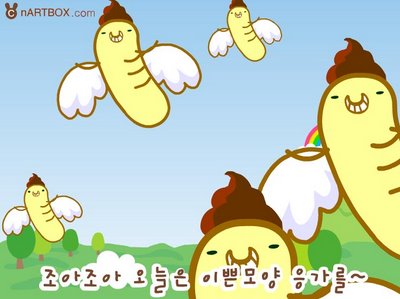
Cute, cartoon turds
As for associating food with anal passages, nothing is more likely to put me off. Cat shit, dog shit, I’ve smelt them all and any food which reminds me of that filthy orifice is unwelcome. I’ll only eat mak-chang ( 막창 – barbecued intestines) if I’m pissed as colonic conduits aren’t my thing unless severely minced, mashed and renamed a sausage. I’m even put off the idea of chicken feet (닭발) because they spend all day tramping on shite. Conversely however, I love sucking the juicy fat off of an English chicken’s ass, after it’s been plucked, basted and roasted, of course! This exception exists because the name, ‘parson’s nose,’ isn’t a reminder of its actual location or function. A Parson’s nose, the very point at which poop is birthed, is almost respectable and reminds me of Sunday afternoons as a child when being offered that fatty morsel for lunch, was a treat. Tastes are all socially constructed!
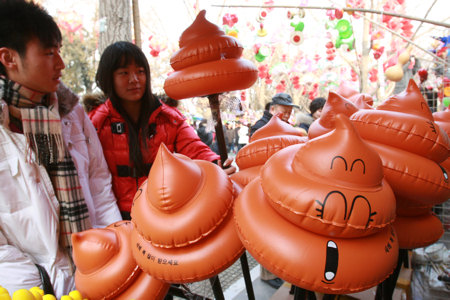
More 'turdy fun.'
While Koreans will tolerate ‘ddong’ and its various manifestations, the don’t like piss. They call piss, ‘dirty water,’ though I don’t particularly find it dirty. I’d much rather be pissed over than shat on, if forced into making a choice, and if ever I was shat on, being pissed over afterwards would be positively refreshing by comparison.

Middle school dictionary
I have three different student dictionaries and all of them of them contain drawings of the human anatomy. They quite interest me as in all three dictionaries, plus a similar poster on the wall of a classroom in my school, the bodies are androgynous. Shortly below the belly button, biology ceases and anything happening in this area does so by some assumed, magical process. In three of the four examples, the poop shoot continues down until it meets the world which is fairly important as the poop shoot is the source of so much Korean humour, but other than this, all other tubing and their associated mechanics, urinary and reproductive, have been censored.
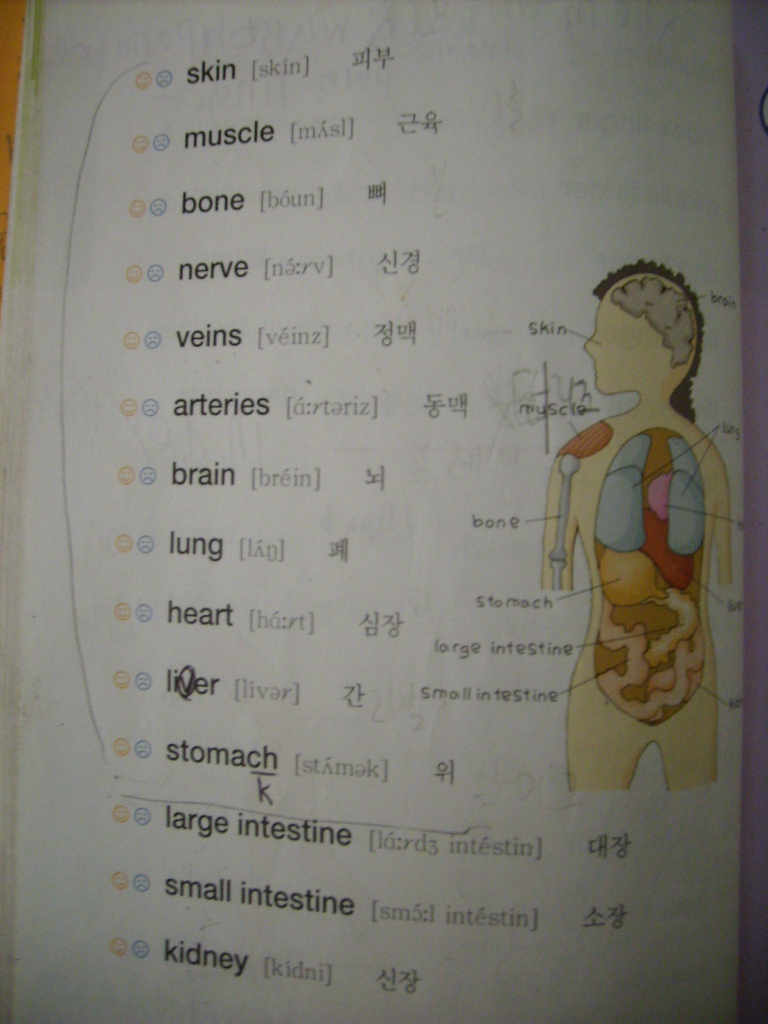
No poop shoot!
And while the drawings have all been denuded of rude bits and the dictionaries purged of anything sensitive, so as to limit speculation, analysis, discussion and questioning, there are instead a numbers of words English speakers rarely, if ever, use. I often have occasions to use words associated with reproduction and urination, as most English speakers will, but I have never used the word ‘scurf’, ‘ordure,’ ‘nose wax,’ or ‘eye wax.’ An understanding of what ‘wax’ is, is clearly missing when the translator defines ‘sleep,’ as ‘eye-wax.’ Indeed, ‘scurf’ and ‘ordure,’ I had to look-up in a dictionary as they are uncommon to me. I’m not even sure, without further consultation, how you would use ‘ordure.’ My ordure was tumultuous, perhaps? I need to ordurate? Whatever, I clearly like the word!
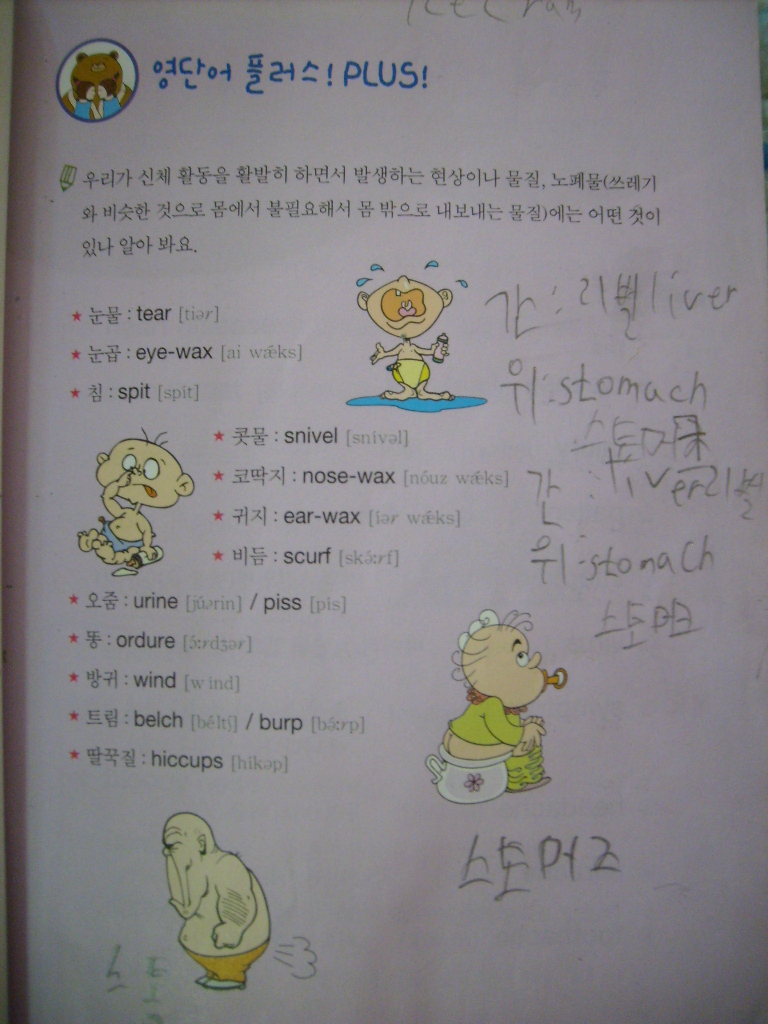
Redundant dirt
© Nick Elwood 2010. This work is licenced under a Creative Commons Licence.
Danger! Donuts!

Bathhouse
I enjoy reading other westerners accounts of the bathhouse experience as so often, and to varying degrees, they highlight how ‘fucked up’ we waygukins are. I’m just as ‘fucked’ as everyone else, though probably in a different way, as I only have a problem with nudity and changing rooms if I am in the west when I find they ooze a hostile atmosphere that seems a juxtaposition of hyper masculinity and homo-eroticism. And I am further ‘fucked’ because I now find semi clothed far more sexually appealing than totally naked and in you face.
I stumbled upon a commentary of a guy’s experiences in a bathhouse that was both open-minded and yet humorously exposed some reactions to the stranger observations bathhouses provide. Quote:

much nicer
We then had to soap up and shower down. An old man saw me struggling and helped me adjust the temperature of my shower, and even got me a fresh cloth to lather up with. After cleaning, we chilled in various hot tubs and saunas for about 30 minutes. Contrary to what I had heard from a female friend, nobody stared at me because I was a foreigner. This might be because men don’t give fuck about seeing other men naked. Personally, I got over seeing other men naked thanks to hockey change rooms, which can desensitize you to male nudity pretty quickly. I was feeling good about remaining unperturbed by this excessive nudity, because my colleague was worried I would not be able to handle all the male genitals/being naked in front of a hundred men. Then I saw a man doing push ups naked beside a man doing disgusting stretches I will never describe to anyone. At that point, I emphatically informed Mun-Gi I was ready to go.
I had to laugh because, as stark and to the point as it is, his comments capture some significant cultural differences. Unfortunately, the author of: I’m In Seoul but I’m not a Soldier, returned to Canada this month.
© Nick Elwood 2010. This work is licenced under a Creative Commons Licence.
Korean Teas: Summer Refreshment – Korean Bamboo Leaf Tea (대잎 차)
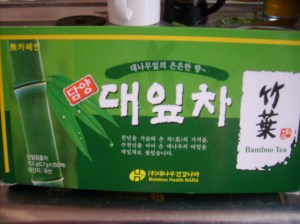
Bamboo leaf tea
Specifics: A leaf tea available in tea bags but not easy to find. Specialist deli type shops often stock it.
In summer, I prefer water or a chilled, non sweetened cereal drink or a tea as a refreshment. My favourite is probably mistletoe tea (겨우살이) but a close contender is bamboo leaf tea (데잎 차) The tea comes in bags which can be a little difficult to find though it can be bought in other forms. I couldn’t buy the bags in my local E-Mart or Home Plus but I know two small delicatessen type shops which sell them.
I have to be honest, making the tea is hit and miss and I still haven’t worked out the best way to make it. Several times I have made a very refreshing brew but repeating this seems temperamental and on some occasions the tea has been almost tasteless. When right however, the flavour is subtle and distinct and bears a similarity to mistletoe – a very mild lemony tang without any tartness or bitterness.
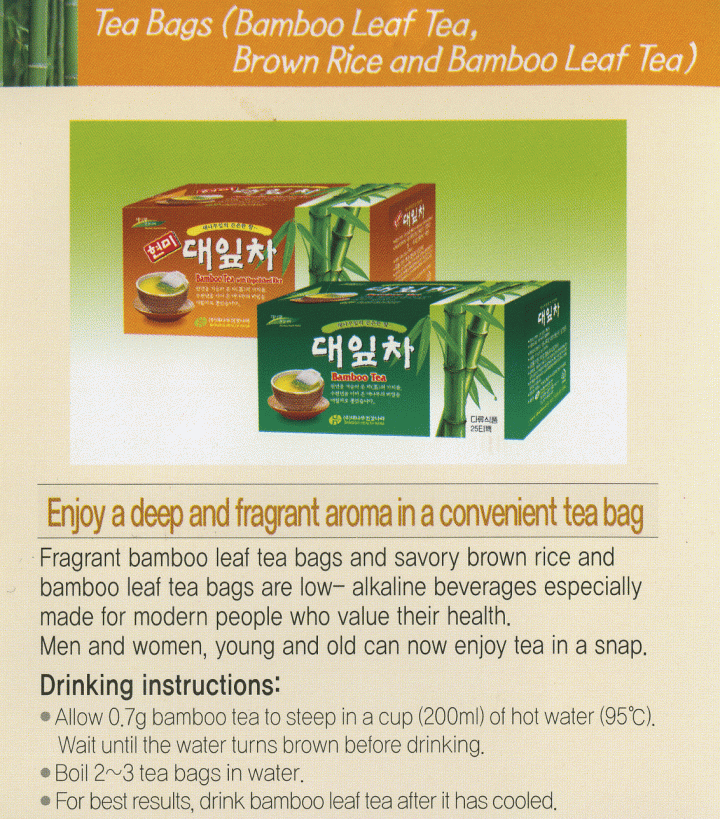
Not to be confused with Green bamboo leaf - green tea - which is from China!
Like most things that taste ‘just,’ (그냥), bamboo leaf tea has those beneficial qualities,’ it is supposedly a detoxicant and can even help you lose weight. Don’t get me wrong, I love these types of tea but can draw a distinction between refreshing and delicious. A high quality milkshake is delicious – bamboo water is ‘just’ but on a hot day or a sweaty training session, the milkshake comes second.
© Nick Elwood 2010. This work is licenced under a Creative Commons Licence.
A Summer Snippet – Circumcision (포경 수술)
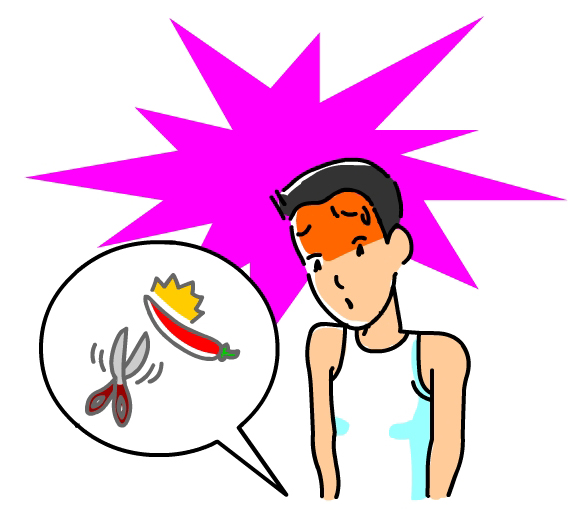
Circumcision (포경 수술)
If there is one subject rarely talked about in Korea, it is the subject of circumcision. I was actually quite surprised when I discovered that Korea has the highest percentage of secular circumcision in the world, outstripping the USA. Over the age of 18, Korean circumcision rates exceed 90 percent.
By the time boys go to high school, the majority of them will have been circumcised and the most common time to perform this is between 13-16 years of age and usually during the winter vacation. Some boys are circumcised earlier and a fair number may delay having it done. I occasionally notice university students who are uncircumcised but it is safe to assume that by the time they go to military service, they will have undergone the procedure.
Occasionally, I will know a boy is either about to have a circumcision or has just had one. Sometimes they will tell you and at other times the pained manner in which they walk makes it obvious. On a few occasions the subject has cropped up in lessons but it is never discussed in front of girls. It’s not unusual for a boy to be in classes the day after his operation though some will take a few days off. Unlike the UK and USA, where non-neonatal circumcision involves a general anesthetic and an overnight stay in hospital, in Korea, it is performed under local anesthetic. Neither are operations performed in hospitals, but clinics which are as prolific as dentists or doctors. There is a circumcision clinic (Urology Clinic) opposite E-mart in Song-So and within minutes of having been circumcised, you can enjoy a Big Mac in their McDonald’s.

‘Ouch’
Aesthetically, Korean circumcisions are much neater than those performed in some other countries. Traditional circumcision in the Philippines, for example, known as pagtutuli, shouldn’t even be classed as circumcision and in the USA, an additional operation known as frenulectomy (frenuplasty – of which their are various spellings), which as many as 33% of circumcised males have had, removes the highly erogenous frenulum. Parents are not asked for consent to perform this ‘bonus’ procedure and indeed many men are unaware what was removed. While the subject of circumcision is controversial, frenulectomy slips by unnoticed and most parents are ignorant as to what is involved. In addition, American circumcision has a history of being the most radical. In Korea, frenulectomy is not conflated with circumcision and the type of procedure doesn’t remove as much foreskin as possible.
I underwent a circumcision in August 2001 at the clinic opposite E-Mart, in Song-So. I had been debating the idea for several years and finally decided to take the plunge as I had never been happy with my status, probably because as a boy most of my friends were circumcised. I quite amazed myself at the time as I had visited my doctors and arranged everything for Thursday, 16th of August. The arrangement took less than a minute and there was no asking why I wanted it doing. My doctor simply made a phone call and booked me in. The operation would cost 100.000W (about £50), would take twenty minutes to perform and would be carried out in the same building as my doctor’s surgery.
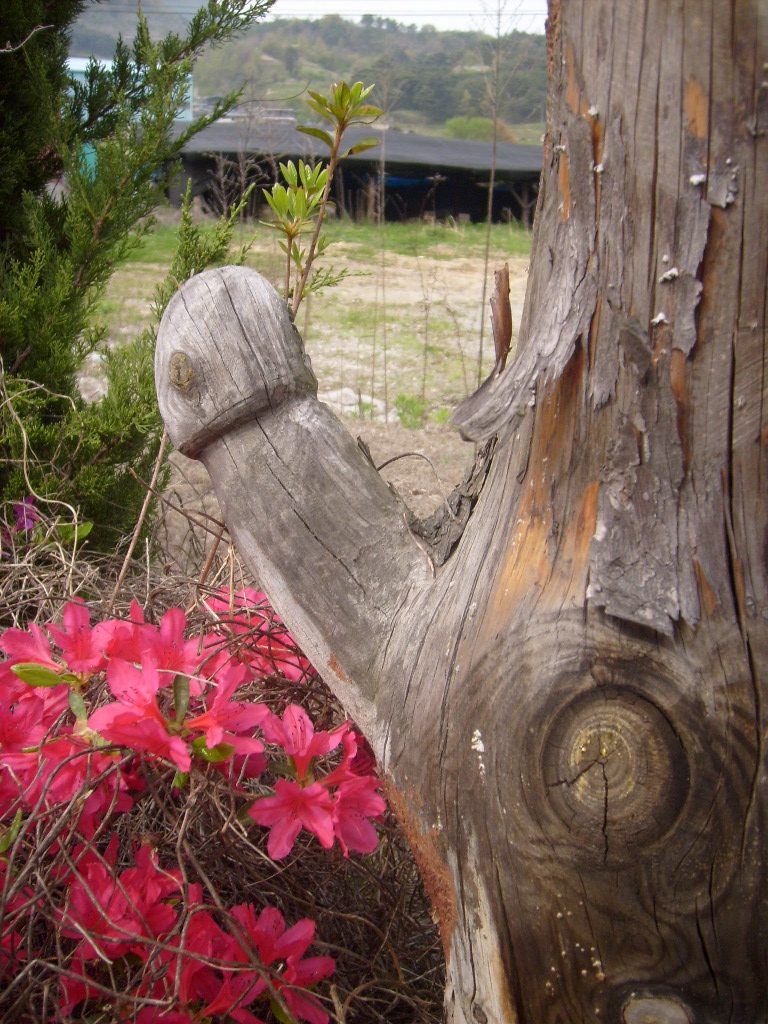
A suitable totem pole near Kayasan
August 16th, 2001. I had to teach on the Thursday morning and though not as hot as a few weeks previously, it was terribly humid. In my classes, many of which had no air conditioning, my shirt was soaked with sweat. I had already perceived that I wouldn’t be in any fit mental state to teach and so had run-off some word puzzles for the kids. When my classes finished, I frantically smoked a couples of fags on the back stairwell and paced up and down. I didn’t really want to leave school and there was an unpleasant feeling in my stomach, but eventually everyone wished me luck and I took a taxi home.
I showered and then gave my friend David (이영순) a call. He arrived a few moments later as he had been waiting at the PC Bang, next door. I don’t think I had ever been so nervous, so much so my hands were trembling. Out on the street, we took a taxi and went straight to the clinic. I was early, so we went to the third floor of the building where I had a brief chat and cup of coffee with my doctor. Then, at 1.59 pm, he said, ‘Oh, Nick, it is time.’ And telling me not to worry, I walked down the stairs to the urology clinic. None of the doctors there spoke very good English so David sat in the clinic office with me and asked the surgeon the list of questions I had compiled:
“What happens if I get a hard-on during the operation?” He laughed and said that wouldn’t happen. What sort of stitches would be used – dissolving or non-dissolving?” I was given a choice and told non-dissolving left less of a scar. “What happens if I get an erection over the next few days?” I was told to stick a cotton bud in my ear or stick my feet in icy water. “’When could I shower next?” Next week!
I was then taken into the operating room which was small and not unlike a dentist’s surgery. In the center stood that ominous table. Dropping my trousers and boxers I lay down and wondered what the fuck I had let myself in for.
Everything everyone had told me worked out the opposite. David had told me to expect two injections (later it became four) well, I was given eight and they stung. I covered my eyes and ears for the whole operation as there was a radio playing shit Korean music and the three surgeons kept fucking singing along to it. David had told me that sometimes you hear the scissors snicking away and I did, even the radio or the surgeons’ singing didn’t drown it so I had to jam my thumbs in my ears. Then the overhead light was so bright I had to cover my eyes. Several people had said the operation would take around twenty minutes, in fact it took forty. Then, all apart from Pak Ji-won (박지원), one of my older students, I had been told it wouldn’t hurt. It did! But not at first. Shortly after the snicking sounds finished, I smelt something cooking; I reckon they had either cauterized an artery or one of them was starting a barbecue. It was like my entire senses were being assaulted: the bright light, the noraebang Nahuna rendition and that strange, almost acidic barbecue smell that lingered. I had to stretch my fingers so I could pinch my nose shut, bung my ears and cover my eyes to blot everything out.
I think I lay like that for twenty minutes and eventually, felt a numb change in what was happening. I thought they were finishing but next followed a sort of slicing sensation which was very unpleasant because although it wasn’t painful, it felt actually felt like something was being sliced. David had told me to expect eight stitches. The following morning I counted 36. At one point during the procedure I told them it hurt but they ignored me and just carried on singing along to the radio.
Finally, the pain stopped and I could sense I was being mopped up. I took my clammy hands off my face and sighed. Then I was able to sit up and pull my trousers up. The surgeons, lined up, smiled and bowed. Out in the corridor David was sat reading. I did a little dance for him as I didn’t hurt at all, probably because my system was zinging with adrenalin. Then, we walked over to E-Matt and bought a McDonald’s which we walked home with. Was I hungry!
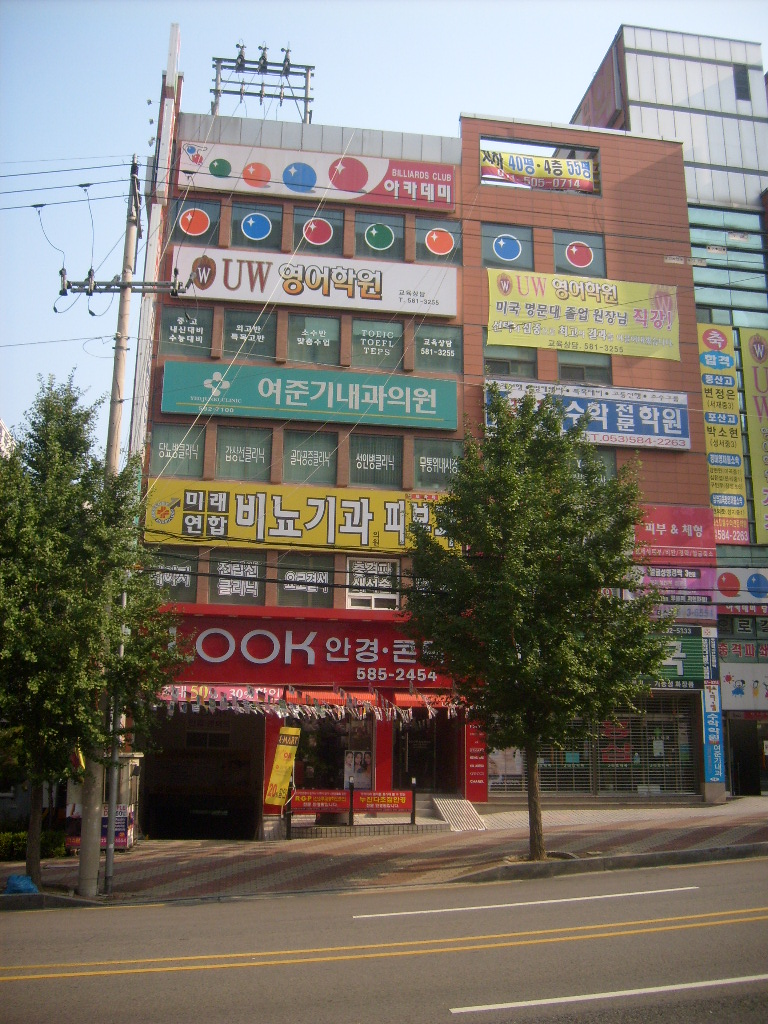
A common place to see boys hobbling. 미래 Urology Clinic opposite Song-So E-Mart.
The clinic has given me a list of after-care procedures which David had translated into English whilst I was being operated on. It listed things like not drinking for a week because of the antibiotics, not showering for a week, resting for a few days, etc, etc. At the bottom of the list was an amendment in David’s handwriting, it read….
6. And you must endure not to have a wang! (Wank).
I didn’t hurt at all but throughout the evening, waited for the drugs to wear off and enter what someone had predicted would be, a ‘new world of pain.’ When my roommates arrived home we went out with them to a nearby restaurant. I wasn’t hobbling at all. Strangely, during the night I was worried more by the fact I didn’t hurt. And you wouldn’t believe how effective cotton buds in the ear are at killing an erection. One of the doctor’s had explained that poking a cotton bug in you ear-hole interrupts signals from your dick to brain and terminates any boner.
Friday 17th of August, 2001. In the morning, I was quite worried because it looked very ill. I wondered whether the bandage was too tight. I phoned David but couldn’t get hold of him so, at 8.45 am, I took a taxi to the clinic only to find it didn’t open until 9.30. So I waited in my doctor’s office on the third floor of the building. He sat me down, gave me a cup of coffee, talked to me and soon it was 9.30 am.
Back on the slab, I was checked-out but they didn’t think anything was wrong. Back in the reception area my doctor was waiting for me as he can speak fairly good English. There were three patients sitting behind me, two young women behind the receptionist’s desk, and four surgeons around me. Ten Koreans in all! Everyone was centered on our conversation – which of course, was about my dick!
As I leave, all the staff smile and bow deeply. My doctor invited me up to his surgery for breakfast and there I am introduced to his mother. We ate fruit and sat talking for about two hours and as I was leaving he invited me out to dinner. At the time, my doctor had just moved into the premises and had few patients, today I have to sit in the waiting room for an hour before I can see him.
Saturday August 18th, 2001. Very irritating because the stitches are made from something resembling nylon – like the material used for a toothbrush.
Although not sore, it is uncomfortable walking any distance so I have spent a considerable time lying down under the fan. Most Koreans get circumcised in winter and I would imagine the possibility of infection is higher in a humid climate so I lie under the fan as much as possible. I have been used to showering over 5 times a day and it is very uncomfortable not being able to do so. Showering is not just a hygienic necessity but a hobby and something I do to kill time.
Tuesday 21st of August 2001. Pak Jun-hee (박준희) has been bringing me lunch for the last couple of afternoons. His mandu and kimchi, made by his wife, Sun-hee, in their restaurant, are definitely the best in Song-So. Today, he asked if he could see ‘the results!’ Yes, I was rather shocked because in the UK no one would ask that. It was a strange situation because between us on the table, were the steaming mandu. Koreans! I love them!
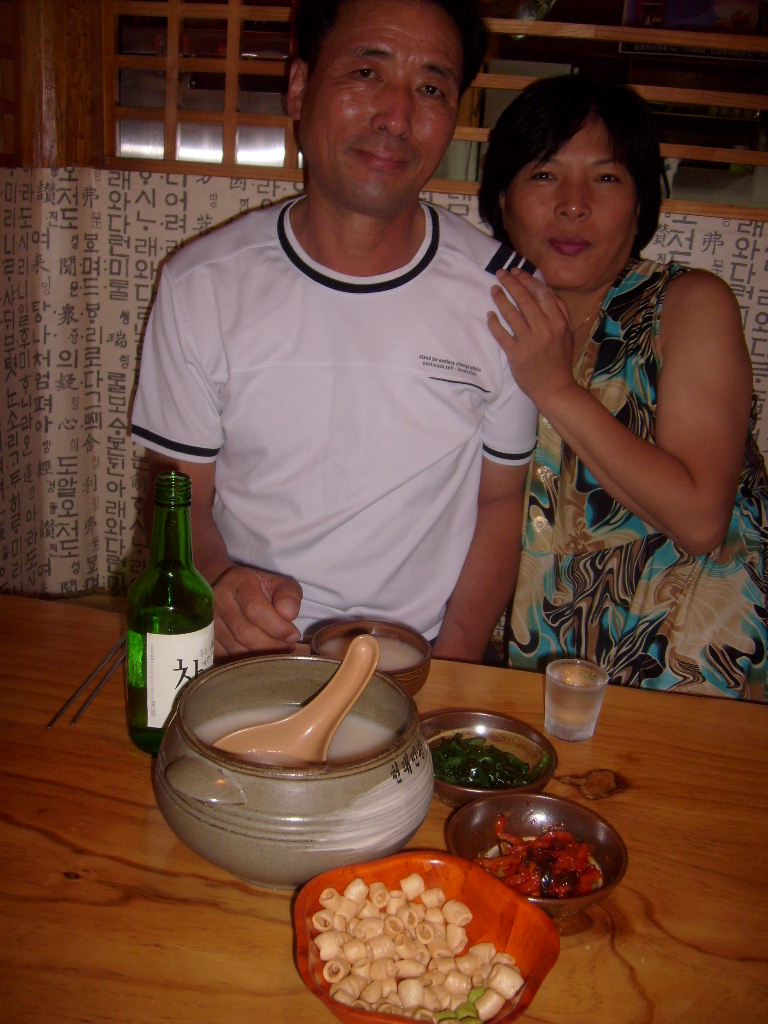
My ‘go-ch’u chin-gu’ of 10 years, Pak Jun-hi and his wife, Sun-hee
Thursday 23rd of August, 2001. My antibiotics and pain killers ran out today and I’ was sore, so much so I had to go and buy some. In the afternoon, I went out to the cinema with Ji-won (박지원, his father is Jun-he). His English has improved so much since I started teaching him back in November. He told me he would be really sad when I left and that he would never forget me. It was all rather poignant. We walked around the Milano area for a while and had pat-ping-soo in a Sweet Water cafe which is just so tacky it’s unbelievable. It was decorated in pinks and had Barbie dolls and Miss Kitty paraphernalia all over the place. After, we had a burger in Lotteria and then took the bus home which was painful as the bumpy journey was over the construction area of what is now Daegu Subway system.
Saturday 25th of August, 2001. Saturday and I’m still in pain so I headed back to the clinic with David. My God! What a hideous experience, so hideous I don’t think I can actually do it justice in writing. It’s like I’ve been to a place of pain that I never want to experience again. I went back onto the couch where they decided to remove the stitches and it felt I was being assaulted with a pair of pliers. I cannot describe how excruciatingly painful it was and I wished they had been singing or cooking a barbecue, anything to take my mind off they pain. At one point, when I flinched, one of them told me off. When I eventually walked out of the small surgery, and David saw me, me he thought I had soaked my head in water and my hands were shaking badly. However, it was much easier walking without those infernal barbed-wire bonds.

‘Go-ch’u chin-gu,’ David (이영선)
Thursday August 30th, 2001. Life is almost back to normal. On Thursday afternoon I did some of my jobs – paid some bills, went to see Mr Pak at the post office and then we spent the afternoon in the Han Song Plaza bathhouse. With school having just started, the place was empty.
RELATED ARTICLES ON THIS SITE
Finding a Pathology to Fit the Procedure
© Nick Elwood 2010. This work is licenced under a Creative Commons Licence.
Dragonfly Days (물잠자리)
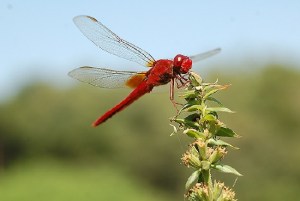
A male 'chili dragonfly' (고추잠자리). This type appear is common in early October
Mid August and the dragonflies (잠자리) are hovering over puddles and pools of water. There are several ‘flushes’ of dragonfly with another in early autumn. I suspect these are collectively known as ‘water dragonflies’ (물잠자리) irrespective of actual specie. Sometimes you can see them in large numbers erratically darting here and there. Some are probably damselflies (실잠자리) which are distinguished from dragonflies in much the same way as butterflies are from moths, in that when resting a dragonfly’s wings are 90 degrees to its body, in contrast, a damselfly’s wings rest along the body itself. Dragonflies can fly in six directions, up, down, forwards, backwards and side to side.
Bright blue damselflies and deep brown reddish dragonflies seem to be particularly prominent around my area of Daegu at present.

A damselfly (실잠자리)
Clicking this link will take you to David Hasenick’s photo gallery which besides hosting some excellent photos of dragonflies, also has a number of other Korean categories.
While searching for information on Korean dragonflies, I discovered a ‘list’ of the variations in Korean regional dialect for ‘dragonfly.’
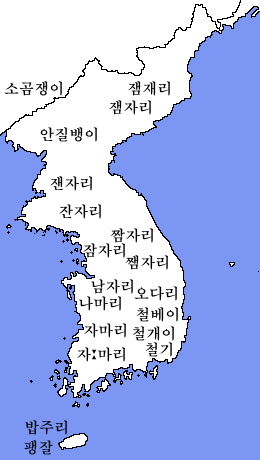
'Dragonfly' - regional variations in dialect
© Nick Elwood 2010. This work is licenced under a Creative Commons Licence.
Samjeong Oasis – Lotte Castle (용산동) Daegu.

삼정 오아시스
First visited August 14th August 2010. Last visited July 2nd 2012. This is a relatively new and very pleasant bathhouse with an adjoining health club located on the edge of the prestigious Lotte Castle Apartments. I have visited here several times and it is very clean. This is a good bathhouse to take a nap in as it has a pleasant raised sleeping area down the far wall and also a large sauna room in which the TV is located. This room is fairly humid and you can easily nod off laying on the floor. Next to this is a steam room with very high humidity. The steam must be pumped in or the boiler situated behind a wall as I didn’t see one. Personally, I love the enormous cauldron that bubble away in a corner and hiss out bursts of steam.
A smaller sauna with no humidity has a jade studded ceiling and the television in the adjacent sauna can be viewed through a window.
There are three central pools, basically a warm pool in the center with a hot pool at one end and a pool in which you lay and press a button to have jets of water squirted onto you spine and legs, at the other. The hot pool temperature varied between 38 degrees and 44 and it heated very quickly. This pool is at the hot and of the spectrum. Conversely, the large cold pool, is colder than some other bathhouses.
For my friend, this is his favourite local bathhouse with Migwang coming second. Personally, I prefer Migwang. Samjeong Oasis is certainly a great place to relax and nap but I find it a little bright and find the rectangular and very open plan, a little dull.
Plan

Sam Jeong Oasis. Yong San Dong. Bathhouse design. May 2011
Location – five to ten minute walk from the Tesco Home Plus at Yong San Dong (용산동). Samjeong Oasis sits behind Home Plus at the furthest right hand corner of the large apartment complex that lays behind the supermarket. (Wiki Map link )
Times – Unsure of timings but I believe the bathhouse is closed on Tuesdays.
Facilities – ground floor ticket booth, women’s bathhouse, men’s bathhouse, health club.
Jjimjilbang – none.
Bathhouse (men) – around twenty stand up shower facilities and fifty sitting down shower units, event pool, (이벤트탕), hot pool (열탕), large warm pool (온탕), large cold pool (냉탕), therapy pool, steam room, jade sauna, humid sauna with television, heated sleeping area. Changing room with television and benches.
Cost – bathhouse 5000 Won.
Others – massage and rub downs, shoe shine, health club, smoking room. Many nearby restaurants and shopping facilities.
Ambiance – relaxing, brightish, somewhat open planned and symmetrical. New and very clean.
Waygukin – Only my second visit but no foreigners.
Address –
Master Georg Soupidis – Osnabruck Song-Do-Kwan (Taekwon-do)

Master Georg Soupidis (6th Dan around 1972))
The e-bente-tang today was mugwort (쑥) and because it is the school holidays it was fairly busy. It was disgustingly hot on my way to Migwang, my favourite bathhouse and it rained all night and a good deal yesterday, so it was humid. As I said, I’m not spending much time in the e-bente-tang (이벤트탕) so I wallowed for a long time in the cold pool (냉탕). I had a dream last night, a taekwondo dream. My most recurrent dreams are either about taekwondo- which I studied for 20 years or the British Army, in which I served around 15 years. They are the sort of dreams, the specifics of which you can’t recall but which shadow your days with their atmosphere.
As I was in the cool pool I started thinking about my taekwondo teacher, Georg Soupidis. I studied almost all my taekwondo in Germany, in a fascinating town called Osnabruck. George had been an ex-soldier, originally from Greece and he was an excellent teacher. There are thousands of fantastic taekwondo practitioners in the world but few fantastic teachers, and Georg was one of them. I left Osnabruck in 1984 and I haven’t seen him since. I’ve spoken to him on the phone a few times and always planned to re-visit Osnabruck but time is running out.

Georg Soupidis (far left)
I entered my first taekwondo school back in 1974 and can still remember the feelings I had training there. All the black belts were decent people and mostly studying at University. I remember Lutz and Heinz, who became lawyers, and there was Stephan who worked in a bank and another youngster called Stefan Wawer whom I had a crush on, but never told. Then there was Stephan Bic, a lad about the same age as myself with a kind and gentle nature. He had a blue belt and being tall we often partnered each other. I admired him for a long time but once again, he never knew. Coming out was just too much of a risk! It was super-cool to practice martial arts in the mid 70’s and having a black belt or advanced belt was revered. Bruce Lee had only just died and his last film, Game of Death, was still to be released and hence the martial arts fad was at its peak .

Georg (left) and myself. (1982)
My school was the Song Do Kwan, a professional martials arts academy situated a short walk from the central railway station, in Osnabruck, on Mosse Strasse. General Choi Hong-hi himself had stayed at Georg’s house when visiting for a training seminar. General Choi was one of the founding fathers of taekwondo though his contributions have subsequently been whitewashed from much of Korean history. If you read anything by the WTF (World Taekwondo Federation ), the sport version of taekwon-do popular throughout the pennisula and perceived as the only form of taekwon-do, it seems to emerge from out of the blue somewhere around 1973. However, it’s history stretched back before this and in Choi’s second manual on taekwon-do, published in 1972, Georg can be seen with the core of German black-belts with General Choi stood in the middle. My point? When this photo was taken the WTF didn’t even exist. I trained in the Song Do Kwan from 1974 until 1981 after-which the school moved into a public facility. However, for the next 5 years, whenever I passed the home of my old school in Mosse Strasse, Osnabruck, I would respectfully bow towards it as I passed.

The Song Do Kwan team after a competition in early 1982.
For years my life was the Song Do Kwan and I trained diligently and became a very competent competition fighter. I eventually passed my black belt on April 3rd 1982. Even after enduring military exercises in the middle of winter I would return to camp and head straight to my dojang. I remember Georg with great affection and he was one of the greatest influences on my life. Walking into the Song Do Kwan changed my life and though I no longer practice taekwondo, it teachings took me elsewhere.
Once I left Osnabruck, in 1986, I lost my focus. I trained in a school in Paderborn, Germany, and when I returned to the UK in 1988, trained in Aylesbury and then at a Karate school in Essex University. When I came to Korea in 2000, I trained in a WTF school, and though I gained my red belt, didn’t think the style was as efficient as the ITF style (International Taekwondo Federation). Of course, a style is as good as its practitioner and a good martial artist borrows from whatever style to improve their technique but WTF was just too much ineffectual bum kicking. Just my opinion!
To all my old friends in martial arts, and especially Master Georg Soupidis, I send my greetings.
(I haven’t written any posts on martial arts despite their having been part of my life for many years. Keep checking as they are long overdue!)
© Nick Elwood 2010. This work is licenced under a Creative Commons Licence.


 Elwood 5566
leave a comment