I was Butt Plugged by a Korean Kiddy…
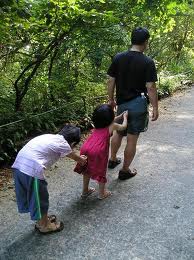
dirty,dirty!
Pinch a Korean man or boy’s nipple and they’ll accuse you of perversion (변태) but you can stroke and touch them everywhere else (except in the most obvious of places), and they won’t see anything wrong with it. Even the bum hole isn’t exempt a digital delving though this is a jokey pastime of kids and much more likely to occur between children or from children to adults. It would be extremely odd for an adult to start surprising his or her work colleagues with a digital ‘ddong-ch’im.’ Apparently, manual butt-plugging, as a form of humour, is widespread across east Asia and has a long history. Naturally, there is an association between the ddong-ch’im, and that other Korean obsession, poo!
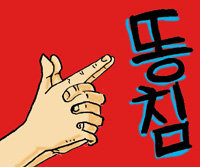
ddong ch'im - shit needle / shit injection

a popular perversion
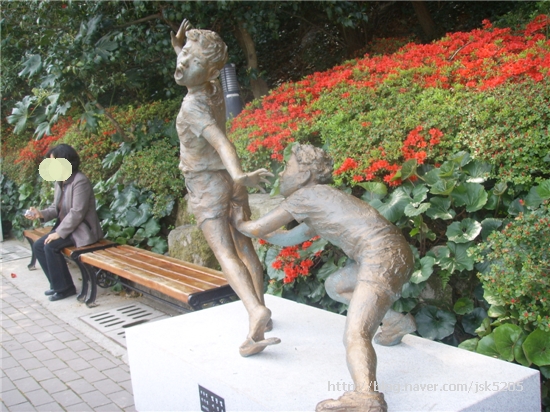
note, how the buttocks are tightly clenched. I'm not sure about the facial expression as it somewhat resembles a blow up doll
But the actual purpose of this post was to expose an excellent Korean game I discovered, entitled JJileo-jjileo which being at the juncture where poo meet ‘the finger,’ brilliantly demonstrates more Korean customs and humour. Enjoy… (Note– I have recently noticed the game breaks down after several minutes, hopefully this is only temporary – for an interesting insight however, it is still worth a visit).

click to enter game

© 林東哲 2011 Creative Commons Licence.
Related articles
- Kids’ Dictionaries (Bathhouse Ballads August 2010)
Tinker, Tailor, Soldier, Sailor – First Birthday Celebrations (돌잔치)
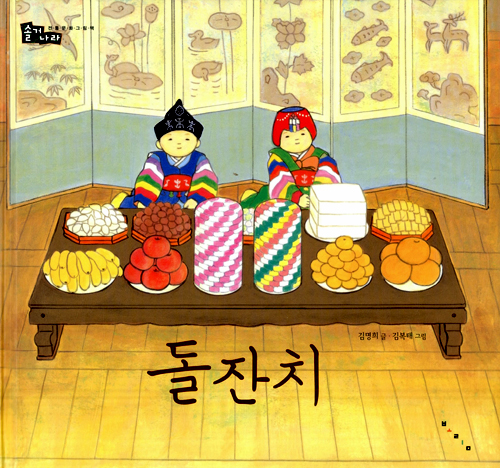
the first birthday party – when baby is 2
Poverty and hardship have left deep impressions on the Korean cultural landscape many of which are still evident today. Korean food, often reflects former economic hardships which is one reason why black-noodles (자짱면) is still a favourite when students graduate. Though many families now go to elaborate buffet restaurants, black-noodles are still eaten to mark graduation as it was at one time considered a ‘luxury’ food. The obsessions Koreans have with food, which might be expected if you are starving, almost matches the British obsession with the weather, the result of living in an unpredictable climate. I am still not used to responding appropriately when a Korean asks me if ‘I’ve eaten’ and on so many occasions still reply with a list of what comprised my last meal or perceive it as the opening for an invite to dine together. Instead, they are really inquiring as to my general well being but so ingrained has this become that for some, even this is not implied and the comment reduced to a basic nicety void of any real meaning and synonymous to British observation about the weather. Historically however, it developed at a time when many people were starving and was a question of much deeper significance. Dog stew (보신탕), silk worm (번데기), grasshopper (메뚜기) and a whole range of roots, woods and barks, many of which grow in the UK (shepherd’s purse 냉이, burdock 우엉, ㅡmugwort 쑥, etc, but which are no longer commonly used), reflect the former scarcity of food.
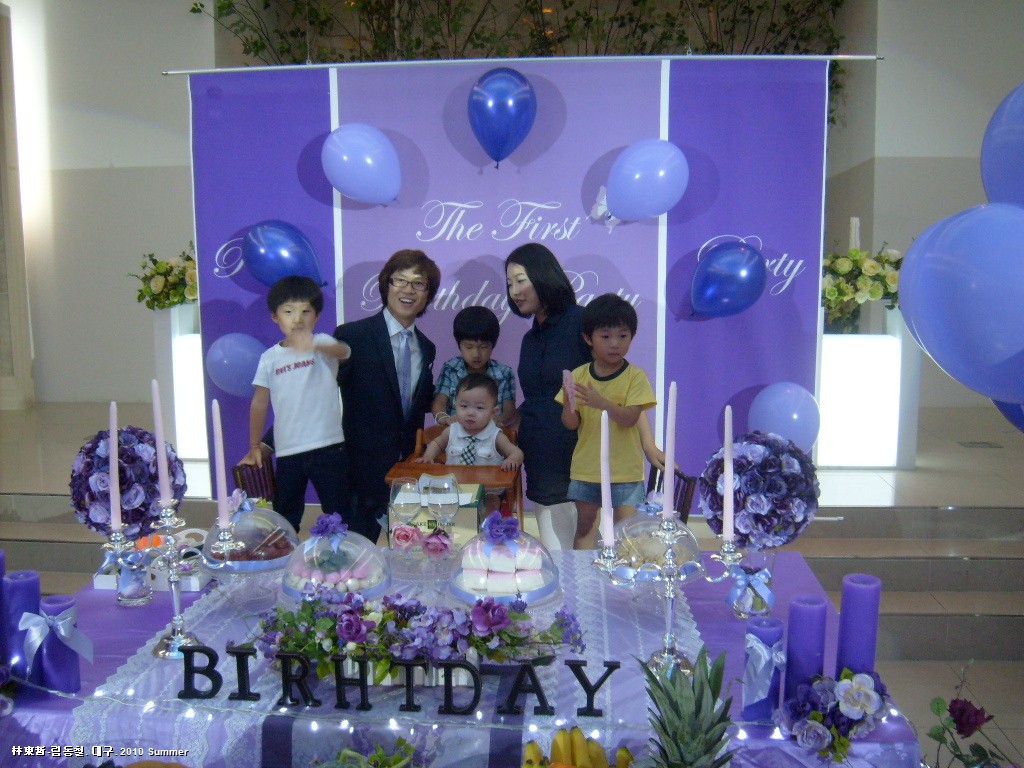
a lavish affair – Lee On-yu’s (이온유) 1st birthday. Hee-ho, On-yu’s older brother, who was the subject of an earlier post, is on the far right (Diary of a Little Boy)
Former high infant mortality rates can be attributed to the custom of a child being one year of age upon being born and with infancy and childhood being so precious, when circumcision was introduced to the peninsula, in the 1950’s, it was an ordeal sparred babies and infants and instead postponed to early adolescence. In 2006, Korea was cited by a UN report (link) of having the world’s lowest infant mortality rate of 3 (3 in 1000) compared to 45 in 1970. A further development of the high infant mortality rate was the importance of a child’s first birthday celebration (돌잔치), when in Korean reckoning they are two years old.
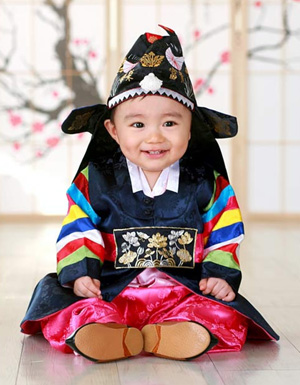
traditional first birthday attire – the dol-bok (돌복)
45 deaths per thousand within the first year doesn’t seem high until you consider that currently, 49 deaths per 1000 is the global average and that today’s most poverty stricken countries have infant mortality rates of around 50 per 1000. The fear your baby may have been one of the unfortunate led to babies, pre and post natal mothers being secluded until deemed healthy. The threats to life weren’t just from disease but also from famine and the wide swings in the Korean climate. Even today, circumcision is usually carried out in the winter rather than the summer vacation where the incredibly high humidity prolongs healing and increases the chances of infection.
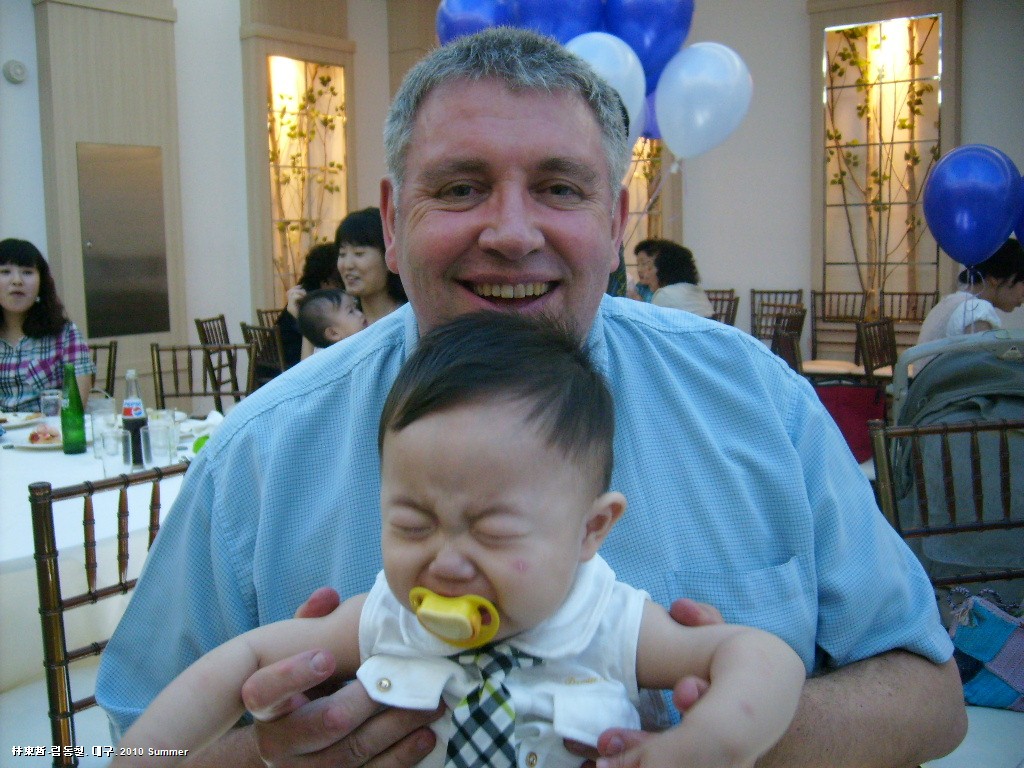
Un-yu. The microphone he played with suggests he might be a future singer – he was certainly in good voice here
The first significant event to celebrate was a child’s 100th day celebration, the baek-il (백일). However, as might be expected, this was a fairly low-key affair and the baby wasn’t ‘publicly’ paraded. On the child’s first birthday, at two years of age, it was time for parents to present their baby to the world and hence the lavish dol-jan-ch’i (돌잔치) celebration.
In today’s affluent Korean society, this event usually takes place in a large, specifically designed function room to which families and friends are invited. Historically, and traditionally, the celebration varied depending on local custom. Today, the baby maybe be casually dressed or might be attired in the highly colourful dol-bok (돌복) which differ according to gender. An elaborate buffet is provided which, along with the usual food one might expect, are foods of a more traditional and symbolic nature.

what will it be?
Now the child has survived the most threatening period of childhood, it is time to ponder what they might achieve in life and hence one of the most important parts of the celebration is when the baby is sat on a traditional duvet, propped by pillows and surrounded by objects which if played with or handled, predict the child’s future. The objects include:
pen, brush, book or calligraphy set – scholar
bow and arrow – warrior/soldier/strength (not as common as in the past)
rice cake – rich or possibly unintelligent
money -rich
thread – long life
ruler, scissors, needle – dexterous
However, numerous other gifts might appear, such as a microphone for a potential singer or a gold ball for a golf player. Nowadays, you seem to be able to add what you want.
The first birthday party has a long tradition and there are numerous variations to the celebrations which I have not done justice to in this short account. A good starting point for more in-depth information can be found at Wikipedia.
© 林東哲 2011 Creative Commons Licence.
Teacher’s Day
The importance and status of teachers in Korea is reflected in existence of a Teachers’ Day, May 15th (스승의 날). Traditionally, teachers receive carnations from students though gifts of soap, rice cake, fruit or simply small tokens such as candy, are common. If the celebration falls on a weekday, teachers may go on outings and schools often close early or don’t open at all.

Kitty presents me with some carnations
© 林東哲 2011 Creative Commons Licence.
If I Knew Your Name I’d Write it in Red!
In my endevours to lose weight and get fitter, I rarely drink alcohol and eat sam-kyeop sal (삼겹살) only a couple of times a year. Last weekend, I went to a restaurant near my ‘one room’ to enjoy both and the evening was ruined by a bunch of wankers sat behind us. One man got so pissed he started a punch up, (if you could call it that), with another person at his table. In the event of trying to stop the fighting my friend had his glasses broken. Then, just as the police arrived, the idiot starts attacking another person at his table. Like most Korean fights, it was lame, laughable and ‘pussy,’ with the men patting each other rather than smashing bottles in faces, which is fantastic as real aggression is repugnant. However, it ruined our evening as Ji-won had to go to the police station in order to get compensated.
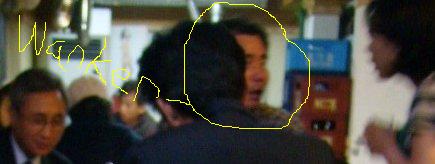
If I knew you’re name I’d write it in red!
In Korea, writing someone’s name in red is very unlucky and is only done after someone has died.
After-note: Ji-won sustained no injury other than the arm of his glasses being broken – he was compensated by 400.000 Won (£200)!
© 林東哲 2011 Creative Commons Licence.
Cultural Clashes – March 25th – 2001 (Korean Accounts 2000-2001)
I am still giving Ji-won a lesson on a Saturday evening. His father, Pak Jun Hee is the same age as I and so we have a very good relationship. A new teacher, Lisa, had arrived from the UK and we decided to take her out to their restaurant and during the course of the evening Ji-won asked her age, Koreans always want to know your age. Lisa, who is possibly nearing retirement, was visibly offended and tried to explain that this was a rude question. Of course, asking ones age is a necessity for Koreans as they need to ascertain where to place you within a hierarchical structure and to address you both in terms of behaviour and language. In order for Koreans to form relationships with westerners, especially ones who fall outside their own peer group, they have to invent relationships in order to ratify a friendship. So for Ji-won, I am his teacher, for Ryo Hyu-sun (료휴선), I am his older brother and I have to refer to him as ‘dong seng’ (동생) and correspondingly, he has to refer to me as ‘hyong je’ (형재). When I thank Ryo Hyu-sun (료휴선) I have to use informal style language whereas towards me he uses formal language which is used from a junior to a senior. When I thank him I will say ‘komapda’ while he will thank me by saying ‘khamsa hamnida’ (감사합니다). Needless to say such linguistic etiquette makes learning the language all the more difficult.
Ji-won is a keen student who at the moment is going to school from 7am until 9pm. He will stick to this regime for the next two years. Last week there were classes at Di Dim Dol hakwon which started at 11.15 in the evening. It amazes me how we moan about child exploitation in the west and yet Korean children lead such hideously pressured lives. A fifteen year old boy jumped out of a tower block here last week, and died all because his maths teacher had been disappointed with his ‘average’ maths score.
At the restaurant Ji-won and I sat talking for several hours and then his father came over with some soju and sashimi. Pak Jun Hee often brings sashimi and I think he considers this a treat for me – which it is. However, while I enjoy sushi (초밥), which is small slices of fish on a small ball of vinegared rice, Korean sashimi I am not so keen on. This is a full platter of various cuts of raw fish and the skill of a sashimi chef is dependant on how long he can keep the fish alive as he is slicing off its flesh. As with Korean barbecues, this fish is eaten with a variety leaves, garlic cloves, the Korean equivalent of wasabi (고추 냉이) and red pepper paste (고추장). One places a small selection of fish in a leaf and adds the other ingredients, wraps it and then eats it. Among Korean friends it is quite acceptable to place food, by way of hand, into you someone else’s mouth. Pak Jun Hee made a massive ball, of sashimi, and mostly fish, which I could only just fit in my mouth and I very nearly puked. I can take a little raw fish but not half a pound of a cold, raw seafood cocktail. Lim Sun-hee, who is Pak Jun Hee’s wife could see I was a little distressed but I pretended it was the heat of the wasabi and everyone laughed. Koreans find it very amusing when you find their food too spicy. The ball was so big I couldn’t just swallow it so I was forced to chew that cold flesh into swallow-able portions. Pak Jun Hee’s has invited me to go to Pusan with him on August 23rd, which is his family’s ancestors’ day. Then he will go to his family tomb on the mountain and pay respects to his dead relatives. It is a very private affair and I am quite privileged.
I have taken a short break from taekwon do as I have had constant problems with my left hamstring. I think I need to strengthen it as stretching weakens the muscle and maybe it needs a little building up. I have started some special exercises which I do in the lunchtimes before I go to the mokyoktang.
©Bathhouse Ballads – 努江虎 – 노강호 2012 Creative Commons Licence.
Senior Green Belt Grading – March 10th, 2001 (Korean Accounts 2000-2001)
In Di Dim Dol last week I passed one of Young-seop’s (영섭) classes. The door was open and he was stood out in the corridor. Inside, the entire class of fifteen year olds were sat meditating. Young-seop told me that by seven in the evening many of his students were exhausted and meditating cleared their minds and prepared them to focus on the lesson. When the older students come into the school there are teenagers in every classroom, very often they sit with their heads on the desk taking a short sleep before their lessons begin. They have quite a funny way of doing this probably as the result of years of practice. They usually sit with their arms hanging loosely at their sides and their head on the table.

'filial piety' - an important Confucian value
The spring holiday has just finished and Ji-won tells me that for the next two years he will be in school from 7am until 9pm and I have noticed that there are now taekwon do classes for high school students who have to adopt these hours. While Korean kids seem brighter than their English counterparts, I don’t think they are proportionally better and I am critical of the Korean education system which put youngsters under so much pressure. Most Koreans lack creativity and their education seems to consist of a lot of rote learning. It seems that social control in Korea is exerted through education and employment. A lot of effort in the west is put into moaning about children who do sweat shop labour or are poorly paid in third world countries and yet Korean teenagers find themselves imprisoned in their schools.
During the spring vacation, many boys are visible hobbling on the streets after being circumcised (포경 수술) . You see them hobbling along as if they have just spent several days in the saddle of a horse. I noticed one boy in KFC who was obviously in a lot of discomfort and who kept having to stand up to adjust his underwear.
I bumped into Ji-won last week, he was walking down the road, arm in arm with his mum, Sun-hee. There seems to be much less evidence of a generation gap between teenagers and their parents than is apparent in the west. Several times he has told me he wants to do something his father has recommend, and the reason he gives for this is that his ‘father knows best.’ When it was raining last week, the seventh shower in almost 5 months, a boy accompanied me home under the protection of his umbrella. He had seen me go into a shop without a brolly and waited for me to reappear. He then walked me under his umbrella which as in the opposite direction to his apartment – how nice!
I had a sore shoulder last week and visited a Korean osteopath. They treated my shoulder with some form of electric shock treatment. I wasn’t very impressed but I was given the most amazing head massage. It was so relaxing and weird as it didn’t feel like I had hands on my head at all. It was quite indescribable and I think I will have to go back for another one.
I had my taekwon do grading this week and managed to jump several belts so I now have my senior green belt which is dark green. I was the first person to be called up as I was still the class junior. I had been told I was to perform the patterns, Taegeuk Il Jang (태극 一 장) and Taegeuk I Jang (태극 二 장) and so I had stopped practising the third pattern, Taegeuk Sam Jang (태극 三 장). Anyway, the moment I was on the mat, with thirty or so Korean students sat behind me, Mr Bae asked me to perform my two patterns and then asked if I could perform the third, Taegeuk Sam Jang (태극 三 장). Confused, and not understanding him, I said I couldn’t and so sat back down. I later discovered I’d been given my first green belt. The grading continued with the black belts, which is a large number of the class, going through patterns or performing with sticks or nunchaku. The following day I had someone write a letter for me explaining that I could perform Taegeuk Sam Jang (태극 三 장) and so that afternoon he asked me to perform it and immediately gave me my senior green belt.
I usually go to the taekwon do school early so I can warm-up and do some bag work. I have discovered there is a class where boys aged between 11 and 14 do dance routines to Korean pop music – affectionately known as k-pop. It is really amazing to watch as it is all choreographed and well rehearsed. I had a job telling my instructors that in the west such a class, despite the fact most of the boys were red or black belts would be seen as effeminate and ‘gay.’
©Bathhouse Ballads – 努江虎 – 노강호 2012 Creative Commons Licence.
My Inauguration into Korean Bathhouse Culture – March 1st 2001. (Korean Accounts Part 1. 2000-2001)
On Korean Independence Day, (Sam-il, March 1st), I went to U-chun’s sister’s house with her daughter, Ga-in and her husband, U-no. They live in Changwon (창원) which sits between Masan in the west, and Pusan in the east. They arrived at my apartment in two cars as her sister, her husband and their daughter, Min-ju, are all traveling to Changwon where another one of their sisters lives. It was great to get out of Daegu and to travel in a direction I had not been before. U-chun has five sisters and the one we are visiting has a husband who is an officer in the army and hence they live in married quarters. The quarters were outside the city and everywhere, as it is Independence Day, hung the national flag, the daeguk gi (대국 기).

Ga-in (Olivia), in 2001 (Sam-il)
U-chun’s sister’s family live on the top floor of the apartment block so there was a great view of the surrounding countryside.
On the journey to Changwon, U-chun asked me what three things I wanted to do before I left Korea. I said I wanted to eat pondeggi which is steamed silk worm cocoons, eat dog soup (보신탕) and go to a bathhouse (목욕탕 ). Now I have no great desire to eat cocoons or dog, but I do think I should fleetingly sample them before I leave. As for the bathhouse, which in Korean is called a mokyoktang, all that is stopping me is a fear of nudity and an insecurity at my own physique. Nana outright refuses to visit one and this is now his fifth year in Korea. Most westerners I meet here have not been to them and many don’t even know they exist. I am drawn to them simply as I am afraid of them and see them to be Korean enclaves.
Anyway, U-chun laughed and said that they were planning to visit a bathhouse this afternoon. There was a strange plummeting sensation in my stomach, like I was suddenly falling at a very fast rate. At first I thought she was joking and then I tried to tell her that I was planning to visit one in the final week or so of my year I Korea. She didn’t seem to understand!
At U-chun’s sister’s house we drank cold green tea and then walked to a nearby restaurant. There were perhaps fifteen of us all together and of course, I was the centre of attention. We were served fish, a very ugly fish which I suspect was monk fish (악귀) as its mouth was massive. Several fish were placed on our tables, all smothered in noodles and drenched in red pepper paste. I didn’t really enjoy it. As always, there were a variety of side dishes one of which was a selection of very chewy meat. I asked U-chun what it was and her and her husband grinned. ‘it’s ddong chip.’ She replied. Now, my knowledge of the Korean language isn’t extensive but I do understand the word ‘ddong’ (똥) as this word I found written all over desks in my classrooms in my first week in Korea. The word was usually written under a drawing of a turd that curled upwards into a little point rather like Mr Whippy ice-cream. ‘Chip’ (집) is simply Korean for house. So I was eating chicken’s arse! Korean food is very often Klingon in nature and I didn’t eat anymore from that bowl.
After the meal we walked to a nearby traditional potter’s work house. The outside of the building was a regular concrete structure but the interior had be decorated to resemble and old, traditional lodging and work place. There were wooden rafters on the ceiling with a papery material stretched over them. Wooden posts had been sunk into the floor and the walls were paneled in wood. Everywhere was covered in Chinese characters and in one room they were even on the walls and ceiling. The potter sat at a wheel making various objects which were later to be fired and put on display. We ordered some dongdong-ju (동동주) which we drank from traditional gourd bowls. I would love a recipe of this drink as we have nothing like it in the west. It is a creamy rice wine which hasn’t been strained and which seems to be the tipple of peasants and farmer folk. As we were walking back to the apartment block, reeking of smoke from the wooden fires in the potter’s shop, U-chun told me the next stop was the bathhouse. Suddenly, the sinking feeling returned.

Sam-il 2001, in a traditional restaurant and potter’s shop on the day of my first visit to a Korean bathhouse
In U-chun’s sister’s apartment, I was offered the choice of staying with the women to play games, or going to the mokyoktang with U-no and two other male relatives. I couldn’t stay with the women without losing face, though they wouldn’t have minded, and so I decided to swallow my pride in the mokyoktang. I was really nervous but I wasn’t going to back out of the experience. At the mokyoktang in Changwon, on my inaugural visit, I immediately saw a few men who were proportionally fatter than I was and any insecurities about the genital department quickly evaporated when I realised that there were very little differences between people. I was quite honoured when two strangers volunteered to scrub my back for me but it was a weird experience. It was wonderfully liberating to be naked with other men and boys and not feel in anyway assessed or eyed up. Nudity in the west is always accompanied with sexual overtones or notions of masculinity which detract from the experience’s potential pleasures. Next to me a boy of about fourteen rubbed his father’s back and then the father rubbed his. I had a slight shock when the boy lay down and his father began rubbing his son’s chest and then moving his dick and balls to one side, scrubbed his groin. The boy then did the same to his father.
My only qualm on my first visit to the mokyoktang, besides squatting on one of those little seats, was bending over to pick up the soap. I felt this a far to undignified act to perform. U-no spent almost an hour scrubbing himself and I did notice that when the boy beside me was having his back scrubbed, a small line of dead, grey skin was being stripped off. Koreans actually have a word for this skin, ‘dae (때) which translates as ‘dirt.’ The abrasive cloths they use, which come is several gradients are almost like sandpaper. When we left the mokyoktang, U-no said to me, Nick! You are a new man now!’ I think he meant it in the sense I was clean but I interpreted it more mentally as the experience was a landmark in my visit to Korea and in my personal development. It was an experience that quite liberated me but has remained an experience I can only enjoy in Korea.
I have since been in three different mokyoktang premises and they are all fairly similar in what they have to offer. The changing rooms are large and opened planned and there is usually a television around which people sit naked or dressed either drying off or recuperating after the session as it can quite tire you. When you go from the changing room area to the bathing area you have no security at all as you are totally naked. Everything is supplied for you and so you have to walk past the relaxation area without even the safety of a face cloth or towel. I actually felt so naked that even my watch and dog tags gave me some minuscule sense of security.
Once in the bathing area there are plenty of high powered showers which you can adjust from freezing cold to scorching hot. Next there are rows of showers where you sit down on a small plastic stool which is not much bigger than a washing-up bowl. In front of you, as you sit, is an enormous mirror and it is here that you do most of your scrubbing clean. One my first visit I avoided these showers as the seat is so low to the floor that even if you have a relatively small belly, it is highlighted. Soap, toothpaste, razor blades, salt – for scrubbing your teeth, towels, abrasive body cloths are all provided. In the bathing area are usually a number of pools which would include a hot pool, a cold pool, a warm pool and often a Jacuzzi. Around these are a number of rooms such as a steam room and various saunas. In some mokyoktang houses are shower cubicles which blast your body from a hundred different vents with ice cold water.
I have fallen in love with the Korean mokyoktang and not for any seedy reason. In fact, since I started this diary entry I have made six trips to different establishments around Song So (성서). First of all, no one ogles at you. Koreans, by their nature will have a little inquisitive stare but will look away very quickly as starring is considered rude. I surmise that Koreans will have seen thousands of bodies by the time they become adults and everything I have to offer, other than Caucasian looks, will have been seen many times before. The mokyoktang, experience has given me a deeper insight into the Korean psyche. Koreans are impeccably clean and have a very healthy attitude towards nudity and physicality albeit within gendered confines. Many of the insecurities that exist in the west I should imagine are unknown here. I doubt few teenage boys or men grow up worrying about the size of their penis. I can remember the hatred I had as a teenager when it came to school showers and there were many of us that used to try and dodge them. For some perverse reason showers only ever seemed to be enforced around the age of puberty. Korean mokyoktangs are full of men and boys of all ages who visit with their friends or alone and obviously have no worries about nudity. When I last taught PE in an English school, probably around 2003, boys undressed underneath enormous towels and even one boy saw another naked both observer and seen were deemed ‘gay’. How pathetic!
In the week following my visit, one of the foreign teachers from the Yon San Dong school suffered an emotional trauma over an experience she had in her classroom. One of the bosses of the school, a guy we call ‘Scary Hat Man, as he always wears the ridiculous looking stetson, was playing with Mr Jo’s youngest son. She saw him playfully pinch the boy between the legs. The event traumatised her and she was sat crying inconsolably. She ranted on about leaving Korea and that she couldn’t work in a school wear a boss was a child abuser. Recently, the relationship between the foreign teachers in the school has been a little strained and Matt and I tried telling her that you couldn’t judge on western attitudes. I have read that Korean adults will often feel a young child between the legs to determine if it is a girl or a boy and that this is quite acceptable. Further, several infant boys have pinched me between the legs and run away laughing, this has happened more than once. Another common behaviour is for children to clasp their hands together with their index fingers protruding, and then to poke you up the backside. This is always accompanied with the Konglish (mixed English and Korean) exclamation, ‘Ddong Injection!’ (‘shit injection!’) This is always a group activity, or perhaps I should say attack, and is always accompanied with laughter. When I told her about the father who moved his son’s dick and balls to one side to scrub his groin, she promptly shook her head and said ‘I don’t want to hear this!’ Her attitude is annoying as I feel that when she is in my class I have to censor the way I act though I have no interest in feeling a kiddies crotch. I am just concerned she may interpret my sitting a child on my knee or touching a child as ‘sexual.’
Another thing I have started doing here, in order to live the Korean experience, is making slurping noises when I eat and making those throaty noises when my nose or chest is blocked. Loudly clearing your nose in the mokyoktang gutter is quite acceptable and actually enjoyable. It provides a wonderful sense of personal freedom though I am sure such habits will cease when I return to the UK.
©Bathhouse Ballads – 努江虎 – 노강호 2012 Creative Commons Licence.
Daeboreum Festival – February 10th – 20th, 2001 (Korean Accounts 2000-2001)
There is a local store just around the corner from where I live and outside stands one of those recreational machines where you lift objects by means of an automated hand and deposit the ‘prize’ in a draw which you can then open. The hand is operated by ‘left, right, up, down’ and ‘grab’ buttons and the prize is usually some fluffy toy. Well, not here! Here the prize is a small lobster. How horrid, being subjected to a game before being put into a pot of boiling water!

some game machines near my 'one-room'
Last weekend I went to Pak U-chun’s house on a Sunday afternoon. They picked me up in their car and drove me the short distance to their house not far from Song So but in another valley which lays in the Dasa area (다사). Daegu seems to be one sprawling mass of small businesses with intermittent islands of towering apartment blocks which rise up at various points around the city. We had only been in U-chun’s house a few minutes when she asked if I would like to visit their church as they were having a festival. My bum hole quite puckered at the thought of having to enter a place of Christian worship and for a fleeting moment I thought that perhaps she was trying to convert me. However, I decided it was an opportunity to see a different part of Korean culture.
The drive took us about twenty minutes and we left the busy city, crossed the river and passed through the rice fields. The ground everywhere is parched and brown and rather bleak looking and I am looking forward to seeing Korea in the spring when everything is supposedly lush and green. I am particularly looking forward to seeing Korea during its brief monsoon period as the landscape must look very different to now.
There are many Christian churches in Daegu, both protestant and catholic. I actually saw some Korean, catholic nuns walking passed my apartment a few days ago. The churches are mostly small but cater for the immediate Christian population and are all marked by a small spire and a cross that at night lights up in neon red. This was one of my first impressionable sights when I initially flew over the city on my arrival. Often, the spires aren’t part of a church building but a small scaffold type structure on the top of a building in which are located various businesses. Apparently, Korea is approximately 50% Christian and 50% Buddhist. U-chun’s church, still within the Dasa area, was actually a building on its own and resembled a western style church in its architectural design. Outside, teenage boys, dressed in suits, played football. Surprisingly, the festival wasn’t for a traditional Christian event but one based on the Korean lunar calendar (daeboreum) – the celebration of the first full moon since the start of the Chinese, new year. This year it was the 15th of February.
I had been in Pak Jun-hee’s, Ji-won’s father’s, restaurant a few days earlier and they had given me food traditionally associated with this festival but at the time I hadn’t understood its significance. The entrance to the church had several ante rooms where older members of the congregation sat cross legged around a mat playing a stick game – the same one played at Ryo Hyu-sun’s house on New years Day. The main hall was very large with a small stage at one end on which was an organ, a grand piano, choir stalls a drum kit. In the basement was a large room where food was being served and so we sat and ate together. I was expecting a bit of a feed, especially since U-chun had described this as a ‘feast.’ The food, consisting of three grain rice, or was it five grain? I’m not sure, and spinach and mijok (미역), which is a seaweed soup, kimchi and moo kimchi was rather bland and uneventful.

Lunar New Year with Hyu-sun's mum and dad (Feb 2001)
The minister’s wife pressed me for some English conversation classes which I had to decline as I have almost no time to myself. The minister had spent several years at Durham University and spoke good English but he didn’t seem to understand what an atheist was! One thing that pisses me off about religions is that they generally consider a non-religious person as being in some way less moral. I often feel a sense of guilt when explaining to religious people like ministers or convicted Christians that I am an atheist. The fact is I probably have a more developed sense of morality than many Christians and it is reflected in my politics, personal life perspective and many of the things I do. The minister showed me around his church and in his vestry presented me with a bible and a large crucifix carved by one of his congregation. I quite cringed at this though his gesture was quite touching. It crossed my mind to perhaps come along to a service as I find the communality of congregations appealing and it is a sure way of making friends. I once considered doing this in Wivenhoe as it would probably have been a good way of getting some sex! Many religious people I consider mentally weak and sometimes the allure of a body and sexual gratification is as powerful as a crucifix and the redemption of Christ. The religious are often people searching for reason, explanations and rationales and there will be some who are easily lured into deviant sexual activities – they just need something to believe in!

Lunar New Year 2001 (Ryu Hyo-sun's family)
Friday was a very busy day as I had to give Pak Dong-soo a lesson at the taekwondo school. On the way to the school I had arranged to meet up with this western guy called Gerry and then met up with U-chun as she wanted me to make a phone call to a friend of hers in the USA. I had to squeeze all this in to two hours. In the evening I went training and the session was grueling. Earlier in the week we had a session of taegookkwon (태국권) which is a form of Korean tai-chi and we also had a weapons session using sticks and nunchaku.


 Elwood 5566
7 comments