Greenvill Sauna – Banwoldang, Jung-gu, Daegu
First visited on Thursday 19th of May 2011. Greenvill is very easy to find given its location to the main road downtown and the nearby Banwoldang subway. Though situated in the Samjung Greencore Apartments (삼정 그린코어) complex, it is only a five minute walk from the subway itself. At the bottom of this post you will find comprehensive instructions on locating the premises.
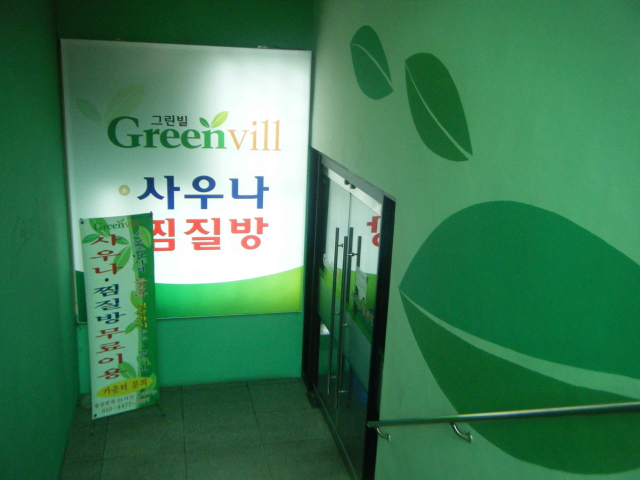
Greenvill Jjimjilbang in Banwoldang
The changing facilities are large and spacious and the staff friendly. I was visiting on a lunchtime and there were only a few customers but I would suspect it might be busier in the evenings. The bathhouse itself is not large but it bright and fresh with numerous murals on the walls and interesting features, for example, a large dolphin stands in the corner of one pool, as if rising out of the water. The bathhouse (male) itself is approximately an ‘L’ shape with the main pools in three corners. There are probably around twenty stand up showers, giving some guide to the more experienced bathhouse user, as to the size of the premises, and close to these the hot (열), warm (온) and event (이벤트) pools. I often joke about the event pools being uneventful but this one was more exciting and a large ‘poster’ on a nearby pillar forecast the weekly aroma schedule: I was there on a Wednesday so the aroma was ‘grape’ and beside looking like a gigantic glass of wine, there was a pleasant hint of grape juice. Other aromas, changed on a daily basis, include menthol, lemon, chrysanthemum, mugwort, ginseng and pine.
In the far corner is a small massage pool (안마탕) with six massage stations. Beside this are stairs leading up to an open planned, infra-red lit, sleeping room. In another corner was a large and very cold, cold pool (냉탕) with attractive blue tiling and a large mural backdrop. There are two saunas: a steam sauna and a spacious pine sauna with various levels of decking and room to sleep.
In all, a very new, clean and relaxing bathhouse though perhaps not providing the most extensive facilities, it is certainly well worth a visit especially if you are in the vicinity or need a place to stop overnight.
Location – The Wikimapia site already had a marker for Greenvill but it was not in the right place. Locating it exactly is difficult as it is within the apartment complex so I took the liberty to update the map. However, the complex is easy to find and I have given some extra pointers. I used a taxi to Banwoldang and my directions are from the subway on the side of the road where traffic is heading downtown and the massive Donga building is directly in front of you.
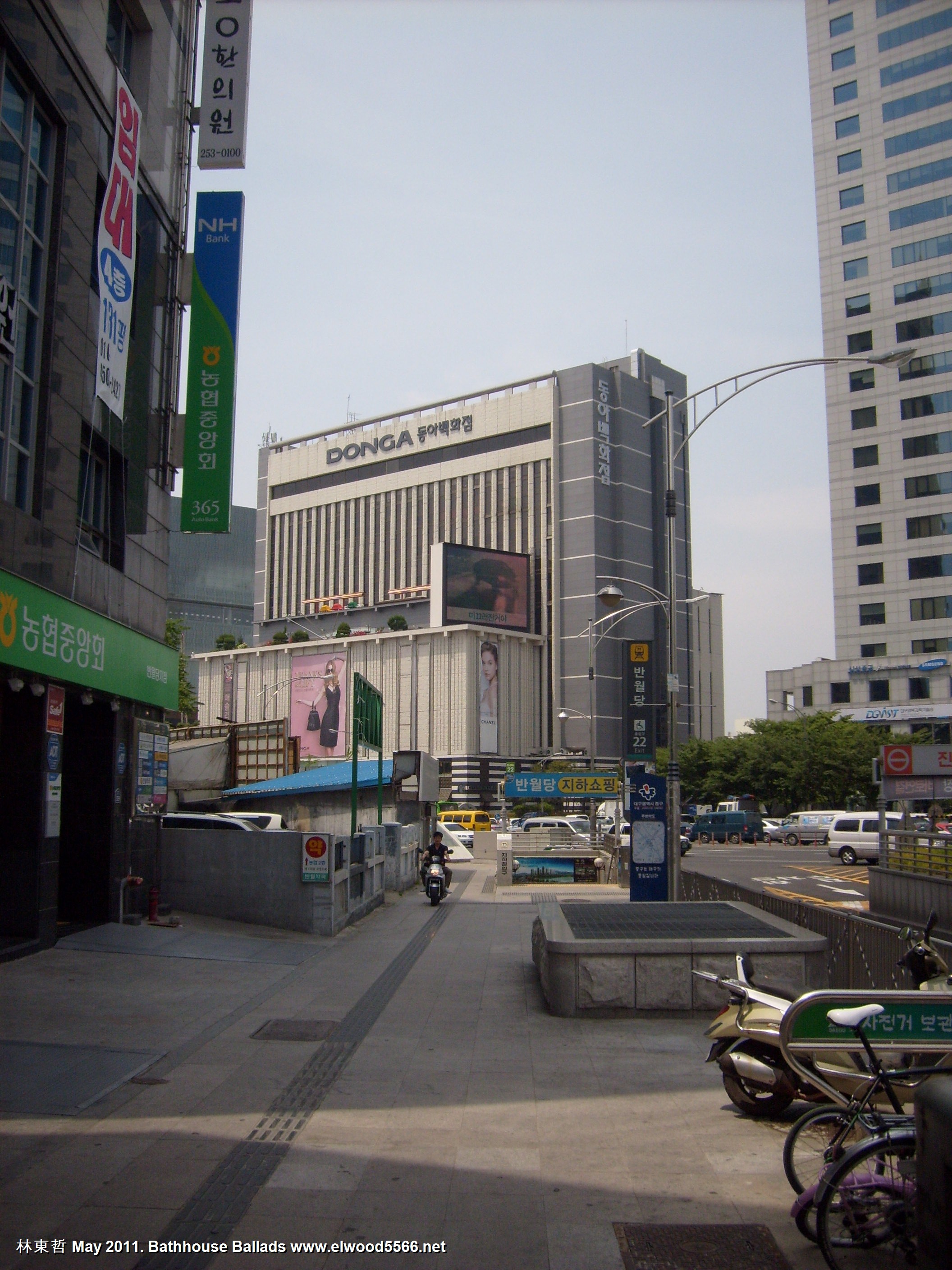
stand in directly in front of Donga with the subway exit on your right. This photo is slightly around the corner from Donga
Behind you you should see a flower shop with a small road leading up to an apartment complex. At the foot of the apartments on the hill you should see the Buddhist symbol as there is a temple here.
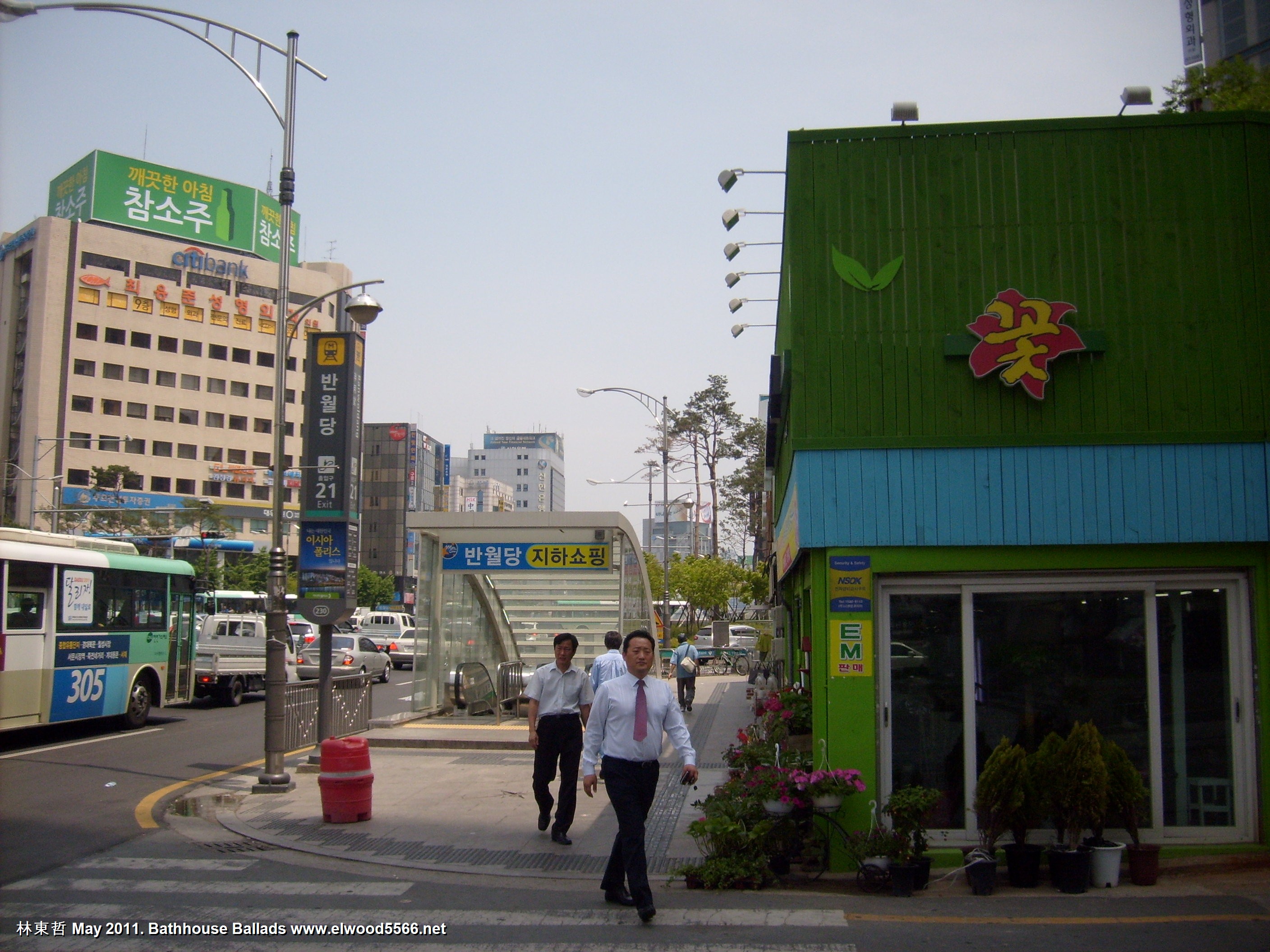
The subway on your right and Donga directly in front, the flower shop is behind you. Start up this road…
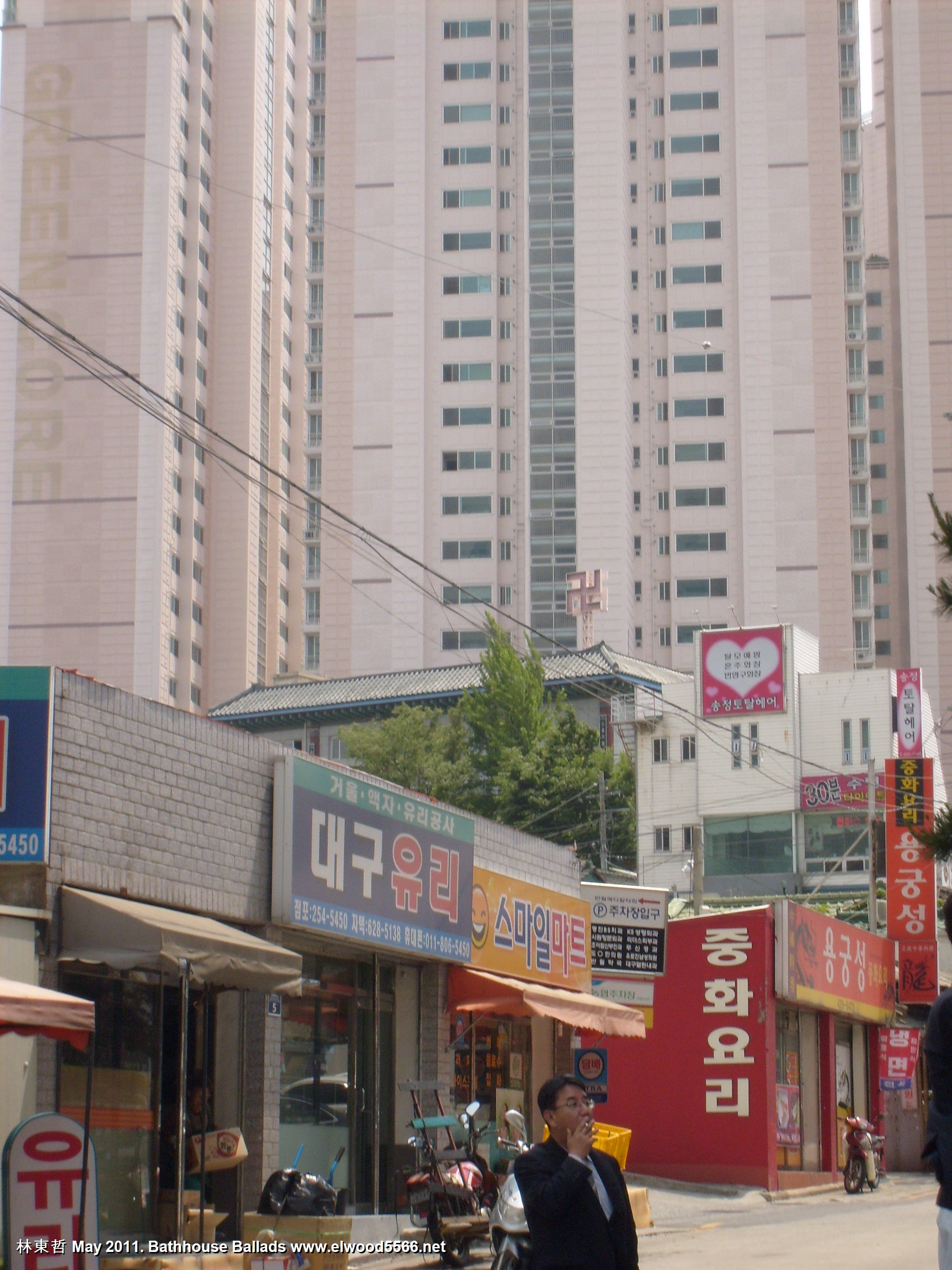
The Buddhist temple is on the top of the hill at the foot of the apartments
Go up to the temple and turn right in front of it. You will then see the turning on your right taking you into the Samjung Greencore Apartments (삼정 그린코어) complex. A small square sits in the middle at the opposite side of which you will see a flight of stairs. Go down these. You are now going past the sauna, it is actually on your right and when you reach the foot of the stairs you will find the entrance.
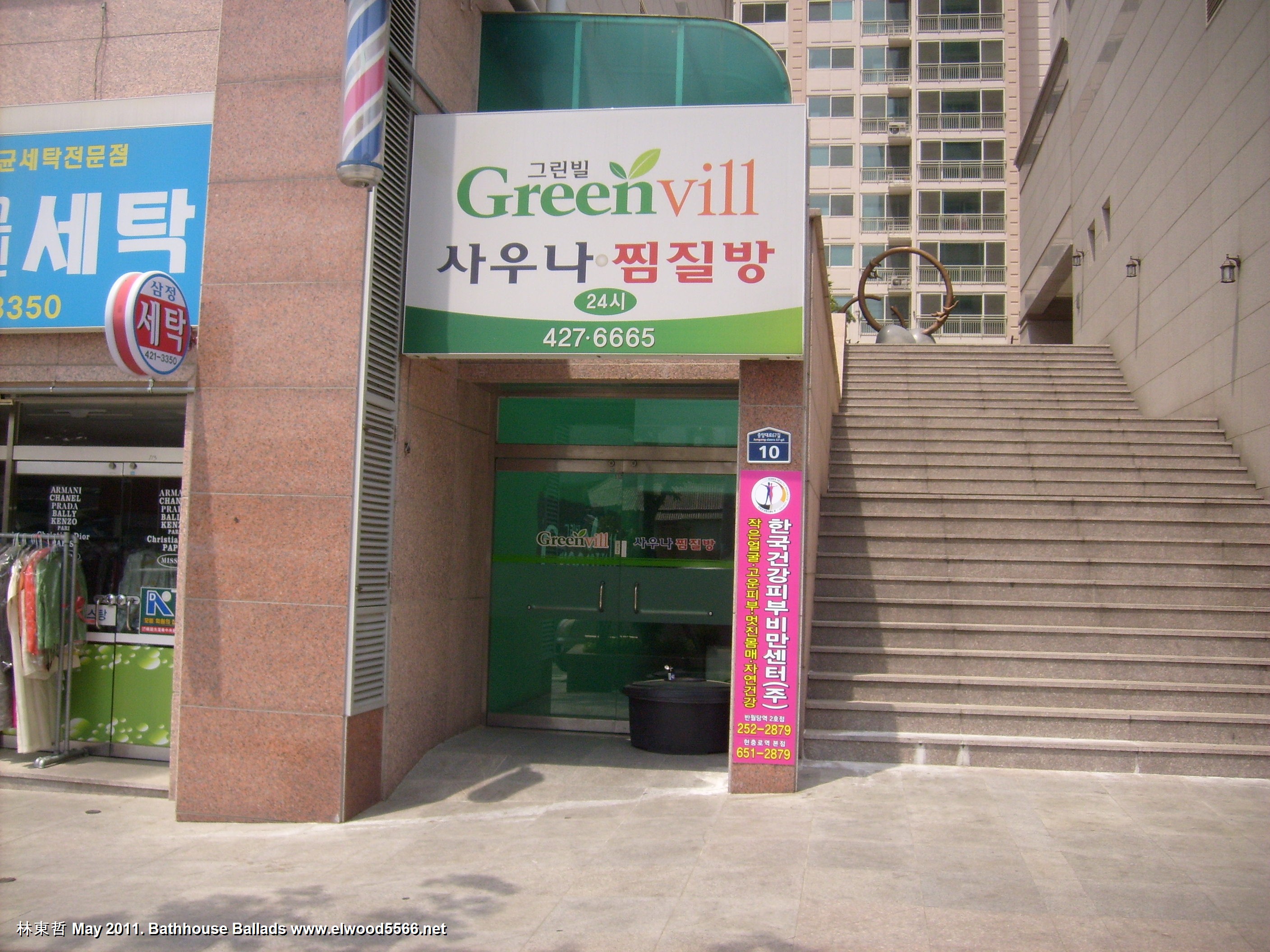
one of several entrances – the other is via the apartment car park
If you come out the exit and take a right and a right, or a left and a left, you will easily find you way back to the Donga building area. Coming out and taking a left and left will take you past a string of Buddhist shops. (Wikimapia link )
Times – 24 hour
Facilities – barber, shoe shine, large changing room with TV.
Jjimjilbang – includes an ice room, DVD room and various other facilities.
Bathhouse (men) – around twenty stand up and perhaps 30 sit down ones.
Cost – 4.500 Won for the bathhouse
Others – Basement car parking. Right next to Banwoldang subway line and on the main bus route (405). An interesting area with many shops and department stores.
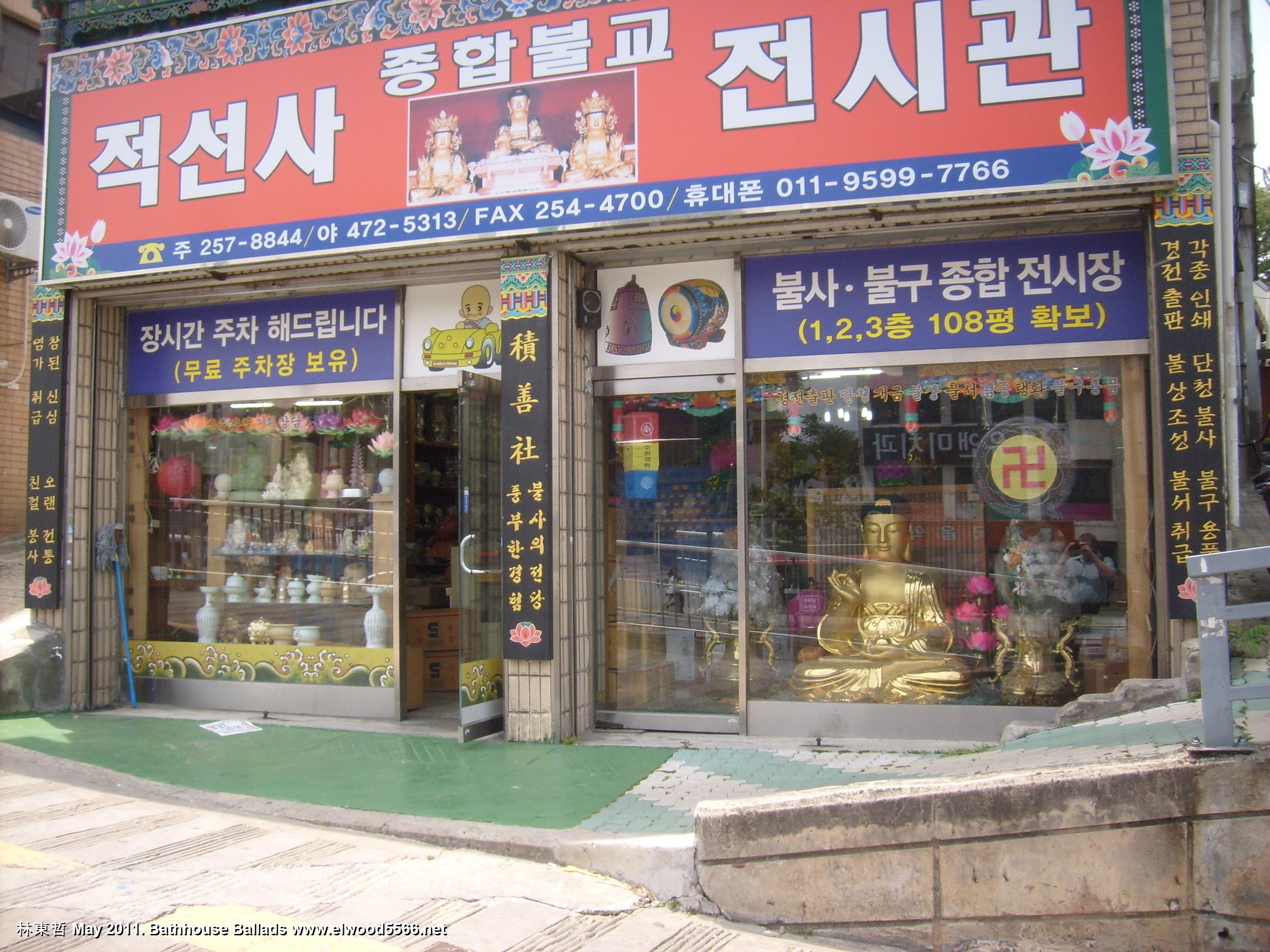
one of the numerous Buddhist shops in the area
Ambiance – bright, airy with a subdued infra-red sleeping area.
Waygukin – first visit – none
Address – 대구 중구 남산2동 665번지, Daegu, Jung-gu, Namsan-2-dong 665. Tel:053-427-6665.
Website –
Updates

© 林東哲 2011 Creative Commons Licence.
FURTHER REFERENCES
There is a very useful review of Greenvill at Jjimjilbang and Saunas in Korea (October 2010)
Teacher’s Day
The importance and status of teachers in Korea is reflected in existence of a Teachers’ Day, May 15th (스승의 날). Traditionally, teachers receive carnations from students though gifts of soap, rice cake, fruit or simply small tokens such as candy, are common. If the celebration falls on a weekday, teachers may go on outings and schools often close early or don’t open at all.

Kitty presents me with some carnations
© 林東哲 2011 Creative Commons Licence.
Collected Bathhouse Designs
(Originally published in September 2010) A collection of bathhouse designs that can be used for contrasting design and facility. Some plans are being added to and they are not to scale – they are very rudimentary but will give those with no knowledge of bathhouses an idea of their layout, approximate dimensions and the amenities available. Click plans for establishment reviews.
DAEGU

Daegu subway map (click for legible resolution)
LINE 1
WOLBAE 월배 SUBWAY, LINE 1,
BANWOLDANG (반월당) LINE 1 AND 2. WITHIN WALKING DISTANCE OF SUBWAY
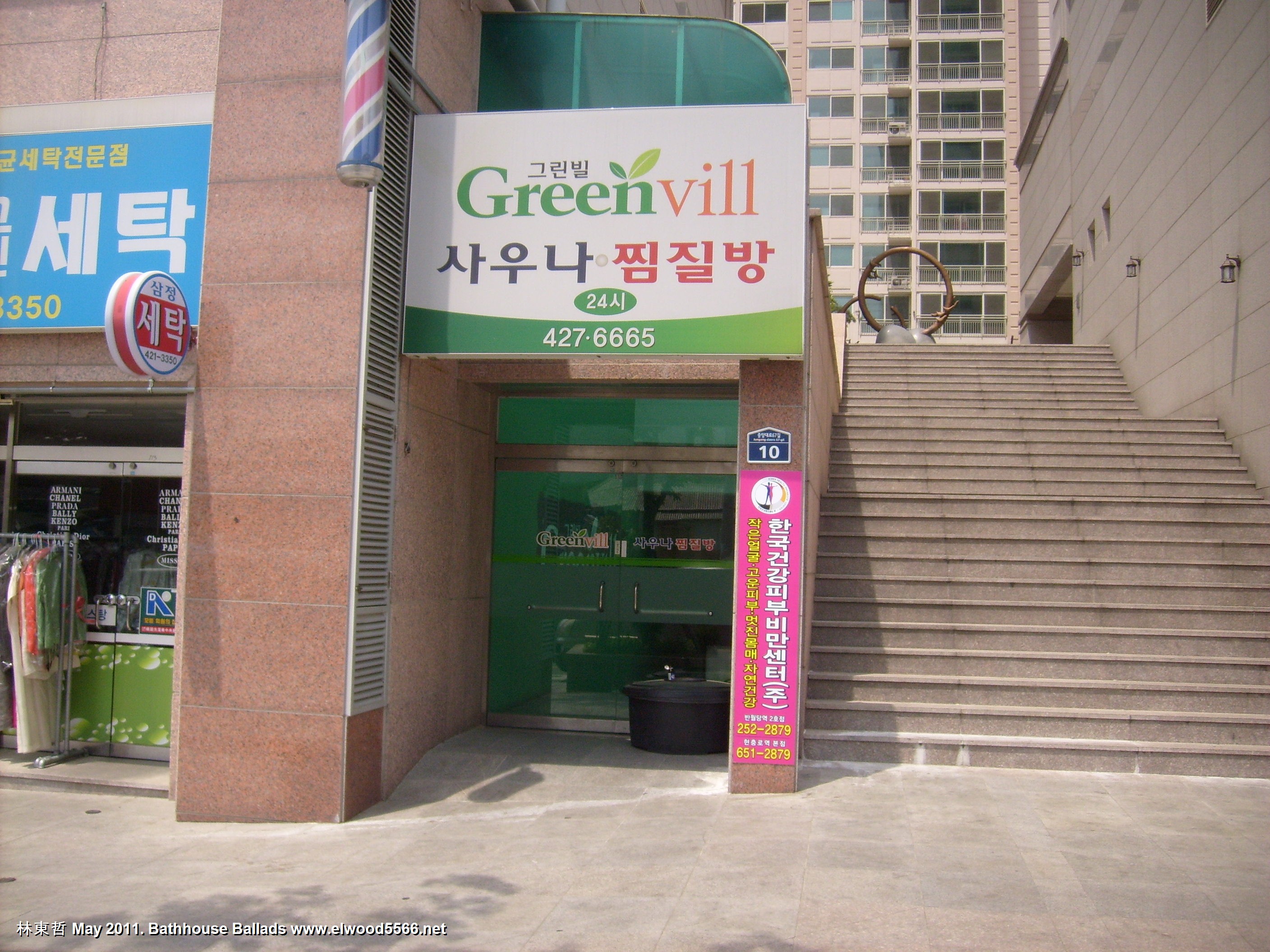
Greenvill Sauna in the Greenvill Apartments, Banwoldang

Greenvill Sauna bathhouse design. Male
DONG DAEGU STATION (동대구) LINE 1. WITHIN WALKING DISTANCE OF MAIN RAILWAY STATION
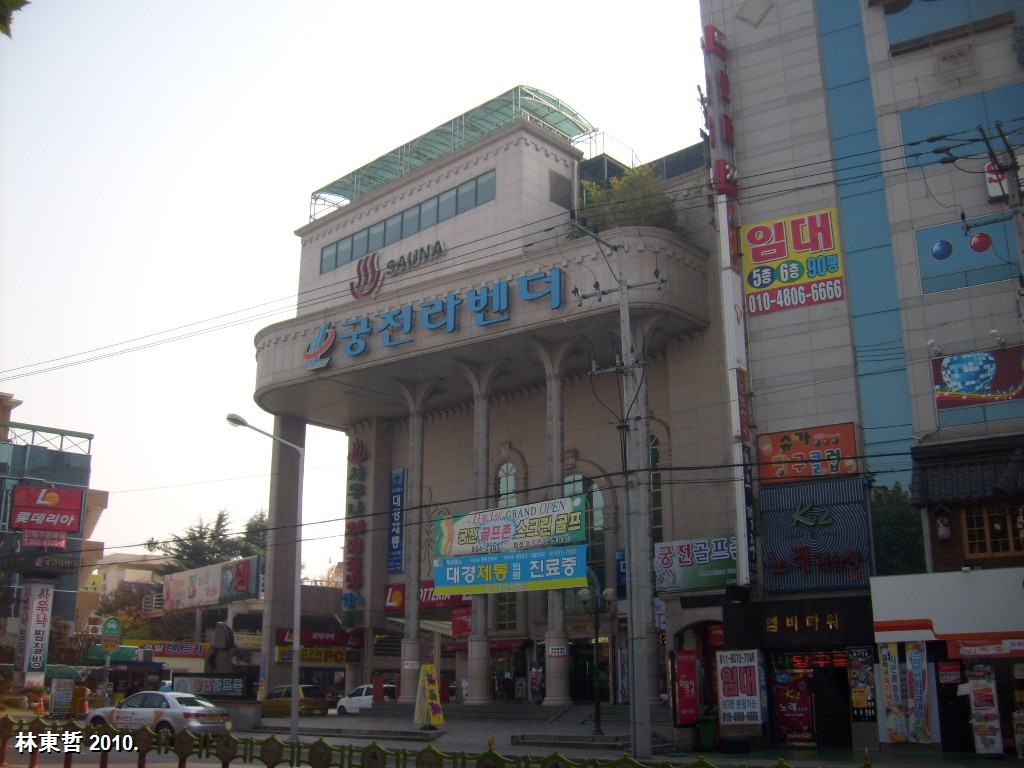
GOONG JEONG LAVENDER
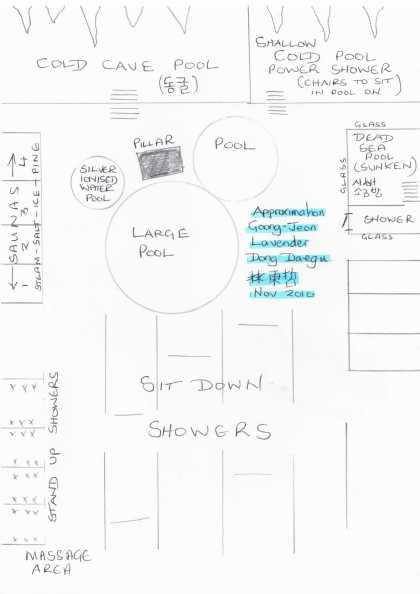
Goong Jeong Lavender bathhouse design (male)
LINE 2
DASA (다사) LINE 2. WITHIN WALKING DISTANCE OF DAESHIL OR DASA SUBWAYS
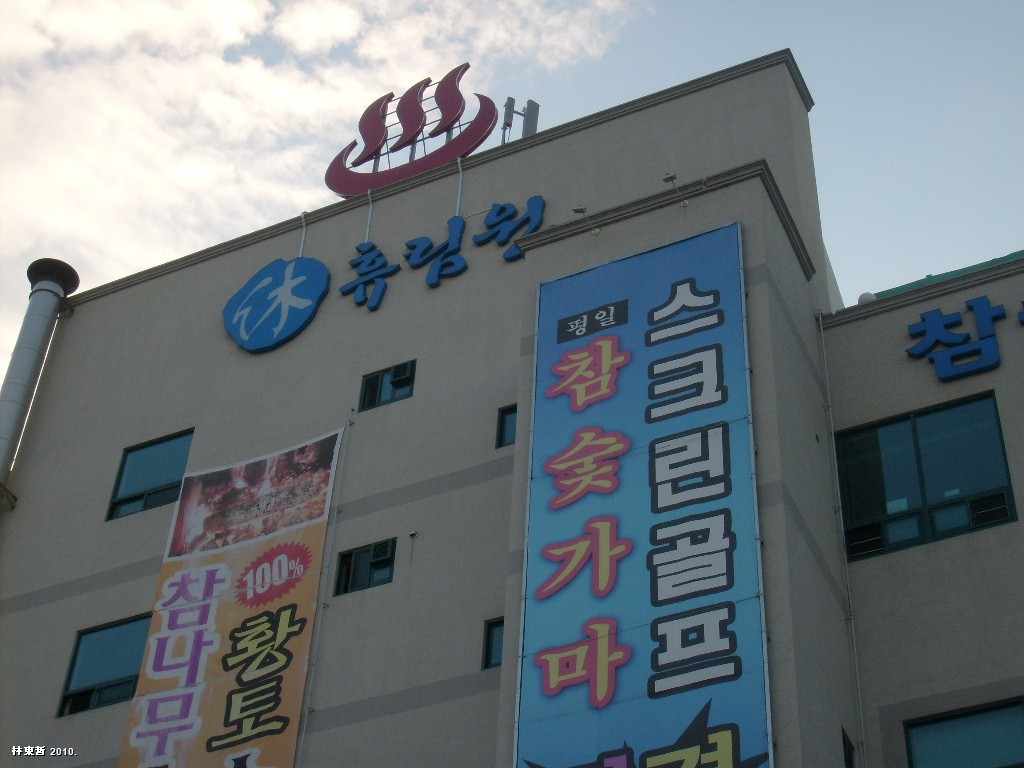
Hyu Lim Won JJimjilbang. Dasa (Closest subway Daeshil)

Hyu Lim Won, Dasa. Bathhouse design (male)
SONG SEO (성서) LINE 2. WITHIN WALKING DISTANCE OF SEONGSEO INDUSTRIAL COMPLEX SUBWAY
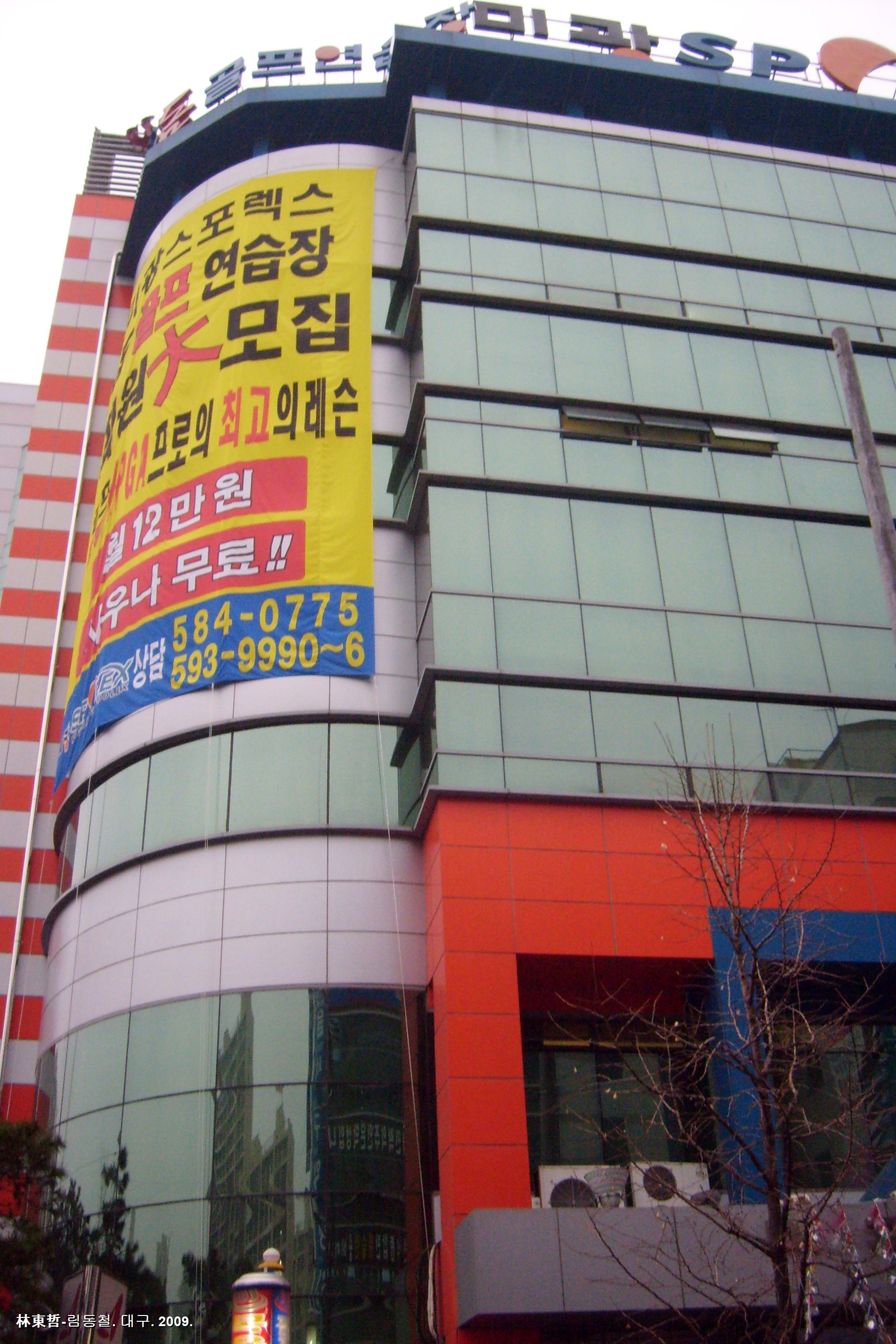
Migwang, Song So, Close to E Mart
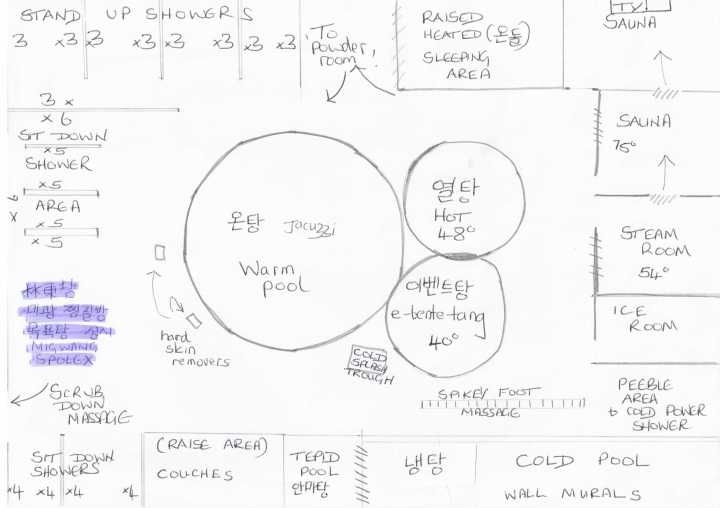
Migwang Spolex. Bathhouse Design (male)

Hwang So. Next to Mega Town and Lotte Cinema Complex

Hwang So, Song So, Bathhouse Design (Male)

Han Song Bathhouse, Song-So. Near MacDonalds

Han Song, Song So. Bathhouse Design (male)
YONGSANDONG (용산동) LINE 2. WITHIN WALKING DISTANCE OF YONGSAN SUBWAY
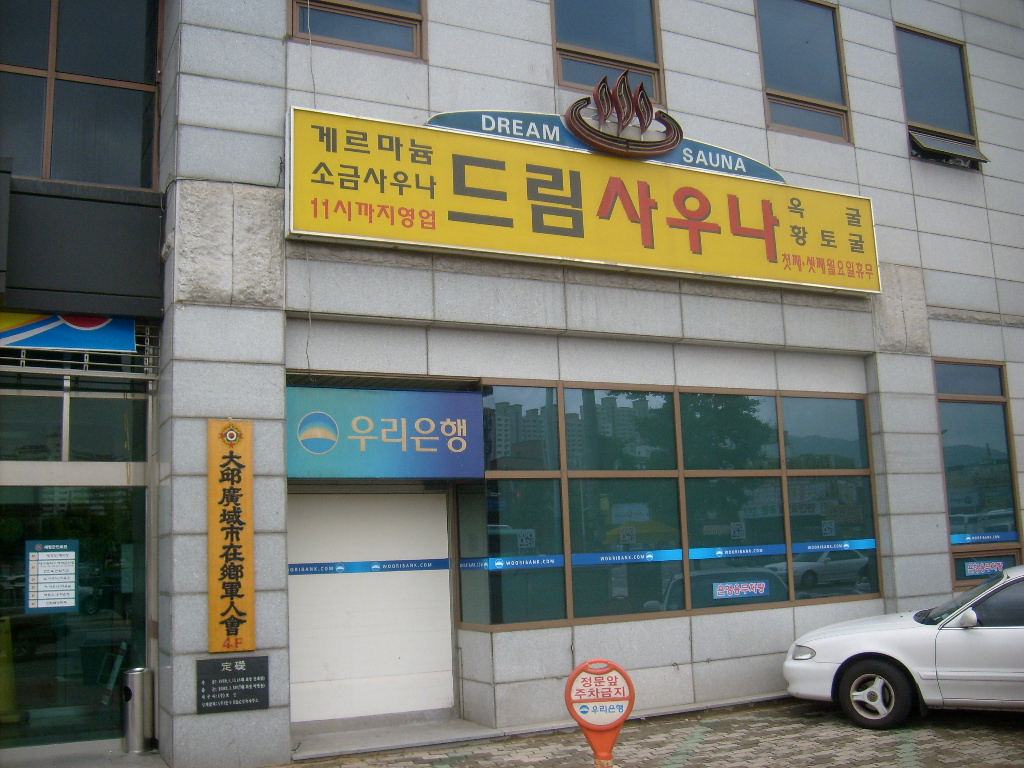
Dream Sauna, next to Home Plus

Dream Sauna. Bathhouse design (male)
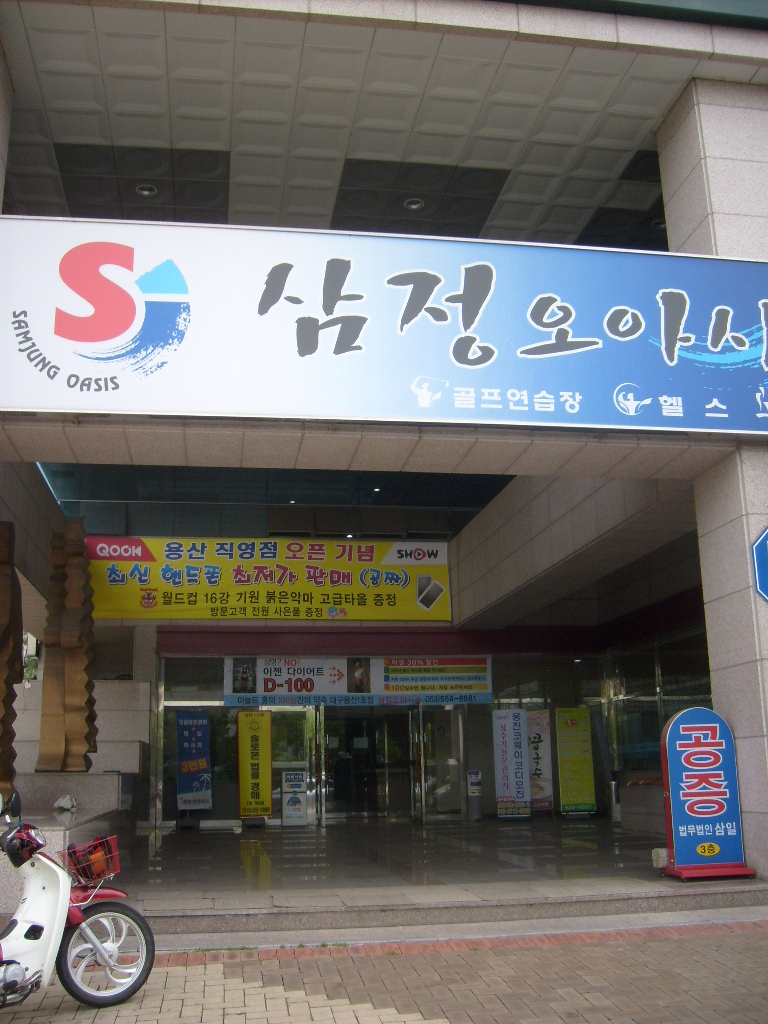
Sam Jeong Oasis Sauna. Behind Lotte Castle

Sam Jeong Oasis. Yong San Dong.Bathhouse design. May 2011
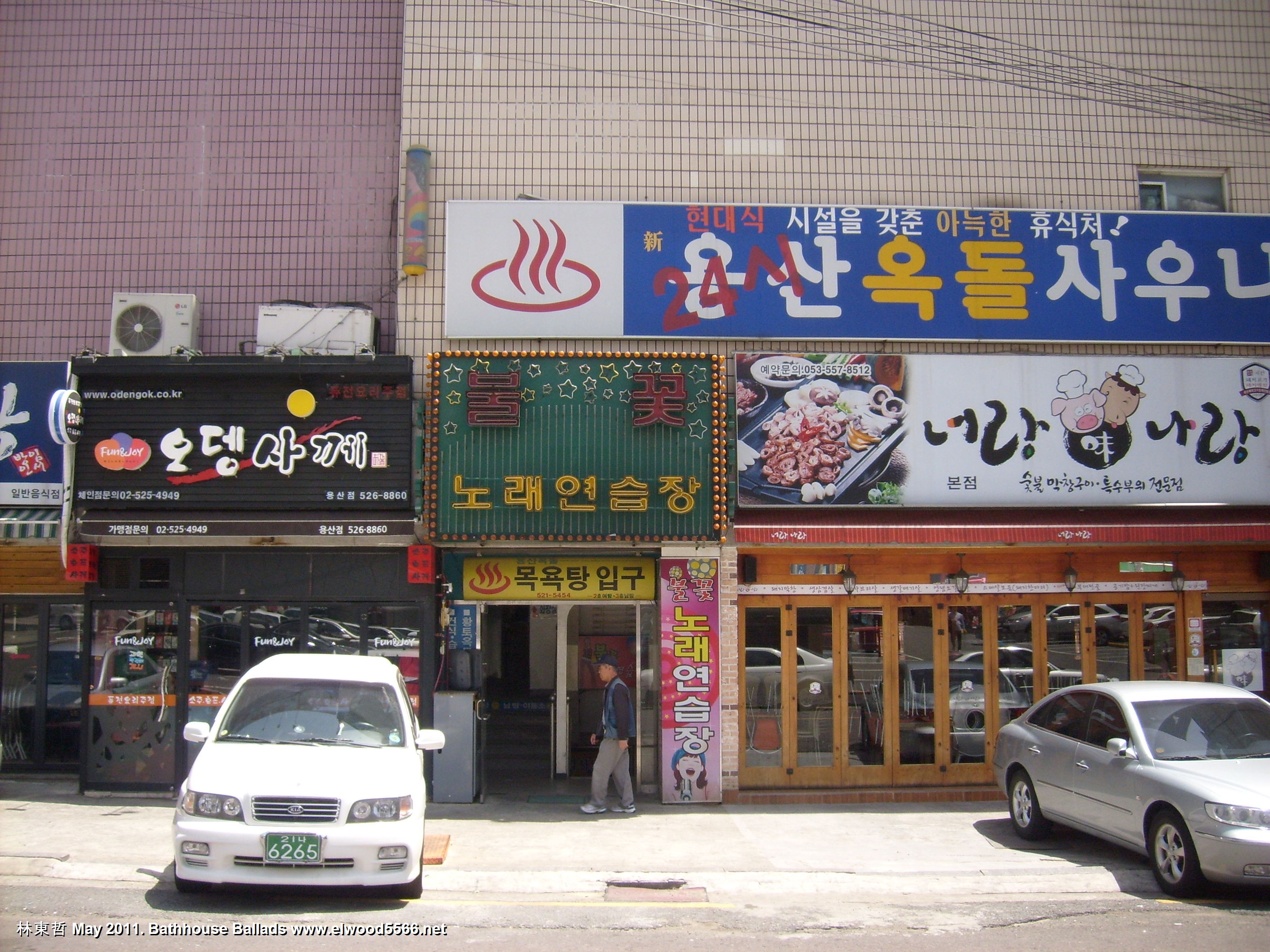
Jade Sauna in Yongsandong

Jade Sauna bathhouse design. Male
WOLBAE (월배) LINE 1. WITHIN WALKING DISTANCE OF WOLBAE SUBWAY.
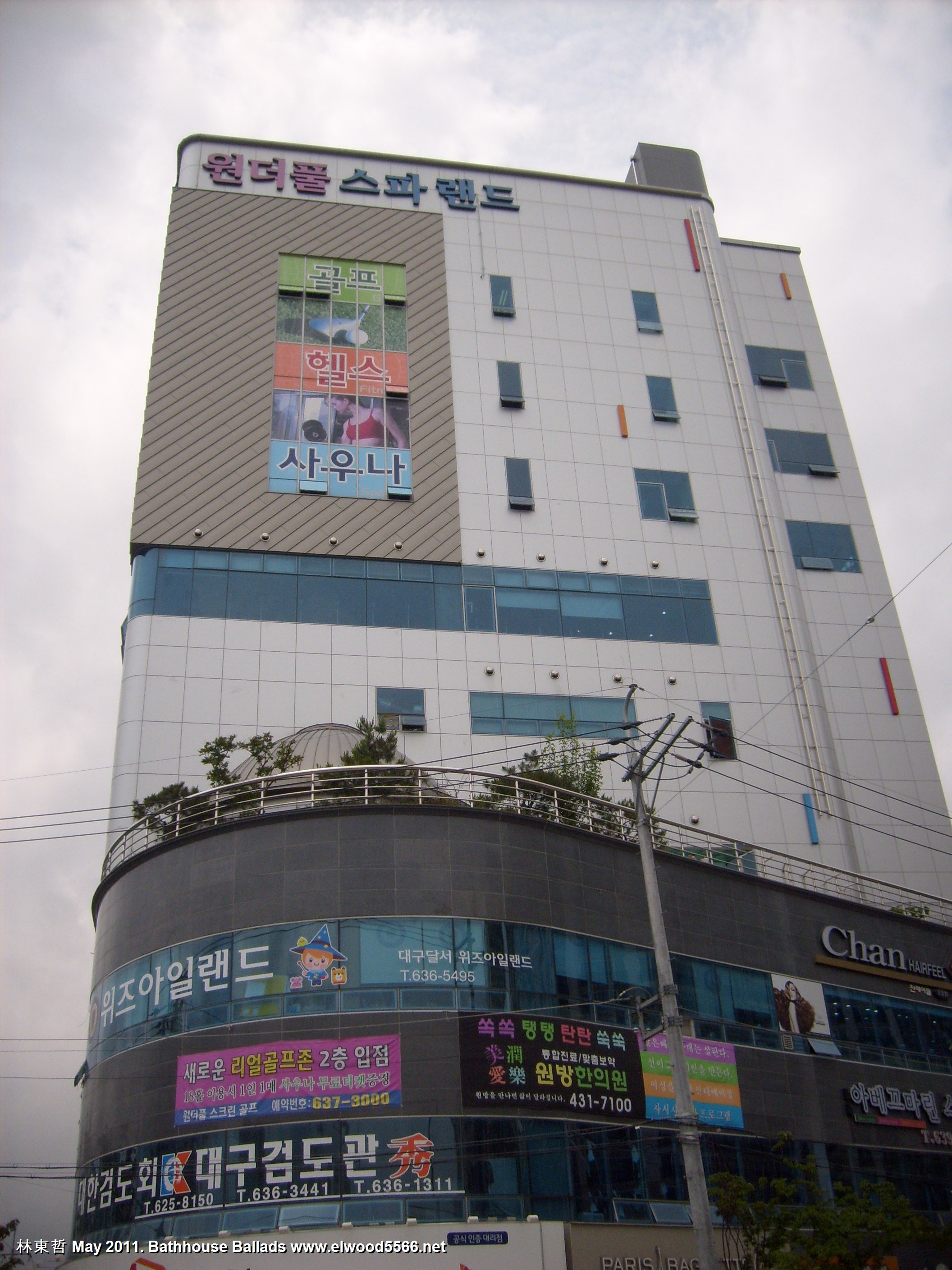
Wonderful Spa Land. Wolbae - awesome!
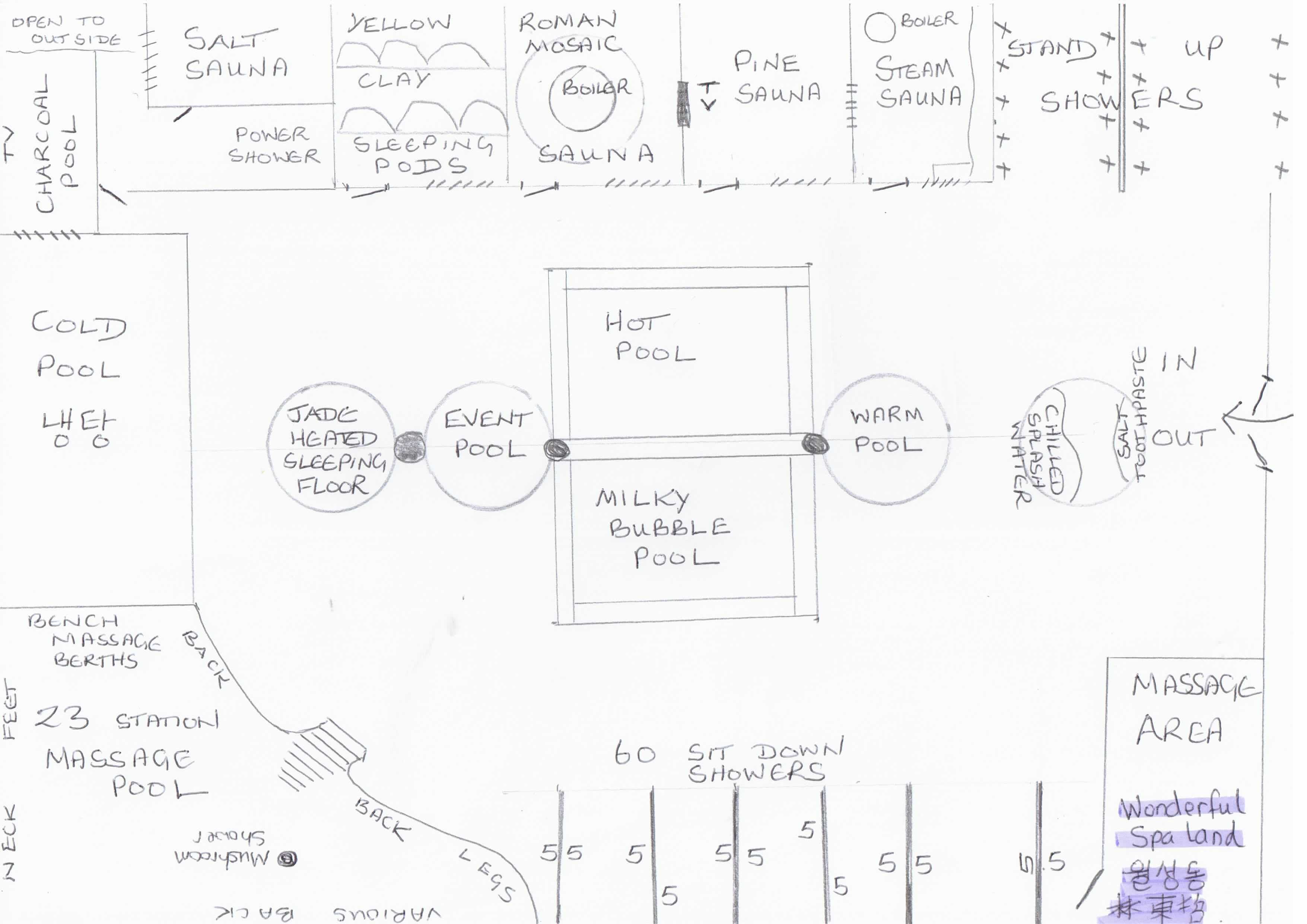
Wonderful Spa Land. Bathhouse design (male)
© Nick Elwood 2010 Creative Commons Licence.
Bratwürst and Kimchi – Fusion Kimchi
My local E-Mart has started selling quite decent German bratwürst and I recently tried them with kimchi. Well, bratwürst and sauerkraut is a common combination so I was thinking a spiced up version should be quite tasty. They worked well together and were okay with mustard but personally, they worked better along with a little potato salad. My kimchi is on the spicy side and the mayonnaise in the salad offsets this.
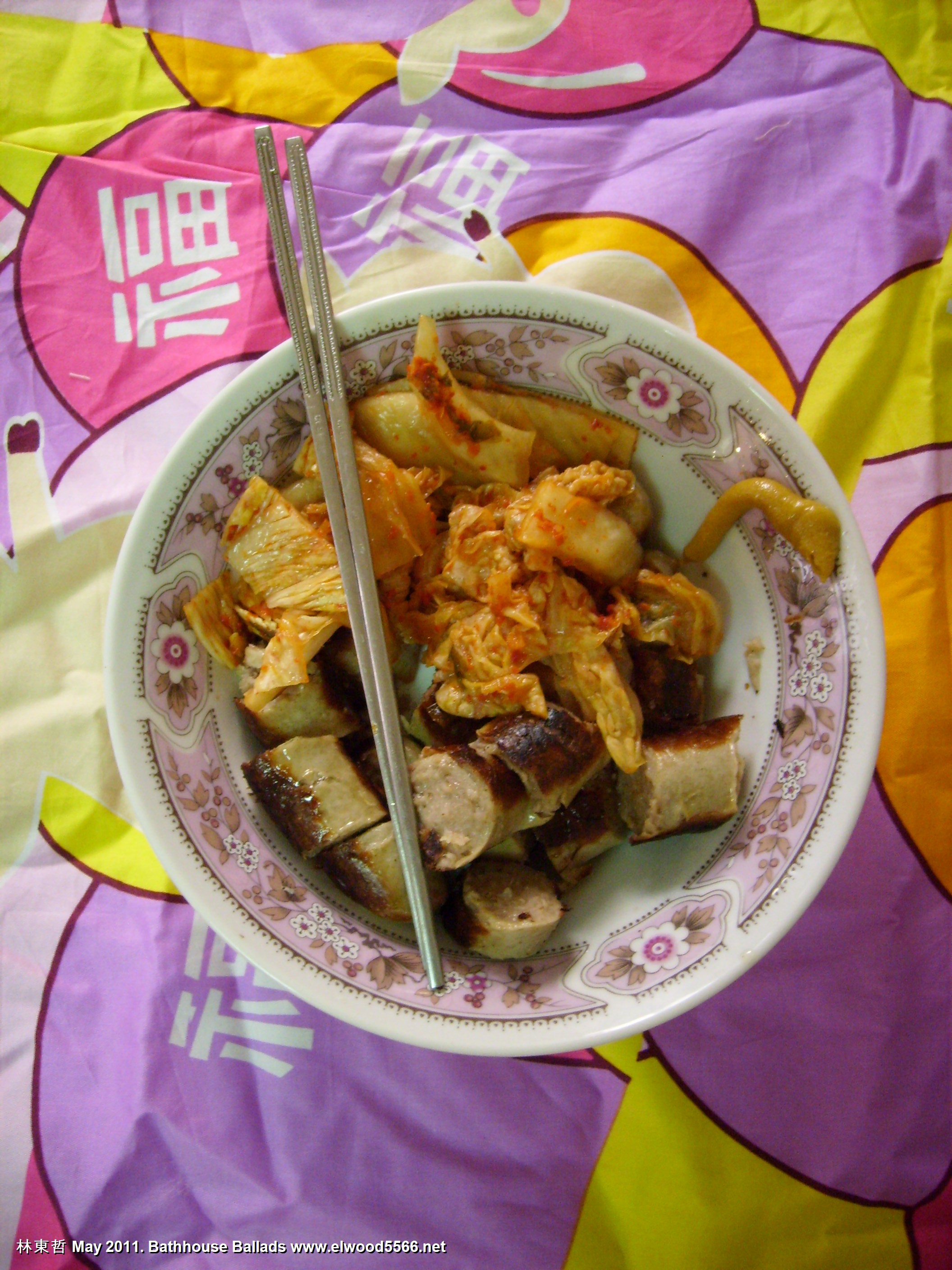
kimchi and bratwürst
©Amongst Other Things – 努江虎 – 노강호 2012 Creative Commons Licence.
Bathhouse Intimacy – Fathers and Sons

Podcast 82
I never really enjoy writing about some of the intimate moments I observe in bathhouses or even in everyday life as many western readers have a real problem with both the authors of such texts, whom they perceive as a perverts, and with the nature of its content, which they categorise, as ‘gay’ and ‘sickening’.
When fathers and sons are mutually washing each other I don’t like to sit and stare but over the last six months and through discussions with Korean friends I have managed to piece together how this process, which might possibly be defined as a ‘ritual,’ functions. At times of the week, usually the weekend, many fathers and sons visit the bathhouse and while for some the cleaning process is the prime function of the visit, for others it is simply for relaxation. I regularly see fathers and sons who will spend as much time cleaning each other, as I might in the pools and it is not in the least unusual for some to spend well over an hour cleaning either cleaning themselves or, in the case of a father, their son.
The process begins with showering under the stand-up showers and entails much the same as a standard ablution – washing the body, shampooing, shaving and brushing teeth. We have now reached the point at which most westerners would consider themselves clean but which for the majority of Koreans is only the preamble to a meticulous ablution. After the stand up shower some visitors go straight to the sit down shower units while others will spend some time enjoying the various pools and saunas. For younger children, this often means playing while older boys are content to sit with their fathers. Most of my Korean friends will soak and sweat in the various facilities for anything up to several hours, at which point dead skin cells and callouses have absorbed water and are easily removed.
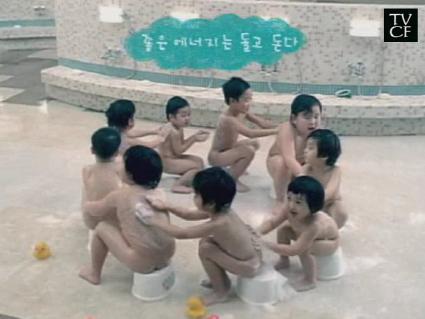
the bathhouse, where ‘skinship’ is taken to the extreme
Between friends, scrubbing each others’ backs is an accepted intimacy and it is not unusual to see peer groups, especially school boys, university students or even monks sat in a line each scrubbing the person in front. Several years ago an advert depicted young boys doing exactly this and attracted some negative and hostile comments from foreigners living in Korea. Unless you opt for a scrub down by a bathhouse attendant, the scrubbing of backs is probably the most intimate extent to which friendships, even between the closest friends, goes and seems much the same as from son to father. However, from father to son, the level of intimacy is much greater and certainly, into middle adolescence, a boy is often totally passive in this procedure. Indeed, there isn’t much difference between how some fathers clean their sons, and how you might wash a car, care for a baby or invalided person.
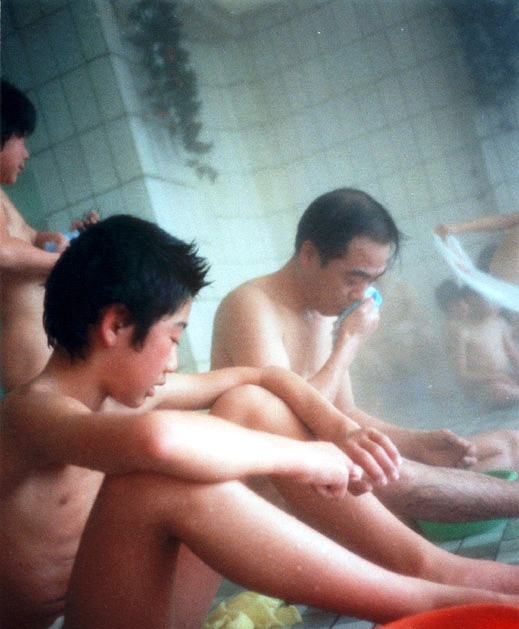
The cleaning process reflects a close bond between fathers and sons
The procedure often takes place in silence and begins with the boy bending over and supporting themselves on the ledge that runs under the mirrors so that their father can vigorously scrub their back with an Italy towel progressing down their buttocks, backs of thighs and calves. For anyone who has visited a bathhouse and seen for themselves this type of ritualistic cleaning, the process isn’t brief or cursory. The Italy towel is used with only the smallest amount of soap, not enough to even produce a lather and in a rough enough manner to produce a visible line of dead skins cells. Once an area has been ex-foliated, it is showered after which the Italy towel is again used, this time with a generous amount of soap.
Next, the boy sits down facing his father and puts each leg, in turn, on his father’s thigh and the same process is repeated from the soles of the feet to the thighs. Then the boy sits with his back, neck or shoulders supported over his father’s knee so that his chest and stomach can be scrubbed. It is not in the least unusual for boys or even their fathers, to hold their genitals to one side while scrubbing the groin. Finally, with head resting on their dad’s thigh, their face is scrubbed even to the extent of cleaning noses and ears. The meticulous process ends with a session under the stand up shower. Sometimes the procedure is organised slightly differently, for example if the boy is not very tall, he might stand for much of the ablution. What is most bizarre for the westerner is the proximity between the face and genitals or backside of another person. Even between friends, if someone is standing and someone sitting, as for example might sometimes be the case when one person is scrubbing another’s back, there is no concern about the distance between the face of one and the genitals of another.
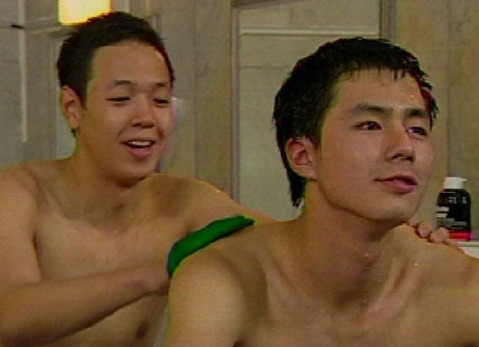
the Italy towel in action
Often the process is performed by a bathhouse attendant and every bathhouse has an area with one or several couches on which you lay for this purpose. I rarely see young children receiving a scrub down but older boys, sometimes unaccompanied and at other times with their fathers, will subject themselves to this ritual. A scrub down from an attendant is every bit as intimate, and for the westerner, invasive, as the one between fathers and sons. Koreans are so used to the cleaning ritual, they subconsciously place their limbs in the required position or require only the briefest prompt, for westerners however, the process is awkward and the body, unaccustomed to the procedure, is antagonistic to the attendant’s manipulation. And yes! They do hold your ‘bits’ to one side as they’re scrubbing. However, the experience is invigorating as well as liberating.
Clearly, father-son, as well as mother-daughter bathhouse rituals are an integral expression of ‘skinship’ and undoubtedly provide the most extreme example of intimacy between individuals in a platonic setting. On several occasions I have witnessed a father bathing his severely mentally and physically disabled son and much that was sad and tragic in the procedure was nullified by the close bond they clearly shared. But it is also possible to see such parent-child intimacy as one aspect of a broader cycle and sons can often be seen tending their aged fathers in the exact reversal of the father-son ritual.
Koreans do not carry the same cultural baggage as regards the body as many westerners either in terms of prudery or propriety and appear much less judgmental about the bodies’ of other people. I recently read a very interesting article by a Korean grandfather who was approached by a little girl in a bathhouse who wanted lifting into a hot pool, because she was cold (link). In many other cultures, racked with obsessions which perversify any contact between minor and adult, such intimacy, and many other intimacies observed in a bathhouse setting, are taboo. It would also seem that what is observed between those of the same gender remains private. To discuss or gossip about the body of another person would be highly inappropriate and improper and certainly, between males and females, would constitute a cultural taboo. And one of the greatest Korean attributes, especially when you’re naked and vulnerable, is that they are excellent at complimenting those parts of your body you don’t like. I wouldn’t wish my body on anyone but even naked many Koreans are able to make you feel very good about yourself.
© 林東哲 2011 Creative Commons Licence.
Bicycle Boy
Sitting outside a GS25 late on a Saturday evening, I noticed quite a few interestingly designed bicycles.
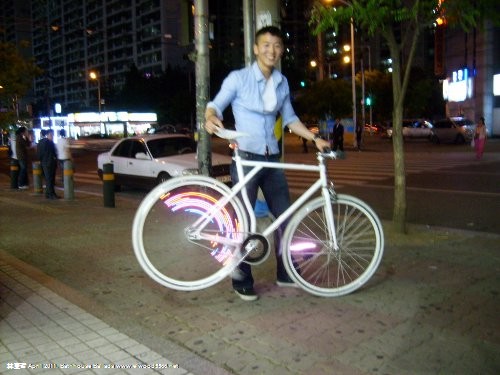
the photo is poor quality, but you get the idea
he was quite proud of the flashing lights
© 林東哲 2011 Creative Commons Licence.
Senior Citizens’ ‘Street Party’
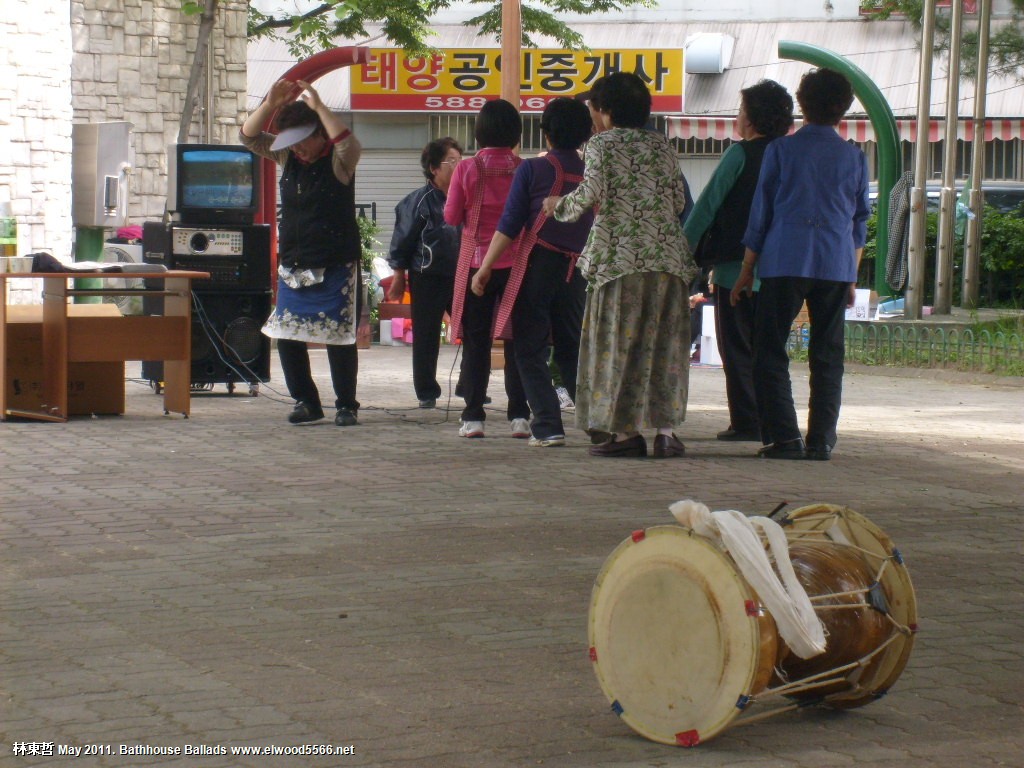
dancing to traditional ‘trot’
Last Saturday, as I was returning home from an outing I heard the sound of gongs and drums and walking down to the small park near my ‘one room,’ where an old peoples facility house is located (이곡경로당), discovered the old folks in the area where having a street party. In the middle of the small park a television screen had been set up and a small group were in the throes of a trot-style (트로트) karaoke session. One the periphery another group were busy accompanying the singing with an assortments of gongs and drums usually associated with traditional music such as pungmul nori (풍물놀이 and samul nori (사물놀이). Meanwhile, others were dancing in the style typical senior citizens. And the soju and makgeolli were flowing freely…
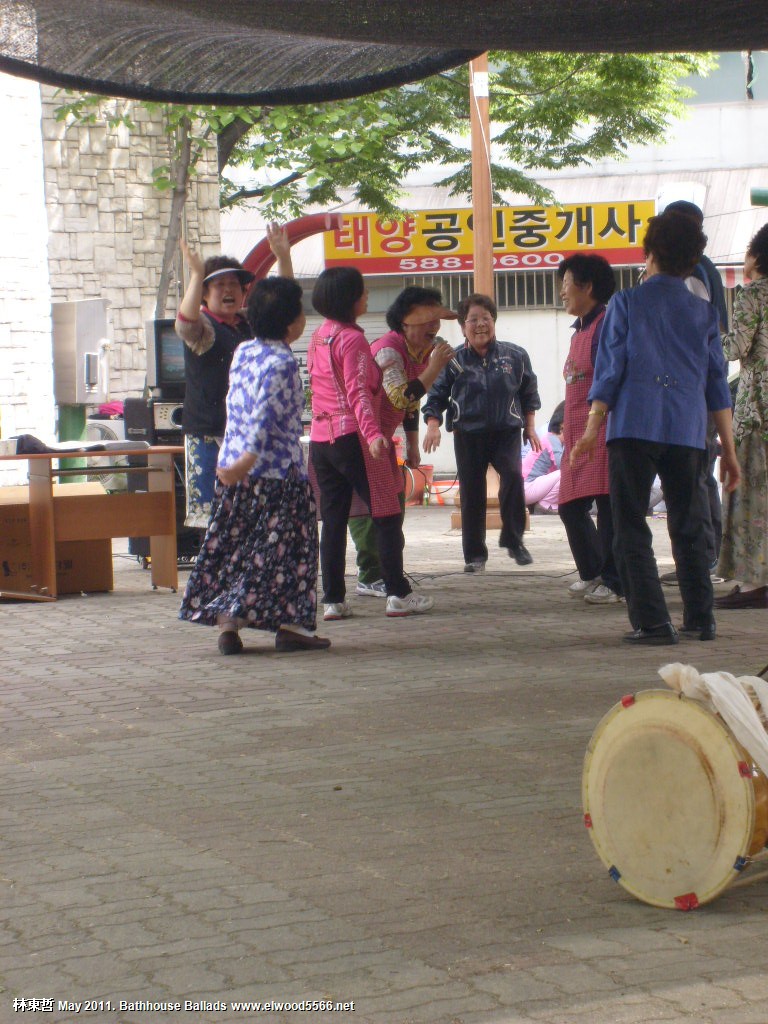
belting one out
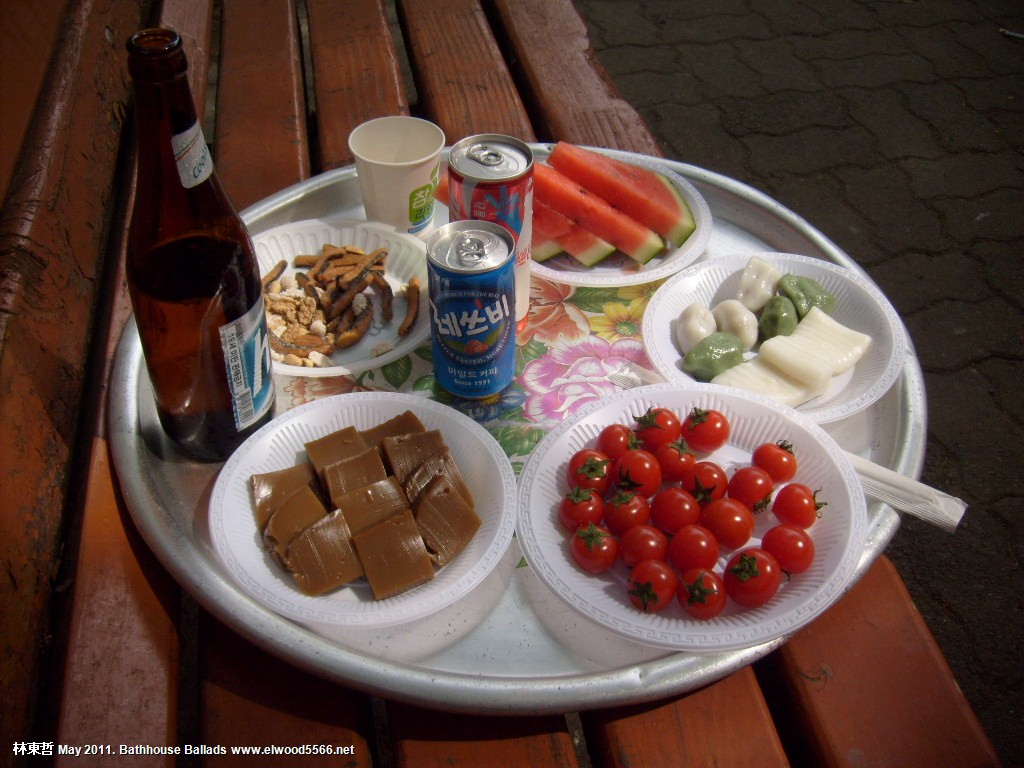
as I sat watching, a tray of snacks was brought to my seat
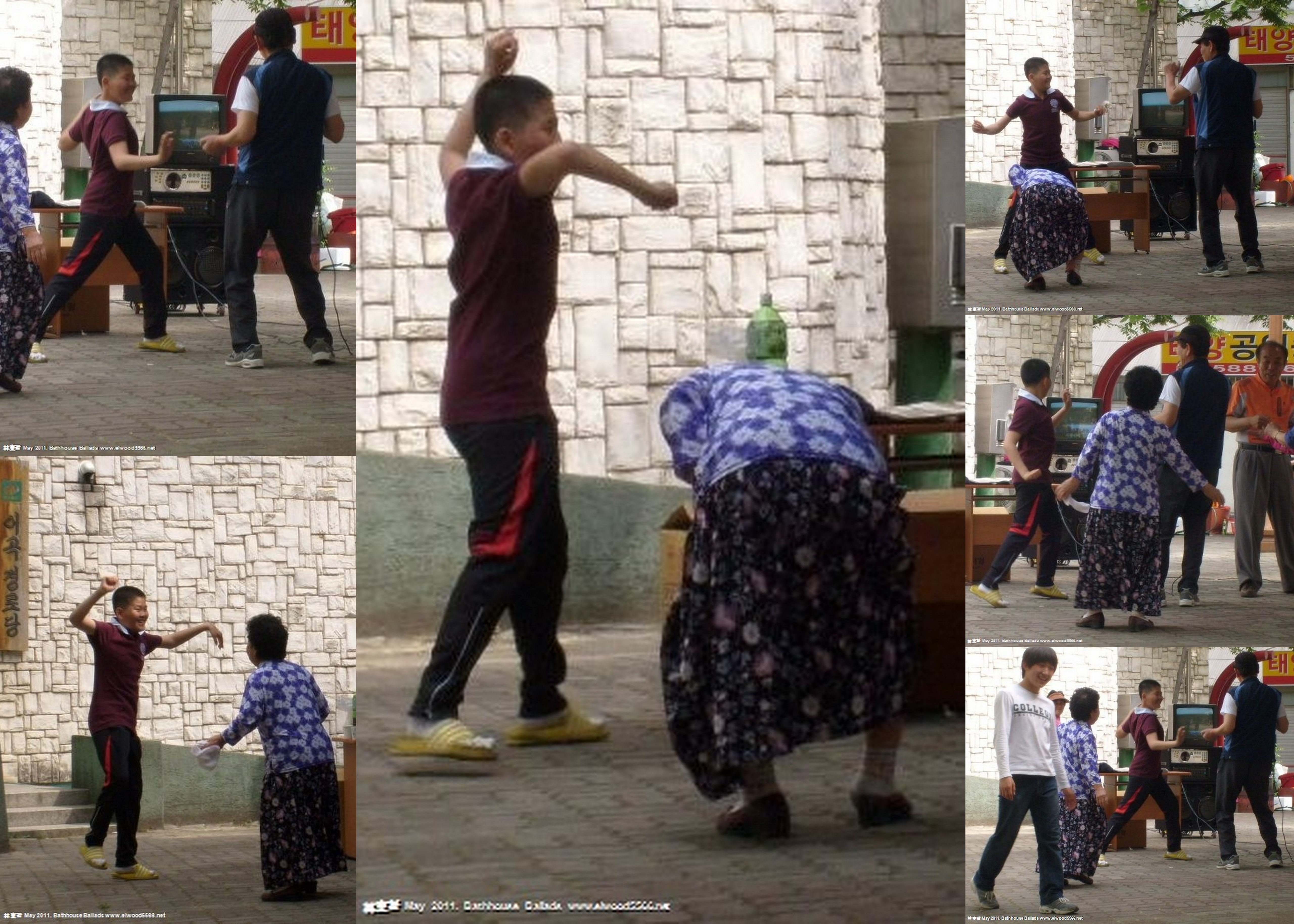
a passing boy joins in…
© 林東哲 2011 Creative Commons Licence.
A Peek Into a Seoul Bathhouse (Korea Times April 28th 2011)
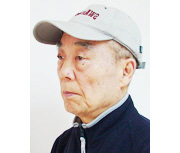
Nam Sang-so
By Nam Sang-so
Dear Pablo, after you were free from diapers, I used to take you to a public bathhouse in Seoul. I do not think you would remember that.
Public bathhouses are abundant here. I enjoy visiting them. For a mere 4,000 won (less than $4), people can enjoy unlimited time in hot spas, saunas and hot or cold showers with free soap and “Italy towels.” Someone gave them the snappy honorific. They are made of sieve-like knitted nylon, woven pink or blue for the purpose of…read more – for touching account of a grandfather’s bathhouse experience.
© 林東哲 2011 Creative Commons Licence.
The ‘Ballads’ via Podcast
Podcasts and Video Podcast (cartoon courtesy of zencast.com)
I have now re-recorded podcasts 2-15 and 70-75 using a Snowball, Blue microphone which means the quality is slightly better than with the previous microphone. The Podcasts are taken from the lengthier, Bathhouse Ballad series. I have another 55 in this series to produce which will take some time.

access current Podcasts here
© 林東哲 2011 Creative Commons Licence.
Waiting for Summer’s Herald – the Memi
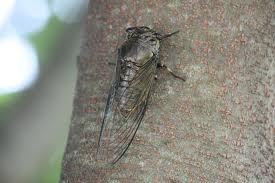
summer's herald
I much prefer the name ‘memi’ for that bizarre insect known in the west as a cicada. I would imagine that in places with a hot summer and hence a familiarity with this strange animal, places like the USA, there is rarely any confusion about the pronunciation, ‘cicada;’ but in the UK, where summers are cooler and the insect pretty rare, I don’t think I’ve ever seen one, mispronunciation is common.
If you’re a visitor to Korea from a country where the song of the memi is simply regular background noise, you probably won’t even notice it but if like me, you are from cooler climes, that summer scream is one dominant leitmotiv in which intense heat, humidity and sticky bollocks converge.
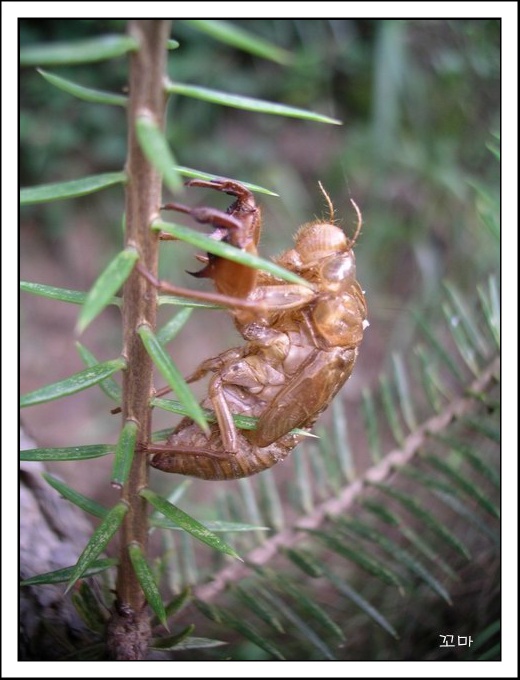
a newly hatched memi makes its journey from the ground to high branches
The first memi to sing are more likely to be heard in Daegu as this is the hottest region of the peninsula and last year I heard the first on July 7th when the temperature was 30 degrees Celsius; the last I heard on September 25th when the temperature was 29 degrees. The memi starts ‘singing’ from 84 degrees Fahrenheit, 29 degrees Celsius. There are still a few weeks of relative coolness to enjoy before the world is turned into one sweaty, sticky, noisy hell during which life is spent hugging shadows on the sidewalk, taking constant cold showers and recuperating in the heavenly chill of the air-con. As much as I love spring, it is marred by the anticipation of what lies in its wake and part of my pleasure in hearing the season’s first memi is knowing that I will also hear its last.
SOME INTERNAL LINKS
Fahrenheit 84 (29 degrees Celsius)
© 林東哲 2011 Creative Commons Licence.


 Elwood 5566
1 comment