Bathhouses are Gay!

I frequently hear or see this comment and consider it the dumbest a westerner could make! Anyone who comes to Korea and doesn’t try a bathhouse is denying themselves an experience rich in its uniqueness and in its ability to afford you a very intimate glimpse of Korean culture. I have probably attended a bathhouse 3 times a week for a period of almost 4 years and in all that time I have only seen 3 western people in bathhouse, 2 adults and a boy. Neither have the numerous westerners I worked with over this period attended one with me. I am no bathhouse guru and there will be foreigners living in Korea far more experienced in this pursuit than I, but turning to my own culture, we certainly have a terrifying fear of nudity.
In UK schools, the practice of showering after sports was phased out around 15-20 years ago. Cutting the heating bill was a good way to save cash even if it meant that students, especially boys, spent the day putrefying in their own sweat. No one seemed to mind especially as showering was only ever enforced when one started puberty and felt uncomfortable being naked. And one common feature of many schools was that boys usually had to undress in front of each other while girls were often, but not always, afforded some privacy. From my own experiences and conversations with other men, there is an agreement that male changing rooms are often charged with a bizarre juxtaposition of the erotic and aggressive. When I last taught in an English High School, around 2003, I had to take several classes of boys preparing for swimming lessons. Each boy was equipped with the most enormous towel of sufficient proportions to cover a single bed. I have several female friends who told me stories about convent life where, after sport or swimming, girls were required to shower in, and undress, under large smocks designed to hide their bodies. This was exactly the same except this wasn’t a catholic school! It wasn’t even Church of England. Most of the boys were around thirteen or fourteen and their bodies were still puny but hidden from the neck down, the material enveloped them twice and doubly guaranteed that not the slightest naked thigh, knee or even elbow should be inadvertently exposed. All the boys were skilled at holding secure the neck of their towelling smock from within its confines, while the remaining free hand, buttocks, hips and knees, shimmied their underwear off and then pulled on their swimming shorts – and this in the reverse order when changing back into uniform. Some boys were unfortunate enough to have restrictive, ordinary size towels and if they slipped or were insufficient to hide their bodies and they were exposed, not only were they mortified but so too was any boy who happened to glimpse what lay under that towel. Then a string of accusations were spat forth declaring the observed and any unfortunate observers, ‘gay.’ In Britain, certainly among school boys, to either see another boy’s dick or for yours to be seen, implies homosexuality. This juvenile attitude is similar to the ones levied at Korean bathhouses and seems to be a western attitude rather than one confined to British men. Of course, nothing could be further from the truth.

if you think bathhouses are ‘gay’ you totally misunderstand Korean social practices
To be honest, in Britain, I too find nudity or even semi nudity uncomfortable. We seem adept at criticizing the bodies of others and many of us, myself included, have been imbued with various attitudes towards the body and nudity. Ironically, I feel more human as a naked, fat foreigner, in a Korean bathhouse, than I do wearing shorts in a British swimming pool. In addition to our internalized assumptions about bodies, we conflate both nudity with sex and same-sex nudity with homosexuality. I am sure that something sexual must occasionally occur in Korean bathhouses, probably in specific bathhouses, but I have never witnessed anything of a sexual nature.
My first experience of bathhouse culture was in 2001, when I was visiting Masan with friends. I was asked which three things I’d like to do before leaving Korea. I replied: I wanted to try dog stew, silk worm and go to a bathhouse. My stomach almost hit the floor when my friend smiled and told me we’d probably visit a bathhouse that very afternoon. The whole experience terrified me but I swallowed my pride and went through with it and then, when back in Daegu, I made myself go to other establishments. I still feel a little uneasy entering a bathing complex probably as I have a negative image of my own body but I have never been made to feel uncomfortable. Koreans will all peak at you but once they’ve looked you up and down you blend in with the other clientele. As usual, if you should make eye contact with them while they are peaking, they will instantly look away.
On the streets of Korea the novelty of foreigners is rapidly declining and I find my presence attracts far less attention than it did 10 years ago. I find it boring that my presence on the street is almost non eventful though I would imagine in rural areas we are still a novelty. Most establishments, bars, restaurants, shops etc, have learned to accommodated foreigners. In many restaurants, menus are available in Korean and English but ten years ago you were only likely to find this in fast food restaurants. I can even remember Pohang bus terminal’s arrival and departure board only being in Korean. If you want to experience the Korea relatively unchanged by the presence of westerners then bathhouses are an ideal location. I am still fascinated by this cultural phenomenon as it has afforded me a far deeper insight into Korean life than probably any other experience. Bathhouses expose not just our bodies but the differences between the Korean and western psyche. Most obvious of course, is the attitude to nudity. I would imagine Korean’s have seen every permutation possible in the human body before they even reach their teens and the traumas our teenagers associate with puberty are minimized in Korea. Also exposed is the level of intimacy that Koreans share not just with their immediate family but with friends and strangers. That horrid male macho-ism that is magnified when western males are in changing rooms or semi naked, a mechanism used to assert masculinity as well as heterosexuality, is absent in a Korean context. To get naked with your friends doesn’t require mitigating the homosexual implications by playing some aggressive sport beforehand. Koreans can sit close to each other, touch each other and even clean each other without any fears of being misunderstood. The most exposed behaviour though, and one that would shock many westerners, is the intimacy shared between fathers and their sons as well as older men and younger people in general. I doubt there are many westerners who would allow their 10-year-old to go to a bathhouse unaccompanied let alone allow them to have an intimate scrub down by a bathhouse attendant who may very well be a stranger to that child. This situation was highlighted several years ago when a youth taekwondo team visiting from the UK was put in a very awkward position when their hosts took the British kids and instructors to a bathhouse. How do you explain to Koreans that in your culture, this activity would be illegal and that children and adults naked together, even if immediate family, is treated with great suspicion and constitutes one enormous taboo.

Cooling off
The most interesting aspect of a bathhouse experience is that it not only exposes Korean culture to the foreign observer, but also exposes you to the nature of your own culture and encourages you to reflect on many taken for granted assumptions and practices. Using bathhouses has given me a deeper insight into both Korean and British culture. On my return to Korea after a holiday, my first task is to take myself into a bathhouse. I have come to perceive communal bathing and the intimacy practiced around it as natural and certainly healthy, both physically and mentally and concurrently, I have come to realise the unhealthy nature of western attitudes where natural human relationships have been moralised if not perversified. To deem bathhouses ‘gay’ is a moral statement in that it suggests ‘not natural,’ ‘wrong’ and ‘unhealthy.’ In the UK, we have already embarked on a brave new future where the most innocent of associations with a minor is suspect and where even the most checked, verified and scrutinized professionals have to be permanently policed. In Britain, I do not think we are too distant from a future where any form of communication with a minor, outside that of the family and school, will be classified as a potential crime and sufficient to call the police.

© 林東哲 2010 Creative Commons Licence.
Shepherd's Purse (냉이)

Shepherd's Purse (Capsella bursa-pastoris)
With the approach of spring many seasonal ‘vegetables’ are appearing on the streets and one of the most common is Shepherd’s Purse. This costs about 2000W (£1 sterling) for a large bunch and can be bought from the elderly women who usually sit on the pavements selling various ‘vegetables.’ I haven’t yet seen it in my local E-Mart. Two of my Korean friends didn’t even know the name for this ‘vegetable’ and neither did they know how to use it. My best Korean friend is a total muppet when it comes to cooking so a much younger colleague gave me instructions. Shepherd’s Purse grows in the UK where for most people it would probably be classified as a weed and indeed when I initially tried it in a soup it tasted as one might imagine boiled grass to taste. Subsequent experiences revealed a subtle taste which some students describe as ‘medicine.’ However, not giving up easily, I have cooked this several times and find it pleasant.
Shepherd’s Purse doesn’t seem to keep long, even in the fridge and it will need washing and the small roots trimmed off. If you buy a bagful this job is tedious! Subsequent purchases, I prepared, chopped and then put in a plastic zip bag in the freezer. It makes a subtle addition to bean paste soup (된장찌개)and is quite often used with oyster soup. I have also used it in fish soup (해물탕). Shepherd’s Purse won’t win any taste awards and although I haven’t quite decided the extent to which I like it, it does provide a distinct but gentle background flavour.
Additional Note
(Three weeks later) Shepherd’s Purse has grown on me. In bean soup it definitely provides a pleasant flavour. I decided to buy some more later in the week. It keeps well stored in the freezer.
FURTHER INFORMATION
Monday Market – Shepherd’s Purse (March 2011)
© Nick Elwood 2010 Creative Commons Licence.
The Changing Face of Song So
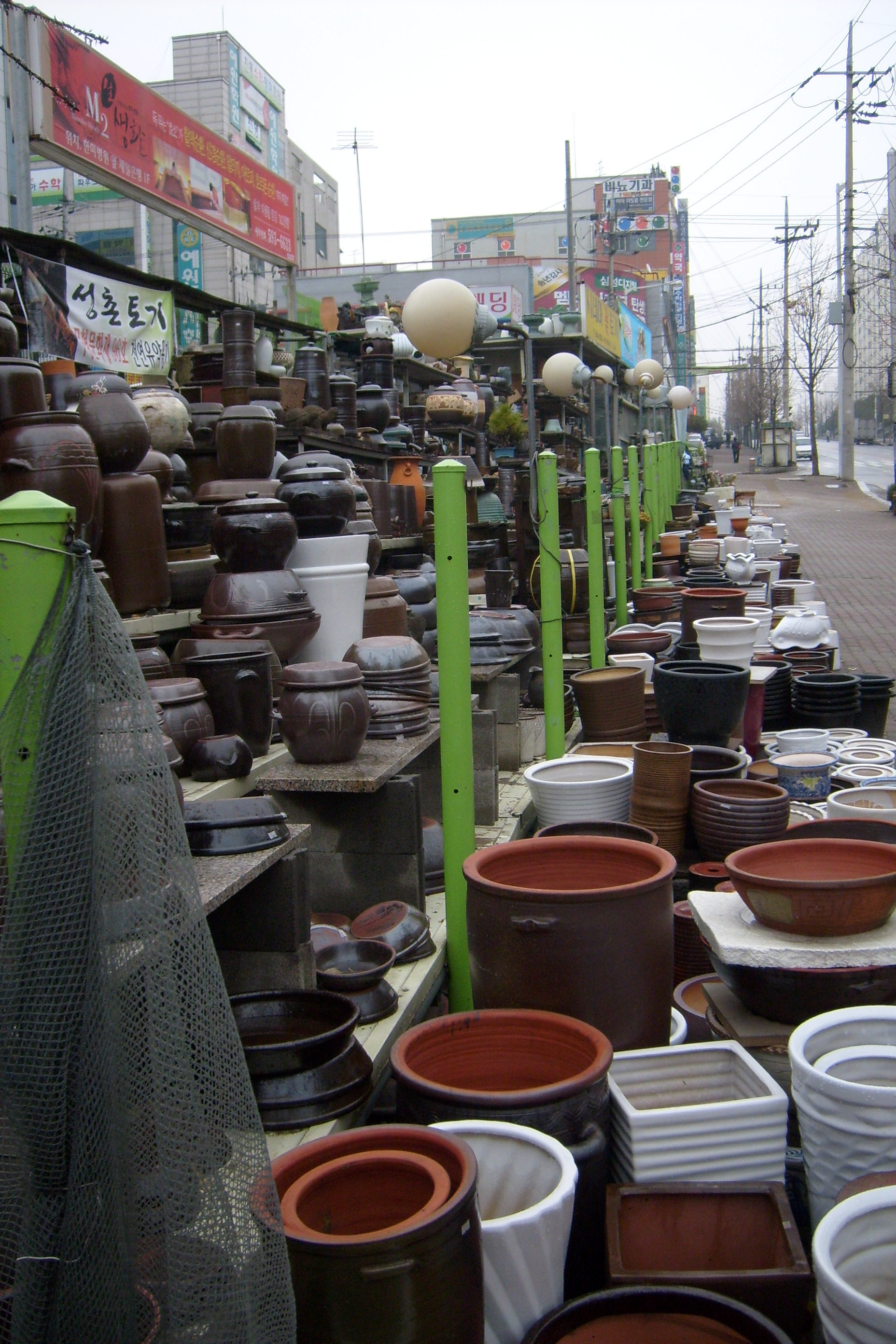
Ceramic store
When I first experienced Korea, in 2000, I remember a chemist shop on the corner where I lived which used to stack vitamin drinks outside the store, in front of the windows. The drinks were in boxes and used to remain there throughout the night. Anyone wishing to steal a box would have had little difficulty. Today, the store is a plush American styled bar which may even be called ‘Friends’ and the chances are that next year it will be a restaurant or internet cafe. I remember the boxes of drinks well as I ways always tempted to steal one. I never did and don’t think I ever intended to but clearly, there is something in the western psyche that prompts one to steal anything which isn’t chained down. This observation I base on my own immoral character, as well as on the characters of fellow westerners, from New Zealand, Australia and the USA, who all admitted that if something isn’t secured it warrants being stolen. I know electrical stores which stack new refrigerators outside the store, flush against the windows, and street vendors, some who are friends, will often leave microwaves, food, small televisions and many items in their little plastic tents over night. All easy pickings for anyone with a pair of scissors or penknife and a will to steal. Leaving property in situations where it could be stolen is clearly not a major concern in Korea and the practice of leaving things unattended or stepping out of premises temporarily, without locking up, is widespread.
Several months ago I went shopping at 6.30 in the morning and apart from the food hall, on the ground floor, the other 3 floors were all void of staff and despite some display being draped with covers, the majority of goods, clothes, sports equipment etc, were visible. Once again that little urge to steal presented itself, but I resisted. I still find it amazing that a large department store leaves its isles open and unguarded overnight. I’m sure cameras were present but I doubt stealing something would have been all that difficult.
Of course, I’m not suggesting that in Korea crime does not exist as it does and on one occasion, I was the victim; but I do feel one is less likely to be a victim in Korea than in the UK, my home country and beyond any doubt, one is much less likely experience physical violence. Several years ago my neighbours in the UK moved house and their old property remained vacant for almost a week prior to new occupants arriving. In their front garden they left two, large ceramic plant pots. Late one evening, just as I was going to bed, I heard a car stop adjacent to my house and looking out the window, I watched a silhouetted figure emerge from the car, dart across the front garden to steal the two pots. My neighbourhood in the UK has one of the lowest crime rates in the UK but it doesn’t stop plant pots or garden sheds from being stolen and rape and the occasional unprovoked, violent assault, all occur from time to time. My home town has a population of 35.000 compared to Daegu which has around 3 million.
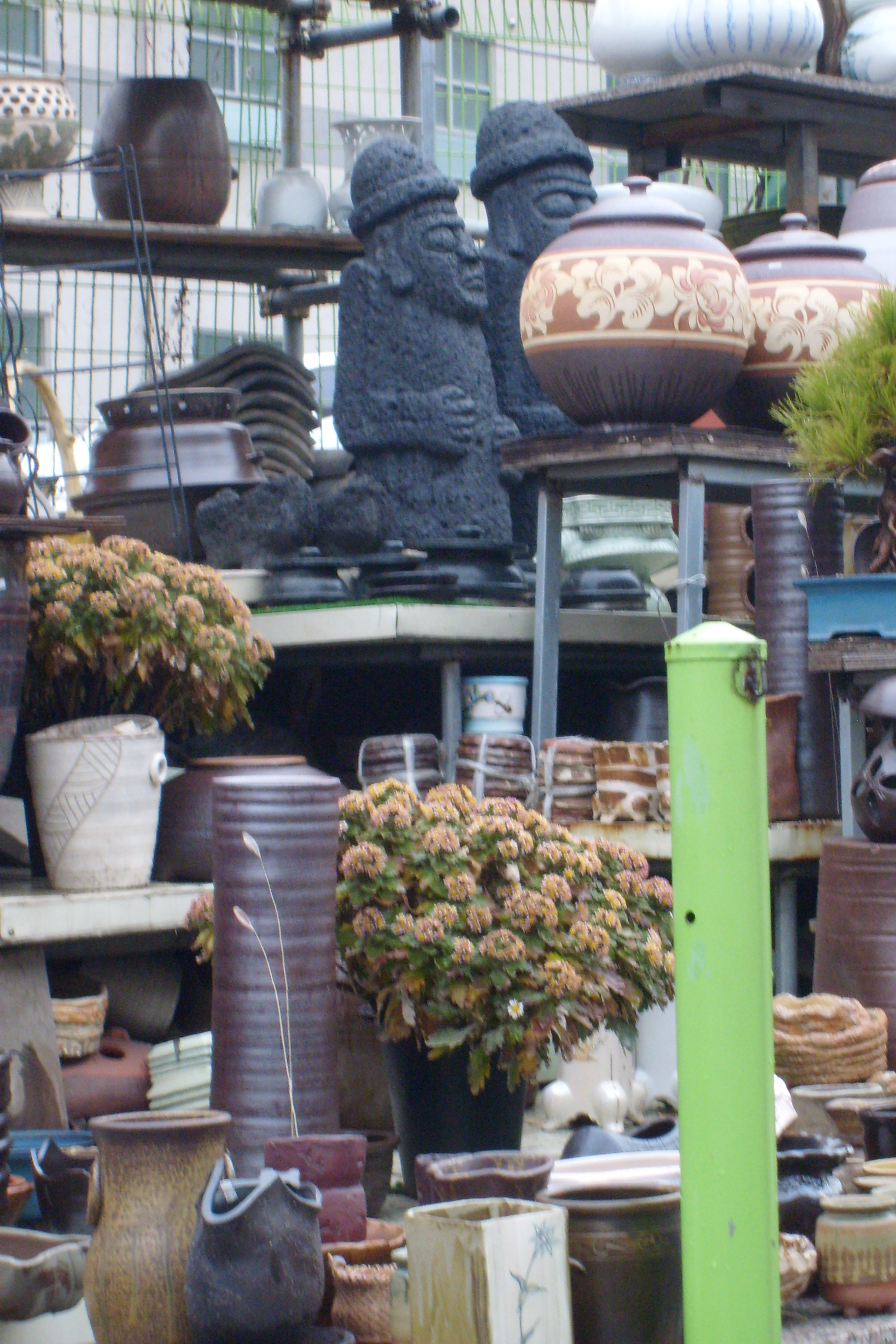
Ceramics
Much of the crime suffered in the UK however, and a crime I feel especially absent in Korea, is the vandalisation and destruction of property for no apparent reasons. A significant element in our society has a bent for destroying, wrecking, maiming or ruining anything which belongs to someone else and there seems to be a correlation between the amount of affection put into what ever it was that was targeted, and the relish with which it is destroyed. Grave stones, bowling greens, and especially attractive gardens seem currently in vogue. If you can assault the victims emotions, committing the crime seems all the more pleasurable.
In 2000, when I first worked in Song So (성서), Daegu, the KFC next to my school had a life-size model of Colonel Saunders stood outside the store. As it was Christmas, he’d been jollied up in a Santa outfit and even had a walking stick hanging from his wrist. Neither the model nor the stick were secured and remained in situ until he was de-jollied sometime in the New Year. In my home town in the UK, a similar model has to be secured by a chain to prevent it being stolen and it is not left out at night. If vandals attempted to remove the UK model and found it chained their tempers would be inflamed and they would simply smash it to pieces. Back in Korea, Colonel Saunders remained outside the store, unfettered, 24 hours a day. No one thought to carry him a mile or so down the road, for some silly prank; or to rip his arms off or kick his head off; and no one thought it necessary to steal his cane and subsequently use it to smash a shop window or terrorize a passer-by. But then the fast food restaurants in my high street have to employ bouncers and at one time, whilst a student at university, I worked as one for almost a year.
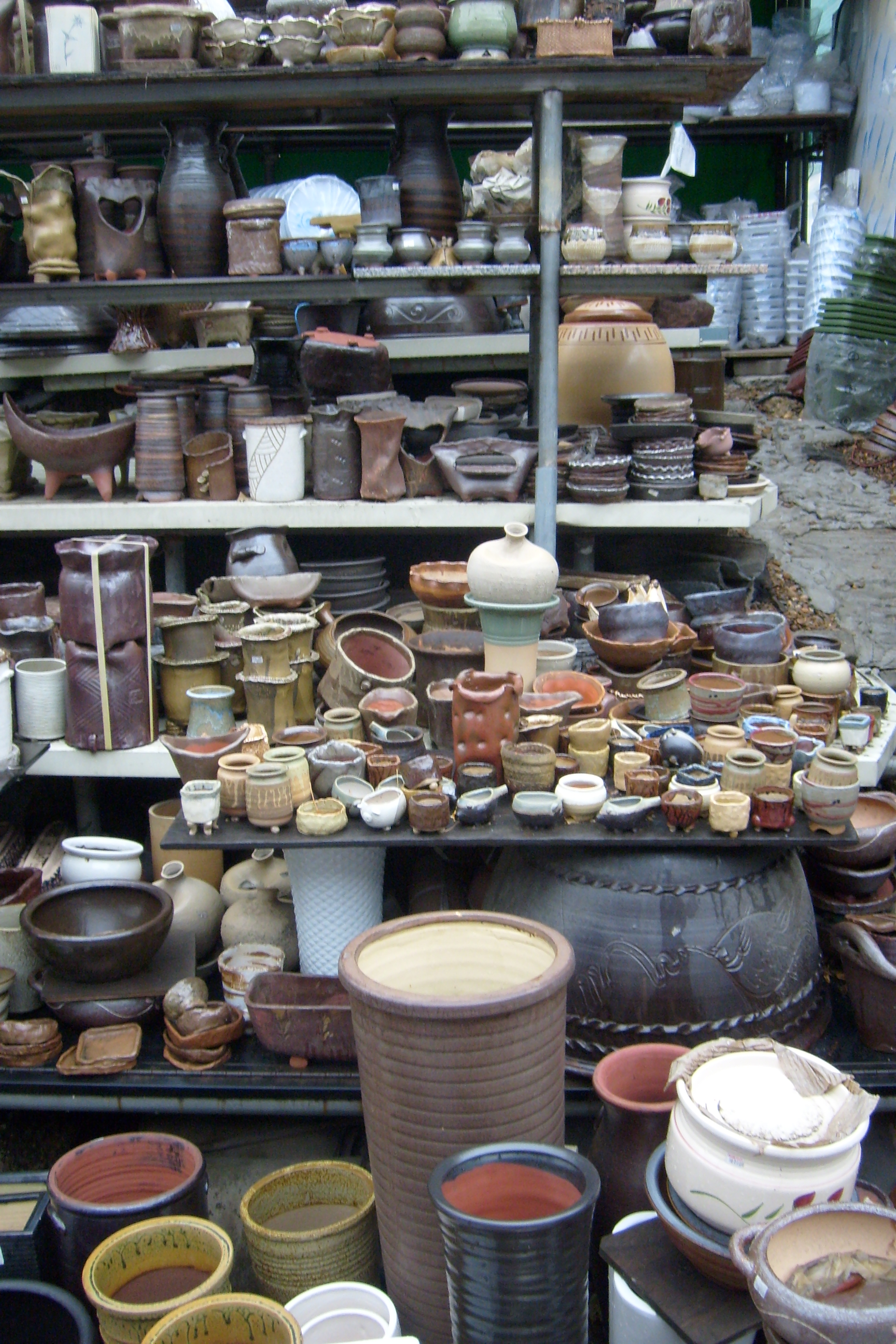
Kicking these about would feel great when pissed!
And in Korea, students as young as 7, usually with mobile phones dangling from their necks, bring their parents’ ATM cards to school to pay their monthly fees. Nonchalantly, they hand them over to staff and no one seems concerned or worried that the kids might lose them, use them or that the staff might make notes of their details or overcharge them. As for their mobile phones? Often expensive and the latest in the range, who would want to steal them? Every one simply trusts each other to do the right thing. I’m sounding like a Kimcheerleader but back home a little kid with an expensive mobile would assaulted and robbed.
Almost opposite my school is a garden center which sells a vast range of ceramic items all of which are stored outside the shop. This business is one of the longest surviving in my part of Song So and has been here since at least 1999. The road on which it stands is fairly quiet, especially in the evening and at one time, prior to building projects, several vacant lots nestled besides its borders which occasionally hosted 24 hours soju tents. Even to this day, I am amazed that the place has never been vandalized or that drunks have never decided to kick over a few pots. I think the photos do the premises justice and as you can see, there are thousands of items all displayed in tiers and completely open to the public. Though there seems to be the supports for a fence fronting the premises and though I pass by here every day, I have never seen evidence of vandalism.
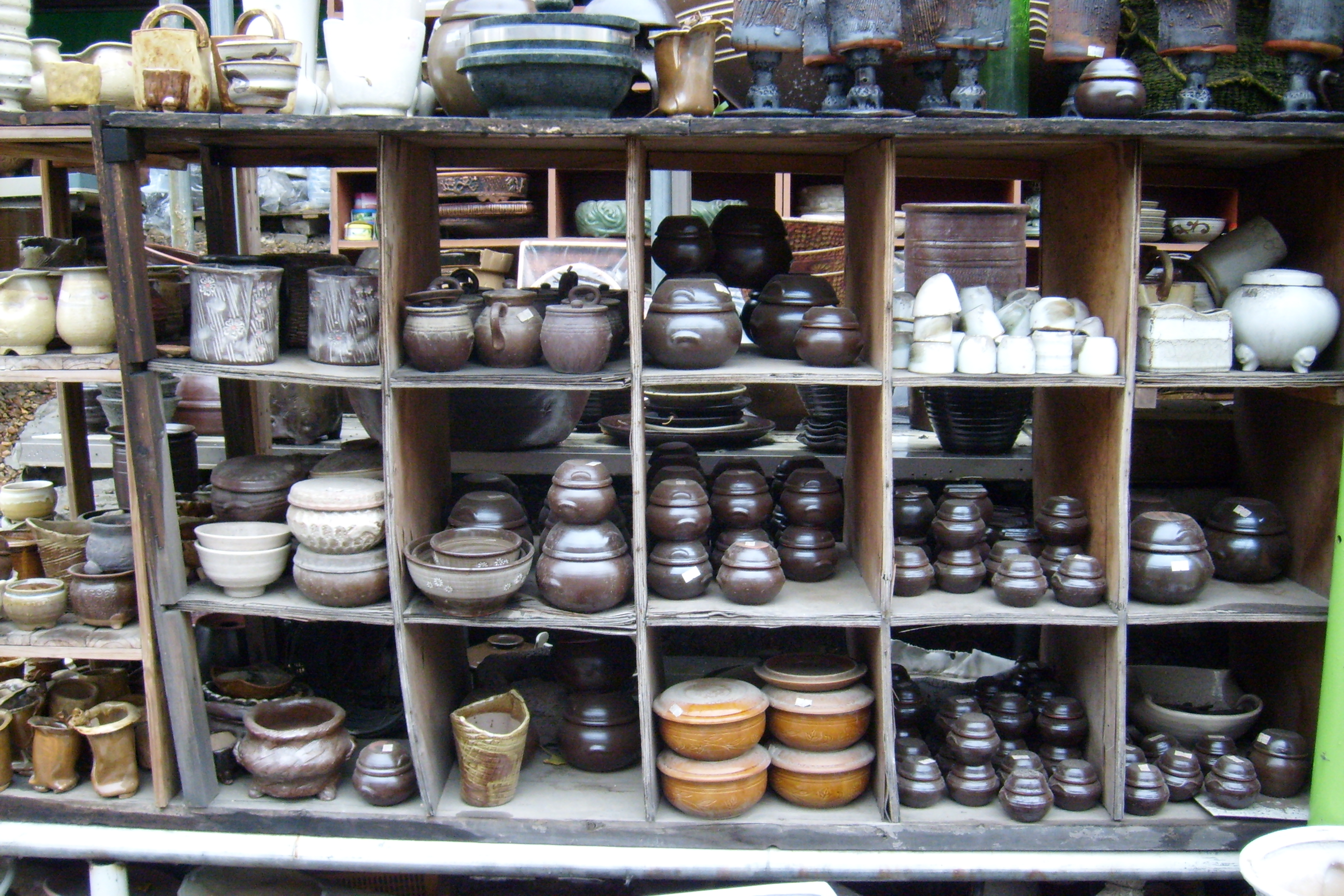
Open to the ‘elements’ 24/7
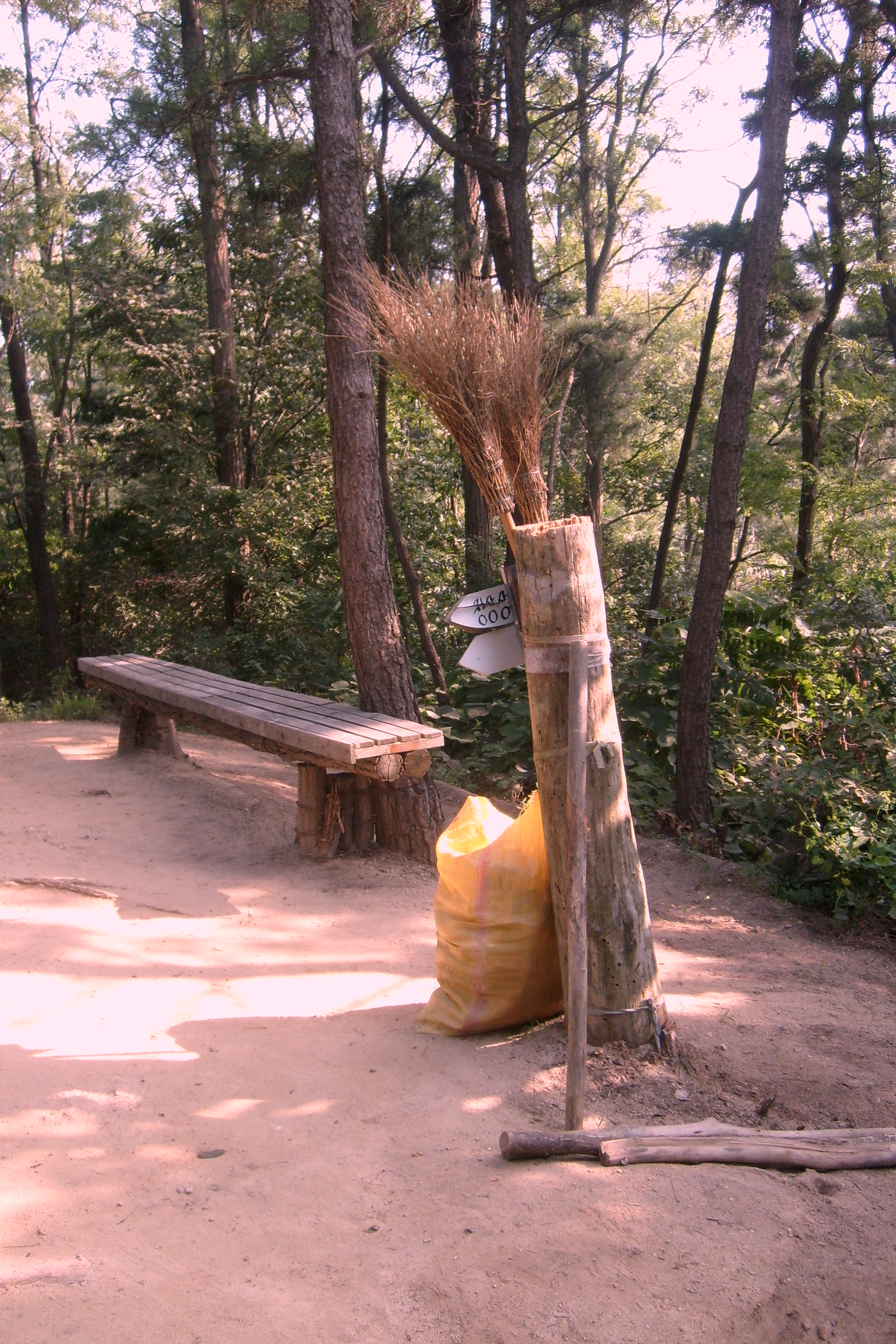
Wooden bokken and brooms
It is not unusual to see people, usually elderly, who will stop and pick up a piece of litter in the street but perhaps the best example of mutual respect and community spirit can be found on mountain trails where small gyms are customarily established, usually on or close to mountain peaks. I have used such gyms in both Cheonan and Daegu and in the mountains verging Song-So, Daegu, I have used two. The closest to my apartment, perhaps a 30 minute, I have used on and off over ten years. Here you will find a number of exercise facilities provide by the local authorities but which have been augmented by items carried to the top by local people. A clock has been secured to a tree, numerous weights, exercise hoops and an exercise bench. None of these items are chained or secured in place. In Ch’eonan, someone had provide stout bokken (wooden kendo sticks made of a durable wood) and on a sturdy tree stump fixed rubber tyres. Frequently, I sat and watched individuals swing the bokken from one side to the other in order to strike the tyres with powerful blows. And nearby was a waste bin and numerous brooms for sweeping the little gym clean. The clock on top of the Song-So mountain impresses me the most as this has been here for ten years though it may not be the same one. Irrespective, no one has thought to smash it or hurl the weights or dumbbells down the steep path which leads to the mountain summit.
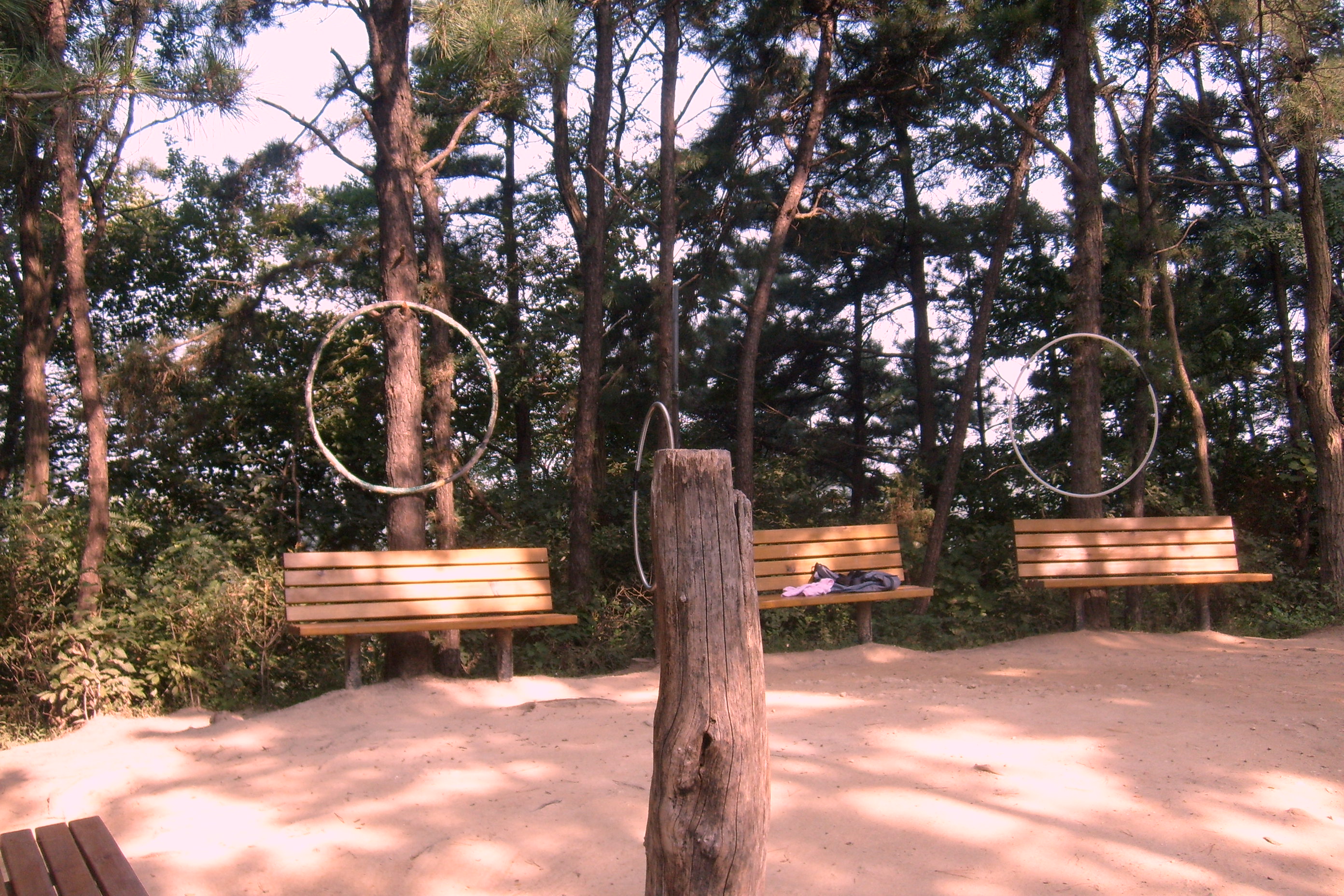
A bokken striking post and exercise hoops
That you can set something delicate on the side of the road or in a small clearing on a secluded mountain summit and leave it in the knowledge it will neither be stolen nor vandalized, is a testament, a trophy, to the nature of the people living around you.
© Nick Elwood 2010 Creative Commons Licence.
The Last Taboo
Recently, I changed my routine so I often go to my favourite bathhouse (목욕탕) after I finish work, around 8.pm, rather than in the morning. However, I prefer the morning as it is quieter and unless it’s a holiday or a weekend there are rarely any kids or university students. As I lay in the ‘special event bath,’ this week scented with lavender, another westerner entered. In four years of fairly daily bathing, this is only the second time I have seen a westerner in a bath house. He probably saw me but as usual, didn’t acknowledge my presence. Most westerners will walk straight passed you even on an early Sunday morning when the streets are empty. I’ve given up being friendly as a cold shoulder is the usual treatment if you are polite. There are exceptions, of course, but this has been my experience. I didn’t particularly want him talking to me anyway; I don’t mind being naked in front of Koreans but have never relished the idea of bumping into a westerner when nude as we tend to be critical and judgmental about nudity and the bodies of others as well as our own. In reality, the westerners who do use bathhouses, especially if alone, probably have healthier attitudes to bodies than those who avoid them. I don’t think he felt particularly comfortable in my presence as he left after only a few minutes which was a shame as, my apprehension aside, it would have been a good opportunity to exchange experiences.

Usually, I have to wiggle my backside like a gigantic duck in order to disengage that little seat from my bum.
I don’t think he was a bathhouse novice, either. From the lavender bath in which I was relaxing, I could see him drying off in the area immediately beyond the bathhouse exit. He had no problem bending over to dry his feet and calves and did so without maneuvering his backside into a corner, thus censoring that most private place from public view. One of my remaining inhibitions, though not as acute as it was, is exposing or touching this area in public. Perhaps I need to set myself the task of prostrating myself 5 times a session and soaping my backside in a position where my neighbours can see, as a therapy to neutralise this remaining inhibition. I would like to squat right down, Korean fashion, and give my entire undercarriage a thorough scrubbing, if it were not for the fact that I find deep squatting both easy to topple over in and difficult to stand up from. I have enough problems standing after sitting on the bucket sized seat from which you wash yourself as often it remains stuck to my arse as I stand. Then, if it clangs to the floor, it attracts unwanted attention. I have a similar, though quieter problem, if I sit on a towel as this too will remain in the grip of my buttocks, as I stand. The term, ‘taking in washing’, which is used to describe the backside’s ability to grip things, usually underwear, comes to mind, but bathhouse furniture and towels is taking it too far! Maybe it’s my arse, I don’t know and I’ve never paid much attention to what Koreans do after sitting on a towel. I have a niggling suspicion that the propensity for my buttocks to grip towels and seats, even the large plastic type, similar to the ones we use in gardens in the UK in summer and which are often found in the steam rooms and saunas, have more to do with my dimensions than my ethnicity; I have a large arse to put it mildly. Of course, I don’t know how other westerners conduct themselves in a bathhouse as I’ve never observed any but I would imagine that many would find it disconcerting to drop the soap and have to pick it up. This chap was quite at ease, as at ease as the Koreans around him, at prostrating himself right in front of the glass doors to the bathhouse and in full view of everyone lounging in the baths. Whoever he was, he left the bathhouse with my admiration.
© Nick Elwood 2010 Creative Commons Licence.
A Touch of Heaven

If this were back home, this restaurant would be in my back garden!
I recently went home to the UK for a Christmas break. I live in a rather attractive village on the south coast with a reputable university and a medium-sized town 3 miles away. I’m not the type of character to bore easily as I always have things to do which is just as well as I find British culture exceedingly boring. Unless you live in one of the major cities there is often little to do in the UK and pubs and restaurants are fairly expensive. For 2 pints of beer you can expect to pay around 12.000W and a fairly average meal will coast you 40.000W, minimum. In the last year in which I lived in the UK, I probably went out in an evening on only a few occasions. In the UK, high prices, poor transport networks, expensive taxis, violence and lack of amenities, are all barriers to stepping outside your front door. I have lived in places in Korea where isolation and boredom were a problem and my sole point is simply that my present location in Daegu, provides a very comfortable lifestyle.
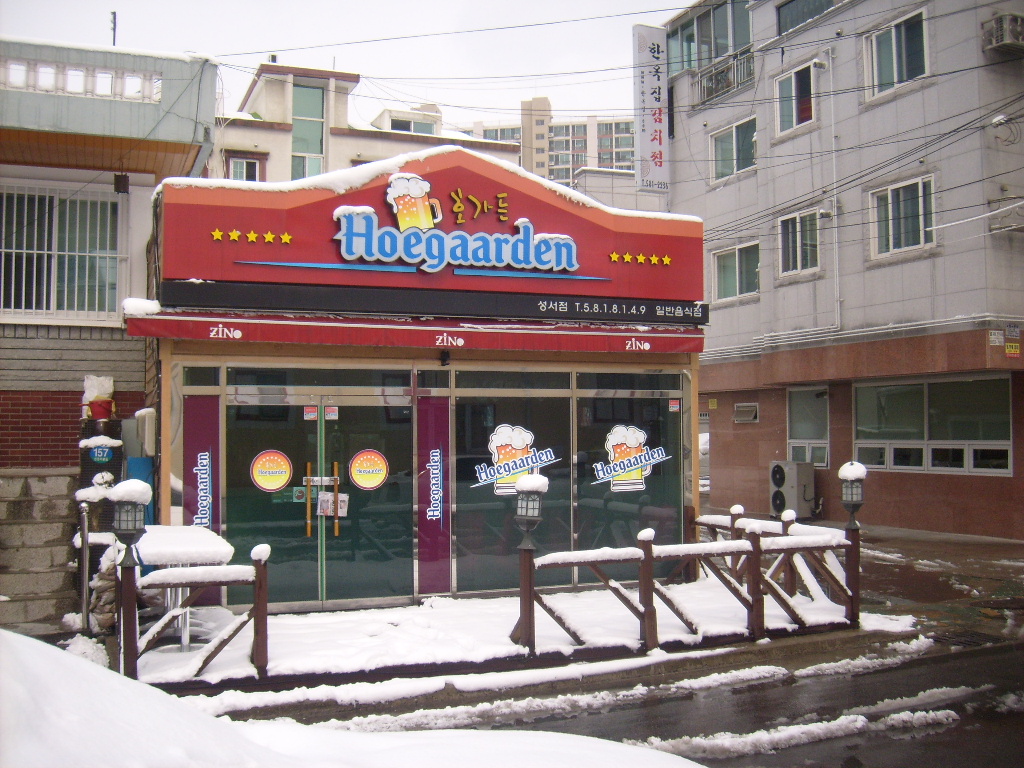
My next door neighbour - a bar
So,,in the particular area of Daegu in which I live, I am totally spoilt. The parameters of my world extend approximately 600 paces in 3 directions and approx 1000 in another. Everything I need is contained within this space. I can comfortably walk 100 paces in a minute. Before any blog-bullies assault my calculations as inaccurate, they are only estimations. If I leave my apartment on my trip to my favourite sports complex, I pass the following facilities:
47 paces, 25 seconds – Kimchi jjim restaurant
65 paces, 35 seconds – a bar
75 paces, 40 seconds – a barbecue restaurant
106 paces, 1 minutes 5 secs – a 24 hour store
146 paces, 1 minutes 25 secs – chemist
247 – paces, 2 minutes 25 secs – a tailor and dry cleaner
250 paces, 2 minutes 30 secs – a bakery
324 paces, 3 minutes 25 secs – a 24 hour kimbap restaurant
348 paces, 3 minutes 30 secs – a dentist
390 paces, 3 minutes 55 secs – my school
433 paces, 4 minutes 20 secs – 24 hour restaurant
450 paces, 4 mins 30 secs – my doctors
520 paces, 5 mins 12 secs – E-mart supermarket
601 paces, 6 minutes – my sports complex, containing a bathhouse and jjimjilbang. In the interim I have passed 4 different and luxurious coffee houses, a small hospital, numerous doctors, singing rooms, bars, internet cafes and dentists as well as around 15 different private academies.

6 minutes walk: gym, squash courts, martial arts classes and 24 hours bathhouse and jjimjilbang
On a Monday:
150 paces, 1 min 30 secs takes me to an extensive street market.
In another direction:
60 paces, 30 secs – a barbecue restaurant.
72 paces, 31 secs – a fish restaurant.
110 paces, 1 minute 6 secs – a computer repair shop
302 paces, 3 minutes (plus the lift) – a 24 hour jjimjilbang and gym.
330 paces – 3 minutes 20 secs – my bank
380 paces, 3 minutes 40 secs ( plus the lift) – a multi complex cinema, seafood buffet restaurant and a large pizza restaurant.
890 paces, 8 mins 55 secs – underground railway system.
And approx 1000 paces, 10 minutes, in the opposite direction takes me to the local swimming pool besides which lays the tranquility of the mountains.
Many of the amenities I am pampered with here I would not experience even in the major cities of the UK. If 24 hour restaurants or food delivery services exist they are very rare and I have never seen a MacDonald’s 24 hour home delivery service. Apart from the odd spa amenity, difficult to access, expensive and basic by comparison, jjimjilbangs and bathhouses are all unheard of in the UK. Likewise, singing rooms, where families, friends and children can go, do not exist and neither do decent internet cafes. Britain’s main pastime is premised around boozing and watching TV which is ironic considering British people, as most westerners, have significantly more free time than do Koreans.
However, I still miss a good indian curry, a decent pizza and Cantonese style Chinese food and roast potatoes make me drool excessively.
White Day March 14th (회이트데이)
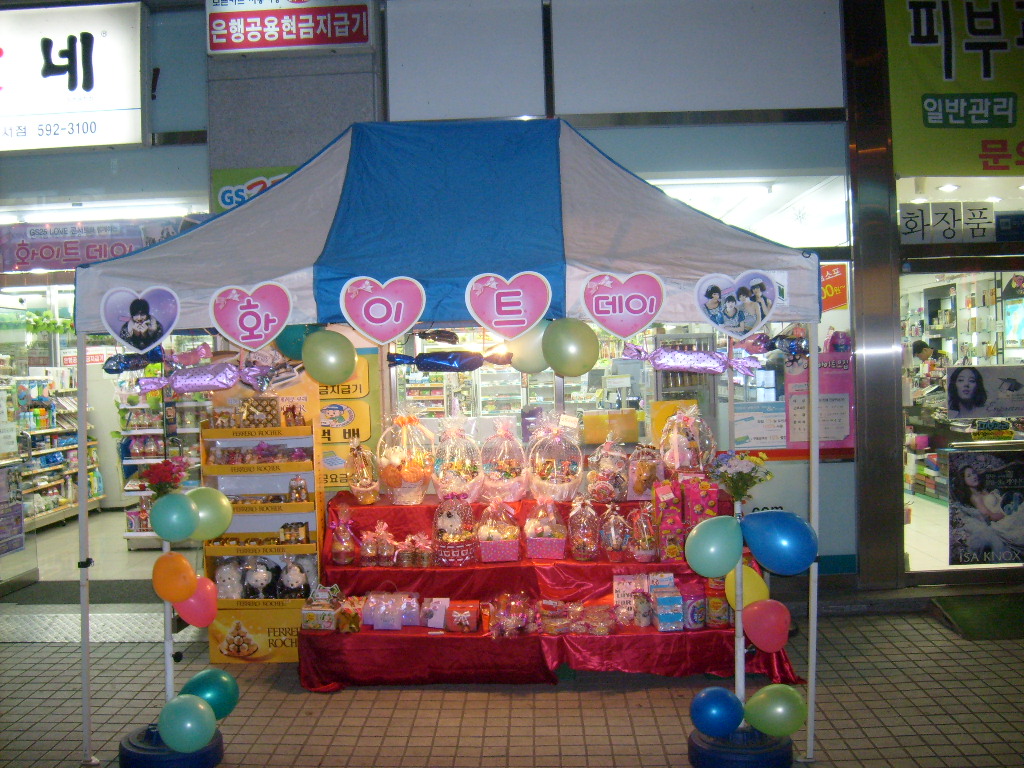 March 14th, White Day, is when men who were given Valentines gifts on February 14th (Red Day), reciprocate, usually with gifts of chocolate, white lingerie or other presents. Like many of the silly days we celebrate around the world, Mother’s Day, and Father’s Day, for example, White Day is a fairly recent invention, not as usual an innovation by a card company, but by a confectioners based in Fukouka, Japan which launched the first White Day in 1978. For saddo men, myself included, April 14th, Black Day, is the day to ‘celebrate’ being sad and single. Considering the animosity many Koreans express for Japanese history, if not Japanese people, I am surprised White Day has become so popular. Although it might not manifest itself in a significant way, even the small store near my apartment has appropriate gifts and I have seen several market stalls this week selling various chocolate items. So, like Valentines Day, for me at least, White Day passed by almost unnoticed.
Am I Really That Dumb?

Korean alaphabet
I think I must be pretty dumb when it comes to learning foreign languages though the skills I do have are clearly above average. I claim this because recently, European Union research highlighted only 5% of British people can count to 20 in a foreign language. Apparently, Americans fair worse! As I can count to 20 in 4 languages, though in two that’s all I can do, I can designate myself a polyglot.
Anyone who has lived in Korea long enough and is battling to learn the language will have met those ‘linguists’ who seem to have picked the language up in a few weeks. Don’t they depress you! I met a chap last summer who told me he’d learned the Korean alphabet in ‘a couple of hours!’ My God! I’ve been struggling with it for years. When I tried to clarify whether he meant he was familiar with it or could actually read it, he insisted his abilities were sufficient to read text though not understand it. I remember another passing acquaintance, a very colourful character, who insisted the language was ‘easy’ and all you had to do was add ‘yo’ onto the end of everything – which also included English words. And then there are those who tell you their level even though they don’t go to classes and have never been assessed. Of course, they’re never a beginner like you are and usually pitch themselves at ‘intermediate’ or if a little humbler, ‘lower intermediate.’ This always reminds me of the cartoon character Peggy, from King of the Hill, who says she has: ” an IQ of 180, give or take a few points because she assessed herself.”
No language is easy and Korean, with a totally different alphabet, three speech levels, honorifics, dialects, the numerous pronunciation exceptions created by certain sound combinations and then the fact that many sounds, ㄷ ㅌ ㄸ ㄱ ㅋ ㄲ ㅓ, to name a few, cannot be rendered by an English equivalent. Or at least this is my humble understanding. So it is neither ‘Daegu’ or ‘Taegu’ and indeed the only way to write the city’s name free of ambiguity is as 대구. Of course, if you want to be really flash you can write it in hanja, 大邱. Recognising sounds is another skill and one I find my weakest. The way Koreans cut short particular final consonants often causes me great confusion so I end up muddling ‘ginger’ with ‘thinking’ and ‘acorn curd’ with ‘eagles.’ Asking the market stall owner how much the ‘eagle curd’ is or, if they have any ‘thinking?’ raises eyebrows. And ‘persimmons’ I am always confusing with ‘liver.’ Talking of 감 and 간, I still find it difficult to hear 홍시 and 혼시. The thought I am a slow learner suddenly intensifies as I remember a two-hour session trying to hear and replicate ㄲ as in ‘꿀” (honey). And if you really want to test your ability to use the Korean alphabet try spelling the most difficult words of the lot – English loan words. I find broccoli, coat, shirt and yogurt especially awkward. Yogurt! Now is that 요구르트 or 요그르트 or even 요구르터?
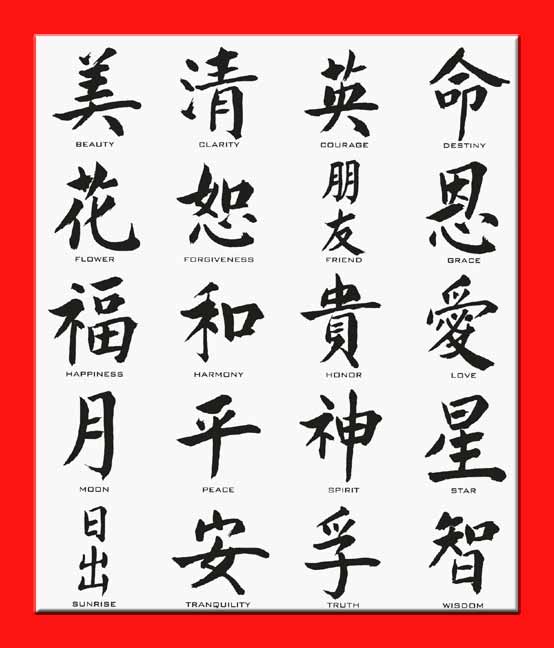
Hanja
No matter how hard you study Korean you will constantly meet those who can speak it better than you. I don’t mean the pretentious linguist types who master the basics in five minutes – you rarely hear them speaking unless it’s in English and telling you how easy Korean is, but those with a genuine talent for languages and who have also made an effort. You read about those who study every moment they can, running on the treadmill listening to dialogues or reciting conversations as they walk to work. It takes me all my effort not to fall off the treadmill and on the pavement, at least in the city, one needs all mental faculties to avoid being smashed to pieces by one of the numerous meals on mopeds maniacs. However, if you really want to impress people, Hanja has few foreign followers. You will have to learn Korean for a few years to truly impress other westerners but with Hanja you can do it with a handful of characters. I’ve met westerners who could speak fairly good Korean but didn’t know any Hanja and I know Korean adults whose Hanja skills are rudimentary. I currently know around 600 characters but at anyone time will have forgotten around a third of them and many of the characters comprising this third will change on a daily basis. The educated Korean should know approximately 1,800 characters; 900 learned in middle school and another 900 in high school. I’ve spent ten years, on and off, studying Hanja – all a total waste of time especially as with every 5 new characters I learn I tend to forget three or four old ones. If I can study Hanja for another 30 years I ‘ll be ‘averagely educated.’ Some of my Koreans friends try to suggest that it is not how many characters I know that is important but that fact I study them. Personally, learning Hanja is a little like learning Latin or Greek, an exercise of the mind but with attractive squiggly little patterns. At the end of the day, Hanja provides few benefits to my spoken Korean but it certainly impresses both westerners and Koreans and to be honest I do get a little thrill when I see some characters and actually recognise them.
I take my hat off to those individuals who can communicate in Korean at any level especially as there are plenty of foreigners living in Korea who see no point at all in learning the language. I even know one teacher, with post-graduate qualifications, who insisted he came to Korea to better understand Korean culture and not to learn Korean. But those who warrant my greatest respect are those individuals who have mastered the intricacies of Korean from a Speak Korean in Five Minutes, (paper back, 50 pages, no cassette), read on the flight to Korea.
Winter Returns to Daegu

Top of Apsan Mountain (앞산)
Just when you thought it was safe to ditch the duck down thermal anorak, and winter suddenly reappears. After several afternoons with spring in the air, Sunday morning saw Apsan Mountain, Daegu, dusted in snow. So, after an invigorating bowl of chicken and ginseng soup, we took the cable car to one of Apsan’s summits. It was freezing with icy patches underfoot and a wind that stung the ears. Icicles hung from the summit buildings and surrounding trees were covered in a powdery snow.

Frosted!

Daegu and even much of the lower mountain however, remained spring-like, if not a little cold.
When the sun rose on Thursday morning, most of the city was under snow. Unlike England however, the buses were all running and no schools closed.

Close to Mega Town, Song-So
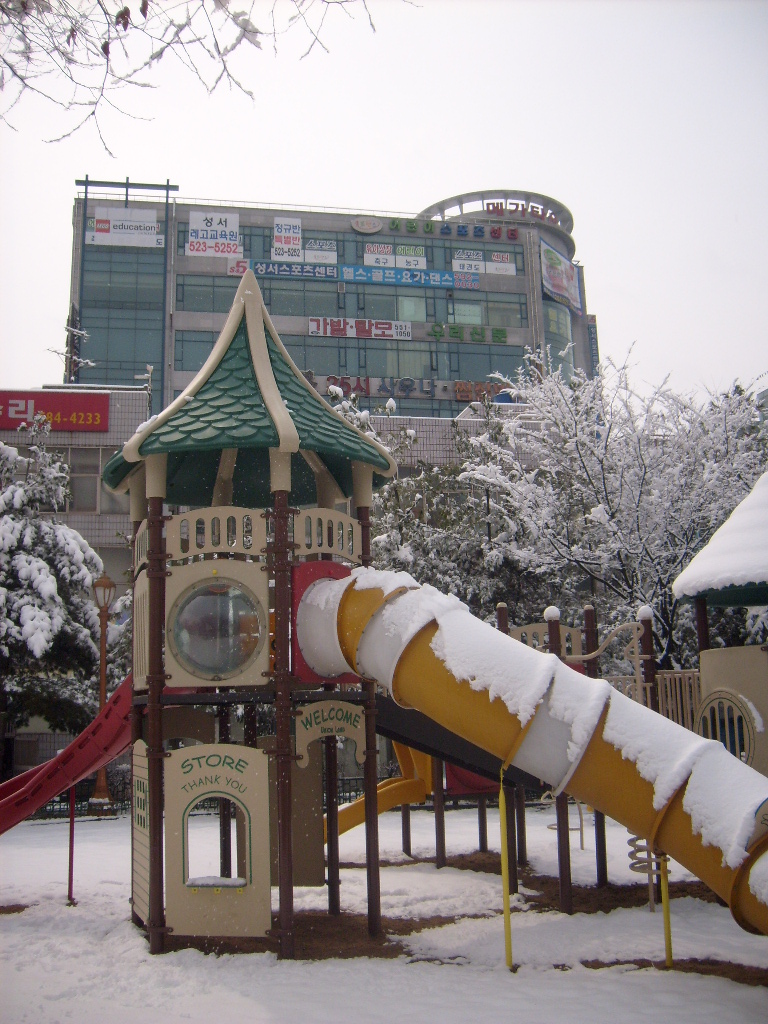
A Small park

Through the trees

By mid-morning the world was slushy!
!
Samil Public Holiday. March 1st
(삼일 운동) Samil – (3-1) relates to March 1st 1919, which saw the emergence of the Korean Independence Movement. On this day, Korean independence fighters declared their independence from the colonial rule of Japan. The Japanese having been in occupation of Korea since 1910. The declaration, sparked widespread processions and demonstrations which Japanese authorities harshly supressed. In one village. Jeam-Ri, all male sympathizers were herded into a church and then burnt. However, in the aftermath the Japanese authorities changed some of their policies especially those deemed particularly obnoxious by the independence fighters. Military police were replaced with a civilian police force and a limited press freedom was allowed. The march 1st Movement was significant in the establishment of the Republic of Korean Provisional Government, in Shanghai, in April 1919.
For those interested in taekwon-do, especially the patriotic and original taekwon-do as practiced by the ITF, the history of which seems unknown here in Korea, Samil is the name given to one of the advanced patterns. The pattern contains 33 movements which represent the original 33 patriots who planned and penned the declaration.


 Elwood 5566
6 comments