Mission Makgeolli – Definitive Recipes
Makgeolli (막걸리) and the closely related dongdongju (동동주) are Korean rice wines which are fairly easy to make. Such rice based fermented alcohols are common across Asia and in the case of makgeolli and dongdongju are the first fruits of a process which if continued and elaborated upon, leads to drinks such as saki. Unlike saki, which looks like water, makgeolli and dongdongju are of a milky appearance often with rice floating in the drink and sediment which necessitates it being stirred or shaken before serving. Dongdongju, often called nongju because of its association with farmers (농), is basically the same recipe as makgeolli but with an additional step in the process. I shall henceforth use the term ‘makgeolli’ when referring to the brewing process of both drinks.

straining the wine through a muslin bag
Originally, makgeolli was a rural alcohol, a sort of home brew and until recently you could neither buy it in cans or cartons as the fermentation was ongoing. Commercial methods have now established the drink in cities where it has gained a somewhat ‘trendy’ image being combined with pulped fruit, yogurt and Chilsung Cider (Seven Up or Sprite). Some companies have also started producing a ‘well being’ variation which uses schisandra (五味子). There is now a wide range of available brands and although makgeolli is naturally ‘bubbly,’ some versions are carbonated – probably as they are boiled to kill the fermentation process and hence lose their natural ‘gassy’ quality.
On parade
Served while still fermenting, it is has the quality of an alcoholic ice cream soda, being both light and creamy, a little like medieval syllabub. The recipe below is still being adjusted but it produces a brew that my Korean friends are happy to drink and if undiluted, is quite potent. Sugar and water, or sprite can always be added to adjust the drink to your own specific preference.
Is it Beer or a Wine?
Perhaps the best method of classification is based on alcohol by volume (ABV). If the brew is in excess of 10% ABV, then it is a ‘wine’, if under 10% ABV it is closer to a beer. Under this classification commercial makgeolli, which is usually 5-7% ABV, would be a ‘beer.’ On the other hand, Japanese Saki, traditionally containing about 16% ABV, is a wine.
For more information on makgeolli click here: (pages: Mister Makgeolli).

©努江虎 – 노강호 2011 Creative Commons Licence.
Interlude (9) Wank
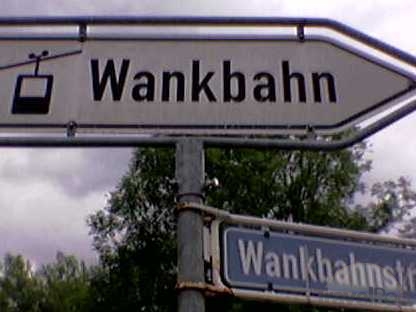
'wank' is very popular in Germany where Wankum, in North Rhine- Westphalia, is close to the municipality of Titz.
For many years the word ‘wank,’ along with other obscenities with which British school kids are acquainted, such as ‘toss,’ or ‘bollocks,’ were absent from the American-English lexicon. As a boy, I can remember being very amused at a Lost in Space episode in which featured a character named Captain Bollocks. British movies such as Austin Powers have since introduced such words to wider audiences and it would seem that in North America the term ‘wank’ is now commonly understood. For any reader unsure of the others terms, ‘bollocks’ is a slang term for testicles and ‘toss,’ is synonymous with ‘wank’ and it’s various other meanings. For British people living in Korea, the Toss English Academy franchise is an amusing title. I did once try to explain to a bus driver for the Toss Academy near my one room, the amusing name of his school and ended up embarrassing myself (‘Toss English’ Bathouse Ballads June 2010).
‘Wank,’ like ‘fuck’ is a highly versatile but I have only ever heard the Korean equivalent, ddal-dda-ri, (딸떨이) in a boys’ high school when it was often the response from others boys, when I asked someone what they’d done over a weekend or vacation
©努江虎-노강호 2012 Creative Commons Licence.
.
A Christmasless Christmas in Korea
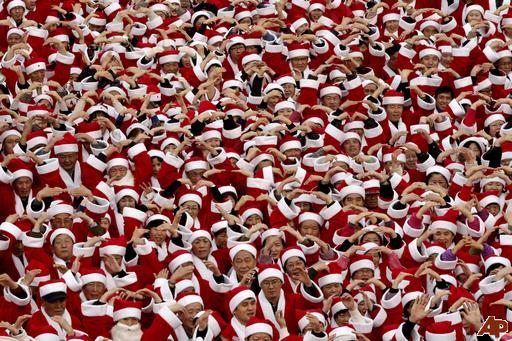
A thousand Santas and not one mince pie, yule log or Brussels sprout!
It’s cold and icy. Sometimes it even snows. From every cafe and on every street corner the sounds of Christmas meander on bitingly cold puffs of wind; Bing Crosby, Mario Lanza, Jim Reeves, Slade and most other Christmas carols or pop ‘hits’ are aired. The only genre missing are those of English cathedral choirs such as King’s College, Cambridge whose traditions and crystalline tones have become such an integral part of the English Christmas landscape. Instead, between Lanza and Reeves are Korean renditions ruthlessly ruined by kiddies’ voices that are a quarter tone flat or hysterical on helium. To subject ‘In the Bleak Mid Winter’ to vocals laced with helium is sacrilegious but then when it comes to traditional carols I’m a purist and prefer not just King’s College but the descants of Sir David Willcocks. Then there are the Christmas trees, twinkling lights and tinsel and occasionally you even see a Korean Father Christmas, even the fattest of whom look like they need a good meal! From a distance there is a sense of the approach of Christmas and sometimes a melody evokes a fleeting anticipation of the pleasures associated with that most celebrated part of the western calendar.
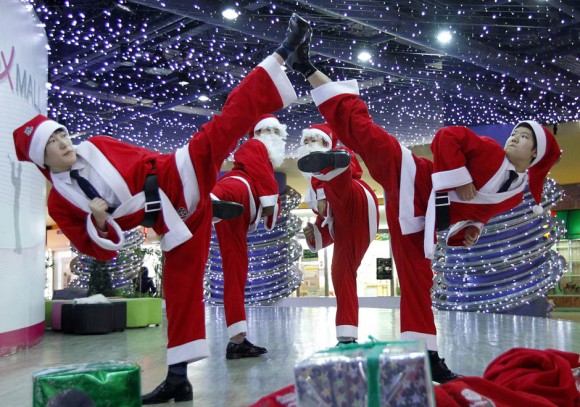
Merry Christmas!
But when such memories are stirred, they are quickly doused by the reminder that however Christmassy it might feel, it is in effect Christmassless! Christmas in Korea joins the numerous contradictions such as school vacations that aren’t vacations, the final exam that is never final but a prelude to the next batch of tests or the public holiday which falling on a weekend, as it does this year, isn’t a holiday at all. However much it might feel like Christmas, it isn’t! There is no over-indulgence, no sumptuous feasts and Boxing Day, which is unknown in Korea, is a normal working day.
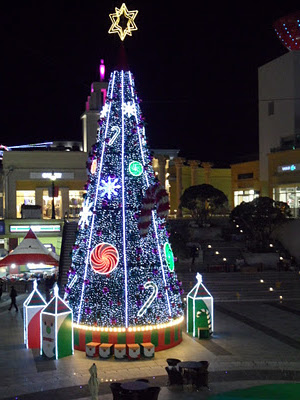
It looks like Christmas, sounds like Christmas, but there's nothing Christmassy about it!
Koreans excel at the melodies, tinsel, silly reindeer antlers and gaudy fake Christmas trees barren of real baubles or chocolate figurines. But no matter how jolly one is hailed with a ‘merry Christmas’, the absence of a holiday, the absence of a genuine festive spirit, the absence of Christmas pudding, mince pies, mistletoe, holly, yule logs (especially chocolate ones), simply conspire to depress me! Role on the lunar new year!
©이동철 2011 Creative Commons Licence.
Demise of Kim Chong-il

Kim Chong-il lying in state
I was sat on a cycle machine in Migwang where I train on an almost daily basis. As the sound from the TV screen was off and my earphones unplugged, I watched a montage of images concerning Kim Chong-il. It was only when I noticed the term ‘sa-mang’ (사망) that I realised he was dead. I confirmed his demise with a student sat on a cycle next to me and I was a little surprised that his death didn’t cause more of an emotional response. With the high school exams (수능) finished, third year students end school in the late morning and the gym has been quite busy with skinny lads who work out with micro-lite weights and then compare their chopstick biceps. Despite almost every TV screen in the gym devoted to Kim Chong-il, and there are 25, one on every treadmill, there was no emotional response to the event and the atmosphere was no different to that of any other morning. Even in my classes reactions were subdued. In North Korea however, emotions ran high.
North Koreans respond to news of Kim Chong-il’s death
Reactions from workers
Spot the guys laughing between 3-9 seconds and at 26 seconds. They look delirious!
©이동철 2011 Creative Commons Licence.
Mission Makgeolli – Brewing Batch 7
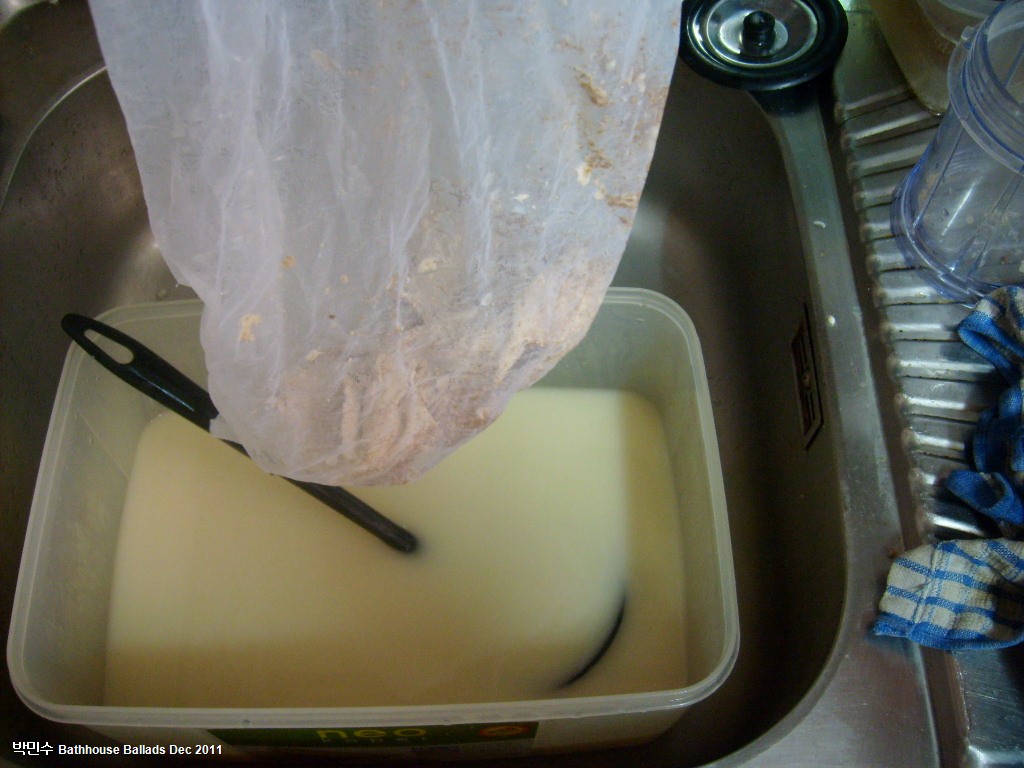
squeezing the wine from the mash
The aim of this brew was to try to remove the slight sourness of batch 6 that I think with too much nu-ruk and yeast but my Korean sources are all contradictory. One source will tell you that a fermentation temperature of 30 degree centigrade causes sourness, another, brewing in excess of 3 days. Batch 6 was brewed 5 days at around 22 degrees centigrade and when I gave it to friends to access it met with a favourable reception. A few friends said it was still a little sour while others said it was perfect and indeed one asked if he could have a bottle. The sourness was mild as I had only added minimal ‘sugar.’ Slowly adding sugar, corn syrup or honey, until the desired sweetness it reached, removes sourness.
In batch 7 I standardized my measurements and in the process reduced both the amount of nu-ruk and yeast. I also terminated fermentation at 3 days. I then added ‘sugar’ to the brew, comparing it with shop bought makgeolli, which after my home-brew is surprisingly sweet – too much so.
The only difference between the commercial product and the home-brew is commercial makgeolli is pure white, carbonated and sweeter.
For my perfected recipe on brewing makgeolli, visit: Makgeolli Mania at Kimchi Gone Fusion
©박민수 2011 Creative Commons Licence.
Related articles
- Mission Makgeolli – Brewing Batches 6-7 (elwood5566.net)
- Mission Makgeolli (elwood5566.net)
Mission Makgeolli – Brewing Batches 6-7

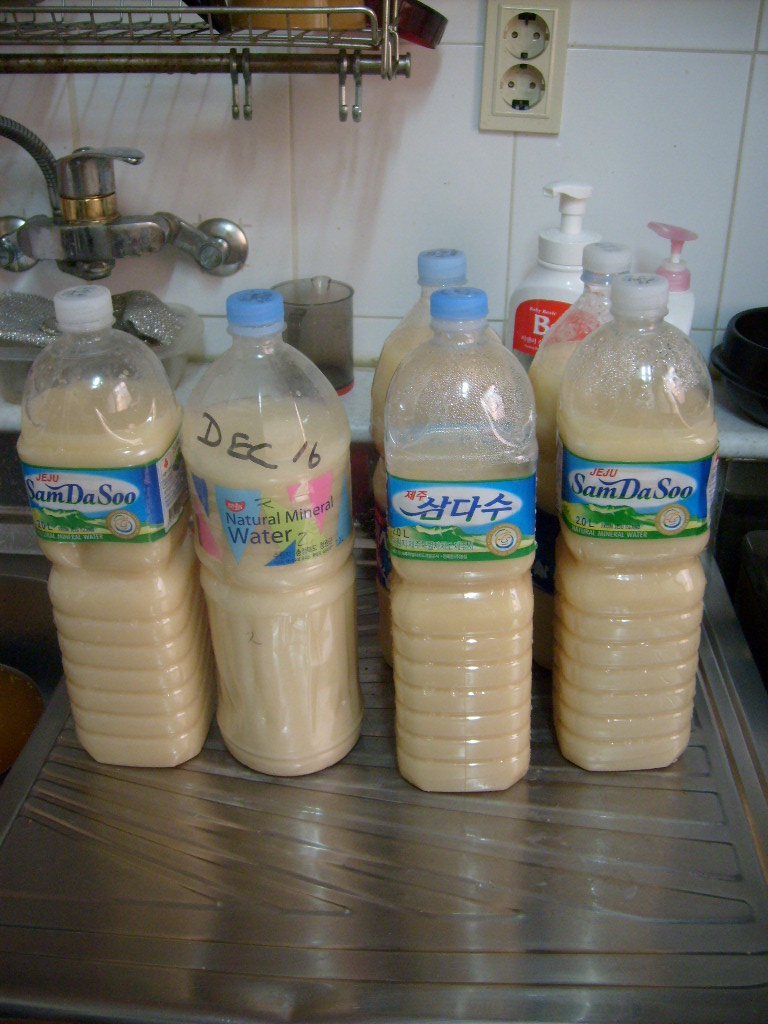
makgeolli, rice wine, batches 2-5
I’ve been searching for a Korean rice wine (makgeolli / dong dong-ju) recipe for over ten years and it’s only been in the last two years that information has begun to surface on the internet. You can sink this unique Korean drink with as much ease as glass of milk, especially when the weather is hot or you are thirsty and it is often an accompaniment taken on hikes up the mountain or wherever there is likely to be some physical exertion.

The popular 'well-being' schisandra makgeolli. (오미자 막걸리)
Several of my friends told me it would be difficult to brew either makgeolli (막걸리) or dong dong-ju (동동주) but after one failed attempt, the failure caused by too warm an environment for the mash, a successful batch emerged. Though it was a little weak, it was perfectly enjoyable. My next five batches significantly increased in size but ended up being rather bitter. I could have added a lot more sugar to compensate but didn’t and three weeks later, they are still fermenting. I blended these five batches together and while they are certainly stronger than a strong wine (14%), they are not as potent as soju (around 20%) so I reckon the kick is about 16-17%. I made batches of both makgeolli and dong dong-ju though to be honest there seemed to be little difference between them and I ended up mixing both types.

The nu-ruk (누룩) after being 'pounded' in the blender
The recipe below is based on my sixth batch (11th December 2011) though I suspect I might have to reduce the amount of wheat yeast to curb a tendency towards bitterness and sourness.
I am not yet fully sure what nu-rook yeast (누룩) is though I do have a Korean recipe for it. Some sources define it as wheat yeast, others as blend of wheat and barley yeast. I do have a makgeolli recipe that uses wheat and barley grains along with the rice, boiling them together and simply adding standard yeast to make the mash. This I will try in the future. If you are in Korea, you can buy nu-rook in markets – I’ve not yet found it in any super-markets.

the 'inoculate' puree comprising nu-ruk (누룩) and yeast (효모)
I’ve discovered the yeast that looks like small seeds, as opposed fine powder, is not effective. Stick to very fine yeast, preferably dried.
Sources I researched varied in the temperatures they recommended in which to sit the mash. My first batch, perched on top of a rice cooker, was too warm and the mash failed to initialise and by the third day a mold contaminant had spoiled the batch. The next five batches sat in a warm corner of my room with the ondol floor heating on for around five days. The room temperature was around 27 degrees centigrade and uncomfortable but jars were very active. I’ve subsequently found that fermentation will occur at 20 degrees (centigrade) and even at ten it continues.
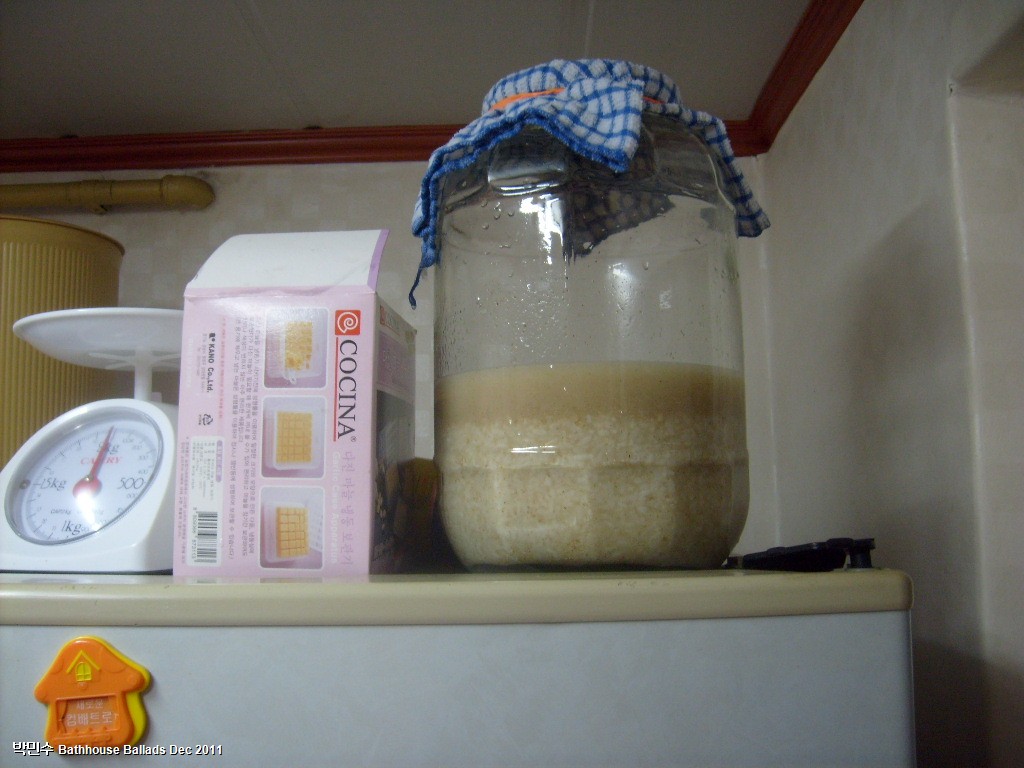
batch 6, technically dong dong ju as it uses glutinous rice, about to be 'bottled'
Most of my sources suggest leaving the mash to ferment for 3 days to a week before filtering it. They also said to bottle the final alcohol but since I’ve had two bottles come close to exploding, I’ve used a large plastic screw jar, which probably hold a gallon and I’ve left the top loosely screwed in place. It is quite amazing the amount of gas that occurs during fermentation. One source said not to open bottles for two weeks! One of my bottles exploded like a champagne bottle after only 9 hours, so be cautious! I have recently started punching a small hole in the tops of the plastic bottles I store rice wine. (Ten years ago, before you could buy canned or bottled rice wine in which the fermentation process had been terminated by boiling and subsequently, often carbonated, the plastic bottles in which you bought the wine had a small hole in the cap).
straining the wine through a muslin bag
Make sure all utensils are boiled or washed in the sort of solution with which you sterilise a baby’s feeding bottle. I also swish out the jar with some soju or vodka prior to filling it with the mash.
The most tiresome part of the entire process is washing the rice. I’ve discovered using a plastic ‘muslin’ bag, or a muslin bag makes this process much easier.

the bottled dong dong-ju, ready to drink
Ingredients used for batches 6 and 7 (seven is in brackets and although seemingly of smaller proportions, I used a standard size cup rather than a rice type cup – the standard size cup probably contains twice the content))
Glutinous rice (찹쌀) 5 cups (3) Glutinous rice for dong dong-ju (동동주)
or standard rice (햅쌀) 5 cups (3) Standard rice for makgeolli (만널리)
Water 2 liters spring water (2)
Wheat Yeast (누룩) 1 cup (.5)
Yeast (효모) 1 teaspoon (.5 teaspoon)
Sugar, honey or corn syrup (물엿) as required
Equipment
rice cooker, large glass container, large rubber band, boiled cloth which can cover jar, muslin.
Wash the rice 20-30 times – until the water in which you swish it remains clear.
Let the rice stand in water for 30 mins after which give it a final rinse and drain. Be careful not to rub the rice too much between the palms as it will start to grind. Add 1.5 cups of water for every cup of rice and then cook this in the rice cooker. (other methods can be used – pot boiling, steaming, etc.)
When the rice is cooked let it stand for several hours before turning off the rice cooker to let it cool.
In a sterilised bowl and the ground nu-rook and yeast and mix it with a little warm water until it is a paste. Do not be tempted to do this in a blender as it might explode.
Put the rice into the glass jar and add about 1 liter of water. Mix the ingredients before adding the blended yeast inoculate and then mix together.
You should now put a sterilised cloth over the jar and secure it with an elastic band.
Stir the mixture once in the morning and in the evening being sure to do so with a sterilised ladle.
You will know if the mash as initialised as you will both see rice particles floating up and down in the jar and see and hear the exchange of gases. From the third day, though I might possibly wait until the fifth, you can pour the mash into a sterilised muslin bag and then proceed to squeeze liquid out of the rice into a storage vessel. Sugar, or corn syrup etc, can be added at this stage and the brew diluted to taste with spring water. In batches 6 and 7 I used about a liter of water. Both types of rice wine are commercially sold at about 5% alcohol and supposedly the undiluted brew from this recipe is around 16%. At an estimate it is probably about 7% if diluted with a liter of water.
It is often mixed with Sprite or Chilsung Cider and also drinking yogurt and this is especially useful if the brew is a little bitter or sour.
Fermentation will continue after this process but the brew is now ready to drink but give the contents a stir or shake before pouring.
NOTES ON BATCH 6 (removed from fermentation jar on December 16th after 6 days at around 22 degrees centigrade). As I mentioned earlier, I added 1 liter of spring water to the wine and about half a cup of corn syrup. There is only a touch of sourness with no bitterness. This is the best batch I’ve made so far in terms of balance.
Batch 7, prepared on December 16th, uses slightly less yeast – update to follow.

batch 7 at the start of fermentation
I have used several sources in the quest for the best recipe but I am indebted to Max from Zedomax.com. This was the first decent recipe I found and without his help I’d still be floundering. Cheers, Max!
For my perfected recipe on making makgeolli, visit: Makgeolli Mania at Kimchi Gone Fusion
©박민수 2011 Creative Commons Licence.
Related articles
- Mission Makgeolli (elwood5566.net)
Not Perfect but Preferable
Okay, I’m 56 this month and I’ll probably return to the UK late next year because I need to get a decent job that pays well before I’m too close to retirement. Unfortunately, that means teaching in a British school, a prospect that fills me with terror. I dread returning to Britain, not just because I find the place boring and the people aggressive and somewhat backward, but because I feel I am going home to die rather than going there to live. Britain, as quaint as it can be, as beautiful, has become a little like the Elephants’ grave yard.
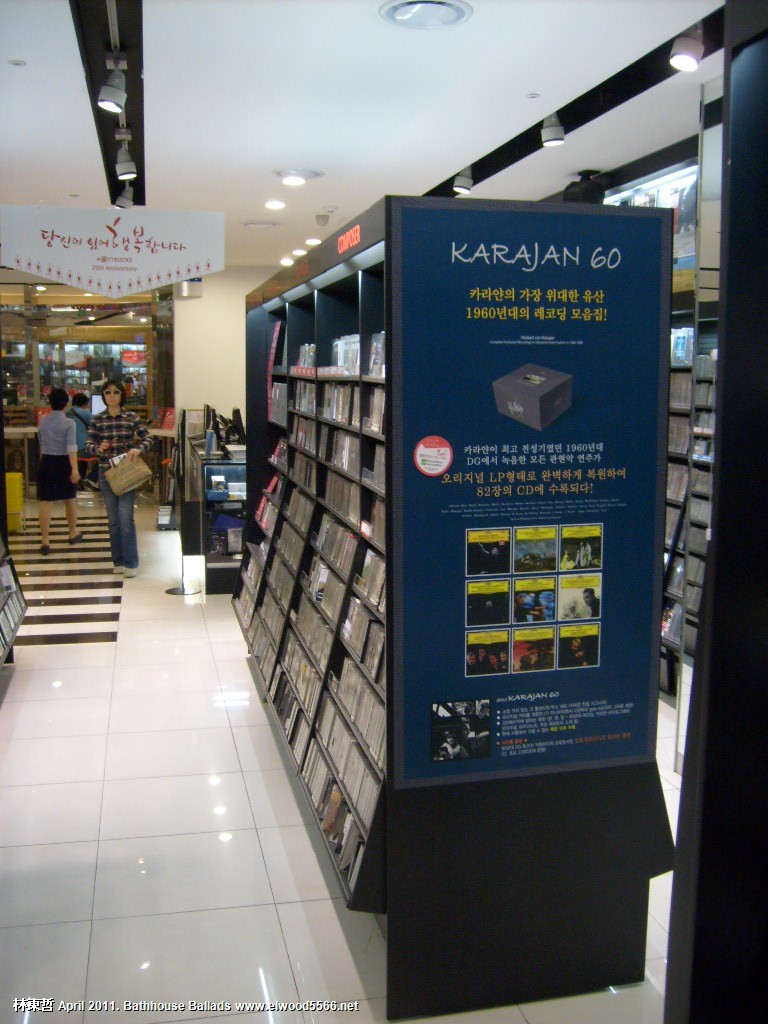
The extensive classical CD selection in Daegu’s ‘Kyobo Books’
Britain on the one hand is rich in culture and London is an awesome city but as in so many cultural areas, its culturally void. Accessing the rich variety of British culture is both expensive and inconvenient. It’s one thing for a country to have a vibrant culture but not so great if it’s focused in a view places, thin on the ground, and expensive to access. Take going out for a meal: I eat out everyday in Korea mostly in a range of mid-standard restaurants and occasionally in fancy ones. In the UK, even on a fairly decent wage, eating out is expensive especially if you have a family. While there are plenty of fast food restaurants, and a few top-notch places, finding a decent middle of the road restaurant is difficult. In Korea, there is a restaurant on every street corner in even the smallest towns whereas my village in the UK has 3 restaurants, all small and expensive to serve a community of 55.000 people.
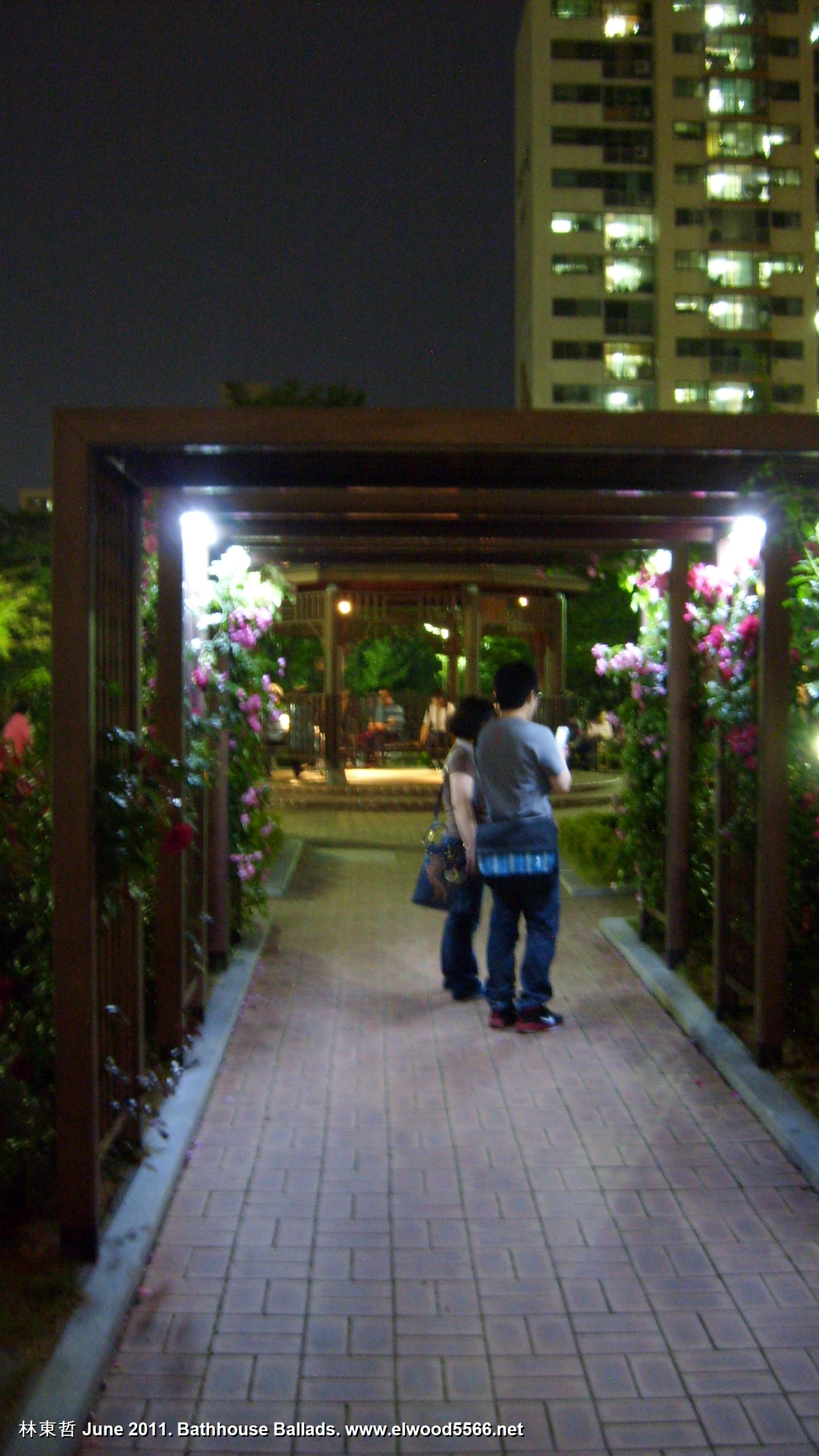
My local rose park. In the UK, such parks are locked at night because of vandalism
In terms of sport, patriots will boast about British prowess but the reality is that while there are excellent facilities in key locations, elsewhere facilities are poor. For example, Colchester, UK, population 155.000, has one mediocre swimming pool and no outdoor swimming facility. Further, it has no concert hall and hence you can’t see the ballet or opera, or a big pop concert. While it does have a decent theater, there’s only one. However, there are hundreds of bars and clubs to get sloshed in, mostly pumping out pop music accompanied by enormous plasma screens and juke boxes. And when you’re pissed and staggering you can lurch to any number of greasy cheap fast food places and then take an expensive taxi home. This pattern, is a major lifestyle for a great number of Brits. Yes, I know not everything is doom and gloom in the UK but my point is that if you want to eat in a decent restaurant every day, possibly twice a day, and do things, it is going to cost you! And then there’s the violence, crime, vandalism and the hordes of a what constitutes a drongo underclass that dominate the streets. Britain is not a nice country and if you think it is you are blinkered. In all my years in Korea I have never walked into an environment in which I felt threatened or intimidated but in my rather small hometown (Colchester), there are places I wouldn’t want to be even in broad daylight. And the rather nicer village in which I live nonetheless feels like a sanctuary protected by the fields and a university which separate it from less savory areas and less savory people.
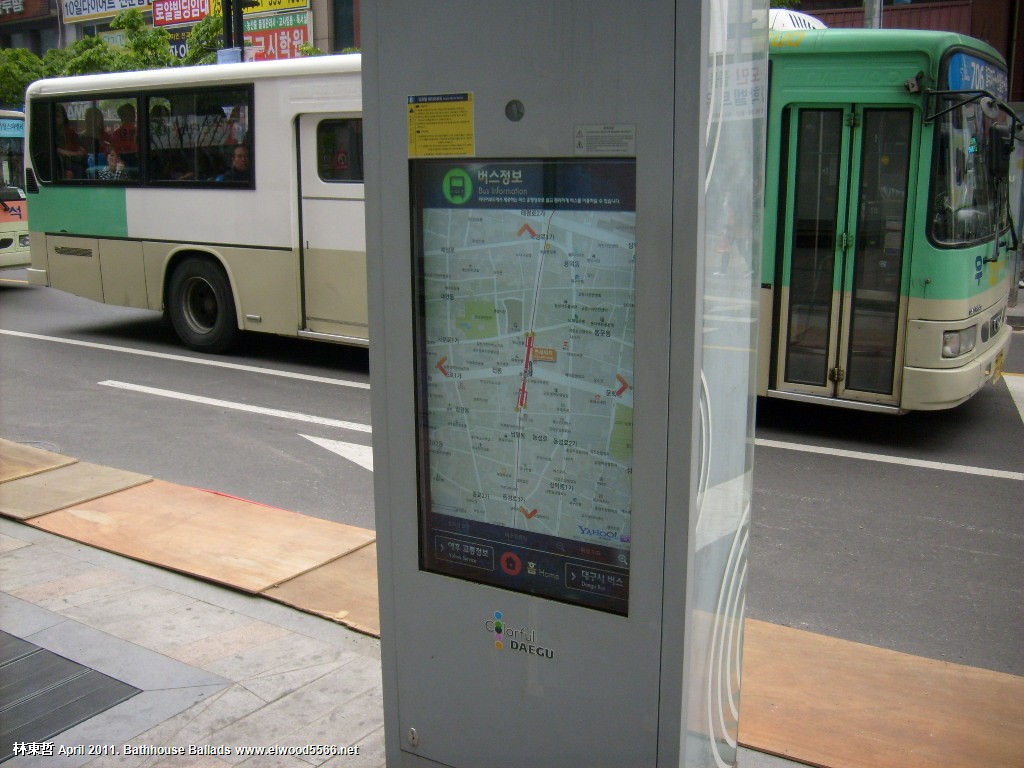
‘Smart’ street information. Another Korean facility that would be wrecked by vandals in the UK
Going back to the UK is a massive step down in terms of lifestyle, cultural opportunities and quality of life and even the massive hike in terms of pay can’t compensate for living in an expensive, insular little enclave surrounded by a cultural wilderness. My home town has a crappy library designed to appeal to the towns large population of drongoes, a couple of small bookshops, no shops which specialise in classical music and apart from bars and restaurants and sport, there is little else to do. I find it hard to imagine life without PC bangs, multi bangs, singing rooms, health centers, bathhouse, jjimjil-bang, stationery stores, coffee shops, medical clinics, dentists, opticians, hospitals, taekwondo, hapkido and comdo schools, cheap taxis and the rich variety of restaurants. So much of British life and British culture is the product of a large drongo population. We are denied so many facilities or social niceties as the scum elements we tolerate ruin them. My local town has a rather attractive public garden but it has to be locked at night because the bowls green and gardens are regularly vandalised and when resident swans pair up and produce cygnets, they are killed by local yobs.
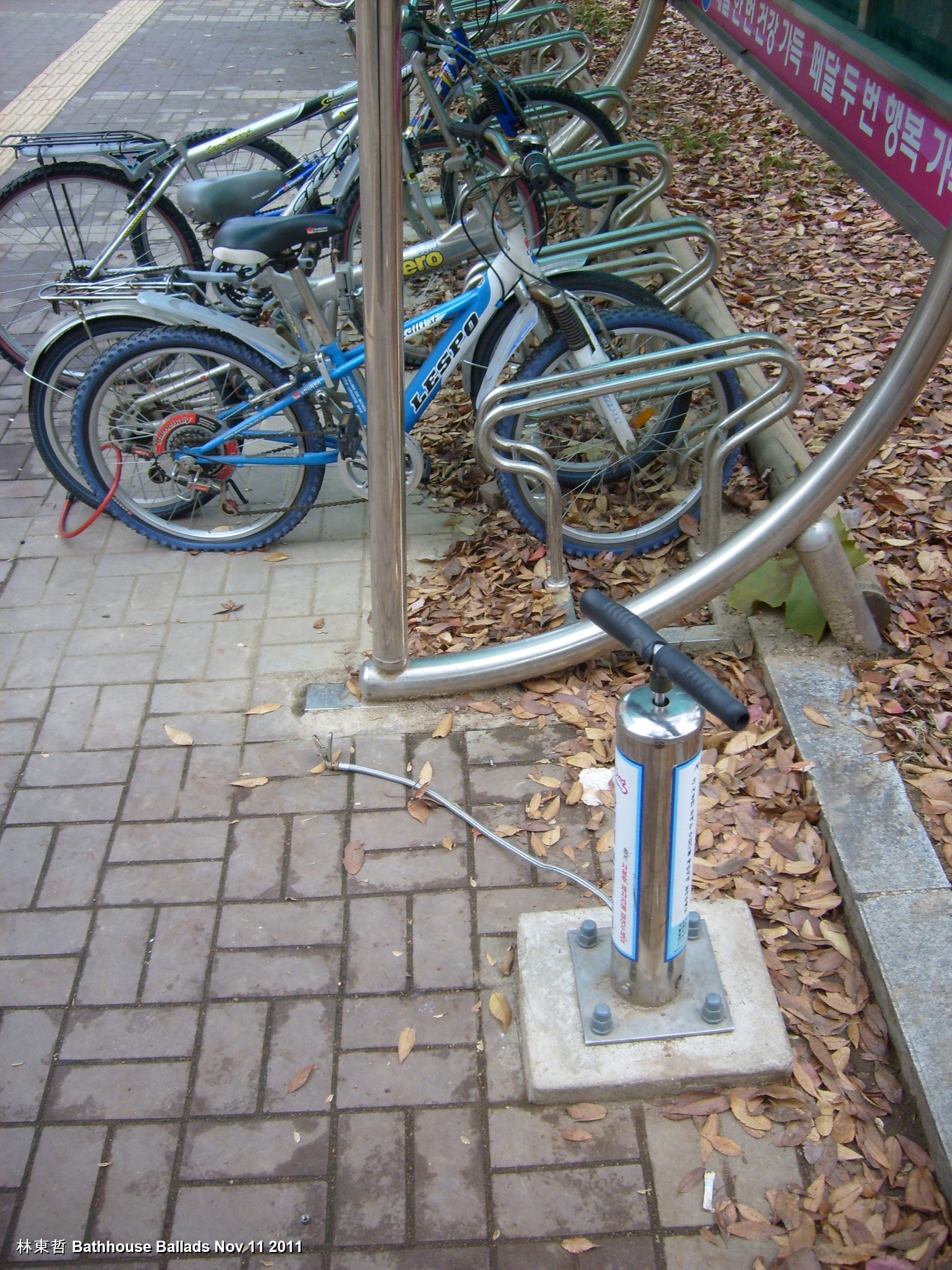
A public bicycle pump facility (and free). Another facility British drongoes would smash
Going back to the UK sucks and I dread it! There is no doubt if I was younger I would consider buying a property here and settling long-term.
©박민수 2011 Creative Commons Licence.
Related articles
- Colchester – Yob Town (porthole2.wordpress.com)
Mission Makgeolli
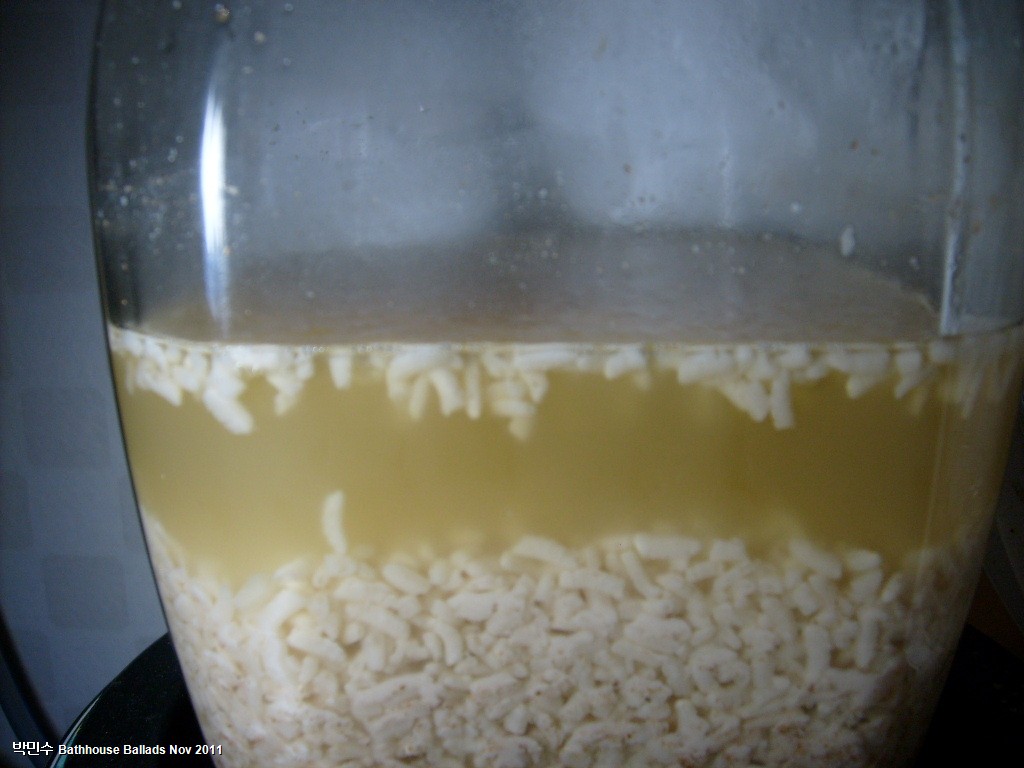
my first batch of dong-dong ju, light, fizzy and refreshing
I often mention how a mere twelve years ago, even 8 years ago, there was very little information on the internet about Korea. Indeed, my attempts at making kimchi and various other recipes as well as learning Korean and hanja, all began with books rather than internet sources. Until recently, there was little available in English in relation to Korean culture. I’m being cynical, but now you don’t really need to come to Korea to discover its secrets because they’ve been exposed to the entire world.
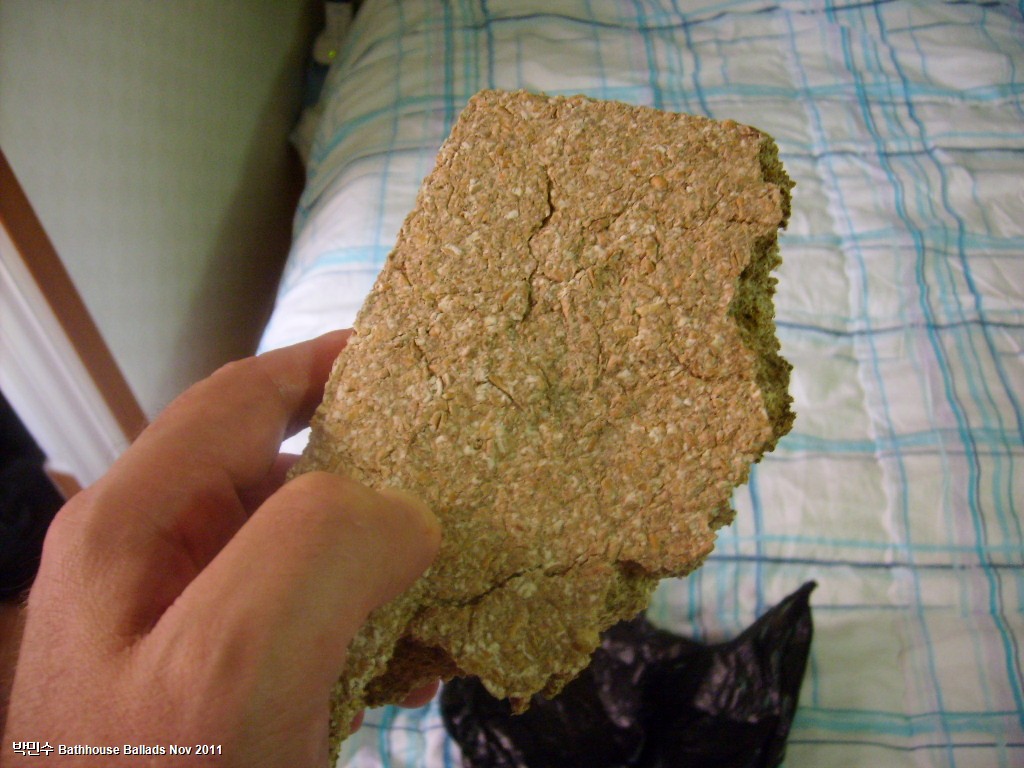
nu-ruk (누룩), a type of yeast made from wheat
I’ve been searching for a makgeolli recipe for over ten years. With the price of a bottle so cheap it’s pointless making your own brew in Korea but back in the UK kimchi is difficult to buy and makgeolli next to impossible. Every six months or so, I’d do a web search and it has only been in the last few years that information has began to emerge. I am now fairly confident at brewing Korean rice wine but my next quest is to learn how to make the wheat and barley type yeast, known as nu-rook (누룩), which is essential both for this recipe and that of the rice drink, shik-hye (식혜). Nu-ruk is not available in the UK. The problem is compounded because a good number of Koreans, especially younger Koreans, have as much knowledge about the purpose of nu-ruk in the production of makgeolli as a British youngster might have about rennet in the process of making junket. Indeed, I’ve met Koreans who had no idea what nu-ruk is.

my first successful batch of dong-dong ju mash sitting fermenting on top of my rice cooker
Anyone who has lived in Korea will be aware of the variations in rice wine, namely between makgeolli and dong-dong ju (동동주). Learning the difference has taken a long time and I’m still not a hundred percent sure my understanding is correct. Misinformation abounds on the internet and even Koreans can be unsure of the difference. Some sources will tell you both versions are different strains of the same mash but the most plausible is that dong-dong ju is produced with sticky rice and makgeolli from standard rice. One source I recently read, western in origin, claimed the name dong-dong ju referred to the small bits of rice that float on the surface, like ‘shit.’ Of course, this is incorrect because ‘shit’ in Korean is ‘ddong’ (똥) and not ‘dong.’ (동). Sometimes, dong-dong ju is known as nong-ju (농주) because of its association with farmers (nong-sa 농사, farming).
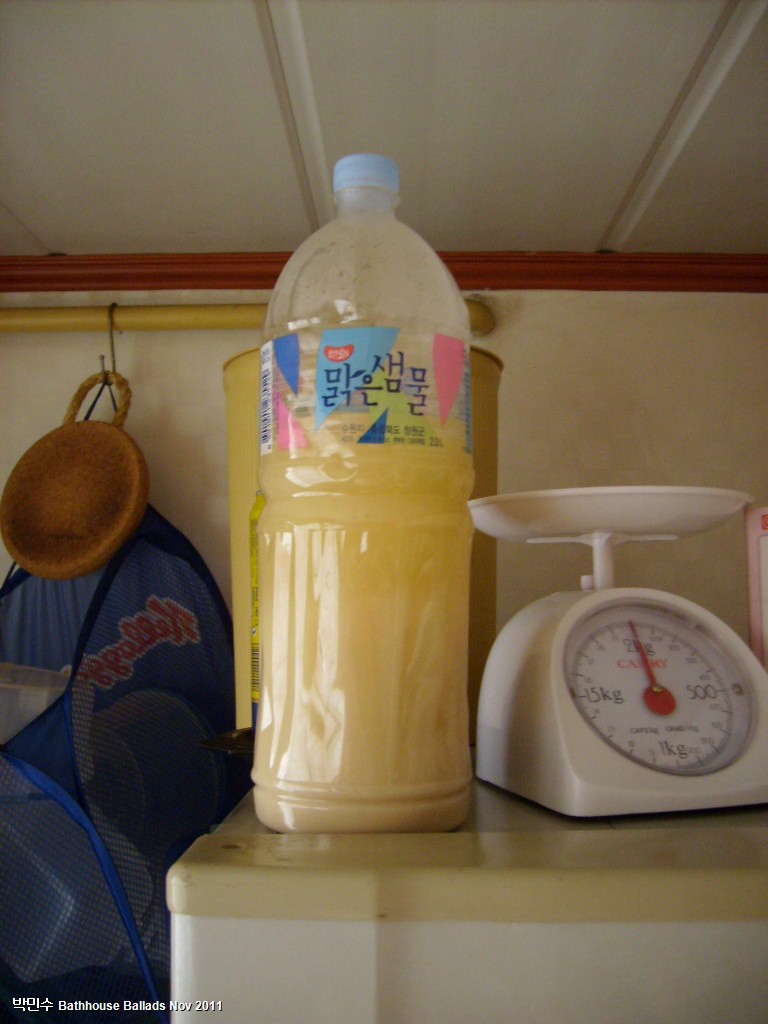
3 cups of rice produced nearly two litres of ,wine’ though I may have over diluted it
The process of making rice wine is quite simple, despite being told by numerous friends that it was both difficult and time-consuming. With only five ingredients, rice, water, nu-ruk, yeast and syrup, the most laborious part of the process was washing the rice, around twenty times, and sterilizing equipment. Apart from a jar and some muslin, all other equipment is basic though a coffee type grinder is needed if the nu-rook hasn’t been previously ground.
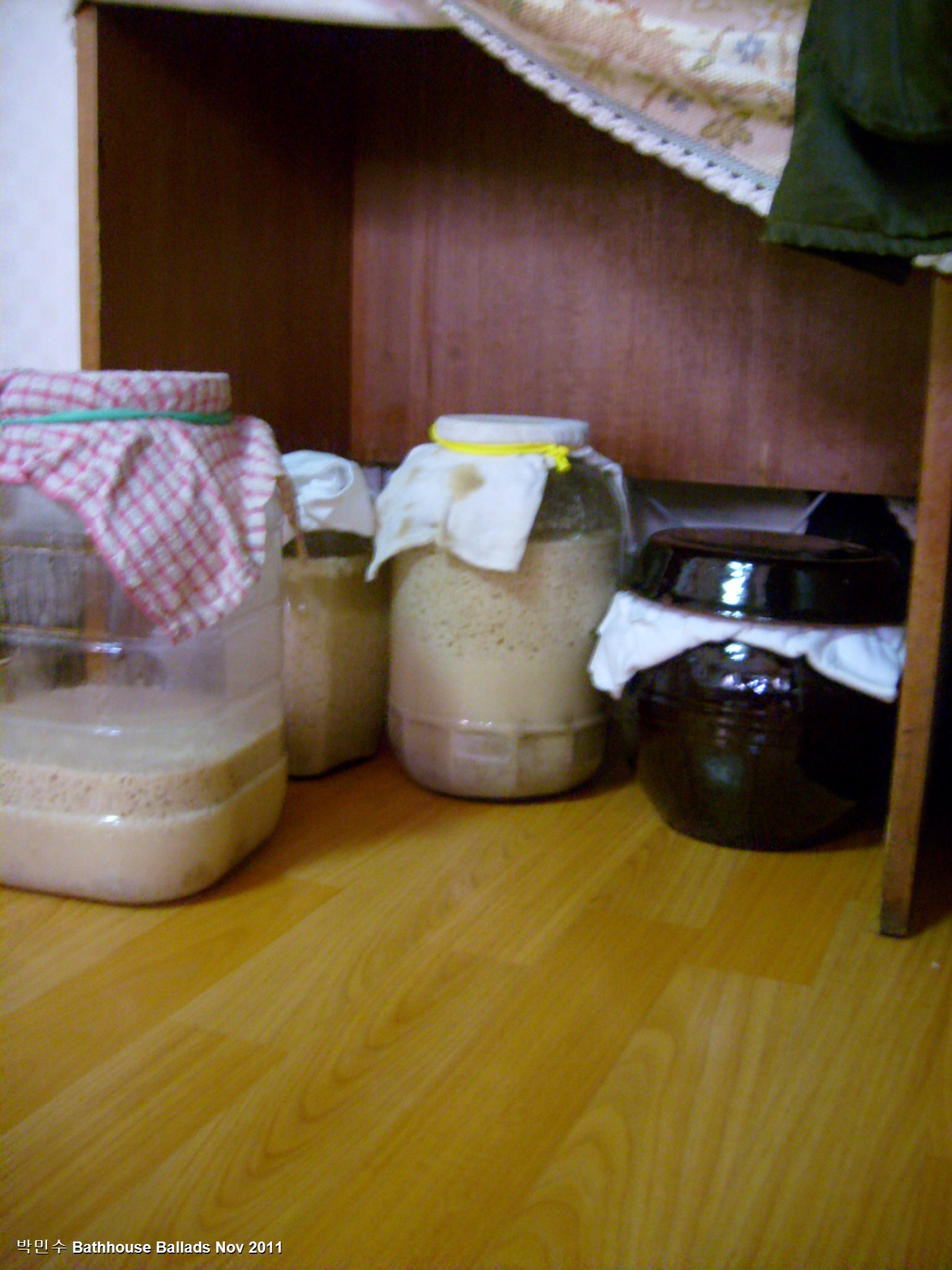
subsequent batches of mash – both from glutinous rice and standard rice
Once again, information on temperature varies. I originally put my jar on the top of my rice cooker, set to ‘keep warm’ mode. However, this was too warm and I think the active enzymes were killed and mould quickly formed. I was originally aiming for a temperature of around 82 degrees and had read that over 97 is detrimental. For my second attempt (dong-dong ju), I then placed a few plates between the top of the metal rice cooker bowl and the jar of mash and this brewed successfully. The process took 4.5 days and my initial batch consisted of 3 cups of rice which when further diluted produced about 1.5 liters of drink. The alcohol content was probably around 4% and a little weaker than I like and I only added about 2 table spoons of syrup. Unlike my first batch, the activity in the mash was high with plenty of bubbles and if you put your ear close to the jar, a constant busy fizzle.
I have now gone on to start five other brews using both glutinous rice and standard rice. The jars of mash are kept in a heat trap under my TV and at a point on the floor over the ondol heating pipes. Currently, I’ve set my room temperature to around 25 degrees (around 68 degrees Fahrenheit) but as I find this uncomfortable, I want to test a brew at around 21 degrees.
When I have perfected my technique and have discovered the secrets of nu-ruk, I will post details.
©박민수 2011 Creative Commons Licence.
Umbrellas
Two photos of the variety of umbrellas brought to school when it’s either raining or likely to rain.
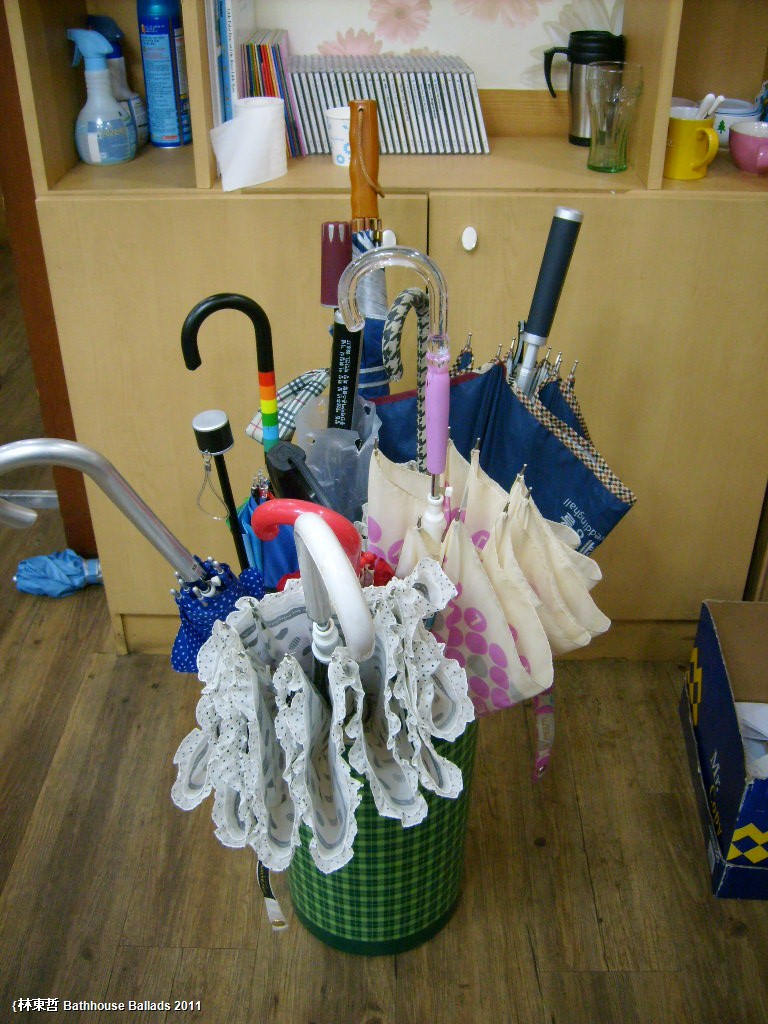
umbrellas galore
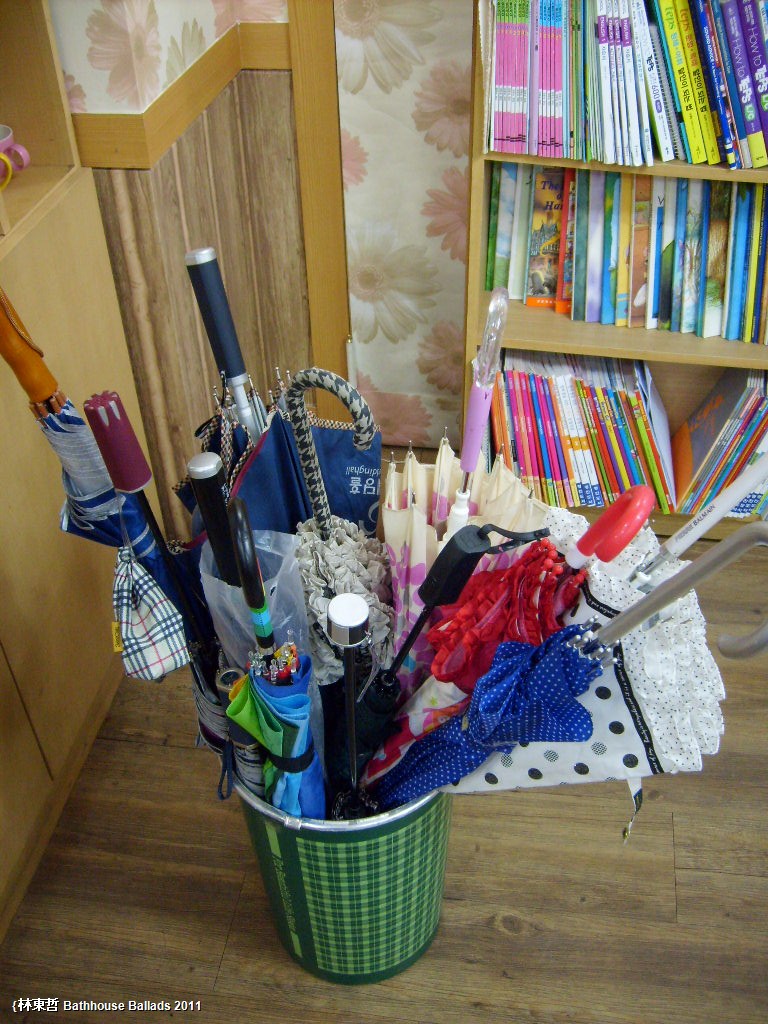
a varied selection
© 林東哲 2011 Creative Commons Licence.
Suneung 2011. D-0
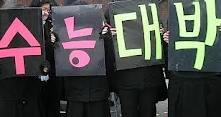
‘Suneung Jackpot’
Early morning, 7.30 am and I’m outside the local boys’ high school to watch the ‘suneung’ students arriving for the most important exam of their lives; an exam which for most students will have been their sole goal for the last three years, if not longer. As always, a few students arrive with just enough time to run into the school before the exam begins. You ask yourself how students can be late on the suneung morning, an event they have been counting down towards for the last year but of course no matter how significant the suneung is in the Korean psyche, the unplanned and unexpected problems of life get in the way; an alarm clock that suddenly ceases to work, the parent’s car that has a problem starting, the unexpected traffic jam.
The school stands on the brow of a hill, its front entrance, in the common tradition of poong-su (feng-shui, 풍수), faces east. Behind the schools lies the Warayong Mountain in which the infamous ‘frog boys’ disappeared in March 1991, their murdered bodies being discovered in 2002 (Five Boys Meet Death Where the Dragon Dwells). In the distance, at the foot of the hill, the wail of a police car cuts through the murmur of morning traffic. Unable to meander through the congested traffic, it mounts the pavement and drives up the footpath towards the school. The car, lights flashing, stops outside the school and to a round of applause by parents and congregated well-wishers, a boy jumps out and hastily runs towards the examination rooms.
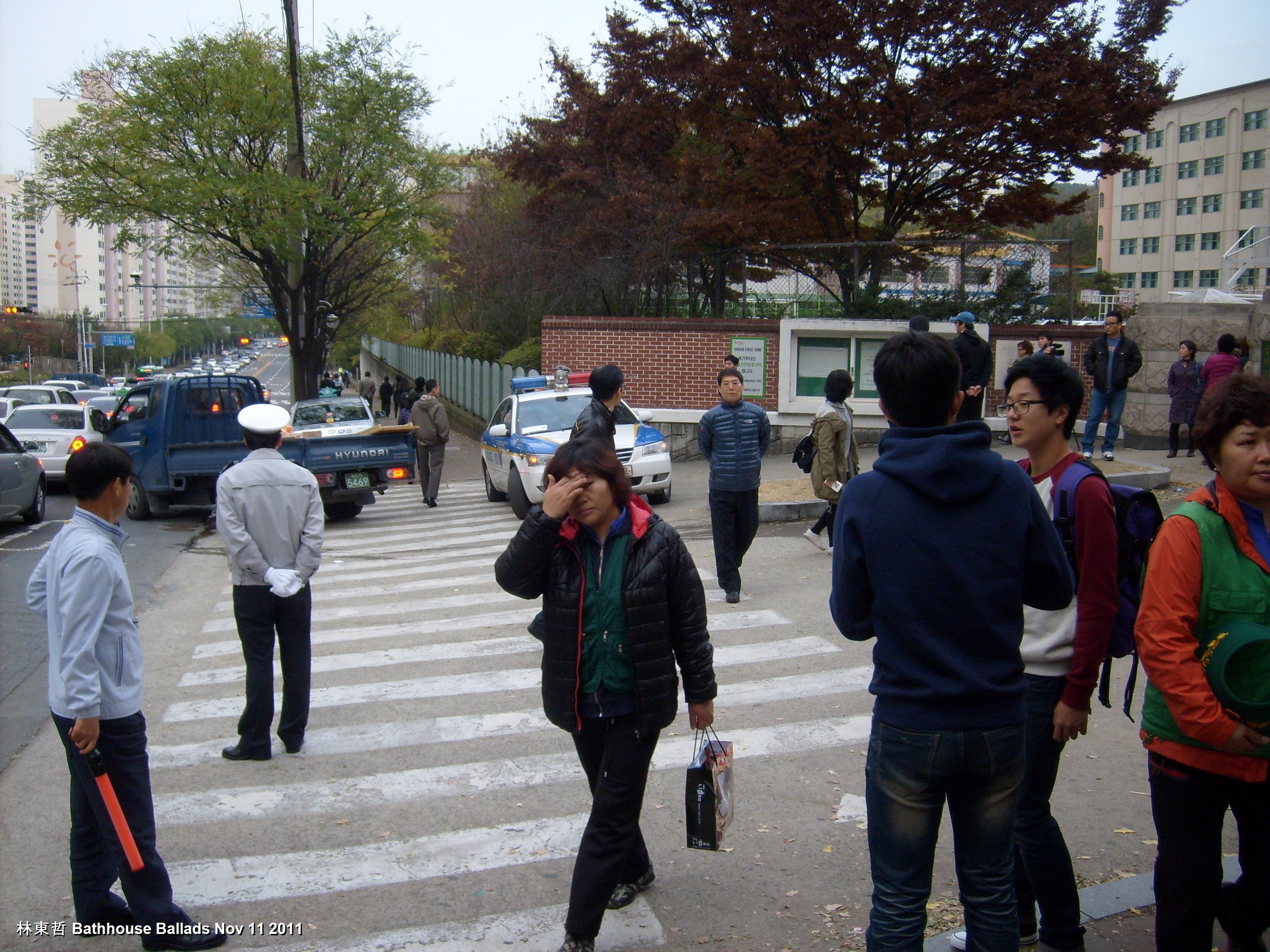
a student being delivered by police car
As much as I try to avoid making comparisons with my own country, suneung always forces me to acknowledge the immense ideological abyss that separates Korea and the UK in terms of education. Suneung is an event which has a profound impact on Korean society and is reflected not just in the annual countdown to its manifestation, but in public regulations, guidelines, a host of gifts and items to aid exam success and a range of ‘gimics’ popularly ‘believed’ to aid exam performance. And after the exams, post suneung students are enticed, rewarded, with a host of reductions and offers appearing in shops, health clubs, cinemas and restaurants. Most profound and quite different to my western experiences however, are the attitudes to education. Try explaining to Korea kids that in your country it isn’t cool to be clever, that intelligent students are often bullied and the cult of anti-intellectualism rife, that a teachers dare not leave their coffee mug on a classroom table for fear of it being spat in, smeared with a pair of testicles or ladled with drawing pins or paper clips (Metro, Feb 2011). And then try explaining that achievement is leveled so that those who do well or are exceptional go unrecognized while those who were bone idle and lazy hide. In recent years one teaching organisation suggested removing the word ‘failure’ from the teacher’s diagnostic lexicon and replacing it with ‘deferred success’ (BBC News July 20th,2005). My university, Essex University, no longer awards graduates’ degrees in academic rank from 1st class honours to pass, and instead, degree ceremonies are ordered alphabetically. The graduation ceremony allows for no distinction between degrees earned by three or four year’s hard work and those the product of a permanent party. In the politically correct world of the UK, we are compelled to down play success and hide failure behind Mickey Mouse courses and useless qualifications both of which are given the veneer of parity with subjects that demand hard graft.
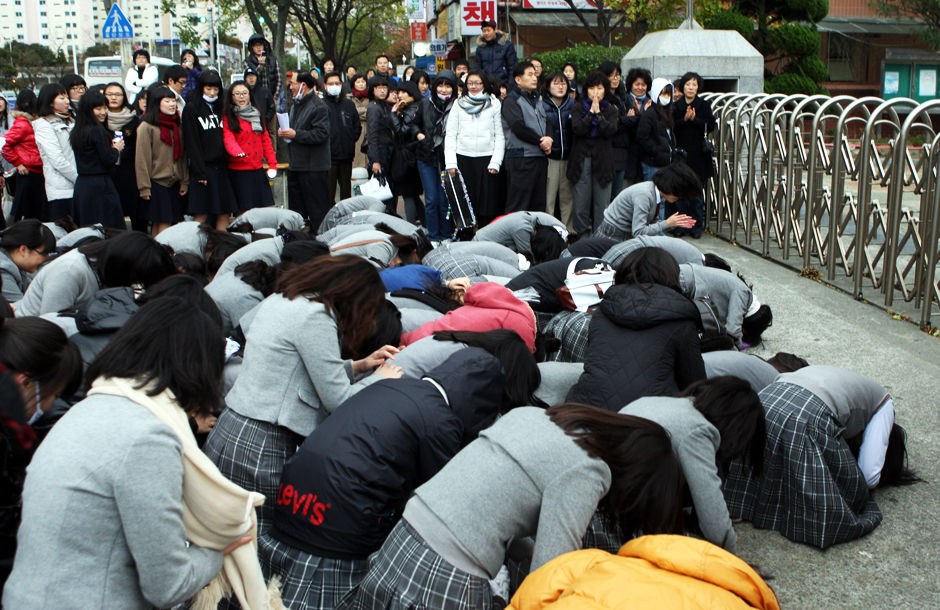
juniors students give the exam students support
However much British politicians and school mangers blab about the importance of education, it is mostly hogwash. Most school are more alike than different and innovation is curtailed rather than encouraged. The quality of the teaching staff in schools, where some excellent teachers do exist, is basically bog-standard because job specifications, in the pursuit of politically correct ‘fair-play,’ castrate all applicants who have qualifications or skills not asked for by the specifications. It is totally irrelevant that an applicant can miraculously turn failing students into ‘A’ grade students, or is qualified to teach any subject on the curriculum, if such a skills or abilities aren’t requested on the specifications. Though rules can be circumnavigated they cannot be seen to do so and in the politically correct environment ‘fair-play’ and notions of ‘equality’ are dictatorial. It is a contradiction that any institution can have the ‘best staff’ when those with skills, qualifications and experience beyond the remit of the post’s specifications, have been rejected.
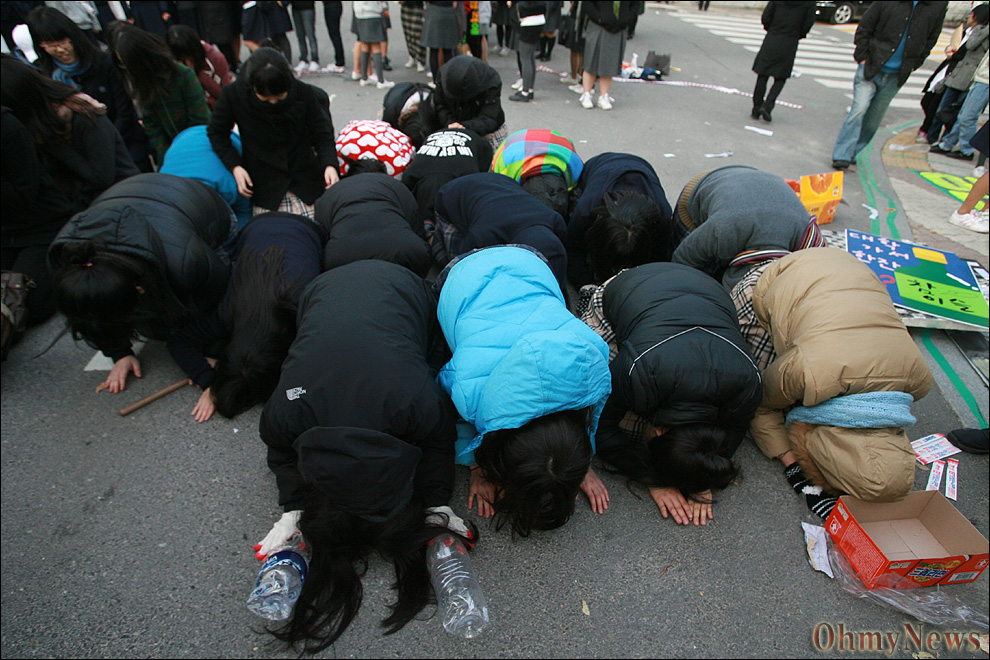
more prostrations
I can’t name one Korean celebrity who I would say is a dimwit but there exists an army of British celebrities who not only aren’t particularly bright, but whose lack of ability is celebrated. A good number of our football players lack a decent education and some are so repugnant and base they are detrimental to the boys who idolise them. And not only does British society tolerate celebrities who abuse themselves with alcohol and drugs, it financially rewards them! After being exposed as a cocaine snorter in 2005, super-model Kate Moss’ earnings between 2005-2006, increased by 3 million dollars. (Forbes. cited in Wikipedia) And in dumbed-down Britain, we love to celebrate mediocrity and stupidity. Jane Goody was a prime example of the failings of British education; despite eleven years compulsory education she was probably one of the most ignorant and dumbest adult humans ever to appear on TV. But more alarmingly, despite her tartish behaviour, foul mouth and racist attitudes, an enormous fan base developed even prior to the time she was diagnosed with cervical cancer (Jane Goody, Wikipedia). For many Brits, Goody was an idol and an example of how brute dumbness, lack of class and vulgarity can triumph. Forget education, manners or decency, just behave like a stupid slag and you too can become a millionaire. And I know it’s pitiful and sad, but once diagnosed with cancer and the mostly moronic public were even more willing to both idolise and defend her.
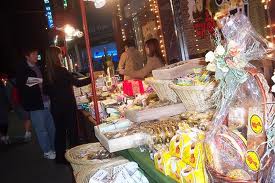
suneung gifts
I remember when the Spice Girls were being interviewed ten years ago and one of them joked about the dismal report she received from her music teacher. The teacher’s suggestion that she not consider music as a career, was pathetically dismissed with the response, “and look at me now!” I doubt any of the Spice Girls could have distinguished a bass clef from a treble clef and other than miming and pouting the lips like a blow-up doll, doubt they had anything but mediocre talent which certainly wouldn’t have survived a facial attack with acid or a vigorous chaffing by a cheese grater.
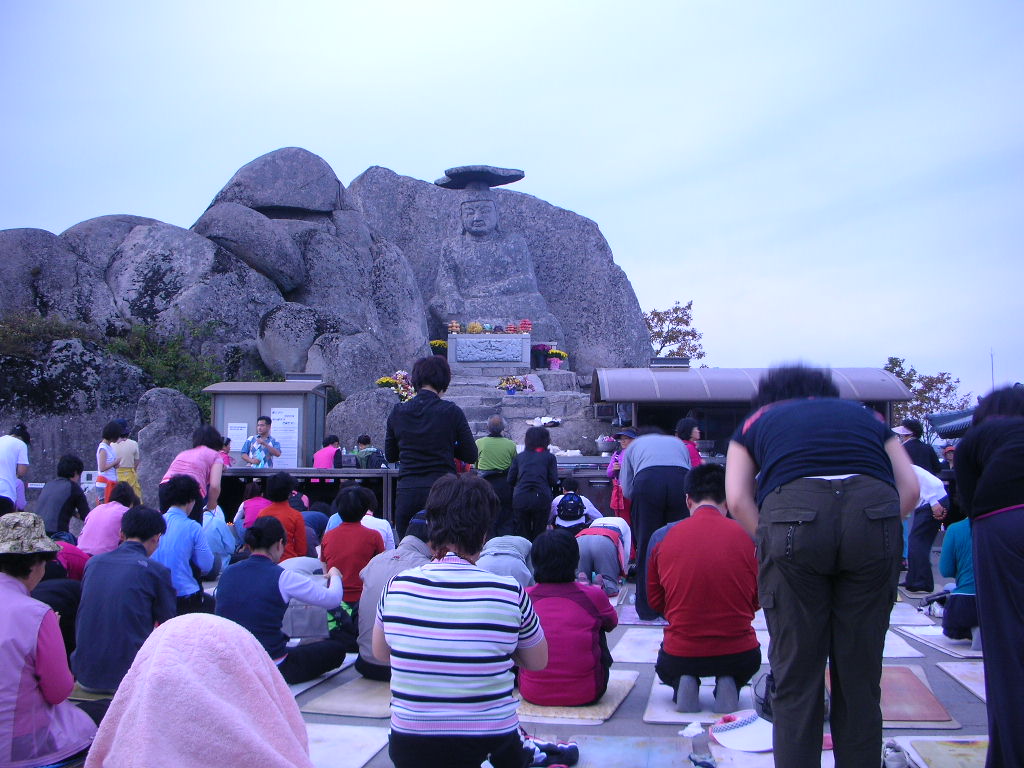
Parents pray for exam success at the Gatbawi (갓바위) shrine in Daegu
I have probably had to teach in one capacity or another in around twenty different British schools and in all but a couple it was hard and degrading work. Most British kids need to be force-fed learning and the high percentage of bad attitudes, behaviour and disruption have a detrimental effect on most classes. Most British teachers are highly defensive about such accusations despite having little or no experience teaching in anything but their own country and school managers are quick to defend their schools and berate the competition in just the same manner the boss of a Burger King will slag-off McDonald’s.
Yes, Korean education has its faults but I prefer being in a system where students know where they stand instead being fed a lot of guff that their nail care technology or business studies course is the equivalent to traditional academic subjects such as maths, history or science. In all but two schools in which I’ve taught there has been a pool of retards in every grade. Of course, most are retards because they behave like scum, abusing teachers and disrupting the learning of their fellow pupils. However, I don’t think I’ve really met a Korean retard and I certainly haven’t met a Korean student who can’t read or write or doesn’t know where their country is on a map. And I’d claim that a number of my students have better English writing skills than kids I’ve taught back in the UK.
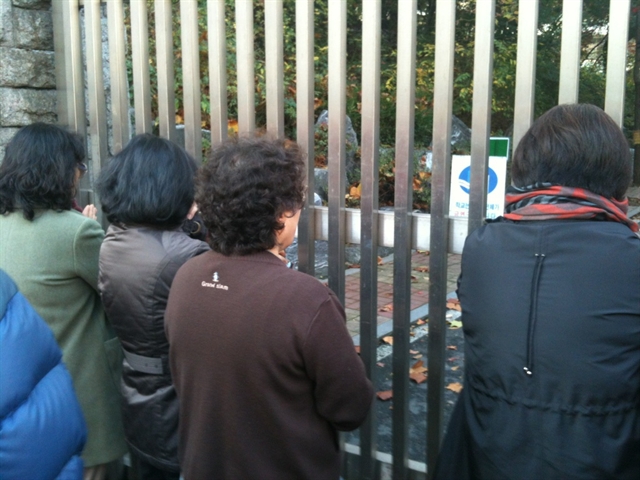
anxious mothers outside a school gate
Britain has lost all sense of values and the dumbest, least talented and badly behaved are often able to earn huge sums of money. It was only a matter of time before the dregs of society and their middle class chums, the army of do-gooders who form the politically correct brigade, were able to crown a cretin like Jade Goody. Indeed, one tabloid compared Goody with Princess Diana who despite an elite education wasn’t particularly bright but at least she had class. Britain needs a good dose of Korean education to rescue it from its anti-intellectual disposition and in the process it needs to purge itself of its predilection for mediocrity. Moron celebrities, bad parents and dimwit football players need public ridicule and condemnation and bad behaviour, especially in terms of drugs and alcohol abuse, requires termination by censorship.
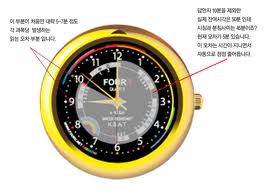
a suneung watch often given to third year high school students
The whole of society, and most especially those involved in education, have colluded to tell the dregs they are ‘in with a chance’ if only they will apply themselves, which with many of the phony courses and qualifications provided, simply means, ‘attend the course.’ A cabbage has potential but only within the limitations of being a cabbage. You can tell a cabbage it could be an award-winning poet but there’s not much chance of that happening because the poor cabbage doesn’t possess the awareness it’s a cabbage. What many of the dregs require, other than a massive brain-over, or better, a total brain transplant, is to be told the truth.
‘Hey kid! You’re a fucking brassica, a fucking cabbage head, a total semi minus moron and you’re going nowhere!’ Then they should be forcibly administered a powerful chemical concoction by the Pest Control Corps to prevent the possibility of ever being able to breed.
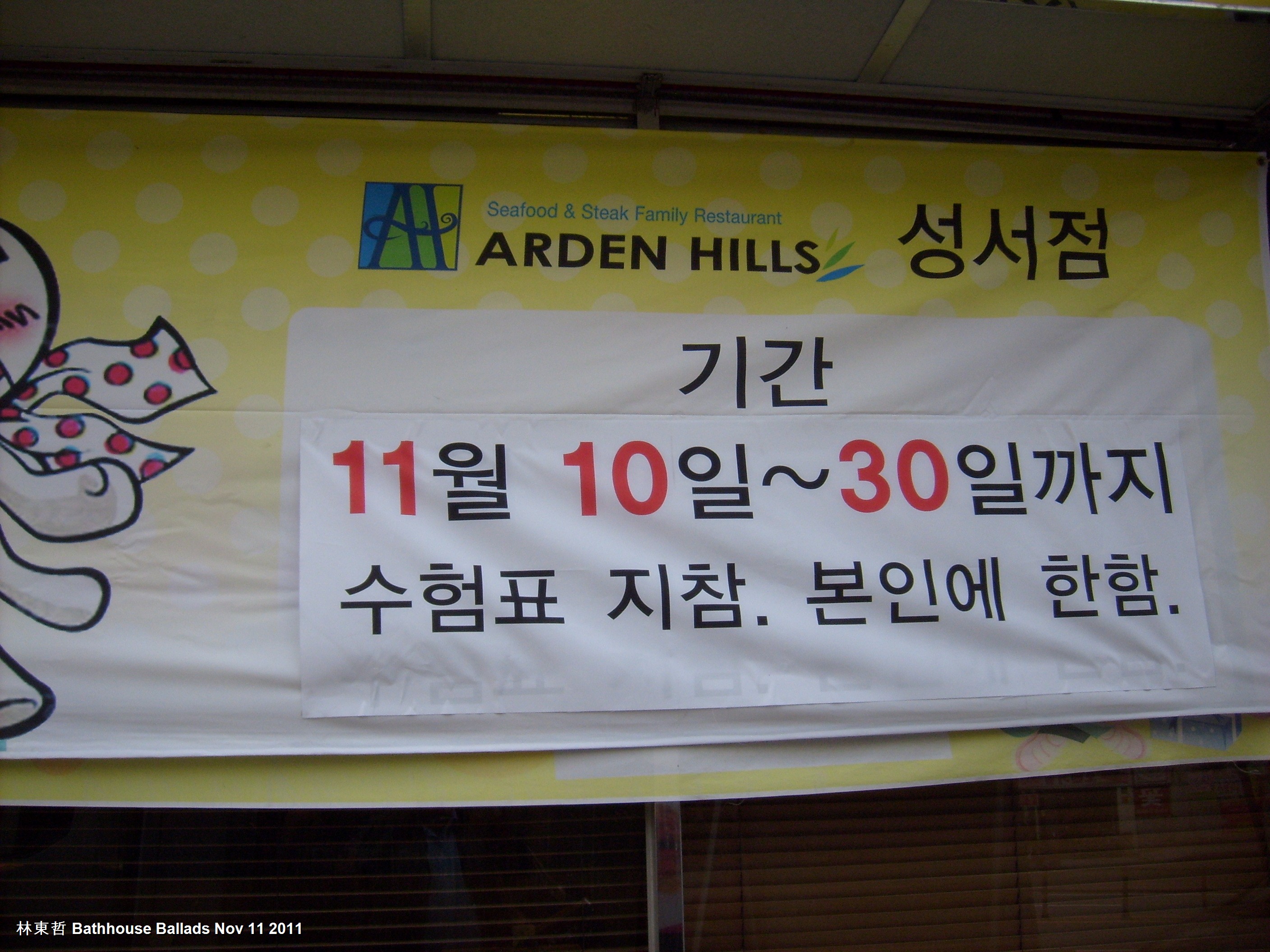
and now the discount season begins for suneung students
© 林東哲 2011 Creative Commons Licence.
Related Posts
Suneung 2010 (Bathhouse Ballads Nov 2010)
D Day and Korean Hooliganism (Bathhouse Ballads Nov 2010)
Suneung – A Day of Reckoning (Bathhouse Ballads Nov 2010)


 Elwood 5566
leave a comment