Snapping off in Seomun Market (서문시장)
It was Children’s Day and downtown would have simply been too crowded so I headed off to Daegu’s largest market, Seo -Mun (West Gate). It is enormous! The photos are dated April but were in fact taken on May 5th.
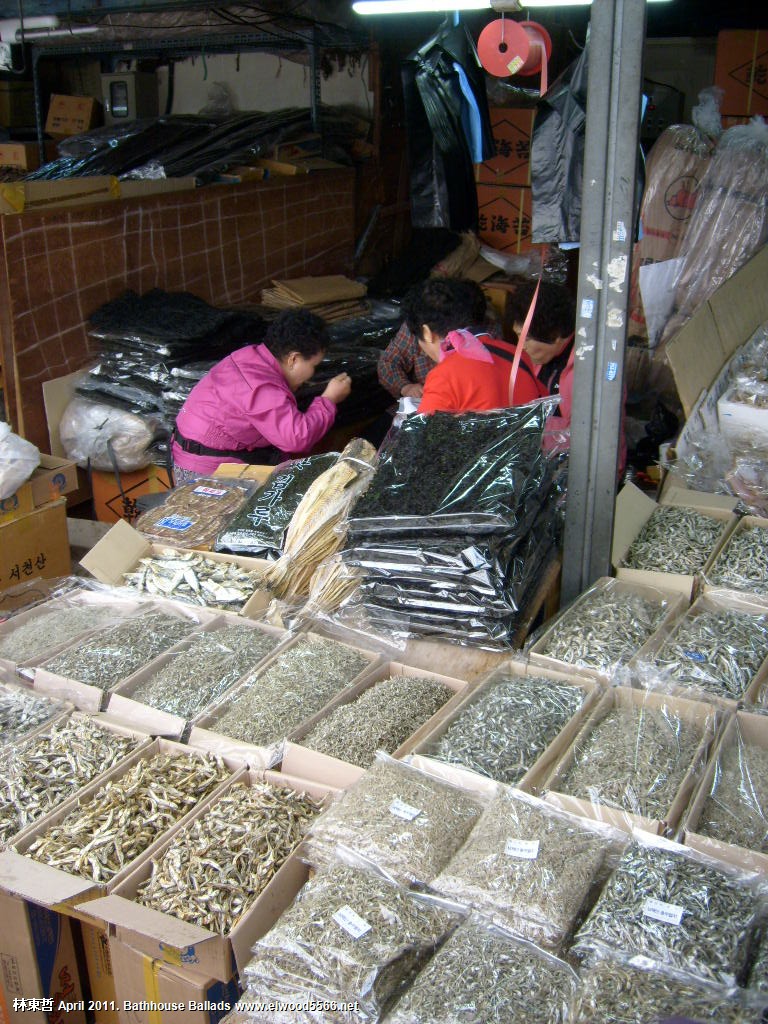
Ajummas eating lunch among dried fish
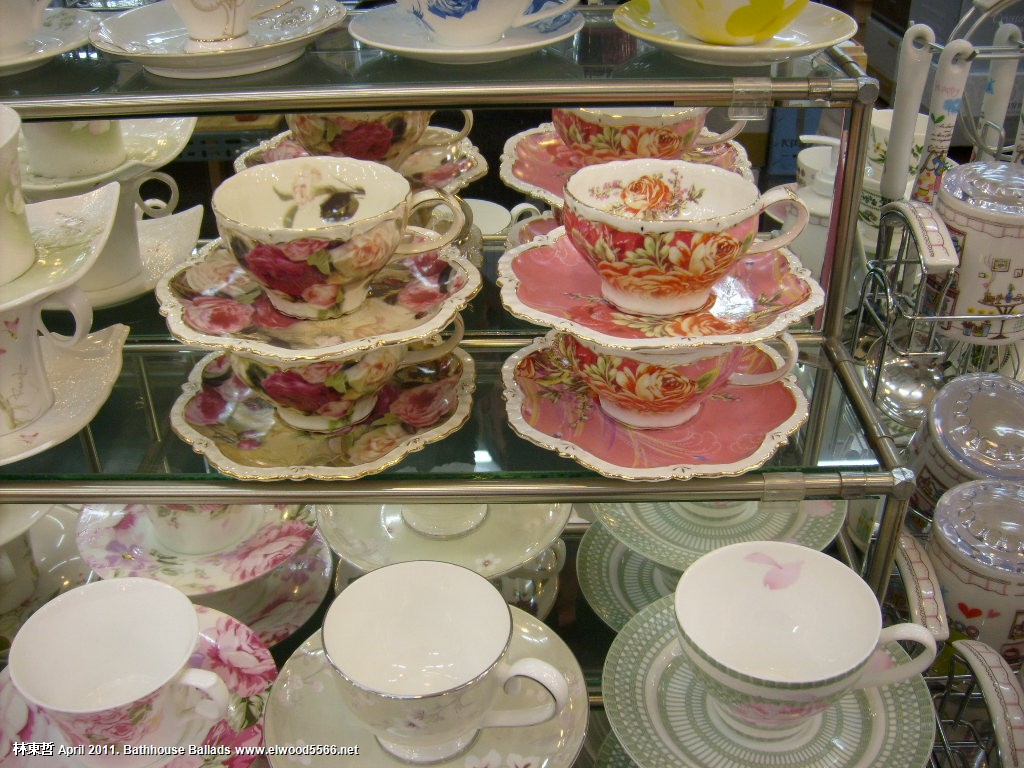
I found these extremely entertaining. Try explaining ‘tacky’ to a Korean!
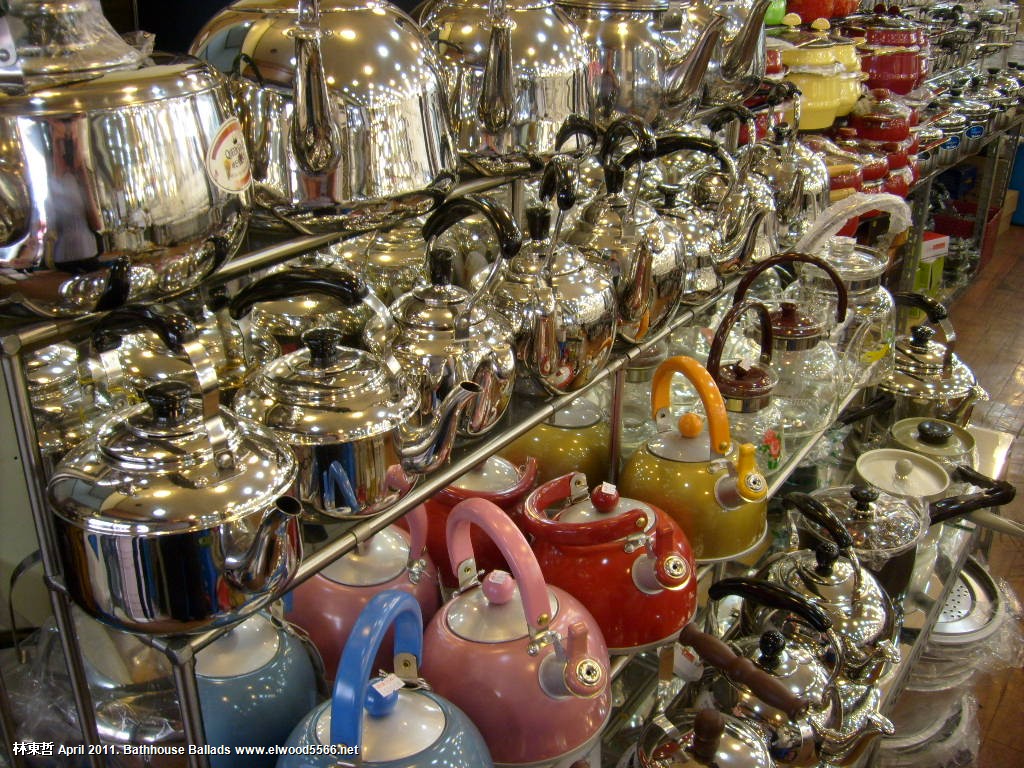
an array of Kettles
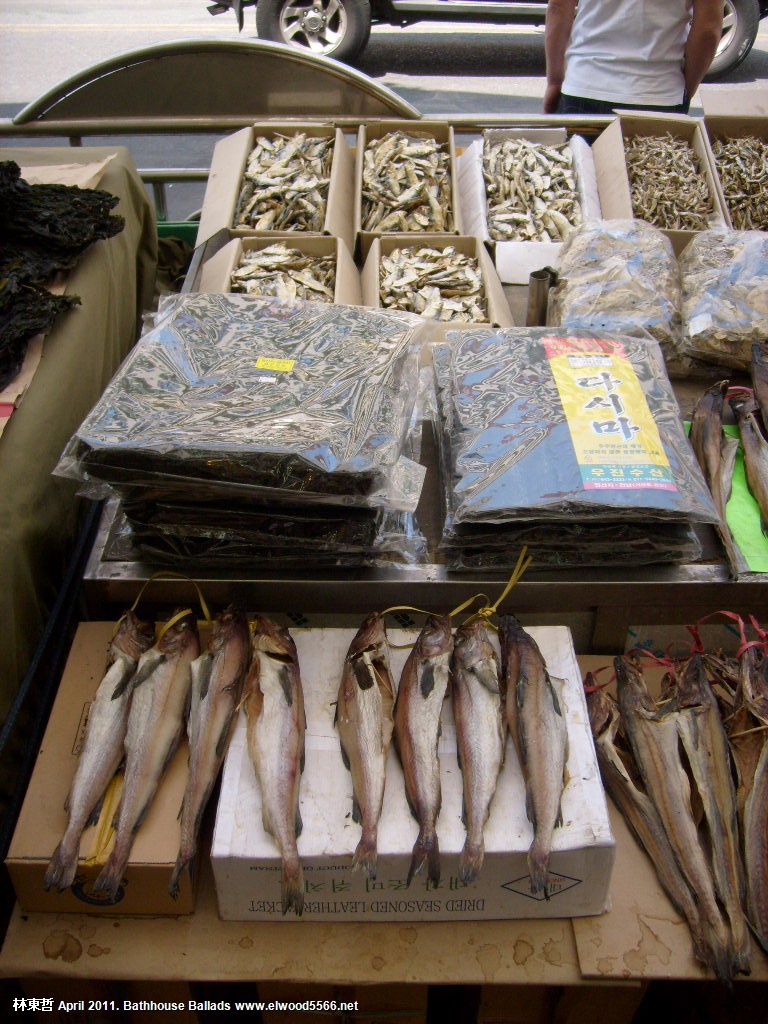
Dried fish and ‘kim’ (김) – dried and toasted seaweed sheets
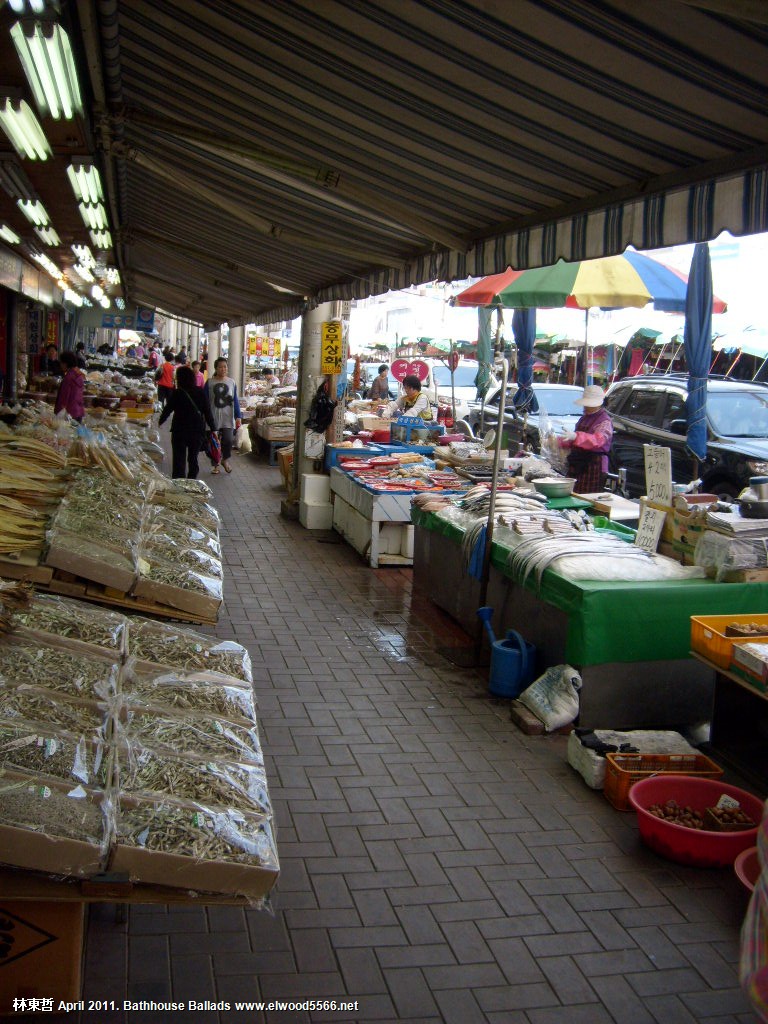
One of the alleys on the periphery of the market
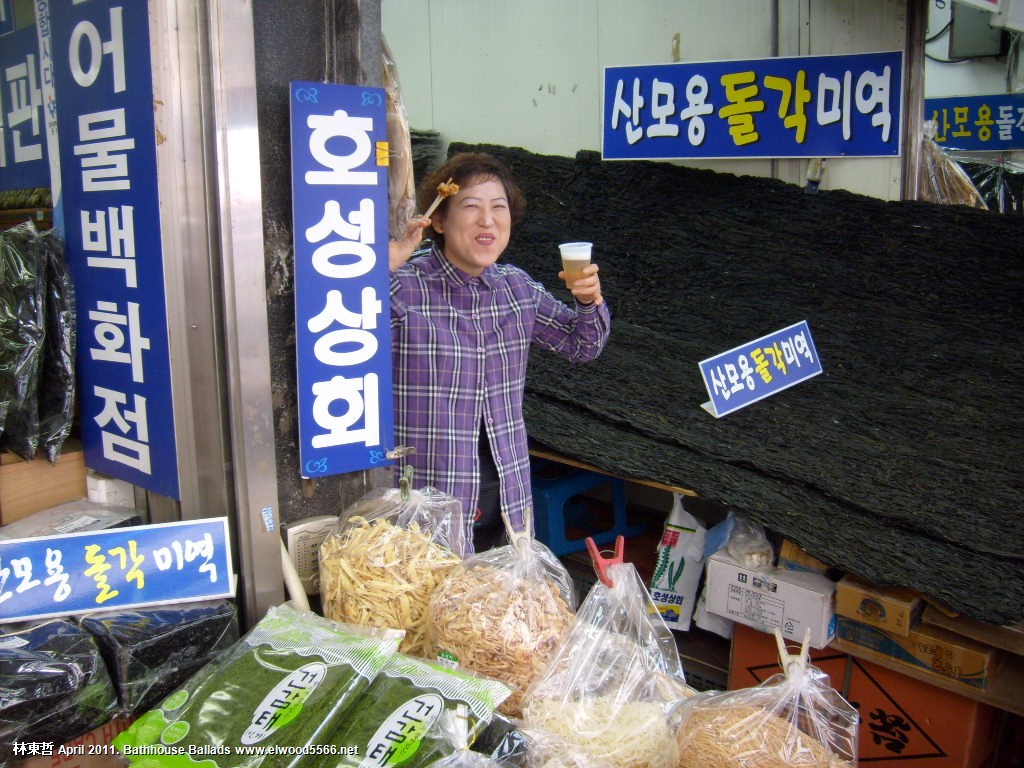
a store owner who insisted on being photographed. The sheets of seaweed in the background are seen as beneficial for pregnant women.
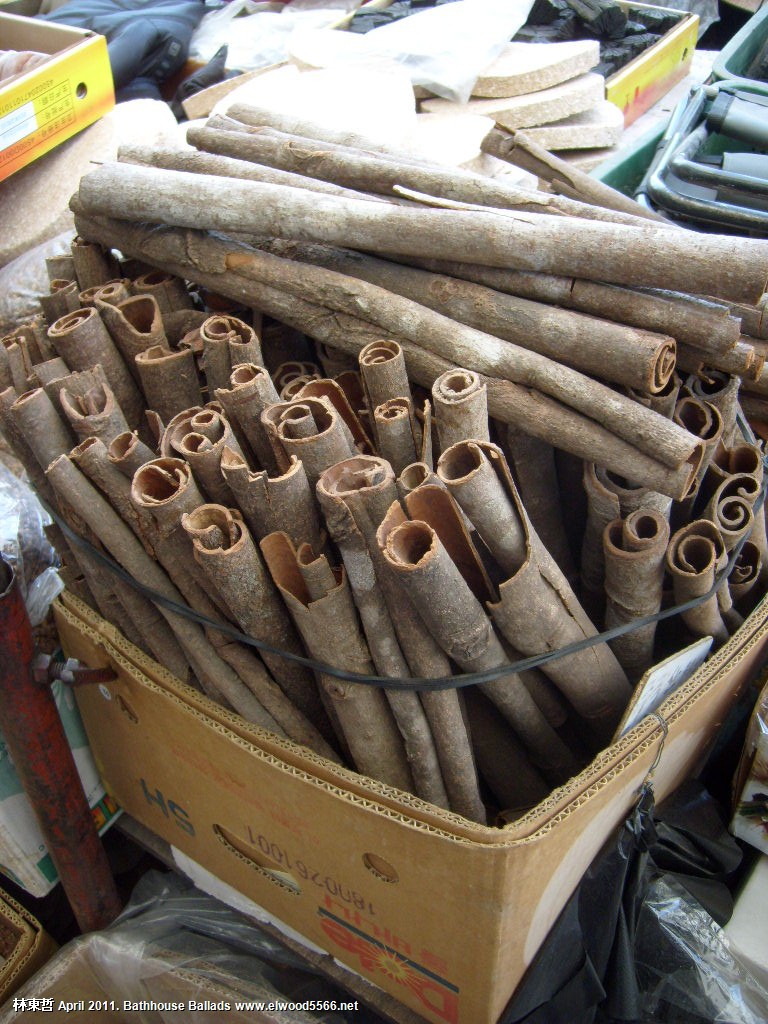
a box of cinammon
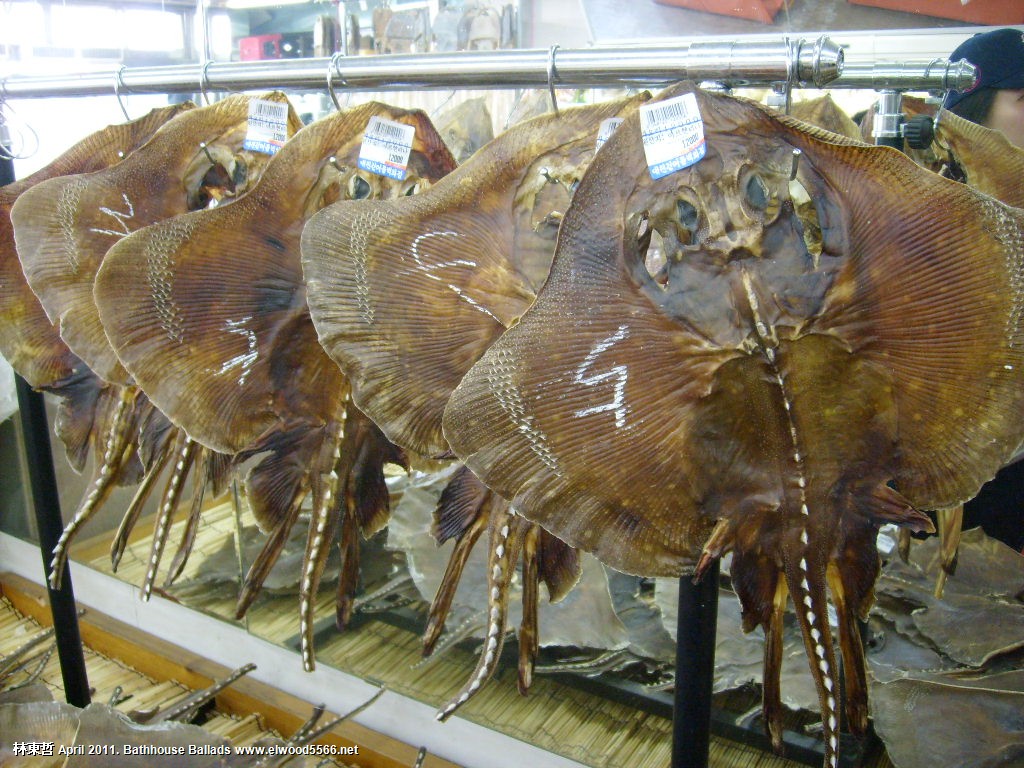
dried ray fish
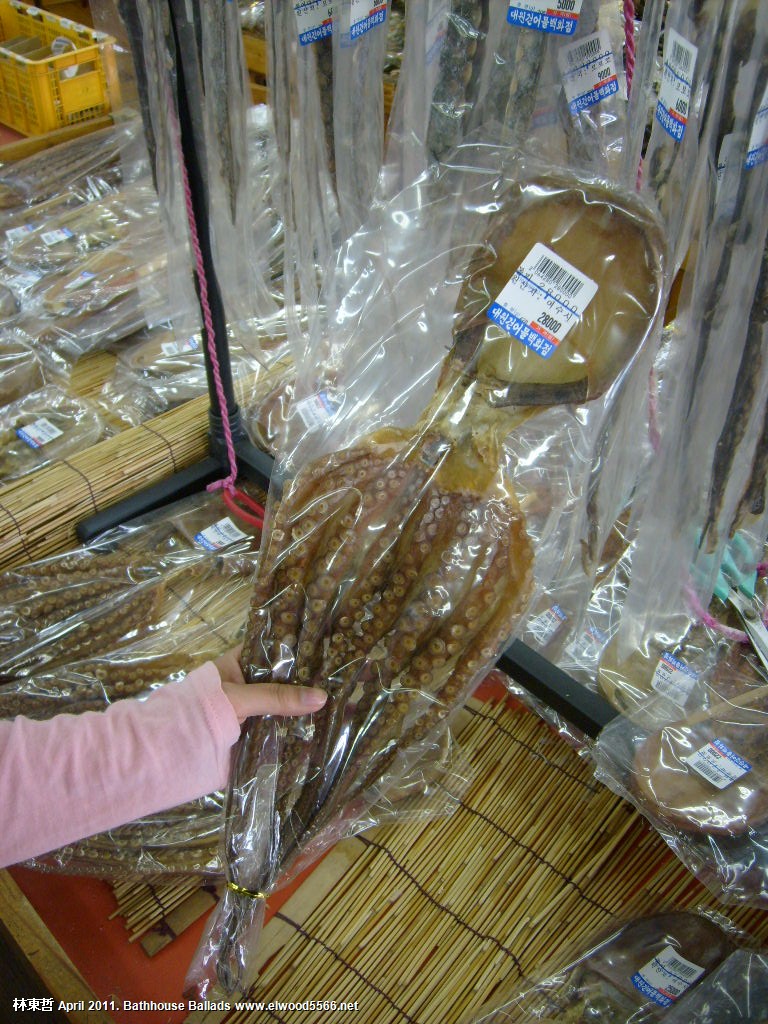
dried octopus
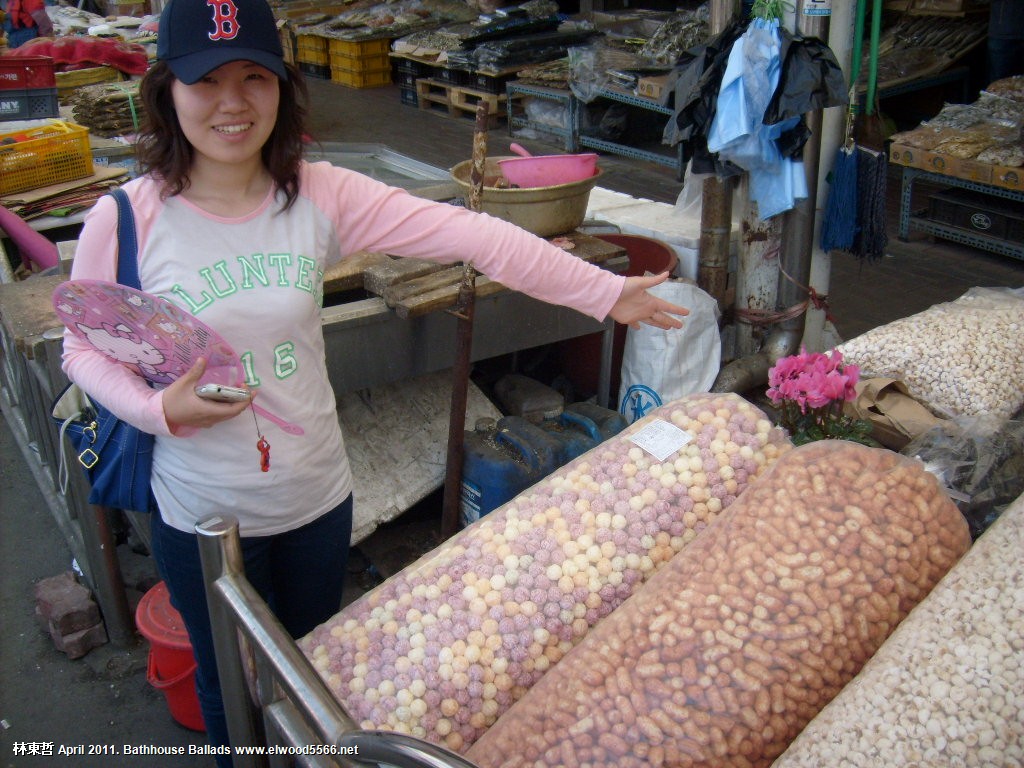
bags of bar snacks
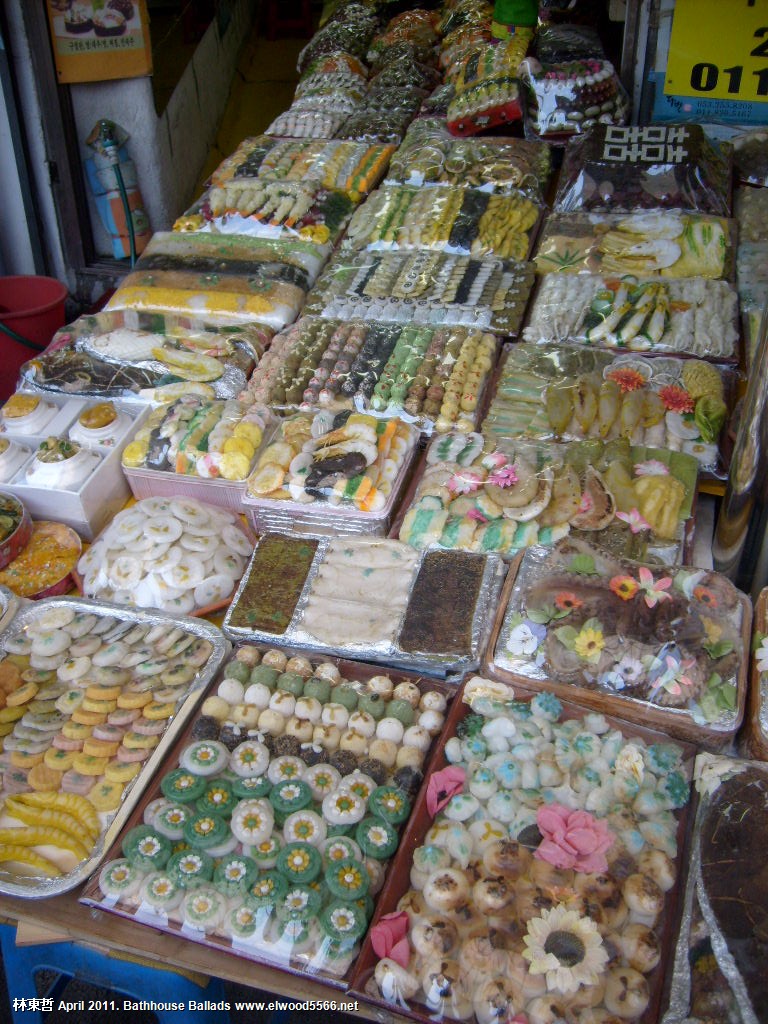
rice cake
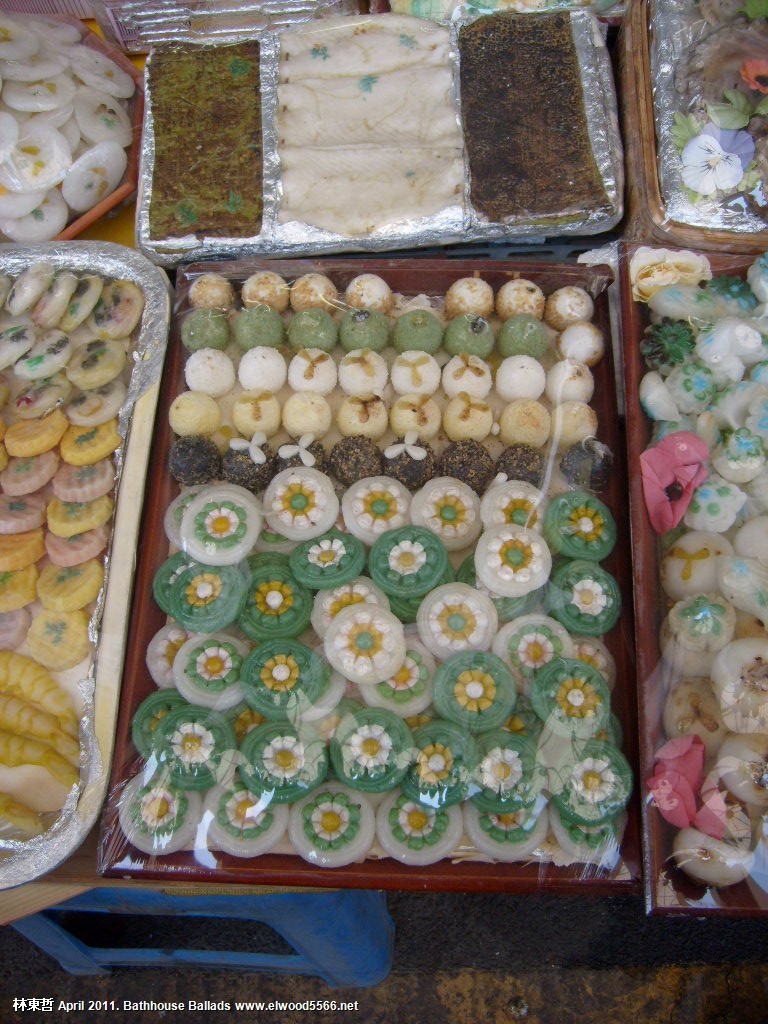
rice cake
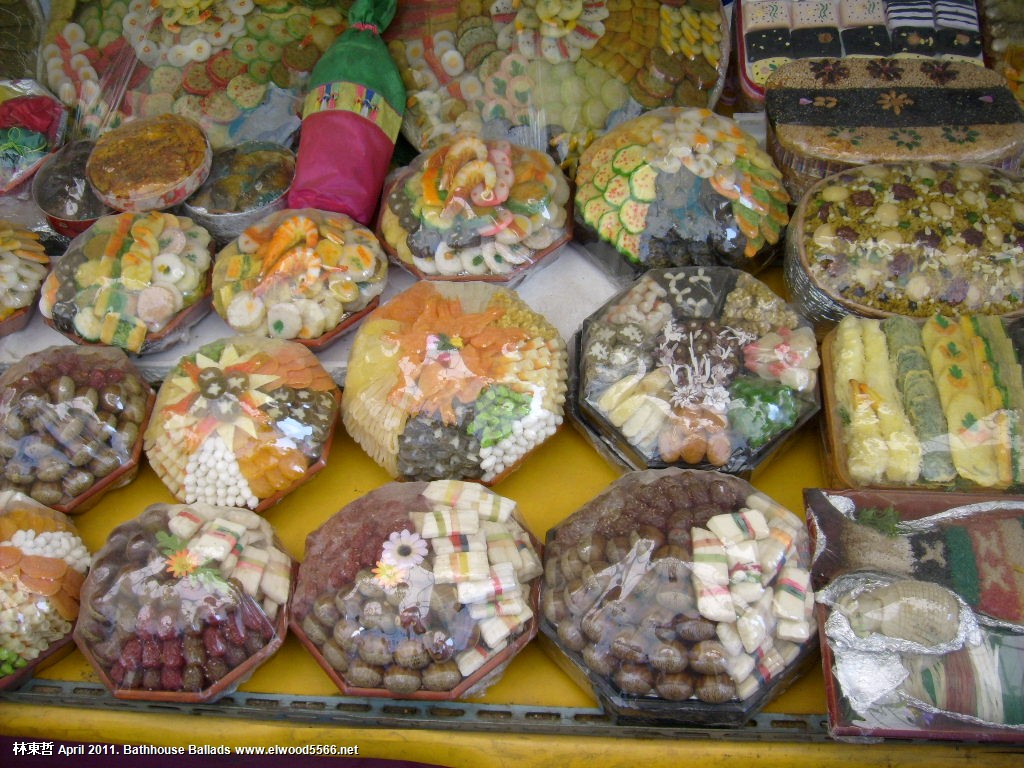
and more rice cake…

© 林東哲 2011 Creative Commons Licence.
Punishing Naughty Students with Ai-Sh-Yo! (아이셔)
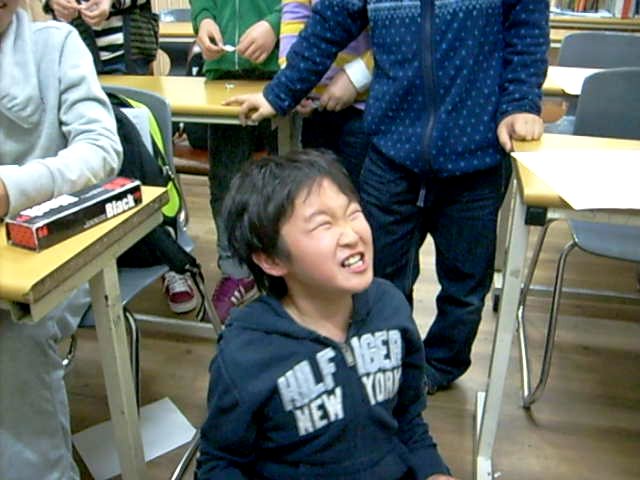
Specially for Children’s Day! In every box of Ai-sh-yo, is an intensely sour gum. You can’t distinguish the gross one from the others in the box. If you want to punish your students or get some pleasure after they’ve pestered you all week for Children’s Day candy, you can do so in this random manner.
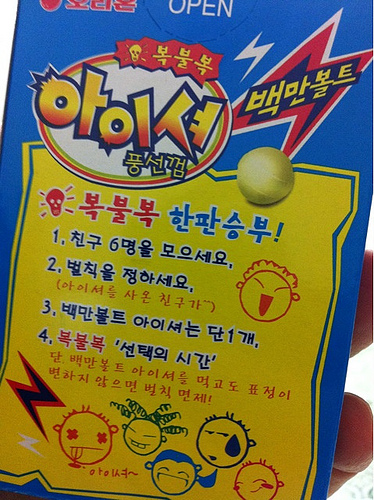
In Seoul you can’t smack them, but you can feed them an Aishyo
Yea, I know my Korean is shitty! And here are some photos capturing the moment.
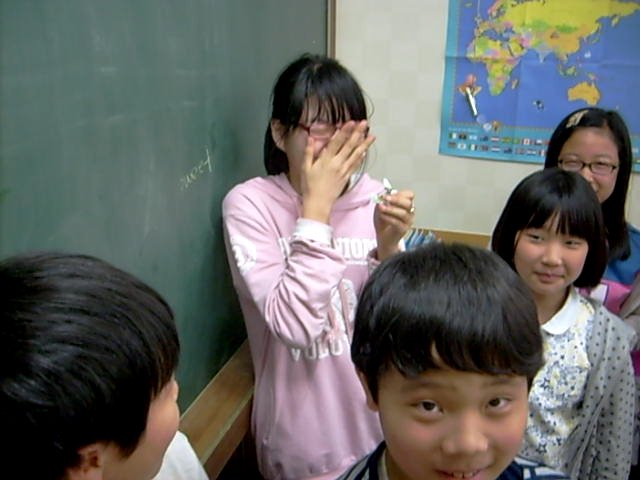
aiiiii….
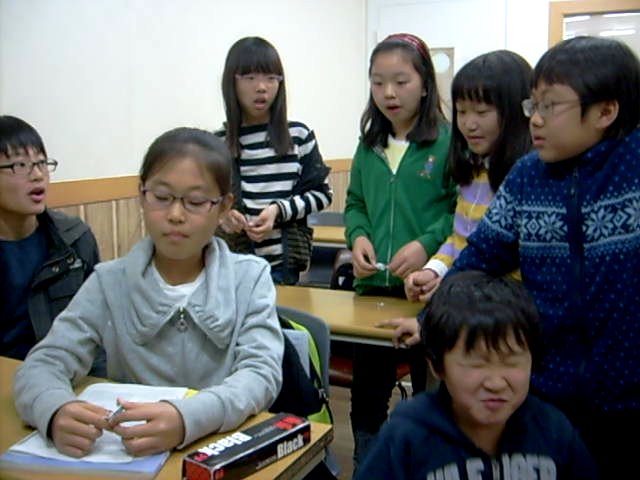
shhhhhhh…
yo…..
Further References
© 林東哲 2011 Creative Commons Licence.
More on Cabbage Kimchi – Some Guidelines
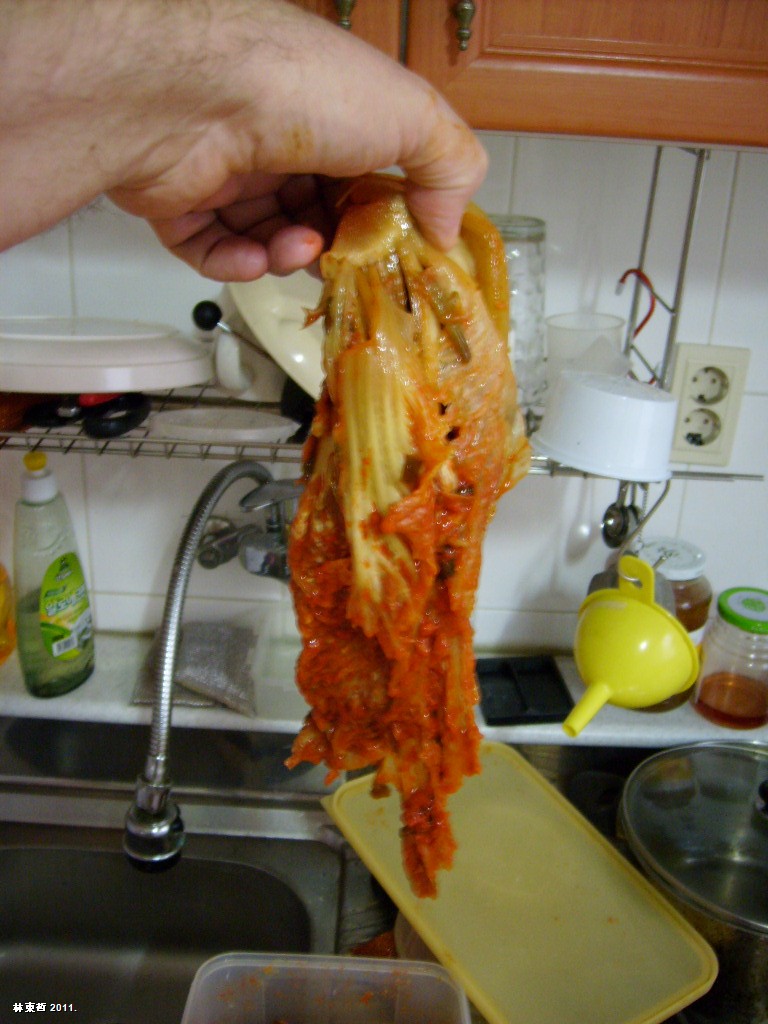
‘decanted’ after over two months and deliciously sour
This post was originally published in February 2011 and is now updated.
I am now quite proud of my cabbage kimchi, a skill which has taken me about ten years to get right. One reason why it takes a long time to make decent kimchi is that you have to develop a sense of what constitutes a good kimchi and an awareness of kimchi at different stages of fermentation. Unless you have a cultivated appreciation of what Kimchi is, and by that I mean an awareness of kimchi that a Korean would enjoy and not what you personally think it should taste like, your kimchi will never be authentic. The subtleties of kimchi are as intricate and extensive as wine or Indian curry and an appreciation is important if you are to use a recipe to guide you.
There exist many recipes for cabbage kimchi, regional, personal and for accompanying certain meals; bo-ssam (boiled, sliced pork, 보쌈) for example, uses a special type of kimchi. I am concerned here with the standard type of kimchi that accompanies the majority of Korean foods and which can be divided into two categories, fresh and sour. There is of course, a range of flavours in between these extremes. Many Koreans have a preference for one or the other and foods which use kimchi as a major constituent, as for example with kimchi stew (김치 찌개 or 김치찜), suit one or the other.
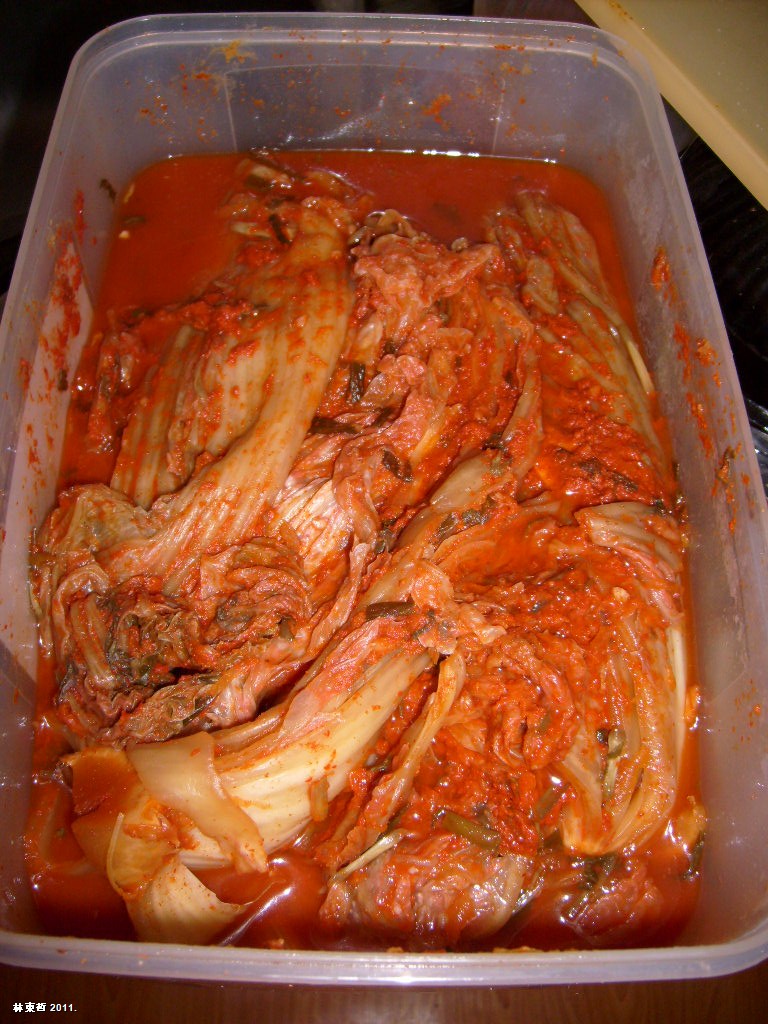
scary yes, but tasty
I’m told by Korean friends that big cabbages are not the best to use and that medium sized ones, which compared to Britain are enormous, are the most suitable. The outer leaves are trimmed and unless damaged these shouldn’t be thrown away as they can be used in other recipes.
One of the most persistent problems I faced was the most crucial; namely getting the salting process right. Even cook books sometimes overlook what is a seemingly simple procedure. When the prepared cabbages are ready to paste with your kimchi paste mix, they should resemble a dishcloth by which I mean they should be floppy and it should be possible to wring them without them tearing. If you get your kimchi paste wrong you can always adjust it. Even if you subsequently discover your kimchi is too salty it will mellow as it ferments but should the kimchi fail to wilt properly it will not be easily rescued.
Many recipes gloss over the salting process and only this week I read Jennifer Barclay’s book, Meeting Mr Kim (Summersdale, 1988). The book is an interesting account of life in Korea and not a cookbook, but her kimchi recipe, and she is not alone, simply directed you to soak the cabbages in salted water. If as recipe does not explain the salting process in some detail, tread with caution! I once used an entire big bag of table salt in which I soaked the cabbages for several days and they still failed to wilt effectively. The salting process is actually simple if you use a coarse type of salt (such as sea salt or if in Korea 굵은 소금)) and sprinkled between the leaves is all that is required to wilt the leaves in several hours, depending on room temperature. When I make kimchi in the UK, I am forced to use cabbages which are almost white in colour, very stemmy, and which are too small to quarter but even these wilt if treated properly. After salting the washed and wet cabbages they can be placed in a bowl or sink, sprinkled with extra salt and a few cups of extra water and left. Immersing them in water isn’t necessary. In hot weather the wilting process is much quicker. You should notice the cabbages almost half in volume and soon become limp, floppy and wringable.
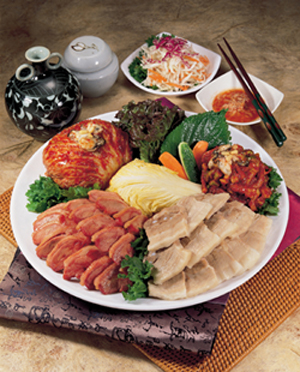
Bo-ssam (보쌈) uses a different type of kimchi
Like rice, traditionally, Koreans rinse the cabbage three times. I have learnt it is much better to rinse them thoroughly, perhaps removing too much salt but this can always be remedied later. However, if you use the correct ammount of salt and don’t sprinkle excess on, three rinses are adequate. You can feel where salt residue remains as the stems are slimy and you can remove these by simply rubbing your fingers over them.
Salty kimchi will mellow with fermentation, it is probably better for it to be not salty enough than too salty, especially given the concerns over salt and blood pressure. One hint Mangchi suggests is adding some thin slices of mooli (무) if it is overly salty.
A good kimchi paste will cling to the leaves like a sauce so it is prudent to drain the segments and even wring water out and this will prevent your kimchi becoming watery as the cabbages ferment.
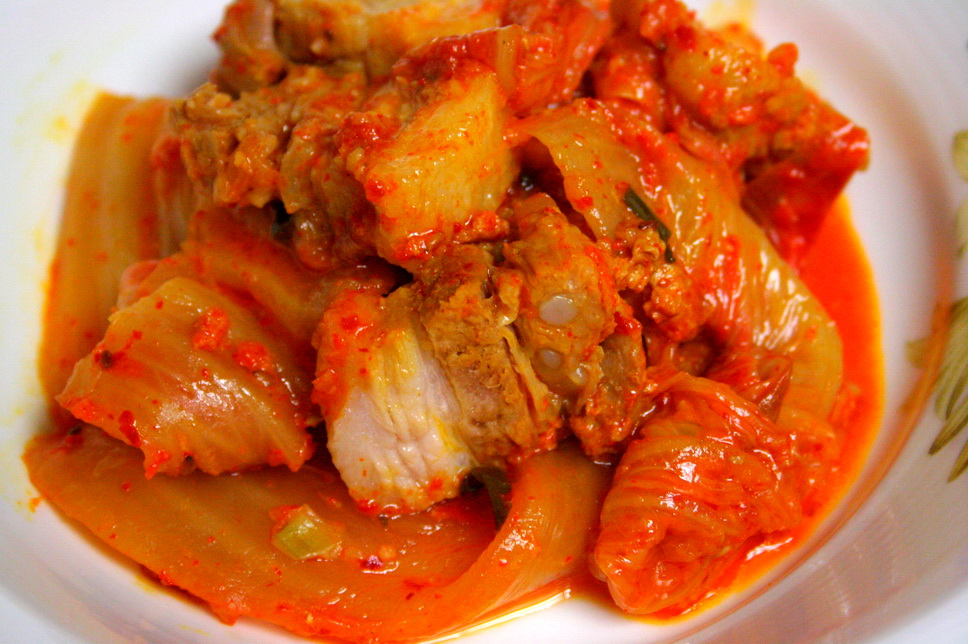
Pork kimchi stew (김치씸) – works just as well with mackerel
Plenty of recipes, online and in books, will guide you through making the paste but my all time favourite is Maangchi. Her website is enormous and her videos on Korean cooking are well presented. Here you will also find other ways to use kimchi as well as many other types of kimchi, cabbage and otherwise.
British friends who have since become lovers of kimchi often ask me how long it will keep. I tend to keep kimchi in the refrigerator in hot weather and somewhere cold, but not freezing, in winter. If you like kimchi fresh (newly made,) keeping it cool or cold will delay fermentation. If you like it sour then you can use a warm place to speed up the process. I tend to juggle things in order to better control fermentation. I made my last batch of kimchi in November and the tub in which it is stored has stood on my balcony almost 6 months. I have now moved it to the bottom of my fridge to mellow indefinitely. I have used kimchi that was over 6 months old and which had white mold on the top but this washed off and the underlying cabbage was excellent as the basis for a stew.
© 林東哲 2011 Creative Commons Licence.
Monday Market – Spicy Crab (양념게장)
Yang-nyeom gejang (양념게장), is basically raw crab marinated in a chilli condiment. There are many regional variations of this side dish (반찬) and though the most common crab used is the horseshoe crab (꽃게), others, including freshwater crabs, are utilized. Yang-nyeom (양념) is a spicy sauce which is very common on fried chicken. Another version, kan-jang gejang (간장게장), marinates the crabs in soy sauce.
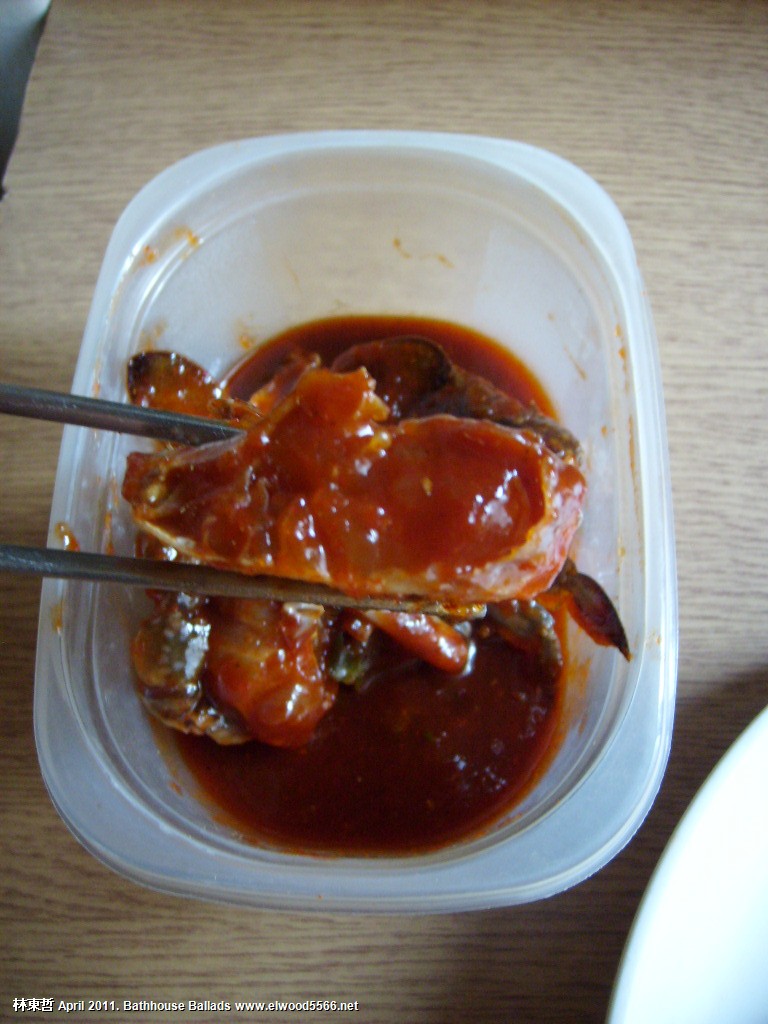
sweet and spicy
The sauce is sweet and spicy and the soft flesh of the crab is sucked out of the cut portions. I didn’t really like this the first few times I encountered it but it has an appeal and like many Korean foods, gradually grows on you.
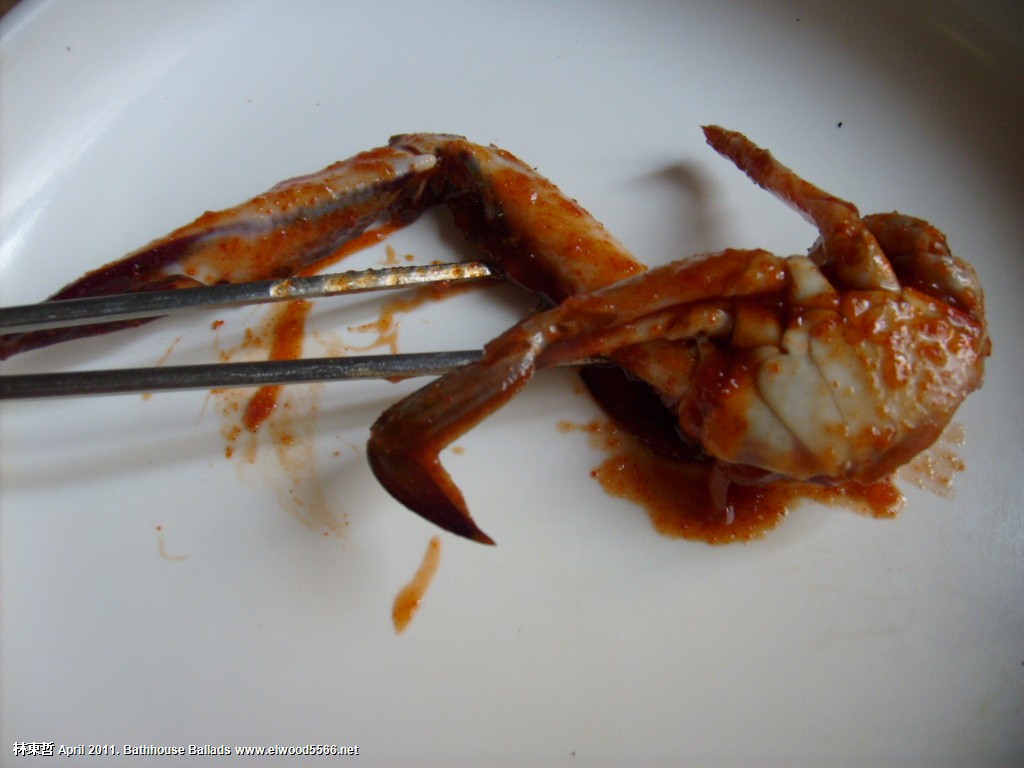
well – at least it’s not alive!
© 林東哲 2011 Creative Commons Licence.
‘Dirty Gays’ or Simply Skinship?

sadly, usually the majority; pumpkin people
I stumbled across this Youtube video this evening. The clip is over two years old but it highlights that even with internet resources at ones fingertips, some waygukin clearly miss the big picture and are only able to reach an understanding of another culture through their own cultural and personal prejudices. What the fuck is the point in coming thousands of miles from home to earn a crap wage when you don’t even have the luxury of removing your blinkers? The subtitle states: ‘there (sic) gays are so dirty.’ The idiot might just have well stayed at home!
© 林東哲 2011 Creative Commons Licence.
Update on Dream Sauna, Yong San Dong, Daegu
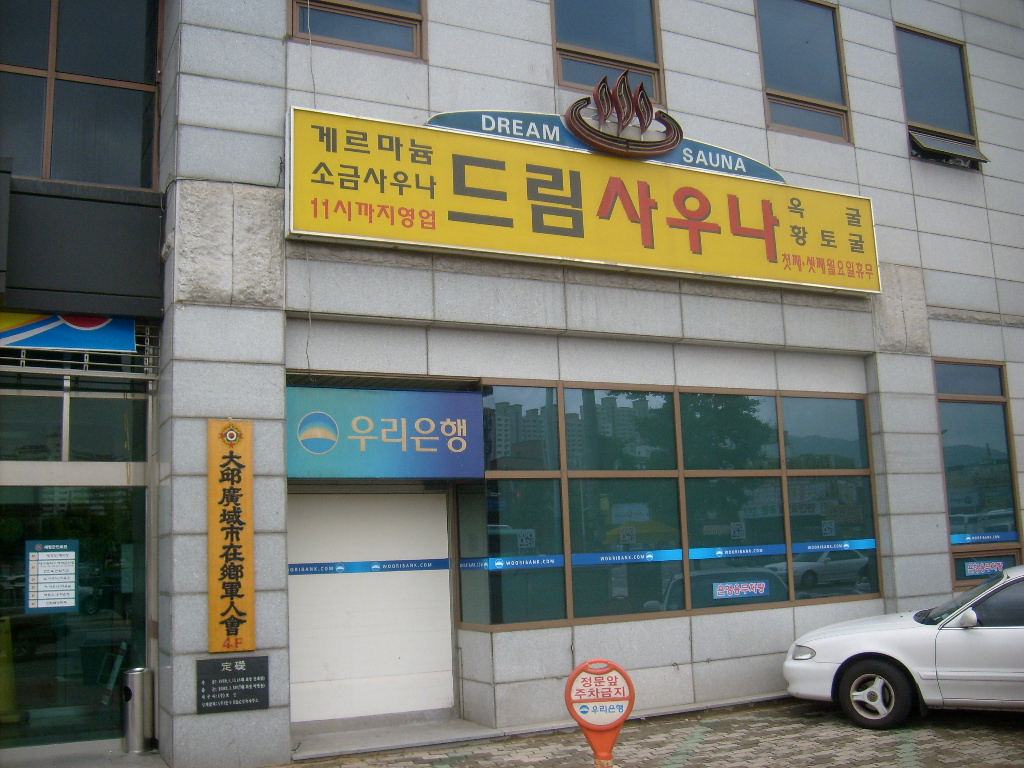
Dream Sauna, next to Home Plus
Yesterday, I made my second trip to Dream Sauna, Yong San Dong, Daegu and have amended my original review. The salt room is brilliant and worth a visit. Here is the link: Dream Sauna.
© 林東哲 2011 Creative Commons Licence.
EPIK Helped Kill the Korean Experience

Podcast 80
Here’s the problem! You’ve lived in Korea three months and you think you know all about it! Now that you’ve got used to being stared at, know the difference between makalli and soju, think you have an understanding of the Korean psyche and culture and have possibly been initiated by the annual waygukin pilgrimage to the Boring Boroyeong (mud festival), Korea has suddenly become mundane, ordinary and predictable.

has Korea becoming boring?
I know the feeling. There are numerous things which can possibly terminate ones Korean experience or at least quickly lead to the honeymoon being over: these include, the internet, a mobile phone, English speaking westerners and ones ability to read and speak Korean.
If you want to preserve that feeling of amazement you experienced during your initial weeks in Korea you have to avoid taking any interest in learning to speak, read or write Korean and while you can use computers to play games and download music, you must shun search engines and any blog related to Korea. Avoiding foreigners, or at least limiting how many you know, is crucial but relatively easy as most are too busy pretending they’ve been in Korea for the last twenty years and are adept at blanking you even if you’re sat under their very noses.

Yeah, but nothing like we used to be…(courtesy of Roketship.com
The famous Chicago School sociologist, Robert Park used to advise his students to ‘go out and get the seats of your pants dirty’ and not too long ago that was the only way you could learn anything about Korea. You wanted to learn about Korea, and then you had to go to Korea. You wanted to learn Korean, you had to go out and find someone to talk to; you wanted to learn how to make kimchi or do taekwondo, you had to go out and find Koreans willing to help you. Today, you can do it all from the comfort of your ‘one-room.’ The online oracle provides extensive resources on every facet of Korean culture so much so that you can learn more today about Korea from a computer in backwater Britain or a rural American retreat than you could gleam living here for a year before the invasion of the internet. And for every foreigner arriving on Korean soil a corresponding blog is birthed to swell the already bloated Klogosphere.
Learning Korean is the quickest way to sully your relationship with Korea. I’m not really happy living anywhere in the world where I don’t have to make an effort to learn what is going on around me because it is easier to get the information I upload. Back in Britain, I live in a constant state of depression and on a daily basis am subject to a plethora of information that I really don’t want to process and which by its very nature is unhealthy. You don’t have to seek information out, it finds you and worse the bulk of it is rubbish. If it’s broadcast in daylight hours or is front page ‘news’ it’s very often shit and I have no interest in the intrigues concerning the latest plastic protégés from Pop Idol, the dumb ass contestants selected for Big Brother, the Royal Spongers, Football or the plots of stupid soaps.

interesting…
It’s fantastic when I go back home as I have no idea who new celebrities are and besides, many will have disappeared by the end of the year. I lived in Germany between 1976-1986 and was telly-less and beside gaining black-belt in taekwon-do, when I came home to headlines announcing, ’Who Shot JR,’ had to ask who he was. A great wadge of what constitutes ‘news’ is newsless shite which cascades into your brain like spam. If people treated that organ the complexity of which potentially separates us from lower primates as they do their computers, with upgrades, antivirus and spam devices, society would be much nicer. Do you lower your firewall, terminate you anti-virus facilities and start downloading everything on-line? Of course not! But that’s what many of us do with our brains and much of it can’t be avoided.
Living in a country where you do not speak the language fluently is one step away from living in a mountain temple. It’s shocking I had to be told there had been a tsunami in Japan and an earthquake in New Zealand and natural disasters don’t depress me like manmade ones; but on the other hand my brain hasn’t been polluted with rubbish about royal weddings or the obnoxious habits of celebrities.
And you can certainly give vent to your creative juices. For the last few years I’ve had to construct an understanding of the world beyond my little nirvana from fragmented ‘evidence.’ Like an historian of ancient history, I piece together a narrative constructed from isolated words I’ve understood or images I’ve seen. When I originally saw a clip of what I now know was the Japanese tsunami (the TV was in a restaurant and there was no audio), I thought it was a graphic from the 24 hour Starcraft channel. I could certainly go online and access information but choose not to as once you open yourself to external content it quickly overwhelms you. Ignorance really is enjoyable and I am infinitely calmer in my little bubble than I would be by allowing the worlds ‘dirty realities to rape my noggin.
EPIK killed the experience
Not only would fluency in Korean make it possible to be spammed and hacked, but it would take all the fun out of life’s little excursions. I remember the time when most restaurants lacked English translations and often had no pictures. Ordering meals by pointing was fun; bus terminals with no English! That was a challenge. By all means, learn Korean to order a pizza or tell the taxi driver where to take you but much more than this will quickly curdle your Korean sojourn. Okay! I do speak a fair amount of Korean and put much effort into learning it but you either have to be very gifted at languages or have been here for a long time to actually be able to speak fluently. So, unable to understand anything but bits and bobs from the fast paced gabble of Korean TV and conversations overheard, living in Korea equips you with one enormous firewall. Not one mega byte of unwanted information enters my brain’s processing center uninvited or unprocessed.
Obviously then, the internet has to be shunned though it’s useful in emergencies and for smoothing out potential problems. However, using it to research where you should go, how to get there, what to expect and equipping you with opinions before you’ve even decided where to go is a little like substituting reading the back page of a book for actually reading the book itself. And the problem with computer technology is that it permits you to lead almost identically the same life as you would have had back home. Yes, even now I am doing exactly the same as I would be doing back in the UK, basically sitting at a computer screen and most of the entertainment it provides in the form of music and film is identical. So vast are the tomes of information on Korea that very little remains mysterious, bizarre or strange. Information technology has helped demystify the Korean experience and severely shortens its potential to engage or entertain us.
Mobile phones are just as bad and owning one simply means that every waygukin you meet gets added to your address book and as they do your social life begins to develop which disproportionately involves fellow westerners. Most westerners, though there will be exceptions, only need a mobile so they can chat with their western mates and book trips to ESL tourist destinations.
As for the waygukin effect, blame it on EPIK! The sharp increase in the number of English speaking foreigners now living in Korea has helped destroy the intense interest Koreans once held in us. I knew more westerners in the area in which I live, ten years ago when they were a handful, than I do now, despite their comprising a small army. At one time, seeing a westerner was so rare you stopped and talked. Today, there are not only more westerners but more westerners married to Koreans or with a Korean boyfriend or girlfriend. There are even western children in some of my local Korean middle schools. And I know it’s mean, but whenever I meet an EPIK teacher I silently curse because it is predominantly their invasion which has turned us from objects of fascination and intrigue into ones boring, mundane and general. We were special until EPIK arrived and now one has been stationed in every school, coffee shop and burger bar; there isn’t s single student who has never met a foreigner.

The Costa del Sol? No! Korea. Boroyeong, waygooked to boredom
Knowing a couple of fellow countrymen, or women, is good for your mental health but getting pally with hordes of them is a bad idea. When ever foreigners hook up in droves you can guarantee the conversation will become anti-Korean and gravitate towards how crappy it is working in Korea, which for many it is but those of us with good bosses or plastic professorships don’t want reminding. Technology and the EPIK invasion now means Korea attracts ESL tourists seeking the Korean package experience. Many waygukin now come here not to experience Korea and its culture, but to basically do exactly the same sort of things that can be done on the Costa del Sol. With a pack of mates in your mobile address book, all waygukin, it won’t be too long before you’re either returning home or looking for another location to provide you that ‘unique’ experience.
© 林東哲 2011 Creative Commons Licence.
A Candy for the Teacher
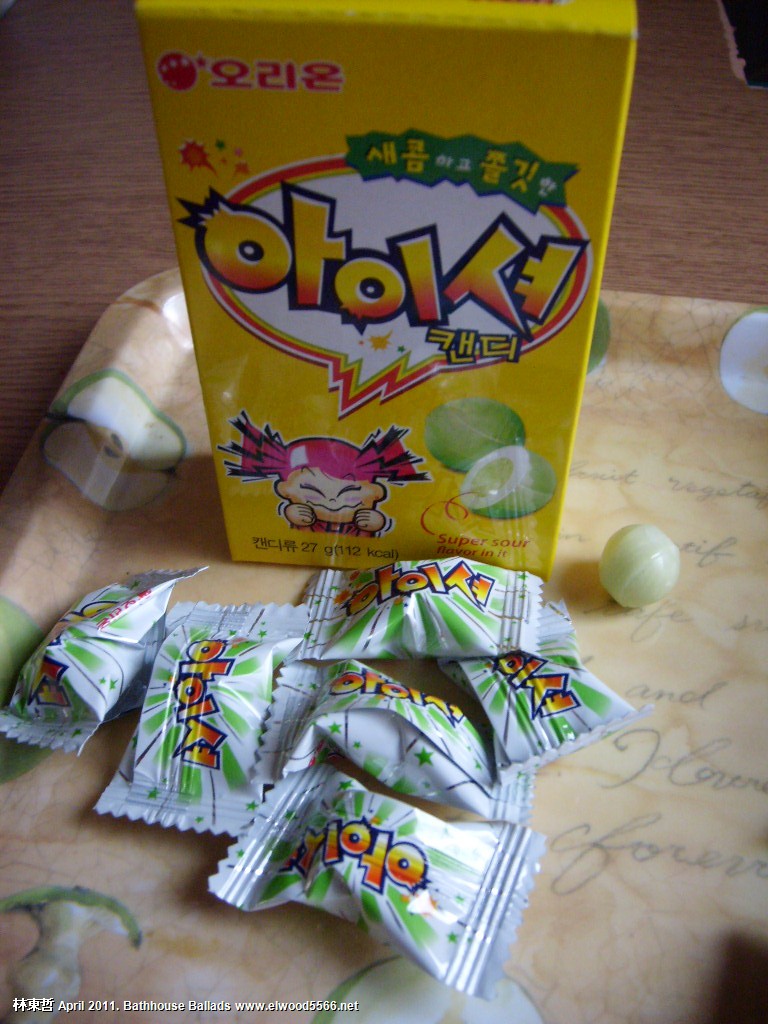
the tangy candy version
What’s that noise you make in your language when you’ve eaten something intensely sour, like lemon or a kumquat which isn’t sweet enough to rescue your distaste? In English-English it might be ‘shhh-it!’ In Korean it’s ‘ai-sh-yo’ (아이셔), though in practice it probably sounds more like ‘ ai-shhhhh-yo!’ The duration of the ‘sh’ a measure of intensity. Not sure what I mean? Let me elucidate; this is ‘sh-it!’ or ‘ai-sh-yo!’:
Apart from being the sound to accompany something unpleasantly sour, like munching on a lemon, Ai-sh-yo is also the name of a chewy confectionary. Kids love to give these candies to teachers and they can be considered the Korean equivalent, innocent and friendly, of spitting in your coffee or putting a tack on your seat. When I was first offered them I noticed a strange expectation on students’ faces, a twinkle in their eyes and the slight anticipatory twitch of a smile but took little notice; I’m orally fixated and the candy was quite nice, initially a little tart and tangy but quickly rescued by sweetness as you continue to chew. I’d eaten quite a few over the week until I discovered their more sinister purpose
I was busy chewing, waiting for the sweetness to curb the rapidly soaring sensation of intensified sourness… Then I realised, with a curse, ai-shhhh (the Korean equivalent of ‘fuck!’), that there wasn’t an iota of sweetness in it but a solely nasty sourness. My students were in hysterics by the time I spat it into a tissue.
Yes, in every blue packet of the gum, 450 Won (about 25 pence) exists one surprise candy that is simply revoltingly sour. The yellow packet is a tart candy that starts off sour but mellows.

an 'ai-sh-yo' face

and another...
the blue packet is the most entertaining
‘Ai-shhhhhhhh-yo!’ ‘Super sour flavour in it.’
Further references
Punishing Naughty Students with an Aishyo
© 林東哲 2011 Creative Commons Licence.
Monday Market – Mackerel Pike (꽁치)
One of my favourite barbecued or grilled fish which often appears as a side dish, the mackerel pike, often called saury, is a long, thin fish with a distinct ‘snout.’ It is an oily fish and is usually grilled whole without being gutted. When eating it however, avoid the gut as it is horribly bitter. Rather like mackerel in taste and texture.

the gong-chi (꽁치)
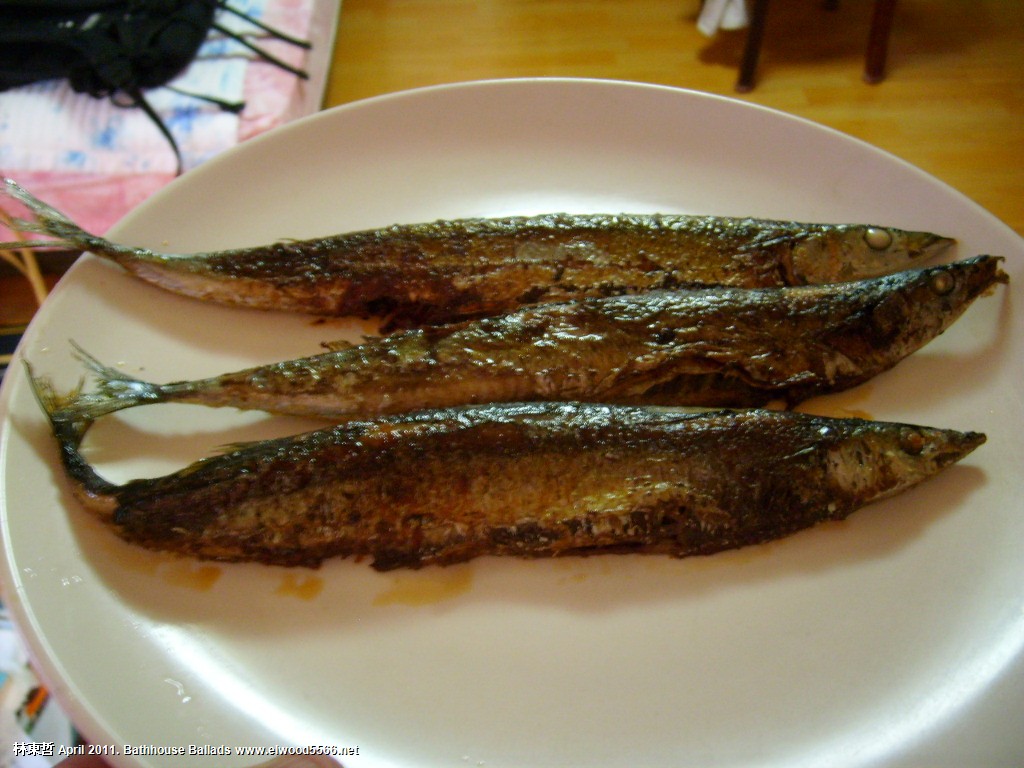
tasty
© 林東哲 2011 Creative Commons Licence.
It’s Kimchi Time – April 26th 2011
This batch of kimchi turned out to be a further improvement on my technique. My cabbages were large and I have since been told that the best cabbages are not the largest, but ideally more middle sized ones.

3 large Chinese leaf cabbages (Napa)

washing the cabbages
- Preparation – Unless the outer leaves are very damaged or spoiled, keep them as they are excellent for use in bean paste soup and numerous other recipes.

slightly damaged leaves can be kept for other uses

if the right type of salt isn’t used wilting won’t occur

table salt is ineffective
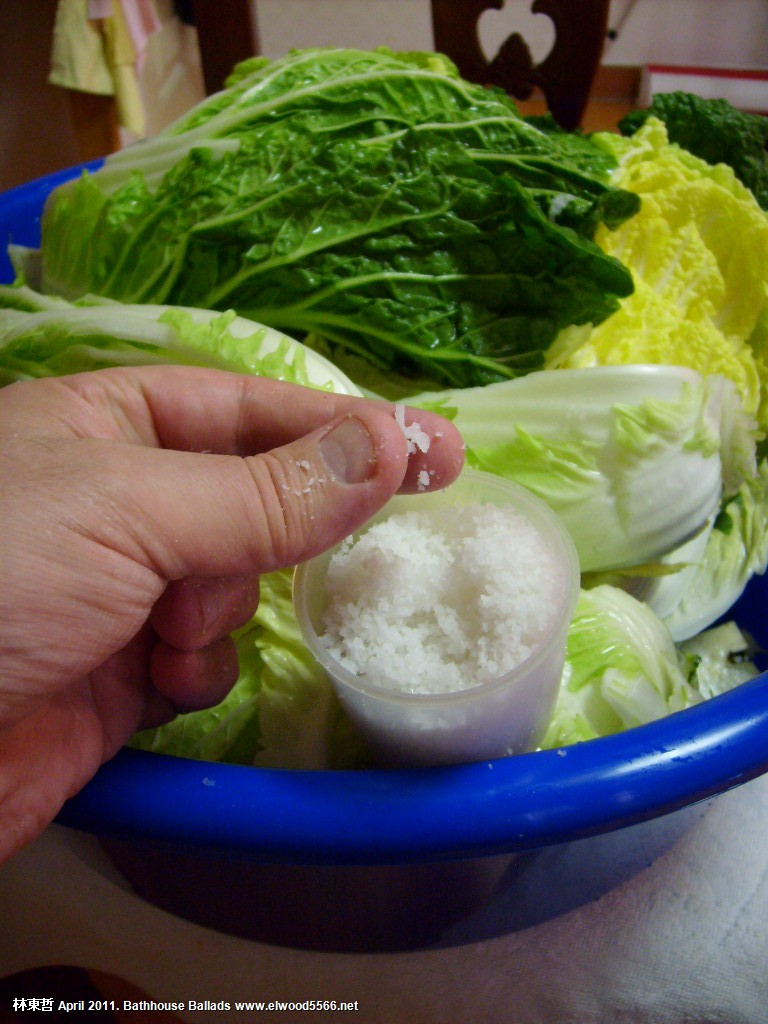
coarse salt is best, preferably sea salt

the leaves after salting
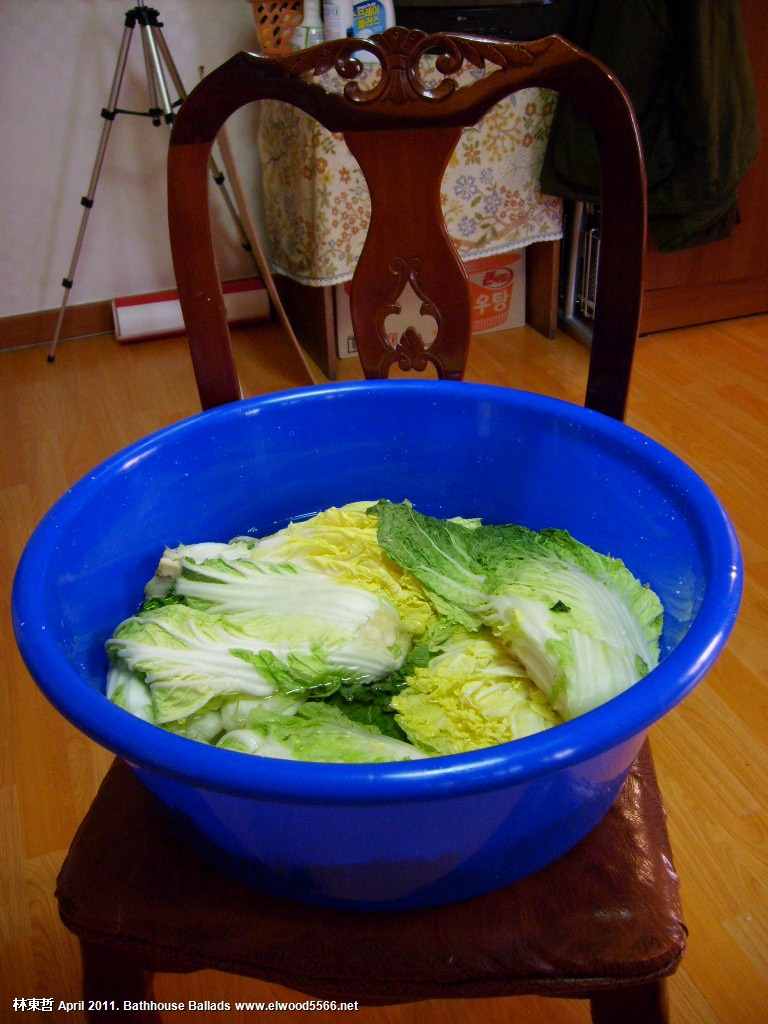
in successful wilting there is around a 50% reduction in bulk
-
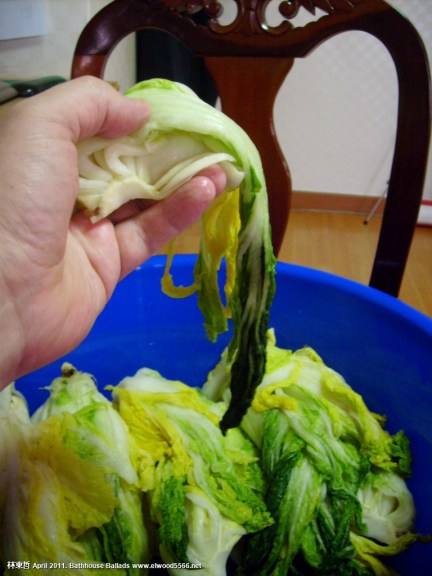
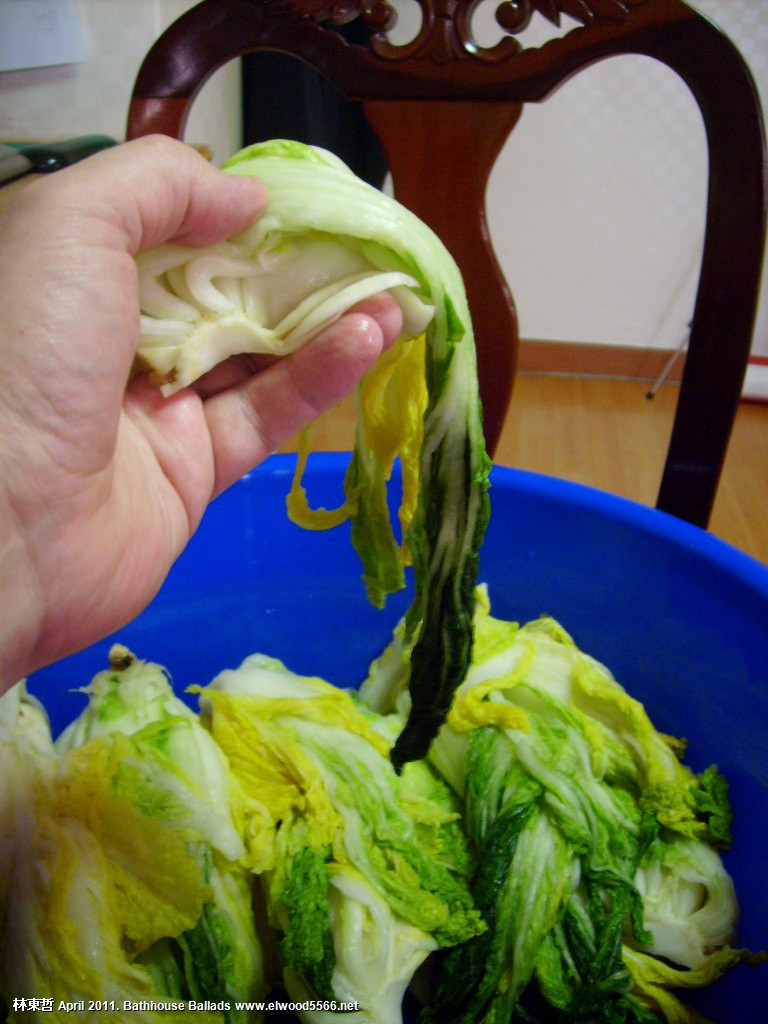
wilted – floppy and rag, like, can be bent without breaking, can be wrung like a dish-cloth
Pasting – I usually add ginger but decide to omit it from this batch. Further, I reduced the amount of down to 2 cups but I feel this is still too hot. When I later made bo-ssam kimchi, I decided that one cup for two fairly large cabbages was still a little to hot and intend reducing it a little more.
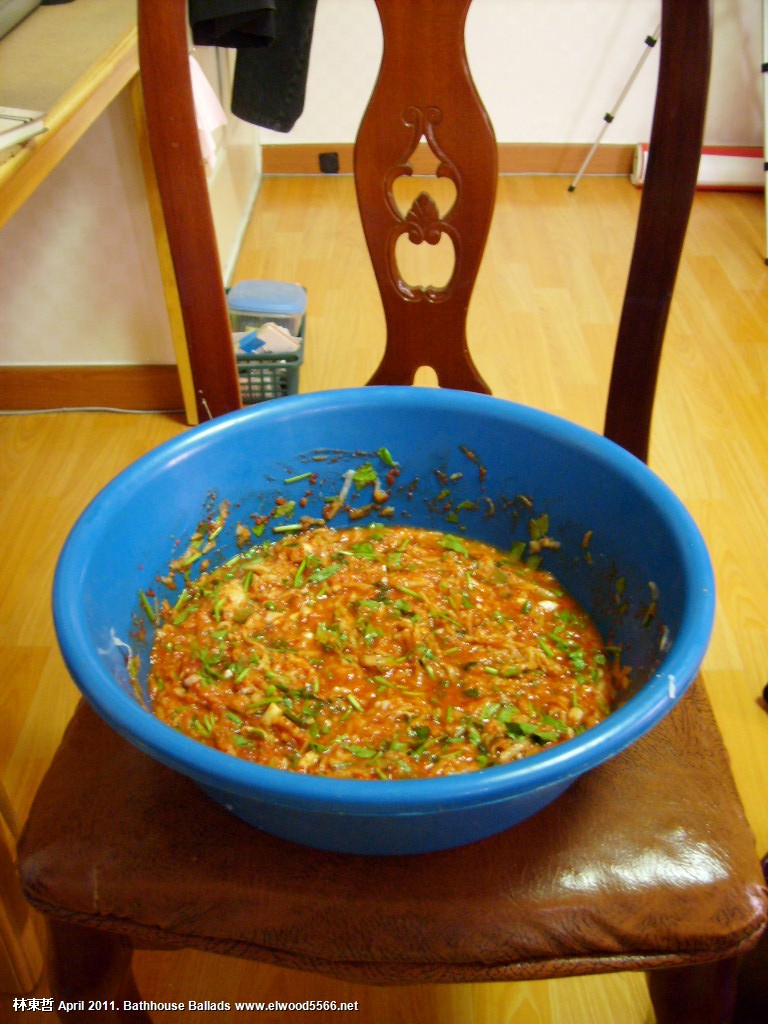
the paste ready to go
-

pasting the segments

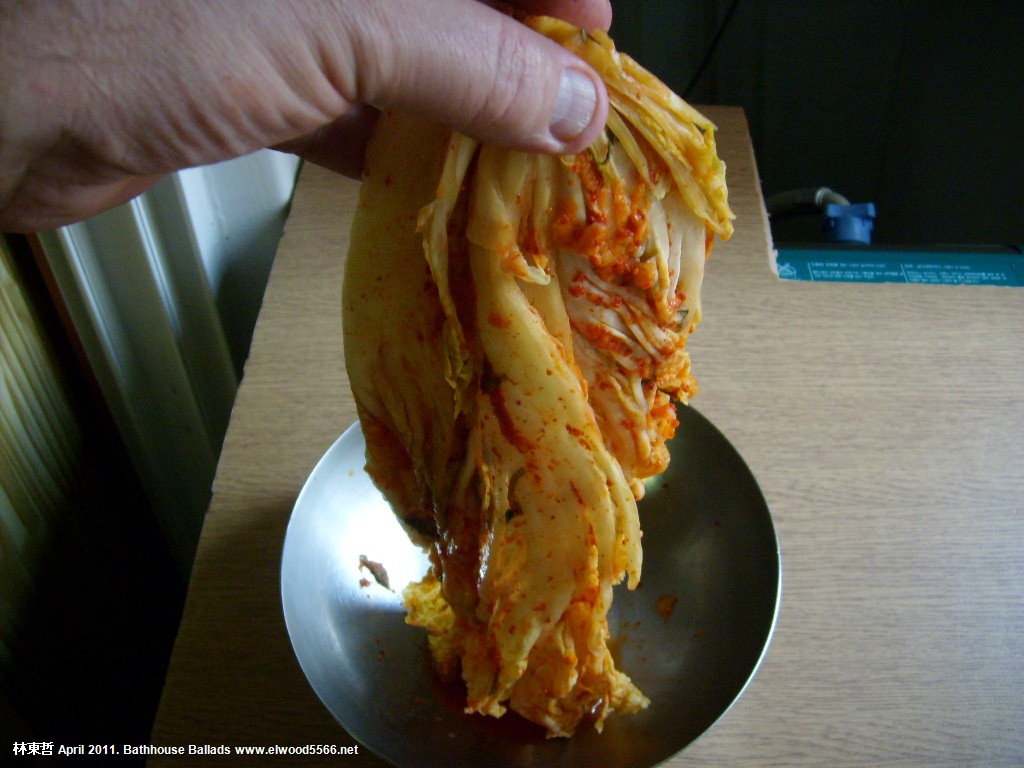
ready to ‘pack’
For the most up to date and effective recipe for Kimchi, check My Recipes.


 Elwood 5566
leave a comment